EP1136246A2 - Procédé pour la fabrication de corps moulés présentant des dépressions - Google Patents
Procédé pour la fabrication de corps moulés présentant des dépressions Download PDFInfo
- Publication number
- EP1136246A2 EP1136246A2 EP01105728A EP01105728A EP1136246A2 EP 1136246 A2 EP1136246 A2 EP 1136246A2 EP 01105728 A EP01105728 A EP 01105728A EP 01105728 A EP01105728 A EP 01105728A EP 1136246 A2 EP1136246 A2 EP 1136246A2
- Authority
- EP
- European Patent Office
- Prior art keywords
- embossing element
- press
- die
- trough
- ram
- Prior art date
- Legal status (The legal status is an assumption and is not a legal conclusion. Google has not performed a legal analysis and makes no representation as to the accuracy of the status listed.)
- Granted
Links
- 238000000034 method Methods 0.000 title claims description 37
- 239000000463 material Substances 0.000 claims abstract description 57
- 238000004519 manufacturing process Methods 0.000 claims abstract description 21
- 238000000465 moulding Methods 0.000 claims abstract description 21
- 238000004049 embossing Methods 0.000 claims description 52
- -1 polyethylene Polymers 0.000 claims description 28
- 239000004800 polyvinyl chloride Substances 0.000 claims description 24
- 229920000915 polyvinyl chloride Polymers 0.000 claims description 20
- 239000004952 Polyamide Substances 0.000 claims description 15
- 229920002647 polyamide Polymers 0.000 claims description 15
- 238000011049 filling Methods 0.000 claims description 14
- 239000004698 Polyethylene Substances 0.000 claims description 13
- 229920000573 polyethylene Polymers 0.000 claims description 13
- 239000004743 Polypropylene Substances 0.000 claims description 12
- 239000011152 fibreglass Substances 0.000 claims description 12
- 229920003023 plastic Polymers 0.000 claims description 12
- 239000004033 plastic Substances 0.000 claims description 12
- 229920001155 polypropylene Polymers 0.000 claims description 12
- 229920002635 polyurethane Polymers 0.000 claims description 12
- 239000004814 polyurethane Substances 0.000 claims description 12
- 239000003365 glass fiber Substances 0.000 claims description 11
- 239000000126 substance Substances 0.000 claims description 11
- 238000005406 washing Methods 0.000 claims description 10
- 229910052751 metal Inorganic materials 0.000 claims description 6
- 239000002184 metal Substances 0.000 claims description 6
- 238000004140 cleaning Methods 0.000 claims description 5
- 235000013305 food Nutrition 0.000 claims description 4
- 229920001903 high density polyethylene Polymers 0.000 claims description 4
- 239000004700 high-density polyethylene Substances 0.000 claims description 4
- 239000000919 ceramic Substances 0.000 claims description 3
- 239000011248 coating agent Substances 0.000 claims description 3
- 238000000576 coating method Methods 0.000 claims description 3
- 235000009508 confectionery Nutrition 0.000 claims description 3
- 239000003610 charcoal Substances 0.000 claims description 2
- 238000003825 pressing Methods 0.000 description 15
- 229920000642 polymer Polymers 0.000 description 12
- 238000006116 polymerization reaction Methods 0.000 description 7
- 239000007844 bleaching agent Substances 0.000 description 6
- 229920001971 elastomer Polymers 0.000 description 5
- NAQMVNRVTILPCV-UHFFFAOYSA-N hexane-1,6-diamine Chemical compound NCCCCCCN NAQMVNRVTILPCV-UHFFFAOYSA-N 0.000 description 5
- 239000011159 matrix material Substances 0.000 description 5
- 229920001169 thermoplastic Polymers 0.000 description 5
- BZHJMEDXRYGGRV-UHFFFAOYSA-N Vinyl chloride Chemical compound ClC=C BZHJMEDXRYGGRV-UHFFFAOYSA-N 0.000 description 4
- 238000006243 chemical reaction Methods 0.000 description 4
- 239000003795 chemical substances by application Substances 0.000 description 4
- 230000006835 compression Effects 0.000 description 4
- 238000007906 compression Methods 0.000 description 4
- 229920001577 copolymer Polymers 0.000 description 4
- 239000000178 monomer Substances 0.000 description 4
- 239000002245 particle Substances 0.000 description 4
- 229920000098 polyolefin Polymers 0.000 description 4
- 239000004416 thermosoftening plastic Substances 0.000 description 4
- UHOVQNZJYSORNB-UHFFFAOYSA-N Benzene Chemical compound C1=CC=CC=C1 UHOVQNZJYSORNB-UHFFFAOYSA-N 0.000 description 3
- VGGSQFUCUMXWEO-UHFFFAOYSA-N Ethene Chemical compound C=C VGGSQFUCUMXWEO-UHFFFAOYSA-N 0.000 description 3
- OFOBLEOULBTSOW-UHFFFAOYSA-N Malonic acid Chemical compound OC(=O)CC(O)=O OFOBLEOULBTSOW-UHFFFAOYSA-N 0.000 description 3
- 229910000831 Steel Inorganic materials 0.000 description 3
- 150000004985 diamines Chemical class 0.000 description 3
- 230000000694 effects Effects 0.000 description 3
- 239000000835 fiber Substances 0.000 description 3
- 229920002521 macromolecule Polymers 0.000 description 3
- 239000000203 mixture Substances 0.000 description 3
- 239000005060 rubber Substances 0.000 description 3
- 239000003381 stabilizer Substances 0.000 description 3
- 239000010959 steel Substances 0.000 description 3
- 238000010557 suspension polymerization reaction Methods 0.000 description 3
- 229920001187 thermosetting polymer Polymers 0.000 description 3
- NIXOWILDQLNWCW-UHFFFAOYSA-M Acrylate Chemical compound [O-]C(=O)C=C NIXOWILDQLNWCW-UHFFFAOYSA-M 0.000 description 2
- KAKZBPTYRLMSJV-UHFFFAOYSA-N Butadiene Chemical compound C=CC=C KAKZBPTYRLMSJV-UHFFFAOYSA-N 0.000 description 2
- 102000004190 Enzymes Human genes 0.000 description 2
- 108090000790 Enzymes Proteins 0.000 description 2
- 239000005977 Ethylene Substances 0.000 description 2
- 239000004721 Polyphenylene oxide Substances 0.000 description 2
- PPBRXRYQALVLMV-UHFFFAOYSA-N Styrene Natural products C=CC1=CC=CC=C1 PPBRXRYQALVLMV-UHFFFAOYSA-N 0.000 description 2
- 239000002253 acid Substances 0.000 description 2
- 150000007513 acids Chemical class 0.000 description 2
- XECAHXYUAAWDEL-UHFFFAOYSA-N acrylonitrile butadiene styrene Chemical compound C=CC=C.C=CC#N.C=CC1=CC=CC=C1 XECAHXYUAAWDEL-UHFFFAOYSA-N 0.000 description 2
- 239000004676 acrylonitrile butadiene styrene Substances 0.000 description 2
- 229920000122 acrylonitrile butadiene styrene Polymers 0.000 description 2
- 239000012190 activator Substances 0.000 description 2
- WNLRTRBMVRJNCN-UHFFFAOYSA-N adipic acid Chemical compound OC(=O)CCCCC(O)=O WNLRTRBMVRJNCN-UHFFFAOYSA-N 0.000 description 2
- 150000001298 alcohols Chemical class 0.000 description 2
- 125000001931 aliphatic group Chemical group 0.000 description 2
- QRUDEWIWKLJBPS-UHFFFAOYSA-N benzotriazole Chemical compound C1=CC=C2N[N][N]C2=C1 QRUDEWIWKLJBPS-UHFFFAOYSA-N 0.000 description 2
- 229910052799 carbon Inorganic materials 0.000 description 2
- 125000004432 carbon atom Chemical group C* 0.000 description 2
- 230000007423 decrease Effects 0.000 description 2
- 238000013461 design Methods 0.000 description 2
- 239000003599 detergent Substances 0.000 description 2
- TVIDDXQYHWJXFK-UHFFFAOYSA-N dodecanedioic acid Chemical compound OC(=O)CCCCCCCCCCC(O)=O TVIDDXQYHWJXFK-UHFFFAOYSA-N 0.000 description 2
- 239000000806 elastomer Substances 0.000 description 2
- 238000007720 emulsion polymerization reaction Methods 0.000 description 2
- JBKVHLHDHHXQEQ-UHFFFAOYSA-N epsilon-caprolactam Chemical compound O=C1CCCCCN1 JBKVHLHDHHXQEQ-UHFFFAOYSA-N 0.000 description 2
- 239000004744 fabric Substances 0.000 description 2
- 239000007789 gas Substances 0.000 description 2
- RRAMGCGOFNQTLD-UHFFFAOYSA-N hexamethylene diisocyanate Chemical compound O=C=NCCCCCCN=C=O RRAMGCGOFNQTLD-UHFFFAOYSA-N 0.000 description 2
- 229920000092 linear low density polyethylene Polymers 0.000 description 2
- 239000004707 linear low-density polyethylene Substances 0.000 description 2
- 239000007788 liquid Substances 0.000 description 2
- 229920001684 low density polyethylene Polymers 0.000 description 2
- 239000004702 low-density polyethylene Substances 0.000 description 2
- 235000011837 pasties Nutrition 0.000 description 2
- 230000035515 penetration Effects 0.000 description 2
- 230000000704 physical effect Effects 0.000 description 2
- 239000004014 plasticizer Substances 0.000 description 2
- 238000006068 polycondensation reaction Methods 0.000 description 2
- 229920000728 polyester Polymers 0.000 description 2
- QQONPFPTGQHPMA-UHFFFAOYSA-N propylene Natural products CC=C QQONPFPTGQHPMA-UHFFFAOYSA-N 0.000 description 2
- 125000004805 propylene group Chemical group [H]C([H])([H])C([H])([*:1])C([H])([H])[*:2] 0.000 description 2
- 230000002787 reinforcement Effects 0.000 description 2
- 150000003839 salts Chemical class 0.000 description 2
- CXMXRPHRNRROMY-UHFFFAOYSA-N sebacic acid Chemical compound OC(=O)CCCCCCCCC(O)=O CXMXRPHRNRROMY-UHFFFAOYSA-N 0.000 description 2
- 238000000926 separation method Methods 0.000 description 2
- YKLJGMBLPUQQOI-UHFFFAOYSA-M sodium;oxidooxy(oxo)borane Chemical compound [Na+].[O-]OB=O YKLJGMBLPUQQOI-UHFFFAOYSA-M 0.000 description 2
- 239000000243 solution Substances 0.000 description 2
- 239000002904 solvent Substances 0.000 description 2
- 238000003756 stirring Methods 0.000 description 2
- 238000012360 testing method Methods 0.000 description 2
- XLYOFNOQVPJJNP-UHFFFAOYSA-N water Substances O XLYOFNOQVPJJNP-UHFFFAOYSA-N 0.000 description 2
- VXNZUUAINFGPBY-UHFFFAOYSA-N 1-Butene Chemical compound CCC=C VXNZUUAINFGPBY-UHFFFAOYSA-N 0.000 description 1
- KWKAKUADMBZCLK-UHFFFAOYSA-N 1-octene Chemical compound CCCCCCC=C KWKAKUADMBZCLK-UHFFFAOYSA-N 0.000 description 1
- SLXKOJJOQWFEFD-UHFFFAOYSA-N 6-aminohexanoic acid Chemical compound NCCCCCC(O)=O SLXKOJJOQWFEFD-UHFFFAOYSA-N 0.000 description 1
- KXDHJXZQYSOELW-UHFFFAOYSA-N Carbamic acid Chemical compound NC(O)=O KXDHJXZQYSOELW-UHFFFAOYSA-N 0.000 description 1
- OKTJSMMVPCPJKN-UHFFFAOYSA-N Carbon Chemical compound [C] OKTJSMMVPCPJKN-UHFFFAOYSA-N 0.000 description 1
- 239000004709 Chlorinated polyethylene Substances 0.000 description 1
- 239000005057 Hexamethylene diisocyanate Substances 0.000 description 1
- VEXZGXHMUGYJMC-UHFFFAOYSA-N Hydrochloric acid Chemical compound Cl VEXZGXHMUGYJMC-UHFFFAOYSA-N 0.000 description 1
- DGAQECJNVWCQMB-PUAWFVPOSA-M Ilexoside XXIX Chemical compound C[C@@H]1CC[C@@]2(CC[C@@]3(C(=CC[C@H]4[C@]3(CC[C@@H]5[C@@]4(CC[C@@H](C5(C)C)OS(=O)(=O)[O-])C)C)[C@@H]2[C@]1(C)O)C)C(=O)O[C@H]6[C@@H]([C@H]([C@@H]([C@H](O6)CO)O)O)O.[Na+] DGAQECJNVWCQMB-PUAWFVPOSA-M 0.000 description 1
- CERQOIWHTDAKMF-UHFFFAOYSA-M Methacrylate Chemical compound CC(=C)C([O-])=O CERQOIWHTDAKMF-UHFFFAOYSA-M 0.000 description 1
- DFPAKSUCGFBDDF-UHFFFAOYSA-N Nicotinamide Chemical group NC(=O)C1=CC=CN=C1 DFPAKSUCGFBDDF-UHFFFAOYSA-N 0.000 description 1
- 229920000305 Nylon 6,10 Polymers 0.000 description 1
- 229920002302 Nylon 6,6 Polymers 0.000 description 1
- 229920000572 Nylon 6/12 Polymers 0.000 description 1
- ISWSIDIOOBJBQZ-UHFFFAOYSA-N Phenol Chemical compound OC1=CC=CC=C1 ISWSIDIOOBJBQZ-UHFFFAOYSA-N 0.000 description 1
- 239000004734 Polyphenylene sulfide Substances 0.000 description 1
- CDBYLPFSWZWCQE-UHFFFAOYSA-L Sodium Carbonate Chemical compound [Na+].[Na+].[O-]C([O-])=O CDBYLPFSWZWCQE-UHFFFAOYSA-L 0.000 description 1
- 238000010521 absorption reaction Methods 0.000 description 1
- 239000004480 active ingredient Substances 0.000 description 1
- 239000013543 active substance Substances 0.000 description 1
- 235000011037 adipic acid Nutrition 0.000 description 1
- 239000001361 adipic acid Substances 0.000 description 1
- 230000032683 aging Effects 0.000 description 1
- 150000001336 alkenes Chemical class 0.000 description 1
- 150000001413 amino acids Chemical class 0.000 description 1
- 125000003277 amino group Chemical group 0.000 description 1
- 229960002684 aminocaproic acid Drugs 0.000 description 1
- 239000003963 antioxidant agent Substances 0.000 description 1
- 125000003118 aryl group Chemical group 0.000 description 1
- 229910052788 barium Inorganic materials 0.000 description 1
- 238000005452 bending Methods 0.000 description 1
- 239000012964 benzotriazole Substances 0.000 description 1
- 230000015572 biosynthetic process Effects 0.000 description 1
- 238000000071 blow moulding Methods 0.000 description 1
- 210000000746 body region Anatomy 0.000 description 1
- 238000012662 bulk polymerization Methods 0.000 description 1
- IAQRGUVFOMOMEM-UHFFFAOYSA-N butene Natural products CC=CC IAQRGUVFOMOMEM-UHFFFAOYSA-N 0.000 description 1
- 229910052793 cadmium Inorganic materials 0.000 description 1
- 229910052791 calcium Inorganic materials 0.000 description 1
- 238000003490 calendering Methods 0.000 description 1
- 125000003178 carboxy group Chemical group [H]OC(*)=O 0.000 description 1
- 229910010293 ceramic material Inorganic materials 0.000 description 1
- 239000012459 cleaning agent Substances 0.000 description 1
- 239000003245 coal Substances 0.000 description 1
- 239000000084 colloidal system Substances 0.000 description 1
- 239000002131 composite material Substances 0.000 description 1
- 238000007334 copolymerization reaction Methods 0.000 description 1
- 238000007872 degassing Methods 0.000 description 1
- HGQSXVKHVMGQRG-UHFFFAOYSA-N dioctyltin Chemical class CCCCCCCC[Sn]CCCCCCCC HGQSXVKHVMGQRG-UHFFFAOYSA-N 0.000 description 1
- 150000002009 diols Chemical class 0.000 description 1
- 238000004851 dishwashing Methods 0.000 description 1
- 238000004821 distillation Methods 0.000 description 1
- 238000009826 distribution Methods 0.000 description 1
- 239000003814 drug Substances 0.000 description 1
- 239000003995 emulsifying agent Substances 0.000 description 1
- 239000003822 epoxy resin Substances 0.000 description 1
- 238000001125 extrusion Methods 0.000 description 1
- 150000002191 fatty alcohols Chemical class 0.000 description 1
- 235000013312 flour Nutrition 0.000 description 1
- 238000011010 flushing procedure Methods 0.000 description 1
- 238000010528 free radical solution polymerization reaction Methods 0.000 description 1
- 239000000446 fuel Substances 0.000 description 1
- 239000007849 furan resin Substances 0.000 description 1
- 238000012685 gas phase polymerization Methods 0.000 description 1
- 239000011521 glass Substances 0.000 description 1
- 229920000578 graft copolymer Polymers 0.000 description 1
- LNEPOXFFQSENCJ-UHFFFAOYSA-N haloperidol Chemical compound C1CC(O)(C=2C=CC(Cl)=CC=2)CCN1CCCC(=O)C1=CC=C(F)C=C1 LNEPOXFFQSENCJ-UHFFFAOYSA-N 0.000 description 1
- 229910001385 heavy metal Inorganic materials 0.000 description 1
- 229920006017 homo-polyamide Polymers 0.000 description 1
- 229910000041 hydrogen chloride Inorganic materials 0.000 description 1
- IXCSERBJSXMMFS-UHFFFAOYSA-N hydrogen chloride Substances Cl.Cl IXCSERBJSXMMFS-UHFFFAOYSA-N 0.000 description 1
- 238000005470 impregnation Methods 0.000 description 1
- 238000007373 indentation Methods 0.000 description 1
- 239000004615 ingredient Substances 0.000 description 1
- 238000001746 injection moulding Methods 0.000 description 1
- 239000012948 isocyanate Substances 0.000 description 1
- 150000002513 isocyanates Chemical class 0.000 description 1
- 238000003475 lamination Methods 0.000 description 1
- 150000002605 large molecules Chemical class 0.000 description 1
- 229910052745 lead Inorganic materials 0.000 description 1
- 239000000314 lubricant Substances 0.000 description 1
- 230000001050 lubricating effect Effects 0.000 description 1
- 150000002739 metals Chemical class 0.000 description 1
- 125000002496 methyl group Chemical group [H]C([H])([H])* 0.000 description 1
- 229930014626 natural product Natural products 0.000 description 1
- 239000004745 nonwoven fabric Substances 0.000 description 1
- 239000003921 oil Substances 0.000 description 1
- 235000019198 oils Nutrition 0.000 description 1
- 229920000620 organic polymer Polymers 0.000 description 1
- 239000005011 phenolic resin Substances 0.000 description 1
- DGTNSSLYPYDJGL-UHFFFAOYSA-N phenyl isocyanate Chemical compound O=C=NC1=CC=CC=C1 DGTNSSLYPYDJGL-UHFFFAOYSA-N 0.000 description 1
- 229920003251 poly(α-methylstyrene) Polymers 0.000 description 1
- 239000004417 polycarbonate Substances 0.000 description 1
- 229920000515 polycarbonate Polymers 0.000 description 1
- 229920000647 polyepoxide Polymers 0.000 description 1
- 229920000570 polyether Polymers 0.000 description 1
- 230000000379 polymerizing effect Effects 0.000 description 1
- 229920006324 polyoxymethylene Polymers 0.000 description 1
- 229920006380 polyphenylene oxide Polymers 0.000 description 1
- 229920000069 polyphenylene sulfide Polymers 0.000 description 1
- 239000011164 primary particle Substances 0.000 description 1
- 238000012545 processing Methods 0.000 description 1
- 230000001681 protective effect Effects 0.000 description 1
- 150000003254 radicals Chemical class 0.000 description 1
- 230000001603 reducing effect Effects 0.000 description 1
- 230000003014 reinforcing effect Effects 0.000 description 1
- 239000012779 reinforcing material Substances 0.000 description 1
- 239000012858 resilient material Substances 0.000 description 1
- 229920005989 resin Polymers 0.000 description 1
- 239000011347 resin Substances 0.000 description 1
- 238000005096 rolling process Methods 0.000 description 1
- 239000011163 secondary particle Substances 0.000 description 1
- 238000005245 sintering Methods 0.000 description 1
- 239000000344 soap Substances 0.000 description 1
- 229910052708 sodium Inorganic materials 0.000 description 1
- 239000011734 sodium Substances 0.000 description 1
- 229960001922 sodium perborate Drugs 0.000 description 1
- 235000019832 sodium triphosphate Nutrition 0.000 description 1
- 239000007787 solid Substances 0.000 description 1
- 235000012424 soybean oil Nutrition 0.000 description 1
- 239000003549 soybean oil Substances 0.000 description 1
- 238000009987 spinning Methods 0.000 description 1
- 238000005507 spraying Methods 0.000 description 1
- 238000012721 stereospecific polymerization Methods 0.000 description 1
- 239000000725 suspension Substances 0.000 description 1
- 230000002522 swelling effect Effects 0.000 description 1
- 239000000454 talc Substances 0.000 description 1
- 229910052623 talc Inorganic materials 0.000 description 1
- 150000003568 thioethers Chemical class 0.000 description 1
- RUELTTOHQODFPA-UHFFFAOYSA-N toluene 2,6-diisocyanate Chemical compound CC1=C(N=C=O)C=CC=C1N=C=O RUELTTOHQODFPA-UHFFFAOYSA-N 0.000 description 1
- 238000012549 training Methods 0.000 description 1
- 229920006337 unsaturated polyester resin Polymers 0.000 description 1
- 239000011800 void material Substances 0.000 description 1
- 238000004804 winding Methods 0.000 description 1
- 239000002023 wood Substances 0.000 description 1
- 229910052725 zinc Inorganic materials 0.000 description 1
Images
Classifications
-
- B—PERFORMING OPERATIONS; TRANSPORTING
- B30—PRESSES
- B30B—PRESSES IN GENERAL
- B30B15/00—Details of, or accessories for, presses; Auxiliary measures in connection with pressing
- B30B15/06—Platens or press rams
- B30B15/065—Press rams
Definitions
- the present invention relates to a process for the production of moldings, a device for the production of moldings and the use of a Device according to the invention for the production of moldings.
- Trough moldings are usually produced by inserting into the upper side of a large-volume molded body, usually a tablet, impresses a trough that in one subsequent assembly process filled with another material, in particular poured out can be.
- Trough moldings are made in particular from substances in combination take effect with other substances. The situation is often that the different substances are most advantageous when they are in exactly defined sequence during application to go to solution in solution to be able to work together.
- a common area of application for this type of agent addition is machine dishwashing. To help the user portion the Rinse aids or more generally the washing, rinsing, cleaning and washing aids the addition quantities matched to the machine capacity Shaped bodies, in particular tablets, pressed.
- Powdery or granular active ingredients because of the above-described more effective action should be added separately, are in discrete layers one above the other pressed. If one or more of the combination agents were originally in pasty or liquid, for example molten form, are available for pressing is unsuitable, the formation of a depression in the surface of the molded body a proven form for the design of any desired substance Active substance combination receiving molded body. The liquid, melted and / or pasty agents are entered and therein after the Solidify the filling.
- the present invention is therefore based on the object of a method for the production of trough moldings to provide the overpressure of parts of the Molded body avoids.
- the mostly powdery or fine-grained material to be pressed is added when filling in step a) of the method according to the invention distributed unevenly in the press die. There is less material above the embossing element than above the other areas of the lower ram. As a result, the material at the points where the Profile of the ram has the highest elevations - namely above the embossing element - Does not have to be compressed, or only slightly more, than over the other Areas of the ram. Because the material to be pressed is also the highest Pressure peaks at least in part by moving in the direction of the less stressed Areas can evade occur in the areas of the highest profile surveys no overpressing effects.
- the embossing element generally consists essentially of a hard and durable resilient material. Corresponding materials are known to the person skilled in the art and can depending on the material to be pressed. For example the embossing element made of metal, in particular steel; made of ceramic materials; or in a preferred embodiment of the invention consist of a hard plastic.
- plastics characterizes in the context of the present invention Materials whose essential components consist of such macromolecular organic Connections exist that are made synthetically or by modifying natural products. They are in many cases under certain conditions (heat and pressure) meltable and malleable.
- plastics are organic polymers and can either according to their physical properties (thermoplastics, thermosets and elastomers), according to the type of reaction in which they are produced (polymers, polycondensates and Polyadducts) or according to their chemical nature (polyolefins, polyesters, polyamides, polyurethanes etc.) are classified.
- Hard plastics in particular meet the requirement profile that the stamping element on the other hand, be hard and resistant to high wing loads but should also have friction-reducing or lubricating properties.
- hardness is the term for the scope of the present invention Resistance that a solid body opposes to the penetration of another body.
- the usual dynamic method for determining hardness is the return method.
- the Shore hardness determined in this way is used as the rebound hardness for steel by the ball drop test determined or with rubber and other elastomers as penetration resistance measured against a truncated cone.
- harder plastics e.g. for hard thermoplastics and especially with thermosets
- the ball indentation is measured as the quotient of the test force and surface of the impression of a steel ball (5 mm diameter) after 10, 30 or. 60 seconds under load.
- polyolefins preferably polyethylene or polypropylene
- PE polyethylenes
- Polyethylenes are polymers with groupings of the type belonging to the polyolefins - [CH 2 -CH 2 ] - as a characteristic basic unit of the polymer chain.
- Polyethylenes are produced by polymerizing ethylene using two fundamentally different methods, the high-pressure and the low-pressure process.
- the resulting products are accordingly often referred to as high-pressure polyethylene or low-pressure polyethylene; they differ mainly in their degree of branching and, related to this, in their degree of crystallinity and density. Both processes can be carried out as solution polymerization, emulsion polymerization or gas phase polymerization.
- HMW-LDPE high molecular weight
- the pronounced degree of branching of the polyethylenes produced by the high-pressure process can be reduced by copolymerization of the ethylene with longer-chain olefins, in particular with butene and octene; the copolymers have the code LLD-PE (linear low density polyethylene).
- the macromolecules of the polyethylenes from low-pressure processes are largely linear and unbranched. These polyethylenes (HDPE) have degrees of crystallinity of 60-80% and a density of approx. 0.94-0.965 g / cm3. They are particularly suitable as stamping element
- Polypropylenes are thermoplastic polymers of propylene with basic units of the type - [CH (CH 3 ) -CH 2 ] -
- Polypropylenes can be prepared by stereospecific polymerization of propylene in the gas phase or in suspension to give highly crystalline isotactic or less crystalline syndiotactic or amorphous atactic polypropylenes.
- Polypropylene is characterized by high hardness, resilience, rigidity and heat resistance and is therefore a suitable embossing element material in the context of the present invention.
- the mechanical properties of the polypropylenes can be improved by reinforcing with talc, chalk, wood flour or glass fibers, and the application of metallic coatings is also possible.
- polyamides are preferred in the context of the present invention usable embossing element materials.
- Polyamides are high molecular weight compounds that consist of building blocks linked by peptide bonds. The synthet.
- Polyamides With few exceptions, (PA) are thermoplastic, chain-shaped polymers with recurring Acid amide groups in the main chain. According to the chemical structure the so-called homopolyamides can be divided into two groups: the aminocarboxylic acid types (AS) and the diamine dicarboxylic acid types (AA-SS); designate A Amino groups and S carboxy groups.
- the former become a building block through polycondensation (Amino acid) or polymerization ( ⁇ -lactam), the latter consisting of two building blocks formed by polycondensation (diamine and dicarboxylic acid).
- the polyamides are encoded from unbranched aliphatic building blocks according to the number of carbon atoms. That's how it is Name PA 6, for example, that made up of ⁇ -aminocaproic acid or ⁇ -caprolactam Polyamide and.
- PA 12 is a poly ( ⁇ -laurine lactam) made from ⁇ -laurine lactam.
- P A 66 polyhexamethylene adipamide
- PA 610 polyhexamethylene sebacinamide
- PA 612 polyhexamethylene dodecanamide
- the polyamide types mentioned are part of the present invention preferred materials for the embossing element.
- Polyurethanes are polymers (polyadducts) with groupings of the type that are accessible through polyaddition from dihydric and higher alcohols and isocyanates - [CO-NH-R 2 -NH-CO-OR 1 -O] - as characteristic basic units of the basic macromolecules, in which R 1 stands for a low-molecular or polymeric diol radical and R 2 for an aliphatic or aromatic group.
- Tabletting punches, the embossing element of which is made of a polyurethane, are also preferred according to the invention.
- PVC polyvinyl chloride
- Polyvinyl chlorides are the polymers that result from the homopolymerization of vinyl chloride (VC).
- VC vinyl chloride
- S-PVC suspension polymerization
- E-PVC micro-suspension polymerization
- M-PVC bulk or bulk polymerization
- S-PVC suspension polymerization
- E-PVC micro-suspension polymerization
- M-PVC bulk or bulk polymerization
- Suspension polymerization processes are by far the most important.
- the resulting polymers have the general basic structure -CH 2 -CH (Cl) -CH 2 -CH (Cl) - resulting from the head / tail polymerization of the monomer.
- the macromolecules of PVC are not strictly linear; depending on the monomer conversion, the polymerization temp. approx. 3-20 short side chains per 1000 carbon atoms.
- Techn. PVC have molar masses of approx. 30000-130000 g / mol, which correspond to K values of 45-80.
- very small PVC primary particles are initially obtained, which aggregate to form much larger secondary particles with higher monomer conversion.
- the desired morphology of the PVC particles for example smooth, compact, irregularly shaped or porous, is set via the polymerization aids used (protective colloids, emulsifiers) and stirring conditions.
- the VC polymerization is initiated by free radicals and is usually terminated at a monomer conversion of 75-90%.
- the unreacted vinyl chloride is largely removed by distillation from the polymerization batches and reduced to the lowest permissible residual levels by intensive degassing.
- PVC is processed by extrusion, calendering, blow molding, injection molding, pressing or sintering, specifically for the production of embossing elements which can be used according to the invention and have plasticizer contents of 0-12% (rigid PVC).
- the plasticizer absorption capacity of PVC increases with increasing molecular weight. Porosity of the PVC particles too.
- the thermal lability of PVC requires the addition of auxiliaries (stabilizers, lubricants, etc.) during processing.
- Hard PVC is resistant to water, acids, alkalis, alcohols, petrol and the like. Resistant to oils.
- stabilizers which bind the hydrogen chloride released and at the same time act as antioxidants; inorganic heavy metal salts, metal soaps, in particular of Ba, Cd, Pb, Zn, Ca, dibutyl and dioctyltin compounds and epoxidized soybean oil are suitable as stabilizers.
- the plastics mentioned can be used alone as embossing element materials, but they can also be coated or laminated with metals or others Provide fabrics or even as a coating agent for embossing elements made of other materials be used.
- Glass fiber reinforced plastics are composite materials made from a combination of a matrix of polymers and glass fibers that act as reinforcements.
- the glass materials used for fiber reinforcement are present in the GRP as fibers, yarns, rovings (fiberglass strands), nonwovens, fabrics or mats.
- Suitable polymeric matrix systems for GRP are both thermosets (such as epoxy resins, unsaturated polyester resins, phenol and furan resins) and thermoplastics (such as polyamides, polycarbonates, polyacetals, polyphenylene oxides and sulfides, polypropylenes and styrene copolymers).
- the weight ratio between the reinforcing material and the polymer matrix is usually in the range from 10: 90-65: 35, the strength properties of the GRP generally increasing up to an amplifier content of approximately 40% by weight.
- the GRP is mainly manufactured in pressing processes; other important manufacturing processes are hand lamination, fiber spraying, continuous impregnation, winding and spinning processes.
- prepregs glass fiber materials pre-impregnated with resins, are used, which are heat-cured using pressure.
- the GRP are characterized by increased tensile, bending and compressive strength, impact resistance, dimensional stability and stability against the influence of heat, acids, salts, gases or solvents.
- glass-fiber reinforced polytetrafluoethylene and glass-fiber reinforced polyamides in particular have proven themselves as embossed element materials.
- the embossing element does not have to consist of a single material. It can also have a preferably disc-shaped insert made of another material. According to the invention, preference is given to using an embossing element made from one of the aforementioned hard materials, which has an insert made from a reversibly deformable material.
- the reversibly deformable material is preferably a material with a hardness of approximately 40 to 99 Shore A according to DIN 53505, preferably a polyurethane material, for example in particular Vulkollan®, or a polyvinyl chloride (PVC), for example in particular Mipolam®.
- Such an embossing element, which has an insert made of a reversibly deformable material is particularly preferably used as a fixed embossing element.
- the dimension of the embossing element can be the dimension of the molded body to be produced be adjusted so that the trough resulting in the molded body compared to the molded body volume has suitable dimensions.
- Preferred trough depths are in the range from about 5 to about 8 mm, especially from about 6 to about 7 mm.
- the embossing element Volume from 0.5 to 5 ml, preferably from 0.6 to 3 ml and in particular from 0.8 to 2 ml having.
- the volume of the embossing element is to be understood as the volume that embossing the embossing element into the molded body as a trough.
- the dimension of the base of the lower ram is also adapted to the dimension of the molded body to be produced, so that the base and top of the molded body have suitable dimensions compared to the volume of the molded body.
- the base area of the ram is 5 to 30 cm 2 , preferably 5 to 20 cm 2 and in particular 8 to 12 cm 2 .
- a fixed embossing element is used in the method according to the invention, then this preferably has a domed dome shape, whereby the detachment of the Shaped body is facilitated.
- Such a stamp which can be used according to the invention is constructed from at least two, preferably exactly two, partial stamps which are movable independently of one another and parallel to one another. If the method according to the invention is carried out on a rotary press, each partial stamp of the lower stamp needs its own lower stamp path so that the partial stamps can move independently of one another.
- the other parts that ensure the movement of the one-piece lower punches in conventional rotary presses, such as pressure rollers and optional pull-down rails, are required in this embodiment of the present invention in two versions. Since, with increasing complexity of the pressing surfaces of the two partial punches, application-technical problems such as die caking, lids, excessive wear etc.
- a lower punch which consists of a central mandrel and a ring punch enclosing this central mandrel.
- a lower punch which consists of a central mandrel and a ring punch enclosing this central mandrel.
- ring stamps and center mandrels There are a variety of design options for ring stamps and center mandrels.
- the center mandrel preferably has an elliptical, circular or rectangular end face.
- the ring punch surrounding the center mandrel also has a circular bore in which the center mandrel can be freely moved up and down.
- the ring stamp has a plan in the form of two concentric circles.
- the upper ram the material to be pressed (premix) and lowers continues in the direction of the lower ram (lower ram).
- the particles of the premix are pressed closer together, the void volume within the filling between the stamps decreases continuously.
- From a certain position of the upper stamp (and thus from a certain pressure on the premix) begins the plastic deformation, in which the particles flow together and the molded body is formed.
- Part of the premix is also crushed and it comes into play even higher pressures to sinter the premix.
- the method according to the invention also allows the production of multi-layer molded bodies by preparing two or more layers of material to be pressed (premixes) which are pressed together and which may be the same or different from one another and / or the first layer.
- step b) the premix which was filled in first is slightly pre-pressed in order to obtain a smooth upper surface, and after the second premix is filled in in step c) it is finally pressed to give the finished molded article.
- a further pre-compression is carried out after each addition of the premix before the molding is finally pressed after the addition of the last premix. Due to the increasing technical complexity, a maximum of two-layer moldings are preferred in practice.
- a preferred embodiment of the process according to the invention comprises the production of two-layer moldings containing detergents or cleaning agents by pressing two different particulate premixes onto one another, one of which contains one or more bleaching agents and the other one or more enzymes.
- the separation of bleaching agents and bleach activators which can optionally be used can also be advantageous, so that process variants according to the invention are preferred in which, in steps b) and c), two-layer molded articles which have a depression, are made by pressing two different particulate premixes together, one containing one or more bleaching agents and the other containing one or more bleach activators.
- the weight and shape of the trough body formed are determined by the position of the lower ram and the shape of the press tool determined.
- the upper die is preferably planar according to the invention, but can also be used for the purpose of impressing be raised by patterns, letters or lettering.
- the constant dosage in steps a) and c), even with high molding throughputs, is preferably achieved by volumetric metering of the premix.
- the trough shaped body can be in a predetermined spatial shape and predetermined Size. Practically all sensibly manageable come as a room shape Configurations into consideration with the molding of a trough in the molded body are compatible; for example, the training as a board, the shape of bars or bars, Cubes, cuboids and corresponding room elements with flat side surfaces as well as special ones cylindrical configurations with circular or oval cross-section. This last embodiment covers the presentation form from the tablet to compact Cylinder pieces with a ratio of height to diameter above 1.
- the finished trough molding is made preferably pressed out of the die by the lower punch and, if necessary transported away by subsequent stripping and transport devices.
- the compression takes place in suitable presses, preferably in commercially available tablet presses, which can in principle be equipped with single or double stamps. in the in the latter case, not only the upper stamp is used to build up pressure, but also the lower stamp moves towards the upper punch during the pressing process, during the Upper stamp presses down.
- Eccentric tablet presses are preferred for small production quantities used where the stamp or stamps on an eccentric disc are attached, which in turn on an axis with a certain rotational speed is mounted. The movement of this ram is usual with the way of working Four-stroke engine comparable.
- the pressing can be done with an upper and lower stamp several stamps can also be attached to an eccentric disc, the number of die holes is expanded accordingly.
- the throughputs of Eccentric presses vary from a few hundred to 3000 tablets per hour, depending on the type. For larger throughputs, it is preferable to choose rotary tablet presses on which a so-called die table a larger number of dies arranged in a circle is.
- the number of matrices varies between 6 and 55, depending on the model, with larger ones Matrices are commercially available.
- Each die on the die table is a top and lower stamp assigned, again the pressing pressure active either only by the top resp. Lower stamp, or can be built up by both stamps.
- the Matrix table and the stamp move around a common vertical Axis, the stamp with the help of rail-like cam tracks during circulation placed in the positions for filling, compression, plastic deformation and discharge become.
- the stamp is required (filling, compacting, ejecting), these are curved tracks supported by additional low-pressure pieces, pull-down rails and lifting tracks.
- the die is filled via a rigidly arranged feed device, the so-called filling shoe, which is connected to a reservoir for the premix.
- the pressing pressure on the premix is individual via the pressing paths for upper and lower punches adjustable, the pressure build-up by rolling the punch shaft heads happens on adjustable pressure rollers.
- Rotary presses can also be equipped with two filling shoes to increase throughput be, with only a semicircle to produce a molded body must become. For the production of two- and multi-layer moldings are preferred several filling shoes arranged one behind the other without the slightly pressed first Layer is ejected before further filling.
- Rotary tablet presses are also can be equipped with single or multiple tools so that, for example, an outer circle with 50 and an inner circle with 35 holes can be used simultaneously for pressing. The throughputs of modern rotary tablet presses are over a million tablets per hour.
- Step d) of the method according to the invention there is a fixed one in particular Embossing element in the lower stamp the risk of a collision between the in Step d) of the method according to the invention over the surface of the rotating die table protruding embossing element and the filling shoe.
- Such a collision can According to the invention can be avoided by at least in steps a) and c) uses a filling shoe that has a tunnel-like channel through which the when lifting the lower ram above the rotating die table protruding Embossing element can slide through without contact.
- Tableting machines which can expediently be converted to carry out the method according to the invention are available, for example, from Apparatebau Holzwarth GbR, Asperg, Wilhelm Fette GmbH, Schwarzenbek, Hofer GmbH, Weil, KILIAN, Cologne, KOMAGE, Kell am See, KORSCH Pressen GmbH, Berlin, Mapag Maschinenbau AG, Bern (CH) and Collrtoy N.V., Halle (BE / LU).
- Another object of the present invention is a device for producing trough moldings in a press, which is characterized in that the lower press ram has the embossing element forming the trough.
- the embossing element preferably consists of a hard material, in particular of ceramic, metal or a hard plastic, preferably of polyethylene, in particular of HDPE, polypropylene, polyamide, polyurethane, hard PVC, glass fiber reinforced plastics, in particular of glass fiber reinforced polytetrafluoethylene or glass fiber reinforced polyamide and / or it is coated with one of the aforementioned substances.
- the embossing element can also have a preferably disc-shaped insert made of a reversibly deformable material, preferably made of a material with a hardness of about 40 to 99 Shore A according to DIN 53505, particularly preferably made of a polyurethane material, in particular Vulkollan®, or a polyvinyl chloride ( PVC), especially Mipolam®.
- a reversibly deformable material preferably made of a material with a hardness of about 40 to 99 Shore A according to DIN 53505, particularly preferably made of a polyurethane material, in particular Vulkollan®, or a polyvinyl chloride ( PVC), especially Mipolam®.
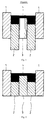
- the embossing element (3) forming the trough is either fixed in the lower ram (2) integrated, as shown in Figure 2, or as a movable center mandrel in one multi-part, in particular two-part, lower press ram (2), as in Figure 1 shown.
- a rotary press is preferably used, particularly preferably a rotary press which is equipped with at least one filling shoe which has a tunnel-like channel through which the embossing element projecting over the rotating die table when the lower punch is lifted can slide through without contact. Presses in which the device according to the invention can be used have already been described in detail above. Embossing elements which can be used advantageously and materials for their production have also already been described in detail above.
- Another object of the present invention is the use of an inventive Device for the production of molded articles in the pharmaceutical industry, in the chemical industry, in or for the food, animal food and Confectionery industry; for the production of shaped charcoal or in particular for the production of washing, rinsing, cleaning or auxiliary washing tablets.
- advantageously compressible materials and mixtures for the production of washing, Flushing, cleaning or auxiliary washing tablets are in the patent application DE 198 31 704.2, to which reference is hereby made in full.
- Another object of the present invention is a trough shaped body, in particular a tray tablet, particularly preferably a two-layer tray tablet with a device according to the invention.
- the premix was pressed under identical pressing conditions with the upper and lower punches reversed.
Landscapes
- Engineering & Computer Science (AREA)
- Mechanical Engineering (AREA)
- Casting Or Compression Moulding Of Plastics Or The Like (AREA)
- Press-Shaping Or Shaping Using Conveyers (AREA)
- Artificial Filaments (AREA)
- Cleaning By Liquid Or Steam (AREA)
Applications Claiming Priority (2)
| Application Number | Priority Date | Filing Date | Title |
|---|---|---|---|
| DE10013449A DE10013449B4 (de) | 2000-03-17 | 2000-03-17 | Verfahren und Vorrichtung sowie Verwendung der Vorrichtung zur Herstellung von Muldenformkörpern |
| DE10013449 | 2000-03-17 |
Publications (3)
| Publication Number | Publication Date |
|---|---|
| EP1136246A2 true EP1136246A2 (fr) | 2001-09-26 |
| EP1136246A3 EP1136246A3 (fr) | 2002-03-20 |
| EP1136246B1 EP1136246B1 (fr) | 2006-10-18 |
Family
ID=7635400
Family Applications (1)
| Application Number | Title | Priority Date | Filing Date |
|---|---|---|---|
| EP01105728A Expired - Lifetime EP1136246B1 (fr) | 2000-03-17 | 2001-03-08 | Procédé pour la fabrication de corps moulés présentant des dépressions |
Country Status (4)
| Country | Link |
|---|---|
| EP (1) | EP1136246B1 (fr) |
| AT (1) | ATE342798T1 (fr) |
| DE (2) | DE10013449B4 (fr) |
| ES (1) | ES2273759T3 (fr) |
Cited By (1)
| Publication number | Priority date | Publication date | Assignee | Title |
|---|---|---|---|---|
| WO2008024406A3 (fr) * | 2006-08-23 | 2008-08-07 | Duramed Pharmaceuticals Inc | Presse à comprimés |
Family Cites Families (11)
| Publication number | Priority date | Publication date | Assignee | Title |
|---|---|---|---|---|
| US1624904A (en) * | 1925-01-20 | 1927-04-12 | Bound Brook Oil Less Bearing | Method of and apparatus for forming bodies by pressure |
| DE910629C (de) * | 1943-08-21 | 1954-05-03 | Porzellanfabrik Kahla | Steuerung der Bewegung des Mantels von Pressformen auf hydraulisch bewegten Pressen |
| DE2604648C2 (de) * | 1976-02-04 | 1980-10-09 | Emil Korsch Spezialfabrik Fuer Komprimiermaschinen, 1000 Berlin | Rundlaufpresse |
| DE3506222C2 (de) * | 1985-02-22 | 1986-12-11 | Messerschmitt-Bölkow-Blohm GmbH, 8012 Ottobrunn | Vorrichtung zum Pressen von Sprengstoff-Formkörpern |
| JPH02240201A (ja) * | 1989-03-10 | 1990-09-25 | Toto Ltd | 圧粉体の成形金型及び圧粉体の製造方法 |
| AU5556894A (en) * | 1993-11-24 | 1995-06-13 | Stackpole Limited | Undercut split die |
| MXPA00011043A (es) * | 1998-05-12 | 2003-09-10 | Biovail Tech Ltd | Conjunto de punzon y punta de troquel mejorado para formar por compresion unidades de dosificacion. |
| DE19851426A1 (de) * | 1998-07-15 | 2000-01-20 | Henkel Kgaa | Verfahren zur Herstellung mehrphasiger Wasch- und Reinigungsmittelformkörper |
| WO2000010801A1 (fr) * | 1998-08-21 | 2000-03-02 | Henkel Kommanditgesellschaft Auf Aktien | Outil de compression a proprietes anti-adherence |
| DE19861338B4 (de) * | 1998-08-21 | 2007-04-05 | Henkel Kgaa | Muldentablette |
| DE19838396A1 (de) * | 1998-08-24 | 2000-03-02 | Henkel Kgaa | Herstellung mehrphasiger Formkörper |
-
2000
- 2000-03-17 DE DE10013449A patent/DE10013449B4/de not_active Expired - Fee Related
-
2001
- 2001-03-08 DE DE50111240T patent/DE50111240D1/de not_active Expired - Lifetime
- 2001-03-08 EP EP01105728A patent/EP1136246B1/fr not_active Expired - Lifetime
- 2001-03-08 ES ES01105728T patent/ES2273759T3/es not_active Expired - Lifetime
- 2001-03-08 AT AT01105728T patent/ATE342798T1/de active
Cited By (1)
| Publication number | Priority date | Publication date | Assignee | Title |
|---|---|---|---|---|
| WO2008024406A3 (fr) * | 2006-08-23 | 2008-08-07 | Duramed Pharmaceuticals Inc | Presse à comprimés |
Also Published As
| Publication number | Publication date |
|---|---|
| ES2273759T3 (es) | 2007-05-16 |
| EP1136246B1 (fr) | 2006-10-18 |
| DE10013449B4 (de) | 2007-03-01 |
| EP1136246A3 (fr) | 2002-03-20 |
| DE10013449A1 (de) | 2001-09-27 |
| ATE342798T1 (de) | 2006-11-15 |
| DE50111240D1 (de) | 2006-11-30 |
Similar Documents
| Publication | Publication Date | Title |
|---|---|---|
| DE60101482T2 (de) | Mehrphasige waschmitteltablette und verfahren zur deren herstellung | |
| DE10046869C2 (de) | Tablettierstempel | |
| DE69426115T2 (de) | Verbundmaterial, verfahren und vorrichtung zu dessen herstellung | |
| DE3715646A1 (de) | Verfahren zum beseitigen, aufarbeiten und verwerten von kunststoffabfaellen sowie hierdurch hergestelltes bodenbelagelement oder dgl. formteile | |
| DE60016335T2 (de) | Mehrschichtiger Kunstoffverschluss mit Barriereeigenschaften und Herstellungsverfahren | |
| EP1136246B1 (fr) | Procédé pour la fabrication de corps moulés présentant des dépressions | |
| DD228209A5 (de) | Verfahren zur herstellung eines trockengepressten formlings aus trockener, rieselfaehiger formmasse, insbesondere keramischer formmasse | |
| DE3333766A1 (de) | Brikettierpresse | |
| DE2008348A1 (de) | Verfahren zur Herstellung von Werkstücken durch Materialumformung und Vorrichtung zur Durchführung des Verfahrens | |
| WO2000010801A1 (fr) | Outil de compression a proprietes anti-adherence | |
| DE3822331A1 (de) | Verfahren zur herstellung von formkoerpern und die nach diesem verfahren erhaltenen formkoerper | |
| AT396905B (de) | Hydraulische presse zur herstellung von formkörpern aus schüttbarer masse | |
| DE19908027C1 (de) | Tablettierstempel | |
| EP0479053B1 (fr) | Procédé pour la fabrication d'un revêtement plastique à haute densité | |
| EP1697108A1 (fr) | Procede de moulage par injection et installation de moulage par injection munie d'une extrudeuse a arbres multiples, notamment extrudeuse annulaire | |
| DE2427498A1 (de) | Verfahren und vorrichtung zur herstellung von spanplatten von besonders feiner staerke mit beladeplattformen, welche den pendelbetrieb zwischen presse und formmaschine ausfuehren | |
| DE2525085A1 (de) | Verfahren zur bildung von keramikgegenstaenden durch pressen von trockenen pulvern und vorrichtung zur durchfuehrung des verfahrens | |
| EP4253027A1 (fr) | Dispositif pour fabriquer des pièces moulées sans bordure | |
| CH642906A5 (de) | Verfahren und vorrichtung zur herstellung von formkoerpern aus hochmolekularem niederdruckpolyaethylen sowie einen ramextruder zur durchfuehrung des verfahrens. | |
| DE1704292A1 (de) | Verfahren zum Ausformen von Gegenstaenden aus thermoplastischen Kunststoffen | |
| SU1761486A1 (ru) | Экструзионна головка дл формовани изделий с сотовой структурой | |
| DE29924239U1 (de) | Preßwerkzeug mit Antihafteigenschaften | |
| EP0117877A1 (fr) | Organe de transmission de vibrations | |
| DE60206311T2 (de) | System zur Kompensation von Dosierungsfehlern für Mehrkammer-Brikettierpressen insbesondere für monoschichtige Briketts oder dergleichen | |
| EP3877465B1 (fr) | Utilisation de filament de polyamide coulé et de granulat de polyamide coulé pour la fabrication additive et procédé de réalisation |
Legal Events
| Date | Code | Title | Description |
|---|---|---|---|
| PUAI | Public reference made under article 153(3) epc to a published international application that has entered the european phase |
Free format text: ORIGINAL CODE: 0009012 |
|
| 17P | Request for examination filed |
Effective date: 20010308 |
|
| AK | Designated contracting states |
Kind code of ref document: A2 Designated state(s): AT BE CH CY DE DK ES FI FR GB GR IE IT LI LU MC NL PT SE TR |
|
| AX | Request for extension of the european patent |
Free format text: AL;LT;LV;MK;RO;SI |
|
| PUAL | Search report despatched |
Free format text: ORIGINAL CODE: 0009013 |
|
| AK | Designated contracting states |
Kind code of ref document: A3 Designated state(s): AT BE CH CY DE DK ES FI FR GB GR IE IT LI LU MC NL PT SE TR |
|
| AX | Request for extension of the european patent |
Free format text: AL;LT;LV;MK;RO;SI |
|
| AKX | Designation fees paid |
Free format text: AT BE CH CY DE DK ES FI FR GB GR IE IT LI LU MC NL PT SE TR |
|
| 17Q | First examination report despatched |
Effective date: 20041118 |
|
| GRAP | Despatch of communication of intention to grant a patent |
Free format text: ORIGINAL CODE: EPIDOSNIGR1 |
|
| GRAS | Grant fee paid |
Free format text: ORIGINAL CODE: EPIDOSNIGR3 |
|
| GRAA | (expected) grant |
Free format text: ORIGINAL CODE: 0009210 |
|
| AK | Designated contracting states |
Kind code of ref document: B1 Designated state(s): AT BE CH CY DE DK ES FI FR GB GR IE IT LI LU MC NL PT SE TR |
|
| PG25 | Lapsed in a contracting state [announced via postgrant information from national office to epo] |
Ref country code: NL Free format text: LAPSE BECAUSE OF FAILURE TO SUBMIT A TRANSLATION OF THE DESCRIPTION OR TO PAY THE FEE WITHIN THE PRESCRIBED TIME-LIMIT Effective date: 20061018 Ref country code: FI Free format text: LAPSE BECAUSE OF FAILURE TO SUBMIT A TRANSLATION OF THE DESCRIPTION OR TO PAY THE FEE WITHIN THE PRESCRIBED TIME-LIMIT Effective date: 20061018 Ref country code: IE Free format text: LAPSE BECAUSE OF FAILURE TO SUBMIT A TRANSLATION OF THE DESCRIPTION OR TO PAY THE FEE WITHIN THE PRESCRIBED TIME-LIMIT Effective date: 20061018 |
|
| REG | Reference to a national code |
Ref country code: GB Ref legal event code: FG4D Free format text: NOT ENGLISH |
|
| REG | Reference to a national code |
Ref country code: CH Ref legal event code: EP Ref country code: IE Ref legal event code: FG4D Free format text: LANGUAGE OF EP DOCUMENT: GERMAN |
|
| REF | Corresponds to: |
Ref document number: 50111240 Country of ref document: DE Date of ref document: 20061130 Kind code of ref document: P |
|
| PG25 | Lapsed in a contracting state [announced via postgrant information from national office to epo] |
Ref country code: DK Free format text: LAPSE BECAUSE OF FAILURE TO SUBMIT A TRANSLATION OF THE DESCRIPTION OR TO PAY THE FEE WITHIN THE PRESCRIBED TIME-LIMIT Effective date: 20070118 Ref country code: SE Free format text: LAPSE BECAUSE OF FAILURE TO SUBMIT A TRANSLATION OF THE DESCRIPTION OR TO PAY THE FEE WITHIN THE PRESCRIBED TIME-LIMIT Effective date: 20070118 |
|
| GBT | Gb: translation of ep patent filed (gb section 77(6)(a)/1977) |
Effective date: 20070122 |
|
| PG25 | Lapsed in a contracting state [announced via postgrant information from national office to epo] |
Ref country code: PT Free format text: LAPSE BECAUSE OF FAILURE TO SUBMIT A TRANSLATION OF THE DESCRIPTION OR TO PAY THE FEE WITHIN THE PRESCRIBED TIME-LIMIT Effective date: 20070319 |
|
| NLV1 | Nl: lapsed or annulled due to failure to fulfill the requirements of art. 29p and 29m of the patents act | ||
| ET | Fr: translation filed | ||
| REG | Reference to a national code |
Ref country code: IE Ref legal event code: FD4D Ref country code: ES Ref legal event code: FG2A Ref document number: 2273759 Country of ref document: ES Kind code of ref document: T3 |
|
| PLBE | No opposition filed within time limit |
Free format text: ORIGINAL CODE: 0009261 |
|
| STAA | Information on the status of an ep patent application or granted ep patent |
Free format text: STATUS: NO OPPOSITION FILED WITHIN TIME LIMIT |
|
| 26N | No opposition filed |
Effective date: 20070719 |
|
| REG | Reference to a national code |
Ref country code: CH Ref legal event code: PL |
|
| BERE | Be: lapsed |
Owner name: HENKEL K.G.A.A. Effective date: 20070331 |
|
| PG25 | Lapsed in a contracting state [announced via postgrant information from national office to epo] |
Ref country code: BE Free format text: LAPSE BECAUSE OF NON-PAYMENT OF DUE FEES Effective date: 20070331 |
|
| PG25 | Lapsed in a contracting state [announced via postgrant information from national office to epo] |
Ref country code: MC Free format text: LAPSE BECAUSE OF NON-PAYMENT OF DUE FEES Effective date: 20070331 |
|
| PG25 | Lapsed in a contracting state [announced via postgrant information from national office to epo] |
Ref country code: LI Free format text: LAPSE BECAUSE OF NON-PAYMENT OF DUE FEES Effective date: 20070331 Ref country code: CH Free format text: LAPSE BECAUSE OF NON-PAYMENT OF DUE FEES Effective date: 20070331 |
|
| PG25 | Lapsed in a contracting state [announced via postgrant information from national office to epo] |
Ref country code: GR Free format text: LAPSE BECAUSE OF FAILURE TO SUBMIT A TRANSLATION OF THE DESCRIPTION OR TO PAY THE FEE WITHIN THE PRESCRIBED TIME-LIMIT Effective date: 20070119 |
|
| PG25 | Lapsed in a contracting state [announced via postgrant information from national office to epo] |
Ref country code: CY Free format text: LAPSE BECAUSE OF FAILURE TO SUBMIT A TRANSLATION OF THE DESCRIPTION OR TO PAY THE FEE WITHIN THE PRESCRIBED TIME-LIMIT Effective date: 20061018 Ref country code: LU Free format text: LAPSE BECAUSE OF NON-PAYMENT OF DUE FEES Effective date: 20070308 |
|
| PG25 | Lapsed in a contracting state [announced via postgrant information from national office to epo] |
Ref country code: TR Free format text: LAPSE BECAUSE OF FAILURE TO SUBMIT A TRANSLATION OF THE DESCRIPTION OR TO PAY THE FEE WITHIN THE PRESCRIBED TIME-LIMIT Effective date: 20061018 |
|
| PGFP | Annual fee paid to national office [announced via postgrant information from national office to epo] |
Ref country code: IT Payment date: 20140313 Year of fee payment: 14 Ref country code: AT Payment date: 20140226 Year of fee payment: 14 Ref country code: FR Payment date: 20140311 Year of fee payment: 14 Ref country code: ES Payment date: 20140211 Year of fee payment: 14 |
|
| PGFP | Annual fee paid to national office [announced via postgrant information from national office to epo] |
Ref country code: GB Payment date: 20140305 Year of fee payment: 14 |
|
| PGFP | Annual fee paid to national office [announced via postgrant information from national office to epo] |
Ref country code: DE Payment date: 20140417 Year of fee payment: 14 |
|
| REG | Reference to a national code |
Ref country code: DE Ref legal event code: R119 Ref document number: 50111240 Country of ref document: DE |
|
| REG | Reference to a national code |
Ref country code: AT Ref legal event code: MM01 Ref document number: 342798 Country of ref document: AT Kind code of ref document: T Effective date: 20150308 |
|
| GBPC | Gb: european patent ceased through non-payment of renewal fee |
Effective date: 20150308 |
|
| PG25 | Lapsed in a contracting state [announced via postgrant information from national office to epo] |
Ref country code: IT Free format text: LAPSE BECAUSE OF NON-PAYMENT OF DUE FEES Effective date: 20150308 |
|
| REG | Reference to a national code |
Ref country code: FR Ref legal event code: ST Effective date: 20151130 |
|
| PG25 | Lapsed in a contracting state [announced via postgrant information from national office to epo] |
Ref country code: GB Free format text: LAPSE BECAUSE OF NON-PAYMENT OF DUE FEES Effective date: 20150308 Ref country code: DE Free format text: LAPSE BECAUSE OF NON-PAYMENT OF DUE FEES Effective date: 20151001 |
|
| PG25 | Lapsed in a contracting state [announced via postgrant information from national office to epo] |
Ref country code: FR Free format text: LAPSE BECAUSE OF NON-PAYMENT OF DUE FEES Effective date: 20150331 Ref country code: AT Free format text: LAPSE BECAUSE OF NON-PAYMENT OF DUE FEES Effective date: 20150308 |
|
| REG | Reference to a national code |
Ref country code: ES Ref legal event code: FD2A Effective date: 20160428 |
|
| PG25 | Lapsed in a contracting state [announced via postgrant information from national office to epo] |
Ref country code: ES Free format text: LAPSE BECAUSE OF NON-PAYMENT OF DUE FEES Effective date: 20150309 |