EP1138469A2 - Matériau pour des articles moulés en résine et article moulé avec ce matériau - Google Patents
Matériau pour des articles moulés en résine et article moulé avec ce matériau Download PDFInfo
- Publication number
- EP1138469A2 EP1138469A2 EP01106911A EP01106911A EP1138469A2 EP 1138469 A2 EP1138469 A2 EP 1138469A2 EP 01106911 A EP01106911 A EP 01106911A EP 01106911 A EP01106911 A EP 01106911A EP 1138469 A2 EP1138469 A2 EP 1138469A2
- Authority
- EP
- European Patent Office
- Prior art keywords
- molded
- molded resin
- resin
- articles
- weight
- Prior art date
- Legal status (The legal status is an assumption and is not a legal conclusion. Google has not performed a legal analysis and makes no representation as to the accuracy of the status listed.)
- Withdrawn
Links
- 229920005989 resin Polymers 0.000 title claims abstract description 108
- 239000011347 resin Substances 0.000 title claims abstract description 108
- 239000000463 material Substances 0.000 title claims abstract description 33
- 239000011152 fibreglass Substances 0.000 claims abstract description 65
- 239000000843 powder Substances 0.000 claims abstract description 54
- 239000000945 filler Substances 0.000 claims abstract description 34
- 239000002699 waste material Substances 0.000 claims abstract description 33
- 239000004033 plastic Substances 0.000 claims abstract description 17
- 229920003023 plastic Polymers 0.000 claims abstract description 17
- 239000002994 raw material Substances 0.000 claims abstract description 16
- 238000010298 pulverizing process Methods 0.000 claims abstract description 11
- 238000000465 moulding Methods 0.000 claims description 47
- 239000000203 mixture Substances 0.000 claims description 43
- 238000000034 method Methods 0.000 description 77
- 238000009472 formulation Methods 0.000 description 33
- 229920006337 unsaturated polyester resin Polymers 0.000 description 25
- 238000004519 manufacturing process Methods 0.000 description 17
- VTYYLEPIZMXCLO-UHFFFAOYSA-L Calcium carbonate Chemical compound [Ca+2].[O-]C([O-])=O VTYYLEPIZMXCLO-UHFFFAOYSA-L 0.000 description 12
- 238000007796 conventional method Methods 0.000 description 12
- 239000003795 chemical substances by application Substances 0.000 description 10
- 239000011521 glass Substances 0.000 description 7
- 238000009787 hand lay-up Methods 0.000 description 7
- 229910002012 Aerosil® Inorganic materials 0.000 description 6
- 239000004412 Bulk moulding compound Substances 0.000 description 6
- VYPSYNLAJGMNEJ-UHFFFAOYSA-N Silicium dioxide Chemical compound O=[Si]=O VYPSYNLAJGMNEJ-UHFFFAOYSA-N 0.000 description 6
- 229910000019 calcium carbonate Inorganic materials 0.000 description 6
- 229910052623 talc Inorganic materials 0.000 description 6
- 239000000454 talc Substances 0.000 description 6
- 238000012856 packing Methods 0.000 description 5
- 244000137852 Petrea volubilis Species 0.000 description 4
- 230000013011 mating Effects 0.000 description 4
- 229910052751 metal Inorganic materials 0.000 description 4
- 239000002184 metal Substances 0.000 description 4
- 238000004064 recycling Methods 0.000 description 4
- 239000003677 Sheet moulding compound Substances 0.000 description 3
- 238000009730 filament winding Methods 0.000 description 3
- 238000009863 impact test Methods 0.000 description 3
- 238000012423 maintenance Methods 0.000 description 3
- PPBRXRYQALVLMV-UHFFFAOYSA-N Styrene Chemical compound C=CC1=CC=CC=C1 PPBRXRYQALVLMV-UHFFFAOYSA-N 0.000 description 2
- 150000001875 compounds Chemical class 0.000 description 2
- 238000010276 construction Methods 0.000 description 2
- 238000005265 energy consumption Methods 0.000 description 2
- 238000002347 injection Methods 0.000 description 2
- 239000007924 injection Substances 0.000 description 2
- 238000010030 laminating Methods 0.000 description 2
- 238000003475 lamination Methods 0.000 description 2
- 238000005498 polishing Methods 0.000 description 2
- 238000001175 rotational moulding Methods 0.000 description 2
- 238000012360 testing method Methods 0.000 description 2
- 238000009461 vacuum packaging Methods 0.000 description 2
- 238000005452 bending Methods 0.000 description 1
- 239000011248 coating agent Substances 0.000 description 1
- 238000000576 coating method Methods 0.000 description 1
- 239000003086 colorant Substances 0.000 description 1
- 238000000748 compression moulding Methods 0.000 description 1
- 230000006866 deterioration Effects 0.000 description 1
- 230000002349 favourable effect Effects 0.000 description 1
- 238000005470 impregnation Methods 0.000 description 1
- 239000000696 magnetic material Substances 0.000 description 1
- 239000006148 magnetic separator Substances 0.000 description 1
- 231100000614 poison Toxicity 0.000 description 1
- 230000007096 poisonous effect Effects 0.000 description 1
- 230000001681 protective effect Effects 0.000 description 1
- 239000012744 reinforcing agent Substances 0.000 description 1
- 238000009966 trimming Methods 0.000 description 1
Images
Classifications
-
- B—PERFORMING OPERATIONS; TRANSPORTING
- B29—WORKING OF PLASTICS; WORKING OF SUBSTANCES IN A PLASTIC STATE IN GENERAL
- B29B—PREPARATION OR PRETREATMENT OF THE MATERIAL TO BE SHAPED; MAKING GRANULES OR PREFORMS; RECOVERY OF PLASTICS OR OTHER CONSTITUENTS OF WASTE MATERIAL CONTAINING PLASTICS
- B29B17/00—Recovery of plastics or other constituents of waste material containing plastics
- B29B17/04—Disintegrating plastics, e.g. by milling
- B29B17/0404—Disintegrating plastics, e.g. by milling to powder
-
- B—PERFORMING OPERATIONS; TRANSPORTING
- B29—WORKING OF PLASTICS; WORKING OF SUBSTANCES IN A PLASTIC STATE IN GENERAL
- B29B—PREPARATION OR PRETREATMENT OF THE MATERIAL TO BE SHAPED; MAKING GRANULES OR PREFORMS; RECOVERY OF PLASTICS OR OTHER CONSTITUENTS OF WASTE MATERIAL CONTAINING PLASTICS
- B29B17/00—Recovery of plastics or other constituents of waste material containing plastics
-
- B—PERFORMING OPERATIONS; TRANSPORTING
- B29—WORKING OF PLASTICS; WORKING OF SUBSTANCES IN A PLASTIC STATE IN GENERAL
- B29C—SHAPING OR JOINING OF PLASTICS; SHAPING OF MATERIAL IN A PLASTIC STATE, NOT OTHERWISE PROVIDED FOR; AFTER-TREATMENT OF THE SHAPED PRODUCTS, e.g. REPAIRING
- B29C70/00—Shaping composites, i.e. plastics material comprising reinforcements, fillers or preformed parts, e.g. inserts
- B29C70/58—Shaping composites, i.e. plastics material comprising reinforcements, fillers or preformed parts, e.g. inserts comprising fillers only, e.g. particles, powder, beads, flakes, spheres
-
- B—PERFORMING OPERATIONS; TRANSPORTING
- B29—WORKING OF PLASTICS; WORKING OF SUBSTANCES IN A PLASTIC STATE IN GENERAL
- B29C—SHAPING OR JOINING OF PLASTICS; SHAPING OF MATERIAL IN A PLASTIC STATE, NOT OTHERWISE PROVIDED FOR; AFTER-TREATMENT OF THE SHAPED PRODUCTS, e.g. REPAIRING
- B29C70/00—Shaping composites, i.e. plastics material comprising reinforcements, fillers or preformed parts, e.g. inserts
- B29C70/003—Shaping composites, i.e. plastics material comprising reinforcements, fillers or preformed parts, e.g. inserts characterised by the matrix material, e.g. material composition or physical properties
-
- B—PERFORMING OPERATIONS; TRANSPORTING
- B29—WORKING OF PLASTICS; WORKING OF SUBSTANCES IN A PLASTIC STATE IN GENERAL
- B29K—INDEXING SCHEME ASSOCIATED WITH SUBCLASSES B29B, B29C OR B29D, RELATING TO MOULDING MATERIALS OR TO MATERIALS FOR MOULDS, REINFORCEMENTS, FILLERS OR PREFORMED PARTS, e.g. INSERTS
- B29K2105/00—Condition, form or state of moulded material or of the material to be shaped
- B29K2105/06—Condition, form or state of moulded material or of the material to be shaped containing reinforcements, fillers or inserts
-
- B—PERFORMING OPERATIONS; TRANSPORTING
- B29—WORKING OF PLASTICS; WORKING OF SUBSTANCES IN A PLASTIC STATE IN GENERAL
- B29K—INDEXING SCHEME ASSOCIATED WITH SUBCLASSES B29B, B29C OR B29D, RELATING TO MOULDING MATERIALS OR TO MATERIALS FOR MOULDS, REINFORCEMENTS, FILLERS OR PREFORMED PARTS, e.g. INSERTS
- B29K2105/00—Condition, form or state of moulded material or of the material to be shaped
- B29K2105/06—Condition, form or state of moulded material or of the material to be shaped containing reinforcements, fillers or inserts
- B29K2105/12—Condition, form or state of moulded material or of the material to be shaped containing reinforcements, fillers or inserts of short lengths, e.g. chopped filaments, staple fibres or bristles
-
- B—PERFORMING OPERATIONS; TRANSPORTING
- B29—WORKING OF PLASTICS; WORKING OF SUBSTANCES IN A PLASTIC STATE IN GENERAL
- B29K—INDEXING SCHEME ASSOCIATED WITH SUBCLASSES B29B, B29C OR B29D, RELATING TO MOULDING MATERIALS OR TO MATERIALS FOR MOULDS, REINFORCEMENTS, FILLERS OR PREFORMED PARTS, e.g. INSERTS
- B29K2267/00—Use of polyesters or derivatives thereof as reinforcement
-
- B—PERFORMING OPERATIONS; TRANSPORTING
- B29—WORKING OF PLASTICS; WORKING OF SUBSTANCES IN A PLASTIC STATE IN GENERAL
- B29K—INDEXING SCHEME ASSOCIATED WITH SUBCLASSES B29B, B29C OR B29D, RELATING TO MOULDING MATERIALS OR TO MATERIALS FOR MOULDS, REINFORCEMENTS, FILLERS OR PREFORMED PARTS, e.g. INSERTS
- B29K2709/00—Use of inorganic materials not provided for in groups B29K2703/00 - B29K2707/00, for preformed parts, e.g. for inserts
- B29K2709/08—Glass
-
- Y—GENERAL TAGGING OF NEW TECHNOLOGICAL DEVELOPMENTS; GENERAL TAGGING OF CROSS-SECTIONAL TECHNOLOGIES SPANNING OVER SEVERAL SECTIONS OF THE IPC; TECHNICAL SUBJECTS COVERED BY FORMER USPC CROSS-REFERENCE ART COLLECTIONS [XRACs] AND DIGESTS
- Y02—TECHNOLOGIES OR APPLICATIONS FOR MITIGATION OR ADAPTATION AGAINST CLIMATE CHANGE
- Y02W—CLIMATE CHANGE MITIGATION TECHNOLOGIES RELATED TO WASTEWATER TREATMENT OR WASTE MANAGEMENT
- Y02W30/00—Technologies for solid waste management
- Y02W30/50—Reuse, recycling or recovery technologies
- Y02W30/62—Plastics recycling; Rubber recycling
Definitions
- the present invention relates to a material for molded resin articles, wherein a powder obtained by pulverizing waste fiberglass-reinforced plastic molded articles is mixed into a plastic raw material, in a specified amount, so that it can be subjected to the resin molding. It also relates to a molded resin article using the material.
- FRP fiberglass reinforced plastics
- FRP having such features are subjected to laminate molding methods, press molding methods, or other molding methods for forming various molded resin articles.
- the above laminate molding methods include a hand lay-up method, a resin injection method, a spray-up method, and various packing methods.
- the above press molding methods include a wet method and a dry method.
- the wet methods include a mat-matched metal die method, a preform-matched metal die method, and a cold press method.
- the dry method includes a sheet molding compound (SMC) method and a bulk molding compound (BMC) method.
- the other molding methods above include a filament winding method, a continuous laminating molding method, a pultrusion molding method, and a rotational molding method.
- a mold releasing agent is applied to a P-mold (Step 1).
- a filler is mixed into an unsaturated polyester resin raw material to prepare a resin for gel coat layers.
- This resin for the gel coat layers is mixed with a curing agent to make a mixed resin formulation. Then, this mixed resin formulation is applied to the P-mold (Step 2).
- Step 3 After the gel coat layer is cured, the above-described mixed resin formulation is applied to the gel coat layer again, and glass mats are laminated by impregnating them with a conventional backing resin (Step 3).
- Step 4 a chopped formulation is applied to the mating margin from the back side for lamination when the front and the back sides of the P-mold are mated with each other for adhesion (Step 4).
- Step 5 When the resin applied in Step 4 has been cured, the molded article is taken out of the P-mold and the flashes around the mating areas are trimmed off, and sand paper or the like is applied there for chamfering (Step 5).
- Step 6 the outer surface of the molded resin article is sanded with sand paper or the like, and the mold releasing agent on the surface of the molded resin article is removed.
- the molded article is then subjected to various finishing steps to produce a finished molded resin product.
- the material for molded resin articles according to a first aspect of the present invention is a material for molded resin articles, comprising a plastic raw material and a filler used for molded resin articles, wherein a powder obtained by pulverizing waste fiberglass reinforced plastic molded articles is mixed, as the filler, into the above plastic raw material at a concentration of from 10% to 50% by weight.
- the molded resin article according to a second aspect of the present invention is a molded resin article molded from a material comprising a plastic raw material and a filler, wherein a powder obtained by pulverizing waste fiberglass reinforced plastic molded articles is mixed, as the filler, into the above plastic raw material at a concentration of from 10% to 50% by weight to form a mixture and the mixture is subjected to molding for providing a specific shape to the molded resin article.
- FRP fiberglass reinforced plastic
- a powder obtained by pulverizing waste fiberglass reinforced plastic molded articles is mixed, as a filler, into the above plastic raw material at a concentration of from 10% to 50% by weight to form a mixture and the mixture is subjected to molding with specific molds for providing various shapes to the molded resin article.
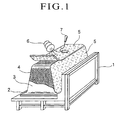
- Fig. 1 is a schematic view showing a molded resin article and a manufacturing method therefor according to an embodiment of the present invention.
- Fig. 1 shows a molded resin article and a manufacturing method therefor according to an embodiment of the present invention.
- reference numeral 1 refers to a working table.
- a P-mold 2 is placed on the working table 1.
- the P-mold 2 is formed to a desired shape.
- the hand lay-up method is used as an example to explain the steps for manufacturing a molded resin article by one of the laminate molding methods.
- a mold releasing agent is applied to the P-mold 2 (Step 1).
- a mold releasing agent-treated layer 3 is formed by this procedure on the surface of the P-mold 2.
- a gel coat layer 4 is formed (Step 2).
- 30% to 35% by weight, preferably about 33% by weight of a powder obtained by crushing and pulverizing waste FRP molded articles (referred to as an "FRP recycled powder” hereinafter) as a filler is mixed with a plastic raw material comprising 50% to 60% by weight of an unsaturated polyester resin, and 50% to 40% by weight of styrene.
- a mixed resin formulation is formed by mixing a curing agent into this mixture. This mixed resin formulation is applied to the surface of the mold releasing agent-treated layer 3.
- the gel coat layer 4 is formed by this procedure.
- the above mixed resin formulation is applied to the surface of the gel coat layer 4 again, and glass mats 5 are laminated on the gel coat layer 4 by impregnating them with a backing resin supplied from a resin supply bucket 6, using a roller 7 or the like (Step 3).
- the backing resin used here is a mixed formulation in which a conventional unsaturated polyester resin is mixed with 8% to 12% by weight, preferably about 10% by weight, of an FRP recycled powder.
- the chopped formulation is a mixed formulation obtained by mixing 35% to 40% by weight, preferably about 37% by weight, of the FRP recycled powder with the unsaturated polyester resin.
- the molded resin article is demolded from the P-mold and the flashes around the mating areas are trimmed off, and chamfering is performed with sand paper or the like (Step 5).
- the outer surface of the molded resin article is sanded with sand paper or the like to remove the mold releasing agent from the surface of the molded resin article (Step 6).
- the molded resin article is subjected to various finishing steps so as to provide a finished molded resin product and thus the finished molded resin product is manufactured in this way.
- This examination was entrusted to the Saitama Prefectural Industrial Technology Center. The examination was performed using specimens from both of the above molded resin articles according to an "Izod impact testing method for rigid plastics.”
- the Izod impact test According to the Izod impact test, one end of a specimen was fixed to an Izod impact tester at a point where a notch was made, and the surface of a part of the specimen was subjected to one strike of a hammer to be break the specimen, in which the struck part was on the other end of the specimen and was 22 mm away from the notch, and the struck surface was on the same side of the specimen as where the notch was situated.
- the impact value was determined by this procedure.
- This impact test is one type of impact bending test. It measures the energy required to break the specimen with one strike of a hammer so as to obtain various data such as impact resistance, brittleness, and tenacity of the rigid plastic material.
- the finished molded resin product using the FRP recycled powder showed an Izod impact value of 58 kJm -2
- the conventional product showed an Izod impact value of 26.8 kJm -2
- the finished molded resin product, using the FRP recycled powder had a strength more than twice as large as that of the conventional product.
- the material for molded resin articles used in manufacturing the molded resin article using the above FRP recycled powder is used as a mixed resin formulation for gel coat layers and as a chopped formulation.
- This mixed resin formulation is prepared by mixing 33% to 35% by weight of the FRP recycled powder, obtained by crushing and pulverizing waste FRP molded articles, as a filler with an unsaturated polyester resin, followed by mixing with a curing agent.
- the chopped formulation is the mixed formulation obtained by mixing the unsaturated polyester resin with 37% by weight of an FRP recycled powder.
- the material for molded resin articles is used as the mixed formulation for forming gel coat layers in which the unsaturated polyester resin is mixed with 33% to 35% by weight of the FRP recycled powder, and is also used as a mixed formulation for a chopped formulation in which the unsaturated polyester resin is mixed with 36% to 38% by weight of the FRP recycled powder, and therefore it is possible to greatly decrease the amounts of talc, Aerosil® , Carplex® , calcium carbonate, etc. used as conventional fillers. Furthermore, no new fillers are required, making it possible to save natural resources.
- molded resin articles obtained by molding using the FRP recycled powder have strengths more than twice as large as those of conventional molded resin articles.
- the FRP recycled powder is obtained as follows. FRP molded articles such as discarded FRP bath tubs are cracked with a pretreatment machine, residues are removed from them, magnetic materials are removed with a magnetic separator, a uniaxial crusher is used for crushing, and a crushed material is stored in an intermediate hopper. The crushed material is taken out of the intermediate hopper and subjected to a pulverizing machine to obtain a fine powder, and the fine powder is passed through a filter cyclone, followed by treatment with a vibrating screen to sort according to the weight so as to provide a plural types of the FRP recycled powders. Different types of FRP recycled powders are used to suit different requirements.
- the FRP recycled powder is mixed as a filler into the above plastic raw material at a concentration of from 10% to 50% by weight, for example.
- molded resin articles having various shapes can be formed by means of the various molding methods other than the above-described hand lay-up method, including, for example, the other types of the laminate molding methods, the press molding method, and the other molding methods which are not classified as belonging to the above two molding methods, using this mixture, and using molds for use in the respective molding methods.
- Molded resin articles having various shapes which are molded according to these molding methods, enumerated include not only dummies, but also bath tubs, various containers, small-sized boats, prefabricated housing parts, protective boards, and molded articles having other shapes.
- a filament winding method is explained as a representative of these other molding methods.
- This is a molding method in which glass roving continuously impregnated with a resin in a resin container is wound around a uniformly rotating mold at a specific angle to the rotational axis while applying a tension until a specific thickness is realized, it is then cured, and is removed from the mold and is subjected to trimming to provide the molded resin article.
- molded resin articles having various shapes can be obtained by applying various molding methods.
- Table 1 shows the materials for the resin molding and mats necessary for manufacturing a dummy according to a conventional method as well as materials for the resin molding and mats necessary for manufacturing a dummy as described in the example according to the present invention, respectively.
- the dummy according to the conventional method requires, as the gel coat formulation, a material consisting of an unsaturated polyester resin and fillers such as talc, Aerosil®, Carplex®, and calcium carbonate, in a total amount of 2,500 g.
- the dummy as described in the example according to the present invention uses a gel coat formulation which contains 1,675 g of the unsaturated polyester resin and 825 g of the FRP recycled powder in a total amount of 2,500 g. The mixing rate is 33% by weight.
- the dummy according to the conventional method requires, as the chopped formulation, a material consisting of the unsaturated polyester resin and fillers such as talc, Aerosil®, Carplex®, and calcium carbonate, at a concentration larger than that of the fillers for the gel coat formulation.
- the amount is 1,000 g.
- the dummy as described in the example according to the present invention uses a chopped formulation which contains 625 g of the unsaturated polyester resin and 375 g of the FRP recycled powder in a total amount of 1,000 g.
- the mixing rate is 37% by weight.
- the dummy according to the conventional method requires, as the backing resin, a material consisting of the unsaturated polyester resin and fillers in a total amount of 2,100 g.
- the dummy as described in the example according to the present invention uses a backing resin which contains 1,890 g of the unsaturated polyester resin and 210 g of the FRP recycled powder in a total amount of 2,100 g.
- the mixing rate is 10% by weight.
- both of the mats for the dummy according to the conventional method and the mats for the dummy as described in the example according to the present invention weigh 900 g.
- the mixing rate of the FRP recycled powder amounts to 25.2% by weight based on the total resin amount, and to 21.7% by weight based on the weight of the dummy.
- Table 2 shows materials for the resin molding and mats necessary for manufacturing a body according to a conventional method as well as the materials for the resin molding and mats necessary for manufacturing a body as described in the example according to the present invention, respectively.
- the body according to the conventional method requires, as the gel coat formulation, a material consisting of an unsaturated polyester resin and fillers such as talc, Aerosil® , Carplex® , and calcium carbonate, in a total amount of 600 g.
- the body as described in the example according to the present invention uses a gel coat formulation which contains 400 g of the unsaturated polyester resin and 200 g of the FRP recycled powder in a total amount of 600 g. The mixing rate is 33% by weight.
- the body according to the conventional method requires, as the chopped formulation, a material containing the unsaturated polyester resin and fillers at a concentration larger than that of the fillers for the gel coat formulation.
- the amount required is 100 g.
- the body as described in the example according to the present invention uses a chopped formulation which contains 63 g of the unsaturated polyester resin and 37 g of the FRP recycled powder in a total amount of 100 g.
- the mixing rate is 37% by weight.
- the body according to the conventional method requires, as the backing resin, a material consisting of the unsaturated polyester resin and fillers in a total amount of 530 g.
- the body as described in the example according to the present invention uses a backing resin which contains 477 g of the unsaturated polyester resin and 53 g of the FRP recycled powder in a total amount of 530 g.
- the mixing rate is 10% by weight.
- both of the mats for the body according to the conventional method and the mats for the body as described in the example according to the present invention weigh 270 g.
- the mixing rate of the FRP recycled powder amounts to 23.6% by weight based on the total resin amount, and to 19.3% by weight based on the weight of the body.
- Table 3 shows a material for molded resin articles necessary for manufacturing a pour-molded article according to a conventional method and the material for molded resin articles necessary for manufacturing a pour-molded article as described in the example according to the present invention, respectively.
- Molded article by a conventional pour molding A conventional resin 100% Molded article by the pour-molding according to the present invention
- a conventional resin 50% A recycled FRP 50% A recycled FRP 50% (mixing rate) based on the weight of the molded article
- the molded article which is pour-molded according to the conventional method requires a material consisting of the unsaturated polyester resin and fillers such as talc, Aerosil® , Carplex® , and calcium carbonate, in a total amount of, for example, 100 g.
- the pour-molded article as described in the example according to the present invention consists of, for example, 50 g of the unsaturated polyester resin and 50 g of the FRP recycled powder in a total amount of 100 g.
- the mixing rate is 50% by weight.
- the FRP recycled powder is used at a mixing rate of 50% by weight based on the weight of the molded article.
- the FRP recycled powder can be used for mixing at a concentration of from 10% to 50% by weight corresponding to the types of molded resin articles to be manufactured.
- the present invention makes it possible to use a mixed formulation in which the FRP recycled powder is mixed with the unsaturated polyester resin at a concentration of from 10% to 50% by weight, corresponding to the types of molded resin articles to be manufactured, it is possible to greatly reduce the amounts of talc, Aerosil® , Carplex® , calcium carbonate, etc. which are conventionally used as fillers. Furthermore, saving of natural resources can be realized since no new fillers are required.
- the present invention since FRP molded articles which have been discarded as wastes are reutilized, no special waste disposal treatment facilities will be necessary, thus avoiding construction costs, operation costs, and maintenance costs of the facilities.
- the present invention also requires no energy consumption for the operation of waste disposal treatment facilities, resulting in energy saving.
- steps for polishing the molded resin articles other than deflashing of them are redundant, time required for obtaining the finished molded resin product is reduced by the amount of time required for the steps, with the result that energy saving can be realized.
Landscapes
- Engineering & Computer Science (AREA)
- Mechanical Engineering (AREA)
- Environmental & Geological Engineering (AREA)
- Chemical & Material Sciences (AREA)
- Composite Materials (AREA)
- Compositions Of Macromolecular Compounds (AREA)
- Reinforced Plastic Materials (AREA)
- Separation, Recovery Or Treatment Of Waste Materials Containing Plastics (AREA)
- Processing And Handling Of Plastics And Other Materials For Molding In General (AREA)
- Manufacture Of Macromolecular Shaped Articles (AREA)
- Moulding By Coating Moulds (AREA)
Applications Claiming Priority (2)
| Application Number | Priority Date | Filing Date | Title |
|---|---|---|---|
| JP2000092748A JP2001279113A (ja) | 2000-03-30 | 2000-03-30 | 樹脂成形用材料及びこれを使用した樹脂成形物 |
| JP2000092748 | 2000-03-30 |
Publications (2)
| Publication Number | Publication Date |
|---|---|
| EP1138469A2 true EP1138469A2 (fr) | 2001-10-04 |
| EP1138469A3 EP1138469A3 (fr) | 2003-07-09 |
Family
ID=18608029
Family Applications (1)
| Application Number | Title | Priority Date | Filing Date |
|---|---|---|---|
| EP20010106911 Withdrawn EP1138469A3 (fr) | 2000-03-30 | 2001-03-20 | Matériau pour des articles moulés en résine et article moulé avec ce matériau |
Country Status (6)
| Country | Link |
|---|---|
| US (1) | US20010036992A1 (fr) |
| EP (1) | EP1138469A3 (fr) |
| JP (1) | JP2001279113A (fr) |
| KR (1) | KR20010095118A (fr) |
| CN (1) | CN1319488A (fr) |
| TW (1) | TW539608B (fr) |
Cited By (4)
| Publication number | Priority date | Publication date | Assignee | Title |
|---|---|---|---|---|
| WO2008080440A1 (fr) * | 2006-12-29 | 2008-07-10 | Cook Composites & Polymers Company | Poudre organique utile en tant que remplacement de charge minérale dans les composites |
| WO2008080550A1 (fr) * | 2006-12-29 | 2008-07-10 | Cook Composites & Polymers Company | Charge pulvérulente organique utile comme remplacement d'une charge minérale dans des composites |
| CN1944034B (zh) * | 2005-10-08 | 2011-11-16 | 积水化学工业株式会社 | 强化复合管的制造装置及设有该制造装置的制造系统 |
| PL447363A1 (pl) * | 2023-12-29 | 2025-06-30 | Kompozyty Trade Spółka Z Ograniczoną Odpowiedzialnością | Odlewane elementy kompozytowe oraz sposób ich wytwarzania |
Families Citing this family (4)
| Publication number | Priority date | Publication date | Assignee | Title |
|---|---|---|---|---|
| US7941311B2 (en) * | 2003-10-22 | 2011-05-10 | Microsoft Corporation | System and method for linguistic collation |
| KR100718949B1 (ko) * | 2005-06-03 | 2007-05-16 | 이동익 | 폐 유리섬유 강화 플라스틱을 이용한 경량보드의 제조방법 및 이를 이용하여 제조된 경량보드 |
| US20180339499A1 (en) * | 2017-05-25 | 2018-11-29 | Nice Glass, LLC | Structurally-reinforced plastic composite products produced with recycled waste glass fibers and recycled polymer compounds and process for making the same |
| JP7326752B2 (ja) * | 2018-01-25 | 2023-08-16 | 東レ株式会社 | リサイクル炭素繊維の製造方法 |
Family Cites Families (5)
| Publication number | Priority date | Publication date | Assignee | Title |
|---|---|---|---|---|
| GB8806915D0 (en) * | 1988-03-23 | 1988-04-27 | Blatchford & Sons Ltd | Moulding compound & method of manufacturing compound |
| DE59001262D1 (de) * | 1990-02-17 | 1993-05-27 | Fibron Gmbh | Verfahren zur herstellung einer duroplastischen pressmasse aus glasfaser-polyester-verbundwerkstoff |
| JPH06102364B2 (ja) * | 1990-12-20 | 1994-12-14 | アサオカ株式会社 | 廃棄された繊維強化プラスチックを充填材とした繊維強化プラスチック成形体およびその製造方法 |
| JPH0817956B2 (ja) * | 1991-03-13 | 1996-02-28 | アサオカ株式会社 | 難破砕性プラスチック廃材の粉砕方法および装置 |
| DE4335054C1 (de) * | 1993-10-14 | 1995-02-23 | Menzolit Gmbh | Verfahren zum Herstellen von SMC-Masse unter Verwendung von Recyclat |
-
2000
- 2000-03-30 JP JP2000092748A patent/JP2001279113A/ja active Pending
-
2001
- 2001-03-20 EP EP20010106911 patent/EP1138469A3/fr not_active Withdrawn
- 2001-03-23 US US09/814,841 patent/US20010036992A1/en not_active Abandoned
- 2001-03-28 TW TW90107371A patent/TW539608B/zh active
- 2001-03-29 KR KR1020010016659A patent/KR20010095118A/ko not_active Withdrawn
- 2001-03-30 CN CN01112194A patent/CN1319488A/zh active Pending
Cited By (7)
| Publication number | Priority date | Publication date | Assignee | Title |
|---|---|---|---|---|
| CN1944034B (zh) * | 2005-10-08 | 2011-11-16 | 积水化学工业株式会社 | 强化复合管的制造装置及设有该制造装置的制造系统 |
| WO2008080440A1 (fr) * | 2006-12-29 | 2008-07-10 | Cook Composites & Polymers Company | Poudre organique utile en tant que remplacement de charge minérale dans les composites |
| WO2008080550A1 (fr) * | 2006-12-29 | 2008-07-10 | Cook Composites & Polymers Company | Charge pulvérulente organique utile comme remplacement d'une charge minérale dans des composites |
| AU2007341656B2 (en) * | 2006-12-29 | 2013-10-10 | Polynt Composites USA, Inc. | Organic powder filler useful as the replacement of mineral filler in composites |
| EA019218B1 (ru) * | 2006-12-29 | 2014-02-28 | Кук Композитс Энд Полимерс Компани | Органический порошковый наполнитель, используемый для замены минерального наполнителя в композиционных материалах |
| US8906502B2 (en) * | 2006-12-29 | 2014-12-09 | Ccp Composites Us Llc | Organic powder useful as the replacement of mineral filler in composites |
| PL447363A1 (pl) * | 2023-12-29 | 2025-06-30 | Kompozyty Trade Spółka Z Ograniczoną Odpowiedzialnością | Odlewane elementy kompozytowe oraz sposób ich wytwarzania |
Also Published As
| Publication number | Publication date |
|---|---|
| KR20010095118A (ko) | 2001-11-03 |
| TW539608B (en) | 2003-07-01 |
| JP2001279113A (ja) | 2001-10-10 |
| CN1319488A (zh) | 2001-10-31 |
| US20010036992A1 (en) | 2001-11-01 |
| EP1138469A3 (fr) | 2003-07-09 |
Similar Documents
| Publication | Publication Date | Title |
|---|---|---|
| EP1578576B1 (fr) | Preimpregne presque a la cote | |
| US5876655A (en) | Method for eliminating flow wrinkles in compression molded panels | |
| EP2844445B1 (fr) | Processus de recyclage d'un polymère renforcé par des fibres et appareil connexe | |
| US20010036992A1 (en) | Material for molded resin articles and molded resin article using the same | |
| Petterson et al. | Recycling of SMC and BMC in standard process equipment | |
| US20080217811A1 (en) | Method of recycling fiberglass reinforced plastics | |
| EP0421767B1 (fr) | Objet moulé en matière plastique renforcée de fibres et son procédé de préparation | |
| JP2009012450A (ja) | 複合材料の二段成形方法 | |
| WO1999038683A1 (fr) | Panneaux composites a revetement de classe a | |
| CN103769289B (zh) | 一种半固化片裁边料的再利用方法 | |
| AU4769299A (en) | Method for producing closed composite structures and moulding apparatus to be used by the method | |
| Bigg | Manufacturing methods for long fiber reinforced polypropylene sheets and laminates | |
| US20220410504A1 (en) | Method for manufacturing near-net shape natural fiber reinforced polymer composite panels | |
| CN112277332A (zh) | 人造大理石3d薄壁壳体及其制备方法和应用 | |
| Henshaw et al. | Recycling of a cyclic thermoplastic composite material by injection and compression molding | |
| CN111421812A (zh) | 一种无人机料仓快速成型工艺 | |
| JPH0679836A (ja) | 積層シート状成形材料及びそれを用いた成形品の製造法 | |
| JPH05309753A (ja) | 廃棄された繊維強化プラスチックを充填材とした繊維強化プラスチック成形体およびその製造方法 | |
| JP3542995B2 (ja) | 成形材料及び成形物 | |
| Wilson | The implementation of recycled thermoset composites in thermoforming molds | |
| JP2004338227A (ja) | 再生成形材の製造方法 | |
| de Luzuriaga et al. | Reworkable, recyclable and repairable thermoset epoxy composites in transportation applications | |
| JPH06328614A (ja) | 複合シンク | |
| JPH0639834A (ja) | 繊維強化熱可塑性樹脂複合材料 | |
| JPH06312427A (ja) | 樹脂部品のリサイクル方法 |
Legal Events
| Date | Code | Title | Description |
|---|---|---|---|
| PUAI | Public reference made under article 153(3) epc to a published international application that has entered the european phase |
Free format text: ORIGINAL CODE: 0009012 |
|
| AK | Designated contracting states |
Kind code of ref document: A2 Designated state(s): AT BE CH CY DE DK ES FI FR GB GR IE IT LI LU MC NL PT SE TR |
|
| AX | Request for extension of the european patent |
Free format text: AL;LT;LV;MK;RO;SI |
|
| PUAL | Search report despatched |
Free format text: ORIGINAL CODE: 0009013 |
|
| RIC1 | Information provided on ipc code assigned before grant |
Ipc: 7B 29K 105/26 - Ipc: 7B 29K 105/06 - Ipc: 7B 29B 13/10 B Ipc: 7B 29B 17/00 B Ipc: 7B 29C 70/58 A |
|
| AK | Designated contracting states |
Designated state(s): AT BE CH CY DE DK ES FI FR GB GR IE IT LI LU MC NL PT SE TR |
|
| AX | Request for extension of the european patent |
Extension state: AL LT LV MK RO SI |
|
| AKX | Designation fees paid |
Designated state(s): BE DE FR GB IT |
|
| STAA | Information on the status of an ep patent application or granted ep patent |
Free format text: STATUS: THE APPLICATION IS DEEMED TO BE WITHDRAWN |
|
| 18D | Application deemed to be withdrawn |
Effective date: 20040110 |