EP1143009A1 - Verfahren zur herstellung eines polypetids in zellfreien proteinsynthese-systemen - Google Patents
Verfahren zur herstellung eines polypetids in zellfreien proteinsynthese-systemen Download PDFInfo
- Publication number
- EP1143009A1 EP1143009A1 EP99961297A EP99961297A EP1143009A1 EP 1143009 A1 EP1143009 A1 EP 1143009A1 EP 99961297 A EP99961297 A EP 99961297A EP 99961297 A EP99961297 A EP 99961297A EP 1143009 A1 EP1143009 A1 EP 1143009A1
- Authority
- EP
- European Patent Office
- Prior art keywords
- cell
- polypeptide
- dialysis
- protein synthesis
- extract
- Prior art date
- Legal status (The legal status is an assumption and is not a legal conclusion. Google has not performed a legal analysis and makes no representation as to the accuracy of the status listed.)
- Withdrawn
Links
Images


Classifications
-
- C—CHEMISTRY; METALLURGY
- C07—ORGANIC CHEMISTRY
- C07K—PEPTIDES
- C07K1/00—General methods for the preparation of peptides, i.e. processes for the organic chemical preparation of peptides or proteins of any length
- C07K1/02—General methods for the preparation of peptides, i.e. processes for the organic chemical preparation of peptides or proteins of any length in solution
Definitions
- the present invention relates to a process for producing a polypeptide in a cell-free protein synthesis system using dialysis.
- a cell-free protein synthesis system is a system in which a protein is synthesized in vitro with a cell extract.
- Cell extracts derived from E.coli , wheat germ, or rabbit reticulocyte are mainly used. Since the system can be readily modified, an expression system suitable for a desired protein can be easily constructed. Moreover, a linear DNA created by PCR may be used as a template. This eliminates all the time and effort consuming steps such as ligation to a vector, transformation, incubation, harvesting, and lysis required in the expression system of a living cell, thus allowing expression of a protein readily within a short time. However, since it has a disadvantage of having a low protein yield, the application thereof has been limited.
- the maximum yield obtained in a cell-free protein system is 1.2mg/ml in 14 hours (Kim and Choi, supra).
- the synthetic rate was approximately 80 ⁇ g/ml/hour, and the yield was approximately 100 ⁇ g per ml of the substrate used.
- the object of the present invention is to provide the process for producing a polypeptide within a short period of time at high yield and at low cost, compared with conventional processes.
- the present invention provides a process for producing polypeptide in a cell-free protein synthesis system using dialysis, which comprises generating the polypeptide via the translation or transcription/translation of a nucleic acid encoding the polypeptide in the cell-free protein synthesis system containing a concentrated cell extract; and recovering the polypeptide from the system.
- the process comprises shaking or agitating the cell-free protein synthesis system, the cell-free protein synthesis system comprising a reaction solution for polypeptide synthesis containing the concentrated cell extract as an internal dialysis solution and a substrate solution for polypeptide synthesis as an external dialysis solution, and the internal dialysis solution and the external dialysis solution being segregated via a dialysis membrane which permits transfer of substances.
- the external dialysis solution of the above-mentioned system may be exchanged with a fresh one when the reaction rate has decreased.
- the dialysis membrane may have a molecular weight cut-off more than 10000 dalton, preferably approximately 50000 Da and more.
- the concentrated cell extract is a concentrated crude cell extract of a eukaryotic or prokaryotic cell such as E. coli , wheat germ, rabbit reticulocyte, mouse L-cell, Ehrlich ascites tumor cell, HeLa cell, Chinese hamster ovarian (CHO) cell, or budding yeast.
- a concentrated cell extract is a concentrated E.coli S30 cell extract.
- the extract can be obtained by concentration methods such as dialysis, ultrafiltration, polyethylene glycol (PEG) precipitation, and the like.
- the concentrated E.coli 30 cell extract can be obtained by using the E.coli S30 extract obtained from an E.coli A19 strain ( rna , met ) with a known method (Zubay et al., Ann. Rev. Genet. 1973, 7, 267-287) (also available from Promega) as an internal dialysis solution and performing dialysis against an external dialysis solution via a dialysis membrane having a 1000-14000 Da molecular weight cut-off in a closed system which can be shaken or agitated.
- the external dialysis solution used herein may comprise a buffer solution containing potassium acetate, magnesium acetate, and dithiothreitol, and polyethylene glycol or a sucrose/epichlorohydrin water-soluble synthetic copolymer (e.g. FicollTM made by SIGMA).
- a buffer solution containing potassium acetate, magnesium acetate, and dithiothreitol may comprise polyethylene glycol or a sucrose/epichlorohydrin water-soluble synthetic copolymer (e.g. FicollTM made by SIGMA).
- the above-mentioned system may comprise a combination of creatine kinase and creatine phosphate as an ATP regenerating system.
- the present invention further provides for a process for producing a polypeptide in a cell-free protein synthesis system using dialysis, which comprises generating the polypeptide via the translation or transcription/translation of a nucleic acid encoding the polypeptide in the cell-free protein synthesis system containing a cell extract derived from E.coli and a combination of creatine kinase and creatine phosphate as an ATP regenerating system; and recovering the polypeptide.
- the cell extract from E. coli may be either concentrated or unconcentrated.
- the above-mentioned cell extract is an E.coli S30 cell extract.
- cell-free protein synthesis system includes a cell-free translation system which reads mRNA information and synthesizes a polypeptide on ribosomes; and both a cell-free transcription system which synthesizes RNA using DNA as a template, and the cell-free translation system.
- concentrated cell extract means the concentrated crude extract of eukaryotic or prokaryotic cells containing components such as ribosomes and tRNA required for protein synthesis, the extract being concentrated by a known concentration method such as dialysis, ultrafiltration, PEG precipitation (H. Nakano et al., Journal of Biotechnology 1996, 46 , 275-282) or a newly found method; and said extract contains components of a translation system or a translation/transcription system involved in in vivo protein synthesis.
- concentration as used herein means an increase in protein concentration in the extract where a total protein concentration is used as an indication.
- polypeptide as used herein includes polypeptides with any molecular weight constituted by a plurality of amino acid residues, that is, any polypeptide from a low molecular weight (small peptide) to a high molecular weight (large peptide including a protein) are included.
- nucleic acid indicates any of RNA, mRNA, DNA, or cDNA.
- the yield of a polypeptide is significantly increased in a cell-free protein synthesis process using dialysis when a concentrated crude cell extract is contained in an internal dialysis solution, compared to the case where an unconcentrated extract is used.
- the yield of a polypeptide can be further improved by using a dialysis membrane having a larger molecular weight cut-off, and/or by exchanging an external dialysis solution with a fresh one when reaction rate decreases.
- the crude extract can be derived from eukaryotic and prokaryotic cells with high protein-synthetic activity such as bacteria (e.g. E. coli ), fungi (e.g. budding yeast), wheat germ, rabbit reticulocyte, mouse L-cell, Ehrlich ascites tumor cell, HeLa cell, CHO cell, etc. (Clemens, M.J., Transcription and translation-a practical approach, (1984), pp.231-270, Henes, B.D.; and Higgins, S.J. eds., IRL Press, Oxford).
- the crude cell extract comprises components required for protein synthesis such as ribosomes, tRNA, and the like.
- Preparation of the crude extract can be performed using a method described in Pratt, J.M. et al., Transcription and translation-a practical approach, (1984), pp. 179-209, Henes, B.D.; and Higgins, S.J. eds., IRL Press, Oxford. Specifically, it can be performed by disintegration with French press (Pratt et al., supra ) or with glass beads (Kim et al., supra ).
- the cell extract is preferably an E.coli S30 cell extract.
- the S30 cell extract can be prepared from E.coli A19 strain ( rna , met ) according to a known method, e.g. Pratt et al. ( supra ), or an extract commercially available from Promega or Novagen can be used.
- the above-mentioned cell extract is required to be concentrated such that the total protein concentration is increased.
- Concentration can be performed according to any method such as ultrafiltration (including ultrafiltration centrifugation), dialysis, PEG precipitation, etc.
- the degree of concentration is usually at least 1.5-fold, preferably at least 2-fold.
- the concentration can be performed up to at least 1.5- to 7-fold by ultrafiltration centrifugation and at least 1.5- to 5-fold by PEG precipitation, but it will be difficult to handle when the degree of concentration exceeds 4-fold.
- concentration can be performed up to 10-fold by PEG precipitation (Nakano, H. et al., supra ).
- a PEG solution is mixed with a cell extract thereby precipitating and collecting proteins and nucleic acids, which are dissolved in a small quantity of a buffer solution to obtain the concentrated cell extract.
- Concentration using dialysis can be carried out, for example, according to a method described in the Example below.
- the concentrated cell extract can be obtained by using the cell extract as an internal dialysis solution and performing dialysis against an external dialysis solution via a dialysis membrane (e.g. having a 1000-14000 molecular weight cut-off) in a closed system which can be shaken or agitated.
- the external dialysis solution used herein may include a buffer solution containing potassium acetate, magnesium acetate, and dithiothreitol, and a polymeric absorbent such as PEG (e.g. #8000), sucrose/epichlorohydrin water-soluble synthetic copolymer (e.g. FicollTM made by SIGMA), or the like.
- PEG e.g. #8000
- sucrose/epichlorohydrin water-soluble synthetic copolymer e.g. FicollTM made by SIGMA
- a polymeric absorbent is essential for absorbing water.
- a large increase in yield can be achieved compared to conventional methods, by concentrating the S30 extract and using it as an internal dialysis solution; and/or using a dialysis membrane with a larger molecular weight cut-off; and/or exchanging the external dialysis solution with a fresh one when decrease in the reaction rate is confirmed.
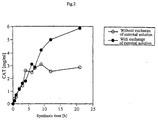
- Such beneficial effects are shown, for example, in Fig.2 and 3 with respect to time course of the yield of chloramphenicol acetyltransferase (CAT) or Ras proteins in the cell-free system (cf. Example 3 and 4).
- a dialyser comprising an internal solution and an external solution separated by means of dialysis membrane, which can be shaken and stirred, can be used.
- a dialyzer for small-scale reaction examples include DispoDialyserTM(Spectrum) and SlidealyzerTM (Pierce), etc.
- a dialyzer for large-scale reaction examples include a Spectra/PorTM dialysis tube (Spectrum).
- the internal dialysis solution (i.e. polypeptide-synthetic reaction solution) in the cell-free protein synthesis system may include DNA or RNA (e.g. mRNA) encoding desired polypeptide, ATP (adenosine 5'-triphosphate), GTP(guanosine 5'-triphosphate), CTP (cytidine 5'-triphosphate), UTP (uridine 5'-triphosphate), buffer, salts, amino acids, RNase inhibitor, antibacterial agent, and where required, RNA polymerase (when DNA is used as a template) and tRNA etc. as well as the concentrated E.coli S30 cell extract.
- DNA or RNA e.g. mRNA
- ATP adenosine 5'-triphosphate
- GTP guanosine 5'-triphosphate
- CTP cytidine 5'-triphosphate
- UTP uridine 5'-triphosphate
- buffer salts, amino acids, RNase inhibitor, antibacterial agent, and
- a combination of phosphoenolpyruvate and pyruvate kinase or a combination of creatine phosphate and creatine kinase, polyethylene glycol (e.g. #8000), 3', 5'-cAMP, folic acids, an RNase inhibitor, a reducing agent (e.g. dithiothreitol) etc. can be included as a ATP regenerating system.
- the external dialysis solution i.e. substrate solution for polypeptide synthesis
- a solution where the cell extract, RNase inhibitor, DNA or RNA, and a RNA polymerase have been removed from the composition of the internal dialysis solution can be used.
- a buffer, ATP, GTP, CTP, UTP, salts, amino acids, and antibacterial agents can be included. The concentrations of the added components can be selected appropriately.
- buffers such as Hepes-KOH, Tris-OAc and the like can be used.
- salts include salts of acetic acid (e.g. ammonium salt, magnesium salt etc.), salts of glutamic acid etc.
- antibacterial agents include sodium azide, ampicillin, etc.
- Amino acids include the 20 types of amino acids from which proteins are generally composed.
- the present invention there is the advantage with a cell-free protein synthesis system that even by generating the polypeptide via the translation or transcription/translation of a nucleic acid encoding the polypeptide in the cell-free protein synthesis system containing the E.coli cell extract and a combination of creatine kinase and creatine phosphate as the ATP regenerating system; and collecting the polypeptide, the synthesis efficiency goes beyond that of conventional methods.
- the cell extract may be concentrated or unconcentrated, preferably concentrated.
- the cell extract is, but is not limited to, the E.coli S30 cell extract. The above-mentioned conditions can be applied to other components or the like in the cell-free protein synthesis system.
- the polypeptide includes any peptide from small peptides to large ones, and known or novel polypeptides are included.
- DNA or RNA encoding a desired polypeptide can be obtained from eukaryotic or prokaryotic cells or tissues as genomic DNA or mRNA by a well-known method (phenol/chloroform treatment, ethanol precipitation, cesium chloride density gradient centrifugation etc.), or can be synthesized/isolated by cDNA cloning.
- a sequence of naturally occurring DNA or RNA may be mutated (e.g., substituted, deleted or added) in a usual manner such as site-specific mutagenesis, thereby synthesizing mutants thereof.
- an amino acid sequence of a polypeptide or a nucleotide sequence which encodes it is clarified, it may be chemically synthesized using a DNA synthesizer.
- the closed system in which the above-mentioned internal and external dialysis solutions are respectively contained inside and outside of the dialysis membrane through which transfer of substances is permitted depending on the molecular weight cut-off of the membrane, is subjected to shake or agitation (e.g., rotatory agitation), thereby collecting the generated polypeptide of interest from the internal or external dialysis solution.
- shake or agitation e.g., rotatory agitation
- the reaction conditions of temperature and agitation rate etc. can be appropriately set depending on kinds of polypeptides.
- the temperature is generally approximately 25-50°C, preferably 37°C, but in a cell-free protein synthesis system where a cell extract derived from extreme thermophile is used, the temperature may be over 50°C.
- a low speed for example, 100-200rpm can be applied. While observing the generation of the desired polypeptide, the reaction time can be selected appropriately.
- the polypeptide yield can be further increased by exchanging the external dialysis solution in the above system with a fresh one when the reaction rate decreases; and/or by using the dialysis membrane with a molecular weight cut-off above 10000 Da, preferably approximately 50000 Da and more.
- Purification of the generated polypeptide can be performed relatively readily, since the amount and kind of contaminants is remarkably few.
- Known purification methods can be used alone or in combination appropriately according to the properties of the polypeptide.
- Purification methods include conventional techniques such as ammonium sulfate or acetone precipitation, acid extraction, anion or cation exchange chromatography, hydrophobic interaction chromatography, affinity chromatography, gel filtration chromatography, HPLC, electrophoresis, chromatofocusing, etc.
- Identification and quantification of the generated polypeptide can be performed by assay of activity, immunological measurement, spectroscopic measurement, amino-acid analysis, etc., optionally while comparing to a standard sample.
- E.coli S30 extract was prepared from the E.coli A19 stratin ( rna , met ) according to the method of Zubay et al. (Annu. Rev. Genet, 1973, 7 , 267-187).
- the dialysis tube containing the E.coli S30 extract was taken out to adjust the position of the clump depending on the decrease in the amount of the solution, followed by dialysis against 500ml of solution A at 4°C for 15 min.
- composition of a protein-synthetic reaction solution was composed of: 55mM Hepes-KOH (pH7.5), 5mM DTT, 1.2mM ATP, 0.8mM each of CTP, GTP and UTP, 80mM creatine phosphate, 250 ⁇ g/ml creatine kinase, 4.0% (w/v) PEG8000, 0.64mM 3', 5'-cAMP, 68 ⁇ M L-(-)-5-formyl-5,6,7,8-tetrahydrofolic acid, 175 ⁇ g/ml E.coli tRNA (Boehringer Mannheim), 210mM potassium glutamate, 27.5mM NH 4 OAc, 10.7mM Mg(CH 3 COO) 2 , 1mM each of 20 essential amino acids from which proteins are made, 0.05% NaN 3 , 6.7 ⁇ g/ml pK7-CAT DNA (CAT expression vector; Kim
- composition of the substrate solution for protein synthesis (i.e., an external dialysis solution) was constituted by removing the E.coli S30 extract, RNase inhibitor, DNA and T7 RNA polymerase from the internal dialysis solution, and adding 4.2mM Mg(CH 3 COO) 2.
- Dispo/Dialyzer CE (having 10000 or 50000 molecular weight cut-off, made by Spectrum) containing 300 ⁇ l of the internal dialysis solution was put in a 15ml tube containing 3000 ⁇ l of the external dialysis solution, followed by shaking at 160rpm at 37°C in a test tube incubator, to perform a protein synthesis.
- CAT protein contained in the reaction solution was performed as follows according to Shaw, Methods Enzymol 1975, 735-755. Acetyl coenzyme A and chloramphenicol were used as substrates to acetylate chloramphenicol by CAT, and the resulting reductive coenzyme A was color-developed and quantified with 5,5'-dithiobis-2-nitro benzoic acid (DTNB). CAT activity was quantified from an increased amount of absorbance per unit time at 412nm at 37°C, which was used as an indication to determine the amount of the CAT protein.
- DTNB 5,5'-dithiobis-2-nitro benzoic acid
- the CAT yield at 6 hours after starting the synthesis reaction is shown in Fig.1.
- the obtained CAT yield was approximately 2mg/ml with the unconcentrated E.coli S30 extract, and approximately 3.5mg/ml with the concentrated one. This figure also indicates that the CAT yield is affected by the magnitude of the molecular weight cut-off of the membrane.
- Example 2 Using the E.coli S30 extract concentrated by the method described in Example 1, the reaction test (with the dialysis membrane having 50000 Da molecular weight cut-off) described in Example 2 was performed; and the resulting CAT yield at the indicated time after start of synthesis is shown in Fig.2. After 6 hours, the CAT synthesis rate was decreased. In the equivalent reaction test, by exchanging the external dialysis solution with a fresh one at the time when the reaction rate was decreased (in this case, at the time of 6 hours), the reaction was continued for extended time, resulting that approximately 5mg/ml and 6mg/ml of CAT were synthesized 12 hours and 21 hours after start of the reaction, respectively (Fig.2).
- the protein synthesis (with a dialysis membrane having 50000 Da molecular weight cut-off) was performed in the same method as in Example 2 except that pK7-Ras (which is an expression vector of Ras protein; Kigawa et al., J. Biomol. NMR 1995, 6 , 129-134) instead of pK7-CAT and 1mM [ 14 C]-leucine (18.5MBq/mmol, Amersham) instead of 1mM leucine were used.
- pK7-Ras which is an expression vector of Ras protein; Kigawa et al., J. Biomol. NMR 1995, 6 , 129-134
- 1mM [ 14 C]-leucine (18.5MBq/mmol, Amersham
- the yield of Ras protein was quantified by the precipitation method using 5% trichloroacetic acid on a filter. As a result, the yield was approximately 3mg/ml 6 hours after start of the reaction.
- CAT yield in the process of the present invention 6mg/ml (Example 3) is well above the value of 1.2mg/ml in the conventional method (Kim and Choi; supra ), which is advantageous for industrial protein production.
- the protein yield per ml of E.coli extract used in the invention is approximately 8mg, which is greater than the value of 3mg by the conventional method.
- the protein can be purified concisely with high purity from the reaction solution according to the process of the invention.
- the synthesis rate in the process of the present invention is approximately 400 ⁇ g/ml/hour, which is far greater than the value of approximately 80 ⁇ g/ml by the conventional method.
- the ability to produce the same yield within a shorter time is advantageous for production of a protein which is prone to be decomposed/denatured.
- the yield per ml of the substrate solution used in the present process is approximately 500 ⁇ g, which is far greater than the value of 100 ⁇ g/ml by the conventional method.
- protein can be produced at a much lower cost by the process of the present invention, compared with the conventional method.
Landscapes
- Chemical & Material Sciences (AREA)
- Organic Chemistry (AREA)
- Medicinal Chemistry (AREA)
- Molecular Biology (AREA)
- Biochemistry (AREA)
- Biophysics (AREA)
- General Health & Medical Sciences (AREA)
- Genetics & Genomics (AREA)
- Health & Medical Sciences (AREA)
- Life Sciences & Earth Sciences (AREA)
- Proteomics, Peptides & Aminoacids (AREA)
- Analytical Chemistry (AREA)
- Preparation Of Compounds By Using Micro-Organisms (AREA)
- Enzymes And Modification Thereof (AREA)
- Micro-Organisms Or Cultivation Processes Thereof (AREA)
- Peptides Or Proteins (AREA)
Applications Claiming Priority (3)
| Application Number | Priority Date | Filing Date | Title |
|---|---|---|---|
| JP35466598A JP2000175695A (ja) | 1998-12-14 | 1998-12-14 | 無細胞タンパク質合成系によるポリペプチドの製造方法 |
| JP35466598 | 1998-12-14 | ||
| PCT/JP1999/007016 WO2000036133A1 (en) | 1998-12-14 | 1999-12-14 | Process for producing polypeptide in cell-free protein synthesis system |
Publications (2)
| Publication Number | Publication Date |
|---|---|
| EP1143009A1 true EP1143009A1 (de) | 2001-10-10 |
| EP1143009A4 EP1143009A4 (de) | 2002-03-27 |
Family
ID=18439091
Family Applications (1)
| Application Number | Title | Priority Date | Filing Date |
|---|---|---|---|
| EP99961297A Withdrawn EP1143009A4 (de) | 1998-12-14 | 1999-12-14 | Verfahren zur herstellung eines polypetids in zellfreien proteinsynthese-systemen |
Country Status (4)
| Country | Link |
|---|---|
| EP (1) | EP1143009A4 (de) |
| JP (1) | JP2000175695A (de) |
| CA (1) | CA2354534A1 (de) |
| WO (1) | WO2000036133A1 (de) |
Cited By (11)
| Publication number | Priority date | Publication date | Assignee | Title |
|---|---|---|---|---|
| US6951734B2 (en) | 2001-03-08 | 2005-10-04 | Riken | Methods for producing proteins by using cell-free protein synthesis systems |
| US7045593B2 (en) | 2001-05-02 | 2006-05-16 | Riken | Process for synthesizing protein using cell-free protein synthesis system |
| US7253144B2 (en) | 2002-05-22 | 2007-08-07 | Riken | Method for producing by cell-free protein synthesis system using thioredoxin-fused protein expression vector |
| EP1995324A1 (de) * | 2007-05-22 | 2008-11-26 | ETH Zurich | Zellfreie Proteinsynthese deuterierter Proteine für strukturelle und funktionelle Untersuchungen durch NMR-Spektroskopie |
| US8226976B2 (en) | 2007-11-05 | 2012-07-24 | Riken | Method of using cell-free protein synthesis to produce a membrane protein |
| US8445232B2 (en) | 2004-11-17 | 2013-05-21 | Riken | Cell-free system for synthesis of proteins derived from cultured mammalian cells |
| US8603774B2 (en) | 2002-11-28 | 2013-12-10 | National Food Research Institute | Extract of E. coli cells having mutation in ribosomal protein S12, and method for producing protein in cell-free system using the extract |
| US8664355B2 (en) | 2004-11-19 | 2014-03-04 | Riken | Cell-free protein synthesis method with the use of linear template DNA and cell extract therefor |
| EP2927312A4 (de) * | 2012-11-30 | 2016-07-27 | Bioneer Corp | Vorrichtung zur automatischen herstellung zellfreier proteine und verfahren zur herstellung von proteinen damit |
| CN111378708A (zh) * | 2018-12-28 | 2020-07-07 | 康码(上海)生物科技有限公司 | 一种优化的体外无细胞蛋白合成体系及其应用 |
| US11618777B2 (en) | 2015-07-31 | 2023-04-04 | Shigeyuki Yokoyama | Method of manufacturing membrane protein and utilization thereof |
Families Citing this family (6)
| Publication number | Priority date | Publication date | Assignee | Title |
|---|---|---|---|---|
| JP2002262873A (ja) | 2001-03-06 | 2002-09-17 | Inst Of Physical & Chemical Res | タンパク質ドメインの製造方法及びその方法により得られたドメインを用いるタンパク質の立体構造解析方法 |
| JP2002372517A (ja) * | 2001-05-31 | 2002-12-26 | Inst Of Physical & Chemical Res | 質量分析法によるタンパク質の構造解析方法 |
| JP4091901B2 (ja) * | 2003-11-13 | 2008-05-28 | 株式会社島津製作所 | 無細胞系タンパク質合成におけるミクロソーム膜添加による翻訳後修飾方法 |
| JP2008029204A (ja) * | 2004-11-12 | 2008-02-14 | Cellfree Sciences Co Ltd | 無細胞タンパク質合成方法 |
| WO2015025865A1 (ja) * | 2013-08-21 | 2015-02-26 | 独立行政法人科学技術振興機構 | 酵素の保存液およびそれを用いた再構成型無細胞翻訳システム用反応液 |
| US10641764B2 (en) | 2015-07-02 | 2020-05-05 | The University Of Massachusetts | Membrane and droplet-interface bilayer systems and methods |
Family Cites Families (7)
| Publication number | Priority date | Publication date | Assignee | Title |
|---|---|---|---|---|
| JP2895220B2 (ja) * | 1990-05-29 | 1999-05-24 | インスティテュト、ベルカ、ロシイスコイ、アカデミイ、ナウク | 無細胞翻訳系におけるポリペプチドの製造方法 |
| JPH06225783A (ja) * | 1992-12-07 | 1994-08-16 | Nippon Flour Mills Co Ltd | 無細胞タンパク合成系を用いたタンパクの製造方法 |
| IL109262A0 (en) * | 1993-04-08 | 1994-08-26 | Res Dev Foundation | Cell free system for protein synthesis and use of chaperon proteins therein |
| JP3434319B2 (ja) * | 1993-06-15 | 2003-08-04 | 日本製粉株式会社 | 無細胞タンパク合成系によるタンパクの製造方法 |
| KR0131166B1 (ko) * | 1994-05-04 | 1998-04-11 | 최차용 | 무세포시스템에서 단백질을 제조하는 방법 |
| JPH09291A (ja) * | 1995-06-15 | 1997-01-07 | Hitachi Ltd | 無細胞蛋白質合成系における活性型蛋白質の合成方法 |
| JPH1080295A (ja) * | 1996-07-15 | 1998-03-31 | Nippon Flour Mills Co Ltd | 無細胞タンパク合成系によるタンパクの合成方法及び装置 |
-
1998
- 1998-12-14 JP JP35466598A patent/JP2000175695A/ja active Pending
-
1999
- 1999-12-14 CA CA002354534A patent/CA2354534A1/en not_active Abandoned
- 1999-12-14 EP EP99961297A patent/EP1143009A4/de not_active Withdrawn
- 1999-12-14 WO PCT/JP1999/007016 patent/WO2000036133A1/ja not_active Ceased
Cited By (14)
| Publication number | Priority date | Publication date | Assignee | Title |
|---|---|---|---|---|
| US6951734B2 (en) | 2001-03-08 | 2005-10-04 | Riken | Methods for producing proteins by using cell-free protein synthesis systems |
| US7045593B2 (en) | 2001-05-02 | 2006-05-16 | Riken | Process for synthesizing protein using cell-free protein synthesis system |
| US7253144B2 (en) | 2002-05-22 | 2007-08-07 | Riken | Method for producing by cell-free protein synthesis system using thioredoxin-fused protein expression vector |
| US8603774B2 (en) | 2002-11-28 | 2013-12-10 | National Food Research Institute | Extract of E. coli cells having mutation in ribosomal protein S12, and method for producing protein in cell-free system using the extract |
| US8445232B2 (en) | 2004-11-17 | 2013-05-21 | Riken | Cell-free system for synthesis of proteins derived from cultured mammalian cells |
| US8664355B2 (en) | 2004-11-19 | 2014-03-04 | Riken | Cell-free protein synthesis method with the use of linear template DNA and cell extract therefor |
| EP1995324A1 (de) * | 2007-05-22 | 2008-11-26 | ETH Zurich | Zellfreie Proteinsynthese deuterierter Proteine für strukturelle und funktionelle Untersuchungen durch NMR-Spektroskopie |
| WO2008141795A3 (en) * | 2007-05-22 | 2009-03-05 | Eth Zuerich | Cell-free protein synthesis of deuterated proteins for structural and functional studies by nmr spectroscopy |
| US8226976B2 (en) | 2007-11-05 | 2012-07-24 | Riken | Method of using cell-free protein synthesis to produce a membrane protein |
| EP2927312A4 (de) * | 2012-11-30 | 2016-07-27 | Bioneer Corp | Vorrichtung zur automatischen herstellung zellfreier proteine und verfahren zur herstellung von proteinen damit |
| US10287542B2 (en) | 2012-11-30 | 2019-05-14 | Bioneer Corporation | Apparatus for automatically preparing cell-free proteins and method for preparing proteins using same |
| US11618777B2 (en) | 2015-07-31 | 2023-04-04 | Shigeyuki Yokoyama | Method of manufacturing membrane protein and utilization thereof |
| CN111378708A (zh) * | 2018-12-28 | 2020-07-07 | 康码(上海)生物科技有限公司 | 一种优化的体外无细胞蛋白合成体系及其应用 |
| CN111378708B (zh) * | 2018-12-28 | 2022-07-19 | 康码(上海)生物科技有限公司 | 一种体外无细胞蛋白合成体系及其应用 |
Also Published As
| Publication number | Publication date |
|---|---|
| JP2000175695A (ja) | 2000-06-27 |
| WO2000036133A1 (en) | 2000-06-22 |
| CA2354534A1 (en) | 2000-06-22 |
| EP1143009A4 (de) | 2002-03-27 |
Similar Documents
| Publication | Publication Date | Title |
|---|---|---|
| EP1143009A1 (de) | Verfahren zur herstellung eines polypetids in zellfreien proteinsynthese-systemen | |
| US6337191B1 (en) | Vitro protein synthesis using glycolytic intermediates as an energy source | |
| EP2376647B1 (de) | Mono-ladesystem zur selektiven einführung von nichtnativen aminosäuren in proteine anhand eines in-vitro-proteinsynthesesystems | |
| Calhoun et al. | Total amino acid stabilization during cell-free protein synthesis reactions | |
| AU660329B2 (en) | Coupled transcription and translation in eukaryotic cell-free extract | |
| US9410170B2 (en) | Methods of in vitro protein synthesis | |
| US5593856A (en) | Method for producing protein in a cell-free system | |
| EP1165826B1 (de) | Methode zur synthese von polypeptiden in zell-freien systemen | |
| US20170349928A1 (en) | Methods for activating natural energy metabolism for improving yeast cell-free protein synthesis | |
| US20120171720A1 (en) | Method of Making Ribosomes | |
| US11939615B2 (en) | Production method of enzymatic reaction using adenosine instead of ATP | |
| JPH08508651A (ja) | 蛋白質合成用無細胞システムおよびそれにおけるシャペロン蛋白質の利用 | |
| CN1143390A (zh) | 合成荧光标记的蛋白质的方法 | |
| EP1655376A1 (de) | Verfahren zur herstellung von protein mit einem zellfreien proteinsynthesesystem und proteinsynthese-reagenzienkit | |
| US20060008871A1 (en) | Extract of E. coli cells having mutation in ribosomal protein S12, and method for producing protein in cell-free system using the extract | |
| JP2002262867A (ja) | 無細胞タンパク質合成系によるタンパク質の製造方法 | |
| EP1341802A1 (de) | In-vitroproteinsynthese unter verwendung von glykolytischen zwischenprodukten als energiequelle | |
| US8664355B2 (en) | Cell-free protein synthesis method with the use of linear template DNA and cell extract therefor | |
| JPWO2008096846A1 (ja) | 安定同位体標識タンパク質合成用組成物及び安定同位体標識タンパク質の製造方法 | |
| KR20090022308A (ko) | 무세포 단백질 합성을 이용한 트랜스아미나제의 활성스크리닝 방법 및 키트 | |
| Hahn et al. | A continuous-exchange cell-free protein synthesis system fabricated on a chip | |
| Kim et al. | Development of a rapid and productive cell-free protein synthesis system | |
| JP7774799B2 (ja) | タンパク質の製造方法 | |
| Spirin | Cell-free protein synthesis | |
| JP3119364B2 (ja) | チオ―メッセンジャrnaを用いるタンパク質の製造法 |
Legal Events
| Date | Code | Title | Description |
|---|---|---|---|
| PUAI | Public reference made under article 153(3) epc to a published international application that has entered the european phase |
Free format text: ORIGINAL CODE: 0009012 |
|
| 17P | Request for examination filed |
Effective date: 20010709 |
|
| AK | Designated contracting states |
Kind code of ref document: A1 Designated state(s): AT BE CH CY DE DK ES FI FR GB GR IE IT LI LU MC NL PT SE |
|
| A4 | Supplementary search report drawn up and despatched |
Effective date: 20020212 |
|
| AK | Designated contracting states |
Kind code of ref document: A4 Designated state(s): AT BE CH CY DE DK ES FI FR GB GR IE IT LI LU MC NL PT SE |
|
| RIC1 | Information provided on ipc code assigned before grant |
Free format text: 7C 12P 21/00 A, 7C 07K 1/00 B, 7C 07K 1/02 B, 7C 12N 1/00 B |
|
| STAA | Information on the status of an ep patent application or granted ep patent |
Free format text: STATUS: THE APPLICATION HAS BEEN WITHDRAWN |
|
| 18W | Application withdrawn |
Withdrawal date: 20020424 |
|
| RBV | Designated contracting states (corrected) |
Designated state(s): DE FR GB |