EP1143505A2 - Planare Isoliertechnik für integrierte Schaltungen - Google Patents
Planare Isoliertechnik für integrierte Schaltungen Download PDFInfo
- Publication number
- EP1143505A2 EP1143505A2 EP01202722A EP01202722A EP1143505A2 EP 1143505 A2 EP1143505 A2 EP 1143505A2 EP 01202722 A EP01202722 A EP 01202722A EP 01202722 A EP01202722 A EP 01202722A EP 1143505 A2 EP1143505 A2 EP 1143505A2
- Authority
- EP
- European Patent Office
- Prior art keywords
- region
- oxide
- silicon
- trench
- field oxide
- Prior art date
- Legal status (The legal status is an assumption and is not a legal conclusion. Google has not performed a legal analysis and makes no representation as to the accuracy of the status listed.)
- Granted
Links
Images

Classifications
-
- H—ELECTRICITY
- H10—SEMICONDUCTOR DEVICES; ELECTRIC SOLID-STATE DEVICES NOT OTHERWISE PROVIDED FOR
- H10W—GENERIC PACKAGES, INTERCONNECTIONS, CONNECTORS OR OTHER CONSTRUCTIONAL DETAILS OF DEVICES COVERED BY CLASS H10
- H10W10/00—Isolation regions in semiconductor bodies between components of integrated devices
- H10W10/01—Manufacture or treatment
- H10W10/011—Manufacture or treatment of isolation regions comprising dielectric materials
- H10W10/014—Manufacture or treatment of isolation regions comprising dielectric materials using trench refilling with dielectric materials, e.g. shallow trench isolations
- H10W10/0148—Manufacture or treatment of isolation regions comprising dielectric materials using trench refilling with dielectric materials, e.g. shallow trench isolations comprising introducing impurities in side walls or bottom walls of trenches, e.g. for forming channel stoppers
-
- H—ELECTRICITY
- H10—SEMICONDUCTOR DEVICES; ELECTRIC SOLID-STATE DEVICES NOT OTHERWISE PROVIDED FOR
- H10W—GENERIC PACKAGES, INTERCONNECTIONS, CONNECTORS OR OTHER CONSTRUCTIONAL DETAILS OF DEVICES COVERED BY CLASS H10
- H10W10/00—Isolation regions in semiconductor bodies between components of integrated devices
- H10W10/01—Manufacture or treatment
- H10W10/011—Manufacture or treatment of isolation regions comprising dielectric materials
- H10W10/014—Manufacture or treatment of isolation regions comprising dielectric materials using trench refilling with dielectric materials, e.g. shallow trench isolations
-
- H—ELECTRICITY
- H10—SEMICONDUCTOR DEVICES; ELECTRIC SOLID-STATE DEVICES NOT OTHERWISE PROVIDED FOR
- H10W—GENERIC PACKAGES, INTERCONNECTIONS, CONNECTORS OR OTHER CONSTRUCTIONAL DETAILS OF DEVICES COVERED BY CLASS H10
- H10W10/00—Isolation regions in semiconductor bodies between components of integrated devices
- H10W10/01—Manufacture or treatment
- H10W10/011—Manufacture or treatment of isolation regions comprising dielectric materials
- H10W10/012—Manufacture or treatment of isolation regions comprising dielectric materials using local oxidation of silicon [LOCOS]
- H10W10/0121—Manufacture or treatment of isolation regions comprising dielectric materials using local oxidation of silicon [LOCOS] in regions recessed from the surface, e.g. in trenches or grooves
-
- H—ELECTRICITY
- H10—SEMICONDUCTOR DEVICES; ELECTRIC SOLID-STATE DEVICES NOT OTHERWISE PROVIDED FOR
- H10W—GENERIC PACKAGES, INTERCONNECTIONS, CONNECTORS OR OTHER CONSTRUCTIONAL DETAILS OF DEVICES COVERED BY CLASS H10
- H10W10/00—Isolation regions in semiconductor bodies between components of integrated devices
- H10W10/01—Manufacture or treatment
- H10W10/041—Manufacture or treatment of isolation regions comprising polycrystalline semiconductor materials
-
- H—ELECTRICITY
- H10—SEMICONDUCTOR DEVICES; ELECTRIC SOLID-STATE DEVICES NOT OTHERWISE PROVIDED FOR
- H10W—GENERIC PACKAGES, INTERCONNECTIONS, CONNECTORS OR OTHER CONSTRUCTIONAL DETAILS OF DEVICES COVERED BY CLASS H10
- H10W10/00—Isolation regions in semiconductor bodies between components of integrated devices
- H10W10/10—Isolation regions comprising dielectric materials
- H10W10/13—Isolation regions comprising dielectric materials formed using local oxidation of silicon [LOCOS], e.g. sealed interface localised oxidation [SILO] or side-wall mask isolation [SWAMI]
-
- H—ELECTRICITY
- H10—SEMICONDUCTOR DEVICES; ELECTRIC SOLID-STATE DEVICES NOT OTHERWISE PROVIDED FOR
- H10W—GENERIC PACKAGES, INTERCONNECTIONS, CONNECTORS OR OTHER CONSTRUCTIONAL DETAILS OF DEVICES COVERED BY CLASS H10
- H10W10/00—Isolation regions in semiconductor bodies between components of integrated devices
- H10W10/10—Isolation regions comprising dielectric materials
- H10W10/17—Isolation regions comprising dielectric materials formed using trench refilling with dielectric materials, e.g. shallow trench isolations
-
- H—ELECTRICITY
- H10—SEMICONDUCTOR DEVICES; ELECTRIC SOLID-STATE DEVICES NOT OTHERWISE PROVIDED FOR
- H10W—GENERIC PACKAGES, INTERCONNECTIONS, CONNECTORS OR OTHER CONSTRUCTIONAL DETAILS OF DEVICES COVERED BY CLASS H10
- H10W10/00—Isolation regions in semiconductor bodies between components of integrated devices
- H10W10/40—Isolation regions comprising polycrystalline semiconductor materials
Definitions
- This invention relates to semiconductor devices and, in particular, semiconductor devices employing large area oxides such as field oxides.
- relatively large areas e.g. 20 to 90 percent of the device surface area of dielectric material, are employed to isolate one device active region from another and/or to prevent electric fields in one region from adversely affecting active devices in another region.
- Examples of such large oxide regions are the field oxide in MOS technology as well as the field oxide isolation region in bipolar technology. In the former case, typical configurations are shown in FIG. 1, where 10 and 11 are the respective drains of field effect transistors 8 and 9 , while 12 and 13 are the sources and 15 and 16 are the gates of these transistors.
- Interconnection between gates must be configured so that the electrical conductors producing these connections do not adversely affect device operation and such that the operation of one field effect transistor does not adversely interfere with the operation of another.
- a field oxide 17 This field oxide is usually thermally grown to a sufficient thickness--generally in the range 100 to 1000 nm--to prevent electric fields generated from runners that connect gates and junctions by traversing the region over the field oxide from producing a charge inverted region under the oxide. This inversion allows leakage currents to flow under the field oxide region between transistors.
- a large oxide is employed typically for the same reason.
- a photoresist deposited on a non-planar surface generally assumes substantially the same contour as that surface.
- images focused on the photoresist, although in focus at one point on the resist surface will be out of focus in the other regions of the resist surface that are not co-planar with the first.
- lithographic resolution is degraded.
- the isolation purposes of the dielectric are maintained while planarity and its associated benefits are obtained.
- a large area dielectric e.g., field oxide
- the surface of the field oxide should be no less than 20 nm above the surface of the silicon in which the active region is defined as shown in FIG. 2 and the dopant level in the silicon active region to a depth of at least ⁇ 100nm from the surface should be at least 10 17 atoms/cm 3 at the silicon/field oxide interface.
- a trench is formed in the active region.
- the surface of the trench is oxidized, a layer of polysilicon is deposited, field oxide is deposited over the polysilicon in the trench and then etched back to the desired geometric configuration.
- FIG. 1 is illustrative of typical configurations employed in the art
- FIGs. 2 and 3 are illustrative of configurations involved in the invention
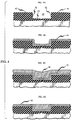
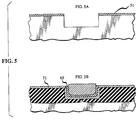
- FIGs. 4 and 5 are illustrative of fabrication procedures involved in the invention.
- a trench-filled large area dielectric with a specific configuration allows production of an essentially planar region while avoiding stray capacitance or undesired depletion effects.
- trench-filled is not used to denote fabrication sequence but merely to indicate appearance after fabrication is complete.
- it is possible to form the device by building the field oxide region, and then surrounding it by an active region or by first etching a trench and filling the trench with the appropriate field oxide region.
- a trench field oxide is a field oxide having less oxide above the substrate surface than field oxide below this surface.
- a buried conducting region 30 between dielectric regions 34 and 35 is present.
- the conducting region generally should have a cross-section in the range 20 nm to 200 nm measured along the direction perpendicular to the trench sidewall at the midpoint between the lowest point of the trench and the upper major surface of the silicon. Regions thinner than 20 nm are difficult to produce without pin holes or voids, while regions thicker than 200 nm tend to undesirably increase capacitance to the gate runner and/or require a significantly deeper trench.
- the resistivity of the region should be less than 0.1 ohm-cm. Resistivities more than 0.1 ohm-cm lead to the possibility of transitory charge accumulation and poor contact to the substrate.
- the resistivity, when the conducting region is polysilicon, is generally adjusted by introducing n- or p-type dopants such as boron, arsenic, antimony and/or phosphorus. (N-type dopants are typically used over an N-tub and p-type dopants over a p-tub.) Typically dopant concentrations in the range 10 16 to 10 21 cm 3 yield the desired resistivity. The presence of the conducting region along the sidewall is significant.
- Presence of this region along the trench bottom has a less significant effect and is not essential because the field produced by the electrical conductors does not cause leakage between active devices when there is a conductor region at the sidewalls.
- presence of a conducting region along the trench bottom although often desirable, is not essential.
- the thickness of the oxide, 35 , between the buried conductive layer and the trench walls should typically be in the range 10 to 50 nm. Additionally, the top edge, 39 , of the conducting region 30 should preferably be oxidized to avoid shorting between the conducting region and the gate interconnect. If a buried conducting region is employed, the upper region 34 of the field oxide should be sufficiently thick to avoid excessive parasitic capacitance in the gate interconnect, e.g. should not contribute more than 10% to parasitic capacitance. In practice, the conductive region is electrically connected such as at 37 to the tub region so that the conducting layer is maintained at the tub potential.
- connection is made by techniques such as etching of the thin oxide between the tub and the conducting region using standard lithographic techniques followed by formation of the conductive layer including the interconnection. In a CMOS device this connection is made preferably to 1) the p tub or to 2) both the p tub and n tub. Additionally, if connection is made to both tubs the conducting region should be broken (shown in phantom at 90 in FIG. 3).
- a buried conductive region is not employed.
- the surface of dielectric in this embodiment should be carefully controlled.
- the surface 41 of the dielectric e.g., field oxide
- the dopant level in the silicon active region should be at least 10 17 atoms/cm 3 at the silicon/field oxide interface.
- the active region is any region containing an active device such as a capacitor, transistor, diode and resistor. Since substantial non-planarities are not desirable, it is advantageous to not substantially exceed the 20 nm step requirement.
- the dielectric region, 21 or 34 should have a thickness generally in the range 100 nm to 1000 nm. Thicknesses less than 100 nm lead to excessive capacitance, while thicknesses greater than 1000 nm lead to difficulties in maintaining planarity.
- Suitable materials for the dielectric region e.g., field oxide, are thermal oxides, spin-on oxides and deposited oxides such as chemical vapor deposited oxides.
- FIG. 4 A convenient procedure for producing the embodiment shown in FIG. 3 is illustrated in FIG. 4.
- a trench 40 is etched in the desired location.
- the trench is positioned between the active devices within a tub and/or positioned between tubs 43 and 44 .
- This objective is achieved in one embodiment by conventional photolithography or by depositing a dielectric, e.g. oxide or nitride, along the trench sidewalls over the conductor by a process described in Sze, supra, Chapter 11.
- This dielectric is then used as a mask for etching all of the conductor at the trench bottom or is used to convert the conductor through processes such as oxidation to an insulator.
- the photolithography mask used to etch openings in the conductor between tubs at the bottom of the field oxide need not be employed if a silicon region containing no active devices, surrounded by field oxide, and overlying the boundary region between p and n tubs is present. This silicon region is definable during the original trench etching. In this configuration the conductive region need not be present at the sidewalls of the silicon region having no active devices.
- the depth of the trench should be in the range 100 nm to 1000 nm. Trenches shallower than 100 nm lead to excessive capacitance while trenches deeper than 1000 nm are inconvenient to etch.
- a dielectric material is then formed on the exposed surfaces 52 and 53. Generally, this material is a dielectric, or combination of dielectrics, such as a thermal oxide, deposited oxide, or a deposited dielectric, e.g. silicon nitride formed as described in VLSI Technology, 2nd Edition, Edited by S. M. Sze, McGraw Hill, 1988, Chapter 3. Surface 43 and 44 should also be protected by a dielectric such as the same dielectric that is found on the surface 52 and 53 .
- the dielectric material, 48 is then deposited as shown in 4C.
- a convenient method for producing this dielectric is by using spin-on glasses as described in U.S. Patent Application Serial No. 161,876, filed February 29, 1988 (Smolinsky and Ryan which is hereby incorporated by reference). A sufficient thickness of dielectric should be deposited so that the surface in region 48 is higher than the surface of the polysilicon in region 45 .
- a sacrificial layer sufficiently thick to planarize the oxide layer is then deposited.
- This sacrificial layer is advantageously photoresist material.
- the photoresist material is then etched utilizing plasma-assisted procedures and plasma compositions such as described in Sze, supra, Chapter 5. Etching is continued until sufficient oxide is removed to yield the configuration shown in FIG. 4D.
- the exposed polysilicon over the active region is removed, for example, by conventional reactive ion etching while retaining the polysilicon along the sidewalls and bottom of the field oxide area.
- the edge of the exposed polysilicon region at the top of the sidewall is then passivated, for example, by thermal oxidation.
- the field oxide layer of thickness approximately equal to the trench depth is deposited, e.g. by means of chemical vapor deposition, and photoresist or other radiation definable material is deposited on the oxide layer.
- This material is then delineated by conventional techniques.
- the pattern of delineation is carefully chosen. In particular, the pattern is the negative of the trench mask and this negative pattern is reduced on all edges by a distance of at least the thickness of the deposited oxide. (If after this reduction, two edges are separated by less than the lithographically minimum resolvable dimension, they are eliminated from the defined pattern.)
- the unmasked oxide is etched until the underlying polysilicon is exposed in the area overlying the active region.
- the polysilicon acts as an etch stop for common etchants such as a chlorofluorocarbon based plasmas used to etch the oxide. Therefore, overetching is not a problem.
- the result of this oxide etch is the production of notches in the field oxide. These notches have tapered edges along the trench faces and nearly vertical edges defined by the mask edges. These notches are relatively small. The widths of the resulting notches, measured at their top, vary depending on trench dimension from a minimum width equal to the oxide thickness to a maximum width equal to the minimum resolvable dimension of the lithographic tool plus two oxide thicknesses.
- the widths at the top of the notches range from approximately 0.5 ⁇ m to approximately 2.0 ⁇ m.
- the widths at the bottom of the notches range from approximately zero to 1.0 ⁇ m.
- At least one edge of each notch is tapered. Therefore after removal of the masking material a second deposition of oxide easily fills these notches without leaving voids or producing a significant nonplanarity in the resulting surface. Etching of this surface therefore easily produces a planar field oxide even for extremely large area field oxide regions.
- the polysilicon layer overlying the active region once again acts as a convenient etch stop and as a protector of the active regions. It is possible to remove the exposed polysilicon layer and to process the then exposed active area to produce active devices and interconnects. The removal of the exposed polysilicon also results in a desirable extension of the field oxide region extending above the plane of the active area.
- an etch stop 51 such as silicon nitride (or silicon nitride over an oxide) is blanket deposited and simultaneously etched with the underlying silicon leaving the configuration shown in 5A.
- An oxide is then produced along the trench walls by thermal oxidation.
- a polysilicon region and the dielectric region are formed by deposition.
- the field oxide region and the exposed polysilicon are then etched back as shown in 5B to expose the nitride region 51 . It is possible to then remove and passivate the edge 65 of the polysilicon by means of selective polysilicon etching and subsequent oxidation. (Subsequent nitride removal is also possible.)
- This alternative procedure for producing a buried conductive region has the advantage of ensuring that the field oxide layer extends above the silicon surface and the conducting layer is protected by an oxide.
- another embodiment involves forming a continuous field oxide over the surface of the substrate, etching regions in this continuous field oxide for the active regions, forming the sidewall conducting regions, and then using selective epitaxial processes to form the active region of silicon in the previously etched areas.
- a buried conductive region in a planar large area oxide is also useful in bipolar technology to prevent inversion below field oxide regions.
- the procedure described for forming such a region is essentially the same as those discussed in conjunction with CMOS technology.
- a silicon substrate (major surface in the 100 crystallographic plane) was processed.
- a thermal oxide ⁇ 35nm in thickness was grown on both major surfaces of the substrate using an oxygen ambient and a temperature of approximately 900°C.
- a silicon nitride layer approximately ⁇ 200nm in thickness was deposited on the thermally grown oxides utilizing low pressure chemical vapor deposition including a SiH 2 Cl 2 + NH 3 gas flow.
- a thin layer of oxide was then formed on the nitride through thermal oxidation at 900°C in oxygen. Regions were opened in a positive acting, near ultraviolet resist spun onto the active side of the wafer. These openings were at locations where the field oxide ultimately was to be formed. The exposure and development of the resist was done by conventional lithographic techniques.
- the uncovered regions of the thin oxide and underlying nitride were then etched utilizing a conventional reactive ion etching procedure with the plasma gas including 10 sccm of Freon 23 (CHF 3 ) and 90 sccm of O 2 . Etching through the nitride took approximately 4.2 minutes and an overetch was employed to ensure complete clearing. After etching the resist was removed.
- the plasma gas including 10 sccm of Freon 23 (CHF 3 ) and 90 sccm of O 2 .
- trenches were etched into the silicon wafer.
- the trench etching was done utilizing a plasma gas including 85 sccm of CFCl 3 16 sccm of Cl 2 and 90 sccm of Ar.
- the etching was continued until a depth of ⁇ 500nm was reached.
- the exposed surfaces of the trench were then oxidized in steam at 900°C for 8 minutes. This oxidation produced an oxide layer approximately ⁇ 50nm in thickness.
- To produce a clean, undamaged surface the grown oxide was removed by immersing the wafer in a 30 to 1 aqueous HF solution.
- An oxide was again grown on the trench walls utilizing an oxygen ambient and a temperature of 900°C. The oxidation was continued until an oxide thickness of ⁇ 25nm was obtained.
- the grown oxide was then cleaned by immersing for 30 seconds in a 100 to 1 aqueous HF solution.
- ⁇ 100nm of polysilicon was deposited by utilizing a low pressure chemical vapor deposition technique with silane as the precursor gas.
- a ⁇ 20nm thick silicon dioxide layer was formed on the polysilicon surface by oxidizing in oxygen at 900°C.
- a ⁇ 500nm layer of undoped silicon dioxide was then deposited by subjecting the wafer at a temperature of 750°C to an atmosphere of tetraethoxysilane together with a dry N 2 flow. All the silicon dioxide, except on the sidewalls of the trench, was removed by subjecting the wafer to a reactive ion etching atmosphere including 75 sccm of CHF 3 and 12 sccm of O 2 for 12.5 min with a short overetch.
- the exposed regions of the polysilicon were removed utilizing a plasma struck in molecular chlorine. The etching was continued until the polysilicon was removed. To form the field oxide region, 1 ⁇ m of silicon dioxide was deposited utilizing the tetraethoxysilane low pressure chemical vapor deposition process previously described. The structure was then planarized by polishing using simultaneous mechanical and chemical polishing.
- Cross-sectional transmission electron microscopy of the resulting structure showed an essentially planar substrate having a buried field oxide and a conducting region separated from the trench sidewalls by a thin oxide.
Landscapes
- Element Separation (AREA)
- Bipolar Transistors (AREA)
- Insulated Gate Type Field-Effect Transistor (AREA)
Applications Claiming Priority (3)
| Application Number | Priority Date | Filing Date | Title |
|---|---|---|---|
| US38747889A | 1989-07-28 | 1989-07-28 | |
| US387478 | 1989-07-28 | ||
| EP90307846A EP0410633B1 (de) | 1989-07-28 | 1990-07-18 | Planare Isoliertechnik für integrierte Schaltungen |
Related Parent Applications (1)
| Application Number | Title | Priority Date | Filing Date |
|---|---|---|---|
| EP90307846A Division EP0410633B1 (de) | 1989-07-28 | 1990-07-18 | Planare Isoliertechnik für integrierte Schaltungen |
Publications (3)
| Publication Number | Publication Date |
|---|---|
| EP1143505A2 true EP1143505A2 (de) | 2001-10-10 |
| EP1143505A3 EP1143505A3 (de) | 2001-11-07 |
| EP1143505B1 EP1143505B1 (de) | 2006-09-13 |
Family
ID=23530045
Family Applications (2)
| Application Number | Title | Priority Date | Filing Date |
|---|---|---|---|
| EP01202722A Expired - Lifetime EP1143505B1 (de) | 1989-07-28 | 1990-07-18 | Planare Isoliertechnik für integrierte Schaltungen |
| EP90307846A Expired - Lifetime EP0410633B1 (de) | 1989-07-28 | 1990-07-18 | Planare Isoliertechnik für integrierte Schaltungen |
Family Applications After (1)
| Application Number | Title | Priority Date | Filing Date |
|---|---|---|---|
| EP90307846A Expired - Lifetime EP0410633B1 (de) | 1989-07-28 | 1990-07-18 | Planare Isoliertechnik für integrierte Schaltungen |
Country Status (6)
| Country | Link |
|---|---|
| US (1) | US5373180A (de) |
| EP (2) | EP1143505B1 (de) |
| JP (1) | JPH0366145A (de) |
| KR (1) | KR940004995B1 (de) |
| CA (1) | CA2016449C (de) |
| DE (2) | DE69034048T2 (de) |
Families Citing this family (5)
| Publication number | Priority date | Publication date | Assignee | Title |
|---|---|---|---|---|
| WO1996002070A2 (en) * | 1994-07-12 | 1996-01-25 | National Semiconductor Corporation | Integrated circuit comprising a trench isolation structure and an oxygen barrier layer and method for forming the integrated circuit |
| JP3904676B2 (ja) | 1997-04-11 | 2007-04-11 | 株式会社ルネサステクノロジ | トレンチ型素子分離構造の製造方法およびトレンチ型素子分離構造 |
| US6472335B1 (en) * | 1998-10-19 | 2002-10-29 | Taiwan Semiconductor Manufacturing Company | Methods of adhesion promoter between low-K layer and underlying insulating layer |
| JP2004172310A (ja) * | 2002-11-19 | 2004-06-17 | Renesas Technology Corp | 半導体装置の製造方法 |
| KR100618698B1 (ko) * | 2004-06-21 | 2006-09-08 | 주식회사 하이닉스반도체 | 반도체 소자 및 그의 제조방법 |
Family Cites Families (11)
| Publication number | Priority date | Publication date | Assignee | Title |
|---|---|---|---|---|
| JPS598353A (ja) * | 1982-07-07 | 1984-01-17 | Nec Corp | 半導体集積回路装置 |
| JPS59217339A (ja) * | 1983-05-26 | 1984-12-07 | Toshiba Corp | 半導体装置の製造方法 |
| JPS6132544A (ja) * | 1984-07-25 | 1986-02-15 | Matsushita Electric Ind Co Ltd | 半導体集積回路装置の製造方法 |
| US4571819A (en) * | 1984-11-01 | 1986-02-25 | Ncr Corporation | Method for forming trench isolation structures |
| JPS61271854A (ja) * | 1985-05-27 | 1986-12-02 | Nec Corp | 半導体素子分離構造及びその製造方法 |
| US4825278A (en) * | 1985-10-17 | 1989-04-25 | American Telephone And Telegraph Company At&T Bell Laboratories | Radiation hardened semiconductor devices |
| US4704368A (en) * | 1985-10-30 | 1987-11-03 | International Business Machines Corporation | Method of making trench-incorporated monolithic semiconductor capacitor and high density dynamic memory cells including the capacitor |
| JPH0616556B2 (ja) * | 1987-04-14 | 1994-03-02 | 株式会社東芝 | 半導体装置 |
| JPH01125935A (ja) * | 1987-11-11 | 1989-05-18 | Seiko Instr & Electron Ltd | 半導体装置の製造方法 |
| JPH01138730A (ja) * | 1987-11-25 | 1989-05-31 | Fujitsu Ltd | 半導体装置 |
| JPH0797627B2 (ja) * | 1987-12-21 | 1995-10-18 | 株式会社日立製作所 | 半導体装置 |
-
1990
- 1990-05-10 CA CA002016449A patent/CA2016449C/en not_active Expired - Lifetime
- 1990-07-18 DE DE69034048T patent/DE69034048T2/de not_active Expired - Lifetime
- 1990-07-18 EP EP01202722A patent/EP1143505B1/de not_active Expired - Lifetime
- 1990-07-18 DE DE69034230T patent/DE69034230T2/de not_active Expired - Lifetime
- 1990-07-18 EP EP90307846A patent/EP0410633B1/de not_active Expired - Lifetime
- 1990-07-25 KR KR1019900011298A patent/KR940004995B1/ko not_active Expired - Lifetime
- 1990-07-27 JP JP2201056A patent/JPH0366145A/ja active Pending
-
1993
- 1993-09-14 US US08/121,082 patent/US5373180A/en not_active Expired - Lifetime
Also Published As
| Publication number | Publication date |
|---|---|
| EP0410633A2 (de) | 1991-01-30 |
| KR910003782A (ko) | 1991-02-28 |
| DE69034230D1 (de) | 2006-10-26 |
| CA2016449C (en) | 1996-06-25 |
| EP0410633B1 (de) | 2003-03-12 |
| DE69034230T2 (de) | 2007-09-13 |
| EP1143505B1 (de) | 2006-09-13 |
| US5373180A (en) | 1994-12-13 |
| CA2016449A1 (en) | 1991-01-28 |
| JPH0366145A (ja) | 1991-03-20 |
| EP1143505A3 (de) | 2001-11-07 |
| DE69034048T2 (de) | 2003-12-24 |
| DE69034048D1 (de) | 2003-04-17 |
| KR940004995B1 (ko) | 1994-06-09 |
| EP0410633A3 (en) | 1991-02-27 |
Similar Documents
| Publication | Publication Date | Title |
|---|---|---|
| US4549927A (en) | Method of selectively exposing the sidewalls of a trench and its use to the forming of a metal silicide substrate contact for dielectric filled deep trench isolated devices | |
| US5915195A (en) | Ion implantation process to improve the gate oxide quality at the edge of a shallow trench isolation structure | |
| US6033980A (en) | Method of forming submicron contacts and vias in an integrated circuit | |
| US6828205B2 (en) | Method using wet etching to trim a critical dimension | |
| US4563227A (en) | Method for manufacturing a semiconductor device | |
| US4419813A (en) | Method for fabricating semiconductor device | |
| US5930620A (en) | Resistance to gate dielectric breakdown at the edges of shallow trench isolation structures | |
| US6180517B1 (en) | Method of forming submicron contacts and vias in an integrated circuit | |
| US6579801B1 (en) | Method for enhancing shallow trench top corner rounding using endpoint control of nitride layer etch process with appropriate etch front | |
| EP0600149B1 (de) | Verfahren zur Herstellung eines selbstausrichtenden statischen Induktionsthyristors | |
| EP0526244B1 (de) | Verfahren zur Herstellung eines vergrabenen Kontaktes aus Polysilizium | |
| US5373180A (en) | Planar isolation technique for integrated circuits | |
| US6399432B1 (en) | Process to control poly silicon profiles in a dual doped poly silicon process | |
| US5449627A (en) | Lateral bipolar transistor and FET compatible process for making it | |
| EP0239384B1 (de) | Verfahren zur Isolierung von Halbleiteranordnungen in einem Substrat | |
| US6235609B1 (en) | Method for forming isolation areas with improved isolation oxide | |
| US5998302A (en) | Method of manufacturing semiconductor device | |
| US6383937B1 (en) | Method of fabricating a silicon island | |
| US6417033B1 (en) | Method of fabricating a silicon island | |
| US12255200B1 (en) | Trench isolation structures with varying depths and method of forming the same | |
| US20240429275A1 (en) | Deep trench isolation with field oxide | |
| KR940004252B1 (ko) | 로컬폴리 산화물을 이용한 격리의 제조방법 | |
| KR0158619B1 (ko) | 반도체 소자의 필드 산화막 제조방법 | |
| JPH0576186B2 (de) | ||
| KR20020051669A (ko) | 반도체 소자의 제조방법 |
Legal Events
| Date | Code | Title | Description |
|---|---|---|---|
| PUAI | Public reference made under article 153(3) epc to a published international application that has entered the european phase |
Free format text: ORIGINAL CODE: 0009012 |
|
| PUAL | Search report despatched |
Free format text: ORIGINAL CODE: 0009013 |
|
| 17P | Request for examination filed |
Effective date: 20010717 |
|
| AC | Divisional application: reference to earlier application |
Ref document number: 410633 Country of ref document: EP |
|
| AK | Designated contracting states |
Kind code of ref document: A2 Designated state(s): DE FR GB NL |
|
| AK | Designated contracting states |
Kind code of ref document: A3 Designated state(s): DE FR GB NL |
|
| RIC1 | Information provided on ipc code assigned before grant |
Free format text: 7H 01L 21/76 A, 7H 01L 21/762 B |
|
| RIN1 | Information on inventor provided before grant (corrected) |
Inventor name: MANCHANDA, LALITA Inventor name: HILLENIUS, STEVEN J. Inventor name: VAIDYA, SHIELA Inventor name: LYNCH, WILLIAM THOMAS Inventor name: PINTO, MARK RICHARD |
|
| AKX | Designation fees paid |
Free format text: DE FR GB NL |
|
| 17Q | First examination report despatched |
Effective date: 20040225 |
|
| GRAP | Despatch of communication of intention to grant a patent |
Free format text: ORIGINAL CODE: EPIDOSNIGR1 |
|
| GRAS | Grant fee paid |
Free format text: ORIGINAL CODE: EPIDOSNIGR3 |
|
| GRAA | (expected) grant |
Free format text: ORIGINAL CODE: 0009210 |
|
| AC | Divisional application: reference to earlier application |
Ref document number: 0410633 Country of ref document: EP Kind code of ref document: P |
|
| AK | Designated contracting states |
Kind code of ref document: B1 Designated state(s): DE FR GB NL |
|
| PG25 | Lapsed in a contracting state [announced via postgrant information from national office to epo] |
Ref country code: NL Free format text: LAPSE BECAUSE OF FAILURE TO SUBMIT A TRANSLATION OF THE DESCRIPTION OR TO PAY THE FEE WITHIN THE PRESCRIBED TIME-LIMIT Effective date: 20060913 |
|
| REG | Reference to a national code |
Ref country code: GB Ref legal event code: FG4D |
|
| REF | Corresponds to: |
Ref document number: 69034230 Country of ref document: DE Date of ref document: 20061026 Kind code of ref document: P |
|
| NLV1 | Nl: lapsed or annulled due to failure to fulfill the requirements of art. 29p and 29m of the patents act | ||
| ET | Fr: translation filed | ||
| PLBE | No opposition filed within time limit |
Free format text: ORIGINAL CODE: 0009261 |
|
| STAA | Information on the status of an ep patent application or granted ep patent |
Free format text: STATUS: NO OPPOSITION FILED WITHIN TIME LIMIT |
|
| 26N | No opposition filed |
Effective date: 20070614 |
|
| PGFP | Annual fee paid to national office [announced via postgrant information from national office to epo] |
Ref country code: FR Payment date: 20090716 Year of fee payment: 20 |
|
| PGFP | Annual fee paid to national office [announced via postgrant information from national office to epo] |
Ref country code: GB Payment date: 20090720 Year of fee payment: 20 Ref country code: DE Payment date: 20090722 Year of fee payment: 20 |
|
| REG | Reference to a national code |
Ref country code: GB Ref legal event code: PE20 Expiry date: 20100717 |
|
| PG25 | Lapsed in a contracting state [announced via postgrant information from national office to epo] |
Ref country code: GB Free format text: LAPSE BECAUSE OF EXPIRATION OF PROTECTION Effective date: 20100717 |
|
| PG25 | Lapsed in a contracting state [announced via postgrant information from national office to epo] |
Ref country code: DE Free format text: LAPSE BECAUSE OF EXPIRATION OF PROTECTION Effective date: 20100718 |