EP1154585A1 - Récepteur pour un dispositif de communication pour un canal radio à multi-voies - Google Patents
Récepteur pour un dispositif de communication pour un canal radio à multi-voies Download PDFInfo
- Publication number
- EP1154585A1 EP1154585A1 EP00110027A EP00110027A EP1154585A1 EP 1154585 A1 EP1154585 A1 EP 1154585A1 EP 00110027 A EP00110027 A EP 00110027A EP 00110027 A EP00110027 A EP 00110027A EP 1154585 A1 EP1154585 A1 EP 1154585A1
- Authority
- EP
- European Patent Office
- Prior art keywords
- signals
- arrangement
- receiver
- receiver arrangement
- less
- Prior art date
- Legal status (The legal status is an assumption and is not a legal conclusion. Google has not performed a legal analysis and makes no representation as to the accuracy of the status listed.)
- Granted
Links
Images




Classifications
-
- H—ELECTRICITY
- H04—ELECTRIC COMMUNICATION TECHNIQUE
- H04B—TRANSMISSION
- H04B1/00—Details of transmission systems, not covered by a single one of groups H04B3/00 - H04B13/00; Details of transmission systems not characterised by the medium used for transmission
- H04B1/69—Spread spectrum techniques
- H04B1/707—Spread spectrum techniques using direct sequence modulation
- H04B1/7097—Interference-related aspects
- H04B1/711—Interference-related aspects the interference being multi-path interference
- H04B1/7115—Constructive combining of multi-path signals, i.e. RAKE receivers
-
- H—ELECTRICITY
- H04—ELECTRIC COMMUNICATION TECHNIQUE
- H04B—TRANSMISSION
- H04B1/00—Details of transmission systems, not covered by a single one of groups H04B3/00 - H04B13/00; Details of transmission systems not characterised by the medium used for transmission
- H04B1/69—Spread spectrum techniques
- H04B1/707—Spread spectrum techniques using direct sequence modulation
- H04B1/709—Correlator structure
Definitions
- the present invention relates to a receiver, in particular a Code Division Multiple Access (CDMA) receiver, for a, in particular mobile, communication device.
- CDMA Code Division Multiple Access
- a (mobile) communication device in particular a mobile communication device having a Code Division Multiple Access (CDMA) receiver, may be allocated to a base station.
- the mobile communication device When the mobile communication device is allocated to the base station, the mobile communication device will, due to reflections, receive multi-path components of a signal sent by the base station.
- a known receiver for receiving multi-path signals from a base station comprises a correlator for correlating the identification signal of the base station with locally generated signals and an hypothesis algorithm judging whether the time delay of the locally generated signal matches the delay time of a multi-path component in the received identification signal.
- a receiver of higher performance may be found in Viterbi, Andrew, "Principles of Spread Spectrum Communications", Addison-Wesley Publishing Company 1995, disclosing a multiple dual series search acquisition scheme.
- Such a multiple dual series search acquisition scheme comprises both a correlator for correlating an identification signal received from the base station and an additional hypothesis testing.
- a known receiver architecture for CDMA mobile systems is the rake receiver. See Price, R. et al., "A Communication Technique for Multipath Channels," Proceedings of the IRE, 1958, vol. 46, pp. 555-570.
- a rake receiver consists of a bank of correlation-type receivers or correlators. Each correlator of the bank of correlators is used to detect a separate multi-path component.
- Such a receiver arrangement or mobile communication device comprises
- the object of the present invention is further achieved by a method for operating a receiver arrangement by receiving an identification signal and obtaining m correlated signals by correlating the identification signal with m locally generated signals, which are time delayed from each other, and identifying j correlated signals of highest power out of the m correlated signals.
- the object of the present invention is further achieved by a method for operating a receiver arrangement, by
- the receiver arrangement is a Code Division Multiple Access, CDMA, receiver, in particular a rake receiver.
- CDMA Code Division Multiple Access
- the delay time is less than 20 ⁇ s.
- m is less than 100, in particular about 80.
- j is grater than 5 and less than m/2, in particular less than 30.
- j is less than 20.
- the receiver arrangement comprises an evaluation arrangement for selecting n correlated signals out of the j correlated signals of highest power, wherein n is less than or equal j.
- the receiver arrangement which is capable of receiving an information signal, comprises a delay arrangement for obtaining n or less delayed information signals by delaying the information signal by delay times which correspond to the n selected correlated signals.
- the receiver arrangement comprises a summation arrangement for adding the n or less delayed information signals or adding the n or less delayed information signals and the information signal.
- the communication device is preferably a mobile communication device, in particular a mobile phone or mobile computer.
- the communication device may also be part of a wireless building communications system.
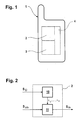
- FIG. 1 shows a mobile communication device 1.
- the mobile communication device 1 is in the present embodiment a mobile phone for a European Telecommunications Standard Institute system or Universal Mobile Telecommunications system, an Association of radio Industries and Businesses Wideband Code Division Multiple Access communications system, and/or a Wideband Code Division Multiple Access system being defined by 3 rd Generation Partnership Project communications system.
- the mobile communication device 1 may be a multi-mode mobile station, capable of operating, for example in a Global System for Mobile Telecommunications (GSM) system as well as a UMTS system.
- GSM Global System for Mobile Telecommunications
- UMTS Universal Mobile Telecommunications
- the mobile communication device 1 comprises the receiver arrangement 2 and processing means 3.
- the receiver arrangement 2 receives signals from a base station (not shown).
- the processing means 3 among many other tasks, proces signals received from the receiver arrangement 2.
- the mobile communication device 1 may further comprise additional circuitry, filter means, processing means, storage means, man machine interfaces and so on which are denoted by reference number 4.
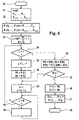
- FIG. 2 shows the receiver arrangement 2 in more detail.
- the receiver arrangement 2 comprises a multi-path identification arrangement 10 which determines time delays ⁇ 1 , Vietnamese, ⁇ n based upon an identification signal S ID received from the base station. Due to reflections and different travels of the signal sent by the base station the identification signal S ID comprises time delayed versions of the signal originally sent from the base station.
- the receiver arrangement 2 further comprises a descrambling arrangement descrambling an information signal S info originating from the base station based upon the time delays ⁇ 1 , ...., ⁇ n provided by the multi-path identification arrangement.
- the output of the descrambling arrangement 11 is a signal S de which is further processed by the processor means 3.
- the information signal S info carries user information such as speech, email or internet information.
- FIG. 3 discloses the multi-path identification arrangement 10 in more detail.
- the multi-path identification arrangement comprises a signal generator 22 for generating locally generated signals S L1 , Vietnamese, S Lm having essentially the same information content as the identification signal S ID of the base station.
- the locally generated signals S L1 , ...., S Lm are timed delayed from each other by a delay between 100ns and 300ns. In the current embodiment the delay is 130ns. m is preferably less than 100. Preferably it is about 80. In the current embodiment m is 77.
- the largest absolute delay time of a locally generated signal S L1 , ...., S Lm is preferably between 10 ⁇ s and 20 ⁇ s.
- the multi-path identification arrangement further comprises a correlator 20 for correlating the identification signal S ID with the locally generated signals S L1 , ...., S Lm.
- the correlation can be carried out serial or in parallel or in a combination of both methods. All three possibilities are within the scopes of the claims. If the correlation is carried out in parallel correlator 20 comprises m subcorrelators 201, 202 and 203 as indicated in FIG. 4.
- the outputs of the correlator 20 are correlated signals S C1 ,.... S Cm . They are inputs to a first filter 21 removing noise from the signals.
- the output signals of the filter are denoted with S CF1 , ...., S CFm. These signals are fed into a ranking arrangement 23 which is shown in more detail in FIG.
- the ranking arrangement 23 identifies the j signals S R1 , ...., S Rj of highest power out of the m correlated signals S CF1 , ...., S CFm .
- the signals of highest power S R1 , .... , S Rj are outputs of the ranking arrangement 23 and inputs to a second filter 24.
- the second filter 24 is preferably a more complex filter than the first filter 21.
- the output signals S RF1 , ... , S RFj of the second filter 24 are fed into an evaluation arrangement 25.
- the evaluation arrangement 25 determines the delay times ⁇ 1 ...., ⁇ n .
- the hypothesis test is preferably a likelihood ratio test which is for example disclosed in K. Sam Shanmugan and A.M. Breipohl "Random signals, the detection estimation and data analysis" John Wiley and Sons, 1988.
- the evaluation arrangement 25 also generates control parameters c ⁇ 1 , ...., c ⁇ n for controlling the signal generator 22.
- FIG. 5 discloses the ranking arrangement 23 in more detail.
- the ranking arrangement 23 comprises a power detector 26 detecting the power P 1 , ...., P m of the signals S CF1 , across , S CFm .
- the values for P 1 , .... , P m as well as the signals S CF1 , Vietnamese , S CFm are fed into a ranking filter 27.
- the ranking filter 27 determines j signals S R1 , Vietnamese, S CFm .
- a preferred embodiment of the ranking filter 27 is shown in FIG. 6 in terms of a flow chart.
- a step 31 is carried out reading the values of P 1 , Vietnamese, P m and the signals S CF1 , .... , S CFm .
- Step 38 is followed by decision block 39 checking whether R is equal to 1. If this condition is not fulfilled decision block 39 is followed by a step 37.
- Step 37 is followed by decision block 43 checking whether J is greater than R. If this decision is not fulfilled decision block 43 is followed by decision block 34. If however this decision is fulfilled, decision block 43 is followed by a step 44. Step 44 is shown in more detail in FIG. 7. Step 44 is followed by decision block 43.
- Step 51 is followed by a decision block 52.
- decision block 50 is followed by decision block 52 checking whether PO > P(J)
- Step 55 is followed by decision block 43.
- Step 53 is followed by a decision block 43.
- FIG. 8 shows the descrambling arrangement 11 in more detail.
- the descrambling arrangement 8 comprises a delay arrangement 50 delaying the information signal S info by the delay times ⁇ 1 , ...., ⁇ n to obtain delayed information signals S info1 , ...., S infon of the information signal S info respectively.
- the delayed information signals S info1 , Vietnamese, S infon are added by a summation arrangement 51.
- the output of the summation point 31 is signal S de which is the sum of S info1 , ...., S infon .
- the method or communication device may be used in an European Telecommunications Standard Institute (ETSI) or Universal Mobile Telecommunications System (UMTS), an Association of Radio Industries and Businesses (ARIB) Wideband Code Division Multiple Access (WCDMA) system, or a Wideband Code Division Multiple Access (WCDMA) system being defined by 3 rd Generation Partnership Project (3GPP) system.
- ETSI European Telecommunications Standard Institute
- UMTS Universal Mobile Telecommunications System
- ARIB Association of Radio Industries and Businesses
- WCDMA Wideband Code Division Multiple Access
- WCDMA Wideband Code Division Multiple Access
- 3GPP 3 rd Generation Partnership Project
- the present invention may be applied to various frequency bands.
- the present invention may be applied for monitoring in other types of mobile communication systems than those described herein.
Landscapes
- Engineering & Computer Science (AREA)
- Computer Networks & Wireless Communication (AREA)
- Signal Processing (AREA)
- Mobile Radio Communication Systems (AREA)
Priority Applications (3)
| Application Number | Priority Date | Filing Date | Title |
|---|---|---|---|
| EP20000110027 EP1154585B1 (fr) | 2000-05-12 | 2000-05-12 | Récepteur pour un dispositif de communication pour un canal radio à multi-voies |
| DK00110027T DK1154585T3 (da) | 2000-05-12 | 2000-05-12 | Modtager til en kommunikationsindretning for en flervejsradiokanal |
| DE2000638163 DE60038163T2 (de) | 2000-05-12 | 2000-05-12 | Empfänger für eine Kommunikationseinrichtung für einen Mehrwegfunkkanal |
Applications Claiming Priority (1)
| Application Number | Priority Date | Filing Date | Title |
|---|---|---|---|
| EP20000110027 EP1154585B1 (fr) | 2000-05-12 | 2000-05-12 | Récepteur pour un dispositif de communication pour un canal radio à multi-voies |
Publications (2)
| Publication Number | Publication Date |
|---|---|
| EP1154585A1 true EP1154585A1 (fr) | 2001-11-14 |
| EP1154585B1 EP1154585B1 (fr) | 2008-02-27 |
Family
ID=8168683
Family Applications (1)
| Application Number | Title | Priority Date | Filing Date |
|---|---|---|---|
| EP20000110027 Revoked EP1154585B1 (fr) | 2000-05-12 | 2000-05-12 | Récepteur pour un dispositif de communication pour un canal radio à multi-voies |
Country Status (3)
| Country | Link |
|---|---|
| EP (1) | EP1154585B1 (fr) |
| DE (1) | DE60038163T2 (fr) |
| DK (1) | DK1154585T3 (fr) |
Cited By (3)
| Publication number | Priority date | Publication date | Assignee | Title |
|---|---|---|---|---|
| GB2375024A (en) * | 2001-01-15 | 2002-10-30 | Nec Corp | CDMA receiver divides a delay profile into regions and meaures the power in each region, with regions of higher power being measured more frequently |
| EP1672808A1 (fr) * | 2004-12-20 | 2006-06-21 | Telefonaktiebolaget L M Ericsson (Publ) | Sélection des valeurs de retard pour un récepteur du type RAKE |
| WO2006066765A1 (fr) * | 2004-12-20 | 2006-06-29 | Telefonaktiebolaget Lm Ericsson (Publ) | Selection de valeurs de retard de cretes pour un recepteur en rateau |
Citations (2)
| Publication number | Priority date | Publication date | Assignee | Title |
|---|---|---|---|---|
| US5280472A (en) * | 1990-12-07 | 1994-01-18 | Qualcomm Incorporated | CDMA microcellular telephone system and distributed antenna system therefor |
| WO1996010873A1 (fr) * | 1994-09-30 | 1996-04-11 | Qualcomm Incorporated | Processeur de recherche multivoie pour systeme de communication a acces multiple a etalement de spectre |
-
2000
- 2000-05-12 DK DK00110027T patent/DK1154585T3/da active
- 2000-05-12 DE DE2000638163 patent/DE60038163T2/de not_active Expired - Lifetime
- 2000-05-12 EP EP20000110027 patent/EP1154585B1/fr not_active Revoked
Patent Citations (2)
| Publication number | Priority date | Publication date | Assignee | Title |
|---|---|---|---|---|
| US5280472A (en) * | 1990-12-07 | 1994-01-18 | Qualcomm Incorporated | CDMA microcellular telephone system and distributed antenna system therefor |
| WO1996010873A1 (fr) * | 1994-09-30 | 1996-04-11 | Qualcomm Incorporated | Processeur de recherche multivoie pour systeme de communication a acces multiple a etalement de spectre |
Cited By (5)
| Publication number | Priority date | Publication date | Assignee | Title |
|---|---|---|---|---|
| GB2375024A (en) * | 2001-01-15 | 2002-10-30 | Nec Corp | CDMA receiver divides a delay profile into regions and meaures the power in each region, with regions of higher power being measured more frequently |
| GB2375024B (en) * | 2001-01-15 | 2003-04-16 | Nec Corp | CDMA receiver,method of operation and program therefor |
| US7254162B2 (en) | 2001-01-15 | 2007-08-07 | Nec Corporation | CDMA receiver performing a path search, path search method, and program therefor |
| EP1672808A1 (fr) * | 2004-12-20 | 2006-06-21 | Telefonaktiebolaget L M Ericsson (Publ) | Sélection des valeurs de retard pour un récepteur du type RAKE |
| WO2006066765A1 (fr) * | 2004-12-20 | 2006-06-29 | Telefonaktiebolaget Lm Ericsson (Publ) | Selection de valeurs de retard de cretes pour un recepteur en rateau |
Also Published As
| Publication number | Publication date |
|---|---|
| DE60038163D1 (de) | 2008-04-10 |
| DE60038163T2 (de) | 2009-03-26 |
| DK1154585T3 (da) | 2008-06-23 |
| EP1154585B1 (fr) | 2008-02-27 |
Similar Documents
| Publication | Publication Date | Title |
|---|---|---|
| US6222834B1 (en) | Spread spectrum communication receiver | |
| EP0654913A2 (fr) | Méthode de synchronisation pour signaux pseudo-aléatoires | |
| US7050484B2 (en) | Method of detecting path timings and CDMA receiving apparatus using the same | |
| US6895036B2 (en) | Apparatus and method for sub-chip offset correlation in spread-spectrum communication systems | |
| KR20030085090A (ko) | 고속 광대역-코드 분할 다중 액세스 획득 방법 및 장치 | |
| US7609785B2 (en) | Mitigation of interference in cell search by wireless transmit and receive units | |
| US7039097B2 (en) | CDMA receiver, path search method and program | |
| KR101032333B1 (ko) | 다중 경로 탐색 | |
| KR100197352B1 (ko) | 기준 정합여파기를 이용한 병렬포착시스템 | |
| US7194018B2 (en) | Apparatus for searching multipath in spread spectrum communications system and method thereof | |
| KR100381877B1 (ko) | 주변 기지국들과 동기를 확립할 수 있는 cdma 기저대역 수신기 | |
| FI104020B (fi) | Vastaanottomenetelmä ja vastaanotin | |
| EP1154585B1 (fr) | Récepteur pour un dispositif de communication pour un canal radio à multi-voies | |
| US20020110103A1 (en) | Apparatus for searching a signal in mobile communication system and method thereof | |
| US7359399B2 (en) | CDMA path protection method based on path protection information | |
| EP1148657A2 (fr) | Appareil de demodulation et procédé de demodulation pour communication mobile | |
| EP1443672A2 (fr) | Procédé, appareil et programme de détermination de chemins | |
| KR101015411B1 (ko) | 확산-스펙트럼 수신기를 위한 동기화 전략 및 구조 | |
| EP1391999A1 (fr) | Procédé et appareil de recherche de cellule et de synchronisation pour un systeme WCDMA | |
| US6765951B2 (en) | Method for estimating the channel impulse response of a mobile radio channel | |
| JP4142259B2 (ja) | Rake受信装置およびその方法 | |
| EP1146657A1 (fr) | Station mobile et procédé d'attribution de derivations rake | |
| CN111446983B (zh) | 多径搜索器、小区搜索装置及小区搜索方法 | |
| KR100399008B1 (ko) | 광대역 직접 시퀀스 코드분할다중접속 수신신호에 대한코드획득수신기 | |
| KR100426564B1 (ko) | 직접 시퀀스 코드분할다중접속 수신신호에 대한 코드획득수신장치 |
Legal Events
| Date | Code | Title | Description |
|---|---|---|---|
| PUAI | Public reference made under article 153(3) epc to a published international application that has entered the european phase |
Free format text: ORIGINAL CODE: 0009012 |
|
| AK | Designated contracting states |
Kind code of ref document: A1 Designated state(s): AT BE CH CY DE DK ES FI FR GB GR IE IT LI LU MC NL PT SE Kind code of ref document: A1 Designated state(s): DE DK FR GB IT SE |
|
| AX | Request for extension of the european patent |
Free format text: AL;LT;LV;MK;RO;SI |
|
| 17P | Request for examination filed |
Effective date: 20020514 |
|
| AKX | Designation fees paid |
Free format text: DE DK FR GB IT SE |
|
| 17Q | First examination report despatched |
Effective date: 20070206 |
|
| RAP1 | Party data changed (applicant data changed or rights of an application transferred) |
Owner name: IPCOM GMBH & CO. KG |
|
| GRAP | Despatch of communication of intention to grant a patent |
Free format text: ORIGINAL CODE: EPIDOSNIGR1 |
|
| GRAS | Grant fee paid |
Free format text: ORIGINAL CODE: EPIDOSNIGR3 |
|
| GRAA | (expected) grant |
Free format text: ORIGINAL CODE: 0009210 |
|
| AK | Designated contracting states |
Kind code of ref document: B1 Designated state(s): DE DK FR GB IT SE |
|
| REG | Reference to a national code |
Ref country code: GB Ref legal event code: FG4D |
|
| REF | Corresponds to: |
Ref document number: 60038163 Country of ref document: DE Date of ref document: 20080410 Kind code of ref document: P |
|
| REG | Reference to a national code |
Ref country code: SE Ref legal event code: TRGR |
|
| REG | Reference to a national code |
Ref country code: DK Ref legal event code: T3 |
|
| ET | Fr: translation filed | ||
| PLBI | Opposition filed |
Free format text: ORIGINAL CODE: 0009260 |
|
| PLAX | Notice of opposition and request to file observation + time limit sent |
Free format text: ORIGINAL CODE: EPIDOSNOBS2 |
|
| 26 | Opposition filed |
Opponent name: NOKIA CORPORATOIN Effective date: 20081127 |
|
| PLAF | Information modified related to communication of a notice of opposition and request to file observations + time limit |
Free format text: ORIGINAL CODE: EPIDOSCOBS2 |
|
| PLAB | Opposition data, opponent's data or that of the opponent's representative modified |
Free format text: ORIGINAL CODE: 0009299OPPO |
|
| PLBB | Reply of patent proprietor to notice(s) of opposition received |
Free format text: ORIGINAL CODE: EPIDOSNOBS3 |
|
| PLAF | Information modified related to communication of a notice of opposition and request to file observations + time limit |
Free format text: ORIGINAL CODE: EPIDOSCOBS2 |
|
| RDAF | Communication despatched that patent is revoked |
Free format text: ORIGINAL CODE: EPIDOSNREV1 |
|
| APBM | Appeal reference recorded |
Free format text: ORIGINAL CODE: EPIDOSNREFNO |
|
| APBP | Date of receipt of notice of appeal recorded |
Free format text: ORIGINAL CODE: EPIDOSNNOA2O |
|
| APAH | Appeal reference modified |
Free format text: ORIGINAL CODE: EPIDOSCREFNO |
|
| APBQ | Date of receipt of statement of grounds of appeal recorded |
Free format text: ORIGINAL CODE: EPIDOSNNOA3O |
|
| PLAB | Opposition data, opponent's data or that of the opponent's representative modified |
Free format text: ORIGINAL CODE: 0009299OPPO |
|
| R26 | Opposition filed (corrected) |
Opponent name: NOKIA CORPORATION Effective date: 20081127 |
|
| APBY | Invitation to file observations in appeal sent |
Free format text: ORIGINAL CODE: EPIDOSNOBA2O |
|
| APCA | Receipt of observations in appeal recorded |
Free format text: ORIGINAL CODE: EPIDOSNOBA4O |
|
| PLAB | Opposition data, opponent's data or that of the opponent's representative modified |
Free format text: ORIGINAL CODE: 0009299OPPO |
|
| R26 | Opposition filed (corrected) |
Opponent name: MICROSOFT MOBILE OY Effective date: 20081127 |
|
| REG | Reference to a national code |
Ref country code: FR Ref legal event code: PLFP Year of fee payment: 17 |
|
| PGFP | Annual fee paid to national office [announced via postgrant information from national office to epo] |
Ref country code: GB Payment date: 20160523 Year of fee payment: 17 Ref country code: DE Payment date: 20160531 Year of fee payment: 17 |
|
| PGFP | Annual fee paid to national office [announced via postgrant information from national office to epo] |
Ref country code: IT Payment date: 20160524 Year of fee payment: 17 Ref country code: DK Payment date: 20160523 Year of fee payment: 17 Ref country code: SE Payment date: 20160523 Year of fee payment: 17 Ref country code: FR Payment date: 20160523 Year of fee payment: 17 |
|
| REG | Reference to a national code |
Ref country code: DE Ref legal event code: R064 Ref document number: 60038163 Country of ref document: DE Ref country code: DE Ref legal event code: R103 Ref document number: 60038163 Country of ref document: DE |
|
| APBU | Appeal procedure closed |
Free format text: ORIGINAL CODE: EPIDOSNNOA9O |
|
| RDAG | Patent revoked |
Free format text: ORIGINAL CODE: 0009271 |
|
| STAA | Information on the status of an ep patent application or granted ep patent |
Free format text: STATUS: PATENT REVOKED |
|
| 27W | Patent revoked |
Effective date: 20170117 |
|
| GBPR | Gb: patent revoked under art. 102 of the ep convention designating the uk as contracting state |
Effective date: 20170117 |
|
| REG | Reference to a national code |
Ref country code: SE Ref legal event code: ECNC |