EP1156645B1 - Ensemble d'un téléphone cellulaire et d'un véhicule automobile. - Google Patents
Ensemble d'un téléphone cellulaire et d'un véhicule automobile. Download PDFInfo
- Publication number
- EP1156645B1 EP1156645B1 EP20010401169 EP01401169A EP1156645B1 EP 1156645 B1 EP1156645 B1 EP 1156645B1 EP 20010401169 EP20010401169 EP 20010401169 EP 01401169 A EP01401169 A EP 01401169A EP 1156645 B1 EP1156645 B1 EP 1156645B1
- Authority
- EP
- European Patent Office
- Prior art keywords
- telephone
- vehicle
- dect
- machine interface
- module
- Prior art date
- Legal status (The legal status is an assumption and is not a legal conclusion. Google has not performed a legal analysis and makes no representation as to the accuracy of the status listed.)
- Expired - Lifetime
Links
Images
Classifications
-
- H—ELECTRICITY
- H04—ELECTRIC COMMUNICATION TECHNIQUE
- H04M—TELEPHONIC COMMUNICATION
- H04M1/00—Substation equipment, e.g. for use by subscribers
- H04M1/60—Substation equipment, e.g. for use by subscribers including speech amplifiers
- H04M1/6033—Substation equipment, e.g. for use by subscribers including speech amplifiers for providing handsfree use or a loudspeaker mode in telephone sets
- H04M1/6041—Portable telephones adapted for handsfree use
- H04M1/6075—Portable telephones adapted for handsfree use adapted for handsfree use in a vehicle
- H04M1/6083—Portable telephones adapted for handsfree use adapted for handsfree use in a vehicle by interfacing with the vehicle audio system
- H04M1/6091—Portable telephones adapted for handsfree use adapted for handsfree use in a vehicle by interfacing with the vehicle audio system including a wireless interface
-
- H—ELECTRICITY
- H04—ELECTRIC COMMUNICATION TECHNIQUE
- H04B—TRANSMISSION
- H04B1/00—Details of transmission systems, not covered by a single one of groups H04B3/00 - H04B13/00; Details of transmission systems not characterised by the medium used for transmission
- H04B1/38—Transceivers, i.e. devices in which transmitter and receiver form a structural unit and in which at least one part is used for functions of transmitting and receiving
- H04B1/3827—Portable transceivers
- H04B1/3877—Arrangements for enabling portable transceivers to be used in a fixed position, e.g. cradles or boosters
-
- H—ELECTRICITY
- H04—ELECTRIC COMMUNICATION TECHNIQUE
- H04M—TELEPHONIC COMMUNICATION
- H04M2250/00—Details of telephonic subscriber devices
- H04M2250/02—Details of telephonic subscriber devices including a Bluetooth® interface
-
- H—ELECTRICITY
- H04—ELECTRIC COMMUNICATION TECHNIQUE
- H04M—TELEPHONIC COMMUNICATION
- H04M2250/00—Details of telephonic subscriber devices
- H04M2250/08—Details of telephonic subscriber devices home cordless telephone systems using the DECT standard
Definitions
- a cell phone by a motor vehicle driver is dangerous.
- the driver can use a hands-free kit, including a microphone and a speaker, connected to the cell phone and placed in the vehicle near the driver.
- a hands-free kit allows the user to make calls with their hands free, without holding the phone near their ear.
- this solution does not remove any handling of the phone.
- the user is indeed always forced to perform certain operations including to call a correspondent, take an incoming call and read the contents of the phone screen.
- Hands-free kits for a vehicle are disclosed for example by the documents WO98 / 57824 and GB 2264613 .
- the present invention proposes to make the use of a cellular phone in a motor vehicle even less dangerous
- the invention relates to a set of a cellular telephone and a motor vehicle according to claim 1.
- the vehicle comprises means for detecting the presence of the telephone in the passenger compartment of the vehicle.
- the doubling of the human-machine interface of the phone by that of the vehicle can be done automatically, without user intervention, on detection of the phone in the passenger compartment.
- the means for detecting the presence of the telephone can be activated on detection of the opening of a vehicle door or on detection of the ignition of the vehicle. With this, they only work when necessary, that is to say when the vehicle is used.
- radio link means are provided between the vehicle man-machine interface and the telephone.
- the vehicle comprises a radio basic telephone module and the cellular telephone comprises a radio telephone handset module, the telephone being thus arranged to connect to the man-machine interface of the vehicle by pairing its module the radio handset and the radio base telephone module of the vehicle.
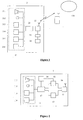
- the assembly of the invention represented in FIG. 1, comprises a cellular / wireless dual-mode telephone 1, in this case GSM / DECT, and a motor vehicle.
- the motor vehicle comprises an edge terminal 2 comprising a man-machine interface 21, a DECT radio base telephone module 22 and a central control unit 25, in this case a microprocessor.
- the human-machine interface 21 comprises a loudspeaker 211, a microphone 212, a display screen 213, an input keyboard 214, a voice recognition block 215, allowing the voice data and control input, and a voice synthesis block 216, enabling the voice broadcast of data and control.
- the DECT basic module 22 comprises the conventional elements of a DECT base, excluding the human-machine interface elements.
- the basic module DECT 22 is in particular arranged to transmit DECT beacon signals, in order to detect the presence of a DECT handset in a given cell occupying here the passenger compartment of the vehicle, and, in case of detection of a DECT handset in the cockpit, to pair with this DECT handset and to communicate with it over the air.
- the onboard terminal 2 further comprises a detector 24 for an action of use or end of use of the vehicle and a block 23 for activation / deactivation of the basic module DECT 22, interposed between the detector 24 and the module 22.
- the detector 24 is intended to detect the opening / closing of the vehicle doors, the locking / unlocking of the doors as well as the state of the vehicle (on or off).
- the basic module DECT 22 is activated on detection of the opening of at least one door and deactivated on detection of the stopping of the vehicle and the locking of all the doors.
- All the elements of the terminal 2 are connected to the microprocessor 25.
- the GSM / DECT telephone 1 comprises a man-machine interface 11, a DECT handset module 12, a GSM telephone module 13 and a central control unit 17, in this case a microprocessor.
- the human-machine interface 11 comprises a loudspeaker 111, a microphone 112, a display screen 113 and an input keyboard 114.
- the GSM telephone module 13 and the DECT handset module 12 here share a common radio block 15, connected to the two modules 12, 13 and to which is connected a radio antenna 16, able to operate simultaneously in DECT mode and in GSM mode.
- the DECT radio handset module 12 in cooperation with the radio block 15, enables the telephone 1 to act as a DECT handset and to pair with and communicate with a DECT base in DECT mode, using the communication protocol. PS.
- the telephone 1 further comprises a block 14, connected to the DECT telephone module 12, for detecting whether the DECT handset module 12 is matched or not to the DECT base module 22 of the motor vehicle.
- the block 14 is arranged to control the deactivation of the man-machine interface 11 of the telephone 1 and the full doubling of the interface 11 of the telephone 1 by the interface 21 of the vehicle, in case of matching of the DECT modules 22 and 12, and the activation of the human-machine interface 11 of the telephone 1, in case of interruption of the DECT radio link between the DECT modules 12 and 22.
- All the elements of the telephone 1 are connected to the microprocessor 17, intended to control the operation of the telephone 1.
- the telephone 1 is arranged to operate simultaneously in DECT mode and GSM mode.
- a user located outside the vehicle but in the coverage area of the GSM network 100, turns on the telephone 1.
- the telephone 1 then connects to the GSM 100 network.
- the user then opens a door of the vehicle and enters the cabin.
- the block 23 activates the basic module DECT 22. It then transmits DECT beacon signals.
- the telephone 1 When the telephone 1 enters the passenger compartment, its DECT handset module 12 detects the DECT beacon signals and then mates with the basic module DECT 22. This connects the telephone 1 to the on-board terminal 2, and thus to the the human-machine interface 21 of the vehicle, via a DECT radio link.
- the block 14 After pairing the DECT handset module 12 and the DECT base module 22, the block 14 provides the microprocessor 17 with a command to deactivate the man-machine interface 11 and to completely override it with that 21 of the on-board terminal 2. All elements 111-114 of the human-machine interface 11 of the phone are then disabled, the phone 1 instead using the elements 211-216 of the man-machine interface 21 of the vehicle.
- the human-machine interface 21 of the vehicle thus acts as a remote man-machine interface of the telephone 1.
- the data entered using the microphone 212 and the keyboard 214 are transmitted to the 1, via the DECT radio link, and are processed by the telephone 1 as data entered using the microphone 112 and the keyboard 114.
- the data normally intended to be broadcast by the loudspeaker. 111 or to be displayed on the screen 113 are transmitted to the on-board terminal 2, via the DECT radio link, and are broadcast by the speaker 211 or displayed on the screen 213.
- the user can activate the voice recognition and / or voice synthesis function. It can thus enter data, for example call a correspondent, using the microphone 212 and the voice recognition block 215, instead of the keyboard 214.
- the loudspeaker 211 in cooperation with the speech synthesis block 216, can also broadcast data, for example the name of the caller when receiving a call, which normally appear on the screen 213.
- the DECT handset module 12 of the telephone 1 transmits to the base module DECT 22 of the vehicle an incoming call signaling and the DECT module 22 then commands the transmission of a ring.
- the user dials his telephone number, using the keyboard 214.
- the user can also access the telephone directory of the telephone 1, using the keyboard 214 and the 213, and select the name of a party to call.
- the user uses the human-machine interface 21 of the vehicle, and in particular the microphone 212 and the loudspeaker 211, in place of the interface 11. phone 1.
- the detector 24 detects the stopping of the vehicle and the locking of the doors and then controls the deactivation of the basic module DECT 22. On detection of the interruption of the link Between the DECT base module 22 and the DECT handset module 12, the block 14 controls the activation of the man-machine interface 11, which then becomes operational again.
- the telephone 1 and the man-machine interface 21 of the vehicle are connected by a DECT radio link, via the DECT base module 22 and the DECT handset module. They could be connected by any other type of short-range radio link, for example by a bluetooth link.
- the telephone 1 could be arranged to operate in a cellular mode, other than the GSM mode.
Landscapes
- Engineering & Computer Science (AREA)
- Computer Networks & Wireless Communication (AREA)
- Signal Processing (AREA)
- Multimedia (AREA)
- Mobile Radio Communication Systems (AREA)
- Telephone Function (AREA)
- Fittings On The Vehicle Exterior For Carrying Loads, And Devices For Holding Or Mounting Articles (AREA)
Description
- L'utilisation d'un téléphone cellulaire par un conducteur de véhicule automobile s'avère dangereuse. Pour rendre cette utilisation moins dangereuse, le conducteur peut utiliser un kit main libre, comprenant un microphone et un haut-parleur, reliés au téléphone cellulaire et placés dans le véhicule à proximité du conducteur. Un tel kit permet à l'utilisateur de téléphoner avec les mains libres, sans tenir le téléphone près de son oreille. Toutefois, cette solution ne supprime pas tout maniement du téléphone. L'utilisateur est en effet toujours contraint d'effectuer certaines manipulations notamment pour appeler un correspondant, prendre un appel entrant et lire le contenu de l'écran du téléphone. Des kits mains libres pour un véhicule sont divulgués par exemple par les documents
WO98/57824 GB 2264613 - La présente invention propose de rendre encore moins dangereuse l'utilisation d'un téléphone cellulaire dans un véhicule automobile
- A cet effet, l'invention concerne un ensemble d'un téléphone cellulaire et d'un véhicule automobile selon la revendication 1.
- Ainsi, on utilise l'écran, le clavier, le haut-parleur et le microphone du véhicule, qui présentent l'avantage d'être agencés pour une utilisation facile et sans danger par le conducteur, comme interface homme-machine déportée du téléphone.
- Avantageusement, le véhicule comprend des moyens de détection de la présence du téléphone dans l'habitacle du véhicule.
- Grâce à cela, le doublement de l'interface homme-machine du téléphone par celle du véhicule peut se faire de façon automatique, sans intervention de l'utilisateur, sur détection du téléphone dans l'habitacle.
- Les moyens de détection de la présence du téléphone peuvent être activés sur détection de l'ouverture d'une porte du véhicule ou sur détection de la mise du contact du véhicule. Grâce à cela, ils ne fonctionnent que lorsque cela est nécessaire, c'est-à-dire lorsque le véhicule est utilisé.
- Dans une forme de réalisation particulière, il est prévu des moyens de liaison radio entre l'interface homme-machine du véhicule et le téléphone.
- Dans ce cas, et avantageusement, le véhicule comprend un module de base téléphonique radio et le téléphone cellulaire comprend un module de combiné téléphonique radio, le téléphone étant ainsi agencé pour se relier à l'interface homme-machine du véhicule par appariement de son module de combiné radio et du module de base téléphonique radio du véhicule.
- L'invention sera mieux comprise à l'aide de la description suivante d'une forme de réalisation particulière de l'ensemble de l'invention en référence au dessin annexé sur lequel:
- la figure 1 représente un schéma bloc fonctionnel de l'ensemble et
- la figure 2 représente un schéma bloc fonctionnel du téléphone de l'ensemble de la figure 1.
- L'ensemble de l'invention, représenté sur la figure 1, comprend un téléphone bimode cellulaire / sans fil 1, ici GSM / DECT, et un véhicule automobile.
- Le véhicule automobile comprend un terminal de bord 2 comportant une interface homme-machine 21, un module de base téléphonique radio DECT 22 et un bloc central de commande 25, en l'espèce un microprocesseur.
- L'interface homme-machine 21 comprend un haut-parleur 211, un microphone 212, un écran d'affichage 213, un clavier de saisie 214, un bloc de reconnaissance vocale 215, permettant la saisie vocale de données et de commande, et un bloc de synthèse vocale 216, permettant la diffusion vocale de données et de commande.
- Le module de base DECT 22 comprend les éléments classiques d'une base DECT, à l'exclusion des éléments d'interface homme-machine. Le module de base DECT 22 est notamment agencé pour émettre des signaux de balise DECT, afin de détecter la présence d'un combiné DECT dans une cellule déterminée occupant ici l'habitacle du véhicule, et, en cas de détection d'un combiné DECT dans l'habitacle, pour s'apparier à ce combiné DECT et pour communiquer avec lui par liaison radio.
- Le terminal de bord 2 comprend en outre un détecteur 24 d'une action d'utilisation ou de fin d'utilisation du véhicule et un bloc 23 d'activation/désactivation du module de base DECT 22, interposé entre le détecteur 24 et le module 22. Le détecteur 24 est destiné à détecter l'ouverture/fermeture des portes du véhicule, le verrouillage/déverrouillage des portes ainsi que l'état du véhicule (marche ou arrêt). Le module de base DECT 22 est activé sur détection de l'ouverture d'au moins une porte et désactivé sur détection de l'arrêt du véhicule et du verrouillage de toutes les portes.
- Tous les éléments du terminal 2 sont reliés au microprocesseur 25.
- Le téléphone GSM/DECT 1 comprend une interface homme-machine 11, un module de combiné DECT 12, un module de téléphone GSM 13 et un bloc central de commande 17, en l'espèce un microprocesseur.
- L'interface homme-machine 11 comprend un haut-parleur 111, un microphone 112, un écran d'affichage 113 et un clavier de saisie 114.
- Le module de téléphone GSM 13 et le module de combiné DECT 12 partagent ici un bloc radio commun 15, relié au deux modules 12, 13 et auquel est connectée une antenne radio 16, pouvant fonctionner simultanément en mode DECT et en mode GSM.
- Le module de téléphone GSM 13, en coopération avec le bloc radio 15, permet au téléphone 1de communiquer en mode GSM, c'est-à-dire en utilisant le protocole de communication GSM, à travers un réseau téléphonique GSM 100.
- Le module de combiné radio DECT 12, en coopération avec le bloc radio 15, permet au téléphone 1 de faire fonction de combiné DECT et de s'apparier à une base DECT et de communiquer avec elle en mode DECT, en utilisant le protocole de communication DECT.
- Le téléphone 1 comprend en outre un bloc 14, relié au module de téléphone DECT 12, destiné à détecter si le module de combiné DECT 12 est apparié ou non au module de base DECT 22 du véhicule automobile. Le bloc 14 est agencé pour commander la désactivation de l'interface homme-machine 11 du téléphone 1 et le doublement intégral de l'interface 11 du téléphone 1 par l'interface 21 du véhicule, en cas d'appariement des modules DECT 22 et 12, et l'activation de l'interface homme-machine 11 du téléphone 1, en cas d'interruption de la liaison radio DECT entre les modules DECT 12 et 22.
- Tous les éléments du téléphone 1 sont connectés au microprocesseur 17, destiné à commander le fonctionnement du téléphone 1.
- On soulignera ici que le téléphone 1 est agencé pour fonctionner simultanément en mode DECT et en mode GSM.
- Après la description structurelle et fonctionnelle de l'ensemble de l'invention, son fonctionnement va maintenant être décrit.
- Un utilisateur, situé en dehors du véhicule mais dans la zone de couverture du réseau GSM 100, met en marche le téléphone 1. Le téléphone 1 se connecte alors au réseau GSM 100.
- L'utilisateur ouvre ensuite une porte du véhicule et pénètre dans l'habitacle. Sur détection de l'ouverture de la porte par le détecteur 24, le bloc 23 active le module de base DECT 22. Celui-ci émet alors des signaux de balise DECT.
- Lorsque le téléphone 1 pénètre dans l'habitacle, son module de combiné DECT 12 détecte les signaux de balise DECT et s'apparie alors au module de base DECT 22. On relie ainsi le téléphone 1 au terminal de bord 2, et donc à l'interface homme-machine 21 du véhicule, par une liaison radio DECT.
- Après appariement du module de combiné DECT 12 et du module de base DECT 22, le bloc 14 fournit au microprocesseur 17 une commande pour désactiver l'interface homme-machine 11 et pour la doubler intégralement à l'aide de celle 21 du terminal de bord 2. Tous les éléments 111-114 de l'interface homme-machine 11 du téléphone sont alors désactivés, le téléphone 1 utilisant à la place les éléments 211-216 de l'interface homme-machine 21 du véhicule. L'interface homme-machine 21 du véhicule fait ainsi fonction d'interface homme-machine déportée du téléphone 1. Les données saisies à l'aide du microphone 212 et du clavier 214 sont transmises au téléphone 1, par l'intermédiaire de la liaison radio DECT, et sont traitées par le téléphone 1 comme des données saisies à l'aide du microphone 112 et du clavier 114. De même, les données normalement destinées à être diffusées par le haut-parleur 111 ou à être affichées sur l'écran 113 sont transmises au terminal de bord 2, par l'intermédiaire de la liaison radio DECT, et sont diffusées par le haut-parleur 211 ou affichées sur l'écran 213.
- L'utilisateur peut activer la fonction de reconnaissance vocale et/ou celle de synthèse vocale. Il peut ainsi saisir des données, par exemple appeler un correspondant, en utilisant le microphone 212 et le bloc de reconnaissance vocale 215, à la place du clavier 214. Le haut-parleur 211, en coopération avec le bloc de synthèse vocale 216, peut également diffuser des données, par exemple le nom de l'appelant en cas de réception d'un appel, qui s'affichent normalement sur l'écran 213.
- En cas de réception d'un appel GSM par le téléphone 1, le module de combiné DECT 12 du téléphone 1 transmet au module de base DECT 22 du véhicule une signalisation d'appel entrant et le module DECT 22 commande alors l'émission d'une sonnerie.
- Pour appeler un correspondant, l'utilisateur compose son numéro d'appel téléphonique, à l'aide du clavier 214. L'utilisateur peut également accéder à l'annuaire téléphonique du téléphone 1, à l'aide du clavier 214 et de l'écran 213, et y sélectionner le nom d'un correspondant à appeler.
- Lors d'une communication téléphonique du téléphone 1 à travers le réseau GSM 100, l'utilisateur utilise l'interface homme-machine 21 du véhicule, et notamment le microphone 212 et le haut-parleur 211, à la place de l'interface 11 du téléphone 1.
- Lorsque l'utilisateur arrête son véhicule puis en sort en verrouillant les portes, le détecteur 24 détecte l'arrêt du véhicule et le verrouillage des portes et commande alors la désactivation du module de base DECT 22. Sur détection de l'interruption de la liaison radio entre le module de base DECT 22 et le module de combiné DECT 12, le bloc 14 commande l'activation de l'interface homme-machine 11, qui devient alors à nouveau opérationnelle.
- Dans la description qui précède, le téléphone 1 et l'interface homme-machine 21 du véhicule sont reliés par une liaison radio DECT, par l'intermédiaire du module de base DECT 22 et du module de combiné DECT. Ils pourraient être reliés par tout autre type de liaison radio de courte portée, par exemple par une liaison bluetooth.
- En outre, le téléphone 1 pourrait être agencé pour fonctionner dans un mode cellulaire, autre que le mode GSM.
Claims (6)
- Ensemble d'un téléphone cellulaire (1) et d'un véhicule automobile, comprenant, chacun, une interface homme-machine (11, 21) et des moyens (22, 12, 14) pour doubler l'interface homme-machine (11) du téléphone (1) à l'aide de celle (21) du véhicule, qui fait ainsi fonction d'interface homme-machine déportée du téléphone (1), caractérisé par le fait que le véhicule comprend des moyens (24) de détection d'une action d'utilisation du véhicule, destinés à commander l'activation de moyens (22) de détection de la présence du téléphone (1) et des moyens (24) de détection d'une action de fin d'utilisation du véhicule, destinés à commander la désactivation des moyens (22) de détection de la présence du téléphone (1).
- Ensemble selon la revendication 1, dans lequel les moyens (22) de détection de la présence du téléphone (1) sont dans l'habitacle du véhicule.
- Ensemble selon l'une des revendications 1 et 2, dans lequel il est prévu des moyens (22, 12, 15, 16) de liaison radio entre l'interface homme-machine (21) du véhicule et le téléphone (1).
- Ensemble selon la revendication 3, dans lequel le véhicule comprend un module de base téléphonique radio (22) et le téléphone cellulaire (1) comprend un module de combiné téléphonique radio (12), le téléphone (1) étant ainsi agencé pour se relier à l'interface homme-machine (21) du véhicule par appariement de son module de combiné radio (12) et du module de base téléphonique radio (22) du véhicule.
- Ensemble selon la revendication 4, dans lequel le véhicule comprend un module de base DECT (22) et le téléphone (1) comprend un module de combiné DECT (12).
- Ensemble selon l'une des revendications 1 à 5, dans lequel l'interface homme-machine (21) du véhicule est celle d'un terminal de bord (2) du véhicule.
Applications Claiming Priority (2)
| Application Number | Priority Date | Filing Date | Title |
|---|---|---|---|
| FR0006209 | 2000-05-16 | ||
| FR0006209A FR2809270B1 (fr) | 2000-05-16 | 2000-05-16 | Ensemble d'un telephone cellulaire et d'un vehicule automoobile, telephone et vehicule automobile pour cet automobile |
Publications (2)
| Publication Number | Publication Date |
|---|---|
| EP1156645A1 EP1156645A1 (fr) | 2001-11-21 |
| EP1156645B1 true EP1156645B1 (fr) | 2007-11-14 |
Family
ID=8850264
Family Applications (1)
| Application Number | Title | Priority Date | Filing Date |
|---|---|---|---|
| EP20010401169 Expired - Lifetime EP1156645B1 (fr) | 2000-05-16 | 2001-05-07 | Ensemble d'un téléphone cellulaire et d'un véhicule automobile. |
Country Status (4)
| Country | Link |
|---|---|
| EP (1) | EP1156645B1 (fr) |
| DE (1) | DE60131319T2 (fr) |
| ES (1) | ES2295119T3 (fr) |
| FR (1) | FR2809270B1 (fr) |
Cited By (1)
| Publication number | Priority date | Publication date | Assignee | Title |
|---|---|---|---|---|
| DE102010007712A1 (de) | 2010-02-12 | 2011-08-18 | Volkswagen AG, 38440 | Verfahren zum Betreiben einer mobilen Vorrichtung in einem Fahrzeug |
Families Citing this family (6)
| Publication number | Priority date | Publication date | Assignee | Title |
|---|---|---|---|---|
| EP1414225A1 (fr) * | 2002-10-22 | 2004-04-28 | Siemens Aktiengesellschaft | Dispositif et procédé de télécommunications |
| DE10326357A1 (de) * | 2003-06-04 | 2004-12-23 | Volkswagen Ag | Kraftfahrzeug-Mobilfunkanordnung |
| JP4654651B2 (ja) | 2004-10-13 | 2011-03-23 | トヨタ自動車株式会社 | 車載ハンズフリー通話システム |
| US7299076B2 (en) | 2005-02-09 | 2007-11-20 | Bose Corporation | Vehicle communicating |
| US20090191922A1 (en) * | 2008-01-29 | 2009-07-30 | Motorola, Inc. | Method of operating a portable hands-free phone accessory |
| DE102008028451A1 (de) * | 2008-06-14 | 2009-12-31 | Bayerische Motoren Werke Aktiengesellschaft | Kraftfahrzeug |
Family Cites Families (6)
| Publication number | Priority date | Publication date | Assignee | Title |
|---|---|---|---|---|
| DE4300848A1 (en) * | 1992-01-17 | 1993-08-12 | Pioneer Electronic Corp | Car telephone system connected to car radio - transmits telephone signals to car radio for replay over loudspeaker and display on radio display |
| US5940503A (en) * | 1993-02-02 | 1999-08-17 | Palett; Anthony P. | Mirror mounted mobile telephone system |
| US6029072A (en) * | 1996-01-25 | 2000-02-22 | Oki Telecom, Inc. | Portable telephone with terminal mode facility |
| AU8209298A (en) * | 1997-06-13 | 1999-01-04 | Siemens Aktiengesellschaft | Device for installing a mobile telephone in a motor vehicle |
| AU4676799A (en) * | 1998-06-19 | 2000-01-05 | Albert William Honeywill | Mobile telephone docking station |
| EP1049347A1 (fr) * | 1999-04-27 | 2000-11-02 | Robert Bosch Gmbh | Méthode et dispositif pour établir une connexion entre un systeme de communication, tel qu'un téléphone mobile et un accessoire correspondant |
-
2000
- 2000-05-16 FR FR0006209A patent/FR2809270B1/fr not_active Expired - Lifetime
-
2001
- 2001-05-07 ES ES01401169T patent/ES2295119T3/es not_active Expired - Lifetime
- 2001-05-07 EP EP20010401169 patent/EP1156645B1/fr not_active Expired - Lifetime
- 2001-05-07 DE DE2001631319 patent/DE60131319T2/de not_active Expired - Lifetime
Cited By (2)
| Publication number | Priority date | Publication date | Assignee | Title |
|---|---|---|---|---|
| DE102010007712A1 (de) | 2010-02-12 | 2011-08-18 | Volkswagen AG, 38440 | Verfahren zum Betreiben einer mobilen Vorrichtung in einem Fahrzeug |
| DE102010007712B4 (de) | 2010-02-12 | 2023-11-30 | Volkswagen Ag | Verfahren zum Betreiben einer mobilen Vorrichtung in einem Fahrzeug |
Also Published As
| Publication number | Publication date |
|---|---|
| EP1156645A1 (fr) | 2001-11-21 |
| ES2295119T3 (es) | 2008-04-16 |
| DE60131319D1 (de) | 2007-12-27 |
| FR2809270A1 (fr) | 2001-11-23 |
| FR2809270B1 (fr) | 2002-10-04 |
| DE60131319T2 (de) | 2008-09-04 |
Similar Documents
| Publication | Publication Date | Title |
|---|---|---|
| EP0613314B1 (fr) | Téléphone cellulaire | |
| DE10101043B4 (de) | Funkvorrichtung zur Verwendung bei einem in ein Fahrzeug eingebauten Telefon | |
| US20080146195A1 (en) | Sharing account information and a phone number between personal mobile phone and an in-vehicle embedded phone | |
| FR2795590A1 (fr) | Systeme de communication | |
| JP2009140445A (ja) | 監視システム | |
| EP1156645B1 (fr) | Ensemble d'un téléphone cellulaire et d'un véhicule automobile. | |
| JP2006519562A (ja) | 車載型の私用及び会議用電話のための無線通信システム、及びその方法 | |
| WO2009102663A1 (fr) | Dispositif pour la communication en mer à connectivité de téléphone cellulaire sans fil | |
| AU2003201186B2 (en) | Mobile telephone device | |
| EP1654897B1 (fr) | Configuration d'un telephone portable sans touche par sms | |
| HU224794B1 (en) | Process for operating a telecommunication terminal and telecommunication terminal | |
| EP0871314B1 (fr) | Appareil téléphonique comportant une station de base et au moins un dispositif d'abonné et procédé correspondant | |
| JP2002171336A (ja) | 携帯電話機およびハンズフリー装置を利用した通話システム | |
| CN110401762B (zh) | 车载装置以及车载装置的电话呼入通知方法 | |
| FR2799861A1 (fr) | Procede d'appel d'urgence et telephone mobile pour la mise en oeuvre du procede | |
| JPH10215303A (ja) | 無線通信機 | |
| JP4471391B2 (ja) | 通信端末装置 | |
| US7590431B2 (en) | System and method for outputting dual voice of mobile terminal | |
| KR100638326B1 (ko) | 운전중 휴대폰의 수신 제어방법 및 그 장치 | |
| EP1120948B9 (fr) | Téléphone portable utilisé conjointement avec un téléphone sans fil pour une station d'accueil de type DECT | |
| JP2002335584A (ja) | 無線通信端末の着信制御装置および車内無線通信システム | |
| JP2007006211A (ja) | 車載端末装置 | |
| JPH1159283A (ja) | 車載ハンズフリー装置 | |
| FR3085094A1 (fr) | Procede de partage automatique des telecommunications entre un boitier telematique embarque dans un vehicule automobile et un telephone mobile externe | |
| JPH06224838A (ja) | 移動体電話装置 |
Legal Events
| Date | Code | Title | Description |
|---|---|---|---|
| PUAI | Public reference made under article 153(3) epc to a published international application that has entered the european phase |
Free format text: ORIGINAL CODE: 0009012 |
|
| AK | Designated contracting states |
Kind code of ref document: A1 Designated state(s): AT BE CH CY DE DK ES FI FR GB GR IE IT LI LU MC NL PT SE TR Kind code of ref document: A1 Designated state(s): DE ES GB IT |
|
| AX | Request for extension of the european patent |
Free format text: AL;LT;LV;MK;RO;SI |
|
| 17P | Request for examination filed |
Effective date: 20020513 |
|
| AKX | Designation fees paid |
Free format text: DE ES GB IT |
|
| RAP1 | Party data changed (applicant data changed or rights of an application transferred) |
Owner name: SAGEM COMMUNICATION |
|
| RTI1 | Title (correction) |
Free format text: ASSEMBLY OF A CELLULAR TELEPHONE AND A MOTOR VEHICLE. |
|
| GRAP | Despatch of communication of intention to grant a patent |
Free format text: ORIGINAL CODE: EPIDOSNIGR1 |
|
| GRAS | Grant fee paid |
Free format text: ORIGINAL CODE: EPIDOSNIGR3 |
|
| GRAA | (expected) grant |
Free format text: ORIGINAL CODE: 0009210 |
|
| AK | Designated contracting states |
Kind code of ref document: B1 Designated state(s): DE ES GB IT |
|
| REG | Reference to a national code |
Ref country code: GB Ref legal event code: FG4D Free format text: NOT ENGLISH |
|
| REF | Corresponds to: |
Ref document number: 60131319 Country of ref document: DE Date of ref document: 20071227 Kind code of ref document: P |
|
| GBT | Gb: translation of ep patent filed (gb section 77(6)(a)/1977) |
Effective date: 20080109 |
|
| REG | Reference to a national code |
Ref country code: ES Ref legal event code: FG2A Ref document number: 2295119 Country of ref document: ES Kind code of ref document: T3 |
|
| PLBE | No opposition filed within time limit |
Free format text: ORIGINAL CODE: 0009261 |
|
| STAA | Information on the status of an ep patent application or granted ep patent |
Free format text: STATUS: NO OPPOSITION FILED WITHIN TIME LIMIT |
|
| 26N | No opposition filed |
Effective date: 20080815 |
|
| REG | Reference to a national code |
Ref country code: DE Ref legal event code: R082 Ref document number: 60131319 Country of ref document: DE Representative=s name: BARDEHLE PAGENBERG PARTNERSCHAFT PATENTANWAELT, DE |
|
| REG | Reference to a national code |
Ref country code: DE Ref legal event code: R081 Ref document number: 60131319 Country of ref document: DE Owner name: APPLE INC., CUPERTINO, US Free format text: FORMER OWNER: SAGEM COMMUNICATION, PARIS, FR Effective date: 20120308 Ref country code: DE Ref legal event code: R081 Ref document number: 60131319 Country of ref document: DE Owner name: APPLE INC., US Free format text: FORMER OWNER: SAGEM COMMUNICATION, PARIS, FR Effective date: 20120308 |
|
| REG | Reference to a national code |
Ref country code: DE Ref legal event code: R082 Ref document number: 60131319 Country of ref document: DE Representative=s name: BARDEHLE PAGENBERG PARTNERSCHAFT MBB PATENTANW, DE Effective date: 20120308 Ref country code: DE Ref legal event code: R081 Ref document number: 60131319 Country of ref document: DE Owner name: APPLE INC., CUPERTINO, US Free format text: FORMER OWNER: SAGEM MOBILES SA, PARIS, FR Effective date: 20121212 Ref country code: DE Ref legal event code: R081 Ref document number: 60131319 Country of ref document: DE Owner name: APPLE INC., US Free format text: FORMER OWNER: SAGEM MOBILES SA, PARIS, FR Effective date: 20121212 Ref country code: DE Ref legal event code: R082 Ref document number: 60131319 Country of ref document: DE Representative=s name: BARDEHLE PAGENBERG PARTNERSCHAFT PATENTANWAELT, DE Effective date: 20120308 |
|
| REG | Reference to a national code |
Ref country code: GB Ref legal event code: 732E Free format text: REGISTERED BETWEEN 20180927 AND 20181005 |
|
| PGFP | Annual fee paid to national office [announced via postgrant information from national office to epo] |
Ref country code: DE Payment date: 20200422 Year of fee payment: 20 Ref country code: ES Payment date: 20200601 Year of fee payment: 20 |
|
| PGFP | Annual fee paid to national office [announced via postgrant information from national office to epo] |
Ref country code: IT Payment date: 20200414 Year of fee payment: 20 Ref country code: GB Payment date: 20200429 Year of fee payment: 20 |
|
| REG | Reference to a national code |
Ref country code: DE Ref legal event code: R071 Ref document number: 60131319 Country of ref document: DE |
|
| REG | Reference to a national code |
Ref country code: GB Ref legal event code: PE20 Expiry date: 20210506 |
|
| REG | Reference to a national code |
Ref country code: ES Ref legal event code: FD2A Effective date: 20210826 |
|
| PG25 | Lapsed in a contracting state [announced via postgrant information from national office to epo] |
Ref country code: GB Free format text: LAPSE BECAUSE OF EXPIRATION OF PROTECTION Effective date: 20210506 |
|
| PG25 | Lapsed in a contracting state [announced via postgrant information from national office to epo] |
Ref country code: ES Free format text: LAPSE BECAUSE OF EXPIRATION OF PROTECTION Effective date: 20210508 |