EP1160141A2 - Bremsmotorlösevorrichtung - Google Patents
Bremsmotorlösevorrichtung Download PDFInfo
- Publication number
- EP1160141A2 EP1160141A2 EP01113429A EP01113429A EP1160141A2 EP 1160141 A2 EP1160141 A2 EP 1160141A2 EP 01113429 A EP01113429 A EP 01113429A EP 01113429 A EP01113429 A EP 01113429A EP 1160141 A2 EP1160141 A2 EP 1160141A2
- Authority
- EP
- European Patent Office
- Prior art keywords
- brake
- motor
- releasing
- power supply
- electromagnetic brake
- Prior art date
- Legal status (The legal status is an assumption and is not a legal conclusion. Google has not performed a legal analysis and makes no representation as to the accuracy of the status listed.)
- Withdrawn
Links
Images



Classifications
-
- B—PERFORMING OPERATIONS; TRANSPORTING
- B66—HOISTING; LIFTING; HAULING
- B66D—CAPSTANS; WINCHES; TACKLES, e.g. PULLEY BLOCKS; HOISTS
- B66D5/00—Braking or detent devices characterised by application to lifting or hoisting gear, e.g. for controlling the lowering of loads
- B66D5/02—Crane, lift hoist, or winch brakes operating on drums, barrels, or ropes
- B66D5/24—Operating devices
- B66D5/30—Operating devices electrical
-
- B—PERFORMING OPERATIONS; TRANSPORTING
- B60—VEHICLES IN GENERAL
- B60T—VEHICLE BRAKE CONTROL SYSTEMS OR PARTS THEREOF; BRAKE CONTROL SYSTEMS OR PARTS THEREOF, IN GENERAL; ARRANGEMENT OF BRAKING ELEMENTS ON VEHICLES IN GENERAL; PORTABLE DEVICES FOR PREVENTING UNWANTED MOVEMENT OF VEHICLES; VEHICLE MODIFICATIONS TO FACILITATE COOLING OF BRAKES
- B60T7/00—Brake-action initiating means
- B60T7/12—Brake-action initiating means for automatic initiation; for initiation not subject to will of driver or passenger
- B60T7/22—Brake-action initiating means for automatic initiation; for initiation not subject to will of driver or passenger initiated by contact of vehicle, e.g. bumper, with an external object, e.g. another vehicle, or by means of contactless obstacle detectors mounted on the vehicle
Definitions
- the present invention relates to a break releasing device of a motor equipped in an apparatus having a mechanism locking a motor shaft when the power is turned off.
- a motor driving device for driving a motor and a break releasing device for releasing an electromagnetic break, which locks a motor shaft, have been independently provided, and the electromagnetic break cannot be released by hand. Because of this independent installation of the motor driving device and the break releasing device, the following inconveniences have occurred: When a motor driving system encounters a trouble, a motor does not produce torque because a driving current stops flowing to the motor. Although no torque is available in the motor, the electromagnetic brake is released or left released. As a result, a final object of the motor shaft may drop due to its own weight when the final object works in the gravity direction. When the final object interferes with an obstacle, a servo control system detects an overload status, so that the interference status cannot be avoided because the motor cannot be driven.
- the present invention addresses the problems discussed above and aims to prevent a motor brake from being released at motor's non-driven status and provide a motor-brake-releasing-device assuring safer operation than ever.
- the motor-brake-releasing-device of the present invention comprises the following elements:
- Another motor-brake-releasing-device of the present invention comprises the following elements:
- Fig. 2 is a circuit diagram in which a motor driving device is compared with a motor-brake-releasing-device of a basic type.
- a motor shaft is locked with brake 2, thereby fixing a final object of the motor.
- a controller (not shown) drives motor 1
- a latch circuit (not shown) turns motor-driving-signal 3 active, and energizes relay K1 ⁇ functioning as a switch ⁇ via driver 4.
- first contact K11 and second contact K12 of relay K1 close in response to the energizing of relay K1, so that ac power supply 5 powers servo-amplifier 6, which drives motor 1.
- a servo control system (not shown) starts controlling using signals of an encoder (not shown) indicating rotating amount of the shaft of motor 1.
- the servo control system confirms servo-lock-status, counts timing to turn brake-releasing-signal 7 active through a latch circuit (not shown), and energizes relay K2 ⁇ functioning as a switch ⁇ via driver 8.
- Contact K21 of relay K2 closes responsive to the energizing of relay K2, and an electromagnetic brake 2 is powered by a power supply derived from the full-wave rectification of ac power supply 9, whereby brake 2 locking a motor shaft is released.
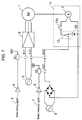
- Fig. 1 is a circuit diagram of a motor driving device and a motor-brake-releasing-device in accordance with the first exemplary embodiment of the present invention.
- a power supply for releasing an electromagnetic brake which locks a motor shaft, is supplied to the brake in an AND form, whereby the motor-brake-releasing-device releases the brake.
- the AND form is produced by a relay contact (switch), which turns conductive at operating the motor, and another relay contact (switch), which turns conductive at permitting the motor to operate.
- third contact K13 of relay K1 ⁇ contact K13 being energized when motor-driving-signal 3 turns active ⁇ is coupled to a power line of a brake-releasing-power-supply in series.
- Contact K13 turns conductive when motor-driving-signal 3 turns active.
- This structure allows two contacts K13 and K21 to be coupled in series, and provides a power supply for releasing brake 2 via these two contacts, whereby brake 2 can be released only when the motor is driven (contact K 13 is closed) and the motor brake is permitted to be released (contact K21 is closed).
- the power for releasing the brake is supplied to the electromagnetic brake following the result of AND signal produced by the motor-driving-signal and the brake-release-permitting-signal.
- the brake is released as discussed above, thus the brake is never released when the motor is not driven.
- the structure shown in Fig. 1 provides a safer mechanism than that shown in Fig. 2.
- two relay contacts K21, K13 are coupled in series, there are less chances for the contacts to be melt comparing with a single contact shown in Fig. 2.
- Fig. 3 is a circuit diagram of a motor driving device and a motor-brake-releasing-device in accordance with the second exemplary embodiment of the present invention.
- the same elements as those in Fig. 2 are denoted with the same reference marks and the descriptions thereof are omitted.
- a feature of the second embodiment is to input motor-driving-signal 3 and brake-releasing-signal 7 to AND gate 15, and an output terminal of gate 15 is coupled to relay K2 via driver 8.
- AND gate 15 the AND of motor-driving-signal 3 and brake-releasing-signal 7 can be produced by software, thereby controlling relay K2 via driver 8.
- the power for releasing the brake is supplied to the electromagnetic brake following the result of AND signal produced by the motor-driving-signal and the brake-release-permitting-signal. Since the brake is released as discussed above, the brake is never released when the motor is not driven. As a result, the structure shown in Fig. 3 provides a safer mechanism than that shown in Fig. 2.
- Fig. 4 is a circuit diagram of a motor driving device and a motor-brake-releasing-device in accordance with the third exemplary embodiment of the present invention.
- the power supply of the electromagnetic brake can be released by an operator when the motor is not driven.
- Fig. 4 the same elements as shown in Fig. 1 are denoted with the same reference marks, and the descriptions thereof are omitted.
- a final object of motor 1 is interfered with a jig or the like, the servo control system detects excess load, which shuts off both a motor-driving-system and a brake system. In this case, a power supply of the servo control system is once turned off, then turned on again and necessary steps for correcting the interference status are taken for removing the interference from the final object.
- servo amplifier 6 detects overload and shouts off instantly after the servo control system is powered on. Therefore, the interference may not be avoided, and if not, another way to avoid the interference should be taken, i.e., fixed sections which fix the entire machine are dismounted and the entire machine must be moved.
- momentary switch 10a is coupled to contacts K13 and K21 in parallel so that switch 10a bypasses a series connection of contacts K13 and K21. If the servo control system is powered on, i.e., ac power supply 9 is powered on, this structure allows brake 2 to be released while an operator depresses switch 10a without driving motor 1. The interference with the final object can be avoided thanks to this mechanism. When equipment including the device of the present invention is moved to another place, an operator can change a posture of the final object without using a power supply of the equipment. This is another advantage of the third embodiment.
- Fig. 5 is a circuit diagram of a motor driving device and a motor-brake-releasing-device in accordance with the fourth exemplary embodiment of the present invention.
- the fourth embodiment shown in Fig. 5 differs from the third embodiment shown in Fig. 4 in the following point:
- switch 10a is disposed at machine 11 including the brake. Therefore, even if a controller is away from the final object, the removal operation of the interference with the final object can be carried out with ease near the final object.
- Fig. 6 is a circuit diagram of a motor driving device and a motor-brake-releasing-device in accordance with the fifth exemplary embodiment of the present invention.
- a battery is used as a power supply for releasing an electromagnetic brake.
- connecting cables ⁇ shown in Fig. 5 of the fourth embodiment ⁇ between ac power supply 9 (e.g. a commercial power supply) and machine 11 are dismounted, and machine 11 is coupled to battery 20 via connector 12 instead.
- ac power supply 9 e.g. a commercial power supply
- battery 20 allows the brake to be released.
- the battery 20 is used as the power supply for releasing the electromagnetic brake, thus the motor brake can be released even in the condition where an ac power supply is not available.
- Fig. 7 is a circuit diagram of a motor driving device and a motor-brake-releasing-device in accordance with the sixth exemplary embodiment of the present invention.
- battery 20 is used as another power supply for releasing the brake in addition to a dc power supply which is derived from the full-wave rectification of ac power supply 9 (e.g. commercial power supply).
- ac power supply 9 e.g. commercial power supply
- the power cable of this dc power supply is not necessarily dismounted.
- alternate switch 13 is disposed in machine 11 for switching ac power supply 9 to battery 20 or vice versa as a brake-releasing-power-supply.
- This structure allows electrical collision between a dc power supply ⁇ derived from the full-wave rectification of ac power supply 9 ⁇ and battery 20 to be avoided because when the brake-releasing-power-supply is switched to battery 20, the power line from the dc power supply is cut off simultaneously.
- Fig. 8 is a circuit diagram of a motor driving device and a motor-brake-releasing-device in accordance with the seventh exemplary embodiment of the present invention.
- the battery is protected from spark-noise (counter electromotive force) due to an electromagnetic-brake-coil when the power supply of the electromagnetic brake is shut off.
- the releasing-power-supply of brake 2 When the releasing-power-supply of brake 2 is switched to battery 20 and momentary switch 10b for releasing the motor brake is turned open from being closed, the counter electromotive force due to the coil of brake 2 occurs at the grounding side of the power line.
- the potential of this negative voltage is more than twice of the power supply voltage. If this negative voltage is repeatedly applied, a voltage-regulation-capacitor (not shown) and battery 20 may be damaged.
- the voltage-regulation-capacitor is, e.g., a smoothing capacitor for a dc voltage derived from the full-wave-rectification of ac power supply 9.
- diode 14 is coupled as follows in order to absorb the negative voltage: the cathode of diode 14 is coupled to a positive electrode of the brake coil viewed from the releasing-power-supply of the motor brake, and the anode of diode 14 is coupled to a negative electrode (grounding) of the brake coil.
- diode 14 is coupled in parallel with the brake coil, i.e., diode 14 functions as a flywheel-diode (damper diode) and absorbs the negative voltage (surge voltage.)
- This structure allows the voltage-regulation-capacitor and the battery to be protected from the negative voltage (surge voltage) produced on the grounding side of the power line of the power supply for releasing the motor brake.
- the negative voltage is produced due to the counter-electromotive-force by the coil of the electromagnetic brake when the power supply is shut off.
Landscapes
- Engineering & Computer Science (AREA)
- Mechanical Engineering (AREA)
- Transportation (AREA)
- Stopping Of Electric Motors (AREA)
- Manipulator (AREA)
- Braking Arrangements (AREA)
- Connection Of Motors, Electrical Generators, Mechanical Devices, And The Like (AREA)
Priority Applications (1)
| Application Number | Priority Date | Filing Date | Title |
|---|---|---|---|
| EP07100612A EP1775187A2 (de) | 2000-06-01 | 2001-06-01 | Motorbremsenauslösungsvorrichtung |
Applications Claiming Priority (2)
| Application Number | Priority Date | Filing Date | Title |
|---|---|---|---|
| JP2000164292A JP2001346400A (ja) | 2000-06-01 | 2000-06-01 | モータブレーキ解除装置 |
| JP2000164292 | 2000-06-01 |
Related Child Applications (1)
| Application Number | Title | Priority Date | Filing Date |
|---|---|---|---|
| EP07100612A Division EP1775187A2 (de) | 2000-06-01 | 2001-06-01 | Motorbremsenauslösungsvorrichtung |
Publications (2)
| Publication Number | Publication Date |
|---|---|
| EP1160141A2 true EP1160141A2 (de) | 2001-12-05 |
| EP1160141A3 EP1160141A3 (de) | 2003-07-02 |
Family
ID=18667934
Family Applications (2)
| Application Number | Title | Priority Date | Filing Date |
|---|---|---|---|
| EP01113429A Withdrawn EP1160141A3 (de) | 2000-06-01 | 2001-06-01 | Bremsmotorlösevorrichtung |
| EP07100612A Withdrawn EP1775187A2 (de) | 2000-06-01 | 2001-06-01 | Motorbremsenauslösungsvorrichtung |
Family Applications After (1)
| Application Number | Title | Priority Date | Filing Date |
|---|---|---|---|
| EP07100612A Withdrawn EP1775187A2 (de) | 2000-06-01 | 2001-06-01 | Motorbremsenauslösungsvorrichtung |
Country Status (3)
| Country | Link |
|---|---|
| US (1) | US6498448B2 (de) |
| EP (2) | EP1160141A3 (de) |
| JP (1) | JP2001346400A (de) |
Families Citing this family (11)
| Publication number | Priority date | Publication date | Assignee | Title |
|---|---|---|---|---|
| KR100488522B1 (ko) * | 2003-02-07 | 2005-05-11 | 삼성전자주식회사 | 모터제어장치 |
| JP4320556B2 (ja) * | 2003-04-02 | 2009-08-26 | 株式会社安川電機 | 産業用ロボットの制御装置 |
| JP2005143257A (ja) * | 2003-11-10 | 2005-06-02 | Nissan Motor Co Ltd | サーボシステム |
| JP2005209061A (ja) * | 2004-01-26 | 2005-08-04 | Yaskawa Electric Corp | 自動機械制御装置 |
| DE102006060823A1 (de) * | 2006-12-21 | 2008-07-03 | Bubenzer Bremsen Gerhard Bubenzer Ing. Gmbh | Elektrische Steuerung für eine Bremseinrichtung |
| US10286883B2 (en) | 2016-05-10 | 2019-05-14 | Sharp Kabushiki Kaisha | Motor-driven traveling device |
| JP6776878B2 (ja) * | 2016-12-21 | 2020-10-28 | トヨタ自動車株式会社 | 電磁ブレーキの摩耗検出装置 |
| US10680538B2 (en) * | 2017-09-28 | 2020-06-09 | Otis Elevator Company | Emergency braking for a drive system |
| JP7281699B2 (ja) * | 2017-12-11 | 2023-05-26 | ニデック株式会社 | ブレーキ駆動制御回路とその故障検出方法 |
| JP7091642B2 (ja) * | 2017-12-11 | 2022-06-28 | 日本電産株式会社 | ブレーキ駆動制御回路とその故障検出方法 |
| CN117043027A (zh) * | 2021-03-31 | 2023-11-10 | 发那科株式会社 | 制动控制装置以及马达驱动装置 |
Family Cites Families (23)
| Publication number | Priority date | Publication date | Assignee | Title |
|---|---|---|---|---|
| US2426071A (en) * | 1943-10-28 | 1947-08-19 | Westinghouse Electric Corp | Alternating-current motor system |
| US3971971A (en) * | 1974-11-15 | 1976-07-27 | Ingersoll-Rand Company | Electric hoist control and braking system |
| US4361312A (en) * | 1979-02-07 | 1982-11-30 | Columbus Mckinnon Corporation | Precise load positioner |
| JPH0729746B2 (ja) * | 1984-01-11 | 1995-04-05 | 株式会社日立製作所 | エレベ−タ−の非常停止制御装置 |
| US4841215A (en) * | 1987-06-22 | 1989-06-20 | Lift Tech International Inc. | D.C. solenoid control circuit |
| JP2823079B2 (ja) * | 1989-11-20 | 1998-11-11 | トキコ株式会社 | 工業用ロボット |
| JP2950564B2 (ja) * | 1990-01-24 | 1999-09-20 | 松下電器産業株式会社 | 産業用ロボット |
| JPH0416470A (ja) * | 1990-05-09 | 1992-01-21 | Mitsubishi Electric Corp | エレベータの安全装置 |
| JPH0754487Y2 (ja) * | 1990-09-28 | 1995-12-18 | 新明和工業株式会社 | 太陽電池を電源に利用した立体駐車設備 |
| JPH04185204A (ja) * | 1990-11-20 | 1992-07-02 | Kubota Corp | 小型電動車 |
| US5333706A (en) * | 1991-10-22 | 1994-08-02 | Akebono Brake Industry Co., Ltd. | Brake apparatus for a vehicle |
| JPH05130579A (ja) * | 1991-10-31 | 1993-05-25 | Fuji Photo Film Co Ltd | 画像通信装置 |
| DE4232402C5 (de) * | 1992-09-26 | 2005-10-27 | Marquardt Gmbh | Bremsschaltung für einen Elektromotor |
| US5394069A (en) * | 1993-03-08 | 1995-02-28 | International Business Machines Corporation | Mechanical brake hold circuit for an electric motor |
| DE4307356A1 (de) * | 1993-03-09 | 1994-09-15 | Bosch Gmbh Robert | Reihenschlußmotor, insbesondere Universalmotor, mit einer Bremseinrichtung |
| JPH0715989A (ja) * | 1993-06-30 | 1995-01-17 | Matsushita Electric Works Ltd | 電動機制御装置 |
| JP3834073B2 (ja) * | 1994-06-22 | 2006-10-18 | 株式会社安川電機 | 巻上・巻下機の停止方法 |
| JP3003768B2 (ja) * | 1994-10-31 | 2000-01-31 | 株式会社安川電機 | 多関節形ロボットの関節の拘束を解除する方法と装置 |
| JPH08171411A (ja) | 1994-12-19 | 1996-07-02 | Fanuc Ltd | ロボットの突き当てマスタリング方法 |
| JPH08202962A (ja) * | 1995-01-30 | 1996-08-09 | Amenitetsukusu:Kk | 光警戒区分標示器 |
| US5893432A (en) * | 1996-12-31 | 1999-04-13 | Inventio Ag | Controlled emergency stop apparatus for elevators |
| JPH1166993A (ja) * | 1997-08-11 | 1999-03-09 | Yaskawa Electric Corp | ブレーキ付きモータの接点溶着検出装置 |
| JP2000296492A (ja) * | 1999-04-15 | 2000-10-24 | Matsushita Electric Ind Co Ltd | ロボットのモータブレーキ装置 |
-
2000
- 2000-06-01 JP JP2000164292A patent/JP2001346400A/ja active Pending
-
2001
- 2001-06-01 EP EP01113429A patent/EP1160141A3/de not_active Withdrawn
- 2001-06-01 US US09/873,116 patent/US6498448B2/en not_active Expired - Lifetime
- 2001-06-01 EP EP07100612A patent/EP1775187A2/de not_active Withdrawn
Non-Patent Citations (1)
| Title |
|---|
| None |
Also Published As
| Publication number | Publication date |
|---|---|
| EP1775187A2 (de) | 2007-04-18 |
| US6498448B2 (en) | 2002-12-24 |
| EP1160141A3 (de) | 2003-07-02 |
| US20020017882A1 (en) | 2002-02-14 |
| JP2001346400A (ja) | 2001-12-14 |
Similar Documents
| Publication | Publication Date | Title |
|---|---|---|
| CN109159669B (zh) | 一种电驱动系统的保护系统和方法 | |
| US6498448B2 (en) | Motor break releasing device | |
| US6580239B1 (en) | Protecting device of electromobile | |
| US11091042B2 (en) | Electric vehicle drive system, backup power supply device and method therefor | |
| US12009654B2 (en) | Motor control system and motor control device | |
| US20200317059A1 (en) | Vehicle | |
| CN109166744B (zh) | 一种双电源自动转换开关及其转换控制方法 | |
| US12556124B2 (en) | Protection apparatus and brushless motor system | |
| WO2002054567A3 (de) | Elektronisch kommutierter motor | |
| JP2001506050A (ja) | セーフティ・リレー | |
| KR101239436B1 (ko) | 개폐기 조작 장치 및 3상용 개폐기 | |
| JP3511563B2 (ja) | 電動パワーステアリング制御装置 | |
| US20240066663A1 (en) | Power tool | |
| CN223495910U (zh) | 用于检测运行接触器的sto装置及电梯 | |
| CN216290741U (zh) | 一种外接动态制动器及伺服电机驱动装置 | |
| CN223006708U (zh) | 一种高可靠性的继电器双边控制电路 | |
| CN113021332B (zh) | 一种工业机器人控制系统以及控制设备 | |
| CN115514084B (zh) | 一种六轴机器人的多电源安全模块及其控制方法 | |
| JP2003297211A (ja) | リモコン駆動装置を備えたブレーカ | |
| CN110842916B (zh) | 一种工业机器人抱闸控制系统 | |
| CN115085594B (zh) | 一种电机急停控制装置及机器人 | |
| CN120638905A (zh) | 一种区域内永磁同步电机多机联动综合管理系统及方法 | |
| CN109723316B (zh) | 一种高安全性的门机安全链控制系统 | |
| JPH01164201A (ja) | 電気自動車の制御装置 | |
| KR20240030052A (ko) | 모터 제어 시스템 및 모터 제어 방법 |
Legal Events
| Date | Code | Title | Description |
|---|---|---|---|
| PUAI | Public reference made under article 153(3) epc to a published international application that has entered the european phase |
Free format text: ORIGINAL CODE: 0009012 |
|
| AK | Designated contracting states |
Kind code of ref document: A2 Designated state(s): AT BE CH CY DE DK ES FI FR GB GR IE IT LI LU MC NL PT SE TR |
|
| AX | Request for extension of the european patent |
Free format text: AL;LT;LV;MK;RO;SI |
|
| PUAL | Search report despatched |
Free format text: ORIGINAL CODE: 0009013 |
|
| RIC1 | Information provided on ipc code assigned before grant |
Ipc: 7H 02P 3/26 B Ipc: 7B 66D 5/30 B Ipc: 7B 66C 13/23 B Ipc: 7H 02K 49/00 B Ipc: 7B 60T 13/74 B Ipc: 7B 60T 7/22 A |
|
| AK | Designated contracting states |
Designated state(s): AT BE CH CY DE DK ES FI FR GB GR IE IT LI LU MC NL PT SE TR |
|
| AX | Request for extension of the european patent |
Extension state: AL LT LV MK RO SI |
|
| 17P | Request for examination filed |
Effective date: 20030805 |
|
| AKX | Designation fees paid |
Designated state(s): DE FR GB SE |
|
| 17Q | First examination report despatched |
Effective date: 20060807 |
|
| RAP1 | Party data changed (applicant data changed or rights of an application transferred) |
Owner name: PANASONIC CORPORATION |
|
| STAA | Information on the status of an ep patent application or granted ep patent |
Free format text: STATUS: THE APPLICATION IS DEEMED TO BE WITHDRAWN |
|
| 18D | Application deemed to be withdrawn |
Effective date: 20150106 |