EP1172648A1 - Bezugselektrode zur Verwendung mit einer Messelektrode in einer potentiometrischen Messkette - Google Patents
Bezugselektrode zur Verwendung mit einer Messelektrode in einer potentiometrischen Messkette Download PDFInfo
- Publication number
- EP1172648A1 EP1172648A1 EP00114841A EP00114841A EP1172648A1 EP 1172648 A1 EP1172648 A1 EP 1172648A1 EP 00114841 A EP00114841 A EP 00114841A EP 00114841 A EP00114841 A EP 00114841A EP 1172648 A1 EP1172648 A1 EP 1172648A1
- Authority
- EP
- European Patent Office
- Prior art keywords
- tube
- electrode
- chamber
- reference electrode
- measuring
- Prior art date
- Legal status (The legal status is an assumption and is not a legal conclusion. Google has not performed a legal analysis and makes no representation as to the accuracy of the status listed.)
- Granted
Links
- 238000005259 measurement Methods 0.000 claims abstract description 26
- 239000003792 electrolyte Substances 0.000 claims description 49
- 239000000243 solution Substances 0.000 claims description 34
- 150000002500 ions Chemical class 0.000 claims description 27
- 239000011521 glass Substances 0.000 claims description 13
- 230000004888 barrier function Effects 0.000 claims description 6
- 239000004033 plastic Substances 0.000 claims description 6
- 239000002574 poison Substances 0.000 claims description 6
- 231100000614 poison Toxicity 0.000 claims description 6
- 229920000642 polymer Polymers 0.000 claims description 5
- 230000009969 flowable effect Effects 0.000 claims description 4
- 239000000615 nonconductor Substances 0.000 claims description 3
- 230000035515 penetration Effects 0.000 claims description 3
- 239000011148 porous material Substances 0.000 claims description 3
- 239000012266 salt solution Substances 0.000 claims description 3
- 230000000149 penetrating effect Effects 0.000 claims 1
- 239000000463 material Substances 0.000 abstract description 2
- HKZLPVFGJNLROG-UHFFFAOYSA-M silver monochloride Chemical compound [Cl-].[Ag+] HKZLPVFGJNLROG-UHFFFAOYSA-M 0.000 description 16
- 229910021607 Silver chloride Inorganic materials 0.000 description 13
- 229910052751 metal Inorganic materials 0.000 description 11
- 239000002184 metal Substances 0.000 description 11
- WCUXLLCKKVVCTQ-UHFFFAOYSA-M Potassium chloride Chemical compound [Cl-].[K+] WCUXLLCKKVVCTQ-UHFFFAOYSA-M 0.000 description 8
- 229910052739 hydrogen Inorganic materials 0.000 description 8
- 239000001257 hydrogen Substances 0.000 description 8
- BASFCYQUMIYNBI-UHFFFAOYSA-N platinum Chemical compound [Pt] BASFCYQUMIYNBI-UHFFFAOYSA-N 0.000 description 8
- 238000009792 diffusion process Methods 0.000 description 7
- 230000015572 biosynthetic process Effects 0.000 description 6
- 238000000034 method Methods 0.000 description 5
- UFHFLCQGNIYNRP-UHFFFAOYSA-N Hydrogen Chemical compound [H][H] UFHFLCQGNIYNRP-UHFFFAOYSA-N 0.000 description 4
- 150000001875 compounds Chemical class 0.000 description 4
- 229910021645 metal ion Inorganic materials 0.000 description 4
- 229910052697 platinum Inorganic materials 0.000 description 4
- BQCADISMDOOEFD-UHFFFAOYSA-N Silver Chemical compound [Ag] BQCADISMDOOEFD-UHFFFAOYSA-N 0.000 description 3
- 230000001419 dependent effect Effects 0.000 description 3
- 230000000694 effects Effects 0.000 description 3
- 235000011164 potassium chloride Nutrition 0.000 description 3
- 239000001103 potassium chloride Substances 0.000 description 3
- 238000007789 sealing Methods 0.000 description 3
- 229910052709 silver Inorganic materials 0.000 description 3
- 239000004332 silver Substances 0.000 description 3
- 150000001450 anions Chemical class 0.000 description 2
- 239000007864 aqueous solution Substances 0.000 description 2
- 230000003111 delayed effect Effects 0.000 description 2
- GPRLSGONYQIRFK-UHFFFAOYSA-N hydron Chemical compound [H+] GPRLSGONYQIRFK-UHFFFAOYSA-N 0.000 description 2
- 239000011244 liquid electrolyte Substances 0.000 description 2
- 238000001139 pH measurement Methods 0.000 description 2
- 150000003839 salts Chemical class 0.000 description 2
- NLXLAEXVIDQMFP-UHFFFAOYSA-N Ammonia chloride Chemical compound [NH4+].[Cl-] NLXLAEXVIDQMFP-UHFFFAOYSA-N 0.000 description 1
- FAPWRFPIFSIZLT-UHFFFAOYSA-M Sodium chloride Chemical compound [Na+].[Cl-] FAPWRFPIFSIZLT-UHFFFAOYSA-M 0.000 description 1
- 238000004026 adhesive bonding Methods 0.000 description 1
- 239000000919 ceramic Substances 0.000 description 1
- 239000003795 chemical substances by application Substances 0.000 description 1
- 238000010276 construction Methods 0.000 description 1
- 230000009189 diving Effects 0.000 description 1
- 238000010292 electrical insulation Methods 0.000 description 1
- 239000012777 electrically insulating material Substances 0.000 description 1
- 239000002001 electrolyte material Substances 0.000 description 1
- 238000005516 engineering process Methods 0.000 description 1
- 239000000835 fiber Substances 0.000 description 1
- 239000011152 fibreglass Substances 0.000 description 1
- 238000009472 formulation Methods 0.000 description 1
- 239000003292 glue Substances 0.000 description 1
- 150000002431 hydrogen Chemical class 0.000 description 1
- 238000011545 laboratory measurement Methods 0.000 description 1
- 238000002386 leaching Methods 0.000 description 1
- 239000007788 liquid Substances 0.000 description 1
- 238000012423 maintenance Methods 0.000 description 1
- 238000004519 manufacturing process Methods 0.000 description 1
- 239000000155 melt Substances 0.000 description 1
- 239000012528 membrane Substances 0.000 description 1
- 239000000203 mixture Substances 0.000 description 1
- 229920001343 polytetrafluoroethylene Polymers 0.000 description 1
- 238000004313 potentiometry Methods 0.000 description 1
- 230000001376 precipitating effect Effects 0.000 description 1
- 239000000126 substance Substances 0.000 description 1
- 239000002351 wastewater Substances 0.000 description 1
- XLYOFNOQVPJJNP-UHFFFAOYSA-N water Substances O XLYOFNOQVPJJNP-UHFFFAOYSA-N 0.000 description 1
Images




Classifications
-
- G—PHYSICS
- G01—MEASURING; TESTING
- G01N—INVESTIGATING OR ANALYSING MATERIALS BY DETERMINING THEIR CHEMICAL OR PHYSICAL PROPERTIES
- G01N27/00—Investigating or analysing materials by the use of electric, electrochemical, or magnetic means
- G01N27/26—Investigating or analysing materials by the use of electric, electrochemical, or magnetic means by investigating electrochemical variables; by using electrolysis or electrophoresis
- G01N27/28—Electrolytic cell components
- G01N27/30—Electrodes, e.g. test electrodes; Half-cells
- G01N27/301—Reference electrodes
-
- G—PHYSICS
- G01—MEASURING; TESTING
- G01N—INVESTIGATING OR ANALYSING MATERIALS BY DETERMINING THEIR CHEMICAL OR PHYSICAL PROPERTIES
- G01N27/00—Investigating or analysing materials by the use of electric, electrochemical, or magnetic means
- G01N27/26—Investigating or analysing materials by the use of electric, electrochemical, or magnetic means by investigating electrochemical variables; by using electrolysis or electrophoresis
- G01N27/28—Electrolytic cell components
- G01N27/30—Electrodes, e.g. test electrodes; Half-cells
- G01N27/36—Glass electrodes
Definitions
- the invention also relates to a potentiometric Measuring chain for determining the ion concentration in a Measuring solution, the measuring chain being a measuring electrode and a Has reference electrode.
- a reference electrode is an electrochemical half cell that provides a reference potential that is as constant as possible.
- the Reference electrode can be used as an independent unit or as a Part of a combined electrode of an electrode, e.g. B. one Single-rod measuring chain.
- the reference electrode can in a measuring chain with a measuring electrode for determining the Ion activity can be used in a measurement solution.
- the electrode element is usually as a metal wire educated. Reference electrodes of the 1st and 2nd type are known. With electrodes of the 1st type, the electrode element is immediately in immersed an electrolyte that contains ions of the metal. In combination with a second electrode, metal ions formed or consumed. The electrode potential is mutable. With electrodes of the 2nd type is in the range of Electrode element forming an electrode of the 2nd type sparingly soluble connection of ions of the metal of the Arranged electrode element.
- the potential of an electrode of the 2nd kind is proportional to that Concentration of the poorly soluble compound contained anions in the surrounding measurement solution.
- the potential is kept constant in particular by the fact that this anion in high concentration in the area surrounding the electrode element Electrolyte is present and is kept constant. Therefore can be a supply of the salt dissolved in the electrolyte be held up. In this way, the concentration of the Electrolytes at a constantly high level and therefore also the reference potential is kept at a constant value become.
- the electrode element is a supply of an electrode of the 2nd type forming poorly soluble compound, e.g. B. AgCl held.
- the concentration of the Identify metal ions in the solution by looking at the potential the reference electrode is subtracted from the EMF. From that potential can be obtained with known normal potential the concentration sought from the Nernst equation determine.
- the pH of a solution can also be measured Potentiometric methods are based on this principle.
- a platinum-hydrogen electrode takes the place of the metal electrode, d. H. a platinum sheet loaded with hydrogen.
- the hydrogen dissolved in the platinum increases electrochemical sense metallic character, and the Electrode behaves as if the hydrogen is a metal vorläge.
- This electrode allows in the manner described Measure hydrogen ion concentration. It is from of fundamental importance for all pH measurements as they are used for Definition of the pH value in aqueous solutions has been.
- the normal potential of hydrogen is at Platinum-hydrogen electrode arbitrary for all temperatures set to zero.
- the mode of operation of the glass electrode is based on the fact that it Glasses exist that have a potential compared to aqueous solutions train that according to the Nernst equation of the Hydrogen ion concentration of the solution is dependent.
- a glass electrode measuring chain is between one Measuring chain made of two metal electrodes from a glass membrane Electrode glass switched.
- pH-dependent potentials develop, which increase add the two metal potentials. If the metal potentials are known, one can tell the difference of the Determine glass potentials from the overall EMF of the measuring chain.
- the present invention therefore has the object Reason, the accuracy of the measurement of the ion concentration in a measurement solution using a potentiometric measurement chain to improve.
- the invention proposes starting from the reference electrode of the type mentioned that the first chamber and the second chamber are designed in such a way that an electrical connection between the first chamber and the second chamber exclusively via the at least one Opening is given, and the electrode element except for one Contact area of an electrically insulating Sheath is surrounded, the contacting area of the Electrode element to the or each opening in the direction of Longitudinal axis is axially offset.
- the formation of mixed potentials can be reduced by the fact that Area of the electrode element with which it is connected Electrolytes come into contact as reduced as possible and therefore the potential formation is limited to a small volume. This can lead to mixed potential formation and an unstable Reference potential can be prevented, leading to an essential leads to more accurate measurement.
- the volume in which potential is formed extends essentially around the electrode element, where the element protrudes from the casing. To the there is no reaction in the coated areas of the element with the electrolyte. Due to the sheathing, one is special simple and effective limitation in using the electrolyte Reacting areas of the electrode element possible.
- the entire electrode element can be made from one unit Metal wire or the like can be made.
- the casing can, for example, as an electrical insulation of the Be formed electrode element. It goes without saying that the jacket of an inert to the electrolyte Material must exist. According to an advantageous Further development of the present invention, however suggested that the sheathing as one with one electrical insulator filled piston is formed.
- the piston is advantageously made of glass or Plastic.
- the casing be used as a downwardly open, air-filled piston is formed the contact area of the electrode element below protrudes.
- the piston is preferably closed at the top.
- the piston can be closed at the top, for example Glue or merge.
- the electrode element from the piston led out is the electrode element from the piston led out. This serves as an electrical insulator Embodiment between the inside of the piston and air trapped in the electrode member.
- the second electrolyte there is no one in the second chamber flowable polymer (e.g. a gel) arranged in the Pores the second electrolyte is trapped. This can be prevented when the head is turned upside down Reference electrode the air escapes from the piston and Electrolyte between the electrode element and the Piston wall can get.
- the second electrolyte is preferably as one Saline solution of a defined concentration.
- Typical electrolyte is, for example, potassium chloride (KCl).
- the present invention proposes that in the second Chamber a stock of an electrode of the 2nd kind sparingly soluble connection is arranged, in which the Contacting area of the electrode element at least partially protrudes.
- an electrode element made of silver and a KCl solution as the electrolyte is the poorly soluble Compound formed, for example, as silver chloride (AgCl).
- AgCl silver chloride
- the necessary supply of the type 2 electrodes poorly soluble compound can be caused by pouring fine grains are made on the bottom of the second chamber become.
- To improve the contacting of the Electrode element with the supply can Contact area of the electrode element in the supply be spiral shaped.
- the necessary stock can also be obtained by diving the Electrode element in a melt of the sparingly soluble Connection directly to the contact area be applied. It is suggested that not flowable polymer with the salt solution immediately in the Polymerized contacting area of the electrode element is.
- the present invention proposes that the first Chamber of a first tube with a first cross section and the second chamber from a second closed down Tube is formed with a second cross section, the second cross section is smaller than the first cross section and the second tube is arranged coaxially within the first tube is.
- the second tube is advantageously closed at the top and the opening is formed in the wall of the second tube.
- the second tube can also be open at the top be formed, the upper opening of the second tube forms the opening between the first and second chambers.
- the first tube is advantageously closed at the bottom and the diaphragm in the wall of the first tube educated.
- the first tube can also go down be open, the in the lower opening Diaphragm is arranged.
- the diaphragm can be ring-shaped be formed, then in the central ring hole of the Diaphragm formed the second tube of the second chamber is.
- the second chamber within the wall of the first tube formed.
- the piston advantageously as a third, closed at the top Tube formed with a third circular cross-section, which is arranged coaxially in the second tube.
- the second chamber be between the wall of the first tube and the wall of the second tube is trained. Then the wall of the first tube opposite the wall of the second tube be sealed.
- the two alternatives of The reference electrode according to the invention is a special one space-saving construction that enables the Reference electrode on particularly simple and inexpensive Realize with the smallest possible diameter.
- the present invention proposed that in the first Chamber is arranged an ion barrier that prevents intrusion Electrode poisons from the measurement solution in the first electrolytes or an advancement of ions from the second chamber to the Prevents diaphragm.
- the electron poisons or the ions are stored in the ion barrier or react with the Ion lock to other connections through which the measurement solution not poisoned or the diaphragm not clogged.
- the measuring electrode fourth tube closed at the bottom with a fourth has circular cross-section, the fourth Cross section is smaller than the second cross section and that fourth tube in the first tube and the second tube coaxial is arranged and below from the first tube and from the protrudes second tube, the wall of the fourth tube opposite the wall of the first tube and / or the wall of the second pipe is sealed.
- the Reference electrode 1 shows a reference electrode according to the invention in its Entirely designated with the reference number 1.
- the Reference electrode 1 is an electrochemical half cell which is a provides as constant a reference potential as possible.
- the Reference electrode 1 can be in a measuring chain together with a Measuring electrode for determining the ion activity in one Measurement solution 2 can be used.
- the reference electrode 1 has a first chamber 3, which with a first electrolyte 4 is filled. In which 1 is the first chamber 3 as the outer chamber of the reference electrode 1 is formed.
- the first Chamber 3 is connected to the measuring solution 2 in via a diaphragm 5 Connection.
- a suitable overpressure p flows through the diaphragm 5 constantly electrolyte 4, so that the Diffusion of electrode poisons is largely prevented.
- the reference electrode 1 also has a second chamber 6, which is filled with a second electrolyte 7. In which 1 is the second chamber 6 as the inner chamber of the reference electrode 1 is formed.
- the second Chamber 6 is closed at the top by a closure 10 and is in an opening 8 with the first electrolyte 4 in Contact.
- the first chamber 3 and the second chamber 6 exist from a tube closed at the bottom.
- the reference electrode 1 finally has an electrode element 9, which at least is partially in contact with the second electrolyte 7.
- the Electrode element 9 stands over the second electrolyte 7 Opening 8, the first electrolyte 4 and the diaphragm 5 with the measuring liquid 2 in contact.
- the first chamber 3 and the second chamber 6 are of this type trained that an electrical connection between the first chamber 3 and the second chamber 6 exclusively over the opening 8 is given.
- the wall 11 of the second chamber 6 is made of an electrically insulating material, e.g. B. Glass or plastic.
- the wall 14 of the first chamber 3 consists of glass or plastic.
- the Electrode element 9 is except for a contact area 9 ' surrounded by an electrically insulating jacket 12. This allows the important for the potential formation Diffusion processes in the reference electrode 1 to a small one Volume can be limited.
- the contacting area 9 'of Electrode element 9 is towards opening 8 in the direction of Longitudinal axis 13 - in the present embodiment around Offset v - is axially offset.
- the first electrolyte 4 and the second electrolyte 7 are shown in the present embodiment, a potassium chloride (KCl) solution used at a concentration of about 3 mol / l. Of course, other electrolytes 4, 7 can also be used Solutions with any concentration can be used.
- the diaphragm 5 consists of a suitable material, for example. made of ceramic, fiberglass or platinum fiber.
- the electrode element In the present case, 9 is made of an electrode of the second type Silver (Ag) / silver chloride (AgCl) as a silver (Ag) wire educated.
- the sheath 12 is up as one closed but open, air-filled piston made of glass or plastic. The top of the Sheath 12 can, for example, by gluing or fusing be closed.
- the second chamber 6 is a below Stock 15 of silver chloride (AgCl) arranged in the Contacting area 9 'protrudes.
- the stock 15 is through Filling of fine-grained AgCl at the bottom of the second chamber 6 manufactured. This can ensure that the Saturation processes in the electrolyte 7, e.g. B. Dissolving AgCl at higher temperatures and failures at lower ones Temperatures, hysteresis-free and reproducible. to better contact between the electrode element 9 and the contact area 9 'in the supply 15 15 spiral.
- the second chamber 6 is filled with a highly viscous gel, whose pores with a concentration of the electrolyte 7 of 3 mol / l are filled.
- the contact area 9 ′ of the electrode element 9 is in contact with an electrolyte 7, in which the Concentration ratios almost the thermodynamic predetermined equilibria.
- the contact area 9 'of the electrode element 9 with which it comes into contact with the electrolyte 7 is relatively small, as a result of which the potential formation is limited to a small volume. In this way, mixed potential formation and an unstable reference potential can be prevented, which leads to a much more precise measurement.
- the path from the contacting area 9 ′, via the opening 8, the diaphragm 5 to the measurement solution 2 is relatively long.
- the second chamber 6 is another embodiment of a Reference electrode 2 according to the invention shown.
- the first chamber 3 from a tube open at the bottom.
- the second chamber 6 still consists of a down closed tube.
- the diaphragm 5 consists, for example Polytetrafluoroethylene (Teflon) and is ring-shaped.
- the first electrolyte 4 in the first Chamber 3 is a highly viscous gel with little discharge educated. This makes the reference electrode according to the invention 1 much less maintenance than one with a liquid Electrolyte filled electrode.
- the 2nd type electrode is in a variant that the necessary AgCl supply 15 by immersing it in an AgCl melt Contacting area 9 'of the electrode element 9 applied is.
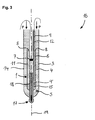
- the measuring chain 16 comprises a measuring electrode 17 and an inventive one Reference electrode 1.
- the measuring electrode 17 points downwards closed pipe on.
- the tube of the measuring electrode 17 has a smaller cross section than that of the pipe of the second Chamber 6.
- the measuring electrode 17 is coaxial with the first Chamber 3 and the second chamber 6 arranged, runs through the two chambers 3, 6 through and protrudes below from the Measuring chain 16 out and into measuring solution 2.
- the Walls 11, 14 are opposite the wall 18 of the Sealed measuring electrode 17, for example glued or merged.
- the wall 18 of the measuring electrode 17 consists of Glass or plastic.
- the second chamber 6 extends hollow cylindrical around the measuring electrode 17.
- the Electrode element 9 together with its casing 12 is offset the longitudinal axis 19 of the measuring chain 16 in the second chamber 6 arranged.
- the opening 8 between the first chamber 3 and the second chamber 6 is through the opening at the top of the Tube of the second chamber 6 is formed.
- the first chamber 3 is with a liquid electrolyte 4 and the second chamber 6 with filled with a gelatinous electrolyte 7.
- the measuring electrode 17 is as a glass electrode with internal buffer and corresponding inner derivative trained.
- the second chamber 6 comprises a tube which is open both upwards and downwards and which is closed at the bottom by means of a corresponding sealing element 20 - for. B. an O-ring - is sealed against the wall 18 of the measuring electrode 17 and the first chamber 3.
- any active element can be introduced into the bottom region of the first chamber 3 before the tube of the second chamber 3 is assembled. Then the tube of the second chamber 3 with the sealing element 20 can be pushed onto the measuring electrode 17 and sealed against the wall 18.
- the active element can be designed, for example, as an electrolyte-forming salt in order to prevent the electrolyte 4, 7 from leaching out in a measurement solution 2 with a low conductivity.
- the active element can also be designed as an ion barrier 21, which prevents the penetration of electrode poisons from the measurement solution 2 into the first electrolyte 4 or the penetration of ions (Ag + ) from the second chamber 6 to the diaphragm 5 and clogging of the diaphragm 5 ,
- the AgCl reservoir 15 and the ion barrier 21 are spatially far apart, so that the ion barrier 21 does not stimulate a directed diffusion of Ag + ions at all or only to a small extent.
- the measuring electrode 17 is designed as a redox electrode and is only shown schematically.
- Fig. 5 shows a third embodiment of a Measuring chain according to the invention 16. Also in this embodiment, the second chamber 6 extends hollow cylindrical around the measuring electrode 17. As most important difference to the previous ones Embodiments, however, the second chamber 6 is between the wall 11 and the wall 14 formed. The wall 11 the second chamber 6 is not opposite the wall 18 Measuring electrode 17, but opposite the wall 14 of the first Chamber 3 sealed with the sealing elements 20.
Landscapes
- Chemical & Material Sciences (AREA)
- Life Sciences & Earth Sciences (AREA)
- Health & Medical Sciences (AREA)
- Physics & Mathematics (AREA)
- Chemical Kinetics & Catalysis (AREA)
- Electrochemistry (AREA)
- Molecular Biology (AREA)
- Analytical Chemistry (AREA)
- Biochemistry (AREA)
- General Health & Medical Sciences (AREA)
- General Physics & Mathematics (AREA)
- Immunology (AREA)
- Pathology (AREA)
- Investigating Or Analyzing Materials By The Use Of Electric Means (AREA)
- Liquid Crystal Substances (AREA)
Abstract
Description
- eine mit einem ersten Elektrolyten gefüllte erste Kammer, die über mindestens ein Diaphragma mit der Messlösung in Verbindung steht,
- eine mit einem zweiten Elektrolyten gefüllte zweite Kammer, die über mindestens eine Öffnung mit dem ersten Elektrolyt in Kontakt steht, und
- ein Elektrodenelement, das zumindest teilweise mit dem zweiten Elektrolyten in Kontakt steht.
- Fig. 1
- eine Bezugselektrode gemäß einer ersten bevorzugten Ausführungsform der Erfindung;
- Fig. 2
- eine Bezugselektrode gemäß einer zweiten bevorzugten Ausführungsform der Erfindung;
- Fig. 3
- eine potentiometrische Messkette gemäß einer ersten bevorzugten Ausführungsform der Erfindung;
- Fig. 4
- eine potentiometrische Messkette gemäß einer zweiten bevorzugten Ausführungsform der Erfindung; und
- Fig. 5
- eine potentiometrische Messkette gemäß einer dritten bevorzugten Ausführungsform der Erfindung.
Claims (19)
- Bezugselektrode (1) zur Verwendung mit einer Messelektrode (17) in einer potentiometrischen Messkette (16) zur Bestimmung der Ionenkonzentration in einer Messlösung (2), wobei die Bezugselektrode (1) aufweist:dadurch gekennzeichnet, dass die erste Kammer (3) und die zweite Kammer (6) derart ausgebildet sind, dass eine elektrische Verbindung zwischen der ersten Kammer (3) und der zweiten Kammer (6) ausschließlich über die mindestens eine Öffnung (8) gegeben ist, und das Elektrodenelement (9) bis auf einen Kontaktierungsbereich (9') von einer elektrisch isolierenden Ummantelung (12) umgeben ist, wobei der Kontaktierungsbereich (9') des Elektrodenelements (9) zu der oder jeder Öffnung (8) in Richtung der Längsachse (13, 19) axial versetzt angeordnet ist.eine mit einem ersten Elektrolyten (4) gefüllte erste Kammer (3), die über mindestens ein Diaphragma (5) mit der Messlösung (2) in Verbindung steht,eine mit einem zweiten Elektrolyten (7) gefüllte zweite Kammer (6), die über mindestens eine Öffnung (8) mit dem ersten Elektrolyten (4) in Kontakt steht, undein Elektrodenelement (9), das zumindest teilweise mit dem zweiten Elektrolyten (7) in Kontakt steht,
- Bezugselektrode (1) nach Anspruch 1, dadurch gekennzeichnet, dass die Ummantelung (12) als ein mit einem elektrischen Isolator gefüllter Kolben ausgebildet ist.
- Bezugselektrode (1) nach Anspruch 2, dadurch gekennzeichnet, dass der Kolben aus Glas oder Kunststoff besteht.
- Bezugselektrode (1) nach Anspruch 2 oder 3, dadurch gekennzeichnet, dass die Ummantelung (12) als ein nach unten offener, luftgefüllter Kolben ausgebildet ist, aus dem unten der Kontaktierungsbereich (9') des Elektrodenelements (9) herausragt.
- Bezugselektrode (1) nach einem der Ansprüche 1 bis 4, dadurch gekennzeichnet, dass in der zweiten Kammer (6) ein nicht fließfähiges Polymer angeordnet ist, in dessen Poren der zweite Elektrolyt (7) eingeschlossen ist.
- Bezugselektrode (1) nach einem der Ansprüche 1 bis 5, dadurch gekennzeichnet, dass der zweite Elektrolyt (7) als eine Salzlösung definierter Konzentration ausgebildet ist.
- Bezugselektrode (1) nach einem der Ansprüche 1 bis 6, dadurch gekennzeichnet, dass in der zweiten Kammer (6) ein Vorrat (15) einer eine Elektrode 2. Art bildenden schwerlöslichen Verbindung angeordnet ist, in die der Kontaktierungsbereich (9') des Elektrodenelements (9) zumindest teilweise hineinragt.
- Bezugselektrode (1) nach Anspruch 7, dadurch gekennzeichnet, dass das nicht fließfähige Polymer mit der Salzlösung unmittelbar in dem Kontaktierungsbereich (9') des Elektrodenelements (9) auspolymerisiert ist.
- Bezugselektrode (1) nach einem der Ansprüche 1 bis 8, dadurch gekennzeichnet, dass die erste Kammer (3) von einem ersten Rohr mit einem ersten Querschnitt und die zweite Kammer (6) von einem nach unten geschlossenen zweiten Rohr mit einem zweiten Querschnitt gebildet ist, wobei der zweite Querschnitt kleiner als der erste Querschnitt ist und das zweite Rohr innerhalb des ersten Rohres koaxial angeordnet ist.
- Bezugselektrode (1) nach Anspruch 9, dadurch gekennzeichnet, dass das zweite Rohr nach oben geschlossen und die Öffnung (8) in der Wandung (11) des zweiten Rohres ausgebildet ist.
- Bezugselektrode (1) nach Anspruch 9 oder 10, dadurch gekennzeichnet, dass das erste Rohr nach unten geschlossen und das Diaphragma (5) in der Wandung (14) des ersten Rohres ausgebildet ist.
- Bezugselektrode (1) nach einem der Ansprüche 9 bis 11, dadurch gekennzeichnet, dass die zweite Kammer (6) innerhalb der Wandung (11) des ersten Rohrs ausgebildet ist.
- Bezugselektrode (1) nach Anspruch 12, dadurch gekennzeichnet, dass der Kolben als ein drittes nach oben abgeschlossenes Rohr mit einem dritten kreisförmigen Querschnitt ausgebildet ist, das in dem zweiten Rohr koaxial angeordnet ist.
- Bezugselektrode (1) nach einem der Ansprüche 9 bis 11, dadurch gekennzeichnet, dass die zweite Kammer (6) zwischen der Wandung (14) des ersten Rohrs und der Wandung (11) des zweiten Rohrs ausgebildet ist.
- Bezugselektrode (1) nach Anspruch 14, dadurch gekennzeichnet, dass die Wandung (14) des ersten Rohrs gegenüber der Wandung (11) des zweiten Rohrs abgedichtet ist.
- Bezugselektrode (1) nach einem der Ansprüche 1 bis 15, dadurch gekennzeichnet, dass in der ersten Kammer (3) eine Ionensperre (21) angeordnet ist, die ein Eindringen von Elektrodengiften aus der Messlösung (2) in den ersten Elektrolyten (4) oder ein Vordringen von Ionen aus der zweiten Kammer (6) zu dem Diaphragma (5) verhindert.
- Potentiometrische Messkette (16) zur Bestimmung der Ionenkonzentration in einer Messlösung (2), wobei die Messkette (16) eine Messelektrode (17) und eine Bezugselektrode (1) aufweist, dadurch gekennzeichnet, dass die Bezugselektrode (1) nach einem der Ansprüche 1 bis 16 ausgebildet ist.
- Messkette (16) nach Anspruch 17, dadurch gekennzeichnet, dass die Messelektrode (17) ein viertes nach unten abgeschlossenes Rohr mit einem vierten kreisförmigen Querschnitt aufweist, wobei der vierte Querschnitt kleiner ist als der zweite Querschnitt und das vierte Rohr in dem ersten Rohr und dem zweiten Rohr koaxial angeordnet ist und unten aus dem ersten Rohr und aus dem zweiten Rohr herausragt, wobei die Wandung (18) des vierten Rohrs gegenüber der Wandung (14) des ersten Rohrs und/oder der Wandung (11) des zweiten Rohrs abgedichtet ist.
- Messkette nach Anspruch 17 oder 18, dadurch gekennzeichnet, dass die Wandungen (11, 14, 18) der Rohre an den abgedichteten Stellen miteinander verschmolzen sind.
Priority Applications (3)
| Application Number | Priority Date | Filing Date | Title |
|---|---|---|---|
| EP00114841A EP1172648B1 (de) | 2000-07-11 | 2000-07-11 | Bezugselektrode zur Verwendung mit einer Messelektrode in einer potentiometrischen Messkette |
| DE50014783T DE50014783D1 (de) | 2000-07-11 | 2000-07-11 | Bezugselektrode zur Verwendung mit einer Messelektrode in einer potentiometrischen Messkette |
| AT00114841T ATE378585T1 (de) | 2000-07-11 | 2000-07-11 | Bezugselektrode zur verwendung mit einer messelektrode in einer potentiometrischen messkette |
Applications Claiming Priority (1)
| Application Number | Priority Date | Filing Date | Title |
|---|---|---|---|
| EP00114841A EP1172648B1 (de) | 2000-07-11 | 2000-07-11 | Bezugselektrode zur Verwendung mit einer Messelektrode in einer potentiometrischen Messkette |
Publications (2)
| Publication Number | Publication Date |
|---|---|
| EP1172648A1 true EP1172648A1 (de) | 2002-01-16 |
| EP1172648B1 EP1172648B1 (de) | 2007-11-14 |
Family
ID=8169215
Family Applications (1)
| Application Number | Title | Priority Date | Filing Date |
|---|---|---|---|
| EP00114841A Expired - Lifetime EP1172648B1 (de) | 2000-07-11 | 2000-07-11 | Bezugselektrode zur Verwendung mit einer Messelektrode in einer potentiometrischen Messkette |
Country Status (3)
| Country | Link |
|---|---|
| EP (1) | EP1172648B1 (de) |
| AT (1) | ATE378585T1 (de) |
| DE (1) | DE50014783D1 (de) |
Cited By (5)
| Publication number | Priority date | Publication date | Assignee | Title |
|---|---|---|---|---|
| WO2008061934A1 (de) * | 2006-11-21 | 2008-05-29 | Endress+Hauser Conducta Gesellschaft Für Mess- Und Regeltechnik Mbh+Co. Kg | Elektrode und einstabmesskette zur bestimmung elektrochemischer potentiale |
| DE102011087188A1 (de) | 2011-11-28 | 2013-05-29 | Endress + Hauser Conducta Gesellschaft für Mess- und Regeltechnik mbH + Co. KG | Verfahren zur Bestimmung zumindest einer Prozessgröße eines Mediums, elektrochemischer Sensor und Einstabmesskette |
| DE102012101004A1 (de) | 2012-02-08 | 2013-08-08 | Endress + Hauser Conducta Gesellschaft für Mess- und Regeltechnik mbH + Co. KG | Elektrode zur Verwendung in elektrochemischen Messsystemen |
| WO2020120467A1 (de) * | 2018-12-13 | 2020-06-18 | Hamilton Bonaduz Ag | Einstabmesskette mit hydrogel aufweisendem diaphragma und verfahren zum herstellen der einstabmesskette |
| CN114689669A (zh) * | 2012-03-26 | 2022-07-01 | 株式会社堀场制作所 | 比较电极和电化学测量装置 |
Citations (4)
| Publication number | Priority date | Publication date | Assignee | Title |
|---|---|---|---|---|
| US4279728A (en) * | 1979-05-16 | 1981-07-21 | Horiba, Ltd. | Apparatus for determining ion concentration |
| US4401548A (en) * | 1981-02-12 | 1983-08-30 | Corning Glass Works | Reference electrode with internal diffusion barrier |
| DE3415089A1 (de) * | 1984-04-21 | 1985-10-31 | Conducta Gesellschaft für Meß- und Regeltechnik mbH & Co, 7016 Gerlingen | Bezugselektrode mit doppeltem uebergang |
| US5360529A (en) * | 1991-08-24 | 1994-11-01 | Eastman Kodak Company | Reference half-cell electrode |
-
2000
- 2000-07-11 AT AT00114841T patent/ATE378585T1/de not_active IP Right Cessation
- 2000-07-11 DE DE50014783T patent/DE50014783D1/de not_active Expired - Lifetime
- 2000-07-11 EP EP00114841A patent/EP1172648B1/de not_active Expired - Lifetime
Patent Citations (4)
| Publication number | Priority date | Publication date | Assignee | Title |
|---|---|---|---|---|
| US4279728A (en) * | 1979-05-16 | 1981-07-21 | Horiba, Ltd. | Apparatus for determining ion concentration |
| US4401548A (en) * | 1981-02-12 | 1983-08-30 | Corning Glass Works | Reference electrode with internal diffusion barrier |
| DE3415089A1 (de) * | 1984-04-21 | 1985-10-31 | Conducta Gesellschaft für Meß- und Regeltechnik mbH & Co, 7016 Gerlingen | Bezugselektrode mit doppeltem uebergang |
| US5360529A (en) * | 1991-08-24 | 1994-11-01 | Eastman Kodak Company | Reference half-cell electrode |
Cited By (13)
| Publication number | Priority date | Publication date | Assignee | Title |
|---|---|---|---|---|
| US8231769B2 (en) | 2006-11-21 | 2012-07-31 | Endress + Hauser Conducta Gesellschaft Fur Mess- U. Regeltechnik Mbh + Co. Kg | Electrode and single-rod measuring chain for determining electrochemical potentials |
| CN101542275B (zh) * | 2006-11-21 | 2013-01-23 | 恩德莱斯和豪瑟尔测量及调节技术分析仪表两合公司 | 用于测定电化学电位的电极与单杆式测量链 |
| WO2008061934A1 (de) * | 2006-11-21 | 2008-05-29 | Endress+Hauser Conducta Gesellschaft Für Mess- Und Regeltechnik Mbh+Co. Kg | Elektrode und einstabmesskette zur bestimmung elektrochemischer potentiale |
| DE102011087188A1 (de) | 2011-11-28 | 2013-05-29 | Endress + Hauser Conducta Gesellschaft für Mess- und Regeltechnik mbH + Co. KG | Verfahren zur Bestimmung zumindest einer Prozessgröße eines Mediums, elektrochemischer Sensor und Einstabmesskette |
| DE102012101004A1 (de) | 2012-02-08 | 2013-08-08 | Endress + Hauser Conducta Gesellschaft für Mess- und Regeltechnik mbH + Co. KG | Elektrode zur Verwendung in elektrochemischen Messsystemen |
| CN114689669A (zh) * | 2012-03-26 | 2022-07-01 | 株式会社堀场制作所 | 比较电极和电化学测量装置 |
| CN114689669B (zh) * | 2012-03-26 | 2025-09-30 | 株式会社堀场制作所 | 比较电极和电化学测量装置 |
| CN113366306A (zh) * | 2018-12-13 | 2021-09-07 | 哈美顿博纳图斯股份公司 | 包括含水凝胶的隔膜的复合电极以及该复合电极的制造方法 |
| EP4137810A1 (de) * | 2018-12-13 | 2023-02-22 | Hamilton Bonaduz AG | Einstabmesskette mit hydrogel aufweisendem diaphragma und verfahren zum herstellen der einstabmesskette |
| CN113366306B (zh) * | 2018-12-13 | 2024-07-12 | 哈美顿博纳图斯股份公司 | 包括含水凝胶的隔膜的复合电极以及该复合电极的制造方法 |
| EP4582798A3 (de) * | 2018-12-13 | 2025-08-06 | Hamilton Bonaduz AG | Einstabmesskette mit hydrogel aufweisendem diaphragma und verfahren zum herstellen der einstabmesskette |
| WO2020120467A1 (de) * | 2018-12-13 | 2020-06-18 | Hamilton Bonaduz Ag | Einstabmesskette mit hydrogel aufweisendem diaphragma und verfahren zum herstellen der einstabmesskette |
| US12560568B2 (en) | 2018-12-13 | 2026-02-24 | Hamilton Bonaduz Ag | Combination electrode having a hydrogel diaphragm |
Also Published As
| Publication number | Publication date |
|---|---|
| EP1172648B1 (de) | 2007-11-14 |
| DE50014783D1 (de) | 2007-12-27 |
| ATE378585T1 (de) | 2007-11-15 |
Similar Documents
| Publication | Publication Date | Title |
|---|---|---|
| DE3405431C2 (de) | ||
| DE10036039B4 (de) | Messsonde für potentiometrische Messungen, Verfahren zur Überwachung des Altrungszustandes der Messonde und ihre Verwendung | |
| CH654112A5 (de) | Bezugselektrode mit innerer diffusionssperre. | |
| WO2010072510A1 (de) | Ionenselektive elektrode | |
| DE102015121364A1 (de) | Potentiometrischer Sensor | |
| DE102015101191A1 (de) | Potentiometrischer Sensor | |
| EP1610120B1 (de) | Potentiometrische Messsonde mit aussenseitiger Beschichtung als Zusatzelektrode | |
| DE2503176A1 (de) | Ionenselektive elektrode | |
| CH654111A5 (de) | Bezugselektrode mit ionenselektiver sperre. | |
| EP0597203B1 (de) | Referenzelektrode | |
| EP1172648B1 (de) | Bezugselektrode zur Verwendung mit einer Messelektrode in einer potentiometrischen Messkette | |
| CH652827A5 (de) | Potentiometrische elektrode. | |
| DE19714474A1 (de) | Elektrochemischer Sensor und Verfahren zu seiner Herstellung | |
| DE2243029A1 (de) | Einrichtung zur messung von elektrodenpotentialen | |
| EP0709669B1 (de) | Multifunktions-Sensor | |
| CH691933A5 (de) | Messeinrichtung zur elektrochemischen Potentialmessung. | |
| DE102018133297A1 (de) | Bezugselektrode und potentiometrischer Sensor | |
| EP0247535A2 (de) | Referenzelektrode für die Ionenaktivitätsmessung, insbesondere für die pH-Wertmessung | |
| EP1219959A1 (de) | Elektrochemisches Messystem mit zwei Referenzelektroden unterschiedlicher Potentialstabilität zur Kontrolle des Salzgehalts im gemeinsamen Referenzelektrolyten | |
| EP0563690A1 (de) | Elektrochemische Messzelle zum Nachweis einer in Wasser gelösten Spezies | |
| DE10305005A1 (de) | Referenzelektrode | |
| DE102019125151A1 (de) | Messaufnehmer mit nicht porösem Referenzübergang | |
| EP1219958A1 (de) | Elektrochemisches Messsystem mit zwei Referenzelektroden unterschiedlicher Potentialstabilität | |
| CH694647A5 (de) | pH-Einstabmesskette mit einer internen Leitfähigkeitsmesszelle. | |
| DE102014119079A1 (de) | Bezugselektrode und elektrochemischer Sensor |
Legal Events
| Date | Code | Title | Description |
|---|---|---|---|
| PUAI | Public reference made under article 153(3) epc to a published international application that has entered the european phase |
Free format text: ORIGINAL CODE: 0009012 |
|
| AK | Designated contracting states |
Kind code of ref document: A1 Designated state(s): AT DE FR GB IT NL Kind code of ref document: A1 Designated state(s): AT BE CH DE DK ES FI FR GB GR IE IT LI LU MC NL PT SE |
|
| AX | Request for extension of the european patent |
Free format text: AL;LT;LV;MK;RO;SI |
|
| 17P | Request for examination filed |
Effective date: 20020711 |
|
| AKX | Designation fees paid |
Free format text: AT DE FR GB IT NL |
|
| RAP1 | Party data changed (applicant data changed or rights of an application transferred) |
Owner name: ENDRESS + HAUSER CONDUCTA GESELLSCHAFT FUER MESS- |
|
| 17Q | First examination report despatched |
Effective date: 20060404 |
|
| GRAP | Despatch of communication of intention to grant a patent |
Free format text: ORIGINAL CODE: EPIDOSNIGR1 |
|
| GRAS | Grant fee paid |
Free format text: ORIGINAL CODE: EPIDOSNIGR3 |
|
| GRAA | (expected) grant |
Free format text: ORIGINAL CODE: 0009210 |
|
| AK | Designated contracting states |
Kind code of ref document: B1 Designated state(s): AT DE FR GB IT NL |
|
| REG | Reference to a national code |
Ref country code: GB Ref legal event code: FG4D Free format text: NOT ENGLISH |
|
| REF | Corresponds to: |
Ref document number: 50014783 Country of ref document: DE Date of ref document: 20071227 Kind code of ref document: P |
|
| ET | Fr: translation filed | ||
| PLBE | No opposition filed within time limit |
Free format text: ORIGINAL CODE: 0009261 |
|
| STAA | Information on the status of an ep patent application or granted ep patent |
Free format text: STATUS: NO OPPOSITION FILED WITHIN TIME LIMIT |
|
| 26N | No opposition filed |
Effective date: 20080815 |
|
| PGFP | Annual fee paid to national office [announced via postgrant information from national office to epo] |
Ref country code: AT Payment date: 20080715 Year of fee payment: 9 Ref country code: FR Payment date: 20080715 Year of fee payment: 9 Ref country code: IT Payment date: 20080724 Year of fee payment: 9 Ref country code: NL Payment date: 20080716 Year of fee payment: 9 |
|
| PGFP | Annual fee paid to national office [announced via postgrant information from national office to epo] |
Ref country code: GB Payment date: 20080722 Year of fee payment: 9 |
|
| GBPC | Gb: european patent ceased through non-payment of renewal fee |
Effective date: 20090711 |
|
| NLV4 | Nl: lapsed or anulled due to non-payment of the annual fee |
Effective date: 20100201 |
|
| REG | Reference to a national code |
Ref country code: FR Ref legal event code: ST Effective date: 20100331 |
|
| PG25 | Lapsed in a contracting state [announced via postgrant information from national office to epo] |
Ref country code: FR Free format text: LAPSE BECAUSE OF NON-PAYMENT OF DUE FEES Effective date: 20090731 |
|
| PG25 | Lapsed in a contracting state [announced via postgrant information from national office to epo] |
Ref country code: GB Free format text: LAPSE BECAUSE OF NON-PAYMENT OF DUE FEES Effective date: 20090711 |
|
| PG25 | Lapsed in a contracting state [announced via postgrant information from national office to epo] |
Ref country code: AT Free format text: LAPSE BECAUSE OF NON-PAYMENT OF DUE FEES Effective date: 20090711 |
|
| PG25 | Lapsed in a contracting state [announced via postgrant information from national office to epo] |
Ref country code: IT Free format text: LAPSE BECAUSE OF NON-PAYMENT OF DUE FEES Effective date: 20090711 |
|
| PG25 | Lapsed in a contracting state [announced via postgrant information from national office to epo] |
Ref country code: NL Free format text: LAPSE BECAUSE OF NON-PAYMENT OF DUE FEES Effective date: 20100201 |
|
| PGFP | Annual fee paid to national office [announced via postgrant information from national office to epo] |
Ref country code: DE Payment date: 20130722 Year of fee payment: 14 |
|
| REG | Reference to a national code |
Ref country code: DE Ref legal event code: R119 Ref document number: 50014783 Country of ref document: DE |
|
| PG25 | Lapsed in a contracting state [announced via postgrant information from national office to epo] |
Ref country code: DE Free format text: LAPSE BECAUSE OF NON-PAYMENT OF DUE FEES Effective date: 20150203 |
|
| REG | Reference to a national code |
Ref country code: DE Ref legal event code: R119 Ref document number: 50014783 Country of ref document: DE Effective date: 20150203 |