EP1173943B1 - Procede pour former et pour determiner une sequence de synchronisation, procede de synchronisation, unite d'emission et unite de reception - Google Patents
Procede pour former et pour determiner une sequence de synchronisation, procede de synchronisation, unite d'emission et unite de reception Download PDFInfo
- Publication number
- EP1173943B1 EP1173943B1 EP00909187A EP00909187A EP1173943B1 EP 1173943 B1 EP1173943 B1 EP 1173943B1 EP 00909187 A EP00909187 A EP 00909187A EP 00909187 A EP00909187 A EP 00909187A EP 1173943 B1 EP1173943 B1 EP 1173943B1
- Authority
- EP
- European Patent Office
- Prior art keywords
- sequence
- synchronization
- constituent
- length
- div
- Prior art date
- Legal status (The legal status is an assumption and is not a legal conclusion. Google has not performed a legal analysis and makes no representation as to the accuracy of the status listed.)
- Expired - Lifetime
Links
- 238000000034 method Methods 0.000 title claims description 25
- 239000000470 constituent Substances 0.000 claims description 46
- 239000011159 matrix material Substances 0.000 claims description 16
- 108010076504 Protein Sorting Signals Proteins 0.000 claims description 15
- 230000001427 coherent effect Effects 0.000 claims description 4
- 238000004364 calculation method Methods 0.000 description 9
- 238000007792 addition Methods 0.000 description 6
- 238000004891 communication Methods 0.000 description 6
- 238000012545 processing Methods 0.000 description 6
- 238000004088 simulation Methods 0.000 description 6
- 230000015572 biosynthetic process Effects 0.000 description 5
- 230000011664 signaling Effects 0.000 description 5
- 230000005540 biological transmission Effects 0.000 description 4
- 230000000295 complement effect Effects 0.000 description 4
- 230000006870 function Effects 0.000 description 4
- 238000009825 accumulation Methods 0.000 description 3
- 238000006243 chemical reaction Methods 0.000 description 3
- 238000010586 diagram Methods 0.000 description 3
- 238000001514 detection method Methods 0.000 description 2
- 238000011161 development Methods 0.000 description 2
- 230000018109 developmental process Effects 0.000 description 2
- 238000010295 mobile communication Methods 0.000 description 2
- 230000009467 reduction Effects 0.000 description 2
- 230000005236 sound signal Effects 0.000 description 2
- 230000007480 spreading Effects 0.000 description 2
- 230000001360 synchronised effect Effects 0.000 description 2
- 238000012935 Averaging Methods 0.000 description 1
- 238000013459 approach Methods 0.000 description 1
- 230000001413 cellular effect Effects 0.000 description 1
- 238000010276 construction Methods 0.000 description 1
- 238000007796 conventional method Methods 0.000 description 1
- 238000012937 correction Methods 0.000 description 1
- 230000001419 dependent effect Effects 0.000 description 1
- 230000002349 favourable effect Effects 0.000 description 1
- 238000001914 filtration Methods 0.000 description 1
- 238000012544 monitoring process Methods 0.000 description 1
- 230000004044 response Effects 0.000 description 1
- 238000005070 sampling Methods 0.000 description 1
- 230000008054 signal transmission Effects 0.000 description 1
- 230000002123 temporal effect Effects 0.000 description 1
- 238000012549 training Methods 0.000 description 1
Images





Classifications
-
- H—ELECTRICITY
- H04—ELECTRIC COMMUNICATION TECHNIQUE
- H04L—TRANSMISSION OF DIGITAL INFORMATION, e.g. TELEGRAPHIC COMMUNICATION
- H04L7/00—Arrangements for synchronising receiver with transmitter
-
- H—ELECTRICITY
- H04—ELECTRIC COMMUNICATION TECHNIQUE
- H04L—TRANSMISSION OF DIGITAL INFORMATION, e.g. TELEGRAPHIC COMMUNICATION
- H04L7/00—Arrangements for synchronising receiver with transmitter
- H04L7/04—Speed or phase control by synchronisation signals
- H04L7/041—Speed or phase control by synchronisation signals using special codes as synchronising signal
-
- H—ELECTRICITY
- H04—ELECTRIC COMMUNICATION TECHNIQUE
- H04B—TRANSMISSION
- H04B1/00—Details of transmission systems, not covered by a single one of groups H04B3/00 - H04B13/00; Details of transmission systems not characterised by the medium used for transmission
- H04B1/69—Spread spectrum techniques
- H04B1/707—Spread spectrum techniques using direct sequence modulation
-
- H—ELECTRICITY
- H04—ELECTRIC COMMUNICATION TECHNIQUE
- H04B—TRANSMISSION
- H04B1/00—Details of transmission systems, not covered by a single one of groups H04B3/00 - H04B13/00; Details of transmission systems not characterised by the medium used for transmission
- H04B1/69—Spread spectrum techniques
- H04B1/707—Spread spectrum techniques using direct sequence modulation
- H04B1/7073—Synchronisation aspects
-
- H—ELECTRICITY
- H04—ELECTRIC COMMUNICATION TECHNIQUE
- H04B—TRANSMISSION
- H04B1/00—Details of transmission systems, not covered by a single one of groups H04B3/00 - H04B13/00; Details of transmission systems not characterised by the medium used for transmission
- H04B1/69—Spread spectrum techniques
- H04B1/707—Spread spectrum techniques using direct sequence modulation
- H04B1/709—Correlator structure
- H04B1/7093—Matched filter type
-
- H—ELECTRICITY
- H04—ELECTRIC COMMUNICATION TECHNIQUE
- H04B—TRANSMISSION
- H04B7/00—Radio transmission systems, i.e. using radiation field
- H04B7/24—Radio transmission systems, i.e. using radiation field for communication between two or more posts
- H04B7/26—Radio transmission systems, i.e. using radiation field for communication between two or more posts at least one of which is mobile
- H04B7/2662—Arrangements for Wireless System Synchronisation
-
- H—ELECTRICITY
- H04—ELECTRIC COMMUNICATION TECHNIQUE
- H04J—MULTIPLEX COMMUNICATION
- H04J13/00—Code division multiplex systems
- H04J13/0007—Code type
- H04J13/0011—Complementary
- H04J13/0014—Golay
Definitions
- the invention relates to a method for synchronizing a base station with a mobile station, a base station and a mobile station.
- first transmission unit In signal transmission systems, such as mobile radio systems, it is necessary that one of the communication partners (first transmission unit) recognizes certain specified signals that are sent by another communication partner (second transmission unit).
- second transmission unit may be, for example, so-called synchronization bursts (synchronization radio blocks) for the synchronization of two synchronization partners, such as radio stations, or so-called access bursts.
- the synchronization signal from the base station of a digital mobile radio system for example, precedes a synchronization sequence as a so-called training sequence, which detects in the mobile station just described by correlation with the stored synchronization sequence or determined becomes. So the mobile stations can be synchronized with the base station.
- Such correlation calculations are required, for example, in Random Access Channel (RACH) detection.
- RACH Random Access Channel
- a correlation calculation is also performed to determine the channel impulse response and the signal propagation times of received signal bursts.
- the correlation sum Sm is successively calculated for a plurality of time-shifted signal sequences E (i) obtained from the received signal, and then the maximum value of Sm is determined. If k consecutive correlation sums are to be calculated, the computational effort is k * n operations, with one multiplication and addition being counted together as one operation.
- the calculation of the correlation sums is therefore very complicated and requires, especially in real-time applications such as voice communication or video telephony or CDMA systems, powerful and therefore expensive processors that have a high power consumption in the calculation.
- a known synchronization sequence of length 256 chips in CDMA, a transmitted bit is also called a chip
- the invention has for its object to provide a method for synchronization of a base station with a mobile station, a base station and a mobile station, which allow a reliable and low-cost synchronization of a base station with a mobile station.
- This principle of construction of a hierarchical synchronization sequence provides for a repetition of a full-length constituent sequence, the repetitions being modulated with the value of the corresponding element of the second constituent sequence.
- synchronization sequences can be formed, which, if they are contained in a received signal sequence, can be easily determined.
- Such synchronization sequences have good correlation properties and enable efficient calculation of the correlation in a mobile station. This could be shown by elaborate simulation tools created especially for this purpose.
- the invention is based on the finding that when using a hierarchical sequence as synchronization sequence, which is based on two constituent sequences, a further reduction in complexity can be achieved at the receiving end if at least one constituent sequence itself is a hierarchical sequence.
- a development of the invention is based on the recognition that when using a hierarchical sequence as a synchronization sequence, which is based on two constituent sequences, wherein at least one constituent sequence is a Golay sequence, a further reduction in complexity can be achieved at the receiving end.
- Specific embodiments of the invention provide for forming a hierarchical 256-chip sequence, in particular a synchronization sequence, to use constituent sequences of length 16, wherein a first constituent sequence is a Golay sequence and a second constituent sequence is a generalized one hierarchical sequence whose constituent sequences are based on two Golay sequences (length 4).
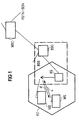
- FIG. 1 shows a cellular mobile radio network, such as the GSM (Global System for Mobile Communication) system, which consists of a multiplicity of mobile switching centers MSC which are networked with each other or establish access to a fixed network PSTN / ISDN. Furthermore, these mobile switching centers MSC are each connected to at least one base station controller BSC, which may also be formed by a data processing system.
- BSC Base station controller
- a similar architecture can also be found in a UMTS (Universal Mobile Telecommunication System).
- UMTS Universal Mobile Telecommunication System
- Each base station controller BSC is in turn connected to at least one base station BS.
- a base station BS is a radio station, which can establish a radio link to other radio stations, so-called mobile stations MS via a radio interface.
- information can be transmitted by means of radio signals within radio channels f which lie within frequency bands b.
- the range of the radio signals of a base station essentially define a radio cell FZ.
- Base stations BS and a base state controller BSC can be combined to form a base station system BSS.
- the base station system BSS is also responsible for the radio channel management and allocation, the data rate adjustment, the monitoring of the radio transmission path, hand-over procedures, and in the case of a CDMA system for the allocation of the spreading code sets to be used, and transmits the necessary signaling information to the mobile stations MS.
- FDD Frequency Division Duplex
- GSM Global System for Mobile communications
- FDD Frequency Division Duplex
- GSM Global System for Mobile communications
- a plurality of frequency channels f can be realized by an FDMA (Frequency Division Multiple Access) method.
- transmission unit also includes the communication unit, transmitting unit, receiving unit, communication terminal, radio station, mobile station or base station.
- Terms and examples used in this application also often refer to a GSM mobile radio system; However, they are by no means limited thereto, but can be easily mapped to other, possibly future, mobile radio systems, such as CDMA systems, in particular wide-band CDMA systems based on the description of a person skilled in the art.
- data can be efficiently transmitted over a radio interface, separated and allocated to one or more specific connections or to the corresponding subscriber.
- These may include a time division multiple access TDMA, a frequency division multiple access FDMA, a code division multiple access CDMA or a combination of several of these multiple access methods are used.
- the frequency band b is decomposed into a plurality of frequency channels f; These frequency channels are divided by the time division multiple access TDMA into time slots ts.
- the signals transmitted within a time slot ts and a frequency channel f can be separated by connection-specific spread codes modulated onto the data, so-called CDMA codes cc.
- the group of broadcast channels includes the broadcast control channel BCCH, through which the MS receives radio information from the base station system BSS, the frequency correction channel FCCH and the synchronization channel SCH.
- Common Control Channels include Random Access Channel RACH.
- the radio blocks or signal sequences transmitted for implementing these logical channels can contain for different purposes synchronization sequences K (i). Correlation sequences, or synchronization sequences K (i) can be transmitted on these logical channels for different purposes.
- the mobile station uses the primary synchronization channel SCH (PSC) to generate a Timeslot synchronization with the strongest base station to achieve.
- PSC primary synchronization channel SCH
- This can be ensured by a matched filter or equivalent circuit adapted to the primary synchronization code cp (synchronization sequence) transmitted by all base stations.
- the same primary synchronization code cp of length 256 is transmitted by all base stations BS.
- the mobile station determines by means of correlation from a receive sequence the received synchronization sequences K (i). In this case, peaks are output at the output of a matched filter (matched filter) for each received synchronization sequence of each base station located within the reception range of the mobile station. The detection of the position of the strongest peak enables the determination of the timing of the strongest base station modulo the slot length. To ensure greater reliability, the output of the matched filter can be non-coherently accumulated over the number of time slots. The mobile station thus performs a correlation via a synchronization sequence of length 256 chips as a matched-filter operation.
- a N then defines the desired Golay sequence.
- FIG. 2 shows a radio station, which may be a mobile station MS, consisting of an operating unit or interface unit MMI, a control device STE, a processing device VE, a power supply device SVE, a receiving device EE and possibly a transmitting device SE.
- a radio station which may be a mobile station MS, consisting of an operating unit or interface unit MMI, a control device STE, a processing device VE, a power supply device SVE, a receiving device EE and possibly a transmitting device SE.
- the control device STE consists essentially of a program-controlled microcontroller MC, which can read and write access memory modules SPE.
- the microcontroller MC controls and controls all essential elements and functions of the radio station.
- the processing device VE can also be formed by a digital signal processor DSP, which can also access memory modules SPE.
- DSP digital signal processor
- the processing device VE can also be used to implement addition and multiplication means.
- microcontroller MC and / or the digital signal processor DSP and / or memory devices SPE and / or further computation elements known to a person skilled in the art can be combined to form a processor device which is set up in such a way that the methods according to claims 1 to 12 can be carried out ,
- the program data required for controlling the radio station and the communication sequence, in particular also the signaling procedures, are stored and information resulting during the processing of signals is stored.
- synchronization sequences K (i) which are used for correlation purposes, and intermediate results of Correlation sum calculations are stored.
- the synchronization sequences K (i) lying within the scope of the invention can thus be stored in the mobile station and / or the base station. It is also possible that one or more parameters for defining synchronization sequences or signal subsequences or signal subsequence pairs (K1 (j); K2 (k)) derived therefrom are stored in the mobile station and / or the base station.
- a synchronization sequence K (i) to be formed in the mobile station and / or the base station from a signal subsequence pair (K1 (j); K2 (k)) and / or one or more parameters for defining synchronization sequences or signal subsequences derived therefrom becomes.
- a synchronization sequence K (i) can be stored, which is transmitted at fixed or variable intervals for synchronization purposes.
- constituent sequences (signal subsequences) or parameters from which the synchronization sequence K (i) stored in the base station can be formed or formed are stored and are used to synchronize the mobile station with a base station for the calculation of the computationally favorable correlation sum calculation.
- the storage of the synchronization sequences or the signal subsequences or parameters can also be done by storing corresponding information in arbitrarily coded form and realized by means for storage, such as volatile and / or non-volatile memory modules or by appropriately configured adder or multiplier inputs or corresponding equivalent hardware configurations ,
- the high-frequency part HF optionally consists of the transmitting device SE, with a modulator and an amplifier V and a receiving device EE with a demodulator and also an amplifier.
- analog / digital conversion the analog audio signals and the analog signals originating from the receiving device EE are converted into digital signals and processed by the digital signal processor DSP. After processing, if necessary, the digital signals are converted by digital / analog conversion into analog audio signals or other output signals and analog signals to be supplied to the transmitting device SE. For this purpose, if necessary, a modulation or demodulation is performed.
- the transmitting device SE and the receiving device EE is supplied via the synthesizer SYN the frequency of a voltage-controlled oscillator VCO.
- the voltage-controlled oscillator VCO and the system clock for clocking processor devices of the radio station can be generated.
- an antenna device ANT For receiving and transmitting signals via the air interface of a mobile radio system, an antenna device ANT is provided.
- the signals are pulsed in time in so-called bursts received and sent.
- the radio station can also be a base station BS.
- the loudspeaker element and the microphone element of the operating unit MMI are replaced by a connection to a mobile radio network, for example via a base station controller BSC or a switching device MSC.
- the base station BS has a corresponding plurality of transmitting and receiving devices.
- FIG. 3 shows a received signal sequence E (l), which may also be a signal sequence derived from a received signal, of length w.
- the synchronization sequence K (i) is displaced to the right by one element as shown in the figure and the elements of the synchronization sequence K (i) are multiplied by the corresponding elements of the signal sequence E (l), and by a Summation of the resulting partial results again formed the correlation sum S1.
- the pairwise multiplication of the elements of the synchronization sequence with corresponding elements of the received signal sequence and the subsequent summation can also be described in vector notation as the formation of a scalar product, as long as the elements of the synchronization sequence and the elements of the received signal sequence are combined into a vector:
- the maximum can be searched in the correlation sums S determined in this way, the maximum of the correlation sums S can be compared with a predefined threshold value, and it can thus be determined whether the predetermined synchronization sequence K (i) is contained in the received signal E (l) and if so, where in the received signal E (l) it is located, and so two radio stations are synchronized with each other or data to which an individual spreading code in the form of a synchronization sequence K (i) has been modulated, can be detected.
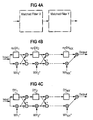
- FIG. 4 shows an efficient hierarchical correlator for synchronization sequences, wherein Golay sequences X, Y of length nx or ny are used as constituent sequences K1, K2.
- the correlator consists of two matched filters (FIG. 4 a), which are each formed as efficient Golay correlators.
- FIG. 4 b) shows the matched filter for the sequence X
- FIG. 4 c) shows the matched filter for the sequence Y.
- W * n denotes the conjugate complex to W n . If the weights W are real, W * n is identical to W n .
- R a ( N ) (k) is then the correlation sum to be calculated.
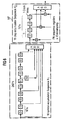
- FIG. 1 One possible implementation of the entire correlator, a more efficiently truncated Golay correlator for generalized hierarchical Golay sequences, is shown in FIG. This is also referred to as a truncated Golay correlator because one of the outputs is truncated in certain stages and instead another output is used as input to the next stage.
- the generalized hierarchical Golay sequence offers advantages compared to a simple hierarchical or Golay-based structure sequence because of more efficient ways of calculating the correlation sum with this Golay sequence. Simulations also show good results in terms of slot synchronization even at higher frequency errors.
- FIG. 6 first shows an efficient correlator for simple hierarchical sequences and a simple correlation method for the hierarchical correlation.
- the hierarchical correlation consists of two concatenated matched filter blocks, each performing a standard correlation over one of the constituent sequences. It is assumed that the correlation over X 1 (16-symbol accumulation) is performed before the correlation over X 2 (16-chip accumulation). This is an implementation option because both matched filter blocks (enclosed in dashed lines in Figure 6) are linear systems that can be connected in any order. In this way, 240 * n delay lines with the minimum word length can be implemented since no accumulation takes place beforehand and therefore no signal / interference gain is achieved. Where n is the oversampling factor, ie how many samples are performed per chip interval.
- one or both of the matched filter blocks may optionally be replaced by a correlator for a (generalized) hierarchical sequence or by an efficient Golay correlator (EGC).
- a correlator for a (generalized) hierarchical sequence or by an efficient Golay correlator (EGC).
- ECG Golay correlator
- FIG 7 shows a simple correlation method for the efficient Golay correlator (EGC) for a simple Golay sequence.
- An efficient hierarchical Golay correlator is structurally equivalent to an efficient correlator for simple hierarchical sequences (see Figure 6), except that two adders can be omitted.
- FIG 8 now shows an efficient Golay correlator for generalized hierarchical Golay sequence.
- the saving of two adders of 15 adders obviously reduces the complexity of the method accordingly.
- Figure 9 shows simulation results in which the slit synchronization step was examined on a RayKey single-beam 3 km / h channel for different chip to noise ratios (CNR) with and without frequency error.
- CNR chip to noise ratios
- the proposed synchronization sequence GHG has better autocorrelation properties than Sold (dotted curve), especially at 10 kHz.
- the graph shows that the synchronization characteristics of GHG are optimal with respect to practical use.
- S old is a hierarchical correlation sequence that is not particularly optimized for frequency errors.
- the calculation complexity is thus reduced at the receiving end; the complexity is reduced compared to conventional sequences of 30 additions or Golay sequences of 15 additions per output sample to only 13 additions.
Landscapes
- Engineering & Computer Science (AREA)
- Computer Networks & Wireless Communication (AREA)
- Signal Processing (AREA)
- Mobile Radio Communication Systems (AREA)
- Synchronisation In Digital Transmission Systems (AREA)
Claims (13)
- Procédé de synchronisation d'une station de base (BS) avec une station mobile (MS),
dans lequel une séquence de synchronisation y(i) de longueur n est émise par la station de base (BS), qui peut être formée à partir d'une première séquence constitutive x1 de longueur n1 et d'une deuxième séquence constitutive x2 de longueur n2 selon la relation suivante:


- Procédé selon la revendication 1, dans lequel
la séquence de synchronisation y(i) présente la longueur 256 et les séquences constitutives x1, x2 présentent la longueur 16. - Procédé selon l'une quelconque des revendications précédentes, au moins une des séquences constitutives x1 resp. x2 étant une séquence de Golay.
- Procédé selon la revendication 3,
au moins une des séquences constitutives x1 resp. x2 étant une séquence de Golay qui est basée sur les paramètres suivants :matrice de retard D1 = [8, 4, 1, 2] et matrice de pondération W1 = [1, -1, 1, 1];
resp.matrice de retard D2 = [8, 4, 1, 2] et matrice de pondération W2 = [1, -1, 1, 1]. - Procédé selon l'une quelconque des revendications précédentes, dans lequel x3 et x4 sont des séquences de Golay identiques de longueur 4 et sont basés sur les paramètres suivants :matrice de retard D3 = D4 = [1, 2] et matrice de pondération W3 = W4 = [1, 1].
- Procédé selon l'une quelconque des revendications 3 à 5, dans lequel une séquence de Golay aN est définie par la relation récursive suivante :


δ(k) fonction de Kronecker. - Procédé selon l'une quelconque des revendications précédentes, dans lequel la séquence de synchronisation y(i) est reçue par une station mobile et est traitée à des fins de synchronisation.
- Procédé selon l'une quelconque des revendications précédentes, dans lequel
des sommes de corrélation S de la séquence de synchronisation y(i) sont déterminées dans la station mobile (MS) avec des sections correspondantes de la séquence de signaux de réception E(1) pour déterminer une séquence de synchronisation y(i) prédéfinie contenue dans une séquence de signaux de réception E(1) . - Procédé selon la revendication 8,
dans lequel au moins un Efficient Golay Correlator (EGC) est utilisé pour déterminer au moins une somme de corrélations S. - Station de base (BS),
qui est configurée de telle manière qu'elle émet une séquence de synchronisation pour la synchronisation entre la station de base (BS) et une station mobile (MS), cette séquence de synchronisation pouvant être formée à partir d'une première séquence constitutive x1 de longueur n1 et d'une deuxième séquence constitutive x2 de longueur n2 selon la relation suivante :


et comprenant des moyens pour émettre cette séquence de synchronisation y(i) dans le but de la synchronisation avec une unité de réception (MS). - Station mobile (MS)
qui est configurée de telle manière qu'elle détermine une séquence de synchronisation pour la synchronisation entre une station de base (BS) et la station mobile (MS), cette séquence de synchronisation pouvant être obtenue du fait qu'elle peut être formée à partir d'une première séquence constitutive x1 de longueur n1 et d'une deuxième séquence constitutive x2 de longueur n2 selon la relation suivante : y(i) = x2 (i mod n2) * x1 (i div n2) pour i = 0 ... (n1*n2) - 1, au moins une séquence constitutive x1 resp. x2 pouvant être formée à partir d'une troisième séquence constitutive x3 de longueur n3 et d'une quatrième séquence constitutive x4 de longueur n4 selon la relation suivante :

- Station mobile (MS) selon la revendication 11,
comprenant au moins un Efficient Golay Correlator pour déterminer la séquence de synchronisation y(i). - Station mobile (MS) selon l'une quelconque des revendications 11 ou 12, comprenant deux Matched Filters couplés en série, qui sont formés comme des Efficient Golay Correlators pour déterminer la séquence de synchronisation y(i).
Priority Applications (1)
| Application Number | Priority Date | Filing Date | Title |
|---|---|---|---|
| EP00909187A EP1173943B1 (fr) | 1999-04-29 | 2000-02-16 | Procede pour former et pour determiner une sequence de synchronisation, procede de synchronisation, unite d'emission et unite de reception |
Applications Claiming Priority (6)
| Application Number | Priority Date | Filing Date | Title |
|---|---|---|---|
| DE19919545 | 1999-04-29 | ||
| DE19919545A DE19919545B4 (de) | 1999-04-29 | 1999-04-29 | Verfahren zur Bildung einer Signalfolge |
| EP99109791 | 1999-05-18 | ||
| EP99109791 | 1999-05-18 | ||
| PCT/EP2000/001263 WO2000067405A1 (fr) | 1999-04-29 | 2000-02-16 | Procede pour former et pour determiner une sequence de synchronisation, procede de synchronisation, unite d'emission et unite de reception |
| EP00909187A EP1173943B1 (fr) | 1999-04-29 | 2000-02-16 | Procede pour former et pour determiner une sequence de synchronisation, procede de synchronisation, unite d'emission et unite de reception |
Publications (2)
| Publication Number | Publication Date |
|---|---|
| EP1173943A1 EP1173943A1 (fr) | 2002-01-23 |
| EP1173943B1 true EP1173943B1 (fr) | 2006-04-19 |
Family
ID=26053133
Family Applications (2)
| Application Number | Title | Priority Date | Filing Date |
|---|---|---|---|
| EP00916836A Expired - Lifetime EP1173944B1 (fr) | 1999-04-29 | 2000-02-15 | Procede pour la formation et la determination d'une sequence de signaux, procede de synchronisation, unite emettrice et unite receptrice |
| EP00909187A Expired - Lifetime EP1173943B1 (fr) | 1999-04-29 | 2000-02-16 | Procede pour former et pour determiner une sequence de synchronisation, procede de synchronisation, unite d'emission et unite de reception |
Family Applications Before (1)
| Application Number | Title | Priority Date | Filing Date |
|---|---|---|---|
| EP00916836A Expired - Lifetime EP1173944B1 (fr) | 1999-04-29 | 2000-02-15 | Procede pour la formation et la determination d'une sequence de signaux, procede de synchronisation, unite emettrice et unite receptrice |
Country Status (11)
| Country | Link |
|---|---|
| US (2) | US7062002B1 (fr) |
| EP (2) | EP1173944B1 (fr) |
| JP (2) | JP4342109B2 (fr) |
| KR (2) | KR100669570B1 (fr) |
| CN (2) | CN100521589C (fr) |
| AU (1) | AU777074B2 (fr) |
| BR (1) | BRPI0010601B1 (fr) |
| DE (2) | DE50009481D1 (fr) |
| ES (1) | ES2233356T3 (fr) |
| HU (2) | HUP0200968A2 (fr) |
| WO (2) | WO2000067404A1 (fr) |
Families Citing this family (50)
| Publication number | Priority date | Publication date | Assignee | Title |
|---|---|---|---|---|
| DE19953895A1 (de) * | 1999-11-10 | 2001-05-17 | Bosch Gmbh Robert | Verfahren zur Korrelation von zeitdiskreten Signalabschnitten |
| DE19961557A1 (de) * | 1999-12-20 | 2001-07-05 | Infineon Technologies Ag | Verfahren und Einrichtung zum Synchronisieren eines Mobilfunkempfängers mit einer Zeitschlitzstruktur eines empfangenen Funksignals |
| ES2164613B1 (es) * | 2000-08-16 | 2003-05-16 | Fuente Vicente Diaz | Metodo, transmisor y receptor para comunicacion digital de espectro ensanchado mediante modulacion de secuencias complementarias golay. |
| EP1234383A2 (fr) * | 2000-09-29 | 2002-08-28 | Kabushiki Kaisha Toshiba | Circuit et procede de detection de code |
| GB0024530D0 (en) * | 2000-10-06 | 2000-11-22 | Roke Manor Research | Use of multiple offsets with concatenated periodically extended complementary sequences |
| DE10124223A1 (de) * | 2001-05-18 | 2002-11-21 | Philips Corp Intellectual Pty | Verfahren und Einrichtung zur Synchronisation eines Funksenders mit einem Funkempfänger |
| DE10125013A1 (de) * | 2001-05-22 | 2002-11-28 | Siemens Ag | Verfahren zur Synchronisation von Basisstationen in einem Funk-Kommunikationssystem |
| US7092469B1 (en) * | 2001-09-26 | 2006-08-15 | Nokia Corporation | Synchronization signal detector and method of detection of synchronization signal |
| KR100461545B1 (ko) * | 2001-10-20 | 2004-12-16 | 한국전자통신연구원 | 동기 채널의 동기코드 생성 및 검출 방법 |
| AU2003273321A1 (en) * | 2002-09-12 | 2004-04-30 | Interdigital Technology Corporation | Mitigation of interference in cell search by wireless transmit and receive units |
| KR100905572B1 (ko) * | 2002-12-03 | 2009-07-02 | 삼성전자주식회사 | 직교 주파수 분할 다중 방식을 사용하는 통신시스템에서 프리앰블 시퀀스 생성 장치 및 방법 |
| CN1283059C (zh) * | 2003-01-23 | 2006-11-01 | 上海贝尔阿尔卡特股份有限公司 | 一种载频同步的方法和装置 |
| EP1443669B1 (fr) | 2003-01-31 | 2017-05-03 | France Brevets | Dispositif pour synchronisation et identification de code |
| KR100770912B1 (ko) * | 2003-06-16 | 2007-10-26 | 삼성전자주식회사 | 직교 주파수 분할 다중 방식을 사용하는 통신 시스템에서프리앰블 시퀀스 생성 장치 및 방법 |
| CN1879426B (zh) * | 2004-01-29 | 2010-06-23 | 桥扬科技有限公司 | 用于多载波、多小区无线通信网络的方法和装置 |
| WO2005074166A1 (fr) | 2004-01-29 | 2005-08-11 | Neocific, Inc. | Procedes et appareil de superpositon de signaux multi-porteuses et a spectre etale a sequence directe dans un systeme de transmission sans fil a bande large |
| WO2005109705A1 (fr) | 2004-05-01 | 2005-11-17 | Neocific, Inc. | Procedes et appareil destines a la communication avec duplexage a repartition dans le temps |
| WO2005081439A1 (fr) | 2004-02-13 | 2005-09-01 | Neocific, Inc. | Procedes et dispositif pour des systemes de communication a porteuses multiples comportant une transmission et une retroaction adaptatives |
| US7532661B2 (en) | 2004-04-19 | 2009-05-12 | Texas Instruments Incorporated | Additional hierarchical preamble for support of FDMA channel in a multi-band OFDM system |
| EP1932288B1 (fr) * | 2005-09-21 | 2010-03-03 | Nxp B.V. | Circuit de bus |
| US8583995B2 (en) * | 2005-11-16 | 2013-11-12 | Qualcomm Incorporated | Multi-mode processor |
| US8429502B2 (en) * | 2005-11-16 | 2013-04-23 | Qualcomm Incorporated | Frame format for millimeter-wave systems |
| US8724676B2 (en) * | 2005-11-16 | 2014-05-13 | Qualcomm Incorporated | Method and apparatus for single carrier spreading |
| US8910027B2 (en) * | 2005-11-16 | 2014-12-09 | Qualcomm Incorporated | Golay-code generation |
| JP5108782B2 (ja) * | 2005-12-08 | 2012-12-26 | コーニンクレッカ フィリップス エレクトロニクス エヌ ヴィ | デジタル通信システムに対するロバスト同期スキームのためのシステム、装置及び方法 |
| KR100656826B1 (ko) * | 2005-12-23 | 2006-12-13 | 주식회사 케이티 | 준동기 부호분할 다원접속 시스템의 낮은 상관구역 수열군생성 장치 및 방법 |
| JP5023539B2 (ja) * | 2006-04-11 | 2012-09-12 | 富士通セミコンダクター株式会社 | 半導体装置及び信号処理方法 |
| CN101192881A (zh) * | 2006-11-30 | 2008-06-04 | 昂达博思公司 | 用于快速上行链路空中接口同步的系统和方法 |
| CN101197590B (zh) * | 2006-12-04 | 2011-08-17 | 海能达通信股份有限公司 | 一种在无线通信中实现位同步数字化的方法及其系统 |
| GB2458418B (en) * | 2006-12-19 | 2011-08-03 | Lg Electronics Inc | Sequence generating method for efficient detection and method for transmitting and receiving signals using the same |
| CN101641924B (zh) * | 2006-12-19 | 2014-03-26 | Lg电子株式会社 | 用于有效检测的序列产生方法及采用该方法收发信号的方法 |
| KR101414610B1 (ko) * | 2007-02-05 | 2014-07-04 | 엘지전자 주식회사 | 2개 이상의 시퀀스 세트 생성 방법 및 이를 위한 시퀀스생성 방법 |
| US8363692B2 (en) * | 2007-02-05 | 2013-01-29 | Lg Electronics Inc. | Method for generating 2 or more sequence set, and method for generating sequence for the same |
| KR100922970B1 (ko) * | 2007-02-08 | 2009-10-22 | 삼성전자주식회사 | 통신 시스템에서의 훈련 시퀀스 코드의 생성/변조 방법 및 이를 이용한 데이터 송신 장치 |
| WO2008130206A1 (fr) * | 2007-04-24 | 2008-10-30 | Lg Electronics Inc. | Procédé pour générer une séquence et de procédé pour émettre un signal sur la base de la séquence dans un système de communication |
| KR101467751B1 (ko) * | 2007-04-24 | 2014-12-03 | 엘지전자 주식회사 | 이동 통신 시스템에서 시퀀스 생성 방법 및 시퀀스 기반의신호 송신 방법 |
| KR100958031B1 (ko) * | 2007-05-17 | 2010-05-19 | 엘지전자 주식회사 | 무선통신 시스템에서 동기 신호를 전송하는 방법 |
| DE102007028732A1 (de) * | 2007-06-21 | 2008-12-24 | Continental Automotive Gmbh | Mehrfache Spreizung/Entspreizung von Spreizspektrumsignalen durch mehrfache Spreizfolgen |
| KR100938756B1 (ko) | 2007-07-06 | 2010-01-26 | 엘지전자 주식회사 | 무선통신 시스템에서 셀 탐색 과정을 수행하는 방법 |
| US8472497B2 (en) * | 2007-10-10 | 2013-06-25 | Qualcomm Incorporated | Millimeter wave beaconing with directional antennas |
| EP2223436B1 (fr) * | 2007-12-21 | 2017-11-22 | Telefonaktiebolaget LM Ericsson (publ) | Génération de codes de synchronisation mbsfn-dob |
| WO2009116769A1 (fr) | 2008-03-17 | 2009-09-24 | Lg Electronics Inc. | Procédé de transmission de signal de référence et émetteur l'utilisant |
| KR100911307B1 (ko) | 2008-03-17 | 2009-08-11 | 엘지전자 주식회사 | 기준신호 전송 방법 |
| US8107443B2 (en) * | 2009-02-10 | 2012-01-31 | Mediatek Inc. | Method of performing cell search for a wireless communications system |
| US8908792B2 (en) | 2009-06-23 | 2014-12-09 | Intel Corporation | Apparatus and methods using an efficient Golay correlator running at 1.5 the sampling rate in wireless communication systems |
| US10257325B2 (en) | 2015-02-05 | 2019-04-09 | Samsung Electronics Co., Ltd. | System, apparatus, and method for configuring preamble and synchronizing frame |
| TR201810572T4 (tr) | 2015-03-06 | 2018-08-27 | Ericsson Telefon Ab L M | Bir anten düzeneği kullanarak huzme oluşturma. |
| KR20170020001A (ko) * | 2015-08-13 | 2017-02-22 | 삼성전자주식회사 | 통신 시스템에서 신호 송수신 장치 및 방법 |
| US10700762B2 (en) | 2016-05-04 | 2020-06-30 | Telefonaktiebolaget Lm Ericsson (Publ) | Beam forming using an antenna arrangement |
| US10708751B2 (en) * | 2016-08-11 | 2020-07-07 | Qualcomm Incorporated | Detection of technologies for coexistence |
Family Cites Families (15)
| Publication number | Priority date | Publication date | Assignee | Title |
|---|---|---|---|---|
| WO1994008403A1 (fr) | 1992-10-01 | 1994-04-14 | Motorola, Inc. | Recepteur d'appel selectif pouvant demander une information a un systeme de communications et procede |
| JPH07297805A (ja) * | 1994-04-28 | 1995-11-10 | Toshiba Corp | スペクトラム拡散符号の同期回路および同期方法 |
| US5717713A (en) * | 1994-11-18 | 1998-02-10 | Stanford Telecommunications, Inc. | Technique to permit rapid acquisition and alert channel signalling for base station-to-user link of an orthogonal CDMA (OCDMA) communication system |
| IL118447A (en) * | 1995-06-05 | 2000-01-31 | Omnipunt Corp | System and method for time division duplex communication |
| US5764630A (en) * | 1996-03-25 | 1998-06-09 | Stanford Telecommunications, Inc. | Forward link carrier recovery in an OCDMA spread spectrum communication system without a pilot tone |
| US5751774A (en) * | 1996-04-04 | 1998-05-12 | Lucent Technologies Inc. | Transmission system for digital audio broadcasting |
| US5748686A (en) * | 1996-04-04 | 1998-05-05 | Globespan Technologies, Inc. | System and method producing improved frame synchronization in a digital communication system |
| US5805646A (en) * | 1996-10-08 | 1998-09-08 | Ericsson Inc. | Synchronization method, and associated circuitry, for improved synchronization of a receiver with a transmitter using early-late testing during coarse synchronization |
| US6181729B1 (en) * | 1997-12-19 | 2001-01-30 | Supergold Communication Limited | Spread spectrum communication |
| US6256304B1 (en) * | 1998-03-31 | 2001-07-03 | Nokia Mobile Phones, Limited | Mobile station using synchronization word order information for improved channel acquisition |
| US7142584B1 (en) * | 1998-09-08 | 2006-11-28 | Siemens Ag | Synchronizing a bash station and a mobile station |
| JP3411836B2 (ja) * | 1998-10-30 | 2003-06-03 | 松下電器産業株式会社 | 同期捕捉装置及び同期捕捉方法 |
| US6873647B1 (en) * | 1999-02-26 | 2005-03-29 | Qualcomm Incorporated | Method and system for reducing synchronization time in a CDMA wireless communication system |
| US6567482B1 (en) * | 1999-03-05 | 2003-05-20 | Telefonaktiebolaget Lm Ericsson (Publ) | Method and apparatus for efficient synchronization in spread spectrum communications |
| CA2276971A1 (fr) * | 1999-07-06 | 2001-01-06 | Wen Tong | Synchroniseur initial faisant appel au code de golay pour un canal d'acces dans des systemes de communications cellulaires |
-
2000
- 2000-02-15 CN CNB008068801A patent/CN100521589C/zh not_active Expired - Lifetime
- 2000-02-15 US US10/018,312 patent/US7062002B1/en not_active Expired - Lifetime
- 2000-02-15 WO PCT/EP2000/001231 patent/WO2000067404A1/fr not_active Ceased
- 2000-02-15 ES ES00916836T patent/ES2233356T3/es not_active Expired - Lifetime
- 2000-02-15 EP EP00916836A patent/EP1173944B1/fr not_active Expired - Lifetime
- 2000-02-15 JP JP2000616148A patent/JP4342109B2/ja not_active Expired - Lifetime
- 2000-02-15 DE DE50009481T patent/DE50009481D1/de not_active Expired - Lifetime
- 2000-02-15 AU AU38043/00A patent/AU777074B2/en not_active Expired
- 2000-02-15 BR BRPI0010601A patent/BRPI0010601B1/pt active IP Right Grant
- 2000-02-15 HU HU0200968A patent/HUP0200968A2/hu unknown
- 2000-02-15 KR KR1020017013856A patent/KR100669570B1/ko not_active Expired - Lifetime
- 2000-02-16 US US10/018,436 patent/US7010071B1/en not_active Expired - Lifetime
- 2000-02-16 JP JP2000616149A patent/JP4650978B2/ja not_active Expired - Lifetime
- 2000-02-16 EP EP00909187A patent/EP1173943B1/fr not_active Expired - Lifetime
- 2000-02-16 KR KR1020017013859A patent/KR100669568B1/ko not_active Expired - Lifetime
- 2000-02-16 CN CNB008068895A patent/CN100459468C/zh not_active Expired - Lifetime
- 2000-02-16 DE DE50012606T patent/DE50012606D1/de not_active Expired - Lifetime
- 2000-02-16 WO PCT/EP2000/001263 patent/WO2000067405A1/fr not_active Ceased
- 2000-02-16 HU HU0200967A patent/HUP0200967A2/hu unknown
Also Published As
| Publication number | Publication date |
|---|---|
| KR100669568B1 (ko) | 2007-01-15 |
| US7010071B1 (en) | 2006-03-07 |
| BRPI0010601B1 (pt) | 2016-01-19 |
| CN1349691A (zh) | 2002-05-15 |
| US7062002B1 (en) | 2006-06-13 |
| KR100669570B1 (ko) | 2007-01-15 |
| HUP0200968A2 (en) | 2002-07-29 |
| EP1173944B1 (fr) | 2005-02-09 |
| AU3804300A (en) | 2000-11-17 |
| KR20020013857A (ko) | 2002-02-21 |
| KR20020013858A (ko) | 2002-02-21 |
| CN100459468C (zh) | 2009-02-04 |
| CN100521589C (zh) | 2009-07-29 |
| JP2002543741A (ja) | 2002-12-17 |
| ES2233356T3 (es) | 2005-06-16 |
| JP2002543742A (ja) | 2002-12-17 |
| DE50012606D1 (de) | 2006-05-24 |
| BR0010601A (pt) | 2002-02-05 |
| JP4650978B2 (ja) | 2011-03-16 |
| AU777074B2 (en) | 2004-09-30 |
| CN1349690A (zh) | 2002-05-15 |
| DE50009481D1 (de) | 2005-03-17 |
| HUP0200967A2 (en) | 2002-07-29 |
| JP4342109B2 (ja) | 2009-10-14 |
| EP1173943A1 (fr) | 2002-01-23 |
| EP1173944A1 (fr) | 2002-01-23 |
| WO2000067404A1 (fr) | 2000-11-09 |
| WO2000067405A1 (fr) | 2000-11-09 |
Similar Documents
| Publication | Publication Date | Title |
|---|---|---|
| EP1173943B1 (fr) | Procede pour former et pour determiner une sequence de synchronisation, procede de synchronisation, unite d'emission et unite de reception | |
| DE60125058T2 (de) | Verfahren zur Synchonisierung von Basisstationen in einem Telekommunikationssystem | |
| EP1006670B1 (fr) | Réseau sans fil | |
| DE69709332T2 (de) | Synchronisationsverfahren und -vorrichtung zur synchronisation eines senders mit einem empfänger | |
| DE60319433T2 (de) | Verfahren und vorrichtung zur erhaltung der synchronisation für tdd drahtlose kommunikation | |
| EP1125463B1 (fr) | Procede d'adaptation des phases d'interruption necessaires pour la surveillance de canaux | |
| DE69614348T2 (de) | Kodeerfassungsverfahren in einer cdma-kommunikationsanordnung unter verwendung mehrerer walsh kanäle | |
| EP1112633B1 (fr) | Procede de formation ou de determination d'une sequence de signaux, unite d'emission et unite de reception | |
| DE69636424T2 (de) | Direktsequenz-Kodemultiplexvielfachzugriffsempfänger und Verfahren zur Synchronisierung dafür | |
| DE20215686U1 (de) | Benutzervorrichtung (UE) mit einem Erfassungsschaltkreis für ein mobiles Telekommunikationssystem mit einer Chip-Rate von 1,28 MCHPS | |
| DE69703700T2 (de) | Verbesserte synchronisation eines empfängers mit einem sender der frü und spät prüfung während grober synchronisation verwendet | |
| DE69902809T2 (de) | Verfahren und vorrichtung zur synchronisierung unter verwendung von partieller sequenz korrelation | |
| DE19919545B4 (de) | Verfahren zur Bildung einer Signalfolge | |
| EP0878064B1 (fr) | Procede de transmission a modulation de code et systeme de transmission fonctionnant d'apres ce procede | |
| DE10015041C2 (de) | Verfahren zur Signalisierung des Beginns eines logischen Kanals in einem gemeinsam genutzten physikalischen Übertragungskanal eines Funk-Kommunikationssystems und Vorrichtung zur Durchführung des Verfahrens | |
| DE69709382T2 (de) | Verbesserte synchronisation eines empfängers mit einem sender der nicht lineare metrische transformationen gebraucht | |
| DE60124595T2 (de) | Hochleistungszeitschlitzsyncronisation für die anfangszellensuche eines w-cdma systems mit reduziertem hardware | |
| WO2002011486A1 (fr) | Procede pour la differenciation de voies logiques dans une voie de transmission physique utilisee en commun d'un systeme de communication radio | |
| EP1226659B1 (fr) | Procede de synchronisation d'une transmission de signaux en sens ascendant dans un systeme de radiotelecommunication | |
| DE19851309C1 (de) | Verfahren zur Datenübertragung in einem Funk-Kommunikationssystem über eine Funkschnittstelle zwischen einer Basisstation und Teilnehmerstation | |
| DE19907083A1 (de) | Verfahren zur Bildung bzw. Ermittlung einer Signalfolge, Verfahren zur Synchronisation, Sendeeinheit und Empfangseinheit | |
| DE19836888A1 (de) | Verfahren und Vorrichtung für ein voll duplexfähigesFunkübertragungssystem mit CDMA-Zugriff | |
| WO2000055991A1 (fr) | Procede de synchronisation de stations de base d'un systeme de transmission radio | |
| EP1292048A1 (fr) | Procédé de transmission de données en diversité dans un système de communication radio | |
| WO1999022479A1 (fr) | Procede et station emettrice permettant de synchroniser des stations emettrices dans un systeme de radiocommunication |
Legal Events
| Date | Code | Title | Description |
|---|---|---|---|
| PUAI | Public reference made under article 153(3) epc to a published international application that has entered the european phase |
Free format text: ORIGINAL CODE: 0009012 |
|
| 17P | Request for examination filed |
Effective date: 20010926 |
|
| AK | Designated contracting states |
Kind code of ref document: A1 Designated state(s): AT BE CH CY DE DK ES FI FR GB GR IE IT LI LU MC NL PT SE |
|
| 17Q | First examination report despatched |
Effective date: 20040218 |
|
| RBV | Designated contracting states (corrected) |
Designated state(s): DE FR GB IT |
|
| GRAP | Despatch of communication of intention to grant a patent |
Free format text: ORIGINAL CODE: EPIDOSNIGR1 |
|
| GRAS | Grant fee paid |
Free format text: ORIGINAL CODE: EPIDOSNIGR3 |
|
| GRAA | (expected) grant |
Free format text: ORIGINAL CODE: 0009210 |
|
| AK | Designated contracting states |
Kind code of ref document: B1 Designated state(s): DE FR GB IT |
|
| PG25 | Lapsed in a contracting state [announced via postgrant information from national office to epo] |
Ref country code: IT Free format text: LAPSE BECAUSE OF FAILURE TO SUBMIT A TRANSLATION OF THE DESCRIPTION OR TO PAY THE FEE WITHIN THE PRESCRIBED TIME-LIMIT;WARNING: LAPSES OF ITALIAN PATENTS WITH EFFECTIVE DATE BEFORE 2007 MAY HAVE OCCURRED AT ANY TIME BEFORE 2007. THE CORRECT EFFECTIVE DATE MAY BE DIFFERENT FROM THE ONE RECORDED. Effective date: 20060419 |
|
| REG | Reference to a national code |
Ref country code: GB Ref legal event code: FG4D Free format text: NOT ENGLISH |
|
| GBT | Gb: translation of ep patent filed (gb section 77(6)(a)/1977) |
Effective date: 20060419 |
|
| REF | Corresponds to: |
Ref document number: 50012606 Country of ref document: DE Date of ref document: 20060524 Kind code of ref document: P |
|
| ET | Fr: translation filed | ||
| PLBE | No opposition filed within time limit |
Free format text: ORIGINAL CODE: 0009261 |
|
| STAA | Information on the status of an ep patent application or granted ep patent |
Free format text: STATUS: NO OPPOSITION FILED WITHIN TIME LIMIT |
|
| 26N | No opposition filed |
Effective date: 20070122 |
|
| PGRI | Patent reinstated in contracting state [announced from national office to epo] |
Ref country code: IT Effective date: 20110501 |
|
| PG25 | Lapsed in a contracting state [announced via postgrant information from national office to epo] |
Ref country code: IT Free format text: LAPSE BECAUSE OF NON-PAYMENT OF DUE FEES Effective date: 20110216 |
|
| REG | Reference to a national code |
Ref country code: FR Ref legal event code: PLFP Year of fee payment: 17 |
|
| REG | Reference to a national code |
Ref country code: FR Ref legal event code: PLFP Year of fee payment: 18 |
|
| REG | Reference to a national code |
Ref country code: FR Ref legal event code: PLFP Year of fee payment: 19 |
|
| PGFP | Annual fee paid to national office [announced via postgrant information from national office to epo] |
Ref country code: IT Payment date: 20190226 Year of fee payment: 20 Ref country code: GB Payment date: 20190213 Year of fee payment: 20 |
|
| PGFP | Annual fee paid to national office [announced via postgrant information from national office to epo] |
Ref country code: FR Payment date: 20190208 Year of fee payment: 20 |
|
| PGFP | Annual fee paid to national office [announced via postgrant information from national office to epo] |
Ref country code: DE Payment date: 20190416 Year of fee payment: 20 |
|
| REG | Reference to a national code |
Ref country code: DE Ref legal event code: R071 Ref document number: 50012606 Country of ref document: DE |
|
| REG | Reference to a national code |
Ref country code: GB Ref legal event code: PE20 Expiry date: 20200215 |
|
| PG25 | Lapsed in a contracting state [announced via postgrant information from national office to epo] |
Ref country code: GB Free format text: LAPSE BECAUSE OF EXPIRATION OF PROTECTION Effective date: 20200215 |