EP1180696A2 - System und Verfahren zur Lokalisierung von Mobilgeräten - Google Patents
System und Verfahren zur Lokalisierung von Mobilgeräten Download PDFInfo
- Publication number
- EP1180696A2 EP1180696A2 EP01118188A EP01118188A EP1180696A2 EP 1180696 A2 EP1180696 A2 EP 1180696A2 EP 01118188 A EP01118188 A EP 01118188A EP 01118188 A EP01118188 A EP 01118188A EP 1180696 A2 EP1180696 A2 EP 1180696A2
- Authority
- EP
- European Patent Office
- Prior art keywords
- signal
- mobile communications
- transmitting
- frequency
- communications device
- Prior art date
- Legal status (The legal status is an assumption and is not a legal conclusion. Google has not performed a legal analysis and makes no representation as to the accuracy of the status listed.)
- Granted
Links
Images


Classifications
-
- G—PHYSICS
- G01—MEASURING; TESTING
- G01S—RADIO DIRECTION-FINDING; RADIO NAVIGATION; DETERMINING DISTANCE OR VELOCITY BY USE OF RADIO WAVES; LOCATING OR PRESENCE-DETECTING BY USE OF THE REFLECTION OR RERADIATION OF RADIO WAVES; ANALOGOUS ARRANGEMENTS USING OTHER WAVES
- G01S5/00—Position-fixing by co-ordinating two or more direction or position line determinations; Position-fixing by co-ordinating two or more distance determinations
- G01S5/02—Position-fixing by co-ordinating two or more direction or position line determinations; Position-fixing by co-ordinating two or more distance determinations using radio waves
- G01S5/06—Position of source determined by co-ordinating a plurality of position lines defined by path-difference measurements
-
- G—PHYSICS
- G01—MEASURING; TESTING
- G01S—RADIO DIRECTION-FINDING; RADIO NAVIGATION; DETERMINING DISTANCE OR VELOCITY BY USE OF RADIO WAVES; LOCATING OR PRESENCE-DETECTING BY USE OF THE REFLECTION OR RERADIATION OF RADIO WAVES; ANALOGOUS ARRANGEMENTS USING OTHER WAVES
- G01S1/00—Beacons or beacon systems transmitting signals having a characteristic or characteristics capable of being detected by non-directional receivers and defining directions, positions, or position lines fixed relatively to the beacon transmitters; Receivers co-operating therewith
- G01S1/02—Beacons or beacon systems transmitting signals having a characteristic or characteristics capable of being detected by non-directional receivers and defining directions, positions, or position lines fixed relatively to the beacon transmitters; Receivers co-operating therewith using radio waves
- G01S1/022—Means for monitoring or calibrating
- G01S1/024—Means for monitoring or calibrating of beacon transmitters
Definitions
- This invention relates in general to telecommunications and, more particularly, to a system and device for locating a mobile transceiver.
- Mobile communications has demonstrated enormous growth over the last decade. Whereas mobile communications was once limited to critical phone calls in situations where wireline communications did not exist, many people now use mobile communications as their primary means of communicating. Further, many present day mobile communications include processing capabilities, such as PDAs (personal digital assistants), hand-held computers, notebook computers, and other devices. Some pagers also have two way communication capabilities.
- PDAs personal digital assistants
- a mobile communication device At times, it is desirable to locate a mobile communication device with some precision.
- An obvious example of an application where mobile locating services are beneficial is in connection with emergency (i.e., 911) services.
- emergency i.e., 911
- the user of a mobile device may be unaware or his or her location, or in a stressed state where he or she is confused about the present location. This can result in critical emergency services, such as police, fire and ambulance services, being sent to a wrong location.
- Other services may also need location information for optimal efficiency.
- a company may provide "roadside assistance” or “concierge” services to customers for a fee. These services could provide directions to the nearest gas station, towing services, directions and so on for users of mobile devices. To effectively administer the services, it will be desirable to have fairly accurate information on the user's location.
- GPS global positioning system
- a number of solutions use triangulation to determine the location based on a transmission from the mobile device. These solutions include TOA (time of arrival) and TDOA (time difference of arrival) techniques. Time synchronization is of particular importance for the receivers (typically, base stations) receiving the signal, since even small variations (as low as tens of nanoseconds) can cause substantial inaccuracies in the resultant location calculation.
- a system for locating one of a plurality of mobile communications devices transmits a first signal, with the first signal having a device identification code for identifying a particular mobile communications device to be located and a time indicator.
- Circuitry in each of the mobile communications devices receives the first signal and transmits a second signal in response to a match between the identification code of the first signal and an internal identification code.
- Each of a plurality of receivers has an internal clock. When the first signal is received, these clocks are set based on the time indicator in the first signal. When the second signal is received, a time difference between the first signal and second signal is determined. Control circuitry determines the location of the particular mobile communications device responsive to time differences determined by multiple receivers.
- the present invention provides significant advantages over the prior art.
- Second, the signals may be transmitted using conventional technology usable within buildings.
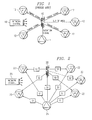
- Figure 1 illustrates a prior art technique for locating a mobile communications device 10.
- a plurality of receivers 12, typically base stations, are in the general vicinity of the mobile communications device 10.
- Network control 16 is coupled to the receivers 12 and transmitter 14.
- the network In operation, the network must synchronize itself or use outside sources for synchronization (i.e., GPS clocks). As will be discussed in greater detail below, it is important that the receivers are time-synchronized.
- the transmitter 14 receives a command from network control 16 to locate a mobile communications device 10, the transmitter 14 issues a signal (the "initiation signal") identifying the particular mobile communications device 10 being located. This signal is also received by receivers 12.
- the mobile communications device 10 identified by the signal will broadcast a signal (the "timing signal”) in response to the initiation signal.
- information such as call setup, framing information, or other overhead could be used to start the triangulation.
- the mobile communications device 10 has an output of limited range. Some of the receivers 12 will detect the timing signal (R1-R4 in the illustration of Figure 1), whereas other receivers will not (R5 in the illustration of Figure 1). Each receiver 12 that receives the signal will detect the time at which the signal was received. If the time of reception of the timing signal is beyond a time threshold from the reception of the initiation signal, the timing signal is invalid.
- Each receiver 12 stores a value indicative of the time that the timing signal was received, based on each receiver's internal clock. Assuming that the timing signal is valid, the time of reception from each receiver 12 is used to calculate the location of the mobile communications device 10. Because the origination time of the location pulse is generally not known to an accuracy required for location determination, a TDOA approach is normally used. Using the technique, the differences in time of arrival between receivers 12 are used in the triangulation calculation. Accordingly, triangulation is performed using T 1-2 , T 1-3 and T 1-4 , where T x-y is the difference in the reception of the timing signal between receivers R x and R y .
- the system for locating the mobile communications device 10 described above has several shortcomings.
- the transmitters 14 and receivers 12 in the network must be highly synchronized.
- the time of day clock for all receivers must be synchronized to within tens of nanoseconds for accurate location of the mobile communications device 10.
- the mobile communications device 10 is responsible for generating the timing signal in response to identifying an initiation signal, thus requiring extra functionality on each mobile communications device 10.
- the mobile communications device 10 is responsible for generating the timing signal in response to identifying an initiation signal, thus requiring extra functionality on each mobile communications device 10.
- Third, in order to obtain at least three triangulation points, four receivers 12 must receive valid timing signals. This diminishes the effective range of the network, since receivers will not be as closely spaced outside of metropolitan areas.
- delays in each receiver, due to the antenna, cable, and internal components will vary from receiver to receiver. These delays can affect the time stamp associated with receiving the timing signal and, hence, must be accounted for and normalized out. Again, errant calculations of the delays
- Figure 2 illustrates an improved location apparatus and method for locating a mobile communications device 20.
- a plurality of receivers 22, typically base stations are in the general vicinity of the mobile communications device 20.
- Network control 26 is coupled to the receivers 22 and transmitter 24.
- network control 26 commands transmitter 24 to generate a first signal S1, which contains a time stamp and an identifier unique to a single mobile communications device 20.
- This signal is broadcast to the mobile communications devices 20 and the receivers 22 in the vicinity of the transmitter 24.
- Each receiver 24 that receives signal S1 uses the S1 signal to set its internal clock to the time indicated in the time stamp.
- each receiver 22 compensates for the distance between the transmitter 24 and the receiver 22, which is fixed and known. Accordingly, all receivers 22 in the vicinity will automatically be synchronized with each S1 signal to a high degree.
- the same signal, S1 is received by the mobile communications devices 20, one of which will be identified by signal S1 (if it is in the broadcast area of the transmitter 24).
- Receivers 22 in the broadcast area of the mobile communications device 20 receive the rebroadcast signal S2.
- Receivers R1 through R4 receive the rebroadcast signal, while receiver R5 is out of the range of the mobile communications device 20.
- the rebroadcast signal S2 may take several forms.
- the mobile communications device 20 receives signal S1 at a first frequency and immediately broadcasts the signal at a second frequency as signal S2.
- the mobile communications device 20 receives signal S1 and sends signal S2 at the same frequency.
- the mobile communications device 20 may also add information to the signal, such as a value indicative of the propagation delay through the electronics of the mobile communications device 20, as shown in Figure 3.
- the receivers 22 receive signal S2 and note the time that signal S2 was received, based on the internal clock which was set in accordance to signal S1.
- the time from the signal to travel from the transmitter 24 to a given receiver is thus T S2 -T S1 , where T S1 is the time that the S1 signal was received and T S2 is the time that the S2 was received.
- the time differential, T S2 -T S1 indicates the distance between the transmitter 24 and the mobile communications device 20, plus the distance between the mobile communications device 20 and the receiver 22.
- the possibilities for a given time differential can be defined as an ellipse, with the transmitter 24 and receiver 22 as foci.
- Network control 26 can use this information to pinpoint the location of the mobile communications device 20.
- three receivers 22 are close enough to the transmitter 24 and the mobile communications device 20 to receive the S1 and S2 signals, three ellipses may be defined, corresponding to the location of the transmitter 24, receiver 22 and the distance defined by T S2 -T S1 . As shown in Figure 4b, the three ellipses will intersect at the location of the mobile communications device 20.
- the ellipses do not need to intersect exactly for an accurate location determination. If, for example, an unaccounted-for delay through the mobile communications device 20 causes the ellipses to be enlarged, as shown in Figure 4c, creating an area 30 between three points of intersection between the ellipses, a least squares determination of the center of the area 30 can closely approximate the location of the mobile communications device 20.
- the location of the mobile communication device 20 may be located in one of two points of intersection. Using other information, such as information from the user, maps, or angle of arrival, the ambiguity may be resolved.
- the S2 signal may be a repeated version of the S1 signal at a different frequency, or the S2 signal may be received and retransmitted at the same frequency. Shifting the S1 signal to a different frequency can be performed with very little time delay through a simple circuit as shown in Figure 5.
- the mixing circuit 40 is provided in the mobile communications device 20.
- Mixing circuit 40 receives the S1 signal from the transmitter 22 through antenna 42.
- Filter/combiner 43 isolates the signal from any signal being simultaneously output and passes the signal for further conditioning through filter/amplifier 44.
- the output of filter/amplifier 44 is input to mixer 46 along with the output of oscillator 48, which shifts the frequency of the S1 signal to a desired intermediate frequency (IF).
- the IF signal is passed through bandpass filter 50.
- the output of bandpass filter 50 is received by mixer 52, along with the output of oscillator 54, which further shifts the frequency to the desired second frequency.
- Figure 6 illustrates a circuit for receiving the S1 signal and sending the S2 signal at the same frequency.
- the S1 signal is received from transmitter 24 through antenna 62.
- the S1 signal is conditioned through filter/amplifier 64.
- the output of filter/amplifier 64 is received by mixer 66 along with the output of oscillator 68, which translates the 51 signal to a desired intermediate frequency.
- the IF signal is demodulated in demodulator 70 into binary form.
- the demodulated bits are stored in memory/processing circuit 72, which adds any desired additional data to the signal.
- the data for signal S2 is output from memory/processing circuit 72 to modulator 74.
- the output of modulator 74 is translated to the original frequency of signal S1 by mixer and oscillator 68.
- the S2 signal is then amplified and transmitted using antenna 62.
- Demodulating the signal from the transmitter and remodulate the signal requires a significant delay within the mobile communications device 20. Therefore, it is desirable to add information regarding the delay through the mobile communications device 20 (which may vary between different mobile communications devices) to provide in a more accurate measurement of the time the signal travels from transmitter 24 to mobile communications device 20 to receiver 22.
- the time period is then calculated as T S2 -T S1 -T d , where T d is the delay through the mobile communications device 20.
- the present invention provides significant advantages over the prior art.
- Second, the signals may be transmitted using convention technology usable within buildings.
- Third, propagation delays within the receiver are eliminated.
Landscapes
- Physics & Mathematics (AREA)
- Engineering & Computer Science (AREA)
- General Physics & Mathematics (AREA)
- Radar, Positioning & Navigation (AREA)
- Remote Sensing (AREA)
- Mobile Radio Communication Systems (AREA)
- Position Fixing By Use Of Radio Waves (AREA)
Applications Claiming Priority (2)
| Application Number | Priority Date | Filing Date | Title |
|---|---|---|---|
| US637382 | 2000-08-11 | ||
| US09/637,382 US6574478B1 (en) | 2000-08-11 | 2000-08-11 | System and method for locating mobile devices |
Publications (3)
| Publication Number | Publication Date |
|---|---|
| EP1180696A2 true EP1180696A2 (de) | 2002-02-20 |
| EP1180696A3 EP1180696A3 (de) | 2004-10-13 |
| EP1180696B1 EP1180696B1 (de) | 2007-03-28 |
Family
ID=24555680
Family Applications (1)
| Application Number | Title | Priority Date | Filing Date |
|---|---|---|---|
| EP01118188A Expired - Lifetime EP1180696B1 (de) | 2000-08-11 | 2001-07-27 | System und Verfahren zur Lokalisierung von Mobilgeräten |
Country Status (8)
| Country | Link |
|---|---|
| US (1) | US6574478B1 (de) |
| EP (1) | EP1180696B1 (de) |
| JP (1) | JP2002098747A (de) |
| CN (1) | CN1245807C (de) |
| AT (1) | ATE358280T1 (de) |
| AU (1) | AU776630B2 (de) |
| DE (1) | DE60127498T2 (de) |
| ES (1) | ES2282177T3 (de) |
Cited By (14)
| Publication number | Priority date | Publication date | Assignee | Title |
|---|---|---|---|---|
| WO2003083504A1 (en) * | 2002-03-28 | 2003-10-09 | Motorola Inc | Mobile communication stations, methods and systems |
| WO2005047926A1 (en) * | 2003-11-07 | 2005-05-26 | Wherenet Corp | Location system and method that achieves time synchronized network performance with nodes divided into separate networks |
| GB2416635A (en) * | 2004-07-23 | 2006-02-01 | Hewlett Packard Development Co | Positioning system |
| WO2006065219A1 (en) * | 2004-12-13 | 2006-06-22 | Fredrik Carle | A portable rescue device and a method for locating such a device |
| GB2441375A (en) * | 2006-08-29 | 2008-03-05 | Ubiquisys Ltd | Controlling operation of an oscillator in a basestation of a cellular communications system |
| US8750267B2 (en) | 2009-01-05 | 2014-06-10 | Qualcomm Incorporated | Detection of falsified wireless access points |
| US8768344B2 (en) | 2008-12-22 | 2014-07-01 | Qualcomm Incorporated | Post-deployment calibration for wireless position determination |
| US8781492B2 (en) | 2010-04-30 | 2014-07-15 | Qualcomm Incorporated | Device for round trip time measurements |
| US8892127B2 (en) | 2008-11-21 | 2014-11-18 | Qualcomm Incorporated | Wireless-based positioning adjustments using a motion sensor |
| US9125153B2 (en) | 2008-11-25 | 2015-09-01 | Qualcomm Incorporated | Method and apparatus for two-way ranging |
| US9213082B2 (en) | 2008-11-21 | 2015-12-15 | Qualcomm Incorporated | Processing time determination for wireless position determination |
| US9274207B2 (en) | 2006-02-01 | 2016-03-01 | Zih Corp. | System and method for determining signal source location in wireless local area network |
| US9360547B2 (en) | 2005-05-10 | 2016-06-07 | Zih Corp. | Extensible object location system and method using multiple references |
| US9645225B2 (en) | 2008-11-21 | 2017-05-09 | Qualcomm Incorporated | Network-centric determination of node processing delay |
Families Citing this family (24)
| Publication number | Priority date | Publication date | Assignee | Title |
|---|---|---|---|---|
| US20030036391A1 (en) * | 2000-08-25 | 2003-02-20 | Xemplix, Ltd. | Relating to information delivery |
| JP4223923B2 (ja) * | 2003-11-06 | 2009-02-12 | 株式会社日立製作所 | 測位方式及び測位システム及び無線基地局 |
| CA2570029A1 (en) * | 2004-06-09 | 2005-12-22 | International Business Machines Corporation | Distance measurement system, distance measurement method, information processing apparatus, program and recording medium |
| JP4693405B2 (ja) * | 2004-12-17 | 2011-06-01 | 株式会社日立製作所 | ノード位置測位システム、無線基地局及び位置測定方法 |
| US7764959B2 (en) * | 2006-04-13 | 2010-07-27 | Carrier Iq, Inc. | Analysis of arbitrary wireless network data using matched filters |
| US20080009295A1 (en) * | 2006-07-07 | 2008-01-10 | Nicole Brousseau | Method for the high accuracy geolocation of outdoor mobile emitters of CDMA cellular systems |
| JP2008039738A (ja) * | 2006-08-10 | 2008-02-21 | Fujitsu Ltd | 測位方法 |
| JP4980021B2 (ja) * | 2006-09-29 | 2012-07-18 | 三菱電機株式会社 | 測位システム、探知装置、測位装置、測位システムの測位方法、探知装置の探知方法、測位装置の測位方法、探知装置の探知プログラムおよび測位装置の測位プログラム |
| US7528776B2 (en) * | 2007-03-22 | 2009-05-05 | Nortel Networks Limited | Beacon-assisted precision location of untethered client in packet networks |
| EP2283474B1 (de) * | 2008-04-14 | 2016-12-14 | Mojix, Inc. | System und verfahren zur auffindung und verfolgung von funkfrequenzidentifikationsetiketten |
| JP4382862B2 (ja) * | 2008-07-25 | 2009-12-16 | 株式会社日立製作所 | 測位方式及び測位システム及び無線基地局 |
| IT1398976B1 (it) * | 2009-06-19 | 2013-03-28 | Sie Soc It Elettronica | Metodo e apparecchiatura per la localizzazione passiva di emittenti di segnali radio. |
| EP2559014A4 (de) | 2010-04-14 | 2016-11-02 | Mojix Inc | Systeme und verfahren zur erkennung von mustern in mit einem rfid-system gesammelten räumlich-zeitlichen daten |
| US8712444B2 (en) * | 2010-05-06 | 2014-04-29 | Digi International Inc. | Signal phase-based location of network nodes |
| US9111156B2 (en) | 2013-03-15 | 2015-08-18 | Mojix, Inc. | Systems and methods for compressive sensing ranging evaluation |
| CN103941226A (zh) * | 2014-05-09 | 2014-07-23 | 华中师范大学 | 一种电子标签三维无线高精度定位系统及方法 |
| US20160047886A1 (en) * | 2014-08-18 | 2016-02-18 | Digi International Inc. | System and method for locating a radio tag |
| JP6142898B2 (ja) * | 2014-09-30 | 2017-06-07 | ダイキン工業株式会社 | 測位システム |
| US9535155B2 (en) * | 2015-02-04 | 2017-01-03 | Cognitive Systems Corp. | Locating the source of a wireless signal |
| US9883337B2 (en) | 2015-04-24 | 2018-01-30 | Mijix, Inc. | Location based services for RFID and sensor networks |
| CN105388454B (zh) * | 2015-10-16 | 2016-10-12 | 四川中电昆辰科技有限公司 | 用于实现信号准同步的装置、定位装置及方法 |
| EP3171193A1 (de) * | 2015-11-18 | 2017-05-24 | The Swatch Group Research and Development Ltd. | Verfahren zur lokalisierung einer leitplanke |
| JP6776848B2 (ja) * | 2016-11-25 | 2020-10-28 | 富士通株式会社 | 情報処理システム、情報処理装置及び情報処理方法 |
| EP3729131A1 (de) * | 2017-12-22 | 2020-10-28 | Khalifa University of Science and Technology | Verfahren und systeme zur ortung |
Family Cites Families (23)
| Publication number | Priority date | Publication date | Assignee | Title |
|---|---|---|---|---|
| JPS6064273A (ja) * | 1983-09-20 | 1985-04-12 | Oki Electric Ind Co Ltd | 物標位置検出方式 |
| NZ222404A (en) * | 1987-11-02 | 1991-06-25 | Precision Technology Inc | Vehicle tracking by comparison of transmitted phase at multiple receivers |
| JPS63266381A (ja) * | 1987-04-24 | 1988-11-02 | Nippon Precision Kk | 受動形ssr装置 |
| JPH0575526A (ja) * | 1991-02-25 | 1993-03-26 | Pagemart Inc | 適応呼出装置 |
| US5600706A (en) | 1992-04-08 | 1997-02-04 | U S West, Inc. | Method and system for determining the position of a mobile receiver |
| US5327144A (en) | 1993-05-07 | 1994-07-05 | Associated Rt, Inc. | Cellular telephone location system |
| US6028551A (en) | 1994-12-13 | 2000-02-22 | Schoen; Neil Charles | Micro-miniature beacon transmit-only geo-location emergency system for personal security |
| US5835907A (en) * | 1995-12-20 | 1998-11-10 | Mci Communications Corporation | Emergency PCS system for identification and notification of a subscriber's location |
| US5835530A (en) | 1995-12-21 | 1998-11-10 | Corsair Communications, Inc. | Bit characteristics measurement system for digitally modulated signals |
| US5825887A (en) | 1995-12-28 | 1998-10-20 | Trimble Navigation Limited | Transmitting and receiving apparatus for full code correlation operation under encryption for satellite positioning system |
| US6122512A (en) * | 1996-09-30 | 2000-09-19 | Telefonaktiebolaget Lm Ericsson (Publ) | Method and apparatus for mobile station geographical location determination |
| US6026304A (en) | 1997-01-08 | 2000-02-15 | U.S. Wireless Corporation | Radio transmitter location finding for wireless communication network services and management |
| DE19707537A1 (de) * | 1997-02-25 | 1998-08-27 | Alsthom Cge Alcatel | Verfahren zur Weitergabe von Informationen zwischen beweglichen Körpern und Kommunikationseinrichtung zur Durchführung des Verfahrens |
| US6246361B1 (en) * | 1999-06-28 | 2001-06-12 | Gary Sutton | Method and apparatus for determining a geographical location of a mobile communication unit |
| US6374098B1 (en) * | 1997-04-22 | 2002-04-16 | Ericsson Inc. | Systems and methods for locating remote units operating in a radiocommunication system using an adjunct system |
| US6040800A (en) | 1997-04-22 | 2000-03-21 | Ericsson Inc. | Systems and methods for locating remote terminals in radiocommunication systems |
| US6021330A (en) | 1997-07-22 | 2000-02-01 | Lucent Technologies Inc. | Mobile location estimation in a wireless system using designated time intervals of suspended communication |
| US5987329A (en) | 1997-07-30 | 1999-11-16 | Ericsson Inc | System and method for mobile telephone location measurement using a hybrid technique |
| JPH1164507A (ja) * | 1997-08-13 | 1999-03-05 | Toyo Commun Equip Co Ltd | 距離測定方法 |
| US6243587B1 (en) * | 1997-12-10 | 2001-06-05 | Ericsson Inc. | Method and system for determining position of a mobile transmitter |
| US6014102A (en) | 1998-04-17 | 2000-01-11 | Motorola, Inc. | Method and apparatus for calibrating location finding equipment within a communication system |
| US6108558A (en) * | 1998-04-21 | 2000-08-22 | Motorola, Inc. | Method for calculating a location of a remote Unit utilizing observed time difference (OTD) and real time difference (RTD) measurements. |
| US6163278A (en) * | 1998-11-10 | 2000-12-19 | Daimlerchrysler Corporation | Electronic locating system for locating vehicles at assembly plants |
-
2000
- 2000-08-11 US US09/637,382 patent/US6574478B1/en not_active Expired - Lifetime
-
2001
- 2001-07-23 AU AU55914/01A patent/AU776630B2/en not_active Expired
- 2001-07-27 DE DE60127498T patent/DE60127498T2/de not_active Expired - Lifetime
- 2001-07-27 EP EP01118188A patent/EP1180696B1/de not_active Expired - Lifetime
- 2001-07-27 AT AT01118188T patent/ATE358280T1/de not_active IP Right Cessation
- 2001-07-27 ES ES01118188T patent/ES2282177T3/es not_active Expired - Lifetime
- 2001-08-03 JP JP2001235900A patent/JP2002098747A/ja active Pending
- 2001-08-10 CN CNB011245794A patent/CN1245807C/zh not_active Expired - Fee Related
Cited By (27)
| Publication number | Priority date | Publication date | Assignee | Title |
|---|---|---|---|---|
| US7102570B2 (en) | 2002-03-28 | 2006-09-05 | Motorola, Inc. | Mobile communications stations methods and systems |
| WO2003083504A1 (en) * | 2002-03-28 | 2003-10-09 | Motorola Inc | Mobile communication stations, methods and systems |
| WO2005047926A1 (en) * | 2003-11-07 | 2005-05-26 | Wherenet Corp | Location system and method that achieves time synchronized network performance with nodes divided into separate networks |
| US7218229B2 (en) | 2003-11-07 | 2007-05-15 | Wherenet Corp | Location system and method that achieves time synchronized network performance with nodes divided into separate networks |
| GB2416635A (en) * | 2004-07-23 | 2006-02-01 | Hewlett Packard Development Co | Positioning system |
| WO2006065219A1 (en) * | 2004-12-13 | 2006-06-22 | Fredrik Carle | A portable rescue device and a method for locating such a device |
| US7245899B2 (en) | 2004-12-13 | 2007-07-17 | Fredrik Carle | Portable rescue device and a method for locating such a device |
| US10139472B2 (en) | 2005-05-10 | 2018-11-27 | Zih Corp. | Extensible object location system and method using multiple references |
| US9360547B2 (en) | 2005-05-10 | 2016-06-07 | Zih Corp. | Extensible object location system and method using multiple references |
| US9519046B2 (en) | 2006-02-01 | 2016-12-13 | Zih Corp. | System and method for determining signal source location in wireless local area network |
| US9274207B2 (en) | 2006-02-01 | 2016-03-01 | Zih Corp. | System and method for determining signal source location in wireless local area network |
| US8565823B2 (en) | 2006-08-29 | 2013-10-22 | Ubiquisys Limited | Basestation for cellular communication system |
| US8041393B2 (en) | 2006-08-29 | 2011-10-18 | Ubiquisys Limited | Basestation for cellular communication system |
| GB2441375B (en) * | 2006-08-29 | 2011-03-02 | Ubiquisys Ltd | Basestation for cellular communication system |
| GB2441375A (en) * | 2006-08-29 | 2008-03-05 | Ubiquisys Ltd | Controlling operation of an oscillator in a basestation of a cellular communications system |
| US9645225B2 (en) | 2008-11-21 | 2017-05-09 | Qualcomm Incorporated | Network-centric determination of node processing delay |
| US8892127B2 (en) | 2008-11-21 | 2014-11-18 | Qualcomm Incorporated | Wireless-based positioning adjustments using a motion sensor |
| US9291704B2 (en) | 2008-11-21 | 2016-03-22 | Qualcomm Incorporated | Wireless-based positioning adjustments using a motion sensor |
| US9213082B2 (en) | 2008-11-21 | 2015-12-15 | Qualcomm Incorporated | Processing time determination for wireless position determination |
| US9125153B2 (en) | 2008-11-25 | 2015-09-01 | Qualcomm Incorporated | Method and apparatus for two-way ranging |
| US8768344B2 (en) | 2008-12-22 | 2014-07-01 | Qualcomm Incorporated | Post-deployment calibration for wireless position determination |
| US9002349B2 (en) | 2008-12-22 | 2015-04-07 | Qualcomm Incorporated | Post-deployment calibration for wireless position determination |
| US8831594B2 (en) | 2008-12-22 | 2014-09-09 | Qualcomm Incorporated | Post-deployment calibration of wireless base stations for wireless position determination |
| US8750267B2 (en) | 2009-01-05 | 2014-06-10 | Qualcomm Incorporated | Detection of falsified wireless access points |
| US9247446B2 (en) | 2010-04-30 | 2016-01-26 | Qualcomm Incorporated | Mobile station use of round trip time measurements |
| US9137681B2 (en) | 2010-04-30 | 2015-09-15 | Qualcomm Incorporated | Device for round trip time measurements |
| US8781492B2 (en) | 2010-04-30 | 2014-07-15 | Qualcomm Incorporated | Device for round trip time measurements |
Also Published As
| Publication number | Publication date |
|---|---|
| EP1180696B1 (de) | 2007-03-28 |
| CN1245807C (zh) | 2006-03-15 |
| US6574478B1 (en) | 2003-06-03 |
| DE60127498D1 (de) | 2007-05-10 |
| AU5591401A (en) | 2002-02-14 |
| CN1338827A (zh) | 2002-03-06 |
| DE60127498T2 (de) | 2007-12-06 |
| ATE358280T1 (de) | 2007-04-15 |
| AU776630B2 (en) | 2004-09-16 |
| EP1180696A3 (de) | 2004-10-13 |
| JP2002098747A (ja) | 2002-04-05 |
| ES2282177T3 (es) | 2007-10-16 |
Similar Documents
| Publication | Publication Date | Title |
|---|---|---|
| US6574478B1 (en) | System and method for locating mobile devices | |
| US7039421B2 (en) | System for determining the position of an object | |
| CN1688892B (zh) | 使用来自第二移动设备的信息确定第一移动设备的位置的装置和方法 | |
| US7030812B2 (en) | Wireless clock synchronization | |
| US5646632A (en) | Method and apparatus for a portable communication device to identify its own location | |
| US5815538A (en) | Method and apparatus for determining location of a subscriber device in a wireless cellular communications system | |
| US6952158B2 (en) | Pseudolite positioning system and method | |
| US7636061B1 (en) | Method and apparatus for location determination of people or objects | |
| US6433740B1 (en) | Determination method for use with analog cellular system | |
| US7667648B2 (en) | Facilitating mobile station location using a ground-based cellular network | |
| US20030137453A1 (en) | Determining wireless device locations | |
| US6798824B2 (en) | Spread spectrum subscriber unit for analyzing multipath components | |
| MXPA02004304A (es) | Metodo y aparato para determinar la ubicacion de posicion utilizando numero raducido de satelites de gps y estaciones base sincronizadas y no sincronizadas. | |
| US20060133556A1 (en) | Device, system and method for obtaining timing information and ranging | |
| JPH1032533A (ja) | 時刻同期型通信システム | |
| US10015632B2 (en) | Precise positioning using time of arrival with pseudo-synchronized anchor nodes | |
| US6968737B2 (en) | Position determining system using transmitted position information | |
| US6195038B1 (en) | Method of automatically determining the position of vehicles |
Legal Events
| Date | Code | Title | Description |
|---|---|---|---|
| PUAI | Public reference made under article 153(3) epc to a published international application that has entered the european phase |
Free format text: ORIGINAL CODE: 0009012 |
|
| AK | Designated contracting states |
Kind code of ref document: A2 Designated state(s): AT BE CH CY DE DK ES FI FR GB GR IE IT LI LU MC NL PT SE TR |
|
| AX | Request for extension of the european patent |
Free format text: AL;LT;LV;MK;RO;SI |
|
| PUAL | Search report despatched |
Free format text: ORIGINAL CODE: 0009013 |
|
| AK | Designated contracting states |
Kind code of ref document: A3 Designated state(s): AT BE CH CY DE DK ES FI FR GB GR IE IT LI LU MC NL PT SE TR |
|
| AX | Request for extension of the european patent |
Extension state: AL LT LV MK RO SI |
|
| RIC1 | Information provided on ipc code assigned before grant |
Ipc: 7G 01S 5/06 B Ipc: 7H 04B 7/26 B Ipc: 7G 01S 5/00 A |
|
| 17P | Request for examination filed |
Effective date: 20050413 |
|
| AKX | Designation fees paid |
Designated state(s): AT BE CH CY DE DK ES FI FR GB GR IE IT LI LU MC NL PT SE TR |
|
| 17Q | First examination report despatched |
Effective date: 20050530 |
|
| GRAP | Despatch of communication of intention to grant a patent |
Free format text: ORIGINAL CODE: EPIDOSNIGR1 |
|
| GRAS | Grant fee paid |
Free format text: ORIGINAL CODE: EPIDOSNIGR3 |
|
| GRAA | (expected) grant |
Free format text: ORIGINAL CODE: 0009210 |
|
| AK | Designated contracting states |
Kind code of ref document: B1 Designated state(s): AT BE CH CY DE DK ES FI FR GB GR IE IT LI LU MC NL PT SE TR |
|
| PG25 | Lapsed in a contracting state [announced via postgrant information from national office to epo] |
Ref country code: NL Free format text: LAPSE BECAUSE OF FAILURE TO SUBMIT A TRANSLATION OF THE DESCRIPTION OR TO PAY THE FEE WITHIN THE PRESCRIBED TIME-LIMIT Effective date: 20070328 Ref country code: CH Free format text: LAPSE BECAUSE OF FAILURE TO SUBMIT A TRANSLATION OF THE DESCRIPTION OR TO PAY THE FEE WITHIN THE PRESCRIBED TIME-LIMIT Effective date: 20070328 Ref country code: FI Free format text: LAPSE BECAUSE OF FAILURE TO SUBMIT A TRANSLATION OF THE DESCRIPTION OR TO PAY THE FEE WITHIN THE PRESCRIBED TIME-LIMIT Effective date: 20070328 Ref country code: LI Free format text: LAPSE BECAUSE OF FAILURE TO SUBMIT A TRANSLATION OF THE DESCRIPTION OR TO PAY THE FEE WITHIN THE PRESCRIBED TIME-LIMIT Effective date: 20070328 Ref country code: AT Free format text: LAPSE BECAUSE OF FAILURE TO SUBMIT A TRANSLATION OF THE DESCRIPTION OR TO PAY THE FEE WITHIN THE PRESCRIBED TIME-LIMIT Effective date: 20070328 Ref country code: BE Free format text: LAPSE BECAUSE OF FAILURE TO SUBMIT A TRANSLATION OF THE DESCRIPTION OR TO PAY THE FEE WITHIN THE PRESCRIBED TIME-LIMIT Effective date: 20070328 |
|
| REG | Reference to a national code |
Ref country code: GB Ref legal event code: FG4D |
|
| REG | Reference to a national code |
Ref country code: CH Ref legal event code: EP |
|
| REF | Corresponds to: |
Ref document number: 60127498 Country of ref document: DE Date of ref document: 20070510 Kind code of ref document: P |
|
| REG | Reference to a national code |
Ref country code: IE Ref legal event code: FG4D |
|
| PG25 | Lapsed in a contracting state [announced via postgrant information from national office to epo] |
Ref country code: SE Free format text: LAPSE BECAUSE OF FAILURE TO SUBMIT A TRANSLATION OF THE DESCRIPTION OR TO PAY THE FEE WITHIN THE PRESCRIBED TIME-LIMIT Effective date: 20070628 |
|
| PG25 | Lapsed in a contracting state [announced via postgrant information from national office to epo] |
Ref country code: PT Free format text: LAPSE BECAUSE OF FAILURE TO SUBMIT A TRANSLATION OF THE DESCRIPTION OR TO PAY THE FEE WITHIN THE PRESCRIBED TIME-LIMIT Effective date: 20070828 |
|
| ET | Fr: translation filed | ||
| REG | Reference to a national code |
Ref country code: CH Ref legal event code: PL |
|
| NLV1 | Nl: lapsed or annulled due to failure to fulfill the requirements of art. 29p and 29m of the patents act | ||
| REG | Reference to a national code |
Ref country code: ES Ref legal event code: FG2A Ref document number: 2282177 Country of ref document: ES Kind code of ref document: T3 |
|
| PG25 | Lapsed in a contracting state [announced via postgrant information from national office to epo] |
Ref country code: DK Free format text: LAPSE BECAUSE OF FAILURE TO SUBMIT A TRANSLATION OF THE DESCRIPTION OR TO PAY THE FEE WITHIN THE PRESCRIBED TIME-LIMIT Effective date: 20070328 |
|
| PLBE | No opposition filed within time limit |
Free format text: ORIGINAL CODE: 0009261 |
|
| STAA | Information on the status of an ep patent application or granted ep patent |
Free format text: STATUS: NO OPPOSITION FILED WITHIN TIME LIMIT |
|
| 26N | No opposition filed |
Effective date: 20080102 |
|
| PG25 | Lapsed in a contracting state [announced via postgrant information from national office to epo] |
Ref country code: GR Free format text: LAPSE BECAUSE OF FAILURE TO SUBMIT A TRANSLATION OF THE DESCRIPTION OR TO PAY THE FEE WITHIN THE PRESCRIBED TIME-LIMIT Effective date: 20070629 Ref country code: MC Free format text: LAPSE BECAUSE OF NON-PAYMENT OF DUE FEES Effective date: 20070731 |
|
| PG25 | Lapsed in a contracting state [announced via postgrant information from national office to epo] |
Ref country code: IE Free format text: LAPSE BECAUSE OF NON-PAYMENT OF DUE FEES Effective date: 20070727 |
|
| PG25 | Lapsed in a contracting state [announced via postgrant information from national office to epo] |
Ref country code: CY Free format text: LAPSE BECAUSE OF FAILURE TO SUBMIT A TRANSLATION OF THE DESCRIPTION OR TO PAY THE FEE WITHIN THE PRESCRIBED TIME-LIMIT Effective date: 20070328 |
|
| PG25 | Lapsed in a contracting state [announced via postgrant information from national office to epo] |
Ref country code: LU Free format text: LAPSE BECAUSE OF NON-PAYMENT OF DUE FEES Effective date: 20070727 |
|
| PG25 | Lapsed in a contracting state [announced via postgrant information from national office to epo] |
Ref country code: TR Free format text: LAPSE BECAUSE OF FAILURE TO SUBMIT A TRANSLATION OF THE DESCRIPTION OR TO PAY THE FEE WITHIN THE PRESCRIBED TIME-LIMIT Effective date: 20070328 |
|
| REG | Reference to a national code |
Ref country code: GB Ref legal event code: 732E Free format text: REGISTERED BETWEEN 20130912 AND 20130918 |
|
| REG | Reference to a national code |
Ref country code: FR Ref legal event code: TP Owner name: ALCATEL-LUCENT USA, INC., US Effective date: 20131121 Ref country code: FR Ref legal event code: CD Owner name: ALCATEL-LUCENT USA, INC., US Effective date: 20131121 |
|
| REG | Reference to a national code |
Ref country code: FR Ref legal event code: GC Effective date: 20140410 |
|
| REG | Reference to a national code |
Ref country code: FR Ref legal event code: RG Effective date: 20141015 |
|
| REG | Reference to a national code |
Ref country code: FR Ref legal event code: PLFP Year of fee payment: 15 |
|
| REG | Reference to a national code |
Ref country code: FR Ref legal event code: PLFP Year of fee payment: 16 |
|
| REG | Reference to a national code |
Ref country code: FR Ref legal event code: PLFP Year of fee payment: 17 |
|
| REG | Reference to a national code |
Ref country code: FR Ref legal event code: PLFP Year of fee payment: 18 |
|
| PGFP | Annual fee paid to national office [announced via postgrant information from national office to epo] |
Ref country code: FR Payment date: 20200611 Year of fee payment: 20 |
|
| PGFP | Annual fee paid to national office [announced via postgrant information from national office to epo] |
Ref country code: DE Payment date: 20200714 Year of fee payment: 20 Ref country code: ES Payment date: 20200803 Year of fee payment: 20 Ref country code: GB Payment date: 20200716 Year of fee payment: 20 |
|
| PGFP | Annual fee paid to national office [announced via postgrant information from national office to epo] |
Ref country code: IT Payment date: 20200610 Year of fee payment: 20 |
|
| REG | Reference to a national code |
Ref country code: DE Ref legal event code: R071 Ref document number: 60127498 Country of ref document: DE |
|
| REG | Reference to a national code |
Ref country code: GB Ref legal event code: PE20 Expiry date: 20210726 |
|
| PG25 | Lapsed in a contracting state [announced via postgrant information from national office to epo] |
Ref country code: GB Free format text: LAPSE BECAUSE OF EXPIRATION OF PROTECTION Effective date: 20210726 |
|
| PG25 | Lapsed in a contracting state [announced via postgrant information from national office to epo] |
Ref country code: ES Free format text: LAPSE BECAUSE OF EXPIRATION OF PROTECTION Effective date: 20210728 |