EP1184994A2 - Système de station de base utilisant l'AMRC - Google Patents
Système de station de base utilisant l'AMRC Download PDFInfo
- Publication number
- EP1184994A2 EP1184994A2 EP01307170A EP01307170A EP1184994A2 EP 1184994 A2 EP1184994 A2 EP 1184994A2 EP 01307170 A EP01307170 A EP 01307170A EP 01307170 A EP01307170 A EP 01307170A EP 1184994 A2 EP1184994 A2 EP 1184994A2
- Authority
- EP
- European Patent Office
- Prior art keywords
- base transceiver
- program data
- signal
- transceiver system
- dsp
- Prior art date
- Legal status (The legal status is an assumption and is not a legal conclusion. Google has not performed a legal analysis and makes no representation as to the accuracy of the status listed.)
- Withdrawn
Links
- 238000000034 method Methods 0.000 claims abstract description 221
- 238000004891 communication Methods 0.000 claims abstract description 179
- 238000012545 processing Methods 0.000 claims abstract description 111
- 230000005540 biological transmission Effects 0.000 claims description 120
- 238000009792 diffusion process Methods 0.000 claims description 79
- 230000015654 memory Effects 0.000 claims description 79
- 238000001514 detection method Methods 0.000 claims description 26
- 238000000926 separation method Methods 0.000 claims description 20
- 230000001360 synchronised effect Effects 0.000 claims description 19
- 238000003860 storage Methods 0.000 claims description 16
- 238000012937 correction Methods 0.000 claims description 9
- 238000013507 mapping Methods 0.000 claims description 6
- 238000010276 construction Methods 0.000 abstract description 63
- 230000006870 function Effects 0.000 description 59
- 238000012423 maintenance Methods 0.000 description 36
- 238000012546 transfer Methods 0.000 description 10
- 230000010355 oscillation Effects 0.000 description 7
- 238000006243 chemical reaction Methods 0.000 description 5
- 230000003321 amplification Effects 0.000 description 4
- 238000003199 nucleic acid amplification method Methods 0.000 description 4
- 230000000994 depressogenic effect Effects 0.000 description 3
- 238000007726 management method Methods 0.000 description 3
- 238000011161 development Methods 0.000 description 2
- 230000018109 developmental process Effects 0.000 description 2
- 239000000758 substrate Substances 0.000 description 2
- 238000012360 testing method Methods 0.000 description 2
- 230000004075 alteration Effects 0.000 description 1
- 238000005352 clarification Methods 0.000 description 1
- 238000007796 conventional method Methods 0.000 description 1
- 230000010485 coping Effects 0.000 description 1
- 238000005516 engineering process Methods 0.000 description 1
- 238000009432 framing Methods 0.000 description 1
- 238000004519 manufacturing process Methods 0.000 description 1
- 238000010295 mobile communication Methods 0.000 description 1
- 238000012544 monitoring process Methods 0.000 description 1
- 238000002360 preparation method Methods 0.000 description 1
- 238000004886 process control Methods 0.000 description 1
- 230000011218 segmentation Effects 0.000 description 1
- 238000010561 standard procedure Methods 0.000 description 1
Images



Classifications
-
- H—ELECTRICITY
- H04—ELECTRIC COMMUNICATION TECHNIQUE
- H04B—TRANSMISSION
- H04B1/00—Details of transmission systems, not covered by a single one of groups H04B3/00 - H04B13/00; Details of transmission systems not characterised by the medium used for transmission
- H04B1/69—Spread spectrum techniques
- H04B1/707—Spread spectrum techniques using direct sequence modulation
Definitions
- the present invention relates to a CDMA base transceiver system for performing wireless communications through the use of a CDMA (Code Division Multiple Access) method. More particularly, the invention concerns a CDMA base transceiver system, etc. that, for example, even when not changing a relevant hardware, can cope with a plurality of communication methods by changing the software of a field programmable gate array (FPGA: Field Programmable Gate Array) or digital signal processor (DSP: Digital Signal Processor).
- FPGA Field Programmable Gate array
- DSP Digital Signal Processor
- the 3rd GPP is a joint project for IMT-2000 technology specification development, and has been studying a third-generation mobile communication (portable telephone) system.
- BTS Base Transceiver System
- BTS system CDMA base transceiver system
- Fig. 7 there is illustrated a construction example of a CDMA base transceiver system 111.
- This CDMA base transceiver system 111 is connected to a higher in-order system (higher-in-order-than-BTS system) 112 via a bi-directional wire transmission path 113.
- the higher in-order system 112 performs transmission/reception of a signal between itself and the CDMA base transceiver system 111 via the wire transmission path 113 to thereby perform control, etc. of the CDMA base transceiver system 111.
- Two antennas A11 and A12 wirelessly transmits a transmission signal input from a duplex part 121, and outputs a signal (reception signal), having wirelessly received, to the duplex part 121.
- the antennas A11 and A12 each transmit or receive a wireless signal (diffusion signal) between itself and a mobile station system (MS: Mobile Station), etc.
- the duplex part 121 separates a transmission signal and a reception signal from each other. Thereby, it enables transmitting or receiving a wireless signal through the use of the common antennas A11, A12.
- An amplification part 122 is constructed using an amplifier. It amplifies a transmission signal input from a wireless transmission/reception part 124, and outputs this transmission signal to the antennas A11 and A12 via the duplex part 121.
- a low noise amplification part 123 is constructed using a low noise amplifier (LNA: Low Noise Amplifier). It amplifies a reception signal input from the antennas A11 and A12 via the duplex part 121 and outputs the reception signal to the wireless transmission/reception part 124.
- LNA Low Noise Amplifier
- the wireless transmission/reception part (TRX part) 124 performs orthogonal modulation of the transmission signal (I signal and Q signal) with respect to that diffusion processing has been performed by a base band part 125 and the frequency of that therefore is in base band. It thereby converts that transmission signal to a transmission signal having a wireless frequency band and outputs this signal to the amplification part 122. It also performs quasi-synchronous detection of the reception signal that is input from the low noise amplification part 123 and that has a wireless frequency band. It thereby converts that reception signal to a reception signal (I signal and Q signal) the frequency of that is in base band, and outputs this signal to the base band part 125.
- the base band part 125 performs the following pieces of processing with respect to the transmission signal (down signal) input from a transmission path signal switching function part 131. Error correction coding, framing, data modulation processing, and diffusion modulation processing. Also, it performs the following pieces of processing with respect to the reception signal (up signal) input from the wireless transmission/reception part 124. Inverse diffusion modulation processing, chip synchronization processing, maximum-ratio-composite-signal processing, error correction decoding, and multiplex separation processing.
- a text function part 126 confirms the normality of the intra-system transmission while monitoring it.
- a call-process monitor control part 127 performs transmission or reception of a call-process control signal between itself and a higher in-order system 112, and executes the following pieces of processing. Wireless-line management processing, wireless-line setting/resetting, call-process monitor processing, and call-control processing.
- a maintenance monitor control part 128 transmits or receives a maintenance monitor control signal between itself and an external operation system (OPS) via the higher in-order system 112. It thereby executes operation management processing and state monitor control processing of the BTS system.
- OPS external operation system
- a download part 129 causes the following renewals to be controlled from outside.
- AP application software
- ROM Read Only Memory
- a memory medium 130 is constructed of, for example, a memory card that is freely detachable from the download part 129. It stores therein the application software for being stored into the ROM of the call-process monitor control part 127 as well as the application software for being stored into the ROM of the maintenance monitor control part 128.
- the application software stored in the memory medium 130 is read by the download part 129. Then, it is transmitted (transferred) by an intra-system bus signal S31 from the download part 129 to the call-process monitor control part 127 or maintenance monitor control part 128.
- the transmission path signal switching function part 131 switches each of processing parts, which are to be connected to a transmission path interface part 132, between the base band part 125, test function part 126, call-process monitor control part 127, and maintenance monitor control part 128. It thereby performs connection changeover for a signal (intra-system signal) that is transmitted or received between the processing parts within the system.
- the transmission path (High Way) interface part 132 has a function to process the terminal end of a wire transmission path 113. It thereby inputs/outputs a signal between itself and the transmission path signal switching function part 131 and also inputs/outputs a signal between itself and the wire transmission path 113.
- the base band part 125 is equipped with a modulation/demodulation part 141 that is constructed of an LSI (Large Scale Integrated Circuit), a channel CODEC (Coder-Decoder) part 142 that is constructed of an LSI, a transmission/reception data input/output part 143, an oscillator 144, and a control part 145.
- LSI Large Scale Integrated Circuit
- CODEC Coder-Decoder
- the modulation/demodulation part 141 includes the following processing parts that each operate as follows.
- An A/D (Analog/Digital) conversion part 151 inputs a reception signal (I signal and Q signal) that is output from the wireless transmission/reception part 124 as an analog signal. It then converts that reception signal to a digital signal and outputs this signal to a matched filter 161 of a searcher part 153 or to each of correlators F1 to FN of a finger part 154.
- a matched filter correlator control part 152 controls a diffusion code (diffusion code) used in the matched filter 161 of the searcher part 153 and a diffusion code used in the correlators F1 to FN of the finger part 154.
- diffusion code diffusion code
- the searcher part 153 includes the matched filter 161, pilot synchronous detection part 162, profile memory bank 163, and path detection part 164.
- the searcher part 153 detects the path of the reception signal (a wireless carrier frequency signal that is transmitted from a mobile station system and comes on into the base transceiver system) that is input from the A/D converter part 151 and notifies the detected result to the finger part 154.
- the matched filter 161 gets, while making different from each other the multiplication timings between the reception signal (in this example a pilot signal portion) and the diffusion code signal, the correlation value between that reception signal and that diffusion code signal. Using this result, the pilot synchronous detection part 162 synchronously detects the pilot signal. Also, the profile memory bank 163 stores therein the obtained correlation value result of the matched filter 161 and the synchronous-detected result of the pilot synchronous detection part 162. Using those stored contents, the path detection part 164 detects the path. And the detected path result is notified to the finger part 154.
- the finger part 154 includes a plurality of (e.g. an N number of pieces) signal processing systems #1 to #N. According to the detected path result that is notified from the searcher part 153, the finger part 154 demodulates the reception signal for each path with the use of each relevant signal processing system #1 to #N. The finger part 154 outputs the demodulated result to a composer part 155.
- the respective signal processing systems #1 to #N each are constructed of one correlator F1 to FN equipped with a diffusion code generator (CG: Code Generator), one piece of memory G1 to GN, and one piece of synchronous detection part H1 to HN.
- CG diffusion code generator
- each correlator F1 to FN For each path detected by the searcher part 153, each correlator F1 to FN performs multiplication between the reception signal input from the A/D conversion part 151 and the diffusion code and thereby performs inverse diffusion and gets the correlation value between that reception signal and that diffusion code signal.
- Each memory G1 to GN stores therein the thus-inverse-diffused result (the correlation value) and, according to this stored content, each synchronous detection part H1 to HN performs synchronous detection of the post-inverse-diffusion reception signal. Then, the part H1 to HN outputs the synchronous-detected result to the composer part 155.
- the composer part 155 composes the synchronous-detected results corresponding to a plurality of paths input from the finger part 154 with the use of, for example, "a maximum-ratio composing method".
- the composer part 155 outputs the composed result to a physical frame separation part 171 as a final reception signal. Further, the composer part 155 detects a signal power/interference power ratio (SIR: Signal-to-Interference-Ratio) with regard to the composed result. According to the detected result, the composer part 155 generates a transmission power control (TPC: Transmission Power Control) bit for controlling the transmission power and outputs this control bit to the transmission frame generation part 156.
- SIR Signal-to-Interference-Ratio
- TPC Transmission Power Control
- a transmission frame generation part 156 generates transmission frames by the use of the transmission signal input from a physical frame multiplexing part 174 of the channel CODEC part 142. Then the transmission frame generation part 156 outputs the thus-generated transmission frame to the diffusion modulation part 158. Further, the transmission frame generation part 156 controls the transmission power according to the transmission power control bit input from the composer part 155.
- a diffusion code generation part 157 generates a diffusion code according to the instruction from the control part 145.
- the diffusion code generation part 157 then outputs the thus-generated diffusion code to the diffusion modulation part 158. It is to be noted that there can also be made up a construction wherein the code generated in the diffusion code generation part 157 is supplied as an inverse diffusion code to the searcher part 153 or finger part 154.
- a diffusion modulation part 158 performs diffusion modulation of the transmission frame signal (framed transmission signal) input from the transmission frame generation part 156 by the use of the diffusion code input from the diffusion code generation part 157. The diffusion modulation part 158 then outputs the diffusion-modulated transmission frame signal to the D/A conversion part 159.
- a D/A converter part 159 converts the diffusion-modulated) transmission frame input as a digital signal from the diffusion modulation part 158 to an analog signal.
- the D/A converter 159 then outputs the post-conversion signal to the wireless transmission/reception part 124 as a transmission signal (I signal and Q signal).
- a base band LSI-interior bus B11 has connected thereto the matched filter correlator control part 152 equipped within the modulation/demodulation part 141, composer part 155, transmission frame generation part 156, diffusion code generation part 157, and bus interface (BUS I/F) part 160.
- the bus interface part 160 has an interface function between the base band LSI-interior bus B11 and the base band bus 13 to thereby connect these two buses B11 and B13 to each other.
- the respective processing parts perform the following operations.
- the physical frame separation part 171 separates physical channel from the reception signal (the composed result) input from the composer part 155 of the modulation/demodulation part 141. Then the physical frame separation part 171 outputs the post-separation reception signal to the decoder part 172.
- the decoder part 172 performs de-interleave processing or error correction decoding with respect to the reception signal input from the physical separation part 171. Then the decoder part 172 outputs the reception signal after those pieces of processing to the transmission/reception data input/output part 143 in units of a transport channel.
- the coder part 173 performs de-interleave processing or error correction coding with respect to the transmission signal input from the transmission/reception data input/output part 143 in units of a transport channel. Then the coder part 173 outputs the transmission signal after those pieces of processing to the physical frame multiplexing part 174.
- the physical frame multiplexing part 174 performs mapping into physical channels of the transmission signal input from the coding part 173. Then the physical frame multiplexing part 174 outputs the post-mapping transmission signal to the transmission frame generation part 156 of the modulation/demodulation part 141.
- a channel CODECLSI-interior bus B12 has connected thereto the physical frame separation part 171 equipped within the channel CODEC part 142, decoder part 172, coder part 173, physical frame multiplexing part 174, and bus interface part 175.
- the bus interface part 175 has an interface function between the channel CODECLSI-interior bus B12 and the base band bus B13 and connects these two buses to each other.
- the transmission/reception data input/output part 143 In the transmission/reception data input/output part 143, between itself and the decoder part 172 or coder part 173 of the channel CODEC part 142, input/output control is performed of the data (reception signal or transmission signal) that is handled in units of a transport channel. Also, the transmission/reception data input/output part 143 has an interface function between itself and the base band part 125 or transmission path signal switching part 131. It thereby inputs or outputs an intra-system signal (reception signal or transmission signal) between itself and the transmission path signal switching function part 131.
- the oscillator 144 it oscillates a clock signal for causing operation of the modulation/demodulation part 141 and supplies this clock signal to the modulation/demodulation part 141.
- 84 MHz is oscillated.
- control part 145 it has a base band control part 181 that is constructed of, for example, an MPU (Micro Processing Unit), memory, etc. Through the intermediary of the base band bus B13, there are controlled the modulation/demodulation part 141, channel CODEC part 142, etc.
- MPU Micro Processing Unit
- the base band bus B13 has connected thereto the modulation part 141, channel CODEC part 142, etc.
- the technique is directed to re-programming, for example, a programmable logic device (PLD) that is a programmable device to thereby enable performing re-configure of it.
- PLD programmable logic device
- the technique is directed to having a DSP that has made therein a general-purpose circuit that can be driven by making only use of, for example, a difference portion information (e.g. coefficient information of a device the stored contents of that are changed).
- a difference portion information e.g. coefficient information of a device the stored contents of that are changed.
- the technique thereby enables one wireless terminal to correspond to a plurality of wireless communication methods through the alteration of that difference portion information.
- the present invention has been made in view of the above-described existing circumstances and has an object to provide a CDMA base transceiver system that even when, for example, not changing the relevant hardware, through changing the software for FPGA or DSP, can be made to cope with a plurality of communication systems, a program data setting method regarding such a CDMA base transceiver system, or a base transceiver system providing system for providing such a base transceiver system.
- the CDMA base transceiver system is equipped with an FPGA for processing a signal at a chip rate through the use of FPGA program data and a DSP for processing a signal at a symbol rate through the use of DSP program data.
- program data setting means sets the FPGA program data used by the FPGA and the DSP program data used by the DSP, whereby wireless communication is performed using a CDMA method.
- a transmission side diffuses a signal that is an object to be transmitted through the use of a diffusion code to thereby perform the wireless communication of the diffusion signal.
- a reception side inverse-diffuses the diffusion signal it has wirelessly received through the use of a diffusion code (the same as that diffusion code). It thereby receives the post-inverse-diffusion signal. Therefore, in the wireless communicator (here, the CDMA base transceiver system) that adopts the CDMA method, it processes the signal that is not diffused at a symbol rate, while it processes the signal that is diffused (the diffusion signal) at a chip rate.
- the present invention it has been arranged that, by the FPGA that suits the signal processing to be performed at a chip rate higher than the symbol rate, the signal be processed at a chip rate.
- the DSP that suits the signal processing to be performed at a symbol rate lower than the chip rate, the signal is processed at a symbol rate.
- the chip rate is a speed that corresponds to an inverse number of the time width corresponding to a 1-chip portion of the diffusion code consisting of, for example, a plurality of chips.
- the symbol rate is a speed that corresponds to an inverse number of the time width corresponding to a 1-symbol portion (1 diffusion-code portion) for example.
- the FPGA or DSP in general, has set therein program data for causing operation of it, thereby operating it according to that program data. Thereby, various kinds of signal processing can be executed.
- the CDMA base transceiver system can achieve the increase in the efficiency of the signal processing through a construction using the FPGA and DSP. Simultaneously, while setting FPGA program data or DSP program data corresponding to each of various kinds of communication methods for example, the CDMA base transceiver system can execute signal processing corresponding to each of various kinds of communication methods. Namely, in the CDMA base transceiver system according to the present invention, even when, for example, not changing the relevant hardware, through changing the software for FPGA or DSP, that system can cope with a plurality of communication methods.
- the communication method (for program data) that is set in the CDMA base transceiver system as a concrete example, there is used the W-CDMA method or multi-carrier CDMA method.
- the present invention is not limited thereto and permits the use of various kinds of CDMA methods.
- the FPGA program data referred to in the present invention if it is data used for operating the FPGA, it includes various kinds of data. Concretely, it is not always limited to data included as the program itself. It may be, for example, data (parameters such as numeric values) that the program refers to, or data for reloading (part of) the program, or the like.
- the DSP program data referred to in the present invention if it is data used for operating the DSP, it includes various kinds of data. Concretely, it is not always limited to data included as the program itself. It may be, for example, data (parameters such as numeric values) that the program refers to, or data for reloading (part of) the program, or the like.
- the mode in which to set the FPGA program data or DSP program data includes the following. A mode in which initially to set program data to the FPGA or DSP having no program data set therein. A mode in which to set program data different from the program data to the FPGA or DSP having this program data already set therein (in other words to reload the program data), and so on.
- the CDMA base transceiver system As an embodiment, it is equipped with memory connection means that is connected to an external memory.
- program data setting means reads out the program data (for FPGA or DSP) stored in the external memory connected thereto by the memory connection means to thereby perform setting of that program data.
- the external memory various kinds of memories such as a memory card may be used.
- the memory connection means it can be constructed using input/output terminals for being directly connected to the input/output terminals provided on, for example, the external memory. Also, it can also be constructed using a communication function for being connected to, for example, the external memory through (wire or wireless) communication.
- the program data setting means set the program data (for FPGA or DSP) corresponding to a communication method selected as follows from a plurality of communication methods including the following. Namely, that communication method is selected, for example, by the user, or selected automatically, for example, by the CDMA base transceiver system.
- a plurality of communication methods include two or more kinds of communication methods of the W-CDMA/TDD (Time Division Duplex) method, the W-CDMA/FDD (Frequency Division Duplex) method, and the multi-carrier CDMA method.
- the FPGA and DSP each process a signal according to such (set) communication method.
- the number of a plurality of communication methods each able to be set to the CDMA base transceiver system may be a variety of values, while the individual communication methods included in those communication methods may be a variety of communication methods.
- (a plurality of) program data corresponding to a plurality of communication methods each able to be set to the CDMA base transceiver system may all be stored in the memory within the CDMA base transceiver system. Or, all of those program data may be stored in a memory outside the CDMA base transceiver system. Or, part of those program data may be stored in the memory within the CDMA base transceiver system while the rest thereof may be stored in the memory outside the CDMA base transceiver system.
- the CDMA base transceiver system includes the base band part that is constructed using the FPGA for processing a signal through the use of the FPGA program data and the DSP for processing a signal through the use of the DSP program data.
- the program data renewing means the FPGA program data used by the FPGA and the DSP program data used by the DSP are each renewed to the program data corresponding to a different type of communication method.
- wireless communication is performed through the use of the CDMA method.
- the base band part with the use of the FPGA and DSP, it is possible to achieve the increase in the efficiency of the signal processing. Simultaneously, even when, for example, not changing the hardware, it is possible to cope with a plurality of communication methods by changing the software for the FPGA or DSP.
- the base band part is constructed using the FPGA for processing a signal at a chip rate and the DSP for processing a signal at a symbol rate as described above.
- the base band part is constructed using the FPGA for processing a signal at a chip rate and the DSP for processing a signal at a symbol rate as described above.
- clock means supplies a clock (a chip-rate clock) the frequency of that corresponds to each of the chip rates corresponding to a plurality of communication methods each changeable by the program data changing means. Simultaneously, that clock means supplies a clock (a symbol-rate clock) the frequency of that corresponds to each of the symbol rates corresponding to a plurality of said communication methods.
- the number of a plurality of communication methods each able to be changed by the program data changing means may be a variety of values, while the individual communication methods included in those communication methods may be a variety of communication methods.
- the frequency of that corresponds to each of the chip rates corresponding to a plurality of communication methods it is possible not only to construct in the following form. Namely, in such a form as to, for example, cause the oscillation of a clock signal the frequency of that, for each communication method, corresponds to its relevant chip rate. But it is also possible to construct in the following form. Namely, in such a form as to cause the oscillation of a clock signal the frequency of that has the value of a common multiple of the frequency values corresponding to the chip rates corresponding to the respective communication methods included in a plurality of communication methods for example. And, to commonly use that clock signal with respect to a plurality of those communication methods.
- the chip-rate clock and the symbol-rate clock it is certainly possible to supply each of them with the use of a (different) clock signal that has been generated through the mutually independent oscillation. But, as a preferred mode of example, it is also possible to supply by generating the chip-rate clock and the symbol-rate clock through the use of a common clock signal for example.
- the clock means causes the following clock signal to oscillate (for example from an oscillator). Namely a clock signal the frequency of that has the value of common multiple of the frequency corresponding to the chip rate of the W-CDMA method (W-CDMA/TDD method or W-CDMA/FDD method) and the chip rate of the multi-carrier CDMA method.
- the clock means supplies the chip-rate clock and symbol-rate clock.
- common multiple for example, a least common multiple may be used, or other common multiple may be used.
- the symbol rate becomes (1/integer) times as high as the chip rate. Therefore, by making the speed of the chip-rate clock signal (1/integer) times as high, it is possible to generate a clock signal the rate of that is the symbol rate.
- the base band part that is constructed using an FPGA for processing a signal through the use of FPGA program data and a DSP for processing a signal through the use of DSP program data. That method thereby sets the program data (for FPGA or DSP) of the CDMA base transceiver system performing wireless communication through the use of the CDMA method as follows.
- the program data (for FPGA or DSP) is set.
- means for having an instruction made with respect thereto by the user or means for having an instruction made with respect thereto by an external device various kinds of means may be used.
- the present invention provides a base transceiver system providing system for providing the above-described base transceiver system.
- base transceiver system information storage means stores therein information on a plurality of base transceiver systems in terms of whether each of these base transceiver systems is being utilized by a communication service provider or entity (throughout this specification, the communication service provider or entity is also referred to as "a communication service company" when the use of the wording "communication service company" is thought more suitable for clarification of the explanation).
- each base transceiver system has set therein program data corresponding to the communication method selected from among a plurality of communication methods, and thereby has a function of performing wireless communication through the use of that communication method.
- search means makes search for (and presents) the empty (i.e. the base transceiver system not utilized by the communication service company.
- register means changes, regarding that base transceiver system, the stored contents of the base transceiver system information storage means to those indicating that that base transceiver system is being utilized.
- the program data setting means sets to that base transceiver system the program data corresponding to the communication method that communication service company uses.
- the number of a plurality of the base transceiver systems it may be a wide variety of values.
- the base transceiver system is not necessarily limited to the CDMA base transceiver system. But it is also possible to use the base transceiver system that adopts other types of communication methods (e.g. TDMA (Time Division Multiple Access) method or FDMA (Frequency Division Multiple Access) method or the like).
- TDMA Time Division Multiple Access
- FDMA Frequency Division Multiple Access
- the communication service provider is an entity that performs communication service through the use of the base transceiver system by utilizing, for example, this base transceiver system. Concretely, it is a communication service company, etc.
- the mode in which the base transceiver system is utilized by the communication service provider includes, for example, the mode in which in case the base transceiver system has been bought by the communication service provider it is regarded as being utilized, the mode in which in case the base transceiver system has been borrowed (rented) by the communication service provider it is regarded as being utilized, and the mode in which in case the base transceiver system has been reserved for utilization by the communication service provider it is regarded as being utilized.
- each base transceiver system is being utilized by the communication service company
- the information on whether each base transceiver system is being utilized by the communication service company it is possible to use, as an example, the information of a flag.
- the flag of a relevant base transceiver system is in an "on” state, it indicates that that system is being utilized.
- the flag is in an "off” state, it can indicate that that system is out of use (i.e. empty).
- the state of the base transceiver system can be changed from the "out-of-use” state to the "in-use” state.
- the base transceiver system information storage means can be constructed using, for example, a memory or database having stored therein information. Also, the base transceiver system information storage means may store therein not only information (regarding whether a relevant base transceiver system is being utilized by the communication service company) but also other information.
- the construction for processing performed by the search means, register means, and program data setting means may be a type wherein that processing is executed, for example, according to the operation performed by the user on a side providing the base transceiver system or by the user on a communication service company side enjoying having provided thereto the base transceiver system.
- the base transceiver system information storage means further stores therein information regarding the installing place of the respective base transceiver systems as well as information regarding the cell areas of the respective base transceiver systems.
- the base transceiver system providing system it is equipped with display means for making a display/output of information.
- display control means displays the installing places, and their cell areas, of the base transceiver systems on a map by that display means.
- the installing places, and their cell areas, of the respective base transceiver systems are displayed and are seen or visually grasped (for example, by the communication service company wanting to utilize). Therefore, it is possible to more smoothly perform the offer of the providing service of the base transceiver system.
- the display means various kinds of means such as a display screen may be used.
- the program data storage means stores therein program data.
- This program data storage means is connected to the base transceiver system via the lines.
- the program data setting means acts on the operation that a change has been made by the register means (to the condition that the base transceiver system is being utilized).
- the program data setting means transmits the program data stored in the program data storage means to the base transceiver system via the lines to thereby set that program data to it.
- the program data storage means provided, for example, at a place remote from the base transceiver system, and, thereby, when the necessity has arisen, to (automatically) transmit the program data corresponding to a desired communication method to the base transceiver system via the lines and set it therein. It is thereby possible to more smoothly perform the offer of the providing service of the base transceiver system.
- lines it is possible to use, for example, wired lines or wireless lines.
- program data storage means it can be constructed from, for example, a memory or database storing therein program data.
- a CDMA base transceiver system according to a first embodiment of the present invention will be explained with reference to the drawings. It is to be noted that, in this embodiment, an example of a method of setting program data according to the present invention will be explained collectively.
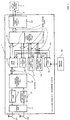
- Fig. 1 there is illustrated a construction example of the CDMA base transceiver system (BTS system) of this embodiment.
- the CDMA base transceiver system 1 is connected to a higher in order system (a system the order of that is higher than that of the BTS system) 2 via a bi-directional (e.g. ATM: Asynchronous Transfer Mode) wire transmission path 3.
- the CDMA base transceiver system 1 illustrated in the same figure includes two antennas A1, A2, a duplex part 11, an amplifier part 12, a low-noise amplifier part 13, a wireless transmission/reception part 14, a base band part 15, a test function part 16, a call-process monitor control part 17, a maintenance monitor control part 18, a download part 19, a transmission path switching function part 21, and a transmission path interface part 22 (e.g. the one having a signal processing function for processing an AAL-Type 2 and an AAL-Type 5 signal). It further includes a memory medium 20 that is freely removably attached to, for example, the download part 19.
- the construction and operation of the CDMA base transceiver system 1 of this embodiment illustrated in the same figure have the portions that are the same as, and the portions that are different from, the construction and operation of the base transceiver system 111 illustrated in Fig. 7.
- the portions that are different from the construction and operation of the base transceiver system 111 illustrated in Fig. 7 will be explained in detail.
- the construction and operation of the base band part 15 differ from those of the base band part 125 illustrated in Fig. 7.
- the maintenance monitor control part 18 of this embodiment performs transmission/reception of a maintenance monitor control signal between itself and an outside operation system via the higher in order system 2. It thereby executes operation management process of the BTS system and state monitor control process of the BTS system.
- the maintenance monitor control part executes download of an application software (AP), download of an FPGA configuration data, or download of a DSP firmware through the control of a relevant software.
- AP application software
- the download part 19 of this embodiment controls from the outside (e.g. by depression of the relevant switches) the following renewals: the renewal of the application software stored in a ROM equipped within the call-process monitor control part 17, the renewal of the application software stored in a ROM equipped within the maintenance monitor control part 18, or the renewal of the FPGA configuration data or DSP firmware stored in a ROM equipped within the base band part 15.
- the memory medium 20 of this embodiment is constructed of a memory card, etc. removably attached to the download part 19. It stores therein the application software for being stored in the ROM of the call-process monitor control part 17 and ROM of the maintenance monitor control part 18, or the FPGA configuration data or DSP firmware for being stored in the ROM within the base band part 15.
- the application software, FPGA configuration data, or DSP firmware stored in the memory medium 20 is read out into the download part 19, and, via an intra-system bus signal S1, from the download part 19 there is transmitted (transferred) to the call-process monitor control part 17, maintenance monitor control part 18, or base band part 15.
- the download part 19 when transmitting the FPGA configuration data or DSP firmware to the base band part 15, the download part 19 transmits a base band part download start signal S2 to the base band part 15.
- FIG. 2 there is illustrated an example of a memory map of the memory medium 20 connected to the download part 19.
- the memory medium 20 of this embodiment there are stored, respectively, from prescribed head addresses respective pieces of application software (the call-process monitor control part AP, maintenance monitor control part AP), FPGA configuration data, and DSP firmware.
- a control part (a control part 97 as later described) of the download part 19 reads out requested data (the pieces of application software, FPGA configuration data, or DSP firmware) from their prescribed head addresses. It thereby outputs that requested data by way of the intra-system bus signal S1.
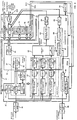
- This base band part 15 includes the following: an FPGA 31 that operates according to the FPGA configuration data, a DSP 32 that operates according to the DSP firmware, a control part 33, an oscillator 34, an A/D converter part 35, a D/A converter part 36, and a base band bus B1.
- the FPGA 31 includes the following: a bus interface part 41, a matched filter 51, profile memory bank 53, and path detection part 54 of a searcher part 42, correlators C1 to CN and memories M1 to MN of a finger part 43, a diffusion-code generation part 44, and a diffusion modulation part 45.
- the DSP 32 includes the following: a pilot synchronous detection part 52 of the searcher part 42, a bus interface part 61, synchronous detection parts D1 to DN of the finger part 43, a composer part 62, a physical frame separation part 63, a decoder part 64, coder part 65, a physical frame multiplexing part 66, and a transmission frame generation part 67.
- the control part 33 includes the following: a DPRAM 71, an SAR (Segmentation and Reassembly) 72, a physical device 73, a flash (Flash) ROM 74, an SDRAM 75, and an MPU part 76.
- the A/D converter part 35 has input thereto a reception signal (an I signal and a Q signal) that is output from a wireless transmission/reception part 14 as an analog signal in the same way as in the case of, for example, the A/D converter part 151 illustrated in Fig. 8. It then converts the reception signal to a digital signal and outputs the signal to the matched filter 51 of the searcher part 42 or each of the correlators C1 to CN of the finger part 43.
- the bus interface part 41 has an interface function between itself and a base band bus B1.
- the bus interface part 41 in this embodiment serves as an interface for controlling from the control part 33 a diffusion code used in the matched filter 51 of the searcher 42, a diffusion code used in each of the correlators C1 to CN of the finger part 43, or a diffusion code generated from the diffusion code generation part 44.
- the searcher part 42 includes the matched filter 51, pilot synchronous detection part 52, profile memory bank 53, and path detection part 54.
- the searcher part 42 detects the path of the reception signal that is input from the A/D converter part 35 and notifies the detected result to the finger part 43.
- the finger part 43 includes a plurality of (e.g. an N number of pieces) signal processing systems #1 to #N each constructed of one correlator C1 to CN equipped with a diffusion code generator, one piece of memory M1 to MN, and one piece of synchronous detection part D1 to DN.
- the finger part 43 demodulates the reception signal for each path with the use of each relevant signal processing system #1 to #N.
- the finger part 43 outputs the demodulated result to the composer part 62.
- the bus interface part 61 has an interface function between a device and a base band bus B1 and, in this embodiment, connects the DSP 32 and the base band bus B1.
- the composer part 62 composes the synchronous-detected results corresponding to a plurality of paths input from the finger part 43 with the use of, for example, "a maximum-ratio composing method".
- the composer part 62 outputs the composed result to the physical frame separation part 63 as a final reception signal.
- the composer part 62 detects a signal power/interference power ratio (SIR) with regard to the composed result.
- SIR signal power/interference power ratio
- the composer part 62 generates a transmission power control (TPC) bit for controlling the transmission power and outputs the control bit to the transmission frame generation part 67.
- TPC transmission power control
- the physical frame separation part 63 separates physical channel from the reception signal (the composed result) input from the composer part 62. Then the physical frame separation part 63 outputs the post-separation reception signal to the decoder part 64.
- the decoder part 64 performs de-interleave processing or error correction decoding with respect to the reception signal input from the physical separation part 63. Then the decoder part 64 outputs the reception signal after those pieces of processing to the SAR 72 of the control part 33.
- the coder part 65 performs de-interleave processing or error correction coding with respect to the transmission signal input from the SAR 72 of the control part 33. Then the coder part 65 outputs the transmission signal after those pieces of processing to the physical frame multiplexing part 66.
- the physical frame multiplexing part 66 performs mapping into physical channels of the transmission signal input from the coding part 65. Then the physical frame multiplexing part 66 outputs the post-mapping transmission signal to the transmission frame generation part 67.
- the transmission frame generation part 67 As in the case of, for example, the transmission frame generation part 156 illustrated in Fig. 8, the transmission frame generation part 67 generates transmission frames by the use of the transmission signal input from the physical frame multiplexing part 66. Then the transmission frame generation part 67 outputs the thus-generated transmission frame to the diffusion modulation part 45. Further, the transmission frame generation part 67 controls the transmission power according to the transmission power control bit input from the composer part 62.
- the diffusion code generation part 44 As in the case of, the diffusion code generation part 157 illustrated in Fig. 8, the diffusion code generation part 44 generates a diffusion code according to the instruction from the control part 33. The diffusion code generation part 44 then outputs the thus-generated diffusion code to the diffusion modulation part 45. It is to be noted that there can also be made up a construction wherein the code generated in the diffusion code generation part 44 is supplied as an inverse diffusion code to the searcher part 42 or finger part 43.
- the diffusion modulation part 45 performs diffusion modulation of the transmission frame signal (framed transmission signal) input from the transmission frame generation part 67 by the use of the diffusion code input from the diffusion code generation part 44.
- the diffusion modulation part 45 then outputs the diffusion-modulated transmission frame signal to the D/A converter part 36.
- the D/A converter 36 converts the diffusion-modulated) transmission frame input as a digital signal from the diffusion modulation part 45 to an analog signal.
- the D/A converter 36 then outputs the post-conversion signal to the wireless transmission/reception part 14 as a transmission signal (I signal and Q signal).
- the DPRAM 71 performs interface between the base band bus B1 and the intra-system bus signal S11.
- the SAR 72 is an SAR device that is, for example, in asynchronous transfer mode (ATM).
- the SAR 72 outputs a (reception) signal input from the decoder part 64 of the DSP 32 to the physical device 73, while it outputs a (transmission) signal input from the physical device 73 to the coder part 65 of the DSP 32.
- the physical device 73 is a physical device that is, for example, in ATM.
- the physical device 73 outputs a reception signal input from the SAR 72 to the transmission path signal switching function part 21 as an ATM signal S12, while it outputs an ATM signal S12 input from the transmission path signal switching function part 21 to the SAR 72 as a transmission signal.
- the flash memory ROM 74 is a loadable ROM. It stores therein program data (MPU program) for operating the MPU of the MPU part 76, FPGA configuration data for operating the FPGA 31, or DSP firmware for operating the DSP 32.
- program data MPU program
- FPGA configuration data for operating the FPGA 31, or DSP firmware for operating the DSP 32.
- the SDRAM 75 is a memory for temporarily storing data, for example, and, in this embodiment, the SDRAM 75 is used as a working area for the MPU part 76.
- the MPU part 76 has an MPU. Executing an MPU program, the MPU part 76 performs various kinds of pieces of processing or control in the base band part 15.
- Fig. 4 there is illustrated a configuration data transfer control signal S13 that is transmitted from the MPU part 76 to the FPGA 31 or a firmware download control signal S14 that is transmitted from the MPU part 76 to the DSP 32.
- the base band bus B1 is connected to the FPGA 31, DSP 32, or the DPRAM 71, SAR 72, flash ROM 74, SDRAM 75 and MPU part 76.
- the oscillator 34 not only supplies a clock signal for operating the FPGA 31 to the FPGA 31 but also supplies a clock signal for operating the DSP 32 to the DSP 32.
- the FPGA configuration data and DSP firmware for causing the execution of the wireless communication processing based on the use of the W-CDMA/TDD method by the FPGA 31 and DSP32.
- the FPGA configuration data and DSP firmware for causing the execution of the wireless communication processing based on the use of the W-CDMA/FDD method by the FPGA 31 and DSP32.
- the FPGA configuration data and DSP firmware for causing the execution of the wireless communication processing based on the use of the multi-carrier CDMA method by the FPGA 31 and DSP32.
- a chip-rate frequency of 3. 84 MHz is used while in the multi-carrier CDMA method a chip-rate frequency of 1. 2288 MHz and 3. 6864 MHz is used. Therefore, the chip-rate frequency differs between the W-CDMA method and the multi-carrier CDMA method.
- the oscillator 34 of this embodiment is constructed, as a preferred embodiment, using the following oscillator.
- the clock signal that is caused to oscillate from that one oscillator is supplied to the FPGA 31 or to the DSP 32.
- the FPGA 31 it operates by a clock signal the frequency of that is a chip-rate frequency (for W-CDMA method or multi-carrier CDMA method) being generated using a clock signal input from the oscillator 34.
- the DSP 32 it operates by a clock signal the frequency of that is a symbol-rate frequency (for W-CDMA method or multi-carrier CDMA method) being generated using a clock signal input from the oscillator 34.
- the frequency that has the value of the above-described common multiple becomes an integral multiple of a W-CDMA method of chip-rate and symbol-rate frequency or a multi-carrier CDMA method of chip-rate frequency and symbol-rate frequency. Therefore, in the FPGA 31 or DSP 32, the speed of a clock signal the frequency of that has the value of the above-described common multiple is made (1/an integer) time as high, which enables generating a clock signal having a required value of frequency.
- the FPGA 31 or DSP 32 has a construction of producing a required-frequency clock signal by the use of a clock signal the frequency of that has the value of the common multiple. Therefore, the contents of the FPGA configuration data or DSP firmware that regards, for example, the diffusion code generation part 44 for generating diffusion codes or a frequency-divider circuit for executing the above-described (1/an integer) time as high processing differ between the W-CDMA method and the multi-carrier CDMA method.
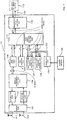
- FIG. 5 there are illustrated in the CDMA base transceiver system of this embodiment construction examples of the construction parts that regard the download function for the application software of the call-process monitor control part 17, and the application software, FPGA configuration data, and DSP firmware of the maintenance monitor control part 18.
- wireless transmission/reception part 14 base band part 15, call-process monitor control part 17, maintenance monitor control part 18, download part 19, memory medium 20, and transmission path signal switching function part 21.
- the ROM 74a for storing therein an MPU program, the ROM 74b for storing therein the FPGA configuration data, and the ROM 74c for storing therein the DSP firmware are illustrated as separate ROM's.
- a DPRAM 81 serving as an interface for the intra-system bus signal S11 and a control part 82 for performing various kinds of control.
- a DPRAM 82 serving as an interface for the intra-system bus signal S11 and a control part 84 for performing various kinds of control.
- the start of this download processing is caused according to the depression of, for example, the switch 94 or the request (e.g. software control) that is made from a higher in-order system 2.
- a call-process monitor control part AP download start request signal S21 is output from the control part 84 of the maintenance monitor control part 18 to the OR circuit 91.
- a call-process monitor control part AP download start signal S24 is input to the control part 97. Thereby, the start of the download processing is caused.
- OR circuit 91 in case it has input thereto either one or each of the signal indicating the depression of the switch 94 and the call-process monitor control part AP download start request signal S21, it outputs the call-process monitor control part AP download start signal S24 to the control part 97.
- the control part 97 that has received the call-process monitor control part AP download start signal S24 outputs a call-process monitor control part AP download start signal S27 to the control part 82 of the call-process monitor control part 17. Simultaneously, the control part 97 transmits (transfers) the application software for call-process monitor control, stored in the memory medium 20, to the control part 82 through the use of the intra-system bus signal S11 via the DPRAM 81 within the call-process monitor control part 17.
- the application software stored in the memory medium 20 is set in the call-process monitor control part 17. Thereby, in the call-process monitor control part 17, it becomes possible to execute the processing according to the contents of the thus-set application software.
- the start of this download processing is caused according to the depression of the switch 95 for example, or, the request (e.g. software control) made from a higher in-order system.
- the maintenance monitor control part AP download start request signal S22 is output from the control part 84 of the maintenance monitor control part 18 to the OR circuit 92. According thereto, the maintenance monitor control part AP download start signal S25 is output from the OR circuit 92, and is input to the control part 97. Thereby, the start of the download processing is caused.
- OR circuit 92 in case it has input thereto either one or each of the signal indicating the depression of the switch 95 and the maintenance monitor control part AP download start request signal S22, it outputs the maintenance monitor control part AP download start signal S25 to the control part 97.
- control part 97 that has received the maintenance monitor control part AP download start signal S25 outputs a maintenance monitor control part AP download start signal S28 to the control part 84 of the maintenance monitor control part 18. Simultaneously, the control part 97 transmits (transfers) the application software for maintenance monitor control, stored in the memory medium 20, to the control part 84 through the use of the intra-system bus signal S11 via the DPRAM 83 within the maintenance monitor control part 18.
- the application software stored in the memory medium 20 is set in the maintenance monitor control part 18. Thereby, in the maintenance monitor control part 18, it becomes possible to execute the processing according to the contents of the thus-set application software.
- the start of this download processing is caused according to, for example, the depression of the switch 96, or the request (e.g. software control) made from a higher in-order system 2.
- a base band part download start request signal S23 is output from the control part 84 of the maintenance monitor control part 18 to the OR circuit 93. According thereto, from the OR circuit 93 there is output the base band part download start signal S26, which is input to the control part 97. Thereby, the start of the download processing is caused.
- OR circuit 93 in case it has input thereto either one or each of the signal indicating the depression of the switch 96 and the base band part download start request signal S23, it outputs the base band part download start signal S26 to the control part 97.
- the control part 97 that has received the base band part download start signal S26 outputs a base band part download start signal S2 to the MPU part 76 of the base band part 15. Simultaneously, it transmits (transfers) the FPGA configuration data stored in the memory medium 20 to the (for-use-for-FPGA) ROM 74b through the use of the intra-system bus signal S11 via the DPRAM 71 within the base band part 15. Further, it transmits (transfers) the DSP firmware stored in the memory medium 20 to the (for-use-for-DSP) ROM 74c through the use of the intra-system bus signal S11 via the DPRAM 71 within the base band part 15.
- the MPU part 76 that has received the base band part download start signal S2 operates as follows after completing the above-described transmission (transfer) of the FPGA configuration data to the (for-use-for-FPGA) ROM 74 or the above-described transmission (transfer) of the DSP firmware to the (for-use-for-DSP) ROM 74c.
- the MPU part 76 outputs a configuration data transfer control signal S13 to the FPGA 31 to thereby execute configuration of the FPGA 31.
- it outputs a firmware download control signal S14 to the DSP 32 to thereby execute download of the DSP firmware to the DSP 32.
- the FPGA configuration data stored in the memory medium 20 is set to the FPGA 31 while the DSP firmware stored in the memory medium 20 is set to the DSP 32.
- the FPGA 31 it becomes possible to execute processing according to the contents of the thus-set FPGA configuration data.
- the DSP 32 it becomes possible to execute processing according to the contents of the thus-set DSP firmware.
- the FPGA configuration data and DSP firmware corresponding to the TDD method of the W-CDMA can have its initial setting done to the FPGA 31 or DSP 32.
- the FPGA configuration data or DSP firmware corresponding to any one of the communication methods is kept set to, for example, the FPGA 31 or DSP 32, re-setting of the FPGA configuration data or DSP firmware corresponding to a different communication method can be done to the FPGA 31 or DSP 32.
- this embodiment has been constructed in such a form wherein download processing is executed according to the depression of the switches 91 to 93 or the request made from a higher in-order system 2.
- it may also be constructed in such a form wherein due, for example, to the clue that the power source of the download part 19 has been switched to "on" the data (application software or FPGA configuration data or DSP firmware) stored in the memory medium 20 is automatically read out and loaded down.
- it is also possible to use a construction of remote download wherein download is executed through the performance of a control made from, for example, a remote system connected to the download part 19 via relevant lines.
- the construction parts for performing processing at a chip rate are incorporated into an FPGA package while the construction parts for performing processing at a symbol rate are incorporated into a DSP package.
- downloading the software for each package is made possible.
- it has been constructed to keep stored into a memory card, etc. beforehand the software for each package. And to connect the memory card, etc. to (the download part 19 of) the CDMA base transceiver system 1 to thereby enable downloading the software to the base band part 15.
- the CDMA base transceiver system 1 of this embodiment it is based on the construction of the base band part 15 that uses the FPGA 31 and the DSP 32. With this construction, it is possible to make high the efficiency of the signal processing. Simultaneously, the pieces of software (FPGA configuration data and DSP firmware) corresponding, for example, to various types of communication methods can be set. And, by this setting, it is possible to execute signal processing corresponding to each of various types of communication methods through the use of the FPGA 31 or DSP 32. Namely, in the CDMA base transceiver system 1 of this embodiment, even if performing no changes of, for example, hardware, it is possible to correspond to a plurality of communication methods by changing the software for FPGA 31 or DSP 32.
- the hardware of the base band part 15 that concerns the specification of the air interface is constructed of the FPGA 31 and DSP 32. Therefore, it is possible to realize causing correspondence to the specification of a different air interface through a common use of the same hardware (substrate).
- the configuration data (circuit construction) of the FPGA 31 and the firmware of the DSP 32 are stored in the memory medium 20 of the download part 19 jointly with the application software (of the call-process monitor control part 17 and maintenance monitor control part 18). Therefore, by inserting the memory medium 20 consisting of a memory card, etc. into the download part 19 of) the CDMA base transceiver system 1, it is possible to easily change the circuit construction of the FPGA 31 within the base band part 15 or the firmware of the DSP 32.
- the W-CDMA/TDD method, W-CDMA/FDD method, or multi-carrier CDMA method is a communication method that is similar to one another.
- Changing the construction parts (the construction parts for performing processing after the base band processing) enabling replacement of the software not by change in hardware makes it possible to cause correspondence to each of those three kinds of communication methods.
- replacing the software for the FPGA 31 and DSP 32 enables correspondence to each of those three kinds of communication methods.
- the (wireless) base transceiver system there are three types: for example, an ultra-small capacity type, an intermediate capacity type, and a large capacity type.
- the construction of the base band part 15 such as that in this embodiment is particularly effective when applied to an ultra-small capacity type of (wireless) base transceiver system.
- the ultra-small capacity type corresponds to a 40 or so channel system
- the intermediate capacity type corresponds to a 256 or so channel system
- the large capacity type corresponds to a 768 or so channel system.
- the CDMA base transceiver system 1 of this embodiment has been constructed in such a form as to oscillate with the oscillator 34 a clock signal the frequency of that has a value of the common multiple of the chip-rate frequency for W-CDMA method and the chip-rate frequency for multi-carrier CDMA method.
- the frequency of the system clock and the chip-rate frequency greatly differ from each other.
- first oscillation means for oscillating a signal having a frequency corresponding to each of a plurality of kinds of chip-rate frequencies (a plurality of kinds of diffusion code frequencies) used in a different type of communication method and second oscillation means for oscillating a signal having a frequency corresponding to each of a plurality of kinds of symbol rate frequencies used in that different type of communication method be equipped to the oscillator 34.
- the FPGA configuration data corresponds to an example of the FPGA program data referred to in the present invention while the DSP firmware corresponds to an example of the DSP program data referred to in the present invention.
- the download part 19, etc. read in the FPGA configuration data or DSP firmware stored in the memory medium 20 and set it to the FPGA 31 or DSP 32 within the base band part 15, or the function of changing the program data through the performance of such setting.
- This function constitutes program data setting means or program data changing means referred to in the present invention.
- the oscillator 34 there is the function of the oscillator 34, or the like's supplying a clock signal having a frequency corresponding to each of the chip rates of a plurality of communication methods or a clock signal having a frequency corresponding to each of the symbol rates of a plurality of communication methods.
- This function constitutes clock means referred to in the present invention.
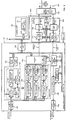
- This base transceiver system providing system is constructed of a managing system Z.
- This managing system Z is connected to, for example, a plurality (e.g. an L number) of (wireless) base transceiver systems P1 to PL through the intermediary of wire lines W1 to WL. That managing system Z is also connected to a (communication service company's) terminal apparatus V through the intermediary of the Internet lines I.
- each of the respective base transceiver systems P1 to PL there is a CDMA base transceiver system (in this embodiment an ultra-small capacity type) that is the same as that illustrated, for example, in the first embodiment.
- the respective base transceiver systems P1 to PL each have set thereto program data (in this embodiment the FPGA configuration data or DSP firmware) corresponding to a desired communication method.
- program data in this embodiment the FPGA configuration data or DSP firmware
- each base transceiver system P1 to PL can be made to correspond to a relevant one of a plurality of communication methods.
- the illustration is made as follows. With one base transceiver system PL being representatively used, an example of a cell area (communicatable area) R of the base transceiver system PL is illustrated. And, there are illustrated a plurality of mobile-station apparatuses Q1, Q2 existing within the cell area R.
- each of the respective base transceiver systems P1 to PL there is allocated its peculiar identification information (in this embodiment the number information "0001" to "000L").
- the managing apparatus Z includes the following.
- a memory medium 102 for storing therein program data for use for download (in this embodiment FPGA configuration data or DSP firmware).
- a communication function 106 having a function of communicating information between itself and each of the base transceiver system P1 to PL via a relevant wire line W1 to WL or a function of communicating information between itself and the terminal apparatus V via the Internet line I.
- a download function 107 for transmitting program data stored in the memory medium 102 to each of the base transceiver system P1 to PL.
- the base transceiver system providing person first, installs each of the base transceiver systems P1 to PL on a BTS equipping point (e.g. on a telephone pole or telephone booth or the like) in a given area of the communication zone.
- a BTS equipping point e.g. on a telephone pole or telephone booth or the like
- the installing place for each of the base transceiver systems P1 to PL there is no particular limitation. However, it is effective to keep it installed at a place such as the interior of a tunnel or an underground shopping center, where the electric waves are unlikely to reach.
- the base transceiver system providing person keeps stored in the database 101 as table data the number information of the base transceiver systems P1 to PL and place data (the data on the equipping points) of the places where the base transceiver systems P1 to PL have been installed in such a way that the information and the place data correspond to each other.
- the following data is also stored in the database 101 as part of the table data.
- the data for specifying program data (in this embodiment the application software such as FPGA configuration data or DSP firmware. Namely, according to the type of the application software, a communication method can be identified.) that is now set (loaded) on the respective base transceiver systems P1 to PL. And, the data for specifying which communication service company each of the base transceiver systems P1 to PL is now being provided (in this embodiment bought by or rented) to.
- information indicating that the relevant portion is "empty” (e.g. a flag indicating that the relevant portion is empty) is kept stored beforehand in that relevant portion of the table data.
- information indicating that that relevant portion is "empty” is kept stored beforehand in that relevant portion of the table data.
- the base transceiver systems P1 to PL that are not being provided to any communication service company in the relevant portion of the table data, there is stored information indicating that that relevant portion is "empty”.
- the base transceiver system providing person accepts a request to provide the base transceiver system P1 to PL from each of (a plurality of) communication service companies.
- the managing system Z makes a search for the database 101 through the use of the search function 103. It can thereby find an ("empty") base transceiver system, provided to none of the communication service companies, as a providing candidate. It can thereby make a display/output of the searched result through the use of the display function 104.
- the display function 104 of this embodiment in case, for example, it makes a display/output of the above-described searched result, it can also display and output on a map the equipped place of each base transceiver system or the cell area thereof (what extent of largeness the cell area has) according to the stored contents of the database 101.
- the base transceiver system providing person operates as follows. Namely, this person, through the use of the register function 105, registers to the database 101 the data for specifying program data set to the base transceiver system or the data for specifying the communication service company that the base transceiver system is provided to, in such a way that that data corresponds to the (number information of) the base transceiver system.
- the following operation occurs. Namely, in that case, through the operation of the download function 107 of the managing system Z, the program data corresponding to the communication system used by the communication service company is transmitted from the memory medium 102 to that base transceiver system via wired lines. Thereby, the program data is loaded down to that base transceiver system and is set thereto.
- the download function 107 (automatically) transmits the program data to the base transceiver system (corresponding to the number information) via the wired lines.
- the terminal apparatus V it is possible, for example, to make a search for information (the information on the installing place on the map, the information on the cell area, etc.) that concerns the empty base transceiver systems and to look through the searched information pieces.
- the base transceiver system providing system of this embodiment it is managed whether the base transceiver system P1 to PL able to correspond to each of a plurality of communication methods is being utilized (in this embodiment bought by or rented to) the communication service company. Then, according to a request made from the communication service company, it is arranged to set a desired communication method to the empty base transceiver system (from among a plurality of settable communication methods). Therefore, it is possible to smoothly offer the from-base-transceiver-system-P1 to PL provided service, thereby enabling the increase in the efficiency of the service provision.
- the base transceiver system providing system of this embodiment there is displayed the installing places of the respective base transceiver systems P1 to PL or the cell areas thereof. Thereby, they are visually understood by the communication service company, etc. that wants to utilize the system. Therefore, it is possible to more smoothly offer the from-base-transceiver-system P1 to PL provided service.
- the base transceiver system providing system for example, in the (managing system Z's) memory medium 102 that is provided at a place remote from the respective base transceiver systems P1 to PL there are stored a plurality of program data corresponding to various types of communication methods. Thereby, when the occasion has demanded, the program data corresponding to a desired one of the communication methods can be (automatically) transmitted and set to a desired one of the base transceiver systems via the wired lines W1 to WL. Thereby, it is possible to more smoothly offer the from-base-transceiver-system P1 to PL provided service.
- the function that is performed by the database 101 constitutes base transceiver system information memory means referred to in the present invention.
- the search function 103 constitutes search means referred to in the present invention.
- the register function 105 constitute register means referred to in the present invention.
- the communication function 106 or download function 107 constitutes program data setting means referred to in the present invention.
- the display function 104 constitutes display means or display control means referred to in the present invention.
- the function that is performed by the memory medium 102 constitute program data memory means referred to in the present invention. It is to be noted that the memory medium 102 of this embodiment is connected to each of the base transceiver systems P1 to PL via the communication function 106, download function 107, or wired lines W1 to WL.
- each of the CDMA base transceiver system and base transceiver system providing system according to the present invention is not necessarily limited to the one that has been described above.
- the present invention permits the use of various other constructions or types.
- the field that the present invention is applied to is not necessarily limited to the one that has been referred to as above.
- the present invention enables the application thereof to various other fields.
- the following constructions may be adopted. Namely, for example, in the hardware resources equipped with a processor, memory, etc., it may be constructed that various kinds of processing can be controlled by the processor executing the control programs stored in the ROM. Or, for example, the respective function means for executing the pieces of processing may be constructed as independent hardware circuits.
- the present invention can also be grasped as computer-readable recording media such as a floppy disk, CD-ROM, etc. each having stored therein the above-described control programs. Namely, these control programs are input from a recording medium into the computer to thereby cause the processor to execute each of them. By doing so, it is possible to execute the necessary pieces of processing according to the present invention.
- the FPGA program data used by the FPGA and the DSP program data used by the DSP can be changed to program data that corresponds to a different type of communication method. Therefore, it is possible to achieve the increase in the efficiency of signal processing through the use of the construction based on the use of the FPGA and DSP. Simultaneously, it is possible to execute signal processing corresponding to each of various types of communication methods through the use of the FPGA or DSP.
- the base transceiver system providing system for example, there is set program data that corresponds to the communication method selected from among a plurality of communication methods.
- the providing system stores therein information on whether a relevant one of those base transceiver systems is being utilized by the communication service company.
- search is performed for the empty base transceiver system (i.e. the one that is not being utilized by any communication service company).
- the program data corresponding to the communication method the communication service company utilizes is set to the relevant base transceiver system. Therefore, it is possible to smoothly perform provision of the service of the base transceiver system and thereby to achieve the increase in the efficiency of the service.
Landscapes
- Engineering & Computer Science (AREA)
- Computer Networks & Wireless Communication (AREA)
- Signal Processing (AREA)
- Mobile Radio Communication Systems (AREA)
- Stored Programmes (AREA)
- Digital Transmission Methods That Use Modulated Carrier Waves (AREA)
- Transceivers (AREA)
Applications Claiming Priority (2)
| Application Number | Priority Date | Filing Date | Title |
|---|---|---|---|
| JP2000268027A JP4523708B2 (ja) | 2000-09-05 | 2000-09-05 | Cdma基地局装置 |
| JP2000268027 | 2000-09-05 |
Publications (2)
| Publication Number | Publication Date |
|---|---|
| EP1184994A2 true EP1184994A2 (fr) | 2002-03-06 |
| EP1184994A3 EP1184994A3 (fr) | 2005-04-13 |
Family
ID=18754853
Family Applications (1)
| Application Number | Title | Priority Date | Filing Date |
|---|---|---|---|
| EP20010307170 Withdrawn EP1184994A3 (fr) | 2000-09-05 | 2001-08-23 | Système de station de base utilisant l'AMRC |
Country Status (3)
| Country | Link |
|---|---|
| US (1) | US7012908B2 (fr) |
| EP (1) | EP1184994A3 (fr) |
| JP (1) | JP4523708B2 (fr) |
Families Citing this family (18)
| Publication number | Priority date | Publication date | Assignee | Title |
|---|---|---|---|---|
| JP4171261B2 (ja) * | 2001-08-27 | 2008-10-22 | 松下電器産業株式会社 | 無線通信装置及び無線通信方法 |
| TWI245512B (en) * | 2002-04-15 | 2005-12-11 | Interdigital Tech Corp | Apparatus capable of operating in both time division duplex (TDD) and frequency division duplex (FDD) modes of wideband code division multiples access (CDMA) |
| GB2396275B (en) | 2002-12-09 | 2006-03-15 | Ipwireless Inc | Support of plural chip rates in a CDMA system |
| WO2004109923A1 (fr) * | 2003-06-05 | 2004-12-16 | Fujitsu Limited | Procede de configuration d'un dispositif programmable et circuit associe |
| GB0316608D0 (en) * | 2003-07-16 | 2003-08-20 | Koninkl Philips Electronics Nv | A method of correlating a sampled direct sequence spread spectrum signal with a locally provided replica |
| JP4308037B2 (ja) * | 2004-02-23 | 2009-08-05 | 三菱電機株式会社 | 無線端末試験装置 |
| US7277712B2 (en) * | 2004-11-17 | 2007-10-02 | At&T Mobility Ii, Llc | Method and system for providing location information for emergency services |
| JP4611182B2 (ja) | 2005-02-16 | 2011-01-12 | パナソニック株式会社 | 無線端末装置及び通信方式切り換え方法 |
| JP4855016B2 (ja) * | 2005-08-22 | 2012-01-18 | 株式会社日立国際電気 | 情報処理装置 |
| KR101246492B1 (ko) * | 2006-01-20 | 2013-03-25 | 파나소닉 주식회사 | 무선 통신 기지국 장치, 무선 통신 기지국 장치에서 이용되는 방법 및 무선 통신용 반도체 집적회로 |
| JP5128585B2 (ja) * | 2006-05-24 | 2013-01-23 | ノキア コーポレイション | Cdma受信機において、捕捉、追跡およびホスティングにハードウェアおよびソフトウェアを使用する方法 |
| US7756193B2 (en) * | 2006-09-21 | 2010-07-13 | Broadcom Corporation | Time divided pilot channel detection processing in WCDMA terminal having shared memory |
| US8583100B2 (en) | 2007-01-25 | 2013-11-12 | Adc Telecommunications, Inc. | Distributed remote base station system |
| US8737454B2 (en) * | 2007-01-25 | 2014-05-27 | Adc Telecommunications, Inc. | Modular wireless communications platform |
| US8369299B2 (en) | 2007-05-07 | 2013-02-05 | Qualcomm Incorporated | Method and apparatus for multiplexing CDM pilot and FDM data |
| US20140242975A1 (en) * | 2011-10-06 | 2014-08-28 | Mitsubishi Electric Corporation | Base station device and communication system |
| JP5759417B2 (ja) * | 2012-05-16 | 2015-08-05 | 日本電信電話株式会社 | 無線通信システム、及び接続切替方法 |
| US10499269B2 (en) | 2015-11-12 | 2019-12-03 | Commscope Technologies Llc | Systems and methods for assigning controlled nodes to channel interfaces of a controller |
Family Cites Families (12)
| Publication number | Priority date | Publication date | Assignee | Title |
|---|---|---|---|---|
| GB2294844B (en) * | 1994-11-07 | 1999-05-26 | Motorola Inc | Communications operating system and method therefor |
| US5640416A (en) * | 1995-06-07 | 1997-06-17 | Comsat Corporation | Digital downconverter/despreader for direct sequence spread spectrum communications system |
| EP0767544A3 (fr) * | 1995-10-04 | 2002-02-27 | Interuniversitair Micro-Elektronica Centrum Vzw | Modem programmable utilisant la communication à spectre étalé |
| JPH09130291A (ja) * | 1995-10-31 | 1997-05-16 | Hitachi Ltd | デュアルモード携帯電話端末のクロック分配方式 |
| US5778022A (en) * | 1995-12-06 | 1998-07-07 | Rockwell International Corporation | Extended time tracking and peak energy in-window demodulation for use in a direct sequence spread spectrum system |
| US6400966B1 (en) * | 1997-10-07 | 2002-06-04 | Telefonaktie Bolaget Lm Ericsson (Publ) | Base station architecture for a mobile communications system |
| JPH11285066A (ja) * | 1998-03-27 | 1999-10-15 | Kokusai Electric Co Ltd | 移動通信装置 |
| JP3680592B2 (ja) * | 1998-10-30 | 2005-08-10 | 株式会社日立製作所 | 通信装置 |
| JP3812705B2 (ja) * | 1998-12-04 | 2006-08-23 | 株式会社日立国際電気 | 受信装置 |
| WO2000069086A1 (fr) * | 1999-05-10 | 2000-11-16 | Sirius Communications N.V. | Procede et appareil de communication par acces multiple a repartition de code grande vitesse reconfigurable par logiciel |
| JP3442325B2 (ja) * | 1999-10-22 | 2003-09-02 | 日本電信電話株式会社 | 無線通信システム制御装置 |
| US6801564B2 (en) * | 2000-02-23 | 2004-10-05 | Ipr Licensing, Inc. | Reverse link correlation filter in wireless communication systems |
-
2000
- 2000-09-05 JP JP2000268027A patent/JP4523708B2/ja not_active Expired - Fee Related
-
2001
- 2001-08-23 EP EP20010307170 patent/EP1184994A3/fr not_active Withdrawn
- 2001-08-31 US US09/942,847 patent/US7012908B2/en not_active Expired - Fee Related
Also Published As
| Publication number | Publication date |
|---|---|
| JP2002077103A (ja) | 2002-03-15 |
| US7012908B2 (en) | 2006-03-14 |
| US20020027892A1 (en) | 2002-03-07 |
| EP1184994A3 (fr) | 2005-04-13 |
| JP4523708B2 (ja) | 2010-08-11 |
Similar Documents
| Publication | Publication Date | Title |
|---|---|---|
| US7012908B2 (en) | CDMA base transceiver system | |
| FI110399B (fi) | Langaton viestin | |
| US6967999B2 (en) | Method and apparatus to support multi standard, multi service base-stations for wireless voice and data networks | |
| US7272413B2 (en) | System and method for supporting multimode communication in a mobile network | |
| US7870233B2 (en) | Efficient software download to configurable communication device | |
| AU700136B2 (en) | Communications operating system and method therefor | |
| US20010014603A1 (en) | Software reconfiguration of communications apparatus | |
| EP0898847A2 (fr) | Systeme d'exploitation de communications et procede afferent | |
| JP2004023391A (ja) | 携帯電話機及びこの携帯電話機における通信方法 | |
| KR20030002452A (ko) | 이동통신 단말기의 3 밴드 수신주파수 회로 | |
| US8509845B2 (en) | Apparatus for impedance matching in dual standby portable terminal and method thereof | |
| KR100576523B1 (ko) | 듀얼모드 단말기에서 모드를 전환하기 위한 장치 및 방법 | |
| TWI407743B (zh) | 在通信系統中處理信號的方法及系統 | |
| US7200389B2 (en) | Dynamic interface software for wireless communication devices | |
| US7197302B2 (en) | System and method for interchangeable modular hardware components for wireless communication devices | |
| US20050135325A1 (en) | Asynchronous mobile communication terminal capable of setting time according to present location information, and asynchronous mobile communication system and method for setting time using the same | |
| KR20050022641A (ko) | 무선통신 단말기에서의 듀얼 심카드 제어 방법 | |
| EP0948225B1 (fr) | Méthode et dispositif pour la sélection de services offerts par un appareil | |
| US7636555B2 (en) | Event list specification based radio interface control | |
| JP2001043087A (ja) | 無線通信端末のソフトウェア変更方法及び無線通信端末 | |
| KR100216236B1 (ko) | 디지탈 셀룰라 전화 시스템의 제어 프로그램 갱신 방법 및 장치 | |
| KR100244858B1 (ko) | 공중전화망 무선전화와 디지틀 셀룰러폰 겸용 멀티밴드 개인휴대통신 시스템 및 방법 | |
| GB2362544A (en) | Filtering module for multi-mode communiction terminal | |
| JP4719492B2 (ja) | 移動無線端末装置 | |
| Schiphorst et al. | The exploration of the Software-Defined Radio concept by prototyping transmitter and receiver functions on a Digital Signal Processor |
Legal Events
| Date | Code | Title | Description |
|---|---|---|---|
| PUAI | Public reference made under article 153(3) epc to a published international application that has entered the european phase |
Free format text: ORIGINAL CODE: 0009012 |
|
| AK | Designated contracting states |
Kind code of ref document: A2 Designated state(s): AT BE CH CY DE DK ES FI FR GB GR IE IT LI LU MC NL PT SE TR |
|
| AX | Request for extension of the european patent |
Free format text: AL;LT;LV;MK;RO;SI |
|
| PUAL | Search report despatched |
Free format text: ORIGINAL CODE: 0009013 |
|
| 17P | Request for examination filed |
Effective date: 20050208 |
|
| RIC1 | Information provided on ipc code assigned before grant |
Ipc: 7H 04Q 7/32 B Ipc: 7H 04B 1/707 A |
|
| AK | Designated contracting states |
Kind code of ref document: A3 Designated state(s): AT BE CH CY DE DK ES FI FR GB GR IE IT LI LU MC NL PT SE TR |
|
| AX | Request for extension of the european patent |
Extension state: AL LT LV MK RO SI |
|
| AKX | Designation fees paid |
Designated state(s): DE FR GB |
|
| 17Q | First examination report despatched |
Effective date: 20090504 |
|
| STAA | Information on the status of an ep patent application or granted ep patent |
Free format text: STATUS: THE APPLICATION IS DEEMED TO BE WITHDRAWN |
|
| 18D | Application deemed to be withdrawn |
Effective date: 20110606 |