EP1201436A2 - Abdeckmechanismus undTintenstrahlaufzeichnungsgerät das diesen Abdeckmechanismus verwendet - Google Patents
Abdeckmechanismus undTintenstrahlaufzeichnungsgerät das diesen Abdeckmechanismus verwendet Download PDFInfo
- Publication number
- EP1201436A2 EP1201436A2 EP01125883A EP01125883A EP1201436A2 EP 1201436 A2 EP1201436 A2 EP 1201436A2 EP 01125883 A EP01125883 A EP 01125883A EP 01125883 A EP01125883 A EP 01125883A EP 1201436 A2 EP1201436 A2 EP 1201436A2
- Authority
- EP
- European Patent Office
- Prior art keywords
- cap
- cam
- recording
- biasing
- engagement portion
- Prior art date
- Legal status (The legal status is an assumption and is not a legal conclusion. Google has not performed a legal analysis and makes no representation as to the accuracy of the status listed.)
- Granted
Links
- 238000007599 discharging Methods 0.000 claims abstract description 32
- 238000009835 boiling Methods 0.000 claims description 3
- 239000000976 ink Substances 0.000 description 76
- 238000011084 recovery Methods 0.000 description 20
- 238000010276 construction Methods 0.000 description 9
- 230000000694 effects Effects 0.000 description 9
- 230000033001 locomotion Effects 0.000 description 8
- 230000001276 controlling effect Effects 0.000 description 5
- 239000007788 liquid Substances 0.000 description 3
- 239000000463 material Substances 0.000 description 3
- 238000000034 method Methods 0.000 description 3
- 230000000979 retarding effect Effects 0.000 description 3
- 238000004140 cleaning Methods 0.000 description 2
- 238000007796 conventional method Methods 0.000 description 2
- 238000006073 displacement reaction Methods 0.000 description 2
- 239000004744 fabric Substances 0.000 description 2
- 238000005096 rolling process Methods 0.000 description 2
- 238000007789 sealing Methods 0.000 description 2
- 239000002131 composite material Substances 0.000 description 1
- 230000008602 contraction Effects 0.000 description 1
- 230000002542 deteriorative effect Effects 0.000 description 1
- 230000026058 directional locomotion Effects 0.000 description 1
- 239000006185 dispersion Substances 0.000 description 1
- 238000001704 evaporation Methods 0.000 description 1
- 230000008020 evaporation Effects 0.000 description 1
- 239000010985 leather Substances 0.000 description 1
- 230000007774 longterm Effects 0.000 description 1
- 239000004745 nonwoven fabric Substances 0.000 description 1
- 239000000123 paper Substances 0.000 description 1
- 239000002985 plastic film Substances 0.000 description 1
- 238000007639 printing Methods 0.000 description 1
- 238000001454 recorded image Methods 0.000 description 1
- 230000001105 regulatory effect Effects 0.000 description 1
- 239000011347 resin Substances 0.000 description 1
- 229920005989 resin Polymers 0.000 description 1
- 230000002441 reversible effect Effects 0.000 description 1
Images





Classifications
-
- B—PERFORMING OPERATIONS; TRANSPORTING
- B41—PRINTING; LINING MACHINES; TYPEWRITERS; STAMPS
- B41J—TYPEWRITERS; SELECTIVE PRINTING MECHANISMS, i.e. MECHANISMS PRINTING OTHERWISE THAN FROM A FORME; CORRECTION OF TYPOGRAPHICAL ERRORS
- B41J2/00—Typewriters or selective printing mechanisms characterised by the printing or marking process for which they are designed
- B41J2/005—Typewriters or selective printing mechanisms characterised by the printing or marking process for which they are designed characterised by bringing liquid or particles selectively into contact with a printing material
-
- B—PERFORMING OPERATIONS; TRANSPORTING
- B41—PRINTING; LINING MACHINES; TYPEWRITERS; STAMPS
- B41J—TYPEWRITERS; SELECTIVE PRINTING MECHANISMS, i.e. MECHANISMS PRINTING OTHERWISE THAN FROM A FORME; CORRECTION OF TYPOGRAPHICAL ERRORS
- B41J2/00—Typewriters or selective printing mechanisms characterised by the printing or marking process for which they are designed
- B41J2/005—Typewriters or selective printing mechanisms characterised by the printing or marking process for which they are designed characterised by bringing liquid or particles selectively into contact with a printing material
- B41J2/01—Ink jet
- B41J2/135—Nozzles
- B41J2/165—Prevention or detection of nozzle clogging, e.g. cleaning, capping or moistening for nozzles
- B41J2/16505—Caps, spittoons or covers for cleaning or preventing drying out
- B41J2/16508—Caps, spittoons or covers for cleaning or preventing drying out connected with the printer frame
- B41J2/16511—Constructions for cap positioning
Definitions
- the present invention relates to a capping mechanism for protecting recording means for effecting recording by discharging ink toward a recording medium, and an ink jet recording apparatus using such a capping mechanism.
- recording apparatuses having a printer, copier or facsimile function, or recording (printing) apparatuses used as a an output device for a composite electronic equipment including a computer or a word processor or for a work station an ink jet recording apparatus in which recording is effected by discharging ink toward a recording medium (recording material) such as paper, cloth, plastic sheet or OHP sheet in response to image information (recording information) has been popularized.
- recording medium such as paper, cloth, plastic sheet or OHP sheet
- the ink jet recording apparatus has widely been used as a printer, a copier and a facsimile because it has low noise and low running cost and it can easily be made compact and it permits color recording.
- Plural discharge ports for discharging ink droplets are provided on a front face of recording means (ink jet recording head) of the ink jet recording apparatus, and each discharge port has of dimension of about several tens of ⁇ .
- the dimension of the discharge port has been reduced more and more as high quality recording has been progressed.
- the ink droplet is discharged from the discharge port in response to a discharge signal processed in the recording apparatus on the basis of recording data sent from a host machine, thereby recording an image (including a character and/or symbol) on the recording material.
- the discharge port may be clogged to cause poor discharging (including non-discharging), thereby deteriorating quality of the recorded image.
- a recovery unit for maintaining and recovering ink discharging performance of the recording means has been used.
- the recovery unit may include a capping mechanism for capping the discharge port of the recording head, suction means adapted to be connected to the capping mechanism in a capping condition and designed to maintain and recover the ink discharging performance by refreshing the ink in the discharge port by sucking and discharging foreign matters such as viscosity-increased ink and/or bubble(s) from the discharge port by negative pressure generated in the capping means by operating a pump, and wiping means for wiping and cleaning foreign matters such as ink adhered to a discharge port face of the recording means.
- suction means adapted to be connected to the capping mechanism in a capping condition and designed to maintain and recover the ink discharging performance by refreshing the ink in the discharge port by sucking and discharging foreign matters such as viscosity-increased ink and/or bubble(s) from the discharge port by negative pressure generated in the capping means by operating a pump
- wiping means for wiping and cleaning foreign matters such as ink adhered to a discharge port face of the recording means
- the capping mechanism including a rubber cap is provided so that the discharge port face can be capped if necessary. Since the cap must be retarded to a retard position to avoid interfere between the recording head and the cap during the recording operation, the cap is designed to be movable. For example, the cap may be slid laterally (in a carriage scanning direction) to effect capping and retarding or may be shifted in a vertical direction to effect capping and retarding.
- the capping and uncapping (retarding) are effected by shifting the cap in an abutting/spacing direction with respect to the discharge port face (for example, a vertical direction).
- a cap arm for holding a cap is rotatably supported and a cap position is controlled by a cap cam and a cap arm spring.
- a capping (closing) force of the cap relies upon the cap arm spring and a closing ability around the abutment area between the cap and the discharge port face relies upon elasticity of the cap itself.
- a capping (closing) force of the cap relies upon the cap arm spring and a closing ability around the abutment area between the cap and the discharge port face relies upon elasticity of the cap itself.
- equalization properties of the contact area of the cap is enhanced by interposing a cap spring (urging spring) between the cap and the cap arm to follow the inclination of the recording head thereby to maintain the closing or sealing condition.
- a cap spring urging spring
- the cap arm spring and the cap spring affect an influence upon each other, with the result that a positional posture of the cap may become unstable.
- the cap is biased by a spring to be retarded from the recording head. That is to say, in this technique, the cap is forcibly shifted in the closing direction by a cam in opposition to the spring acting toward the retard direction and the closing position (capping position) is determined by dimensions of various parts.
- a cap spring is disposed between the cap and a cap holding member so that equalization properties of the cap (uniform contacting ability around the cap) is enhanced by the spring.
- the cap may be fixedly adhered to the discharge port face of the recording head with which the cap is closely contacted, with the result that the cap cannot be separated (peeled) from the discharge port face only by the force of the returning spring, thereby generating error in the opening/closing operation of the cap.
- the operational error can be eliminated by setting the spring force of the returning spring to have a great value, in this case, load torque is also increased accordingly, with the result that additional countermeasure to torque increase of a drive motor and deformation/wear of various parts is required, thereby increasing the cost of the apparatus. Namely, it is not preferable to have excessive burden due to rare inconvenience generated by the adhesion between the recording head and the cap.
- An object of the present invention is to provide a capping mechanism in which, even if a cap is adhered to recording means, an opening/closing operation of the cap can be effected positively and correctly without increasing a returning force, and an ink jet recording apparatus using such a capping mechanism.
- Another object of the present invention is to provide a capping mechanism for protecting recording means for effecting recording by discharging ink toward a recording medium, which comprises a cap movable in directions along which the cap can be contacted with and separated from a discharge port face of the recording means, cam means for controlling a position of the cap, shifting means for shifting the cap in the above-mentioned directions, and biasing means for biasing the cap to be separated from the discharge port face, and in which the cam means includes first and second cams and the shifting means includes first and second engagement portions so that the first cam is normally engaged with the first engagement portion, and, when the first cam is disengaged from the first engagement portion, the second cam is engaged with the second engagement portion.
- a further object of the present invention is to provide a capping mechanism for protecting recording means for effecting recording by discharging ink toward a recording medium, which comprises a cap movable in directions along which the cap can be contacted with and separated from a discharge port face of the recording means, cam means for controlling a position of the cap, and biasing means for biasing the cap to be separated from the discharge port face, and in which the cam means includes first and second cams and a cap holding member for holding the cap includes first and second engagement portions so that the first cam is normally engaged with the first engagement portion, and, when the first cam is disengaged from the first engagement portion, the second cam is engaged with the second engagement portion.
- an adhered condition can be released without aiding of a force of the biasing means, with the result that an error in an opening/closing operation of the cap due to the adhesion between the recording means and the cap can be eliminated, thereby realizing correct opening/closing operation of the cap, and, since setting force of the biasing means is not required to be increased, increase in load torque and increase in deformation/wear of parts can be eliminated.
- Fig. 10 is a schematic perspective view showing an embodiment of an ink jet recording apparatus to which the present invention is applied.
- a recording medium (recording paper and the like) supplied by sheet feeding means 100 is pinched between and conveyed by a conveying roller 101 and a pinch roller 102 to be sent onto a plate-shaped platen 103.
- line recording is effected on the recording medium by supported by the platen 103 by discharging ink from recording means (recording head) 110 mounted on a carriage 104 in response to image information while shifting the carriage along a guide shaft 105.
- the conveying roller 101 is rotated by a predetermined amount so that the recording medium is conveyed (fed) up to a position where a portion of the recording medium on which next recording is effected is opposed to the recording head 110.
- the carriage 104 is shifted (main scanning) again; meanwhile, the next recording is effected by driving the recording head 110 in response to image information.
- all predetermined recording data are recorded or recording of all area of the recording medium (recording sheet) is finished.
- the recording medium is discharged out of the recording apparatus by sheet discharge rollers 106, thereby finishing the recording.
- the recording means (recording head) 110 can perform color recording by using plural color inks and has plural rows of discharge ports (plural ink discharge portions) corresponding to kinds of inks.
- the discharge port rows are spaced apart from each other by a predetermined pitch in a carriage scanning direction (main scanning direction).
- the recording means (recording head) having the plural rows of discharge ports may be constituted by a plurality of discrete recording head portions (ink discharge portions) for respective discharge port rows (respective ink discharge portions) or may be constituted as integral recording means including one or two recording means having plural discharge port rows.
- the recording means (recording head) 110 is ink jet recording means for discharging the ink by utilizing thermal energy and has electrothermal converters for generating the thermal energy. Further, the recording head 110 serves to effecting the recording by discharging the ink by utilizing change in pressure (change in condition) caused by growth and contraction of a bubble generated by film-boiling effected by the thermal energy given by the electrothermal converter.
- Fig. 11 is a partial perspective view schematically showing a structure of the ink discharge portion (one of discharge port rows) of the recording head 110 of Fig. 10.
- a discharge port face 81 opposed to the recording medium such as the recording paper with a predetermined gap (for example, about 0.3 to 2.0 mm) therebetween is provided with a plurality of discharge ports 82 at a predetermined interval, and electrothermal converters (heat generating resistance members) 85 for generating ink discharging energy are disposed along walls of liquid paths 84 communicating the respective discharge ports 82 to a common liquid chamber 83.
- the recording head 110 is mounted on the carriage 104 in such a manner that the discharge ports 82 are arranged side by side along a direction perpendicular to the scanning direction of the carriage 104.
- the recording means (recording head) 110 in which the film-boiling is generated in the ink within the liquid path 84 by driving (energizing) the corresponding electrothermal converter 85 in response to an image signal or a discharge signal and the pressure generated thereby causes the ink to discharge from the discharge port 82.
- Fig. 10 is an explanatory view schematically showing the integral discharge port face in which a plurality (four) of discharge port rows 111, 112, 113, 114 of the recording means 110 are formed.
- the discharge port row 111 includes plural discharge ports for discharging black ink
- the discharge port row 112 includes plural discharge ports for discharging cyan ink
- the discharge port row 113 includes plural discharge ports for discharging magenta ink
- the discharge port row 114 includes plural discharge ports for discharging yellow ink.
- a recovery unit 1 for maintaining and recovering ink discharging performance of the recording means (recording head) 110 by preventing clogging of the recording means is disposed at a predetermined position (right in Fig. 10) out of a recording area of the ink jet recording apparatus.
- the recovery unit 1 includes a capping mechanism for covering (capping) the recording head (discharge port face thereof) to protect the discharge port face 81 of the recording head 110 in a non-recording condition and to reduce evaporation of ink from the discharge ports 82. Further, when the recording is effected again after the head has been capped for a long term, suction recovery processing for sucking and discharging the ink from the discharge ports 82 is performed before the re-recording in order to stabilize the ink discharging by removing the ink (viscosity increased ink) solidified around the discharge ports. The suction recovery processing is carried out by operating a pump (suction pump) connected to the cap in the capping condition.
- a pump suction pump
- a tube pump of type in which negative pressure is generated by rolling a roller (pressurizing roller) while squeezing a tube connected to the cap and the ink in the recording head is sucked and discharged by the negative pressure is used.
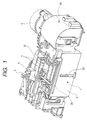
- Fig. 1 is a perspective view of the recovery unit 1 and Fig. 2 is a perspective view showing an internal construction of the recovery unit.
- the recovery unit 1 has a cap 3 for covering the discharge port face of the recording means (recording head) 110, and a capping mechanism 30 operable to engage and disengage the cap 3 with respect to the discharge port face by shifting the recovery unit in a vertical direction along a vertical guide 2a of a base 2.
- the recovery unit 1 also includes a wiping mechanism having a blade 4 for wiping (cleaning) the discharge port face of the recording head 110 by reciprocal movement along a horizontal guide 2b, a carriage lock mechanism having a rocking member (carriage lock) 5 capable of engaging with the carriage to prevent inadvertent movement of the carriage 104 (Fig. 10) in a condition that the discharge port face is sealed by the cap 3 (capping condition), and a suction recovery mechanism 40 operable to refresh the ink in the discharge ports by discharging foreign matters such as viscosity-increased or solidified ink, bubble and dirt together with the ink from the discharge ports of the recording head 110 by driving a suction pump (negative pressure generating means) connected to the cap 3 in the capping condition.
- the capping mechanism 30 constitutes a part of the suction recovery mechanism.
- Operations of the capping mechanism 30, wiping mechanism and carriage lock mechanism are effected by transmitting one-way rotation of a driving force transmitted from a motor 6 through gear trans 7, 8, 9 to a main cam 11 via a one-way clutch gear 10 thereby to rotate the main cam 11.
- the main cam 11 has a plurality of longitudinal cams so that rotation of the main cam 11 is converted into rotation of the carriage lock 5 by one of the cams, the rotation of the main cam 11 is converted into a horizonal reciprocal movement of the blade 4 by another cam and blade driving means, and the rotation of the main cam 11 is converted into a reciprocal shifting movement (vertical reciprocal movement in the illustrated embodiment) of the cap 3 by the other cam and a lever 14.
- the cap 3 is of two-chamber type including a black discharge port chamber for covering a black ink discharge portion of the recording head 110, and a color discharge port chamber for covering color ink discharge portions (cyan, magenta and yellow discharge portions) of the recording head 110.
- the two chambers of the cap 3 are connected to tubes 12, 13, respectively, and these tubes are arranged along an arcuated guide surface of the base 2, and a pressurizing roller rolling along the tubes while squeezing the tubes constitutes a tube pump as the negative pressure generating means (suction pump).
- pressurizing roller holding means 15 rotatable around a center axis of the arcuated guide surface, and the driving force of the motor 6 is transmitted to a pump gear 16 secured to one end of the pressurizing roller holding means 15, and, by rotating the pressurizing roller holding means 15 via the pump gear 16, the tubes 12, 13 are squeezed while being deformed.
- the other directional rotation of the motor 6 causes the pressurizing roller holding means 15 to rotate, thereby squeezing the tubes 12, 13.
- the ink is sucked from the discharge ports of the recording head 110 due to negative pressure generated in the tubes 12, 13 (suction recovery).
- the tube pump suction recovery mechanism
- the one-way clutch gear 10 is idly rotated not to rotate the main cam 11, with the result that the capping mechanism 30 (cap 3), wiping mechanism (blade 4) and carriage locking mechanism (carriage lock 5) are still stopped.
- the capping mechanism 30, wiping mechanism and carriage locking mechanism are operated at predetermined timings. In this case, the roller 17 is released from the tubes 12, 13 not to drive the pump.
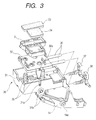
- FIG. 3 is an exploded perspective view showing a first embodiment of the capping mechanism to which the present invention is applied.
- a cap holding member (cap holder) 32 is rockably supported on a cap base 31 by fitting a support shaft 32a of the cap holding 32 into a guide groove 31a of the cap base 31.
- the cap 3 is incorporated into and fixed to the cap holder 32.
- Ink absorbing members 33, 34 are disposed within the cap 3 (in two chambers thereof) for absorbing the ink sucked from the discharge ports of the recording head 110.
- each chamber is connected to the tube pump (suction recovery mechanism) by connecting the tubes 12, 13 to one of the openings of the chambers.
- the other openings of the chambers are connected to tubes 36, 36 and the other ends of these tubes 36 can be opened and closed by valves 37, 38. Namely, by controlled the opening/closing timing of the valves 37, 38, independent ink suction from the black ink discharge ports or color ink discharge ports can be effected, or idle suction after the suction can be effected in the capping condition.
- cap springs 35 (two biasing springs in the example of Fig. 2) as a biasing members are disposed between the cap base 31 and the cap holding member (cap holder) 32.
- the cap springs (biasing members) 35 are charged (compressed in the illustrated embodiment) to afford required pressure sufficient to maintain the sealing condition between the recording head and the discharge port face.
- Bosses 31b are formed on both sides of the cap base 31 so that, by engaging these bosses 31b by the guide groove 2a of the base 2, the cap base 31 is held for redetermined directional movement (vertical movement in the illustrated embodiment) with respect to the base 2.
- the shifting (vertical movement) of the cap base 31 is effected via a lever (cap lever) 14 as shifting means rockably supported by a support shaft 14e of the recovery unit 1.
- the cap lever (shifting means) 14 is biased by a return spring 20 as biasing means in a direction along which the capping mechanism 30 is retarded from the recording head 110.
- the shifting of the capping mechanism 30 to the capping condition is effected by rotating the main cam 11 to displace the cap lever 14 by the predetermined cam of the main cam.
- the capping position (lifted position) of the cap base 31 is dispersed due to tolerance of parts
- the actual capping pressure (contact force with the discharge port face) is determined by the biasing members (cap springs) 35, and, even if the recording head 110 is inclined, since the equalization properties (uniform contacting ability around the cap) is provided to permit the cap 3 and the cap holder (cap holding member) 32 to follow such inclination, the cap 3 can be uniformly urged against the discharge port face, thereby positively maintaining the capping condition.
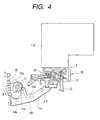
- Fig. 4 is a longitudinal sectional view showing a condition that the capping mechanism 30 (including a part of a driving mechanism) of the first embodiment is positioned at the capping position (closed position)
- Fig. 5 is a longitudinal sectional view showing a condition that the cap 3 adhered to the recording head 110 is peeled while lowering the cap base from the capping position
- Fig. 6 is a longitudinal sectional view showing a condition that the capping mechanism 30 of the first embodiment is positioned at the retard position spaced apart from the recording head 110.
- the capping mechanism serves to protect the recording means (recording head) for effecting the recording by discharging the ink toward the recording medium and includes the cap 3 movable in directions along which the cap can be contacted with and separated from the discharge port face of the recording means 110, cam means (main cam 11) for controlling the position of the cap, shifting means (cap lever 14) for shifting the cap in the above-mentioned directions, and biasing means (return spring 20) for biasing the cap to be separated from the discharge port face, and in which the cam means includes first and second cams 11a, 11b and the shifting means includes first and second engagement portions 14a, 14b so that the first cam is normally engaged with the first engagement portion, and, when the first cam is disengaged from the first engagement portion, the second cam is engaged with the second engagement portion.
- the capping condition can be maintained by the optimum urging force with the equalization properties (uniform contacting ability around the cap), as the equalization operation (uniform contacting around the cap)is performed.
- the cap lever (shifting means) 14 is rotated by the return spring (biasing means) 20 in a direction shown by the arrow C around the support shaft 14e in a condition that the first cam 11a is engaged by the first engagement portion 14a, thereby lowering the cap base 31 downwardly to be spaced apart from the recording head 110.
- the cap 3 may be adhered to the recording head 110, with the result that the cap 3 may not be peeled from the recording head 110 only by the force of the return spring (biasing means) 20.
- the cap lever 14 as the shifting means is further rotated by the return spring (biasing means) 20 in a clockwise direction (direction C in Fig. 5) around the support shaft 14e in the condition that the first cam 11a is engaged by the first engagement portion 14a, thereby lowering the cap base 31 to the lowermost position thereby to bring the cap 3 to the retard position spaced apart from the recording head 110.
- the capping mechanism 30 shiftable to be engaged and disengaged with respect to the recording means 110 is biased toward the retard direction by the return spring 20 as the biasing means and the position of the cap 3 of forcibly regulated by the first cam 11a of the main cam (cam means) 11 and, if the engagement of the first cam is released due to adhesion between the cap 3 and the recording head 110 (normally, when only separated), the cap is peeled from the recording head by the second cam 11b, even if the cap is adhered to the recording means, the adhering condition can be released without the aid of the force of the return spring (biasing means).
- a capping mechanism in which the opening/closing error of the cap due to the adhesion between the recording means 110 and the cap 3 can be eliminated thereby achieving the correct opening/closing operation of the cap, and further, since the setting force of the return spring as the biasing means is not required to be increased, increase in load torque and increase in deformation/wear of the parts can be avoided, and an ink jet recording apparatus using such a capping mechanism. Further, there can be provided a capping mechanism having fewer number of parts and easy and cheap construction and achieving the above-mentioned effect.
- Figs. 7 to 9 show a capping mechanism according to a second embodiment of the present invention.
- Fig. 7 is a longitudinal sectional view showing a condition that a capping mechanism 30 (including a part of a driving mechanism) of the second embodiment is positioned in a capping position (closing position)
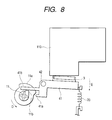
- Fig. 8 is a longitudinal sectional view showing a condition that a cap 3 adhered to a recording head 110 is peeled while lowering a cap base from the capping position
- Fig. 9 is a longitudinal sectional view showing a condition that the cap 3 of the capping mechanism 30 of the second embodiment is positioned at a retard position spaced apart from the recording head 110.
- the capping mechanism according to the second embodiment shown in Figs. 7 to 9 serves to protect the recording means (recording head) for effecting the recording by discharging the ink toward the recording medium and includes a cap 3 movable in directions along which the cap can be contacted with and separated from a discharge port face of a recording means 110, cam means (main cam 11) for controlling the position of the cap, and biasing means (return spring 20) for biasing the cap to be separated from the discharge port face, and in which the cam means includes first and second cams 43a, 43b and a cap holding member (cap holder) 41 includes first and second engagement portions 41a, 41b so that the first cam is normally engaged with the first engagement portion, and, when the first cam is disengaged from the first engagement portion (for example, when only disengaged), the second cam is engaged with the second engagement portion.
- the cap 3 of Fig. 7 In the condition that the cap 3 of Fig. 7 is in the closed position (capping position), the first engagement portion 41a of the cap holding member 41 is engaged by the first cam 43a of the main cam 11, with the result that the cap holding member 41 rockably (rotatably) supported by the support shaft 42 is forcibly displaced in an anti-clockwise direction in opposition to the return spring 20 as biasing means, thereby displacing the cap 3 to the capping position (uppermost position).
- the cap may be biased toward the recording head 110 by providing a biasing member (for example, a spring) between the cap holding member 41 and the cap 3.
- the cap holding member 41 is rotated by the return spring (biasing means) 20 in a direction shown by the arrow E around the support shaft 42 in a condition that the first cam 43a is engaged by the first engagement portion 41a, thereby lowering the cap 3 downwardly to be spaced apart from the recording head 110.
- the cap 3 may be adhered to the recording head 110, with the result that the cap 3 may not be peeled from the recording head 110 only by the force of the return spring 20.
- the cap 3 can positively be peeled from the recording head 110, thereby releasing the capping operation positively.
- the cap 3 is peeled, since the first cam 43a is engaged by the first engagement portion 41a again, the normal operation can be restored.
- the same effect as the first embodiment can be achieved. Namely, according to the second embodiment, since the rotatable (rockable) cap holding member 41 is biased by the return spring (biasing means) toward the retard direction spaced apart from the head 110 and the positions of the cap holding member 41 and the cap 3 are controlled by the main cam 11, the adhering condition of the cap 3 can be released without the aid of the force of the return spring (biasing means).
- a capping mechanism in which, if the cap 3 is adhered to the recording means 110, the adhering condition can be released without the aid of the force of the biasing means 20, and the opening/closing error of the cap due to the adhesion between the recording means 110 and the cap 3 can be eliminated thereby achieving the correct opening/closing operation of the cap, and further, since the setting force of the return spring as the biasing means is not required to be increased, increase in load torque and increase in deformation/wear of the parts can be avoided, and an ink jet recording apparatus using such a capping mechanism. Further, according to the second embodiment, there can be provided a capping mechanism having fewer number of parts than the first embodiment and easier and cheaper construction.
- the present invention can similarly be applied to a recording apparatus of line type (line type recording apparatus) in which recording is effected only by sub scanning by using recording means of line type having a length for covering the entire or part of width of the recording medium, thereby achieving the similar technical effect.
- the present invention can freely be carried out regardless of the number of the recording heads (recording means) and can similarly be applied to a recording apparatus using plural recording means, a gradation recording apparatus using plural recording means for effecting recording with same color and different densities or a recording apparatus having a combination thereof, as well as the recording apparatus having the single recording means, thereby achieving the similar technical effect.
- the present invention can be applied to any arrangement in which the recording means is integrally formed with an ink tank to provide an exchangeable ink jet cartridge or the recording means is formed independently from the ink tank and the recording means and the ink tank are interconnected via an ink supplying tube, thereby achieving the similar technical effect.
- the present invention can be applied to ink jet recording apparatuses using recording means utilizing an electrothermal converter such as a piezo-electric element, among them, the present invention gives excellent effect in an ink jet recording apparatus using recording means of type in which ink is discharged by utilizing thermal energy. According to such a system, high density and-highly fine recording can be achieved.
- the present invention provides a capping mechanism for protecting recording means for effecting recording by discharging ink toward a recording medium, comprising a cap movable in directions along which the cap can be contacted with and separated from a discharge port face of the recording means, cam means for controlling a position of the cap, shifting means for shifting the cap in said directions, and biasing means for biasing the cap to be separated from the discharge port face, and wherein the cam means includes first and second cams and the shifting means includes first and second engagement portions so that the first cam is normally engaged with the first engagement portion, and, when the first cam is disengaged from the first engagement portion, the second cam is engaged with the second engagement portion.
Landscapes
- Ink Jet (AREA)
- Accessory Devices And Overall Control Thereof (AREA)
- Printers Characterized By Their Purpose (AREA)
Applications Claiming Priority (2)
| Application Number | Priority Date | Filing Date | Title |
|---|---|---|---|
| JP2000332729 | 2000-10-31 | ||
| JP2000332729A JP2002137405A (ja) | 2000-10-31 | 2000-10-31 | キャッピング機構及び該機構を用いるインクジェット記録装置 |
Publications (3)
| Publication Number | Publication Date |
|---|---|
| EP1201436A2 true EP1201436A2 (de) | 2002-05-02 |
| EP1201436A3 EP1201436A3 (de) | 2003-01-08 |
| EP1201436B1 EP1201436B1 (de) | 2008-06-11 |
Family
ID=18808900
Family Applications (1)
| Application Number | Title | Priority Date | Filing Date |
|---|---|---|---|
| EP01125883A Expired - Lifetime EP1201436B1 (de) | 2000-10-31 | 2001-10-30 | Abdeckmechanismus undTintenstrahlaufzeichnungsgerät das diesen Abdeckmechanismus verwendet |
Country Status (7)
| Country | Link |
|---|---|
| US (1) | US6629749B2 (de) |
| EP (1) | EP1201436B1 (de) |
| JP (1) | JP2002137405A (de) |
| KR (1) | KR100401318B1 (de) |
| CN (1) | CN1165430C (de) |
| AT (1) | ATE398022T1 (de) |
| DE (1) | DE60134377D1 (de) |
Cited By (2)
| Publication number | Priority date | Publication date | Assignee | Title |
|---|---|---|---|---|
| EP1754607A3 (de) * | 2005-08-19 | 2007-11-07 | Samsung Electronics Co., Ltd. | Tintenstrahlbilderzeugungsgerät und Verfahren zur Wartung dessen Düsenanordnung |
| GB2505883A (en) * | 2012-09-12 | 2014-03-19 | Linx Printing Tech | Inkjet print head and cap |
Families Citing this family (17)
| Publication number | Priority date | Publication date | Assignee | Title |
|---|---|---|---|---|
| AUPS048502A0 (en) | 2002-02-13 | 2002-03-07 | Silverbrook Research Pty. Ltd. | Methods and systems (ap44) |
| AUPS048602A0 (en) * | 2002-02-13 | 2002-03-07 | Silverbrook Research Pty. Ltd. | Methods and systems (ap46) |
| JP2004042550A (ja) * | 2002-07-15 | 2004-02-12 | Canon Inc | インクジェット記録装置 |
| JP3958145B2 (ja) * | 2002-08-09 | 2007-08-15 | キヤノン株式会社 | インクジェット記録装置 |
| JP4154190B2 (ja) * | 2002-08-28 | 2008-09-24 | キヤノン株式会社 | インクジェット記録装置 |
| KR100532844B1 (ko) * | 2003-03-07 | 2005-12-05 | 삼성전자주식회사 | 잉크젯프린터의 서비스스테이션 |
| KR100544205B1 (ko) * | 2004-07-01 | 2006-01-23 | 삼성전자주식회사 | 이동가이드를 구비하는 잉크젯 프린터 |
| US7611222B2 (en) * | 2004-10-06 | 2009-11-03 | Hewlett-Packard Development Company, L.P. | Nozzle shield assembly |
| JP5127561B2 (ja) * | 2007-07-11 | 2013-01-23 | キヤノン株式会社 | インクジェット記録装置 |
| JP2009045900A (ja) * | 2007-08-22 | 2009-03-05 | Seiko Epson Corp | 液体噴射装置 |
| JP4379509B2 (ja) * | 2007-10-01 | 2009-12-09 | セイコーエプソン株式会社 | キャッピング治具 |
| JP5845605B2 (ja) * | 2011-03-29 | 2016-01-20 | セイコーエプソン株式会社 | 液体吐出ヘッドのキャップ、及び、液体吐出装置 |
| EP2755825B1 (de) * | 2011-09-13 | 2015-11-18 | Videojet Technologies Inc. | Abdeckvorrichtung |
| US8672445B2 (en) * | 2011-09-13 | 2014-03-18 | Videojet Technologies, Inc. | Capping device |
| CN107053850A (zh) * | 2015-09-28 | 2017-08-18 | 罗兰Dg有限公司 | 喷墨打印机 |
| JP7013160B2 (ja) * | 2017-07-28 | 2022-01-31 | キヤノン株式会社 | インクジェット記録装置 |
| JP7242236B2 (ja) * | 2018-03-22 | 2023-03-20 | キヤノン株式会社 | 液体吐出装置および回復装置 |
Citations (1)
| Publication number | Priority date | Publication date | Assignee | Title |
|---|---|---|---|---|
| JP2000103072A (ja) | 1998-09-29 | 2000-04-11 | Canon Inc | インクジェット記録装置用の回復装置 |
Family Cites Families (4)
| Publication number | Priority date | Publication date | Assignee | Title |
|---|---|---|---|---|
| JP2628195B2 (ja) | 1988-08-05 | 1997-07-09 | アルプス電気株式会社 | 記録装置 |
| US5663751A (en) | 1994-12-22 | 1997-09-02 | Pitney Bowes Inc. | Automatic service station for the printhead of an inkjet printer and method for cleaning the printhead |
| US6132027A (en) | 1996-07-30 | 2000-10-17 | Fuji Xerox Co., Ltd. | Ink-jet type image forming apparatus |
| WO1999061249A1 (fr) | 1998-05-28 | 1999-12-02 | Citizen Watch Co., Ltd. | Imprimante a jet d'encre equipee d'un systeme de maintenance |
-
2000
- 2000-10-31 JP JP2000332729A patent/JP2002137405A/ja active Pending
-
2001
- 2001-10-26 US US09/983,843 patent/US6629749B2/en not_active Expired - Fee Related
- 2001-10-30 AT AT01125883T patent/ATE398022T1/de not_active IP Right Cessation
- 2001-10-30 DE DE60134377T patent/DE60134377D1/de not_active Expired - Lifetime
- 2001-10-30 EP EP01125883A patent/EP1201436B1/de not_active Expired - Lifetime
- 2001-10-31 KR KR10-2001-0067298A patent/KR100401318B1/ko not_active Expired - Fee Related
- 2001-10-31 CN CNB01143323XA patent/CN1165430C/zh not_active Expired - Fee Related
Patent Citations (1)
| Publication number | Priority date | Publication date | Assignee | Title |
|---|---|---|---|---|
| JP2000103072A (ja) | 1998-09-29 | 2000-04-11 | Canon Inc | インクジェット記録装置用の回復装置 |
Cited By (8)
| Publication number | Priority date | Publication date | Assignee | Title |
|---|---|---|---|---|
| EP1754607A3 (de) * | 2005-08-19 | 2007-11-07 | Samsung Electronics Co., Ltd. | Tintenstrahlbilderzeugungsgerät und Verfahren zur Wartung dessen Düsenanordnung |
| US7527349B2 (en) | 2005-08-19 | 2009-05-05 | Samsung Electronics Co., Ltd | Inkjet image forming apparatus and method of maintaining nozzle unit thereof |
| GB2505883A (en) * | 2012-09-12 | 2014-03-19 | Linx Printing Tech | Inkjet print head and cap |
| GB2507876A (en) * | 2012-09-12 | 2014-05-14 | Linx Printing Tech | Ink jet print head and cap |
| GB2505883B (en) * | 2012-09-12 | 2014-10-08 | Linx Printing Tech | Ink jet print head and cap |
| GB2507876B (en) * | 2012-09-12 | 2014-10-08 | Linx Printing Tech | Ink jet print head and cap |
| US9333753B2 (en) | 2012-09-12 | 2016-05-10 | Linx Printing Technologies Ltd. | Ink jet print head and cap |
| US9517627B2 (en) | 2012-09-12 | 2016-12-13 | Linx Printing Technologies Ltd | Ink jet print head and cap |
Also Published As
| Publication number | Publication date |
|---|---|
| EP1201436B1 (de) | 2008-06-11 |
| EP1201436A3 (de) | 2003-01-08 |
| CN1165430C (zh) | 2004-09-08 |
| DE60134377D1 (de) | 2008-07-24 |
| JP2002137405A (ja) | 2002-05-14 |
| US6629749B2 (en) | 2003-10-07 |
| US20020080208A1 (en) | 2002-06-27 |
| CN1350925A (zh) | 2002-05-29 |
| KR100401318B1 (ko) | 2003-10-10 |
| ATE398022T1 (de) | 2008-07-15 |
| KR20020034927A (ko) | 2002-05-09 |
Similar Documents
| Publication | Publication Date | Title |
|---|---|---|
| US6629749B2 (en) | Capping mechanism and ink jet recording apparatus using such capping mechanism | |
| EP1369242B1 (de) | Farbstrahlaufzeichnungsgerät und Reinigungsteil | |
| EP0552030B1 (de) | Abdeckmechanismus für ein Tintenstrahlaufzeichnungsgerät | |
| US6523929B2 (en) | Image forming apparatus | |
| US7806506B2 (en) | Droplet ejecting device having cap that seals nozzles | |
| US7878622B2 (en) | Ink jet recording apparatus | |
| JP2001277528A (ja) | インクジェット記録装置 | |
| JP2004082578A (ja) | キャッピング機構及びインクジェット記録装置 | |
| US7753476B2 (en) | Image recording apparatus | |
| JP2916009B2 (ja) | インクジェット記録装置、インクジェット記録装置用回復処理装置、および液体移動装置 | |
| US6293669B1 (en) | Ink jet recording apparatus | |
| JP3245358B2 (ja) | 画像記録装置 | |
| JPH10202916A (ja) | インクジェット式記録装置 | |
| JPH06126947A (ja) | インクジェット記録装置 | |
| JPH09187954A (ja) | インクジェット記録装置 | |
| JP2004042446A (ja) | インクジェット記録装置 | |
| JP2002096457A (ja) | インクジェットプリンタ | |
| JP3025089B2 (ja) | インクジェット記録装置 | |
| JP3978995B2 (ja) | インクジェット記録装置 | |
| JPH07125357A (ja) | インクジェット記録装置 | |
| JP2024180093A (ja) | 液体吐出装置 | |
| JP3572929B2 (ja) | インクジェット式記録装置 | |
| JP2004082579A (ja) | 吐出回復装置及びインクジェット記録装置 | |
| JP3489419B2 (ja) | インクジェット式記録装置 | |
| JP2001191522A (ja) | インクジェットヘッド及びインクジェット記録装置 |
Legal Events
| Date | Code | Title | Description |
|---|---|---|---|
| PUAI | Public reference made under article 153(3) epc to a published international application that has entered the european phase |
Free format text: ORIGINAL CODE: 0009012 |
|
| AK | Designated contracting states |
Kind code of ref document: A2 Designated state(s): AT BE CH CY DE DK ES FI FR GB GR IE IT LI LU MC NL PT SE TR |
|
| AX | Request for extension of the european patent |
Free format text: AL;LT;LV;MK;RO;SI |
|
| PUAL | Search report despatched |
Free format text: ORIGINAL CODE: 0009013 |
|
| AK | Designated contracting states |
Kind code of ref document: A3 Designated state(s): AT BE CH CY DE DK ES FI FR GB GR IE IT LI LU MC NL PT SE TR |
|
| AX | Request for extension of the european patent |
Free format text: AL;LT;LV;MK;RO;SI |
|
| 17P | Request for examination filed |
Effective date: 20030521 |
|
| AKX | Designation fees paid |
Designated state(s): AT BE CH CY DE DK ES FI FR GB GR IE IT LI LU MC NL PT SE TR |
|
| 17Q | First examination report despatched |
Effective date: 20050830 |
|
| GRAP | Despatch of communication of intention to grant a patent |
Free format text: ORIGINAL CODE: EPIDOSNIGR1 |
|
| GRAS | Grant fee paid |
Free format text: ORIGINAL CODE: EPIDOSNIGR3 |
|
| GRAA | (expected) grant |
Free format text: ORIGINAL CODE: 0009210 |
|
| AK | Designated contracting states |
Kind code of ref document: B1 Designated state(s): AT BE CH CY DE DK ES FI FR GB GR IE IT LI LU MC NL PT SE TR |
|
| REG | Reference to a national code |
Ref country code: GB Ref legal event code: FG4D |
|
| REG | Reference to a national code |
Ref country code: CH Ref legal event code: EP |
|
| REF | Corresponds to: |
Ref document number: 60134377 Country of ref document: DE Date of ref document: 20080724 Kind code of ref document: P |
|
| REG | Reference to a national code |
Ref country code: IE Ref legal event code: FG4D |
|
| PG25 | Lapsed in a contracting state [announced via postgrant information from national office to epo] |
Ref country code: FI Free format text: LAPSE BECAUSE OF FAILURE TO SUBMIT A TRANSLATION OF THE DESCRIPTION OR TO PAY THE FEE WITHIN THE PRESCRIBED TIME-LIMIT Effective date: 20080611 |
|
| PG25 | Lapsed in a contracting state [announced via postgrant information from national office to epo] |
Ref country code: NL Free format text: LAPSE BECAUSE OF FAILURE TO SUBMIT A TRANSLATION OF THE DESCRIPTION OR TO PAY THE FEE WITHIN THE PRESCRIBED TIME-LIMIT Effective date: 20080611 Ref country code: AT Free format text: LAPSE BECAUSE OF FAILURE TO SUBMIT A TRANSLATION OF THE DESCRIPTION OR TO PAY THE FEE WITHIN THE PRESCRIBED TIME-LIMIT Effective date: 20080611 |
|
| NLV1 | Nl: lapsed or annulled due to failure to fulfill the requirements of art. 29p and 29m of the patents act | ||
| PG25 | Lapsed in a contracting state [announced via postgrant information from national office to epo] |
Ref country code: SE Free format text: LAPSE BECAUSE OF FAILURE TO SUBMIT A TRANSLATION OF THE DESCRIPTION OR TO PAY THE FEE WITHIN THE PRESCRIBED TIME-LIMIT Effective date: 20080911 Ref country code: ES Free format text: LAPSE BECAUSE OF FAILURE TO SUBMIT A TRANSLATION OF THE DESCRIPTION OR TO PAY THE FEE WITHIN THE PRESCRIBED TIME-LIMIT Effective date: 20080922 Ref country code: PT Free format text: LAPSE BECAUSE OF FAILURE TO SUBMIT A TRANSLATION OF THE DESCRIPTION OR TO PAY THE FEE WITHIN THE PRESCRIBED TIME-LIMIT Effective date: 20081111 |
|
| PG25 | Lapsed in a contracting state [announced via postgrant information from national office to epo] |
Ref country code: BE Free format text: LAPSE BECAUSE OF FAILURE TO SUBMIT A TRANSLATION OF THE DESCRIPTION OR TO PAY THE FEE WITHIN THE PRESCRIBED TIME-LIMIT Effective date: 20080611 |
|
| PLBE | No opposition filed within time limit |
Free format text: ORIGINAL CODE: 0009261 |
|
| STAA | Information on the status of an ep patent application or granted ep patent |
Free format text: STATUS: NO OPPOSITION FILED WITHIN TIME LIMIT |
|
| PG25 | Lapsed in a contracting state [announced via postgrant information from national office to epo] |
Ref country code: DK Free format text: LAPSE BECAUSE OF FAILURE TO SUBMIT A TRANSLATION OF THE DESCRIPTION OR TO PAY THE FEE WITHIN THE PRESCRIBED TIME-LIMIT Effective date: 20080611 |
|
| 26N | No opposition filed |
Effective date: 20090312 |
|
| PG25 | Lapsed in a contracting state [announced via postgrant information from national office to epo] |
Ref country code: MC Free format text: LAPSE BECAUSE OF NON-PAYMENT OF DUE FEES Effective date: 20081031 |
|
| REG | Reference to a national code |
Ref country code: CH Ref legal event code: PL |
|
| REG | Reference to a national code |
Ref country code: FR Ref legal event code: ST Effective date: 20090630 |
|
| PG25 | Lapsed in a contracting state [announced via postgrant information from national office to epo] |
Ref country code: IT Free format text: LAPSE BECAUSE OF FAILURE TO SUBMIT A TRANSLATION OF THE DESCRIPTION OR TO PAY THE FEE WITHIN THE PRESCRIBED TIME-LIMIT Effective date: 20080611 |
|
| PG25 | Lapsed in a contracting state [announced via postgrant information from national office to epo] |
Ref country code: LI Free format text: LAPSE BECAUSE OF NON-PAYMENT OF DUE FEES Effective date: 20081031 Ref country code: CH Free format text: LAPSE BECAUSE OF NON-PAYMENT OF DUE FEES Effective date: 20081031 Ref country code: IE Free format text: LAPSE BECAUSE OF NON-PAYMENT OF DUE FEES Effective date: 20081030 Ref country code: FR Free format text: LAPSE BECAUSE OF NON-PAYMENT OF DUE FEES Effective date: 20081031 |
|
| PG25 | Lapsed in a contracting state [announced via postgrant information from national office to epo] |
Ref country code: CY Free format text: LAPSE BECAUSE OF FAILURE TO SUBMIT A TRANSLATION OF THE DESCRIPTION OR TO PAY THE FEE WITHIN THE PRESCRIBED TIME-LIMIT Effective date: 20080611 Ref country code: LU Free format text: LAPSE BECAUSE OF NON-PAYMENT OF DUE FEES Effective date: 20081030 |
|
| PG25 | Lapsed in a contracting state [announced via postgrant information from national office to epo] |
Ref country code: TR Free format text: LAPSE BECAUSE OF FAILURE TO SUBMIT A TRANSLATION OF THE DESCRIPTION OR TO PAY THE FEE WITHIN THE PRESCRIBED TIME-LIMIT Effective date: 20080611 |
|
| PG25 | Lapsed in a contracting state [announced via postgrant information from national office to epo] |
Ref country code: GR Free format text: LAPSE BECAUSE OF FAILURE TO SUBMIT A TRANSLATION OF THE DESCRIPTION OR TO PAY THE FEE WITHIN THE PRESCRIBED TIME-LIMIT Effective date: 20080912 |
|
| PGFP | Annual fee paid to national office [announced via postgrant information from national office to epo] |
Ref country code: DE Payment date: 20141031 Year of fee payment: 14 Ref country code: GB Payment date: 20141021 Year of fee payment: 14 |
|
| REG | Reference to a national code |
Ref country code: DE Ref legal event code: R119 Ref document number: 60134377 Country of ref document: DE |
|
| GBPC | Gb: european patent ceased through non-payment of renewal fee |
Effective date: 20151030 |
|
| PG25 | Lapsed in a contracting state [announced via postgrant information from national office to epo] |
Ref country code: GB Free format text: LAPSE BECAUSE OF NON-PAYMENT OF DUE FEES Effective date: 20151030 Ref country code: DE Free format text: LAPSE BECAUSE OF NON-PAYMENT OF DUE FEES Effective date: 20160503 |