EP1201629A1 - Procédé de conversion endothermique d'hydrocarbures, ses utilisations et installation pour la mise en oeuvre de ce procédé - Google Patents
Procédé de conversion endothermique d'hydrocarbures, ses utilisations et installation pour la mise en oeuvre de ce procédé Download PDFInfo
- Publication number
- EP1201629A1 EP1201629A1 EP01402568A EP01402568A EP1201629A1 EP 1201629 A1 EP1201629 A1 EP 1201629A1 EP 01402568 A EP01402568 A EP 01402568A EP 01402568 A EP01402568 A EP 01402568A EP 1201629 A1 EP1201629 A1 EP 1201629A1
- Authority
- EP
- European Patent Office
- Prior art keywords
- exchanger
- current
- hydrocarbons
- fluid
- thermal fluid
- Prior art date
- Legal status (The legal status is an assumption and is not a legal conclusion. Google has not performed a legal analysis and makes no representation as to the accuracy of the status listed.)
- Granted
Links
- 238000006243 chemical reaction Methods 0.000 title claims abstract description 53
- 238000000034 method Methods 0.000 title claims abstract description 43
- 229930195733 hydrocarbon Natural products 0.000 title claims abstract description 32
- 150000002430 hydrocarbons Chemical class 0.000 title claims abstract description 32
- 238000009434 installation Methods 0.000 title claims abstract description 13
- 239000012530 fluid Substances 0.000 claims abstract description 58
- 230000003197 catalytic effect Effects 0.000 claims abstract description 30
- 238000004939 coking Methods 0.000 claims abstract description 14
- 238000010438 heat treatment Methods 0.000 claims abstract description 12
- 238000003303 reheating Methods 0.000 claims abstract description 12
- 239000004215 Carbon black (E152) Substances 0.000 claims abstract description 9
- 230000035945 sensitivity Effects 0.000 claims abstract description 4
- 239000011949 solid catalyst Substances 0.000 claims abstract description 4
- UHOVQNZJYSORNB-UHFFFAOYSA-N Benzene Chemical compound C1=CC=CC=C1 UHOVQNZJYSORNB-UHFFFAOYSA-N 0.000 claims description 43
- 239000003054 catalyst Substances 0.000 claims description 19
- 238000006356 dehydrogenation reaction Methods 0.000 claims description 19
- 239000007789 gas Substances 0.000 claims description 17
- 239000001257 hydrogen Substances 0.000 claims description 16
- 229910052739 hydrogen Inorganic materials 0.000 claims description 16
- UFHFLCQGNIYNRP-UHFFFAOYSA-N Hydrogen Chemical compound [H][H] UFHFLCQGNIYNRP-UHFFFAOYSA-N 0.000 claims description 13
- 150000001875 compounds Chemical class 0.000 claims description 13
- XLYOFNOQVPJJNP-UHFFFAOYSA-N water Chemical compound O XLYOFNOQVPJJNP-UHFFFAOYSA-N 0.000 claims description 13
- 238000005804 alkylation reaction Methods 0.000 claims description 12
- 230000029936 alkylation Effects 0.000 claims description 11
- 238000004821 distillation Methods 0.000 claims description 8
- 238000004064 recycling Methods 0.000 claims description 8
- 150000004996 alkyl benzenes Chemical class 0.000 claims description 7
- ATUOYWHBWRKTHZ-UHFFFAOYSA-N Propane Chemical compound CCC ATUOYWHBWRKTHZ-UHFFFAOYSA-N 0.000 claims description 6
- 125000004432 carbon atom Chemical group C* 0.000 claims description 6
- 238000005194 fractionation Methods 0.000 claims description 5
- 239000007788 liquid Substances 0.000 claims description 5
- 238000011144 upstream manufacturing Methods 0.000 claims description 5
- YNQLUTRBYVCPMQ-UHFFFAOYSA-N Ethylbenzene Chemical compound CCC1=CC=CC=C1 YNQLUTRBYVCPMQ-UHFFFAOYSA-N 0.000 claims description 4
- 150000001336 alkenes Chemical class 0.000 claims description 4
- 238000009833 condensation Methods 0.000 claims description 4
- 230000005494 condensation Effects 0.000 claims description 4
- NNPPMTNAJDCUHE-UHFFFAOYSA-N isobutane Chemical compound CC(C)C NNPPMTNAJDCUHE-UHFFFAOYSA-N 0.000 claims description 4
- 150000002431 hydrogen Chemical class 0.000 claims description 3
- 229910052751 metal Inorganic materials 0.000 claims description 3
- 239000002184 metal Substances 0.000 claims description 3
- 150000002739 metals Chemical class 0.000 claims description 3
- 239000000203 mixture Substances 0.000 claims description 3
- 239000012188 paraffin wax Substances 0.000 claims description 3
- 239000001294 propane Substances 0.000 claims description 3
- 150000003839 salts Chemical class 0.000 claims description 3
- OTMSDBZUPAUEDD-UHFFFAOYSA-N Ethane Chemical compound CC OTMSDBZUPAUEDD-UHFFFAOYSA-N 0.000 claims description 2
- 239000001282 iso-butane Substances 0.000 claims description 2
- 238000011084 recovery Methods 0.000 claims description 2
- 238000002407 reforming Methods 0.000 claims description 2
- IJDNQMDRQITEOD-UHFFFAOYSA-N sec-butylidene Natural products CCCC IJDNQMDRQITEOD-UHFFFAOYSA-N 0.000 claims description 2
- 238000000926 separation method Methods 0.000 claims description 2
- 229910001220 stainless steel Inorganic materials 0.000 claims description 2
- 239000010935 stainless steel Substances 0.000 claims description 2
- OKTJSMMVPCPJKN-UHFFFAOYSA-N Carbon Chemical compound [C] OKTJSMMVPCPJKN-UHFFFAOYSA-N 0.000 claims 1
- 125000004429 atom Chemical group 0.000 claims 1
- 229910052799 carbon Inorganic materials 0.000 claims 1
- 230000000694 effects Effects 0.000 claims 1
- 238000004519 manufacturing process Methods 0.000 description 12
- 230000005855 radiation Effects 0.000 description 7
- 239000000543 intermediate Substances 0.000 description 6
- 239000000571 coke Substances 0.000 description 4
- 239000003153 chemical reaction reagent Substances 0.000 description 3
- 239000007787 solid Substances 0.000 description 3
- 239000000126 substance Substances 0.000 description 3
- 239000000567 combustion gas Substances 0.000 description 2
- 150000001993 dienes Chemical class 0.000 description 2
- 238000005984 hydrogenation reaction Methods 0.000 description 2
- BASFCYQUMIYNBI-UHFFFAOYSA-N platinum Chemical compound [Pt] BASFCYQUMIYNBI-UHFFFAOYSA-N 0.000 description 2
- ATJFFYVFTNAWJD-UHFFFAOYSA-N Tin Chemical compound [Sn] ATJFFYVFTNAWJD-UHFFFAOYSA-N 0.000 description 1
- PNEYBMLMFCGWSK-UHFFFAOYSA-N aluminium oxide Inorganic materials [O-2].[O-2].[O-2].[Al+3].[Al+3] PNEYBMLMFCGWSK-UHFFFAOYSA-N 0.000 description 1
- 150000001491 aromatic compounds Chemical class 0.000 description 1
- 239000011324 bead Substances 0.000 description 1
- 210000004899 c-terminal region Anatomy 0.000 description 1
- 230000015556 catabolic process Effects 0.000 description 1
- 238000001833 catalytic reforming Methods 0.000 description 1
- 238000001816 cooling Methods 0.000 description 1
- 238000005336 cracking Methods 0.000 description 1
- 230000009849 deactivation Effects 0.000 description 1
- 238000005235 decoking Methods 0.000 description 1
- 238000006731 degradation reaction Methods 0.000 description 1
- 239000003599 detergent Substances 0.000 description 1
- 238000010586 diagram Methods 0.000 description 1
- 230000004907 flux Effects 0.000 description 1
- 239000013529 heat transfer fluid Substances 0.000 description 1
- 230000010354 integration Effects 0.000 description 1
- TVMXDCGIABBOFY-UHFFFAOYSA-N octane Chemical compound CCCCCCCC TVMXDCGIABBOFY-UHFFFAOYSA-N 0.000 description 1
- 239000002245 particle Substances 0.000 description 1
- 239000003208 petroleum Substances 0.000 description 1
- 229910052697 platinum Inorganic materials 0.000 description 1
- QQONPFPTGQHPMA-UHFFFAOYSA-N propylene Natural products CC=C QQONPFPTGQHPMA-UHFFFAOYSA-N 0.000 description 1
- 125000004805 propylene group Chemical group [H]C([H])([H])C([H])([*:1])C([H])([H])[*:2] 0.000 description 1
- 239000002994 raw material Substances 0.000 description 1
- 238000006057 reforming reaction Methods 0.000 description 1
- 238000004227 thermal cracking Methods 0.000 description 1
Images

Classifications
-
- C—CHEMISTRY; METALLURGY
- C10—PETROLEUM, GAS OR COKE INDUSTRIES; TECHNICAL GASES CONTAINING CARBON MONOXIDE; FUELS; LUBRICANTS; PEAT
- C10G—CRACKING HYDROCARBON OILS; PRODUCTION OF LIQUID HYDROCARBON MIXTURES, e.g. BY DESTRUCTIVE HYDROGENATION, OLIGOMERISATION, POLYMERISATION; RECOVERY OF HYDROCARBON OILS FROM OIL-SHALE, OIL-SAND, OR GASES; REFINING MIXTURES MAINLY CONSISTING OF HYDROCARBONS; REFORMING OF NAPHTHA; MINERAL WAXES
- C10G35/00—Reforming naphtha
-
- C—CHEMISTRY; METALLURGY
- C10—PETROLEUM, GAS OR COKE INDUSTRIES; TECHNICAL GASES CONTAINING CARBON MONOXIDE; FUELS; LUBRICANTS; PEAT
- C10G—CRACKING HYDROCARBON OILS; PRODUCTION OF LIQUID HYDROCARBON MIXTURES, e.g. BY DESTRUCTIVE HYDROGENATION, OLIGOMERISATION, POLYMERISATION; RECOVERY OF HYDROCARBON OILS FROM OIL-SHALE, OIL-SAND, OR GASES; REFINING MIXTURES MAINLY CONSISTING OF HYDROCARBONS; REFORMING OF NAPHTHA; MINERAL WAXES
- C10G31/00—Refining of hydrocarbon oils, in the absence of hydrogen, by methods not otherwise provided for
- C10G31/06—Refining of hydrocarbon oils, in the absence of hydrogen, by methods not otherwise provided for by heating, cooling, or pressure treatment
-
- C—CHEMISTRY; METALLURGY
- C07—ORGANIC CHEMISTRY
- C07C—ACYCLIC OR CARBOCYCLIC COMPOUNDS
- C07C15/00—Cyclic hydrocarbons containing only six-membered aromatic rings as cyclic parts
- C07C15/02—Monocyclic hydrocarbons
- C07C15/107—Monocyclic hydrocarbons having saturated side-chain containing at least six carbon atoms, e.g. detergent alkylates
-
- C—CHEMISTRY; METALLURGY
- C07—ORGANIC CHEMISTRY
- C07C—ACYCLIC OR CARBOCYCLIC COMPOUNDS
- C07C5/00—Preparation of hydrocarbons from hydrocarbons containing the same number of carbon atoms
- C07C5/32—Preparation of hydrocarbons from hydrocarbons containing the same number of carbon atoms by dehydrogenation with formation of free hydrogen
-
- C—CHEMISTRY; METALLURGY
- C07—ORGANIC CHEMISTRY
- C07C—ACYCLIC OR CARBOCYCLIC COMPOUNDS
- C07C5/00—Preparation of hydrocarbons from hydrocarbons containing the same number of carbon atoms
- C07C5/32—Preparation of hydrocarbons from hydrocarbons containing the same number of carbon atoms by dehydrogenation with formation of free hydrogen
- C07C5/327—Formation of non-aromatic carbon-to-carbon double bonds only
- C07C5/333—Catalytic processes
- C07C5/3335—Catalytic processes with metals
- C07C5/3337—Catalytic processes with metals of the platinum group
-
- B—PERFORMING OPERATIONS; TRANSPORTING
- B01—PHYSICAL OR CHEMICAL PROCESSES OR APPARATUS IN GENERAL
- B01J—CHEMICAL OR PHYSICAL PROCESSES, e.g. CATALYSIS OR COLLOID CHEMISTRY; THEIR RELEVANT APPARATUS
- B01J2219/00—Chemical, physical or physico-chemical processes in general; Their relevant apparatus
- B01J2219/00002—Chemical plants
- B01J2219/00004—Scale aspects
- B01J2219/00006—Large-scale industrial plants
-
- C—CHEMISTRY; METALLURGY
- C10—PETROLEUM, GAS OR COKE INDUSTRIES; TECHNICAL GASES CONTAINING CARBON MONOXIDE; FUELS; LUBRICANTS; PEAT
- C10G—CRACKING HYDROCARBON OILS; PRODUCTION OF LIQUID HYDROCARBON MIXTURES, e.g. BY DESTRUCTIVE HYDROGENATION, OLIGOMERISATION, POLYMERISATION; RECOVERY OF HYDROCARBON OILS FROM OIL-SHALE, OIL-SAND, OR GASES; REFINING MIXTURES MAINLY CONSISTING OF HYDROCARBONS; REFORMING OF NAPHTHA; MINERAL WAXES
- C10G2300/00—Aspects relating to hydrocarbon processing covered by groups C10G1/00 - C10G99/00
- C10G2300/10—Feedstock materials
- C10G2300/1081—Alkanes
-
- C—CHEMISTRY; METALLURGY
- C10—PETROLEUM, GAS OR COKE INDUSTRIES; TECHNICAL GASES CONTAINING CARBON MONOXIDE; FUELS; LUBRICANTS; PEAT
- C10G—CRACKING HYDROCARBON OILS; PRODUCTION OF LIQUID HYDROCARBON MIXTURES, e.g. BY DESTRUCTIVE HYDROGENATION, OLIGOMERISATION, POLYMERISATION; RECOVERY OF HYDROCARBON OILS FROM OIL-SHALE, OIL-SAND, OR GASES; REFINING MIXTURES MAINLY CONSISTING OF HYDROCARBONS; REFORMING OF NAPHTHA; MINERAL WAXES
- C10G2300/00—Aspects relating to hydrocarbon processing covered by groups C10G1/00 - C10G99/00
- C10G2300/10—Feedstock materials
- C10G2300/1088—Olefins
-
- C—CHEMISTRY; METALLURGY
- C10—PETROLEUM, GAS OR COKE INDUSTRIES; TECHNICAL GASES CONTAINING CARBON MONOXIDE; FUELS; LUBRICANTS; PEAT
- C10G—CRACKING HYDROCARBON OILS; PRODUCTION OF LIQUID HYDROCARBON MIXTURES, e.g. BY DESTRUCTIVE HYDROGENATION, OLIGOMERISATION, POLYMERISATION; RECOVERY OF HYDROCARBON OILS FROM OIL-SHALE, OIL-SAND, OR GASES; REFINING MIXTURES MAINLY CONSISTING OF HYDROCARBONS; REFORMING OF NAPHTHA; MINERAL WAXES
- C10G2300/00—Aspects relating to hydrocarbon processing covered by groups C10G1/00 - C10G99/00
- C10G2300/10—Feedstock materials
- C10G2300/1096—Aromatics or polyaromatics
-
- C—CHEMISTRY; METALLURGY
- C10—PETROLEUM, GAS OR COKE INDUSTRIES; TECHNICAL GASES CONTAINING CARBON MONOXIDE; FUELS; LUBRICANTS; PEAT
- C10G—CRACKING HYDROCARBON OILS; PRODUCTION OF LIQUID HYDROCARBON MIXTURES, e.g. BY DESTRUCTIVE HYDROGENATION, OLIGOMERISATION, POLYMERISATION; RECOVERY OF HYDROCARBON OILS FROM OIL-SHALE, OIL-SAND, OR GASES; REFINING MIXTURES MAINLY CONSISTING OF HYDROCARBONS; REFORMING OF NAPHTHA; MINERAL WAXES
- C10G2300/00—Aspects relating to hydrocarbon processing covered by groups C10G1/00 - C10G99/00
- C10G2300/40—Characteristics of the process deviating from typical ways of processing
- C10G2300/4006—Temperature
-
- C—CHEMISTRY; METALLURGY
- C10—PETROLEUM, GAS OR COKE INDUSTRIES; TECHNICAL GASES CONTAINING CARBON MONOXIDE; FUELS; LUBRICANTS; PEAT
- C10G—CRACKING HYDROCARBON OILS; PRODUCTION OF LIQUID HYDROCARBON MIXTURES, e.g. BY DESTRUCTIVE HYDROGENATION, OLIGOMERISATION, POLYMERISATION; RECOVERY OF HYDROCARBON OILS FROM OIL-SHALE, OIL-SAND, OR GASES; REFINING MIXTURES MAINLY CONSISTING OF HYDROCARBONS; REFORMING OF NAPHTHA; MINERAL WAXES
- C10G2300/00—Aspects relating to hydrocarbon processing covered by groups C10G1/00 - C10G99/00
- C10G2300/40—Characteristics of the process deviating from typical ways of processing
- C10G2300/4081—Recycling aspects
-
- C—CHEMISTRY; METALLURGY
- C10—PETROLEUM, GAS OR COKE INDUSTRIES; TECHNICAL GASES CONTAINING CARBON MONOXIDE; FUELS; LUBRICANTS; PEAT
- C10G—CRACKING HYDROCARBON OILS; PRODUCTION OF LIQUID HYDROCARBON MIXTURES, e.g. BY DESTRUCTIVE HYDROGENATION, OLIGOMERISATION, POLYMERISATION; RECOVERY OF HYDROCARBON OILS FROM OIL-SHALE, OIL-SAND, OR GASES; REFINING MIXTURES MAINLY CONSISTING OF HYDROCARBONS; REFORMING OF NAPHTHA; MINERAL WAXES
- C10G2300/00—Aspects relating to hydrocarbon processing covered by groups C10G1/00 - C10G99/00
- C10G2300/80—Additives
- C10G2300/805—Water
- C10G2300/807—Steam
-
- C—CHEMISTRY; METALLURGY
- C10—PETROLEUM, GAS OR COKE INDUSTRIES; TECHNICAL GASES CONTAINING CARBON MONOXIDE; FUELS; LUBRICANTS; PEAT
- C10G—CRACKING HYDROCARBON OILS; PRODUCTION OF LIQUID HYDROCARBON MIXTURES, e.g. BY DESTRUCTIVE HYDROGENATION, OLIGOMERISATION, POLYMERISATION; RECOVERY OF HYDROCARBON OILS FROM OIL-SHALE, OIL-SAND, OR GASES; REFINING MIXTURES MAINLY CONSISTING OF HYDROCARBONS; REFORMING OF NAPHTHA; MINERAL WAXES
- C10G2400/00—Products obtained by processes covered by groups C10G9/00 - C10G69/14
- C10G2400/30—Aromatics
-
- Y—GENERAL TAGGING OF NEW TECHNOLOGICAL DEVELOPMENTS; GENERAL TAGGING OF CROSS-SECTIONAL TECHNOLOGIES SPANNING OVER SEVERAL SECTIONS OF THE IPC; TECHNICAL SUBJECTS COVERED BY FORMER USPC CROSS-REFERENCE ART COLLECTIONS [XRACs] AND DIGESTS
- Y02—TECHNOLOGIES OR APPLICATIONS FOR MITIGATION OR ADAPTATION AGAINST CLIMATE CHANGE
- Y02P—CLIMATE CHANGE MITIGATION TECHNOLOGIES IN THE PRODUCTION OR PROCESSING OF GOODS
- Y02P20/00—Technologies relating to chemical industry
- Y02P20/10—Process efficiency
-
- Y—GENERAL TAGGING OF NEW TECHNOLOGICAL DEVELOPMENTS; GENERAL TAGGING OF CROSS-SECTIONAL TECHNOLOGIES SPANNING OVER SEVERAL SECTIONS OF THE IPC; TECHNICAL SUBJECTS COVERED BY FORMER USPC CROSS-REFERENCE ART COLLECTIONS [XRACs] AND DIGESTS
- Y02—TECHNOLOGIES OR APPLICATIONS FOR MITIGATION OR ADAPTATION AGAINST CLIMATE CHANGE
- Y02P—CLIMATE CHANGE MITIGATION TECHNOLOGIES IN THE PRODUCTION OR PROCESSING OF GOODS
- Y02P20/00—Technologies relating to chemical industry
- Y02P20/10—Process efficiency
- Y02P20/129—Energy recovery, e.g. by cogeneration, H2recovery or pressure recovery turbines
-
- Y—GENERAL TAGGING OF NEW TECHNOLOGICAL DEVELOPMENTS; GENERAL TAGGING OF CROSS-SECTIONAL TECHNOLOGIES SPANNING OVER SEVERAL SECTIONS OF THE IPC; TECHNICAL SUBJECTS COVERED BY FORMER USPC CROSS-REFERENCE ART COLLECTIONS [XRACs] AND DIGESTS
- Y10—TECHNICAL SUBJECTS COVERED BY FORMER USPC
- Y10S—TECHNICAL SUBJECTS COVERED BY FORMER USPC CROSS-REFERENCE ART COLLECTIONS [XRACs] AND DIGESTS
- Y10S585/00—Chemistry of hydrocarbon compounds
- Y10S585/909—Heat considerations
- Y10S585/911—Heat considerations introducing, maintaining, or removing heat by atypical procedure
-
- Y—GENERAL TAGGING OF NEW TECHNOLOGICAL DEVELOPMENTS; GENERAL TAGGING OF CROSS-SECTIONAL TECHNOLOGIES SPANNING OVER SEVERAL SECTIONS OF THE IPC; TECHNICAL SUBJECTS COVERED BY FORMER USPC CROSS-REFERENCE ART COLLECTIONS [XRACs] AND DIGESTS
- Y10—TECHNICAL SUBJECTS COVERED BY FORMER USPC
- Y10S—TECHNICAL SUBJECTS COVERED BY FORMER USPC CROSS-REFERENCE ART COLLECTIONS [XRACs] AND DIGESTS
- Y10S585/00—Chemistry of hydrocarbon compounds
- Y10S585/909—Heat considerations
- Y10S585/911—Heat considerations introducing, maintaining, or removing heat by atypical procedure
- Y10S585/912—Molten material
Definitions
- the cooling generated by endothermic reactions is such that it it is not possible to carry out the chemical reaction in a single reactor. It is notably the case for the catalytic reforming of hydrocarbons, or for the production of gasoline with high octane number.
- the charge typically a naphtha, added with hydrogen, passes successively several catalytic beds, with reheating between each of the beds in order to compensate for the drop in temperature in said catalytic beds, due to the endothermicity of the reaction.
- a naphtha added with hydrogen
- the charge passes successively several catalytic beds, with reheating between each of the beds in order to compensate for the drop in temperature in said catalytic beds, due to the endothermicity of the reaction.
- several reactors are used, each containing at least one bed of catalyst. solid or equivalent catalytic zones with catalyst deposited on at least one part of the solid surfaces of said zones.
- the reheating of the load is carried out in tubular radiation ovens, where the charge circulates in heated coils in the radiation zone supplied by burners.
- these conversion processes produce unsaturated compounds which are coke promoters and participate in particular in catalytic coking.
- This catalytic coking takes place in particular in tube furnaces; in fact, the charge which typically circulates in these ovens at temperatures of approximately 500 or 600 ° C. is subjected to the radiation of the burners, the combustion gases of which typically have a temperature of between 1100 and 1600 ° C. and transmit high thermal fluxes, for example of the order of 50 KW / m 2 or more.
- This second type of reactor and conversion process therefore has drawbacks in terms of the use of the catalyst.
- the object of the invention is a process and an installation for converting hydrocarbons by endothermic reactions, suppressing or significantly limiting the phenomena catalytic coking, including in the case of coke promoter reagents, and not having no problems using the catalyst, especially not causing dots hot at the level of the catalyst.
- Another object of the invention is a process for converting hydrocarbons by reactions endothermic, with integration and high energy efficiency.
- a particularly important object of the invention is a dehydrogenation process high conversion rate hydrocarbons for the production of olefins.
- a use significant olefinic charge formed relates to the alkylation of aromatic compounds and in particular the production of alkylbenzenes (very often used as raw material for the manufacture of detergent bases).
- the process of the present invention can be defined as a conversion process of hydrocarbons by at least one globally endothermic chemical reaction, in which a hydrocarbon feedstock successively crosses at least two zones each containing at least one solid catalyst and comprising between said reaction zones intermediate heating, in a non-catalytic zone, current (ST) from the first of the two reaction zones before its introduction in said second reaction zone and in which this reheating is carried out in a heat exchanger, with heat transfer essentially by convection by means a thermal fluid TF with a coking sensitivity index CS lower than that of the current ST, the temperature difference ⁇ T between the temperature of the fluid TF at the inlet of the exchanger and the ST current temperature at the outlet of the heat exchanger being less than about 250 ° C, preferably less than 200 ° C.
- the partially converted charge current from, for example, the first catalytic bed reactor is heated mainly by convection and not mainly by radiation, that is to say with much less thermal means severe than in a radiation reheating oven;
- the temperature difference ⁇ T between the hot thermal fluid TF at the inlet of the exchanger, and the current ST at the outlet of the heat exchanger is less than about 250 ° C, preferably less than 200 ° C, and often between 10 and 150 ° C limits included, and preferably between 10 and 120 ° C terminals included.
- This temperature difference between the fluids is much more moderate than in an oven where the combustion gases are typically at temperatures above 1100 ° C., therefore usually more than 500 ° C higher than the temperature of the process stream ST implemented and heated in the oven.
- the risks of coking and degradation are considerably limited reagents. Furthermore, this "gentle" heating of the reagents is carried out on the fluid alone in leaving a reaction zone, in the absence of catalyst. This avoids all the risks of hot spots at the level of the catalyst, encountered in the reactor-exchangers catalyst.
- a TF thermal fluid is usually chosen relatively little coke promoter, which can therefore easily be heated in an oven. So we transfer relatively brutal heating on the thermal fluid and no longer on the load reaction.
- CS is equal to 10.
- fluids will most often be used non-coking thermal as for example one of the fluids chosen from the group formed by water vapor, molten salts, molten metals, whose CS index is zero or one mixture of at least two of these fluids.
- the thermal fluid TF is often a chosen fluid in the group of gaseous thermal fluids allowing heat transfer only by sensible heat.
- This vapor usually typically at a higher temperature at around 400 ° C at the inlet and outlet of the heat exchanger is used as a gaseous fluid carrying sensible heat and not latent heat. His pressure will usually from about 0.1 to about 15 MPa.
- a gas stream rich in hydrogen a gas stream of recycling most often rich in hydrogen and including limited quantities of light hydrocarbons, possibly after hydrogenation of the unsaturated compounds which it contains for example by catalytic means.
- a gas stream of recycling most often rich in hydrogen and including limited quantities of light hydrocarbons, possibly after hydrogenation of the unsaturated compounds which it contains for example by catalytic means.
- thermal fluid TF with index CS less than or equal to 100, often with a CS index less than or equal to 50 and preferably with a CS index less than or equal to 10.
- the TF thermal fluid is often an inorganic liquid stream chosen from the group formed by molten metals and molten salts.
- the temperature difference ⁇ T is between 10 ° C and 150 ° C including terminals, from preferably between 10 ° C and 120 ° C limits included.
- the thermal fluid TF is a stream of water vapor under higher pressure or equal to approximately 0.7 MPa absolute, at least part of said current TF at the output of the heat exchanger being expanded in a turbine to obtain recovery of power, especially electrical power.
- said turbine drives a compressor for recycling hydrogen-rich gas, this gas being added to hydrocarbons to carry out the chemical reaction under pressure hydrogen.
- the process of the present invention can be used for dehydrogenation hydrocarbons chosen from the group formed by ethane, propane, normal butane, isobutane, paraffins comprising from 5 to 20 carbon atoms in their molecule, monoolefinic compounds comprising from 4 to 20 carbon atoms in their molecule and ethylbenzene.
- This process is in particular used for the dehydrogenation of a paraffin charge long having bounds essentially included between 10 and 14 carbon atoms in their molecule, to produce an alkylation charge of benzene, in which the charge of paraffins crosses at least two reaction zones in the presence of a catalyst dehydrogenation, with intermediate heating in a heat exchanger, allowing a conversion of paraffins of about 15 to 50% by weight.
- the number of reaction zones is preferably between 2 and 6, the temperatures of these zones are generally between 440 and 520 ° C and the molar ratio of hydrogen relative to the hydrocarbons in these areas is generally between 1: 1 and 15: 1.
- Another frequent use of the process according to the invention is reforming under hydrogen. hydrocarbons.
- the fluid stream thermal TF is composed of water vapor under a pressure of approximately 1.5 MPa to approximately 13 MPa absolute, and at least part of this current TF, at the outlet of the exchanger, is used, in condensation, for reboiling a fractionation column by distillation.
- a fractionation step is planned in an effluent distillation column the alkylation stage for the separation of excess benzene from the less volatile compounds, comprising unprocessed paraffins and alkylbenzenes, in which part at least current TF, at the output of said exchanger is used for reboiling said distillation column.
- the present invention also relates to an installation for carrying out the process described above in which the exchanger used is a plate exchanger, in particular a stainless steel plate heat exchanger.
- the method of the present is used for implementing the method.
- a thermal fluid TF which is a stream of water vapor at a pressure P1, of which a part is recompressed downstream of the heat exchanger, by a steam ejector supplied by a vapor current at a pressure P2 higher than P1, to be recycled, at less partly upstream of said exchanger.
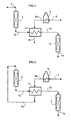
- Figure 1 shows part of a hydrocarbon conversion installation for the carrying out the method according to the invention.
- Figure 2 shows part of a hydrocarbon conversion installation for the realization of a first variant of the method according to the invention.
- Figure 3 shows part of a hydrocarbon conversion installation for the realization of a second alternative embodiment of the method according to the invention.
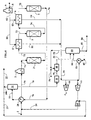
- Figure 4 shows part of a chemical complex for production alkylbenzenes, comprising a step of dehydrogenation of long paraffins, according to the process of the invention.
- a preheated current flowing in line (1) and containing a hydrocarbon charge passes through a first bed of catalyst in the reactor (3), which makes it possible to obtain a current ST containing the partially converted charge sent by the line (72) in the heat exchanger (4).
- the reaction being endothermic, the current ST flowing in the line (72) at the outlet of the reactor (3) at a temperature lower than that of the current entering the reactor (3) via the line (1).
- This ST current is heated by indirect heat exchange, mainly by convection, in the exchanger heat (4), in order to raise its temperature to a sufficient level.
- ST current reheated is sent via line (73) to the reactor (5) containing a catalyst bed for obtain an additional conversion of the charge from the reactor (3).
- the temperature difference ⁇ T between the temperature of this fluid TF in the conduit (90) at its entry into the exchanger (4) and the temperature of the ST fluid flowing in the conduit (73) at the outlet of the exchanger (4) is chosen to be relatively low, for example from 10 to 100 ° C., so as to substantially eliminate the risks of coking in the exchanger (4).
- the invention is a current flowing in the line (1) and containing the feedstock, or for example the hydrocarbon feedstock supplemented with recycling rich in hydrogen which constitutes the hot thermal fluid TF, after heating in the oven (9).
- the current TF is sent by the line (90) in the exchanger (4).
- At the end of the exchanger (4) then supplies the first reactor (3) via the line (92).
- the rest of the installation is identical to that described in conjunction with the description of Figure 1.
- the catalytic beds are of the solid catalyst type.
- the particle size of the catalyst, the geometry of the catalytic beds (radial, axial or other) are not limitations of the invention which can be implemented with all types of catalytic beds: fixed bed, bed mobile, fluid bed, catalyst deposited on the surface of solids (thin layers), for example monolithic reactors.
- FIG. 3 uses the same references as FIG. 1.
- the thermal fluid TF consists of water vapor, for example medium vapor pressure P1 (1 to 2.5 MPa for example); at the outlet of the exchanger (4), part of the fluid thermal TF is purged by line (28) (used for other thermal needs, or generation of mechanical or electrical power, these means not being shown); another part of the current TF is sent by the line (27) then recompressed in the steam ejector (26) supplied by high pressure steam entering the line (25) in this ejector, for example at a pressure P2 of between 10 and 13 MPa absolute.
- P1 medium vapor pressure
- P1 medium vapor pressure
- the vapor current is sent by the line (8) and heated in the oven (9) to constitute the hot thermal fluid TF sent by the line (90) in the heat exchanger (4).
- FIG 4 This figure represents part of a complex petrochemical for the production of alkylbenzenes, especially linear, known to man of art under the acronym "LAB" (from English Linear Alkyl Benzene).
- the current flowing in the hydrocarbon-rich line (1) of the feed, essentially paraffins in particular linear having from 10 to 14 carbon atoms, and added with a current, arriving via line (24), of hydrogen-rich recycling gas, is preheated in the exchanger (20), superheated at the reaction temperature, for example 485 ° C in the oven (2) into which it arrives by line (70), before supplying the first by line (71) catalytic dehydrogenation reactor (3).
- the current ST containing the partially converted charge is sent via line (72) and then reheated according to the invention in the heat exchanger (4). It then supplies the second line (73) catalytic dehydrogenation reactor (5).
- the reaction fluid formed is sent through the line (74) and then reheated in the heat exchanger (6), (also according to the invention), before being sent by line (75) to the third reactor catalytic bed dehydrogenation (7).
- the effluent from the catalytic dehydrogenation section is sent by the line (76) in the exchanger (20) then at the output of this exchanger it is sent by the line (77) in a gas / liquid separator tank (21).
- the gas produced in the balloon (21) comes out by the line (100) of said balloon then is separated into an excess of hydrogen-rich gas discharged by line (22), and in a recycle gas stream sent by line (23) then recompressed by the compressor (14) to constitute the current sent by the line (24) in the charge arrival line (1) to form the charge-recycling gas mixture mentioned above.
- the thermal fluid circuit consists of a stream of water vapor arriving through line (8) (for example at 40 bar absolute at the level of the heat exchangers according to the invention). This stream of water vapor is heated in the tubular radiation oven (9), to constitute a thermal fluid TF making it possible to supply the heat exchangers (4) and (6) respectively by lines (80) and (83).
- the catalytic beds are for example (without this limiting the invention) catalytic beds radials, containing a dehydrogenation catalyst for example of the platinum / tin type on an alumina support in the form of beads.
- the temperatures at the inlet of the catalytic beds can typically be of the order of 420 to 550 ° C., preferably from 450 to 500 ° C.
- the molar rate of hydrogen with respect to hydrocarbons is typically between 1 and 15, preferably between 2 and 10, and the pressure at the outlet of the last reactor is typically between 0.10 MPa (mega pascals) and 5 MPa absolute limits included, and preferably between 0.15 MPa and 0.5 MPa absolute limits included.
- VVH space velocities
- the installation may possibly include not 3 catalytic zones, as indicated in the diagram of FIG. 4, but for example 4 or 5 catalytic zones, with intermediate reheating, or more if necessary.
- Such an installation can make it possible to reach, depending on the temperatures used in particular, very high conversions, for example between 15% and 50%, in particular between 18% and 35% by mass of the paraffin charge used, without risks significant coking, and without hot spots at the level of the catalyst.
Landscapes
- Chemical & Material Sciences (AREA)
- Organic Chemistry (AREA)
- Oil, Petroleum & Natural Gas (AREA)
- Chemical Kinetics & Catalysis (AREA)
- Engineering & Computer Science (AREA)
- General Chemical & Material Sciences (AREA)
- Production Of Liquid Hydrocarbon Mixture For Refining Petroleum (AREA)
- Organic Low-Molecular-Weight Compounds And Preparation Thereof (AREA)
- Low-Molecular Organic Synthesis Reactions Using Catalysts (AREA)
Abstract
Description
- le fluide envoyé dans le premier réseau, respectivement par les lignes (81) et (54), alimenté par la ligne (10) est détendu dans une turbine (12) pour la production d'énergie électrique.
- Le fluide envoyé dans le second réseau par la ligne (11) est détendu dans la turbine (13) qui entraíne le compresseur de gaz de recyclage (14).
- Le fluide envoyé dans le troisième réseau par la ligne (54), alimente et sert de fluide thermique au rebouilleur à condensation (53) d'une colonne de distillation (50). Cette colonne (50) est alimentée par le courant d'effluent liquide de la section de déshydrogénation, à partir du ballon séparateur (21) par la ligne (78) ; ce courant liquide issu du ballon (21) traverse successivement une unité d'hydrogénation sélective (des dioléfines) (30), puis via la ligne (79) une unité d'alkylation (40) par le benzène. Cette unité est alimentée par du benzène via la ligne (56) additionné par du benzène recyclé via la ligne (52). Ainsi la colonne (50) est la première colonne de fractionnement de l'effluent de l'unité d'alkylation (40), et est alimentée par la ligne (51). Cette colonne (50) réalise le fractionnement du benzène en excès (courant recyclé par la ligne (52)) des produits moins volatils contenant notamment des paraffines non transformées et des alkylbenzènes évacués par la ligne (84). Cette colonne (50) comporte un rebouilleur (53) alimenté par la ligne (85) dont l'effluent réchauffé est renvoyé dans la colonne (50) par la ligne (86).
Claims (16)
- Procédé de conversion d'hydrocarbures par au moins une réaction chimique globalement endothermique, dans lequel une charge hydrocarbonée traverse successivement au moins deux zones réactionnelles contenant chacune au moins un catalyseur solide et comprenant entre lesdites zones réactionnelles un réchauffage intermédiaire, dans une zone non catalytique, du courant (ST) issu de la première des deux zones réactionnelles avant son introduction dans la deuxième zone réactionnelle caractérisé en ce que ce réchauffage est effectué dans un échangeur de chaleur, avec transfert de chaleur essentiellement par convection au moyen d'un fluide thermique TF d'indice de sensibilité au cokage CS inférieur à celui du courant ST, en ce que ce fluide thermique TF est chauffé dans un four en amont de l'échangeur de chaleur et en ce que l'écart de température ΔT entre la température du fluide TF à l'entrée de l'échangeur et la température du courant ST à la sortie de l'échangeur de chaleur est inférieur à 250 °C.
- Procédé selon la revendication 1 dans lequel le fluide thermique TF est un fluide choisi dans le groupe des fluides thermiques gazeux permettant un transfert de chaleur uniquement par chaleur sensible.
- Procédé selon la revendication 1 ou 2 dans lequel le fluide thermique TF est un fluide gazeux comprenant essentiellement de la vapeur d'eau sous une pression d'environ 0,1 à environ 15 MPa et à une température supérieure à environ 400 °C.
- Procédé selon la revendication 1 ou 2 dans lequel le fluide thermique TF est choisi dans le groupe formé par un courant gazeux riche en hydrogène, un courant de gaz de recyclage, un courant gazeux contenant des hydrocarbures de la charge circulant en amont de la première zone réactionnelle.
- Procédé selon la revendication 1 dans lequel le fluide thermique TF est un courant liquide inorganique choisi dans le groupe formé par les métaux fondus et les sels fondus.
- Procédé selon l'une des revendications 1 à 5 dans lequel ΔT est compris entre 10 °C et 150 °C bornes incluses, de préférence entre 10 °C et 120 °C bornes incluses.
- Procédé selon l'une des revendications 1 à 4 et 6 dans lequel le fluide thermique TF est un courant de vapeur d'eau sous une pression supérieure ou égale à environ 0,7 MPa absolus, une partie au moins dudit courant TF en sortie de l'échangeur de chaleur étant détendu dans une turbine pour obtenir une récupération de puissance, en particulier de puissance électrique.
- Procédé selon la revendication 7 dans lequel la dite turbine entraíne un compresseur de recyclage de gaz riche en hydrogène, ce gaz étant ajouté aux hydrocarbures pour effectuer la réaction chimique sous une pression d'hydrogène.
- Utilisation du procédé selon l'une des revendications 1 à 8 pour la déshydrogénation d'hydrocarbures choisis dans le groupe formé par l'éthane, le propane, le normal butane, l'isobutane, les paraffines comprenant de 5 à 20 atomes de carbone dans leur molécule, les composés monooléfiniques comprenant de 4 à 20 atomes de carbone dans leur molécule, l'éthylbenzène et les mélanges d'au moins deux de ces hydrocarbures.
- Utilisation du procédé selon la revendication 9 pour la déshydrogénation d'une charge de paraffines longues ayant bornes incluses essentiellement entre 10 et 14 atomes de carbone dans la molécule, pour produire une charge d'alkylation du benzène, dans lequel la charge de paraffines traverse au moins deux zones réactionnelles en présence d'un catalyseur de déshydrogénation, avec réchauffage intermédiaire dans une échangeur de chaleur, permettant d'obtenir une conversion des paraffines d'environ 15 à 50 % en poids.
- Utilisation du procédé selon la revendication 10 dans lequel le nombre de zones réactionnelles est compris entre 2 et 6, les températures de ces zones sont comprises entre 440 et 520 °C et le rapport molaire d'hydrogène par rapport aux hydrocarbures dans ces zones est compris entre 1 : 1 et 15 : 1.
- Utilisation du procédé selon l'une des revendications 10 ou 11, dans lequel le courant de fluide thermique TF est composé de vapeur d'eau sous une pression d'environ 1,5 MPa à environ 13 MPa absolus, une partie au moins de ce courant TF, en sortie de l'échangeur, étant utilisée, en condensation, pour le rebouillage d'une colonne de fractionnement par distillation.
- Utilisation du procédé selon l'une des revendications 1 à 8 pour le réformage sous hydrogène des hydrocarbures.
- Utilisation du procédé selon les revendications 10 et 12, comprenant une étape d'alkylation par le benzène des oléfines produites par la déshydrogénation des paraffines, en présence de benzène en excès, et une étape de fractionnement dans une colonne de distillation de l'effluent de l'étape d'alkylation pour la séparation du benzène en excès des composés moins volatils, comprenant des paraffines non transformées et des alkylbenzènes, dans lequel une partie au moins du courant TF, en sortie dudit échangeur est utilisée pour le rebouillage de ladite colonne de distillation.
- Installation pour la réalisation du procédé selon l'une des revendications 1 à 13, dans lequel l'échangeur est un échangeur à plaques, en particulier un échangeur à plaques en acier inoxydables.
- Installation selon l'une des revendications 1, 2 et 6 à 15, dans lequel le fluide thermique TF est un courant de vapeur d'eau à une pression P1, dont une partie est recomprimée en aval de l'échangeur de chaleur, par un éjecteur à vapeur alimenté par un courant de vapeur à pression P2 supérieure à P1, pour être recyclé, au moins en partie en amont dudit échangeur.
Applications Claiming Priority (2)
| Application Number | Priority Date | Filing Date | Title |
|---|---|---|---|
| FR0014019A FR2815955B1 (fr) | 2000-10-31 | 2000-10-31 | Procede de conversion endothermique d'hydrocarbures, ses utilisations et installation pour la mise en oeuvre de ce procede |
| FR0014019 | 2000-10-31 |
Publications (2)
| Publication Number | Publication Date |
|---|---|
| EP1201629A1 true EP1201629A1 (fr) | 2002-05-02 |
| EP1201629B1 EP1201629B1 (fr) | 2006-11-15 |
Family
ID=8855972
Family Applications (1)
| Application Number | Title | Priority Date | Filing Date |
|---|---|---|---|
| EP01402568A Expired - Lifetime EP1201629B1 (fr) | 2000-10-31 | 2001-10-03 | Procédé de conversion endothermique d'hydrocarbures, ses utilisations et installation pour la mise en oeuvre de ce procédé |
Country Status (12)
| Country | Link |
|---|---|
| US (1) | US6875338B2 (fr) |
| EP (1) | EP1201629B1 (fr) |
| JP (1) | JP2002206091A (fr) |
| KR (1) | KR100813376B1 (fr) |
| CN (1) | CN1227331C (fr) |
| AR (1) | AR031167A1 (fr) |
| BR (1) | BR0104903B1 (fr) |
| CA (1) | CA2360896C (fr) |
| DE (1) | DE60124489T2 (fr) |
| FR (1) | FR2815955B1 (fr) |
| MX (1) | MX230379B (fr) |
| TW (1) | TW553928B (fr) |
Families Citing this family (9)
| Publication number | Priority date | Publication date | Assignee | Title |
|---|---|---|---|---|
| US7740751B2 (en) | 2006-11-09 | 2010-06-22 | Uop Llc | Process for heating a stream for a hydrocarbon conversion process |
| US20080110801A1 (en) * | 2006-11-09 | 2008-05-15 | Leon Yuan | Process For Heating A Hydrocarbon Stream Entering A Reaction Zone With A Heater Convection Section |
| CN101348409B (zh) * | 2007-07-19 | 2011-06-15 | 中国石油化工股份有限公司 | 一种生产低碳烯烃的方法 |
| US8282814B2 (en) * | 2009-03-31 | 2012-10-09 | Uop Llc | Fired heater for a hydrocarbon conversion process |
| CN107057838B (zh) * | 2017-05-28 | 2023-12-08 | 天津大学 | 基于蒸汽再压缩和热量交换集成的微藻联合处理装置 |
| US11414362B2 (en) * | 2018-03-23 | 2022-08-16 | Exxonmobil Chemical Patents Inc. | Processes and systems for the conversion of hydrocarbons |
| ES2796092B2 (es) * | 2020-06-03 | 2021-07-05 | Cuetos Evaristo Fontecha | Sistema y procedimiento de extraccion selectiva de hidro-carburos viscosos de tanques y otros recipientes |
| CN111606315A (zh) * | 2020-07-06 | 2020-09-01 | 中国石油化工股份有限公司 | 一种降低碳素中金属含量的方法 |
| JP7683991B2 (ja) * | 2020-11-11 | 2025-05-27 | エルジー・ケム・リミテッド | アクリル酸の製造方法 |
Citations (1)
| Publication number | Priority date | Publication date | Assignee | Title |
|---|---|---|---|---|
| US2271646A (en) * | 1939-05-17 | 1942-02-03 | Universal Oil Prod Co | Control of contact catalytic reactions |
Family Cites Families (5)
| Publication number | Priority date | Publication date | Assignee | Title |
|---|---|---|---|---|
| US3326996A (en) * | 1964-05-06 | 1967-06-20 | Union Carbide Corp | Dehydrogenation of ethylbenzene to styrene |
| US5560900A (en) * | 1994-09-13 | 1996-10-01 | The M. W. Kellogg Company | Transport partial oxidation method |
| US6025403A (en) * | 1997-07-07 | 2000-02-15 | Mobil Oil Corporation | Process for heat integration of an autothermal reformer and cogeneration power plant |
| JP4305973B2 (ja) * | 1997-07-23 | 2009-07-29 | トヨタ自動車株式会社 | 燃料改質装置 |
| US5885439A (en) * | 1997-11-04 | 1999-03-23 | Uop Llc | Catalytic reforming process with multiple zones |
-
2000
- 2000-10-31 FR FR0014019A patent/FR2815955B1/fr not_active Expired - Fee Related
-
2001
- 2001-10-03 DE DE60124489T patent/DE60124489T2/de not_active Expired - Lifetime
- 2001-10-03 EP EP01402568A patent/EP1201629B1/fr not_active Expired - Lifetime
- 2001-10-26 TW TW090126585A patent/TW553928B/zh not_active IP Right Cessation
- 2001-10-29 MX MXPA01010997 patent/MX230379B/es active IP Right Grant
- 2001-10-29 AR ARP010105062A patent/AR031167A1/es active IP Right Grant
- 2001-10-29 CA CA2360896A patent/CA2360896C/fr not_active Expired - Fee Related
- 2001-10-30 KR KR1020010066999A patent/KR100813376B1/ko not_active Expired - Fee Related
- 2001-10-30 US US09/984,372 patent/US6875338B2/en not_active Expired - Fee Related
- 2001-10-31 BR BRPI0104903-8A patent/BR0104903B1/pt not_active IP Right Cessation
- 2001-10-31 CN CNB011377887A patent/CN1227331C/zh not_active Expired - Fee Related
- 2001-10-31 JP JP2001333591A patent/JP2002206091A/ja active Pending
Patent Citations (1)
| Publication number | Priority date | Publication date | Assignee | Title |
|---|---|---|---|---|
| US2271646A (en) * | 1939-05-17 | 1942-02-03 | Universal Oil Prod Co | Control of contact catalytic reactions |
Also Published As
| Publication number | Publication date |
|---|---|
| KR20020034911A (ko) | 2002-05-09 |
| TW553928B (en) | 2003-09-21 |
| DE60124489T2 (de) | 2007-03-01 |
| DE60124489D1 (de) | 2006-12-28 |
| BR0104903B1 (pt) | 2012-07-10 |
| EP1201629B1 (fr) | 2006-11-15 |
| MXPA01010997A (es) | 2002-12-02 |
| FR2815955A1 (fr) | 2002-05-03 |
| US6875338B2 (en) | 2005-04-05 |
| KR100813376B1 (ko) | 2008-03-12 |
| MX230379B (es) | 2005-09-06 |
| CA2360896C (fr) | 2011-07-26 |
| CN1227331C (zh) | 2005-11-16 |
| US20020052534A1 (en) | 2002-05-02 |
| FR2815955B1 (fr) | 2002-12-13 |
| BR0104903A (pt) | 2002-07-09 |
| CN1351109A (zh) | 2002-05-29 |
| CA2360896A1 (fr) | 2002-04-30 |
| AR031167A1 (es) | 2003-09-10 |
| JP2002206091A (ja) | 2002-07-26 |
Similar Documents
| Publication | Publication Date | Title |
|---|---|---|
| CN101688128B (zh) | 共进料的甲烷和烃原料转化为更高价值的烃 | |
| US4097363A (en) | Thermal cracking of light gas oil at high severity to ethylene | |
| EP0229093B1 (fr) | Procede de vapocraquage d'hydrocarbures | |
| US4061562A (en) | Thermal cracking of hydrodesulfurized residual petroleum oils | |
| US8815080B2 (en) | Adiabatic reactor to produce olefins | |
| US6743961B2 (en) | Olefin production utilizing whole crude oil | |
| US7019187B2 (en) | Olefin production utilizing whole crude oil and mild catalytic cracking | |
| CA2728567C (fr) | Procede pour le decokage en marche productive d'un four pour le craquage d'une alimentation hydrocarbonee | |
| EP0226487B1 (fr) | Procédé de conversion thermique du méthane en hydrocarbures de poids moléculaires plus élevés | |
| JP7303258B2 (ja) | 原油の加熱方法 | |
| EP1201629B1 (fr) | Procédé de conversion endothermique d'hydrocarbures, ses utilisations et installation pour la mise en oeuvre de ce procédé | |
| US20260117131A1 (en) | Catalytic Conversion Of Light Hydrocarbons | |
| US20250188368A1 (en) | Adiabatic olefin production | |
| US20250026987A1 (en) | Electric adiabatic heater for olefin production | |
| WO2026060185A1 (fr) | Four de craquage électrique pour charges lourdes afin de produire des oléfines | |
| BE614412A (fr) |
Legal Events
| Date | Code | Title | Description |
|---|---|---|---|
| PUAI | Public reference made under article 153(3) epc to a published international application that has entered the european phase |
Free format text: ORIGINAL CODE: 0009012 |
|
| AK | Designated contracting states |
Kind code of ref document: A1 Designated state(s): DE FR GB IT NL Kind code of ref document: A1 Designated state(s): AT BE CH CY DE DK ES FI FR GB GR IE IT LI LU MC NL PT SE TR |
|
| AX | Request for extension of the european patent |
Free format text: AL;LT;LV;MK;RO;SI |
|
| 17P | Request for examination filed |
Effective date: 20021104 |
|
| AKX | Designation fees paid |
Free format text: DE FR GB IT NL |
|
| 17Q | First examination report despatched |
Effective date: 20030227 |
|
| RIC1 | Information provided on ipc code assigned before grant |
Ipc: 7C 07C 5/32 B Ipc: 7C 10G 35/04 A |
|
| GRAP | Despatch of communication of intention to grant a patent |
Free format text: ORIGINAL CODE: EPIDOSNIGR1 |
|
| GRAS | Grant fee paid |
Free format text: ORIGINAL CODE: EPIDOSNIGR3 |
|
| GRAA | (expected) grant |
Free format text: ORIGINAL CODE: 0009210 |
|
| AK | Designated contracting states |
Kind code of ref document: B1 Designated state(s): DE FR GB IT NL |
|
| PG25 | Lapsed in a contracting state [announced via postgrant information from national office to epo] |
Ref country code: IT Free format text: LAPSE BECAUSE OF FAILURE TO SUBMIT A TRANSLATION OF THE DESCRIPTION OR TO PAY THE FEE WITHIN THE PRESCRIBED TIME-LIMIT;WARNING: LAPSES OF ITALIAN PATENTS WITH EFFECTIVE DATE BEFORE 2007 MAY HAVE OCCURRED AT ANY TIME BEFORE 2007. THE CORRECT EFFECTIVE DATE MAY BE DIFFERENT FROM THE ONE RECORDED. Effective date: 20061115 |
|
| REG | Reference to a national code |
Ref country code: GB Ref legal event code: FG4D Free format text: NOT ENGLISH |
|
| GBT | Gb: translation of ep patent filed (gb section 77(6)(a)/1977) |
Effective date: 20061115 |
|
| REF | Corresponds to: |
Ref document number: 60124489 Country of ref document: DE Date of ref document: 20061228 Kind code of ref document: P |
|
| PLBE | No opposition filed within time limit |
Free format text: ORIGINAL CODE: 0009261 |
|
| STAA | Information on the status of an ep patent application or granted ep patent |
Free format text: STATUS: NO OPPOSITION FILED WITHIN TIME LIMIT |
|
| 26N | No opposition filed |
Effective date: 20070817 |
|
| REG | Reference to a national code |
Ref country code: FR Ref legal event code: CD |
|
| REG | Reference to a national code |
Ref country code: DE Ref legal event code: R081 Ref document number: 60124489 Country of ref document: DE Owner name: IFP ENERGIES NOUVELLES, FR Free format text: FORMER OWNER: INSTITUT FRANCAIS DU PETROLE, RUEIL-MALMAISON, HAUTS-DE-SEINE, FR Effective date: 20110331 |
|
| REG | Reference to a national code |
Ref country code: FR Ref legal event code: PLFP Year of fee payment: 15 |
|
| REG | Reference to a national code |
Ref country code: FR Ref legal event code: PLFP Year of fee payment: 16 |
|
| REG | Reference to a national code |
Ref country code: FR Ref legal event code: PLFP Year of fee payment: 17 |
|
| REG | Reference to a national code |
Ref country code: FR Ref legal event code: PLFP Year of fee payment: 18 |
|
| PGFP | Annual fee paid to national office [announced via postgrant information from national office to epo] |
Ref country code: NL Payment date: 20181026 Year of fee payment: 18 |
|
| PGFP | Annual fee paid to national office [announced via postgrant information from national office to epo] |
Ref country code: DE Payment date: 20181030 Year of fee payment: 18 |
|
| PGFP | Annual fee paid to national office [announced via postgrant information from national office to epo] |
Ref country code: IT Payment date: 20181031 Year of fee payment: 18 Ref country code: GB Payment date: 20181024 Year of fee payment: 18 Ref country code: FR Payment date: 20181025 Year of fee payment: 18 |
|
| REG | Reference to a national code |
Ref country code: DE Ref legal event code: R119 Ref document number: 60124489 Country of ref document: DE |
|
| REG | Reference to a national code |
Ref country code: NL Ref legal event code: MM Effective date: 20191101 |
|
| PG25 | Lapsed in a contracting state [announced via postgrant information from national office to epo] |
Ref country code: DE Free format text: LAPSE BECAUSE OF NON-PAYMENT OF DUE FEES Effective date: 20200501 |
|
| PG25 | Lapsed in a contracting state [announced via postgrant information from national office to epo] |
Ref country code: NL Free format text: LAPSE BECAUSE OF NON-PAYMENT OF DUE FEES Effective date: 20191101 |
|
| GBPC | Gb: european patent ceased through non-payment of renewal fee |
Effective date: 20191003 |
|
| PG25 | Lapsed in a contracting state [announced via postgrant information from national office to epo] |
Ref country code: GB Free format text: LAPSE BECAUSE OF NON-PAYMENT OF DUE FEES Effective date: 20191003 Ref country code: FR Free format text: LAPSE BECAUSE OF NON-PAYMENT OF DUE FEES Effective date: 20191031 Ref country code: IT Free format text: LAPSE BECAUSE OF NON-PAYMENT OF DUE FEES Effective date: 20191003 |