EP1201704B1 - Composition caoutchouteuse et tuyaux thermo-résistants - Google Patents
Composition caoutchouteuse et tuyaux thermo-résistants Download PDFInfo
- Publication number
- EP1201704B1 EP1201704B1 EP20010124715 EP01124715A EP1201704B1 EP 1201704 B1 EP1201704 B1 EP 1201704B1 EP 20010124715 EP20010124715 EP 20010124715 EP 01124715 A EP01124715 A EP 01124715A EP 1201704 B1 EP1201704 B1 EP 1201704B1
- Authority
- EP
- European Patent Office
- Prior art keywords
- weight
- parts
- hose
- vulcanizing agent
- acrylic rubber
- Prior art date
- Legal status (The legal status is an assumption and is not a legal conclusion. Google has not performed a legal analysis and makes no representation as to the accuracy of the status listed.)
- Expired - Lifetime
Links
Classifications
-
- C—CHEMISTRY; METALLURGY
- C08—ORGANIC MACROMOLECULAR COMPOUNDS; THEIR PREPARATION OR CHEMICAL WORKING-UP; COMPOSITIONS BASED THEREON
- C08K—Use of inorganic or non-macromolecular organic substances as compounding ingredients
- C08K5/00—Use of organic ingredients
- C08K5/16—Nitrogen-containing compounds
-
- C—CHEMISTRY; METALLURGY
- C08—ORGANIC MACROMOLECULAR COMPOUNDS; THEIR PREPARATION OR CHEMICAL WORKING-UP; COMPOSITIONS BASED THEREON
- C08K—Use of inorganic or non-macromolecular organic substances as compounding ingredients
- C08K3/00—Use of inorganic substances as compounding ingredients
- C08K3/02—Elements
- C08K3/04—Carbon
-
- C—CHEMISTRY; METALLURGY
- C08—ORGANIC MACROMOLECULAR COMPOUNDS; THEIR PREPARATION OR CHEMICAL WORKING-UP; COMPOSITIONS BASED THEREON
- C08K—Use of inorganic or non-macromolecular organic substances as compounding ingredients
- C08K5/00—Use of organic ingredients
- C08K5/16—Nitrogen-containing compounds
- C08K5/34—Heterocyclic compounds having nitrogen in the ring
- C08K5/3442—Heterocyclic compounds having nitrogen in the ring having two nitrogen atoms in the ring
- C08K5/3445—Five-membered rings
Definitions
- This invention relates to a rubber composition and a heat-resistant hose. More particularly, it relates to an acrylic rubber composition having an epoxy group in which the total content of necessary or useful additives and a Mooney viscosity are within specified ranges.
- the acrylic rubber composition can be extruded into a hose of a large diameter having high heat resistance and high compression set resistance.
- This invention also relates to a heat-resistant hose formed of such a composition.
- a rubber composition mainly composed of acrylic rubber as a base material has often been used as a material for hoses required to have heat and oil resistances .
- Examples of those hoses are oil and air system hoses for motor vehicles.
- the use of acrylic rubber having an epoxy group has been proposed to obtain an acrylic rubber composition improved in heat resistance, compression set resistance, etc.
- Various proposals have also been made for the monomeric compositions of acrylic rubber having an epoxy group and for the additives such as a vulcanizing agent.
- the invention disclosed in Japanese Patent Application Laid-Open No. 176293/1997 proposes the addition of an imidazole compound, trimethyl thiourea and a quaternary ammonium salt to an elastomer having an epoxy group. Its object is to provide an acrylic elastomer composition having a high rate of vulcanization and a low compression set.
- the invention disclosed in Japanese Patent Application Laid-Open No. 227749/1997 proposes an acrylic elastomer composition having an epoxy group and containing carbon black having an average particle diameter of 20 to 30 nm and a DBP (dibutyl phthalate) absorption of at least 115 ml/100 g.
- the composition also contains an imidazole compound, trimethyl thiourea and a quaternary ammonium salt.
- the invention disclosed in Japanese Patent Application Laid-Open No. 322853/1999 proposes acrylic rubber having the monomeric composition stated below. Its monomeric composition consists of 0.1 to 2.9% by weight of an ethylene monomer, 0 to 10% by weight of a cure site monomer, and 87.1 to 99.9% by weight of an ethyl acrylate and/or n-butyl acrylate monomer.
- An acrylic rubber composition having an epoxy group is required to satisfy three conditions as stated below in order to be suitable for use in making, for example, an air hose for a supercharger in a turbocharger assembly vehicle.
- the inventors of this invention have found that none of the known acrylic rubber compositions cited above can satisfy all of the three conditions:
- an imidazole compound, trimethyl thiourea and a quaternary ammonium salt as a vulcanizing agent for acrylic rubber. It is also necessary or beneficial to add carbon black having an average particle diameter of 20 to 30 nm and a DBP absorption of at least 115 ml/100 g.
- the selection of the monomeric composition as cited above is itself necessary or beneficial.
- the selection of the vulcanizing agent as stated above may give a rubber composition improved in (1) and (2), but its extrusion into a hose with a large diameter may result in a flattened hose. Its satisfactory extrusion is difficult. The difficulty is apparently due to too low a Mooney viscosity of the composition as is obvious from the description of examples in Japanese Patent Application Laid-Open No. 322853/1999.
- an object of this invention to provide an acrylic rubber composition having an epoxy group which satisfies all of the three requirements as stated at (1) to (3) above. It is another object of this invention to provide a heat-resistant hose formed of the acrylic rubber composition and having improved quality.
- the inventors have found that in order to attain these objects, it is important to increase a Mooney viscosity of uncured rubber without allowing a vulcanized product thereof to harden.
- a rubber composition comprising acrylic rubber having an epoxy group as a base material, and 50 to 80 parts by weight of carbon black having an average particle diameter of 30 to 60 nm and a dibutyl phthalate (DBP) absorption of at least 150 cc/100 g, and 0.8 to 2.6 parts by weight of a vulcanizing agent, each relative to 100 parts by weight of the base material, wherein the rubber composition contains a total of 160 to 220 parts by weight of additives including the carbon black and the vulcanizing agent relative to 100 parts by weight of the base material, and has a Mooney viscosity of 30 to 70 ML 1+3 (121°C).
- DBP dibutyl phthalate
- the acrylic rubber composition having a Mooney viscosity of 30 to 70 ML 1+3 (121°C) can be extruded satisfactorily into a hose having a diameter as large as 35 to 80 mm without causing any flattening.
- the addition of carbon black in the proportion as stated improves the tensile strength and heat resistance of the composition as intended and prevents any flattening of an extruded hose. It does not substantially affect the Mooney viscosity of the composition.
- the addition of the vulcanizing agent in the proportion as stated improves the heat and compression set resistances of the composition as intended without affecting its Mooney viscosity substantially.
- the composition further contains other additives to the extent that all the additives including carbon black and the vulcanizing agent make a total of 160 to 220 parts by weight.
- additives such as an antioxidant, a plasticizer and a processing aid may be included in appropriate amounts.
- the rubber composition according to the first aspect of this invention has a high heat resistance and a low compression set at a high temperature and can be extruded satisfactorily into a hose having a large diameter.
- Carbon black having an average particle diameter of 30 to 60 nm is more useful for heat and compression set resistances than carbon black having an average particle diameter of less than 30 nm, or about 20 nm.
- Carbon black having a DBP absorption of at least 150 cc/100 g is more useful for flattening resistance and surface skin quality than carbon black having a DBP absorption of, say, 115 to 145 cc/100 g.
- the vulcanizing agent comprises an imidazole compound, a thiourea compound and a quaternary ammonium salt.
- This combination of compounds is preferred as the vulcanizing agent for an acrylic rubber composition having an epoxy group in order to ensure its heat and compression set resistances.
- the vulcanizing agent comprises 0.5 to 1.5 parts by weight of an imidazole compound, 0.2 to 0.7 part by weight of a thiourea compound and 0.1 to 0.4 part by weight of a quaternary ammonium salt. These proportions are preferred for the heat and compression set resistances of the composition and its pot life or storage stability.
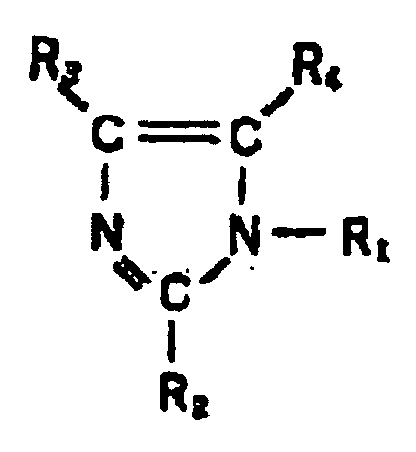
- the imidazole compound has the chemical formula: where R 1 is a methyl or ethyl group, R 2 is a hydrogen atom, or an alkyl, substituted alkyl, aryl or substituted aryl group having one to 17 carbon atoms, and R 3 and R 4 are each a hydrogen atom, or an alkyl or substituted alkyl group having one to 17 carbon atoms, or a cyano, hydroxyalkyl, carboxyl, thiocarbamoyl or imidazolyl group.
- R 1 is preferably a methyl or ethyl group to ensure the heat and compression set resistances and storage stability of the composition.
- the acrylic rubber of one of the first to fourth aspects comprises at least 70% by weight of ethyl acrylate and at most 10% by weight of methoxyethyl acrylate as a monomer. It is superior in heat and compression set resistances to the rubber having the monomeric composition shown in Japanese Patent Application Laid-Open No. 322853/1999.
- a heat-resistant hose made by extrusion from the rubber composition according to any of the first to fifth aspects of this invention, and having an inside diameter of 35 to 80 mm.
- the hose has a high heat resistance and a low compression set at a high temperature. Uncured rubber can be extruded satisfactorily without flattening despite its diameter as large as 35 to 80 mm.
- the hose is an air or oil system hose of a high heat resistance for a motor vehicle.
- the hose according to this aspect of the invention is preferred as an air or oil system hose for a motor vehicle, and particularly as an air system hose for a supercharger.
- the rubber composition according to this invention comprises acrylic rubber having an epoxy group as a base material, and 50 to 80 parts by weight of carbon black and 0.8 to 2.6 parts by weight of a vulcanizing agent, each relative to 100 parts by weight of the base material.
- the composition also comprises a total of 160 to 220 parts by weight of additives icluding the carbon black and the vulcanizing agent relative to 100 parts by weight of the base material.
- the composition has a Mooney viscosity of 30 to 70 ML 1+3 (121°C) as determined in accordance with the JIS K-6300 method.
- the acrylic rubber used as the base material has an epoxy group as a cure site. It is obtained by copolymerizing a cure site monomer having an epoxy group and at least one kind of copolymerizable monomer by a known method such as emulsion, suspension, solution or bulk polymerization. Its monomeric composition preferably comprises at least 70% by weight of ethyl acrylate and at most 10% by weight of methoxyethyl acrylate.
- the cure site monomers include glycidyl acrylate, glycidyl methacrylate, allylglycidyl ether and metaallylglycidyl ether.
- the cure site monomers are preferably so employed as to give acrylic rubber having an epoxy group content of 0.7 to 2.3% by weight.
- Examples of the monomers copolymerizable with the cure site monomers include known alkyl ester acrylates, such as methyl, ethyl, n-propyl, n-butyl and isobutyl acrylates.
- Other examples include known alkoxyalkyl ester acrylates, such as 2-methoxyethyl, 2-(n-propoxy)ethyl, 2-(n-butoxy)ethyl and 3-methoxypropyl acrylates.
- the monomeric composition of the acrylic rubber preferably includes not less than 60% by weight of ethyl acrylate so that there may not be any undesirable deterioration of reinforcing yarn.
- Examples of other monomers copolymerizable with the cure site monomers are known fluoro ester acrylates, such as 1,1-dihydroperfluoroethyl, 1,1-dihydroperfluoropropyl and 1,1,5-trihydroperfluorohexyl (meth)acrylates.
- Other examples are known hydroxy ester acrylates, such as 1-hydroxypropyl, 2-hydroxypropyl and hydroxyethyl (meth)acrylates.
- Other examples are known tertiary amino acrylates, such as diethylaminoethyl and dibutylaminoethyl (meth)acrylates.
- Still other examples are known methacrylates, such as methyl and octyl methacrylates.
- alkyl vinyl ketones vinyl ethers, allyl ethers, aromatic vinyl compounds, vinylnitrile, ethylene, propylene, vinyl chloride, vinylidene chloride, vinyl fluoride, vinylidene fluoride, vinyl acetate, vinyl propionate and alkyl fumarates.
- acrylic rubbers are NOXTITE of Nippon Mektron, Ltd., Nipol AR of Nippon Zeon Co., Ltd., TOA ACRON of Tohpe Corporation, DENKA ER of Denki Kagaku Kogyo K.K. and ESPRENE EMA of Sumitomo Chemical Co., Ltd.
- the carbon black added to the acrylic rubber has an average particle diameter of 30 to 60 nm and a DBP absorption of at least 150 cc/100 g. It preferably has an average particle diameter of 35 to 50 nm.
- the average particle diameter of carbon black means its length-mean particle diameter as determined by electron microscopic analysis, and its DBP absorption is the value as determined in accordance with the JIS K-6221 A method (mechanical method).
- preferred commercially available carbon blacks are SEAST 116HM and SEAST FM of Tokai Carbon Co., Ltd. and Asahi F-200 of Asahi Carbon Co., Ltd. Either a single product, or a mixture of two or more may be used to achieve the desired properties.
- the vulcanizing agent is employed in the proportion of 0.8 to 2.6 parts, or preferably 1.25 to 2.15 parts by weight relative to 100 parts by weight of acrylic rubber having an epoxy group.
- a vulcanizing agent or any combination of two or more agents to be employed.
- the vulcanizing agent preferably comprises an imidazole compound, a thiourea compound and a quaternary ammonium salt. It more preferably comprises 0.5 to 1.5 parts, or still more preferably 0.75 to 1.25 parts by weight of an imidazole compound, 0.2 to 0.7 part, or still more preferably 0.3 to 0.6 part by weight of a thiourea compound, and 0.1 to 0.4 part, or still more preferably 0.2 to 0.3 part by weight of a quaternary ammonium salt, making a total of 0.8 to 2.6 parts by weight.
- the imidazole compound is preferably of the formula shown before, where R 1 is a methyl or ethyl group. It is possible to use any of the compounds obtained by substituting an atom or a group of atoms for each of the substituents on the imidazole skeleton.
- Examples include 1-methylimidazole, 1,2-dimethylimidazole, 1-benzyl-2-ethylimidazole, 1-benzyl-2-phenylimidazole ⁇ trimellitic acid salt, 1-aminoethyl-2-methylimidazole, 1-cyanoethyl-2-ethyl-4-methylimidazole and a trimellitate thereof, 2,4-diamino-6-[2'-methylimidazolyl-(1)']ethyl-s-triazine and isocyanuric acid additament, N,N'-bis(2-methylimidazolyl-1-ethyl)urea, N,N'-[2-methylimidazolyl-(1)-ethyl]adipoyldiamide and 1-dodecyl-2-methyl-3-benzylimidazolium chloride.
- thiourea compound there is no specific limitation as to the thiourea compound to be employed. Examples include trimethyl thiourea, ethylene thiourea, N,N'-diphenyl thiourea, diorthotolyl thiourea, diethyl thiourea, dibutyl thiourea and dilauryl thiourea. Trimethyl thiourea is, among others, preferred for its effectiveness in improving the compression set resistance of acrylic rubber.
- quaternary ammonium salt there is no specific limitation as to the quaternary ammonium salt, either. Examples are tetraethylammonium bromide, tetrabutylammonium chloride, cetyltrimethylammonium bromide, n-dodecyltrimethylammonium bromide, cetyl pyridium chloride, 1,8-diaza-bicyclo(5,4,0)undecene-7-benzylammonium chloride and cetyl pyridium iodide.
- the rubber composition contains a total of 160 to 220 parts by weight of additives including the carbon black and vulcanizing agent relative to 100 parts by weight of acrylic rubber having an epoxy group as a base material. It is possible to employ any suitable additives other than the carbon black and vulcanizing agent in any suitable proportions if the total falls within the range as stated. Examples of the other additives are a vulcanization accelerator, a white reinforcing agent and an antioxidant, which are all known in the art.
- the heat-resistant hose according to this invention is made by extrusion from any acrylic rubber composition according to this invention, and has an inside diameter of 35 to 80 mm. Its use is not specifically limited, though it may preferably be used as a heat-resistant air or oil system hose for a motor vehicle.
- the hose may be formed only of a layer of the acrylic rubber having an epoxy group. It may alternatively be formed of a multilayer further including an inner, middle and/or outer layer of any other kind of synthetic rubber. Examples of the other synthetic rubbers include fluororubber, fluoroacrylic rubber, hydrin rubber, CSM, CR, NBR and ethylene-propylene rubber.
- the multilayer wall may also include a middle or outermost layer of reinforcing yarn or wire.
- Acrylic rubber compositions according to Examples 1 to 8 embodying this invention and Comparative Examples 1 to 13 were prepared as shown in Tables 1 to 3.
- Comparative Example 7 8 9 10 11 12 13
- Acrylic rubber - 1 - - - - - - - - Acrylic rubber - 2 100 100 100 100 - - - - Acrylic rubber - 3 - - - - 100 - - Acrylic rubber - 4 - - - - - - 100 - Acrylic rubber - 5 - - - - - - - 100 Stearic acid 1 1 1 1 1 1 1 1 1 Antioxidant 2 2 2 2 1 1 1 1 Carbon black 1 65 - - - 60 - 50 Carbon black - 2 - - - - - - - - - Carbon black - 3 - - - - - - - Carbon black - 4 4 - 65 - - - - - - Carbon black - 5 - - 65 -
- Each of acrylic rubbers 1 to 5 having the monomeric composition (% by weight) shown in Table 4 was used as the base material of the acrylic rubber composition.
- Example or Comparative Example those amounts of the additives excluding the vulcanizing agents which are shown by parts by weight relative to 100 parts by weight of the base material in Table 1, 2 or 3 were mixed with the base material in a Banbury mixer having a capacity of 1.5 liters. Then, the vulcanizing agents, i.e. the imidazole compound, thiourea compound, and quaternary ammonium salt, were mixed with the mixture containing the base material in an 8-inch roll mill.
- the vulcanizing agents i.e. the imidazole compound, thiourea compound, and quaternary ammonium salt
- Table 5 shows the average particle diameter (nm) and DBP absorption (cc/100 g) of each of carbon blacks 1 to 7 shown in Tables 1 to 3.
- Table 6 shows the tradenames of the vulcanizing agents, carbon blacks and other additives shown in Tables 1 to 3.
- the Mooney viscosity (ML 1+3 , 121°C) of the acrylic rubber composition according to each Example or Comparative Example was determined in accordance with the JIS K-6300 method. It was determined by using an L type rotor, preheating the composition at a temperature of 121°C for a minute, rotating the rotor and reading the meter after three minutes. The results are shown in Tables 1 to 3.
- a Garvey die extrusion test conforming to ASTM D2230 was conducted on the acrylic rubber composition according to each Example or Comparative Example. It was conducted after 72 hours of heat aging at a temperature of 40°C.
- the results are shown for the edge and surface skin of the extruded product in Tables 1 to 3.
- the edge means the appearance of the edge of the product (i.e. its sharpness and continuity) and its evaluation is shown by one of ten figures from 1 (Inferior) to 10 (Superior).
- the surface skin means its smoothness and its evaluation is shown by one of five letters A (Superior) to E (Inferior).
- the acrylic rubber composition according to each Example or Comparative Example was extruded into a tubular sample by employing a die diameter of 50 mm, a spindle diameter of 45 mm and a screw rotating speed of 40 rpm.
- the sample was left to stand at a temperature of 40°C for 24 hours and its shape was thereafter examined visually.
- the result is shown in Table 1, 2 or 3 (at Extrudability 2) by a circle if the sample retained at least 75% of its original diameter, by a triangle if it retained at least 50% and less than 75% of its original diameter, or by an x if it retained only less than 50% of its original diameter.
- a rubber sheet having a thickness of 2 mm was formed from the acrylic rubber composition according to each Example or Comparative Example by a 6-inch roll mill. It was subjected to 60 minutes of press vulcanization at a temperature of 160°C, and then to eight hours of oven vulcanization at 150°C to prepare a test specimen for evaluation. The specimen was tested for its tensile strength (MPa) and elongation (%) in accordance with the JIS K-6251 methods. The results are shown in Table 1, 2 or 3 (at Ordinary Physical Properties).
- a specimen in the form of a sheet was likewise prepared from each acrylic rubber composition for a heat resistance test. It was tested for its elongation (%) after 750 hours of heat aging at a temperature of 175°C in accordance with the JIS K-6257 method.
- a JIS 5 dumbbell specimen was prepared from the sheet as heat aged, was bent by an angle of 180 degrees, and was visually inspected for anything abnormal, such as cracking or breaking. The results are shown in Table 1, 2 or 3 by the expression OK if nothing abnormal was found, or by another specific expression for something abnormal.
- a large test specimen conforming to JIS K-6262 was prepared from each acrylic rubber composition by 60 hours of press vulcanization at 160°C and eight hours of oven vulcanization at 150°C. It was examined for its compression set (%) after 22 hours of heat aging at 200°C in accordance with the JIS K-6262 method. The result is shown in Table 1, 2 or 3 (at Compression Set).
Landscapes
- Chemical & Material Sciences (AREA)
- Health & Medical Sciences (AREA)
- Chemical Kinetics & Catalysis (AREA)
- Medicinal Chemistry (AREA)
- Polymers & Plastics (AREA)
- Organic Chemistry (AREA)
- Compositions Of Macromolecular Compounds (AREA)
- Rigid Pipes And Flexible Pipes (AREA)
- Manufacture Of Macromolecular Shaped Articles (AREA)
Claims (10)
- Composition caoutchouteuse comprenant :dans laquelle la composition de caoutchouc. contient un total de 160 à 220 parties en poids d'additifs comprenant le noir de carbone et l'agent de vulcanisation par rapport à 100 parties en poids du matériau de base, et a une consistance Mooney de 30 à 70 ML1+3 (121°C).un caoutchouc acrylique ayant un groupe époxy comme matériau de base, etde 50 à 80 parties en poids de noir de carbone ayant un diamètre de particule moyen de 30 à 60 nm et une absorption de phtalate de dibutyle (DHP) d'au moins 150 cm3/100 g, et de 0,8 à 2,6 parties en poids d'un agent de vulcanisation, chacun par rapport à 100 parties en poids du matériau de base,
- Composition selon la revendication 1, dans laquelle le contenu de l'agent de vulcanisation est de 1,25 à 2,15 parties en poids.
- Composition selon la revendication 1, dans laquelle l'agent de vulcanisation comprend un composé imidazole, un composé thiourée et un sel d'ammonium quaternaire.
- Composition selon la revendication 3, dans laquelle l'agent de vulcanisation comprend de 0,5 à 1,5 parties en poids du composé imidazole, de 0,2 à 0,7 parties en poids du composé thiourée et de 0,1 à 0,4 parties en poids du sel d'ammonium quaternaire, chacun par rapport à 100 parties en poids du matériau de base.
- Composition selon la revendication 3, dans laquelle l'agent de vulcanisation comprend de 0,75 à 1,25 parties en poids du composé imidazole, de 0,3 à 0,6 parties en poids du composé thiourée et de 0,2 à 0,3 parties en poids du sel d'ammonium quaternaire, chacun par rapport à 100 parties en poids du matériau de base.
- Composé selon la revendication 3, dans lequel le composé imidazole a la formule suivante :où R1 est un groupe méthyle ou éthyle, R2 est un atome d'hydrogène, ou un groupe alkyle, alkyle substitué, aryle ou aryle substitué ayant un à 17 atomes de carbone, et R3 et R4 sont chacun un atome d'hydrogène, ou un groupe alkyle ou alkyle substitué ayant un à 17 atomes de carbone, ou un groupe cyano, hydroxyalkyle, carboxyle, thiocarbamoyle, ou imidazolyle.
- Composition selon la revendication 1, dans laquelle le caoutchouc acrylique ayant un groupe époxy comprend au moins 70 % en poids d'acrylate d'éthyle et au plus 10 % en poids d'acrylate de méthoxyéthyle comme monomère.
- Tuyau flexible thermo-résistant fait par extrusion à partir de la composition selon la revendication 1, et ayant un diamètre intérieur de 35 à 80 mm.
- Tuyau flexible selon la revendication 8, dans lequel le tuyau flexible est un tuyau flexible de système d'air ou d'huile de résistance à la chaleur élevée pour un véhicule à moteur.
- Tuyau flexible selon la revendication 8, dans lequel le tuyau flexible est formé d'une couche unique de la composition de caoutchouc acrylique ou d'une multicouche comprenant une couche de la composition de caoutchouc acrylique et une couche interne, centrale et/ou externe d'un type différent de caoutchouc synthétique.
Applications Claiming Priority (2)
| Application Number | Priority Date | Filing Date | Title |
|---|---|---|---|
| JP2000318821A JP3815201B2 (ja) | 2000-10-19 | 2000-10-19 | ゴム組成物及び耐熱ホース |
| JP2000318821 | 2000-10-19 |
Publications (3)
| Publication Number | Publication Date |
|---|---|
| EP1201704A2 EP1201704A2 (fr) | 2002-05-02 |
| EP1201704A3 EP1201704A3 (fr) | 2003-01-15 |
| EP1201704B1 true EP1201704B1 (fr) | 2004-10-13 |
Family
ID=18797390
Family Applications (1)
| Application Number | Title | Priority Date | Filing Date |
|---|---|---|---|
| EP20010124715 Expired - Lifetime EP1201704B1 (fr) | 2000-10-19 | 2001-10-16 | Composition caoutchouteuse et tuyaux thermo-résistants |
Country Status (3)
| Country | Link |
|---|---|
| EP (1) | EP1201704B1 (fr) |
| JP (1) | JP3815201B2 (fr) |
| DE (1) | DE60106367D1 (fr) |
Families Citing this family (7)
| Publication number | Priority date | Publication date | Assignee | Title |
|---|---|---|---|---|
| JP2003082029A (ja) | 2001-09-14 | 2003-03-19 | Tokai Rubber Ind Ltd | アクリルゴム組成物及び耐熱ホース |
| JP2005214294A (ja) * | 2004-01-29 | 2005-08-11 | Tokai Rubber Ind Ltd | 耐熱エアホース |
| JP5313135B2 (ja) * | 2007-06-13 | 2013-10-09 | 電気化学工業株式会社 | アクリルゴム組成物ならびにその加硫ゴムおよびその用途 |
| US9227380B2 (en) | 2010-06-09 | 2016-01-05 | Denka Company Limited | Laminated body and vulcanizate therefor |
| EP2666607B1 (fr) * | 2011-01-17 | 2018-03-14 | Denka Company Limited | Vessie de pneu |
| JP5465204B2 (ja) * | 2011-03-11 | 2014-04-09 | 東海ゴム工業株式会社 | 車両用耐熱ホース |
| WO2021192897A1 (fr) | 2020-03-25 | 2021-09-30 | 日本ゼオン株式会社 | Composition de caoutchouc acrylique et produit réticulé en caoutchouc |
Family Cites Families (2)
| Publication number | Priority date | Publication date | Assignee | Title |
|---|---|---|---|---|
| JPS58111843A (ja) * | 1981-12-25 | 1983-07-04 | Osaka Soda Co Ltd | ブレンドゴム加硫組成物 |
| JPH0623238B2 (ja) * | 1986-04-08 | 1994-03-30 | 日本ゼオン株式会社 | アクリレ−ト系エラストマ−加硫性組成物 |
-
2000
- 2000-10-19 JP JP2000318821A patent/JP3815201B2/ja not_active Expired - Lifetime
-
2001
- 2001-10-16 EP EP20010124715 patent/EP1201704B1/fr not_active Expired - Lifetime
- 2001-10-16 DE DE2001606367 patent/DE60106367D1/de not_active Expired - Fee Related
Also Published As
| Publication number | Publication date |
|---|---|
| JP2002121352A (ja) | 2002-04-23 |
| EP1201704A2 (fr) | 2002-05-02 |
| EP1201704A3 (fr) | 2003-01-15 |
| DE60106367D1 (de) | 2004-11-18 |
| JP3815201B2 (ja) | 2006-08-30 |
Similar Documents
| Publication | Publication Date | Title |
|---|---|---|
| JP5715758B2 (ja) | 耐熱老化性に優れたアクリルゴム加硫物 | |
| JP5814343B2 (ja) | クロロプレンゴム組成物およびその加硫ゴム、並びに該加硫ゴムを用いたゴム型物、防振ゴム部材、エンジンマウントおよびホース | |
| JP5714055B2 (ja) | ホース用ゴム組成物及びホース | |
| JP5022165B2 (ja) | アクリルゴム組成物 | |
| DE102014225565A1 (de) | EPDM-Kautschukzusammensetzung für eine Schalldämpferhalterung mit einer hohen Wärmebeständigkeit und einer geringen dynamischen Kennzahl | |
| EP1201704A2 (fr) | Composition caoutchouteuse et tuyaux thermo-résistants | |
| WO2024024858A1 (fr) | Composition de caoutchouc acrylique et produit réticulé de caoutchouc | |
| JP4441348B2 (ja) | エチレン−アクリルゴム組成物 | |
| JP5313135B2 (ja) | アクリルゴム組成物ならびにその加硫ゴムおよびその用途 | |
| JP4297544B2 (ja) | アクリル系ゴム組成物 | |
| JP4346800B2 (ja) | カルボキシル基含有アクリル系ゴム組成物 | |
| JP3900834B2 (ja) | ゴム組成物及び耐熱ホース | |
| US5506322A (en) | Acrylic rubber composition and rubber hose obtained using the same | |
| JP3852171B2 (ja) | 防振ゴム用クロロプレンゴム組成物 | |
| JP4605843B2 (ja) | アクリル系ゴムおよびその組成物 | |
| JP2783425B2 (ja) | 耐劣化油亀裂成長性ゴム組成物 | |
| JP4003224B2 (ja) | 繊維補強ホース | |
| JPH0819265B2 (ja) | フッ素ゴム架橋製品の製造方法 | |
| JPH11153169A (ja) | 高減衰ゴム組成物 | |
| JPH09227749A (ja) | エラストマー組成物及びゴムホース | |
| JP2003082029A (ja) | アクリルゴム組成物及び耐熱ホース | |
| JP3919053B2 (ja) | アクリル系ゴムおよびその組成物 | |
| JP4255608B2 (ja) | アクリル系ゴム及びその組成物 | |
| JP3037119B2 (ja) | ゴムアロイ組成物 | |
| KR20180029609A (ko) | 휠 밸런스 웨이트용 고비중 컴파운드 |
Legal Events
| Date | Code | Title | Description |
|---|---|---|---|
| PUAI | Public reference made under article 153(3) epc to a published international application that has entered the european phase |
Free format text: ORIGINAL CODE: 0009012 |
|
| AK | Designated contracting states |
Kind code of ref document: A2 Designated state(s): AT BE CH CY DE DK ES FI FR GB GR IE IT LI LU MC NL PT SE TR |
|
| AX | Request for extension of the european patent |
Free format text: AL;LT;LV;MK;RO;SI |
|
| PUAL | Search report despatched |
Free format text: ORIGINAL CODE: 0009013 |
|
| AK | Designated contracting states |
Kind code of ref document: A3 Designated state(s): AT BE CH CY DE DK ES FI FR GB GR IE IT LI LU MC NL PT SE TR |
|
| AX | Request for extension of the european patent |
Free format text: AL;LT;LV;MK;RO;SI |
|
| 17P | Request for examination filed |
Effective date: 20030124 |
|
| AKX | Designation fees paid |
Designated state(s): DE FR GB |
|
| GRAP | Despatch of communication of intention to grant a patent |
Free format text: ORIGINAL CODE: EPIDOSNIGR1 |
|
| GRAS | Grant fee paid |
Free format text: ORIGINAL CODE: EPIDOSNIGR3 |
|
| GRAA | (expected) grant |
Free format text: ORIGINAL CODE: 0009210 |
|
| AK | Designated contracting states |
Kind code of ref document: B1 Designated state(s): DE FR GB |
|
| REG | Reference to a national code |
Ref country code: GB Ref legal event code: FG4D |
|
| REG | Reference to a national code |
Ref country code: IE Ref legal event code: FG4D |
|
| REF | Corresponds to: |
Ref document number: 60106367 Country of ref document: DE Date of ref document: 20041118 Kind code of ref document: P |
|
| PG25 | Lapsed in a contracting state [announced via postgrant information from national office to epo] |
Ref country code: DE Free format text: LAPSE BECAUSE OF NON-PAYMENT OF DUE FEES Effective date: 20050503 |
|
| ET | Fr: translation filed | ||
| PLBE | No opposition filed within time limit |
Free format text: ORIGINAL CODE: 0009261 |
|
| STAA | Information on the status of an ep patent application or granted ep patent |
Free format text: STATUS: NO OPPOSITION FILED WITHIN TIME LIMIT |
|
| 26N | No opposition filed |
Effective date: 20050714 |
|
| PG25 | Lapsed in a contracting state [announced via postgrant information from national office to epo] |
Ref country code: GB Free format text: LAPSE BECAUSE OF NON-PAYMENT OF DUE FEES Effective date: 20051016 |
|
| GBPC | Gb: european patent ceased through non-payment of renewal fee |
Effective date: 20051016 |
|
| REG | Reference to a national code |
Ref country code: FR Ref legal event code: CD Owner name: SUMITOMO RIKO COMPANY LIMITED, JP Effective date: 20141203 |
|
| REG | Reference to a national code |
Ref country code: FR Ref legal event code: PLFP Year of fee payment: 15 |
|
| REG | Reference to a national code |
Ref country code: FR Ref legal event code: PLFP Year of fee payment: 16 |
|
| PGFP | Annual fee paid to national office [announced via postgrant information from national office to epo] |
Ref country code: FR Payment date: 20160919 Year of fee payment: 16 |
|
| REG | Reference to a national code |
Ref country code: FR Ref legal event code: ST Effective date: 20180629 |
|
| PG25 | Lapsed in a contracting state [announced via postgrant information from national office to epo] |
Ref country code: FR Free format text: LAPSE BECAUSE OF NON-PAYMENT OF DUE FEES Effective date: 20171031 |