EP1202066A2 - Vorrichtung zur Uberprüfung des Abgabe von Flüssigkeiten - Google Patents
Vorrichtung zur Uberprüfung des Abgabe von Flüssigkeiten Download PDFInfo
- Publication number
- EP1202066A2 EP1202066A2 EP02000782A EP02000782A EP1202066A2 EP 1202066 A2 EP1202066 A2 EP 1202066A2 EP 02000782 A EP02000782 A EP 02000782A EP 02000782 A EP02000782 A EP 02000782A EP 1202066 A2 EP1202066 A2 EP 1202066A2
- Authority
- EP
- European Patent Office
- Prior art keywords
- fluid
- dispense
- receiver
- source
- signal
- Prior art date
- Legal status (The legal status is an assumption and is not a legal conclusion. Google has not performed a legal analysis and makes no representation as to the accuracy of the status listed.)
- Granted
Links
Images
Classifications
-
- G—PHYSICS
- G01—MEASURING; TESTING
- G01N—INVESTIGATING OR ANALYSING MATERIALS BY DETERMINING THEIR CHEMICAL OR PHYSICAL PROPERTIES
- G01N35/00—Automatic analysis not limited to methods or materials provided for in any single one of groups G01N1/00 - G01N33/00; Handling materials therefor
- G01N35/10—Devices for transferring samples or any liquids to, in, or from, the analysis apparatus, e.g. suction devices, injection devices
- G01N35/1009—Characterised by arrangements for controlling the aspiration or dispense of liquids
- G01N35/1016—Control of the volume dispensed or introduced
-
- G—PHYSICS
- G01—MEASURING; TESTING
- G01N—INVESTIGATING OR ANALYSING MATERIALS BY DETERMINING THEIR CHEMICAL OR PHYSICAL PROPERTIES
- G01N35/00—Automatic analysis not limited to methods or materials provided for in any single one of groups G01N1/00 - G01N33/00; Handling materials therefor
- G01N35/10—Devices for transferring samples or any liquids to, in, or from, the analysis apparatus, e.g. suction devices, injection devices
- G01N35/1009—Characterised by arrangements for controlling the aspiration or dispense of liquids
- G01N35/1016—Control of the volume dispensed or introduced
- G01N2035/102—Preventing or detecting loss of fluid by dripping
Definitions
- Embodiments of the present invention generally relate to an apparatus and a method for verifying dispense of a fluid. More specifically, the embodiments relate to an apparatus and a method for verifying fluid dispense in an automated instrument.
- Automated instruments are available to perform a number of tasks.
- One such automated instrument is an analytical instrument.
- An analytical instrument can perform tests, such as medical diagnostic tests, on a sample. For example, such tests may identify the AIDS virus in a blood sample or other item of interest in a biological sample.
- an analytical instrument may mix the biological sample with a substance, such as a reagent and the like.
- these reagents may be fluids.
- the fluids may be supplied to the biological sample within the medical instrument by a fluid system.
- the fluid system may include a source of fluid, a pump, a dispense nozzle and a conduit fluidly connecting those elements.
- the source of fluid may be a container and the like.
- the pump operates to move fluid from the container toward the dispense nozzle through the conduit.
- the sample which may be held in a suitable container, is positioned adjacent the dispense nozzle. When the pump is operated, fluid from the container leaves the nozzle and enters the sample container. Movement of the fluid into the container, if desired, can cause the fluid and the sample to mix.
- a given instrument may perform a blood analysis.
- the instrument adds a predetermined volume of a fluid to a predetermined volume of a blood sample.
- the fluid reacts with the blood sample. Because of the reaction between the sample and the fluid, an electromagnetic signal or light is sent from the mixture of sample and fluid.
- a detector in the instrument sees or reads the light sent from the mixture.
- Appropriate elements of the instrument such as a computer and the like, interpret the information obtained by the detector and provide an operator with information about the blood sample.
- the test performed may be to see if a unit of blood were infected with the AIDS virus. Assuming that the blood is infected with the AIDS virus, adding too little or too much fluid to the blood sample may result in the instrument telling the operator that the unit of blood is not infected with the AIDS virus.
- the conduit may contain a bubble.
- the conduit itself may be bent or damaged.
- the pump may not function properly.
- a drop of fluid may form on an end of the dispense nozzle.
- Embodiments disclosed herein provide apparatuses and methods for verifying dispense of a fluid from a dispense nozzle.
- a path of electromagnetic radiation from a source to a receiver is obstructed with the fluid dispensed from the dispense nozzle.
- the intensity of the electromagnetic radiation received by the receiver is measured.
- the measured intensity is compared with a predetermined intensity to verify the dispense of fluid from the dispense nozzle.
- One apparatus for verifying dispense of a fluid comprises a source of electromagnetic radiation, and a receiver of the electromagnetic radiation from the source of the electromagnetic radiation operatively associated with the source of the electromagnetic radiation such that the electromagnetic radiation from the source is received by the receiver.
- a path followed by the electromagnetic radiation from the source to the receiver is offset from the fluid exiting end of the dispense nozzle by a predetermined distance such that dispense of fluid and a major drop of fluid depending from the fluid exiting end of the dispense nozzle obstruct the path and such that a minor drop of fluid does not obstruct the path.
- a source of electromagnetic radiation and a receiver of the electromagnetic radiation from the source of electromagnetic radiation are provided operatively associated with the dispense nozzle.
- the source is energized such that the source produces electromagnetic radiation.
- the receiver is illuminated with the electromagnetic radiation.
- a first signal is generated with the receiver.
- a threshold is set based on the first signal.
- Fluid is dispensed from the dispense nozzle.
- the fluid dispensed from the dispense nozzle obstructs the electromagnetic signal between the source and the receiver.
- the receiver generates a second signal.
- the threshold and the second signal are compared to indicate start of a dispense of fluid from the dispense nozzle.
- the receiver generates a third signal which is compared with the threshold to indicate finish of a dispense of fluid from the dispense nozzle.
- a first time period between generation of the second signal and generation of the third signal is determined.
- a second time period representing an expected temporal duration between start and finish of the dispense of fluid from the dispense nozzle is also determined. The first time period and the second time period are compared to verify the dispense of fluid from the dispense nozzle.
- a source of electromagnetic radiation and a receiver of the electromagnetic radiation from the source of electromagnetic radiation are provided operatively associated with the dispense nozzle for detecting a major drop of fluid depending from the dispense nozzle and for ignoring a minor drop of fluid depending from the dispense nozzle.
- a threshold relevant to electromagnetic radiation received by the receiver is set. The threshold is sufficient for detection of the major drop and for ignorance of the minor drop.
- the electromagnetic radiation moving between the source and the receiver is obstructed with the fluid being dispensed from the dispense nozzle to generate a signal with the receiver. The signal is compared with the threshold to verify a dispense of the fluid from the dispense nozzle.
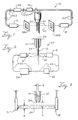
- Fig. 1 illustrates one embodiment 10 of an apparatus and a method for verifying dispense of a fluid 12 from a dispense nozzle 14.
- Dispense verification refers to obtaining information about the status of a fluid dispense, detecting a major hanging drop of fluid, checking temporal duration of a dispense, etc.
- dispense verification utilizes an electromagnetic radiation intensity measurement, possibly coupled with a temporal measurement.
- structures and method steps of one embodiment may be combined, in any suitable fashion, with structures and method steps of another embodiment to arrive at still further embodiments.
- multiple embodiments may be integrated along a processing path in a single instrument.
- the fluid 12 may be understood to be a reagent, other fluids are also possible. It may be desirable to locate an apparatus at every fluid addition location apt to cause a false result or inaccurate information being given to an instrument operator. Illustrating by example, in an analytical instrument, dispense verification apparatus may be located where particles, conjugates and/or probes are added to sample and where washes occur.
- the embodiment 10 comprises a source 16 of electromagnetic radiation and a receiver 18 operatively associated with the dispense nozzle 14.
- the source 16 and the receiver 18 are disposed with respect to the dispense nozzle 14 such that flow of fluid 12 from the nozzle 14 passes through a path 20 of electromagnetic radiation from the source 16 to the receiver 18.
- the path 20 passes through an ambient fluid, such as air. No lenses or filters are required. As will be discussed in further detail later, passage of fluid 12 through the path 20 allows for dispense verification.
- the source 16 and the receiver 18 are predetermined such that the receiver 18 generates a signal responsive to electromagnetic radiation sent from the source 16.
- the source 16 may be a light emitting diode and the like.
- the source 16 is capable of emitting electromagnetic radiation of about 900nm (infrared).
- the receiver 18, in an exemplary embodiment, may be a phototransistor and the like. If the source 16 were a diode emitting electromagnetic radiation at about 900nm, then the receiver 18 would be chosen such that a peak sensitivity of the receiver 18 would be in substantially the same range of the electromagnetic spectrum.
- the source 16 is an SEP8706-002 and the receiver 18 is an SDP8406-003, both being available from Honeywell, MICRO SWITCH, Optoelectronics Division of Richardson, Texas.
- the source 16 and the receiver 18 are electrically connected by a wire 22 to other supporting electronics, such as a controller 24 through a preamplifier 26, for instance.
- the source 16 is supplied with power at a substantially constant level.
- all embodiments may be compared against a common threshold, discussed later.
- the preamplifier 26 presents a relatively high input impedance to match the impedance of the receiver 18.
- the preamplifier 26 also presents a relatively low impedance to match the impedance of the controller 24.
- the relatively low impedance facilitates signal transmission along conduit 22 toward controller 24.
- the controller 24 comprises a processor, such as a Motorola (Schaumburg, Illinois) 68HC11F1 and the like, and a digital-to-analog converter, such as a 7228A, available from Analog Devices, Inc. of Norwood, Massachusetts, and the like. If multiple apparatuses 10 were provided, then the controller 24 can include a multiplexer, such as one handling about six outputs and about 12 inputs.
- the outputs would drive, up to about 5mA, two source 16/receiver 18 pairs connected electrically in series.
- Such a circuit can incorporate current feedback to provide a substantially linear response.
- the multiplexer is predetermined to have a frequency response sufficient for about 98% setting in about 130 microseconds. In this manner, switching of source 16 drives and multiplexer input signals would be appropriately chosen such that the 12 inputs could be read, approximately, every 1.6 msec.
- the preamplifier 26 drives two source 16/receiver 18 pairs selectively with two predetermined electrical signals.
- a first pair of source 16/receiver 18 is designated the "A" pair, while the other pair is designated the "B" pair.
- the A and B pairs are electrically connected in series with the preamplifier 26.
- the preamplifier 26 drives the A and B pairs at a predetermined electrical signal appropriate for the A pair.
- the output of the receiver 18 in the A pair is monitored.
- the preamplifier 26 drives the A and B pairs at a predetermined electrical signal for the B pair.
- the output of the B receiver 18 is monitored.
- the electrical signal driving all of the sources 16 is not constant.
- the A electrical signal is applied to the source 16 and the output of the associated receiver 18 is monitored after it settles.
- the B electrical signal is applied and the output of the B receiver 18 is monitored. This process can repeat at a rate of about 1250 times per second.
- each receiver 18 output is monitored about 625 times each second. Accordingly, during a dispense cycle, the receiver 18 output can be monitored about 80 times while the output is below the threshold. This can result in an error tolerance of about one percent.
- the controller 24 may be provided with access, such as an RS232 port, to a computer for monitoring, controlling and trouble shooting the apparatus 10.
- the computer or other electronic element operatively associated with the access may provide a feedback signal to an operator indicative of the status of dispense of fluid 12 from the dispense nozzle 14.
- the source 16 and the receiver 18 are offset from the path of fluid 12 flow from the dispense nozzle 14 by screens 28A and 28B, respectively.
- the screens 28A and 28B are constructed and located to reduce the chance that fluid 12 flowing from the dispense nozzle 14 might reach the source 16 or the receiver 18. If fluid 12 were to reach either the source 16 or the receiver 18, then the embodiment 10 may not operate as intended.
- the screens 28A and 28B may also be used if it were desired to avoid cleaning the source 16 and/or the receiver 18. In this embodiment, the screens 28A and 28B could be cleaned instead of the source 16 and receiver 18.
- Fig. 2 illustrates an embodiment 30 of an apparatus for verifying dispense of fluid 12 from dispense nozzle 14 which does not comprise screens 28A and 28B.
- the embodiment 30 is substantially similar to the embodiment 10 of Fig. 1, hence the like reference numerals for similar structures. Both embodiments 10 and 30 function substantially the same.
- the dispense nozzle 14 comprises a bore 32 having a diameter D of about 0.030 inches. Therefore, a stream of fluid 12 leaving the dispense nozzle 14 has a diameter of about 0.030 inches.
- the source 16, which illuminates relevant portions of the receiver 18 with electromagnetic radiation, and the receiver 18 are mutually exposed through an aperture having a diameter A of about 0.062 inches.
- the apertures may be formed by a suitable technique, such as machining and the like, in a mounting bracket, formed from a suitable material such as aluminum and the like, operatively associated with the source 16 and the receiver 18.
- the apertures define dimensions of a latitudinal cross section of the path 20 of electromagnetic radiation from the source 16 to the receiver 18.
- a longitudinal axis of the path 20 is offset from a fluid-exiting end 34 of the dispense nozzle 14 by a specific, predetermined distance O, shown in Fig. 3.
- the distance O is about 0.10 inches.
- the distance O is chosen so that the embodiments 10 and 30 are able to sense a significant volume of fluid 12 depending from the end 34 of the dispense nozzle 14. Put in another way, the distance O is chosen such that the embodiments 10 and 30 detect a major drop of fluid 12 and avoid a minor drop of fluid 12 depending or hanging from the end 34 of the nozzle 14.
- a major drop of fluid 12 contains a volume of fluid 12 sufficient to significantly adversely affect dispense of an intended volume of fluid 12 from the nozzle 14, whereas a minor drop of fluid 12 does not have sufficient volume of fluid 12 to significantly adversely affect dispense of an intended volume of fluid 12.
- minor hanging drops the likelihood of sensing a dispense incorrectly can be reduced.
- detecting major hanging drops is desirable because a major hanging drop can significantly affect dispense of fluid 12 from the dispense nozzle 14. If the dispense of fluid 12 were significantly affected, then it is possible that the instrument associated with the dispense nozzle 14 could give the instrument operator incorrect information about a sample being tested.
- Detection of a major hanging drop is also dependent upon a threshold applied to a signal generated by the receiver 18.
- the threshold is a predetermined percentage of electromagnetic signal (i.e. electromagnetic intensity) sent from the source 16 and received by the receiver 18.
- the threshold may be considered to represent a portion of the electromagnetic signal sent from the source 16 and blocked from reaching the receiver 18 by fluid 12 depending or dispensed from the dispense nozzle 14.
- the value of the threshold is predetermined such that the embodiments 10 and 30 can detect fluid dispense status and a major hanging drop and ignore a minor hanging drop. Determination of the threshold will be discussed in detail later.
- the embodiments 10 and 30, as well as all supporting electronics, are constructed to provide feedback dependent upon a comparison of electromagnetic intensity received by the receiver 18 with the threshold, thereby indicative of fluid dispense status and/or hanging drops, to the operator.
- the embodiments 10 and 30 could indicate presence of a hanging drop if the receiver 18 was illuminated by the source 16 at a level of less than about 90% of the level of illumination of the receiver 18 by the source 16 when no fluid 12 is present (i.e. a quiescent state).
- the embodiments 10 and 30 would indicate an erroneous dispense if the electromagnetic radiation received by the receiver 18 were to fall by about 10% from its quiescent state.
- the embodiments 10 and 30 would detect a drop of fluid 12, having a fluid volume as small as about 10 ⁇ l, for example, depending from the end 34 of the nozzle 14. In this manner, the effects of things which cause a dispense of fluid 12 from the nozzle 14 to decrease or trail off relatively slowly at the end of a dispense cycle, rather than the dispense cycle ending abruptly, can be detected.
- the source 16 is energized to produce an electromagnetic signal of predetermined characteristics.
- the electromagnetic signal travels from the source 16 along the path 20 to the receiver 18.
- the source 16 generates this electromagnetic signal substantially continuously during operation of the embodiments 10 and 30. If the embodiments 10 and 30 were included in an analytical instrument, then, in one embodiment, the source 16 would generate the electromagnetic signal throughout substantially the entire duration of analytical instrument operation.
- the receiver 18 is at the quiescent state. The electromagnetic signal received by the receiver 18 at this time is defined as the quiescent or reference signal.
- the substantially continuous operation of the source 16 allows for substantially fail-safe operation of the embodiments.
- the electromagnetic signal travels from the source 16 to the receiver 18 substantially continuously so that any deviation, as determined by the controller 24, in transmitted signal intensity, received by the receiver 18 can be used to provide feedback indicative of fluid 12 dispense from the nozzle 14 to the operator.
- the intensity of the electromagnetic signal transmitted by the source 16 and received the receiver 18 is used to determine the threshold discussed earlier. If there were multiple embodiments 10 and 30 in a given instrument, then all of the embodiments may be set to the same threshold. In an exemplary embodiment, because the flow of fluid 12 from the nozzle 14 during an intended fluid dispense cycle will pass through about half of the path 20 of electromagnetic radiation from the source 16 to the detector 18, the threshold may be selected to be about 75% of the quiescent state signal.
- the source 16 driving signal is adjusted prior to dispense of fluid 12 from the dispense nozzle 14.
- the source 16 driving signal is adjusted so that the quiescent signal is at a desired, predetermined level above the threshold.
- the source 16 driving signal can be adjusted within the range of a maximum and a minimum source 16 driving signal associated with the relevant source 16. If it were not possible to adjust the source 16 driving signal such that the quiescent signal is above the threshold by the desired amount, then an error message may be reported to an operator. Thus, functionality of the associated source 16/receiver 18 pair is verified.
- the threshold may be desirable to detect a major hanging drop. Therefore, in these embodiments, it may be desirable to set the threshold substantially within the range of about 80% to about 90% of the quiescent signal.
- the exact value of the threshold may depend on a number of factors, such as physical dimensions of the embodiments 10 and 30, characteristics of the fluid 12, etc.
- the threshold value may be determined by and stored in memory, such as a RAM, ROM, EPROM, SRAM and the like running appropriate routines, present in or associated with the controller 24.
- the controller 24 may update the threshold as necessary, thereby possibly allowing for obstructions, such as dust, other than fluid 12 in the path 20. These obstructions may accumulate over time, thereby making updating of the threshold desirable.
- fluid 12 dispense cycles can begin. As fluid 12 exits the dispense nozzle 14, the fluid 12 passes through the path 20 and correspondingly reduces the intensity of the electromagnetic signal reaching the receiver 18. The electromagnetic intensity received by the receiver 18 is monitored by the controller 24.
- the controller 24 may contain a timer to monitor duration of the reduction in received electromagnetic intensity. In these embodiments, the controller 24 monitors the time interval during which the electromagnetic intensity received by the receiver 18 is reduced below the predetermined threshold. The end of the dispense cycle is determined by the intensity received by the receiver 18 returning to a value greater than the threshold. The time between the moment the received intensity falls below the threshold and the moment the received intensity rises above the threshold is an actual temporal duration of the dispense cycle. This actual temporal duration is compared to a predetermined, expected temporal duration of the dispense cycle, which may be determined empirically. The expected temporal duration may depend on fluid 12 pump tolerances, conduit length from pump to the end 34 of the dispense nozzle 14, etc.
- an expected temporal duration may be about 124 msec. to about 144 msec. If the two temporal durations were substantially the same, then the controller 24 can cause feedback indicative of a proper dispense to be sent to the operator. If the actual and expected durations were not substantially the same, then the controller 24 can cause feedback indicative of an improper dispense to be sent to the operator.
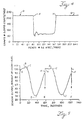
- an electronic signal generated by the receiver 18 responsive to the electromagnetic signal sent by the source 16 during a proper dispense is shown in Fig. 4.
- the threshold is set at about 90% of the quiescent signal Q and the expected temporal duration for a proper dispense is substantially within the range of 124 and 144 msec.
- the dispense cycle begins, labelled "X" in Fig. 4, and fluid 12 flowing from the dispense nozzle 14 blocks a portion of the path 20.
- the fluid 12 reduces the intensity of the electromagnetic signal received by the receiver 18.
- the received intensity is reduced sufficiently such that it falls below the predetermined threshold value. This reduction in received intensity lasts for about 138 msec (actual temporal duration).
- the dispense cycle ends, indicated by "Y” in Fig. 4
- the received intensity increases, rises above the threshold value and approaches the quiescent signal Q.
- the controller 24 compares the actual and expected temporal durations. Because the two durations are substantially identical, this dispense is a proper dispense. If desired, the controller 24 can cause a relevant feedback signal to be sent to the operator.
- Improper dispenses can have a number of causes.
- One of the causes may be a gas, i.e. air bubble and the like, in the fluid 12 path from a fluid 12 stock container to the end 34 of the dispense nozzle 14.
- gases may cause gas to be present in the fluid path.
- the fluid 12 system may have been improperly "primed"
- the fluid 12 stock container may be almost empty, connections in the fluid 12 system may leak, fluid 12 may be restricted, there may be effects due to siphoning, etc.
- the actual temporal duration may be shortened. This can occur without changing substantially the volume of fluid 12 dispensed from the dispense nozzle 14.
- the gas in the line may be compressed during initial activation of a pump forcing fluid 12 through the line supplying the dispense nozzle 14, thereby possibly causing a delay in beginning the dispense.
- the velocity of the fluid 12 leaving the end 34 of the dispense nozzle 14 may be greater than the fluid velocity generated by the pump.
- the increased fluid 12 velocity can cause the desired volume of fluid 12 to leave the dispense nozzle 14 before the expiration of the expected temporal duration. Also, the increased fluid 12 velocity can cause fluid 12 to splash into unintended places.
- Build-up of fluid 12 residue which may be caused by fluid 12 evaporating from the end 34 of the nozzle 14, may direct fluid 12 from the end 34 of the dispense nozzle 14 in an unintended direction. Misdirection of fluid 12 from the end 34 of the dispense nozzle 14 during a dispense cycle may result in an improper dispense which is also detectable by the embodiment 10.
- the embodiment 10 can also verify that fluid 12 was dispensed from the dispense nozzle 14 in an intended path or direction.
- Another cause of improper dispenses may be a drop of fluid 12 depending or hanging from the end 34 of the dispense nozzle.
- the hanging drop may be formed by fluid pressure being relieved through the dispense nozzle 14. This may be caused by a "kink" or other restriction in the fluid line supplying fluid 12 to the dispense nozzle 14.
- a hanging drop may become a restriction to fluid 12 leaving the nozzle 14 through the end 34.
- the fluid 12 comprising the drop may dry on the dispense nozzle 14.
- fluid 12 hanging from the end 34 of the nozzle 14 in the form of a drop may fall off of the end 34 of the nozzle 14 at an unadvantageous time. The falling drop may cause erroneous information to be given to the operator. Thus, it is recommended that all data associated with tests involving an improper dispense be discarded.
- an electronic signal generated by the receiver 18 responsive to the electromagnetic signal sent by the source 16 during an improper dispense is shown in Fig. 5.
- the threshold and the expected temporal durations are assumed to be the same as described above.
- the improper dispense in this example, is the result of a major hanging drop.
- the major hanging drop may have been caused by fluid 12 slowing leaking from the end 34 of the dispense nozzle 14. This may be indicative of a defect in the nozzle 14 or in the conduit supplying fluid 12 to the nozzle 14.
- the received signal is at about the quiescent signal. As time progresses, more fluid 12 leaks from the end 34 of the nozzle 14. A drop begins to form at the end 34. The drop of fluid 12 directs stray light back into the path 20 of electromagnetic radiation from the source 16 to the receiver 18. The direction of stray light into the path 20 causes the received intensity to increase, as shown at B.
- the received intensity increases until a portion of the drop of fluid 12 depending from the end 34 of the nozzle 14 begins to obstruct a portion of the path 20 between the source 16 and the receiver 18. At this point C, the received intensity of electromagnetic intensity begins to decrease. The received intensity decreases until the drop of fluid 12 is sufficient to substantially focus or direct electromagnetic radiation from the source 16 onto the receiver 18. As shown, the received intensity increases due to the redirection effected by the drop of fluid 12 hanging from the end 34 of the dispense nozzle 14.
- the size of the hanging drop continues to grow as more and more fluid 12 leaks from the dispense nozzle 14.
- the size of the drop increases until forces of the system, e.g. gravity, surface tension, adhesion, etc., are insufficient to maintain the drop of fluid 12 on the end 34 of the dispense nozzle 14.
- forces of the system e.g. gravity, surface tension, adhesion, etc.
- the drop falls off of the end 34 of the dispense nozzle 14.
- the received intensity increases, labelled F, toward the quiescent signal. Because fluid 12 continues to leak from the end 34 of the nozzle 14, the above-described behavior repeats.
- any conditions relevant to a fluid 12 dispense from the dispense nozzle 14 can be monitored by the embodiments 10 and 30 with appropriate modifications to the disclosed structures.
- the distance between the end 34 of the dispense nozzle 14 and the longitudinal mid line of the path 20 may be determined to allow detection of minor hanging drops.
- the threshold may be predetermined to allow detection of air bubbles, clots, inhomogeneities, etc. in the dispensed fluid 12 as it flows from the end 34 of the dispense nozzle 14.
- the present invention provides for particular advantages in an embodiment wherein there is provided a method for verifying dispense of fluid from a dispense nozzle, the method comprising the steps of: obstructing a path of electromagnetic radiation from a source to a receiver with the fluid dispensed from the dispense nozzle; measuring the intensity of the electromagnetic radiation received by the receiver; and comparing the measured intensity with a predetermined intensity to verify the dispense of fluid from the dispense nozzle.
- the above method provides for particular advantages when it further comprises the step of: updating the predetermined intensity; and/or measuring a time period during which the measured intensity is less than about the predetermined intensity; and/or verifying that the fluid dispensed from the dispense nozzle followed a predetermined path.
Landscapes
- Physics & Mathematics (AREA)
- Health & Medical Sciences (AREA)
- Life Sciences & Earth Sciences (AREA)
- Chemical & Material Sciences (AREA)
- Analytical Chemistry (AREA)
- Biochemistry (AREA)
- General Health & Medical Sciences (AREA)
- General Physics & Mathematics (AREA)
- Immunology (AREA)
- Pathology (AREA)
- Automatic Analysis And Handling Materials Therefor (AREA)
- Loading And Unloading Of Fuel Tanks Or Ships (AREA)
- Application Of Or Painting With Fluid Materials (AREA)
- Infusion, Injection, And Reservoir Apparatuses (AREA)
- Sampling And Sample Adjustment (AREA)
Applications Claiming Priority (3)
| Application Number | Priority Date | Filing Date | Title |
|---|---|---|---|
| US332307 | 1994-10-31 | ||
| US08/332,307 US5559339A (en) | 1994-10-31 | 1994-10-31 | Method and apparatus for verifying dispense of a fluid from a dispense nozzle |
| EP95939513A EP0789845B1 (de) | 1994-10-31 | 1995-10-06 | Verfahren und vorrichtung zur überprüfung der abgabe von flüssigkeiten |
Related Parent Applications (2)
| Application Number | Title | Priority Date | Filing Date |
|---|---|---|---|
| EP95939513A Division EP0789845B1 (de) | 1994-10-31 | 1995-10-06 | Verfahren und vorrichtung zur überprüfung der abgabe von flüssigkeiten |
| EP95939513A Division-Into EP0789845B1 (de) | 1994-10-31 | 1995-10-06 | Verfahren und vorrichtung zur überprüfung der abgabe von flüssigkeiten |
Publications (3)
| Publication Number | Publication Date |
|---|---|
| EP1202066A2 true EP1202066A2 (de) | 2002-05-02 |
| EP1202066A3 EP1202066A3 (de) | 2002-07-31 |
| EP1202066B1 EP1202066B1 (de) | 2008-12-10 |
Family
ID=23297658
Family Applications (2)
| Application Number | Title | Priority Date | Filing Date |
|---|---|---|---|
| EP02000782A Expired - Lifetime EP1202066B1 (de) | 1994-10-31 | 1995-10-06 | Verfahren zur Uberprüfung der Abgabe von Flüssigkeiten |
| EP95939513A Expired - Lifetime EP0789845B1 (de) | 1994-10-31 | 1995-10-06 | Verfahren und vorrichtung zur überprüfung der abgabe von flüssigkeiten |
Family Applications After (1)
| Application Number | Title | Priority Date | Filing Date |
|---|---|---|---|
| EP95939513A Expired - Lifetime EP0789845B1 (de) | 1994-10-31 | 1995-10-06 | Verfahren und vorrichtung zur überprüfung der abgabe von flüssigkeiten |
Country Status (7)
| Country | Link |
|---|---|
| US (1) | US5559339A (de) |
| EP (2) | EP1202066B1 (de) |
| JP (1) | JP3213325B2 (de) |
| AT (2) | ATE231974T1 (de) |
| DE (2) | DE69529531T2 (de) |
| ES (2) | ES2316493T3 (de) |
| WO (1) | WO1996013726A1 (de) |
Cited By (1)
| Publication number | Priority date | Publication date | Assignee | Title |
|---|---|---|---|---|
| EP1760472A1 (de) * | 2005-08-29 | 2007-03-07 | Sysmex Corporation | Verfahren und Vorrichtung zur Überwachung des Aufsaugens einer Flüssigkeit |
Families Citing this family (50)
| Publication number | Priority date | Publication date | Assignee | Title |
|---|---|---|---|---|
| US6235242B1 (en) * | 1997-09-25 | 2001-05-22 | Robert A. Small | Sample size characterization technique and apparatus for liquid analysis |
| EP0982593B1 (de) * | 1998-08-17 | 2005-12-07 | F. Hoffmann-La Roche Ag | Verfahren zur Ueberwachung von Pipettiervorgängen |
| US6350006B1 (en) * | 1998-11-17 | 2002-02-26 | Pitney Bowes Inc. | Optical ink drop detection apparatus and method for monitoring operation of an ink jet printhead |
| US6612676B1 (en) | 1998-11-17 | 2003-09-02 | Pitney Bowes Inc. | Apparatus and method for real-time measurement of digital print quality |
| US6604807B1 (en) * | 1999-02-18 | 2003-08-12 | Hewlett-Packard Company | Method and apparatus for detecting anomalous nozzles in an ink jet printer device |
| EP1099484B1 (de) | 1999-11-11 | 2006-06-07 | The Provost, Fellows And Scholars Of The College Of The Holy And Undivided Trinity Of Queen Elizabeth Near Dublin | Vorrichtung und Verfahren zur Verabreichung von Tropfen |
| US6347976B1 (en) | 1999-11-30 | 2002-02-19 | The Boeing Company | Coating removal system having a solid particle nozzle with a detector for detecting particle flow and associated method |
| JP4717312B2 (ja) | 2000-02-29 | 2011-07-06 | ジェン−プローブ・インコーポレイテッド | 流体搬送プローブ |
| AU2005211570B2 (en) * | 2000-02-29 | 2007-01-04 | Gen-Probe Incorporated | Fluid dispense and fluid surface verification system and method |
| GB0012184D0 (en) * | 2000-05-22 | 2000-07-12 | Ibm | Suface analysis |
| US6617079B1 (en) * | 2000-06-19 | 2003-09-09 | Mykrolis Corporation | Process and system for determining acceptibility of a fluid dispense |
| US20020168297A1 (en) * | 2001-05-11 | 2002-11-14 | Igor Shvets | Method and device for dispensing of droplets |
| US7198073B2 (en) * | 2002-07-26 | 2007-04-03 | Gfi, Innovations | Methodology and apparatus for storing and dispensing liquid components to create custom formulations |
| US20060048841A1 (en) * | 2002-07-26 | 2006-03-09 | Gfi Innovations, Llc | Methodology and apparatus for storing and dispensing liquid components to create custom formulations |
| US7114368B2 (en) * | 2003-04-08 | 2006-10-03 | Abbott Laboratories | Apparatus and method for verifying the volume of liquid dispensed by a liquid-dispensing mechanism |
| DE102005010847B4 (de) * | 2005-03-07 | 2007-08-02 | Rea Elektronik Gmbh | Vorrichtung zur Messung einer austretenden Flüssigkeit |
| US7403125B2 (en) * | 2005-05-06 | 2008-07-22 | Accuri Cytometers, Inc. | Flow cytometry system with bubble detection |
| US8017402B2 (en) | 2006-03-08 | 2011-09-13 | Accuri Cytometers, Inc. | Fluidic system for a flow cytometer |
| US8303894B2 (en) | 2005-10-13 | 2012-11-06 | Accuri Cytometers, Inc. | Detection and fluidic system of a flow cytometer |
| US7780916B2 (en) * | 2006-03-08 | 2010-08-24 | Accuri Cytometers, Inc. | Flow cytometer system with unclogging feature |
| US8283177B2 (en) * | 2006-03-08 | 2012-10-09 | Accuri Cytometers, Inc. | Fluidic system with washing capabilities for a flow cytometer |
| JP4906416B2 (ja) | 2006-07-11 | 2012-03-28 | 日本碍子株式会社 | 物体の通過検出装置 |
| US8715573B2 (en) | 2006-10-13 | 2014-05-06 | Accuri Cytometers, Inc. | Fluidic system for a flow cytometer with temporal processing |
| US8445286B2 (en) | 2006-11-07 | 2013-05-21 | Accuri Cytometers, Inc. | Flow cell for a flow cytometer system |
| EP1946843A1 (de) * | 2006-12-21 | 2008-07-23 | Allegro Research Limited | Vorrichtung und Verfahren zum Überwachen und Messen von Tröpfchen |
| US8432541B2 (en) * | 2007-12-17 | 2013-04-30 | Accuri Cytometers, Inc. | Optical system for a flow cytometer with an interrogation zone |
| DE102008016513B4 (de) * | 2008-03-31 | 2012-12-20 | Bartels Mikrotechnik Gmbh | Vorrichtung und Verfahren zum exakten Dosieren von Flüssigkeiten |
| US7804599B2 (en) * | 2008-07-24 | 2010-09-28 | MGM Instruments, Inc. | Fluid volume verification system |
| US8507279B2 (en) * | 2009-06-02 | 2013-08-13 | Accuri Cytometers, Inc. | System and method of verification of a prepared sample for a flow cytometer |
| US20110061471A1 (en) * | 2009-06-02 | 2011-03-17 | Rich Collin A | System and method of verification of a sample for a flow cytometer |
| US9551600B2 (en) | 2010-06-14 | 2017-01-24 | Accuri Cytometers, Inc. | System and method for creating a flow cytometer network |
| EP2633284B1 (de) | 2010-10-25 | 2021-08-25 | Accuri Cytometers, Inc. | Systeme und benutzeroberfläche zur sammlung eines datensatzes in einem durchflusszytometer |
| US9010580B2 (en) * | 2010-10-29 | 2015-04-21 | Whirlpool Corporation | Stream detection and/or characterization for beverage dispensing in a refrigerator |
| US20130074982A1 (en) * | 2011-09-28 | 2013-03-28 | Gfi Innovations, Inc. | Methodology and Apparatus for Storing and Dispensing Liquid Components to Create Custom Formulations |
| US10504758B2 (en) * | 2014-02-14 | 2019-12-10 | Taiwan Semiconductor Manufacturing Company Ltd. | Nozzle having real time inspection functions |
| CA3012489C (en) * | 2016-02-29 | 2023-01-31 | Ventana Medical Systems, Inc. | System and method for dispense characterization |
| US10072962B2 (en) * | 2016-07-05 | 2018-09-11 | Ecolab Usa Inc. | Liquid out-of-product alarm system and method |
| DE102016114607B4 (de) * | 2016-08-05 | 2025-03-20 | Infineon Technologies Ag | Flüssigkeitsabgabesystem, -Vorrichtung und -Verfahren |
| EP3501335B1 (de) | 2017-12-20 | 2020-06-17 | The Gillette Company LLC | Zahnbürste |
| EP3524093A1 (de) | 2018-02-09 | 2019-08-14 | The Gillette Company LLC | Verfahren zur herstellung eines mundpflegegeräts |
| PL3524091T3 (pl) | 2018-02-09 | 2025-06-23 | The Gillette Company Llc | Ręczne narzędzie do higieny jamy ustnej |
| US11659922B2 (en) | 2018-09-03 | 2023-05-30 | The Gillette Company, LLC. | Head for an oral-care implement and a kit comprising such head |
| EP3616561B1 (de) | 2018-09-03 | 2022-09-28 | The Gillette Company LLC | Kopf für ein mundpflegegerät und kit mit solch einem kopf |
| EP3714732B1 (de) | 2019-03-29 | 2024-11-20 | The Gillette Company LLC | Kopf für eine mundpflegevorrichtung sowie mundpflegevorrichtung |
| EP3818904B1 (de) | 2019-11-06 | 2024-12-18 | The Gillette Company LLC | Griff für ein elektrisch betriebenes körperpflegegerät |
| EP3995042B1 (de) | 2020-11-06 | 2025-06-04 | The Gillette Company LLC | Griff für ein körperpflegegerät sowie körperpflegegerät |
| EP3995039B1 (de) | 2020-11-06 | 2023-11-08 | The Gillette Company LLC | Griff für ein körperpflegegerät sowie körperpflegegerät |
| EP3995037B1 (de) | 2020-11-06 | 2025-04-16 | The Gillette Company LLC | Griff für ein körperpflegegerät sowie körperpflegegerät |
| EP3995038B1 (de) | 2020-11-06 | 2025-05-14 | The Gillette Company LLC | Griff für ein körperpflegegerät sowie körperpflegegerät |
| PL3995040T3 (pl) | 2020-11-06 | 2025-06-16 | The Gillette Company Llc | Rękojeść urządzenia do higieny osobistej i urządzenie do higieny osobistej |
Family Cites Families (37)
| Publication number | Priority date | Publication date | Assignee | Title |
|---|---|---|---|---|
| BE568988A (de) * | 1957-05-23 | |||
| US3143393A (en) * | 1959-06-18 | 1964-08-04 | Luc Donald De Seguin Des Hons | Apparatus for automatically performing chemical operations and similar or related operations |
| US3600953A (en) * | 1969-07-25 | 1971-08-24 | Technicon Corp | Method and apparatus for the introduction of auxiliary separating fluid in fluid sample analyses means |
| US3759667A (en) * | 1971-10-22 | 1973-09-18 | Damon Corp | Apparatus for aspirating precise volumes of fluid sample |
| DE2219862A1 (de) * | 1972-04-22 | 1973-10-31 | Hans Dr Haug | Verfahren und vorrichtung zum verteilen von fluessigkeitsproben, insbesondere serumproben auf dem gebiet der klinischen chemie |
| US3874850A (en) * | 1972-07-24 | 1975-04-01 | Radiometer As | Blood analyzing method and apparatus |
| US3994423A (en) * | 1973-06-28 | 1976-11-30 | American Hospital Supply Corporation | Drop dispensing apparatus for laboratory reagents |
| US3929413A (en) * | 1974-03-04 | 1975-12-30 | Anatronics Corp | Fluid transport and metering system |
| US4253846A (en) * | 1979-11-21 | 1981-03-03 | Technicon Instruments Corporation | Method and apparatus for automated analysis of fluid samples |
| US4344429A (en) * | 1979-12-13 | 1982-08-17 | Baxter Travenol Laboratories, Inc. | Bubble detector with feedback circuit for improved sensitivity |
| US4312341A (en) * | 1979-12-13 | 1982-01-26 | Baxter Travenol Laboratories, Inc. | Bubble detector |
| US4372150A (en) * | 1980-06-05 | 1983-02-08 | Beckman Instruments, Inc. | Flow monitoring method and apparatus |
| JPS5811859A (ja) * | 1981-07-16 | 1983-01-22 | Olympus Optical Co Ltd | 分注検出装置 |
| US4420566A (en) * | 1982-06-10 | 1983-12-13 | Eastman Kodak Company | Method and apparatus for detecting sample fluid on an analysis slide |
| JPS595933A (ja) * | 1982-07-02 | 1984-01-12 | Hitachi Ltd | 液体試料のフロ−分析方法 |
| JPS5919858A (ja) * | 1982-07-26 | 1984-02-01 | Sanuki Kogyo Kk | 自動分析処理装置 |
| US4526754A (en) * | 1982-07-30 | 1985-07-02 | Technicon Instruments Corporation | Sample transport system |
| US4853336A (en) * | 1982-11-15 | 1989-08-01 | Technicon Instruments Corporation | Single channel continuous flow system |
| US4517302A (en) * | 1982-11-15 | 1985-05-14 | Technicon Instruments Corporation | Continuous flow metering apparatus |
| DE3344387A1 (de) * | 1983-12-08 | 1985-06-20 | Hoechst Ag, 6230 Frankfurt | Photometerkopf fuer kleine messvolumina |
| JPS61231461A (ja) * | 1985-04-05 | 1986-10-15 | Fuji Photo Film Co Ltd | 試料液点着装置 |
| US4774055A (en) * | 1985-06-26 | 1988-09-27 | Japan Tectron Instruments Corporation | Automatic analysis apparatus |
| US4640821A (en) * | 1985-07-16 | 1987-02-03 | Fisher Scientific Company | Analysis apparatus |
| US4691580A (en) * | 1986-01-08 | 1987-09-08 | Egil Fosslien | Fluid sampling apparatus |
| US4703314A (en) * | 1986-02-27 | 1987-10-27 | Fisher Scientific Group, Inc. | Empty container detector with drop sensor |
| US4752690A (en) * | 1986-08-11 | 1988-06-21 | Coulter Electronics, Inc. | Method and apparatus for detecting incongruities, such as air bubbles, in fluid material |
| US4935346A (en) * | 1986-08-13 | 1990-06-19 | Lifescan, Inc. | Minimum procedure system for the determination of analytes |
| DD255002A1 (de) * | 1986-12-17 | 1988-03-16 | Medizin Labortechnik Veb K | Verfahren und vorrichtung zur erzeugung eines probenstroms fuer kontinuierliche analysenautomaten |
| US4861553A (en) * | 1987-06-11 | 1989-08-29 | Technicon Instruments Corporation | Automatic sampling system |
| US4896545A (en) * | 1988-04-22 | 1990-01-30 | Dynatech Precision Sampling Corporation | Automatic fluid injector |
| US5067092A (en) * | 1990-01-24 | 1991-11-19 | Eastman Kodak Company | Prespot detection method and apparatus in an analyzer |
| US5094961A (en) * | 1990-12-13 | 1992-03-10 | Coulter Corporation | Aspiration method for hematology analyzing apparatus |
| JPH05223830A (ja) * | 1991-04-04 | 1993-09-03 | Olympus Optical Co Ltd | 分注量検出装置および方法 |
| JP2539126Y2 (ja) * | 1991-08-26 | 1997-06-25 | 東亜医用電子株式会社 | 自動調整機能を備えた試料吸引監視装置 |
| JP3230277B2 (ja) * | 1992-05-15 | 2001-11-19 | 東ソー株式会社 | 液体の排出モニタ−方法及びそのための装置 |
| US5352887A (en) * | 1992-08-28 | 1994-10-04 | Motorola, Inc. | Circuit for detecting a droplet in motion and method therefor |
| US5434430A (en) * | 1993-04-30 | 1995-07-18 | Hewlett-Packard Company | Drop size detect circuit |
-
1994
- 1994-10-31 US US08/332,307 patent/US5559339A/en not_active Expired - Lifetime
-
1995
- 1995-10-06 AT AT95939513T patent/ATE231974T1/de not_active IP Right Cessation
- 1995-10-06 EP EP02000782A patent/EP1202066B1/de not_active Expired - Lifetime
- 1995-10-06 ES ES02000782T patent/ES2316493T3/es not_active Expired - Lifetime
- 1995-10-06 DE DE69529531T patent/DE69529531T2/de not_active Expired - Lifetime
- 1995-10-06 ES ES95939513T patent/ES2191718T3/es not_active Expired - Lifetime
- 1995-10-06 JP JP51461196A patent/JP3213325B2/ja not_active Expired - Fee Related
- 1995-10-06 DE DE69535896T patent/DE69535896D1/de not_active Expired - Lifetime
- 1995-10-06 EP EP95939513A patent/EP0789845B1/de not_active Expired - Lifetime
- 1995-10-06 WO PCT/US1995/013091 patent/WO1996013726A1/en not_active Ceased
- 1995-10-06 AT AT02000782T patent/ATE417277T1/de not_active IP Right Cessation
Cited By (3)
| Publication number | Priority date | Publication date | Assignee | Title |
|---|---|---|---|---|
| EP1760472A1 (de) * | 2005-08-29 | 2007-03-07 | Sysmex Corporation | Verfahren und Vorrichtung zur Überwachung des Aufsaugens einer Flüssigkeit |
| US8252235B2 (en) | 2005-08-29 | 2012-08-28 | Sysmex Corporation | Monitoring method, monitoring apparatus, and liquid sample analyzer |
| US8821791B2 (en) | 2005-08-29 | 2014-09-02 | Sysmex Corporation | Monitoring method, monitoring apparatus and liquid sample analyzer |
Also Published As
| Publication number | Publication date |
|---|---|
| JPH10506998A (ja) | 1998-07-07 |
| ES2316493T3 (es) | 2009-04-16 |
| EP1202066B1 (de) | 2008-12-10 |
| DE69529531T2 (de) | 2003-11-20 |
| EP0789845B1 (de) | 2003-01-29 |
| ES2191718T3 (es) | 2003-09-16 |
| EP0789845A1 (de) | 1997-08-20 |
| DE69529531D1 (de) | 2003-03-06 |
| EP1202066A3 (de) | 2002-07-31 |
| WO1996013726A1 (en) | 1996-05-09 |
| US5559339A (en) | 1996-09-24 |
| JP3213325B2 (ja) | 2001-10-02 |
| DE69535896D1 (de) | 2009-01-22 |
| ATE231974T1 (de) | 2003-02-15 |
| ATE417277T1 (de) | 2008-12-15 |
Similar Documents
| Publication | Publication Date | Title |
|---|---|---|
| US5559339A (en) | Method and apparatus for verifying dispense of a fluid from a dispense nozzle | |
| US6372506B1 (en) | Apparatus and method for verifying drop delay in a flow cytometer | |
| EP1059535B1 (de) | Verfahren zum Verifizieren eines aspirierten Flüssigkeitsvolumens in einem Automatisiertem Diagnostiksystem | |
| US4318483A (en) | Automatic relative droplet charging time delay system for an electrostatic particle sorting system using a relatively moveable stream surface sensing system | |
| EP0753750B1 (de) | Verfahren und Vorrichtung zum Aufsaugen und Abgeben von Probenflüssigkeiten | |
| US5670946A (en) | Smoke detector sensitivity testing apparatus | |
| US5540081A (en) | Pipetting apparatus with clot detection | |
| US6203759B1 (en) | Microvolume liquid handling system | |
| EP1316802B1 (de) | Verfahren zur Analyse der Blutkoagluationsreaktion | |
| US4317520A (en) | Servo system to control the spatial position of droplet formation of a fluid jet in a cell sorting apparatus | |
| EP1036335A1 (de) | Verfahren zur verifikation des aufgesaugten volumens in einem automatischen diagnostischen system | |
| JPH0217448A (ja) | 空気式検出方式 | |
| EP0857295B1 (de) | Automatisiertes immunotest-verarbeitungssystem | |
| EP0075440B1 (de) | Verfahren und Vorrichtung zum Mischen von Reagenzien | |
| EP0042337B1 (de) | Verfahren und Vorrichtung zum Dosieren biologischer Flüssigkeiten | |
| JPH05223830A (ja) | 分注量検出装置および方法 | |
| CA2202649C (en) | Method and apparatus for dispense verification | |
| JP2013044692A (ja) | 分注機構及びこれを用いた自動分析装置 | |
| JP3119773U (ja) | 自動分析装置 | |
| US5763795A (en) | Sampling apparatus | |
| JP3365806B2 (ja) | 自動分注装置 | |
| JP3926546B2 (ja) | 点着検出方法および点着検出装置 | |
| JP2688163B2 (ja) | 分注装置 | |
| JP2001242182A (ja) | 自動分析装置のサンプル分注装置 | |
| JPH052025A (ja) | 分注量検出装置及びその方法 |
Legal Events
| Date | Code | Title | Description |
|---|---|---|---|
| PUAI | Public reference made under article 153(3) epc to a published international application that has entered the european phase |
Free format text: ORIGINAL CODE: 0009012 |
|
| AC | Divisional application: reference to earlier application |
Ref document number: 789845 Country of ref document: EP |
|
| AK | Designated contracting states |
Kind code of ref document: A2 Designated state(s): AT BE CH DE ES FR GB IT LI NL |
|
| PUAL | Search report despatched |
Free format text: ORIGINAL CODE: 0009013 |
|
| AK | Designated contracting states |
Kind code of ref document: A3 Designated state(s): AT BE CH DE ES FR GB IT LI NL |
|
| 17P | Request for examination filed |
Effective date: 20030108 |
|
| AKX | Designation fees paid |
Designated state(s): AT BE CH DE ES FR GB IT LI NL |
|
| 17Q | First examination report despatched |
Effective date: 20060823 |
|
| GRAP | Despatch of communication of intention to grant a patent |
Free format text: ORIGINAL CODE: EPIDOSNIGR1 |
|
| GRAS | Grant fee paid |
Free format text: ORIGINAL CODE: EPIDOSNIGR3 |
|
| GRAA | (expected) grant |
Free format text: ORIGINAL CODE: 0009210 |
|
| AC | Divisional application: reference to earlier application |
Ref document number: 0789845 Country of ref document: EP Kind code of ref document: P |
|
| AK | Designated contracting states |
Kind code of ref document: B1 Designated state(s): AT BE CH DE ES FR GB IT LI NL |
|
| REG | Reference to a national code |
Ref country code: GB Ref legal event code: FG4D |
|
| REG | Reference to a national code |
Ref country code: CH Ref legal event code: EP |
|
| REF | Corresponds to: |
Ref document number: 69535896 Country of ref document: DE Date of ref document: 20090122 Kind code of ref document: P |
|
| REG | Reference to a national code |
Ref country code: ES Ref legal event code: FG2A Ref document number: 2316493 Country of ref document: ES Kind code of ref document: T3 |
|
| PG25 | Lapsed in a contracting state [announced via postgrant information from national office to epo] |
Ref country code: NL Free format text: LAPSE BECAUSE OF FAILURE TO SUBMIT A TRANSLATION OF THE DESCRIPTION OR TO PAY THE FEE WITHIN THE PRESCRIBED TIME-LIMIT Effective date: 20081210 |
|
| NLV1 | Nl: lapsed or annulled due to failure to fulfill the requirements of art. 29p and 29m of the patents act | ||
| PG25 | Lapsed in a contracting state [announced via postgrant information from national office to epo] |
Ref country code: BE Free format text: LAPSE BECAUSE OF FAILURE TO SUBMIT A TRANSLATION OF THE DESCRIPTION OR TO PAY THE FEE WITHIN THE PRESCRIBED TIME-LIMIT Effective date: 20081210 |
|
| PG25 | Lapsed in a contracting state [announced via postgrant information from national office to epo] |
Ref country code: AT Free format text: LAPSE BECAUSE OF FAILURE TO SUBMIT A TRANSLATION OF THE DESCRIPTION OR TO PAY THE FEE WITHIN THE PRESCRIBED TIME-LIMIT Effective date: 20081210 |
|
| PLBE | No opposition filed within time limit |
Free format text: ORIGINAL CODE: 0009261 |
|
| STAA | Information on the status of an ep patent application or granted ep patent |
Free format text: STATUS: NO OPPOSITION FILED WITHIN TIME LIMIT |
|
| 26N | No opposition filed |
Effective date: 20090911 |
|
| REG | Reference to a national code |
Ref country code: CH Ref legal event code: PL |
|
| PG25 | Lapsed in a contracting state [announced via postgrant information from national office to epo] |
Ref country code: CH Free format text: LAPSE BECAUSE OF NON-PAYMENT OF DUE FEES Effective date: 20091031 Ref country code: LI Free format text: LAPSE BECAUSE OF NON-PAYMENT OF DUE FEES Effective date: 20091031 |
|
| PGFP | Annual fee paid to national office [announced via postgrant information from national office to epo] |
Ref country code: GB Payment date: 20130925 Year of fee payment: 19 |
|
| PGFP | Annual fee paid to national office [announced via postgrant information from national office to epo] |
Ref country code: FR Payment date: 20130924 Year of fee payment: 19 Ref country code: DE Payment date: 20131031 Year of fee payment: 19 |
|
| PGFP | Annual fee paid to national office [announced via postgrant information from national office to epo] |
Ref country code: IT Payment date: 20131016 Year of fee payment: 19 Ref country code: ES Payment date: 20131011 Year of fee payment: 19 |
|
| REG | Reference to a national code |
Ref country code: DE Ref legal event code: R119 Ref document number: 69535896 Country of ref document: DE |
|
| GBPC | Gb: european patent ceased through non-payment of renewal fee |
Effective date: 20141006 |
|
| PG25 | Lapsed in a contracting state [announced via postgrant information from national office to epo] |
Ref country code: DE Free format text: LAPSE BECAUSE OF NON-PAYMENT OF DUE FEES Effective date: 20150501 Ref country code: GB Free format text: LAPSE BECAUSE OF NON-PAYMENT OF DUE FEES Effective date: 20141006 |
|
| REG | Reference to a national code |
Ref country code: FR Ref legal event code: ST Effective date: 20150630 |
|
| PG25 | Lapsed in a contracting state [announced via postgrant information from national office to epo] |
Ref country code: IT Free format text: LAPSE BECAUSE OF NON-PAYMENT OF DUE FEES Effective date: 20141006 Ref country code: FR Free format text: LAPSE BECAUSE OF NON-PAYMENT OF DUE FEES Effective date: 20141031 |
|
| REG | Reference to a national code |
Ref country code: ES Ref legal event code: FD2A Effective date: 20151127 |
|
| PG25 | Lapsed in a contracting state [announced via postgrant information from national office to epo] |
Ref country code: ES Free format text: LAPSE BECAUSE OF NON-PAYMENT OF DUE FEES Effective date: 20141007 |