EP1206247B1 - Composition pharmaceutique flottante comprenant une phase active et une phase non active - Google Patents
Composition pharmaceutique flottante comprenant une phase active et une phase non active Download PDFInfo
- Publication number
- EP1206247B1 EP1206247B1 EP00956599A EP00956599A EP1206247B1 EP 1206247 B1 EP1206247 B1 EP 1206247B1 EP 00956599 A EP00956599 A EP 00956599A EP 00956599 A EP00956599 A EP 00956599A EP 1206247 B1 EP1206247 B1 EP 1206247B1
- Authority
- EP
- European Patent Office
- Prior art keywords
- phase
- active
- layer
- tablet
- active phase
- Prior art date
- Legal status (The legal status is an assumption and is not a legal conclusion. Google has not performed a legal analysis and makes no representation as to the accuracy of the status listed.)
- Expired - Lifetime
Links
Images

Classifications
-
- A—HUMAN NECESSITIES
- A61—MEDICAL OR VETERINARY SCIENCE; HYGIENE
- A61K—PREPARATIONS FOR MEDICAL, DENTAL OR TOILETRY PURPOSES
- A61K9/00—Medicinal preparations characterised by special physical form
- A61K9/0012—Galenical forms characterised by the site of application
- A61K9/0053—Mouth and digestive tract, i.e. intraoral and peroral administration
- A61K9/0065—Forms with gastric retention, e.g. floating on gastric juice, adhering to gastric mucosa, expanding to prevent passage through the pylorus
-
- A—HUMAN NECESSITIES
- A61—MEDICAL OR VETERINARY SCIENCE; HYGIENE
- A61K—PREPARATIONS FOR MEDICAL, DENTAL OR TOILETRY PURPOSES
- A61K9/00—Medicinal preparations characterised by special physical form
- A61K9/0002—Galenical forms characterised by the drug release technique; Application systems commanded by energy
- A61K9/0007—Effervescent
-
- A—HUMAN NECESSITIES
- A61—MEDICAL OR VETERINARY SCIENCE; HYGIENE
- A61K—PREPARATIONS FOR MEDICAL, DENTAL OR TOILETRY PURPOSES
- A61K9/00—Medicinal preparations characterised by special physical form
- A61K9/20—Pills, tablets, discs, rods
- A61K9/2072—Pills, tablets, discs, rods characterised by shape, structure or size; Tablets with holes, special break lines or identification marks; Partially coated tablets; Disintegrating flat shaped forms
- A61K9/2086—Layered tablets, e.g. bilayer tablets; Tablets of the type inert core-active coat
Definitions
- the present invention relates to a floating pharmaceutical composition consisting of at least a first phase comprising at least one active ingredient very strongly assayed in combination with one or more excipients and at least one second phase comprising at least one system generating a gas.
- the invention also relates to tablets comprising such a pharmaceutical composition and a process for preparing such tablets.
- compositions formulated in the form of floating tablets are known in the state of the art.
- floating tablets have been obtained by acting on the density of the total composition, for example by varying the weight ratios between different excipient polymers such as carboxymethylcellulose, ethylcellulose, crosslinked povidone, or chitosan, compound well known for its low density and its muco-adhesive properties.
- excipient polymers such as carboxymethylcellulose, ethylcellulose, crosslinked povidone, or chitosan, compound well known for its low density and its muco-adhesive properties.
- Another technical solution has been to use, among the excipients, a porous mineral material such as calcium silicate, in which air has been trapped in the pores, the tablets then being covered with a polymer such as hydroxypropylcellulose or ethylcellulose for retaining air within the porous mineral matrix.
- a porous mineral material such as calcium silicate
- Gelatin capsules filled with an inert gas or filled with a substance containing inert gas bubbles have also been used in the state of the art.
- microspheres of hollow polycarbonate resin loaded with the active ingredient or hollow microspheres containing the active ingredient in the presence of Eudragit-S, which are perfect spheres of 500 to 1000 microns. diameter capable of floating more than twelve hours in an acid medium in a solution of Tween-20 at 0.02%.
- Another strategy has been to obtain a decrease in the density of the tablet at the time of use, by incorporating into the pharmaceutical composition compounds capable of releasing a gas which remains at least partly trapped within this tablet. and that will allow it to float on the surface of the gastric juice, in the stomach.
- the requests EP 0 795 324 and EP 0 235 718 disclose multilayer gastric residence pharmaceutical compositions comprising an active ingredient and hydrophilic polymers.
- Requirement PCT No. WO 98/47506 discloses a gastric residence pharmaceutical composition
- a gastric residence pharmaceutical composition comprising an active ingredient of the benzamide family in combination with a hydrophilic polymer or a porous mineral matrix and a carbon dioxide generating system.
- Such a pharmaceutical composition may be suitable for low doses of active principle, in particular when the dose of active principle in the tablet does not exceed 500 mg, as is generally the case for benzamides.
- it has been observed for such compositions a modification of the dissolution profile of the active principle, compared to conventional pharmaceutical compositions containing no gas generating system.
- gas-generating system and the active ingredient are in the form of an intimate mixture is likely to favor the interactions between the active ingredient and the other ingredients of the pharmaceutical composition, which may lead to an alteration. chemical, at least partial, of the active ingredient and therefore a significant decrease in the therapeutic effectiveness of the composition as well as long-term preservation problems.
- the coating of the effervescent couple layer with the polymer requires the use of solvents other than water, such as ethanol, dichloromethane or else acetone, in order to prevent the effervescent couple from reacting. at the time of manufacture.
- the present invention overcomes the many disadvantages identified above floating compositions of the state of the art and provides a new pharmaceutical composition comprising at least one active phase and one non-active phase.
- a first subject of the invention consists of a floating pharmaceutical composition as defined in the claims.
- the active phase and the non-active phase have a common contact surface.
- the active phase and the non-active phase are separated by a polymer layer.
- the active phase and the inactive phase are included in a single structure, for example that of a tablet.
- the non-active phase is in direct contact with the external medium, for example gastric juice.
- the phase active and the non-active phase are joined together by compression, according to techniques well known to those skilled in the art.
- non-active phase of the pharmaceutical composition according to the invention must be such as to allow the retention of the gas bubbles produced by the gas generating system included in the latter, for a time sufficient to allow the floatation of said pharmaceutical composition at the liquid / air interface, during the passage in the gastrointestinal tract.
- the second non-active phase is formed of a micro-array of hydrophilic polymer (s).
- the system generating a gas is made necessary to reduce the high density of the pharmaceutical composition of the invention, this high density resulting from high proportion in principle (s) active (s) in the active phase of the composition.
- the system generating a gas allows the rapid release of the gas, as soon as this system is brought into contact with the aqueous gastric or post-gastric medium, rapidly causing a decrease in the density of the pharmaceutical composition with a reaction rate. much higher than that which would be observed with swelling polymers.
- the use of swelling polymers therefore does not solve the technical problem of the invention, because their rate of swelling is not sufficient and would not sufficiently reduce the density of a pharmaceutical composition highly dosed in principle (s). ) active (s) of the invention.
- At least one of the surfaces of the non-active phase is directly in contact with the external environment. This means that the inactive phase is not coated with any coating preventing contact with the external environment.
- the hydrophilic polymer of the non-active phase is chosen from polysaccharide substances, related substances, and protein substances.
- the saccharide substances and the related substances are chosen from galactomannans and its derivatives, starch and its derivatives, gum arabic, gum tragacanth, pectins and its derivatives, alginates, cellulose and its derivatives, dextrans of high molecular weight, or xanthan and its derivatives.
- METOLOSE® 90 SH 4000 SR hyperromellose or KLUCEL HXF ® (hydroxypropylcellulose).
- the protein substances are chosen from gelatin and its purified derivatives.
- the polymer of the non-active phase is chosen from poloxamers, polyethylene glycol of high molecular weight (greater than 6000 kDa) or polymers of acrylic or methacrylic acids and their derivatives.
- the polymer or the polymer mixture constituting the non-active phase forms a "gel" in contact with an aqueous medium.
- an aqueous medium There is a gradual hydration of the polymer particles with a slight swelling of these, which then dissolve to form a "gel”.
- the gel swells due to the displacement of the water of the aqueous medium in the non-active phase of the tablet.
- the non-active phase of the pharmaceutical composition according to the invention also comprises means for reducing the density of the latter at the time of its administration in humans or animals, this means being constituted by a system generating a gas, such as a carbon dioxide generating system.
- a carbon dioxide generating system preferably used within the non-active phase of a pharmaceutical composition according to the invention comprises a carbonate of alkali or alkaline earth metal, or an alkali metal bicarbonate.
- alkali metal carbonate calcium carbonate will be preferred.
- the alkali metal bicarbonate is sodium bicarbonate or potassium bicarbonate.
- a carbon dioxide generating system of a type as defined above, produces carbon dioxide only when it comes into contact with an acidic aqueous medium, such as the gastric juice present in the stomach cavity. This is a carbon dioxide generator system called "pH dependent".
- the non-active phase of the pharmaceutical composition according to the invention may contain a gas generating system, in particular carbon dioxide, called "independent pH".
- a carbon dioxide generating system comprises, in intimate mixture, an alkali or alkaline earth metal carbonate or an alkali metal bicarbonate, as defined above, in association with a selected acid. among the mono- and poly-carboxylic acids or a partial salt of a polycarboxylic acid. Such a mixture is commonly called an effervescent couple.
- partial salt of a carboxylic acid is meant according to the invention, a polycarboxylic compound in which only part of the carboxylic functions of the acid compound is associated with cations.
- carboxylic acids By way of example of carboxylic acids, mention may be made of citric acid, tartaric acid and their partial salts, such as monosodium citrate and / or disodium citrate.
- the non-active phase comprises from 10 to 70% by weight of said phase of the hydrophilic polymer.
- the non-active phase comprises from 5 to 60% by weight of said phase of the gas-generating system, whether this is a dependent pH or an independent pH.
- the active phase of the floating pharmaceutical composition according to the invention comprises at least one active ingredient in combination with one or more excipients.
- this active phase can be of any nature known to those skilled in the art. Indeed, it has been shown that the dissolution profile of the active phase in a floating pharmaceutical composition according to the invention, that is to say in association with the non-active phase, was not significantly modified. compared to the observed dilution profile of the active phase alone.
- the active phase may contain a single active ingredient or, conversely, several active ingredients in combination, the active ingredient (s) being of any nature.
- the particular flotation properties of the pharmaceutical composition according to the invention makes it particularly suitable for the use of active ingredients having a low or irregular bioavailability, due for example to slow dissolution.
- a conventional tablet only resides in the stomach cavity for a time varying from 1 to 3 minutes, beyond which the tablet crosses the pylorus and then passes to the level of the small intestine and transits throughout the intestinal tract to the colon.
- a tablet according to the invention floats at the level of gastric juice in the stomach.
- the active principle contained in the active phase is biologically accessible to the target sites for a long time, on the one hand, and that the entire dose of active ingredient initially contained in the active phase can access these target sites. , on the other hand.
- a pharmaceutical composition according to the invention comprises one or more active principles with a local action absorption window.
- a tablet of a pharmaceutical composition according to the invention because of its flotation, allows the release of active ingredient (s) contained in the active phase upstream or on target sites thereof, for a long period of time. time, and the saturation of the target sites for a much longer time than the non-floating tablets of the state of the art.
- These flotation characteristics of a tablet of the invention are particularly taken advantage of when a bimodal release is desired.
- the localization of the tablet upstream of the target sites makes it particularly advantageous to immediately release a high concentration of active ingredient (s) contained in the active phase in order to quickly saturate the target sites, followed by a prolonged release of a smaller quantity. of the active ingredient (s) in order to maintain for a long period of time the saturation state of the target sites.
- a release of the total amount of the active ingredient (s) upstream of the target sites substantially excludes, or at least greatly decreases, a deviation of the metabolic pathways which is observed with non-floating tablets. With the latter, a significant amount of the active ingredient (s) is released downstream of the target sites, said active ingredient (s) being then transformed by metabolic pathways different from the initially targeted metabolic pathways.
- the active ingredients that can be included in a pharmaceutical composition according to the invention are, for example, Flutamide or Metformin.
- one or more active principles capable of ionizing mainly in the gastrointestinal tract as well as active principles which, because they are released very slowly, can not saturate the target enzyme sites when they are formulated with conventional pharmaceutical compositions.
- one or more active ingredients having a local action on the level of the digestive mucous membranes will be used.
- active ingredients include antacids, such as magnesium hydroxide, which are used in a highly dosed form.
- the active phase is strongly dosed in principle (s) active (s).
- the active phase comprises an amount of active ingredient of at least about 80%, preferably at least 85% and even more preferably at least about 90% by weight of the active phase.
- the pharmaceutical composition according to the invention is further characterized in that the active phase consists of a composition comprising at least one active ingredient and, as disintegrating agents, hydroxypropylmethylcellulose, highly substituted hydroxypropylcellulose and / or ethylcellulose in amounts of less than 15% by weight of the active phase and in a form which provides a disintegrating effect while avoiding the formation of a continuous network.
- the active phase consists of a composition comprising at least one active ingredient and, as disintegrating agents, hydroxypropylmethylcellulose, highly substituted hydroxypropylcellulose and / or ethylcellulose in amounts of less than 15% by weight of the active phase and in a form which provides a disintegrating effect while avoiding the formation of a continuous network.
- the invention also relates to a tablet constituted, at least in part, by a floating pharmaceutical composition as defined above.
- such a tablet may consist of a double-core tablet or a multilayer tablet.
- a tablet according to the invention is characterized in that it is a two-layer compound consisting of a first active phase layer and a second non-active phase layer.
- the first and second layers have a common contact surface.
- the active phase and the non-active phase are separated by a polymer layer.
- a tablet according to the invention is characterized in that it is a three-layer tablet consisting of a active phase layer placed between a first and a second non-active phase layer.
- the active phase can be separated from the first and second non-active phase by a film of polymer (film coating).
- a tablet according to the invention consists of a three-layer tablet consisting of a non-active phase layer placed between a first and a second active phase layer.
- a tablet according to the invention is in the form of microgranules.
- a tablet according to the invention, it consists of an inner core of active phase and an outer layer of non-active phase covering the inner core (dual core tablet).
- the active phase inner core can be separated from the non-active phase outer layer by a film coating, so as to avoid direct contact between the active phase and the non-active phase and consequently an interaction between the excipients of the non-active phase and the active ingredient (s) contained in the active phase.
- the outer phase comprises at least one effective amount of one or more active ingredients and at least one high disintegrating compound.
- Such an embodiment of the present invention is particularly advantageous because it makes it possible to rapidly release a high dose of active ingredient by dissolving the external phase and then releasing the active ingredient (s) contained in the inner core in a delayed manner.
- Such a pharmaceutical form will advantageously be used, for example, for the anti-acid active principles described above or any other active principle requiring a multimodal release, for example a bimodal release, which is characterized by a rapid release followed by a slow release of the active principle. .
- the non-active phase is added to the outer surface of the double core, for example by compression.
- this tablet is adapted to the release of the active ingredient (s) at a post-gastric level, for example in the intestinal tract and in the termenum.
- such a tablet comprises, in addition to the active phase and the non-active phase as described above, a polymer having muco-adhesive properties.
- the polymer having muco-adhesive properties covers the outer surface of the non-active layer.
- such a tablet adheres to the mucous membranes, preferentially the post-gastric mucosa, on the external side of the non-active phase while the active ingredient is released from the active phase which is directly in contact with the external aqueous medium.
- a three-layer compound consisting of an active phase layer placed between a first and a second non-active phase layer, each of the outer surfaces of the two inactive phase layers is covered with a polymer having mucosal properties. adhesive.
- a release of the active ingredient (s) is obtained by erosion and diffusion of the active layer, without simultaneous erosion of the non-active layer covered with a polymer which adheres to the mucous membranes .
- each of the micro-granules is then covered with a polymer having muco-adhesive properties.
- the polymer having muco-adhesive properties is chosen from celluloses and their derivatives, carbomer (carbopol) and its derivatives, povidone and its derivatives or polyvinylacetate (PVA) and its derivatives.
- a tablet according to the invention can be rendered gastro-resistant, when the active principle (s) contained in the active phase must be released downstream of the stomach, at the post-gastric level, for example at the level of intestine or perpetunum.
- the tablet is coated with a layer of a gastroresistant polymer capable of solubilizing at a pH greater than the pH of the stomach, that is to say at a pH greater than 4, and most preferably at a pH greater than 2.
- each of the microgranules is coated with a layer of a gastro-resistant polymer.
- the enteric polymer is selected from cellulose acetate phthalate, hydropropyl methylcellulose phthalate (also called hypromellose phthalate) or a copolymer of methacrylic acid.
- such a tablet will comprise, in combination, both a polymer having mucoadhesive properties and a gastroresistant polymer, according to the method. embodiment described above.
- An enteric-coated tablet according to the invention is particularly suitable for the release of active principles with a window of release which are sensitive to acidic pH and which can therefore be degraded by the acidic pH of the gastric juice.
- An enteric-coated tablet according to the invention is also particularly suitable when the release of an active ingredient whose target sites are localized at the level of the intestine is sought.
- an enteric-coated tablet according to the invention is particularly advantageous in all cases where the release of the active ingredient (s) is sought at the post-gastric level.
- the subject of the invention is also a method for preparing a tablet as defined above, characterized in that at least one active phase layer and at least one non-active phase layer are brought into contact and then joined together between they by compression.
- the active phase may consist of microgranules containing a combination of the active ingredient (s) with the excipients.
- the corresponding tablet then consists of an active phase core comprising said microgranules surrounded by an outer layer consisting of the non-active phase.
- the inner core of the active phase and the outer non-active phase layer are separated by a polymer film, according to techniques well known to those skilled in the art.
- An enteric-coated tablet according to the invention is preferably manufactured by techniques using a fluidized air bed, a film-coating turbine or a Mixture-Granulation-Drying (MGS) technique, which is well known to the person skilled in the art. job.
- MGS Mixture-Granulation-Drying
- one skilled in the art can determine, for each active ingredient, the appropriate amounts of excipients, in particular by using the dissolution tests described in FIG. "European Pharmacopoeia” (1997, Method of Pharmacotechny, pages 127 to 130 ). These tests are carried out by placing the pharmaceutical form containing the active ingredient in a pallet, basket or continuous flow apparatus, and observing the kinetics of release of the active principle.
- Scheduled release tablet containing metformin hydrochloride containing metformin hydrochloride.
- Active layer • Metformin HCl 51.33 • Carbomer (Carbopol®974) 3.02 • Highly substituted hydroxypropylcellulose 4.53 (Klucel® HXF) • magnesium stearate 0.06
- Inactive layer • Hydroxypropyl methylcellulose 24.64 (Metolose® 90SH4000SR) 9.20 • Monosodium citrate anhydrous 7.23 • Sodium bicarbonate (13/50)
- Composition presented in the form of three-layer or bilayer tablets presented in the form of three-layer or bilayer tablets.
- compositions a) and b) serve to supply the compression machine equipped with punches of 13.5R17 format.
- Tablets resulting from this manufacture are either bilayers or tri-layers of average mass 974 mg per unit.
- Scheduled release tablet containing flutamide
- the active layer is manufactured by a wet granulation process and compressed on a 12 mm diameter punch.
- the non-active layer is used to feed a compression machine for the production of dual core tablets.
- the tablets of each of the above pharmaceutical compositions were immersed in buffer medium adjusted to pH 6.8 in a conventional paddle dissolution analysis device, the blade speed being set at 100 rpm and the volume of medium being 1000 ml, at a temperature of 37 ° C.
- the tablets tested are tablets obtained in a 13.5 R17 compression format. During the test, the tablets are "ballasted", that is to say placed in a JAGO type basket, itself deposited at the bottom of the dissolution tank.
- the tablet tested is a three-layer tablet as described in Figure 1B prepared essentially as described in Example 1.
- the active phase layer is compressed between two layers of non-active phase of the same composition.
- the non-active phase comprises a monosodium citrate / sodium bicarbonate ratio of 65/35.
- the breaking strength of the tablets is about 390 Newtons.
Landscapes
- Health & Medical Sciences (AREA)
- Public Health (AREA)
- Veterinary Medicine (AREA)
- Chemical & Material Sciences (AREA)
- Medicinal Chemistry (AREA)
- Pharmacology & Pharmacy (AREA)
- Epidemiology (AREA)
- Life Sciences & Earth Sciences (AREA)
- Animal Behavior & Ethology (AREA)
- General Health & Medical Sciences (AREA)
- Bioinformatics & Cheminformatics (AREA)
- Engineering & Computer Science (AREA)
- Nutrition Science (AREA)
- Physiology (AREA)
- Medicinal Preparation (AREA)
- Medicines Containing Material From Animals Or Micro-Organisms (AREA)
- Medicines That Contain Protein Lipid Enzymes And Other Medicines (AREA)
- Acyclic And Carbocyclic Compounds In Medicinal Compositions (AREA)
- Transition And Organic Metals Composition Catalysts For Addition Polymerization (AREA)
- Saccharide Compounds (AREA)
Description
- La présente invention est relative à une composition pharmaceutique flottante constituée d'au moins une première phase comprenant au moins un principe actif très fortement dosé en association avec un ou plusieurs excipients et d'au moins une seconde phase comprenant au moins un système générateur d'un gaz.
- L'invention concerne aussi des comprimés comprenant une telle composition pharmaceutique ainsi qu'un procédé de préparation de tels comprimés.
- Diverses compositions pharmaceutiques formulées sous la forme de comprimés flottants sont connues dans l'état de la technique.
- Par exemple, des comprimés flottants ont été obtenus en agissant sur la densité de la composition totale, par exemple en faisant varier les rapports pondéraux entre différents polymères excipients tels que la carboxyméthylcellulose, l'éthylcellulose, la povidone réticulée, ou encore le chitosan, composé bien connu pour sa faible densité et pour ses propriétés muco-adhésives.
- Une autre solution technique a consisté à utiliser, parmi les excipients, une matière minérale poreuse telle que le silicate de calcium, dans laquelle de l'air a été emprisonné dans les pores, les comprimés étant alors recouverts d'un polymère tel que l'hydroxypropylcellulose ou encore l'éthylcellulose destiné à retenir l'air au sein de la matrice minérale poreuse.
- On a également eu recours dans l'état de la technique à des capsules de gélatine remplies d'un gaz inerte ou encore remplies d'une substance contenant des bulles de gaz inerte.
- Une autre solution technique a consisté à mettre en oeuvre des microsphères de résine de polycarbonate creux chargé avec le principe actif ou encore des microsphères creuses contenant le principe actif en présence d'Eudragit-S, qui sont des sphères parfaites de 500 à 1000 µm de diamètre capables de flotter plus de douze heures dans un milieu acide dans une solution de Tween-20 à 0.02%.
- Une autre stratégie a consisté à obtenir une diminution de la densité du comprimé au moment de l'emploi, par l'incorporation dans la composition pharmaceutique de composés capables de libérer un gaz qui reste, au moins en partie, emprisonné au sein de ce comprimé et qui va ainsi lui permettre de flotter à la surface du suc gastrique, dans l'estomac. Les demandes
EP 0 795 324 etEP 0 235 718 divulguent des compositions pharmaceutiques à résidence gastrique multicouches comprenant un principe actif et des polymères hydrophiles. - La demande
PCT n°WO 98/47.506 - De plus, le fait que le système générateur de gaz et le principe actif soient sous la forme d'un mélange intime est de nature à favoriser les interactions entre le principe actif et les autres ingrédients de la composition pharmaceutique, ce qui peut entraîner une altération chimique, au moins partielle, du principe actif et en conséquence une diminution significative de l'efficacité thérapeutique de la composition ainsi que des problèmes de conservation à long terme.
- ICHIKAWA et al. (1991, Journal of Pharmaceutical Sciences, vol.80, n°11, pages 1062-1066) ont décrit un comprimé flottant constitué d'un noyau contenant une composition pharmaceutique à libération prolongée recouvert d'une première couche comprenant un couple effervescent, cette première couche étant elle-même recouverte d'une pellicule de polymère capable de retenir un gaz. L'eau ou le suc gastrique pénètre à travers la pellicule de polymère externe et entre en contact avec le couple effervescent qui génère alors le dioxyde de carbone . En se libérant au sein du comprimé, le dioxyde de carbone va gonfler le comprimé sous la forme d'un « micro-ballon » capable de flotter dans l'estomac. Un tel comprimé a le désavantage d'être difficile à industrialiser et est en outre onéreux à fabriquer. De plus, le pelliculage de la couche de couple effervescent par le polymère nécessite l'utilisation de solvants autres que l'eau, tels que l'éthanol, le dichlorométhane ou encore l'acétone, afin d'éviter que le couple effervescent ne réagisse au moment de la fabrication.
- Outre le coût, l'emploi de solvants organiques pose le problème de leur élimination dans les étapes finales de fabrication du comprimé, de manière à satisfaire aux contraintes administratives croissantes préalables à l'obtention d'une autorisation de mise sur le marché d'une spécialité pharmaceutique.
- La présente invention remédie aux nombreux inconvénients identifiés ci-avant des compositions flottantes de l'état de la technique et fournit une nouvelle composition pharmaceutique comprenant au moins une phase active et une phase non active.
- Ainsi, un premier objet de l'invention consiste en une composition pharmaceutique flottante telle que defini dans les revendications.
- Selon un premier aspect, la phase active et la phase non active ont une surface commune de contact.
- Selon un second aspect, la phase active et la phase non active sont séparées par une couche de polymère.
- Dans tous les cas, la phase active et la phase inactive sont comprises dans une structure unique, par exemple celle d'un comprimé.
- Dans un mode de réalisation préféré la phase non active est en contact direct avec le milieu extérieur, par exemple le suc gastrique.
- Plus précisément, dans le cas où la composition pharmaceutique est formulée sous la forme de comprimés, la phase active et la phase non active sont solidarisées entre elles par compression, selon des techniques bien connues de l'homme du métier.
- La nature de la phase non active de la composition pharmaceutique selon l'invention doit être telle qu'elle permet la rétention des bulles de gaz produites par le système générateur de gaz inclus dans cette dernière, pendant un temps suffisant pour permettre la flottaison de ladite composition pharmaceutique à l'interface liquide/air, lors du passage dans le tractus gastro-intestinal.
- C'est la raison pour laquelle la seconde phase non active est formée d'un micro-réseau de polymère(s) hydrophile(s).
- Le système générateur d'un gaz est rendu nécessaire pour diminuer la forte densité de la composition pharmaceutique de l'invention, cette forte densité résultant de forte proportion en principe(s) actif(s) dans la phase active de la composition.
- De plus, le système générateur d'un gaz permet la libération rapide du gaz, dès la mise en contact de ce système avec le milieu aqueux gastrique ou post-gastrique, provoquant rapidement une diminution de densité de la composition pharmaceutique avec une vitesse de réaction bien supérieure à celle qui serait observée avec des polymères gonflants. L'utilisation de polymères gonflants ne permet donc pas de résoudre le problème technique de l'invention, car leur vitesse de gonflement n'est pas suffisante et ne permettrait pas de réduire suffisamment la densité d'une composition pharmaceutique fortement dosée en principe(s) actif(s) de l'invention.
- En outre, dans un mode de réalisation préféré, au moins l'une des surfaces de la phase non active est directement en contact avec le milieu extérieur. Cela signifie que la phase non active n'est revêtue d'aucun pelliculage empêchant tout contact avec le milieu extérieur.
- Selon un premier mode de réalisation, le polymère hydrophile de la phase non active est choisi parmi des substances polysaccharidiques, les substances apparentées, et les substances protéiques.
- Avantageusement, les substances saccharidiques et les substances apparentées sont choisies parmi les galactomannanes et ses dérivés, l'amidon et ses dérivés, la gomme arabique, la gomme adragante, les pectines et ses dérivés, les alginates, la cellulose et ses dérivés, les dextrans de haut poids moléculaire, ou encore le xanthane et ses dérivés.
- Parmi ces différentes substances, plusieurs produits commerciaux peuvent être mis en oeuvre comme par exemple METOLOSE® 90 SH 4000 SR (hypromellose ou KLUCEL® HXF (hydroxypropylcellulose).
- De manière préférée, les substances protéiques sont choisies parmi la gélatine et ses produits dérivés purifiés.
- Selon un autre aspect, le polymère de la phase non active est choisi parmi les poloxamères, les polyéthylèneglycol de haut poids moléculaire (supérieur à 6000 kDa) ou encore les polymères des acides acryliques ou méthacryliques et leurs dérivés.
- De manière préférée, le polymère ou le mélange de polymères constitutif de la phase non active forme un « gel » au contact d'un milieu aqueux. Il y a une hydratation progressive des particules de polymère avec un léger gonflement de celles-ci, qui se dissolvent ensuite pour former un « gel ». Le gel gonfle du fait du déplacement de l'eau du milieu aqueux dans la phase non active du comprimé.
- La phase non active de la composition pharmaceutique selon l'invention comprend en outre un moyen destiné à diminuer la densité de cette dernière au moment de son administration chez l'homme ou l'animal, ce moyen étant constitué d'un système générateur d'un gaz, tel qu'un système générateur de dioxyde de carbone.
- Un système générateur de dioxyde de carbone préférentiellement utilisé au sein de la phase non active d'une composition pharmaceutique selon l'invention comprend un carbonate de métal alcalin ou alcalino-terreux, ou encore un bicarbonate de métal alcalin.
- Comme carbonate de métal alcalin, on préférera le carbonate de calcium.
- Avantageusement, le bicarbonate de métal alcalin est le bicarbonate de sodium ou le bicarbonate de potassium.
- Un système générateur de dioxyde de carbone, d'un type tel que défini ci-dessus, ne produit de dioxyde de carbone que lorsqu'il se retrouve en contact avec un milieu aqueux acide, tel que le suc gastrique présent dans la cavité stomacale. Il s'agit d'un système générateur de dioxyde de carbone dit « pH dépendant ».
- Selon un autre mode de réalisation, la phase non active de la composition pharmaceutique selon l'invention peut contenir un système générateur de gaz, en particulier de dioxyde de carbone, dit « pH indépendant ».
- Dans ce mode de réalisation particulier, un système générateur de dioxyde de carbone comprend, en mélange intime, un carbonate de métal alcalin ou alcalino-terreux ou encore un bicarbonate de métal alcalin, tel que défini ci-dessus, en association avec un acide choisi parmi les acides mono- et poly-carboxyliques ou encore un sel partiel d'un acide polycarboxylique. Un tel mélange est communément appelé un couple effervescent.
- Par sel partiel d'un acide carboxylique, on entend selon l'invention, un composé polycarboxylique dans lequel seule une partie des fonctions carboxyliques du composé acide est associée à des cations.
- A titre d'exemple d'acides carboxyliques, on peut citer l'acide citrique, l'acide tartrique et leurs sels partiels tel le citrate monosodique et/ou disodique.
- Dans le cas d'une utilisation d'un système générateur de dioxyde de carbone pH indépendant, on aura avantageusement recours à un mélange dans lequel le rapport entre le carbonate de métal alcalin ou alcalino-terreux ou le bicarbonate de métal alcalin, d'une part, et l'acide mono- ou poly-carboxylique, sous forme saline ou non saline, d'autre part, est approximativement stoechiométrique, selon les usages classiques bien connus de l'homme du métier.
- Selon un autre aspect, la phase non active comprend de 10 à 70% en poids de ladite phase du polymère hydrophile.
- Selon un mode de réalisation préféré, la phase non active comprend de 5 à 60% en poids de ladite phase du système générateur de gaz, que celui-ci soit pH dépendant ou pH indépendant.
- Comme déjà mentionné précédemment, la phase active de la composition pharmaceutique flottante selon l'invention comprend au moins un principe actif en association avec un ou plusieurs excipients.
- La constitution de cette phase active peut être de toute nature connue de l'homme du métier. En effet, il a été montré que le profil de dissolution de la phase active au sein d'une composition pharmaceutique flottante selon l'invention, c'est-à-dire en association avec la phase non active, n'était pas significativement modifié par rapport au profil de dilution observé de la phase active seule.
- En particulier, la phase active peut contenir un seul principe actif ou au contraire plusieurs principes actifs en association, le ou les principes actifs pouvant être de toute nature.
- Toutefois, les propriétés particulières de flottaison de la composition pharmaceutique selon l'invention la rend particulièrement apte à l'utilisation de principes actifs ayant une biodisponibilité faible ou irrégulière, due par exemple à une dissolution lente.
- En effet, de tels principes actifs, lorsqu'ils sont inclus dans des compositions conventionnelles, non flottantes, sont libérés pendant un temps restreint dans la cavité de l'estomac, puis transitent rapidement dans le tractus intestinal où la libération dudit principe actif se poursuit.
- Ainsi, dans le cas de principes actifs dont les sites cibles sont localisés dans l'estomac ou dans la partie haute de l'intestin grêle, des compositions pharmaceutiques conventionnelles ne permettent pas une biodisponibilité du principe actif suffisante pour saturer ces sites, de nature à permettre une action thérapeutique optimale.
- Il est en effet généralement observé qu'un comprimé classique ne réside dans la cavité stomacale que pendant un temps variant de 1 à 3 minutes, au-delà duquel ce comprimé franchit le pylhore et passe alors au niveau de l'intestin grêle et transite tout au long du tractus intestinal jusqu'au colon.
- Au contraire, un comprimé selon l'invention flotte au niveau du suc gastrique dans l'estomac.
- Il a été montré in vitro que les comprimés constitués d'une composition pharmaceutique selon l'invention étaient capables de flotter après environ 30 secondes de contact suivant le moment de leur immersion dans un milieu aqueux acide et étaient en outre capables de flotter pendant environ 10 à 20 heures.
- Il en résulte que le principe actif contenu dans la phase active est biologiquement accessible aux sites cibles pendant un temps prolongé, d'une part, et que la totalité de la dose de principe actif contenue initialement dans la phase active peut accéder à ces sites cibles, d'autre part.
- Avantageusement, une composition pharmaceutique selon l'invention comprend un ou plusieurs principes actifs à fenêtre d'absorption à action locale.
- En effet, un comprimé d'une composition pharmaceutique selon l'invention, du fait de sa flottaison, permet la libération du ou des principes actifs contenus dans la phase active en amont ou sur des sites cibles de ces derniers, pendant une longue période de temps, et la saturation des sites cibles pendant un temps bien supérieur aux comprimés non flottants de l'état de la technique. Il est particulièrement tiré profit de ces caractéristiques de flottaison d'un comprimé de l'invention lorsqu'une libération bimodale est recherchée. La localisation du comprimé en amont des sites cibles rend particulièrement avantageux une libération immédiate d'une forte concentration du ou des principes actifs contenus dans la phase active afin de saturer rapidement les sites cibles, suivie d'une libération prolongée d'une quantité plus faible du ou des principes actifs afin de maintenir pendant une longue période de temps l'état de saturation des sites cibles.
- En outre, une libération de la totalité de la quantité du ou des principes actifs en amont des sites cibles exclut pratiquement, ou à tout le moins diminue fortement, une déviation des voies métaboliques qui est observée avec les comprimés non flottants. Avec ces derniers, une quantité significative du ou des principes actifs est libérée en aval des sites cibles, ledit ou lesdits principes actifs étant alors transformés par des voies métaboliques différentes des voies métaboliques ciblées initialement.
- Les principes actifs pouvant être inclus dans une composition pharmaceutique selon l'invention sont par exemple le Flutamide ou la Metformine.
- En outre, on utilisera avantageusement un ou plusieurs principes actifs capables de s'ioniser principalement dans le tractus gastro-intestinal ainsi que des principes actifs qui, parce qu'ils sont libérés très lentement, ne peuvent saturer les sites enzymatiques cibles lorsqu'ils sont formulés avec des compositions pharmaceutiques conventionnelles.
- Selon un autre aspect, on utilisera un ou plusieurs principes actifs ayant une action locale au niveau des muqueuses digestives. Appartiennent à cette classe de principes actifs les anti-acides, comme par exemple l'hydroxyde de magnésium, qui sont utilisés sous une forme hautement dosée.
- Plus généralement, une composition pharmaceutique selon l'invention comprend un ou plusieurs principes actifs choisis parmi les principes actifs suivants:
- antibiotiques: céfalosporines (cefaclor)
- antisécrétoires gastriques: métoclopramide
- anticonvulsivants: acide valproïque et ses dérivés, carbanazepine,
- antiviraux: nucléosides (acyclovir),
- inhibiteurs calciques: nicardipine et ses dérivés, virapamil
- diurétiques: sulfamides (furosémide)
- antiarythmiques: dihydroquinidine
- suppléments minéraux : potassium
- antidiabétiques: biguanidine (metformine et ses dérivés),
- anti-inflammatoires: etodolac, kétoproféne, ibuprofène,
- antihormones: antiandrogènes (flutamide)
- antiparkinsoniens: levodopa/carbidopa
- bétabloquants: acébutolol
- neuroleptiques: butyrophénones (penfluridol), phénothiazines,
- Selon l'invention, la phase active est fortement dosée en principe(s) actif(s).
- Préférentiellement, la phase active comprend une quantité de principe actif d'au moins environ 80%, préférentiellement d'au moins 85% et encore plus préférentiellement d'au moins environ 90% en poids de la phase active.
- Selon ce mode de réalisation particulier, la composition pharmaceutique selon l'invention est en outre caractérisée en ce que la phase active est constituée d'une composition comprenant au moins un principe actif et, à titre d'agents désintégrants, de l'hydroxypropylméthylcellulose, de l'hydroxypropylcellulose fortement substitué et/ou de l'éthylcellulose dans des quantités inférieures à 15% en poids de la phase active et sous une forme permettant d'obtenir un effet désintégrant tout en évitant la formation d'un réseau continu.
- La constitution d'une phase active telle que définie ci-dessus est décrite en détail dans la demande de brevet français publié le 5.2.1999 n°
2766708 - L'invention est également relative à un comprimé constitué, au moins en partie, par une composition pharmaceutique flottante telle que définie ci-dessus.
- De manière générale, un tel comprimé peut consister en un comprimé à double noyau ou encore un comprimé multicouches.
- Selon un premier aspect, un comprimé selon l'invention est caractérisé en ce qu'il s'agit d'un composé bicouche constitué d'une première couche de phase active et d'une seconde couche de phase non active.
- Selon un premier mode de réalisation, la première et la seconde couche ont une surface de contact commune.
- Selon un second mode de réalisation, la phase active et la phase non active sont séparées par une couche de polymère.
- Selon un second aspect, un comprimé selon l'invention est caractérisé en ce qu'il s'agit d'un comprimé tricouche constitué d'une couche de phase active placée entre une première et une seconde couche de phase non active.
- La phase active peut être séparée de la première et de la seconde phase non active par une pellicule de polymère (pelliculage).
- Selon un troisième aspect, un comprimé selon l'invention consiste en un comprimé tricouche constitué d'une couche de phase non active placée entre une première et une seconde couche de phase active.
- Selon un quatrième aspect, un comprimé selon l'invention se présente sous la forme de microgranules.
- Selon encore un autre mode de réalisation d'un comprimé selon l'invention, celui-ci est constitué d'un noyau interne de phase active et d'une couche externe de phase non active recouvrant le noyau interne (comprimé double noyau).
- Dans un tel mode de réalisation, le noyau interne de phase active peut être séparé de la couche externe de phase non active par un pelliculage, de manière à éviter un contact direct entre la phase active et la phase non active et en conséquence une interaction entre les excipients de la phase non active et le ou les principes actifs contenus dans la phase active.
- Selon encore un autre mode de réalisation, la phase active peut elle-même être constituée d'un noyau interne et d'une phase externe:
- a) le noyau interne étant constitué d'une composition comprenant au moins un principe actif et, à titre d'agents désintégrants, de l'hydroxypropylméthylcellulose, de l'hydroxypropylcellulose fortement substitué et/ou de l'éthylcellulose dans des quantités inférieures à 15% en poids de la phase active et sous une forme permettant d'obtenir un effet désintégrant tout en évitant la formation d'un réseau continu;
- b) la phase externe comprenant au moins un composé à fort effet désintégrant et une quantité efficace du ou des principes actifs compris dans le noyau interne.
- La phase externe comprend au moins une quantité efficace d'un ou plusieurs principes actifs et au moins un composé à fort effet désintégrant.
- Un tel mode de mise en oeuvre de la présente invention est particulièrement avantageux car il permet de libérer rapidement une forte dose de principe actif par dissolution de la phase externe puis de libérer de manière retardée le ou les principes actifs contenus dans le noyau interne.
- Une telle forme pharmaceutique sera avantageusement mise en oeuvre par exemple pour les principes actifs anti-acides décrits précédemment ou tout autre principe actif nécessitant une libération multimodale, par exemple bimodale, qui se caractérise par une libération rapide suivie d'une libération lente du principe actif.
- Dans ce mode de réalisation particulier d'un comprimé selon l'invention, la phase non active est ajoutée sur la surface externe du double noyau , par exemple par compression.
- Dans encore un autre mode de réalisation particulier d'un comprimé selon l'invention, ce comprimé est adapté à la libération du ou des principes actifs à un niveau post-gastrique, par exemple dans le tractus intestinal et dans le jugénum.
- Selon un premier aspect, un tel comprimé comprend, en plus de la phase active et de la phase non-active telle que décrite précédemment, un polymère possédant des propriétés muco-adhésives. De manière tout à fait préférée, le polymère possédant des propriétés muco-adhésives recouvre la surface externe de la couche non-active. Ce mode de réalisation particulier d'un comprimé selon l'invention permet d'obtenir des propriétés d'adhésion du comprimé aux muqueuses tout en maintenant un contrôle précis de la libération du ou des principes actifs contenus dans la phase active.
- Selon ce mode de réalisation, un tel comprimé adhère aux muqueuses, préférentiellement les muqueuses post-gastriques, du côté externe de la phase non-active tandis que le principe actif est libéré de la phase active qui est directement en contact avec le milieu aqueux extérieur. Dans le cas d'un composé tricouche constitué d'une couche de phase active placée entre une première et une seconde couche de phase non active, chacune des surfaces externes des deux couches de phase inactive est recouverte d'un polymère possédant des propriétés muco-adhésives.
- Selon ce mode de réalisation particulier d'un comprimé selon l'invention, on obtient une libération du ou des principes actifs par érosion et diffusion de la couche active, sans érosion simultanée de la couche non active recouverte d'un polymère qui adhère aux muqueuses.
- Lorsque le comprimé se présente sous la forme de micro-granules, chacun des micro-granules est alors recouvert d'un polymère possédant des propriétés muco-adhésives.
- Préférentiellement, le polymère possédant des propriétés muco-adhésives est choisi parmi les celluloses et leurs dérivés, le carbomer(carbopol) et ses dérivés, la povidone et ses dérivés ou encore le polyvinylacétate(PVA) et ses dérivés.
- Selon un second aspect, un comprimé selon l'invention peut être rendu gastro-résistant, lorsque le ou les principes actifs contenus dans la phase active doivent être libérés en aval de l'estomac, au niveau post-gastrique comme par exemple au niveau de l'intestin ou du jugénum.
- Selon cet aspect particulier d'un comprimé selon l'invention, le comprimé est enrobé d'une couche d'un polymère gastro-résistant capable de se solubiliser à un pH supérieur au pH de l'estomac, c'est-à-dire à un pH supérieur à 4, et de manière tout à fait préférée à un pH supérieur à 2.
- Lorsque le comprimé se présente sous la forme de microgranules, chacun des microgranules est enrobé d'une couche d'un polymère gastro-résistant.
- Préférentiellement, le polymère gastro-résistant est choisi parmi l'acétate phthalate de cellulose, le phthalate d'hydropropylméthylcellulose (encore appelé phthalate d'hypromellose) ou encore un copolymère de l'acide méthacrylique.
- Dans un mode de réalisation tout à fait préféré d'un comprimé gastro-résistant selon l'invention, un tel comprimé comprendra, en combinaison, à la fois un polymère possédant des propriétés muco-adhésives et un polymère gastro-résistant, conformément au mode de réalisation décrit ci-dessus.
- Un comprimé gastro-résistant selon l'invention est particulièrement adapté à la libération de principes actifs à fenêtre de libération qui sont sensibles à un pH acide et qui peuvent en conséquence être dégradés par le pH acide du suc gastrique.
- Un comprimé gastro-résistant selon l'invention est aussi particulièrement adapté lorsque la libération d'un principe actif dont les sites cibles sont localisés au niveau de l'intestin est recherchée.
- Selon encore un autre aspect, un comprimé gastro-résistant selon l'invention est particulièrement avantageux dans tous les cas où la libération du ou des principes actifs est recherchée au niveau post-gastrique.
- Un comprimé gastro-résistant selon l'invention comprendra de préférence un ou plusieurs principes actifs choisis parmi les principes actifs suivants:
- Acyclovir et ses sels
- Ranitidine et ses sels
- Alfusozine et ses sels
- Metformine et ses sels
- Nicardipine et ses sels
- Antibiotiques et plus particulièrement les β-lactamines et notamment le CEFACLOR et ses sels ou encore Ciprofloxacine,
- Hormones et plus particulièrement les oestrogènes et progestatifs tels que par exemple l'oestradiol et la progestérone;
- Méthyldopa et ses sels
- Levodopa,
- Inosine
- Verapamil
- Nifedipine
- Tribavidine
- Zidovudine
- Ketanserine
- Loperamid
- Cimetidine
- Misoprostol
- Omeprazol
- L'invention a encore pour objet un procédé de préparation d'un comprimé tel que défini ci-dessus, caractérisé en ce qu'au moins une couche de phase active et au moins une couche de phase non active sont mises en contact puis solidarisées entre elles par compression.
- Selon encore un autre aspect, la phase active peut être constituée de microgranules contenant une association du ou des principes actifs avec les excipients. Le comprimé correspondant est alors constitué d'un noyau de phase active comprenant lesdits microgranules entourée d'une couche externe constituée de la phase non active. Le cas échéant, le noyau interne de phase active et la couche externe de phase non active sont séparés par une pellicule de polymère, selon des techniques bien connues de l'homme du métier.
- Un comprimé gastro-résistant selon l'invention est fabriqué préférentiellement par des techniques mettant en oeuvre un lit d'air fluidisé, une turbine de pelliculage ou encore une technique de Mélange-Granulation-Séchage (MGS), bien connues de l'homme du métier.
- De manière générale, l'homme du métier peut déterminer, pour chaque principe actif, les quantités adéquates d'excipients, en particulier en utilisant les tests de dissolution décrits dans la « Pharmacopée Européenne » (1997, Méthode de Pharmacotechnie, pages 127 à 130). Ces tests sont réalisés en disposant la forme pharmaceutique contenant le principe actif dans un appareil à palettes, à panier, ou à flux continu, et en observant les cinétiques de libération du principe actif.
- L'homme du métier peut ainsi déterminer de manière simple et fiable les rapports principe(s) actif(s)/excipient(s) et moduler la libération (immédiate ou prolongée) en fonction des besoins thérapeutiques.
- L'invention est en outre illustrée par les figures et les exemples suivants:
- La
figure 1 illustre plusieurs modes de réalisation d'un comprimé flottant selon l'invention:- A : comprimé constitué d'un noyau interne de phase active et d'une couche externe de phase non active.
- B : comprimé tricouche constitué d'une couche de phase active localisée entre deux couches de phase non active.
- C : comprimé bicouche constitué d'une couche de phase active et d'une couche de phase non active.
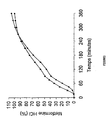
- La
figure 2 illustre les résultats comparatifs de profil de dissolution d'un comprimé flottant bicouche selon l'invention, et d'un comprimé constitué uniquement d'une couche de phase active. - En abscisse, pourcentage du principe actif Metformine libellé.
- En ordonnées, temps écoulé après contact des comprimés avec un milieu aqueux.
- Les carrés représentent les résultats obtenus avec la phase active du comprimé décrit à l'exemple 1.
- Les losanges représentent les résultats obtenus avec le comprimé de l'exemple 1.
-
Nom des composants Quantité (en %) Couche active • Metformine HCl 51,33 • Carbomère (Carbopol®974) 3,02 • Hydroxypropylcellulose fortement substitué 4,53 (Klucel® HXF) • Stéarate de magnésium 0,06 Couche non active • Hydroxypropylméthylcellulose 24,64 (Metolose® 90SH4000SR) 9,20 • Citrate monosodique anhydre 7,23 • Bicarbonate de sodium (13/50) - Composition présentée sous forme de comprimés tricouches ou bicouches.
-
- a) Couche active: granulation par voie humide.
- Dans un mélangeur granulateur de type ROTOLAB® ou équivalent, introduire le chlorhydrate de metformine et le CARBOPOL®.
- Mélanger à l'aide de la tripale pendant 3 minutes.
- Débuter l'opération de mouillage en incorporant de l'eau purifiée comme solution de mouillage.
- Granuler l'ensemble jusqu'à obtention d'un grain de qualité satisfaisante.
- Sécher le grain
- Calibrer le grain sur granulateur oscillant ERWEKA AR 401 ou équivalent.
- Mélanger au grain calibré l'hydroxypropylcellulose puis le stéarate de magnésium dans un mélangeur adapté.
- b) Couche non active.
- Un mélange homogène est réalisé entre les différents composants de cette couche.
- Les deux compositions a) et b) ainsi préparées servent à alimenter la machine à comprimer équipée de poinçons de format 13,5R17.
- Les comprimés issus de cette fabrication sont soit des bicouches ou soit des tricouches de masse moyenne 974 mg par unité.
-
Nom des composants Quantité (en %) Couche active • Flutamide 70,00 • Povidone K90F 2,00 • Hydroxypropylméthylcellulose 1,00 (Metolose® 90SH4000SR) 6,25 • Stéarate de magnésium 0,25 Couche non active • Hydroxypropylméthylcellulose 20 (Metolose® 90SH100000SR) • Bicarbonate de potassium 6,75 - Dans ce cas, la couche active est fabriquée par un procédé de granulation humide et comprimée sur un poinçon de diamètre 12 mm.
- La couche non active sert à alimenter une machine à comprimer en vu de la fabrication de comprimés double noyau.
- Les profils de dissolution de deux compositions pharmaceutiques ont été étudiés, respectivement pour :
- un comprimé d'une composition pharmaceutique selon l'invention, conforme à l'exemple 1:
- un comprimé contenant uniquement la phase active d'une composition pharmaceutique conforme à l'exemple 1.
- Les comprimés de chacune des compositions pharmaceutiques ci-dessus ont été immergés dans un milieu tampon ajusté à pH 6,8 dans un dispositif d'analyse de dissolution classique à pales, la vitesse des pales étant fixée à 100 tours/minute et le volume du milieu étant de 1000 ml, à une température de 37°C.
- Les comprimés testés sont des comprimés obtenus selon un format de compression de 13,5 R17 . Lors du test, les comprimés sont « lestés », c'est-à-dire placés dans un panier de type JAGO, lui-même déposé au fond de la cuve de dissolution.
- Les résultats sont reportés à la
figure 2 . - Comme on peut le voir, les profils de dissolution du principe actif chlorhydrate de metformine sont identiques pour les deux comprimés testés.
- Ces résultats montrent que l'adjonction de la phase non active constitutive d'un comprimé selon l'invention est sans effet observable sur le profil de dissolution du principe contenu dans la phase active.
- Le comprimé testé est un comprimé tricouche tel que décrit à la
figure 1B , préparé essentiellement comme décrit à l'exemple 1. - La couche de phase active est comprimée entre deux couches de phase non active de même composition.
- La phase non active comprend un rapport citrate monosodique/bicarbonate de sodium égal à 65/35. La résistance à la rupture des comprimés est d'environ 390 Newtons.
- Les comprimés ont été immergés dans respectivement :
- 100 ml d'eau. R conforme à la section « Réactifs » de la Pharmacopée, à la température de 37°C
- 100 ml d'HCl à 0,1N à 37°C.
- Dans l'eau R à 37°C, le temps de latence avant flottaison des comprimés est de 47 ». Ce temps de latence est de 29 secondes dans 100 ml d'HCl à 0,1N.
- Dans les deux milieux aqueux, les comprimés flottent après plus de 16 heures.
Claims (25)
- Composition pharmaceutique flottante caractérisée en ce qu'elle est constituée d'au moins :a) une première phase, dite active, comprenant au moins un principe actif et, à titre d'agents désintégrants, de l'hydroxypropylméthyl cellulose, de l'hydroxypropylcellulose fortement substituée et/ou de l'éthylcellulose dans des quantités inférieures à 15% en poids de la phase active et sous une forme permettant d'obtenir un effet désintégrant tout en évitant la formation d'un réseau continu ;b) une seconde phase, dite non active, comprenant au moins un système générateur d'un gaz et au moins un polymère hydrophile,la phase active comprenant une quantité de principe(s) actif(s) d'au moins 80%, préférentiellement d'au moins 85%, et encore plus préférentiellement d'au moins environ 90% en poids de la phase active.
- Composition selon la revendication 1, caractérisée en ce que le polymère hydrophile de la phase non active est choisi parmi les substances polysaccharidiques et les substances apparentées, et les substances protéiques.
- Composition selon la revendication 2, caractérisée en ce que les substances polysaccharidiques et les substances apparentées sont choisies parmi les galactomannanes et ses dérivés, l'amidon et ses dérivés, la gomme arabique, la gomme adragante, les pectines et ses dérivés, les alginates, la cellulose et ses dérivés, les dextrans de haut poids moléculaire, ou encore le xanthane et ses dérivés.
- Composition selon la revendication 2, caractérisée en ce que les substances protéiques sont choisies parmi la gélatine et ses produits dérivés purifiés.
- Composition selon la revendication 1, caractérisée en ce que le polymère hydrophile de la phase non active est choisi parmi les poloxamères, les polyéthylène glycols de haut poids moléculaire ou encore les polymères des acides acryliques ou méthacryliques et leurs dérivés.
- Composition selon l'une des revendications 1 à 5, caractérisée en ce que le système générateur de gaz de la phase inactive est un système générateur de dioxyde de carbone.
- Composition selon la revendication 6, caractérisée en ce qu'il s'agit d'un système générateur de dioxyde de carbone comprenant un carbonate de métal alcalin ou alcalino-terreux, tel que le carbonate de calcium ou encore un bicarbonate de métal alcalin, tel que le bicarbonate de sodium ou le bicarbonate de potassium.
- Composition selon la revendication 7, caractérisée en ce que ledit carbonate de métal alcalin ou alcalino-terreux ou ledit bicarbonate est en association avec un acide choisi parmi les acides mono- et polycarboxyliques ou un sel partiel d'un acide polycarboxylique.
- Composition selon l'une des revendications 1 à 8, caractérisée en ce que la phase non active comprend de 10 à 70% en poids de ladite phase d'un polymère hydrophile.
- Composition selon l'une des revendication 1 à 9, caractérisée en ce que la phase non active comprend de 5 à 60% en poids de ladite phase d'un système générateur de gaz.
- Composition selon l'une des revendications 1 à 10, caractérisée en ce que la phase active comprend au moins un principe actif choisi parmi les principes actifs se présentant sous une forme ionique en milieu acide, et les principes actifs qui sont dégradés par un pH acide.
- Comprimé constitué, au moins en partie, par une composition selon l'une des revendications 1 à 11.
- Comprimé selon la revendication 12, caractérisé en ce qu'il s'agit d'un composé bicouche constitué d'une première couche de phase active et d'une seconde couche de phase non active.
- Comprimé selon la revendication 13, caractérisé en ce qu'il s'agit d'un comprimé tricouche constitué d'une couche de phase active placée entre une première et une seconde couche de phase non active.
- Comprimé selon la revendication 12, caractérisé en ce qu'il s'agit d'un comprimé tricouche constitué d'une couche de phase non active placée entre une première et une seconde couche de phase active.
- Comprimé selon la revendication 12, caractérisé en qu'il est constitué d'un noyau interne de phase active et d'une couche externe de phase non active recouvrant le noyau interne.
- Comprimé selon la revendication 12, caractérisé en ce qu'il se présente sous la forme de micro-granules.
- Comprimé selon la revendication 12, caractérisé en ce que la phase active est un double noyau constituée d'un noyau interne et d'une phase externe,a) le noyau interne étant constitué d'une composition comprenant au moins un principe actif et, à titre d'agents désintégrants, de l'hydroxypropylméthyl cellulose, de l'hydroxypropylcellulose fortement substituée et/ou de l'éthylcellulose dans des quantités inférieures à 15 pour cent en poids de la phase active et sous une forme permettant d'obtenir un effet désintégrant tout en évitant la formation d'un réseau continu ;b) la phase externe comprenant au moins un composé à fort effet désintégrant et une quantité efficace du ou des principes actifs compris dans le noyau interne.
- Comprimé selon l'une des revendications 12 à 16, caractérisé en ce que la surface externe de la couche non active est recouverte d'un polymère possédant des propriétés muco-adhésives.
- Comprimé selon la revendication 17, caractérisé en ce que chacun des microgranules est recouvert d'un polymère possédant des propriétés muco-adhésives.
- Comprimé selon l'une des revendications 19 à 20, caractérisé en ce que le polymère possédant des propriétés mucoadhésives est choisi parmi :- les celluloses et leurs dérivés ;- le carbomer dénommé carbopol et ses dérivés- la povidone et ses dérivés ;- le polyvinylacétate dénommé PVA et ses dérivés.
- Comprimé selon l'une des revendications 12 à 16 et 19, caractérisé en ce qu'il est enrobé d'une couche d'un polymère gastrorésistant.
- Comprimé selon l'une des revendications 17 et 20, caractérisé en ce que chaque microgranule est enrobé d'une couche d'un polymère gastrorésistant.
- Composé selon l'une des revendications 22 et 23, caractérisé en ce que le polymère gastro-résistant est choisi parmi l'acétatephtalate de cellulose, le phtalate d'hydroxypropylméthylcellulose dénommé hypromellosephtalate et un copolymère d'acide méthacrylique.
- Procédé de préparation d'un comprimé selon l'une des revendications 12 à 15, caractérisé en ce qu'au moins une couche de phase active et au moins une couche de phase non active sont mises en contact puis solidarisées entre elles par compression.
Applications Claiming Priority (3)
| Application Number | Priority Date | Filing Date | Title |
|---|---|---|---|
| FR9910285 | 1999-08-06 | ||
| FR9910285A FR2797185B1 (fr) | 1999-08-06 | 1999-08-06 | Composition pharmaceutique flottante comprenant une phase active et une phase non active |
| PCT/FR2000/002223 WO2001010417A1 (fr) | 1999-08-06 | 2000-08-02 | Composition pharmaceutique flottante comprenant une phase active et une phase non active |
Publications (2)
| Publication Number | Publication Date |
|---|---|
| EP1206247A1 EP1206247A1 (fr) | 2002-05-22 |
| EP1206247B1 true EP1206247B1 (fr) | 2009-12-02 |
Family
ID=9548990
Family Applications (1)
| Application Number | Title | Priority Date | Filing Date |
|---|---|---|---|
| EP00956599A Expired - Lifetime EP1206247B1 (fr) | 1999-08-06 | 2000-08-02 | Composition pharmaceutique flottante comprenant une phase active et une phase non active |
Country Status (12)
| Country | Link |
|---|---|
| US (1) | US7682629B1 (fr) |
| EP (1) | EP1206247B1 (fr) |
| AT (1) | ATE450254T1 (fr) |
| AU (1) | AU779036B2 (fr) |
| BR (1) | BR0013106A (fr) |
| CA (1) | CA2378988C (fr) |
| DE (1) | DE60043442D1 (fr) |
| FR (1) | FR2797185B1 (fr) |
| HU (1) | HUP0202764A3 (fr) |
| IL (2) | IL148003A0 (fr) |
| NO (1) | NO20020572L (fr) |
| WO (1) | WO2001010417A1 (fr) |
Families Citing this family (16)
| Publication number | Priority date | Publication date | Assignee | Title |
|---|---|---|---|---|
| RU2325152C2 (ru) | 2001-07-04 | 2008-05-27 | Сан Фармасьютикл Индастриз Лимитид | Удерживаемая в желудке система регулируемой доставки лекарственного средства |
| NZ536273A (en) * | 2002-12-20 | 2007-08-31 | Hoffmann La Roche | High dose ibandronate formulation |
| TW200533391A (en) | 2004-03-25 | 2005-10-16 | Sun Pharmaceutical Ind Ltd | Gastric retention drug delivery system |
| BRPI0615410A2 (pt) * | 2005-08-30 | 2013-02-13 | Nicholas Piramal India Ltd | composiÇço farmacÊutica de liberaÇço prolongada de metformina e processo para produÇço da mesma |
| JP5545952B2 (ja) * | 2007-08-31 | 2014-07-09 | 第一三共株式会社 | 徐放性製剤及びその製造方法 |
| JP2012500230A (ja) | 2008-08-18 | 2012-01-05 | 北京天衡▲薬▼物研究院 | 胃内滞留薬物放出システム及びその製造方法と使用 |
| FR2938431B1 (fr) | 2008-11-14 | 2013-12-20 | Debregeas Et Associes Pharma | Nouvelle composition a base d'acide gamma-hydroxybutyrique |
| FR2949061B1 (fr) | 2009-08-12 | 2013-04-19 | Debregeas Et Associes Pharma | Microgranules flottants |
| FR2949062B1 (fr) | 2009-08-12 | 2011-09-02 | Debregeas Et Associes Pharma | Nouvelles formulations pharmaceutiques contre le mesusage des medicaments |
| FR2967352B1 (fr) * | 2010-11-12 | 2012-12-28 | Unither Dev | Comprime effervescent pour l'administration par voie orale de principes actifs |
| WO2015089420A1 (fr) | 2013-12-13 | 2015-06-18 | Biogen Idec Ma Inc. | Forme pharmaceutique à libération contrôlée pour administration une fois par jour de fumarate de diméthyle |
| WO2019126218A1 (fr) * | 2017-12-18 | 2019-06-27 | Tris Pharma, Inc. | Composition de poudre de médicament à libération modifiée comprenant des systèmes de formation de raft de rétention gastrique ayant une libération de médicament par impulsions de déclenchement |
| WO2019126216A1 (fr) | 2017-12-18 | 2019-06-27 | Tris Phama, Inc. | Compositions pharmaceutiques comprenant un système formant un réseau polymère d'interpénétration flottant |
| EP3737353A1 (fr) | 2017-12-18 | 2020-11-18 | Tris Pharma, Inc. | Compositions pharmaceutiques de ghb comprenant un système de formation de réseau polymère interpénétrant flottant |
| US11337920B2 (en) | 2017-12-18 | 2022-05-24 | Tris Pharma, Inc. | Pharmaceutical composition comprising GHB gastro-retentive raft forming systems having trigger pulse drug release |
| JP2026513019A (ja) | 2023-02-03 | 2026-04-22 | トリス・フアルマ・インコーポレーテツド | 1晩1回の低ナトリウムオキシベート組成物 |
Citations (1)
| Publication number | Priority date | Publication date | Assignee | Title |
|---|---|---|---|---|
| FR2766708A1 (fr) * | 1997-07-30 | 1999-02-05 | Galenix Dev | Composition contenant de l'hydroxypropylcellulose, de l'hydroxypropylmethylcellulose et/ou de l'ethylcellullose a titre d'agents desintegrants, et procede d'obtention |
Family Cites Families (8)
| Publication number | Priority date | Publication date | Assignee | Title |
|---|---|---|---|---|
| US4167558A (en) * | 1976-02-13 | 1979-09-11 | Hoffmann-La Roche Inc. | Novel sustained release tablet formulations |
| JPS62195323A (ja) | 1986-02-24 | 1987-08-28 | Eisai Co Ltd | 胃内滞留型粒子 |
| DE3803482A1 (de) * | 1988-02-05 | 1989-08-17 | Lohmann Therapie Syst Lts | Schwimmfaehiges orales therapeutisches system |
| DE4403943A1 (de) * | 1994-02-08 | 1995-08-10 | Hexal Pharma Gmbh | Orale Azrneimittelzubereitung mit Diclofenac-Natrium |
| DE4406424A1 (de) * | 1994-02-28 | 1995-08-31 | Bayer Ag | Expandierbare Arzneiformen |
| US5783212A (en) * | 1996-02-02 | 1998-07-21 | Temple University--of the Commonwealth System of Higher Education | Controlled release drug delivery system |
| IT1282650B1 (it) * | 1996-02-19 | 1998-03-31 | Jagotec Ag | Compressa farmaceutica,caratterizzata da elevato aumento di volume a contatto con liquidi biologici |
| US6197328B1 (en) * | 1999-08-20 | 2001-03-06 | Dott Research Laboratory | Nasally administrable compositions |
-
1999
- 1999-08-06 FR FR9910285A patent/FR2797185B1/fr not_active Expired - Lifetime
-
2000
- 2000-08-02 BR BR0013106-7A patent/BR0013106A/pt not_active Application Discontinuation
- 2000-08-02 CA CA2378988A patent/CA2378988C/fr not_active Expired - Fee Related
- 2000-08-02 WO PCT/FR2000/002223 patent/WO2001010417A1/fr not_active Ceased
- 2000-08-02 DE DE60043442T patent/DE60043442D1/de not_active Expired - Lifetime
- 2000-08-02 HU HU0202764A patent/HUP0202764A3/hu unknown
- 2000-08-02 AT AT00956599T patent/ATE450254T1/de not_active IP Right Cessation
- 2000-08-02 AU AU68487/00A patent/AU779036B2/en not_active Ceased
- 2000-08-02 IL IL14800300A patent/IL148003A0/xx active IP Right Grant
- 2000-08-02 EP EP00956599A patent/EP1206247B1/fr not_active Expired - Lifetime
- 2000-08-02 US US10/048,459 patent/US7682629B1/en not_active Expired - Fee Related
-
2002
- 2002-02-05 NO NO20020572A patent/NO20020572L/no not_active Application Discontinuation
- 2002-02-05 IL IL148003A patent/IL148003A/en not_active IP Right Cessation
Patent Citations (1)
| Publication number | Priority date | Publication date | Assignee | Title |
|---|---|---|---|---|
| FR2766708A1 (fr) * | 1997-07-30 | 1999-02-05 | Galenix Dev | Composition contenant de l'hydroxypropylcellulose, de l'hydroxypropylmethylcellulose et/ou de l'ethylcellullose a titre d'agents desintegrants, et procede d'obtention |
Also Published As
| Publication number | Publication date |
|---|---|
| HUP0202764A2 (hu) | 2003-01-28 |
| NO20020572L (no) | 2002-04-03 |
| FR2797185B1 (fr) | 2001-10-26 |
| WO2001010417A1 (fr) | 2001-02-15 |
| IL148003A (en) | 2007-06-03 |
| US7682629B1 (en) | 2010-03-23 |
| CA2378988A1 (fr) | 2001-02-15 |
| EP1206247A1 (fr) | 2002-05-22 |
| IL148003A0 (en) | 2002-09-12 |
| BR0013106A (pt) | 2002-07-23 |
| FR2797185A1 (fr) | 2001-02-09 |
| CA2378988C (fr) | 2012-04-17 |
| ATE450254T1 (de) | 2009-12-15 |
| NO20020572D0 (no) | 2002-02-05 |
| AU779036B2 (en) | 2005-01-06 |
| HUP0202764A3 (en) | 2004-05-28 |
| DE60043442D1 (de) | 2010-01-14 |
| AU6848700A (en) | 2001-03-05 |
Similar Documents
| Publication | Publication Date | Title |
|---|---|---|
| EP1121099B1 (fr) | Composition pharmaceutique a residence gastrique et a liberation controlee | |
| CA2378988C (fr) | Composition pharmaceutique flottante comprenant une phase active et une phase non active | |
| EP2464333B1 (fr) | Microgranulés flottants | |
| EP1007005B1 (fr) | Compositions pharmaceutiques pour la liberation controlee de substances actives | |
| EP1194125B1 (fr) | Procede de fabrication de granules enrobes a gout masque et liberation immediate du principe actif | |
| CN1081916C (zh) | 一种控释药物悬浮液的释放装置 | |
| EP0938318B1 (fr) | Comprime a liberation controlee de chlorhydrate d'alfuzosine | |
| BE1014328A7 (fr) | Composition pharmaceutique orale a liberation controlee. | |
| FR2762513A1 (fr) | Comprimes bioadhesifs | |
| FR2471786A1 (fr) | Composition pharmaceutique seche a liberation lente contenant un excipient sec et procedes pour preparer cette composition et cet excipient | |
| EP2272506A2 (fr) | Microcapsules a liberation modifiee de principes actifs peu solubles pour administration per os | |
| MC1101A1 (fr) | Composition a activite retardee | |
| CN87100378A (zh) | 泡腾对偶物,含有它们的组胺h2-拮抗药的泡腾组合物及其制造方法 | |
| EP1368002B1 (fr) | Procede de fabrication d'un comprime flottant incluant de l'alfuzosine | |
| Zanke et al. | Recent advance in gastroretantive drug delivery system (GRDDS) | |
| CN1630511A (zh) | 表现出s形曲线模式控释的依来曲帕滕颗粒组合物 | |
| EP0983065A1 (fr) | Composition pharmaceutique a residence gastrique | |
| EP3082791B1 (fr) | Compositions pharmaceutiques orales à rétention gastrique à base de baclofène | |
| FR2885526A1 (fr) | Medicament oral a base d'inhibiteur de pompe a protons | |
| EP2942053A1 (fr) | Compositions pharmaceutiques pour administration gastro-intestinale de médicaments | |
| BE1018280A3 (fr) | Composition de nimesulide a liberation prolongee. | |
| EP1904037A1 (fr) | Formulation a liberation prolongee de principes actifs presentant une solubilite dependante du ph | |
| FR3009496A1 (fr) | Formes multiparticulaires a liberation prolongee, procede de leurs preparations et compositions les contenant pour le traitement et/ou prevention de la cyctinurie | |
| FR2752737A1 (fr) | Comprime a liberation controlee de chlorhydrate d'alfuzosine | |
| FR2747573A1 (fr) | Nouvelle composition contenant un benzimidazole acido-labile et son procede de preparation |
Legal Events
| Date | Code | Title | Description |
|---|---|---|---|
| PUAI | Public reference made under article 153(3) epc to a published international application that has entered the european phase |
Free format text: ORIGINAL CODE: 0009012 |
|
| 17P | Request for examination filed |
Effective date: 20020306 |
|
| AX | Request for extension of the european patent |
Free format text: AL;LT;LV;MK;RO PAYMENT 20020306;SI PAYMENT 20020306 |
|
| 17Q | First examination report despatched |
Effective date: 20030403 |
|
| GRAP | Despatch of communication of intention to grant a patent |
Free format text: ORIGINAL CODE: EPIDOSNIGR1 |
|
| GRAS | Grant fee paid |
Free format text: ORIGINAL CODE: EPIDOSNIGR3 |
|
| GRAA | (expected) grant |
Free format text: ORIGINAL CODE: 0009210 |
|
| AK | Designated contracting states |
Kind code of ref document: B1 Designated state(s): AT BE CH CY DE DK ES FI FR GB GR IE IT LI LU MC NL PT SE |
|
| AX | Request for extension of the european patent |
Extension state: RO SI |
|
| REG | Reference to a national code |
Ref country code: GB Ref legal event code: FG4D Free format text: NOT ENGLISH |
|
| REG | Reference to a national code |
Ref country code: CH Ref legal event code: EP |
|
| REG | Reference to a national code |
Ref country code: IE Ref legal event code: FG4D |
|
| REF | Corresponds to: |
Ref document number: 60043442 Country of ref document: DE Date of ref document: 20100114 Kind code of ref document: P |
|
| REG | Reference to a national code |
Ref country code: NL Ref legal event code: T3 |
|
| PG25 | Lapsed in a contracting state [announced via postgrant information from national office to epo] |
Ref country code: FI Free format text: LAPSE BECAUSE OF FAILURE TO SUBMIT A TRANSLATION OF THE DESCRIPTION OR TO PAY THE FEE WITHIN THE PRESCRIBED TIME-LIMIT Effective date: 20091202 Ref country code: SE Free format text: LAPSE BECAUSE OF FAILURE TO SUBMIT A TRANSLATION OF THE DESCRIPTION OR TO PAY THE FEE WITHIN THE PRESCRIBED TIME-LIMIT Effective date: 20091202 |
|
| PG25 | Lapsed in a contracting state [announced via postgrant information from national office to epo] |
Ref country code: CY Free format text: LAPSE BECAUSE OF FAILURE TO SUBMIT A TRANSLATION OF THE DESCRIPTION OR TO PAY THE FEE WITHIN THE PRESCRIBED TIME-LIMIT Effective date: 20091202 |
|
| PG25 | Lapsed in a contracting state [announced via postgrant information from national office to epo] |
Ref country code: AT Free format text: LAPSE BECAUSE OF FAILURE TO SUBMIT A TRANSLATION OF THE DESCRIPTION OR TO PAY THE FEE WITHIN THE PRESCRIBED TIME-LIMIT Effective date: 20091202 |
|
| REG | Reference to a national code |
Ref country code: IE Ref legal event code: FD4D |
|
| PG25 | Lapsed in a contracting state [announced via postgrant information from national office to epo] |
Ref country code: PT Free format text: LAPSE BECAUSE OF FAILURE TO SUBMIT A TRANSLATION OF THE DESCRIPTION OR TO PAY THE FEE WITHIN THE PRESCRIBED TIME-LIMIT Effective date: 20100402 Ref country code: ES Free format text: LAPSE BECAUSE OF FAILURE TO SUBMIT A TRANSLATION OF THE DESCRIPTION OR TO PAY THE FEE WITHIN THE PRESCRIBED TIME-LIMIT Effective date: 20100313 Ref country code: IE Free format text: LAPSE BECAUSE OF FAILURE TO SUBMIT A TRANSLATION OF THE DESCRIPTION OR TO PAY THE FEE WITHIN THE PRESCRIBED TIME-LIMIT Effective date: 20091202 |
|
| PLBE | No opposition filed within time limit |
Free format text: ORIGINAL CODE: 0009261 |
|
| STAA | Information on the status of an ep patent application or granted ep patent |
Free format text: STATUS: NO OPPOSITION FILED WITHIN TIME LIMIT |
|
| PG25 | Lapsed in a contracting state [announced via postgrant information from national office to epo] |
Ref country code: GR Free format text: LAPSE BECAUSE OF FAILURE TO SUBMIT A TRANSLATION OF THE DESCRIPTION OR TO PAY THE FEE WITHIN THE PRESCRIBED TIME-LIMIT Effective date: 20100303 |
|
| 26N | No opposition filed |
Effective date: 20100903 |
|
| PGFP | Annual fee paid to national office [announced via postgrant information from national office to epo] |
Ref country code: LU Payment date: 20100812 Year of fee payment: 11 |
|
| PG25 | Lapsed in a contracting state [announced via postgrant information from national office to epo] |
Ref country code: DK Free format text: LAPSE BECAUSE OF FAILURE TO SUBMIT A TRANSLATION OF THE DESCRIPTION OR TO PAY THE FEE WITHIN THE PRESCRIBED TIME-LIMIT Effective date: 20091202 |
|
| BERE | Be: lapsed |
Owner name: GALENIX DEVELOPPEMENT Effective date: 20100831 |
|
| PG25 | Lapsed in a contracting state [announced via postgrant information from national office to epo] |
Ref country code: MC Free format text: LAPSE BECAUSE OF NON-PAYMENT OF DUE FEES Effective date: 20100831 Ref country code: IT Free format text: LAPSE BECAUSE OF FAILURE TO SUBMIT A TRANSLATION OF THE DESCRIPTION OR TO PAY THE FEE WITHIN THE PRESCRIBED TIME-LIMIT Effective date: 20091202 |
|
| PG25 | Lapsed in a contracting state [announced via postgrant information from national office to epo] |
Ref country code: BE Free format text: LAPSE BECAUSE OF NON-PAYMENT OF DUE FEES Effective date: 20100831 |
|
| PGFP | Annual fee paid to national office [announced via postgrant information from national office to epo] |
Ref country code: NL Payment date: 20110825 Year of fee payment: 12 |
|
| REG | Reference to a national code |
Ref country code: NL Ref legal event code: V1 Effective date: 20130301 |
|
| REG | Reference to a national code |
Ref country code: CH Ref legal event code: PL |
|
| PG25 | Lapsed in a contracting state [announced via postgrant information from national office to epo] |
Ref country code: LI Free format text: LAPSE BECAUSE OF NON-PAYMENT OF DUE FEES Effective date: 20120831 Ref country code: NL Free format text: LAPSE BECAUSE OF NON-PAYMENT OF DUE FEES Effective date: 20130301 Ref country code: CH Free format text: LAPSE BECAUSE OF NON-PAYMENT OF DUE FEES Effective date: 20120831 |
|
| PG25 | Lapsed in a contracting state [announced via postgrant information from national office to epo] |
Ref country code: LU Free format text: LAPSE BECAUSE OF NON-PAYMENT OF DUE FEES Effective date: 20110802 |
|
| REG | Reference to a national code |
Ref country code: CH Ref legal event code: AECN Free format text: LE BREVET A ETE REACTIVE SELON LA DEMANDE DE POURSUITE DE PROCEDURE DU 14.05.2013 |
|
| PGFP | Annual fee paid to national office [announced via postgrant information from national office to epo] |
Ref country code: CH Payment date: 20130514 Year of fee payment: 13 |
|
| PGRI | Patent reinstated in contracting state [announced from national office to epo] |
Ref country code: CH Effective date: 20130514 Ref country code: LI Effective date: 20130514 |
|
| PGFP | Annual fee paid to national office [announced via postgrant information from national office to epo] |
Ref country code: DE Payment date: 20130731 Year of fee payment: 14 |
|
| PGFP | Annual fee paid to national office [announced via postgrant information from national office to epo] |
Ref country code: GB Payment date: 20130731 Year of fee payment: 14 |
|
| REG | Reference to a national code |
Ref country code: CH Ref legal event code: PL |
|
| PG25 | Lapsed in a contracting state [announced via postgrant information from national office to epo] |
Ref country code: LI Free format text: LAPSE BECAUSE OF NON-PAYMENT OF DUE FEES Effective date: 20130831 Ref country code: CH Free format text: LAPSE BECAUSE OF NON-PAYMENT OF DUE FEES Effective date: 20130831 |
|
| REG | Reference to a national code |
Ref country code: FR Ref legal event code: ST Effective date: 20140430 |
|
| REG | Reference to a national code |
Ref country code: FR Ref legal event code: RN Effective date: 20140624 |
|
| REG | Reference to a national code |
Ref country code: FR Ref legal event code: FC Effective date: 20140708 |
|
| PG25 | Lapsed in a contracting state [announced via postgrant information from national office to epo] |
Ref country code: FR Free format text: LAPSE BECAUSE OF NON-PAYMENT OF DUE FEES Effective date: 20130902 |
|
| PGRI | Patent reinstated in contracting state [announced from national office to epo] |
Ref country code: FR Effective date: 20140709 |
|
| REG | Reference to a national code |
Ref country code: DE Ref legal event code: R119 Ref document number: 60043442 Country of ref document: DE |
|
| GBPC | Gb: european patent ceased through non-payment of renewal fee |
Effective date: 20140802 |
|
| REG | Reference to a national code |
Ref country code: DE Ref legal event code: R119 Ref document number: 60043442 Country of ref document: DE Effective date: 20150303 |
|
| PG25 | Lapsed in a contracting state [announced via postgrant information from national office to epo] |
Ref country code: DE Free format text: LAPSE BECAUSE OF NON-PAYMENT OF DUE FEES Effective date: 20150303 Ref country code: GB Free format text: LAPSE BECAUSE OF NON-PAYMENT OF DUE FEES Effective date: 20140802 |
|
| REG | Reference to a national code |
Ref country code: FR Ref legal event code: PLFP Year of fee payment: 17 |
|
| REG | Reference to a national code |
Ref country code: FR Ref legal event code: PLFP Year of fee payment: 18 |
|
| REG | Reference to a national code |
Ref country code: FR Ref legal event code: PLFP Year of fee payment: 19 |
|
| PGFP | Annual fee paid to national office [announced via postgrant information from national office to epo] |
Ref country code: FR Payment date: 20180730 Year of fee payment: 19 |
|
| PG25 | Lapsed in a contracting state [announced via postgrant information from national office to epo] |
Ref country code: FR Free format text: LAPSE BECAUSE OF NON-PAYMENT OF DUE FEES Effective date: 20190831 |