EP1206555B1 - Fv-antikörper-konstrukte mit bindungsstellen für einen cd16-rezeptor und ein cd30-oberflächenprotein - Google Patents
Fv-antikörper-konstrukte mit bindungsstellen für einen cd16-rezeptor und ein cd30-oberflächenprotein Download PDFInfo
- Publication number
- EP1206555B1 EP1206555B1 EP00958214A EP00958214A EP1206555B1 EP 1206555 B1 EP1206555 B1 EP 1206555B1 EP 00958214 A EP00958214 A EP 00958214A EP 00958214 A EP00958214 A EP 00958214A EP 1206555 B1 EP1206555 B1 EP 1206555B1
- Authority
- EP
- European Patent Office
- Prior art keywords
- antibody construct
- cells
- antibody
- receptor
- construct according
- Prior art date
- Legal status (The legal status is an assumption and is not a legal conclusion. Google has not performed a legal analysis and makes no representation as to the accuracy of the status listed.)
- Expired - Lifetime
Links
Images


Classifications
-
- C—CHEMISTRY; METALLURGY
- C07—ORGANIC CHEMISTRY
- C07K—PEPTIDES
- C07K16/00—Immunoglobulins [IG], e.g. monoclonal or polyclonal antibodies
- C07K16/18—Immunoglobulins [IG], e.g. monoclonal or polyclonal antibodies against material from animals or humans
- C07K16/28—Immunoglobulins [IG], e.g. monoclonal or polyclonal antibodies against material from animals or humans against receptors, cell surface antigens or cell surface determinants
- C07K16/2803—Immunoglobulins [IG], e.g. monoclonal or polyclonal antibodies against material from animals or humans against receptors, cell surface antigens or cell surface determinants against the immunoglobulin superfamily
- C07K16/283—Immunoglobulins [IG], e.g. monoclonal or polyclonal antibodies against material from animals or humans against receptors, cell surface antigens or cell surface determinants against the immunoglobulin superfamily against Fc-receptors, e.g. CD16, CD32, CD64
-
- A—HUMAN NECESSITIES
- A61—MEDICAL OR VETERINARY SCIENCE; HYGIENE
- A61P—SPECIFIC THERAPEUTIC ACTIVITY OF CHEMICAL COMPOUNDS OR MEDICINAL PREPARATIONS
- A61P35/00—Antineoplastic agents
-
- C—CHEMISTRY; METALLURGY
- C07—ORGANIC CHEMISTRY
- C07K—PEPTIDES
- C07K16/00—Immunoglobulins [IG], e.g. monoclonal or polyclonal antibodies
- C07K16/18—Immunoglobulins [IG], e.g. monoclonal or polyclonal antibodies against material from animals or humans
- C07K16/28—Immunoglobulins [IG], e.g. monoclonal or polyclonal antibodies against material from animals or humans against receptors, cell surface antigens or cell surface determinants
- C07K16/2878—Immunoglobulins [IG], e.g. monoclonal or polyclonal antibodies against material from animals or humans against receptors, cell surface antigens or cell surface determinants against the NGF-receptor/TNF-receptor superfamily, e.g. CD27, CD30, CD40, CD95
-
- A—HUMAN NECESSITIES
- A61—MEDICAL OR VETERINARY SCIENCE; HYGIENE
- A61K—PREPARATIONS FOR MEDICAL, DENTAL OR TOILETRY PURPOSES
- A61K39/00—Medicinal preparations containing antigens or antibodies
- A61K2039/505—Medicinal preparations containing antigens or antibodies comprising antibodies
-
- C—CHEMISTRY; METALLURGY
- C07—ORGANIC CHEMISTRY
- C07K—PEPTIDES
- C07K2317/00—Immunoglobulins specific features
- C07K2317/60—Immunoglobulins specific features characterized by non-natural combinations of immunoglobulin fragments
- C07K2317/62—Immunoglobulins specific features characterized by non-natural combinations of immunoglobulin fragments comprising only variable region components
- C07K2317/622—Single chain antibody (scFv)
-
- C—CHEMISTRY; METALLURGY
- C07—ORGANIC CHEMISTRY
- C07K—PEPTIDES
- C07K2317/00—Immunoglobulins specific features
- C07K2317/60—Immunoglobulins specific features characterized by non-natural combinations of immunoglobulin fragments
- C07K2317/62—Immunoglobulins specific features characterized by non-natural combinations of immunoglobulin fragments comprising only variable region components
- C07K2317/626—Diabody or triabody
Definitions
- the present invention relates to F v antibody constructs capable of inducing regression of Hodgkin's disease, DNAs encoding such F v antibody constructs, and a method of making the F v antibody coupons and their use.
- Natural antibodies have four variable domains, two V H and two V L domains.
- the variable domains serve as binding sites for an antigen, with a binding site formed of a V H and a V L domain.
- Natural antibodies have two identical binding sites, ie they recognize an antigen and are therefore also called monospecific.
- Artificial antibodies can also have two different binding sites, ie they then recognize two antigens and are accordingly designated as bispecific.
- An example of such antibodies is that recognizing the FcyIIIA receptor (CD16) of natural killer cells (NK cells) and the surface protein CD30 of Hodgkin's disease cells.
- NK cells can be activated and directed against Hodgkin's lymphocytes, thereby inducing a regression of Hodgkin's disease (cf. DE 43 37 197C such as Hartmann, F. et al., Blood 89 (1997), 2042 ).
- bimAbHRS-3 / A9 is difficult to prepare or clean.
- bimAbHRS-3 / A9 has been shown to induce undesirable immune responses in many patients.
- a bispecific Fv antibody construct (diabody) containing only variable domains with binding sites for CD19 and CD3 is available in Kipriyanov S. et al. (International Journal of Cancer Vol. 77 (1998), No. 5, pages 763-772 described.
- the present invention is therefore based on the object to provide an antibody with which a regression of Hodgkin's disease can be induced, the above disadvantages are avoided.
- the present invention is based on the Applicant's finding that an F v antibody construct having binding sites for a CD16 receptor and a CD30 surface protein can induce regression of Hodgkin's disease, with greater lysis of the tumor cells than with bimAbHRS-3 / A9. Further, he has recognized that such an F v antibody construct can be produced in large quantities and high purity. Furthermore, the F v antibody construct is characterized by the fact that it contains no parts that can lead to unwanted immune reactions in patients.
- the Applicant's findings are used to provide a F v antibody construct having binding sites for a CD16 receptor and a CD30 surface protein.
- F v antibody construct indicates an antibody construct that has variable domains but not constant domains.
- binding sites for a CD16 receptor and a CD30 surface protein are present as variable domains.
- binding site indicates a V H and a V L domain by which the F v antibody construct can bind to a CD16 receptor or a CD30 surface protein, respectively.
- CD16 receptor includes a CD16 receptor of any kind and ancestry.
- the CD16 receptor may be derived from NK cells, macrophages or activated monocytes.
- the CD16 receptor may be in wild-type or altered form, the latter form also comprising a fragment of a CD16 receptor to which an antibody directed against a CD16 receptor can bind.
- CD30 receptor includes a CD30 receptor of any kind and ancestry.
- the CD30 receptor from Hodgkin's disease or Reed-Sternberg cells.
- the CD30 receptor may be in wild-type or altered form, the latter form also comprising a fragment of a CD30 receptor to which an antibody directed against a CD30 receptor can bind.
- An F v antibody construct according to the invention has one or more binding sites for a CD16 receptor and one or more binding sites for a CD30 surface protein.
- the F v antibody construct has one or two binding sites for a CD16 receptor and one or two binding sites for a CD30 surface protein.
- an F v antibody construct according to the invention can be prepared by various methods.
- an F v antibody construct having a binding site for a CD16 receptor and a binding site for a CD30 surface protein can be prepared, for example, by having a first single-chain F v antibody construct that is a V H domain an anti-CD16 antibody and a V L domain of an anti-CD30 antibody, together with a second single-chain F v antibody construct comprising a V L domain of an anti-CD16 antibody and a V H domain of an anti-CD30 antibody is expressed, whereby both bind to each other and the F v antibody construct according to the invention is formed.
- Examples 1-3 reference is made to Examples 1-3.
- a further subject of the present invention is a nucleic acid, in particular a DNA, which codes for an above F v antibody construct.
- expression vectors containing such DNA are an object of the present invention.
- the expression vector pKID16-30 of Fig. 1 This was deposited with DSMZ (German Collection of Microorganisms and Cells) on July 29, 1999 under DSM 12960.
- DSMZ German Collection of Microorganisms and Cells
- cells containing a protruding expression vector are an object of the present invention.
- the present invention provides a F v antibody construct which has binding sites for a CD16 receptor and a CD30 surface protein.
- This F v antibody construct can be produced in large quantities and with great purity. Also, it has no parts that can lead to unwanted immune reactions in patients.
- the F v antibody construct is characterized by being able to activate NK cells and target CD30 surface protein expressing cells, particularly tumor cells, most particularly Hodgkin's or Reed-Sternberg's cells, thereby lysing these cells.
- the present invention is useful against diseases in which CD30 surface protein expressing cells play a role. Such diseases include tumor diseases, in particular Hodgkin's disease.
- Example 1 Construction of the expression vector pKID16-30 according to the invention
- the PCR was performed as follows: one cycle; At 94 ° C for 5 minutes, 58 ° C for 3 minutes and 72 ° C for 2 minutes, followed by 30 cycles; 80 sec at 94 ° C, 80 sec at 58 ° C and 2 min at 72 ° C and the latter 10 min in the last cycle.
- the PCR products were gel purified and inserted into the vector pCR-Script SK (+) (Stratagene) for sequencing.
- the V H domain was inserted via NcoI / HindIII and the V L domain via MluI / NotI into the vector pHOG21.
- V H and V L domains of the anti-CD30 scFv fragment and the anti-CD16 scFv fragment, respectively, were inserted into the expression vector pKID to obtain the expression vector pKID 16-30 of the present invention.
- E.coli X11 Blue cells (Stratagene, La Jolla, CA) transformed with the expression plasmid pKID16-30 grown overnight in 2YT medium with 100 ⁇ g / ml ampicillin and 100 mM glucose at 37 ° C. 1:20 dilutions of the overnight cultures were grown as flask cultures in 2YT medium at 38 ° C with shaking at 280 rpm. At an OD 600 value of 0.8, the bacteria were pelleted by centrifugation at 1500 g for 10 minutes at 20 ° C and in the same volume of fresh 2YT medium containing 100 ⁇ g / ml ampicillin and 0.4 M sucrose. resuspended.
- the F v antibody construct was constructed as in Kipriyanov, SM et al., Protein Engineering 10, (1997), 445 described, isolated. It was then concentrated by ammonium sulfate precipitation (final concentration 70% saturation). The protein precipitate was recovered by centrifugation (30,000 g, 4 ° C, 45 min) and dissolved in 10% of the initial volume of 50 mM Tris-HCl, 1 M NaCl, pH 7.0. An immobilized metal affinity chromatography (IMAC) was performed as in Kipriyanov, SM et al., J. Immunol. Methods 200, (1997), 69 described, performed. The purified F v antibody construct was dialyzed against a phosphate buffered saline.
- IMAC immobilized metal affinity chromatography
- FACScan Beckton Dickinson analysis was performed. For this purpose, 1 ⁇ 10 6 cells were washed twice in ice-cold PBS-N (PBS, 0.05% NaN 3 ) and incubated with 100 ⁇ l of the F v antibody construct of Example 2 for 45 min on ice. The cells were pelleted for 5 min at 1200 rpm at 4 ° C and washed with 2 ml PBS-N.
- the cells were resuspended in 100 ⁇ l of PBS-N containing 10 ⁇ g / ml of the c-myc binding antibody 9E10 (ICI chemicals) and incubated on ice for 30 minutes. The cells were pelleted and washed as above. The cells were then resuspended with fluorescein-labeled goat anti-mouse IgG (Gibco BRL; diluted 1: 100 in PBS-N) and incubated on ice for 30 min. After rinsing with PBS-N, cells were ready for analysis with PBS-N containing 1 ⁇ g / ml propidium iodide (Sigma). Background fluorescence was determined by incubating the cells with antibody 9E10 and fluorescein-labeled goat anti-mouse IgG under the same conditions.
- the F v antibody construct according to the invention recognizes and binds to both CD16 + granolocytes and CD30 + L540 CY Hodgkin's disease cells.
- a cytotoxicity test was performed according to the method described in US Pat Matzinger, P., J. Immunol. Meth. 145 (1991), 185 JAM tests described. In the cytotoxicity test, DNA fragmentation is evaluated. Cells were labeled with [ 3 H] thymidine to a final concentration of 2.5-5 ⁇ Ci / ml for 4-6 h. The cells were pelleted, washed once with culture medium and adjusted to 10 4 cells / well of a 96-well plate.
- NK cell-containing peripheral blood cells PBL cells
- the 96-well plate was incubated in a humidified atmosphere with 7.5% CO 2 for 4 h.
- the cells and medium were aspirated onto fiberglass filters. After washing and drying the filters, they were transferred to plastic bags containing a scintillation fluid and counted using a liquid scintillation counter (LKB).
- LLB liquid scintillation counter
- an F v antibody construct of the present invention can activate NK cells to lyse CD30 + L540CY Hodgkin's disease cells, lysis being greater than using bimAbHRS-3 / A9.
- CD30 + L540CY Hodgkin's lymphomas were detected in SCID mice, as in Hombach, A. et al., Int. J. Cancer 55, (1993), 830 ; Renner, C. et al., J. Hematotherapy 4, (1995) 447 described, established.
- 1.5 ⁇ 10 7 tumor cells were subcutaneously injected into the right flank of the mice in 200 ⁇ l PBS.
- Tumor development, ie tumor diameter was determined twice a week.
- Mice with tumors of 4-6 mm in diameter were divided into several groups and received an F v antibody construct of the invention in 200 ⁇ l PBS together with NK cell-containing peripheral blood lymphocytes (PBL cells). The tumor volume and its development were determined (see legend Fig. 4 ).
- an F v antibody construct of the invention can activate NK cells not only in vitro but also in vivo to lyse CD30 + L540CY Hodgkin's disease cells.
Landscapes
- Health & Medical Sciences (AREA)
- Chemical & Material Sciences (AREA)
- Immunology (AREA)
- Organic Chemistry (AREA)
- Medicinal Chemistry (AREA)
- Life Sciences & Earth Sciences (AREA)
- General Health & Medical Sciences (AREA)
- Proteomics, Peptides & Aminoacids (AREA)
- Genetics & Genomics (AREA)
- Molecular Biology (AREA)
- Biophysics (AREA)
- Biochemistry (AREA)
- Nuclear Medicine, Radiotherapy & Molecular Imaging (AREA)
- General Chemical & Material Sciences (AREA)
- Chemical Kinetics & Catalysis (AREA)
- Pharmacology & Pharmacy (AREA)
- Animal Behavior & Ethology (AREA)
- Public Health (AREA)
- Veterinary Medicine (AREA)
- Peptides Or Proteins (AREA)
- Micro-Organisms Or Cultivation Processes Thereof (AREA)
- Medicines Containing Antibodies Or Antigens For Use As Internal Diagnostic Agents (AREA)
- Medicines That Contain Protein Lipid Enzymes And Other Medicines (AREA)
Description
- Die vorliegende Erfindung betriff Fv-Antikörper-Konstrukte, die eine Regression von Morbus - Hodgkin induzieren können, für solche Fv-Antikörper-Konstrukte kodierende DNAs sowie ein Verfahren zur Herstellung der Fv-Antikörper-Konsbukte und ihre Verwendung.
- Natürliche Antikörper weisen vier variable Domänen, zwei VH- und zwei VL-Domänen, auf. Die variablen Domänen dienen als Bindungsstellen für ein Antigen, wobei eine Bindungsstelle aus einer VH- und einer VL-Domäne ausgebildet ist. Natürliche Antikörper weisen zwei gleiche Bindungsstellen auf, d.h. sie erkennen ein Antigen und werden daher auch als monospezifisch bezeichnet. Künstliche Antikörper können auch zwei verschiedene Bindungsstellen aufweisen, d.h. sie erkennen dann zwei Antigene und werden entsprechend als bispezifisch bezeichnet. Ein Beispiel solcher Antikörper ist jener, der den FcyIIIA Rezeptor (CD16) von natürlichen Killerzellen (NK-Zellen) und das Oberflächenprotein CD30 von Morbus Hodgkin- Zellen erkennt. Mit diesem Antikörper (bimAbHRS-3/A9) können NK-Zellen aktiviert und gegen Morbus Hodgkin-Zellen ausgerichtet werden, wodurch eine Regression von Morbus Hodgkin induziert wird (vgl.
DE 43 37 197C sowie Hartmann, F. et al., Blood 89 (1997), 2042). Andererseits hat sich gezeigt, daß bimAbHRS-3/A9 nur schwer herstellbar bzw. reinigungsfähig ist. Darüber hinaus hat sich gezeigt, daß bimAbHRS-3/A9 bei vielen Patienten unerwünschte Immunreaktionen hervorruft. - Ein bispezifisches Fv-Antkörper-Konstruct (Diabody), das nur variable Domänen mit Bindungsstellen für CD19 und CD3 enthält ist in Kipriyanov S. et al. (International Journal of Cancer Bd. 77 (1998), Nr. 5, Seiten 763-772 beschrieben.
- Der vorliegenden Erfindung liegt somit die Aufgabe zugrunde, einen Antikörper bereitzustellen, mit dem eine Regression von Morbus Hodgkin induziert werden kann, wobei vorstehende Nachteile vermieden werden.
- Erfindungsgemäß wird dies durch die Gegenstände in den Patent-ansprüche erreicht.
- Die vorliegende Erfindung beruht auf den Erkenntnissen des Anmelders, daß ein Fv-Antikörper-Konstrukt, das Bindungsstellen für einen CD16-Rezeptor und ein CD30-Oberflächenprotein aufweist, eine Regression von Morbus Hodgkin induzieren kann, wobei die Lyse der Tumorzellen stärker ist als mit bimAbHRS-3/A9. Ferner hat er erkannt, daß ein solches Fv-Antikörper-Konstrukt in großen Mengen und hoher Reinheit hergestellt werden kann. Desweiteren zeichnet sich das Fv-Antikörper-Konstrukt dadurch aus, daß es keine Teile enthält, die zu unerwünschten Immunreaktionen bei Patienten führen können.
- Erfindungsgemäß werden die Erkenntnisse des Anmelders genutzt, ein Fv-Antikörper-Konstrukt bereitzustellen, das Bindungsstellen für einen CD16-Rezeptor und ein CD30-Oberflächenprotein aufweist.
- Der Ausdruck "Fv-Antikörper-Konstrukt" weist auf ein Antikörper-Konstrukt hin, das variable Domänen, nicht aber konstante Domänen aufweist. Als variable Domänen liegen insbesondere Bindungsstellen für einen CD16-Rezeptor und ein CD30-Oberflächenprotein vor.
- Der Ausdruck "Bindungsstelle" weist auf eine VH- und eine VL-Domäne hin, mittels derer das Fv-Antikörper-Konstrukt an einen CD16-Rezeptor bzw. ein CD30-Oberflächenprotein binden kann.
- Der Ausdruck "CD16-Rezeptor" umfaßt einen CD16-Rezeptor jeglicher Art und Abstammung. Beispielsweise kann der CD16-Rezeptor von NK-Zellen, Makrophagen oder aktivierten Monocyten stammen. Auch kann der CD16-Rezeptor in Wildtyp- oder veränderter Form vorliegen, wobei letztere Form auch ein Fragment eines CD16-Rezeptors umfaßt, an das ein gegen einen CD16-Rezeptor gerichteter Antikörper binden kann.
- Der Ausdruck "CD30-Rezeptor" umfaßt einen CD30-Rezeptor jeglicher Art und Abstammung. Beispielsweise kann der CD30-Rezeptor von Morbus Hodgkin- oder Reed-Sternberg-Zellen stammen. Auch kann der CD30-Rezeptor in Wildtyp- oder veränderter Form vorliegen, wobei letztere Form auch ein Fragment eines CD30-Rezeptors umfaßt, an das ein gegen einen CD30-Rezeptor gerichteter Antikörper binden kann.
- Ein erfindungsgemäßes Fv-Antikörper-Konstrukt weist eine oder mehrere Bindungsstellen für einen CD16-Rezeptor und eine oder mehrere Bindungsstellen für ein CD30-Oberflächenprotein auf. Vorzugsweise weist das Fv-Antikörper-Konstrukt eine oder zwei Bindungsstellen für einen CD16-Rezeptor und eine oder zwei Bindungsstellen für ein CD30-Oberflächenprotein auf.
- Ein erfindungsgemäßes Fv-Antikörper-Konstrukt kann durch verschiedene Verfahren hergestellt werden. Beispielsweise kann ein Fv-Antikörper-Konstrukt, das eine Bindungsstelle für einen CD16-Rezeptor und eine Bindungsstelle für ein CD30-Oberflächenprotein aufweist, z.B. dadurch hergestellt werden, daß ein erstes einzelkettiges Fv-Antikörper-Konstrukt, das eine VH-Domäne eines anti-CD16-Antikörpers und eine VL-Domäne eines anti-CD30-Antikörpers aufweist, zusammen mit einem zweiten einzelkettigen Fv-Antikörper-Konstrukt, das eine VL-Domäne eines anti-CD16-Antikörpers und eine VH-Domäne eines anti-CD30-Antikörpers aufweist, exprimiert wird, wodurch sich beide aneinanderlagern und das erfindungsgemäße Fv-Antikörper-Konstrukt ausgebildet wird. Ergänzend wird auf die Beispiele 1-3 verwiesen.
- Ferner kann ein Fv-Antikörper-Konstrukt, das zwei bis vier Bindungsstellen für einen CD16-Rezeptor und zwei Bindungsstellen für ein CD30-Oberflächenprotein aufweist, z.B. dadurch hergestellt werden, daß ein einzelkettiges Fv-Antikörper-Konstrukt exprimiert wird, das die Elemente (a), und (b) umfaßt:
- (a) eine VH-Domäne eines anti-CD16-Antikörpers und eine VL Domäne eines anti-CD30-Antikörpers, wobei die Domänen über einen Peptidlinker 1 miteinander verbunden sind, der jegliche Aminosäuren, insbesondere Glycin (G), Serin (S) und Prolin (P) und vorzugsweise O - 10 Aminosäuren umfassen kann,
- (b) eine VH-Domäne eines anti-CD30-Antikörpers und eine VL-Domäne eines anti-CD16-Antikörpers, wobei die Domänen über vorstehenden Peptidlinker 1 miteinander verbunden sind,
- Ein weiterer Gegenstand der vorliegenden Erfindung ist eine Nukleinsäure, insbesondere eine DNA, die für ein vorstehendes Fv-Antikörper-Konstrukt kodiert. Ferner sind Expressions-vektoren, die eine solche DNA enthalten, ein Gegenstand der vorliegenden Erfindung. Bevorzugt wird der Expressionsvektor pKID16-30 von
Fig. 1 . Dieser wurde bei der DSMZ (Deutsche Sammlung für Mikroorganismen und Zellen) am 29. Juli 1999 unter DSM 12960 hinterlegt. Desweiteren sind Zellen, die einen vorstehenden Expressionsvektor enthalten, ein Gegenstand der vorliegenden Erfindung. - Ein weiterer Gegenstand der vorliegenden Erfindung ist ein Kit, umfassend:
- (a) ein erfindungsgemäßes Fv-Antikörper-Konstrukt, und/oder
- (b) einen erfindungsgemäßen Expressionsvektor, sowie
- (c) übliche Hilfsstoffe, wie Puffer, Lösungsmittel, Träger, Kontrollen und Marker.
- Von den einzelnen Komponenten können ein oder mehrere Vertreter vorliegen.
- Die vorliegende Erfindung stellt ein Fv-Antikörper-Konstrukt bereit, das Bindungsstellen für einen CD16-Rezeptor und ein CD30-Oberflächenprotein aufweist. Dieses Fv-Antikörper-Konstrukt läßt sich in großen Mengen und großer Reinheit herstellen. Auch weist es keine Teile auf, die zu unerwünschten Immunreaktionen bei Patienten führen können. Besonders kennzeichnet sich das Fv-Antikörper-Konstrukt dadurch, daß es NK-Zellen aktivieren und gegen CD30-Oberflächenproteine exprimierende Zellen, insbesondere Tumorzellen, ganz besonders Morbus Hodgkin- oder Reed-Sternberg Zellen, ausrichten kann, wodurch diese Zellen lysiert werden. Somit eignet sich die vorliegende Erfindung gegen Erkrankungen vorzugehen, bei denen CD30-Oberflächenproteine exprimierende Zellen eine Rolle spielen. Solche Erkrankungen sind z.B. Tumorerkrankungen, insbesondere Morbus Hodgkin.
- Kurze Beschreibung der Zeichnungen:
- Fig. 1
- zeigt den erfindungsgemäßen Expressionsvektor pKID16-30. Dieser kodiert für zwei einzelkettige Fv-Antikörper-Konstrukte, von denen das eine die VH- Domäne eines anti-CD16-Antikörpers und die VL-Domäne eines anti-CD30-Antikörpers und das andere die VH- Domäne eines anti-CD30-Antikörpers und die VL-Domäne eines anti-CD16-Antikörpers aufweist. Nach Expres- sion der einzelkettigen Fv-Antikörper-Konstrukte lagern sich diese aneinander, wodurch ein erfin- dungsgemäßes Fv-Antikörper-Konstrukt erhalten wird.
- Fig. 2
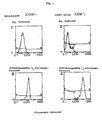
- zeigt eine FACS-Analyse der Bindung eines erfin- dungsgemäßen Fv-Antikörper-Konstruktes an CD30+ L540CY Morbus Hodgkin-Zellen und CD16+ Granulocyten. Die Tumorzellen und die Granulocyten wurden jeweils mit 20 µg des erfindungsgemäßen Fv-Antikörper-Kon- struktes inkubiert. Die Bindung des Fv-Antikörper- Konstruktes wurde mit dem anti-c-myc Antikörper 9E10 und Fluorescein-konjugiertem Ziege-anti-Maus IgG bestimmt. Als Negativ-Kontrolle wurden die Zellen alleine mit 9E10 und Fluorescein-konjugiertem Ziege- anti-Maus-IgG inkubiert.
- Fig. 3
- zeigt die cytolytische Aktivität von in peripheren Blutlymphozyten (PBL-Zellen) enthaltenen NK-Zellen (Effektor) gegenüber CD30+ L540CY Morbus Hogdkin- Zellen (Zielzellen) bei unterschiedlichen Effektor- Zielzellen-Verhältnissesn in einem 5h JAM-Test. Ein erfindungsgemäßes Fv-Antikörper-Konstrukt (●) wurde mit einer Konzentration von 1 µg/ml verabreicht. Als Kontrolle wurde bimAbHRS-3/A9 (▲) (mit einer Konzen- tration von 4 µg/ml verwendet. Als Negativ- Kontrol- le wurden das erfindungsgemäße Fv-Antikörper-Kon- strukt ohne NK-Zellen (o) und NK-Zellen alleine (□) verwendet.
- Fig. 4
- zeigt die Behandlung von SCID Mäusen, die Morbus Hodgkin-Xenotransplantate tragen, mit einem erfin- dungsgemäßen Fv-Antikörper-Konstrukt. Die Mäuse wur- den am Tag 0 i.V. mit 100 µg eines erfindungsgemäßen Fv-Antikörper-Konstruktes zusammen mit NK-Zellen enthaltenden PBL-Zellen (●) bzw. ohne solche (o), mit 200 µl PBS (*), mit 1 x 10⁷ PBL-Zellen (□), bzw. mit einem Gemisch von 100 µg mAb HRS-3 und A9 zu- sammen mit PBL-Zellen (◇) behandelt. Tumor-Durch- messer wurden zweimal pro Woche gemessen und das Tumor-Volumen wurde mit folgender Formel berechnet: Volumen = d2x Dxπ/6, wobei d der kleinere und D der größere Tumor-Durchmesser ist.
- Die cDNA der VH- und VL-Domänen eines anti-CD16-Antikörpers mAb A9 wurde einer PCR unterzogen. Hierfür wurden die folgenden Primer verwendet:
- VH5', 5-CAGCCGGCCATGGCGCAGGTC(G)CAGCTGCAGC(G)AG-3 (NcoI);
- VH3',5-CCAGGGGCCAGTGGATAGACAAGCTTGGGTGTTGTTTT-3 (HindIII):
- VL5',5-AGAGACGCGTACAGGCTGTTGTGACTCAGG-3 (Mlul);
- VL3',5-GACTGCGGCCGCAGACTTGGGCTGGCC-3 (NotI) .
- Die PCR wurde wie folgt durchgeführt: Ein Zyklus; 5 min bei 94°C, 3 min bei 58°C und 2 min bei 72°C, gefolgt von 30 Zyklen; 80 sec bei 94°C, 80 sec bei 58°C und 2 min bei 72°C bzw. letzteres 10 min im letzten Zyklus. Die PCR-Produkte wurden Gelgereinigt und in den Vektor pCR-Script SK(+) (Stratagene) zur Sequenzierung inseriert. Zur Expression wurde die VH-Domäne über NcoI/HindIII und die VL-Domäne über MluI/NotI in den Vektor pHOG21 inseriert.
- Die VH- und VL-Domänen eines anti-CD30-scFv-Fragmentes wurden einer PCR unterzogen. Hierfür wurden die folgenden Primer verwendet:
- 5-ATGACCATGATTACGCCAAGC-3
- 5-AGACAAGCTTGGGTTGTTTTGGCTGAGGAGACGG-3 (HindIII);
- 5-GGCGGATATCGAGCTCACTCAGTCTCC-3 (EcoRV)
- 5-TATAGCGGCCGCAGCATCAGCCCGTTTGATTTCC-3 (NotI).
- Die VH- und VL-Domänen des anti-CD30-scFv-Fragmentes bzw. des anti-CD16-scFv-Fragmentes wurden in den Expressionsvektor pKID inseriert, wodurch der erfindungsgemäße Expressionsvektor pKID 16-30 erhalten wurde. Dieser kodiert für die einzelkettigen Fv-Antikörper-Konstrukte VH 16-VL 30 und VH 30-VL 16.
- E.coli-X11 Blue-Zellen (Stratagene, La Jolla, CA), die mit dem Expressionsplasmid pKID16-30 transformiert worden waren, wurden über Nacht in 2YT-Medium mit 100 µg/ml Ampicillin und 100 mM Glucose bei 37°C gezüchtet. 1:20-Verdünnungen der über Nacht-Kulturen wurden als Kolbenkulturen in 2YT-Medium bei 38°C unter Schütteln mit 280 rpm gezüchtet. Bei einem OD600-Wert von 0,8 wurden die Bakterien durch 10 minütige Zentrifugation mit 1500 g bei 20°C pelletiert und in dem gleichen Volumen eines frischen 2YT-Mediums, das 100 µg/ml Ampicillin und 0,4 M Saccharose enthielt, resuspendiert. IPTG wurde mit einer Endkonzentration von 0,1 M zugesetzt und das Wachstum wurde bei 21°C (20-22°C) 18-20 h fortgesetzt. Das Fv-Antikörper-Konstrukt wurde wie in Kipriyanov, S.M. et al., Protein Engineering 10, (1997), 445 beschrieben, isoliert. Anschließend wurde es durch eine Ammoniumsulfatfällung (Endkonzentration 70 % Sättigung) eingeengt. Das Proteinpräzipitat wurde durch Zentrifugation (30000 g, 4°C, 45 min) gewonnen und in 10 % des Anfangsvolumens von 50 mM Tris-HCl, 1 M NaCl, pH 7,0 aufgelöst. Eine immobilisierte Metallaffinitäts-Chromatographie (IMAC) wurde wie in Kipriyanov, S.M. et al., J. Immunol. Methods 200, (1997), 69 beschrieben, durchgeführt. Das gereinigte Fv-Antikörper-Konstrukt wurde gegen eine Phosphat-gepufferte Kochsalzlösung dialysiert.
- Zum Nachweis der Bindung eines erfindungsgemäßen Fv-Antikörper-Konstruktes an CD16+ Granulocyten und CD30+ L540CY-Morbus Hodgkin-Zellen wurde eine FACScan (Beckton Dickinson)-Analyse durchgeführt. Hierzu wurden 1 x 10⁶-Zellen zweimal in eiskaltem PBS-N (PBS, 0,05% NaN3) gewaschen und mit 100 µl des Fv-Antikörper-Konstruktes von Beispiel 2 45 min auf Eis inkubiert. Die Zellen wurden 5 min mit 1200 rpm bei 4°C pelletiert und mit 2 ml PBS-N gewaschen. Die Zellen wurden in 100 µl PBS-N, das 10 µg/ml des an das c-myc bindenden Antikörpers 9E10 (ICI Chemikalien) enthielt, resuspendiert und 30 min auf Eis inkubiert. Die Zellen wurden pelletiert und wie vorstehend gewaschen. Danach wurden die Zellen mit Fluorescein-markiertem Ziege-anti-Maus IgG (Gibco BRL; 1:100 verdünnt in PBS-N), resuspendiert und 30 min auf Eis inkubiert. Nach erneutem Waschen mit PBS-N waren die Zellen für die Analyse mit PBS-N, das 1 µg/ml Propidiumjodid (Sigma) enthielt, bereit. Hintergrund-Fluoreszenz wurde bestimmt, indem die Zellen mit dem Antikörper 9E10 und Fluorescein-markiertem Ziege-anti-Maus-IgG unter gleichen Bedingungen inkubiert wurden.
- Es zeigte sich, daß das erfindungsgemäße Fv-Antikörper-Konstrukt sowohl CD16+ Granolocyten als auch CD30+ L540 CY Morbus Hodgkin-Zellen erkennt und an sie bindet.
- Zum Nachweis der Aktivität eines erfindungsgemäßen Fv-Antikörper-Konstruktes NK-Zellen zu aktivieren, CD30+ L540CY Morbus Hodgkin-Zellen zu lysieren wurde ein Cytotoxizitätstest entsprechend des in Matzinger, P., J. Immunol. Meth. 145 (1991), 185 beschriebenen JAM-Tests durchgeführt. In dem Cytotoxizitätstest wird die DNA-Fragmentierung bewertet. Zellen wurden mit [3H] Thymidin bis zu einer Endkonzentration von 2,5-5 µCi/ml für 4-6 h markiert. Die Zellen wurden pelletiert, einmal mit Kulturmedium gewaschen und auf 104 Zellen/Vertiefung einer 96-Lochplatte eingestellt. Nach Zugabe von Effektor-Zellen (NK Zellen enthaltende periphere Blutzellen "PBL-Zellen") in verschiedenen Verdünnungen wurde die 96.Lochplatte in einer befeuchteten Atmosphäre mit 7,5 % CO2 für 4 h inkubiert. Die Zellen und das Medium wurden auf Fiberglas-Filter gesaugt. Nach Waschen und Trocknen der Filter wurden sie in Plastik-Tüten überfährt, die eine Szintillationsflüssigkeit enthielten und unter Verwendung eines Flüssig-Szintillations-Zählers (LKB) gezählt. Die gemessene Radioaktivität bezieht sich auf intakte DNA, da DNA aus toten Zellen in kleine Fragmente abgebaut ist, die nicht von den Filtern festgehalten werden. Zur Bestimmung der Cytotoxizität, d.h. der Abtötung von Zellen, wurde die Standardformel für den JAM-Test verwendet: % spezifische Abtötung = (S-E)/S 100, wobei E = experimentell erhaltene DNA in Gegenwart von Effektor-Zellen (in cpm) und S = erhaltene DNA in Abweseneheit von Effektor-Zellen (spontan).
- Es zeigte sich, daß ein erfindungsgemäßes Fv-Antikörper-Konstrukt NK-Zellen aktivieren kann, CD30+ L540CY Morbus Hodgkin-Zellen zu lysieren, wobei die Lyse stärker ist als bei Verwendung von bimAbHRS-3/A9.
- CD30+ L540CY Hodgkin's Lymphome wurden in SCID Mäusen, wie in Hombach, A. et al., Int. J. Cancer 55, (1993), 830; Renner, C. et al., J. Hematotherapy 4, (1995), 447 beschrieben, etabliert. Hierzu wurden 1.5x10⁷ Tumorzellen in 200µl PBS subcutan in die rechte Flanke der Mäuse injiziert. Die Tumor-Entwicklung, d.h. der Tumor-Durchmesser, wurde zweimal pro Woche bestimmt. Mäuse mit Tumoren von 4-6 mm im Durchmesser wurden in verschiedene Gruppen eingeteilt und erhielten ein erfindungsgemäßes Fv-Antikörper-Konstrukt in 200µl PBS zusammen mit NK-Zellen enthaltenden peripheren Blutlymphozyten (PBL-Zellen). Das Tumorvolumen und seine Entwicklung wurden bestimmt (vgl. Legende zu
Fig. 4 ). - Es zeigte sich, daß ein erfindungsgemäßes Fv-Antikörper-Konstrukt nicht nur in vitro sondern auch in vivo NK-Zellen aktivieren kann, CD30+ L540CY Morbus Hodgkin-Zellen zu lysieren.
-
- <110> Deutsches Krebsforschungszentrum
- <120> Fv-Antikörper-Konstrukte
- <130> K 2839
- <140> unbekannt
- <150>
DE 199 37 264.0
<151> 1999-08-06 - <160> 11
- <170> PatentIn Ver. 2.1
- <210> 1
<211> 4570
<212> DNA
<213> Künstliche Sequenz - <220>
<223> Beschreibung der künstlichen Sequenz: Expressionsvektor kodierend für zwei einzelkettige Fv-Antikörper-Konstrukte - <220>
<221> CDS
<222> (217)..(1002) - <220>
<221> CDS
<222> (1102)..(1920) - <400> 1
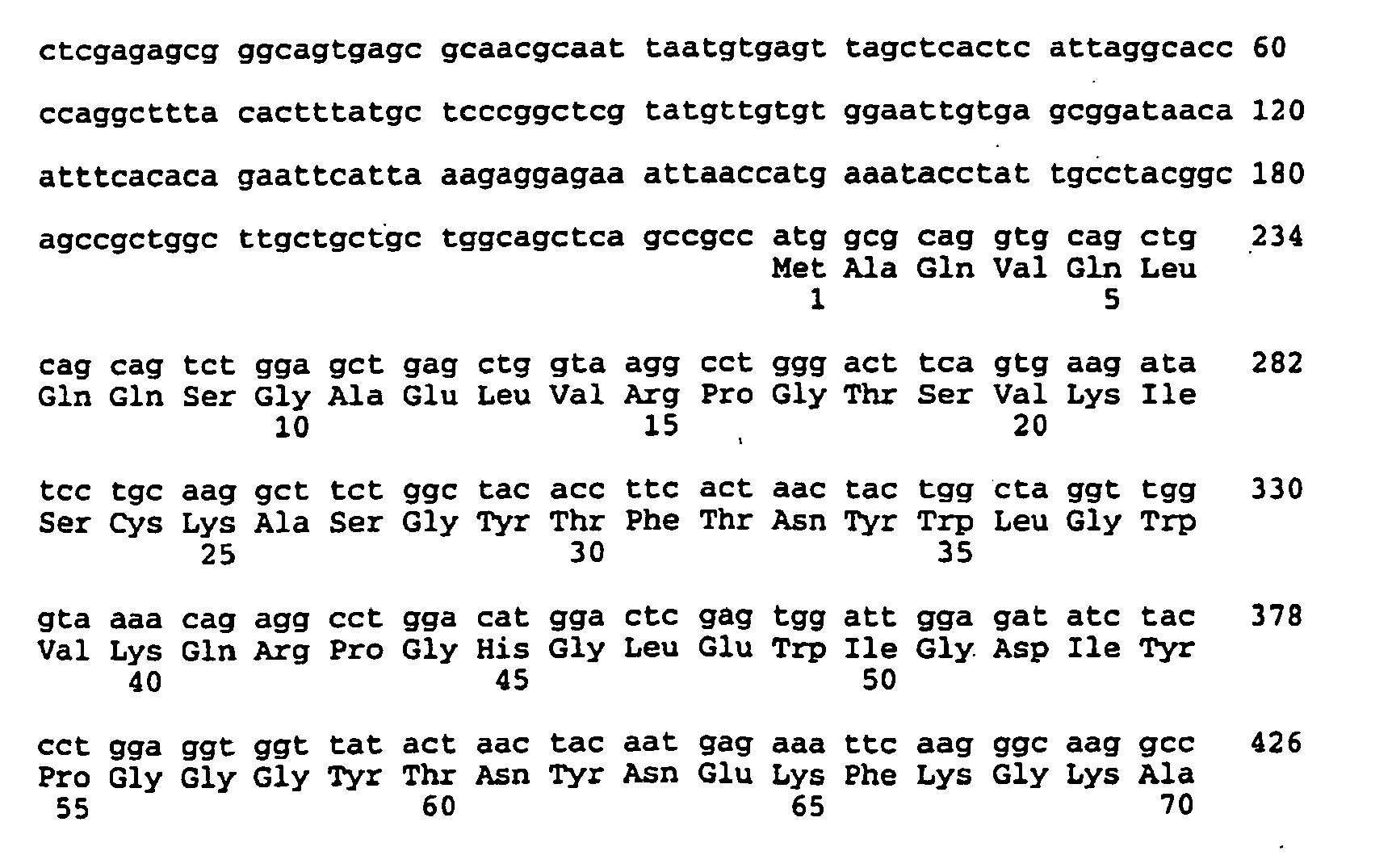


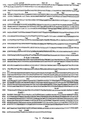
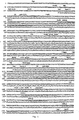
- <210> 2
<211> 262
<212> PRT
<213> Künstliche Sequenz
<223> Beschreibung der künstlichen Sequenz: Expressionsvektor kodierend für zwei einzelkettige Fv-Antikörper-Konstrukte - <400> 2

- <210> 3
<211> 273
<212> PRT
<213> Künstliche Sequenz
<223> Beschreibung der künstlichen Sequenz: Expressionsvektor kodierend für zwei einzelkettige Fv-Antikörper-Konstrukte - <400> 3

- <210> 4
<211> 35
<212> DNA
<213> Künstliche Sequenz - <220>
<223> Beschreibung der künstlichen Sequenz: Primer - <400> 4
cagccggcca tggcgcaggt cgcagctgca gcgag 35 - <210> 5
<211> 38
<212> DNA
<213> Künstliche Sequenz - <220>
<223> Beschreibung der künstlichen Sequenz: Primer - <400> 5
ccaggggcca gtggatagac aagcttgggt gttgtttt 38 - <210> 6
<211> 30
<212> DNA
<213> Künstliche Sequenz - <220>
<223> Beschreibung der künstlichen Sequenz: Primer - <400> 6
agagacgcgt acaggctgtt gtgactcagg 30 - <210> 7
<211> 27
<212> DNA
<213> Künstliche Sequenz - <220>
<223> Beschreibung der künstlichen Sequenz: Primer - <400> 7
gactgcggcc gcagacttgg gctggcc 27 - <210> 8
<211> 21
<212> DNA
<213> Künstliche Sequenz - <220>
<223> Beschreibung der künstlichen Sequenz: Primer - <400> 8
atgaccatga ttacgccaag c 21 - <210> 9
<211> 36
<212> DNA
<213> Künstliche Sequenz - <220>
<223> Beschreibung der künstlichen Sequenz: Primer - <400> 9
agacaagctt gggtgttgtt ttggctgagg agacgg 36 - <210> 10
<211> 27
<212> DNA
<213> Künstliche Sequenz - <220>
- <223> Beschreibung der künstlichen Sequenz: Primer
- <400> 10
ggcggatatc gagctcactc agtctcc 27 - <210> 11
<211> 34
<212> DNA
<213> Künstliche Sequenz - <220>
<223> Beschreibung der künstlichen Sequenz: Primer - <400> 11
tatagcggcc gcagcatcag cccgtttgat ttcc 34
Claims (14)
- Fv-Antikörper-Konstrukt, das variable Domänen, nicht aber konstante Domänen aufweist, wobei die variablen Domänen Bindungsstellen für einen CD16-Rezeptor und ein CD30-Oberflächenprotein umfassen.
- Fv-Antikörper-Konstrukt nach Anspruch 1, wobei der CD16-Rezeptor von NK-Zellen stammt.
- Fv-Antikörper-Konstrukt nach Anspruch 1 oder 2, wobei das CD30-Oberflächenprotein von Morbus Hodgkin- oder Reed-Sternberg-Zellen stammt.
- Fv-Antikörper-Konstrukt nach einem der Ansprüche 1 - 3, wobei jeweils eine Bindungsstelle vorliegt.
- Fv-Antikörper-Konstrukt nach Anspruch 4, kodiert durch den Expressionsvektor pKID16-30 (DSM 12960).
- Fv-Antikörper-Konstrukt nach einem der Ansprüche 1-3, wobei jeweils zwei Bindungsstellen vorliegen.
- Expressionsvektor, kodierend für das Fv-Antikörper-Konstrukt nach einem der Ansprüche 1 - 6.
- Expressionsvektor nach Anspruch 7, nämlich pKID16-30 (DSM 12960).
- Transformante, enthaltend den Expressionsvektor nach Anspruch 7 oder 8.
- Verfahren zur Herstellung des Fv-Antikörper-Konstruktes nach einem der Ansprüche 1-6, umfassend die Kultivierung der Transformante nach Anspruch 9 unter geeigneten Bedingungen.
- Kit, umfassend:(a) ein Fv-Antikörper-Konstrukt nach einem der Ansprüche 1-6, und/oder(b) einen Expressionsvektor nach Anspruch 7 oder 8, sowie(c) übliche Hilfsstoffe, wie Puffer, Lösungsmittel, Träger, Kontrollen und Marker,wobei von den einzelnen Komponenten ein oder mehrere Vertreter vorliegen können.
- Fv-Antikörper-Konstrukt nach einem der Ansprüche 1 bis 6 zur Verwendung als Arzneimittel..
- Verwendung des Fv-Antikörper-Konstruktes nach einem der Ansprüche 1 bis 6 zur Herstellung eines Medikaments zur Lyse von CD30-Oberflächenproteinen exprimierenden Zellen .
- Verwendung nach Anspruch 13, wobei das Medikament zur Behandlung von Tumorerkrankungen, insbesondere von Morbus Hodgkin- oder Reed-Tumoren ist.
Applications Claiming Priority (3)
| Application Number | Priority Date | Filing Date | Title |
|---|---|---|---|
| DE19937264 | 1999-08-06 | ||
| DE19937264A DE19937264A1 (de) | 1999-08-06 | 1999-08-06 | F¶v¶-Antikörper-Konstrukte |
| PCT/DE2000/002589 WO2001011059A1 (de) | 1999-08-06 | 2000-08-02 | Fv-antikörper-konstrukte mit bindungsstellen für einen cd16-rezeptor und ein cd30-oberflächenprotein |
Publications (2)
| Publication Number | Publication Date |
|---|---|
| EP1206555A1 EP1206555A1 (de) | 2002-05-22 |
| EP1206555B1 true EP1206555B1 (de) | 2008-11-19 |
Family
ID=7917521
Family Applications (1)
| Application Number | Title | Priority Date | Filing Date |
|---|---|---|---|
| EP00958214A Expired - Lifetime EP1206555B1 (de) | 1999-08-06 | 2000-08-02 | Fv-antikörper-konstrukte mit bindungsstellen für einen cd16-rezeptor und ein cd30-oberflächenprotein |
Country Status (6)
| Country | Link |
|---|---|
| EP (1) | EP1206555B1 (de) |
| AT (1) | ATE414777T1 (de) |
| AU (1) | AU6982500A (de) |
| DE (2) | DE19937264A1 (de) |
| ES (1) | ES2316381T3 (de) |
| WO (1) | WO2001011059A1 (de) |
Families Citing this family (21)
| Publication number | Priority date | Publication date | Assignee | Title |
|---|---|---|---|---|
| IL162835A0 (en) | 2002-01-09 | 2005-11-20 | Medarex Inc | Human monoclonal antibodies against cd30 |
| US20050069549A1 (en) | 2002-01-14 | 2005-03-31 | William Herman | Targeted ligands |
| WO2006039644A2 (en) | 2004-10-01 | 2006-04-13 | Medarex, Inc. | Methods of treating cd30 positive lymphomas |
| ES2498794T3 (es) | 2005-02-18 | 2014-09-25 | Medarex, L.L.C. | Anticuerpos monoclonales contra CD30 que carecen de restos fucosilo |
| US11254748B2 (en) | 2005-04-15 | 2022-02-22 | Macrogenics, Inc. | Covalent diabodies and uses thereof |
| US9963510B2 (en) | 2005-04-15 | 2018-05-08 | Macrogenics, Inc. | Covalent diabodies and uses thereof |
| US9284375B2 (en) | 2005-04-15 | 2016-03-15 | Macrogenics, Inc. | Covalent diabodies and uses thereof |
| ES2971647T3 (es) * | 2005-04-15 | 2024-06-06 | Macrogenics Inc | Diacuerpos covalentes y usos de los mismos |
| DE102007041834A1 (de) * | 2007-09-03 | 2009-03-05 | Siemens Ag | Arzneimittel zur Behandlung eines Karzinoms |
| JP5898082B2 (ja) | 2009-10-07 | 2016-04-06 | マクロジェニクス,インコーポレーテッド | フコシル化程度の変更により改良されたエフェクター機能を示すFc領域含有ポリペプチドおよびその使用法 |
| AU2011286024B2 (en) | 2010-08-02 | 2014-08-07 | Macrogenics, Inc. | Covalent diabodies and uses thereof |
| BR112013029892A2 (pt) | 2011-05-21 | 2016-12-20 | Macrogenics Inc | polipeptídeo, molécula de ligação a antígeno, diacorpo e uso de uma porção polipeptídica de uma proteína de ligação a soro desimunizada |
| SMT202100464T1 (it) | 2013-03-14 | 2021-11-12 | Macrogenics Inc | Molecole bispecifiche che sono immunoreattive con cellule effettrici immunitarie che esprimono un recettore di attivazione |
| US11384149B2 (en) | 2013-08-09 | 2022-07-12 | Macrogenics, Inc. | Bi-specific monovalent Fc diabodies that are capable of binding CD32B and CD79b and uses thereof |
| UA116479C2 (uk) | 2013-08-09 | 2018-03-26 | Макродженікс, Інк. | БІСПЕЦИФІЧНЕ МОНОВАЛЕНТНЕ Fc-ДІАТІЛО, ЯКЕ ОДНОЧАСНО ЗВ'ЯЗУЄ CD32B I CD79b, ТА ЙОГО ЗАСТОСУВАННЯ |
| EP2840091A1 (de) | 2013-08-23 | 2015-02-25 | MacroGenics, Inc. | Bispezifische Diabodies, die gpA33 und CD3 binden können und Anwendungen dieser |
| EP2839842A1 (de) | 2013-08-23 | 2015-02-25 | MacroGenics, Inc. | Bispezifische monovalente Diabodies mit Fähigkeit zur Bindung von CD123 und CD3 und Verwendungen davon |
| MX386297B (es) | 2014-09-29 | 2025-03-18 | Univ Duke | Moleculas biespecificas que comprenden un brazo orientado a la envoltura vih-1. |
| CN113396230A (zh) | 2019-02-08 | 2021-09-14 | 豪夫迈·罗氏有限公司 | 癌症的诊断和治疗方法 |
| WO2022036146A1 (en) | 2020-08-12 | 2022-02-17 | Genentech, Inc. | Diagnostic and therapeutic methods for cancer |
| WO2022232503A1 (en) | 2021-04-30 | 2022-11-03 | Genentech, Inc. | Therapeutic and diagnostic methods and compositions for cancer |
Family Cites Families (3)
| Publication number | Priority date | Publication date | Assignee | Title |
|---|---|---|---|---|
| DE4337197C1 (de) * | 1993-10-30 | 1994-08-25 | Biotest Pharma Gmbh | Verfahren zur selektiven Herstellung von Hybridomazellinien, die monoklonale Antikörper mit hoher Zytotoxizität gegen humanes CD16-Antigen produzieren, sowie Herstellung bispezifischer monoklonaler Antikörper unter Verwendung derartiger monoklonaler Antikörper und des CD30-HRS-3-Antikörpers zur Therapie menschlicher Tumore |
| DE19531346A1 (de) * | 1995-08-25 | 1997-02-27 | Gsf Forschungszentrum Umwelt | Arzneimittel zur Immuntherapie, enthaltend Antikörper, die spezifisch das MHCII-Antigen eines zu behandelnden Patienten erkennen |
| DE19838967A1 (de) * | 1998-02-06 | 1999-08-12 | Abken Hinrich Univ Prof Dr Med | Verfahren zur Hemmung der unbegrenzten Proliferation, Tumorbildung oder Metastasierung CD30 Antigen exprimierender Zellen |
-
1999
- 1999-08-06 DE DE19937264A patent/DE19937264A1/de not_active Ceased
-
2000
- 2000-08-02 DE DE50015463T patent/DE50015463D1/de not_active Expired - Lifetime
- 2000-08-02 AU AU69825/00A patent/AU6982500A/en not_active Abandoned
- 2000-08-02 ES ES00958214T patent/ES2316381T3/es not_active Expired - Lifetime
- 2000-08-02 EP EP00958214A patent/EP1206555B1/de not_active Expired - Lifetime
- 2000-08-02 WO PCT/DE2000/002589 patent/WO2001011059A1/de not_active Ceased
- 2000-08-02 AT AT00958214T patent/ATE414777T1/de active
Also Published As
| Publication number | Publication date |
|---|---|
| ATE414777T1 (de) | 2008-12-15 |
| AU6982500A (en) | 2001-03-05 |
| WO2001011059A1 (de) | 2001-02-15 |
| DE50015463D1 (de) | 2009-01-02 |
| DE19937264A1 (de) | 2001-02-15 |
| EP1206555A1 (de) | 2002-05-22 |
| ES2316381T3 (es) | 2009-04-16 |
Similar Documents
| Publication | Publication Date | Title |
|---|---|---|
| EP1206555B1 (de) | Fv-antikörper-konstrukte mit bindungsstellen für einen cd16-rezeptor und ein cd30-oberflächenprotein | |
| DE19819846B4 (de) | Multivalente Antikörper-Konstrukte | |
| DE69327229T2 (de) | Multivalente einkettige Antikörper | |
| DE3883899T3 (de) | Geänderte antikörper. | |
| DE69330523T3 (de) | Immunoglobuline ohne leichte ketten | |
| DE60124912T2 (de) | Multimerische, einzelkettige, Tandem-Fv-Antikörper | |
| DE69434578T2 (de) | Expressionsvektoren die für bispezifische Proteine kodieren, und Verfahren zur Herstellung von biologisch-aktiven bispezifischen Fusionsproteinen in Zellen von Säugetieren | |
| DE60127143T2 (de) | Bispezifische Antikörper gegen CD19 und CD16 und deren Verwendung | |
| DE69633175T2 (de) | Multimere proteine | |
| DE69406423T2 (de) | Methode zum überbringen von agenzien an zielzellen | |
| DE69232137T2 (de) | Multivalente antigen-bindende proteine | |
| DE3853515T3 (de) | Multifunktionelle proteine mit vorbestimmter zielsetzung. | |
| EP1566442B1 (de) | Herstellung und Verwendung von Genbanken menschlicher Antikörper("Human-Antikörper-Bibliotheken") | |
| EP1444268A2 (de) | Bispezifisches anti-cd28 antikörper-molekül | |
| DE19600589C1 (de) | Antikörper A3C6E2 | |
| DE60214127T2 (de) | Hybridomzelllinie g250 und deren verwendung zur herstellung monoklonaler antikörper | |
| EP1141271B1 (de) | Selektion von monoklonalen antikörpern | |
| WO2001085795A1 (de) | Trivalente antikörperkonstrukte mit disulfid-brücken stabilisierten variablen regionen | |
| EP1307490B1 (de) | Fv-konstrukte mit beeinflussbarer affinitat zu einer zu bindenden substanz | |
| DE69028713T3 (de) | Schimäre immunoglobuline für cd4-rezeptoren | |
| DE69327693T2 (de) | Interferon-Alpha/Beta bindendes Protein, seine Herstellung und seine enthaltende pharmazeutische Zusammensetzungen | |
| EP1749210B1 (de) | Isolation allergen-spezifischer immunoglobulin-gene aus humanen b-zellen von atopikern | |
| DE69230659T2 (de) | Polypeptide, die an die schweren Ketten von IL-2-Rezeptoren binden können | |
| WO2001081423A1 (de) | Antikörper gegen natives gp96, deren herstellung und verwendung | |
| DE69211922T2 (de) | Rekombinantes DNS-Molekül zur Expression von FV-Fragmenten eines Antikörpers |
Legal Events
| Date | Code | Title | Description |
|---|---|---|---|
| PUAI | Public reference made under article 153(3) epc to a published international application that has entered the european phase |
Free format text: ORIGINAL CODE: 0009012 |
|
| 17P | Request for examination filed |
Effective date: 20020301 |
|
| AX | Request for extension of the european patent |
Free format text: AL;LT;LV;MK;RO;SI |
|
| 17Q | First examination report despatched |
Effective date: 20040512 |
|
| 17Q | First examination report despatched |
Effective date: 20040512 |
|
| GRAP | Despatch of communication of intention to grant a patent |
Free format text: ORIGINAL CODE: EPIDOSNIGR1 |
|
| RTI1 | Title (correction) |
Free format text: FV ANTIBODY CONSTRUCT COMPRISING BINDING SITES FOR A CD16 RECEPTOR AND A CD30 SURFACE PROTEIN |
|
| GRAS | Grant fee paid |
Free format text: ORIGINAL CODE: EPIDOSNIGR3 |
|
| GRAA | (expected) grant |
Free format text: ORIGINAL CODE: 0009210 |
|
| AK | Designated contracting states |
Kind code of ref document: B1 Designated state(s): AT BE CH CY DE DK ES FI FR GB GR IE IT LI LU MC NL PT SE |
|
| REG | Reference to a national code |
Ref country code: GB Ref legal event code: FG4D Free format text: NOT ENGLISH |
|
| REG | Reference to a national code |
Ref country code: CH Ref legal event code: EP |
|
| REG | Reference to a national code |
Ref country code: IE Ref legal event code: FG4D Free format text: LANGUAGE OF EP DOCUMENT: GERMAN |
|
| REF | Corresponds to: |
Ref document number: 50015463 Country of ref document: DE Date of ref document: 20090102 Kind code of ref document: P |
|
| REG | Reference to a national code |
Ref country code: CH Ref legal event code: NV Representative=s name: ING. MARCO ZARDI C/O M. ZARDI & CO. S.A. |
|
| REG | Reference to a national code |
Ref country code: ES Ref legal event code: FG2A Ref document number: 2316381 Country of ref document: ES Kind code of ref document: T3 |
|
| PG25 | Lapsed in a contracting state [announced via postgrant information from national office to epo] |
Ref country code: FI Free format text: LAPSE BECAUSE OF FAILURE TO SUBMIT A TRANSLATION OF THE DESCRIPTION OR TO PAY THE FEE WITHIN THE PRESCRIBED TIME-LIMIT Effective date: 20081119 |
|
| PG25 | Lapsed in a contracting state [announced via postgrant information from national office to epo] |
Ref country code: DK Free format text: LAPSE BECAUSE OF FAILURE TO SUBMIT A TRANSLATION OF THE DESCRIPTION OR TO PAY THE FEE WITHIN THE PRESCRIBED TIME-LIMIT Effective date: 20081119 |
|
| PG25 | Lapsed in a contracting state [announced via postgrant information from national office to epo] |
Ref country code: SE Free format text: LAPSE BECAUSE OF FAILURE TO SUBMIT A TRANSLATION OF THE DESCRIPTION OR TO PAY THE FEE WITHIN THE PRESCRIBED TIME-LIMIT Effective date: 20090219 Ref country code: PT Free format text: LAPSE BECAUSE OF FAILURE TO SUBMIT A TRANSLATION OF THE DESCRIPTION OR TO PAY THE FEE WITHIN THE PRESCRIBED TIME-LIMIT Effective date: 20090420 |
|
| PLBE | No opposition filed within time limit |
Free format text: ORIGINAL CODE: 0009261 |
|
| STAA | Information on the status of an ep patent application or granted ep patent |
Free format text: STATUS: NO OPPOSITION FILED WITHIN TIME LIMIT |
|
| 26N | No opposition filed |
Effective date: 20090820 |
|
| PG25 | Lapsed in a contracting state [announced via postgrant information from national office to epo] |
Ref country code: MC Free format text: LAPSE BECAUSE OF NON-PAYMENT OF DUE FEES Effective date: 20090831 |
|
| PG25 | Lapsed in a contracting state [announced via postgrant information from national office to epo] |
Ref country code: GR Free format text: LAPSE BECAUSE OF FAILURE TO SUBMIT A TRANSLATION OF THE DESCRIPTION OR TO PAY THE FEE WITHIN THE PRESCRIBED TIME-LIMIT Effective date: 20090220 |
|
| PG25 | Lapsed in a contracting state [announced via postgrant information from national office to epo] |
Ref country code: LU Free format text: LAPSE BECAUSE OF NON-PAYMENT OF DUE FEES Effective date: 20090802 |
|
| PG25 | Lapsed in a contracting state [announced via postgrant information from national office to epo] |
Ref country code: CY Free format text: LAPSE BECAUSE OF FAILURE TO SUBMIT A TRANSLATION OF THE DESCRIPTION OR TO PAY THE FEE WITHIN THE PRESCRIBED TIME-LIMIT Effective date: 20081119 |
|
| PGFP | Annual fee paid to national office [announced via postgrant information from national office to epo] |
Ref country code: IT Payment date: 20110824 Year of fee payment: 11 |
|
| PG25 | Lapsed in a contracting state [announced via postgrant information from national office to epo] |
Ref country code: IT Free format text: LAPSE BECAUSE OF NON-PAYMENT OF DUE FEES Effective date: 20110802 |
|
| REG | Reference to a national code |
Ref country code: FR Ref legal event code: PLFP Year of fee payment: 17 |
|
| REG | Reference to a national code |
Ref country code: FR Ref legal event code: PLFP Year of fee payment: 18 |
|
| REG | Reference to a national code |
Ref country code: FR Ref legal event code: PLFP Year of fee payment: 19 |
|
| PGFP | Annual fee paid to national office [announced via postgrant information from national office to epo] |
Ref country code: DE Payment date: 20190916 Year of fee payment: 20 Ref country code: NL Payment date: 20190829 Year of fee payment: 20 Ref country code: IE Payment date: 20190826 Year of fee payment: 20 Ref country code: FR Payment date: 20190827 Year of fee payment: 20 |
|
| PGFP | Annual fee paid to national office [announced via postgrant information from national office to epo] |
Ref country code: BE Payment date: 20190829 Year of fee payment: 20 |
|
| PGFP | Annual fee paid to national office [announced via postgrant information from national office to epo] |
Ref country code: AT Payment date: 20190827 Year of fee payment: 20 Ref country code: GB Payment date: 20190829 Year of fee payment: 20 |
|
| PGFP | Annual fee paid to national office [announced via postgrant information from national office to epo] |
Ref country code: CH Payment date: 20190827 Year of fee payment: 20 |
|
| PGFP | Annual fee paid to national office [announced via postgrant information from national office to epo] |
Ref country code: ES Payment date: 20191003 Year of fee payment: 20 |
|
| REG | Reference to a national code |
Ref country code: DE Ref legal event code: R071 Ref document number: 50015463 Country of ref document: DE |
|
| REG | Reference to a national code |
Ref country code: NL Ref legal event code: MK Effective date: 20200801 |
|
| REG | Reference to a national code |
Ref country code: CH Ref legal event code: PL |
|
| REG | Reference to a national code |
Ref country code: GB Ref legal event code: PE20 Expiry date: 20200801 |
|
| REG | Reference to a national code |
Ref country code: BE Ref legal event code: MK Effective date: 20200802 |
|
| REG | Reference to a national code |
Ref country code: AT Ref legal event code: MK07 Ref document number: 414777 Country of ref document: AT Kind code of ref document: T Effective date: 20200802 |
|
| REG | Reference to a national code |
Ref country code: IE Ref legal event code: MK9A |
|
| PG25 | Lapsed in a contracting state [announced via postgrant information from national office to epo] |
Ref country code: IE Free format text: LAPSE BECAUSE OF EXPIRATION OF PROTECTION Effective date: 20200802 Ref country code: GB Free format text: LAPSE BECAUSE OF EXPIRATION OF PROTECTION Effective date: 20200801 |
|
| REG | Reference to a national code |
Ref country code: ES Ref legal event code: FD2A Effective date: 20220127 |
|
| PG25 | Lapsed in a contracting state [announced via postgrant information from national office to epo] |
Ref country code: ES Free format text: LAPSE BECAUSE OF EXPIRATION OF PROTECTION Effective date: 20200803 |