EP1209680A1 - Verfahren und anordnung zum registrieren von av daten, und mittels dieses verfaren undanordnung registrierde platte - Google Patents
Verfahren und anordnung zum registrieren von av daten, und mittels dieses verfaren undanordnung registrierde platte Download PDFInfo
- Publication number
- EP1209680A1 EP1209680A1 EP00948330A EP00948330A EP1209680A1 EP 1209680 A1 EP1209680 A1 EP 1209680A1 EP 00948330 A EP00948330 A EP 00948330A EP 00948330 A EP00948330 A EP 00948330A EP 1209680 A1 EP1209680 A1 EP 1209680A1
- Authority
- EP
- European Patent Office
- Prior art keywords
- file
- recorded
- directory
- reservation region
- disk
- Prior art date
- Legal status (The legal status is an assumption and is not a legal conclusion. Google has not performed a legal analysis and makes no representation as to the accuracy of the status listed.)
- Withdrawn
Links
Images
















Classifications
-
- G—PHYSICS
- G11—INFORMATION STORAGE
- G11B—INFORMATION STORAGE BASED ON RELATIVE MOVEMENT BETWEEN RECORD CARRIER AND TRANSDUCER
- G11B27/00—Editing; Indexing; Addressing; Timing or synchronising; Monitoring; Measuring tape travel
- G11B27/10—Indexing; Addressing; Timing or synchronising; Measuring tape travel
- G11B27/19—Indexing; Addressing; Timing or synchronising; Measuring tape travel by using information detectable on the record carrier
- G11B27/28—Indexing; Addressing; Timing or synchronising; Measuring tape travel by using information detectable on the record carrier by using information signals recorded by the same method as the main recording
- G11B27/32—Indexing; Addressing; Timing or synchronising; Measuring tape travel by using information detectable on the record carrier by using information signals recorded by the same method as the main recording on separate auxiliary tracks of the same or an auxiliary record carrier
- G11B27/326—Indexing; Addressing; Timing or synchronising; Measuring tape travel by using information detectable on the record carrier by using information signals recorded by the same method as the main recording on separate auxiliary tracks of the same or an auxiliary record carrier used signal is a video-frame or a video-field (P.I.P.)
-
- G—PHYSICS
- G11—INFORMATION STORAGE
- G11B—INFORMATION STORAGE BASED ON RELATIVE MOVEMENT BETWEEN RECORD CARRIER AND TRANSDUCER
- G11B20/00—Signal processing not specific to the method of recording or reproducing; Circuits therefor
- G11B20/10—Digital recording or reproducing
- G11B20/12—Formatting, e.g. arrangement of data block or words on the record carriers
- G11B20/1217—Formatting, e.g. arrangement of data block or words on the record carriers on discs
-
- G—PHYSICS
- G06—COMPUTING OR CALCULATING; COUNTING
- G06F—ELECTRIC DIGITAL DATA PROCESSING
- G06F16/00—Information retrieval; Database structures therefor; File system structures therefor
- G06F16/10—File systems; File servers
-
- G—PHYSICS
- G06—COMPUTING OR CALCULATING; COUNTING
- G06F—ELECTRIC DIGITAL DATA PROCESSING
- G06F3/00—Input arrangements for transferring data to be processed into a form capable of being handled by the computer; Output arrangements for transferring data from processing unit to output unit, e.g. interface arrangements
- G06F3/06—Digital input from, or digital output to, record carriers, e.g. RAID, emulated record carriers or networked record carriers
- G06F3/0601—Interfaces specially adapted for storage systems
- G06F3/0602—Interfaces specially adapted for storage systems specifically adapted to achieve a particular effect
- G06F3/061—Improving I/O performance
- G06F3/0613—Improving I/O performance in relation to throughput
-
- G—PHYSICS
- G06—COMPUTING OR CALCULATING; COUNTING
- G06F—ELECTRIC DIGITAL DATA PROCESSING
- G06F3/00—Input arrangements for transferring data to be processed into a form capable of being handled by the computer; Output arrangements for transferring data from processing unit to output unit, e.g. interface arrangements
- G06F3/06—Digital input from, or digital output to, record carriers, e.g. RAID, emulated record carriers or networked record carriers
- G06F3/0601—Interfaces specially adapted for storage systems
- G06F3/0602—Interfaces specially adapted for storage systems specifically adapted to achieve a particular effect
- G06F3/0614—Improving the reliability of storage systems
-
- G—PHYSICS
- G06—COMPUTING OR CALCULATING; COUNTING
- G06F—ELECTRIC DIGITAL DATA PROCESSING
- G06F3/00—Input arrangements for transferring data to be processed into a form capable of being handled by the computer; Output arrangements for transferring data from processing unit to output unit, e.g. interface arrangements
- G06F3/06—Digital input from, or digital output to, record carriers, e.g. RAID, emulated record carriers or networked record carriers
- G06F3/0601—Interfaces specially adapted for storage systems
- G06F3/0628—Interfaces specially adapted for storage systems making use of a particular technique
- G06F3/0638—Organizing or formatting or addressing of data
- G06F3/0643—Management of files
-
- G—PHYSICS
- G06—COMPUTING OR CALCULATING; COUNTING
- G06F—ELECTRIC DIGITAL DATA PROCESSING
- G06F3/00—Input arrangements for transferring data to be processed into a form capable of being handled by the computer; Output arrangements for transferring data from processing unit to output unit, e.g. interface arrangements
- G06F3/06—Digital input from, or digital output to, record carriers, e.g. RAID, emulated record carriers or networked record carriers
- G06F3/0601—Interfaces specially adapted for storage systems
- G06F3/0668—Interfaces specially adapted for storage systems adopting a particular infrastructure
- G06F3/0671—In-line storage system
- G06F3/0673—Single storage device
- G06F3/0674—Disk device
- G06F3/0677—Optical disk device, e.g. CD-ROM, DVD
-
- G—PHYSICS
- G11—INFORMATION STORAGE
- G11B—INFORMATION STORAGE BASED ON RELATIVE MOVEMENT BETWEEN RECORD CARRIER AND TRANSDUCER
- G11B20/00—Signal processing not specific to the method of recording or reproducing; Circuits therefor
- G11B20/10—Digital recording or reproducing
- G11B20/10527—Audio or video recording; Data buffering arrangements
-
- G—PHYSICS
- G11—INFORMATION STORAGE
- G11B—INFORMATION STORAGE BASED ON RELATIVE MOVEMENT BETWEEN RECORD CARRIER AND TRANSDUCER
- G11B27/00—Editing; Indexing; Addressing; Timing or synchronising; Monitoring; Measuring tape travel
- G11B27/02—Editing, e.g. varying the order of information signals recorded on, or reproduced from, record carriers
- G11B27/031—Electronic editing of digitised analogue information signals, e.g. audio or video signals
- G11B27/034—Electronic editing of digitised analogue information signals, e.g. audio or video signals on discs
-
- G—PHYSICS
- G11—INFORMATION STORAGE
- G11B—INFORMATION STORAGE BASED ON RELATIVE MOVEMENT BETWEEN RECORD CARRIER AND TRANSDUCER
- G11B27/00—Editing; Indexing; Addressing; Timing or synchronising; Monitoring; Measuring tape travel
- G11B27/10—Indexing; Addressing; Timing or synchronising; Measuring tape travel
- G11B27/11—Indexing; Addressing; Timing or synchronising; Measuring tape travel by using information not detectable on the record carrier
-
- G—PHYSICS
- G11—INFORMATION STORAGE
- G11B—INFORMATION STORAGE BASED ON RELATIVE MOVEMENT BETWEEN RECORD CARRIER AND TRANSDUCER
- G11B27/00—Editing; Indexing; Addressing; Timing or synchronising; Monitoring; Measuring tape travel
- G11B27/10—Indexing; Addressing; Timing or synchronising; Measuring tape travel
- G11B27/19—Indexing; Addressing; Timing or synchronising; Measuring tape travel by using information detectable on the record carrier
- G11B27/28—Indexing; Addressing; Timing or synchronising; Measuring tape travel by using information detectable on the record carrier by using information signals recorded by the same method as the main recording
- G11B27/32—Indexing; Addressing; Timing or synchronising; Measuring tape travel by using information detectable on the record carrier by using information signals recorded by the same method as the main recording on separate auxiliary tracks of the same or an auxiliary record carrier
- G11B27/327—Table of contents
- G11B27/329—Table of contents on a disc [VTOC]
-
- G—PHYSICS
- G11—INFORMATION STORAGE
- G11B—INFORMATION STORAGE BASED ON RELATIVE MOVEMENT BETWEEN RECORD CARRIER AND TRANSDUCER
- G11B27/00—Editing; Indexing; Addressing; Timing or synchronising; Monitoring; Measuring tape travel
- G11B27/10—Indexing; Addressing; Timing or synchronising; Measuring tape travel
- G11B27/34—Indicating arrangements
-
- G—PHYSICS
- G11—INFORMATION STORAGE
- G11B—INFORMATION STORAGE BASED ON RELATIVE MOVEMENT BETWEEN RECORD CARRIER AND TRANSDUCER
- G11B27/00—Editing; Indexing; Addressing; Timing or synchronising; Monitoring; Measuring tape travel
- G11B27/36—Monitoring, i.e. supervising the progress of recording or reproducing
-
- H—ELECTRICITY
- H04—ELECTRIC COMMUNICATION TECHNIQUE
- H04N—PICTORIAL COMMUNICATION, e.g. TELEVISION
- H04N9/00—Details of colour television systems
- H04N9/79—Processing of colour television signals in connection with recording
- H04N9/80—Transformation of the television signal for recording, e.g. modulation, frequency changing; Inverse transformation for playback
- H04N9/804—Transformation of the television signal for recording, e.g. modulation, frequency changing; Inverse transformation for playback involving pulse code modulation of the colour picture signal components
- H04N9/8042—Transformation of the television signal for recording, e.g. modulation, frequency changing; Inverse transformation for playback involving pulse code modulation of the colour picture signal components involving data reduction
-
- G—PHYSICS
- G06—COMPUTING OR CALCULATING; COUNTING
- G06F—ELECTRIC DIGITAL DATA PROCESSING
- G06F3/00—Input arrangements for transferring data to be processed into a form capable of being handled by the computer; Output arrangements for transferring data from processing unit to output unit, e.g. interface arrangements
- G06F3/06—Digital input from, or digital output to, record carriers, e.g. RAID, emulated record carriers or networked record carriers
- G06F3/0601—Interfaces specially adapted for storage systems
-
- G—PHYSICS
- G11—INFORMATION STORAGE
- G11B—INFORMATION STORAGE BASED ON RELATIVE MOVEMENT BETWEEN RECORD CARRIER AND TRANSDUCER
- G11B20/00—Signal processing not specific to the method of recording or reproducing; Circuits therefor
- G11B20/00007—Time or data compression or expansion
- G11B2020/00014—Time or data compression or expansion the compressed signal being an audio signal
-
- G—PHYSICS
- G11—INFORMATION STORAGE
- G11B—INFORMATION STORAGE BASED ON RELATIVE MOVEMENT BETWEEN RECORD CARRIER AND TRANSDUCER
- G11B20/00—Signal processing not specific to the method of recording or reproducing; Circuits therefor
- G11B20/10—Digital recording or reproducing
- G11B20/10527—Audio or video recording; Data buffering arrangements
- G11B2020/10537—Audio or video recording
-
- G—PHYSICS
- G11—INFORMATION STORAGE
- G11B—INFORMATION STORAGE BASED ON RELATIVE MOVEMENT BETWEEN RECORD CARRIER AND TRANSDUCER
- G11B20/00—Signal processing not specific to the method of recording or reproducing; Circuits therefor
- G11B20/10—Digital recording or reproducing
- G11B20/12—Formatting, e.g. arrangement of data block or words on the record carriers
- G11B20/1217—Formatting, e.g. arrangement of data block or words on the record carriers on discs
- G11B2020/1218—Formatting, e.g. arrangement of data block or words on the record carriers on discs wherein the formatting concerns a specific area of the disc
- G11B2020/1224—Formatting, e.g. arrangement of data block or words on the record carriers on discs wherein the formatting concerns a specific area of the disc extent, i.e. a set of sectors which numbers form a continuous ascending sequence
-
- G—PHYSICS
- G11—INFORMATION STORAGE
- G11B—INFORMATION STORAGE BASED ON RELATIVE MOVEMENT BETWEEN RECORD CARRIER AND TRANSDUCER
- G11B20/00—Signal processing not specific to the method of recording or reproducing; Circuits therefor
- G11B20/10—Digital recording or reproducing
- G11B20/12—Formatting, e.g. arrangement of data block or words on the record carriers
- G11B2020/1264—Formatting, e.g. arrangement of data block or words on the record carriers wherein the formatting concerns a specific kind of data
- G11B2020/1265—Control data, system data or management information, i.e. data used to access or process user data
-
- G—PHYSICS
- G11—INFORMATION STORAGE
- G11B—INFORMATION STORAGE BASED ON RELATIVE MOVEMENT BETWEEN RECORD CARRIER AND TRANSDUCER
- G11B2220/00—Record carriers by type
- G11B2220/20—Disc-shaped record carriers
- G11B2220/21—Disc-shaped record carriers characterised in that the disc is of read-only, rewritable, or recordable type
- G11B2220/213—Read-only discs
-
- G—PHYSICS
- G11—INFORMATION STORAGE
- G11B—INFORMATION STORAGE BASED ON RELATIVE MOVEMENT BETWEEN RECORD CARRIER AND TRANSDUCER
- G11B2220/00—Record carriers by type
- G11B2220/20—Disc-shaped record carriers
- G11B2220/21—Disc-shaped record carriers characterised in that the disc is of read-only, rewritable, or recordable type
- G11B2220/215—Recordable discs
- G11B2220/216—Rewritable discs
-
- G—PHYSICS
- G11—INFORMATION STORAGE
- G11B—INFORMATION STORAGE BASED ON RELATIVE MOVEMENT BETWEEN RECORD CARRIER AND TRANSDUCER
- G11B2220/00—Record carriers by type
- G11B2220/20—Disc-shaped record carriers
- G11B2220/21—Disc-shaped record carriers characterised in that the disc is of read-only, rewritable, or recordable type
- G11B2220/215—Recordable discs
- G11B2220/218—Write-once discs
-
- G—PHYSICS
- G11—INFORMATION STORAGE
- G11B—INFORMATION STORAGE BASED ON RELATIVE MOVEMENT BETWEEN RECORD CARRIER AND TRANSDUCER
- G11B2220/00—Record carriers by type
- G11B2220/20—Disc-shaped record carriers
- G11B2220/25—Disc-shaped record carriers characterised in that the disc is based on a specific recording technology
- G11B2220/2508—Magnetic discs
- G11B2220/2516—Hard disks
-
- G—PHYSICS
- G11—INFORMATION STORAGE
- G11B—INFORMATION STORAGE BASED ON RELATIVE MOVEMENT BETWEEN RECORD CARRIER AND TRANSDUCER
- G11B2220/00—Record carriers by type
- G11B2220/20—Disc-shaped record carriers
- G11B2220/25—Disc-shaped record carriers characterised in that the disc is based on a specific recording technology
- G11B2220/2525—Magneto-optical [MO] discs
-
- G—PHYSICS
- G11—INFORMATION STORAGE
- G11B—INFORMATION STORAGE BASED ON RELATIVE MOVEMENT BETWEEN RECORD CARRIER AND TRANSDUCER
- G11B2220/00—Record carriers by type
- G11B2220/20—Disc-shaped record carriers
- G11B2220/25—Disc-shaped record carriers characterised in that the disc is based on a specific recording technology
- G11B2220/2537—Optical discs
- G11B2220/2562—DVDs [digital versatile discs]; Digital video discs; MMCDs; HDCDs
-
- G—PHYSICS
- G11—INFORMATION STORAGE
- G11B—INFORMATION STORAGE BASED ON RELATIVE MOVEMENT BETWEEN RECORD CARRIER AND TRANSDUCER
- G11B2220/00—Record carriers by type
- G11B2220/20—Disc-shaped record carriers
- G11B2220/25—Disc-shaped record carriers characterised in that the disc is based on a specific recording technology
- G11B2220/2537—Optical discs
- G11B2220/2562—DVDs [digital versatile discs]; Digital video discs; MMCDs; HDCDs
- G11B2220/2575—DVD-RAMs
-
- G—PHYSICS
- G11—INFORMATION STORAGE
- G11B—INFORMATION STORAGE BASED ON RELATIVE MOVEMENT BETWEEN RECORD CARRIER AND TRANSDUCER
- G11B2220/00—Record carriers by type
- G11B2220/60—Solid state media
- G11B2220/65—Solid state media wherein solid state memory is used for storing indexing information or metadata
-
- H—ELECTRICITY
- H04—ELECTRIC COMMUNICATION TECHNIQUE
- H04N—PICTORIAL COMMUNICATION, e.g. TELEVISION
- H04N5/00—Details of television systems
- H04N5/76—Television signal recording
- H04N5/84—Television signal recording using optical recording
- H04N5/85—Television signal recording using optical recording on discs or drums
Definitions
- the present invention relates to an AV data recording apparatus and method, suitable for recording/reproducing AV (audio-video) data such as a digital image.
- AV audio-video
- optical disks are being used as recording media for recording digital images including animation, due to their increased density.
- Optical disks are applied in a wide range; specifically, they are applied to peripheral equipment of computers, video players for use at home, etc. Furthermore, it is expected that optical disks will be used as recording media, in place of tape media in the future.
- data In order to handle data for common use in such a wide range of applications, data generally is managed as a logical unit (i.e., file).
- a logical unit i.e., file
- UDF Universal Disk Format
- the UDF standard is prescribed so as to ensure medium compatibility among various kinds of computer OSes (Operating Systems).
- the UDF standard also is used in consumer equipment such as DVD-Video players. Furthermore, it is expected that the UDF standard will be supported over a wider platform in the future.
- FIG. 35 shows an example of a structure of an apparatus for recording/reproducing data adopting a conventional AV data recording method.
- reference numeral 101 denotes a disk (e.g., a magneto-optical disk), and 102 denotes a recording medium driving section.
- the recording medium driving section 102 may be composed of a spindle motor, or the like.
- Reference numeral 103 denotes a recording/reproducing section, which is composed of an optical pickup, a magnetic head, a servo circuit, a modulation/demodulation circuit, and the like, when the disk 101 is, for example, a magneto-optical disk.
- Reference numeral 104 denotes a memory section, which stores data temporarily during recording/reproduction.
- Reference numeral 105 denotes a disk drive unit, which is composed of the disk 101, the recording medium driving section 102, the recording/reproducing section 103, and the memory section 104.
- Reference numeral 106 denotes an AV signal processing section, which subjects an AV input signal (that is input through a CCD camera, for example) to processing such as MPEG compression or subjects AV data read from the disk 101 to processing such as MPEG decoding, and outputs the results to a monitor or the like.
- reference numeral 107 denotes a system control section, which controls the AV signal processing section 106 and the disk drive unit 105.
- an AV signal input to the AV signal processing section 106 is subjected to image compression in accordance with the MPEG system or the like, and transferred to the memory section 104 under the control of the system control section 107.
- system control section 107 operates the recording medium driving section 102 and the recording/reproducing section 103 to record data in the memory section 104 onto the disk 101.
- the system control section 107 operates the recording medium driving section 102 and the recording/reproducing section 103 to transfer data recorded on the disk 101 to the memory section 104.
- the data in the memory section 104 is read under the control of the system control section 107, and is output from the AV signal processing section 106 as an AV signal.
- Figure 36 shows the structure in a volume space of the UDF formed on the disk 101.
- the disk 101 in order to handle the disk 101 as a logical volume, the disk 101 is divided into units called sectors, and the sectors are assigned logical sector numbers (LSNs) from 0 (Zero) to a last logical number (Last LSN).
- LSNs logical sector numbers
- Last LSN last logical number
- a volume structure is recorded, respectively.
- a partition space is allocated between the volume structures.
- file structure information and a file i.e., user data
- LBNs logical block numbers
- Figure 37 shows a structure of the partition space when a directory structure shown in Figure 38 is recorded on the disk 101.
- a directory Dir1 is present under a root directory, and File 1_1 and File 1_2 are present under the directory Dir1.
- the space bitmap descriptor has a space bitmap showing whether or not each logical block is allocatable. Each bit of the space bitmap corresponds to a respective logical block. When a bit value is "1”, its corresponding logical block is unallocated, and when a bit value is "0", its corresponding logical block is allocated.
- positional information of a file entry of the root directory is recorded. The file entry will be described in detail later.
- LBN 81
- the terminating descriptor represents an end of a file set descriptor string.
- LBN 82
- a file entry of the root directory is recorded.
- the file entry is used for storing various pieces of attribute information specific to each file, information on the recorded position and size of each file, and the like, and managing each file as a group of extents. The extent will be described in detail later.
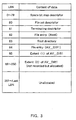
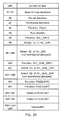
- Figure 39 shows a structure of the file entry.
- a descriptor tag field information is recorded for identifying various kinds of descriptors such as a space bitmap descriptor, a file set descriptor, and a file entry in the partition space. In the case of the file entry, "261" is described.
- ICB Information Control Block
- attribute information on the file entry itself is recorded.
- An extended attribute field is used for describing attribute information other than that prescribed in an attribute information field in the file entry.
- allocation descriptor field the required number of allocation descriptors are recorded for managing a region of continuous logical blocks as one extent.
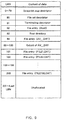
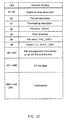
- Figure 40 shows a structure of the allocation descriptor.
- an extent is represented by an extent length and an extent position.
- Figure 41 shows interpretation of the 2 most significant bits of the extent length included in the allocation descriptor.
- An allocated state and a recorded state of the extent are represented by the value of the 2 most significant bits.
- the value "0" represents an extent recorded and allocated, and file data is recorded therein.
- the value "1” represents an extent not recorded but allocated, and its region is allocated to a particular file/directory; however, no data is recorded therein.
- the value "2” represents an extent not recorded and not allocated, and no data is recorded therein.
- the value "3” represents the extent that is the next extent of the allocation descriptors.
- a plurality of allocation descriptors can be recorded, and collection of extents managed by these allocation descriptors form one file.
- the extents forming a file are called a main data stream, in which user data is stored.
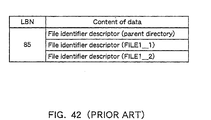
- the directory file is composed of a plurality of file identifier descriptors, and each file identifier descriptor has information on each file included in the directory.
- the main information associated with each file identifier descriptor includes a name of a file to which the file identifier descriptor corresponds and positional information on a file entry thereof.
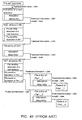
- Figure 43 shows an example of the logical structure of a directory/file in file management information in accordance with the UDF standard.
- the file set descriptor is recorded at a predetermined position in the partition space as a part of file management information.
- a recorded position of the file entry of the root directory file is stored.
- a recorded position of the file entry of the directory Dir1 is stored.
- a plurality of file identifier descriptors are present, and file names and recorded positions of file entries of FILE 1_1 and FILE 1_2 are stored, respectively.
- an extended file entry can be used in place of the above-mentioned file entry.
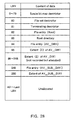
- Figure 44 shows an example of a structure of an extended file entry.
- in the UDF standard in a descriptor tag field of the extended file entry, "266" is described.
- the extended file entry is different from the file entry, in that the extended file entry has a stream directory ICB field.
- the stream directory ICB positional information on a file entry for describing a special directory called a stream directory is stored.
- Figure 45 shows an example of a structure of the stream directory.
- the stream directory also is a kind of a directory file, and is composed of a plurality of file identifier descriptors in the same way as in a general directory file.
- the stream directory file is different from a general directory file, in that a file identifier descriptor in the stream directory is related to a special file called a named data stream.
- a main data stream is referred to as a parent entry, in place of a parent directory.
- a file managed by an extended file entry is composed of one main data stream, or one main data stream and at least one named data stream.
- Figure 46 shows an example of a directory/file logical structure when an extended file entry is used in accordance with the UDF standard.
- the relationship among a file set descriptor, a root directory, a directory Dir1 and files FILE1 _ 1 and FILE_2 is the same as that shown in Figure 43, except that an extended file entry is used in place of a file entry.
- a plurality of file identifier descriptors are present, and names and recorded positions of extended file entries of named_stream_1 and named_stream_2 are stored in the respective file identifier descriptors.
- the content of a root directory file is read. More specifically, a position of a file entry of the root directory is obtained by referring to a file set descriptor. Then, an allocation descriptor is read from the file entry to obtain the position and length of an extent of the root directory file, and data of the root directory file are read. By scanning information on the root directory file thus obtained, a file identifier descriptor matched with an intended directory name Dir1 can be detected.
- the content of the intended directory file is read. More specifically, when a file identifier descriptor matched with an intended directory is detected, positional information of a file entry is obtained from the content of the file identifier descriptor, and the file entry is read. An allocation descriptor is read from the file entry regarding the intended directory to obtain the position and length of an extent recorded in the allocation descriptor, and data of the directory file are read.
- data in a file under the directory Dir1 are scanned to detect a file identifier descriptor matched with an intended file name FILE1_1.
- a file identifier descriptor matched with the intended file name is detected, positional information of a file entry is obtained from the file identifier descriptor, and a file entry thereof is read.
- An allocation descriptor is read from the file entry to obtain the position and length of an extent recorded in the allocation descriptor, and data of the intended file FILE1_1 is read.
- a space bitmap is scanned, and an unallocated logical block with a bit "1" is obtained.
- Data of FILE1_3 is recorded as an extent in the unallocated logical block.
- a file entry indicating FILE1_3 is recorded in the unallocated logical block.
- positional information on the extent indicating FILE1_3 and the extent length are recorded in the file entry as a required number of allocation descriptors.
- a file identifier descriptor indicating FILE1_3 is recorded in a file of a directory Dir1 that is a parent directory of FILE1_3.
- a file name of FILE1_3 and positional information of the file entry thereof are recorded.
- a bit in the space bitmap corresponding to a sector that has been allocated by the above processing is set at "0" so as to be in an allocated state.
- Figure 47 shows a logical volume space obtained as a result of the above processing.
- the order of processing with respect to file management information is not particularly limited to the above example. The processing may be performed in a different order.
- a stream directory ICB is read from an extended file entry of the directory Dir1, and an extended file entry of a stream directory recorded therein is obtained.
- an allocation descriptor is read from the extended file entry to obtain the position and length of an extent of the stream directory, and data of the stream directory file is read.
- Positional information of an extended file entry is obtained from the content of the file identifier descriptor, and the extended file entry is read.
- An allocation descriptor is read from the extended file entry regarding the named data stream to obtain the position and length of an extent recorded therein, and data of an intended named data stream (named_stream_1) is read.
- a named data stream also is recorded in the same way as in a file, except that a file identifier descriptor for storing a recorded position of an extended file entry of the named data stream is recorded in a stream directory file.
- the order of processing with respect to the named data stream is not particularly limited to the above example, and the processing may be performed in a different order.
- the above-mentioned file management method using the UDF has the following problem. More specifically, according to the UDF, a directory is recorded as a file in a partition space, and a file entry also is recorded in the partition space. Therefore, the directory file and the file entry may be distributed on a disk. Thus, in the case where it is attempted to read all the files under a certain directory, when a directory file and a file entry are distributed, seeking occurs often with respect to a disk.
- file entries of FILE 1_1 FILE1_2, and FILE 1_3 are distributed; therefore, seeking cannot be avoided for reading them.
- a file to be reproduced is the one which requires real time reproduction, such as an AV file, reproduction. of the file may be difficult due to the occurrence of seeking.
- the AV data recording apparatus of the present invention includes: a disk as a recording medium for AV data; a recording medium driving section for driving the disk; a recording/reproducing section for recording data onto the disk/reproducing the data from the disk; a memory section for storing data temporarily; an AV signal processing section for performing conversion between an AV signal and a digital signal; and a system control section for controlling a recording method, wherein the apparatus has file management information for managing continuous blocks on the disk as an extent, and dividing the extent into groups so as to manage the extent as a file in the system control section, and a new directory is created on the disk, and the extent that has been allocated is kept as a reservation region for recording the file management information.
- file management information of a file to be recorded is not distributed on a disk, and seeking with respect to a disk can be minimized. Therefore, recording can be performed with high reliability at a high speed. Furthermore, by allocating a reservation region, other information can be prevented from being recorded therein.
- the reservation region is a part of a main data stream.
- the reservation region is a part of a named data stream.
- attribute information of the file is recorded in the reservation region.
- the file is a transport stream of MPEG
- the attribute information of the file recorded in the reservation region is a private stream containing a time map table of a transport stream.
- special reproduction such as fast-forward reproduction and fast-backward reproduction, reproduction at a specified time, and the like can be performed easily.
- the file is an Exif image file
- the attribute information of the file recorded in the reservation region is additional information of the Exif image file. Since thumbnail information and the like are contained in the additional information, thumbnail information and the like can be reproduced at a high speed by reading only the additional information.
- the reservation region is kept by recording the file management information of the file previously. In this case, it is not required to scan a non-recorded region during recording of a file, so that seeking can be reduced.
- an allocated extent is kept as a reservation region for recording the file management information of the file in the subdirectory. In this case, the same effect can be expected even when an AV file is recorded in the subdirectory.
- a directory file of the subdirectory is recorded in the reservation region. This is because seeking can be reduced even in the case of recording an AV file in the subdirectory.
- the directory is created, a defective block in the reservation region is detected, and the defective block is skipped.
- the continuity of data to be recorded in the reservation region is not impaired, so that recording can be performed with high reliability.
- the thumbnail file is recorded in the reservation region. In this case, since seeking does not occur, even a thumbnail image with a large capacity containing a plurality of pieces of image data can be displayed at a high speed.
- the AV data recording method has file management information for managing continuous blocks on a disk as an extent, and dividing the extent into groups so as to manage the extent as a file, wherein a new directory is created on the disk, and the extent that has been allocated is kept as a reservation region for recording the file management information.
- file management information of a file to be recorded is not distributed in a disk, and seeking with respect to a disk can be minimized. As a result, recording can be performed with high reliability at a high speed. Furthermore, by allocating the reservation region, other information can be prevented from being recorded.
- the reservation region is a part of a main data stream.
- the reservation region is a part of a named data stream.
- attribute information of the file is recorded in the reservation region.
- the file is a transport stream of MPEG
- the attribute information of the file recorded in the reservation region is a private stream containing a time map table of a transport stream.
- special reproduction such as fast-forward reproduction and fast-backward reproduction, reproduction at a specified time, and the like can be performed easily.
- the file is an Exif image file
- the attribute information of the file recorded in the reservation region is additional information of the Exif image file. Since thumbnail information and the like are contained in the additional information, thumbnail information and the like can be reproduced at a high speed by reading only the additional information.
- the reservation region is kept by recording the file management information of the file previously. In this case, it is not required to scan a non-recorded region during recording of a file, so that seeking can be reduced.
- an allocated extent is kept as a reservation region for recording file management information of the file in the subdirectory. In this case, the same effect can be expected even when an AV file is recorded in the subdirectory.
- a directory file of the subdirectory is recorded in the reservation region. This is because seeking can be reduced even in the case of recording an AV file in the subdirectory.
- the directory is created, a defective block in the reservation region is detected, and the defective block is skipped.
- the continuity of data to be recorded in the reservation region is not impaired, so that recording can be performed with high reliability.
- the thumbnail file is recorded in the reservation region. In this case, since seeking does not occur, even thumbnail image with a large capacity containing a plurality of pieces of image data can be displayed at a high speed.
- disks collectively refer to recording media having a disk shape, such as an optical disk, a hard disk, and the like (e.g., DVD-RAM, MO, DVD-R, DVD-RW, DVD+RW, etc.).
- Figure 1 shows the structure of an AV data recording apparatus in Embodiment 1 of the present invention.
- reference numeral 1 denotes a disk (e.g., a magneto-optical disk)
- 2 denotes a recording medium driving section, which may be composed of a spindle motor, or the like, when the disk 1 is, for example, a magneto-optical disk.
- Reference numeral 3 denotes a recording/reproducing section.
- the recording/reproducing section 3 is composed of an optical pickup, a magnetic head, a servo circuit, a modulation/demodulation circuit, and the like.
- Reference numeral 4 denotes a memory section, which temporarily stores data during recording/reproduction.
- Reference numeral 5 denotes a disk drive unit, which is composed of the disk 1, the recording medium driving section 2, the recording/reproducing section 3 and the memory section 4.
- Reference numeral 6 denotes an AV signal processing section, which subjects an AV input signal (that is input from a CCD camera, for example) to processing such as MPEG compression or subjects AV data read from the disk medium to processing such as MPEG decoding, and outputs the results to a monitor or the like.
- Reference numeral 7 denotes a system control section, which controls the AV signal processing section 6 and the disk drive unit 5.
- an AV signal input to the AV signal processing section 6 is subjected to image compression processing based on the MPEG system, and transferred to the memory section 4 under the control of the system control section 7.
- the system control section 7 operates the recording medium driving section 2 and the recording/reproducing section 3 to record data in the memory section 4 onto the disk 1.
- the system control section 7 When data is reproduced, the system control section 7 operates the recording medium driving section 2 and the recording/reproducing section 3 to transfer data recorded on the disk 1 to the memory section 4. Then, the data in the memory section 4 is read under the control of the system control section 7, and is output from the AV signal processing section 6 as an AV signal.
- Figure 2 illustrates a file/directory structure immediately after a directory for recording an AV file is created in Embodiment 1 of the present invention.
- Root surrounded by an ellipse represents a root directory
- AV_DIR1 represents a directory for recording an AV file, respectively.
- Figure 3 illustrates a data structure in a partition space in which the file/directory structure shown in Figure 2 is recorded on a disk used in the AV data recording apparatus in Embodiment 1 of the present invention.
- LBN 0 to 79
- LBN 251 to Last is "unallocated”. Therefore, bits corresponding to the sectors therein are set at "1".
- a file entry is that of the root directory, positional information thereof is recorded in the file set descriptor.
- a terminating descriptor is recorded.
- the value of the 2 most significant bits of an allocation descriptor is determined so that the extent (2) is "not recorded” but "allocated".
- FIG. 4 is a flow chart showing the process of recording an AV file onto a disk having the above-mentioned data structure.
- information in the AV reservation region in the memory section 4 is scanned to determine whether or not there is a non-recorded region sufficient for newly recording a file identifier descriptor and a file entry (Step S402). If it is determined that there is not a sufficient non-recorded region (Step S402: No), error processing is performed, and recording of an AV file is ended. If it is determined that there is a sufficient non-recorded region, a file identifier descriptor and a file entry are recorded in a non-recorded region in the AV reservation region in the memory section 4 (Step S403).
- the size of the extent of the directory AV_DIR1 is changed due to recording of the file identifier descriptor and the file entry, so that an allocation descriptor of the file entry of the directory AV_DIR1 is rewritten in accordance with the change. More specifically, the extent length of the extent (1) is changed by addition of the file identifier descriptor, and a portion in which the file entry has been recorded is excluded from the extent (2).
- Step S404 the space bitmap in the memory section 4 is scanned to determine whether or not there are the required number of unallocated logical blocks for recording an AV file. If it is determined that there are no required number of unallocated logical blocks (Step S404: No), error processing is performed, and recording of an AV file is ended. When it is determined that there are the required number of unallocated logical blocks, data are recorded in logical blocks on the recording medium corresponding to the unallocated region obtained in Step S404 (Step S405).
- Step S406 When recording of AV file data is completed, in order to update the file management information of an AV file, information on the position and length of the extent of the AV file is recorded in an allocation descriptor in the file entry in the memory section 4 created in Step 403 (Step S406). Furthermore, required information such as a file name and a file creation time also are updated with respect to the file identifier descriptor and the file entry, in addition to the allocation descriptor.
- Step S407 bits corresponding to the logical blocks in which data has been recorded in Step 405 are changed to "1" representing an "allocated” state.
- an AV file is recorded in the directory AV_DIR1.
- Steps S402 to S407 are repeated after Step S401 until recording of all the AV files is completed, and after recording of all the AV files is completed, a process should proceed to Step S408.
- Figure 5 shows a data structure in the partition space after FILE1.
- DAT that are AV files are recorded in the directory AV_DIR1 in accordance with the flow chart shown in Figure 4.
- logical blocks are used for recording new file entries in the decreasing order of LBN.
- a file identifier descriptor is added to the end of the extent (1) that is a recorded extent of the directory AV_DIR1. Since the file identifier descriptor and the file entry both have a data structure with a variable length, it is desirable that the file identifier descriptor is recorded in the increasing order of LBN in the AV reservation region, and the file entry is recorded in the decreasing order of LBN.
- the allocation descriptor in the directory AV_DIR1 is corrected so that a block adjacent to the extent (1) in the AV reservation region is included in the extent (1), and a file identifier descriptor should be recorded therein.
- Addition of a file entry and a file identifier descriptor with respect to the AV reservation region is not limited to the above procedure. For example, it may be possible to divide the AV reservation region into two, and to use a region with the smaller LBN for recording a file identifier descriptor and record a file entry from the leading edge of the remaining region.
- the upper limit of the data length recorded in the file identifier descriptor is determined previously, for example, by previously determining the length of a name of a file to be recorded, and the capacity allocation for dividing the AV reservation region is determined.
- a recorded AV file is reproduced from the disk shown in Figure 5 in the following manner.
- the recorded extent of the directory AV_DIR1 is scanned to obtain a name of a file present under the directory AV DIR1.
- Such continuous reproduction is realized easily by performing recording in accordance with the processing procedure shown in Figure 4. If the recording procedure of the present invention is not used, it is unclear in which logical block in the partition space an entry of an AV file recorded in the directory AV_DIR1 is recorded. Similarly, the operation of reading data to the memory section 4 is realized easily at a high speed by performing recording in accordance with the processing procedure shown in Figure 4. If the recording procedure of the present invention is not used, although it is possible to read data to the memory section 4, seeking occurs a number of times at the beginning of a recording/reproduction operation.
- the recording procedure is not limited to the one shown in Figure 4.
- a plurality of available continuous regions are kept prior to recording of actual data; these regions are registered in the space bitmap as "an allocated state"; and thereafter, actual data start to be recorded.
- information on the allocation descriptor of the directory AV_DIR1 and the space bitmap may be updated collectively after recording of file data is completed.
- a directory/file name in which an AV file is to be recorded is not limited to that described in Embodiment 1. Another directory/file name may be used.
- Embodiment 1 the case using a file entry has been described. However, an extended file entry may be used.
- the AV reservation region may be kept as a part of the extent of a named data stream of the directory AV_DIR1.
- the extent forming the AV reservation region may be set to be an "allocated" and "recorded" extent.
- Embodiment 2 a file identifier descriptor and a file entry of an AV file to be newly recorded are recorded in a "not recorded” but "allocated” extent of the directory AV_DIR 1.
- a management file to store information for managing an AV file is created under the directory AV_DIR1, and the management file is allowed to have a "not recorded” but "allocated” extent.
- Figure 6 illustrates a file/directory structure immediately after a directory for recording an AV file is created in the AV data recording apparatus in Embodiment 2 of the present invention.
- the file/directory structure shown in Figure 6 is different from the directory structure shown in Figure 2, in that a management file (AVFILES.IFO) is present under the directory AV_DIR1.
- AVFILES.IFO management file
- Figure 7 illustrates a data structure in a partition space when a directory for recording an AV file is recorded.
- LBN 80, a file set descriptor is recorded.
- positional information is recorded in the file set descriptor.
- Embodiment 2 When an AV file is recorded on a disk having the above-mentioned data structure, a processing procedure similar to that shown in Figure 4 can be performed. However, the processing procedure in Embodiment 2 is different from that in Embodiment 1, in that the AV reservation region for recording a new file identifier descriptor and a file entry is a "not recorded” but "allocated" extent of AVFILES.IFO, which is a management file.
- Embodiment 2 When an AV file is reproduced from a disk, a procedure similar to that described in Embodiment 1 can be performed.
- Embodiment 2 no data is recorded in the AVFILES. IFO file in an initial state; however, it may be possible that attribute information and the like on the directory AV_DIR1 are recorded in an initial state, and the AVFILES.IFO file is allowed to have an "allocated” and “recorded” extent, as well as a "not recorded” but “allocated” extent. Furthermore, the "allocated” and “recorded” extent may be set to be an AV reservation region.
- Embodiment 2 the case using a file entry has been described. However, an extended file entry may be used.
- the AV reservation region may be kept as a part of an extent of a named data stream of the file AVFILES.IFO.
- the extent forming the AV reservation region may be set to be an "allocated" and "recorded" extent.
- the AV reservation region management file is recorded in the same directory as that for recording an AV file.
- the AV reservation region management file may be recorded in another directory.
- Embodiment 3 an AV data recording apparatus in Embodiment 3 of the present invention will be described with reference to the drawings.
- Embodiment 3 the case will be described where 100 AV files are recorded in the directory AV_DIR1.
- Figure 8 illustrates a file/directory structure in Embodiment 3.
- Embodiments 1 and 2 a "not recorded” but “allocated” extent is allocated to a directory or a file, and a file entry or the like of an AV file is recorded in the extent.
- Embodiment 3 is different from Embodiments 1 and 2, in that when a directory for recording an AV file is created, a file identifier descriptor and a file entry for an AV file also are created in a continuous region.
- Figure 9 illustrates a data structure in a partition space in Embodiment 3.
- each file is assigned a file name automatically, and these file names are recorded in the file identifier descriptor.
- 100 files are present under the directory AV_DIR1, so that 100 file identifier descriptors are recorded in the extent of the directory AV_DIR1.
- a file entry with a file capacity of 0 is detected, and data are recorded using the detected file entry as a new AV file.
- a method for detecting a new file entry is not limited to this method. Another method may be used. For example, a file name in an initial state may be changed after recording of actual AV data. Alternatively, it may be possible to determined whether or not AV data can be recorded, using a file attribute field in a file identifier descriptor, an extended attribute field in the file entry, and the like.
- the data capacity of a file in an initial state is set to be 0.
- data may be recorded even in an initial state.
- Embodiments 1 to 3 file management information such as a file entry is recorded in a region that already has been kept.
- attribute information of an AV file, as well as a file entry are recorded in a region that has already been kept. Because of this, particular information on an AV file can be accessed continuously at a high speed.
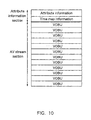
- FIG 10 illustrates a data structure of an AV file to be recorded in Embodiment 4.
- an AV file in Embodiment 4 is a transport stream based on the MPEG system, and is composed of an AV stream part that is a video stream and an attribute information part that is a private stream.
- the AV stream part is composed of a plurality of video object units (hereinafter, referred to as "VOBU").
- One VOBU is AV data corresponding to 0.4 to 1 second of video data, and includes a video data interval called a GOP (Group of Picture) under the MPEG2 standard.
- the GOP includes at least one I-picture, so that the GOP can be reproduced independently.
- an I-picture in the GOP is extracted as an image to be reproduced.
- attribute information on an AV stream is recorded. For example, a recorded date and time of a file, a comment with respect to recorded information, parameters during recording, a thumbnail image, and the like are recorded. Furthermore, in the attribute information part, in addition to the above-mentioned attribute information, time map information is recorded for the purpose of facilitating special reproduction such as fast-forward reproduction and reproduction at a specified time with respect to an AV stream.
- the time map information is the one in which a reproduction time of an AV stream is related to a recorded position, for example, as described in JP 3028517.
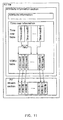
- the time map information has a hierarchical data structure composed of two tables called a time map table and a VOBU table.
- Time maps #1, #2, ... represent recorded positions of VOBU corresponding to reproduction times in the case where data is reproduced at a predetermined time interval TMU (e.g., 60 seconds) on a time axis with a leading edge of the AV stream part at a starting time.
- TMU time interval
- VOBU maps each containing a reproduction time and a data size of each VOBU, are arranged in the order of reproduction time from the leading edge of the AV stream part.
- Figure 12 shows the data structure of time map information in more detail.
- Figure 13 shows the logical link relationship between the time map table and the VOBU table.
- time map general information includes the number of time maps and VOBU maps included in the time map information, a time unit (hereinafter, referred to as "TMU”) representing a predetermined time interval in which time maps are provided, and a time offset (hereinafter, referred to as "TM_OFS”) representing a time difference between the leading time of the AV stream part and the time of the leading time map.
- TEU time unit
- TM_OFS time offset
- time map table a plurality of time maps #1, #2, ... are provided at a predetermined time interval represented by the TMU and arranged in the order of time.
- Each time map is composed of a VOBU map number, a time difference (hereinafter, referred to as "TM_DIFF"), and a VOBU address (hereinafter, referred to as "VOBU_ADR").
- VOBU_ADR is positional information in the AV stream part at the leading edge of the corresponding VOBU.
- a reproduction time (hereinafter, referred to as a "time map time") with respect to time map #i is represented by Formula (1).
- (Time map time) (TMU * (i - 1) + TM_OFS)
- the VOBU map number represents the number present at a reproduction time represented by Formula (1).
- the time map # 1 represents a time obtained by adding TM OFS to a leading time in the AV stream part.
- the time map #2 represents a time after TMU from the time map # 1. Thereafter, the time maps represent VOBU maps present at reproduction times at 2 TMU, 3TMU, ..., respectively.
- TM_DIFF represents a time difference between the leading time of the corresponding VOBU and the time map time.
- Each VOBU map consists of a reference image size, a VOBU reproduction time, and a VOBU size.
- the reference image size refers to the size of the first I-picture in the VOBU, and is used for finding an image of interest for special reproduction or reproduction at a specified time. For example, by adding successively a VOBU reproduction time to the VOBU leading time until the reproduction time of an image of interest is obtained, a VOBU to be reproduced is specified and an image in the VOBU is specified.
- a VOBU size is a data size of a VOBU, and is used for specifying the position of image data of interest for special reproduction or reproduction at a specified time.
- Embodiment 4 even in the case of special reproduction, a particular image such as an I-picture can be searched for at a high speed.
- Figure 14 shows a data structure in a partition space in this case.
- the data structure shown in Figure 14 can keep more AV files, compared with that shown in Figure 3.
- the capacity to be kept equals the total of the capacity of file management information and the capacity of attribute information part with respect to the assumed number of AV files.
- an item i.e., time map information
- the attribute information part is included in the attribute information part.
- the maximum capacity in the time map information part to be recorded on the disk 1 can be determined previously.
- the capacity of an AV reservation region should be kept with respect to an AV file to be recorded in the directory AV_DIR1, expecting the total capacity in the attribute information part in the case where the capacity of the time map information part becomes maximized.
- An AV file is recorded onto a disk having the above-mentioned data structure in accordance with a flow chart shown in Figure 15.
- a file identifier descriptor, a file entry, and an attribute information part of an AV file are recorded in the non-recorded region in the extent of the directory AV_DIR1 in the memory section 4 (Step S1303).
- an allocation descriptor of the file entry of the directory AV_DIR1 is rewritten. More specifically, the extent length of the recorded extent is changed by addition of the file identifier descriptor, and a portion in which the file entry has been recorded is excluded from the non-recorded extent. Furthermore, information that is determined to be recorded in the attribute information part of an AV file also is recorded in the AV reservation region in the memory section 4.
- Step S1304 the space bitmap in the memory section 4 is scanned to determine whether or not there are the required number of unallocated logical blocks for recording an AV file.
- Step S1304 No
- error processing is performed, and recording of an AV file is ended.
- Step S1305 data is recorded in a logical block on a recording medium corresponding to the non-recorded region obtained in Step S1303 (Step S1305).
- time map information is obtained at this time among attribute information of an AV file, so that it is recorded appropriately in the AV reservation region in the memory section 4.
- information on the position and length of an extent of the AV file are recorded in an allocation descriptor in the file entry created in Step S1303 (Step S1306).
- required information such as a file name and a file creation time are updated with respect to the file identifier descriptor and the file entry, in addition to the allocation descriptor.
- Steps S1302 to S1307 are repeated after Step S1301 until recording of all the AV files is completed, and after recording of all the AV files is completed, a process should proceed to Step S1308. Because of this, it is not required to write a file identifier descriptor and a file entry onto a disk every time a file is created, and seeking can be reduced substantially.
- Figure 16 shows a data structure in the partition space after FILE1.
- DAT that are AV files are recorded in the directory AV_DIR1 in accordance with the flow chart shown in Figure 15.
- a file identifier descriptor, a file entry, and an attribute information part of an AV file are recorded.
- Step S408 An AV file is reproduced from a disk having the data structure as shown in Figure 16 by the procedure similar to that described in Embodiment 1.
- file identifier descriptors, file entries, and attribute information parts including time map information of all the AV files present under the directory AV_DIR1 are read to the memory section 4.
- an offset position in a file with respect to a certain reproduction time is obtained by processing only information in the memory section 4, and seeking is not required with respect to the disk 1.
- special reproduction selective reproduction of particular frames
- the positional relationship in the AV reservation region of a file entry, attribute information, and time map information may be varied.
- a portion of the AV reservation region, in which attribute information of an AV file is recorded is read entirely to the memory section 4.
- the attribute information may be read when required.
- seeking can be reduced, and a table for attribute information of an AV file and a high-speed access can be read at a high speed.
- the AV reservation region is provided as an extent of the directory AV_DIR1.
- the AV reservation region may be kept as a plurality of extents. For example, it may be possible to provide an AV reservation region for a file management region as an extent of the directory AV_DIR1, and to provide an AV reservation region for attribute information of an AV file as an extent of the management file.
- the following may be possible: two kinds of management files are provided, an AV reservation region for a file management region is provided in the first management file, and an AV reservation region for attribute information of an AV file is provided in the second management file.
- other methods may be used, as long as an AV reservation region is kept as a continuous region.
- Time map information should be the one in which a reproduction time of an AV stream is related to a recorded position, and may have a structure other than that shown in Figure 11.
- an AV file is a transport stream based on the MPEG.
- the AV file may be in another format.
- Particular information of an AV file simply may be recorded in a region that has been kept previously.
- an AV data recording apparatus in Embodiment 5 of the present invention will be described with reference to the drawings.
- an AV file is recorded, which is composed of an AV stream part in which video data of MPEG2 is recorded and an attribute information part.
- an AV file is an Exif image file, which is composed of an Exif main image (main image data), and additional information related to the Exif main image.
- an AV file in Embodiment 5 is composed of a header part formed of additional information related to a still image and a video data part formed of a still image data body.
- the additional information is recorded in an AV reservation region. Because of this, particular information such as a thumbnail image of an AV file can be accessed continuously at a high speed, by seeking only in the AV reservation region.
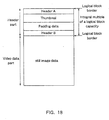
- Figure 17 illustrates a data structure of an AV file in the AV data recording apparatus in Embodiment 5 of the present invention.
- an AV file in Embodiment 5 is composed of a header part and a video data part.
- additional information on the image data part is recorded. For example, a recorded date and time of a file, a comment on recorded information, parameters at a time of recording/compression, a thumbnail image, and the like are recorded. Furthermore, in the video data part, a still image data body compressed based on the JPEG system is recorded.
- a file/directory structure in the AV data recording apparatus in Embodiment 5 is the same as that shown in Figure 2.
- a data structure in a partition space thereof is the same as that shown in Figure 14.
- file management information of an AV file and data with a predetermined capacity from the leading edge of the AV file are recorded. It is assumed that data with such a predetermined capacity include at least a thumbnail image in the header part of an AV file.
- a data structure of an AV file may be constructed as shown in Figure 18: padding data are inserted into the header part so that the capacity of the entire header part is adjusted to be an integral multiple of the logical block capacity of the UDF.
- the capacity of the header part is an integral multiple of the logical block capacity of the UDF, the video data part always is positioned from the leading edge of the logical block.
- only the file management information and the header part are recorded in the AV reservation region.
- the header part can be separated completely from the video data part, and data can be processed on a logical block basis; therefore, recording/reproduction can be performed at a higher speed.
- Embodiment 5 as an AV file, an Exif file containing a main image compressed based on the JPEG system is used.
- the present invention is not limited thereto. Any still image file with a format having additional information in the header part may be used.
- a plurality of AV directories may be present on the disk.
- a still image file is recorded in one directory as in Embodiment 5, and a video file of MPEG2 may be recorded in the other directory as in Embodiment 4.
- the number of AV directories is not limited to two. If required, the number of directories may be increased.
- the AV reservation region may be managed on a directory basis.
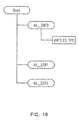
- an AV reservation region management file AVFILES.IFO is placed under a management directory AV_INFO, a still image file is recorded in the AV directory AV_DIR1 using an AV reservation region managed by the AV reservation region management file, and a video file is recorded in the directory AV_DIR2.
- a video file and a still image file are not required to be recorded in separate directories.
- a video file and a still image file may be mixed in one directory.
- Embodiment 5 data recorded by a user can be separated from information for managing the data, which prevents damage and the like to management information due to maloperation and the like.
- a single AV reservation management region file is used.
- an AV reservation management region file may be provided on an AV directory basis.
- Embodiment 6 of the present invention will be described with reference to the drawings.
- an AV directory has a hierarchical structure. It is convenient to support a hierarchical directory for classifying recorded data, and the like.
- a directory also is handled as a kind of a file, so that seeking cannot be avoided particularly in the case of a directory structure with a deep hierarchy.
- FIG. 6 a reservation region is provided for creating a hierarchical directory.
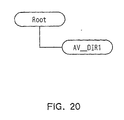
- Figure 20 illustrates a file/directory structure immediately after a directory for recording an AV file is created.
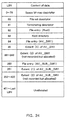
- Figure 21 shows a data structure in a partition space when the file/directory structure shown in Figure 20 is recorded on a disk used in the AV data recording apparatus in Embodiment 6 of the present invention.
- the extent (2) will be referred to as an AV directory reservation region.
- a subdirectory is created under the AV directory on the disk having the above-mentioned structure in accordance with a flow chart shown in Figure 22.
- Step S173 When it is determined that there is a sufficient non-recorded region, a file identifier descriptor and a file entry are recorded in the non-recorded region in the AV reservation region in the memory section 4 (Step S173). At this time, the size of the extent of the AV DIR1 directory is changed due to recording of the file identifier descriptor and the file entry; therefore, an allocation descriptor of the file entry of the AV_DIR1 directory is rewritten in accordance with the change.
- the extent length of the extent (1) is changed by addition of the file identifier descriptor, and a portion in which the file entry has been recorded is excluded from the extent (2).
- Step S174 the space bitmap in the memory section 4 is scanned to determine whether or not there are the required number of continuous unallocated logical blocks for recording an AV subdirectory and an AV reservation region to be allocated thereto.
- Step S174 No
- processing is ended.
- Step S175 When it is determined that there are the required number of continuous unallocated logical blocks, data are recorded in a logical block on the disk corresponding to an unallocated region obtained in Step S173 (Step S175).
- recording of data includes creation of a directory file of an AV subdirectory, and keeping of an AV reservation region allocated to the AV subdirectory.
- Step S176 When recording of data is completed, in order to update file management information of the AV subdirectory file, information on the position and length of the extent of the AV subdirectory file is recorded in an allocation descriptor of the file entry in the memory section 4 created in Step S173 (Step S176).
- required information such as a file name and a file creation time also are updated with respect to the file identifier descriptor and the file entry, in addition to the allocation descriptor.
- Step S177 bits corresponding to logical blocks in which data is recorded in Step S173 are changed to "1" representing an "allocated” state.
- the created AV subdirectory is an extent (2), and the value of the 2 most significant bits of an allocation descriptor is set so that the extent (2) is "not recorded” but "allocated”.
- an AV file is recorded in the directory AV_SUB_DIR1 hereinafter, it is recorded in the same procedure as that in Embodiment 1, using the AV reservation region.
- an AV file is recorded on the disk having the above-mentioned data structure in accordance with a flow chart in Figure 25.
- Step S203 When it is determined that there is a sufficient non-recorded region, a file identifier descriptor and a file entry are recorded in a non-recorded region in the AV reservation region in the subdirectory AV SUB_DIR1 in the memory section 4 (Step S203).
- Step S204 the space bitmap in the memory section 4 is scanned to determine whether or not there are the required number of unallocated logical blocks for recording AV files.
- Step S204 When it is determined that there are not the required number of unallocated logical blocks (Step S204: No), error processing is performed, and recording is completed.
- Step S205 When it is determined that there are the required number of unallocated logical blocks, data is recorded in a logical block on a recording medium corresponding to the non-recorded region obtained in Step S203 (Step S205).
- Step S206 When recording of AV file data is completed, in order to update the file management information of the AV file, information on the position and length of the extent of the AV file is recorded in an allocation descriptor of the file entry in the memory section 4 created in Step S205 (Step S206).
- Step S207 bits corresponding to logical blocks in which data are recorded in Step S205 are changed to "1" representing an "allocated” state
- Figure 26 shows a data structure in a partition space after FILE1.DAT and FILE2.DAT that are AV files are recorded in the directory AV_SUB_DIR1 by processing shown in Figure 25.
- An AV file is reproduced from a disk having the data structure shown in Figure 26 by the following procedure.
- a root directory is read, and the directory AV_DIR1 and the directory AV_SUB_DIR1 are read.
- the recorded extent of the directory AV_SUB_DIR1 is scanned to obtain a name of a file in the directory AV_SUB_DIR1.
- Embodiment 6 even in the case where a directory has a hierarchical structure, seeking at a time of creating a file and reading a file can be reduced substantially.
- a new AV subdirectory should be created, for example, in the case of a user's instruction, or in the case where a predetermined number of files are recorded in the AV subdirectory.
- Embodiment 7 of the present invention will be described with reference to the drawings.
- an AV reservation region also is allocated to an AV subdirectory when the AV directory has a hierarchical structure.
- FIG. 7 is a flow chart showing processing in the case where a subdirectory is created under an AV directory on a disk having the above-mentioned data structure.
- Step S242 When it is determined that there is not a sufficient non-recorded region (Step S242: No), error processing is performed, and creation of an AV subdirectory is ended. When it is determined that there is a sufficient non-recorded region (Step S242: Yes), a file identifier descriptor, a file entry, and an AV subdirectory file are recorded in a non-recorded region in the AV reservation region in the memory section 4 (Step S243).
- Step S244 information on a space bitmap in the memory section 4 is updated if required.
- An AV subdirectory_AV_SUB_DIR1 is created under the directory AV _ DIR1 by the above-mentioned series of processing.
- a directory structure after creation of an AV subdirectory is the same as that shown in Figure 23.
- Figure 28 shows a partition structure after creation of an AV subdirectory.
- a file identifier descriptor is recorded so as to be added to the end of the extent (1) that is a recorded extent of the subdirectory AV_SUB_DIR1.
- "logical blocks are used in decreasing order of LBN in the AV directory reservation region.
- Figure 29 is a flow chart showing processing for recording an AV file on a disk having the above-mentioned data structure.
- Step S262 When it is determined that there is not a sufficient non-recorded region (Step S262: No), error processing is performed, and recording of an AV file is ended. When it is determined that there is a sufficient non-recorded region (Step S262: Yes), a file identifier descriptor and a file entry are recorded in a non-recorded region in the AV reservation region in the memory section 4 (Step S263).
- Step S264 the space bitmap in the memory section 4 is scanned to determine whether or not there are the required number of unallocated logical blocks for recording an AV file.
- Step S264: No error processing is performed, and recording of an AV file is ended.
- Step S264: Yes data are recorded in a logical block corresponding to the region (Step S265).
- Step S266 When recording of AV file data is completed, in order to update file management information of the AV file, information on the position and length of the extent of the AV file is recorded in an allocation descriptor of the file entry in the memory section 4 created in Step S263 (Step S266).
- Figure 30 shows a structure in a partition space after an AV file FAILE1.DAT is recorded in the AV subdirectory AV_SUB_DIR1, and a new subdirectory AV_SUB_DIR2 is created.
- Figure 30 in an AV reservation region in the directory AV_DIR1, an AV subdirectory, file management information of an AV file recorded in the AV subdirectory, and an AV subdirectory file are recorded. Because of this structure, even in the case where files in different AV subdirectories are accessed continuously, seeking with respect to the disk can be reduced.
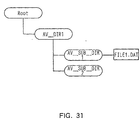
- Figure 31 shows a directory structure in this case.
- a root directory is read, and a directory AV DIR1 is read.
- an extent of the subdirectory AV_SUB_DIR1 in the memory section 1 is scanned to obtain a name of a file recorded in the subdirectory AV_SUB_DIR1.
- Embodiment 7 even in the case where a directory has a hierarchical structure, seeking during creation/reading of a file can be reduced substantially.
- an AV file is often recorded, skipping a defective block without conducting replacement processing, as described in WO 98/14938.
- an AV data recording method in Embodiment 8 when a directory for recording an AV file is created, and an AV reservation region is kept, a defective block is examined. When a defective block is found, the subsequent block is used instead of the defective block, and an AV reservation region is kept.
- an AV file has a thumbnail image as a separate file
- a continuous region for recording the thumbnail image is kept as a reservation region.
- thumbnail image Since the thumbnail image is recorded in the continuous region, a thumbnail list of a recorded file can be displayed to a user at a high speed.
- Embodiment 10 in the case where an AV reservation region has an insufficient capacity, a new AV reservation region is kept, and thereafter, an AV file is recorded.
- Figure 32 shows a partition space when there is no non-recorded region in an AV reservation region due to recording of an AV file.
- LBN 86 to 250 that is an AV reservation region, file management information and the like of file entries with respect to the AV files are recorded.
- the AV reservation region has no non-recorded region, so that an AV file cannot be recorded.
- a new AV reservation region is kept as a "not recorded” but "allocated" extent of the directory AV_DIR1. Processing for keeping a new AV reservation region is performed in the procedure shown in Figure 33.
- Step S33 information on the space bitmap is scanned to determine whether or not there are the required number of continuous unallocated logical blocks for keeping a new AV reservation region (Step S331).
- Step S331 No
- error processing is performed, and an operation of keeping an AV reservation region is ended (Step S332).
- Step S331 When it is determined that there are the required number of logical blocks (Step S331: Yes), the unallocated region is kept as a "not recorded” but "allocated" extent (3) of the directory AV_DIR1. More specifically, information on the position and length of the extent (3) is recorded in an allocation descriptor in the file entry of the directory AV DIR1 (Step S333).
- bits corresponding to logical blocks of the extent (3) are changed to "1" representing an "allocated” state (Step S334).
- Figure 34 shows a state of a partition space after a new AV reservation region is kept.
- LBN 686 to 850 is kept as a new AV reservation region.
- the processing procedure for keeping a new AV reservation region is not limited to the above-mentioned order. For example, the following may be possible: after it is determined whether or not there are the required number of logical blocks, information on the space bitmap is changed; thereafter, information on the extent (3) is recorded in an allocation descriptor in the file entry of the directory AV_DIR1.
- a new AV reservation region should be kept as an extent of the management file AVFILES.IFO.
- the new AV reservation region may be kept as a named stream.
- the AV data recording apparatus of the present invention by recording file management information and attribute information of an AV file in a continuous region that has been kept previously, seeking with respect to a disk, which prevents real-time recording/reproduction of an AV file, can be reduced.
Landscapes
- Engineering & Computer Science (AREA)
- Theoretical Computer Science (AREA)
- General Engineering & Computer Science (AREA)
- General Physics & Mathematics (AREA)
- Physics & Mathematics (AREA)
- Human Computer Interaction (AREA)
- Multimedia (AREA)
- Signal Processing (AREA)
- Databases & Information Systems (AREA)
- Data Mining & Analysis (AREA)
- Management Or Editing Of Information On Record Carriers (AREA)
- Signal Processing For Digital Recording And Reproducing (AREA)
- Information Retrieval, Db Structures And Fs Structures Therefor (AREA)
- Television Signal Processing For Recording (AREA)
Applications Claiming Priority (5)
| Application Number | Priority Date | Filing Date | Title |
|---|---|---|---|
| JP21952399 | 1999-08-03 | ||
| JP21952399 | 1999-08-03 | ||
| JP2000033538 | 2000-02-10 | ||
| JP2000033538 | 2000-02-10 | ||
| PCT/JP2000/005122 WO2001011626A1 (en) | 1999-08-03 | 2000-07-31 | Method and apparatus for av data recording, and disk recorded by the method and apparatus |
Publications (2)
| Publication Number | Publication Date |
|---|---|
| EP1209680A1 true EP1209680A1 (de) | 2002-05-29 |
| EP1209680A4 EP1209680A4 (de) | 2006-03-22 |
Family
ID=26523178
Family Applications (1)
| Application Number | Title | Priority Date | Filing Date |
|---|---|---|---|
| EP00948330A Withdrawn EP1209680A4 (de) | 1999-08-03 | 2000-07-31 | Verfahren und gerät zur aufzeichnung audiovisueller daten und mit diesem varfahren und gerät aufgezeichnete platte |
Country Status (9)
| Country | Link |
|---|---|
| US (8) | US6873789B1 (de) |
| EP (1) | EP1209680A4 (de) |
| JP (1) | JP3859207B2 (de) |
| KR (1) | KR20020025211A (de) |
| CN (1) | CN1377502A (de) |
| AU (1) | AU6183400A (de) |
| MY (1) | MY128743A (de) |
| TW (1) | TW526477B (de) |
| WO (1) | WO2001011626A1 (de) |
Cited By (10)
| Publication number | Priority date | Publication date | Assignee | Title |
|---|---|---|---|---|
| EP1324586A1 (de) * | 2001-12-24 | 2003-07-02 | Lg Electronics Inc. | Aufzeichnungsverfahren von Standbildern auf ein Aufzeichnungsmedium |
| WO2004061846A1 (ja) | 2002-12-26 | 2004-07-22 | Sony Corporation | 光ディスク記録装置及び方法 |
| EP1130599A3 (de) * | 2000-02-29 | 2005-05-04 | Sony Corporation | Aufzeichnungsverfahren und Gerät und Aufzeichnungsmedium |
| EP1130598A3 (de) * | 2000-02-29 | 2005-09-28 | Sony Corporation | Aufzeichnungsgerät und Verfahren und Aufzeichnungsmedium |
| WO2006072922A1 (en) | 2005-01-10 | 2006-07-13 | Koninklijke Philips Electronics, N.V. | Checking a batch of dvd titles to be archived |
| EP1391892A4 (de) * | 2001-05-24 | 2008-04-16 | Sony Corp | Aufzeichnungsverfahren, aufzeichnungsgeraet und aufzeichnungstraeger |
| EP1343069A3 (de) * | 2002-03-06 | 2008-07-02 | Microsoft Corporation | System und Verfahren zur Erzeugung von Folgeströmen von Informationskontrollblöcken für Dateiensysteme mit Universalplattenformat |
| CN100414989C (zh) * | 2002-11-11 | 2008-08-27 | 索尼株式会社 | 信息处理设备和方法 |
| US7496279B2 (en) | 2001-12-22 | 2009-02-24 | Lg Electronics Inc. | Method of recording dubbing audio data onto a rewritable recording medium |
| US7907186B2 (en) | 2002-01-28 | 2011-03-15 | Lg Electronics Inc. | Method of recording still pictures on a recording medium |
Families Citing this family (18)
| Publication number | Priority date | Publication date | Assignee | Title |
|---|---|---|---|---|
| MY130203A (en) | 1999-05-06 | 2007-06-29 | Sony Corp | Methods and apparatus for data processing, methods and apparatus for data reproducing and recording media |
| TW526477B (en) * | 1999-08-03 | 2003-04-01 | Matsushita Electric Industrial Co Ltd | A/V data recording device and method, and the disk recording with the same |
| JPWO2002023898A1 (ja) * | 2000-09-18 | 2004-01-29 | 松下電器産業株式会社 | 映像記録再生装置および方法、ディスク、映像再生装置、並びに映像記録装置および方法 |
| JP3674531B2 (ja) * | 2001-04-12 | 2005-07-20 | 株式会社日立製作所 | ファイル管理方法、ファイル管理装置、プログラム |
| EP1336967A1 (de) * | 2002-02-15 | 2003-08-20 | Deutsche Thomson-Brandt Gmbh | Verfahren und Gerät zur Adressierung von Datensegmenten auf einem Speichermedium zur Datenwiedergabe |
| KR20040097980A (ko) * | 2002-04-05 | 2004-11-18 | 마츠시타 덴끼 산교 가부시키가이샤 | 기록매체 |
| JP4279515B2 (ja) * | 2002-06-25 | 2009-06-17 | 株式会社日立グローバルストレージテクノロジーズ | 記録再生装置 |
| JP4347707B2 (ja) * | 2004-01-09 | 2009-10-21 | パナソニック株式会社 | 情報記録媒体のフォーマット方法および情報記録媒体 |
| CN1961372A (zh) * | 2004-06-03 | 2007-05-09 | 皇家飞利浦电子股份有限公司 | 在数据载体上对数据分区的方法 |
| US20090068597A1 (en) * | 2005-01-14 | 2009-03-12 | Naomasa Shiraishi | Exposure method and apparatus, and electronic device manufacturing method |
| EP1879194A1 (de) * | 2005-04-26 | 2008-01-16 | Matsushita Electric Industrial Co., Ltd. | Einrichtung, verfahren und programm zum aufzeichnen/wiedergeben von informationen und das programm zum aufzeichnen/wiedergeben von informationen enthaltendes computerlesbares aufzeichnungsmedium |
| JP2006352770A (ja) * | 2005-06-20 | 2006-12-28 | Toshiba Corp | 映像録画装置および映像録画方法 |
| US20070223875A1 (en) * | 2006-03-21 | 2007-09-27 | Tsung-Ning Chung | Storage device and method of accessing storage device |
| KR100828479B1 (ko) * | 2006-06-07 | 2008-05-13 | 삼성전자주식회사 | 전자기기에서 이미지 파일에 추가 정보 삽입 장치 및 방법 |
| KR101437653B1 (ko) | 2007-01-26 | 2014-09-12 | 삼성전자주식회사 | 재생시점 변경용 gui 제공방법 및 이를 적용한 영상기기 |
| JP5746071B2 (ja) * | 2012-02-27 | 2015-07-08 | アルパイン株式会社 | 情報再生装置および早送り/早戻し再生方法 |
| KR101472016B1 (ko) * | 2013-02-25 | 2014-12-15 | 삼성전자주식회사 | 이미지 파일에 추가 데이터가 삽입된 복합파일 생성방법 및 상기 복합파일이 기록된 데이터 저장장치 |
| CN103810114A (zh) * | 2014-03-07 | 2014-05-21 | 华为技术有限公司 | 分配存储空间的方法及装置 |
Family Cites Families (28)
| Publication number | Priority date | Publication date | Assignee | Title |
|---|---|---|---|---|
| US4777537A (en) * | 1985-10-21 | 1988-10-11 | Sony Corporation | Signal recording apparatus and method |
| JPH02265074A (ja) * | 1989-04-05 | 1990-10-29 | Mitsubishi Electric Corp | データフアイルシステム用追記式光デイスク |
| JPH0522682A (ja) * | 1991-07-16 | 1993-01-29 | Sanyo Electric Co Ltd | 静止画記録媒体およびその媒体を再生する静止画再生装置 |
| JPH05304653A (ja) * | 1992-04-24 | 1993-11-16 | Toshiba Corp | 画像ファイル装置 |
| JPH0635780A (ja) * | 1992-07-17 | 1994-02-10 | Olympus Optical Co Ltd | 大容量記憶装置のファイル管理方法 |
| JP3441118B2 (ja) | 1993-07-15 | 2003-08-25 | 株式会社マンダム | 抗酸化剤 |
| KR100330289B1 (ko) | 1993-10-18 | 2002-10-04 | 소니 가부시끼 가이샤 | 정보관리방법,데이터기록매체,데이터기록방법,정보검색방법및정보검색장치 |
| JPH07121993A (ja) * | 1993-10-21 | 1995-05-12 | Ricoh Co Ltd | 光学情報記録再生装置 |
| JP3211539B2 (ja) * | 1994-02-14 | 2001-09-25 | 松下電器産業株式会社 | 画像データ記録媒体及び記録再生装置 |
| JPH07262059A (ja) * | 1994-03-25 | 1995-10-13 | Sony Corp | ファイル管理方法 |
| CN1084107C (zh) * | 1994-08-31 | 2002-05-01 | 索尼公司 | 静止图像系统 |
| JP3637082B2 (ja) * | 1994-09-07 | 2005-04-06 | ペンタックス株式会社 | 電子スチルカメラの情報記録方法およびその装置 |
| CA2168327C (en) * | 1995-01-30 | 2000-04-11 | Shinichi Kikuchi | A recording medium on which a data containing navigation data is recorded, a method and apparatus for reproducing a data according to navigationdata, a method and apparatus for recording a data containing navigation data on a recording medium. |
| JP3884785B2 (ja) | 1995-11-08 | 2007-02-21 | キヤノン株式会社 | 記録再生装置、再生装置及び再生方法 |
| US5768055A (en) | 1996-09-19 | 1998-06-16 | Sae Magnetics (H.K.) Ltd. | Magnetic recording head having a carbon overcoat array on slider air bearings surfaces |
| DE69718355T2 (de) * | 1996-09-30 | 2003-09-04 | Matsushita Electric Industrial Co., Ltd. | Aufzeichnungsverfahren zur Aufzeichnung audiovisueller Daten auf einer Platte und Informationsverarbeitungssystem |
| JP3995747B2 (ja) | 1997-01-27 | 2007-10-24 | 株式会社リコー | 情報ファイル記録方法及び記録装置 |
| JPH11102577A (ja) * | 1997-08-01 | 1999-04-13 | Fuji Photo Film Co Ltd | 画像情報記録媒体、およびその記録媒体を生成する画像処理システム |
| JP3028517B2 (ja) | 1997-09-17 | 2000-04-04 | 松下電器産業株式会社 | 光ディスク、録画装置及び方法、再生装置及び方法並びにプログラム記憶媒体 |
| CN100403404C (zh) * | 1997-09-17 | 2008-07-16 | 松下电器产业株式会社 | 光盘记录装置和记录方法 |
| CN1295702C (zh) | 1997-09-17 | 2007-01-17 | 松下电器产业株式会社 | 一种再现方法和一种记录方法 |
| EP1744316A1 (de) * | 1997-10-21 | 2007-01-17 | Sony Corporation | Aufzeichnungs- und/oder Wiedergabevorrichtung, Dateiverwaltungsverfahren und Liefermedium |
| US6734876B2 (en) * | 1997-11-28 | 2004-05-11 | Minolta Co. ,Ltd. | Image display apparatus |
| JP3597690B2 (ja) * | 1998-01-21 | 2004-12-08 | 株式会社東芝 | デジタル情報記録再生システム |
| JPH11232838A (ja) * | 1998-02-16 | 1999-08-27 | Matsushita Electric Ind Co Ltd | 光ディスク、光ディスク記録装置、及び光ディスク読取装置 |
| JP3383587B2 (ja) * | 1998-07-07 | 2003-03-04 | 株式会社東芝 | 静止画像連続情報記録方法と光ディスクと光ディスクの情報再生装置と情報再生方法 |
| CA2289958C (en) * | 1998-11-19 | 2003-01-21 | Tomoyuki Okada | Information recording medium, apparatus and method for recording or reproducing data thereof |
| TW526477B (en) * | 1999-08-03 | 2003-04-01 | Matsushita Electric Industrial Co Ltd | A/V data recording device and method, and the disk recording with the same |
-
2000
- 2000-07-29 TW TW089115217A patent/TW526477B/zh not_active IP Right Cessation
- 2000-07-31 CN CN00813841A patent/CN1377502A/zh active Pending
- 2000-07-31 JP JP2001516192A patent/JP3859207B2/ja not_active Expired - Fee Related
- 2000-07-31 KR KR1020027001500A patent/KR20020025211A/ko not_active Withdrawn
- 2000-07-31 AU AU61834/00A patent/AU6183400A/en not_active Abandoned
- 2000-07-31 EP EP00948330A patent/EP1209680A4/de not_active Withdrawn
- 2000-07-31 WO PCT/JP2000/005122 patent/WO2001011626A1/ja not_active Ceased
- 2000-07-31 US US09/629,744 patent/US6873789B1/en not_active Expired - Lifetime
- 2000-08-02 MY MYPI20003532A patent/MY128743A/en unknown
-
2005
- 2005-02-14 US US11/057,258 patent/US7260317B2/en not_active Expired - Fee Related
- 2005-02-14 US US11/057,474 patent/US7327946B2/en not_active Expired - Fee Related
- 2005-02-14 US US11/057,856 patent/US7305175B2/en not_active Expired - Fee Related
- 2005-02-14 US US11/057,526 patent/US20050147392A1/en not_active Abandoned
- 2005-02-14 US US11/057,352 patent/US20050147389A1/en not_active Abandoned
- 2005-02-14 US US11/057,763 patent/US7324740B2/en not_active Expired - Fee Related
- 2005-02-14 US US11/057,444 patent/US7218844B2/en not_active Expired - Fee Related
Cited By (15)
| Publication number | Priority date | Publication date | Assignee | Title |
|---|---|---|---|---|
| EP1130598A3 (de) * | 2000-02-29 | 2005-09-28 | Sony Corporation | Aufzeichnungsgerät und Verfahren und Aufzeichnungsmedium |
| US7054889B2 (en) | 2000-02-29 | 2006-05-30 | Sony Corporation | Recording method, recording apparatus, and record medium for recording data corresponding to a hierarchial file system |
| EP1130599A3 (de) * | 2000-02-29 | 2005-05-04 | Sony Corporation | Aufzeichnungsverfahren und Gerät und Aufzeichnungsmedium |
| EP1391892A4 (de) * | 2001-05-24 | 2008-04-16 | Sony Corp | Aufzeichnungsverfahren, aufzeichnungsgeraet und aufzeichnungstraeger |
| US7974954B2 (en) | 2001-05-24 | 2011-07-05 | Sony Corporation | Recording method, recording apparatus, and record medium |
| US7496279B2 (en) | 2001-12-22 | 2009-02-24 | Lg Electronics Inc. | Method of recording dubbing audio data onto a rewritable recording medium |
| US8295686B2 (en) | 2001-12-22 | 2012-10-23 | Lg Electronics Inc. | Method of recording dubbing audio data onto a rewritable recording medium |
| EP1324586A1 (de) * | 2001-12-24 | 2003-07-02 | Lg Electronics Inc. | Aufzeichnungsverfahren von Standbildern auf ein Aufzeichnungsmedium |
| US7545407B2 (en) | 2001-12-24 | 2009-06-09 | Lg Electronics Inc. | Method of recording still pictures onto a recording medium |
| US7907186B2 (en) | 2002-01-28 | 2011-03-15 | Lg Electronics Inc. | Method of recording still pictures on a recording medium |
| EP1343069A3 (de) * | 2002-03-06 | 2008-07-02 | Microsoft Corporation | System und Verfahren zur Erzeugung von Folgeströmen von Informationskontrollblöcken für Dateiensysteme mit Universalplattenformat |
| CN100414989C (zh) * | 2002-11-11 | 2008-08-27 | 索尼株式会社 | 信息处理设备和方法 |
| WO2004061846A1 (ja) | 2002-12-26 | 2004-07-22 | Sony Corporation | 光ディスク記録装置及び方法 |
| EP1471530A4 (de) * | 2002-12-26 | 2009-11-04 | Sony Corp | Aufzeichnungsanordnung und -verfahren fuer eine optische platte |
| WO2006072922A1 (en) | 2005-01-10 | 2006-07-13 | Koninklijke Philips Electronics, N.V. | Checking a batch of dvd titles to be archived |
Also Published As
| Publication number | Publication date |
|---|---|
| US20050147389A1 (en) | 2005-07-07 |
| MY128743A (en) | 2007-02-28 |
| US20050147393A1 (en) | 2005-07-07 |
| CN1377502A (zh) | 2002-10-30 |
| US20050147390A1 (en) | 2005-07-07 |
| US7218844B2 (en) | 2007-05-15 |
| WO2001011626A1 (en) | 2001-02-15 |
| US7324740B2 (en) | 2008-01-29 |
| US7260317B2 (en) | 2007-08-21 |
| TW526477B (en) | 2003-04-01 |
| JP3859207B2 (ja) | 2006-12-20 |
| US7327946B2 (en) | 2008-02-05 |
| KR20020025211A (ko) | 2002-04-03 |
| US20050147391A1 (en) | 2005-07-07 |
| EP1209680A4 (de) | 2006-03-22 |
| US7305175B2 (en) | 2007-12-04 |
| US20050147394A1 (en) | 2005-07-07 |
| US20050147388A1 (en) | 2005-07-07 |
| US20050147392A1 (en) | 2005-07-07 |
| US6873789B1 (en) | 2005-03-29 |
| AU6183400A (en) | 2001-03-05 |
Similar Documents
| Publication | Publication Date | Title |
|---|---|---|
| EP1209680A1 (de) | Verfahren und anordnung zum registrieren von av daten, und mittels dieses verfaren undanordnung registrierde platte | |
| US9225954B2 (en) | Recording medium for storing information for still picture, recording and/or reproducing method and apparatus therefor | |
| US6519415B1 (en) | Method and apparatus for creating still picture management data on a rewritable storage media | |
| JPWO2001011626A1 (ja) | Avデータ記録装置及び方法、又は当該記録装置及び方法で記録されたディスク | |
| US6873785B2 (en) | Recording medium for storing virtually deleted still picture information, recording and/or reproducing method and apparatus therefor | |
| US8055119B2 (en) | Method for creating, updating, and recording seamless presentation information of moving picture data in a rewritable recording medium | |
| EP1271325A1 (de) | Dateiverwaltungsverfahren und datenaufzeichungsvorrichtung damit, datenwiedergabevorrichtung, datenaufzeichnungs-/ wiedergabevorrichtung und durch das dateiverwaltungsverfahren aufgezeichnete platte | |
| US7333713B1 (en) | Information recording apparatus and method, and information recording medium on which information is recorded by using them | |
| JP4203043B2 (ja) | Avデータ記録装置及び方法、又は当該記録装置及び方法で記録されたディスク | |
| US7860374B2 (en) | Information recording method, format changing method, and information reproduction method | |
| JP2003153178A (ja) | 映像信号変換方法及び映像信号変換装置 |
Legal Events
| Date | Code | Title | Description |
|---|---|---|---|
| PUAI | Public reference made under article 153(3) epc to a published international application that has entered the european phase |
Free format text: ORIGINAL CODE: 0009012 |
|
| 17P | Request for examination filed |
Effective date: 20020304 |
|
| AK | Designated contracting states |
Kind code of ref document: A1 Designated state(s): AT BE CH CY DE DK ES FI FR GB GR IE IT LI LU MC NL PT SE |
|
| AX | Request for extension of the european patent |
Free format text: AL;LT;LV;MK;RO;SI |
|
| RBV | Designated contracting states (corrected) |
Designated state(s): DE FR GB |
|
| A4 | Supplementary search report drawn up and despatched |
Effective date: 20060203 |
|
| STAA | Information on the status of an ep patent application or granted ep patent |
Free format text: STATUS: THE APPLICATION IS DEEMED TO BE WITHDRAWN |
|
| 18D | Application deemed to be withdrawn |
Effective date: 20060322 |