EP1214075B1 - POLYMORPHE DES N-METHYL-N-(3-(2-THIENYLCARBONYL)-PYRAZOL[1,5-a]PYRIMIDIN-7-YL PHENYL)ACETAMID UND ZUSAMMENSTELLUNGEN UND DIESBEZÜGLICHE METHODEN - Google Patents
POLYMORPHE DES N-METHYL-N-(3-(2-THIENYLCARBONYL)-PYRAZOL[1,5-a]PYRIMIDIN-7-YL PHENYL)ACETAMID UND ZUSAMMENSTELLUNGEN UND DIESBEZÜGLICHE METHODEN Download PDFInfo
- Publication number
- EP1214075B1 EP1214075B1 EP00957941A EP00957941A EP1214075B1 EP 1214075 B1 EP1214075 B1 EP 1214075B1 EP 00957941 A EP00957941 A EP 00957941A EP 00957941 A EP00957941 A EP 00957941A EP 1214075 B1 EP1214075 B1 EP 1214075B1
- Authority
- EP
- European Patent Office
- Prior art keywords
- polymorph form
- polymorph
- pyrimidin
- pyrazol
- acetamide
- Prior art date
- Legal status (The legal status is an assumption and is not a legal conclusion. Google has not performed a legal analysis and makes no representation as to the accuracy of the status listed.)
- Expired - Lifetime
Links
Images


Classifications
-
- C—CHEMISTRY; METALLURGY
- C07—ORGANIC CHEMISTRY
- C07D—HETEROCYCLIC COMPOUNDS
- C07D487/00—Heterocyclic compounds containing nitrogen atoms as the only ring hetero atoms in the condensed system, not provided for by groups C07D451/00 - C07D477/00
- C07D487/02—Heterocyclic compounds containing nitrogen atoms as the only ring hetero atoms in the condensed system, not provided for by groups C07D451/00 - C07D477/00 in which the condensed system contains two hetero rings
- C07D487/04—Ortho-condensed systems
-
- A—HUMAN NECESSITIES
- A61—MEDICAL OR VETERINARY SCIENCE; HYGIENE
- A61P—SPECIFIC THERAPEUTIC ACTIVITY OF CHEMICAL COMPOUNDS OR MEDICINAL PREPARATIONS
- A61P21/00—Drugs for disorders of the muscular or neuromuscular system
-
- A—HUMAN NECESSITIES
- A61—MEDICAL OR VETERINARY SCIENCE; HYGIENE
- A61P—SPECIFIC THERAPEUTIC ACTIVITY OF CHEMICAL COMPOUNDS OR MEDICINAL PREPARATIONS
- A61P21/00—Drugs for disorders of the muscular or neuromuscular system
- A61P21/02—Muscle relaxants, e.g. for tetanus or cramps
-
- A—HUMAN NECESSITIES
- A61—MEDICAL OR VETERINARY SCIENCE; HYGIENE
- A61P—SPECIFIC THERAPEUTIC ACTIVITY OF CHEMICAL COMPOUNDS OR MEDICINAL PREPARATIONS
- A61P25/00—Drugs for disorders of the nervous system
- A61P25/08—Antiepileptics; Anticonvulsants
-
- A—HUMAN NECESSITIES
- A61—MEDICAL OR VETERINARY SCIENCE; HYGIENE
- A61P—SPECIFIC THERAPEUTIC ACTIVITY OF CHEMICAL COMPOUNDS OR MEDICINAL PREPARATIONS
- A61P25/00—Drugs for disorders of the nervous system
- A61P25/20—Hypnotics; Sedatives
-
- A—HUMAN NECESSITIES
- A61—MEDICAL OR VETERINARY SCIENCE; HYGIENE
- A61P—SPECIFIC THERAPEUTIC ACTIVITY OF CHEMICAL COMPOUNDS OR MEDICINAL PREPARATIONS
- A61P25/00—Drugs for disorders of the nervous system
- A61P25/22—Anxiolytics
Definitions
- This invention is directed to polymorphs of N-methyl-N-(3- ⁇ 3-[2-thienylcarbonyl]-pyrazol-[1,5- ⁇ ,]-pyrimidin-7-yl ⁇ phenyl)acetamide having activity over a wide range of indications, and particularly useful for the treatment of insomnia, and to related processes, compositions and methods.
- Insomnia is used to describe all conditions related to the perception of inadequate or non-restful sleep by the patient (Dement, International Pharmacopsychiatry 17 :3-38, 1982). Insomnia is the most frequent complaint, being reported by 32% of the adult population surveyed in the Los Angeles area (Bixler et al, Amer. Journal of Psychiatry 136 :1257-1262, 1979), and 13% of the population surveyed in San Marino, Italy (Lugaresi et al., Psychiatric Annals 17 :446-453, 1987).
- insomnia Fully 45% of the surveyed adult population of Alachua County, Florida, reported trouble getting to sleep or staying asleep (Karacan et al., Social Science and Medicine 10 :239-244, 1976). The prevalence of insomnia has also been shown to be related to the age and sex of the individuals, being higher in older individuals and in females.
- insomnia if left untreated, may result in disturbances in metabolism and overall body function. Reduced productivity and significant changes in mood, behavior and psychomotor function. Chronic insomnia is associated with a higher incidence of morbidity and mortality. Traditionally, the management of insomnia includes treatment and/or mitigation of the etiological factors, improving sleep hygiene and the administration of hypnotic agents.
- the early hypnotic agents such as barbiturates, while effective, elicited a spectrum of unwanted side effects and longer-term complications. For example, barbiturates have the potential to result in lethargy, confusion, depression and a variety of other residual effects many hours post dosing, as well as having a potential for being highly addictive.
- insomnia shifted away from barbiturates and other CNS depressants toward the benzodiazepine class of sedative-hypnotics.
- This class of sedative-hypnotic agents showed substantial effectiveness in producing a calming effect which results in sleep-like states in man and animals (Gee et al., Drugs in Central Nervous Systems, Horwell (ed.), New York, Marcel Dekker, Inc., 1985, p. 123-147) and had a greater safety margin than prior hypnotics, barbiturates or chloral hydrate (Cook and Sepinwall, Mechanism of Action of Benzodiazepines, Costa and Greengard (eds.), New York, Raven Press, 1975, p. 1-28).
- benzodiazepines The therapeutic action of benzodiazepines is believed to be mediated by binding to a specific receptor on benzodiazepine GABA complexes in the brain. As a result of this binding, synaptic transmission is altered at neurons containing the benzodiazepine GABA complex (Clody et al., Benzodiazepines II, Rechtschaffen and Kales (eds.), New York, Springer-Verlag, 1989, p. 341-354).
- Memory impairment which can include amnesia for events occurring prior to and after drug administration, is of particular concern in the elderly whose cognitive function may already be impaired by the aging process (Ayd, Benzodiazepines II, Rechtschaffen and Kales (eds.), New York, Springer-Verlag, 1989, p. 593-600; Finkle, supra; Linnoila and Ellinwood, supra).
- agents are non-benzodiazepine compounds, which bing selectively to a specific receptor subtype of the benzodiazepine receptor. This receptor selectivity is thought to be the mechanism by which these compounds are able to exert a robust hypnotic effect, while also demonstrating an improved safety profile relative to the non-selective, benzodiazepine class of agents.
- FDA United States Food and Drug Administration
- Compound 1 may be made according to the procedures disclosed in U.S. Patent No. 4,521,422, which procedure is more specifically disclosed in Example 1.
- Compound 1 is made by reacting an appropriately substituted pyrazole (a) (i.e., wherein R 2 is hydrogen and R 3 is 2-thienyl) with an appropriately substituted 3-dimethylamino-2-propen-1-one (b) ( i.e. , wherein R 5 and R 6 are hydrogen and R 7 is 3-N(CH 3 )(COCH 3 )phenyl), followed by recystallization from dichloromethane/hexane.
- a i.e., wherein R 2 is hydrogen and R 3 is 2-thienyl
- b i.e. , wherein R 5 and R 6 are hydrogen and R 7 is 3-N(CH 3 )(COCH 3 )phenyl
- the present invention is directed to substantially pure polymorphs of Compound 1 (referred to herein as "Form I” and “Form II'') which have particularly advantageous properties.
- the present invention accordingly provides the embodiments as defined in claims 1 to 58.
- a substantially pure polymorph Form I of Compound 1 exhibits a predominant endotherm at about 196° C (192-197° C as measured by a TA 2920 Modulated Differential Scanning Calorimeter (DSC) at a scan rate of 10° C per minute), and contains less than about 6% by weight of Form II.
- Specific embodiments of the substantially pure polymorph Form I contain less than about 2% by weight total impurities, less than about 1% by weight water, and/or less than about 0.5% by weight residual organic solvent.
- Another embodiment includes substantially pure polymorph Form I containing less than 1 % by weight total impurities, less than about 0.75% by weight water, and less than 0.4% by weight residual organic solvent. Other embodiments of the polymorph Form I are described further below.
- a substantially pure polymorph exhibits a predominant endotherm at about 176° C (173-177° C as measured by a TA 2920 Modulated Differential Scanning Calorimeter at a scan rate of 10° C per minute), and contains less than about 20% by weight of Form I.
- Specific embodiments of the substantially pure polymorph Form II contain less than about 2% by weight total impurities, less than about 1% by weight water, and less than about 0.5% by weight residual organic solvent.
- Another embodiment includes substantially pure polymorph Form II containing less than 1% by weight total impurities, less than about 0.75% by weight water, and less than 0.4% by weight residual organic solvent.
- Other embodiments of the polymorph Form II are described further below,
- the polymorphs Form I and II are useful as sedative or hypnotic agents generally and, more specifically, are useful in the treatment of insomnia.
- the present invention is also directed to methods for treating a variety of conditions by administering an effective amount of the polymorph Form I and/or II to an animal or subject in need thereof (referred to herein as a "patient"), typically a warm-blooded animal (including a human).
- a patient typically a warm-blooded animal (including a human).
- the administered polymorph Prior to administration, is generally formulated as a pharmaceutical composition that contains an effective dosage amount of the polymorph in combination with one (or more) pharmaceutically acceptable carrier(s).
- Conditions that may be treated by the polymorphs of this invention, or a pharmaceutical composition containing a polymorph of this invention, include any disorder or disease that may be improved or ameliorated by administration of a polymorph according to the invention, which possess anxiolytic, anti-anoxic, sleep-inducing, hypnotic, anticonvulsant, and/or skeletal muscle relaxant properties.
- Such conditions include insomnia specifically, as well as sleep disorders generally and other neurological and psychiatric complaints; anxiety states; vigilance disorders, such as for combating behavioral disorders attributable to cerebral vascular damage and to the cerebral sclerosis encountered in geriatrics; epileptic vertigo attributable to cranial trauma; and metabolic encephalopathies.
- substantially pure Form I of Compound 1 is made by forming a solution of acetone and Compound 1, cooling the solution to result in a crystallized mass, and collecting the crystallized mass to yield substantially pure Form I.
- substantially pure Form II of Compound 1 is made by forming a solution of methanol and Compound 1, cooling the homogenous solution to result in a crystallized mass, and collecting the crystallized mass to yield substantially pure Form II.
- Specific embodiments of the invention include those wherein the solution of Compound 1 further comprises one or more other organic solvents, thereby making a combination homogeneous solution.
- Another aspect of the invention provides a method of converting the polymorph Form II to the polymorph Form I.
- Specific embodiments of this aspect include: 1) exposing the polymorph Form II to a high energy, such as thermal energy or mechanical energy, process. Such processes include: 1) exposing the polymorph Form II to an elevated temperature for a sufficient period of time to convert the polymorph Form II to the polymorph Form I; 2) milling or grinding the polymorph Form II to form the polymorph Form I; 3) dissolving the polymorph Form II in acetone (or a combination of acetone and one or more other solvents) to form a solution, cooling the solution to form a crystallized mass, and collecting the crystallized mass to yield substantially pure Form I; and/or 4) heating the polymorph Form II above its melting point to form a molten mass, and cooling the molten mass to form the polymorph Form I.
- This aspect of the invention can also be used to purify lots of polymorph Form I that contain unacceptable amounts of the polymorph Form II by subjecting impure polymorph Form I
- compositions are also disclosed containing substantially pure Form I or Form II in combination with a pharmaceutically acceptable carrier.
- Such compositions may assume a variety of forms, including pills, tablet and capsules for oral administration.
- Solids exist in either amorphous or crystalline forms. In the case of crystalline forms, molecules are positioned in 3-dimensional lattice sites. When a compound recrystallizes from a solution or slurry, it may crystallize with different spatial lattice arrangements, a property referred to as "polymorphism,” with the different crystal forms individually being referred to as a "polymorph”. Different polymorphic forms of a given substance may differ from each other with respect to one or more physical properties, such as solubility and dissociation, true density, crystal shape, compaction behavior, flow properties, and/or solid state stability.
- the unstable forms In the case of a chemical substance that exists in two (or more) polymorphic forms, the unstable forms generally convert to the more thermodynamically stable forms at a given temperature after a sufficient period of time. When this transformation is not rapid, the thermodynamically unstable form is referred to as the "metastable" form.
- the stable form exhibits the highest melting point, the lowest solubility, and the maximum chemical stability.
- the metastable form may exhibit sufficient chemical and physical stability under normal storage conditions to permit its use in a commercial form. In this case, the metastable form, although less stable, may exhibit properties desirable over those of the stable form, such as enhanced solubility or better oral bioavailability.
- the present inventors have discovered the polymorph Form I, which has a "high” melting point of about 196°C, and the polymorph Form II, which has a "low” melting point of about 176°C, as measured by a TA 2920 Modulated Differential Scanning Calorimeter (TA Instruments, New Castle, Delaware), at a scan rate of 10°C per minute.
- Figure 1 is a Differential Scanning Calorimetry (DSC) thermogram (as measured by the instrument noted above) of Compound 1 made according to the prior art (see Example 1). As illustrated in Figure 1, Compound 1 exhibits endotherms at 175.41°C and 195.08°C, and an exotherm at 177.93°C, establishing the presence of both the high melting point, Form I polymorph, and the low melting point, Form II polymorph.
- DSC Differential Scanning Calorimetry
- Figure 2 is a DSC thermogram of substantially pure polymorph Form I made according to the process of the invention.
- Figure 3 is a DSC thermogram of substantially pure polymorphic Form II. As illustrated in Figure 2, Form I exhibits a predominant endotherm at 195.98°C, while Figure 3 shows that Form II exhibits a predominant endotherm at 175.93°C (the minor endotherm at 194.6°C in Figure 3 is due to the presence of Form I in an amount of about 6% by weight).
- the endotherms of the respective Forms I and II may vary by about 0.01-10° C, or about 0-5° C, above or below the endotherms depicted in the drawings.
- the observed endotherm may also differ from instrument to , instrument; however, it will generally be within the ranges defined herein provided the instruments are calibrated similarly.
- the polymorphs Form I and Form II differ in their crystal structure as determined by single-crystal X-ray crystallography.
- the data relating to the single-crystal X-ray crystallography spectrum for Form I is presented in the following Tables 1-6, as obtained on a Picker four-circle goniostat equipped with a Furnas Monochromator (HOG crystal), modified by addition of stepping motors (Slo-Syn) on each of the four axes, and a fifth motor drives a 20-position filter/attenuator wheel.
- Crystal Parameters of Form I Crystal Dimensions were 0.12 x 0.05 x 0.015 mm.
- Biso values are X 10. 2) Isotropic values for those atoms refined anisotropically are calculated using the formula given by W. C. Hamilton, Acta Cryst., 12,609 (1959). 3) Parameters marked by an asterisk (*) were not varied.
- Biso values are X 10. 2) Isotropic values for those atoms refined anisotropically are calculated using the formula given by W. C. Hamilton, Acta Cryst. 12:609 (1959) 3) Parameters marked by an asterisk (*) were not varied.
- Form I is considered to be “substantially pure” when Form II constitutes less than about 6% (by weight), less than about 3%, or less than about 1% of Form I.
- Form II is considered to be “substantially pure” when Form I constitutes less than about 20% (by weight), less than about 10%, or less than about 5% of Form II.
- a substantially pure form of either Form I or Form II will generally contain less than about 2% total impurities, less than about 1% water, and less than about 0.5% residual organic solvent.
- Polymorphic Forms I and II of this invention may be obtained by crystallization, starting from Compound 1, with each polymorph resulting by crystallization from a different solvent. More specifically, Compound 1 may be obtained by the procedure disclosed in U.S. Patent No. 4, 521,422. Compound 1 is then crystallized from acetone as disclosed in Example 2 to yield Form I. Form II may also be obtained from Compound 1 as set forth above, but by crystallization from methanol as disclosed in Example 3.
- a process for preparing substantially pure Form I or Form II.
- the process involves the step of forming a homogenous solution of N-methyl-N-(3- ⁇ 3-[2-thienylcarbonyl]-pyrazol-[1,5- ⁇ ]-pyrimidin-7-yl ⁇ phenyl)acetamide in acetone (for production of Form I) or methanol (for production of Form II).
- a homogenous solution may be formed, for example, by mixing N-methyl-N-(3- ⁇ 3-[2-thienylcarbonyl]-pyrazol-[1,5- ⁇ ]-pyrimidin-7-yl ⁇ phenyl)acetamide with the appropriate solvent, followed by heating.
- the homogenous solution is then cooled, resulting in the crystallization of substantially pure Form I (if the solvent is acetone) or substantially pure Form II (if the solvent is methanol), which crystals are then collected and dried ( e.g. , at 40°C for a period of time, such as six or more hours).
- the crystallization solvent can be seeded with crystals of the desired polymorph.
- the polymorph Form II may be obtained by crystallization from solvents such as methanol, acetonitrile, 1-butanol, diethyl ether, N,N-dimethylformamide (DMF), toluene, tetrahydrofuran (THF) and combinations thereof.
- solvents such as methanol, acetonitrile, 1-butanol, diethyl ether, N,N-dimethylformamide (DMF), toluene, tetrahydrofuran (THF) and combinations thereof.
- the polymorph Form I may be obtained by crystallization from solvents such as acetone, ethyl acetate, toluene and combinations thereof.
- Large-scale processes of manufacture generally include transfer of a concentrated solution containing a desired compound. Accordingly, the Compound 1 may be added to the crystallization solvent as a solid or as a solution in a cosolvent, such as methylene chloride, methylene chloride/hexane or other organic solvent. The polymorph is then crystallized from acetone or methanol as desired to form the polymorph Form I or Form II, respectively.
- a cosolvent such as methylene chloride, methylene chloride/hexane or other organic solvent.
- the concentration of Compound 1 present in the cosolvent may vary from 0.1% wt. to saturation, 0.1 % wt. to about 16%.
- the concentration of Compound 1 in the cosolvent will vary according to the temperature at which the cosolvent is held. Generally, warmer temperatures will provide more concentrated solutions of Compound 1.
- a solution containing cosolvent and Compound 1 can be added to the crystallization solvent (for example, methanol or acetone) or the crystallization solvent can be added to the solution containing cosolvent and Compound 1.
- the solution containing Compound 1 is generally at ambient temperature or at an elevated temperature with respect to ambient temperature, and the crystallization solvent temperature is independently initially chilled (a temperature below ambient temperature), at ambient temperature, or at an elevated temperature (a temperature above ambient temperature).
- a solution containing Compound 1 and the cosolvent can undergo a solvent exchange and to form a solution or heterogeneous mixture of the crystallization solvent and Compound 1, as described in Example 4.
- the crystallization solvent can be seeded with one or more crystals of a particular polymorph in order to promote formation of that particular crystal in the crystallization solvent. Seeding of the crystallization solvent is optional.
- Compound 1 is dissolved in hot acetone. After cooling has begun, the crystallization solvent is seeded with crystals of the polymorph Form I. Alternatively, the seed crystals can be added once the crystallization solvent is saturated with Compound 1.
- crystallization solvent means a solvent or combination of solvents used to crystallize a polymorph of the Compound 1 to preferentially form the desired polymorph Form I of Form II.
- the crystallization solvent used to crystallize the polymorph Form I comprises a major portion of acetone.
- the crystallization solvent used to crystallize the polymorph Form II comprises a major portion of methanol.
- the crystallization solvent may also contain one or more of the herein-described cosolvents. The cosolvent can be present is a wide range of amounts depending upon the combination solvent system being used and the polymorph being produced.
- cosolvents can be used as cosolvents in the crystallization of Form I or Form II from acetone or methanol, respectively.
- the cosolvent will generally be present in amounts small enough to ensure that it does not negatively interfere with the formation of the desired polymorph.
- Suitable cosolvents include polar solvent, nonpolar solvent, protic solvent, aprotic solvent, acetone, methanol, ethanol, propanol, butanol, ethyl acetate, THF, DMF, diethyl ether, acetonitrile, toluene, dichloromethane, water, and combinations thereof.
- the polymorph Form I can be formed by heating the polymorph Form II for a sufficient period of time and at a temperature sufficient to effect the conversion.
- Figure 4 depicts a DSC thermogram of a substantially pure polymorph Form II containing approximately 92% of Form II and approximately 8% of Form I.
- Figure 5 depicts a DSC thermogram of a mixture of Compound 1 containing about 46% of polymorph Form I and about 54% of polymorph Form II. These amounts have been determined by quantitating the area within the endotherm peak for each respective polymorph, summing the respective areas, and calculating the relative percent of each peak with respect to the total area.
- the DSC thermograms of Figures 4 and 5 were obtained by employing the following procedure.
- a sample was heated from 15 °C to 300 °C, at a scan rate of 10 °C per minute, in a DSC instrument and held at 300 °C for one minute. The sample was then cooled to 15 °C by lowering the temperature at a rate of 50 °C per minute. DSC data were acquired during the temperature ramp up
- Substantially pure Form I is also prepared by milling of Form II, or of Compound 1 that has been prepared according to known techniques. For example, milling of Form II in a fluid energy mill, jet mill, roller or ball mill, or other mechanical device to a mean particle size of approximately 1 micron to 15 microns will generally convert a portion or all of Form II to Form I.
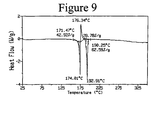
- Figure 8 is a DSC thermogram of the substantially pure polymorph Form II prior to being exposed to high energy milling and containing no detectable amounts of the polymorph Form I.
- the polymorph Form II is converted to the polymorph Form I by heating the polymorph Form II, by milling the polymorph Form II, and/or by dissolving the polymorph Form II in an acetone containing solvent and crystallizing the polymorph Form I therefrom.
- the polymorph Form II can be pure, substantially pure or impure prior to conversion to the Form I.
- the polymorph Form I is considered a heat stable form of Compound 1.
- heat stable or “physically stable” is meant that the Form I is stable toward conversion to the polymorph Form II; although, it may be labile toward degradation to other compounds.
- Form I has significant advantages over the polymorphic mixture of Compound 1 prepared according to known techniques. Specifically, Form I exhibits superior physical stability, thus allowing processing and manufacture of solid dosage forms without conversion to a different polymorphic form. This, in turn, enhances the milling and compaction properties of the drug substance.
- Form II also has significant advantages over the polymorphic mixture of Compound 1 as prepared according to known techniques. Specifically, Form II exhibits superior water solubility over Form I and generally greater solubility in a range of organic solvents as compared to Form I (See Table 13). Form II is generally more soluble in polar and protic solvents than is Form I. Enhanced solubility of a compound will generally increase the bioavailability of that compound. When absorption of a drug is dissolution rate limited, use of the more soluble and faster dissolving form improves the rate and extent of bioavailability.
- a polymorph of this invention may be formulated as a pharmaceutical composition.
- Pharmaceutical compositions of the present invention comprise a polymorph and a pharmaceutically acceptable carrier, wherein the polymorph is present in the composition in an amount that is effective to treat the condition of interest.
- the pharmaceutical compositions of the present invention include the polymorph in an amount from 0.1 mg to 250 mg per dosage depending upon the route of administration, and more typically from 1 mg to 60 mg. Appropriate concentrations and dosages can be readily determined by one skilled in the art.
- compositions formulated as liquid solutions include saline and sterile water, and may optionally include antioxidants, buffers, bacteriostats and other common additives.
- the compositions can also be formulated as pills, capsules, granules, or tablets which contain - in addition to the polymorph - diluents, dispersing and surface active agents, binders, and lubricants.
- One skilled in this art may further formulate the polymorph in an appropriate manner, and in accordance with accepted practices, such as those disclosed in Remington's Pharmaceutical Sciences, Gennaro, Ed., Mack Publishing Co., Easton, PA 1990.
- the present invention provides the compounds for use for treating conditions which benefit from administration of agents which possess anxiolytic, anti-anoxic, sleep-inducing, hypnotic, anticonvulsant, and/or skeletal muscle relaxant properties.
- agents which possess anxiolytic, anti-anoxic, sleep-inducing, hypnotic, anticonvulsant, and/or skeletal muscle relaxant properties include insomnia specifically, as well as sleep disorders generally and other neurological and psychiatric complaints, anxiety states, vigilance disorders, such as for combating behavioral disorders attributable to cerebral vascular damage and to the cerebral sclerosis encountered in geriatrics, epileptic vertigo attributable to cranial trauma, and for metabolic encephalopathies.
- systemic administration of a polymorph as disclosed herein, preferably in the form of a pharmaceutical composition.
- systemic administration encompasses both oral and parenteral methods of administration.
- suitable pharmaceutical compositions include powders, granules, pills, tablets, and capsules as well as liquids, syrups, suspensions, and emulsions. These compositions may also include flavorants, preservatives, suspending, thickening and emulsifying agents, and other pharmaceutically acceptable additives.
- the compounds of the present invention can be prepared in aqueous injection solutions that may contain buffers, antioxidants, bacteriostats, and other additives commonly employed in such solutions.
- Example 2 To 1.5 g of Compound 1 as prepared in Example 1 is added 100 mL of acetone. The solution is heated to reflux until the solution is homogeneous. The solution is quickly filtered through a glass-fritted funnel. The solution is allowed to gradually cool to room temperature, approximately 1 hour. The mixture is further cooled to 5°C using an ice bath. The solid formed is collected by filtration and washed with 10 mL of cold acetone yielding 0.4 g of Form I. The mother liquor is concentrated to approximately 20 mL in vacuo. The solution is cooled to 5°C and the solid is collected by filtration and washed with 10 mL of cold acetone affording an additional 0.5 g of Form I.
Landscapes
- Health & Medical Sciences (AREA)
- Chemical & Material Sciences (AREA)
- Organic Chemistry (AREA)
- Veterinary Medicine (AREA)
- Life Sciences & Earth Sciences (AREA)
- Public Health (AREA)
- General Health & Medical Sciences (AREA)
- Bioinformatics & Cheminformatics (AREA)
- Chemical Kinetics & Catalysis (AREA)
- General Chemical & Material Sciences (AREA)
- Medicinal Chemistry (AREA)
- Nuclear Medicine, Radiotherapy & Molecular Imaging (AREA)
- Engineering & Computer Science (AREA)
- Pharmacology & Pharmacy (AREA)
- Neurology (AREA)
- Animal Behavior & Ethology (AREA)
- Biomedical Technology (AREA)
- Neurosurgery (AREA)
- Physical Education & Sports Medicine (AREA)
- Orthopedic Medicine & Surgery (AREA)
- Pain & Pain Management (AREA)
- Anesthesiology (AREA)
- Pharmaceuticals Containing Other Organic And Inorganic Compounds (AREA)
- Nitrogen Condensed Heterocyclic Rings (AREA)
- Medicinal Preparation (AREA)
- Plural Heterocyclic Compounds (AREA)
Claims (58)
- Polymorphe Form I von N-Methyl-N-(3-{3-[2-thienylcarbonyl]-pyrazol-[1,5-α]-pyrimidin-7-yl}phenyl)acetamid mit einem predominanten endothermen Signal bei 192 - 198 °C, bestimmt durch DSC, wobei besagte polymorphe Form I weniger als etwa 6 Gew.-% der polymorphen Form II umfasst.
- Polymorphe Form I nach Anspruch 1, wobei besagte polymorphe Form I weniger als 2 Gew.-% Verunreinigungen, weniger als 1 Gew.-% Wasser und weniger als 0,5 Gew.-% Rest an organischen Lösungsmitteln enthält.
- Polymorphe Form I nach Anspruch 1, wobei besagte polymorphe Form ein predominantes endothermes Signal bei 195 - 197 °C zeigt.
- Polymorphe Form I nach Anspruch 1, wobei besagte polymorphe Form zwei Moleküle pro Zelle umfasst und der P1 bar Raumgruppe angehört, bestimmt durch Einkristallröntgenkristallographie.
- Polymorphe Form I nach Anspruch 1, wobei besagte polymorphe Form Kristalldimensionen von 0,12 mm x 0,05 mm x 0,015 mm aufweist, sowie ein Volumen von 913, bestimmt durch Einkristallröntgenkristallographie.
- Polymorphe Form I nach Anspruch 1, wobei besagte polymorphe Form eine berechnete Dichte von 1,37 aufweist, bestimmt durch Einkristallröntgenkristallographie.
- Polymorphe Form I nach Anspruch 1, weiter charakterisiert durch die folgenden Bindungsdistanzen, bestimmt durch Einkristallröntgenkristallographie:
A B Distanz S(1) C(2) 1,728(9) S(1) C(5) 1,763(7) O(7) C(6) 1,263(8) O(26) C(25) 1,306(12) N(10) N(11) 1,392(7) N(10) C(9) 1,352(8) N(11) C(12) 1,404(7) N(11) C(16) 1,415(8) N(15) C(14) 1,343(8) N(15) C(16) 1,357(9) N(23) C(19) 1,514(10) N(23) C(24) 1,530(10) N(23) C(25) 1,234(9) C(2) C(3) 1,365(10) C(3) C(4) 1,434(9) C(4) C(5) 1,400(10) C(5) C(6) 1,490(10) C(6) C(8) 1,483(9) C(8) C(9) 1,418(9) C(8) C(16) 1,421(9) C(12) C(13) 1,380(9) C(12) C(17) 1,486(9) C(13) C(14) 1,428(9) C(17) C(18) 1,415(10) C(17) C(22) 1,424(8) C(18) C(19) 1,387(10) C(19) C(20) 1,409(9) C(20) C(21) 1,404(10) C(21) C(22) 1,412(9) C(25) C(27) 1,584(13) C(2) H(1) 0,921(7) C(3) H(2) 0,978(8) C(4) H(3) 0,945(7) C(9) H(4) 0,954(7) C(13) H(5) 0,949(6) C(14) H(6) 0,961 (7) C(18) H(7) 0,940(6) C(20) H(8) 0,958(7) C(21) H(9) 0,952(6) C(22) H(10) 0,950(7) C(24) H(11) 0,943(8) C(24) H(12) 0,939(7) C(24) H(13) 0,954(7) C(27) H(14) 0,953(8) C(27) H(15) 0,942(7) C(27) H(16) 0,937(8) - Polymorphe Form II von N-Methyl-N-(3-{3-[2-thienylcarbonyl]-pyrazol-[1,5-α]-pyrimidin-7-yl)phenyl)acetamid mit einem predominanten endothermen Signal bei 172 - 179 °C bestimmt durch DSC, wobei besagte polymorphe Form II weniger als 20 Gew.-% der polymorphen Form I umfasst.
- Polymorphe Form II nach Anspruch 8, wobei besagte polymorphe Form II weniger als 2 Gew.-% Verunreinigungen, weniger als 1 Gew.-% Wasser und weniger als 0,5 Gew.-% Rest an organischen Lösungsmitteln umfasst.
- Polymorphe Form II nach Anspruch 8, wobei besagte polymorphe Form an ein predominantes endothermes Signal bei 173 - 177 °C zeigt.
- Polymorphe Form II nach Anspruch 8, wobei besagte polymorphe Form vier Moleküle pro Zelle aufweist und der P2/a1 Raumgruppe angehört, bestimmt durch Einkristallröntgenkristallographie.
- Polymorphe Form II nach Anspruch 8, wobei besagte polymorphe Form Kristalldimensionen von 0,35 mm x 0,2 mm x 0,12 mm aufweist und ein Volumen von 1.797, bestimmt durch Einkristallröntgenkristallographie.
- Polymorphe Form II nach Anspruch 8, wobei besagte polymorphe Form eine berechnete Dichte von 1,39 aufweist, bestimmt durch Einkristallröntgenkristallographie.
- Polymorphe Form II nach Anspruch 8, weiter charakterisiert, durch die folgenden Bindungsdistanzen, bestimmt durch Einkristallröntgenkristallographie:
A B Distanz S(1 ) C(2) 1,703(8) S(1 ) C(5) 1,734(6) O(7) C(6) 1,233(7) O(26) C(25) 1,267(9) N(10) N(11) 1,373(6) N(10) C(9) 1,332(7) N(11) C(12) 1,391(7) N(11) C(16) 1,389(7) N(15) C(14) 1,328(7) N(15) C(16) 1,336(8) N(23) C(19) 1,451(9) N(23) C(24) 1,486(8) N(23) C(25) 1,295(9) C(2) C(3) 1,366(9) C(3) C(4) 1,405(9) C(4) C(5) 1,377(9) C(5) C(6) 1,453(9) C(6) C(8) 1,480(8) C(8) C(9) 1,379(8) C(8) C(16) 1,410(8) C(12) C(13) 1,353(8) C(12) C(17) 1,484(8) C(13) C(14) 1,405(8) C(17) C(18) 1,392(8) C(17) C(22) 1,379(9) C( 18) C(19) 1,406(9) C(19) C(20) 1,369(9) C(20) C(21) 1,379(9) C(21) C(22) 1,379(8) C(25) C(27) 1,548(10) C(2) H(1) 0,950(7) C(3) H(2) 0,950(7) C(4) H(3) 0,949(6) C(9) H(4) 0,950(6) C(13) H(5) 0,950(6) C(14) H(6) 0,950(6) C(18) H(7) 0,950(7) C(20) H(8) 0,950(6) C(21) H(9) 0,950(7) C(22) H(10) 0,949(7) C(24) H(11) 0,952(8) C(24) H(12) 0,949(8) C(24) H(13) 0,948(8) C(27) H(14) 0,952(8) C(27) H(15) 0,949(8) C(27) H(16) 0,952(7) - Verfahren zur Herstellung von Form I von N-Methyl-N-(3-{3-[2-thienylcarbonyl]-pyrazol-[1,5-α]-pyrimidin-7-yl}phenyl)acetamid, umfassend die Stufen:Formen einer Lösung eines Kristallisationslösungsmittels, umfassend Aceton, und N-Methyl-N-(3-{3-[2-thienylcarbonyl]-pyrazol-[1,5-α]-pyrimidin-7-yl}phenyl)acetamid; und Abkühlen der Lösung um eine Kristallmasse zu formen und Aufsammeln der Kristalle der Form I.
- Verfahren nach Anspruch 15, weiter umfassend die Stufe:Trocknen der aufgesammelten Kristalle, um Form I zu ergeben.
- Polymorphe Form I von N-Methyl-N-(3-{3-[2-thienylcarbonyl]-pyrazol-[1,5-α]-pyrimidin-7-yl}phenyl)acetamid, hergestellt in Übereinstimmung mit einem Verfahren nach irgendeinem der Ansprüche 15 bis 16.
- Verfahren für die Herstellung der Form II von N-Methyl-N-(3-{3-[2-thienylcarbonyl]-pyrazol-[1,5-α]-pyrimidin-7-yl}phenyl)acetamid umfassend die Stufen:Formen einer Lösung eines Kristallisationslösungsmittels umfassend Methanol, und N-Methyl-N-(3-{3-[2-thienylcarbonyl]-pyrazol-[1,5-α]-pyrimidin-7-yl}phenyl)acetamid; und Kühlen der Lösung, um eine Kristallmasse zu formen und Aufsammeln der Kristalle der Form II.
- Verfahren nach Anspruch 18, weiter umfassend die Stufe:Trocknen der aufgesammelten Kristalle, um Form II zu erhalten.
- Verfahren nach Anspruch 18 oder 19, wobei die Stufe der Formung einer Lösung die folgenden Stufen umfasst:zur Verfügung stellen von N-Methyl-N-(3-{3-[2-thienylcarbonyl]-pyrazol-[1,5-α]-pyrimidin-7-yl}phenyl)acetamid; und in Kontakt bringen von N-Methyl-N-(3-{3-[2-thienylcarbonyl)-pyrazol-[1,5-α]-pyrimidin-7-yl}phenyl)acetamid mit einem Kristallisationslösungsmittel.
- Verfahren nach Anspruch 20, wobei das N-Methyl-N-(3-{3-[2-thienylcarbonyl]-pyrazol-[1,5-α]-pyrimidin-7-yl}phenyl)acetamid in der Form eines Feststoffes zur Verfügung gestellt wird.
- Verfahren nach Anspruch 20, wobei N-Methyl-N-(3-{3-(2-thienylcarbonyl]-pyrazol-[1,5-α]-pyrimidin-7-yl}phenyl)acetamid in der Form eines Konzentrats in einem organischen Colösungsmittel zur Verfügung gestellt wird.
- Verfahren nach Anspruch 22, wobei das Colösungsmittel Methylenchlorid umfasst.
- Verfahren nach Anspruch 20, weiter umfassend die Stufe:Erwärmen des Kristallisationslösungsmittels um Lösung von N-Methyl-N-(3-{3-[2-thienylcarbonyl)-pyrazol-[1,5-α]-pyrimidin-7-yl}phenyl)acetamid hervorzurufen.
- Verfahren für die Umwandlung der polymorphen Form II von N-Methyl-N-(3-{3-[2-thienylcarbonyl]-pyrazol-[1,5-α]-pyrimidin-7-yl}phenyl)acetamid in eine polymorphe Form I, wobei das Verfahren die Stufen umfasst:zur Verfügung stellen einer Zusammensetzung, umfassend die polymorphe Form II in Übereinstimmung mit Anspruch 8; Erwärmen der Zusammensetzung auf eine Temperatur, höher als der Schmelzpunkt der polymorphen Form II; und Abkühlen der Zusammensetzung, um die polymorphe Form I in Übereinstimmung mit Anspruch 1 zu formen.
- Polymorphe Form I von N-Methyl-N-(3-{3-[2-thienylcarbonyl]-pyrazol-[1,5-α]-pyrimidin-7-yl}phenyl)acetamid hergestellt in Übereinstimmung mit dem Verfahren nach Anspruch 25.
- Verfahren zur Umwandlung einer polymorphen Form 11 von N-Methyl-N-(3-{3-[2-thienylcarbonyl]-pyrazol-[1,5-α]-pyrimidin-7-yl}phenyl)acetamid in eine polymorphe Form I wobei das Verfahren die Stufen umfasst:zur Verfügung stellen einer Zusammensetzung, umfassend die polymorphe Form II in Übereinstimmung mit Anspruch 8; und Mahlen der Zusammensetzung, einmal oder mehrere Male, um die polymorphe Form I in Übereinstimmung mit Anspruch 1 zu formen.
- Polymorphe Form I von N-Methyl-N-(3-{3-(2-thienylcarbonyl]-pyrazol-[1,5-α]-pyrimidin-7-yl}phenyl)acetamid hergestellt in Übereinstimmung mit dem Verfahren nach Anspruch 27.
- Verfahren für die Umwandlung einer polymorphen Form II von N-Methyl-N-(3-{3-[2-thienylcarbonyl]-pyrazol-[1,5-α]-pyrimidin-7-yl}phenyl)acetamid in eine polymorphe Form I, wobei das Verfahren die folgenden Stufen umfasst:zur Verfügung stellen einer Zusammensetzung, umfassend die polymorphe Form II in Übereinstimmung mit Anspruch 8; Erwärmen der Zusammensetzung auf eine Temperatur oberhalb von Raumtemperatur aber unterhalb der Schmelztemperatur der polymorphen Form II, für eine ausreichend lange Periode, um die polymorphe Form II in die polymorphe Form I in Übereinstimmung mit Anspruch 1 umzuwandeln, und Abkühlen der polymorphen Form I.
- Polymorphe Form I von N-Methyl-N-(3-{3-[2-thienylcarbonyl]-pyrazol-[1,5-α]-pyrimidin-7-yl}phenyl)acetamid hergestellt in Übereinstimmung mit dem Verfahren nach Anspruch 29.
- Zusammensetzung, umfassend Form I von N-Methyl-N-(3-{3-[2-thienylcarbonyl]-pyrazol-[1,5-α]-pyrimidin-7-yl)phenyl)acetamid in Übereinstimmung mit Anspruch 1 sowie einen pharmazeutisch akzeptablen Träger.
- Zusammensetzung, umfassend Form II von N-Methyl-N-(3-{3-[2-thienylcarbonyl]-pyrazol-[1,5-a)-pyrimidin-7-yl}phenyl)acetamid in Übereinstimmung mit Anspruch 8, sowie einen pharmazeutisch akzeptablen Träger.
- Zusammensetzung nach Anspruch 31 oder 32, wobei die Zusammensetzung für orale Verabreichung formuliert ist.
- Zusammensetzung nach Anspruch 33, wobei die Zusammensetzung in der Form einer Pille, einer Kapsel oder einer Tablette vorliegt.
- Zusammensetzung nach Anspruch 34, wobei die Form II in der Form einer Einheitsdosierung vorliegt, in einer Menge von 0,1 bis 250 mg.
- Form I nach Anspruch 1 zur Verwendung in einem Verfahren zur Behandlung von Schlafstörungen, bei einem Patienten der dafür Bedarf hat, umfassend die Verabreichung, an den Patienten, einer effektiven Menge besagter Form I.
- Form I nach Anspruch 1 zur Verwendung in einem Verfahren zur Induzierung von Schlaf, bei einem Patienten der dafür Bedarf hat, umfassend die Verabreichung, an einen Patienten, einer effektiven Menge besagter Form I.
- Form I nach Anspruch 1 zur Verwendung in einem Verfahren zur Sedierung oder Hypnotisierung eines Patienten, der dafür Bedarf hat, umfassend die Verabreichung, an den Patienten, einer effektiven Menge besagter Form I.
- Form I nach Anspruch 1 zur Verwendung in einem Verfahren zur Induzierung von Entspannung von Muskeln bei einem Patienten, der daran Bedarf hat, umfassend das Verabreichen, an einen Patienten, einer effektiven Menge besagter Form I.
- Form II nach Anspruch 8 zur Verwendung in einem Verfahren zur Behandlung von Schlafstörungen, bei einem Patienten der dafür Bedarf hat, umfassend die Verabreichung, an den Patienten, einer effektiven Menge besagter Form II.
- Form II nach Anspruch 8 zur Verwendung in einem Verfahren zur Induzierung von Schlaf, bei einem Patienten der dafür Bedarf hat, umfassend die Verabreichung, an einen Patienten, einer effektiven Menge besagter Form II.
- Form II nach Anspruch 8 zur Verwendung in einem Verfahren zur Sedierung oder Hypnotisierung eines Patienten, der dafür Bedarf hat, umfassend die Verabreichung, an den Patienten, einer effektiven Menge besagter Form II.
- Form II nach Anspruch 8 zur Verwendung in einem Verfahren zur Induzierung von Entspannung von Muskeln bei einem Patienten, der daran Bedarf hat, umfassend das Verabreichen, an einen Patienten, einer effektiven Menge besagter Form II.
- Verfahren zur Umwandlung einer polymorphen Form II von N-Methyl-N-(3-{3-[2-thienylcarbonyl]-pyrazol-[1,5-α]-pyrimidin-7-yl}phenyl)acetamid in eine polymorphe Form I, wobei das Verfahren die Stufe der Aussetzung einer Zusammensetzung, umfassend die polymorphe Form II, gegenüber thermischer Energie umfasst, wodurch polymorphe Form I geformt wird.
- Verfahren zur Umwandlung einer polymorphen Form II von N-Methyl-N-(3-{3-[2-thienylcarbonyl]-pyrazol-[1,5-α]-pyrimidin-7-yl}phenyl)acetamid in eine polymorphe Form I, wobei das Verfahren die Stufe der Aussetzung einer Zusammensetzung umfassend die polymorphe Form II gegenüber Wärme, bei einer Temperatur unterhalb des Schmelzpunktes der polymorphen Form II umfasst, wodurch die polymorphe Form I geformt wird.
- Verfahren nach Anspruch 45, wobei die Zusammensetzung einer Temperatur von oberhalb von 15 °C ausgesetzt wird.
- Verfahren nach Anspruch 45, wobei die Zusammensetzung einer Temperatur von weniger als 172 °C ausgesetzt wird.
- Verfahren zur Umwandlung einer polymorphen Form II von N-Methyl-N-(3-{3-[2-thienylcarbonyl]-pyrazol-[1,5-α]-pyrimidin-7-yl}phenyl)acetamid in eine polymorphe Form I, wobei das Verfahren die Stufe der Aussetzung einer Zusammensetzung umfassend die polymorphe Form II gegenüber Wärme, bei einer Temperatur bei oder oberhalb des Schmelzpunktes der polymorphen Form II, und weniger als dem Schmelzpunkt der polymorphen Form I umfasst. wodurch die polymorphe Form I geformt wird.
- Verfahren nach Anspruch 48, wobei die Zusammensetzung einer Temperatur von 172 °C oder mehr ausgesetzt wird.
- Verfahren nach Anspruch 49, wobei die Zusammensetzung einer Temperatur von 192 °C oder weniger ausgesetzt wird.
- Verfahren zur Umwandlung einer polymorphen Form II von N-Methyl-N-(3-{3-[2-thienylcarbonyl]-pyrazol-[1,5-α]-pyrimidin-7-yl}phenyl)acetamid in eine polymorphe Form I, wobei das Verfahren die Stufen der Erwärmung einer Zusammensetzung umfassend die polymorphe Form 11 für eine ausreichend lange Zeitperiode und bei einer ausreichenden Temperatur umfasst, um polymorphe Form I zu formen.
- Verfahren nach irgendeinem der Ansprüche 45 bis 51, weiter umfassend die Stufe des Abkühlens der erwärmten Zusammensetzung, um die polymorphe Form I zu formen.
- Verfahren für die Umwandlung einer polymorphen Form II von N-Methy)-N-(3-{3-[2-thienylcarbonyl]-pyrazol-[1,5-α]-pyrimidin-7-yl}phenyl)acetamid in eine polymorphe Form I, wobei das Verfahren die Stufe der Aussetzung einer Zusammensetzung umfassend die polymorphe Form II gegenüber mechanischer Energie für eine ausreichende Zeitperiode umfasst, um die polymorphe Form I zu formen.
- Verfahren nach Anspruch 53, wobei die Zusammensetzung mechanischer Energie in einem Apparat zur Reduzierung der Partikelgröße ausgesetzt wird.
- Verfahren nach Anspruch 54, wobei der Apparat zur Reduzierung der Partikelgröße eine Mühle ist.
- Verfahren nach Anspruch 55, wobei die Mühle ausgewählt ist, aus der Gruppe bestehend aus Fluidmühle, Düsenmühle, Walzenmühle und Kugelmühle.
- Polymorphe Form I von N-Methyl-N-(3-{3-[2-thienylcarbonyl]-pyrazol-[1,5-α]-pyrimidin-7-yl}phenyl)acetamid hergestellt in Übereinstimmung mit dem Verfahren irgendeinem der Ansprüche 44 bis 56.
- Polymorphe Form in Übereinstimmung mit irgendeinem der Ansprüche 1 bis 14 als Medikament.
Priority Applications (2)
| Application Number | Priority Date | Filing Date | Title |
|---|---|---|---|
| EP04013998A EP1477169A1 (de) | 1999-09-02 | 2000-09-01 | Reaktionen polymorpher Formen von N-methyl-N-(3-(3-(2-thienylcarbonyl)-pyrazol-(1,5-alpha)-pyrimidin-7-yl)phenyl)acetamide |
| DK00957941T DK1214075T3 (da) | 1999-09-02 | 2000-09-01 | Polymorfer af N-methyl-N-(3-(3-[2-thienylcarbonyl]-pyrazol-[1,5-alpha]-pyrimidin-7-yl)phenyl)acetamid og beslægtede sammensætninger og fremgangsmåder |
Applications Claiming Priority (5)
| Application Number | Priority Date | Filing Date | Title |
|---|---|---|---|
| US38952499A | 1999-09-02 | 1999-09-02 | |
| US389524 | 1999-09-02 | ||
| US42162099A | 1999-10-19 | 1999-10-19 | |
| US421620 | 1999-10-19 | ||
| PCT/US2000/024051 WO2001015700A1 (en) | 1999-09-02 | 2000-09-01 | POLYMORPHS OF N-METHYL-N-(3-{3-[2-THIENYLCARBONYL]-PYRAZOL-[1,5-α]-PYRIMIDIN -7-YL }PHENYL )ACETAMIDE AND COMPOSITIONS AND METHODS RELATED THERETO |
Related Child Applications (1)
| Application Number | Title | Priority Date | Filing Date |
|---|---|---|---|
| EP04013998A Division EP1477169A1 (de) | 1999-09-02 | 2000-09-01 | Reaktionen polymorpher Formen von N-methyl-N-(3-(3-(2-thienylcarbonyl)-pyrazol-(1,5-alpha)-pyrimidin-7-yl)phenyl)acetamide |
Publications (3)
| Publication Number | Publication Date |
|---|---|
| EP1214075A1 EP1214075A1 (de) | 2002-06-19 |
| EP1214075A4 EP1214075A4 (de) | 2003-05-02 |
| EP1214075B1 true EP1214075B1 (de) | 2004-06-16 |
Family
ID=27012737
Family Applications (2)
| Application Number | Title | Priority Date | Filing Date |
|---|---|---|---|
| EP00957941A Expired - Lifetime EP1214075B1 (de) | 1999-09-02 | 2000-09-01 | POLYMORPHE DES N-METHYL-N-(3-(2-THIENYLCARBONYL)-PYRAZOL[1,5-a]PYRIMIDIN-7-YL PHENYL)ACETAMID UND ZUSAMMENSTELLUNGEN UND DIESBEZÜGLICHE METHODEN |
| EP04013998A Withdrawn EP1477169A1 (de) | 1999-09-02 | 2000-09-01 | Reaktionen polymorpher Formen von N-methyl-N-(3-(3-(2-thienylcarbonyl)-pyrazol-(1,5-alpha)-pyrimidin-7-yl)phenyl)acetamide |
Family Applications After (1)
| Application Number | Title | Priority Date | Filing Date |
|---|---|---|---|
| EP04013998A Withdrawn EP1477169A1 (de) | 1999-09-02 | 2000-09-01 | Reaktionen polymorpher Formen von N-methyl-N-(3-(3-(2-thienylcarbonyl)-pyrazol-(1,5-alpha)-pyrimidin-7-yl)phenyl)acetamide |
Country Status (26)
| Country | Link |
|---|---|
| EP (2) | EP1214075B1 (de) |
| JP (1) | JP4592241B2 (de) |
| KR (1) | KR20020035585A (de) |
| CN (2) | CN1331865C (de) |
| AP (1) | AP1631A (de) |
| AT (1) | ATE269082T1 (de) |
| AU (2) | AU769856B2 (de) |
| BR (1) | BR0014459A (de) |
| CA (1) | CA2382588C (de) |
| CZ (1) | CZ2002783A3 (de) |
| DE (1) | DE60011638T2 (de) |
| DK (1) | DK1214075T3 (de) |
| EA (1) | EA004706B1 (de) |
| ES (1) | ES2222920T3 (de) |
| HK (1) | HK1047407B (de) |
| HU (1) | HUP0202698A3 (de) |
| IL (2) | IL148242A0 (de) |
| MX (1) | MXPA02002314A (de) |
| NO (1) | NO322752B1 (de) |
| NZ (1) | NZ517298A (de) |
| OA (1) | OA12200A (de) |
| PL (1) | PL353362A1 (de) |
| PT (1) | PT1214075E (de) |
| SK (1) | SK2782002A3 (de) |
| TR (1) | TR200200534T2 (de) |
| WO (1) | WO2001015700A1 (de) |
Families Citing this family (7)
| Publication number | Priority date | Publication date | Assignee | Title |
|---|---|---|---|---|
| AP2005003220A0 (en) * | 2002-08-26 | 2005-03-31 | Neurocrine Biosciences Inc | Novel polymorph of N-Methyl-N-(3-{3-[2-Thienylcarbonyl]-Pyrazol-[1,5-Alpha]-Pyrimidin-7-YI}Phenyl) Acetanide and compositions and methods related thereto. |
| WO2004110454A1 (ja) * | 2003-06-13 | 2004-12-23 | Ishihara Sangyo Kaisha, Ltd. | アデノシンA2a受容体アゴニストの投与が必要な疾患を治療又は予防するための組成物 |
| US7371906B2 (en) * | 2004-08-24 | 2008-05-13 | Eastman Kodak Company | Process for photo-oxidative stability improvements |
| EP1956021A1 (de) * | 2006-10-11 | 2008-08-13 | Ferrer Internacional, S.A. | Verfahren zur Herstellung von Crystallin pyrazol[1,5-a]pyrimidin Verbindung |
| EP1918290A1 (de) * | 2006-10-11 | 2008-05-07 | Ferrer Internacional, S.A. | Polymprph B von N-{2-Fluor-5-[3-(thiophen-2-carbonyl)-pyrazolo[1,5-a]pyrimidin-7-yl]phenyl}-N-methyl-acetamid |
| CN101177427B (zh) * | 2006-11-09 | 2011-07-20 | 中国人民解放军军事医学科学院放射与辐射医学研究所 | 一种用于催眠的化合物的多晶型α和溶剂化物,其制备方法及含该物质的组合物 |
| WO2010109480A2 (en) * | 2009-03-24 | 2010-09-30 | Glenmark Generics Limited | Processes for the preparation of indiplon and intermediates thereof |
Family Cites Families (6)
| Publication number | Priority date | Publication date | Assignee | Title |
|---|---|---|---|---|
| US4626538A (en) * | 1983-06-23 | 1986-12-02 | American Cyanamid Company | [7-(3-disubstituted amino)phenyl]pyrazolo[1,5-a]pyrimidines |
| NZ208554A (en) * | 1983-06-23 | 1987-06-30 | American Cyanamid Co | (aryl and heteroaryl)-(7-(aryl and heteroaryl)-pyrazolo (1,5-a) pyrimidin-3-yl)-methanone derivatives and pharmaceutical compositions |
| US4654347A (en) * | 1983-06-23 | 1987-03-31 | American Cyanamid Company | Aryl and heteroaryl[[7-(3-disubstituted amino)phenyl]pyrazolo[1,5-a]pyrimidin-3-yl]methanones |
| US4521422A (en) * | 1983-06-23 | 1985-06-04 | American Cyanamid Company | Aryl and heteroaryl[7-(aryl and heteroaryl)pyrazolo[1,5-a]pyrimidin-3-yl]methanones |
| DE3689294T2 (de) * | 1985-05-13 | 1994-06-09 | American Cyanamid Co | [7-(3-Disubstituierte Amino)phenyl]pyrazolo[1,5-a]-pyrimidine. |
| US5421422A (en) * | 1993-11-19 | 1995-06-06 | Boretec Inc | Roller cutter mount for tunneling machine |
-
2000
- 2000-09-01 KR KR1020027002829A patent/KR20020035585A/ko not_active Ceased
- 2000-09-01 MX MXPA02002314A patent/MXPA02002314A/es active IP Right Grant
- 2000-09-01 EA EA200200320A patent/EA004706B1/ru not_active IP Right Cessation
- 2000-09-01 CA CA002382588A patent/CA2382588C/en not_active Expired - Fee Related
- 2000-09-01 OA OA1200200057A patent/OA12200A/en unknown
- 2000-09-01 AT AT00957941T patent/ATE269082T1/de active
- 2000-09-01 AU AU69491/00A patent/AU769856B2/en not_active Ceased
- 2000-09-01 PT PT00957941T patent/PT1214075E/pt unknown
- 2000-09-01 AP APAP/P/2002/002428A patent/AP1631A/en active
- 2000-09-01 SK SK278-2002A patent/SK2782002A3/sk unknown
- 2000-09-01 PL PL00353362A patent/PL353362A1/xx not_active Application Discontinuation
- 2000-09-01 CN CNB2005100545485A patent/CN1331865C/zh not_active Expired - Fee Related
- 2000-09-01 ES ES00957941T patent/ES2222920T3/es not_active Expired - Lifetime
- 2000-09-01 DE DE60011638T patent/DE60011638T2/de not_active Expired - Lifetime
- 2000-09-01 HK HK02109094.4A patent/HK1047407B/en not_active IP Right Cessation
- 2000-09-01 JP JP2001519914A patent/JP4592241B2/ja not_active Expired - Lifetime
- 2000-09-01 WO PCT/US2000/024051 patent/WO2001015700A1/en not_active Ceased
- 2000-09-01 NZ NZ517298A patent/NZ517298A/en not_active IP Right Cessation
- 2000-09-01 CN CNB008131589A patent/CN1198824C/zh not_active Expired - Fee Related
- 2000-09-01 IL IL14824200A patent/IL148242A0/xx active IP Right Grant
- 2000-09-01 DK DK00957941T patent/DK1214075T3/da active
- 2000-09-01 EP EP00957941A patent/EP1214075B1/de not_active Expired - Lifetime
- 2000-09-01 EP EP04013998A patent/EP1477169A1/de not_active Withdrawn
- 2000-09-01 CZ CZ2002783A patent/CZ2002783A3/cs unknown
- 2000-09-01 HU HU0202698A patent/HUP0202698A3/hu unknown
- 2000-09-01 BR BR0014459-2A patent/BR0014459A/pt not_active Application Discontinuation
- 2000-09-01 TR TR2002/00534T patent/TR200200534T2/xx unknown
-
2002
- 2002-02-19 IL IL148242A patent/IL148242A/en not_active IP Right Cessation
- 2002-03-01 NO NO20021041A patent/NO322752B1/no not_active IP Right Cessation
-
2004
- 2004-03-31 AU AU2004201356A patent/AU2004201356A1/en not_active Abandoned
Also Published As
Similar Documents
| Publication | Publication Date | Title |
|---|---|---|
| EP1532152B1 (de) | Polymorph von n-methyl-n-(3- 3-¬2-thienylcarbonyl|-pyrazol-¬1,5-alpha|-pyrimidin-7-yl phenyl)acetamid und zusammensetzungen sowie verfahren hierzu | |
| US6384221B1 (en) | Polymorphs of N-methyl-N-(3-{3-[2-thienylcarbonyl]-pyrazol-[1,5-α]-pyrimidin-7-yl}phenyl)acetamide and compositions and methods related thereto | |
| EP1477169A1 (de) | Reaktionen polymorpher Formen von N-methyl-N-(3-(3-(2-thienylcarbonyl)-pyrazol-(1,5-alpha)-pyrimidin-7-yl)phenyl)acetamide | |
| HK1071077A (en) | Reactions of polymorphs of n-methyl-n-(3-(3-(2-thienylcarbonyl)-pyrazol-(1,5-alpha)-pyrimidin-7-yl)phenyl)acetamide | |
| HK1071373B (en) | Novel polymorph of n-methyl-n-(3- 3- 2-thienylcarbonyl-pyrazol- 1,5-alpha-pyrimidin-7-yl phenyl)acetamide and compositions and methods related thereto |
Legal Events
| Date | Code | Title | Description |
|---|---|---|---|
| PUAI | Public reference made under article 153(3) epc to a published international application that has entered the european phase |
Free format text: ORIGINAL CODE: 0009012 |
|
| 17P | Request for examination filed |
Effective date: 20020402 |
|
| AK | Designated contracting states |
Kind code of ref document: A1 Designated state(s): AT BE CH CY DE DK ES FI FR GB GR IE IT LI LU MC NL PT SE |
|
| AX | Request for extension of the european patent |
Free format text: AL;LT;LV;MK;RO;SI |
|
| A4 | Supplementary search report drawn up and despatched |
Effective date: 20030313 |
|
| RIC1 | Information provided on ipc code assigned before grant |
Ipc: 7C 07D 487/02 B Ipc: 7A 61K 31/519 A Ipc: 7A 61K 31/505 B Ipc: 7C 07D 487/04 B |
|
| 17Q | First examination report despatched |
Effective date: 20030814 |
|
| GRAP | Despatch of communication of intention to grant a patent |
Free format text: ORIGINAL CODE: EPIDOSNIGR1 |
|
| GRAS | Grant fee paid |
Free format text: ORIGINAL CODE: EPIDOSNIGR3 |
|
| GRAA | (expected) grant |
Free format text: ORIGINAL CODE: 0009210 |
|
| AK | Designated contracting states |
Kind code of ref document: B1 Designated state(s): AT BE CH CY DE DK ES FI FR GB GR IE IT LI LU MC NL PT SE |
|
| REG | Reference to a national code |
Ref country code: GB Ref legal event code: FG4D |
|
| REG | Reference to a national code |
Ref country code: CH Ref legal event code: EP |
|
| REF | Corresponds to: |
Ref document number: 60011638 Country of ref document: DE Date of ref document: 20040722 Kind code of ref document: P |
|
| REG | Reference to a national code |
Ref country code: IE Ref legal event code: FG4D |
|
| REG | Reference to a national code |
Ref country code: CH Ref legal event code: NV Representative=s name: BOVARD AG PATENTANWAELTE Ref country code: CH Ref legal event code: PFA Owner name: NEUROCRINE BIOSCIENCES, INC. Free format text: NEUROCRINE BIOSCIENCES, INC.#10555 SCIENCE CENTER DRIVE#SAN DIEGO, CA 92121-1102 (US) -TRANSFER TO- NEUROCRINE BIOSCIENCES, INC.#12790 EL CAMINO REAL#SAN DIEGO, CA 92130 (US) |
|
| RAP2 | Party data changed (patent owner data changed or rights of a patent transferred) |
Owner name: NEUROCRINE BIOSCIENCES, INC. |
|
| RTI2 | Title (correction) |
Free format text: POLYMORPHS OF N-METHYL-N-(3-(3-(2-THIENYLCARBONYL)-PYRAZOL-(1,5-ALPHA)-PYRIMIDIN-7-YL)PHENYL)ACETAMIDE AND COMPOSITIONS A |
|
| NLT2 | Nl: modifications (of names), taken from the european patent patent bulletin |
Owner name: NEUROCRINE BIOSCIENCES, INC. |
|
| REG | Reference to a national code |
Ref country code: SE Ref legal event code: TRGR |
|
| REG | Reference to a national code |
Ref country code: DK Ref legal event code: T3 |
|
| REG | Reference to a national code |
Ref country code: GR Ref legal event code: EP Ref document number: 20040403112 Country of ref document: GR |
|
| LTIE | Lt: invalidation of european patent or patent extension |
Effective date: 20040616 |
|
| REG | Reference to a national code |
Ref country code: PT Ref legal event code: SC4A Free format text: AVAILABILITY OF NATIONAL TRANSLATION Effective date: 20040915 |
|
| REG | Reference to a national code |
Ref country code: HK Ref legal event code: GR Ref document number: 1047407 Country of ref document: HK |
|
| REG | Reference to a national code |
Ref country code: ES Ref legal event code: FG2A Ref document number: 2222920 Country of ref document: ES Kind code of ref document: T3 |
|
| ET | Fr: translation filed | ||
| PLBE | No opposition filed within time limit |
Free format text: ORIGINAL CODE: 0009261 |
|
| STAA | Information on the status of an ep patent application or granted ep patent |
Free format text: STATUS: NO OPPOSITION FILED WITHIN TIME LIMIT |
|
| 26N | No opposition filed |
Effective date: 20050317 |
|
| PGFP | Annual fee paid to national office [announced via postgrant information from national office to epo] |
Ref country code: CY Payment date: 20070827 Year of fee payment: 8 |
|
| PG25 | Lapsed in a contracting state [announced via postgrant information from national office to epo] |
Ref country code: CY Free format text: LAPSE BECAUSE OF NON-PAYMENT OF DUE FEES Effective date: 20080901 |
|
| REG | Reference to a national code |
Ref country code: CH Ref legal event code: PFA Owner name: NEUROCRINE BIOSCIENCES, INC. Free format text: NEUROCRINE BIOSCIENCES, INC.#12790 EL CAMINO REAL#SAN DIEGO, CA 92130 (US) -TRANSFER TO- NEUROCRINE BIOSCIENCES, INC.#12790 EL CAMINO REAL#SAN DIEGO, CA 92130 (US) |
|
| PGFP | Annual fee paid to national office [announced via postgrant information from national office to epo] |
Ref country code: SE Payment date: 20130927 Year of fee payment: 14 Ref country code: MC Payment date: 20130820 Year of fee payment: 14 Ref country code: NL Payment date: 20130926 Year of fee payment: 14 Ref country code: PT Payment date: 20130301 Year of fee payment: 14 Ref country code: DK Payment date: 20130925 Year of fee payment: 14 Ref country code: FI Payment date: 20130927 Year of fee payment: 14 Ref country code: AT Payment date: 20130821 Year of fee payment: 14 Ref country code: GR Payment date: 20130926 Year of fee payment: 14 |
|
| PGFP | Annual fee paid to national office [announced via postgrant information from national office to epo] |
Ref country code: CH Payment date: 20130927 Year of fee payment: 14 Ref country code: LU Payment date: 20131008 Year of fee payment: 14 |
|
| REG | Reference to a national code |
Ref country code: PT Ref legal event code: MM4A Free format text: LAPSE DUE TO NON-PAYMENT OF FEES Effective date: 20150302 |
|
| REG | Reference to a national code |
Ref country code: DK Ref legal event code: EBP Effective date: 20140930 |
|
| PG25 | Lapsed in a contracting state [announced via postgrant information from national office to epo] |
Ref country code: FI Free format text: LAPSE BECAUSE OF NON-PAYMENT OF DUE FEES Effective date: 20140901 Ref country code: LU Free format text: LAPSE BECAUSE OF NON-PAYMENT OF DUE FEES Effective date: 20140901 Ref country code: PT Free format text: LAPSE BECAUSE OF NON-PAYMENT OF DUE FEES Effective date: 20150302 Ref country code: MC Free format text: LAPSE BECAUSE OF NON-PAYMENT OF DUE FEES Effective date: 20140930 |
|
| REG | Reference to a national code |
Ref country code: CH Ref legal event code: PL |
|
| REG | Reference to a national code |
Ref country code: SE Ref legal event code: EUG |
|
| REG | Reference to a national code |
Ref country code: AT Ref legal event code: MM01 Ref document number: 269082 Country of ref document: AT Kind code of ref document: T Effective date: 20140901 |
|
| REG | Reference to a national code |
Ref country code: GR Ref legal event code: ML Ref document number: 20040403112 Country of ref document: GR Effective date: 20150403 |
|
| PG25 | Lapsed in a contracting state [announced via postgrant information from national office to epo] |
Ref country code: SE Free format text: LAPSE BECAUSE OF NON-PAYMENT OF DUE FEES Effective date: 20140902 |
|
| PG25 | Lapsed in a contracting state [announced via postgrant information from national office to epo] |
Ref country code: NL Free format text: LAPSE BECAUSE OF NON-PAYMENT OF DUE FEES Effective date: 20150401 |
|
| PG25 | Lapsed in a contracting state [announced via postgrant information from national office to epo] |
Ref country code: CH Free format text: LAPSE BECAUSE OF NON-PAYMENT OF DUE FEES Effective date: 20140930 Ref country code: LI Free format text: LAPSE BECAUSE OF NON-PAYMENT OF DUE FEES Effective date: 20140930 |
|
| PG25 | Lapsed in a contracting state [announced via postgrant information from national office to epo] |
Ref country code: AT Free format text: LAPSE BECAUSE OF NON-PAYMENT OF DUE FEES Effective date: 20140901 Ref country code: GR Free format text: LAPSE BECAUSE OF NON-PAYMENT OF DUE FEES Effective date: 20150403 |
|
| PG25 | Lapsed in a contracting state [announced via postgrant information from national office to epo] |
Ref country code: DK Free format text: LAPSE BECAUSE OF NON-PAYMENT OF DUE FEES Effective date: 20140930 |
|
| REG | Reference to a national code |
Ref country code: FR Ref legal event code: PLFP Year of fee payment: 17 |
|
| REG | Reference to a national code |
Ref country code: FR Ref legal event code: PLFP Year of fee payment: 18 |
|
| PGFP | Annual fee paid to national office [announced via postgrant information from national office to epo] |
Ref country code: FR Payment date: 20170925 Year of fee payment: 18 Ref country code: GB Payment date: 20170927 Year of fee payment: 18 Ref country code: IT Payment date: 20170925 Year of fee payment: 18 |
|
| PGFP | Annual fee paid to national office [announced via postgrant information from national office to epo] |
Ref country code: IE Payment date: 20170928 Year of fee payment: 18 Ref country code: BE Payment date: 20170927 Year of fee payment: 18 |
|
| PGFP | Annual fee paid to national office [announced via postgrant information from national office to epo] |
Ref country code: DE Payment date: 20170927 Year of fee payment: 18 |
|
| PGFP | Annual fee paid to national office [announced via postgrant information from national office to epo] |
Ref country code: ES Payment date: 20171002 Year of fee payment: 18 |
|
| REG | Reference to a national code |
Ref country code: DE Ref legal event code: R119 Ref document number: 60011638 Country of ref document: DE |
|
| GBPC | Gb: european patent ceased through non-payment of renewal fee |
Effective date: 20180901 |
|
| REG | Reference to a national code |
Ref country code: BE Ref legal event code: MM Effective date: 20180930 |
|
| REG | Reference to a national code |
Ref country code: IE Ref legal event code: MM4A |
|
| PG25 | Lapsed in a contracting state [announced via postgrant information from national office to epo] |
Ref country code: IE Free format text: LAPSE BECAUSE OF NON-PAYMENT OF DUE FEES Effective date: 20180901 Ref country code: DE Free format text: LAPSE BECAUSE OF NON-PAYMENT OF DUE FEES Effective date: 20190402 Ref country code: IT Free format text: LAPSE BECAUSE OF NON-PAYMENT OF DUE FEES Effective date: 20180901 |
|
| PG25 | Lapsed in a contracting state [announced via postgrant information from national office to epo] |
Ref country code: FR Free format text: LAPSE BECAUSE OF NON-PAYMENT OF DUE FEES Effective date: 20180930 Ref country code: BE Free format text: LAPSE BECAUSE OF NON-PAYMENT OF DUE FEES Effective date: 20180930 |
|
| PG25 | Lapsed in a contracting state [announced via postgrant information from national office to epo] |
Ref country code: GB Free format text: LAPSE BECAUSE OF NON-PAYMENT OF DUE FEES Effective date: 20180901 |
|
| REG | Reference to a national code |
Ref country code: ES Ref legal event code: FD2A Effective date: 20191129 |
|
| PG25 | Lapsed in a contracting state [announced via postgrant information from national office to epo] |
Ref country code: ES Free format text: LAPSE BECAUSE OF NON-PAYMENT OF DUE FEES Effective date: 20180902 |