EP1214633B2 - Prozesssender mit orthogonaler-polynomialer anpassung - Google Patents
Prozesssender mit orthogonaler-polynomialer anpassung Download PDFInfo
- Publication number
- EP1214633B2 EP1214633B2 EP00963693A EP00963693A EP1214633B2 EP 1214633 B2 EP1214633 B2 EP 1214633B2 EP 00963693 A EP00963693 A EP 00963693A EP 00963693 A EP00963693 A EP 00963693A EP 1214633 B2 EP1214633 B2 EP 1214633B2
- Authority
- EP
- European Patent Office
- Prior art keywords
- polynomial
- transmitter
- process variable
- output
- chebychev
- Prior art date
- Legal status (The legal status is an assumption and is not a legal conclusion. Google has not performed a legal analysis and makes no representation as to the accuracy of the status listed.)
- Expired - Lifetime
Links
Images



Classifications
-
- G—PHYSICS
- G01—MEASURING; TESTING
- G01F—MEASURING VOLUME, VOLUME FLOW, MASS FLOW OR LIQUID LEVEL; METERING BY VOLUME
- G01F1/00—Measuring the volume flow or mass flow of fluid or fluent solid material wherein the fluid passes through a meter in a continuous flow
- G01F1/05—Measuring the volume flow or mass flow of fluid or fluent solid material wherein the fluid passes through a meter in a continuous flow by using mechanical effects
- G01F1/34—Measuring the volume flow or mass flow of fluid or fluent solid material wherein the fluid passes through a meter in a continuous flow by using mechanical effects by measuring pressure or differential pressure
- G01F1/36—Measuring the volume flow or mass flow of fluid or fluent solid material wherein the fluid passes through a meter in a continuous flow by using mechanical effects by measuring pressure or differential pressure the pressure or differential pressure being created by the use of flow constriction
- G01F1/40—Details of construction of the flow constriction devices
- G01F1/42—Orifices or nozzles
-
- G—PHYSICS
- G01—MEASURING; TESTING
- G01F—MEASURING VOLUME, VOLUME FLOW, MASS FLOW OR LIQUID LEVEL; METERING BY VOLUME
- G01F25/00—Testing or calibration of apparatus for measuring volume, volume flow or liquid level or for metering by volume
- G01F25/10—Testing or calibration of apparatus for measuring volume, volume flow or liquid level or for metering by volume of flowmeters
-
- G—PHYSICS
- G05—CONTROLLING; REGULATING
- G05B—CONTROL OR REGULATING SYSTEMS IN GENERAL; FUNCTIONAL ELEMENTS OF SUCH SYSTEMS; MONITORING OR TESTING ARRANGEMENTS FOR SUCH SYSTEMS OR ELEMENTS
- G05B19/00—Program-control systems
- G05B19/02—Program-control systems electric
- G05B19/04—Program control other than numerical control, i.e. in sequence controllers or logic controllers
- G05B19/042—Program control other than numerical control, i.e. in sequence controllers or logic controllers using digital processors
- G05B19/0423—Input/output
-
- G—PHYSICS
- G05—CONTROLLING; REGULATING
- G05B—CONTROL OR REGULATING SYSTEMS IN GENERAL; FUNCTIONAL ELEMENTS OF SUCH SYSTEMS; MONITORING OR TESTING ARRANGEMENTS FOR SUCH SYSTEMS OR ELEMENTS
- G05B2219/00—Program-control systems
- G05B2219/30—Nc systems
- G05B2219/31—From computer integrated manufacturing till monitoring
- G05B2219/31126—Transmitter coupled to fieldbus and to sensor, a-d conversion
-
- G—PHYSICS
- G05—CONTROLLING; REGULATING
- G05B—CONTROL OR REGULATING SYSTEMS IN GENERAL; FUNCTIONAL ELEMENTS OF SUCH SYSTEMS; MONITORING OR TESTING ARRANGEMENTS FOR SUCH SYSTEMS OR ELEMENTS
- G05B2219/00—Program-control systems
- G05B2219/30—Nc systems
- G05B2219/34—Director, elements to supervisory
- G05B2219/34084—Software interpolator using microprocessor
-
- G—PHYSICS
- G05—CONTROLLING; REGULATING
- G05B—CONTROL OR REGULATING SYSTEMS IN GENERAL; FUNCTIONAL ELEMENTS OF SUCH SYSTEMS; MONITORING OR TESTING ARRANGEMENTS FOR SUCH SYSTEMS OR ELEMENTS
- G05B2219/00—Program-control systems
- G05B2219/30—Nc systems
- G05B2219/34—Director, elements to supervisory
- G05B2219/34142—Polynomial
-
- G—PHYSICS
- G05—CONTROLLING; REGULATING
- G05B—CONTROL OR REGULATING SYSTEMS IN GENERAL; FUNCTIONAL ELEMENTS OF SUCH SYSTEMS; MONITORING OR TESTING ARRANGEMENTS FOR SUCH SYSTEMS OR ELEMENTS
- G05B2219/00—Program-control systems
- G05B2219/30—Nc systems
- G05B2219/37—Measurements
- G05B2219/37401—Differential pressure
Definitions
- the invention relates to the field of process measurement and control industry.
- process variable transmitters to remotely monitor process variables associated with fluids such as flurries, liquids, vapors, gases, chemicals, pulp, petroleum, pharmaceuticals, food and other processing plants.
- process variables include pressure, temperature, flow, level, turbidity, concentration, chemical composition, pH and other properties.
- One technique to reduce the complexity of the calculations is to simply use fixed approximations for some of the parameters. For example, fixed values can be stored in memory rather than calculated using precise formulas. A more accurate technique is the use of straight polynomial curve fitting. In this technique, a process variable is estimated by using a less than complex polynomial rather than perform the precise computation.
- Such a technique is described in WIPO Publication No. WO 97/04288, filed June 20, 1997 and entitled "TRANSMITTER FOR PROVIDING A SIGNAL INDICATIVE OF FLOW THROUGH A DIFFERENTIAL PRODUCER USING A SIMPLIFIED PROCESS" and U.S. Patent No.
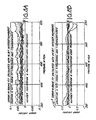
- FIGS. 3A and 3B illustrate errors in prior art polynomial curve fitting techniques.
- FIG. 3A shows the curve fit error for ethylene as a function of pressure for 10 different temperature values.
- the highest powers of pressure P and inverse temperature (1/T) in the interpolating polynomial are eight and six, respectively.
- the temperatures and pressures for ethylene are not far from saturation pressures and temperatures.
- FIG. 3A illustrates the large error associated with straight polynomial curve fitting, particularly at the pressure extremes.
- FIG. 3A illustrates the large error associated with straight polynomial curve fitting, particularly at the pressure extremes.
- 3B illustrates an even greater error when 32 bit floating point numbers (with 24 bit mantissa) are used. As illustrated in FIG. 3B , the results are essentially meaningless, with errors exceeding 10 5 percent.
- the coefficients were determined with 64 bit numbers and the calculation of the fitting polynomial was performed with 32 bit floating point numbers. Note that 32 bits is the typical number of bits used in floating point math performed in microprocessors.
- the use of a least-squares fitting technique reduces the roughness produced by the loss of significant digits. However, the errors produced with such curve fitting are still relatively large in some situations.
- the present invention provides a transmitter for measuring a process variable according to claim 1.
- the present invention further provides a device for monitoring a process according to claim 14.
- the present invention further provides a method for measuring a process variable according to claim 15.
- An interpolating polynomial is used to determine a process variable in a transmitter.
- the interpolating polynomial is "orthogonal" and provides an accurate estimation of the process variable without a significant increase in power consumption.
- the transmitter includes a sensor configured to couple to a process and having a sensor output related to the process variable.
- the transmitter also includes a microprocessor coupled to the sensor output and having a process variable output.
- the process variable output is an orthogonal-polynomial function of the sensor output.
- a transmitter output is configured to provide an output related to the interpolated process variable.
- FIG. 1 illustrates the environment of a process transmitter such as flow transmitter 10 of a process measurement or control system 2.
- Transmitter 10 couples to control room 24 through a two-wire process control loop 14 (shown substantially as voltage source 6 and resistance 8).
- Transmitter 10 is coupled to a process fluid container such as pipe 12 through pipe fitting or flange 14.
- Pipe 12 conducts flow of a fluid, such as a gas or liquid, in the direction indicated by arrow 16.
- the following description sets forth a transmitter such as transmitter 10 for measuring a process variable.
- the process variable is estimated using a mathematical technique known as polynomial interpolation.
- a specific type of polynomial known as an orthogonal-polynomial, is used in the polynomial interpolation.
- the orthogonal-polynomial provides highly accurate estimations of the process variable without requiring excessive computation.
- the following description is provided to illustrate and explain aspects of the invention.
- Transmitter 10 determines flow through pipe 12 by measuring a differential pressure, static pressure and temperature and includes transmitter electronics module 18. Transmitter 10 couples to a resistive temperature device (RTD) carried in temperature sensor housing 24 through electrical conduit 26. Transmitter 10 includes a differential pressure sensor and an absolute pressure sensor. The transmitter 10 provides an output signal indicative of flow of the process fluid flowing through pipe 12 to control room 4 by 4-20 mA two-wire loop 14 preferably formed using twisted pair of conductors through flexible conduit 28. Transmission can be for example, in accordance with the Highway Addressable Remote Transducer (HART®) or FoundationTM Fieldbus standards. Flow is determined using an interpolation polynomial, such as an orthogonal-polynomial in accordance with one aspect of the invention, as will be described later in the specification.
- RTD resistive temperature device
- Transmitter 10 includes a differential pressure sensor and an absolute pressure sensor.
- the transmitter 10 provides an output signal indicative of flow of the process fluid flowing through pipe 12 to control room 4 by 4-20 mA two-wire loop
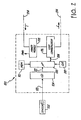
- FIG. 2 is a simplified block diagram of a process transmitter 100 which couples to sensor 102 (in some embodiments, element 102 represents multiple sensors) which may be either internal or external to the housing for transmitter 100.
- the output from sensor 102 is digitized by analog to digital converter 104 and provided to a polynomial interpolator embodied in microprocessor 106.
- Microprocessor 106 operates at a rate determined by clock 108 and in accordance with instructions stored in memory 110.
- Memory 110 can also store both permanent and temporary variables.
- Microprocessor 106 couples to a loop communicator 112 which couples to loop 114.
- Transmitter 100 is used to measure a process variable.
- Sensor 102 is configured to couple to a process, such as process fluid carried in pipe 12 shown in FIG. 1 , and provide a sensor output 120 to analog to digital converter 104.
- Analog to digital converter 104 provides a digitized output 122 to a polynomial interpolator such as microprocessor 106 which provides a process variable output 124 to a transmitter output such as loop communicator 116.
- the process variable output 124 is a function of an orthogonal-polynomial of sensor output 120.
- Memory 110 stores the coefficients of the orthogonal-polynomial.
- the orthogonal-polynomial function is used to approximate the process variable based upon the sensor output using a mathematical method known as interpolation.
- the measured process variable can be a function of more than one sensor output as described below.
- the orthogonal-polynomial function is a particular type of orthogonal polynomial known as a Chebychev polynomial for approximating the process variable through mathematical interpolation. (The Chebychev polynomial is explained below.)
- FIG. 2 is provided for illustrative purposes and actual transmitter configurations can vary.
- the functions performed by microprocessor 106 can be performed by a number of different microprocessors or circuits.
- the output from sensor 102 can be processed prior to its analog to digital conversion by analog to digital converter 104. Additional compensation steps can be performed using digital circuitry.
- Many functions can be implemented in either hardware or software, or in their combination.
- the particular configuration set forth in FIG. 2 should not limit the scope of the invention and those skilled in the art will recognize that the configuration can be modified.
- sensor 102 can comprise more than one sensor and the interpolated process variable can be a function of more than one sensor output from differing sensors. Typically, each additional sensor output requires an additional term in the interpolation polynomial.
- Two-wire process control loop carries a current I which has a minimum value of 4 mA and a maximum value of 20 mA. Data can be transmitted in a digital and/or an analog format.
- Loop communicator 116 is also used by microprocessor 106 to receive data from loop 114.
- a power module 118 is used to provide power to components in transmitter 100 using power received from loop 114.
- the transmitter is completely powered with power received from loop 114.
- Embodiments of the invention make use of a form of orthogonal-polynomials to form the interpolation equation and solve the resulting system of equations for the coefficients. While many types of orthogonal-polynomials exist, one specific orthogonal-polynomial is a discrete polynomial, known as a Chebychev polynomial that provides improved accuracy for process transmitters. In a process transmitter, the independent variables have a finite range and the input and/or calibration data is usually uniformly spaced over the range of the independent variables. Further, the measurements are typically performed with five or six significant digits of accuracy and the required accuracy of the calculated independent variables is in the range of 0.1 to 0.001 percent. Embodiments of the invention can use types of orthogonal-polynomials other than the particular Chebychev polynomial set forth.
- FIGS. 4A and 4B are graphs of the error in the curve fit using a Chebychev polynomial in accordance with embodiments of the invention.
- FIG. 4B illustrates a relatively good curve fit even when 32 bit floating point calculations are used. This level of accuracy can be achieved with prior art straight polynomial curve fitting techniques only if 64 or more bits are used.
- Chebychev polynomial interpolation requires some additional calculations and additions than prior art techniques, the improved accuracy offsets the slight increase in calculation complexity. For example, evaluating a 9x7 straight interpolating polynomial (8 TH power in pressure and 6 TH power in temperature) requires 62 multiplies and 62 adds.
- a 9x7 Chebychev interpolation requires 88 multiplies and 78 adds.
- this increase in complexity is not particularly significant and only requires a small amount of additional power in view of the improved accuracy in the process variable measurements.
- the Chebychev interpolation polynomial provides improved accuracy, even when a smaller number of bits are used for the calculation.
- the curve fit improves sufficiently using the Chebychev polynomial that the number of terms in the fitting polynomial can be reduced while maintaining acceptable accuracy.
- FIG. 5A shows the accuracy of a 7x5 exact Chebychev interpolation and FIG. 5B illustrates errors when 32 bit floating point numbers are used. The results compare favorably to a 9x7 least square curve fit.
- the number of multiplies is reduced to 52 and number of additions is reduced to 46, which is less than those required by a 9x7 straight polynomial interpolation.
- n th order Chebychev polynomial can be denoted as T n (x).
- the highest power of x in T n (x) is n.
- the columns of the matrices Q1 and Q2 are normalized by dividing by the square root of the sum of the squares of all entries in each column.
- the normalization factors are determined for the case when: xp 1 ⁇ 0 ; xp 2 ⁇ 1 ; xp 3 ⁇ 2 ; ⁇ xp m ⁇ NPt - 1 xs 1 ⁇ 0 ; xs 2 ⁇ 1 ; xs 3 ⁇ 2 ; ⁇ xs n ⁇ NPt - 1
- Q2 T denotes the transpose of Q2
- A is an NPExNTE matrix whose (m,n) th entry is coefficient A m,n and Z is an NPtxNTt matrix whose (m,n) th entry is 1/Z (xp m ,xs n ).
- Equation 19 is easily solved as:
- A Q ⁇ 1 T ⁇ ZQ ⁇ 2 Equation 20 holds and is well-behave numerically because both Q1 and Q2 are orthogonal matrices with unit condition numbers.
- Q1 T Q1) -1 denotes the inverse of (Q1 T Q1) and Q2 -T that of Q2 T . Equation 21 is reasonably well-behaved numerically.
- the normalization factors, norp(m) and nort(n), used to normalize Q1 and Q2 are always determined from uniformly spaced xp m and xs n , and not from the actual xp m and xs n . Several tests with the normalization factors determined from the actual nonuniform spacing of the data did not produce any substantial difference in accuracy.
- the sensitivity of the Chebychev interpolation approach to non-uniformly spaced pressure and inverse temperature points was tested.
- the curve fit involved 7 temperatures and 9 pressure for ethylene.
- the curve fit errors of the uniformly spaced data are shown in FIGS. 4A and 4B .
- Each temperature and pressure point used in the curve fit was perturbed from its uniform position by a random amount uniformly distributed over the range ⁇ 1 ⁇ 2 the uniform step size. Theoretically, this perturbation approach could lead to two identical pressure or temperature points. However, this did not happen during the test. Instead, the condition numbers for Q1 varied from 2 to 440 and those of Q2 from 1.2 to 65.
- the maximum error of the curve fit varied from 0.00034% to 0.0014%.
- the maximum fit error in FIGS. 4A and 4B was 0.00075%. This does not represent a significant change in the curve fit error.
- T p m (xp) and T s m (xs) are the normalized pressure and temperature Chebychev terms, respectively. These normalized polynomials are equal to the regular Chebychev polynomials (Equation 4) divided by a constant that depends on the order of the polynomial and the number of points used in the interpolation.
- T 1 P xp Cp 1 ⁇ P - P min - 1 T 0
- P xp 1
- the values of pressure and temperature must be between the maximum and minimum pressure and temperature points used in the curve fitting.
- B m,n denotes the normalized interpolation coefficients.
- the normalization factors Cp(m), Ct(n), norpt(m) and nortt(n) are evaluated as follows.
- the normalization factors, norp(m) and nort(n) used to form matrices Q1 and Q2 in the solution for A m,n are required to calculate these parameters.
- microprocessor 106 retrieves the Chebychev polynomial coefficients from memory 110.
- sensor outputs 120 such as pressure and temperature, are obtained from the sensors and the first order Chebychev polynomial is calculated using Equations 24 and 25 at block 158.
- the remaining Chebychev polynomials are calculated using Equations 22 and 23.
- the process variable 1/Z is approximated using Equation 34 by microprocessor 106 at block 162.
- the approximated process variable is output, for example, using loop communicator 116.
- control is returned to start block 152 and the interpolation process repeats.
- Equation 24 and 25 can also be implemented in integer format.
- Equation 34 To evaluate Equation 34 using integer math, two normalizations are performed.
- the first normalization scales 1/ Z to have a maximum value of one.
- the second normalization scales the values of the coefficients B m,n so that the summations in Equation 34 do not produce a value greater than one.
- Another normalization approach consists of sweeping the xp and xs values over their range and finding the maximum value of the resulting T n (xs) and T m (xp) . This maximum value is used in conjunction with the appropriate B m,n coefficient to determine the maximum value that the sum can achieve. This value is then used as the normalization value nor.
- This normalization approach has the advantage of making better use of the available number range.
- the correct value can be obtained by multiplying by Kf and nor .
- the constants Kf and nor are combined with some other constant such as the gas constant, R.
- the range of the input pressures and temperatures must be limited to slightly less then the curve fit range so that round off errors do not cause the variables to exceed the maximum and minimum curve fit pressures and temperatures. Less than 1% reduction in range is necessary to achieve this condition.
- FIGS. 7A and 7B show the curve fit errors using 16 bit and 32 bit integer math, respectively.
- the 16 bit calculation shows that numerical errors are present. However, the magnitude of these errors is less than 3 or 4 least significant bits. For most transmitters, this accuracy is sufficient.
- These error curves were produced using rounding for all multiplications and converting numbers to 16 bit integers. If truncation is used, the errors are larger and produce systematic errors. With truncation, the errors approach 0.08% for 16 bit integers.
- FIGS. 8A and 8B show the results of truncation for 16 bit and 24 bit integers, respectively. The errors due to truncation just begin to appear when 24 bit integers are used.
- the polynomial interpolator can be implemented in a microprocessor circuitry.
- orthogonal-polynomials other than the specific Chebychev polynomial disclosed herein are used.
- the polynomial can be used to estimate a process variable using any number of sensor outputs. For example, pressure can be corrected based upon a temperature reading and flow can be calculated based upon differential pressure, static pressure and temperature.
- the orthogonal-polynomial provides an accurate interpolation of a process variable without requiring highly complex calculations which have large electrical power requirements.
Landscapes
- Physics & Mathematics (AREA)
- General Physics & Mathematics (AREA)
- Fluid Mechanics (AREA)
- Engineering & Computer Science (AREA)
- Automation & Control Theory (AREA)
- Measuring Fluid Pressure (AREA)
- Arrangements For Transmission Of Measured Signals (AREA)
- Complex Calculations (AREA)
- Testing Or Calibration Of Command Recording Devices (AREA)
- Feedback Control In General (AREA)
Claims (22)
- Sender (100) zum Messen einer Prozessvariablen, der Folgendes aufweist:eine Leistungs- bzw. Energiemodulvorrichtung (118), welche derart konfiguriert ist, dass sie an eine Zweidraht-Prozessregelschleife koppelt und den Sender vollständig mit von der Zweidraht-Prozessregelschleife erhaltenen Energie versorgt bzw. betreibt;eine Sensorvorrichtung (102) zum Liefern einer Sensorausgabe (120), die mit der Prozessvariablen in Beziehung steht;einen polynomischen Interpolator (106) zum Empfangen der Sensor- ausgabe (120) und zum Bestimmen einer interpolierten Ausgabe einer Prozessvariablen;eine Ausgabevorrichtung, welche zur Bereitstellung bzw. Lieferung einer Ausgabe auf der Zweidraht-Prozessregelschleife konfiguriert ist, wobei die Ausgabe mit der interpolierten Prozessvariablen in Beziehung steht;wobei der Sender dadurch gekennzeichnet ist, dass der polynomische Interpolator (106) die interpolierte Ausgabe der Prozessvariablen als Funktion eines normalisierten Tschebyscheff-Orthogonalpolynoms bestimmt, welches zur Interpolation der Sensorausgabe unter Verwendung gerader Zahlen verwendet wird, wobei die polynomische Funktion den Energiever brauch durch den polynomischen Interpolator reduziert.
- Sender gemäß Anspruch 1, dadurch gekennzeichnet, dass Terme Tn(x) des Tschebyscheff-Polynoms einer rekursiven Formel folgen, und dass Tn(x) ein Tschebyscheff-Polynom n-ter Ordnung ist, wobei n die Ordnung des Tschebyscheff-Polynoms ist und x mit der Sensorausgabe in Beziehung steht.
- Sender nach Anspruch 2, dadurch gekennzeichnet, dass die rekursive Formel folgende Formel ist:

wobei T das Tschebyscheff-Polynom ist, x mit der Sensorausgabe in Beziehung steht, n eine Ordnung des Tschebyscheff-Polynoms repräsentiert und N eine Anzahl unabhängiger Auslesungen der Sensorausgabe repräsentiert. - Sender nach Anspruch 1, dadurch gekennzeichnet, dass die interpolierte Prozessvariable eine Funktion mindestens zweier Auslesungen der Sensorausgabe ist.
- Sender nach Anspruch 1, dadurch gekennzeichnet, dass die Zweidraht-Prozessregelschleife eine 4- bis 20-mA-Zweidraht-Prozessregelschleife aufweist.
- Sender nach Anspruch 1, dadurch gekennzeichnet, dass der polynomische Interpolator einen Mikroprozessor aufweist.
- Sender nach Anspruch 1, dadurch gekennzeichnet, dass der polynomische Interpolator Zahlen mit Hilfe von 32 Datenbits und/oder einer 24-Datenbit-Mantisse darstellt.
- Sender nach Anspruch 1, dadurch gekennzeichnet, dass die interpolierte Ausgabe der Prozessvariablen eine orthogonal-polynomische Funktion zweier Sensorausgaben ist.
- Sender nach Anspruch 8, dadurch gekennzeichnet, dass die beiden Sensorausgaben Druck und Temperatur darstellen.
- Sender nach Anspruch 8, dadurch gekennzeichnet, dass die interpolierte Ausgabe der Prozessvariablen den Druck aufweist.
- Sender nach Anspruch 1, dadurch gekennzeichnet, dass die interpolierte Ausgabe der Prozessvariablen eine orthogonal-polynomische Funktion dreier Sensorausgaben ist.
- Sender nach Anspruch 11, dadurch gekennzeichnet, dass die drei Sensorausgaben Differenzdruck, absoluten Druck und Temperatur darstellen.
- Sender nach Anspruch 5, dadurch gekennzeichnet, dass die interpolierte Ausgabe der Prozessvariablen Durchfluss, Dichte und/oder einen Gasausdehnungs-Koeffizienten aufweist.
- Vorrichtung zum Überwachen eines Prozesses, die Folgendes aufweist:einen Sensor (102), der zum Koppeln an den Prozess konfiguriert ist, und eine Sensorausgabe aufweist, welche mit einer Prozessvariablen in Beziehung steht;einen polynomischen Interpolator (106), der an die Sensorausgabe gekoppelt ist, und eine interpolierte Ausgabe einer Prozessvariablen aufweist; undeinen Vorrichtungsausgang (116), welcher zur Bereitstellung einer mit der interpolierten Prozessvariablen in Beziehung stehenden Ausgabe konfiguriert ist;dadurch gekennzeichnet, dass die interpolierte Ausgabe der Prozessvariablen eine Funktion eines normalisierten Tschebyscheff-Orthogonalpolynoms ist, welches zur Interpolation der Sensorausgabe verwendet wird; undder polynomische Interpolator Berechnungen unter Verwendung numerischer ganzer Zahlen zusammen mit der polynomischen Funktion durchführt, um den Energieverbrauch durch den polynomischen Interpolator zu reduzieren.
- Verfahren zum Messen einer Prozessvariablen in einem Verfahrens-Prozesssender, das folgende Schritte aufweist:Vollständiges Betreiben bzw. Versorgen des Senders mit Energie, welche von einer Zweidraht-Prozessregelschleife erhalten wird;Messen eines Parameters eines Prozesses, der mit der Prozessvariablen in Beziehung steht, und Liefern einer Sensorausgabe, die mit der Prozessvariablen in Beziehung steht; undwobei das Verfahren des Weiteren dadurch gekennzeichnet ist, dass die Prozessvariable unter Verwendung eines normalisierten Tschebyscheff-Orthogonalpolynoms angenähert wird, um eine angenäherte Prozessvariable zu erhalten, wobei das Orthogonalpolynom eine ganzzahlige Berechnung zulässt, um den von dem Prozesssender bei der Durchführung des Annäherungsschritts erforderlichen Energieverbrauch zu reduzieren; undAusgabe der angenäherten Prozessvariablen auf der Zweidraht-Prozessregelschleife.
- Verfahren nach Anspruch 15, dadurch gekennzeichnet, dass Terme Tn(x) des Tschebyscheff-Polynoms einer rekursiven Formel folgen, und dass Tn(x) ein Tschebyscheff-Polynom n-ter Ordnung ist, wobei n die Ordnung des Tschebyscheff-Polynoms ist, und wobei x mit der Sensorausgabe in Beziehung steht.
- Verfahren nach Anspruch 16, dadurch gekennzeichnet, dass das Annähern der Prozessvariablen eine Funktion mindestens zweier Sensorausgaben zweier unterschiedlicher Sensoren ist.
- Verfahren nach Anspruch 15, dadurch gekennzeichnet, dass das Annähern der Prozessvariablen das Darstellen von Zahlen mit Hilfe von 32 Datenbits aufweist.
- Verfahren nach Anspruch 15, dadurch gekennzeichnet, dass die angenäherte Prozessvariable den Durchfluss von Prozessfluid anzeigt.
- Verfahren nach Anspruch 15, dadurch gekennzeichnet, dass die Terme der polynomischen Funktion einer rekursiven Formel folgen.
- Verfahren nach Anspruch 20, dadurch gekennzeichnet, dass die rekursive Formel folgende Formel ist:

wobei T das Tschebyscheff-Polynom ist, x mit der Sensorausgabe in Beziehung steht, n eine Ordnung des Polynoms repräsentiert und N eine Anzahl unabhängiger Auslesungen der Sensorausgabe repräsentiert. - Verfahren nach Anspruch 15, dadurch gekennzeichnet, dass das Annähern der Prozessvariablen das Anwenden der polynomischen Funktion bei mehr als einer Sensorausgabe für mehr als einen Sensor einschließt.
Applications Claiming Priority (3)
| Application Number | Priority Date | Filing Date | Title |
|---|---|---|---|
| US405196 | 1999-09-24 | ||
| US09/405,196 US6643610B1 (en) | 1999-09-24 | 1999-09-24 | Process transmitter with orthogonal-polynomial fitting |
| PCT/US2000/025923 WO2001023972A1 (en) | 1999-09-24 | 2000-09-22 | Process transmitter with orthogonal-polynomial fitting |
Publications (3)
| Publication Number | Publication Date |
|---|---|
| EP1214633A1 EP1214633A1 (de) | 2002-06-19 |
| EP1214633B1 EP1214633B1 (de) | 2004-05-12 |
| EP1214633B2 true EP1214633B2 (de) | 2009-07-22 |
Family
ID=23602686
Family Applications (1)
| Application Number | Title | Priority Date | Filing Date |
|---|---|---|---|
| EP00963693A Expired - Lifetime EP1214633B2 (de) | 1999-09-24 | 2000-09-22 | Prozesssender mit orthogonaler-polynomialer anpassung |
Country Status (7)
| Country | Link |
|---|---|
| US (1) | US6643610B1 (de) |
| EP (1) | EP1214633B2 (de) |
| JP (1) | JP4989831B2 (de) |
| CN (1) | CN1376278A (de) |
| AU (1) | AU4025001A (de) |
| DE (1) | DE60010728T3 (de) |
| WO (1) | WO2001023972A1 (de) |
Families Citing this family (15)
| Publication number | Priority date | Publication date | Assignee | Title |
|---|---|---|---|---|
| US6643610B1 (en) * | 1999-09-24 | 2003-11-04 | Rosemount Inc. | Process transmitter with orthogonal-polynomial fitting |
| JP2004110548A (ja) * | 2002-09-19 | 2004-04-08 | Fuji Xerox Co Ltd | ユーザビリティ評価支援装置および方法 |
| US7209837B2 (en) | 2004-06-04 | 2007-04-24 | Invensys Systems, Inc. | Systems and methods for determining compensated conductivities |
| DE102005047092A1 (de) * | 2005-09-30 | 2007-04-05 | Robert Bosch Gmbh | Übertragungsglied mit bereichsweisen Kennfeld |
| DE102005062981A1 (de) * | 2005-12-28 | 2007-07-05 | Endress + Hauser Flowtec Ag | Verfahren zur Bestimmung eines Ausgangswertes eines Sensors der Automatisierungstechnik |
| US7467555B2 (en) * | 2006-07-10 | 2008-12-23 | Rosemount Inc. | Pressure transmitter with multiple reference pressure sensors |
| US7768530B2 (en) * | 2007-01-25 | 2010-08-03 | Fisher-Rosemount Systems, Inc. | Verification of process variable transmitter |
| JP5663475B2 (ja) * | 2008-05-23 | 2015-02-04 | ローズマウント インコーポレイテッド | エネルギの流れの計算を備える多変数プロセス流体の流れの装置 |
| CN102171620B (zh) * | 2008-10-01 | 2013-07-24 | 罗斯蒙德公司 | 具有用于工业过程变送器的在线和离线测试计算的过程控制系统 |
| WO2010062583A1 (en) * | 2008-10-27 | 2010-06-03 | Rosemount, Inc. | Multivariable fluid flow measurement device with fast response flow calculation |
| US8578783B2 (en) * | 2011-09-26 | 2013-11-12 | Rosemount Inc. | Process fluid pressure transmitter with separated sensor and sensor electronics |
| ES2921859T3 (es) * | 2012-11-30 | 2022-09-01 | Ip2Ipo Innovations Ltd | Un dispositivo, procedimiento y sistema para monitorizar una red de conductos de transporte de fluidos |
| US20150242547A1 (en) | 2014-02-27 | 2015-08-27 | Phadke Associates, Inc. | Method and apparatus for rapid approximation of system model |
| CN104154944A (zh) * | 2014-08-13 | 2014-11-19 | 北京遥测技术研究所 | 一种提高传感器测量精度的方法 |
| US10324004B2 (en) * | 2015-04-15 | 2019-06-18 | The Boeing Company | Methods and devices for adaptive autonomous polynomial interpolation of time series data |
Citations (1)
| Publication number | Priority date | Publication date | Assignee | Title |
|---|---|---|---|---|
| EP0421394A2 (de) † | 1989-10-06 | 1991-04-10 | Endress u. Hauser GmbH u. Co. | Differenzdruckmessgerät |
Family Cites Families (42)
| Publication number | Priority date | Publication date | Assignee | Title |
|---|---|---|---|---|
| US3564912A (en) | 1968-10-28 | 1971-02-23 | Westinghouse Electric Corp | Fluid flow measurement system |
| US3701280A (en) | 1970-03-18 | 1972-10-31 | Daniel Ind Inc | Method and apparatus for determining the supercompressibility factor of natural gas |
| US4103551A (en) | 1977-01-31 | 1978-08-01 | Panametrics, Inc. | Ultrasonic measuring system for differing flow conditions |
| US4238825A (en) | 1978-10-02 | 1980-12-09 | Dresser Industries, Inc. | Equivalent standard volume correction systems for gas meters |
| US4249164A (en) | 1979-05-14 | 1981-02-03 | Tivy Vincent V | Flow meter |
| GB2085597B (en) | 1980-10-17 | 1985-01-30 | Redland Automation Ltd | Method and apparatus for detemining the mass flow of a fluid |
| US4403296A (en) | 1980-12-18 | 1983-09-06 | Electromedics, Inc. | Measuring and determination device for calculating an output determination based on a mathematical relationship between multiple different input responsive transducers |
| US4437164A (en) | 1981-03-05 | 1984-03-13 | Bristol Babcock Inc. | Ridge circuit compensation for environmental effects |
| US4485673A (en) | 1981-05-13 | 1984-12-04 | Drexelbrook Engineering Company | Two-wire level measuring instrument |
| US4414634A (en) | 1981-07-17 | 1983-11-08 | The Scott & Fetzer Company | Fluid flow totalizer |
| US4446730A (en) | 1982-04-26 | 1984-05-08 | Quintex Research International, Inc. | Specific gravity independent gauging of liquid filled tanks |
| US4598381A (en) | 1983-03-24 | 1986-07-01 | Rosemount Inc. | Pressure compensated differential pressure sensor and method |
| US4677841A (en) | 1984-04-05 | 1987-07-07 | Precision Measurement, Inc. | Method and apparatus for measuring the relative density of gases |
| US4562744A (en) | 1984-05-04 | 1986-01-07 | Precision Measurement, Inc. | Method and apparatus for measuring the flowrate of compressible fluids |
| US4528855A (en) | 1984-07-02 | 1985-07-16 | Itt Corporation | Integral differential and static pressure transducer |
| US4602344A (en) | 1984-10-25 | 1986-07-22 | Air Products And Chemicals, Inc. | Method and system for measurement of liquid level in a tank |
| GB2179156B (en) | 1985-08-14 | 1990-08-22 | Ronald Northedge | Flow meters |
| EP0214801A1 (de) | 1985-08-22 | 1987-03-18 | Parmade Instruments C.C. | Verfahren zur Kontrolle des Flüssigkeitsinhaltes eines Behälters, Kontrollvorrichtung zur Verwendung in diesem Verfahren und Anlage mit einer solchen Vorrichtung |
| NL8503192A (nl) | 1985-11-20 | 1987-06-16 | Ems Holland Bv | Gasmeter. |
| US4795968A (en) | 1986-06-30 | 1989-01-03 | Sri International | Gas detection method and apparatus using chemisorption and/or physisorption |
| JPS6333663A (ja) | 1986-07-28 | 1988-02-13 | Yamatake Honeywell Co Ltd | 流速測定装置 |
| DE3752283D1 (de) | 1986-08-22 | 1999-07-29 | Rosemount Inc | Analoger messumformer mit digitaler steuerung |
| JPS6391684A (ja) * | 1986-10-04 | 1988-04-22 | Agency Of Ind Science & Technol | 映像形成方式 |
| US4799169A (en) | 1987-05-26 | 1989-01-17 | Mark Industries, Inc. | Gas well flow instrumentation |
| US4870863A (en) | 1987-09-17 | 1989-10-03 | Square D Company | Modular switch device |
| US4818994A (en) | 1987-10-22 | 1989-04-04 | Rosemount Inc. | Transmitter with internal serial bus |
| US4796651A (en) | 1988-03-30 | 1989-01-10 | LeRoy D. Ginn | Variable gas volume flow measuring and control methods and apparatus |
| JP2544435B2 (ja) | 1988-04-06 | 1996-10-16 | 株式会社日立製作所 | 多機能センサ |
| FR2637075B1 (fr) | 1988-09-23 | 1995-03-10 | Gaz De France | Procede et dispositif destines a indiquer le debit d'un fluide compressible circulant dans un detendeur, et capteur de vibrations utilise a cet effet |
| US5035140A (en) | 1988-11-03 | 1991-07-30 | The Boeing Company | Self cleaning liquid level detector |
| US4958938A (en) | 1989-06-05 | 1990-09-25 | Rosemount Inc. | Temperature transmitter with integral secondary seal |
| US4949581A (en) | 1989-06-15 | 1990-08-21 | Rosemount Inc. | Extended measurement capability transmitter having shared overpressure protection means |
| GB9011084D0 (en) | 1990-05-17 | 1990-07-04 | Ag Patents Ltd | Volume measurement |
| SG44494A1 (en) | 1993-09-07 | 1997-12-19 | R0Semount Inc | Multivariable transmitter |
| US5606513A (en) | 1993-09-20 | 1997-02-25 | Rosemount Inc. | Transmitter having input for receiving a process variable from a remote sensor |
| US5772323A (en) | 1994-10-26 | 1998-06-30 | Felice; Ralph A. | Temperature determining device and process |
| WO1996018871A1 (en) * | 1994-12-15 | 1996-06-20 | Anritsu Corporation | Temperature sensor system using thin film of microcrystalline semiconductor |
| JPH08201189A (ja) * | 1995-01-24 | 1996-08-09 | Hitachi Ltd | 電子式測定装置の補償方法 |
| WO1997004288A1 (en) | 1995-07-17 | 1997-02-06 | Rosemount Inc. | Transmitter for providing a signal indicative of flow through a differential transducer using a simplified process |
| US5857777A (en) * | 1996-09-25 | 1999-01-12 | Claud S. Gordon Company | Smart temperature sensing device |
| US5949695A (en) * | 1997-01-10 | 1999-09-07 | Harris Corporation | Interpolator using a plurality of polynomial equations and associated methods |
| US6643610B1 (en) * | 1999-09-24 | 2003-11-04 | Rosemount Inc. | Process transmitter with orthogonal-polynomial fitting |
-
1999
- 1999-09-24 US US09/405,196 patent/US6643610B1/en not_active Expired - Lifetime
-
2000
- 2000-09-22 DE DE60010728T patent/DE60010728T3/de not_active Expired - Lifetime
- 2000-09-22 CN CN00813214A patent/CN1376278A/zh active Pending
- 2000-09-22 EP EP00963693A patent/EP1214633B2/de not_active Expired - Lifetime
- 2000-09-22 JP JP2001526675A patent/JP4989831B2/ja not_active Expired - Fee Related
- 2000-09-22 AU AU40250/01A patent/AU4025001A/en not_active Abandoned
- 2000-09-22 WO PCT/US2000/025923 patent/WO2001023972A1/en not_active Ceased
Patent Citations (1)
| Publication number | Priority date | Publication date | Assignee | Title |
|---|---|---|---|---|
| EP0421394A2 (de) † | 1989-10-06 | 1991-04-10 | Endress u. Hauser GmbH u. Co. | Differenzdruckmessgerät |
Non-Patent Citations (5)
| Title |
|---|
| D. SCOTT HOLMES, S. SCOTT COURTS: "Resolution and Accuracy of Cryogenic Temperature Measurements", OMEGA'S TEMPERATURE HANDBOOK, Z-SECTION, 12 May 1999 (1999-05-12), URL: WWW.OMEGA.COM, pages Z-94 - Z-99 † |
| I. N. BRONSTEIN, K. A. SEMENDJAJEW: "Taschenbuch der Mathematik, 25. durchgesehene Auflage", 1991, B. G. TEUBNER VERLAGSGESELLSCHAFT, STUTTGART - LEIPZIG, ISBN: 3815420008, pages: 749 - 753 † |
| MOTOROLA INC.: "PowerPC 603e, RISC Microprocessor User's Manual with Supplement for PowerPC 603 Microprocessor", September 1995 (1995-09-01), USA, pages 1-1 † |
| O. Machul: "Nichtlineare Approximationsmethoden zur Reduzierung nichtidealer Sensoreigenschaften in integrierten CMOS-Sensorsystemen", Dissertation, Fachbereich Elektrotechnik der Gerhard-Mercator-Universität - Gesamthochschule Duisburg, 1999 † |
| WILLIAM H. PRESS ET AL.: "Numerical Recipes in Pascal - The Art of Scientific Computing", 1992, CAMBRIDGE UNIVERSITY PRESS, CAMBRIDGE, ISBN: 0521375169, pages: 165 - 170 † |
Also Published As
| Publication number | Publication date |
|---|---|
| EP1214633B1 (de) | 2004-05-12 |
| US6643610B1 (en) | 2003-11-04 |
| DE60010728T3 (de) | 2010-02-18 |
| JP4989831B2 (ja) | 2012-08-01 |
| DE60010728D1 (de) | 2004-06-17 |
| EP1214633A1 (de) | 2002-06-19 |
| CN1376278A (zh) | 2002-10-23 |
| DE60010728T2 (de) | 2005-05-12 |
| AU4025001A (en) | 2001-04-30 |
| WO2001023972A1 (en) | 2001-04-05 |
| JP2003510711A (ja) | 2003-03-18 |
Similar Documents
| Publication | Publication Date | Title |
|---|---|---|
| EP1214633B1 (de) | Prozesssender mit orthogonaler-polynomialer anpassung | |
| RU2138781C1 (ru) | Датчик с улучшенной компенсацией | |
| EP0839316B1 (de) | Ein strömungssignal durch einen druckdifferenzsensor anzeigender geber unter verwendung eines vereinfachten prozesses | |
| EP1585943B1 (de) | Mehrfachmessungs-vortex-strömungsmesser | |
| US5911238A (en) | Thermal mass flowmeter and mass flow controller, flowmetering system and method | |
| EP2422289B1 (de) | Feldgerät mit messgenauigkeitsbericht | |
| US5751611A (en) | Display device for linearly displaying a non-linear input variable | |
| US6935156B2 (en) | Characterization of process pressure sensor | |
| EP1206689A1 (de) | Vorhersage der groesse eines fehlers in einem druckwandler | |
| US4581714A (en) | Method of calibrating and linearizing the output of fluid measuring instruments | |
| EP0717869A1 (de) | Messumformer für mehrere variablen | |
| EP3889555B1 (de) | Durchflussmesserkalibrierverfahren | |
| US20020035441A1 (en) | Scaled quadrature pulse signal generator | |
| EP0758739A1 (de) | Sensormodul | |
| Brauner et al. | Identifying and removing sources of imprecision in polynomial regression | |
| Pang et al. | Research on nonlinear calibration and temperature compensation methods for silicon strain gauge pressure sensors | |
| CN101351793A (zh) | 用于确定自动化技术的传感器的输出值的方法 | |
| Mozek et al. | Calibration and error correction algorithms for smart pressure sensors | |
| Barford et al. | Choosing designs of calibration transducer electronic data sheets | |
| Didenko et al. | Polynomial and piece-wise linear approximation of smart transducer errors | |
| Cvitaš et al. | Increasing accuracy of temperature measurement based on adaptive algorithm for microcontroller transmitter | |
| Risse et al. | High accuracy temperature measurements: Are they worth the investment? | |
| Krause | Discussion:“Precise Measurement of Differential Pressure When Calibrating a Head Class Flow Meter”(Miller, RW, 1970, ASME J. Basic Eng., 92, pp. 742–751) |
Legal Events
| Date | Code | Title | Description |
|---|---|---|---|
| PUAI | Public reference made under article 153(3) epc to a published international application that has entered the european phase |
Free format text: ORIGINAL CODE: 0009012 |
|
| 17P | Request for examination filed |
Effective date: 20020222 |
|
| AK | Designated contracting states |
Kind code of ref document: A1 Designated state(s): AT BE CH CY DE DK ES FI FR GB GR IE IT LI LU MC NL PT SE |
|
| AX | Request for extension of the european patent |
Free format text: AL;LT;LV;MK;RO;SI |
|
| 17Q | First examination report despatched |
Effective date: 20030203 |
|
| GRAP | Despatch of communication of intention to grant a patent |
Free format text: ORIGINAL CODE: EPIDOSNIGR1 |
|
| GRAS | Grant fee paid |
Free format text: ORIGINAL CODE: EPIDOSNIGR3 |
|
| GRAA | (expected) grant |
Free format text: ORIGINAL CODE: 0009210 |
|
| AK | Designated contracting states |
Kind code of ref document: B1 Designated state(s): DE |
|
| REG | Reference to a national code |
Ref country code: IE Ref legal event code: FG4D |
|
| REF | Corresponds to: |
Ref document number: 60010728 Country of ref document: DE Date of ref document: 20040617 Kind code of ref document: P |
|
| LTIE | Lt: invalidation of european patent or patent extension |
Effective date: 20040512 |
|
| PLAQ | Examination of admissibility of opposition: information related to despatch of communication + time limit deleted |
Free format text: ORIGINAL CODE: EPIDOSDOPE2 |
|
| PLBQ | Unpublished change to opponent data |
Free format text: ORIGINAL CODE: EPIDOS OPPO |
|
| PLAQ | Examination of admissibility of opposition: information related to despatch of communication + time limit deleted |
Free format text: ORIGINAL CODE: EPIDOSDOPE2 |
|
| PLAR | Examination of admissibility of opposition: information related to receipt of reply deleted |
Free format text: ORIGINAL CODE: EPIDOSDOPE4 |
|
| PLBQ | Unpublished change to opponent data |
Free format text: ORIGINAL CODE: EPIDOS OPPO |
|
| PLBI | Opposition filed |
Free format text: ORIGINAL CODE: 0009260 |
|
| PLAX | Notice of opposition and request to file observation + time limit sent |
Free format text: ORIGINAL CODE: EPIDOSNOBS2 |
|
| 26 | Opposition filed |
Opponent name: ENDRESS + HAUSER(DEUTSCHLAND) HOLDING GMBH Effective date: 20050214 |
|
| REG | Reference to a national code |
Ref country code: IE Ref legal event code: MM4A |
|
| PLAF | Information modified related to communication of a notice of opposition and request to file observations + time limit |
Free format text: ORIGINAL CODE: EPIDOSCOBS2 |
|
| PLBB | Reply of patent proprietor to notice(s) of opposition received |
Free format text: ORIGINAL CODE: EPIDOSNOBS3 |
|
| PLAB | Opposition data, opponent's data or that of the opponent's representative modified |
Free format text: ORIGINAL CODE: 0009299OPPO |
|
| R26 | Opposition filed (corrected) |
Opponent name: ENDRESS+HAUSER (DEUTSCHLAND) AG+CO. KG Effective date: 20050214 |
|
| PLAY | Examination report in opposition despatched + time limit |
Free format text: ORIGINAL CODE: EPIDOSNORE2 |
|
| PLBC | Reply to examination report in opposition received |
Free format text: ORIGINAL CODE: EPIDOSNORE3 |
|
| RIC2 | Information provided on ipc code assigned after grant |
Ipc: G05B 23/02 20060101AFI20090303BHEP Ipc: G05B 19/042 20060101ALI20090303BHEP Ipc: G05B 19/418 20060101ALI20090303BHEP |
|
| PUAH | Patent maintained in amended form |
Free format text: ORIGINAL CODE: 0009272 |
|
| STAA | Information on the status of an ep patent application or granted ep patent |
Free format text: STATUS: PATENT MAINTAINED AS AMENDED |
|
| 27A | Patent maintained in amended form |
Effective date: 20090722 |
|
| AK | Designated contracting states |
Kind code of ref document: B2 Designated state(s): DE |
|
| PGFP | Annual fee paid to national office [announced via postgrant information from national office to epo] |
Ref country code: DE Payment date: 20180927 Year of fee payment: 19 |
|
| REG | Reference to a national code |
Ref country code: DE Ref legal event code: R119 Ref document number: 60010728 Country of ref document: DE |
|
| PG25 | Lapsed in a contracting state [announced via postgrant information from national office to epo] |
Ref country code: DE Free format text: LAPSE BECAUSE OF NON-PAYMENT OF DUE FEES Effective date: 20200401 |