EP1217440A2 - Traítement de matériau photographique - Google Patents
Traítement de matériau photographique Download PDFInfo
- Publication number
- EP1217440A2 EP1217440A2 EP01204686A EP01204686A EP1217440A2 EP 1217440 A2 EP1217440 A2 EP 1217440A2 EP 01204686 A EP01204686 A EP 01204686A EP 01204686 A EP01204686 A EP 01204686A EP 1217440 A2 EP1217440 A2 EP 1217440A2
- Authority
- EP
- European Patent Office
- Prior art keywords
- tank
- solution
- processing
- film
- photographic material
- Prior art date
- Legal status (The legal status is an assumption and is not a legal conclusion. Google has not performed a legal analysis and makes no representation as to the accuracy of the status listed.)
- Withdrawn
Links
Images


Classifications
-
- G—PHYSICS
- G03—PHOTOGRAPHY; CINEMATOGRAPHY; ANALOGOUS TECHNIQUES USING WAVES OTHER THAN OPTICAL WAVES; ELECTROGRAPHY; HOLOGRAPHY
- G03D—APPARATUS FOR PROCESSING EXPOSED PHOTOGRAPHIC MATERIALS; ACCESSORIES THEREFOR
- G03D3/00—Liquid processing apparatus involving immersion; Washing apparatus involving immersion
- G03D3/02—Details of liquid circulation
- G03D3/04—Liquid agitators
Definitions
- This invention relates to a method and apparatus for processing photographic material.
- the invention relates to a single use processor.
- GB 9930140.0 discloses a method and apparatus for processing photographic material in which the low volume of applied solution can be reused by moving it about the film surface with a porous pad. This reduces the component requirement in any part of the film.
- DSU Dymanic Single Use
- the present invention solves these problems by maintaining the solution in a tank that can be heated, easily loaded and unloaded and is self cleaning if all of the process occurs in the same tank.
- a method of processing photographic material comprising the steps of transporting the material to be processed into at least one tank containing a predetermined volume of processing solution and plunging a reciprocable member into the tank to thereby rapidly displace the solution through the narrow channels created between the tank and member and thus across the surface of the material.
- the present invention further provides an apparatus for processing photographic material comprising at least one tank containing a predetermined volume of processing solution, an equivalent number of recriprocable members for plunging into each respective tank and means for transporting the material into and out of the at least one tank.
- a plurality of reciprocable members are provided.
- the invention overcomes the problems of the prior art.
- the processor is of low volume, provides high agitation and wets the whole film quickly. This avoids seasoning effects between opposite ends of the film.
- Temperature control is easy at elevated temperatures and higher temperature solutions can be utilised than in conventional tanks. This enables more rapid processing. Unstable processing solutions can be used as only small volumes are required. These solutions can then be disposed of after use. If the process ends with a wash step the processor is self cleaning.
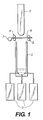
- Figure 1 shows a schematic view of a first embodiment of the invention.
- the apparatus consists of a low volume tank 2 into which a central agitating member or plunger 1 is reciprocated.
- the relative sizes of the tank 2 and the plunger 1 are such that only a very narrow channel is left when the plunger 1 is within the tank.
- the width of the channel is typically between 0.25 mm and 1 mm.
- a plurality of reservoirs 3 are in fluid connection with the tank 2. Each reservoir contains the processing fluids required by the process. The processing fluids may be reused or disposed of after use.
- a pair of pinch rollers 4, 5 are provided at the entry and exit of the tank 2.
- the material to be processed, in this example film 6, is transported into and out of the tank by the action of the rollers, 4 and 5.
- the film may be processed whilst still attached to the film cassette 7. This is shown more clearly in Figures 2A and 2B.
- the invention is applicable whether the film is housed in an APS cassette or in a 35 mm cassette.
- the film 6 is fed into the tank 2 with the emulsion side facing outwards. Developer is fed into the tank 2.
- the film displaces its own volume in developer and hence allows rapid wetting of the total film in the narrow channel with a very small volume. It is known that in order not to observe a seasoning effect from the wetting solution along the film that the whole film needs to be wetted in the small volume in about three seconds.
- the method of the invention allows this to happen as the solution is rapidly displaced up the narrow channels containing the film.
- the film 6 is also agitated when the plunger 1 is reciprocated up and down over the development time. The agitation can be further embellished by placing materials known to provide a physical rubbing action on the tank wall.
- Such materials need to be chosen to achieve the agitation without imparting physical damage to the emulsion surface to be processed.
- These can be any known conventional materials such as fine nylon mesh coated with pvc, velvet plush as found in film cassettes or plushes typically found on porous pads used in photographic processing. These are examples only and it will be understood by those skilled in the art that the invention is not limited to such materials. Loading and unloading of the invention presents no engineering difficulties as envisaged.
- Figure 2 shows a further embodiment of the invention.
- This embodiment provides a plurality of plungers, three in the example shown. Each plunger descends into a corresponding tank. This allows the processing apparatus to occupy less volume than the single loop for a given length of film. It is expected that a forty exposure APS film could be accommodated in a processor of 26cm depth.
- the multiple plunger embodiment also allows different length films to be processed. For a film of fifteen exposures just the central plunger would be used. For a film with twenty five exposures the central tank and plunger and one other could accommodate the film length. All three tanks and plungers would accommodate a forty exposure roll of film. The length of film from the very end thereof to the first processed section is maintained the same throughout, regardless of how many tanks are to be used.
- Figure 2B illustrates how if not all the plungers 1 are to be used the feeding apparatus, including the pinch rollers and the film cassette, is moved toward the tanks to be used. In this embodiment only two, the second and third, tanks are to be used. The feeding apparatus is therefore moved as shown over the first tank.
- the apparatus would need to be heated to maintain the correct temperature for processing. This could be achieved by heating a fluid, such as water, that resides in cavities inside the processor, not shown. Rather than making this water redundant volume, it could be used as the wash water and /or any chemical required by the process. Thus the processor and chemistry is maintained at the correct temperature ready for the next film and is not in contact with the air which may cause oxidation of certain chemicals.
- a fluid such as water
- the replenisher could be delivered from the plunger that acts as the replenisher cartridge or from a cartridge that sits on top of the plunger or elsewhere in the machine.
- 80ml of developer 80ml machine capacity was added to the displacement processor that contained a film of 40 exposure length.
- the films used were a scan film, as disclosed in copending application, Kodak reference docket 81063, see figure 3, and Royal Gold 400, see figure 4.
- the developer was agitated once per second by raising and lowering the plunger at a temperature of 50°C for 40 seconds.
- the Stop bath was added (5ml/L Glacial acetic acid + 5g/L sodium sulphite). The process was stopped for one minute before the solution was removed from the processor.
- 80ml of bleach was added and agitated as before. After three minutes this was removed and 80ml of fixer added for a further three minutes.
- the film was then washed and dried externally from the device.
- the sensitometric curves shown in figures 3 and 4 were obtained. These can be corrected by scan printing onto output media.
- the method of the invention is not designed to yield optically printable negatives. An identical result can be achieved by keeping the plunger in the lower position and circulating the solution in the processor by means of a small positive displacement pump.
- the process wash water may be used as heating water.
- chemicals can be used as heating solutions for the processor.
- the processor of the invention can accommodate any cycle.
- the cycle can be quickly changed as required. Different lengths of film may be accommodated by changing the number of plungers and tanks used as described above. Having a plurality of plungers reduces the size of the apparatus to a more compact design.
- the tank may be sealed after processing has occurred and can be left to keep warm with the last wash of the previous process inside.
Landscapes
- Physics & Mathematics (AREA)
- General Physics & Mathematics (AREA)
- Photographic Processing Devices Using Wet Methods (AREA)
Applications Claiming Priority (2)
| Application Number | Priority Date | Filing Date | Title |
|---|---|---|---|
| GB0031197 | 2000-12-21 | ||
| GBGB0031197.7A GB0031197D0 (en) | 2000-12-21 | 2000-12-21 | Processing photographic material |
Publications (2)
| Publication Number | Publication Date |
|---|---|
| EP1217440A2 true EP1217440A2 (fr) | 2002-06-26 |
| EP1217440A3 EP1217440A3 (fr) | 2002-08-14 |
Family
ID=9905551
Family Applications (1)
| Application Number | Title | Priority Date | Filing Date |
|---|---|---|---|
| EP01204686A Withdrawn EP1217440A3 (fr) | 2000-12-21 | 2001-12-04 | Traítement de matériau photographique |
Country Status (4)
| Country | Link |
|---|---|
| US (1) | US6505978B2 (fr) |
| EP (1) | EP1217440A3 (fr) |
| JP (1) | JP2002202579A (fr) |
| GB (1) | GB0031197D0 (fr) |
Families Citing this family (2)
| Publication number | Priority date | Publication date | Assignee | Title |
|---|---|---|---|---|
| US6651432B1 (en) | 2002-08-08 | 2003-11-25 | The United States Of America As Represented By The Administrator Of The Environmental Protection Agency | Controlled temperature combustion engine |
| GB0220263D0 (en) * | 2002-08-31 | 2002-10-09 | Eastman Kodak Co | Washing method and apparatus |
Family Cites Families (11)
| Publication number | Priority date | Publication date | Assignee | Title |
|---|---|---|---|---|
| GB342387A (en) * | 1929-11-08 | 1931-02-05 | Peter Watt Yuille | An improved method of and apparatus for washing photographic negatives and prints |
| GB382537A (en) * | 1931-04-01 | 1932-10-27 | Ig Farbenindustrie Ag | An improvement in photographic developing vessels |
| FR1206372A (fr) * | 1958-08-13 | 1960-02-09 | Kodak Pathe | Procédé et appareil pour le traitement de produits photographiques en un seul bain |
| US4168899A (en) * | 1977-06-27 | 1979-09-25 | Klass Carl S | Temperature controlled photographic processing system |
| GB2094671B (en) * | 1981-03-17 | 1984-06-13 | Base Electronics Ltd | Fluid treatment apparatus |
| JP2640520B2 (ja) | 1988-11-16 | 1997-08-13 | コニカ株式会社 | 写真感光材料の処理方法及び処理機 |
| JP2699119B2 (ja) * | 1990-05-31 | 1998-01-19 | 富士写真フイルム株式会社 | ハロゲン化銀乳剤の製造方法 |
| US5452043A (en) | 1993-02-19 | 1995-09-19 | Eastman Kodak Company | Rack and a tank for a photographic low volume thin tank insert for a rack and a tank photographic processing apparatus |
| US5678120A (en) * | 1996-03-27 | 1997-10-14 | Eastman Kodak Company | Method and apparatus for processing a photosensitive material |
| US6076980A (en) * | 1998-12-29 | 2000-06-20 | Eastman Kodak Company | Photographic processor having scrubbing rollers |
| GB9930140D0 (en) | 1999-12-22 | 2000-02-09 | Eastman Kodak Co | Method and apparatus for processing photographic material |
-
2000
- 2000-12-21 GB GBGB0031197.7A patent/GB0031197D0/en not_active Ceased
-
2001
- 2001-12-04 EP EP01204686A patent/EP1217440A3/fr not_active Withdrawn
- 2001-12-11 US US10/014,962 patent/US6505978B2/en not_active Expired - Fee Related
- 2001-12-18 JP JP2001385069A patent/JP2002202579A/ja active Pending
Also Published As
| Publication number | Publication date |
|---|---|
| JP2002202579A (ja) | 2002-07-19 |
| US6505978B2 (en) | 2003-01-14 |
| GB0031197D0 (en) | 2001-01-31 |
| EP1217440A3 (fr) | 2002-08-14 |
| US20020114629A1 (en) | 2002-08-22 |
Similar Documents
| Publication | Publication Date | Title |
|---|---|---|
| US6505978B2 (en) | Processing photographic material | |
| US5452043A (en) | Rack and a tank for a photographic low volume thin tank insert for a rack and a tank photographic processing apparatus | |
| US6505979B2 (en) | Processing photographic material | |
| US6554506B1 (en) | Method and apparatus for processing photographic material | |
| JP2883360B2 (ja) | 感光材料の処理方法 | |
| EP0410791A2 (fr) | Appareil pour le traitement d'un matériau photographique photosensible | |
| JP3874481B2 (ja) | ハロゲン化銀写真感光材料用自動現像機 | |
| US5687419A (en) | Method of processing photographic material and photographic processing apparatus | |
| JP2700472B2 (ja) | 写真感光材料の処理機 | |
| JPH09230566A (ja) | 写真処理方法および装置 | |
| JPH0142099Y2 (fr) | ||
| JPH0566541A (ja) | 感光材料処理装置 | |
| EP1203987A1 (fr) | Traitement de matériau photographique | |
| JPH1130846A (ja) | 感光材料処理装置及び感光材料処理方法 | |
| JP2588130Y2 (ja) | 感光材料処理装置 | |
| JP2731975B2 (ja) | 撮影用感光材料の処理方法 | |
| JPH0651453A (ja) | 写真材料の処理方法 | |
| JPH02271354A (ja) | 一体型プリンター・プロセッサー | |
| EP0694814A1 (fr) | Appareil et méthode de traitement de matériaux pour l'enregistrement d'images | |
| JPS59164556A (ja) | 感光材料の処理装置 | |
| EP1321818A1 (fr) | Tambour de développement à faible volume | |
| JPH0311344A (ja) | 感光材料処理装置 | |
| JPH11119404A (ja) | ハロゲン化銀写真感光材料用自動現像機及びハロゲン化銀写真感光材料の処理方法 | |
| JPH03226752A (ja) | ハロゲン化銀写真感光材料の処理装置 | |
| JP2001033924A (ja) | 感光材料現像装置 |
Legal Events
| Date | Code | Title | Description |
|---|---|---|---|
| PUAI | Public reference made under article 153(3) epc to a published international application that has entered the european phase |
Free format text: ORIGINAL CODE: 0009012 |
|
| AK | Designated contracting states |
Kind code of ref document: A2 Designated state(s): AT BE CH CY DE DK ES FI FR GB GR IE IT LI LU MC NL PT SE TR |
|
| AX | Request for extension of the european patent |
Free format text: AL;LT;LV;MK;RO;SI |
|
| PUAL | Search report despatched |
Free format text: ORIGINAL CODE: 0009013 |
|
| AK | Designated contracting states |
Kind code of ref document: A3 Designated state(s): AT BE CH CY DE DK ES FI FR GB GR IE IT LI LU MC NL PT SE TR |
|
| AX | Request for extension of the european patent |
Free format text: AL;LT;LV;MK;RO;SI |
|
| 17P | Request for examination filed |
Effective date: 20030117 |
|
| AKX | Designation fees paid |
Designated state(s): DE FR GB |
|
| 17Q | First examination report despatched |
Effective date: 20040618 |
|
| STAA | Information on the status of an ep patent application or granted ep patent |
Free format text: STATUS: THE APPLICATION IS DEEMED TO BE WITHDRAWN |
|
| 18D | Application deemed to be withdrawn |
Effective date: 20041029 |