EP1218423B1 - Catalyseurs supportes modifies utilises dans la polymerisation d'olefines - Google Patents
Catalyseurs supportes modifies utilises dans la polymerisation d'olefines Download PDFInfo
- Publication number
- EP1218423B1 EP1218423B1 EP00964473A EP00964473A EP1218423B1 EP 1218423 B1 EP1218423 B1 EP 1218423B1 EP 00964473 A EP00964473 A EP 00964473A EP 00964473 A EP00964473 A EP 00964473A EP 1218423 B1 EP1218423 B1 EP 1218423B1
- Authority
- EP
- European Patent Office
- Prior art keywords
- catalyst
- olefin
- polymerization
- group
- methyl
- Prior art date
- Legal status (The legal status is an assumption and is not a legal conclusion. Google has not performed a legal analysis and makes no representation as to the accuracy of the status listed.)
- Expired - Lifetime
Links
Classifications
-
- C—CHEMISTRY; METALLURGY
- C08—ORGANIC MACROMOLECULAR COMPOUNDS; THEIR PREPARATION OR CHEMICAL WORKING-UP; COMPOSITIONS BASED THEREON
- C08F—MACROMOLECULAR COMPOUNDS OBTAINED BY REACTIONS ONLY INVOLVING CARBON-TO-CARBON UNSATURATED BONDS
- C08F10/00—Homopolymers and copolymers of unsaturated aliphatic hydrocarbons having only one carbon-to-carbon double bond
-
- C—CHEMISTRY; METALLURGY
- C08—ORGANIC MACROMOLECULAR COMPOUNDS; THEIR PREPARATION OR CHEMICAL WORKING-UP; COMPOSITIONS BASED THEREON
- C08F—MACROMOLECULAR COMPOUNDS OBTAINED BY REACTIONS ONLY INVOLVING CARBON-TO-CARBON UNSATURATED BONDS
- C08F110/00—Homopolymers of unsaturated aliphatic hydrocarbons having only one carbon-to-carbon double bond
- C08F110/02—Ethene
-
- C—CHEMISTRY; METALLURGY
- C08—ORGANIC MACROMOLECULAR COMPOUNDS; THEIR PREPARATION OR CHEMICAL WORKING-UP; COMPOSITIONS BASED THEREON
- C08F—MACROMOLECULAR COMPOUNDS OBTAINED BY REACTIONS ONLY INVOLVING CARBON-TO-CARBON UNSATURATED BONDS
- C08F110/00—Homopolymers of unsaturated aliphatic hydrocarbons having only one carbon-to-carbon double bond
- C08F110/04—Monomers containing three or four carbon atoms
- C08F110/06—Propene
-
- C—CHEMISTRY; METALLURGY
- C08—ORGANIC MACROMOLECULAR COMPOUNDS; THEIR PREPARATION OR CHEMICAL WORKING-UP; COMPOSITIONS BASED THEREON
- C08F—MACROMOLECULAR COMPOUNDS OBTAINED BY REACTIONS ONLY INVOLVING CARBON-TO-CARBON UNSATURATED BONDS
- C08F210/00—Copolymers of unsaturated aliphatic hydrocarbons having only one carbon-to-carbon double bond
- C08F210/04—Monomers containing three or four carbon atoms
- C08F210/06—Propene
-
- C—CHEMISTRY; METALLURGY
- C08—ORGANIC MACROMOLECULAR COMPOUNDS; THEIR PREPARATION OR CHEMICAL WORKING-UP; COMPOSITIONS BASED THEREON
- C08F—MACROMOLECULAR COMPOUNDS OBTAINED BY REACTIONS ONLY INVOLVING CARBON-TO-CARBON UNSATURATED BONDS
- C08F4/00—Polymerisation catalysts
- C08F4/42—Metals; Metal hydrides; Metallo-organic compounds; Use thereof as catalyst precursors
- C08F4/44—Metals; Metal hydrides; Metallo-organic compounds; Use thereof as catalyst precursors selected from light metals, zinc, cadmium, mercury, copper, silver, gold, boron, gallium, indium, thallium, rare earths or actinides
- C08F4/60—Metals; Metal hydrides; Metallo-organic compounds; Use thereof as catalyst precursors selected from light metals, zinc, cadmium, mercury, copper, silver, gold, boron, gallium, indium, thallium, rare earths or actinides together with refractory metals, iron group metals, platinum group metals, manganese, rhenium technetium or compounds thereof
- C08F4/62—Refractory metals or compounds thereof
- C08F4/64—Titanium, zirconium, hafnium or compounds thereof
- C08F4/659—Component covered by group C08F4/64 containing a transition metal-carbon bond
- C08F4/65912—Component covered by group C08F4/64 containing a transition metal-carbon bond in combination with an organoaluminium compound
-
- C—CHEMISTRY; METALLURGY
- C08—ORGANIC MACROMOLECULAR COMPOUNDS; THEIR PREPARATION OR CHEMICAL WORKING-UP; COMPOSITIONS BASED THEREON
- C08F—MACROMOLECULAR COMPOUNDS OBTAINED BY REACTIONS ONLY INVOLVING CARBON-TO-CARBON UNSATURATED BONDS
- C08F4/00—Polymerisation catalysts
- C08F4/42—Metals; Metal hydrides; Metallo-organic compounds; Use thereof as catalyst precursors
- C08F4/44—Metals; Metal hydrides; Metallo-organic compounds; Use thereof as catalyst precursors selected from light metals, zinc, cadmium, mercury, copper, silver, gold, boron, gallium, indium, thallium, rare earths or actinides
- C08F4/60—Metals; Metal hydrides; Metallo-organic compounds; Use thereof as catalyst precursors selected from light metals, zinc, cadmium, mercury, copper, silver, gold, boron, gallium, indium, thallium, rare earths or actinides together with refractory metals, iron group metals, platinum group metals, manganese, rhenium technetium or compounds thereof
- C08F4/62—Refractory metals or compounds thereof
- C08F4/64—Titanium, zirconium, hafnium or compounds thereof
- C08F4/659—Component covered by group C08F4/64 containing a transition metal-carbon bond
- C08F4/6592—Component covered by group C08F4/64 containing a transition metal-carbon bond containing at least one cyclopentadienyl ring, condensed or not, e.g. an indenyl or a fluorenyl ring
- C08F4/65922—Component covered by group C08F4/64 containing a transition metal-carbon bond containing at least one cyclopentadienyl ring, condensed or not, e.g. an indenyl or a fluorenyl ring containing at least two cyclopentadienyl rings, fused or not
- C08F4/65927—Component covered by group C08F4/64 containing a transition metal-carbon bond containing at least one cyclopentadienyl ring, condensed or not, e.g. an indenyl or a fluorenyl ring containing at least two cyclopentadienyl rings, fused or not two cyclopentadienyl rings being mutually bridged
-
- Y—GENERAL TAGGING OF NEW TECHNOLOGICAL DEVELOPMENTS; GENERAL TAGGING OF CROSS-SECTIONAL TECHNOLOGIES SPANNING OVER SEVERAL SECTIONS OF THE IPC; TECHNICAL SUBJECTS COVERED BY FORMER USPC CROSS-REFERENCE ART COLLECTIONS [XRACs] AND DIGESTS
- Y10—TECHNICAL SUBJECTS COVERED BY FORMER USPC
- Y10S—TECHNICAL SUBJECTS COVERED BY FORMER USPC CROSS-REFERENCE ART COLLECTIONS [XRACs] AND DIGESTS
- Y10S526/00—Synthetic resins or natural rubbers -- part of the class 520 series
- Y10S526/904—Monomer polymerized in presence of transition metal containing catalyst at least part of which is supported on a polymer, e.g. prepolymerized catalysts
-
- Y—GENERAL TAGGING OF NEW TECHNOLOGICAL DEVELOPMENTS; GENERAL TAGGING OF CROSS-SECTIONAL TECHNOLOGIES SPANNING OVER SEVERAL SECTIONS OF THE IPC; TECHNICAL SUBJECTS COVERED BY FORMER USPC CROSS-REFERENCE ART COLLECTIONS [XRACs] AND DIGESTS
- Y10—TECHNICAL SUBJECTS COVERED BY FORMER USPC
- Y10S—TECHNICAL SUBJECTS COVERED BY FORMER USPC CROSS-REFERENCE ART COLLECTIONS [XRACs] AND DIGESTS
- Y10S526/00—Synthetic resins or natural rubbers -- part of the class 520 series
- Y10S526/943—Polymerization with metallocene catalysts
Definitions
- the invention relates to modified supported catalysts for the polymerization of olefins, for example based on single-site and multi-site metallocene catalysts, supported on inorganic or organic supports, or based on the Ziegler-Natta type catalysts.
- Metallocenes of the metals of e.g. transition group IV of the Periodic Table of the elements are highly active catalysts for the polymerization of olefins.
- the resulting polyolefins have new advantageous combinations and supplement the product range of the polyolefins prepared hitherto using known conventional Ziegler-Natta catalysts.
- catalysts based on unbridged, substituted and unsubstituted biscyclopentadienyl metallocenes in combination with aluminoxanes as cocatalyst can be used for the preparation of polyethylene and ethylene-olefin copolymers (EP 0 128 046).
- stereoregular polyolefins can be prepared using bridged, chiral metallocenes.
- bridging the ligand systems use is mostly made of dimethylsilanediyl groups (EP 0 316 155), methylphenylsilanediyl groups (EP 0 320 762), ethylene groups (Brintzinger, J. Organomet. Chem. 288 (1985), 63-67) isopropylidene bridges (EP 0 459 264) and silyl-substituted diyl bridges (WO 97 02 276).
- isotactic, syndiotactic, hemiisotactic, stereoblock-type and atactic homopolymers and copolymers having aliphatic or cyclic structures can be prepared.
- bridged metallocenes having a cyclopentadienyl system and a heteroatom ligand can also be used for the polymerization of olefins (US 5 096 867).
- a disadvantage of such homogeneous catalysts in the polymerization of olefins are the resulting powders, having only a low bulk density.
- the particle morphology of such products can in principle be somewhat improved by a specific pretreatment of the metallocene with the cocatalyst (EP 0 302 424).
- EP 0 302 424 a specific pretreatment of the metallocene with the cocatalyst
- such a process has the disadvantage of, in particular, heavy deposit formation in industrial reactors (EP 0 563 917).
- EP 0 685 494 describes a further supported catalyst which is prepared by the application of methylaluminoxane to a hydrophilic oxide, subsequent crosslinking of the methylaluminoxane using a polyfunctional organic crosslinker and subsequent application of an activated methylaluminoxane/metallocene complex.
- the disadvantage of this supported catalyst is that at the relatively high polymerization conversions achieved in industrial plants, the strength of the supported catalysts is not sufficient to ensure a compact, granular morphology of the polymer product.
- a support material by drying hydrophilic inorganic oxides and reacting with aluminoxanes and polyfunctional crosslinkers gives, after contacting with catalysts, a supported catalyst system for a stable high bulk density in olefin polymerization even at high conversion rates (EP 0 787 746).
- a homogeneous catalyst is prepared by pre-polymerizing a precipitated complex of an aluminium alkyl and a metallocene catalyst with an olefin monomer at a temperature below the polymerization temperature of the monomer, followed by polymerizing the olefin monomer under polymerization conditions.
- EP 0 426 638 describes the pre-polymerization of propylene in combination with homogeneous metallocene catalysts for reproducible and controllable polymerization. The disadvantage of homogeneous polymerization, resulting in powders having only a low bulk density, is not resolved in these processes.
- pre-polymerization of olefinic monomers is known from EP 0 705 281 using bis-indenyl metallocene reaction product catalysts whereby the indenyl rings are 2-substituted, further from WO 97 02 297 wherein the pores of the catalyst system contain a volume of liquid that is equal to or less than the total pore volume of the supported catalyst system.
- a supported metallocene catalyst system having an activity greater than 100,000 g/g/h and at least an ⁇ -olefin monomer are combined under pre-polymerization conditions, hydrogen is added, and after recovering the prepolymerized supported catalyst system, ethylene or propylene is fed for polymerization.
- these pre-polymerizations generally use the same olefin or olefin mixture as the olefin or olefin mixture of the subsequent olefin polymerization, or in the case of WO 99 24 478 the pre-polymerized catalyst is used directly in the subsequent polymerization.
- One of the main disadvantages of these known pre-polymerization processes is the impossibility to use the known metallocene supported catalysts necessary for the production of high molecular weight polyolefins without reactor fouling, formation of polymer fines resulting from soluble catalyst components and disrupted catalyst components in the initial phase of the olefin polymerization under technical liquid olefin polymerization conditions.
- the supported catalyst is a metallocene catalyst, for example with one, two or three ⁇ 5 ligands bonding to a transition metal or lanthanide, preferably one or two ⁇ 5 ligands such as cyclopentadienyl, indenyl or fluorenyl.
- the ⁇ 5 ligands may be linked to each other by bridging groups, for example to yield a bridged bis- ⁇ 5 ligand. Where only one ⁇ 5 ligand is bonded to the metal, a pendant group on the ligand can also form a ⁇ bond to the metal, a so-called "scorpionate" catalyst.
- Metallocene catalysts may be coactivated by a cocatalyst, for example methyl aluminoxane, and may be supported on an inorganic or organic carrier.
- a cocatalyst for example methyl aluminoxane
- the olefin used for the polymerization is one or more of 1-butene, 3-methyl-1-butene, 3,3-dimethyl-1-butene, 4-methyl-1-pentene, 4,4-dimethyl-1-pentene, 4,5-dimethyl-1-hexene, vinyl cyclopentane, vinyl cyclohexane, vinyl cycloheptane, allyl cyclopentane, allyl cyclohexane or allyl cycloheptane, whilst particulary preferred olefins are 3-methyl-1-butene, 4-methyl-1-pentene, vinyl cyclopentane and vinyl cyclohexane.
- the pre-polymerization will result in 0.001 - 5.0, e.g. 0.001 - 3.0 or 0.01 - 1.0 parts by weight relative to the catalyst and support of the polyolefin or olefin copolymer different from the polyolefin or olefin copolymer of the subsequent olefin polymerization.
- the melting point or softening point of the polyolefin or olefin copolymer resulting from pre-polymerization is at least 20°C, preferably 30°C higher than the melting point or softening point of the polyolefin or olefin copolymer of the subsequent olefin polymerization.
- One particular supported metallocene catalyst for olefin polymerization which may be modified according to the invention, especially for liquid-phase polymerization of olefins, comprises
- the hydrophilic oxides used in the catalyst support usually contain hydroxyl groups and/or physically absorbed water. They are preferably porous and finely divided and usually have a mean particle size of from 10 to 300 microns.
- the hydrophilic inorganic oxide is an aluminum oxide (alumina), silicon oxide (silica), magnesium oxide, titanium oxide or zirconium oxide or a mixture or mixed oxide thereof.
- alumina aluminum oxide
- silicon oxide silicon oxide
- magnesium oxide magnesium oxide
- titanium oxide or zirconium oxide a mixture or mixed oxide thereof.
- silicon dioxides of the Grace Davison type particular preference is given to using silicon dioxides of the Grace Davison type.
- other suitable starting materials are finely divided oxides, for example those described in EP 0 585 544, which are prepared by high temperature hydrolysis from gaseous metal chlorides or silicon compounds.
- Magnesium chloride is another suitable support material.
- the aluminoxane used in the catalyst support is a linear aluminoxane of the formula II or an aluminoxane of the cyclic type III where, in the formula II and Ill, the radicals R can be identical or different and are each a C 1 -C 6 -alkyl group and n is an integer in the range 1 - 50.
- the radicals R are identical and are methyl, isobutyl, phenyl or benzyl.
- the aluminoxane can be prepared in various ways by known methods. One possibility is, for example, the reaction of aluminium alkyls with aluminium sulphate containing one water of crystallisation (EP 0 302 424).
- the molar ratio of aluminium (as aluminoxane) to surface hydroxyl groups of the hydrophilic inorganic oxide is between 1 and 50, preferably between 1 and 30.
- suitable polyfunctional organic crosslinkers in the catalyst support are all organic compounds having more than one functional group which can react with metal-carbon bond.
- a bifunctional crosslinker can be, for example, aliphatic or aromatic diols, aldehydes, dicarboxylic acids, primary or secondary diamines, diepoxy compounds.
- Tri- or higher functional crosslinkers which can be used are, for example, triethanolamine, glycerol, phloroglucinol or tetraethylenepentamine.
- the molar ratio between the aluminium as aluminoxane and the polyfunctional organic compound in the catalyst support can vary within a wide range and is between 1 and 100, preferably between 1 and 40. Higher molar ratios of aluminium to polyfunctional organic compound are used particularly when use is made of tri- or higher-functional crosslinkers which can form a correspondingly higher number of crosslinks.
- preferred ligands L 1 and/or L 2 in the metallocene compound are substituted or unsubstituted cyclopentadienyl, indenyl or fluorenyl radicals.
- Particular preference is given to cyclopentadienyl, tetramethylcyclopentadienyl, indenyl, 2-methylindenyl, 2-methyl-4-phenylindenyl, 2-methyl-4,5-benzoindenyl and fluorenyl units and also ferrocene- and ruthenocene-substituted units as are described, for example, in EP 0 673 946.
- metallocenes are particularly preferred:
- ligands L 2 in the metallocene compound in addition also amido, phosphido and arsenido radicals can be used as ligands L 2 , where the substituents of these ligands are as defined for X 1 and X 2 , or substituted or fused ferrocenyl- or ruthenocenyl-radicals.
- the invention further provides a process for preparing the modified supported catalyst as hereinbefore described, comprising the step of modifying a supported olefin polymerization catalyst by pre-polymerization with an olefin or an olefin mixture different from the olefin or olefin mixture of the subsequent olefin polymerization, whereby the melting point or softening point of the polyolefin or olefin copolymer resulting from pre-polymerization is at least 20°C, preferably 30°C higher than the melting point or softening point of the polyolefin or olefin copolymer, of the subsequent olefin polymerization.
- the modified catalyst may be isolated from the modofication medium prior to use in the subsequent polymerization reaction.
- a process for preparing a modified supported metallocene catalyst for polymerization of olefins, especially in liquid phase comprises the steps:
- the oxide is preferably dehydrated in a stream of nitrogen or under reduced pressure at temperatures of from 110 to 800°C or 900°C over a period from 1 to 24 hours.
- concentration of free hydroxyl groups established as a function of the drying temperature selected, is then measured.
- the free hydroxyl groups can be reacted completely or partially with aluminoxanes or aluminium alkyls in stage ⁇ 2).
- the dried oxide is reacted simultaneously with aluminoxanes and at least one polyfunctional organic crosslinker, which is suspended, for example, in a suitable hydrocarbon solvent such as toluene in such a way that it is covered with the solvent.
- a suitable hydrocarbon solvent such as toluene
- the solvents for the aluminoxane and for the crosslinker have to be miscible and the same solvents are preferable used. Particular preference is given to using toluene.
- the solvent used for the crosslinker can be the same as for the aluminoxane solution.
- the desired concentration can be set in an targeted manner by the choice of the temperature of the solution. Particularly advantageous is the selection of a solvent whose boiling point is below the decomposition temperature of the solid prepared in stage ⁇ 3). Preference is given to using aromatic solvents such as xylene, benzene or toluene.
- the molar ratio between the aluminium used in stage ⁇ 3) as aluminoxane and the crosslinker can vary within a wide range and is between 1 and 100, preferably between 1 and 40, particularly preferably between 10 and 25. It is dependent, in particular, on the type and pretreatment of the metal oxides, the type of aluminoxanes used, on the respective molar ratio of aluminium (as aluminoxane) to the surface hydroxyl groups on the metal oxide and on the type of crosslinker. Higher molar ratios of aluminium to the crosslinker are used particularly when use is made of tri- or higher functional crosslinkers which can form a correspondingly higher number of crosslinks.
- the suspended dried oxide from stage ⁇ 1) is preferably treated with a solution of aluminoxane and a solution of one or more polyfunctional organic crosslinkers in the same solvent.
- stage ⁇ 2) it is also possible in stage ⁇ 2) to react the free hydroxyl groups of the oxide with an up to equimolar amount of an aluminoxane or an aluminium alkyl solution, for example trimethylaluminium prior to the crosslinking reaction. Preference is given to using methylaluminoxane for this purpose. It has been found to be particularly advantageous if all hydroxyl groups have been reacted. However, even a partial reaction of these groups gives a positive effect.
- the metering in of the solutions is carried out simultaneously and continuously and the crosslinker solution may be heated or cooled if desired.
- the temperature to which the solution is heated or cooled depends on the solubility of the crosslinker in the solvent selected and on the desired crosslinking density on the support surface.
- the rate at which the two streams are metered in can be set by means of metering pumps and is in a range between 0.1 and 1000 ml per minute, preferably between 0.5 and 250 ml per minute, particularly preferably between 1 and 50 ml per minute.
- the reaction is preferably carried out in such a way that all the aluminoxane has been reacted after the simultaneous metering in of the two solutions.
- the usable catalyst supports as described in EP 0 685 494 display a soluble aluminium proportion in the solvent used of preferably less than 1.4 mol% based on the aluminoxane used. In this case, it is possible to carry out one or more washing steps in order to reduce the concentration below the desired limit. It is also possible to add a further amount of alumoxane and to store the resulting suspension to improve the catalyst - performance (DE-OS 19821370).
- reaction mixture is stirred further for about 60 minutes and the solvent is then removed.
- the residue can be dried under reduced pressure, but it is preferably used further in the moist state.
- the metallocene compounds, used for the supported metallocene catalyst B are prepared by reacting metallocenes of the formula IV where L 1 , L 2 , F, G and R are as defined for the formula I and M' is an alkali metal, preferably lithium, with a compound of the formula V M(X') 2 X 1 X 2
- X 1 and X 2 are as defined for the formula I and X' is a halogen atom, preferably chlorine.
- the reaction of the dimetallated compound of the formula IV with the metal halide of the formula V can be carried out, for example, as described in EP 0 659 756.
- the reaction of the dimetallated compound of the formula IV with the metal halide of the formula V is advantageously carried out in solvent mixtures of aromatic and/or aliphatic hydrocarbons, which may also be halogenated, with dialkyl ethers, preferably alkane/ether mixtures such as, for example, hexane/ether mixtures.
- Aliphatic hydrocarbons can be, for example, all C 5 -C 12 -alkanes.
- n-pentane Preference is given to n-pentane, n-hexane, n-heptane or cyclohexane.
- dialkylethers preference is given to all di-C 2 -C 4 -alkyl ethers, for example diethyl ether, di-n-propyl ether, diisopropyl ether, di-n-butyl ether or tert-butyl-methyl ether.
- suitable halogenated hydrocarbons are all C 1 -C 4 -chloroalkanes. Particular preference is given to dichloromethane.
- the preparation of the supported metallocene catalyst according to ⁇ is carried out by suspending the catalyst support A) in an inert hydrocarbon, preferably toluene, and bringing it into contact with the metallocene compound B). In this procedure, the metallocene compound is dissolved, for example, in an inert hydrocarbon. Inert solvents which can be used are, for example, aliphatic or aromatic hydrocarbons, preferably toluene.
- the metallocene compounds B) are preferably used in an amount of from 0.3 wt % to 5 wt % based on the total mass of the supported catalyst.
- the mixing time is from 5 minutes to 24 hours, preferably from 1 to 1 2 hours.
- the mixing is carried out at a temperature of from - 10 to +80°C, in particular from 20 to 70°C.
- the application of the metallocene compound B) is preferably carried out subsequent to the synthesis of the support A) in order to save a drying step. After the reaction is complete, the solvent is decanted and taken off under reduced pressure until a free-flowing solid remains.
- the pre-polymerization of the supported catalyst is carried out in absence of a solvent or in an inert hydrocarbon solvent.
- the pre-polymerization temperature is from particularly -20 to 95°C, preferably from 0 to 60°C.
- the treatment of the supported catalyst may be carried out under reduced, atmospheric or elevated pressure batchwise or continuously.
- the monomer feed during pre-polymerization reaction is at a rate from 0.05 to 20 g monomer/g supported catalyst/h, more preferably from 0.5 to 2 g monomer/g supported catalyst/h.
- the modification of the supported metallocene catalyst is carried out by pre-polymerization of 4-methyl-1-pentene.
- the modified supported catalyst of the invention is polymerization-active without further activating additives.
- aluminium alkyls preferably trimethylaluminium, triethylaluminium or triisobutylaluminium, as scavenger and as additional activator.
- the amount is, based on the aluminium, 50 - 5000 mol, preferably 100 - 500 mol, per mol transition metal of the metallocene compound in the modified supported catalyst.
- the modified supported catalysts may be used for the polymerization of olefins or olefin mixtures, in particular C 2 -C 16 - ⁇ -olefins, preferably ethylene, propylene, 1-butene, 1-hexene, 1-octene, 4-methyl-1-pentene, cyclopentene, norbornene and/or norbornadiene.
- the modified supported catalysts make possible the preparation of homopolymers, copolymers and heterophasic copolymers. Most preferred is the use of the modified supported catalysts for the polymerization of propylene.
- the invention further provides a process for preparing polyolefins by polymerization or copolymerization of olefins, wherein the polymerization catalyst used is a modified supported catalyst according to the invention.
- liquid phase polymerization it is possible to use inert solvents, for example, aliphatic or cycloaliphatic hydrocarbons such as pentane, hexane or cyclohexane; toluene can also be used. Preference is given to carrying out the polymerization in the liquid monomer.
- inert solvents for example, aliphatic or cycloaliphatic hydrocarbons such as pentane, hexane or cyclohexane; toluene can also be used. Preference is given to carrying out the polymerization in the liquid monomer.
- the total pressure in the polymerization is usually 0.5 - 150 bar. Polymerization is preferably carried out in the pressure range of 1 - 40 bar.
- the polymerization is preferably carried out in liquid propylene or in hexane as suspension medium.
- P ethylene partial pressure of the ethylene in the gas phase over the suspension
- P propylene partial pressure of the propylene in the gas phase over the suspension P propylene partial pressure of the propylene in the gas phase over the suspension.
- an ethylene/propylene gas mixture having a propylene content of from 1 to 50 mol%, preferably from 5 to 30 mol%, is fed in.
- the total pressure is kept constant during the polymerization by metering in a further amount.
- the total pressure is from 0.5 to 40 bar, preferably from 1 to 20 bar.
- the polymerization time is from 1 0 minutes to 6 hours, preferably from 30 minutes to 2 hours.
- the modified supported catalysts make possible the preparation of high molecular weight polyolefins and olefin copolymers without reactor fouling, without formation of polymer fines resulting from soluble catalyst components and disrupted catalyst components in the initial phase of the olefin polymerization, especially under technical liquid polymerization conditions.
- Particle size and particle size distribution may be controlled in all stages of polymerization process.
- the polyolefins and olefin copolymers are obtained in granular form even at high polymerization conversions, they have a high bulk density and a low fines content.
- the silica (pore volume 1.58 cm 3 /g; surface area 300 m 2 /g) was dried at 200°C using the procedure described in EP 787 746 Example 1.
- the OH content was 2.05 mmol/g SiO 2 . 109.1 g of the dried oxide were suspended in 1.41 of dry toluene in a three-neck flask equipped with a stirrer and two dropping funnels.
- a suspension of 21.0 g of zirconium tetrachloride in 300 ml of absolute n-hexane is added at -80°C to a solution of 46.6 g of the dilithium salt in 300 ml of absolute diethyl ether. After warming to room temperature over a period of two hours, the mixture is stirred for 20 hours at room temperature. After taking off the solvent in a high vacuum, the solid residue is washed twice with 100 ml absolute diethyl ether. The ether fractions are collected, the solvent is evaporated to a residual volume of 100 ml and the solution is cooled to -30°C for a few days, yielding an amorphous product which is isolated by filtration.
- a 20 l stirred reactor was, after being made inert, charged at room temperature with 6.5 kg of liquid propylene and the mixture was stirred for 15 minutes at 200 rpm. 438 mg of the supported metallocene catalyst prepared in Example 3 were placed in the catalyst feeder.
- the powder was rinsed into the reactor using a further 500 g of propylene, the stirrer speed was increased to 400 rpm, the mixture was heated over a period of 12 minutes to the polymerization temperature of 70°C and the temperature was kept constant. The reaction was stopped after two hours by flashing off the propylene. This gave 109.5 g of polypropylene with a fines content ( ⁇ 100 ⁇ m) determined by sieve analysis of 3.8 % by weight. The activity was 0.25 kg/g cat pure x 2 h.
- a modified thin-film evaporator was used for the pre-polymerisation.
- the evaporator was placed in a glove box and equipped with a powder flask that contained the catalyst powder.
- the system was connected with a second flask filled with oxygen and moisture free 4-methyl-1-pentene.
- 10 g of the catalyst prepared in example 3 were placed in the powder flask.
- the pressure was reduced to the vapour pressure of the monomer. 0.1 bar hydrogen was added.
- the polymerization conversion was followed by weighing the flask. After a polymerization time of one hour the weight ratio pre-polymer to catalyst (m pre-pol /m cat ) was 0.4. Softening of the pre-polymer began at a temperature of 234°C.
- a 20 l stirred reactor was, after being made inert with nitrogen, charged at room temperature with 6.5 kg of liquid propylene, 2 l hydrogen and with a 1 molar triethylaluminum/hexane solution and the mixture was stirred for 15 minutes at 200 rpm.
- the triethylaluminum/hexane solution was fed in such an amount that a TEAL/Zr molar ratio of 600 was adjusted.
- the polymerisation was carried out by the method described in Example 6, but using 445 mg of the pre-polymerized catalyst of Example 5.
- the pre-polymerization was carried out by the method described in Example 5.
- the weight ratio pre-polymer to catalyst (m pre-pol /m cat ) was 0.8.
- Softening of the pre-polymer began at a temperature of 232°C.
- the polymerization reactor was charged with 295 mg of the pre-polymerized catalyst.
- the pre-polymerisation was carried out by the method described in Example 5.
- the gaseous 3-methyl-1-butene was directly fed without dilution to the pre-polymerization reactor over a period of 4 hours. No hydrogen was used.
- the weight ratio pre-polymer to catalyst (m pre-pol /m cat ) was 0.2. Softening of the pre-polymer began at a temperature of 301°C.
- the polymerisation reactor was charged with 546 mg of the pre-polymerized catalyst.
- the pre-polymerization was carried out by the method described in Example 5.
- the weight ratio pre-polymer to catalyst (m pre-pol /m cat ) was 0.8.
- Softening of the pre-polymer began at a temperature of 232°C.
- the 20 l stirred polymerization reactor was, after being made inert, charged at room temperature with 6.5 kg of liquid propylene, 85 g ethylene, 2 l hydrogen and with a 1 molar triethylaluminum/hexane solution and the mixture was stirred 1 5 minutes at 200 rpm.
- the triethylaluminum/hexane solution was fed in such an amount that a TEAL/Zr mole ratio of 600 was adjusted.
- the polymerization reactor was charged with 295 mg of the pre-polymerized catalyst.
- the reaction was terminated after 30 minutes to limit the extent of conversion.
- the polymerization run gave 607 g of polypropylene copolymer with a fines content ( ⁇ 100 ⁇ m) determined by sieve analysis of 1.6 % by weight.
- the activity was 5.8 kg/g Cat pre-pol x 2h (10.4 kg/g cat pure x 2h).
- Example 11 333 g of supported catalyst, Example 11, was placed in an inerted glass vessel, volume 3000 mL, equipped with a Teflon bladed stirrer. The vessel was connected to a steel cylinder containing a preweighed amount of liquid propylene. The catalyst vessel nitrogen atmosphere was replaced by gaseous propylene, and pressure from the propylene cylinder adjusted to 0.6 bar. The pressure was increased up to 1.5 bar during 3 hours 15 min at ambient temperature, until the propylene cylinder was emptied. Weight of resulting prepolymerised catalyst was 424 g. The procedure was repeated for another two batches of catalyst, giving overall 1274 g prepolymerised catalyst from 963 g of pure catalyst.
- the catalyst prepared in Example 11 was dispersed to a 153 g/l oil/grease mixture (80+20 vol% of "Parafinium Liquidum 68" from Technol and "Vaselinfett Album” from Technol).
- the catalyst mud was then fed to a continuous process of two reactors in series: bulk propylene prepolymerisation (9 min residence time at 20°C) and loop bulk propylene polymerisation (1.9 h residence time at 70°C), 585 ppm of hydrogen and 0.1 g/kgpropylene of triethyl aluminum were present.
- the catalyst productivity became 6.2 kg/gCat, or 3.2 kg/gCat*h. Process operability was bad. Inspection of the polymerisation reactor inner surface after 38 hours of operation showed sheeting and plugging from this catalyst.
- the catalyst prepared in Example 12 was dispersed to a 148.5 g/l oil/grease mixture (80+20 vol% of "Parafinium Liquidum 68" from Technol and "Vaselinfett Album” from Technol).
- the catalyst mud was then fed to a continuous process of two reactors in series: bulk propylene prepolymerisation (9 min residence time at 20°C) and loop bulk propylene polymerisation (1.3 h residence time at 70°C), 620 ppm of hydrogen and 0.1 g/kgpropylene of triethyl aluminum were present.
- the catalyst productivity became 4.8 kg/gCat pure , or 3.5 kg/gCat pure *h.
- Process operability was bad, although less severe than in Example 14. Inspection of the polymerisation reactor inner surface after 46 hours of operation showed plugging from this catalyst, but no sheeting and only few fine particle residues.
- the catalyst prepared in Example 13 was dispersed to a 150 g/l oil/grease mixture (80+20 vol% of "Parafinium Liquidum 68" from Technol and "Vaselinfett Album” from Technol).
- the catalyst mud was then fed to a continuous process of two reactors in series: bulk propylene prepolymerisation (9 min residence time at 15°C) and loop bulk propylene polymerisation (1.4 h residence time at 70°C), 670 ppm of hydrogen and 0.1 g/kgpropylene of triethyl aluminum were present.
- the catalyst productivity became 6.36 kg/gCat pure , or 4.54 kg/gCat pure *h.
- Process operability was good, and morphology of powder particles, taken out of the lots and from the reactor, showed neither the transparency nor partly fused surface as noticed while using non batch prepolymerised catalyst in Example 14. Inspection of the polymerisation reactor inner surface after 3.5 days of operation did not show sheeting or plugging from this catalyst.
- Example 11 10.08 g of supported catalyst, Example 11, was placed in an inerted glass vessel, volume 250 ml, equipped with a Teflon bladed stirrer. Pressure was reduced to 100 mbar and 1-hexene in a connected glass bottle was allowed to evaporate into the vessel through a steel tubing. The 1-hexene pressure in the vessel was ca 150 mbar at 25°C. The 1-hexene connection was closed after 143 min, and the residual 1-hexene removed by evacuation. The weight of prepolymerised catalyst was 11.07 g.
- Example 18 200 mg of the catalyst prepared in Example 18 was placed in a 2l inerted steel reactor, and 1.0 mmol TEAL (as 1 M heptane solution) and 0.2 bar hydrogen added. Thereafter 1300 mL liquid propylene was added, and 15°C temperature maintained for 8 min. Temperature was then raised to 70°C during 2 min, and maintained for 60 min.
- TEAL as 1 M heptane solution
- Example 11 1.00 g of supported catalyst, Example 11, was placed in an inerted glass flask, volume 50 ml, equipped with a magnetic stirrer. A steel bottle containing 3-Me-1-butene (obtainable from Aldrich) was connected using a needle through a septum. A pressure reduction valve was placed in between to control the pressure of 3-Me-1-butene. The flask was first flushed with 3-Me-1-butene to substitute the nitrogen, and then pressure was adjusted to 1.3 bar for 1 hour. The weight increase of the glass flask content was 0.25 g. Thereafter the steel bottle was tilted upside down, and 0.55 g of 3-Me-1-butene added as liquid.
- 3-Me-1-butene obtainable from Aldrich
- the Ziegler-Natta MgCl 2 -supported catalyst was synthesised following procedures given in patent EP-A-591224, essentially by spray crystallizing a magnesium chloride alcoholate followed by treatment with hot titanium tetrachloride, reacting with an 1,2-dicarboxylic ester, washing in a hydrocarbon and drying.
- the catalyst was prepolymerised in an oil mud inside an inerted 50 ml glass bottle containing a magnetic stirrer. An amount of 0.300 g catalyst was dispersed into 14.66 oil, and 0.9 ml 0.5 M heptane solution of TEAL was added. Then 0.31 g of neat 4-Me-1-pentene was added, and the mud was stored over night. This oil mud was used for polymerisation without further treatment. Total weight of mud was 16.00 g, giving a cat pure concentration of 1.875 wt%.
- the Ziegler-Natta silica-supported catalyst was synthesised following procedures given in patent EP-A-949274, essentially by precipitating magnesium chloride onto silica, reacting with titanium tetrachloride and evaporating the slurry medium.
- the catalyst was prepolymerised in a oil mud inside an inerted 50 ml glass bottle containing a magnetic stirrer. 1.206 g catalyst and 1.25 mmol TEA (as 0.5 M heptane solution) were dispersed in oil to a total weight of 12.00 g. Then 1.0 g of neat 4-Me-1-pentene was added, and the mud was stored over night. This oil mud was used for polymerisation without further treatment. Total weight of mud was 13.0 g, giving a catpure concentration of 9.28 w%.
Landscapes
- Chemical & Material Sciences (AREA)
- Health & Medical Sciences (AREA)
- Chemical Kinetics & Catalysis (AREA)
- Medicinal Chemistry (AREA)
- Polymers & Plastics (AREA)
- Organic Chemistry (AREA)
- Transition And Organic Metals Composition Catalysts For Addition Polymerization (AREA)
- Catalysts (AREA)
Claims (9)
- Procédé de préparation de polyoléfines comprenant les étapes consistant àdans lequel l'oléfine ou le mélange d'oléfines de la polymérisation préalable est différent(e) de celle/celui de la polymérisation postérieure d'oléfines et est l'un ou plusieurs des composés suivants : le 1-butène, le 3-méthyl-1-butène, le 3,3-diméthyl-1-butène, le 4-méthyl-1-pentène, le 4,4-diméthyl-1-pentène, le 4,5-diméthyl-1-hexène, le vinyl cyclopentane, le vinyl cyclohexane, le vinyl cycloheptane, l'allyl cyclopentane, l'allyl cyclohexane ou l'allyl cycloheptane, dans lequel le point de fusion ou le point de ramollissement de la polyoléfine ou du copolymère d'oléfine résultant de la pré-polymérisation est au moins 20°C supérieur au point de fusion ou au point de ramollissement de la polyoléfine ou du copolymère d'oléfine de la polymérisation postérieure d'oléfines, et dans lequel ledit catalyseur de polymérisation d'oléfine est un métallocène.(I) polymériser au préalable un catalyseur de polymérisation oléfine-supporté avec une oléfine ou un mélange d'oléfines ;(II) isoler le catalyseur de polymérisation d'oléfine pré-polymérisé résultant ; et(III) polymériser ou copolymériser des oléfines en présence du catalyseur de polymérisation d'oléfine pré-polymérisé ;
- Procédé selon la revendication 1 dans lequel le point de fusion ou le point de ramollissement de la polyoléfine ou du copolymère d'oléfine résultant de la pré-polymérisation est au moins 30°C supérieur au point de fusion ou au point de ramollissement de la polyoléfine ou du copolymère d'oléfine de la polymérisation postérieure d'oléfines.
- Procédé selon la revendication 1 ou 2 comprenant deux ou plusieurs métallocènes formant un catalyseur à plusieurs sites.
- Procédé selon les revendications 1 à 3 dans lequel l'oléfine ou le mélange d'oléfines de pré-polymérisation est l'un ou plusieurs des composés suivants : le 3-méthyl-1-butène, le 4-méthyl-1-pentène, le vinyl cyclopentane ou le vinyl cyclohexane.
- Procédé selon les revendications 1 à 4 dans lequel le matériau support est la silice.
- Procédé selon la revendication 1 dans lequel ledit catalyseur de polymérisation d'oléfine est un catalyseur métallocène supporté, comprenantoùA) de 90,0 à 99,9 parties en poids d'un support de catalyseur basé sur un oxyde inorganique hydrophile d'un élément des principaux groupes II à IV ou du groupe de transition IV du Tableau Périodique ou un mélange ou un oxyde mélangé, ledit support de catalyseur pouvant être obtenu par réaction simultanée avec des aluminoxanes et avec des agents de réticulation organiques poly-fonctionnels,B) de 10 à 0,1 partie(s) en poids d'un composé métallocène de formule I
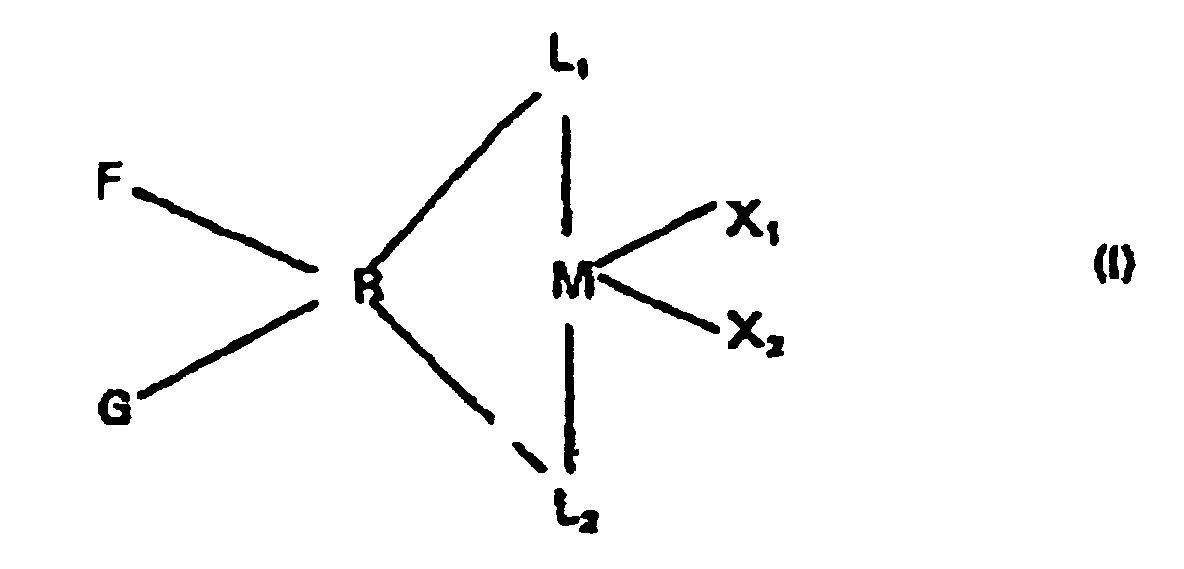
M est un métal choisi parmi le groupe constitué par les éléments suivants : Ti, Zr, Hf, V, Nb et Ta ou un élément choisi parmi le groupe constitué par les lanthanides,
X1 et X2 sont identiques ou différents et sont chacun un groupe alkyle en C1-C10, un groupe alcoxy en C1-C10, un groupe aryle en C6-C10, un groupe aryloxy en C6-C10, un groupe alcényle en C2-C10, un groupe alkylaryle en C7-C20, un groupe arylalcényle en C8-C20, un hydrogène ou un atome d'halogène,
L1 et L2 sont identiques ou différents et sont chacun un radical hydrocarboné monocyclique ou polycyclique non substitué, monosubstitué ou polysubstitué contenant au moins une unité cyclopentadiényle capable de former une structure en sandwich avec M,
R est du carbone, du silicium, du germanium ou de l'étain,
F et G sont identiques ou différents et sont chacun un radical triméthylsilyle de formule -Si(CH3)3, où G peut aussi être un radical alkyle en C1-C10, de préférence un radical alkyle en C1-C4, ou un radical aryle en C6-C10,
caractérisé en ce que le catalyseur métallocène supporté comprenant A et B, présente une activité maximale de 100 kg, de préférence maximale de 50 kg, de préférence maximale de 20 kg de polyoléfine/g de catalyseur supporté/heure. - Procédé selon l'une quelconque des revendications 1 à 6, dans lequel la pré-polymérisation est exécutée en phase gazeuse.
- Procédé selon l'une quelconque des revendications 1 à 6, dans lequel la pré-polymérisation est une polymérisation en suspension dans un milieu en suspension huileux ou gras.
- Procédé selon la revendication 1, dans lequel pour la polymérisation en phase liquide de propylène la modification du catalyseur supporté est exécutée par la pré-polymérisation du 4-méthyl-1-pentène.
Priority Applications (1)
| Application Number | Priority Date | Filing Date | Title |
|---|---|---|---|
| EP00964473A EP1218423B1 (fr) | 1999-10-02 | 2000-10-02 | Catalyseurs supportes modifies utilises dans la polymerisation d'olefines |
Applications Claiming Priority (4)
| Application Number | Priority Date | Filing Date | Title |
|---|---|---|---|
| EP99119575 | 1999-10-02 | ||
| EP99119575 | 1999-10-02 | ||
| PCT/GB2000/003775 WO2001025296A1 (fr) | 1999-10-02 | 2000-10-02 | Catalyseurs supportes modifies utilises dans la polymerisation d'olefines |
| EP00964473A EP1218423B1 (fr) | 1999-10-02 | 2000-10-02 | Catalyseurs supportes modifies utilises dans la polymerisation d'olefines |
Publications (2)
| Publication Number | Publication Date |
|---|---|
| EP1218423A1 EP1218423A1 (fr) | 2002-07-03 |
| EP1218423B1 true EP1218423B1 (fr) | 2005-03-16 |
Family
ID=8239109
Family Applications (1)
| Application Number | Title | Priority Date | Filing Date |
|---|---|---|---|
| EP00964473A Expired - Lifetime EP1218423B1 (fr) | 1999-10-02 | 2000-10-02 | Catalyseurs supportes modifies utilises dans la polymerisation d'olefines |
Country Status (7)
| Country | Link |
|---|---|
| US (1) | US6841634B1 (fr) |
| EP (1) | EP1218423B1 (fr) |
| JP (1) | JP2003511493A (fr) |
| AT (1) | ATE291041T1 (fr) |
| AU (1) | AU7540700A (fr) |
| DE (1) | DE60018775T2 (fr) |
| WO (1) | WO2001025296A1 (fr) |
Families Citing this family (19)
| Publication number | Priority date | Publication date | Assignee | Title |
|---|---|---|---|---|
| BR0315341B1 (pt) | 2002-10-15 | 2014-02-18 | Adesivos compreendendo poliolefina. | |
| US7223822B2 (en) | 2002-10-15 | 2007-05-29 | Exxonmobil Chemical Patents Inc. | Multiple catalyst and reactor system for olefin polymerization and polymers produced therefrom |
| US7550528B2 (en) | 2002-10-15 | 2009-06-23 | Exxonmobil Chemical Patents Inc. | Functionalized olefin polymers |
| US7541402B2 (en) | 2002-10-15 | 2009-06-02 | Exxonmobil Chemical Patents Inc. | Blend functionalized polyolefin adhesive |
| US7122606B2 (en) | 2003-07-04 | 2006-10-17 | Basell Polyolefine Gmbh | Olefin polymerization process |
| GB0329348D0 (en) * | 2003-12-18 | 2004-01-21 | Bp Chem Int Ltd | Polymerisation process |
| JP2008509277A (ja) * | 2004-08-09 | 2008-03-27 | ダウ グローバル テクノロジーズ インコーポレイティド | ポリマーの製造のための担持ビス(ヒドロキシアリールアリールオキシ)触媒 |
| ATE406393T1 (de) * | 2006-07-10 | 2008-09-15 | Borealis Tech Oy | Kurzkettig verzweigtes polypropylen |
| ATE421760T1 (de) | 2006-07-10 | 2009-02-15 | Borealis Tech Oy | Elektrischer isolierfilm |
| PT2208749E (pt) | 2006-07-10 | 2016-03-04 | Borealis Tech Oy | Películas de polipropileno orientadas biaxialmente |
| EP1967547A1 (fr) | 2006-08-25 | 2008-09-10 | Borealis Technology OY | Substrat couche par extrusion |
| ATE427330T1 (de) | 2006-08-25 | 2009-04-15 | Borealis Tech Oy | Polypropylenschaumstoff |
| EP1903579B1 (fr) | 2006-09-25 | 2010-03-24 | Borealis Technology Oy | Câble coaxial |
| ATE424424T1 (de) | 2006-12-28 | 2009-03-15 | Borealis Tech Oy | Verfahren zur herstellung von verzweigtem polypropylen |
| WO2012071205A2 (fr) | 2010-11-22 | 2012-05-31 | Albemarle Corporation | Compositions d'activateurs, leur préparation et leur utilisation en catalyse |
| KR101757370B1 (ko) | 2015-06-01 | 2017-07-12 | 주식회사 엘지화학 | 1-옥텐 조성물 |
| CN109456429B (zh) * | 2017-09-06 | 2021-05-11 | 中国石油化工股份有限公司 | 一种气相法聚丙烯生产方法 |
| WO2020064484A1 (fr) * | 2018-09-28 | 2020-04-02 | Borealis Ag | Procédé multi-étapes pour la production d'une composition de polymère oléfinique en c2 à c8 |
| EP3628693A1 (fr) * | 2018-09-28 | 2020-04-01 | Borealis AG | Procédé de production d'un copolymère de propylène hétérophasique présentant une grande fraction soluble à froid dans le xylène (xcs) |
Family Cites Families (11)
| Publication number | Priority date | Publication date | Assignee | Title |
|---|---|---|---|---|
| DE3782243T2 (de) | 1986-08-26 | 1993-03-04 | Mitsui Petrochemical Ind | Katalysator zur polymerisierung von alpha-olefin und verfahren. |
| CA1306579C (fr) | 1987-12-15 | 1992-08-18 | Mamoru Kioka | Methode de production de pellicules de polypropylene et de polypropylene allonge |
| IT1246614B (it) * | 1991-06-03 | 1994-11-24 | Himont Inc | Procedimento per la polimerizzazione in fase gas delle olefine |
| US5376743A (en) * | 1993-03-11 | 1994-12-27 | Union Carbide Chemicals & Plastics Technology Corporation | Process for the production of sticky polymers |
| DE69408989T2 (de) | 1993-05-25 | 1998-11-05 | Exxon Chemical Patents Inc | Metallocen-katalysatorsysteme auf einem träger für die olefinpolymerisation, ihre herstellung und verwendung |
| TW354792B (en) | 1993-08-13 | 1999-03-21 | Mitsui Petrochemical Ind | Olefin polymerization catalyst and process for preparing polypropylene and propylene block copolymer |
| US6391817B1 (en) | 1993-12-28 | 2002-05-21 | Exxonmobil Chemical Patents Inc. | Method for producing a prepolymerized catalyst |
| JPH11508932A (ja) | 1995-07-06 | 1999-08-03 | エクソン・ケミカル・パテンツ・インク | 予備重合され担持されたメタロセン触媒系の製造方法 |
| FI104825B (fi) | 1996-01-26 | 2000-04-14 | Borealis As | Olefiinien polymerointikatalysaattorisysteemi, sen valmistus ja käyttö |
| AT403919B (de) * | 1996-02-02 | 1998-06-25 | Danubia Petrochem Polymere | Verfahren zur herstellung von katalysatorträgern und geträgerter polyolefin-katalysatoren sowie deren verwendung für die herstellung von polyolefinen |
| FI974175L (fi) | 1997-11-07 | 1999-05-08 | Borealis As | Menetelmä polypropeenin valmistamiseksi |
-
2000
- 2000-10-02 JP JP2001528461A patent/JP2003511493A/ja active Pending
- 2000-10-02 DE DE60018775T patent/DE60018775T2/de not_active Expired - Lifetime
- 2000-10-02 AT AT00964473T patent/ATE291041T1/de not_active IP Right Cessation
- 2000-10-02 WO PCT/GB2000/003775 patent/WO2001025296A1/fr not_active Ceased
- 2000-10-02 US US10/089,049 patent/US6841634B1/en not_active Expired - Fee Related
- 2000-10-02 AU AU75407/00A patent/AU7540700A/en not_active Abandoned
- 2000-10-02 EP EP00964473A patent/EP1218423B1/fr not_active Expired - Lifetime
Also Published As
| Publication number | Publication date |
|---|---|
| WO2001025296A1 (fr) | 2001-04-12 |
| AU7540700A (en) | 2001-05-10 |
| US6841634B1 (en) | 2005-01-11 |
| ATE291041T1 (de) | 2005-04-15 |
| EP1218423A1 (fr) | 2002-07-03 |
| JP2003511493A (ja) | 2003-03-25 |
| DE60018775T2 (de) | 2005-08-11 |
| DE60018775D1 (de) | 2005-04-21 |
Similar Documents
| Publication | Publication Date | Title |
|---|---|---|
| US6225252B1 (en) | Process for preparing catalyst supports and supported polyolefin catalysts and also their use for the preparation of polyolefins | |
| US6841634B1 (en) | Modified supported catalysts for the polymerization of olefins | |
| US7468416B2 (en) | Catalyst composition for olefin polymerization | |
| US5532396A (en) | Metallocene compound | |
| RU2165435C2 (ru) | Каталитическая композиция, используемая при полимеризации олефинов | |
| US5106804A (en) | Catalyst and prepolymer used for the preparation of polyolefins | |
| JP4299775B2 (ja) | エチレンコポリマー | |
| US6069108A (en) | Catalyst supports metallacene catalysts and their use for the preparation of polyolefins O | |
| JP3429334B2 (ja) | ポリオレフィンワックスの製造方法 | |
| JP3717542B2 (ja) | メタロセン化合物 | |
| US6136742A (en) | Metallocene catalyst systems | |
| JPS63501369A (ja) | 担持された重合触媒 | |
| EP0435514B1 (fr) | Catalyseur et prépolymère utilisées dans la préparation de polyoléfines | |
| JP2000095811A (ja) | ポリエチレン又はポリプロピレンの製造方法 | |
| MXPA02006571A (es) | Catalizador mixto de ziegler/metaloceno para la produccion de poliolefinas bimodales. | |
| JPH0710917A (ja) | 触媒系、その触媒系のオレフィン(共)重合のための使用、その触媒系の製造方法及びオレフィン(共)重合法 | |
| US5654248A (en) | Catalyst for polymerizing alpha-olefins and process for polymerization | |
| JP3751344B2 (ja) | メタロセン化合物 | |
| RU2126424C1 (ru) | Каталитическая композиция для использования при полимеризации олефинов | |
| WO1995015985A1 (fr) | Nouveau catalyseur de polymerisation d'olefines et procede pour polymeriser des olefines a l'aide de ce catalyseur | |
| EP0585512B1 (fr) | Procédé de préparation d'un composant de catalyseur pour polymérisation d'oléfines | |
| GB2305178A (en) | Metallocene catalyst for producing polyolefins | |
| EP0754706B1 (fr) | Catalyseur de polymérisation sur support et son utilisation pour la polymérisation d'oléfine | |
| JP3124086B2 (ja) | ポリオレフィンの製造方法 | |
| JPH072793B2 (ja) | ポリオレフインの製造方法 |
Legal Events
| Date | Code | Title | Description |
|---|---|---|---|
| PUAI | Public reference made under article 153(3) epc to a published international application that has entered the european phase |
Free format text: ORIGINAL CODE: 0009012 |
|
| 17P | Request for examination filed |
Effective date: 20020411 |
|
| AK | Designated contracting states |
Kind code of ref document: A1 Designated state(s): AT BE CH CY DE DK ES FI FR GB GR IE IT LI LU MC NL PT SE |
|
| AX | Request for extension of the european patent |
Free format text: AL;LT;LV;MK;RO;SI |
|
| 17Q | First examination report despatched |
Effective date: 20040311 |
|
| GRAP | Despatch of communication of intention to grant a patent |
Free format text: ORIGINAL CODE: EPIDOSNIGR1 |
|
| GRAS | Grant fee paid |
Free format text: ORIGINAL CODE: EPIDOSNIGR3 |
|
| GRAA | (expected) grant |
Free format text: ORIGINAL CODE: 0009210 |
|
| AK | Designated contracting states |
Kind code of ref document: B1 Designated state(s): AT BE CH CY DE DK ES FI FR GB GR IE IT LI LU MC NL PT SE |
|
| PG25 | Lapsed in a contracting state [announced via postgrant information from national office to epo] |
Ref country code: IT Free format text: LAPSE BECAUSE OF FAILURE TO SUBMIT A TRANSLATION OF THE DESCRIPTION OR TO PAY THE FEE WITHIN THE PRESCRIBED TIME-LIMIT;WARNING: LAPSES OF ITALIAN PATENTS WITH EFFECTIVE DATE BEFORE 2007 MAY HAVE OCCURRED AT ANY TIME BEFORE 2007. THE CORRECT EFFECTIVE DATE MAY BE DIFFERENT FROM THE ONE RECORDED. Effective date: 20050316 Ref country code: CH Free format text: LAPSE BECAUSE OF FAILURE TO SUBMIT A TRANSLATION OF THE DESCRIPTION OR TO PAY THE FEE WITHIN THE PRESCRIBED TIME-LIMIT Effective date: 20050316 Ref country code: NL Free format text: LAPSE BECAUSE OF FAILURE TO SUBMIT A TRANSLATION OF THE DESCRIPTION OR TO PAY THE FEE WITHIN THE PRESCRIBED TIME-LIMIT Effective date: 20050316 Ref country code: AT Free format text: LAPSE BECAUSE OF FAILURE TO SUBMIT A TRANSLATION OF THE DESCRIPTION OR TO PAY THE FEE WITHIN THE PRESCRIBED TIME-LIMIT Effective date: 20050316 Ref country code: BE Free format text: LAPSE BECAUSE OF FAILURE TO SUBMIT A TRANSLATION OF THE DESCRIPTION OR TO PAY THE FEE WITHIN THE PRESCRIBED TIME-LIMIT Effective date: 20050316 Ref country code: LI Free format text: LAPSE BECAUSE OF FAILURE TO SUBMIT A TRANSLATION OF THE DESCRIPTION OR TO PAY THE FEE WITHIN THE PRESCRIBED TIME-LIMIT Effective date: 20050316 Ref country code: FI Free format text: LAPSE BECAUSE OF FAILURE TO SUBMIT A TRANSLATION OF THE DESCRIPTION OR TO PAY THE FEE WITHIN THE PRESCRIBED TIME-LIMIT Effective date: 20050316 |
|
| REG | Reference to a national code |
Ref country code: GB Ref legal event code: FG4D |
|
| REG | Reference to a national code |
Ref country code: CH Ref legal event code: EP |
|
| REG | Reference to a national code |
Ref country code: IE Ref legal event code: FG4D |
|
| REF | Corresponds to: |
Ref document number: 60018775 Country of ref document: DE Date of ref document: 20050421 Kind code of ref document: P |
|
| PG25 | Lapsed in a contracting state [announced via postgrant information from national office to epo] |
Ref country code: GR Free format text: LAPSE BECAUSE OF FAILURE TO SUBMIT A TRANSLATION OF THE DESCRIPTION OR TO PAY THE FEE WITHIN THE PRESCRIBED TIME-LIMIT Effective date: 20050616 Ref country code: DK Free format text: LAPSE BECAUSE OF FAILURE TO SUBMIT A TRANSLATION OF THE DESCRIPTION OR TO PAY THE FEE WITHIN THE PRESCRIBED TIME-LIMIT Effective date: 20050616 |
|
| PG25 | Lapsed in a contracting state [announced via postgrant information from national office to epo] |
Ref country code: ES Free format text: LAPSE BECAUSE OF FAILURE TO SUBMIT A TRANSLATION OF THE DESCRIPTION OR TO PAY THE FEE WITHIN THE PRESCRIBED TIME-LIMIT Effective date: 20050627 |
|
| NLV1 | Nl: lapsed or annulled due to failure to fulfill the requirements of art. 29p and 29m of the patents act | ||
| PG25 | Lapsed in a contracting state [announced via postgrant information from national office to epo] |
Ref country code: PT Free format text: LAPSE BECAUSE OF FAILURE TO SUBMIT A TRANSLATION OF THE DESCRIPTION OR TO PAY THE FEE WITHIN THE PRESCRIBED TIME-LIMIT Effective date: 20050907 |
|
| REG | Reference to a national code |
Ref country code: CH Ref legal event code: PL |
|
| PG25 | Lapsed in a contracting state [announced via postgrant information from national office to epo] |
Ref country code: CY Free format text: LAPSE BECAUSE OF FAILURE TO SUBMIT A TRANSLATION OF THE DESCRIPTION OR TO PAY THE FEE WITHIN THE PRESCRIBED TIME-LIMIT Effective date: 20051002 |
|
| PG25 | Lapsed in a contracting state [announced via postgrant information from national office to epo] |
Ref country code: IE Free format text: LAPSE BECAUSE OF NON-PAYMENT OF DUE FEES Effective date: 20051003 |
|
| PG25 | Lapsed in a contracting state [announced via postgrant information from national office to epo] |
Ref country code: MC Free format text: LAPSE BECAUSE OF NON-PAYMENT OF DUE FEES Effective date: 20051031 Ref country code: LU Free format text: LAPSE BECAUSE OF NON-PAYMENT OF DUE FEES Effective date: 20051031 |
|
| PLBE | No opposition filed within time limit |
Free format text: ORIGINAL CODE: 0009261 |
|
| STAA | Information on the status of an ep patent application or granted ep patent |
Free format text: STATUS: NO OPPOSITION FILED WITHIN TIME LIMIT |
|
| ET | Fr: translation filed | ||
| 26N | No opposition filed |
Effective date: 20051219 |
|
| REG | Reference to a national code |
Ref country code: IE Ref legal event code: MM4A |
|
| PG25 | Lapsed in a contracting state [announced via postgrant information from national office to epo] |
Ref country code: SE Free format text: LAPSE BECAUSE OF FAILURE TO SUBMIT A TRANSLATION OF THE DESCRIPTION OR TO PAY THE FEE WITHIN THE PRESCRIBED TIME-LIMIT Effective date: 20050616 |
|
| REG | Reference to a national code |
Ref country code: FR Ref legal event code: PLFP Year of fee payment: 16 |
|
| PGFP | Annual fee paid to national office [announced via postgrant information from national office to epo] |
Ref country code: GB Payment date: 20151021 Year of fee payment: 16 Ref country code: DE Payment date: 20151022 Year of fee payment: 16 |
|
| PGFP | Annual fee paid to national office [announced via postgrant information from national office to epo] |
Ref country code: FR Payment date: 20151023 Year of fee payment: 16 |
|
| REG | Reference to a national code |
Ref country code: DE Ref legal event code: R119 Ref document number: 60018775 Country of ref document: DE |
|
| GBPC | Gb: european patent ceased through non-payment of renewal fee |
Effective date: 20161002 |
|
| REG | Reference to a national code |
Ref country code: FR Ref legal event code: ST Effective date: 20170630 |
|
| PG25 | Lapsed in a contracting state [announced via postgrant information from national office to epo] |
Ref country code: DE Free format text: LAPSE BECAUSE OF NON-PAYMENT OF DUE FEES Effective date: 20170503 Ref country code: GB Free format text: LAPSE BECAUSE OF NON-PAYMENT OF DUE FEES Effective date: 20161002 Ref country code: FR Free format text: LAPSE BECAUSE OF NON-PAYMENT OF DUE FEES Effective date: 20161102 |