EP1222183B1 - Benzopyran-derivate - Google Patents
Benzopyran-derivate Download PDFInfo
- Publication number
- EP1222183B1 EP1222183B1 EP00975868A EP00975868A EP1222183B1 EP 1222183 B1 EP1222183 B1 EP 1222183B1 EP 00975868 A EP00975868 A EP 00975868A EP 00975868 A EP00975868 A EP 00975868A EP 1222183 B1 EP1222183 B1 EP 1222183B1
- Authority
- EP
- European Patent Office
- Prior art keywords
- phenyl
- benzopyran
- oxo
- methyl
- compound
- Prior art date
- Legal status (The legal status is an assumption and is not a legal conclusion. Google has not performed a legal analysis and makes no representation as to the accuracy of the status listed.)
- Expired - Lifetime
Links
- 150000001562 benzopyrans Chemical class 0.000 title abstract description 4
- 125000001997 phenyl group Chemical group [H]C1=C([H])C([H])=C(*)C([H])=C1[H] 0.000 claims abstract description 52
- 125000003917 carbamoyl group Chemical group [H]N([H])C(*)=O 0.000 claims abstract description 15
- 150000001204 N-oxides Chemical class 0.000 claims abstract description 8
- 125000004448 alkyl carbonyl group Chemical group 0.000 claims abstract description 8
- 125000004453 alkoxycarbonyl group Chemical group 0.000 claims abstract description 7
- 125000004466 alkoxycarbonylamino group Chemical group 0.000 claims abstract description 7
- 150000003839 salts Chemical class 0.000 claims abstract description 7
- 150000001875 compounds Chemical class 0.000 claims description 240
- OKKJLVBELUTLKV-UHFFFAOYSA-N Methanol Chemical compound OC OKKJLVBELUTLKV-UHFFFAOYSA-N 0.000 claims description 63
- 239000002904 solvent Substances 0.000 claims description 58
- 238000000034 method Methods 0.000 claims description 50
- WEVYAHXRMPXWCK-UHFFFAOYSA-N Acetonitrile Chemical compound CC#N WEVYAHXRMPXWCK-UHFFFAOYSA-N 0.000 claims description 48
- ZMXDDKWLCZADIW-UHFFFAOYSA-N N,N-Dimethylformamide Chemical compound CN(C)C=O ZMXDDKWLCZADIW-UHFFFAOYSA-N 0.000 claims description 45
- -1 trifluoromethanesulphonyloxy group Chemical group 0.000 claims description 41
- BWHMMNNQKKPAPP-UHFFFAOYSA-L potassium carbonate Chemical compound [K+].[K+].[O-]C([O-])=O BWHMMNNQKKPAPP-UHFFFAOYSA-L 0.000 claims description 24
- 125000000229 (C1-C4)alkoxy group Chemical group 0.000 claims description 17
- YZTJYBJCZXZGCT-UHFFFAOYSA-N phenylpiperazine Chemical class C1CNCCN1C1=CC=CC=C1 YZTJYBJCZXZGCT-UHFFFAOYSA-N 0.000 claims description 15
- 229910052739 hydrogen Inorganic materials 0.000 claims description 14
- 125000004093 cyano group Chemical group *C#N 0.000 claims description 13
- 239000001257 hydrogen Substances 0.000 claims description 13
- 125000005843 halogen group Chemical group 0.000 claims description 12
- 229910000027 potassium carbonate Inorganic materials 0.000 claims description 12
- 239000003795 chemical substances by application Substances 0.000 claims description 11
- 238000002360 preparation method Methods 0.000 claims description 11
- 125000004178 (C1-C4) alkyl group Chemical group 0.000 claims description 9
- 125000004793 2,2,2-trifluoroethoxy group Chemical group FC(CO*)(F)F 0.000 claims description 9
- VHYFNPMBLIVWCW-UHFFFAOYSA-N 4-Dimethylaminopyridine Chemical compound CN(C)C1=CC=NC=C1 VHYFNPMBLIVWCW-UHFFFAOYSA-N 0.000 claims description 8
- 125000004435 hydrogen atom Chemical group [H]* 0.000 claims description 8
- 238000009833 condensation Methods 0.000 claims description 7
- 230000005494 condensation Effects 0.000 claims description 7
- 125000002887 hydroxy group Chemical group [H]O* 0.000 claims description 7
- 125000005115 alkyl carbamoyl group Chemical group 0.000 claims description 6
- PFKFTWBEEFSNDU-UHFFFAOYSA-N carbonyldiimidazole Chemical compound C1=CN=CN1C(=O)N1C=CN=C1 PFKFTWBEEFSNDU-UHFFFAOYSA-N 0.000 claims description 6
- 125000005117 dialkylcarbamoyl group Chemical group 0.000 claims description 6
- UFHFLCQGNIYNRP-UHFFFAOYSA-N Hydrogen Chemical compound [H][H] UFHFLCQGNIYNRP-UHFFFAOYSA-N 0.000 claims description 5
- 150000001408 amides Chemical class 0.000 claims description 5
- ZWWWLCMDTZFSOO-UHFFFAOYSA-N diethoxyphosphorylformonitrile Chemical compound CCOP(=O)(C#N)OCC ZWWWLCMDTZFSOO-UHFFFAOYSA-N 0.000 claims description 5
- 150000002148 esters Chemical class 0.000 claims description 5
- 150000001412 amines Chemical class 0.000 claims description 4
- 239000000010 aprotic solvent Substances 0.000 claims description 4
- 239000008194 pharmaceutical composition Substances 0.000 claims description 4
- 230000001737 promoting effect Effects 0.000 claims description 4
- GNPVFESNCYHNOE-UHFFFAOYSA-N 2-acetyl-n-[3-[4-(5-chloro-2-methoxyphenyl)piperazin-1-yl]propyl]-3-methyl-4-oxochromene-8-carboxamide Chemical compound COC1=CC=C(Cl)C=C1N1CCN(CCCNC(=O)C=2C3=C(C(C(C)=C(C(C)=O)O3)=O)C=CC=2)CC1 GNPVFESNCYHNOE-UHFFFAOYSA-N 0.000 claims description 3
- HCIHJTBRHKIPAK-UHFFFAOYSA-N 8-n-[3-[4-(5-chloro-2-hydroxyphenyl)piperazin-1-yl]propyl]-3-methyl-4-oxochromene-2,8-dicarboxamide Chemical compound C1=CC=C2C(=O)C(C)=C(C(N)=O)OC2=C1C(=O)NCCCN(CC1)CCN1C1=CC(Cl)=CC=C1O HCIHJTBRHKIPAK-UHFFFAOYSA-N 0.000 claims description 3
- DRBGBHGREFJXNP-UHFFFAOYSA-N 8-n-[3-[4-(5-chloro-2-methoxyphenyl)piperazin-1-yl]propyl]-2-n,2-n,3-trimethyl-4-oxochromene-2,8-dicarboxamide Chemical compound COC1=CC=C(Cl)C=C1N1CCN(CCCNC(=O)C=2C3=C(C(C(C)=C(C(=O)N(C)C)O3)=O)C=CC=2)CC1 DRBGBHGREFJXNP-UHFFFAOYSA-N 0.000 claims description 3
- QWUMWMGUVQLCHP-UHFFFAOYSA-N 8-n-[3-[4-(5-chloro-2-methoxyphenyl)piperazin-1-yl]propyl]-2-n,3-dimethyl-4-oxochromene-2,8-dicarboxamide Chemical compound C1=CC=C2C(=O)C(C)=C(C(=O)NC)OC2=C1C(=O)NCCCN(CC1)CCN1C1=CC(Cl)=CC=C1OC QWUMWMGUVQLCHP-UHFFFAOYSA-N 0.000 claims description 3
- KLWWSRSXHBPNIY-UHFFFAOYSA-N 8-n-[3-[4-(5-chloro-2-methoxyphenyl)piperazin-1-yl]propyl]-3-methyl-4-oxochromene-2,8-dicarboxamide Chemical compound COC1=CC=C(Cl)C=C1N1CCN(CCCNC(=O)C=2C3=C(C(C(C)=C(C(N)=O)O3)=O)C=CC=2)CC1 KLWWSRSXHBPNIY-UHFFFAOYSA-N 0.000 claims description 3
- QOSSAOTZNIDXMA-UHFFFAOYSA-N Dicylcohexylcarbodiimide Chemical compound C1CCCCC1N=C=NC1CCCCC1 QOSSAOTZNIDXMA-UHFFFAOYSA-N 0.000 claims description 3
- NQTADLQHYWFPDB-UHFFFAOYSA-N N-Hydroxysuccinimide Chemical compound ON1C(=O)CCC1=O NQTADLQHYWFPDB-UHFFFAOYSA-N 0.000 claims description 3
- 150000008064 anhydrides Chemical class 0.000 claims description 3
- 125000001309 chloro group Chemical group Cl* 0.000 claims description 3
- 239000003085 diluting agent Substances 0.000 claims description 3
- DWSMRRPUBTWYBU-UHFFFAOYSA-N ethyl 8-[3-[4-(5-chloro-2-methoxyphenyl)piperazin-1-yl]propylcarbamoyl]-3-methyl-4-oxochromene-2-carboxylate Chemical compound C1=CC=C2C(=O)C(C)=C(C(=O)OCC)OC2=C1C(=O)NCCCN(CC1)CCN1C1=CC(Cl)=CC=C1OC DWSMRRPUBTWYBU-UHFFFAOYSA-N 0.000 claims description 3
- BGSDOQDLXPGBIB-UHFFFAOYSA-N n-[3-[4-(5-carbamoyl-2-methoxyphenyl)piperazin-1-yl]propyl]-3-methyl-4-oxo-2-phenylchromene-8-carboxamide Chemical compound COC1=CC=C(C(N)=O)C=C1N1CCN(CCCNC(=O)C=2C3=C(C(C(C)=C(O3)C=3C=CC=CC=3)=O)C=CC=2)CC1 BGSDOQDLXPGBIB-UHFFFAOYSA-N 0.000 claims description 3
- DYSHMERGGZXZAO-UHFFFAOYSA-N n-[3-[4-(5-cyano-2-methoxyphenyl)piperazin-1-yl]propyl]-3-methyl-4-oxo-2-phenylchromene-8-carboxamide Chemical compound COC1=CC=C(C#N)C=C1N1CCN(CCCNC(=O)C=2C3=C(C(C(C)=C(O3)C=3C=CC=CC=3)=O)C=CC=2)CC1 DYSHMERGGZXZAO-UHFFFAOYSA-N 0.000 claims description 3
- LRLSHKYXJXVHJZ-UHFFFAOYSA-N 3-methyl-4-oxo-2-phenyl-n-[3-[4-[2-(trifluoromethoxy)phenyl]piperazin-1-yl]propyl]chromene-8-carboxamide Chemical compound C1=CC=C2C(=O)C(C)=C(C=3C=CC=CC=3)OC2=C1C(=O)NCCCN(CC1)CCN1C1=CC=CC=C1OC(F)(F)F LRLSHKYXJXVHJZ-UHFFFAOYSA-N 0.000 claims description 2
- ZQVPSHWZFUVFIL-UHFFFAOYSA-N [2-[4-[3-[(2-carbamoyl-3-methyl-4-oxochromene-8-carbonyl)amino]propyl]piperazin-1-yl]-4-chlorophenyl] trifluoromethanesulfonate Chemical compound C1=CC=C2C(=O)C(C)=C(C(N)=O)OC2=C1C(=O)NCCCN(CC1)CCN1C1=CC(Cl)=CC=C1OS(=O)(=O)C(F)(F)F ZQVPSHWZFUVFIL-UHFFFAOYSA-N 0.000 claims description 2
- MMGPJIIWCBGPCB-UHFFFAOYSA-N n-[3-[4-(5-chloro-2-methoxyphenyl)piperazin-1-yl]propyl]-2-cyano-3-methyl-4-oxochromene-8-carboxamide Chemical compound COC1=CC=C(Cl)C=C1N1CCN(CCCNC(=O)C=2C3=C(C(C(C)=C(C#N)O3)=O)C=CC=2)CC1 MMGPJIIWCBGPCB-UHFFFAOYSA-N 0.000 claims description 2
- KILQRVGUXLESPJ-UHFFFAOYSA-N n-[3-[4-[2-methoxy-5-(trifluoromethyl)phenyl]piperazin-1-yl]propyl]-3-methyl-4-oxo-2-phenylchromene-8-carboxamide Chemical compound COC1=CC=C(C(F)(F)F)C=C1N1CCN(CCCNC(=O)C=2C3=C(C(C(C)=C(O3)C=3C=CC=CC=3)=O)C=CC=2)CC1 KILQRVGUXLESPJ-UHFFFAOYSA-N 0.000 claims description 2
- 239000002798 polar solvent Substances 0.000 claims description 2
- QEPZCLKKHVSIDC-UHFFFAOYSA-N 3-methyl-4-oxochromene-8-carboxylic acid Chemical compound C1=CC=C2C(=O)C(C)=COC2=C1C(O)=O QEPZCLKKHVSIDC-UHFFFAOYSA-N 0.000 claims 5
- 229910052731 fluorine Chemical group 0.000 claims 3
- PXGOKWXKJXAPGV-UHFFFAOYSA-N Fluorine Chemical group FF PXGOKWXKJXAPGV-UHFFFAOYSA-N 0.000 claims 2
- 229910052801 chlorine Chemical group 0.000 claims 2
- 239000011737 fluorine Chemical group 0.000 claims 2
- QDEMYUDOBJGGHG-UHFFFAOYSA-N [2-[4-[3-[(3-methyl-4-oxo-2-phenylchromene-8-carbonyl)amino]propyl]piperazin-1-yl]phenyl] trifluoromethanesulfonate Chemical compound C1=CC=C2C(=O)C(C)=C(C=3C=CC=CC=3)OC2=C1C(=O)NCCCN(CC1)CCN1C1=CC=CC=C1OS(=O)(=O)C(F)(F)F QDEMYUDOBJGGHG-UHFFFAOYSA-N 0.000 claims 1
- NXZDEHZJJKGZNH-UHFFFAOYSA-N [4-chloro-2-[4-[3-[(3-methyl-4-oxo-2-phenylchromene-8-carbonyl)amino]propyl]piperazin-1-yl]phenyl] trifluoromethanesulfonate Chemical compound C1=CC=C2C(=O)C(C)=C(C=3C=CC=CC=3)OC2=C1C(=O)NCCCN(CC1)CCN1C1=CC(Cl)=CC=C1OS(=O)(=O)C(F)(F)F NXZDEHZJJKGZNH-UHFFFAOYSA-N 0.000 claims 1
- 125000005278 alkyl sulfonyloxy group Chemical group 0.000 claims 1
- 125000005279 aryl sulfonyloxy group Chemical group 0.000 claims 1
- 229940126214 compound 3 Drugs 0.000 claims 1
- ZONYXWQDUYMKFB-UHFFFAOYSA-N flavanone Chemical compound O1C2=CC=CC=C2C(=O)CC1C1=CC=CC=C1 ZONYXWQDUYMKFB-UHFFFAOYSA-N 0.000 claims 1
- 125000001153 fluoro group Chemical group F* 0.000 claims 1
- OHHOUQGQDWYKDJ-UHFFFAOYSA-N tert-butyl n-[8-[3-[4-(5-chloro-2-methoxyphenyl)piperazin-1-yl]propylcarbamoyl]-3-methyl-4-oxochromen-2-yl]carbamate Chemical compound COC1=CC=C(Cl)C=C1N1CCN(CCCNC(=O)C=2C3=C(C(C(C)=C(NC(=O)OC(C)(C)C)O3)=O)C=CC=2)CC1 OHHOUQGQDWYKDJ-UHFFFAOYSA-N 0.000 claims 1
- 125000002023 trifluoromethyl group Chemical group FC(F)(F)* 0.000 claims 1
- 230000000694 effects Effects 0.000 abstract description 26
- 125000006297 carbonyl amino group Chemical group [H]N([*:2])C([*:1])=O 0.000 abstract description 25
- 210000001635 urinary tract Anatomy 0.000 abstract description 12
- 230000000414 obstructive effect Effects 0.000 abstract description 8
- 238000011282 treatment Methods 0.000 abstract description 8
- 125000000217 alkyl group Chemical group 0.000 abstract description 3
- 230000001077 hypotensive effect Effects 0.000 abstract description 3
- 125000003545 alkoxy group Chemical group 0.000 abstract description 2
- 229910052736 halogen Inorganic materials 0.000 abstract description 2
- 208000011580 syndromic disease Diseases 0.000 abstract description 2
- 102100022738 5-hydroxytryptamine receptor 1A Human genes 0.000 abstract 1
- 101710138638 5-hydroxytryptamine receptor 1A Proteins 0.000 abstract 1
- 239000000674 adrenergic antagonist Substances 0.000 abstract 1
- 102000030619 alpha-1 Adrenergic Receptor Human genes 0.000 abstract 1
- 108020004102 alpha-1 Adrenergic Receptor Proteins 0.000 abstract 1
- 150000002367 halogens Chemical class 0.000 abstract 1
- XEKOWRVHYACXOJ-UHFFFAOYSA-N Ethyl acetate Chemical compound CCOC(C)=O XEKOWRVHYACXOJ-UHFFFAOYSA-N 0.000 description 144
- GLUUGHFHXGJENI-UHFFFAOYSA-N Piperazine Chemical compound C1CNCCN1 GLUUGHFHXGJENI-UHFFFAOYSA-N 0.000 description 134
- HEDRZPFGACZZDS-MICDWDOJSA-N Trichloro(2H)methane Chemical compound [2H]C(Cl)(Cl)Cl HEDRZPFGACZZDS-MICDWDOJSA-N 0.000 description 76
- RTZKZFJDLAIYFH-UHFFFAOYSA-N Diethyl ether Chemical compound CCOCC RTZKZFJDLAIYFH-UHFFFAOYSA-N 0.000 description 73
- 238000005160 1H NMR spectroscopy Methods 0.000 description 57
- HEDRZPFGACZZDS-UHFFFAOYSA-N Chloroform Chemical compound ClC(Cl)Cl HEDRZPFGACZZDS-UHFFFAOYSA-N 0.000 description 52
- XLYOFNOQVPJJNP-UHFFFAOYSA-N water Chemical compound O XLYOFNOQVPJJNP-UHFFFAOYSA-N 0.000 description 52
- PMZURENOXWZQFD-UHFFFAOYSA-L Sodium Sulfate Chemical compound [Na+].[Na+].[O-]S([O-])(=O)=O PMZURENOXWZQFD-UHFFFAOYSA-L 0.000 description 48
- 239000000243 solution Substances 0.000 description 47
- 239000000203 mixture Substances 0.000 description 46
- YXFVVABEGXRONW-UHFFFAOYSA-N Toluene Chemical compound CC1=CC=CC=C1 YXFVVABEGXRONW-UHFFFAOYSA-N 0.000 description 45
- LFQSCWFLJHTTHZ-UHFFFAOYSA-N Ethanol Chemical compound CCO LFQSCWFLJHTTHZ-UHFFFAOYSA-N 0.000 description 41
- HEMHJVSKTPXQMS-UHFFFAOYSA-M Sodium hydroxide Chemical compound [OH-].[Na+] HEMHJVSKTPXQMS-UHFFFAOYSA-M 0.000 description 39
- IAZDPXIOMUYVGZ-WFGJKAKNSA-N Dimethyl sulfoxide Chemical compound [2H]C([2H])([2H])S(=O)C([2H])([2H])[2H] IAZDPXIOMUYVGZ-WFGJKAKNSA-N 0.000 description 38
- 238000003818 flash chromatography Methods 0.000 description 34
- ZMANZCXQSJIPKH-UHFFFAOYSA-N Triethylamine Chemical compound CCN(CC)CC ZMANZCXQSJIPKH-UHFFFAOYSA-N 0.000 description 33
- BDVFVCGFMNCYPV-NSHDSACASA-N 1-(5-isoquinolinesulfonyl)-2-methylpiperazine Chemical compound C[C@H]1CNCCN1S(=O)(=O)C1=CC=CC2=CN=CC=C12 BDVFVCGFMNCYPV-NSHDSACASA-N 0.000 description 30
- YMWUJEATGCHHMB-UHFFFAOYSA-N Dichloromethane Chemical compound ClCCl YMWUJEATGCHHMB-UHFFFAOYSA-N 0.000 description 27
- VEXZGXHMUGYJMC-UHFFFAOYSA-N Hydrochloric acid Chemical compound Cl VEXZGXHMUGYJMC-UHFFFAOYSA-N 0.000 description 24
- 229910052938 sodium sulfate Inorganic materials 0.000 description 24
- 235000011152 sodium sulphate Nutrition 0.000 description 24
- 125000002496 methyl group Chemical group [H]C([H])([H])* 0.000 description 23
- 239000007787 solid Substances 0.000 description 23
- SFLSHLFXELFNJZ-QMMMGPOBSA-N (-)-norepinephrine Chemical compound NC[C@H](O)C1=CC=C(O)C(O)=C1 SFLSHLFXELFNJZ-QMMMGPOBSA-N 0.000 description 22
- 108060003345 Adrenergic Receptor Proteins 0.000 description 22
- 102000017910 Adrenergic receptor Human genes 0.000 description 22
- 206010004446 Benign prostatic hyperplasia Diseases 0.000 description 22
- 208000004403 Prostatic Hyperplasia Diseases 0.000 description 22
- 229960002748 norepinephrine Drugs 0.000 description 22
- SFLSHLFXELFNJZ-UHFFFAOYSA-N norepinephrine Natural products NCC(O)C1=CC=C(O)C(O)=C1 SFLSHLFXELFNJZ-UHFFFAOYSA-N 0.000 description 22
- 102000005962 receptors Human genes 0.000 description 22
- 108020003175 receptors Proteins 0.000 description 22
- GRVDJDISBSALJP-UHFFFAOYSA-N methyloxidanyl Chemical compound [O]C GRVDJDISBSALJP-UHFFFAOYSA-N 0.000 description 21
- 239000005557 antagonist Substances 0.000 description 19
- 229960004132 diethyl ether Drugs 0.000 description 17
- QTBSBXVTEAMEQO-UHFFFAOYSA-N Acetic acid Chemical compound CC(O)=O QTBSBXVTEAMEQO-UHFFFAOYSA-N 0.000 description 16
- 150000001735 carboxylic acids Chemical class 0.000 description 16
- 238000002425 crystallisation Methods 0.000 description 16
- 239000012044 organic layer Substances 0.000 description 16
- 230000002829 reductive effect Effects 0.000 description 15
- 238000010992 reflux Methods 0.000 description 14
- STALANBIHAODET-UHFFFAOYSA-N 1-[2-(2,2,2-trifluoroethoxy)phenyl]piperazine Chemical group FC(F)(F)COC1=CC=CC=C1N1CCNCC1 STALANBIHAODET-UHFFFAOYSA-N 0.000 description 12
- CSCPPACGZOOCGX-UHFFFAOYSA-N Acetone Chemical compound CC(C)=O CSCPPACGZOOCGX-UHFFFAOYSA-N 0.000 description 12
- 206010071289 Lower urinary tract symptoms Diseases 0.000 description 12
- IENZQIKPVFGBNW-UHFFFAOYSA-N prazosin Chemical compound N=1C(N)=C2C=C(OC)C(OC)=CC2=NC=1N(CC1)CCN1C(=O)C1=CC=CO1 IENZQIKPVFGBNW-UHFFFAOYSA-N 0.000 description 12
- 229960001289 prazosin Drugs 0.000 description 12
- 239000011541 reaction mixture Substances 0.000 description 12
- 210000001519 tissue Anatomy 0.000 description 12
- UUFQTNFCRMXOAE-UHFFFAOYSA-N 1-methylmethylene Chemical compound C[CH] UUFQTNFCRMXOAE-UHFFFAOYSA-N 0.000 description 11
- 239000003208 petroleum Substances 0.000 description 11
- 239000000725 suspension Substances 0.000 description 11
- WYURNTSHIVDZCO-UHFFFAOYSA-N Tetrahydrofuran Chemical compound C1CCOC1 WYURNTSHIVDZCO-UHFFFAOYSA-N 0.000 description 10
- 238000006243 chemical reaction Methods 0.000 description 10
- VHUUQVKOLVNVRT-UHFFFAOYSA-N Ammonium hydroxide Chemical compound [NH4+].[OH-] VHUUQVKOLVNVRT-UHFFFAOYSA-N 0.000 description 9
- 229940126062 Compound A Drugs 0.000 description 9
- NLDMNSXOCDLTTB-UHFFFAOYSA-N Heterophylliin A Natural products O1C2COC(=O)C3=CC(O)=C(O)C(O)=C3C3=C(O)C(O)=C(O)C=C3C(=O)OC2C(OC(=O)C=2C=C(O)C(O)=C(O)C=2)C(O)C1OC(=O)C1=CC(O)=C(O)C(O)=C1 NLDMNSXOCDLTTB-UHFFFAOYSA-N 0.000 description 9
- 235000011114 ammonium hydroxide Nutrition 0.000 description 9
- CBHOOMGKXCMKIR-UHFFFAOYSA-N azane;methanol Chemical compound N.OC CBHOOMGKXCMKIR-UHFFFAOYSA-N 0.000 description 9
- NLKNQRATVPKPDG-UHFFFAOYSA-M potassium iodide Chemical compound [K+].[I-] NLKNQRATVPKPDG-UHFFFAOYSA-M 0.000 description 9
- 210000003708 urethra Anatomy 0.000 description 9
- NLXLAEXVIDQMFP-UHFFFAOYSA-N Ammonium chloride Substances [NH4+].[Cl-] NLXLAEXVIDQMFP-UHFFFAOYSA-N 0.000 description 8
- LRHPLDYGYMQRHN-UHFFFAOYSA-N N-Butanol Chemical compound CCCCO LRHPLDYGYMQRHN-UHFFFAOYSA-N 0.000 description 8
- QAOWNCQODCNURD-UHFFFAOYSA-N Sulfuric acid Chemical compound OS(O)(=O)=O QAOWNCQODCNURD-UHFFFAOYSA-N 0.000 description 8
- 239000012267 brine Substances 0.000 description 8
- 125000003178 carboxy group Chemical group [H]OC(*)=O 0.000 description 8
- 210000002307 prostate Anatomy 0.000 description 8
- 230000000284 resting effect Effects 0.000 description 8
- HPALAKNZSZLMCH-UHFFFAOYSA-M sodium;chloride;hydrate Chemical compound O.[Na+].[Cl-] HPALAKNZSZLMCH-UHFFFAOYSA-M 0.000 description 8
- 229960000583 acetic acid Drugs 0.000 description 7
- 230000036772 blood pressure Effects 0.000 description 7
- 230000008602 contraction Effects 0.000 description 7
- 230000035487 diastolic blood pressure Effects 0.000 description 7
- 239000003814 drug Substances 0.000 description 7
- 238000001704 evaporation Methods 0.000 description 7
- 230000008020 evaporation Effects 0.000 description 7
- 238000001914 filtration Methods 0.000 description 7
- 239000000543 intermediate Substances 0.000 description 7
- 230000003647 oxidation Effects 0.000 description 7
- 238000007254 oxidation reaction Methods 0.000 description 7
- 238000000746 purification Methods 0.000 description 7
- 239000001117 sulphuric acid Substances 0.000 description 7
- 235000011149 sulphuric acid Nutrition 0.000 description 7
- VCKUSRYTPJJLNI-UHFFFAOYSA-N terazosin Chemical compound N=1C(N)=C2C=C(OC)C(OC)=CC2=NC=1N(CC1)CCN1C(=O)C1CCCO1 VCKUSRYTPJJLNI-UHFFFAOYSA-N 0.000 description 7
- 229960001693 terazosin Drugs 0.000 description 7
- 238000012360 testing method Methods 0.000 description 7
- ZADZZEZAWMZYEC-UHFFFAOYSA-N 1-[4-fluoro-2-(2,2,2-trifluoroethoxy)phenyl]piperazine Chemical compound FC(F)(F)COC1=CC(F)=CC=C1N1CCNCC1 ZADZZEZAWMZYEC-UHFFFAOYSA-N 0.000 description 6
- IJGRMHOSHXDMSA-UHFFFAOYSA-N Atomic nitrogen Chemical compound N#N IJGRMHOSHXDMSA-UHFFFAOYSA-N 0.000 description 6
- CDBYLPFSWZWCQE-UHFFFAOYSA-L Sodium Carbonate Chemical compound [Na+].[Na+].[O-]C([O-])=O CDBYLPFSWZWCQE-UHFFFAOYSA-L 0.000 description 6
- 229940079593 drug Drugs 0.000 description 6
- 238000000605 extraction Methods 0.000 description 6
- 125000004005 formimidoyl group Chemical group [H]\N=C(/[H])* 0.000 description 6
- 239000003921 oil Substances 0.000 description 6
- CTSLXHKWHWQRSH-UHFFFAOYSA-N oxalyl chloride Chemical compound ClC(=O)C(Cl)=O CTSLXHKWHWQRSH-UHFFFAOYSA-N 0.000 description 6
- 230000000144 pharmacologic effect Effects 0.000 description 6
- 208000024891 symptom Diseases 0.000 description 6
- VZGDMQKNWNREIO-UHFFFAOYSA-N tetrachloromethane Chemical compound ClC(Cl)(Cl)Cl VZGDMQKNWNREIO-UHFFFAOYSA-N 0.000 description 6
- FYSNRJHAOHDILO-UHFFFAOYSA-N thionyl chloride Chemical compound ClS(Cl)=O FYSNRJHAOHDILO-UHFFFAOYSA-N 0.000 description 6
- DIOHEXPTUTVCNX-UHFFFAOYSA-N 1,1,1-trifluoro-n-phenyl-n-(trifluoromethylsulfonyl)methanesulfonamide Chemical compound FC(F)(F)S(=O)(=O)N(S(=O)(=O)C(F)(F)F)C1=CC=CC=C1 DIOHEXPTUTVCNX-UHFFFAOYSA-N 0.000 description 5
- MWWCHMRATZTTMK-UHFFFAOYSA-N 1-[5-fluoro-2-(2,2,2-trifluoroethoxy)phenyl]piperazine Chemical compound FC1=CC=C(OCC(F)(F)F)C(N2CCNCC2)=C1 MWWCHMRATZTTMK-UHFFFAOYSA-N 0.000 description 5
- FAPWRFPIFSIZLT-UHFFFAOYSA-M Sodium chloride Chemical compound [Na+].[Cl-] FAPWRFPIFSIZLT-UHFFFAOYSA-M 0.000 description 5
- 239000007983 Tris buffer Substances 0.000 description 5
- 239000002253 acid Substances 0.000 description 5
- 239000000872 buffer Substances 0.000 description 5
- 239000012362 glacial acetic acid Substances 0.000 description 5
- IXCSERBJSXMMFS-UHFFFAOYSA-N hydrogen chloride Substances Cl.Cl IXCSERBJSXMMFS-UHFFFAOYSA-N 0.000 description 5
- 229910000041 hydrogen chloride Inorganic materials 0.000 description 5
- 238000002347 injection Methods 0.000 description 5
- 239000007924 injection Substances 0.000 description 5
- 229910052757 nitrogen Inorganic materials 0.000 description 5
- 230000004044 response Effects 0.000 description 5
- 210000002460 smooth muscle Anatomy 0.000 description 5
- JVBXVOWTABLYPX-UHFFFAOYSA-L sodium dithionite Chemical compound [Na+].[Na+].[O-]S(=O)S([O-])=O JVBXVOWTABLYPX-UHFFFAOYSA-L 0.000 description 5
- 238000001356 surgical procedure Methods 0.000 description 5
- YLQBMQCUIZJEEH-UHFFFAOYSA-N tetrahydrofuran Natural products C=1C=COC=1 YLQBMQCUIZJEEH-UHFFFAOYSA-N 0.000 description 5
- LENZDBCJOHFCAS-UHFFFAOYSA-N tris Chemical compound OCC(N)(CO)CO LENZDBCJOHFCAS-UHFFFAOYSA-N 0.000 description 5
- WSLDOOZREJYCGB-UHFFFAOYSA-N 1,2-Dichloroethane Chemical compound ClCCCl WSLDOOZREJYCGB-UHFFFAOYSA-N 0.000 description 4
- SSWLUCQLJACPOR-UHFFFAOYSA-N 1-[2-methoxy-5-(trifluoromethyl)phenyl]piperazine Chemical compound COC1=CC=C(C(F)(F)F)C=C1N1CCNCC1 SSWLUCQLJACPOR-UHFFFAOYSA-N 0.000 description 4
- IPXPSZPZGYTMQP-UHFFFAOYSA-N 1-[5-chloro-2-(2,2,2-trifluoroethoxy)phenyl]piperazine;hydrochloride Chemical compound Cl.FC(F)(F)COC1=CC=C(Cl)C=C1N1CCNCC1 IPXPSZPZGYTMQP-UHFFFAOYSA-N 0.000 description 4
- CNIIGCLFLJGOGP-UHFFFAOYSA-N 2-(1-naphthalenylmethyl)-4,5-dihydro-1H-imidazole Chemical compound C=1C=CC2=CC=CC=C2C=1CC1=NCCN1 CNIIGCLFLJGOGP-UHFFFAOYSA-N 0.000 description 4
- XCIQEABKWHUPMK-UHFFFAOYSA-N 2-(dimethylcarbamoyl)-3-methyl-4-oxochromene-8-carboxylic acid Chemical compound C1=CC=C2C(=O)C(C)=C(C(=O)N(C)C)OC2=C1C(O)=O XCIQEABKWHUPMK-UHFFFAOYSA-N 0.000 description 4
- KKMQFNTXRFGUHO-UHFFFAOYSA-N 2-acetyl-3-methyl-4-oxochromene-8-carboxylic acid Chemical compound C1=CC=C2C(=O)C(C)=C(C(=O)C)OC2=C1C(O)=O KKMQFNTXRFGUHO-UHFFFAOYSA-N 0.000 description 4
- YMDZDFSUDFLGMX-UHFFFAOYSA-N 2-chloro-n-(2-chloroethyl)ethanamine;hydron;chloride Chemical compound [Cl-].ClCC[NH2+]CCCl YMDZDFSUDFLGMX-UHFFFAOYSA-N 0.000 description 4
- PCVMDGDPVHAUNN-UHFFFAOYSA-N 2-ethoxycarbonyl-3-methyl-4-oxochromene-8-carboxylic acid Chemical compound C1=CC=C2C(=O)C(C)=C(C(=O)OCC)OC2=C1C(O)=O PCVMDGDPVHAUNN-UHFFFAOYSA-N 0.000 description 4
- UWPYDJFNRSFERK-UHFFFAOYSA-N 4-chloro-2-piperazin-1-ylphenol;dihydrobromide Chemical compound Br.Br.OC1=CC=C(Cl)C=C1N1CCNCC1 UWPYDJFNRSFERK-UHFFFAOYSA-N 0.000 description 4
- LFIRBTKVPRXFQH-UHFFFAOYSA-N 4-fluoro-2-nitro-1-(2,2,2-trifluoroethoxy)benzene Chemical compound [O-][N+](=O)C1=CC(F)=CC=C1OCC(F)(F)F LFIRBTKVPRXFQH-UHFFFAOYSA-N 0.000 description 4
- ACAYRJJVKPMSIS-UHFFFAOYSA-N 4-methoxy-3-nitrobenzonitrile Chemical compound COC1=CC=C(C#N)C=C1[N+]([O-])=O ACAYRJJVKPMSIS-UHFFFAOYSA-N 0.000 description 4
- QGZKDVFQNNGYKY-UHFFFAOYSA-N Ammonia Chemical compound N QGZKDVFQNNGYKY-UHFFFAOYSA-N 0.000 description 4
- KYNSBQPICQTCGU-UHFFFAOYSA-N Benzopyrane Chemical group C1=CC=C2C=CCOC2=C1 KYNSBQPICQTCGU-UHFFFAOYSA-N 0.000 description 4
- ISWSIDIOOBJBQZ-UHFFFAOYSA-N Phenol Chemical compound OC1=CC=CC=C1 ISWSIDIOOBJBQZ-UHFFFAOYSA-N 0.000 description 4
- UIIMBOGNXHQVGW-UHFFFAOYSA-M Sodium bicarbonate Chemical compound [Na+].OC([O-])=O UIIMBOGNXHQVGW-UHFFFAOYSA-M 0.000 description 4
- DTQVDTLACAAQTR-UHFFFAOYSA-N Trifluoroacetic acid Chemical compound OC(=O)C(F)(F)F DTQVDTLACAAQTR-UHFFFAOYSA-N 0.000 description 4
- 150000007513 acids Chemical class 0.000 description 4
- 239000007864 aqueous solution Substances 0.000 description 4
- 230000015572 biosynthetic process Effects 0.000 description 4
- 239000002775 capsule Substances 0.000 description 4
- 210000004027 cell Anatomy 0.000 description 4
- 238000001816 cooling Methods 0.000 description 4
- 230000004064 dysfunction Effects 0.000 description 4
- 238000000338 in vitro Methods 0.000 description 4
- 230000002401 inhibitory effect Effects 0.000 description 4
- 230000005764 inhibitory process Effects 0.000 description 4
- 239000000463 material Substances 0.000 description 4
- NRSBJRXKEWQNSP-UHFFFAOYSA-N n-[3-[4-(5-chloro-2-hydroxyphenyl)piperazin-1-yl]propyl]-3-methyl-4-oxo-2-phenylchromene-8-carboxamide Chemical compound C1=CC=C2C(=O)C(C)=C(C=3C=CC=CC=3)OC2=C1C(=O)NCCCN(CC1)CCN1C1=CC(Cl)=CC=C1O NRSBJRXKEWQNSP-UHFFFAOYSA-N 0.000 description 4
- 238000003786 synthesis reaction Methods 0.000 description 4
- IWDLBIAIZXMEBO-UHFFFAOYSA-N tert-butyl 4-(5-chloro-2-hydroxyphenyl)piperazine-1-carboxylate Chemical compound C1CN(C(=O)OC(C)(C)C)CCN1C1=CC(Cl)=CC=C1O IWDLBIAIZXMEBO-UHFFFAOYSA-N 0.000 description 4
- GDEFBLAPDVUMHR-UHFFFAOYSA-N tert-butyl 4-(5-hydroxy-2-methoxyphenyl)piperazine-1-carboxylate Chemical compound COC1=CC=C(O)C=C1N1CCN(C(=O)OC(C)(C)C)CC1 GDEFBLAPDVUMHR-UHFFFAOYSA-N 0.000 description 4
- RIOQSEWOXXDEQQ-UHFFFAOYSA-N triphenylphosphine Chemical compound C1=CC=CC=C1P(C=1C=CC=CC=1)C1=CC=CC=C1 RIOQSEWOXXDEQQ-UHFFFAOYSA-N 0.000 description 4
- LQUPKVMEAATBSL-UHFFFAOYSA-L zinc;2,3,4-trichlorophenolate Chemical compound [Zn+2].[O-]C1=CC=C(Cl)C(Cl)=C1Cl.[O-]C1=CC=C(Cl)C(Cl)=C1Cl LQUPKVMEAATBSL-UHFFFAOYSA-L 0.000 description 4
- MAUMSNABMVEOGP-UHFFFAOYSA-N (methyl-$l^{2}-azanyl)methane Chemical compound C[N]C MAUMSNABMVEOGP-UHFFFAOYSA-N 0.000 description 3
- RFFLAFLAYFXFSW-UHFFFAOYSA-N 1,2-dichlorobenzene Chemical compound ClC1=CC=CC=C1Cl RFFLAFLAYFXFSW-UHFFFAOYSA-N 0.000 description 3
- IPZOBFFCRVZYFU-UHFFFAOYSA-N 2-carbamoyl-3-methyl-4-oxochromene-8-carboxylic acid Chemical compound C1=CC=C2C(=O)C(C)=C(C(N)=O)OC2=C1C(O)=O IPZOBFFCRVZYFU-UHFFFAOYSA-N 0.000 description 3
- JHWIEAWILPSRMU-UHFFFAOYSA-N 2-methyl-3-pyrimidin-4-ylpropanoic acid Chemical compound OC(=O)C(C)CC1=CC=NC=N1 JHWIEAWILPSRMU-UHFFFAOYSA-N 0.000 description 3
- MAYBZGKWHOVSAQ-UHFFFAOYSA-N 3-amino-4-methoxybenzonitrile Chemical compound COC1=CC=C(C#N)C=C1N MAYBZGKWHOVSAQ-UHFFFAOYSA-N 0.000 description 3
- FETYHHJIVUJIGC-UHFFFAOYSA-N 3-methyl-2-[(2-methylpropan-2-yl)oxycarbonylamino]-4h-chromene-8-carboxylic acid Chemical compound C1=CC=C(C(O)=O)C2=C1CC(C)=C(NC(=O)OC(C)(C)C)O2 FETYHHJIVUJIGC-UHFFFAOYSA-N 0.000 description 3
- MCFBUIIRFZBRCU-UHFFFAOYSA-N 4-[1-[5-[6-(trifluoromethyl)-1h-benzimidazol-2-yl]pyridin-2-yl]piperidin-4-yl]oxycyclohexane-1-carboxylic acid Chemical compound C1CC(C(=O)O)CCC1OC1CCN(C=2N=CC(=CC=2)C=2NC3=CC(=CC=C3N=2)C(F)(F)F)CC1 MCFBUIIRFZBRCU-UHFFFAOYSA-N 0.000 description 3
- UIADWSXPNFQQCZ-UHFFFAOYSA-N 4-[4-(3,4-dichlorophenyl)-5-phenyl-1,3-oxazol-2-yl]butanoic acid Chemical compound ClC=1C=C(C=CC=1Cl)C=1N=C(OC=1C1=CC=CC=C1)CCCC(=O)O UIADWSXPNFQQCZ-UHFFFAOYSA-N 0.000 description 3
- WVDDGKGOMKODPV-UHFFFAOYSA-N Benzyl alcohol Chemical compound OCC1=CC=CC=C1 WVDDGKGOMKODPV-UHFFFAOYSA-N 0.000 description 3
- 241000282472 Canis lupus familiaris Species 0.000 description 3
- GJSURZIOUXUGAL-UHFFFAOYSA-N Clonidine Chemical compound ClC1=CC=CC(Cl)=C1NC1=NCCN1 GJSURZIOUXUGAL-UHFFFAOYSA-N 0.000 description 3
- WMFOQBRAJBCJND-UHFFFAOYSA-M Lithium hydroxide Chemical compound [Li+].[OH-] WMFOQBRAJBCJND-UHFFFAOYSA-M 0.000 description 3
- SJRJJKPEHAURKC-UHFFFAOYSA-N N-Methylmorpholine Chemical compound CN1CCOCC1 SJRJJKPEHAURKC-UHFFFAOYSA-N 0.000 description 3
- 239000004698 Polyethylene Substances 0.000 description 3
- DNIAPMSPPWPWGF-UHFFFAOYSA-N Propylene glycol Chemical compound CC(O)CO DNIAPMSPPWPWGF-UHFFFAOYSA-N 0.000 description 3
- KEAYESYHFKHZAL-UHFFFAOYSA-N Sodium Chemical compound [Na] KEAYESYHFKHZAL-UHFFFAOYSA-N 0.000 description 3
- OJFKUJDRGJSAQB-UHFFFAOYSA-N TAK-632 Chemical compound C1=C(NC(=O)CC=2C=C(C=CC=2)C(F)(F)F)C(F)=CC=C1OC(C(=C1S2)C#N)=CC=C1N=C2NC(=O)C1CC1 OJFKUJDRGJSAQB-UHFFFAOYSA-N 0.000 description 3
- DRHKJLXJIQTDTD-OAHLLOKOSA-N Tamsulosine Chemical compound CCOC1=CC=CC=C1OCCN[C@H](C)CC1=CC=C(OC)C(S(N)(=O)=O)=C1 DRHKJLXJIQTDTD-OAHLLOKOSA-N 0.000 description 3
- TUCNEACPLKLKNU-UHFFFAOYSA-N acetyl Chemical compound C[C]=O TUCNEACPLKLKNU-UHFFFAOYSA-N 0.000 description 3
- 230000009471 action Effects 0.000 description 3
- 239000000556 agonist Substances 0.000 description 3
- 230000003042 antagnostic effect Effects 0.000 description 3
- 210000000709 aorta Anatomy 0.000 description 3
- 125000000068 chlorophenyl group Chemical group 0.000 description 3
- 229960002896 clonidine Drugs 0.000 description 3
- 230000009989 contractile response Effects 0.000 description 3
- 208000037265 diseases, disorders, signs and symptoms Diseases 0.000 description 3
- 238000011833 dog model Methods 0.000 description 3
- 238000002474 experimental method Methods 0.000 description 3
- 238000011049 filling Methods 0.000 description 3
- SPIUTQOUKAMGCX-UHFFFAOYSA-N flavoxate Chemical compound C1=CC=C2C(=O)C(C)=C(C=3C=CC=CC=3)OC2=C1C(=O)OCCN1CCCCC1 SPIUTQOUKAMGCX-UHFFFAOYSA-N 0.000 description 3
- 229960000855 flavoxate Drugs 0.000 description 3
- 238000001990 intravenous administration Methods 0.000 description 3
- 229910052744 lithium Inorganic materials 0.000 description 3
- 239000012528 membrane Substances 0.000 description 3
- 230000027939 micturition Effects 0.000 description 3
- JATLMHFOAZDQRG-UHFFFAOYSA-N n,3-dimethyl-4-oxo-8-prop-1-enylchromene-2-carboxamide Chemical compound C1=CC=C2C(=O)C(C)=C(C(=O)NC)OC2=C1C=CC JATLMHFOAZDQRG-UHFFFAOYSA-N 0.000 description 3
- SOCSDBJEMNFGEU-UHFFFAOYSA-N n,n,3-trimethyl-4-oxo-8-prop-1-enylchromene-2-carboxamide Chemical compound O1C(C(=O)N(C)C)=C(C)C(=O)C2=C1C(C=CC)=CC=C2 SOCSDBJEMNFGEU-UHFFFAOYSA-N 0.000 description 3
- VLKZOEOYAKHREP-UHFFFAOYSA-N n-Hexane Chemical compound CCCCCC VLKZOEOYAKHREP-UHFFFAOYSA-N 0.000 description 3
- 210000000056 organ Anatomy 0.000 description 3
- 239000012074 organic phase Substances 0.000 description 3
- XHXFXVLFKHQFAL-UHFFFAOYSA-N phosphoryl trichloride Chemical compound ClP(Cl)(Cl)=O XHXFXVLFKHQFAL-UHFFFAOYSA-N 0.000 description 3
- 229920000573 polyethylene Polymers 0.000 description 3
- 108090000623 proteins and genes Proteins 0.000 description 3
- 229910000029 sodium carbonate Inorganic materials 0.000 description 3
- 239000012258 stirred mixture Substances 0.000 description 3
- 229960002613 tamsulosin Drugs 0.000 description 3
- JCPJTKXGWSMSBD-UHFFFAOYSA-N tert-butyl n-(3-methyl-4-oxo-8-prop-1-enylchromen-2-yl)carbamate Chemical compound O1C(NC(=O)OC(C)(C)C)=C(C)C(=O)C2=C1C(C=CC)=CC=C2 JCPJTKXGWSMSBD-UHFFFAOYSA-N 0.000 description 3
- 238000002560 therapeutic procedure Methods 0.000 description 3
- 238000010626 work up procedure Methods 0.000 description 3
- RYHBNJHYFVUHQT-UHFFFAOYSA-N 1,4-Dioxane Chemical compound C1COCCO1 RYHBNJHYFVUHQT-UHFFFAOYSA-N 0.000 description 2
- FCZBQMUDGBEIHG-UHFFFAOYSA-N 1-(5-chloro-2-methoxyphenyl)piperazine Chemical compound COC1=CC=C(Cl)C=C1N1CCNCC1 FCZBQMUDGBEIHG-UHFFFAOYSA-N 0.000 description 2
- IGKCQDUYZULGBM-UHFFFAOYSA-N 2,2,2-trifluoroethyl 4-methylbenzenesulfonate Chemical compound CC1=CC=C(S(=O)(=O)OCC(F)(F)F)C=C1 IGKCQDUYZULGBM-UHFFFAOYSA-N 0.000 description 2
- 125000004206 2,2,2-trifluoroethyl group Chemical group [H]C([H])(*)C(F)(F)F 0.000 description 2
- LTMRRSWNXVJMBA-UHFFFAOYSA-L 2,2-diethylpropanedioate Chemical compound CCC(CC)(C([O-])=O)C([O-])=O LTMRRSWNXVJMBA-UHFFFAOYSA-L 0.000 description 2
- IAABGLNZYBDCHN-UHFFFAOYSA-N 2-acetyl-3-methyl-8-prop-1-enylchromen-4-one Chemical compound O1C(C(C)=O)=C(C)C(=O)C2=C1C(C=CC)=CC=C2 IAABGLNZYBDCHN-UHFFFAOYSA-N 0.000 description 2
- WUTVVHZNZHDMNM-UHFFFAOYSA-N 2-hydroxy-1-phenylhex-4-en-1-one Chemical compound CC=CCC(O)C(=O)C1=CC=CC=C1 WUTVVHZNZHDMNM-UHFFFAOYSA-N 0.000 description 2
- KTVOUHKKCACUOA-HWKANZROSA-N 3-methyl-4-oxo-8-[(e)-prop-1-enyl]chromene-2-carboxamide Chemical compound O1C(C(N)=O)=C(C)C(=O)C2=C1C(/C=C/C)=CC=C2 KTVOUHKKCACUOA-HWKANZROSA-N 0.000 description 2
- ZYVKQKUOIVRAHK-UHFFFAOYSA-N 3-methyl-4-oxo-8-prop-1-enylchromene-2-carbonyl chloride Chemical compound O1C(C(Cl)=O)=C(C)C(=O)C2=C1C(C=CC)=CC=C2 ZYVKQKUOIVRAHK-UHFFFAOYSA-N 0.000 description 2
- NOYJUKOYCOPYRZ-UHFFFAOYSA-N 3-methyl-4-oxo-8-prop-1-enylchromene-2-carboxylic acid Chemical compound O1C(C(O)=O)=C(C)C(=O)C2=C1C(C=CC)=CC=C2 NOYJUKOYCOPYRZ-UHFFFAOYSA-N 0.000 description 2
- PAYRUJLWNCNPSJ-UHFFFAOYSA-N Aniline Chemical compound NC1=CC=CC=C1 PAYRUJLWNCNPSJ-UHFFFAOYSA-N 0.000 description 2
- CIWBSHSKHKDKBQ-JLAZNSOCSA-N Ascorbic acid Chemical compound OC[C@H](O)[C@H]1OC(=O)C(O)=C1O CIWBSHSKHKDKBQ-JLAZNSOCSA-N 0.000 description 2
- ROSDSFDQCJNGOL-UHFFFAOYSA-N Dimethylamine Chemical compound CNC ROSDSFDQCJNGOL-UHFFFAOYSA-N 0.000 description 2
- 239000006144 Dulbecco’s modified Eagle's medium Substances 0.000 description 2
- KCXVZYZYPLLWCC-UHFFFAOYSA-N EDTA Chemical compound OC(=O)CN(CC(O)=O)CCN(CC(O)=O)CC(O)=O KCXVZYZYPLLWCC-UHFFFAOYSA-N 0.000 description 2
- 239000001828 Gelatine Substances 0.000 description 2
- WQZGKKKJIJFFOK-GASJEMHNSA-N Glucose Natural products OC[C@H]1OC(O)[C@H](O)[C@@H](O)[C@@H]1O WQZGKKKJIJFFOK-GASJEMHNSA-N 0.000 description 2
- PEDCQBHIVMGVHV-UHFFFAOYSA-N Glycerine Chemical compound OCC(O)CO PEDCQBHIVMGVHV-UHFFFAOYSA-N 0.000 description 2
- 206010021639 Incontinence Diseases 0.000 description 2
- WHXSMMKQMYFTQS-UHFFFAOYSA-N Lithium Chemical compound [Li] WHXSMMKQMYFTQS-UHFFFAOYSA-N 0.000 description 2
- TWRXJAOTZQYOKJ-UHFFFAOYSA-L Magnesium chloride Chemical compound [Mg+2].[Cl-].[Cl-] TWRXJAOTZQYOKJ-UHFFFAOYSA-L 0.000 description 2
- CSNNHWWHGAXBCP-UHFFFAOYSA-L Magnesium sulfate Chemical compound [Mg+2].[O-][S+2]([O-])([O-])[O-] CSNNHWWHGAXBCP-UHFFFAOYSA-L 0.000 description 2
- BAVYZALUXZFZLV-UHFFFAOYSA-N Methylamine Chemical compound NC BAVYZALUXZFZLV-UHFFFAOYSA-N 0.000 description 2
- XFDVJGKSQRUEEM-UHFFFAOYSA-N N-(2,6-Dichloro-4-(((2-chloroethyl)methylamino)methyl)phenyl)-4,5-dihydro-1H-imidazol-2-amine Chemical compound ClC1=CC(CN(CCCl)C)=CC(Cl)=C1NC1=NCCN1 XFDVJGKSQRUEEM-UHFFFAOYSA-N 0.000 description 2
- 241000283973 Oryctolagus cuniculus Species 0.000 description 2
- 229920002873 Polyethylenimine Polymers 0.000 description 2
- CZMRCDWAGMRECN-UGDNZRGBSA-N Sucrose Chemical compound O[C@H]1[C@H](O)[C@@H](CO)O[C@@]1(CO)O[C@@H]1[C@H](O)[C@@H](O)[C@H](O)[C@@H](CO)O1 CZMRCDWAGMRECN-UGDNZRGBSA-N 0.000 description 2
- 229930006000 Sucrose Natural products 0.000 description 2
- DKGAVHZHDRPRBM-UHFFFAOYSA-N Tert-Butanol Chemical compound CC(C)(C)O DKGAVHZHDRPRBM-UHFFFAOYSA-N 0.000 description 2
- 206010046542 Urinary hesitation Diseases 0.000 description 2
- 238000007171 acid catalysis Methods 0.000 description 2
- 230000001800 adrenalinergic effect Effects 0.000 description 2
- 239000000464 adrenergic agent Substances 0.000 description 2
- WNMJYKCGWZFFKR-UHFFFAOYSA-N alfuzosin Chemical compound N=1C(N)=C2C=C(OC)C(OC)=CC2=NC=1N(C)CCCNC(=O)C1CCCO1 WNMJYKCGWZFFKR-UHFFFAOYSA-N 0.000 description 2
- 229960004607 alfuzosin Drugs 0.000 description 2
- 125000003368 amide group Chemical group 0.000 description 2
- 125000003277 amino group Chemical group 0.000 description 2
- 229940065524 anticholinergics inhalants for obstructive airway diseases Drugs 0.000 description 2
- 230000008901 benefit Effects 0.000 description 2
- WQZGKKKJIJFFOK-VFUOTHLCSA-N beta-D-glucose Chemical compound OC[C@H]1O[C@@H](O)[C@H](O)[C@@H](O)[C@@H]1O WQZGKKKJIJFFOK-VFUOTHLCSA-N 0.000 description 2
- 230000027455 binding Effects 0.000 description 2
- 238000009835 boiling Methods 0.000 description 2
- FJDQFPXHSGXQBY-UHFFFAOYSA-L caesium carbonate Chemical compound [Cs+].[Cs+].[O-]C([O-])=O FJDQFPXHSGXQBY-UHFFFAOYSA-L 0.000 description 2
- 229910000024 caesium carbonate Inorganic materials 0.000 description 2
- 239000003054 catalyst Substances 0.000 description 2
- 210000000170 cell membrane Anatomy 0.000 description 2
- 210000003169 central nervous system Anatomy 0.000 description 2
- 239000003610 charcoal Substances 0.000 description 2
- 229940127070 chloroethylclonidine Drugs 0.000 description 2
- 239000000812 cholinergic antagonist Substances 0.000 description 2
- 238000006297 dehydration reaction Methods 0.000 description 2
- WYACBZDAHNBPPB-UHFFFAOYSA-N diethyl oxalate Chemical compound CCOC(=O)C(=O)OCC WYACBZDAHNBPPB-UHFFFAOYSA-N 0.000 description 2
- MKRTXPORKIRPDG-UHFFFAOYSA-N diphenylphosphoryl azide Chemical compound C=1C=CC=CC=1P(=O)(N=[N+]=[N-])C1=CC=CC=C1 MKRTXPORKIRPDG-UHFFFAOYSA-N 0.000 description 2
- 208000035475 disorder Diseases 0.000 description 2
- 239000002552 dosage form Substances 0.000 description 2
- RUZYUOTYCVRMRZ-UHFFFAOYSA-N doxazosin Chemical compound C1OC2=CC=CC=C2OC1C(=O)N(CC1)CCN1C1=NC(N)=C(C=C(C(OC)=C2)OC)C2=N1 RUZYUOTYCVRMRZ-UHFFFAOYSA-N 0.000 description 2
- 229960001389 doxazosin Drugs 0.000 description 2
- 230000002526 effect on cardiovascular system Effects 0.000 description 2
- 210000003191 femoral vein Anatomy 0.000 description 2
- 239000000706 filtrate Substances 0.000 description 2
- 239000000796 flavoring agent Substances 0.000 description 2
- 125000001207 fluorophenyl group Chemical group 0.000 description 2
- 235000003599 food sweetener Nutrition 0.000 description 2
- 230000006870 function Effects 0.000 description 2
- 229920000159 gelatin Polymers 0.000 description 2
- 235000019322 gelatine Nutrition 0.000 description 2
- 230000001976 improved effect Effects 0.000 description 2
- 238000011534 incubation Methods 0.000 description 2
- 239000004615 ingredient Substances 0.000 description 2
- 238000001361 intraarterial administration Methods 0.000 description 2
- 230000000622 irritating effect Effects 0.000 description 2
- 239000010410 layer Substances 0.000 description 2
- 239000003446 ligand Substances 0.000 description 2
- HQKMJHAJHXVSDF-UHFFFAOYSA-L magnesium stearate Chemical compound [Mg+2].CCCCCCCCCCCCCCCCCC([O-])=O.CCCCCCCCCCCCCCCCCC([O-])=O HQKMJHAJHXVSDF-UHFFFAOYSA-L 0.000 description 2
- 230000001404 mediated effect Effects 0.000 description 2
- 238000002844 melting Methods 0.000 description 2
- 230000008018 melting Effects 0.000 description 2
- OSWPMRLSEDHDFF-UHFFFAOYSA-N methyl salicylate Chemical compound COC(=O)C1=CC=CC=C1O OSWPMRLSEDHDFF-UHFFFAOYSA-N 0.000 description 2
- NUFZAKVXJKBCKH-UHFFFAOYSA-N n-[3-[4-(2-hydroxyphenyl)piperazin-1-yl]propyl]-3-methyl-4-oxo-2-phenylchromene-8-carboxamide Chemical compound C1=CC=C2C(=O)C(C)=C(C=3C=CC=CC=3)OC2=C1C(=O)NCCCN(CC1)CCN1C1=CC=CC=C1O NUFZAKVXJKBCKH-UHFFFAOYSA-N 0.000 description 2
- 229960005016 naphazoline Drugs 0.000 description 2
- 230000001272 neurogenic effect Effects 0.000 description 2
- 150000002825 nitriles Chemical class 0.000 description 2
- 206010029446 nocturia Diseases 0.000 description 2
- 230000009871 nonspecific binding Effects 0.000 description 2
- 238000010534 nucleophilic substitution reaction Methods 0.000 description 2
- 230000001590 oxidative effect Effects 0.000 description 2
- VLTRZXGMWDSKGL-UHFFFAOYSA-N perchloric acid Chemical compound OCl(=O)(=O)=O VLTRZXGMWDSKGL-UHFFFAOYSA-N 0.000 description 2
- 239000000546 pharmaceutical excipient Substances 0.000 description 2
- XKJCHHZQLQNZHY-UHFFFAOYSA-N phthalimide Chemical compound C1=CC=C2C(=O)NC(=O)C2=C1 XKJCHHZQLQNZHY-UHFFFAOYSA-N 0.000 description 2
- 239000006187 pill Substances 0.000 description 2
- 125000004193 piperazinyl group Chemical group 0.000 description 2
- 125000002924 primary amino group Chemical group [H]N([H])* 0.000 description 2
- 239000002287 radioligand Substances 0.000 description 2
- 230000009467 reduction Effects 0.000 description 2
- 229910000030 sodium bicarbonate Inorganic materials 0.000 description 2
- 239000011780 sodium chloride Substances 0.000 description 2
- QDRKDTQENPPHOJ-UHFFFAOYSA-N sodium ethoxide Chemical compound [Na+].CC[O-] QDRKDTQENPPHOJ-UHFFFAOYSA-N 0.000 description 2
- 230000000638 stimulation Effects 0.000 description 2
- 238000006467 substitution reaction Methods 0.000 description 2
- 239000005720 sucrose Substances 0.000 description 2
- 239000003765 sweetening agent Substances 0.000 description 2
- 239000006188 syrup Substances 0.000 description 2
- 235000020357 syrup Nutrition 0.000 description 2
- DYHSDKLCOJIUFX-UHFFFAOYSA-N tert-butoxycarbonyl anhydride Chemical compound CC(C)(C)OC(=O)OC(=O)OC(C)(C)C DYHSDKLCOJIUFX-UHFFFAOYSA-N 0.000 description 2
- HCORPODITWGXGG-UHFFFAOYSA-N tert-butyl n-[8-[3-[4-(5-chloro-2-methoxyphenyl)piperazin-1-yl]propylcarbamoyl]-3-methyl-4-oxochromen-2-yl]carbamate;hydrate Chemical compound O.COC1=CC=C(Cl)C=C1N1CCN(CCCNC(=O)C=2C3=C(C(C(C)=C(NC(=O)OC(C)(C)C)O3)=O)C=CC=2)CC1 HCORPODITWGXGG-UHFFFAOYSA-N 0.000 description 2
- 230000001225 therapeutic effect Effects 0.000 description 2
- FWPIDFUJEMBDLS-UHFFFAOYSA-L tin(II) chloride dihydrate Chemical compound O.O.Cl[Sn]Cl FWPIDFUJEMBDLS-UHFFFAOYSA-L 0.000 description 2
- 208000019206 urinary tract infection Diseases 0.000 description 2
- 210000002700 urine Anatomy 0.000 description 2
- 230000003202 urodynamic effect Effects 0.000 description 2
- NWZSZGALRFJKBT-KNIFDHDWSA-N (2s)-2,6-diaminohexanoic acid;(2s)-2-hydroxybutanedioic acid Chemical compound OC(=O)[C@@H](O)CC(O)=O.NCCCC[C@H](N)C(O)=O NWZSZGALRFJKBT-KNIFDHDWSA-N 0.000 description 1
- NONHMRZXKRBXRX-UHFFFAOYSA-N 1-[2-(trifluoromethoxy)phenyl]piperazine Chemical compound FC(F)(F)OC1=CC=CC=C1N1CCNCC1 NONHMRZXKRBXRX-UHFFFAOYSA-N 0.000 description 1
- ZFZJUOFJMBDGRY-UHFFFAOYSA-N 1-[2-methoxy-5-(2,2,2-trifluoroethoxy)phenyl]piperazine Chemical compound COC1=CC=C(OCC(F)(F)F)C=C1N1CCNCC1 ZFZJUOFJMBDGRY-UHFFFAOYSA-N 0.000 description 1
- VKJCJJYNVIYVQR-UHFFFAOYSA-N 2-(3-bromopropyl)isoindole-1,3-dione Chemical compound C1=CC=C2C(=O)N(CCCBr)C(=O)C2=C1 VKJCJJYNVIYVQR-UHFFFAOYSA-N 0.000 description 1
- RKUSRLUGUVDNKP-UHFFFAOYSA-N 2-methoxy-5-(trifluoromethyl)aniline Chemical compound COC1=CC=C(C(F)(F)F)C=C1N RKUSRLUGUVDNKP-UHFFFAOYSA-N 0.000 description 1
- VNWYCQAUXWEBHU-UHFFFAOYSA-N 2h-chromene-8-carboxamide Chemical class C1=CCOC2=C1C=CC=C2C(=O)N VNWYCQAUXWEBHU-UHFFFAOYSA-N 0.000 description 1
- IBNRDTJVLAKUGH-UHFFFAOYSA-N 3-[4-(5-chloro-2-methoxyphenyl)piperazin-1-yl]propan-1-amine;trihydrochloride Chemical compound Cl.Cl.Cl.COC1=CC=C(Cl)C=C1N1CCN(CCCN)CC1 IBNRDTJVLAKUGH-UHFFFAOYSA-N 0.000 description 1
- BMYNFMYTOJXKLE-UHFFFAOYSA-N 3-azaniumyl-2-hydroxypropanoate Chemical compound NCC(O)C(O)=O BMYNFMYTOJXKLE-UHFFFAOYSA-N 0.000 description 1
- IHPRVZKJZGXTBQ-UHFFFAOYSA-N 3-chloropropan-1-amine;hydron;chloride Chemical compound Cl.NCCCCl IHPRVZKJZGXTBQ-UHFFFAOYSA-N 0.000 description 1
- VFODBPSXPXKASZ-UHFFFAOYSA-N 3-methyl-2-(methylcarbamoyl)-4-oxochromene-8-carboxylic acid Chemical compound C1=CC=C2C(=O)C(C)=C(C(=O)NC)OC2=C1C(O)=O VFODBPSXPXKASZ-UHFFFAOYSA-N 0.000 description 1
- QCQCHGYLTSGIGX-GHXANHINSA-N 4-[[(3ar,5ar,5br,7ar,9s,11ar,11br,13as)-5a,5b,8,8,11a-pentamethyl-3a-[(5-methylpyridine-3-carbonyl)amino]-2-oxo-1-propan-2-yl-4,5,6,7,7a,9,10,11,11b,12,13,13a-dodecahydro-3h-cyclopenta[a]chrysen-9-yl]oxy]-2,2-dimethyl-4-oxobutanoic acid Chemical compound N([C@@]12CC[C@@]3(C)[C@]4(C)CC[C@H]5C(C)(C)[C@@H](OC(=O)CC(C)(C)C(O)=O)CC[C@]5(C)[C@H]4CC[C@@H]3C1=C(C(C2)=O)C(C)C)C(=O)C1=CN=CC(C)=C1 QCQCHGYLTSGIGX-GHXANHINSA-N 0.000 description 1
- ZHRLVDHMIJDWSS-UHFFFAOYSA-N 4-fluoro-2-nitrophenol Chemical compound OC1=CC=C(F)C=C1[N+]([O-])=O ZHRLVDHMIJDWSS-UHFFFAOYSA-N 0.000 description 1
- INBLGVOPOSGVTA-UHFFFAOYSA-N 4-hydroxy-3-nitrobenzonitrile Chemical compound OC1=CC=C(C#N)C=C1[N+]([O-])=O INBLGVOPOSGVTA-UHFFFAOYSA-N 0.000 description 1
- LDFPKEMJRJFDFM-UHFFFAOYSA-N 4-methoxy-3-piperazin-1-ylbenzamide Chemical compound COC1=CC=C(C(N)=O)C=C1N1CCNCC1 LDFPKEMJRJFDFM-UHFFFAOYSA-N 0.000 description 1
- FGXAOQFRWBVXQC-UHFFFAOYSA-N 4-methoxy-3-piperazin-1-ylbenzonitrile Chemical compound COC1=CC=C(C#N)C=C1N1CCNCC1 FGXAOQFRWBVXQC-UHFFFAOYSA-N 0.000 description 1
- OBYTZGCUJMSGJV-UHFFFAOYSA-N 4-methoxy-3-piperazin-1-ylphenol Chemical compound COC1=CC=C(O)C=C1N1CCNCC1 OBYTZGCUJMSGJV-UHFFFAOYSA-N 0.000 description 1
- SJDUTHOKAJHJFQ-UHFFFAOYSA-N 4-methoxy-3-piperazin-1-ylphenol;dihydrobromide Chemical compound Br.Br.COC1=CC=C(O)C=C1N1CCNCC1 SJDUTHOKAJHJFQ-UHFFFAOYSA-N 0.000 description 1
- YEGURGWPKJYFKH-UHFFFAOYSA-N 5-fluoro-2-(2,2,2-trifluoroethoxy)aniline Chemical compound NC1=CC(F)=CC=C1OCC(F)(F)F YEGURGWPKJYFKH-UHFFFAOYSA-N 0.000 description 1
- ASXGJMSKWNBENU-UHFFFAOYSA-N 8-OH-DPAT Chemical compound C1=CC(O)=C2CC(N(CCC)CCC)CCC2=C1 ASXGJMSKWNBENU-UHFFFAOYSA-N 0.000 description 1
- 241000416162 Astragalus gummifer Species 0.000 description 1
- 206010071445 Bladder outlet obstruction Diseases 0.000 description 1
- 0 CC(C(c1ccc2)=O)=C(*)Oc1c2C(NCN(C)CN(CC1)CCN1c1cc(*)c(*)cc1*)=O Chemical compound CC(C(c1ccc2)=O)=C(*)Oc1c2C(NCN(C)CN(CC1)CCN1c1cc(*)c(*)cc1*)=O 0.000 description 1
- 229940127291 Calcium channel antagonist Drugs 0.000 description 1
- UXVMQQNJUSDDNG-UHFFFAOYSA-L Calcium chloride Chemical compound [Cl-].[Cl-].[Ca+2] UXVMQQNJUSDDNG-UHFFFAOYSA-L 0.000 description 1
- 229920002261 Corn starch Polymers 0.000 description 1
- OMFXVFTZEKFJBZ-UHFFFAOYSA-N Corticosterone Natural products O=C1CCC2(C)C3C(O)CC(C)(C(CC4)C(=O)CO)C4C3CCC2=C1 OMFXVFTZEKFJBZ-UHFFFAOYSA-N 0.000 description 1
- 238000006969 Curtius rearrangement reaction Methods 0.000 description 1
- XDTMQSROBMDMFD-UHFFFAOYSA-N Cyclohexane Chemical compound C1CCCCC1 XDTMQSROBMDMFD-UHFFFAOYSA-N 0.000 description 1
- HCYAFALTSJYZDH-UHFFFAOYSA-N Desimpramine Chemical compound C1CC2=CC=CC=C2N(CCCNC)C2=CC=CC=C21 HCYAFALTSJYZDH-UHFFFAOYSA-N 0.000 description 1
- YZCKVEUIGOORGS-OUBTZVSYSA-N Deuterium Chemical compound [2H] YZCKVEUIGOORGS-OUBTZVSYSA-N 0.000 description 1
- CEAZRRDELHUEMR-URQXQFDESA-N Gentamicin Chemical compound O1[C@H](C(C)NC)CC[C@@H](N)[C@H]1O[C@H]1[C@H](O)[C@@H](O[C@@H]2[C@@H]([C@@H](NC)[C@@](C)(O)CO2)O)[C@H](N)C[C@@H]1N CEAZRRDELHUEMR-URQXQFDESA-N 0.000 description 1
- 229930182566 Gentamicin Natural products 0.000 description 1
- 208000010412 Glaucoma Diseases 0.000 description 1
- 206010020772 Hypertension Diseases 0.000 description 1
- 206010020853 Hypertonic bladder Diseases 0.000 description 1
- 206010020880 Hypertrophy Diseases 0.000 description 1
- 239000007836 KH2PO4 Substances 0.000 description 1
- 239000012839 Krebs-Henseleit buffer Substances 0.000 description 1
- GUBGYTABKSRVRQ-QKKXKWKRSA-N Lactose Natural products OC[C@H]1O[C@@H](O[C@H]2[C@H](O)[C@@H](O)C(O)O[C@@H]2CO)[C@H](O)[C@@H](O)[C@H]1O GUBGYTABKSRVRQ-QKKXKWKRSA-N 0.000 description 1
- FYYHWMGAXLPEAU-UHFFFAOYSA-N Magnesium Chemical compound [Mg] FYYHWMGAXLPEAU-UHFFFAOYSA-N 0.000 description 1
- 241000124008 Mammalia Species 0.000 description 1
- 244000246386 Mentha pulegium Species 0.000 description 1
- 235000016257 Mentha pulegium Nutrition 0.000 description 1
- 235000004357 Mentha x piperita Nutrition 0.000 description 1
- 238000006957 Michael reaction Methods 0.000 description 1
- 229920000168 Microcrystalline cellulose Polymers 0.000 description 1
- 208000012902 Nervous system disease Diseases 0.000 description 1
- 208000025966 Neurological disease Diseases 0.000 description 1
- 241000283977 Oryctolagus Species 0.000 description 1
- 229910019142 PO4 Inorganic materials 0.000 description 1
- DPWPWRLQFGFJFI-UHFFFAOYSA-N Pargyline Chemical compound C#CCN(C)CC1=CC=CC=C1 DPWPWRLQFGFJFI-UHFFFAOYSA-N 0.000 description 1
- QGMRQYFBGABWDR-UHFFFAOYSA-M Pentobarbital sodium Chemical compound [Na+].CCCC(C)C1(CC)C(=O)NC(=O)[N-]C1=O QGMRQYFBGABWDR-UHFFFAOYSA-M 0.000 description 1
- 206010036018 Pollakiuria Diseases 0.000 description 1
- 206010036940 Prostatic adenoma Diseases 0.000 description 1
- 206010037211 Psychomotor hyperactivity Diseases 0.000 description 1
- 239000007868 Raney catalyst Substances 0.000 description 1
- NPXOKRUENSOPAO-UHFFFAOYSA-N Raney nickel Chemical compound [Al].[Ni] NPXOKRUENSOPAO-UHFFFAOYSA-N 0.000 description 1
- 229910000564 Raney nickel Inorganic materials 0.000 description 1
- 206010039897 Sedation Diseases 0.000 description 1
- 229920001800 Shellac Polymers 0.000 description 1
- VYPSYNLAJGMNEJ-UHFFFAOYSA-N Silicium dioxide Chemical compound O=[Si]=O VYPSYNLAJGMNEJ-UHFFFAOYSA-N 0.000 description 1
- DWAQJAXMDSEUJJ-UHFFFAOYSA-M Sodium bisulfite Chemical compound [Na+].OS([O-])=O DWAQJAXMDSEUJJ-UHFFFAOYSA-M 0.000 description 1
- 229920002472 Starch Polymers 0.000 description 1
- NINIDFKCEFEMDL-UHFFFAOYSA-N Sulfur Chemical group [S] NINIDFKCEFEMDL-UHFFFAOYSA-N 0.000 description 1
- 229920001615 Tragacanth Polymers 0.000 description 1
- 208000003800 Urinary Bladder Neck Obstruction Diseases 0.000 description 1
- 206010046555 Urinary retention Diseases 0.000 description 1
- 206010046640 Urine flow decreased Diseases 0.000 description 1
- BLGXFZZNTVWLAY-CCZXDCJGSA-N Yohimbine Natural products C1=CC=C2C(CCN3C[C@@H]4CC[C@@H](O)[C@H]([C@H]4C[C@H]33)C(=O)OC)=C3NC2=C1 BLGXFZZNTVWLAY-CCZXDCJGSA-N 0.000 description 1
- ZSIDEYXFUBFFQT-UHFFFAOYSA-N [2-[4-[3-[(3-methyl-4-oxo-2-phenylchromene-8-carbonyl)amino]propyl]piperazin-1-yl]phenyl] trifluoromethanesulfonate;hydrochloride Chemical compound Cl.C1=CC=C2C(=O)C(C)=C(C=3C=CC=CC=3)OC2=C1C(=O)NCCCN(CC1)CCN1C1=CC=CC=C1OS(=O)(=O)C(F)(F)F ZSIDEYXFUBFFQT-UHFFFAOYSA-N 0.000 description 1
- MJJXAQCPNPWFOS-UHFFFAOYSA-N [4-chloro-2-[4-[3-[(3-methyl-4-oxo-2-phenylchromene-8-carbonyl)amino]propyl]piperazin-1-yl]phenyl] trifluoromethanesulfonate;hydrochloride Chemical compound Cl.C1=CC=C2C(=O)C(C)=C(C=3C=CC=CC=3)OC2=C1C(=O)NCCCN(CC1)CCN1C1=CC(Cl)=CC=C1OS(=O)(=O)C(F)(F)F MJJXAQCPNPWFOS-UHFFFAOYSA-N 0.000 description 1
- 230000003187 abdominal effect Effects 0.000 description 1
- 150000001242 acetic acid derivatives Chemical class 0.000 description 1
- PQLVXDKIJBQVDF-UHFFFAOYSA-N acetic acid;hydrate Chemical compound O.CC(O)=O PQLVXDKIJBQVDF-UHFFFAOYSA-N 0.000 description 1
- 230000002378 acidificating effect Effects 0.000 description 1
- 230000004913 activation Effects 0.000 description 1
- 239000004480 active ingredient Substances 0.000 description 1
- 150000001263 acyl chlorides Chemical class 0.000 description 1
- 150000001266 acyl halides Chemical class 0.000 description 1
- 150000007929 acylimidazolides Chemical class 0.000 description 1
- 239000000951 adrenergic alpha-1 receptor antagonist Substances 0.000 description 1
- 230000032683 aging Effects 0.000 description 1
- 230000001476 alcoholic effect Effects 0.000 description 1
- 239000000783 alginic acid Substances 0.000 description 1
- 235000010443 alginic acid Nutrition 0.000 description 1
- 229920000615 alginic acid Polymers 0.000 description 1
- 229960001126 alginic acid Drugs 0.000 description 1
- 150000004781 alginic acids Chemical class 0.000 description 1
- 125000005907 alkyl ester group Chemical group 0.000 description 1
- 239000002168 alkylating agent Substances 0.000 description 1
- 229940100198 alkylating agent Drugs 0.000 description 1
- 102000004305 alpha Adrenergic Receptors Human genes 0.000 description 1
- 108090000861 alpha Adrenergic Receptors Proteins 0.000 description 1
- 229910021529 ammonia Inorganic materials 0.000 description 1
- 230000003444 anaesthetic effect Effects 0.000 description 1
- 238000010171 animal model Methods 0.000 description 1
- 230000008485 antagonism Effects 0.000 description 1
- 239000003242 anti bacterial agent Substances 0.000 description 1
- 230000001466 anti-adreneric effect Effects 0.000 description 1
- 230000001078 anti-cholinergic effect Effects 0.000 description 1
- 230000003276 anti-hypertensive effect Effects 0.000 description 1
- 239000003963 antioxidant agent Substances 0.000 description 1
- 235000006708 antioxidants Nutrition 0.000 description 1
- 210000000702 aorta abdominal Anatomy 0.000 description 1
- 210000002376 aorta thoracic Anatomy 0.000 description 1
- 229960002610 apraclonidine Drugs 0.000 description 1
- IEJXVRYNEISIKR-UHFFFAOYSA-N apraclonidine Chemical compound ClC1=CC(N)=CC(Cl)=C1NC1=NCCN1 IEJXVRYNEISIKR-UHFFFAOYSA-N 0.000 description 1
- 239000011260 aqueous acid Substances 0.000 description 1
- 210000001367 artery Anatomy 0.000 description 1
- 235000010323 ascorbic acid Nutrition 0.000 description 1
- 239000011668 ascorbic acid Substances 0.000 description 1
- 229960005070 ascorbic acid Drugs 0.000 description 1
- 238000000376 autoradiography Methods 0.000 description 1
- 150000001540 azides Chemical class 0.000 description 1
- 238000005815 base catalysis Methods 0.000 description 1
- 235000019445 benzyl alcohol Nutrition 0.000 description 1
- BLGXFZZNTVWLAY-UHFFFAOYSA-N beta-Yohimbin Natural products C1=CC=C2C(CCN3CC4CCC(O)C(C4CC33)C(=O)OC)=C3NC2=C1 BLGXFZZNTVWLAY-UHFFFAOYSA-N 0.000 description 1
- 239000011230 binding agent Substances 0.000 description 1
- TXFLGZOGNOOEFZ-UHFFFAOYSA-N bis(2-chloroethyl)amine Chemical compound ClCCNCCCl TXFLGZOGNOOEFZ-UHFFFAOYSA-N 0.000 description 1
- 230000037396 body weight Effects 0.000 description 1
- 125000001246 bromo group Chemical group Br* 0.000 description 1
- 239000007853 buffer solution Substances 0.000 description 1
- 244000309464 bull Species 0.000 description 1
- 239000006227 byproduct Substances 0.000 description 1
- 239000000480 calcium channel blocker Substances 0.000 description 1
- 239000001110 calcium chloride Substances 0.000 description 1
- 229910001628 calcium chloride Inorganic materials 0.000 description 1
- 244000309466 calf Species 0.000 description 1
- 229910052799 carbon Inorganic materials 0.000 description 1
- 125000004432 carbon atom Chemical group C* 0.000 description 1
- 210000000748 cardiovascular system Anatomy 0.000 description 1
- 239000004359 castor oil Substances 0.000 description 1
- 235000019438 castor oil Nutrition 0.000 description 1
- 239000002738 chelating agent Substances 0.000 description 1
- 239000003153 chemical reaction reagent Substances 0.000 description 1
- 229940112822 chewing gum Drugs 0.000 description 1
- 235000015218 chewing gum Nutrition 0.000 description 1
- WBLIXGSTEMXDSM-UHFFFAOYSA-N chloromethane Chemical compound Cl[CH2] WBLIXGSTEMXDSM-UHFFFAOYSA-N 0.000 description 1
- 230000001684 chronic effect Effects 0.000 description 1
- 150000001860 citric acid derivatives Chemical class 0.000 description 1
- 238000010367 cloning Methods 0.000 description 1
- 239000003245 coal Substances 0.000 description 1
- 238000000576 coating method Methods 0.000 description 1
- 229940075614 colloidal silicon dioxide Drugs 0.000 description 1
- 238000004040 coloring Methods 0.000 description 1
- 239000008120 corn starch Substances 0.000 description 1
- 229940099112 cornstarch Drugs 0.000 description 1
- OMFXVFTZEKFJBZ-HJTSIMOOSA-N corticosterone Chemical compound O=C1CC[C@]2(C)[C@H]3[C@@H](O)C[C@](C)([C@H](CC4)C(=O)CO)[C@@H]4[C@@H]3CCC2=C1 OMFXVFTZEKFJBZ-HJTSIMOOSA-N 0.000 description 1
- 239000007822 coupling agent Substances 0.000 description 1
- 230000001186 cumulative effect Effects 0.000 description 1
- 230000018044 dehydration Effects 0.000 description 1
- 238000010511 deprotection reaction Methods 0.000 description 1
- 229960003914 desipramine Drugs 0.000 description 1
- 230000006866 deterioration Effects 0.000 description 1
- 238000011161 development Methods 0.000 description 1
- 230000018109 developmental process Effects 0.000 description 1
- 239000008121 dextrose Substances 0.000 description 1
- SBZXBUIDTXKZTM-UHFFFAOYSA-N diglyme Chemical compound COCCOCCOC SBZXBUIDTXKZTM-UHFFFAOYSA-N 0.000 description 1
- VAYGXNSJCAHWJZ-UHFFFAOYSA-N dimethyl sulfate Chemical compound COS(=O)(=O)OC VAYGXNSJCAHWJZ-UHFFFAOYSA-N 0.000 description 1
- 201000010099 disease Diseases 0.000 description 1
- CLPHAYNBNTVRDI-UHFFFAOYSA-N ditert-butyl propanedioate Chemical compound CC(C)(C)OC(=O)CC(=O)OC(C)(C)C CLPHAYNBNTVRDI-UHFFFAOYSA-N 0.000 description 1
- 238000009509 drug development Methods 0.000 description 1
- 206010013781 dry mouth Diseases 0.000 description 1
- 238000001035 drying Methods 0.000 description 1
- 239000000975 dye Substances 0.000 description 1
- 206010013990 dysuria Diseases 0.000 description 1
- 238000004520 electroporation Methods 0.000 description 1
- 239000002702 enteric coating Substances 0.000 description 1
- 238000009505 enteric coating Methods 0.000 description 1
- 125000003754 ethoxycarbonyl group Chemical group C(=O)(OCC)* 0.000 description 1
- GUTVFIFOKKROPB-UHFFFAOYSA-N ethyl 3-methyl-4-oxo-8-prop-1-enylchromene-2-carboxylate Chemical compound C1=CC=C2C(=O)C(C)=C(C(=O)OCC)OC2=C1C=CC GUTVFIFOKKROPB-UHFFFAOYSA-N 0.000 description 1
- UKFXDFUAPNAMPJ-UHFFFAOYSA-N ethylmalonic acid Chemical compound CCC(C(O)=O)C(O)=O UKFXDFUAPNAMPJ-UHFFFAOYSA-N 0.000 description 1
- 238000011156 evaluation Methods 0.000 description 1
- 239000010685 fatty oil Substances 0.000 description 1
- 210000001105 femoral artery Anatomy 0.000 description 1
- 235000019634 flavors Nutrition 0.000 description 1
- 235000013355 food flavoring agent Nutrition 0.000 description 1
- 229960002518 gentamicin Drugs 0.000 description 1
- 239000011521 glass Substances 0.000 description 1
- 239000008103 glucose Substances 0.000 description 1
- 235000011187 glycerol Nutrition 0.000 description 1
- ZEMPKEQAKRGZGQ-XOQCFJPHSA-N glycerol triricinoleate Natural products CCCCCC[C@@H](O)CC=CCCCCCCCC(=O)OC[C@@H](COC(=O)CCCCCCCC=CC[C@@H](O)CCCCCC)OC(=O)CCCCCCCC=CC[C@H](O)CCCCCC ZEMPKEQAKRGZGQ-XOQCFJPHSA-N 0.000 description 1
- 238000010438 heat treatment Methods 0.000 description 1
- 125000005842 heteroatom Chemical group 0.000 description 1
- 125000000623 heterocyclic group Chemical group 0.000 description 1
- 235000001050 hortel pimenta Nutrition 0.000 description 1
- 210000005260 human cell Anatomy 0.000 description 1
- IKDUDTNKRLTJSI-UHFFFAOYSA-N hydrazine monohydrate Substances O.NN IKDUDTNKRLTJSI-UHFFFAOYSA-N 0.000 description 1
- 238000005984 hydrogenation reaction Methods 0.000 description 1
- 230000007062 hydrolysis Effects 0.000 description 1
- 238000006460 hydrolysis reaction Methods 0.000 description 1
- 125000004464 hydroxyphenyl group Chemical group 0.000 description 1
- 206010020718 hyperplasia Diseases 0.000 description 1
- 230000002390 hyperplastic effect Effects 0.000 description 1
- 210000003090 iliac artery Anatomy 0.000 description 1
- 238000001727 in vivo Methods 0.000 description 1
- 208000023127 incomplete bladder emptying Diseases 0.000 description 1
- 230000001939 inductive effect Effects 0.000 description 1
- 239000003701 inert diluent Substances 0.000 description 1
- 238000001802 infusion Methods 0.000 description 1
- 208000014674 injury Diseases 0.000 description 1
- 230000030214 innervation Effects 0.000 description 1
- 230000003993 interaction Effects 0.000 description 1
- 238000011835 investigation Methods 0.000 description 1
- 238000002955 isolation Methods 0.000 description 1
- 125000000468 ketone group Chemical group 0.000 description 1
- 230000003907 kidney function Effects 0.000 description 1
- 239000008101 lactose Substances 0.000 description 1
- 238000012417 linear regression Methods 0.000 description 1
- 239000007788 liquid Substances 0.000 description 1
- 239000000314 lubricant Substances 0.000 description 1
- 229910001629 magnesium chloride Inorganic materials 0.000 description 1
- 159000000003 magnesium salts Chemical class 0.000 description 1
- 235000019359 magnesium stearate Nutrition 0.000 description 1
- 229910052943 magnesium sulfate Inorganic materials 0.000 description 1
- 230000007246 mechanism Effects 0.000 description 1
- GXHFUVWIGNLZSC-UHFFFAOYSA-N meldrum's acid Chemical compound CC1(C)OC(=O)CC(=O)O1 GXHFUVWIGNLZSC-UHFFFAOYSA-N 0.000 description 1
- 108020004999 messenger RNA Proteins 0.000 description 1
- 125000000956 methoxy group Chemical group [H]C([H])([H])O* 0.000 description 1
- STZCRXQWRGQSJD-GEEYTBSJSA-M methyl orange Chemical compound [Na+].C1=CC(N(C)C)=CC=C1\N=N\C1=CC=C(S([O-])(=O)=O)C=C1 STZCRXQWRGQSJD-GEEYTBSJSA-M 0.000 description 1
- 229940012189 methyl orange Drugs 0.000 description 1
- 235000010270 methyl p-hydroxybenzoate Nutrition 0.000 description 1
- 229960001047 methyl salicylate Drugs 0.000 description 1
- 229940016286 microcrystalline cellulose Drugs 0.000 description 1
- 235000019813 microcrystalline cellulose Nutrition 0.000 description 1
- 239000008108 microcrystalline cellulose Substances 0.000 description 1
- 230000003278 mimic effect Effects 0.000 description 1
- 230000004048 modification Effects 0.000 description 1
- 238000012986 modification Methods 0.000 description 1
- 238000010369 molecular cloning Methods 0.000 description 1
- 229910000402 monopotassium phosphate Inorganic materials 0.000 description 1
- 239000012452 mother liquor Substances 0.000 description 1
- 210000003205 muscle Anatomy 0.000 description 1
- JHEGXAJWTZBWPX-UHFFFAOYSA-N n-(2-chloroethyl)-3-methyl-4-oxo-2-phenylchromene-8-carboxamide Chemical compound O1C2=C(C(=O)NCCCl)C=CC=C2C(=O)C(C)=C1C1=CC=CC=C1 JHEGXAJWTZBWPX-UHFFFAOYSA-N 0.000 description 1
- MOOFRIDRSWHYST-UHFFFAOYSA-N n-(3-chloropropyl)-3-methyl-4-oxo-2-phenylchromene-8-carboxamide Chemical compound O1C2=C(C(=O)NCCCCl)C=CC=C2C(=O)C(C)=C1C1=CC=CC=C1 MOOFRIDRSWHYST-UHFFFAOYSA-N 0.000 description 1
- DUCNHKDCVVSJLG-UHFFFAOYSA-N n-[3-[4-(2-methoxyphenyl)piperazin-1-yl]propyl]-3-methyl-4-oxo-2-phenylchromene-8-carboxamide Chemical compound COC1=CC=CC=C1N1CCN(CCCNC(=O)C=2C3=C(C(C(C)=C(O3)C=3C=CC=CC=3)=O)C=CC=2)CC1 DUCNHKDCVVSJLG-UHFFFAOYSA-N 0.000 description 1
- LKPFBGKZCCBZDK-UHFFFAOYSA-N n-hydroxypiperidine Chemical compound ON1CCCCC1 LKPFBGKZCCBZDK-UHFFFAOYSA-N 0.000 description 1
- 239000000133 nasal decongestant Substances 0.000 description 1
- 210000005036 nerve Anatomy 0.000 description 1
- 230000001537 neural effect Effects 0.000 description 1
- 239000002858 neurotransmitter agent Substances 0.000 description 1
- 125000004433 nitrogen atom Chemical group N* 0.000 description 1
- 229910000069 nitrogen hydride Inorganic materials 0.000 description 1
- 231100000252 nontoxic Toxicity 0.000 description 1
- 230000003000 nontoxic effect Effects 0.000 description 1
- 239000000346 nonvolatile oil Substances 0.000 description 1
- 150000002894 organic compounds Chemical class 0.000 description 1
- 239000003960 organic solvent Substances 0.000 description 1
- 230000020477 pH reduction Effects 0.000 description 1
- 210000001002 parasympathetic nervous system Anatomy 0.000 description 1
- 229960001779 pargyline Drugs 0.000 description 1
- 210000003903 pelvic floor Anatomy 0.000 description 1
- 229960002275 pentobarbital sodium Drugs 0.000 description 1
- 230000002093 peripheral effect Effects 0.000 description 1
- 210000001428 peripheral nervous system Anatomy 0.000 description 1
- 230000002688 persistence Effects 0.000 description 1
- 239000008177 pharmaceutical agent Substances 0.000 description 1
- MRBDMNSDAVCSSF-UHFFFAOYSA-N phentolamine Chemical compound C1=CC(C)=CC=C1N(C=1C=C(O)C=CC=1)CC1=NCCN1 MRBDMNSDAVCSSF-UHFFFAOYSA-N 0.000 description 1
- 229960001999 phentolamine Drugs 0.000 description 1
- 235000021317 phosphate Nutrition 0.000 description 1
- 150000003013 phosphoric acid derivatives Chemical class 0.000 description 1
- 125000005544 phthalimido group Chemical group 0.000 description 1
- 230000035790 physiological processes and functions Effects 0.000 description 1
- 125000003386 piperidinyl group Chemical group 0.000 description 1
- 239000004033 plastic Substances 0.000 description 1
- 229920003023 plastic Polymers 0.000 description 1
- 229920001223 polyethylene glycol Polymers 0.000 description 1
- GNSKLFRGEWLPPA-UHFFFAOYSA-M potassium dihydrogen phosphate Chemical compound [K+].OP(O)([O-])=O GNSKLFRGEWLPPA-UHFFFAOYSA-M 0.000 description 1
- LPNYRYFBWFDTMA-UHFFFAOYSA-N potassium tert-butoxide Chemical compound [K+].CC(C)(C)[O-] LPNYRYFBWFDTMA-UHFFFAOYSA-N 0.000 description 1
- 230000003389 potentiating effect Effects 0.000 description 1
- 239000003755 preservative agent Substances 0.000 description 1
- 230000000750 progressive effect Effects 0.000 description 1
- 102000004169 proteins and genes Human genes 0.000 description 1
- 238000003653 radioligand binding assay Methods 0.000 description 1
- 238000001525 receptor binding assay Methods 0.000 description 1
- 230000000306 recurrent effect Effects 0.000 description 1
- 230000002040 relaxant effect Effects 0.000 description 1
- 238000007363 ring formation reaction Methods 0.000 description 1
- CVHZOJJKTDOEJC-UHFFFAOYSA-N saccharin Chemical compound C1=CC=C2C(=O)NS(=O)(=O)C2=C1 CVHZOJJKTDOEJC-UHFFFAOYSA-N 0.000 description 1
- 229940081974 saccharin Drugs 0.000 description 1
- 235000019204 saccharin Nutrition 0.000 description 1
- 239000000901 saccharin and its Na,K and Ca salt Substances 0.000 description 1
- 230000036280 sedation Effects 0.000 description 1
- 210000002265 sensory receptor cell Anatomy 0.000 description 1
- 230000000862 serotonergic effect Effects 0.000 description 1
- 210000002966 serum Anatomy 0.000 description 1
- 239000004208 shellac Substances 0.000 description 1
- ZLGIYFNHBLSMPS-ATJNOEHPSA-N shellac Chemical compound OCCCCCC(O)C(O)CCCCCCCC(O)=O.C1C23[C@H](C(O)=O)CCC2[C@](C)(CO)[C@@H]1C(C(O)=O)=C[C@@H]3O ZLGIYFNHBLSMPS-ATJNOEHPSA-N 0.000 description 1
- 229940113147 shellac Drugs 0.000 description 1
- 235000013874 shellac Nutrition 0.000 description 1
- ODZPKZBBUMBTMG-UHFFFAOYSA-N sodium amide Chemical compound [NH2-].[Na+] ODZPKZBBUMBTMG-UHFFFAOYSA-N 0.000 description 1
- 235000017557 sodium bicarbonate Nutrition 0.000 description 1
- 239000012312 sodium hydride Substances 0.000 description 1
- 229910000104 sodium hydride Inorganic materials 0.000 description 1
- 235000010267 sodium hydrogen sulphite Nutrition 0.000 description 1
- 239000004289 sodium hydrogen sulphite Substances 0.000 description 1
- 239000008109 sodium starch glycolate Substances 0.000 description 1
- 229940079832 sodium starch glycolate Drugs 0.000 description 1
- 229920003109 sodium starch glycolate Polymers 0.000 description 1
- 230000009870 specific binding Effects 0.000 description 1
- 208000020431 spinal cord injury Diseases 0.000 description 1
- 230000002269 spontaneous effect Effects 0.000 description 1
- 230000003019 stabilising effect Effects 0.000 description 1
- 230000010473 stable expression Effects 0.000 description 1
- 229940032147 starch Drugs 0.000 description 1
- 239000008107 starch Substances 0.000 description 1
- 235000019698 starch Nutrition 0.000 description 1
- 230000004936 stimulating effect Effects 0.000 description 1
- 238000003756 stirring Methods 0.000 description 1
- 238000003860 storage Methods 0.000 description 1
- 125000001424 substituent group Chemical group 0.000 description 1
- 230000002889 sympathetic effect Effects 0.000 description 1
- 210000002820 sympathetic nervous system Anatomy 0.000 description 1
- 230000009885 systemic effect Effects 0.000 description 1
- 239000003826 tablet Substances 0.000 description 1
- 239000004149 tartrazine Substances 0.000 description 1
- IKVPCUWMTWLEHP-UHFFFAOYSA-N tert-butyl 4-[2-methoxy-5-(2,2,2-trifluoroethoxy)phenyl]piperazine-1-carboxylate Chemical compound COC1=CC=C(OCC(F)(F)F)C=C1N1CCN(C(=O)OC(C)(C)C)CC1 IKVPCUWMTWLEHP-UHFFFAOYSA-N 0.000 description 1
- HBDGKNYIPBIXOH-UHFFFAOYSA-N tert-butyl 4-[2-methoxy-5-[(2-methylpropan-2-yl)oxycarbonyloxy]phenyl]piperazine-1-carboxylate Chemical compound COC1=CC=C(OC(=O)OC(C)(C)C)C=C1N1CCN(C(=O)OC(C)(C)C)CC1 HBDGKNYIPBIXOH-UHFFFAOYSA-N 0.000 description 1
- PYSSEAMTWWFGQQ-UHFFFAOYSA-N tert-butyl 4-[5-chloro-2-(2,2,2-trifluoroethoxy)phenyl]piperazine-1-carboxylate Chemical compound C1CN(C(=O)OC(C)(C)C)CCN1C1=CC(Cl)=CC=C1OCC(F)(F)F PYSSEAMTWWFGQQ-UHFFFAOYSA-N 0.000 description 1
- 150000003512 tertiary amines Chemical class 0.000 description 1
- 229940124597 therapeutic agent Drugs 0.000 description 1
- 230000009466 transformation Effects 0.000 description 1
- 230000008733 trauma Effects 0.000 description 1
- WJKHJLXJJJATHN-UHFFFAOYSA-N triflic anhydride Chemical compound FC(F)(F)S(=O)(=O)OS(=O)(=O)C(F)(F)F WJKHJLXJJJATHN-UHFFFAOYSA-N 0.000 description 1
- 125000000876 trifluoromethoxy group Chemical group FC(F)(F)O* 0.000 description 1
- JLTRXTDYQLMHGR-UHFFFAOYSA-N trimethylaluminium Chemical compound C[Al](C)C JLTRXTDYQLMHGR-UHFFFAOYSA-N 0.000 description 1
- 235000012431 wafers Nutrition 0.000 description 1
- 238000005406 washing Methods 0.000 description 1
- 239000008215 water for injection Substances 0.000 description 1
- 238000005303 weighing Methods 0.000 description 1
- BLGXFZZNTVWLAY-SCYLSFHTSA-N yohimbine Chemical compound C1=CC=C2C(CCN3C[C@@H]4CC[C@H](O)[C@@H]([C@H]4C[C@H]33)C(=O)OC)=C3NC2=C1 BLGXFZZNTVWLAY-SCYLSFHTSA-N 0.000 description 1
- 229960000317 yohimbine Drugs 0.000 description 1
- AADVZSXPNRLYLV-UHFFFAOYSA-N yohimbine carboxylic acid Natural products C1=CC=C2C(CCN3CC4CCC(C(C4CC33)C(O)=O)O)=C3NC2=C1 AADVZSXPNRLYLV-UHFFFAOYSA-N 0.000 description 1
Images

Classifications
-
- C—CHEMISTRY; METALLURGY
- C07—ORGANIC CHEMISTRY
- C07D—HETEROCYCLIC COMPOUNDS
- C07D311/00—Heterocyclic compounds containing six-membered rings having one oxygen atom as the only hetero atom, condensed with other rings
- C07D311/02—Heterocyclic compounds containing six-membered rings having one oxygen atom as the only hetero atom, condensed with other rings ortho- or peri-condensed with carbocyclic rings or ring systems
- C07D311/04—Benzo[b]pyrans, not hydrogenated in the carbocyclic ring
- C07D311/22—Benzo[b]pyrans, not hydrogenated in the carbocyclic ring with oxygen or sulfur atoms directly attached in position 4
- C07D311/24—Benzo[b]pyrans, not hydrogenated in the carbocyclic ring with oxygen or sulfur atoms directly attached in position 4 with carbon atoms having three bonds to hetero atoms with at the most one bond to halogen, e.g. ester or nitrile radicals, directly attached in position 2
-
- A—HUMAN NECESSITIES
- A61—MEDICAL OR VETERINARY SCIENCE; HYGIENE
- A61P—SPECIFIC THERAPEUTIC ACTIVITY OF CHEMICAL COMPOUNDS OR MEDICINAL PREPARATIONS
- A61P13/00—Drugs for disorders of the urinary system
- A61P13/02—Drugs for disorders of the urinary system of urine or of the urinary tract, e.g. urine acidifiers
-
- A—HUMAN NECESSITIES
- A61—MEDICAL OR VETERINARY SCIENCE; HYGIENE
- A61P—SPECIFIC THERAPEUTIC ACTIVITY OF CHEMICAL COMPOUNDS OR MEDICINAL PREPARATIONS
- A61P13/00—Drugs for disorders of the urinary system
- A61P13/08—Drugs for disorders of the urinary system of the prostate
-
- A—HUMAN NECESSITIES
- A61—MEDICAL OR VETERINARY SCIENCE; HYGIENE
- A61P—SPECIFIC THERAPEUTIC ACTIVITY OF CHEMICAL COMPOUNDS OR MEDICINAL PREPARATIONS
- A61P15/00—Drugs for genital or sexual disorders; Contraceptives
- A61P15/10—Drugs for genital or sexual disorders; Contraceptives for impotence
-
- A—HUMAN NECESSITIES
- A61—MEDICAL OR VETERINARY SCIENCE; HYGIENE
- A61P—SPECIFIC THERAPEUTIC ACTIVITY OF CHEMICAL COMPOUNDS OR MEDICINAL PREPARATIONS
- A61P25/00—Drugs for disorders of the nervous system
- A61P25/02—Drugs for disorders of the nervous system for peripheral neuropathies
-
- A—HUMAN NECESSITIES
- A61—MEDICAL OR VETERINARY SCIENCE; HYGIENE
- A61P—SPECIFIC THERAPEUTIC ACTIVITY OF CHEMICAL COMPOUNDS OR MEDICINAL PREPARATIONS
- A61P25/00—Drugs for disorders of the nervous system
- A61P25/04—Centrally acting analgesics, e.g. opioids
-
- A—HUMAN NECESSITIES
- A61—MEDICAL OR VETERINARY SCIENCE; HYGIENE
- A61P—SPECIFIC THERAPEUTIC ACTIVITY OF CHEMICAL COMPOUNDS OR MEDICINAL PREPARATIONS
- A61P27/00—Drugs for disorders of the senses
- A61P27/02—Ophthalmic agents
-
- A—HUMAN NECESSITIES
- A61—MEDICAL OR VETERINARY SCIENCE; HYGIENE
- A61P—SPECIFIC THERAPEUTIC ACTIVITY OF CHEMICAL COMPOUNDS OR MEDICINAL PREPARATIONS
- A61P27/00—Drugs for disorders of the senses
- A61P27/02—Ophthalmic agents
- A61P27/06—Antiglaucoma agents or miotics
-
- A—HUMAN NECESSITIES
- A61—MEDICAL OR VETERINARY SCIENCE; HYGIENE
- A61P—SPECIFIC THERAPEUTIC ACTIVITY OF CHEMICAL COMPOUNDS OR MEDICINAL PREPARATIONS
- A61P3/00—Drugs for disorders of the metabolism
- A61P3/06—Antihyperlipidemics
-
- A—HUMAN NECESSITIES
- A61—MEDICAL OR VETERINARY SCIENCE; HYGIENE
- A61P—SPECIFIC THERAPEUTIC ACTIVITY OF CHEMICAL COMPOUNDS OR MEDICINAL PREPARATIONS
- A61P43/00—Drugs for specific purposes, not provided for in groups A61P1/00-A61P41/00
-
- A—HUMAN NECESSITIES
- A61—MEDICAL OR VETERINARY SCIENCE; HYGIENE
- A61P—SPECIFIC THERAPEUTIC ACTIVITY OF CHEMICAL COMPOUNDS OR MEDICINAL PREPARATIONS
- A61P9/00—Drugs for disorders of the cardiovascular system
-
- A—HUMAN NECESSITIES
- A61—MEDICAL OR VETERINARY SCIENCE; HYGIENE
- A61P—SPECIFIC THERAPEUTIC ACTIVITY OF CHEMICAL COMPOUNDS OR MEDICINAL PREPARATIONS
- A61P9/00—Drugs for disorders of the cardiovascular system
- A61P9/06—Antiarrhythmics
-
- A—HUMAN NECESSITIES
- A61—MEDICAL OR VETERINARY SCIENCE; HYGIENE
- A61P—SPECIFIC THERAPEUTIC ACTIVITY OF CHEMICAL COMPOUNDS OR MEDICINAL PREPARATIONS
- A61P9/00—Drugs for disorders of the cardiovascular system
- A61P9/10—Drugs for disorders of the cardiovascular system for treating ischaemic or atherosclerotic diseases, e.g. antianginal drugs, coronary vasodilators, drugs for myocardial infarction, retinopathy, cerebrovascula insufficiency, renal arteriosclerosis
-
- C—CHEMISTRY; METALLURGY
- C07—ORGANIC CHEMISTRY
- C07D—HETEROCYCLIC COMPOUNDS
- C07D311/00—Heterocyclic compounds containing six-membered rings having one oxygen atom as the only hetero atom, condensed with other rings
- C07D311/02—Heterocyclic compounds containing six-membered rings having one oxygen atom as the only hetero atom, condensed with other rings ortho- or peri-condensed with carbocyclic rings or ring systems
- C07D311/04—Benzo[b]pyrans, not hydrogenated in the carbocyclic ring
- C07D311/22—Benzo[b]pyrans, not hydrogenated in the carbocyclic ring with oxygen or sulfur atoms directly attached in position 4
- C07D311/26—Benzo[b]pyrans, not hydrogenated in the carbocyclic ring with oxygen or sulfur atoms directly attached in position 4 with aromatic rings attached in position 2 or 3
- C07D311/28—Benzo[b]pyrans, not hydrogenated in the carbocyclic ring with oxygen or sulfur atoms directly attached in position 4 with aromatic rings attached in position 2 or 3 with aromatic rings attached in position 2 only
- C07D311/30—Benzo[b]pyrans, not hydrogenated in the carbocyclic ring with oxygen or sulfur atoms directly attached in position 4 with aromatic rings attached in position 2 or 3 with aromatic rings attached in position 2 only not hydrogenated in the hetero ring, e.g. flavones
Definitions
- This invention relates to benzopyran derivatives, to pharmaceutical compositions containing them and to uses for such derivatives and compositions.
- Flavoxate 3-methyl-4-oxo-2-phenyl-8-(2,N-piperidinylethoxycarbonyl)-4H-1-benzopyran, has the formula: and is used as a pharmaceutical agent for urinary-tract disturbances as it possesses a smooth-muscle relaxing activity attributable to its calcium antagonist activity. This activity is exerted on the bladder-neck smooth muscles or can be related to an effect on the micturition centre in the central nervous system (Guarneri L. et al., Drugs of Today, 30 , 91-98 (1994)).
- the compounds of the invention retain the 3-methyl-4-oxo-8-[ ⁇ -(4-phenyl-1-piperazinyl)-alkylcarbamoyl]-4H-1-benzopyran structure of Compound A, but introduce alternative substituents in place of the phenyl group at position 2 of the benzopyran ring and new patterns of substitution for the phenyl group linked to the piperazine ring.
- These new compounds are endowed with selective antagonistic activity for the ⁇ 1a receptor subtype (in particular if compared to affinity for the 5-HT 1A receptor) and are able to reduce the contractility of prostatic urethra in mammals with little or no effect on blood pressure.
- This activity profile suggests the safer use of the compounds of the invention in the therapy of obstructive syndromes of the lower urinary tract, including benign prostatic hyperplasia (BPH); of lower urinary tract symptoms (LUTS); and of neurogenic lower urinary tract dysfunction (NLUTD); without side-effects associated with hypotensive activity.
- BPH benign prostatic hyperplasia
- LUTS lower urinary tract symptoms
- NUTD neurogenic lower urinary tract dysfunction
- Some of the new compounds also have a longer duration of action on the urethra than Compound A.
- the invention also includes the N-oxides and pharmaceutically acceptable salts of these compounds.
- each of R 4 and R 5 preferably independently represents a hydrogen or halogen atom or a polyfluoroalkoxy group.
- Alkyl and alkoxy groups preferably have from 1 to 4 carbon atoms; complex groups such as alkoxycarbonyl, alkylcarbonyl, alkylcarbamoyl, dialkylcarbamoyl, polyfluoroalkyl, polyfluoroalkoxy and alkoxycarbonylamino, are preferably construed accordingly.
- the preferred polyfluoroalkoxy groups are trifluoromethoxy and-2,2,2-trifluoroethoxy.
- the preferred value for n is 1.
- the invention further provides pharmaceutical compositions comprising a compound of the general formula I or a N-oxide or pharmaceutically acceptable salt of such a compound in admixture with a pharmaceutically acceptable diluent or carrier.
- the adrenergic antagonistic activity of the compounds of the invention renders them useful as agents acting on body tissues particularly rich in ⁇ 1 adrenergic receptors (such as prostate and urethra). Accordingly, the anti-adrenergic compounds within the invention, established as such on the basis of their receptor-binding profile, can be useful therapeutic agents for the treatment, for example, of micturition problems associated with obstructive disorders of the lower urinary tract, including but not limited to benign prostatic hyperplasia (BPH).
- BPH benign prostatic hyperplasia
- BPH is a progressive condition, which is characterised by a nodular enlargement of prostatic tissue resulting in obstruction of the urethra. This results in increased frequency of urination, nocturia, a poor urinary stream and hesitancy or delay in starting urine flow.
- Chronic consequences of BPH can include hypertrophy of bladder smooth muscle, a decompensated bladder and an increased incidence of urinary tract infection.
- the specific biochemical, histological and pharmacological properties of the prostate adenoma leading to the bladder outlet obstruction are not yet known.
- the development of BPH is considered to be an inescapable phenomenon for the ageing male population. BPH is observed in approximately 70% of males over the age of 70.
- the specific method of choice for treating BPH is surgery. A medicinal alternative to surgery is clearly very desirable.
- the limitations of surgery for treating BPH include the morbidity rate of an operative procedure in elderly men, persistence or recurrence of obstructive and irritative symptoms, as well as the
- ⁇ -Adrenergic receptors are specific neuroreceptor proteins located in the peripheral and central nervous systems on tissues and organs throughout the body. These receptors are important targets for controlling many physiological functions and, thus, represent important objectives for drug development.
- ⁇ adrenergic drugs have been developed over the past 40 years. Examples include clonidine, phenpxybenzamine and prazosin, terazosin, alfuzosin, doxazosin, tamsulosin (treatment of hypertension), naphazoline (nasal decongestant), and apraclonidine (treating glaucoma).
- ⁇ -Adrenergic drugs can be broken down into two distinct classes: agonists (clonidine and naphazoline are agonists), which mimic the receptor activation properties of the endogenous neurotransmitter noradrenaline, and antagonists (pherioxybenzamine and prazosin, terazosin, alfuzosin, doxazosin and tamsulosin are antagonists), which act to block the effects of noradrenaline. Many of these drugs are effective, but also produce unwanted side effects (for example, clonidine produces dry mouth and sedation in addition to its antihypertensive effect).
- adrenergic nerves are considered responsible for prostatic smooth-muscle tone by releasing noradrenaline, stimulating contraction-mediating ⁇ 1 adrenoceptors.
- Approximately 50% of the total urethral pressure in BPH patients may be due to ⁇ 1 -adrenoceptor-mediated muscle tone.
- Functional studies have indicated the occurrence of important adrenoceptor functions in prostatic adenomatous and capsular tissue. Further clinical studies with the prototypical ⁇ 1 -adrenoceptor-selective antagonist, prazosin, enforced the key role of ⁇ 1 adrenoceptors in the control of prostatic smooth-muscle tone.
- ⁇ 1 and ⁇ 2 adrenoceptors can be identified within the human prostate, the contractile properties are mediated primarily by ⁇ 1 adrenoceptors.
- Many clinical investigations have confirmed that ⁇ 1 -adrenoceptor blockade relieves lower-urinary-tract symptoms (LUTS), both of irritative and obstructive type, in patients with BPH.
- LUTS lower-urinary-tract symptoms
- Lower urinary tract dysfunction symptoms also develop in women as they age.
- LUTS in women includes both filling symptoms such as urgency, incontinence and nocturia, and voiding symptoms such as weak stream, hesitancy, intermittency, incomplete bladder emptying and abdominal straining. That both men and women experience a similar high prevalence of filling and voiding LUTS suggests that at least part of the underlying etiology may be identical.
- an ⁇ 1 -antagonist was reported to reduce LUTS in women to a greater extent than an anticholinergic (Serels, S. and Stein, M., Neurology and Urodynamics 17: 31-36 (1998)).
- ⁇ 1 -antagonists are used in clinical practice to treat LUTS in women (Fitzpatrick, International British J. Urol . 85, Supp. 2: 1-5 (2000); Kakizaki, M. et al., Brit. J. Urol. International 85, Supp.
- ⁇ 1 -antagonists are neurogenic lower urinary tract dysfunction (NLUTD), as can be caused by neurological disease or trauma. NLUTD may lead to debilitating symptoms and serious complications, including increased urinary frequency, incontinence, voiding difficulty, recurrent upper urinary tract infections and upper urinary tract deterioration. Management of NLUTD is indicated to preserve renal function and avoid urological complications. Administration of ⁇ 1 -antagonists may benefit patients with NLUTD by facilitating urine storage by alleviating high detrusor pressure during bladder filling, which is evidenced by poor bladder compliance and detrusor hyperreflexia. In both animal models and patients with spinal cord injury resistant to anticholinergics, ⁇ 1 -antagonists improved bladder compliance.
- ⁇ 1 -adrenoceptor subtypes Two distinct ⁇ 1 -adrenoceptor subtypes have been suggested to be present in the human prostate, one with high ( ⁇ 1H ) and one with low ( ⁇ 1L ) affinity for prazosin. All three high-affinity ⁇ 1 -adrenoceptor subtypes found in molecular cloning studies have been identified in prostatic stromal tissue. The ⁇ 1a subtype was found to be the dominant, representing about 60-85% of the ⁇ 1 -adrenoceptor population.
- the ⁇ 1A adrenoceptor was reported to mediate the contractile response of the human prostate in vitro. Ford A. P. D. W. et al., Br. J. Pharmacol. 114 , 24 P (1995), found that the ⁇ 1A adrenoceptor may not mediate contractile responses to noradrenaline, and suggested as a candidate the ⁇ 1L adrenoceptor. Findings by Kenny B. A. et al., Br. J. Pharmacol . 118 , 871-878 (1996) support the view that the ⁇ 1L adrenoceptor, which appears to share many of the characteristics of an ⁇ 1A adrenoceptor, mediates the contractile response of the human prostate.
- ⁇ 1A and ⁇ 1D subtypes are reported to be present in the human detrusor, with the latter subtype predominant (Malloy, B. et al., J . Urol . 160: 937-943 (1998)).
- ⁇ 1 adrenoceptor antagonists are useful in treating lower urinary tract symptoms of both prostatic and non-prostatic origin in both males and females can be used to support the usefulness of the compounds of the present invention in treating such symptoms regardless of whether they are of obstructive origin or not and regardless of the sex of the patient.
- ⁇ 1A and ⁇ 1L adrenoceptors may represent distinct pharmacological sites of the same receptor.
- the affinity of compounds of the invention for each receptor can be assessed by receptor binding assays, for example as follows:
- the ⁇ 1L adrenergic receptor is not yet cloned and, therefore, the functional affinity of the compounds of the invention for this subtype can be assessed by using an isolated organ preparation as reported by Testa R. et al., J. Pharmacol. Exp. Ther., 281 , 1284-1293 (1997).
- the drugs having ⁇ 1 -adrenergic antagonistic activity currently used for the symptomatic therapy of BPH are poorly subtype selective and subject to cause relevant side effects due to their hypotensive activity.
- compositions comprising 2-substituted benzopyran-8-carboxamide derivatives which are very potent ⁇ 1a(L) -adrenoceptor antagonists, which compositions are effective for the treatment of BPH.
- the compounds according to the invention may generally be prepared as follows:
- the condensation of acids 1 with ⁇ -aminoalkylamino derivatives 2 can be carried out in the presence or absence of a coupling agent (e.g. dicyclohexylcarbodiimide or diethyl cyanophosphonate) optionally in the presence of a promoting agent (e.g. N-hydroxysuccinimide, 4-dimethylaminopyridine or N,N'-carbonyldiimidazole) in a dipolar aprotic or chlorinated solvent (e.g. dimethylformamide or chloroform) at -10/140°C (Albertson N. F., Org. React. 12 , 205-218 (1962); Doherty A. M. et al., J . Med. Chem., 35 , 2-14 (1992); Ishihara Y. et al., Chem. Pharm. Bull., 39 , 3236-3243 (1991)).
- a coupling agent e.g. dicyclohex
- the intermediate esters or amides can be isolated and further reacted with 2 to be transformed into the corresponding amides (I) in polar aprotic or chlorinated solvent at 10/100°C.
- Another intermediate which can be used is the mixed anhydride obtainable by reacting 1 with an alkyl chloroformate in the presence of a tertiary amine (e.g. triethylamine or N-methylmorpholine) followed by addition of 2 at 0-80°C.
- a promoting agent e.g. 1-hydroxypiperidine
- condensation can be carried out without solvent at 150-220°C (Mitchell J. A. et al., J. Am. Chem. Soc. 53 , 1879 (1931)) or in high-boiling ethereal solvents (e.g. diglyme).
- the condensation can also be performed through isolation of reactive derivatives of 1 such as acyl halides. The preparation and use of these last derivatives are well documented in the literature and clearly known to people skilled in the art.
- less reactive derivatives of 1 can be used; such as alkyl esters, which, in turn, can be converted into I in the presence of a condensing agent (e.g. trimethylaluminium) in an aprotic and/or chlorinated solvent (e.g. hexane, dichloromethane) at -10/80°C, or without solvents at 80-180°C (Weinreb S. M. et al., Tetrahedron Lett. 4171 (1977); Lipton M. F. et al., Org. Synth. 59 , 49 (1979)).
- a condensing agent e.g. trimethylaluminium
- an aprotic and/or chlorinated solvent e.g. hexane, dichloromethane
- derivatives 1 can be converted into the corresponding derivatives 3 .
- Compounds 3 can be subsequently reacted with the appropriate phenylpiperazine 7 directly or by two sequential reactions in the case of OH derivatives, which include conversion of the alcoholic group into a suitable leaving group by methods well known to those skilled in the art.
- the nucleophilic substitution on 3 to give I is preferably, but not necessarily, carried out at a temperature within the range of 20-160°C in a polar solvent such as dimethylformamide, acetonitrile, methanol or other, or without solvent, in the presence of a base such as potassium carbonate. See also Gibson's chapter in Patai, The Chemistry of the Amino Group , p. 45, Wiley Int. Sci., N.Y. (1968).
- addition of 7 to ⁇ , ⁇ -unsaturated alkylamides or nitriles can be used, followed by reduction of the amido or cyano groups.
- the addition of ⁇ , ⁇ -unsaturated alkylamides or nitrile can be carried out in solvents such as ethanol, acetonitrile, toluene, dimethylformamide or a chlorinated solvent at a temperature between 20-25°C and the reflux temperature in the presence or absence of a catalyst such as triethylamine, 4-dimethylaminopyridine etc..
- the compounds 1 of the invention in which R represents an alkylcarbonyl group can be synthesised starting from 2-hydroxy-3-(1-propenyl)-propiophenone which is condensed with excess diethyl oxalate in the presence of a base (e.g.
- Well known procedures include the use of sodium hydroxide in aqueous ethanol at 40-75°C or lithium hydroxide in aqueous dimethylformamide or dioxane or tetrahydrofuran at 40-100°C.
- Compounds 5 can be converted into keto derivatives 6 by direct reaction of lithium carboxylate with alkyl lithium derivatives (Rubottom G. M., J. Org. Chem. 48 , 1550-1552 (1983)). Alternatively by conversion of the carboxy group into a more reactive C(O)X group where X is 1-imidazolyl, chloro or bromo, OC(O)R or other reactive group and continuing reaction with, for example, Meldrum's acid to afford an enolacyl derivative which can be hydrolysed with acetic acid to give 6 or, alternatively, with the magnesium salt of a suitable ⁇ -diester (such as di- t -butyl malonate or ethyl malonate or diethyl malonate) to afford the corresponding ⁇ -ketoester to be hydrolysed to 6 .
- a suitable ⁇ -diester such as di- t -butyl malonate or ethyl malonate or diethyl malonate
- Acids 1 in which R is a COOAlk group can be clearly prepared from intermediates 4 carrying out the double-bond oxidation step as described above for 6 .
- Acids 1 in which R is a CONR 1 R 2 group can be prepared from intermediates 5 through an amidification reaction, well known to those skilled in the art, such as that described for 1 , with ammonia or an appropriate amine, then the double-bond oxidation step is carried out as described above.
- One of the preferred method of amidification includes conversion of 5 to the respective acyl chloride by the use of oxalyl chloride, because of the mild conditions (EP 0625522).
- R is a NHCOOAlk group
- N-oxides of compounds I can be synthesised by simple oxidation procedures known to those skilled in the art.
- the oxidation procedure described by P. Brougham et al., Synthesis, 1015-1017 (1987), allows the two nitrogen of the piperazine ring to be differentiated, enabling both the N-oxides and N,N'-dioxide to be obtained.
- the title compound was prepared according to the method described in Example 1g) but using Compound 2C instead of Compound 1D.
- the reaction mixture was poured into water and extracted with ethyl acetate (3 x 50 ml). The organic layer was washed with water, dried over sodium sulphate and the solvents were evaporated off under vacuum to dryness.
- the crude was purified by flash chromatography (chloroform : methanol 97:3) followed by crystallisation from toluene to afford the title compound (52%).
- the title compound was synthesised following the procedure described for Compound 2C, except that Compound 3A was used instead of Compound 2B.
- the reaction was carried out at 40°C.
- Treatment of the reaction mixture with sodium dithionite and extraction with chloroform afforded a crude which was rinsed with 50 ml of ethyl acetate, boiled for 2 hours and filtered to give a first crop of Compound 3B.
- the mother liquor was evaporated and the residue was purified by flash chromatography (ethyl acetate /petroleum ether / glacial acetic acid 50:50:1) to give a second crop of Compound 3B. Total yield: 34%.
- the title compound was prepared according to the method described in Example 1g but using Compound 5B instead of Compound 1D.
- the reaction mixture was poured into water and filtered after overnight resting at 5°C.
- the crude was purified by crystallisation from acetonitrile to afford the title compound (70%). M.p.
- This compound was prepared as described in Example 7b, with the exception that Compound 8C was substituted for 1-[4-fluoro-2-(2,2,2-trifluoroethoxy)-phenyl]-piperazine.
- the crude was purified by flash chromatography, eluting with ethyl acetate /2N ammonia solution in methanol 95:5, followed by crystallisation from ethyl acetate to give the title compound (16%). M.p.191-194°C.
- N-phenyltrifluoromethanesulphonimide 1.41 g was added at room temperature to a stirred solution of 1.22 g of 8- ⁇ 3-[4-(2-hydroxyphenyl)-1-piperazinyl]-propylcarbamoyl ⁇ -3-methyl-4-oxo-2-phenyl-4H-1-benzopyran (prepared as described in US 5474994) and 0.84 ml of triethylamine in 60 ml of anhydrous dichloromethane. The mixture was kept for 24 hours at 22-25°C. 1.68 ml of triethylamine and 2.73 g of N-phenyltrifluoromethanesulphonimide were added over the next 5 days.
- the title compound was prepared following the procedure described in Example 15, but using 1-(2-trifluoromethoxyphenyl)-piperazine (prepared as described in EP 748800) in place of 1-[2-(2,2,2-trifluoroethoxy)-phenyl]-piperazine.
- the flash chromatography was carried out with ethyl acetate / methanol (gradient from 100:0 to 100:5). Yield 34%. M.p. 103-112°C.
- the solution was acidified with 36% hydrochloric acid, washed with 3 x 50 ml of diethyl ether, alkalinised with excess 36% sodium hydroxide and extracted with 2 x 70 ml of diethyl ether.
- the organic layer was dried over sodium sulphate and evaporated to dryness at reduced pressure to give a residue which was purified twice by flash chromatography, first using chloroform / 3N methanolic ammonia 100:3 and subsequently using the upper layer of a 4:5:1 mixture of water, n -butanol and glacial acetic acid. The solvents were removed by evaporation in vacuo to give a residue which was dissolved in water.
- the title compound was prepared following the procedure described in Example 15, but using 1-[4-fluoro-2-(2,2,2-trifluoroethoxy)-phenyl]-piperazine (prepared as described in EP 748800) in place of 1-[2-(2,2,2-trifluoroethoxy)-phenyl]-piperazine.
- the flash chromatography was carried out with ethyl acetate / methanol 100:3. Yield 73.4%, as an ivory solid.
- Example 9b The title compound was prepared following the method described in Example 9b, but substituting Compound 22A for Compound 9A.
- the crude oily residue was purified by flash chromatography eluting sequentially with dichloromethane, petroleum ether and petroleum ether / ethyl acetate 90:10.
- the solvents of the pure collected fractions were removed at reduced pressure to give Compound 22B (68.5%) as a thick oil, used in the next step without further purification.
- the cell membranes were incubated in 50 nM Tris, pH 7.4, with 0.2 nM [ 3 H]prazosin, in a final volume of 1.02 ml for 30 minutes at 25°C, in the absence or presence of competing drugs (1 ⁇ M-10 ⁇ M). Non-specific binding was determined in the presence of 10 ⁇ M phentolamine. The incubation was stopped by addition of ice-cold Tris buffer and rapid filtration through 0.2%-polyethyleneimine-pretreated Schleicher & Schuell GF52 filters. Genomic clone G-21 coding for the human 5-HT 1A -serotoninergic receptor was stably transfected in a human cell line (HeLa) (Fargin A.
- DMEM Dulbecco's Modified Eagle medium
- foetal calf serum and gentamicin 100 ⁇ g/ml
- CO 2 5% CO 2
- the homogenates were centrifuged at 40000 x g x 20 minutes and the membranes were resuspended in a small volume of ice-cold buffer containing Tris 5 mM and EDTA 5 mM (pH 7.4), and immediately frozen and stored at - 70°C until use. On the day of the experiment, the cell membranes were resuspended in a buffer containing 50 mM Tris (pH 7.4), 2.5 mM MgCl 2 , 10 ⁇ M pargyline (Fargin et al., Nature 335, 358-360 (1988)).
- the membranes were incubated in a final volume of 1 ml for 30 minutes at 30°C with 1.2 nM [ 3 H]8-OH-DPAT, in the absence or presence of test molecules; non-specific binding was determined in the presence of 10 ⁇ M 5-HT.
- the incubation was stopped by addition of ice-cold Tris buffer and rapid filtration through 0.2%-polyethyleneimine-pretreated Schleicher & Schuell filters.
- Inhibition of specific binding of the radioligands by the active drugs was analysed to estimate the IC 50 value by using the non-linear curve-fitting program Allfit (De Lean A. et al., Am. J. Physiol. 235 , E97-E102 (1978)).
- the IC 50 value was converted to an affinity constant (Ki) by the equation of Cheng Y. C. et al., Biochem. Pharmacol. 22 , 3099-3108 (1973). Data were expressed as mean of Ki.
- the compounds of the invention exhibited the desired potency and selectivity at ⁇ 1a - adrenoceptors, as shown in Table 1. Affinity (Ki, nM) of the different compounds tested for recombinant ⁇ 1 -adrenoceptor subtypes and 5-HT 1A receptor.
- ⁇ 1 -antagonistic activity of the test compounds against noradrenaline (NA)-induced contractions of rabbit aorta pretreated with chloroethylclonidine ( ⁇ IL receptor) was evaluated according to the method of Testa R. et al., J. Pharmacol. Exp. Ther. 281 , 1284-1293 (1997).
- Rings were prepared from each artery (8 rings per aorta, about 4-5 mm wide) and suspended in 20 ml organ bath containing Krebs bicarbonate buffer of the following composition (mM): NaCl 112.0, KCl 5.0, CaCl 2 2.5, KH 2 PO 4 . 1.0, MgSO 4 1.2, NaHCO 3 12.0 and glucose 11.1, equilibrated at 37° C with 95% O 2 : 5% CO 2 .
- the tissues were subjected to a passive load of 2 g and the developed tension was measured using isometric transducers (Basile 7003).
- the preparations were allowed to equilibrate for 60 minutes and then primed every thirty minutes with 10 ⁇ M NA for three times.
- the aortic rings were then incubated with the alkylating agent chloroethylclonidine (5 x 10 -5 M) for 30 minutes and then washed extensively three times (in 0.5 hours) before constructing the NA-concentration/response curve. After washout of NA and reequilibration of the tissue (45 minutes), the drug to be tested was added and, after 30 minutes, a second NA-cumulative-concentration/response curve constructed.
- Dose ratios i.e. the ratio between the concentrations of NA required to produce half-maximal response in the presence and in the absence of the test antagonist
- the logarithm of these dose ratio -1 was plotted against the logarithm of the compound concentrations (Schild plot) to evaluate the affinity constant Kb.
- Kb [B]/(DOSE RATIO-1), where B is the antagonist concentration.
- NA noradrenaline
- a PE catheter was introduced into the lower portion of the abdominal aorta via the right external iliac artery.
- NA was selectively distributed to the lower urinary tract.
- the bladder was manually emptied with a syringe.
- Prostatic urethral pressure was monitored with a Mikro-tip catheter (5F) introduced into the bladder via the external urethral meatus, and withdrawn until the pressure transducer was positioned in the prostatic region of the urethra.
- Mikro-tip catheter 5F
- a ligature was secured between the neck of the bladder and urethra to isolate the response of the latter and to avoid any interaction with the bladder.
- Another ligature was put around the Mikro-tip catheter at the external meatus, to secure the catheter itself.
- administration of NA was made at intervals of 20 minutes.
- the doses of NA chosen were such to produce an increase of at least 100% in urethral pressure.
- the test compounds were administered i.v. in a cumulative manner with intervals of 15-20 minutes between administrations. I.a. injections of NA were repeated 5 minutes after every dosing of test compound with intervals of about 10 minutes between stimulations.
- dose/response curves were constructed by computing, at the peak effect, the percent decrease in diastolic blood pressure and the percent inhibition of the increase in urethral pressure induced by NA. Linear regression equations were then used in order to evaluate the theoretical effectiveness as ED 25 (the effective dose inducing a 25% decrease in diastolic blood pressure) and ID 50 (the dose inhibiting by 50% the increase in urethral pressure).
- Example 28 The dog model described in Example 28 was used. In order to evaluate the duration of inhibition of the increase in urethral pressure, NA stimulations were repeated at the following times after the administration of the compounds: 5, 30, 60, 90, 120, 180 and 240 minutes.
- Figure 1 shows the experimental data of the compound of Example 15 (30 ⁇ g/kg) compared to Compound A (10 ⁇ g/kg).
- the pharmacological results obtained in Examples 26 to 29 show that the compounds of the invention are ⁇ 1 -adrenoceptor antagonists with good selectivity for the ⁇ 1a subtype, in particular versus the 5HT 1A receptor, and good affinity also for the ⁇ 1L subtype, as far as in vitro data are concerned.
- the in vivo pharmacological results confirm the extremely high uroselectivity of the compounds of the invention as well as the long duration of the effect, and justify their possible use in the treatment of obstructive diseases of the lower urinary tract, including BPH, with limited effect on the cardiovascular system.
- Intravenous dosages should be 10 to 100 fold lower.
- Selective-use dosages i.e. dosages that are active in the lower urinary tract without a substantial effect on blood pressure, depend on the particular compound employed. Generally, in the case of a compound selective in inhibiting urethral contraction, up to four times the amount of the ED 50 used in inhibiting urethral contraction can be administered without substantial effect on blood pressure. Further refinements and optimisation of dosages are possible using no more than routine experiments.
- the active compounds of the invention may be orally administered, for example, with an inert diluent or with an edible carrier, or they may be enclosed in gelatine capsules, or they may be compressed into tablets.
- the active compounds of the invention may be incorporated with excipients and used in the form of tablets, troches, capsules, elixirs, suspensions, syrups, wafers, chewing gum and the like. These preparations should contain at least 0.5% of active compounds, but the amount of active ingredient may be varied depending upon the particular form and may conveniently be between 5% and about 70% of the weight of the unit. The amount of active compound in such compositions is such that a suitable dosage will be obtained although the desired dosage can be obtained by administering a plurality of dosage forms.
- the preferred compositions and preparations according to the invention are prepared so that an oral dosage unit form contains between 1.0 and 300 milligrams of active compound.
- the tablets, pills, capsules, troches and the like may also contain, for example, the following ingredients: a binder such as microcrystalline cellulose, gum tragacanth or gelatine; an excipient such as starch or lactose; a disintegrating agent such as alginic acid, sodium starch glycolate, cornstarch and the like; a lubricant such as magnesium stearate or hydrogenated castor oil, a glidant such as colloidal silicon dioxide; a sweetening agent such as sucrose or saccharin; and a flavouring agent such as peppermint, methyl salicylate or orange flavouring.
- a binder such as microcrystalline cellulose, gum tragacanth or gelatine
- an excipient such as starch or lactose
- a disintegrating agent such as alginic acid, sodium starch glycolate, cornstarch and the like
- a lubricant such as magnesium stearate or hydrogenated castor oil, a glidant such as colloidal silicon
- dosage unit forms may contain other various materials which modify the physical form of the dosage unit, for example coatings.
- tablets or pills may be coated with sugar, shellac, or other enteric-coating agents.
- a syrup may contain, in addition to the active compounds, sucrose as a sweetening agent and certain preservatives, dyes, colouring and flavours.
- the materials used in preparing these various compositions should be pharmaceutically pure and non-toxic in the amounts used.
- the active compounds of the invention may be incorporated into a solution or suspension. These preparations should contain at least 0.1% of active compound, but this may vary between 0.5 and about 30% of their weight. The amount of active compound in such compositions is such that a suitable dosage will be obtained.
- compositions and preparations according to the invention are prepared so that a parenteral dosage unit contains between 0.2 and 100 milligrams of active compound.
- the solutions or suspensions may also include the following components: a sterile diluent such as water for injection, saline solution, fixed oils, polyethylene glycols, glycerine, propylene glycol or other synthetic solvents; antibacterial agents such as benzyl alcohol or methyl parabens; antioxidants such as ascorbic acid or sodium bisulphite; chelating agents such as ethylenediaminetetraacetic acid; buffers such as acetates; citrates or phosphates and agents for the adjustment of tonicity such as sodium chloride or dextrose.
- a sterile diluent such as water for injection, saline solution, fixed oils, polyethylene glycols, glycerine, propylene glycol or other synthetic solvents
- antibacterial agents such as benzyl alcohol or methyl parabens
- parenteral multiple dose vials may be of glass or plastics material. Additional compositions suitable for administration by various routes and containing compounds according to the invention are also within the scope of the invention. Dosage forms, additional ingredients and routes of administration contemplated herein include those disclosed in US 4089969 and US 5091182.
Landscapes
- Health & Medical Sciences (AREA)
- Chemical & Material Sciences (AREA)
- Organic Chemistry (AREA)
- Engineering & Computer Science (AREA)
- Bioinformatics & Cheminformatics (AREA)
- Medicinal Chemistry (AREA)
- General Chemical & Material Sciences (AREA)
- Nuclear Medicine, Radiotherapy & Molecular Imaging (AREA)
- Chemical Kinetics & Catalysis (AREA)
- Pharmacology & Pharmacy (AREA)
- Life Sciences & Earth Sciences (AREA)
- Animal Behavior & Ethology (AREA)
- General Health & Medical Sciences (AREA)
- Public Health (AREA)
- Veterinary Medicine (AREA)
- Heart & Thoracic Surgery (AREA)
- Cardiology (AREA)
- Urology & Nephrology (AREA)
- Ophthalmology & Optometry (AREA)
- Biomedical Technology (AREA)
- Neurosurgery (AREA)
- Neurology (AREA)
- Pain & Pain Management (AREA)
- Reproductive Health (AREA)
- Hematology (AREA)
- Diabetes (AREA)
- Vascular Medicine (AREA)
- Gynecology & Obstetrics (AREA)
- Endocrinology (AREA)
- Obesity (AREA)
- Pharmaceuticals Containing Other Organic And Inorganic Compounds (AREA)
- Pyrane Compounds (AREA)
- Plural Heterocyclic Compounds (AREA)
- Low-Molecular Organic Synthesis Reactions Using Catalysts (AREA)
- Saccharide Compounds (AREA)
- Addition Polymer Or Copolymer, Post-Treatments, Or Chemical Modifications (AREA)
Claims (14)
- Verbindung der allgemeinen Formel I:wobei
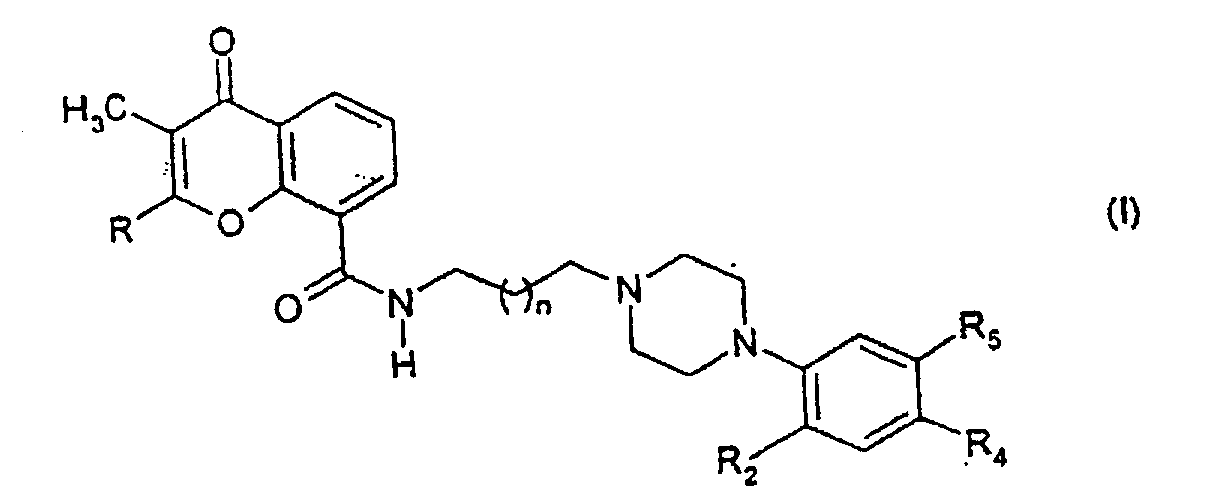
R eine Phenyl-, C1-C4-Alkoxycarbonyl-, C1-C4-Alkylcarbonyl-, Carbamoyl-, C1-C4-Alkylcarbamoyl-, C1-C4-Dialkylcarbamoyl-, Cyano- oder C1-C4-Alkoxycarbonylaminogruppe darstellt;
R2 eine C1-C4-Alkyl-, C1-C4-Alkoxy-, Polyfluor-C1-C4-Alkoxy-, Hydroxy- oder Trifluormethansulfonyloxygruppe darstellt;
jeder der Reste R4 und R5 unabhängig voneinander ein Wasserstoff- oder Halogenatom oder eine Polyfluor-C1-C4-Alkyl-, Polyfluor-C1-C4-Alkoxy-, Cyano- oder Carbamoylgruppe darstellt; und
n gleich 0, 1 oder 2 ist;
mit der Maßgabe, daß, wenn R eine Phenylgruppe darstellt und beide Reste R4 und R5 Wasserstoff- und/oder Halogenatome darstellen, R2 einen Polyfluor-C1-C4-Alkoxy- oder Trifluormethansulfonyloxygruppe darstellt;
oder ein N-Oxid oder pharmazeutisch verträgliches Salz dieser Verbindung. - Verbindung gemäß Anspruch 1, wobei R eine C1-C4-Alkoxycarbonyl-, C1-C4-Alkylcarbonyl-, Carbamoyl-, C1-C4-Alkylcarbamoyl-, C1-C4-Dialkylcarbamoyl-, Cyano- oder C1-C4-Alkoxycarbonylaminogruppe darstellt und jeder der Reste R4 und R5 unabhängig voneinander ein Wasserstoff- oder Halogenatom oder eine Polyfluor-C1-C4-Alkoxygruppe darstellt.
- Verbindung gemäß Anspruch 1 oder 2, wobei R2 eine Methoxy-, Trifluormethoxy-, 2,2,2-Trifluorethoxy-, Hydroxy- oder Trifluormethansulfonyloxygruppe darstellt.
- Verbindung gemäß einem der Ansprüche 1 bis 3, wobei R4 ein Wasserstoff- oder Fluoratom darstellt.
- Verbindung gemäß einem der Ansprüche 1 bis 4, wobei R5 ein Wasserstoff-, Fluor- oder Chloratom oder eine 2,2,2-Trifluorethoxygruppe darstellt.
- Verbindung gemäß Anspruch 1, wobei R5 ein Wasserstoff-, Fluor- oder Chloratom oder eine Trifluormethyl-, 2,2,2-Trifluorethoxy-, Cyano- oder Carbamoylgruppe darstellt.
- Verbindung gemäß einem der Ansprüche 1 bis 6, wobei n gleich 1 ist.
- Eine der folgenden Verbindungen:oder ein N-Oxid oder pharmazeutisch verträgliches Salz dieser Verbindung.2-Carbamoyl-8-{3-[4-(5-chlor-2-methoxyphenyl)-1-piperazinyl]-propylcarbamoyl}-3-methyl-4-oxo-4H-1-benzopyran,2-Acetyl-8-{3-[4-(5-chlor-2-methoxyphenyl)-1-piperazinyl]-propylcarbamoyl}-3-methyl-4-oxo-4H-1-benzopyran,2-(1,1-Dimethylethoxycarbonylamino)-8-{3-[4-(5-chlor-2-methoxyphenyl)-1-piperazinyl]-propylcarbamoyl}-3-methyl-4-oxo-4H-1-benzopyran,2-Ethoxycarbonyl-8-{3-[4-(5-chlor-2-methoxyphenyl)-1-piperazinyl]-propylcarbamoyl}-3-methyl-4-oxo-4H-1-benzopyran,8-{3-[4-(5-chlor-2-methoxyphenyl)-1-piperazinyl]-propylcarbamoyl}-3-methyl-2-methylcarbamoyl-4-oxo-4H-1 -benzopyran,8-{3-[4-(5-chlor-2-methoxyphenyl)-1-piperazinyl]-propylcarbamoyl}-3-methyl-2-dimethylcarbamoyl-4-oxo-4H-1-benzopyran,2-Carbamoyl-8-<3-{4-[4-fluor-2-(2,2,2-trifluorethoxy)-phenyl]-1-piperazinyl}propylcarbamoyl>-3-methyl-4-oxo-4H-1-benzopyran,2-Carbamoyl-8-<3-{4-[5-fluor-2-(2,2,2-trifluorethoxy)-phenyl]-1-piperazinyl}propylcarbamoyl>-3-methyl-4-oxo-4H-1-benzopyran,2-Carbamoyl-8-<3-{4-[2-methoxy-5-(2,2,2-trifluorethoxy)-phenyl]-1-piperazinyl}propylcarbamoyl>-3-methyl-4-oxo-4H-1-benzopyran,2-Carbamoyl-8-<3-{4-[2-(2,2,2-trifluorethoxy)-phenyl]-1-piperazinyl}propylcarbamoyl>-3-methyl-4-oxo-4H-1-benzopyran,8-{3-[4-(5-chlor-2-methoxyphenyl)-1-piperazinyl]-propylcarbamoyl}-2-cyano-3-methyl-4-oxo-4H-1-benzopyran,2-Carbamoyl-8-{3-[4-(5-chlor-2-hydroxyphenyl)-1-piperazinyl]-propylcarbamoyl}-3-methyl-4-oxo-4H-1-benzopyran,2-Carbamoyl-8-{3-[4-(5-chlor-2-trifluormethansulfonyloxyphenyl)-1-piperazinyl]-propylcarbamoyl}-3-methyl-4-oxo-4H-1-benzopyran,8-{3-[4-(2-trifluormethansulfonyloxyphenyl)-1-piperazinyl]-propylcarbamoyl}-3-methyl-4-oxo-2-phenyl-4H-1-benzopyran,8-<3-{4-[2-(2,2,2-trifluorethoxy)-phenyl]-1-piperazinyl}propylcarbamoyl>-3-methyl-4-oxo-2-phenyl-4H-1-benzopyran,8-{3-[4-(2-trifluormethoxyphenyl)-1-piperazinyl]-propylcarbamoyl}-3-methyl-4-oxo-2-phenyl-4H-1-benzopyran,8-{3-[4-(2-methoxy-5-trifluormethylphenyl)-1-piperazinyl]-propylcarbamoyl}-3-methyl-4-oxo-2-phenyl-4H-1-benzopyran,8-{3-[4-(5-cyano-2-methoxyphenyl)-1-piperazinyl]-propylcarbamoyl}-3-methyl-4-oxo-2-phenyl-4H-1-benzopyran,8-<3-{4-[4-fluor-2-(2,2,2-trifluorethoxy)-phenyl]-1-piperazinyl}propylcarbamoyl>-3-methyl-4-oxo-2-phenyl-4H-1-benzopyran,8-<3-{4-[5-fluor-2-(2,2,2-trifluorethoxy)-phenyl]-1-piperazinyl}propylcarbamoyl>-3-methyl-4-oxo-2-phenyl-4H-1 -benzopyran,8-<3-{4-[2-methoxy-5-(2,2,2-trifluorethoxy)-phenyl]-1-piperazinyl}propylcarbamoyl>-3-methyl-4-oxo-2-phenyl-4H-1-benzopyran,8-<3-{4-[5-chlor-2-(2,2,2-trifluorethoxy}-phenyl]-1-piperazinyl}-propylcarbamoyl>-3-methyl-4-oxo-2-phenyl-4H-1-benzopyran,8-{3-[4-(5-carbamoyl-2-methoxyphenyl)-1-piperazinyl]-propylcarbamoyl}-3-methyl-4-oxo-2-phenyl-4H-1-benzopyran,8-{3-[4-(5-chlor-2-trifluormethansulfonyloxyphenyl)-1-piperazinyl]-propylcarbamoyl}-3-methyl-4-oxo-2-phenyl-4H-1-benzopyran, und2-Phenyl-8-<2-{4-[2-(2,2,2-trifluorethoxy)-phenyl]-1-piperazinyl}ethylcarbamoyl>-3-methyl-4-oxo-4H-1-benzopyran;
- Arzneimittel umfassend eine Verbindung gemäß einem der vorstehenden Ansprüche oder ein N-Oxid oder ein pharmazeutisch verträgliches Salz dieser Verbindung in einem Gemisch mit einem pharmazeutisch verträglichen Verdünnungsmittel oder Träger.
- Verfahren zur Herstellung einer Verbindung der allgemeinen Formel Iwobei
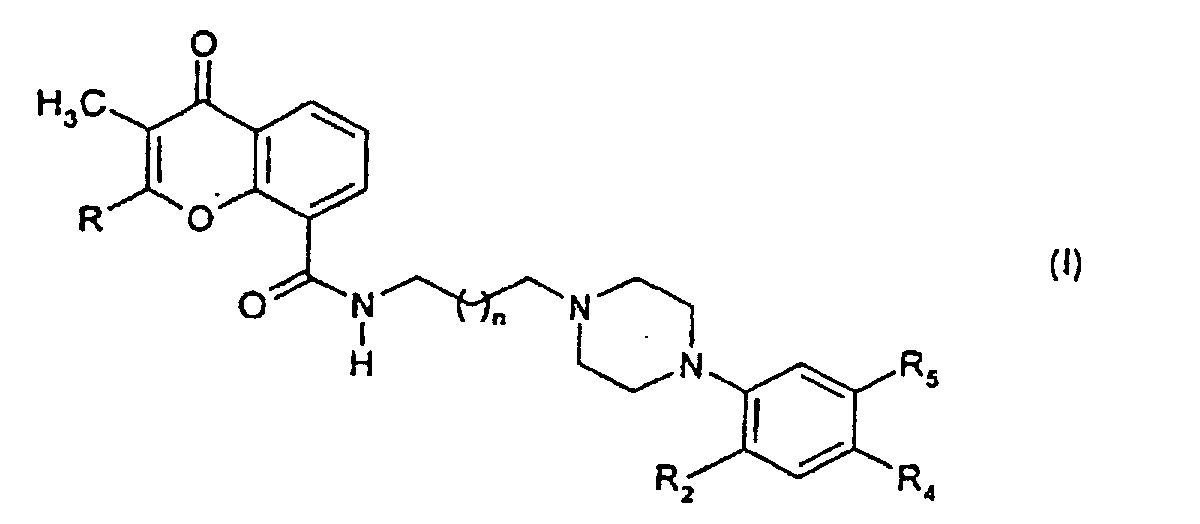
R eine Phenylgruppe, einen C1-C4-Alkoxycarbonylrest, C1-C4-Alkylcarbonylrest, eine Carbamoylgruppe, einen C1-C4-Alkylcarbamoylrest, C1-C4-Dialkylcarbamoylrest, eine Cyanogruppe oder einen C1-C4-Alkoxycarbonylaminorest darstellt;
R2 einen C1-C4-Alkylrest, C1-C4-Alkoxyrest, Polyfluor-C1-C4-Alkoxyrest, eine Hydroxygruppe oder eine Trifluormethansulfonyloxygruppe darstellt;
jeder der Reste R4 und R5 unabhängig voneinander ein Wasserstoffatom oder ein Halogenatom oder einen Polyfluor-C1-C4-Alkylrest, Polyfluor-C1-C4-Alkoxyrest, eine Cyanogruppe oder Carbamoylgruppe darstellt; und
n gleich 0,1 oder 2 ist;
mit der Maßgabe, daß, wenn R eine Phenylgruppe darstellt und beide Reste R4 und R5 Wasserstoff- und/oder Halogenatome darstellen, R2 einen Polyfluor-C1-C4-Alkoxyrest oder eine Trifluormethansulfonyloxygruppe darstellt;
wobei das Verfahren das Kondensieren eines 8-Carboxy-3-methyl-4-oxo-4H-1-benzopyrans der allgemeinen Formel 1wobei R wie in diesem Anspruch definiert ist, oder eines Esters, Amids oder Anhydrids einer solchen Verbindung, mit einem N-(ω-aminoalkyl)-N'-phenylpiperazin-derivat der allgemeinen Formel 2 wobei n, R2, R4 und R5 wie in diesem Anspruch definiert sind, umfaßt.
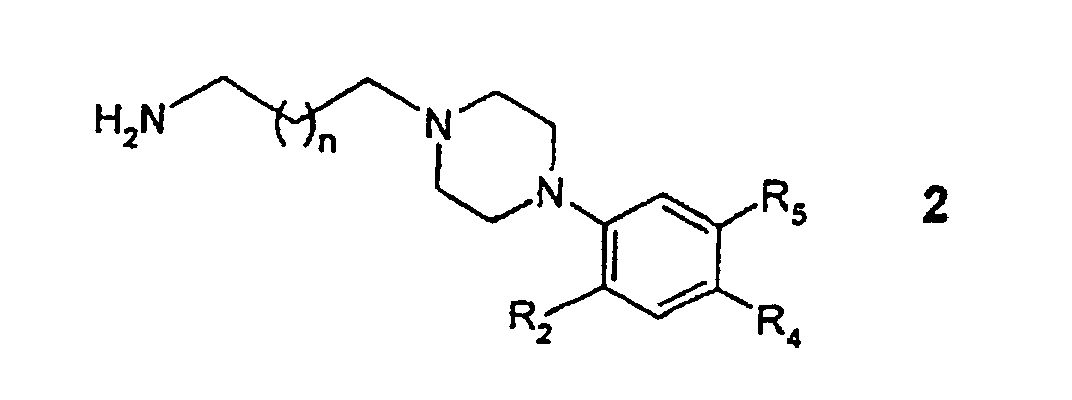
- Verfahren gemäß Anspruch 10, wobei die Kondensation in Gegenwart eines Kondensationsmittels, wie Dicyclohexylcarbodiimid oder Diethylcyanophosphonat, gegebenenfalls in der Gegenwart eines Promoters, wie N-Hydroxysuccinimid oder 4-Dimethylaminopyridin oder N,N'-Carbonyldiimidazol, in einem aprotischen Lösungsmittel oder einem chlorinierten Lösungsmittel bei einer Temperatur von -10 bis 140°C durchgeführt wird.
- Verfahren zur Herstellung einer Verbindung der allgemeinen Formel Iwobei
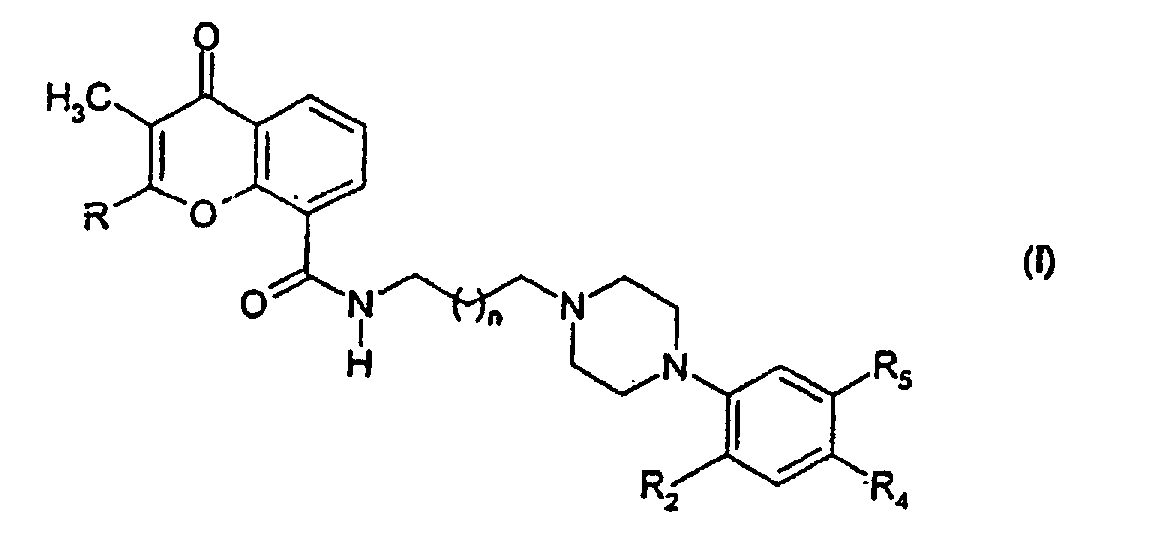
R eine Phenyl-, C1-C4-Alkoxycarbonyl-, C1-C4-Alkylcarbonyl-, Carbamoyl-, C1-C4-Alkylcarbamoyl-, C1-C4-Dialkylcarbamoyl-, Cyano- oder C1-C4-Alkoxycarbonylaminogruppe darstellt;
R2 eine C1-C4-Alkyl-, C1-C4-Alkoxy-, Polyfluor-C1-C4-Alkoxy-, Hydroxy- oder Trifluormethansulfonyloxygruppe darstellt;
jeder der Reste R4 und R5 unabhängig voneinander ein Wasserstoff- oder Halogenatom oder eine Polyfluor-C1-C4-Alkyl-, Polyfluor-C1-C4-Alkoxy-, Cyano- oder Carbamoylgruppe darstellt; und
n gleich 0, 1 oder 2 ist;
mit der Maßgabe, daß, wenn R eine Phenylgruppe darstellt und beide Reste R4 und R5 Wasserstoff- und/oder Halogenatome darstellen, R2 einen Polyfluor-C1-C4-Alkoxy- oder Trifluormethansulfonyloxygruppe darstellt,
wobei das Verfahren das Kondensieren eines 8-Carboxy-3-methyl-4-oxo-4H-1-benzopyrans der allgemeinen Formel 1wobei R wie in diesem Anspruch definiert ist, oder eines Esters, Amids oder Anhydrids einer solchen Verbindung, mit einem Amin der allgemeinen Formel H2NCH2(CH2)nCH2X, wobei X ein Halogenatom oder eine Hydroxygruppe darstellt und n wie in diesem Anspruch definiert ist, zu einer Verbindung der allgemeinen Formel 3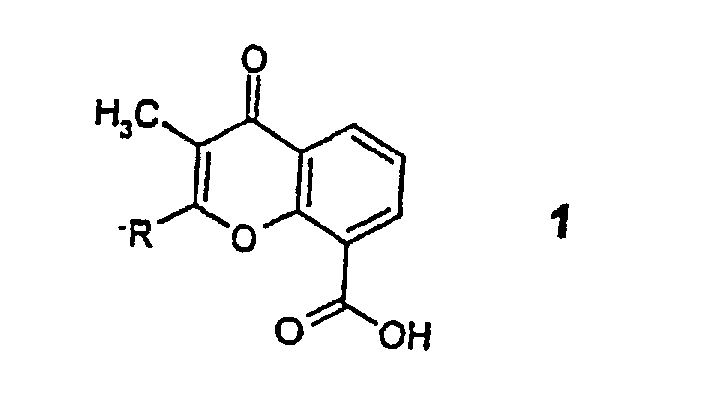 und das Kondensieren der Verbindung der allgemeinen Formel 3, wobei, wenn X eine Hydroxygruppe darstellt, diese in eine Abgangsgruppe, wie eine Alkylsulfonyloxy- oder Arylsulfonyloxygruppe, umgewandelt wird, mit einem Phenylpiperazin-Derivat 7
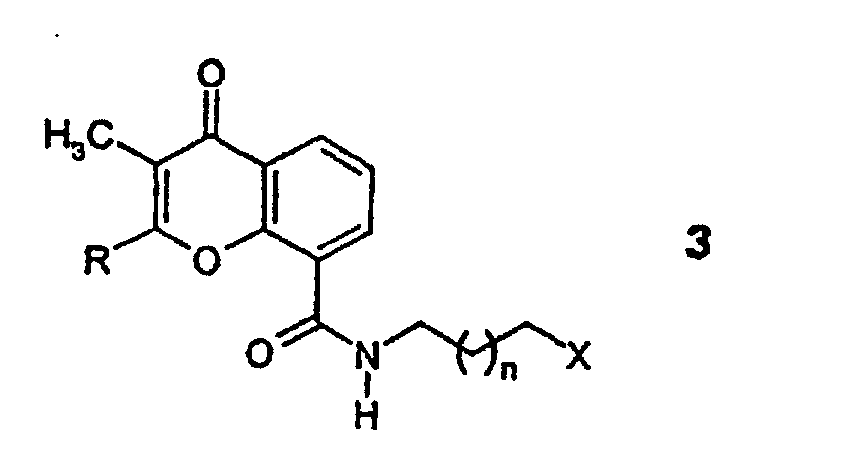 wobei R2, R4 und R5 wie in diesem Anspruch definiert sind, umfaßt.
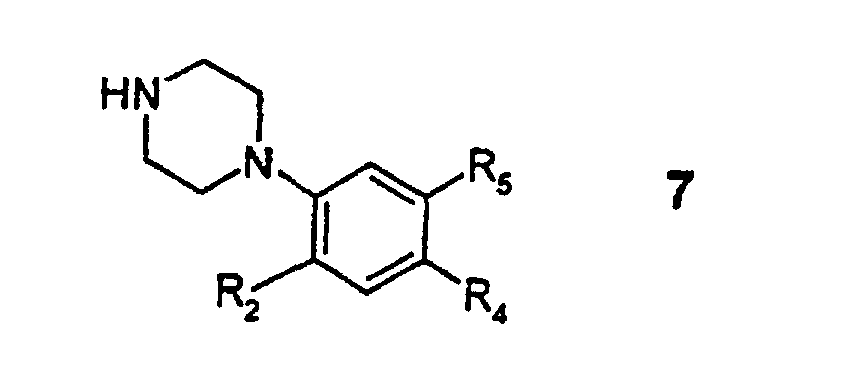
- Verfahren gemäß Anspruch 12, wobei die Kondensation des 8-Carboxy-3-methyl-4-oxo-4H-1-benzopyrans 1 mit dem Amin H2NCH2(CH2)nCH2X in der Gegenwart eines Kondensationsmittels, wie Dicyclohexylcarbodiimid oder Diethylcyanophosphonat, gegebenenfalls in der Gegenwart eines Promoters, wie
N-Hydroxysuccinimid oder 4-Dimethylaminopyridin oder N,N'-Carbonyldiimidazol, in einem aprotischen Lösungsmittel oder einem chlorinierten Lösungsmittel bei einer Temperatur von -10 bis 140°C durchgeführt wird. - Verfahren gemäß Anspruch 12 oder 13, wobei die Kondensation von Verbindung 3 mit dem Phenylpiperazin-Derivat 7 ohne Lösungsmittel, oder, in einer anderen Ausführungsform, in einem polaren Lösungsmittel, wie Dimethylformamid oder Acetonitril oder Methanol, bei einer Temperatur von 20 bis 160°C, bevorzugterweise in der Gegenwart einer Base, wie Kaliumcarbonat, durchgeführt wird.
Priority Applications (1)
| Application Number | Priority Date | Filing Date | Title |
|---|---|---|---|
| SI200030087T SI1222183T1 (en) | 1999-10-18 | 2000-10-16 | Benzopyran derivatives |
Applications Claiming Priority (3)
| Application Number | Priority Date | Filing Date | Title |
|---|---|---|---|
| ITMI992174 | 1999-10-18 | ||
| IT1999MI002174A IT1314192B1 (it) | 1999-10-18 | 1999-10-18 | Derivati benzopiranici |
| PCT/EP2000/010143 WO2001029022A1 (en) | 1999-10-18 | 2000-10-16 | Benzopyran derivatives |
Publications (2)
| Publication Number | Publication Date |
|---|---|
| EP1222183A1 EP1222183A1 (de) | 2002-07-17 |
| EP1222183B1 true EP1222183B1 (de) | 2003-04-23 |
Family
ID=11383798
Family Applications (1)
| Application Number | Title | Priority Date | Filing Date |
|---|---|---|---|
| EP00975868A Expired - Lifetime EP1222183B1 (de) | 1999-10-18 | 2000-10-16 | Benzopyran-derivate |
Country Status (10)
| Country | Link |
|---|---|
| EP (1) | EP1222183B1 (de) |
| JP (1) | JP2003512366A (de) |
| AT (1) | ATE238291T1 (de) |
| AU (1) | AU1384701A (de) |
| DE (1) | DE60002357T2 (de) |
| DK (1) | DK1222183T3 (de) |
| ES (1) | ES2197123T3 (de) |
| IT (1) | IT1314192B1 (de) |
| PT (1) | PT1222183E (de) |
| WO (1) | WO2001029022A1 (de) |
Families Citing this family (1)
| Publication number | Priority date | Publication date | Assignee | Title |
|---|---|---|---|---|
| BR0212824A (pt) * | 2001-09-27 | 2004-10-13 | Pharmacia Ab | Composição farmacêutica |
Family Cites Families (3)
| Publication number | Priority date | Publication date | Assignee | Title |
|---|---|---|---|---|
| HRP930210A2 (en) * | 1992-02-25 | 1995-06-30 | Recordati Chem Pharm | Heterobicyclic compounds and pharmaceutical preparations containing them |
| AU9256498A (en) * | 1997-08-01 | 1999-02-22 | Recordati S.A. Chemical And Pharmaceutical Company | 1,4-disubstituted piperazines |
| IT1293807B1 (it) * | 1997-08-01 | 1999-03-10 | Recordati Chem Pharm | Derivati 1- (n-fenilaminoalchil) piperazinici sostituiti alla posizione 2 dell'anello fenilico |
-
1999
- 1999-10-18 IT IT1999MI002174A patent/IT1314192B1/it active
-
2000
- 2000-10-16 PT PT00975868T patent/PT1222183E/pt unknown
- 2000-10-16 AU AU13847/01A patent/AU1384701A/en not_active Abandoned
- 2000-10-16 EP EP00975868A patent/EP1222183B1/de not_active Expired - Lifetime
- 2000-10-16 WO PCT/EP2000/010143 patent/WO2001029022A1/en not_active Ceased
- 2000-10-16 AT AT00975868T patent/ATE238291T1/de not_active IP Right Cessation
- 2000-10-16 DE DE60002357T patent/DE60002357T2/de not_active Expired - Fee Related
- 2000-10-16 DK DK00975868T patent/DK1222183T3/da active
- 2000-10-16 JP JP2001531822A patent/JP2003512366A/ja active Pending
- 2000-10-16 ES ES00975868T patent/ES2197123T3/es not_active Expired - Lifetime
Also Published As
| Publication number | Publication date |
|---|---|
| AU1384701A (en) | 2001-04-30 |
| JP2003512366A (ja) | 2003-04-02 |
| EP1222183A1 (de) | 2002-07-17 |
| ITMI992174A1 (it) | 2001-04-18 |
| WO2001029022A1 (en) | 2001-04-26 |
| DE60002357D1 (de) | 2003-05-28 |
| ES2197123T3 (es) | 2004-01-01 |
| ATE238291T1 (de) | 2003-05-15 |
| IT1314192B1 (it) | 2002-12-06 |
| PT1222183E (pt) | 2003-08-29 |
| ITMI992174A0 (it) | 1999-10-18 |
| DK1222183T3 (da) | 2003-08-11 |
| DE60002357T2 (de) | 2004-02-12 |
Similar Documents
| Publication | Publication Date | Title |
|---|---|---|
| EP1226131B1 (de) | Isoxazolcarboxamid-derivate als antagonisten des alpha1-adrenergischen rezeptors | |
| US6306861B1 (en) | Thienopyrancecarboxamide derivatives | |
| RU2335496C2 (ru) | Арилкарбонилпиперазины и гетероарилкарбонилпиперазины для лечения опухолевых заболеваний (варианты), лекарственное средство (варианты), способ его получения и способ лечения опухолевых заболеваний | |
| US6403594B1 (en) | Benzopyran derivatives | |
| US6680319B2 (en) | Isoxazolecarboxamide derivatives | |
| JP2001512112A (ja) | フェニル環の2位で置換された1−(n−フェニルアミノアルキル)−ピペラジン誘導体 | |
| US6387909B1 (en) | Thienopyranecarboxamide derivatives | |
| EP1200445B1 (de) | Thienopyran-carboxamid-derivate | |
| ES2197123T3 (es) | Derivados de benzopirano. | |
| HK1044763B (en) | Thienopyranecarboxamide derivatives | |
| US20020183290A1 (en) | Adrenergic receptor antagonists selective for both alpha1A-and alpha1D-subtypes and uses therefor | |
| WO2002060534A2 (en) | Selective alpha 1 antagonists a + d |
Legal Events
| Date | Code | Title | Description |
|---|---|---|---|
| PUAI | Public reference made under article 153(3) epc to a published international application that has entered the european phase |
Free format text: ORIGINAL CODE: 0009012 |
|
| 17P | Request for examination filed |
Effective date: 20020507 |
|
| AK | Designated contracting states |
Kind code of ref document: A1 Designated state(s): AT BE CH CY DE DK ES FI FR GB GR IE IT LI LU MC NL PT SE |
|
| AX | Request for extension of the european patent |
Free format text: AL PAYMENT 20020507;LT PAYMENT 20020507;LV PAYMENT 20020507;MK PAYMENT 20020507;RO PAYMENT 20020507;SI PAYMENT 20020507 |
|
| GRAH | Despatch of communication of intention to grant a patent |
Free format text: ORIGINAL CODE: EPIDOS IGRA |
|
| GRAH | Despatch of communication of intention to grant a patent |
Free format text: ORIGINAL CODE: EPIDOS IGRA |
|
| GRAA | (expected) grant |
Free format text: ORIGINAL CODE: 0009210 |
|
| AK | Designated contracting states |
Designated state(s): AT BE CH CY DE DK ES FI FR GB GR IE IT LI LU MC NL PT SE |
|
| AX | Request for extension of the european patent |
Extension state: AL LT LV MK RO SI |
|
| REG | Reference to a national code |
Ref country code: GB Ref legal event code: FG4D |
|
| REG | Reference to a national code |
Ref country code: CH Ref legal event code: EP |
|
| REF | Corresponds to: |
Ref document number: 60002357 Country of ref document: DE Date of ref document: 20030528 Kind code of ref document: P |
|
| REG | Reference to a national code |
Ref country code: IE Ref legal event code: FG4D |
|
| REG | Reference to a national code |
Ref country code: CH Ref legal event code: NV Representative=s name: KEMIA S.A. |
|
| REG | Reference to a national code |
Ref country code: SE Ref legal event code: TRGR |
|
| REG | Reference to a national code |
Ref country code: DK Ref legal event code: T3 |
|
| REG | Reference to a national code |
Ref country code: GR Ref legal event code: EP Ref document number: 20030402676 Country of ref document: GR |
|
| PGFP | Annual fee paid to national office [announced via postgrant information from national office to epo] |
Ref country code: IE Payment date: 20030930 Year of fee payment: 4 |
|
| PGFP | Annual fee paid to national office [announced via postgrant information from national office to epo] |
Ref country code: MC Payment date: 20031002 Year of fee payment: 4 |
|
| PGFP | Annual fee paid to national office [announced via postgrant information from national office to epo] |
Ref country code: GR Payment date: 20031003 Year of fee payment: 4 |
|
| PGFP | Annual fee paid to national office [announced via postgrant information from national office to epo] |
Ref country code: FI Payment date: 20031006 Year of fee payment: 4 |
|
| PGFP | Annual fee paid to national office [announced via postgrant information from national office to epo] |
Ref country code: PT Payment date: 20031009 Year of fee payment: 4 |
|
| PGFP | Annual fee paid to national office [announced via postgrant information from national office to epo] |
Ref country code: LU Payment date: 20031014 Year of fee payment: 4 |
|
| PG25 | Lapsed in a contracting state [announced via postgrant information from national office to epo] |
Ref country code: CY Free format text: LAPSE BECAUSE OF FAILURE TO SUBMIT A TRANSLATION OF THE DESCRIPTION OR TO PAY THE FEE WITHIN THE PRESCRIBED TIME-LIMIT Effective date: 20031016 |
|
| PGFP | Annual fee paid to national office [announced via postgrant information from national office to epo] |
Ref country code: AT Payment date: 20031017 Year of fee payment: 4 |
|
| PGFP | Annual fee paid to national office [announced via postgrant information from national office to epo] |
Ref country code: FR Payment date: 20031020 Year of fee payment: 4 Ref country code: SE Payment date: 20031020 Year of fee payment: 4 |
|
| PGFP | Annual fee paid to national office [announced via postgrant information from national office to epo] |
Ref country code: DE Payment date: 20031021 Year of fee payment: 4 |
|
| PGFP | Annual fee paid to national office [announced via postgrant information from national office to epo] |
Ref country code: DK Payment date: 20031027 Year of fee payment: 4 |
|
| PGFP | Annual fee paid to national office [announced via postgrant information from national office to epo] |
Ref country code: BE Payment date: 20031031 Year of fee payment: 4 |
|
| PGFP | Annual fee paid to national office [announced via postgrant information from national office to epo] |
Ref country code: ES Payment date: 20031126 Year of fee payment: 4 |
|
| REG | Reference to a national code |
Ref country code: ES Ref legal event code: FG2A Ref document number: 2197123 Country of ref document: ES Kind code of ref document: T3 |
|
| ET | Fr: translation filed | ||
| PLBE | No opposition filed within time limit |
Free format text: ORIGINAL CODE: 0009261 |
|
| STAA | Information on the status of an ep patent application or granted ep patent |
Free format text: STATUS: NO OPPOSITION FILED WITHIN TIME LIMIT |
|
| 26N | No opposition filed |
Effective date: 20040126 |
|
| PG25 | Lapsed in a contracting state [announced via postgrant information from national office to epo] |
Ref country code: LU Free format text: LAPSE BECAUSE OF NON-PAYMENT OF DUE FEES Effective date: 20041016 Ref country code: GB Free format text: LAPSE BECAUSE OF NON-PAYMENT OF DUE FEES Effective date: 20041016 Ref country code: AT Free format text: LAPSE BECAUSE OF NON-PAYMENT OF DUE FEES Effective date: 20041016 Ref country code: FI Free format text: LAPSE BECAUSE OF NON-PAYMENT OF DUE FEES Effective date: 20041016 |
|
| PG25 | Lapsed in a contracting state [announced via postgrant information from national office to epo] |
Ref country code: SE Free format text: LAPSE BECAUSE OF NON-PAYMENT OF DUE FEES Effective date: 20041017 |
|
| PG25 | Lapsed in a contracting state [announced via postgrant information from national office to epo] |
Ref country code: IE Free format text: LAPSE BECAUSE OF NON-PAYMENT OF DUE FEES Effective date: 20041018 Ref country code: ES Free format text: LAPSE BECAUSE OF NON-PAYMENT OF DUE FEES Effective date: 20041018 |
|
| PG25 | Lapsed in a contracting state [announced via postgrant information from national office to epo] |
Ref country code: LI Free format text: LAPSE BECAUSE OF NON-PAYMENT OF DUE FEES Effective date: 20041031 Ref country code: BE Free format text: LAPSE BECAUSE OF NON-PAYMENT OF DUE FEES Effective date: 20041031 Ref country code: MC Free format text: LAPSE BECAUSE OF NON-PAYMENT OF DUE FEES Effective date: 20041031 Ref country code: CH Free format text: LAPSE BECAUSE OF NON-PAYMENT OF DUE FEES Effective date: 20041031 |
|
| PG25 | Lapsed in a contracting state [announced via postgrant information from national office to epo] |
Ref country code: DK Free format text: LAPSE BECAUSE OF NON-PAYMENT OF DUE FEES Effective date: 20041101 |
|
| REG | Reference to a national code |
Ref country code: SI Ref legal event code: IF |
|
| BERE | Be: lapsed |
Owner name: S.A. *RECORDATI CHEMICAL AND PHARMACEUTICAL CY Effective date: 20041031 |
|
| PG25 | Lapsed in a contracting state [announced via postgrant information from national office to epo] |
Ref country code: NL Free format text: LAPSE BECAUSE OF NON-PAYMENT OF DUE FEES Effective date: 20050501 |
|
| PG25 | Lapsed in a contracting state [announced via postgrant information from national office to epo] |
Ref country code: DE Free format text: LAPSE BECAUSE OF NON-PAYMENT OF DUE FEES Effective date: 20050503 |
|
| PG25 | Lapsed in a contracting state [announced via postgrant information from national office to epo] |
Ref country code: GR Free format text: LAPSE BECAUSE OF NON-PAYMENT OF DUE FEES Effective date: 20050504 |
|
| EUG | Se: european patent has lapsed | ||
| REG | Reference to a national code |
Ref country code: DK Ref legal event code: EBP |
|
| GBPC | Gb: european patent ceased through non-payment of renewal fee |
Effective date: 20041016 |
|
| REG | Reference to a national code |
Ref country code: CH Ref legal event code: PL |
|
| LTLA | Lt: lapse of european patent or patent extension |
Effective date: 20041016 |
|
| PG25 | Lapsed in a contracting state [announced via postgrant information from national office to epo] |
Ref country code: FR Free format text: LAPSE BECAUSE OF NON-PAYMENT OF DUE FEES Effective date: 20050630 |
|
| NLV4 | Nl: lapsed or anulled due to non-payment of the annual fee |
Effective date: 20050501 |
|
| PG25 | Lapsed in a contracting state [announced via postgrant information from national office to epo] |
Ref country code: PT Free format text: LAPSE BECAUSE OF NON-PAYMENT OF DUE FEES Effective date: 20050718 |
|
| REG | Reference to a national code |
Ref country code: IE Ref legal event code: MM4A |
|
| REG | Reference to a national code |
Ref country code: FR Ref legal event code: ST |
|
| PG25 | Lapsed in a contracting state [announced via postgrant information from national office to epo] |
Ref country code: IT Free format text: LAPSE BECAUSE OF NON-PAYMENT OF DUE FEES Effective date: 20051016 |
|
| REG | Reference to a national code |
Ref country code: SI Ref legal event code: KO00 Effective date: 20050816 Ref country code: PT Ref legal event code: MM4A Effective date: 20050718 |
|
| REG | Reference to a national code |
Ref country code: ES Ref legal event code: FD2A Effective date: 20041018 |
|
| BERE | Be: lapsed |
Owner name: S.A. *RECORDATI CHEMICAL AND PHARMACEUTICAL CY Effective date: 20041031 |
|
| PG25 | Lapsed in a contracting state [announced via postgrant information from national office to epo] |
Ref country code: PT Free format text: LAPSE BECAUSE OF NON-PAYMENT OF DUE FEES Effective date: 20041016 |