EP1226869A2 - Kationenaustauscher, Verfahren zu dessen Herstellung und dessen Verwendung - Google Patents
Kationenaustauscher, Verfahren zu dessen Herstellung und dessen Verwendung Download PDFInfo
- Publication number
- EP1226869A2 EP1226869A2 EP02001858A EP02001858A EP1226869A2 EP 1226869 A2 EP1226869 A2 EP 1226869A2 EP 02001858 A EP02001858 A EP 02001858A EP 02001858 A EP02001858 A EP 02001858A EP 1226869 A2 EP1226869 A2 EP 1226869A2
- Authority
- EP
- European Patent Office
- Prior art keywords
- polymer
- cation exchanger
- carboxylic acid
- acid
- functional group
- Prior art date
- Legal status (The legal status is an assumption and is not a legal conclusion. Google has not performed a legal analysis and makes no representation as to the accuracy of the status listed.)
- Granted
Links
Images

Classifications
-
- B—PERFORMING OPERATIONS; TRANSPORTING
- B01—PHYSICAL OR CHEMICAL PROCESSES OR APPARATUS IN GENERAL
- B01J—CHEMICAL OR PHYSICAL PROCESSES, e.g. CATALYSIS OR COLLOID CHEMISTRY; THEIR RELEVANT APPARATUS
- B01J39/00—Cation exchange; Use of material as cation exchangers; Treatment of material for improving the cation exchange properties
- B01J39/08—Use of material as cation exchangers; Treatment of material for improving the cation exchange properties
- B01J39/16—Organic material
- B01J39/18—Macromolecular compounds
- B01J39/20—Macromolecular compounds obtained by reactions only involving unsaturated carbon-to-carbon bonds
-
- B—PERFORMING OPERATIONS; TRANSPORTING
- B01—PHYSICAL OR CHEMICAL PROCESSES OR APPARATUS IN GENERAL
- B01J—CHEMICAL OR PHYSICAL PROCESSES, e.g. CATALYSIS OR COLLOID CHEMISTRY; THEIR RELEVANT APPARATUS
- B01J39/00—Cation exchange; Use of material as cation exchangers; Treatment of material for improving the cation exchange properties
- B01J39/26—Cation exchangers for chromatographic processes
Definitions
- This invention relates to a cation exchanger, a process for producing the cation exchanger, and a packing for chromatography comprised of the cation exchanger.
- Fine particles having a cation exchanging group are widely used in the field of liquid chromatography for analyzing or separating or isolating, for example, amino acids, peptide, protein, nucleic acids and saccharides.
- Cation exchangers are usually made by introducing a cation exchanging group in fine particles by allowing the cation exchanging group to directly react with a functional group present on the surface of the fine particles.
- Specific examples of the method of introducing a cation exchanging group in fine particles there can be mentioned a method of introducing a carboxylic acid by allowing, for example, chloroacetic acid to react with a hydroxyl group present on the surface of fine particles; and a method of introducing an allyl group or an epoxy group to a hydroxyl group present on a fine particle surface and then sulfonating the introduced group.
- the cation exchanging group is introduced onto the surface of fine particles.
- the cation exchanging group is introduced onto the inner wall of pores as well as the particle surfaces. Therefore, the amount of a sample to be analyzed or separated which is capable of being retained on the fine particle surfaces is determined principally on the surface area of the fine particles or on both of the surface area thereof and the pore diameter.
- the cation exchanger adsorbs or retains a sample to be analyzed or separated in a single layer form on fine particle surface. Therefore, when the cation exchanger is used for liquid chromatography, it rapidly absorbs or desorbs the sample and gives a sharp separation pattern.
- the proposed methods include (i) a method of graft polymerization, namely, irradiating a fine particle surface with radiation to form radical initiating sites, or treating a fine particle surface with a cerium salt or a manganese salt to form hydroxyl groups as radical initiating sites, and then, allowing a polymer chain to grow on each radical initiating site; (ii) a method of introducing an unsaturated group onto a fine particle surface and then treating the unsaturated group-introduced fine particle in a monomer solution whereby a polymer chain derived from the monomer is allowed to grow on the unsaturated group; and (iii) a method of introducing a functional group to a polymer terminal and then the polymer is allowed to react with a functional group present on a fine particle surface.
- the cation exchangers produced by the above-proposed processes exhibit enhanced capacity for adsorbing an objective sample and, when the cation exchanger is used for separation of an objective sample, the operation can be carried out at a high rate.
- these cation exchangers have straight-chain polymers introduced onto the fine particle surfaces thereof, and therefore, when it is used as being packed in a column for liquid chromatography, a high operation pressure is required for feeding a liquid.
- pressure-resistant equipment and pipes must be used for liquid chromatography means spanning from a liquid-feed pump to a detector and for paths of flow connecting these means each other. Consequently problems arise in that the equipment cost increases, a sealing material is readily deteriorated and parts must be exchanged with a shortened interval of time, and further, liquid leakage tends to occur.
- the cation exchangers are broken by the high pressure.
- the liquid flow characteristics are closely related with the particle diameter of cation exchangers. If the particle diameter of cation exchangers is enlarged, the liquid passage characteristics can be improved, but, the separation capacity of cation exchangers as used for liquid chromatography is lowered. To sum up, the cation exchangers produced by the above-proposed processes cannot be advantageously employed for liquid chromatography for which a high adsorption capacity and a high separation capacity are required.
- an object of the present invention is to provide a cation exchanger comprised of a fine particle, which has an enhanced capacity for adsorption of a sample to be analyzed, separated or isolated, and exhibits improved liquid passage characteristics.
- Another object of the present invention is to provide a process for producing a cation exchanger comprised of a fine particle, which exhibits an enhanced capacity for adsorption of a sample to be analyzed, separated or isolated and exhibits improved liquid passage characteristics.
- Another objects of the present invention are to provide a packing for chromatography comprised of a cation exchanger exhibiting an enhanced capacity for adsorption of a sample to be analyzed, separated or isolated, and to provide a column for chromatography packed with the packing comprised of the cation exchanger.
- a cation exchanger comprised of a fine particle having bound to the surface thereof a polymer having a cation exchanging property, characterized in that said polymer having a cation exchanging property is at least one polymer selected from (i) polymers prepared by polymerization of at least one kind of unsaturated carboxylic acid and partially crosslinked with a polymer having a functional group capable of reacting with a carboxylic acid, and (ii) acrylic acid-maleic acid copolymers.
- the polymers (i) are preferably copolymers prepared by copolymerization of at least one kind of unsaturated carboxylic acid selected from acrylic acid, methacrylic acid, maleic acid and itaconic acid with at least one kind of monomer selected from vinylsulfonic acid, 3 - sulfopropyl acrylate, 3-sulfopropyl methacrylate, 3-sulfo-2-hydroxypropyl acrylate and 3-sulfo-2-hydroxypropyl methacrylate.
- the polymer having a functional group capable of reacting with a carboxylic acid for partially crosslinking the polymer (i) preferably has at least one kind of functional group selected from a hydroxyl group, a glycidyl group and an amino group as the functional group capable of reacting with a carboxylic acid.
- the polymer having a hydroxyl group as the functional group capable of reacting with a carboxylic acid is preferably selected from polyvinyl alcohol and polysaccharides, and the polymer having an amino group as the functional group capable of reacting with a carboxylic acid is preferably polyethyleneimine.
- the acrylic acid-maleic acid copolymers (ii) preferably have a weight average molecular weight of at least 10,000 and are bound to the fine particles through a single bond.
- a process for producing the above-mentioned cation exchanger which comprises the steps of: dispersing fine particles in (i) a solution containing a combination of at least one polymer selected from polymers prepared by polymerization of at least one kind of unsaturated carboxylic acid, with a polymer having a functional group capable of reacting with a carboxylic acid, or (ii) a solution containing at least one acrylic acid-maleic acid copolymer, to prepare a dispersion of fine particles; removing a liquid medium from the dispersion of fine particles to separate a solid content; and then, heating the separated solid content in a dried state to obtain a fine particle having bound to the surface thereof a polymer having a cation exchanging property.
- the fine particles preferably have at least one kind of functional group selected from a hydroxyl group, a glycidyl group and an amino group.
- a packing for chromatography which is comprised of the above-mentioned cation exchanger.
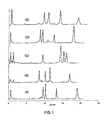
- Figure 1 illustrates chromatograms (A), (B), (c) and (D) as obtained for separating protein by using cation exchangers of the present invention in Examples 1, 2, 4 and 5, respectively, and chromatogram (E) as obtained for separating protein by using a comparative cation exchanger in Comparative Example 2.
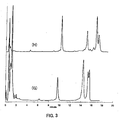
- Figure 2 illustrates chromatograms (F) as obtained for separating peptide by using a cation exchanger of the present invention in Example 3.
- Figure 3 illustrates chromatograms (G) and (H) as obtained for separating protein by using cation exchangers of the present invention in Examples 6 and 7, respectively.
- the anion exchanger of the present invention is comprised of a fine particle having bound to the surface thereof a polymer having a cation exchanging property.
- the polymer having a cation exchanging property is characterized as being selected from (i) polymers (hereinafter referred to as "unsaturated carboxylic acid polymers" when appropriate) prepared by polymerization of at least one kind of unsaturated carboxylic acid and partially crosslinked with a polymer having a functional group capable of reacting with a carboxylic acid, and (ii) acrylic acid-maleic acid copolymers.
- the cation exchanger of the present invention exhibits an enhanced capacity for adsorption of a sample to be analyzed or separated and improved liquid passage characteristics. Consequently, if the fine particle diameter is reduced, a high separation performance can be retained. Further, although the capacity for adsorption of a sample to be analyzed or separated is high, ion exchange can be carried out at a high rate.
- the size of a fine particle constituting the cation exchanger of the present invention is not particularly limited, but the fine particle usually has an average particle diameter in the range of 1 ⁇ m to 1,000 ⁇ m, preferably 1 ⁇ m to 100 ⁇ m to obtain good separation performance when it is used for liquid chromatography.
- the fine particle may be either a porous particle having pores on the surface thereof, or a non-porous particle having no pore.
- the fine particles used include organic fine particles and inorganic fine particles.
- the fine particles are selected from those which have good heat resistance sufficient for withstanding the heat-treatment carried out in the production process.
- the organic fine particles include, for example, those of copolymers of a monofunctional vinyl monomer with a polyfunctional vinyl monomer, and crosslinked polysaccharides.
- hydroxyalkyl esters of acrylic acid and methacrylic acid such as 2-hydroxyethyl acrylate, 2,3-dihydroxypropyl acrylate, 2-hydroxyethyl methacrylate and 2,3-dihydroxypropyl methacrylate; epoxy group-containing esters of acrylic acid and methacrylic acid, such as glycidyl acrylate and glycidyl methacrylate; acrylic acid and methacrylic acid; alkyl acrylates and alkyl methacrylates, such as methyl acrylate, ethyl acrylate, methyl methacrylate and ethyl methacrylate; styrene derivatives such as vinylbenzyl alacohol, vinylbenzyl glycidyl ether and hydroxystyrene; and vinyl acetate.
- polyfunctional vinyl monomer there can be mentioned polyol esters of acrylic acid and methacrylic acid, such as ethylene glycol diacrylate, glycerol diacrylate, ethylene glycol dimethacrylate and glycerol dimethacrylate; and divinylbenzene and triallyl isocyanurate.
- polyol esters of acrylic acid and methacrylic acid such as ethylene glycol diacrylate, glycerol diacrylate, ethylene glycol dimethacrylate and glycerol dimethacrylate
- divinylbenzene and triallyl isocyanurate As specific examples of the crosslinked polysaccharides, there can be mentioned cellulose, agarose, dextran and mannose.
- inorganic fine particles there can be mentioned silica, zeolite and titania.
- the fine particle surface When the polymer having a cation exchanging property to be bound to the fine particle surface is an unsaturated carboxylic acid polymer partially crosslinked with a polymer having a functional group capable of reacting with a carboxylic acid, the fine particle preferably has a functional group capable of reacting with a carboxylic acid because the cation exchanger has good durability when used as a packing for liquid chromatography, although the fine particle used is not limited thereto.
- the polymer having a cation exchanging property is an acrylic acid-maleic acid copolymer
- the fine particle preferably has on the surface thereof at least one kind of functional group capable of being condensed with carboxylic acid, such as a hydroxyl group, a glycidyl group or an amino group.
- the unsaturated carboxylic acid polymer partially crosslinked with a polymer having a functional group capable of reacting with a carboxylic acid there can be mentioned those which have at least one kind of structural units derived from acrylic acid, methacrylic acid, itaconic acid, maleic acid and cinnamic acid.
- the amount of the unsaturated carboxylic acid polymer partially crosslinked with a polymer having a functional group capable of reacting with a carboxylic acid is preferably in the range of 0.05 to 0.3 part by weight based on one part by weight of a fine particle.
- the acrylic acid-maleic acid copolymer preferably has a weight average molecular weight of at least 10,000 in view of high capacity for adsorption of a sample to be analyzed or separated.
- the amount of the acrylic acid-maleic acid copolymer is preferably in the range of 0.05 to 0.3 part by weight based on one part by weight of a fine particle.
- the unsaturated carboxylic acid polymer having a cation exchanging property to be bound to the fine particle surface preferably includes, for example, sulfonic acid type copolymers which are prepared by copolymerization of at least one unsaturated carboxylic acid, such as recited above, with at least one sulfonic acid group-containing vinyl monomer.
- sulfonic acid group-containing vinyl monomer there can be mentioned 3-sulfopropyl acrylate, 3-sulfo-2-hydroxypropyl acrylate, 3-sulfopropyl methacrylate, 3-sulfo-2-hydroxypropyl methacrylate, 3-sulfopropyl acrylamide, 3-sulfopropyl methacrylamide and vinylsulfonic acid.
- the sulfonic acid type unsaturated carboxylic acid polymer there can be mentioned copolymers prepared by copolymerization of at least one kind of unsaturated carboxylic acid selected from acrylic acid, methacrylic acid, maleic acid and itaconic acid with at least one kind of monomer selected from vinylsulfonic acid, 3-sulfopropyl acrylate, 3-sulfopropyl methacrylate, 3-sulfo-2-hydroxypropyl acrylate and 3-sulfo-2-hydroxypropyl methacrylate.
- These copolymers preferably contain at least 2% by mol of units derived from an unsaturated carboxylic acid.
- the polymer having a functional group capable of reacting with a carboxylic acid for partially crosslinking the unsaturated carboxylic acid polymer preferably has at least one kind of functional group selected from a hydroxyl group, a glycidyl group and an amino group as the functional group capable of reacting with a carboxylic acid.
- a hydroxyl group there can be mentioned polyvinyl alcohol, dextran, alkyl cellulose, agarose, pullulan, inulin, chitosan, poly-2-hydroxypropyl acrylate, poly-2-hydroxypropyl methacrylate, glycerol monoacrylate and glycerol monomethacrylate.
- polyvinyl alcohol and the above-recited polysaccarides are preferable.
- polymer having a glycidyl group there can be mentioned glycidyl group-containing polymers such as polyglycidyl acrylate, polyglycidyl methacrylate, sorbitol polygycidyl ether and phenolic epoxy resins.
- polymer having an amino group there can be mentioned polyallylamine, polyethyleneimine, poly-3-aminopropyl acrylate, poly-3-aminopropyl methacrylate, poly-3-aminopropyl acrylamide, poly-3-aminopropyl methacrylamide and chitosan. Of these, polyethyleneimine is preferable.
- the polymer having a hydroxyl group is especially preferable in view of ease in handling property.
- the amount of the polymer having a functional group capable of reacting with a carboxylic acid for partially crosslinking the unsaturated carboxylic acid polymer is preferably in the range of 0.05 to 0.2 part by weight based on one part by weight of the unsaturated carboxylic acid polymer.
- the cation exchanger of the present invention can be easily produced by a process comprising the following steps: a first step of dispersing fine particles in (i) a solution containing a combination of at least one unsaturated carboxylic acid polymer with a polymer having a functional group capable of reacting with a carboxylic acid, or (ii) a solution containing at least one acrylic acid-maleic acid copolymer, to prepare a dispersion of fine particles; a second step of removing a liquid medium from the dispersion of fine particles to separate a solid content; and a third step of heating the separated solid content in a dried state to obtain a fine particle having bound to the surface thereof a polymer having a cation exchanging property.
- the unsaturated carboxylic acid polymer when used in combination with the polymer having a functional group capable of reacting with a carboxylic acid, when a liquid medium is removed from the dispersion of fine particles to separate the solid content at the second step, the separated solid content is fine particles having a surface layer comprised of a mixture of the two polymers.
- the separated solid content is heated in a dried state at the third step, a carboxylic acid group of the unsaturated carboxylic acid polymer and a functional group capable of reacting with a carboxylic acid group are allowed to react with each other whereby the unsaturated carboxylic acid polymer is partially crosslinked.
- the acrylic acid-maleic acid copolymer when the separated solid content is heated in a dried state at the third step, fine particles having a surface layer comprised of the acrylic acid-maleic acid copolymer are obtained.
- the acrylic acid-maleic acid copolymer in the surface layer is usually bound to the fine particles through a single bond. By the binding through a single bond, the acrylic acid-maleic acid copolymer is firmly retained on the fine particles.
- liquid medium in which the fine particles are dispersed solvents which have a low boiling point and are capable of being easily removed, such as water and lower alcohols, are preferably used.
- the removal of the liquid medium is preferably carried out by vacuuming, for example, by using an evaporator and subjecting the dispersion of fine particles to vacuum distillation at a temperature of, for example, 80°C to 90°C so that the fine particles are covered by a uniform surface layer comprised of polymer.
- the fine particles are heated to effect crosslinking of polymer. More specifically the fine particles are heated in a dried state preferably at a temperature of at least 160°C but not higher than 200°C.
- the heat-treated fine particles are purified by washing with an aqueous alkali solution and water to give fine particles having a cured surface layer comprised of crosslinked polymer having a cation exchanging property.
- the cation exchanger of the present invention is useful as a packing for chromatography. More specifically the anion extender is packed in a column made of glass or a metal, and the packed column is used in chromatography for analyzing, separating or isolating anionic protein or other materials. Especially when the packed column is used for liquid chromatography, an enhanced capacity for adsorption of a sample to be analyzed, separated or isolated and improved liquid passage characteristics are obtained.
- Example 1 polymer A cooling pipe and a nitrogen-blowing pipe were fitted to the flask, and then the flask was dipped in an oil bath maintained at 60°C to conduct a polymerization under nitrogen stream for 6 hours.
- Thus-obtained polymer precipitate was subjected to decantation to remove the solvent, and then methanol was added and decantation was carried out whereby the polymer was purified.
- the purified polymer was dried in a vacuum to give a white polymer (hereinafter referred to as "example 1 polymer").
- Example 1 polymer had a weight average molecular weight (Mw) of 186,000 as measured by liquid chromatography employing the following equipment and conditions.
- Mw weight average molecular weight
- Mn number average molecular weight
- a two-liter Kjeldahl flask was charged with 50 g of example 1 polymer, 5 g of dextran (available from Sigma Co., molecular weight: 20,000) and 1 liter of distilled water to prepare an aqueous polymer solution.
- 500 g of porous hydrophilic acrylate polymer particles having an average particle diameter of 7 ⁇ m and having pores with an average diameter of 1,000 ⁇ on the surface thereof were added to prepare an aqueous dispersion of fine particles.
- the flask was set to an evaporator and dipped in an oil bath maintained at 90°C for 3 hours to distill off the solvent.
- the thus-obtained cation exchanger was placed in a square vat and the vat was heated for 3 hours in a warm air-circulating heater maintained at 180°C. After the heating, the vat was cooled, and the obtained cation exchanger was dispersed in pure water and then washed by using a glass filter.
- the porous hydrophilic acrylate polymer particles used were prepared by taking them from a commercially available column (trade name "TSK gel G5000 PWXL" available from Tosoh Corporation), followed by classification.
- the cation exchanger was packed in a column having a size of 4.6 mm I.D. ⁇ 5 mmL.
- the adsorption capacity for protein was measured by a break-through method.
- the measuring conditions and equipment employed were as follows.
- the adsorption capacity for protein was 98 mg Lysozyme/ml ⁇ gel as calculated taking the 10% height of extinction change due to protein elution as the break point.
- the above-mentioned cation exchanger was packed in a column having a size of 5.0 mm I.D. ⁇ 50 mmL. Separation of protein was conducted under the following conditions. The equipment used was the same as mentioned above.
- the test results are shown in chromatogram (A) in Fig. 1.
- the abscissa shows the time (in minutes) elapsing from the injection of a sample into a measuring apparatus.
- the cation exchanger made in Example 1 had a large adsorption capacity for protein and a high separation performance.
- the operation pressure in the flow paths was 1.2 MPa, and thus, the cation exchanger had good liquid passage characteristics. That is, a large adsorption capacity and high separation performance can be obtained at a low operation pressure.
- a cation exchanger was prepared from example 1 polymer and its adsorption capacity for protein was evaluated by the same procedures as described in Example 1, wherein silica fine particles having an average particle diameter of 4 ⁇ m taken from a commercially available column (trade name "TSK gel Super SW3000" available from Tosoh Corporation) were used instead of the hydrophilic porous acrylate polymer particles. All other conditions remained the same.
- the cation exchanger exhibited an adsorption capacity for protein (Lysozyme) of 110 mg/ml ⁇ gel.
- chromatogram (B) The results of testing the separation of protein using the cation exchanger are shown in chromatogram (B) in Fig. 1.
- the cation exchanger made in Example 2 had a large adsorption capacity for protein and a high separation performance.
- the operation pressure in the flow paths was 4.0 MPa.
- a cation exchanger was prepared from example 1 polymer by the same procedures as described in Example 1, wherein silica fine particles having an average particle diameter of 4 ⁇ m taken from a commercially available column (trade name "TSK gel Super SW2000" available from Tosoh Corporation) were used instead of the hydrophilic porous acrylate polymer particles. All other conditions remained the same.
- the cation exchanger was packed in a column having a size of 5.0 mm I.D. ⁇ 50 mm L. Separation of peptide was conducted under the following conditions. The equipment used was the same as that used for separation of protein in Example 1.
- chromatogram (F) in Fig. 2.
- the abscissa shows the time (in minutes) elapsing from the injection of a sample into a measuring apparatus. Meanings of the symbols in Fig. 2 are as follows.
- the cation exchanger made in Example 3 exhibited a high separation performance for peptide and good adsorption peaks.
- the cation exchanger of the invention has a high separation performance.
- the operation pressure in the flow paths was 4.0 MPa, and thus, the cation exchanger has good liquid passage characteristics. That is, a large adsorption capacity and high separation performance can be obtained at a low operation pressure.
- a cation exchanger was prepared by the same procedures as described in Example 1, wherein 100 g of an acrylic acid-maleic acid copolymer (available from Aldrich Co.; molecular weight 70,000) was used instead of 50 g of example 1 polymer, and the amount of dextran was changed to 10 g with all other conditions remaining the same.
- an acrylic acid-maleic acid copolymer available from Aldrich Co.; molecular weight 70,000
- the cation exchanger exhibited an adsorption capacity for protein of 92 mg/ml ⁇ gel as measured by the same procedures as in Example 1.
- Example 4 Separation of protein was conducted by the same procedures as in Example 1.
- the results of the protein separation test using the cation exchanger are shown in chromatogram (C) in Fig. 1.
- the cation exchanger made in Example 4 had a high separation performance, which was similar to that in Example 1.
- the operation pressure in the flow paths was 1.5 MPa.
- a cation exchanger was prepared by the same procedures as described in Example 1, wherein 2 g of polyethyleneimine having an average molecular weight of 10,000 was used instead of 5 g of dextran with all other conditions remaining the same.
- the cation exchanger exhibited an adsorption capacity for protein of 94 mg/ml ⁇ gel as measured by the same procedures as in Example 1.
- a cation exchanger was prepared by the same procedures as described in Example 1, wherein 100 g of an acrylic acid-maleic acid copolymer having an average molecular weight of 50,000 was used instead of 50 g of example 1 polymer, and dextran was not used with all other conditions remaining the same.
- the thus-obtained cation exchanger was packed in a column having a size of 4.6 mm I.D. ⁇ 5 mm L.
- the adsorption capacity for protein was measured by a break-through method.
- the measuring conditions and equipment employed were as follows.
- the adsorption capacity for protein was 98 mg Lysozyme/ml ⁇ gel as calculated taking the 10% height of extinction change due to protein elution as the break point.
- the cation exchanger made in Example 6 had an enhanced capacity for adsorption of protein and a high separation performance. Further, the operation pressure in the flow paths was 1.7 MPa, and thus, the cation exchanger has good liquid passage characteristics. That is, a large adsorption capacity and high separation performance can be obtained at a low operation pressure.
- a cation exchanger was prepared by the same procedures as described in Example 6, wherein silica fine particles having an average particle diameter of 4 ⁇ m taken from a commercially available column (trade name "TSK gel Super SW3000WXL” available from Tosoh Corporation) were used with all other conditions remaining the same.
- the cation exchanger exhibited an adsorption capacity for protein of 113 mg/ml ⁇ gel as measured by the same procedures as in Example 6.
- a cation exchanger was prepared by the same procedures as described in Example 6, wherein an acrylic acid-maleic acid copolymer having an average molecular weight of 70,000 was used instead of an acrylic acid-maleic acid copolymer having an average molecular weight of 50,000 with all other conditions remaining the same.
- the cation exchanger exhibited an adsorption capacity for protein of 102 mg/ml ⁇ gel as measured by the same procedures as in Example 6.
- a cation exchanger was prepared by the same procedures as described in Example 6, wherein an acrylic acid-maleic acid copolymer having an average molecular weight of 3,000 was used instead of an acrylic acid-maleic acid copolymer having an average molecular weight of 50,000 with all other conditions remaining the same.
- the cation exchanger exhibited an adsorption capacity for protein of 57 mg/ml ⁇ gel as measured by the same procedures as in Example 6.
- a cation exchanger was prepared by the same procedures as described in Example 1, wherein dextran was not used with all other conditions remaining the same.
- the cation exchanger exhibited an adsorption capacity for protein of 120 mg/ml ⁇ gel as measured by the same procedures as in Example 1.
- Example 2 Separation of protein was tried by the same procedures as in Example 1 using a column having a size of 5.0 mm I.D. ⁇ 50 mmL. But, the operation pressure was too high and the packing was broken by the high pressure during operation. Thus, measurement could not be carried out.
- a cation exchanger was prepared by the same procedures as described in Example 1, wherein an cation exchanger, made from the same porous hydrophilic acrylate polymer particles without use of example 1 polymer and dextran, was used with all other conditions remaining the same.
- the cation exchanger exhibited an adsorption capacity for protein of 41 mg/ml ⁇ gel as measured by the same procedures as in Example 1.
- a cation exchanger was prepared by the same procedures as described in Example 6, wherein polyacrylic acid having an average molecular weight of 90,000 was used instead of an acrylic acid-maleic acid copolymer having an average molecular weight of 50,000 with all other conditions remaining the same.
- the cation exchanger exhibited an adsorption capacity for protein of 16 mg/ml ⁇ gel as measured by the same procedures as in Example 6.
- a cation exchanger was prepared by the same procedures as described in Example 6, wherein polyacrylic acid having an average molecular weight of 2,000 was used instead of an acrylic acid-maleic acid copolymer having an average molecular weight of 50,000 with all other conditions remaining the same.
- the cation exchanger exhibited an adsorption capacity for protein of 34 mg/ml ⁇ gel as measured by the same procedures as in Example 6.
- the cation exchanger exhibits an enhanced capacity for adsorption of protein or other objective sample, although the cation exchanger is comprised of fine particles. Further, when the cation exchanger is used as a packing for liquid chromatography, it exhibits high adsorption capacity, high retention, and high resolution for separation with a low operation pressure.
Landscapes
- Chemical & Material Sciences (AREA)
- Organic Chemistry (AREA)
- Chemical Kinetics & Catalysis (AREA)
- Analytical Chemistry (AREA)
- Solid-Sorbent Or Filter-Aiding Compositions (AREA)
- Treatment Of Liquids With Adsorbents In General (AREA)
Applications Claiming Priority (4)
| Application Number | Priority Date | Filing Date | Title |
|---|---|---|---|
| JP2001020232 | 2001-01-29 | ||
| JP2001020233 | 2001-01-29 | ||
| JP2001020233 | 2001-01-29 | ||
| JP2001020232 | 2001-01-29 |
Publications (3)
| Publication Number | Publication Date |
|---|---|
| EP1226869A2 true EP1226869A2 (de) | 2002-07-31 |
| EP1226869A3 EP1226869A3 (de) | 2003-01-29 |
| EP1226869B1 EP1226869B1 (de) | 2010-08-11 |
Family
ID=26608446
Family Applications (1)
| Application Number | Title | Priority Date | Filing Date |
|---|---|---|---|
| EP02001858A Expired - Lifetime EP1226869B1 (de) | 2001-01-29 | 2002-01-28 | Kationenaustauscher, Verfahren zu dessen Herstellung und dessen Verwendung |
Country Status (3)
| Country | Link |
|---|---|
| US (1) | US6624205B2 (de) |
| EP (1) | EP1226869B1 (de) |
| DE (1) | DE60237251D1 (de) |
Cited By (1)
| Publication number | Priority date | Publication date | Assignee | Title |
|---|---|---|---|---|
| CN109061009A (zh) * | 2018-09-30 | 2018-12-21 | 安徽省食品药品检验研究院 | 一种发酵液中衣康酸含量的测定方法 |
Families Citing this family (12)
| Publication number | Priority date | Publication date | Assignee | Title |
|---|---|---|---|---|
| MY144940A (en) * | 2005-01-25 | 2011-11-30 | Avantor Performance Mat Inc | Chromatographic media |
| FR2884253B1 (fr) * | 2005-04-08 | 2007-06-22 | Univ Lille Sciences Tech | Materiaux monolithiques fonctionnalisables |
| DE102005035616A1 (de) * | 2005-07-29 | 2007-02-08 | Lanxess Deutschland Gmbh | Monodisperse Kationenaustauscher |
| DE102007009072A1 (de) * | 2007-02-24 | 2008-08-28 | Lanxess Deutschland Gmbh | Monodisperse schwachsaure Kationenaustauscher |
| GB0706634D0 (en) * | 2007-04-04 | 2007-05-16 | Itm Fuel Cells Ltd | Membrane production |
| EP2811983B1 (de) | 2012-09-17 | 2019-05-01 | W.R. Grace & CO. - CONN. | Trägermaterial in form funktionalisierter teilchen und verfahren zur herstellung und verwendung davon |
| EP2812091B1 (de) | 2012-09-17 | 2021-03-10 | W.R. Grace & CO. - CONN. | Chromatographiemedien und -vorrichtungen |
| WO2014157670A1 (ja) * | 2013-03-29 | 2014-10-02 | 東ソー株式会社 | 液体クロマトグラフィー用カチオン交換体、その製造方法及びその用途 |
| ES2887110T3 (es) | 2014-01-16 | 2021-12-21 | Grace W R & Co | Medios para cromatografía de afinidad y dispositivos para cromatografía |
| PL3137209T3 (pl) | 2014-05-02 | 2023-01-02 | W.R. Grace & Co. - Conn. | Funkcjonalizowany materiał nośnikowy i sposoby wytwarzania oraz stosowania funkcjonalizowanego materiału nośnikowego |
| KR102566292B1 (ko) | 2015-06-05 | 2023-08-10 | 더블유.알. 그레이스 앤드 캄파니-콘. | 흡착성 바이오프로세싱 정화제와 이의 제조 및 사용 방법 |
| KR102663020B1 (ko) * | 2018-10-12 | 2024-05-07 | 삼성전자주식회사 | 바인더, 그 제조방법, 이를 포함하는 이차전지용 전극 및 이차전지 |
Citations (2)
| Publication number | Priority date | Publication date | Assignee | Title |
|---|---|---|---|---|
| FR2443867A1 (fr) | 1978-12-15 | 1980-07-11 | Rhone Poulenc Ind | Procede de separation des proteines du lactoserum acide |
| EP0172579A2 (de) | 1984-08-22 | 1986-02-26 | Cuno Incorporated | Kieselträger |
Family Cites Families (15)
| Publication number | Priority date | Publication date | Assignee | Title |
|---|---|---|---|---|
| NL84524C (de) * | 1952-02-19 | |||
| US3083118A (en) | 1958-03-04 | 1963-03-26 | Tee Pak Inc | Method of depositing a polymer of olefinically unsaturated monomer within a polymeric material and the resulting product |
| US3227510A (en) | 1958-03-04 | 1966-01-04 | Tee Pak Inc | Dyeing substrates ionically binding in localized areas catalysts for the predyeing olefin polymerization thereon |
| JPS5613501B2 (de) * | 1973-11-14 | 1981-03-28 | ||
| CS171963B1 (de) * | 1974-02-01 | 1976-11-29 | ||
| US4100149A (en) | 1975-08-28 | 1978-07-11 | Rhone-Poulenc Industries | Method of separating proteins by ion exchange |
| US4245005A (en) | 1979-02-28 | 1981-01-13 | Purdue Research Foundation | Pellicular coated support and method |
| US4337185A (en) | 1980-06-23 | 1982-06-29 | The Dow Chemical Company | Process for making cationic structured particle latexes using reactive polymeric surfactants |
| US5292818A (en) * | 1982-07-20 | 1994-03-08 | Sekisui Kagaku Kogyo Kabushiki Kaisha | Method for producing a carrier for cation exchange liquid chromatography and a method for determining glycosylated hemoglobins using the carrier |
| US4859462A (en) | 1986-07-30 | 1989-08-22 | Fisons Corporation | Polymer-treated ion exchange resins |
| DE3811042A1 (de) * | 1988-03-31 | 1989-10-19 | Merck Patent Gmbh | Ionenaustauscher |
| US5030352A (en) | 1990-01-25 | 1991-07-09 | Purdue Research Foundation | Coated media for chromatography |
| AU654323B2 (en) | 1991-01-04 | 1994-11-03 | Perseptive Biosystems, Inc. | Sulfonamide bonded hydrophilic coating |
| US5648400A (en) | 1992-08-04 | 1997-07-15 | Japan Atomic Energy Research Inst. | Process for producing polymeric electrolyte complex and ion-exchange resin |
| YU48814B (sh) * | 1994-07-18 | 2001-07-10 | Dušan dr. Miljković | Postupak za sintezu kopolimera maleinske i akrilne kiseline |
-
2002
- 2002-01-28 DE DE60237251T patent/DE60237251D1/de not_active Expired - Lifetime
- 2002-01-28 EP EP02001858A patent/EP1226869B1/de not_active Expired - Lifetime
- 2002-01-28 US US10/055,921 patent/US6624205B2/en not_active Expired - Lifetime
Patent Citations (2)
| Publication number | Priority date | Publication date | Assignee | Title |
|---|---|---|---|---|
| FR2443867A1 (fr) | 1978-12-15 | 1980-07-11 | Rhone Poulenc Ind | Procede de separation des proteines du lactoserum acide |
| EP0172579A2 (de) | 1984-08-22 | 1986-02-26 | Cuno Incorporated | Kieselträger |
Cited By (2)
| Publication number | Priority date | Publication date | Assignee | Title |
|---|---|---|---|---|
| CN109061009A (zh) * | 2018-09-30 | 2018-12-21 | 安徽省食品药品检验研究院 | 一种发酵液中衣康酸含量的测定方法 |
| CN109061009B (zh) * | 2018-09-30 | 2021-09-17 | 安徽省食品药品检验研究院 | 一种发酵液中衣康酸含量的测定方法 |
Also Published As
| Publication number | Publication date |
|---|---|
| EP1226869A3 (de) | 2003-01-29 |
| EP1226869B1 (de) | 2010-08-11 |
| US6624205B2 (en) | 2003-09-23 |
| DE60237251D1 (de) | 2010-09-23 |
| US20020103265A1 (en) | 2002-08-01 |
Similar Documents
| Publication | Publication Date | Title |
|---|---|---|
| EP0763064B1 (de) | Verfahren zur herstellung von teilchen und teilchen die mit hilfe dieses verfahrens hergestellt werden können | |
| US6624205B2 (en) | Cation exchanger, process for producing same, and its use | |
| EP1224975B1 (de) | Anionenaustauscher, Verfahren zu seiner Herstellung und seine Verwendung | |
| CA1329800C (en) | Composite separating agent | |
| US6046246A (en) | Process for making fluorinated polymer adsorbent particles | |
| EP1226870B1 (de) | Anionenaustauscher, Verfahren zu seiner Herstellung und seine Verwendung | |
| Hosoya et al. | In situ surface-selective modification of uniform size macroporous polymer particles with temperature-responsive poly-N-isopropylacrylamide | |
| JP2896571B2 (ja) | 複合化分離剤及びその製造法 | |
| EP2274091B1 (de) | Verbundwerkstoff | |
| SU1311631A3 (ru) | Насадка дл жидкостной хроматографии | |
| EP0021817B1 (de) | Füllmaterial für Flüssigkeits-Chromatographie, Verfahren zur Trennung wasserlöslicher Substanzen mit diesem Füllstoff und Verwendung dieses Füllstoffes bei der Trennung wasserlöslicher biochemischer Substanzen | |
| EP1436056A2 (de) | Makroporöses gel, seine herstellung und seine verwendung | |
| JP2002543224A (ja) | スルホン化されたポリマー樹脂及びその調製 | |
| US6746608B2 (en) | Use of adsorbent polymer particles in DNA separation | |
| JPH0373848A (ja) | 液体クロマトグラフィー用充填剤とその製造法 | |
| JP3972662B2 (ja) | カチオン交換体、その製造方法及びそれを用いた用途 | |
| Švec et al. | Separation of hydrophilic oligomers and polymers using monodisperse poly (2, 3-dihydroxypropyl methacrylate-co-ethylene dimethacrylate) beads via normal-phase and hydrophilic-interaction HPLC | |
| JPH087198B2 (ja) | 糖化ヘモグロビンの定量法 | |
| JP2004083561A (ja) | リポ蛋白質分離用イオン交換体及びそれを用いたリポ蛋白質の分離方法 | |
| JPH0623258B2 (ja) | 親水性多孔粒子 | |
| Chang et al. | Preparation of High‐capacity, Monodisperse Polymeric Weak Cation Exchange Packings Using Surface‐initiated Atom Transfer Radical Polymerization and Its Chromatographic Properties | |
| US7071240B1 (en) | Carboxylic cationites and methods of manufacture | |
| EP1084150A1 (de) | Carboxyl-cationite und verfahren zur herstellung | |
| JP2002060404A (ja) | 疎水性物質吸着剤の製造方法 |
Legal Events
| Date | Code | Title | Description |
|---|---|---|---|
| PUAI | Public reference made under article 153(3) epc to a published international application that has entered the european phase |
Free format text: ORIGINAL CODE: 0009012 |
|
| AK | Designated contracting states |
Kind code of ref document: A2 Designated state(s): AT BE CH CY DE DK ES FI FR GB GR IE IT LI LU MC NL PT SE TR |
|
| AX | Request for extension of the european patent |
Free format text: AL;LT;LV;MK;RO;SI |
|
| PUAL | Search report despatched |
Free format text: ORIGINAL CODE: 0009013 |
|
| AK | Designated contracting states |
Designated state(s): AT BE CH CY DE DK ES FI FR GB GR IE IT LI LU MC NL PT SE TR |
|
| AX | Request for extension of the european patent |
Extension state: AL LT LV MK RO SI |
|
| 17P | Request for examination filed |
Effective date: 20030619 |
|
| AKX | Designation fees paid |
Designated state(s): DE FR GB |
|
| GRAP | Despatch of communication of intention to grant a patent |
Free format text: ORIGINAL CODE: EPIDOSNIGR1 |
|
| RIC1 | Information provided on ipc code assigned before grant |
Ipc: B01J 39/20 20060101AFI20100122BHEP |
|
| GRAS | Grant fee paid |
Free format text: ORIGINAL CODE: EPIDOSNIGR3 |
|
| GRAA | (expected) grant |
Free format text: ORIGINAL CODE: 0009210 |
|
| AK | Designated contracting states |
Kind code of ref document: B1 Designated state(s): DE FR GB |
|
| REG | Reference to a national code |
Ref country code: GB Ref legal event code: FG4D |
|
| REF | Corresponds to: |
Ref document number: 60237251 Country of ref document: DE Date of ref document: 20100923 Kind code of ref document: P |
|
| PLBE | No opposition filed within time limit |
Free format text: ORIGINAL CODE: 0009261 |
|
| STAA | Information on the status of an ep patent application or granted ep patent |
Free format text: STATUS: NO OPPOSITION FILED WITHIN TIME LIMIT |
|
| 26N | No opposition filed |
Effective date: 20110512 |
|
| REG | Reference to a national code |
Ref country code: DE Ref legal event code: R097 Ref document number: 60237251 Country of ref document: DE Effective date: 20110512 |
|
| REG | Reference to a national code |
Ref country code: FR Ref legal event code: PLFP Year of fee payment: 15 |
|
| REG | Reference to a national code |
Ref country code: FR Ref legal event code: PLFP Year of fee payment: 16 |
|
| REG | Reference to a national code |
Ref country code: FR Ref legal event code: PLFP Year of fee payment: 17 |
|
| PGFP | Annual fee paid to national office [announced via postgrant information from national office to epo] |
Ref country code: FR Payment date: 20181213 Year of fee payment: 18 |
|
| PGFP | Annual fee paid to national office [announced via postgrant information from national office to epo] |
Ref country code: GB Payment date: 20190123 Year of fee payment: 18 Ref country code: DE Payment date: 20190115 Year of fee payment: 18 |
|
| REG | Reference to a national code |
Ref country code: DE Ref legal event code: R119 Ref document number: 60237251 Country of ref document: DE |
|
| GBPC | Gb: european patent ceased through non-payment of renewal fee |
Effective date: 20200128 |
|
| PG25 | Lapsed in a contracting state [announced via postgrant information from national office to epo] |
Ref country code: DE Free format text: LAPSE BECAUSE OF NON-PAYMENT OF DUE FEES Effective date: 20200801 Ref country code: GB Free format text: LAPSE BECAUSE OF NON-PAYMENT OF DUE FEES Effective date: 20200128 Ref country code: FR Free format text: LAPSE BECAUSE OF NON-PAYMENT OF DUE FEES Effective date: 20200131 |