EP1241132A2 - Inhomogene Kieselsäuren in Zahnpflegemittel - Google Patents
Inhomogene Kieselsäuren in Zahnpflegemittel Download PDFInfo
- Publication number
- EP1241132A2 EP1241132A2 EP02000632A EP02000632A EP1241132A2 EP 1241132 A2 EP1241132 A2 EP 1241132A2 EP 02000632 A EP02000632 A EP 02000632A EP 02000632 A EP02000632 A EP 02000632A EP 1241132 A2 EP1241132 A2 EP 1241132A2
- Authority
- EP
- European Patent Office
- Prior art keywords
- silica
- fractions
- precipitation
- mixed
- acid
- Prior art date
- Legal status (The legal status is an assumption and is not a legal conclusion. Google has not performed a legal analysis and makes no representation as to the accuracy of the status listed.)
- Withdrawn
Links
Classifications
-
- A—HUMAN NECESSITIES
- A61—MEDICAL OR VETERINARY SCIENCE; HYGIENE
- A61K—PREPARATIONS FOR MEDICAL, DENTAL OR TOILETRY PURPOSES
- A61K8/00—Cosmetics or similar toiletry preparations
- A61K8/18—Cosmetics or similar toiletry preparations characterised by the composition
- A61K8/19—Cosmetics or similar toiletry preparations characterised by the composition containing inorganic ingredients
- A61K8/25—Silicon; Compounds thereof
-
- A—HUMAN NECESSITIES
- A61—MEDICAL OR VETERINARY SCIENCE; HYGIENE
- A61Q—SPECIFIC USE OF COSMETICS OR SIMILAR TOILETRY PREPARATIONS
- A61Q11/00—Preparations for care of the teeth, of the oral cavity or of dentures; Dentifrices, e.g. toothpastes; Mouth rinses
-
- C—CHEMISTRY; METALLURGY
- C01—INORGANIC CHEMISTRY
- C01B—NON-METALLIC ELEMENTS; COMPOUNDS THEREOF; METALLOIDS OR COMPOUNDS THEREOF NOT COVERED BY SUBCLASS C01C
- C01B33/00—Silicon; Compounds thereof
- C01B33/113—Silicon oxides; Hydrates thereof
- C01B33/12—Silica; Hydrates thereof, e.g. lepidoic silicic acid
- C01B33/18—Preparation of finely divided silica neither in sol nor in gel form; After-treatment thereof
-
- C—CHEMISTRY; METALLURGY
- C01—INORGANIC CHEMISTRY
- C01B—NON-METALLIC ELEMENTS; COMPOUNDS THEREOF; METALLOIDS OR COMPOUNDS THEREOF NOT COVERED BY SUBCLASS C01C
- C01B33/00—Silicon; Compounds thereof
- C01B33/113—Silicon oxides; Hydrates thereof
- C01B33/12—Silica; Hydrates thereof, e.g. lepidoic silicic acid
- C01B33/18—Preparation of finely divided silica neither in sol nor in gel form; After-treatment thereof
- C01B33/187—Preparation of finely divided silica neither in sol nor in gel form; After-treatment thereof by acidic treatment of silicates
- C01B33/193—Preparation of finely divided silica neither in sol nor in gel form; After-treatment thereof by acidic treatment of silicates of aqueous solutions of silicates
-
- C—CHEMISTRY; METALLURGY
- C09—DYES; PAINTS; POLISHES; NATURAL RESINS; ADHESIVES; COMPOSITIONS NOT OTHERWISE PROVIDED FOR; APPLICATIONS OF MATERIALS NOT OTHERWISE PROVIDED FOR
- C09C—TREATMENT OF INORGANIC MATERIALS, OTHER THAN FIBROUS FILLERS, TO ENHANCE THEIR PIGMENTING OR FILLING PROPERTIES ; PREPARATION OF CARBON BLACK ; PREPARATION OF INORGANIC MATERIALS WHICH ARE NO SINGLE CHEMICAL COMPOUNDS AND WHICH ARE MAINLY USED AS PIGMENTS OR FILLERS
- C09C1/00—Treatment of specific inorganic materials other than fibrous fillers; Preparation of carbon black
- C09C1/28—Compounds of silicon
- C09C1/30—Silicic acid
- C09C1/3063—Treatment with low-molecular organic compounds
-
- C—CHEMISTRY; METALLURGY
- C01—INORGANIC CHEMISTRY
- C01P—INDEXING SCHEME RELATING TO STRUCTURAL AND PHYSICAL ASPECTS OF SOLID INORGANIC COMPOUNDS
- C01P2004/00—Particle morphology
- C01P2004/60—Particles characterised by their size
- C01P2004/61—Micrometer sized, i.e. from 1-100 micrometer
-
- C—CHEMISTRY; METALLURGY
- C01—INORGANIC CHEMISTRY
- C01P—INDEXING SCHEME RELATING TO STRUCTURAL AND PHYSICAL ASPECTS OF SOLID INORGANIC COMPOUNDS
- C01P2006/00—Physical properties of inorganic compounds
- C01P2006/11—Powder tap density
-
- C—CHEMISTRY; METALLURGY
- C01—INORGANIC CHEMISTRY
- C01P—INDEXING SCHEME RELATING TO STRUCTURAL AND PHYSICAL ASPECTS OF SOLID INORGANIC COMPOUNDS
- C01P2006/00—Physical properties of inorganic compounds
- C01P2006/12—Surface area
-
- C—CHEMISTRY; METALLURGY
- C01—INORGANIC CHEMISTRY
- C01P—INDEXING SCHEME RELATING TO STRUCTURAL AND PHYSICAL ASPECTS OF SOLID INORGANIC COMPOUNDS
- C01P2006/00—Physical properties of inorganic compounds
- C01P2006/19—Oil-absorption capacity, e.g. DBP values
-
- C—CHEMISTRY; METALLURGY
- C01—INORGANIC CHEMISTRY
- C01P—INDEXING SCHEME RELATING TO STRUCTURAL AND PHYSICAL ASPECTS OF SOLID INORGANIC COMPOUNDS
- C01P2006/00—Physical properties of inorganic compounds
- C01P2006/40—Electric properties
Definitions
- the invention relates to silicas with an inhomogeneous structure or structure, process for their manufacture and their use in dentifrices.
- silicas are also produced by acid precipitation, however, dried by hot air atomization and at the same time easily destructible Balls shaped.
- EP 018 866 describes the production of spray-dried silica with an average particle diameter of over 80 ⁇ m, the particles being a homogeneous Have structure and are massive.
- silica that has wide ranges of physico-chemical data such as BET or CTAB surface, and good abrasiveness combined with a good thickening effect.
- silicas produced according to the invention are low in dust, which makes handling facilitated and the "dusting" of the systems at the customer prevented.
- the present invention therefore relates to silicas containing at least two Silicic acid fractions, which can be found in at least one measured value for BET surface area, CTAB surface area and DBP intake by at least 10%.
- the silicas according to the invention are therefore particularly suitable as fillers in dentifrices suitable.
- the structure of the silicas from at least two fractions of silicic acid causes one Inhomogeneity of the silica, which results in good abrasivities and Thickening effect and a small amount of fines.
- the abrasive values according to the RDA method range from 45% to 70%, which is typical for modern toothpaste silicic acids, but can also exceed or fall short of this, depending on the selected mixture of the precipitation suspensions and their processing technology.
- the toothpastes made from them are also in the typical flow range.
- they in the shear stress test up to a shear stress of 600 Pa, they have a gravitational speed of 100 s -1 to 500 s -1 , depending on the silica mixture used according to the invention and the concentration used in the paste. Higher or lower speeds of gravity in the shear stress range mentioned can occur depending on the selected mixture of the precipitation suspensions and their processing engineering.
- Silicas according to the invention have a fine fraction of at most 10% Particle diameter less than or equal to 63 ⁇ m (Alpine sieve residue).
- the different silica fractions of the present invention are not described; there is also a different aggregate size of the silica fractions in the This case is of secondary importance, the differences in the physico-chemical data.
- Silicon acid fraction in the sense of the present invention denotes different types of silicas which, due to different production processes or variants, have a difference of 10% in at least one of the above-mentioned physico-chemical data. Two, particularly preferably three, of these parameters preferably have such a difference. The differences in the parameters already mentioned can be obtained by different production processes for the silica fractions. All, one or more of the silicic acid fractions can be precipitated silicas and / or pyrogenic silicas. In the case of precipitated silica, it is above all possible to obtain different silica fractions by means of different precipitation processes. Silicas according to the invention can also be produced from fractions of precipitated and pyrogenic silicas.
- the silica fractions can be precipitated silicas or pyrogenic silicas, taking a mixture of the fractions at different process steps, usually at the production of silicas can be carried out.
- the mixture can be prepared after Precipitation of silicate with an acid (usually water glass, i.e. sodium silicate with Sulfuric acid) by mixing the precipitation suspensions or after filtering the Suspensions obtained filter cake and liquefied, resuspended filter cake respectively. It is also possible to use already prepared and dried silica fractions Add solid to the suspensions or the filter cake.
- an acid usually water glass, i.e. sodium silicate with Sulfuric acid
- the mixtures thus obtained may have to be filtered off and dried in a conventional manner become. Drying processes are e.g. B. spray drying, nozzle tower, floor dryer, Rotary tube dryer or spin flash dryer.
- the physicochemical data of the silica fractions must be described in Manner by at least 10, preferably by at least 15, particularly preferably by at least Distinguish 20%.
- the invention further relates to a process for the preparation of silicas, containing at least two fractions of silica, at least two Silicic acid fractions, which can be found in at least one measured value for BET surface area, CTAB surface area and DBF intake by at least 10%, mixed together become.
- the proportion of the respective fractions in the suspension or in the silica should in each case between 5 and 95% by weight, based on the dry silica.
- the silica is preferably in particle form with an average diameter of over 80, in particular over 100, particularly preferably over 200 microns, z. B. by spray drying receive.
- the spray drying of the suspension can e.g. B. performed according to US 4 097 771 become.
- the silicas according to the invention can therefore be used as dentifrices, toothpastes or Abrasives are used.
- silicas according to the invention can be used in all fields of application are used, in which silicas are usually used, such as. B. in Battery separators, anti-blocking agents, matting agents in paints, paper lines or Defoamers.
- the Alpine sieve residue is determined as follows, one at a time Sieve with the specified mesh size (63 ⁇ m, 250 ⁇ m) is used.
- the silica or silicate sample is marked with a 500 ⁇ m sieve sieved to destroy any ventilation agglomerates. Then 10 g of the sieved sample are placed on the air jet sieve, which with a 63 microns Screen mesh is equipped and screened at 200 mm water column vacuum. silica or Silicate particles that settle on the sieve cover of the device are carefully removed Hit the button on the strainer cover.
- the sieving process generally lasts 5 minutes. It ends when the backlog remains constant, which is usually the most free-flowing Appearance is recognizable. To be on the safe side, you sieve another minute.
- the sieving process is briefly interrupted and the Agglomerates destroyed with a brush under light pressure. After screening, the Carefully knock the residue from the air jet sieve and weigh it back. The sieve residue is given in percent, always in connection with the mesh size of the sieve.
- the precipitation suspensions of the silica fractions A and B were in a ratio of 50:50 mixed.
- 80 kg of precipitated silica A solids content approx. 170 g / l
- 80 kg the precipitated silica B solids content approx. 63 g / l
- the mixture obtained was filtered, the filter cake liquefied with a little acid and opened sprayed a nozzle tower dryer.
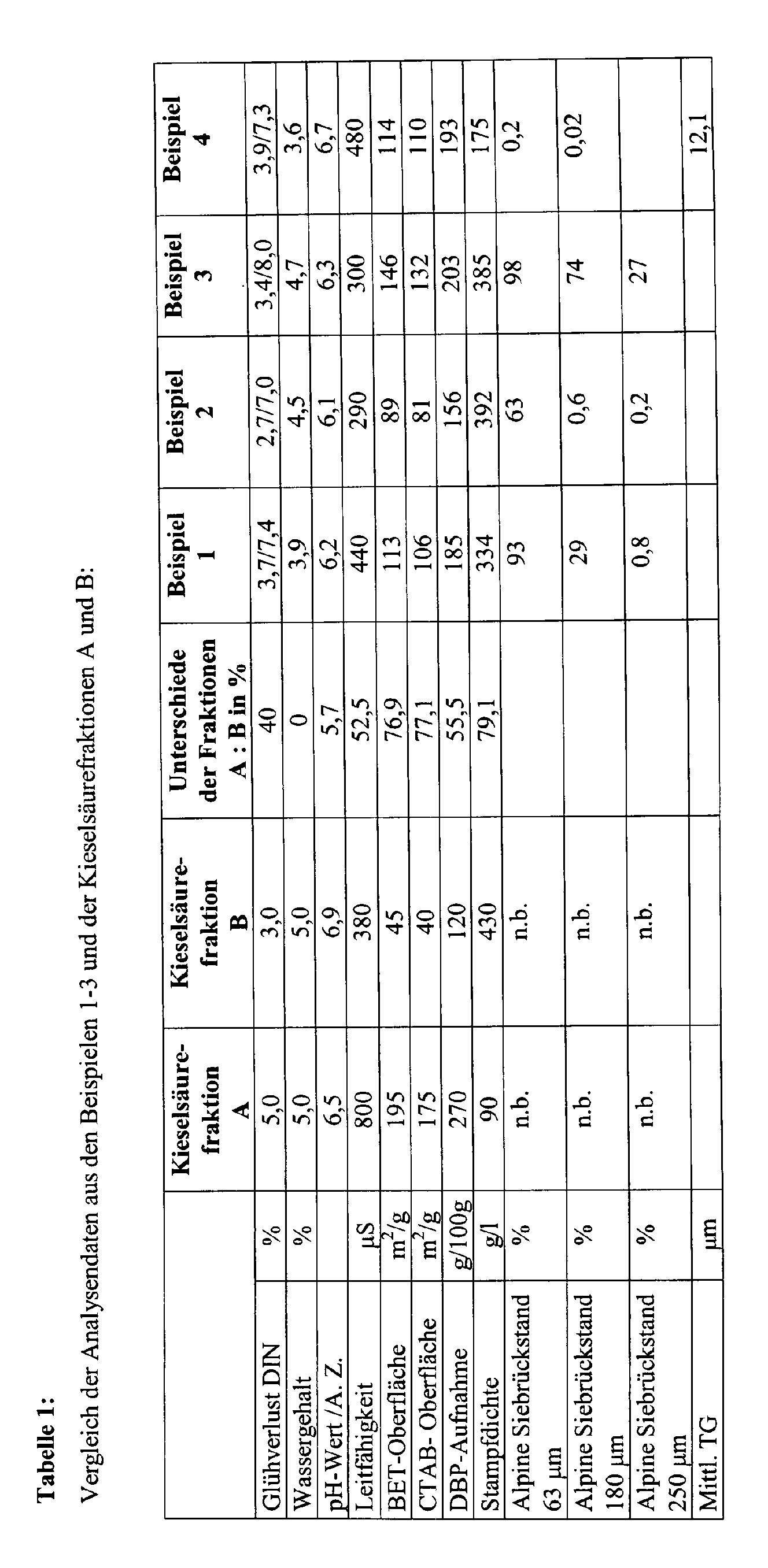
- Table 1 The analysis data are summarized in Table 1.
- the precipitation suspensions of the precipitated silicas A and B were in a ratio of 70:30 mixed. 196 kg of precipitated silica A (solids content approx. 174 g / l) were added at 84 kg of the precipitated silica B (solids content approx. 63 g / l) mixed in a stirred container. The mixture obtained was filtered, the filter cake liquefied with a little acid and opened sprayed a nozzle tower dryer.
- Table 1 The analysis data are summarized in Table 1.
- the precipitation suspensions of the precipitated silicas A and B were in a ratio of 30:70 mixed.
- 71 kg of the precipitated silica A solids content approx. 174 g / l
- 142 kg of precipitated silica B solids content approx. 63 g / l
- the analysis data are in Table 1 summarized.
- a white, opaque toothpaste was produced with a mixture of the precipitated silicas according to Example 3 (ratio A to B as 30:70).
- substance Dimensions [%] Silica according to example 3 20.00 Sorbitol, 70% solution 40,00 water 31.69 Polyethylene glycol 400 3.50 sodium lauryl sulfate 1.20 carboxymethylcellulose 1.20 Sodium monofluorophosphate 0.76 Titanium dioxide 0.40 Methyl paraben, sodium salt 0.15 Sakharin, sodium salt 0.10 Aroma 1.00
- the paste was applied in the Mixer mechanically processed several times using a three-roll mill.
- a transparent toothpaste was produced with a mixture of the precipitated silicas according to Example 3 (ratio A to B as 30:70).
- substance Dimensions [%] Silica according to example 3 20.00 Glycerin, 99% 20.00 Sorbitol, 70% solution 40,00 water 12.09 Polyethylene glycol 400 3.50 sodium lauryl sulfate 1.30 carboxymethylcellulose 0.60 Sodium monofluorophosphate 0.76 Dye FD&C No. 1, 1% solution 0.50 Methyl paraben, sodium salt 0.15 Sakharin, sodium salt 0.10 Aroma 1.00
- the paste was mechanically processed several times using a three-roll chair after it had been mixed.
Landscapes
- Chemical & Material Sciences (AREA)
- Organic Chemistry (AREA)
- Health & Medical Sciences (AREA)
- Life Sciences & Earth Sciences (AREA)
- Inorganic Chemistry (AREA)
- Animal Behavior & Ethology (AREA)
- General Health & Medical Sciences (AREA)
- Public Health (AREA)
- Veterinary Medicine (AREA)
- Oral & Maxillofacial Surgery (AREA)
- Birds (AREA)
- Epidemiology (AREA)
- Silicon Compounds (AREA)
- Cosmetics (AREA)
Abstract
Description
Die Unterschiede in den bereits genannten Parametern können durch unterschiedliche Herstellverfahren der Kieselsäurefraktionen erhalten werden. So können alle, ein oder mehrere der Kieselsäurefraktionen Fällungskieselsäuren und/oder pyrogene Kieselsäuren sein. Bei Fällungskieselsäuren ist es vor allem möglich, durch verschiedene Fällungsverfahren verschiedene Kieselsäurefraktionen zu erhalten. Erfindungsgemäße Kieselsäuren können auch aus Fraktionen von gefällten und pyrogenen Kieselsäuren hergestellt werden.
- BET-Oberfläche
- 30 - 300 m2/g, insbesondere 30 - 200 m2/g
- CTAB-Oberfläche
- 30 - 300 m2/g, insbesondere 30 - 200 m2/g
- DBP-Aufnahme
- 80 - 300 g/100 g.
- BET-Oberfläche
- Areameter, Fa. Ströhlein, gemäß ISO 5794/Annex D
- CTAB-Oberfläche
- bei pH 9, gemäß Jay, Janzen und Kraus in "Rubber Chemistry and Technology" 44 (1971) 1287
- DBP-Zahl
- ASTM D 2414-88
Staubsauger oder Gebläse
Luftstrahlsieb mit Siebgewebe 63 µm nach DIN 4188
Präzisionswaage
Es wurden zwei Kieselsäurefraktionen A gemäß US 1 043 282, DE 24 47 613 und B gemäß DE 44 23 493 hergestellt und die aus den Fällungen erhaltenen Suspensionen in der im folgenden beschriebenen Weise weiter umgesetzt.
| Substanz | Masse [%] |
| Kieselsäure gemäß Beispiel 3 | 20,00 |
| Sorbitol, 70%ige Lösung | 40,00 |
| Wasser | 31,69 |
| Polyethylenglykol 400 | 3,50 |
| Natriumlaurylsulfat | 1,20 |
| Carboxymethylcellulose | 1,20 |
| Natriummonofluorsphosphat | 0,76 |
| Titandioxid | 0,40 |
| Methylparaben, Natriumsalz | 0,15 |
| Sacharin, Natriumsalz | 0,10 |
| Aroma | 1,00 |
| Substanz | Masse [%] |
| Kieselsäure gemäß Beispiel 3 | 20,00 |
| Glyzerin, 99%ig | 20,00 |
| Sorbitol, 70%ige Lösung | 40,00 |
| Wasser | 12,09 |
| Polyethylenglykol 400 | 3,50 |
| Natriumlaurylsulfat | 1,30 |
| Carboxymethylcellulose | 0,60 |
| Natriummonofluorsphosphat | 0,76 |
| Farbstoff FD&C Nr. 1, 1%ige Lösung | 0,50 |
| Methylparaben, Natriumsalz | 0,15 |
| Sacharin, Natriumsalz | 0,10 |
| Aroma | 1,00 |
Claims (21)
- Kieselsäure, enthaltend mindestens zwei Kieselsäurefraktionen,
dadurch gekennzeichnet, dass die mindestens zwei Kieselsäurefraktionen sich in mindestens einem Meßwert für BET-Oberfläche, CTAB-Oberfläche und DBP-Aufnahme um mindestens 10 % unterscheiden. - Kieselsäure nach Anspruch 1,
dadurch gekennzeichnet, dass sie in Form von Partikeln mit einem mittleren Teilchendurchmesser von über 80 µm vorliegt. - Kieselsäure nach einem der Ansprüche 1 oder 2,
dadurch gekennzeichnet, dass die Kieselsäure die folgenden physikalisch-chemischen Daten aufweist:- BET-Oberfläche
- 30 - 300 m2/g
- CTAB-Oberfläche
- 30-300 m2/g
- DBP-Aufhahme
- 80 - 300 g/100 g.
- Kieselsäure nach einem der Ansprüche 1 bis 3,
dadurch gekennzeichnet, dass der jeweilige Anteil einer Kieselsäurefraktion in der Kieselsäure zwischen 5 und 95 Gew.-% liegt. - Kieselsäure nach einem der Ansprüche 1 bis 4,
dadurch gekennzeichnet, dass eine oder mehrere Kieselsäurefraktionen aus einer Fällungskieselsäure bestehen. - Kieselsäure nach einem der Ansprüche 1 bis 5,
dadurch gekennzeichnet, dass die Kieselsäurefraktionen durch Fällung von Silikat mit einer Säure hergestellt und die so erhaltenen Fällungssuspensionen gemischt werden. - Kieselsäure nach einem der Ansprüche 1 bis 5,
dadurch gekennzeichnet, dass die Kieselsäurefraktionen durch Fällung von Silikat mit einer Säure hergestellt, die Fällungssuspension abfiltriert und die so erhaltenen Filterkuchen gemischt werden. - Kieselsäure nach einem der Ansprüche 1 bis 5,
dadurch gekennzeichnet, dass die Kieselsäurefraktionen durch Fällung von Silikat mit einer Säure hergestellt, die Filterkuchen oder bereits getrocknete Kieselsäure verflüssigt und die so erhaltenen Suspensionen gemischt werden. - Kieselsäure nach einem der Ansprüche 1 bis 4,
dadurch gekennzeichnet, dass eine oder mehrere Kieselsäurefraktionen aus einer pyrogenen Kieselsäure bestehen. - Kieselsäure nach einem der Ansprüche 1 bis 5 und 9,
dadurch gekennzeichnet, dass die Kieselsäurefraktionen im trockenen Zustand gemischt werden. - Verfahren zur Herstellung von Kieselsäuren, enthaltend mindestens zwei Kieselsäurefraktionen,
dadurch gekennzeichnet, dass mindestens zwei Kieselsäurefraktionen, die sich in mindestens einem Meßwert für BET-Oberfläche, CTAB-Oberfläche und DBP-Aufnahme um mindestens 10 % unterscheiden, miteinander vermischt werden. - Verfahren nach Anspruch 11,
dadurch gekennzeichnet, dass die Kieselsäure in Form von Partikeln mit einem mittleren Teilchendurchmesser von über 80 µm vorliegt. - Verfahren nach einem der Ansprüche 11 oder 12,
dadurch gekennzeichnet, dass die Kieselsäure die folgenden physikalisch-chemischen Daten aufweist:- BET-Oberfläche
- 30 - 300 m2/g
- CTAB-Oberfläche
- 30 - 300 m2/g
- DBP-Aufnahme
- 80 - 300 g/100 g.
- Verfahren nach einem der Ansprüche 11 bis 13,
dadurch gekennzeichnet, dass der jeweilige Anteil einer Kieselsäurefraktion in der Kieselsäure zwischen 5 und 95 Gew.-% liegt. - Verfahren nach einem der Ansprüche 11 bis 14,
dadurch gekennzeichnet, dass eine oder mehrere Kieselsäurefraktionen aus einer Fällungskieselsäure bestehen. - Verfahren nach einem der Ansprüche 11 bis 15,
dadurch gekennzeichnet, dass die Kieselsäurefraktionen durch Fällung von Silikat mit einer Säure hergestellt und die so erhaltenen Fällungssuspensionen gemischt werden. - Verfahren nach einem der Ansprüche 11 bis 15,
dadurch gekennzeichnet, dass die Kieselsäurefraktionen durch Fällung von Silikat mit einer Säure hergestellt, die Fällungssuspension abfiltriert und die so erhaltenen Filterkuchen gemischt werden. - Verfahren nach einem der Ansprüche 11 bis 15,
dadurch gekennzeichnet, dass die Kieselsäurefraktionen durch Fällung von Silikat mit einer Säure hergestellt, die Filterkuchen oder bereits getrocknete Kieselsäure verflüssigt und die so erhaltenen Suspensionen gemischt werden. - Verfahren nach einem der Ansprüche 11 bis 14,
dadurch gekennzeichnet, dass eine oder mehrere Kieselsäurefraktionen aus einer pyrogenen Kieselsäure bestehen. - Verfahren nach einem der Ansprüche 11 bis 15 und 19,
dadurch gekennzeichnet, dass die Kieselsäurefraktionen im trockenen Zustand gemischt werden. - Verwendung der Kieselsäure nach einem der Ansprüche 1 bis 10, in Zahnpasta, Zahnpflegemittel oder Schleifpasten.
Applications Claiming Priority (2)
| Application Number | Priority Date | Filing Date | Title |
|---|---|---|---|
| DE10112650A DE10112650A1 (de) | 2001-03-16 | 2001-03-16 | Inhomogene Kieselsäuren in Zahnpflegemittel |
| DE10112650 | 2001-03-16 |
Publications (2)
| Publication Number | Publication Date |
|---|---|
| EP1241132A2 true EP1241132A2 (de) | 2002-09-18 |
| EP1241132A3 EP1241132A3 (de) | 2003-01-02 |
Family
ID=7677686
Family Applications (1)
| Application Number | Title | Priority Date | Filing Date |
|---|---|---|---|
| EP02000632A Withdrawn EP1241132A3 (de) | 2001-03-16 | 2002-01-11 | Inhomogene Kieselsäuren in Zahnpflegemittel |
Country Status (5)
| Country | Link |
|---|---|
| US (1) | US6613309B2 (de) |
| EP (1) | EP1241132A3 (de) |
| JP (1) | JP2002338233A (de) |
| CN (1) | CN1375452A (de) |
| DE (1) | DE10112650A1 (de) |
Cited By (1)
| Publication number | Priority date | Publication date | Assignee | Title |
|---|---|---|---|---|
| EP2881367A1 (de) * | 2013-12-09 | 2015-06-10 | Evonik Industries AG | Verfahren zur Reduzierung des Staubanteiles von Metalloxidgranulaten |
Families Citing this family (13)
| Publication number | Priority date | Publication date | Assignee | Title |
|---|---|---|---|---|
| DE10112651A1 (de) * | 2001-03-16 | 2002-09-19 | Degussa | Inhomogene Kieselsäuren als Trägermaterial |
| DE10146325A1 (de) * | 2001-09-20 | 2003-04-10 | Degussa | Fällungskieselsäure mit hohem BET/CTAB-Verhältnis |
| US8017098B2 (en) * | 2002-06-14 | 2011-09-13 | Evonik Degussa Gmbh | Aluminum-containing precipitated silicic acid having an adjustable BET/CTAB ratio |
| DE10330221A1 (de) * | 2002-08-03 | 2004-02-12 | Degussa Ag | Hochdispersible Fällungskieselsäure |
| PL202604B1 (pl) * | 2002-08-03 | 2009-07-31 | Degussa | Strąceniowy kwas krzemowy, sposób jego wytwarzania oraz zastosowanie |
| PL202602B1 (pl) * | 2002-08-03 | 2009-07-31 | Degussa | Strąceniowy kwas krzemowy, sposób jego wytwarzania oraz zastosowanie |
| DE10330222A1 (de) | 2002-08-03 | 2004-02-12 | Degussa Ag | Hochdispersible Fällungskieselsäure mit hoher Oberfläche |
| KR100960519B1 (ko) | 2003-01-22 | 2010-06-03 | 에보닉 데구사 게엠베하 | 고무에 사용하기 위한 고분산성 실리카 |
| PL210478B1 (pl) * | 2003-01-22 | 2012-01-31 | Degussa | Strącane kwasy krzemowe, sposób wytwarzania strącanych kwasów krzemowych, ich zastosowanie oraz wulkanizowane mieszanki gumowe albo kauczuki |
| DE102005043202A1 (de) * | 2005-09-09 | 2007-03-15 | Degussa Ag | Fällungskieselsäuren mit besonderer Porengrößenverteilung |
| DE102005043201A1 (de) * | 2005-09-09 | 2007-03-15 | Degussa Ag | Fällungskieselsäuren mit einer besonderen Porengrößenverteilung |
| US20090042166A1 (en) * | 2005-12-29 | 2009-02-12 | Craig Bradley D | Abrasive tool including agglomerate particles and an elastomer, and related methods |
| EP3954743A1 (de) | 2020-08-12 | 2022-02-16 | Evonik Operations GmbH | Verwendung von siliziumdioxid zur verbesserung der leitfähigkeit von beschichtungen |
Family Cites Families (15)
| Publication number | Priority date | Publication date | Assignee | Title |
|---|---|---|---|---|
| US3538230A (en) * | 1966-12-05 | 1970-11-03 | Lever Brothers Ltd | Oral compositions containing silica xerogels as cleaning and polishing agents |
| FR1600227A (de) * | 1968-02-10 | 1970-07-20 | ||
| US3705940A (en) * | 1969-02-07 | 1972-12-12 | Degussa | Silicic acid-containing dentifrice |
| US3689637A (en) * | 1969-07-11 | 1972-09-05 | Lever Brothers Ltd | Dentifrice composition |
| IT988355B (it) * | 1971-11-02 | 1975-04-10 | Degussa | Dentifricio |
| GB1433743A (en) * | 1972-07-21 | 1976-04-28 | Unilever Ltd | Toothpastes |
| AU505536B2 (en) * | 1975-03-12 | 1979-11-22 | J.M. Huber Corp. | Methods for production and use of siliceous products |
| DE3114492A1 (de) * | 1981-04-10 | 1982-10-28 | Degussa Ag, 6000 Frankfurt | Zahnpflegemittel |
| DE3246080A1 (de) * | 1982-12-13 | 1984-06-14 | Henkel KGaA, 4000 Düsseldorf | Reinigungsverfahren |
| US4485089A (en) * | 1983-10-17 | 1984-11-27 | Hercules Incorporated | Gel toothpastes |
| DE3639845A1 (de) * | 1986-11-21 | 1988-06-01 | Degussa | Faellungskieselsaeuren, verfahren zu ihrer herstellung und verwendung |
| DE3639844A1 (de) * | 1986-11-21 | 1988-06-01 | Degussa | Zahnpflegemittel |
| JP3166324B2 (ja) * | 1992-06-17 | 2001-05-14 | 信越化学工業株式会社 | シリカ微粉末、その製造方法及び該シリカ微粉末を含有する樹脂組成物 |
| JP3587476B2 (ja) * | 1994-11-15 | 2004-11-10 | 東ソー・シリカ株式会社 | 沈澱法シリカ造粒体の製造方法及びエラストマー補強用充填剤 |
| CA2261481A1 (en) * | 1998-03-09 | 1999-09-09 | Thierry Florent Edme Materne | Rubber composition containing silica having first and second aggregates each containing different particle sizes |
-
2001
- 2001-03-16 DE DE10112650A patent/DE10112650A1/de not_active Withdrawn
-
2002
- 2002-01-11 EP EP02000632A patent/EP1241132A3/de not_active Withdrawn
- 2002-03-13 JP JP2002068876A patent/JP2002338233A/ja not_active Withdrawn
- 2002-03-15 CN CN02107405.4A patent/CN1375452A/zh active Pending
- 2002-03-18 US US10/098,595 patent/US6613309B2/en not_active Expired - Fee Related
Cited By (1)
| Publication number | Priority date | Publication date | Assignee | Title |
|---|---|---|---|---|
| EP2881367A1 (de) * | 2013-12-09 | 2015-06-10 | Evonik Industries AG | Verfahren zur Reduzierung des Staubanteiles von Metalloxidgranulaten |
Also Published As
| Publication number | Publication date |
|---|---|
| US20030068281A1 (en) | 2003-04-10 |
| JP2002338233A (ja) | 2002-11-27 |
| DE10112650A1 (de) | 2002-09-19 |
| US6613309B2 (en) | 2003-09-02 |
| CN1375452A (zh) | 2002-10-23 |
| EP1241132A3 (de) | 2003-01-02 |
Similar Documents
| Publication | Publication Date | Title |
|---|---|---|
| EP1398301B1 (de) | Effiziente Mattierungsmittel basierend auf Fällungskieselsäuren | |
| DE69603179T2 (de) | Mattierungsmittel auf basis von kieselsäureaggregat | |
| EP0754650B1 (de) | Fällungskieselsäure | |
| DE10112651A1 (de) | Inhomogene Kieselsäuren als Trägermaterial | |
| DE2920906C2 (de) | Wäßriges Siliciumdioxidgel enthaltende Zahnputzmittelzusammensetzung und Verfahren zu deren Herstellung | |
| EP0857764B2 (de) | Anorganische Pigmentgranulate zum Einfärben von Kunststoffen, Lacken und Baustoffen und ein Verfahren zu deren Herstellung | |
| DE69432248T2 (de) | Fällungskieselsäure | |
| EP1241132A2 (de) | Inhomogene Kieselsäuren in Zahnpflegemittel | |
| DE3114493A1 (de) | "faellungskieselsaeuren und verfahren zu ihrer herstellung" | |
| DE69714846T2 (de) | Zur verwendung in zahnpasten geeignete kieselsäure | |
| DE60127691T2 (de) | Abrasive zubereitung und verfahren zu deren herstellung | |
| DE69523938T2 (de) | Granuläre zusammenzetzungen | |
| CH650754A5 (de) | Kieselsaeuregel, verfahren zu deren herstellung sowie dessen verwendung. | |
| EP0755899A2 (de) | Fällungskieselsäure | |
| DE2004492A1 (de) | Verfahren zur Herstellung von Verstärkerfüllstoffgemischen für Kautschuke und mit diesen Füllstoffgemischen verstärkte Kautschuke | |
| EP1241133B1 (de) | Inhomogene Kieselsäuren für Elastomerenmischungen | |
| EP1348669B1 (de) | Fällungskieselsäure mit enger Partikelgrössenverteilung | |
| DE2344805A1 (de) | Verfahren zum herstellen von gefaellten kieselsaeuren | |
| EP3900083B1 (de) | Beschichtetes pulvriges bleioxid, ein verfahren zu dessen herstellung und verwendungen | |
| EP0027996A1 (de) | Verfahren zur Herstellung von mineralischen Füllstoffen durch Nasszerkleinerung | |
| EP1754755B1 (de) | Pigment-Hilfsmittel-Kombination mit verbesserten Farbeigenschaften | |
| EP2070992A1 (de) | Lacksysteme | |
| EP0798266A1 (de) | Fällungskieselsäure | |
| DE68905938T2 (de) | Aluminiumoxidhydrat enthaltende zahnpasta. | |
| DE2555454A1 (de) | Zahnpaste |
Legal Events
| Date | Code | Title | Description |
|---|---|---|---|
| PUAI | Public reference made under article 153(3) epc to a published international application that has entered the european phase |
Free format text: ORIGINAL CODE: 0009012 |
|
| 17P | Request for examination filed |
Effective date: 20020111 |
|
| AK | Designated contracting states |
Kind code of ref document: A2 Designated state(s): AT BE CH CY DE DK ES FI FR GB GR IE IT LI LU MC NL PT SE TR |
|
| AX | Request for extension of the european patent |
Free format text: AL;LT;LV;MK;RO;SI |
|
| PUAL | Search report despatched |
Free format text: ORIGINAL CODE: 0009013 |
|
| AK | Designated contracting states |
Kind code of ref document: A3 Designated state(s): AT BE CH CY DE DK ES FI FR GB GR IE IT LI LU MC NL PT SE TR |
|
| AX | Request for extension of the european patent |
Free format text: AL;LT;LV;MK;RO;SI |
|
| RIC1 | Information provided on ipc code assigned before grant |
Free format text: 7C 01B 33/18 A, 7C 01B 33/193 B, 7A 61K 7/16 B, 7C 09C 1/30 B |
|
| AKX | Designation fees paid |
Designated state(s): AT BE CH CY DE DK ES FI FR GB GR IE IT LI LU MC NL PT SE TR |
|
| 17Q | First examination report despatched |
Effective date: 20041007 |
|
| GRAP | Despatch of communication of intention to grant a patent |
Free format text: ORIGINAL CODE: EPIDOSNIGR1 |
|
| GRAS | Grant fee paid |
Free format text: ORIGINAL CODE: EPIDOSNIGR3 |
|
| STAA | Information on the status of an ep patent application or granted ep patent |
Free format text: STATUS: THE APPLICATION HAS BEEN WITHDRAWN |
|
| 18W | Application withdrawn |
Effective date: 20060331 |