EP1249829A2 - Système actif de suppression du bruit à basse fréquence - Google Patents
Système actif de suppression du bruit à basse fréquence Download PDFInfo
- Publication number
- EP1249829A2 EP1249829A2 EP20020076358 EP02076358A EP1249829A2 EP 1249829 A2 EP1249829 A2 EP 1249829A2 EP 20020076358 EP20020076358 EP 20020076358 EP 02076358 A EP02076358 A EP 02076358A EP 1249829 A2 EP1249829 A2 EP 1249829A2
- Authority
- EP
- European Patent Office
- Prior art keywords
- air
- loudspeaker
- inlet duct
- air inlet
- noise
- Prior art date
- Legal status (The legal status is an assumption and is not a legal conclusion. Google has not performed a legal analysis and makes no representation as to the accuracy of the status listed.)
- Granted
Links
Images

Classifications
-
- G—PHYSICS
- G10—MUSICAL INSTRUMENTS; ACOUSTICS
- G10K—SOUND-PRODUCING DEVICES; METHODS OR DEVICES FOR PROTECTING AGAINST, OR FOR DAMPING, NOISE OR OTHER ACOUSTIC WAVES IN GENERAL; ACOUSTICS NOT OTHERWISE PROVIDED FOR
- G10K11/00—Methods or devices for transmitting, conducting or directing sound in general; Methods or devices for protecting against, or for damping, noise or other acoustic waves in general
- G10K11/16—Methods or devices for protecting against, or for damping, noise or other acoustic waves in general
- G10K11/175—Methods or devices for protecting against, or for damping, noise or other acoustic waves in general using interference effects; Masking sound
- G10K11/178—Methods or devices for protecting against, or for damping, noise or other acoustic waves in general using interference effects; Masking sound by electro-acoustically regenerating the original acoustic waves in anti-phase
- G10K11/1785—Methods, e.g. algorithms; Devices
- G10K11/17855—Methods, e.g. algorithms; Devices for improving speed or power requirements
-
- G—PHYSICS
- G10—MUSICAL INSTRUMENTS; ACOUSTICS
- G10K—SOUND-PRODUCING DEVICES; METHODS OR DEVICES FOR PROTECTING AGAINST, OR FOR DAMPING, NOISE OR OTHER ACOUSTIC WAVES IN GENERAL; ACOUSTICS NOT OTHERWISE PROVIDED FOR
- G10K11/00—Methods or devices for transmitting, conducting or directing sound in general; Methods or devices for protecting against, or for damping, noise or other acoustic waves in general
- G10K11/16—Methods or devices for protecting against, or for damping, noise or other acoustic waves in general
- G10K11/175—Methods or devices for protecting against, or for damping, noise or other acoustic waves in general using interference effects; Masking sound
- G10K11/178—Methods or devices for protecting against, or for damping, noise or other acoustic waves in general using interference effects; Masking sound by electro-acoustically regenerating the original acoustic waves in anti-phase
- G10K11/1785—Methods, e.g. algorithms; Devices
- G10K11/17857—Geometric disposition, e.g. placement of microphones
-
- G—PHYSICS
- G10—MUSICAL INSTRUMENTS; ACOUSTICS
- G10K—SOUND-PRODUCING DEVICES; METHODS OR DEVICES FOR PROTECTING AGAINST, OR FOR DAMPING, NOISE OR OTHER ACOUSTIC WAVES IN GENERAL; ACOUSTICS NOT OTHERWISE PROVIDED FOR
- G10K11/00—Methods or devices for transmitting, conducting or directing sound in general; Methods or devices for protecting against, or for damping, noise or other acoustic waves in general
- G10K11/16—Methods or devices for protecting against, or for damping, noise or other acoustic waves in general
- G10K11/175—Methods or devices for protecting against, or for damping, noise or other acoustic waves in general using interference effects; Masking sound
- G10K11/178—Methods or devices for protecting against, or for damping, noise or other acoustic waves in general using interference effects; Masking sound by electro-acoustically regenerating the original acoustic waves in anti-phase
- G10K11/1787—General system configurations
- G10K11/17875—General system configurations using an error signal without a reference signal, e.g. pure feedback
-
- G—PHYSICS
- G10—MUSICAL INSTRUMENTS; ACOUSTICS
- G10K—SOUND-PRODUCING DEVICES; METHODS OR DEVICES FOR PROTECTING AGAINST, OR FOR DAMPING, NOISE OR OTHER ACOUSTIC WAVES IN GENERAL; ACOUSTICS NOT OTHERWISE PROVIDED FOR
- G10K11/00—Methods or devices for transmitting, conducting or directing sound in general; Methods or devices for protecting against, or for damping, noise or other acoustic waves in general
- G10K11/16—Methods or devices for protecting against, or for damping, noise or other acoustic waves in general
- G10K11/175—Methods or devices for protecting against, or for damping, noise or other acoustic waves in general using interference effects; Masking sound
- G10K11/178—Methods or devices for protecting against, or for damping, noise or other acoustic waves in general using interference effects; Masking sound by electro-acoustically regenerating the original acoustic waves in anti-phase
- G10K11/1787—General system configurations
- G10K11/17879—General system configurations using both a reference signal and an error signal
- G10K11/17883—General system configurations using both a reference signal and an error signal the reference signal being derived from a machine operating condition, e.g. engine RPM or vehicle speed
-
- G—PHYSICS
- G10—MUSICAL INSTRUMENTS; ACOUSTICS
- G10K—SOUND-PRODUCING DEVICES; METHODS OR DEVICES FOR PROTECTING AGAINST, OR FOR DAMPING, NOISE OR OTHER ACOUSTIC WAVES IN GENERAL; ACOUSTICS NOT OTHERWISE PROVIDED FOR
- G10K2210/00—Details of active noise control [ANC] covered by G10K11/178 but not provided for in any of its subgroups
- G10K2210/10—Applications
- G10K2210/112—Ducts
-
- G—PHYSICS
- G10—MUSICAL INSTRUMENTS; ACOUSTICS
- G10K—SOUND-PRODUCING DEVICES; METHODS OR DEVICES FOR PROTECTING AGAINST, OR FOR DAMPING, NOISE OR OTHER ACOUSTIC WAVES IN GENERAL; ACOUSTICS NOT OTHERWISE PROVIDED FOR
- G10K2210/00—Details of active noise control [ANC] covered by G10K11/178 but not provided for in any of its subgroups
- G10K2210/10—Applications
- G10K2210/128—Vehicles
- G10K2210/1282—Automobiles
-
- G—PHYSICS
- G10—MUSICAL INSTRUMENTS; ACOUSTICS
- G10K—SOUND-PRODUCING DEVICES; METHODS OR DEVICES FOR PROTECTING AGAINST, OR FOR DAMPING, NOISE OR OTHER ACOUSTIC WAVES IN GENERAL; ACOUSTICS NOT OTHERWISE PROVIDED FOR
- G10K2210/00—Details of active noise control [ANC] covered by G10K11/178 but not provided for in any of its subgroups
- G10K2210/30—Means
- G10K2210/301—Computational
- G10K2210/3026—Feedback
-
- G—PHYSICS
- G10—MUSICAL INSTRUMENTS; ACOUSTICS
- G10K—SOUND-PRODUCING DEVICES; METHODS OR DEVICES FOR PROTECTING AGAINST, OR FOR DAMPING, NOISE OR OTHER ACOUSTIC WAVES IN GENERAL; ACOUSTICS NOT OTHERWISE PROVIDED FOR
- G10K2210/00—Details of active noise control [ANC] covered by G10K11/178 but not provided for in any of its subgroups
- G10K2210/30—Means
- G10K2210/321—Physical
- G10K2210/3214—Architectures, e.g. special constructional features or arrangements of features
-
- G—PHYSICS
- G10—MUSICAL INSTRUMENTS; ACOUSTICS
- G10K—SOUND-PRODUCING DEVICES; METHODS OR DEVICES FOR PROTECTING AGAINST, OR FOR DAMPING, NOISE OR OTHER ACOUSTIC WAVES IN GENERAL; ACOUSTICS NOT OTHERWISE PROVIDED FOR
- G10K2210/00—Details of active noise control [ANC] covered by G10K11/178 but not provided for in any of its subgroups
- G10K2210/30—Means
- G10K2210/321—Physical
- G10K2210/3217—Collocated sensor and cancelling actuator, e.g. "virtual earth" designs
Definitions
- This invention relates generally to an active noise control system for attenuating noise emanating from an air induction system of an internal combustion engine.
- Internal combustion engines include intake and exhaust valves that rapidly open at specific intervals to introduce a fuel air mixture into a combustion chamber, and to subsequently exhaust waste gases.
- a major source of noise emanating from an engine is generated from the sudden opening and closing of the intake and exhaust valves during the combustion cycle.
- the sudden opening and closing of the intake and exhaust valves create acoustic waves due to inertia of the gas streams in the connected passages.
- a compression zone created near the suddenly closed valve caused by the continued inertia of the incoming stream of the gases propagates an acoustic wave back through the intake manifold passages. This emanates from the air intake inlet as undesirable noise.
- Prior art systems for actively controlling the undesirable noise emanating from the air intake include a loudspeaker for generating a sound out of phase with the noise emanating from the air intake system.
- a microphone disposed near the air inlet detects the noise within the air induction system and a controller generates an input to the loudspeaker to create a sound out of phase with the noise from the engine.
- the out of phase sound generated by the loudspeaker cancels a substantial amount of audible noise.
- these systems are limited by practical application limitations including speaker size and available power limitations.
- An embodiment of this invention is an active noise control system for attenuating noise emitted from an air induction system including a loudspeaker connected to an air horn to magnify the sound output of the loudspeaker.
- the noise attenuation system includes an air inlet duct having an open end through which air is drawn into the air induction system.
- the air induction system feeds air into an internal combustion engine.
- the air horn is preferably positioned concentrically within the air inlet duct and preferably includes an outlet positioned within a plane defined by an open end of the inlet duct.
- a loudspeaker is connected to the air horn and produces a canceling sound that is transmitted through the air horn.
- the most undesirable noises emitted from the engine are typically of a lower frequency.
- a loudspeaker generating enough sound power to overcome or provide a canceling effect to the emitted noise from the engine would be impractically large.
- the large size of the loudspeaker required to cancel the lower frequency noises has inhibited the application of active noise control in vehicles with larger engines that produce undesirable noise at the lower frequencies.
- the air horn increases the sound power of the loudspeaker, allowing a smaller loudspeaker to generate a canceling sound comparable to that of a loudspeaker several times its size.
- the outlet end of the air horn is preferably positioned within a plane defined by the inlet of the air inlet duct. This position optimizes the noise cancellation obtained by the sound output of the loudspeaker. As appreciated, if the outlet end of the air horn was positioned within the air inlet duct, sound waves emanating from the air horn might bounce off the interior walls of the air inlet duct reducing the cancellation effect of the sound generated from the loudspeaker.
- a sound detector is mounted near the air inlet duct and is in electrical communication with a controller.
- the controller generates an input signal to the loudspeaker to control the frequency of sound generated by the loudspeaker.
- the controller is also in communication with an engine rpm sensor.
- the controller uses the data from the sound detectors and from the engine rpm sensor to generate an input to the loudspeaker.
- the input to the loudspeaker is 180° out of phase with the frequency of noise generated by the engine.
- the out of phase sound produced by the loudspeaker produces the canceling effect that reduces the overall noise emanating from the air induction system.
- the noise control system of this invention provides for the cancellation of a substantial amount of undesirable lower frequency noises within practical size and power limitations such that the use of the active noise control system is practical for use to cancel lower frequency noise.
- Figure 1 is a cross-sectional view of a noise attenuation system 10 for an air induction system 12 for an internal combustion engine 14, both shown schematically at 16.
- the attenuation system 10 is enclosed within an air inlet duct 16.
- the air inlet duct 16 includes an open end 18 into which air is drawn and passed to an outlet opening 30.
- Noise created by the rapidly opening and closing of intake and exhaust valves of the engine 14 propagate acoustic waves that transmit back through the air induction system 12 and out the open end 18.
- the air inlet duct 16 is shown as rectangular hollow body. However, it is within the contemplation of this invention that the air inlet duct 16 may take any shape as shown to one skilled in the art and as required by specific application.
- the loudspeaker 22 is electrically connected with a controller 28.
- the controller 28 is also in communication with at least one microphone 26.
- the microphone 26 detects noises emanating from the engine 14 and transmitted through the air induction system 12 and the air inlet duct 16. The characteristics of the detected noise are communicated to the controller 28 which in turn generates an input signal to drive the loudspeaker 22.
- the sound generated by the loudspeaker 22 is 180° out of phase with the noise generated from the engine 14 and transmitted through the air inlet duct 16. Specifically, the frequency of the noise generated and transmitted through the air induction system 12 is detected by the microphones 26.
- the controller 28 then generates a noise with a frequency 180° out of phase from the noise detected by the microphones 26.
- the out of phase noise frequency generated by the loudspeaker 22 emanates from an air horn 24. This aspect of the invention is generally known in the art.
- the air horn and speaker 24, 22 are preferably mounted concentrically within the air inlet duct 16. Supports 40 are disposed within the air inlet duct 16 to support the air horn and loudspeaker 24, 22.
- the inlet 18 for air drawn through the air duct 16 is formed between the outlet end 34 of the air horn 24 and the inner periphery of duct 16.
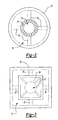
- the air inlet 18 formed between the air horn 24 and air inlet duct 16 is annular as is shown in Figure 2.
- the air inlet duct 16 may take any shape as would be known to a worker skilled in the art such as a rectangular shape as is shown in Figure 3.
- the outlet end 34 of the air horn 24 is disposed substantially within a plane defined by the open end 18.
- Noise propagating from the air induction system and transmitted through the air inlet 16 is shown schematically at A.
- Sound generated by the loudspeaker 22 and transmitted through the air horn 24 is shown schematically at B.
- Transmitting sound from the loudspeaker 22 through the outlet 34 of the air horn 24 at a plane 20 defined by the outlet opening 18 provides optimal sound cancellation.
- the open end 34 of the air horn 24 was disposed in a non-planar arrangement with the open end 18, the sound generated by the loudspeaker 22 and emitted through the open end 34 might mix with the sound A generated from the air induction system 12 and not provide optimal cancellation. This is so because sound waves generated by the loudspeaker 22 and emitted from the open end 34 of air horn 24 might bounce against the inner walls of the inlet 16 thereby creating additional noise and reducing the amount of sound power directed at canceling noise indicated at A.
- the addition of the air horn 24 to the loudspeaker 22 provides for an increase in sound power within the lower frequency ranges. Absent the air horn 24, the loudspeaker 22 would have to be of a much larger size to provide the same sound power output to cancel noise indicated at A generated from the air induction system 12 and engine 14. The addition of the air horn 24 allows for a much smaller loudspeaker 22 to be used in applications especially requiring cancellation of lower frequency noise. Further, lower frequency noise generated by the air induction system 12 and engine 14 are the most undesirable and therefore require cancellation.
- the air horn 24 optimizes the use of the loudspeaker 22 for low frequency noise emitted from the air induction system 12 and engine 14, without the air horn 24, the loudspeaker 22 would need to be approximately 15 inches in diameter. With inclusion of the air horn 24 to the loudspeaker 22, the same noise power at specific lower frequencies can be generated with a 4 inch diameter speaker. Generally, the use of the noise attenuation system 10 will lower the sound output at the inlet 18 by between 15 and 20 decibels.
- Attaching the air horn 24 to the loudspeaker 22 results in an increase in acoustic output at low frequencies.
- the air horn 24 acts as an acoustic transformer matching the impedance of the loudspeaker 22 to that of the air.
- the low frequency acoustic assistance at the throat of the air horn 24 is greater than that acting on a loudspeaker of equal size generating sound without the air horn 24.
- the air horn 24 includes a length 38 and an inner diameter 36.
- the inner diameter 36 defines a cross-sectional area which increases with the distance from the loudspeaker 22.
- the shape of an air horn 24 may be of any type that would be known to a worker skilled in the art such as hyperbola or exponential shape.
- the air horn 24 is preferably of a cross-section that increases directly with distance from the loudspeaker 22.
- a worker in the art would understand how to configure the specific cross-sectional area 20 of the air horn 24 and specifically the change in cross-sectional area along the length 38 of the air horn 24 provides the desired sound power to cancel noise generated and transmitted to the air inlet 16.
- the controller 28 communicates with sound detectors to generate canceling sound transmitted from the loudspeaker 22.
- the sound detectors are preferably microphones 26 that are disposed within the air inlet duct 16. The specific position of the microphones 26 close to the plane 20 as possible such that false noise readings will not be transmitted to the controller 28 caused by sound waves bouncing off internal structures of the air inlet duct such as the supports 40.
- the controller 28 may receive data from the engine 14 concerning engine rpm. The controller 20 will then further tailor the generated electrical signals to the loudspeaker 22 to provide for a better and optimal canceling effect of the noise A.
Landscapes
- Physics & Mathematics (AREA)
- Engineering & Computer Science (AREA)
- Acoustics & Sound (AREA)
- Multimedia (AREA)
- Soundproofing, Sound Blocking, And Sound Damping (AREA)
- Exhaust Silencers (AREA)
Applications Claiming Priority (4)
| Application Number | Priority Date | Filing Date | Title |
|---|---|---|---|
| US28355401P | 2001-04-12 | 2001-04-12 | |
| US283554P | 2001-04-12 | ||
| US10/106,077 US6959093B2 (en) | 2001-04-12 | 2002-03-26 | Low frequency active noise control |
| US106077 | 2002-03-26 |
Publications (3)
| Publication Number | Publication Date |
|---|---|
| EP1249829A2 true EP1249829A2 (fr) | 2002-10-16 |
| EP1249829A3 EP1249829A3 (fr) | 2006-09-13 |
| EP1249829B1 EP1249829B1 (fr) | 2011-08-10 |
Family
ID=26803276
Family Applications (1)
| Application Number | Title | Priority Date | Filing Date |
|---|---|---|---|
| EP02076358A Expired - Lifetime EP1249829B1 (fr) | 2001-04-12 | 2002-04-05 | Système actif de suppression du bruit à basse fréquence |
Country Status (2)
| Country | Link |
|---|---|
| US (1) | US6959093B2 (fr) |
| EP (1) | EP1249829B1 (fr) |
Cited By (1)
| Publication number | Priority date | Publication date | Assignee | Title |
|---|---|---|---|---|
| EP1813801A1 (fr) * | 2006-01-31 | 2007-08-01 | Nissan Motor Co., Ltd. | Appareil et procédé de contrôle d'entrée du son |
Families Citing this family (3)
| Publication number | Priority date | Publication date | Assignee | Title |
|---|---|---|---|---|
| WO2015025484A1 (fr) * | 2013-08-21 | 2015-02-26 | パナソニックIpマネジメント株式会社 | Dispositif de ventilation |
| EP3248394B1 (fr) | 2015-01-19 | 2024-12-11 | 3M Innovative Properties Company | Dispositif de protection auditive avec pavillon acoustique en spirale |
| CN109448690A (zh) * | 2018-09-28 | 2019-03-08 | 天津职业技术师范大学 | 一种气流管道内噪声主动控制测试系统及测试方法 |
Citations (3)
| Publication number | Priority date | Publication date | Assignee | Title |
|---|---|---|---|---|
| US5386689A (en) | 1992-10-13 | 1995-02-07 | Noises Off, Inc. | Active gas turbine (jet) engine noise suppression |
| WO1997020307A1 (fr) | 1995-11-30 | 1997-06-05 | Siemens Electric Limited | Systeme et procede permettant de reduire le bruit d'un moteur |
| WO1997020301A1 (fr) | 1995-11-29 | 1997-06-05 | Plasmaco Inc. | Ecran a plasma a contraste renforce |
Family Cites Families (5)
| Publication number | Priority date | Publication date | Assignee | Title |
|---|---|---|---|---|
| US5446790A (en) * | 1989-11-24 | 1995-08-29 | Nippondenso Co., Ltd. | Intake sound control apparatus |
| JP3099217B2 (ja) * | 1994-04-28 | 2000-10-16 | 株式会社ユニシアジェックス | 自動車用アクティブ騒音制御装置 |
| US6084971A (en) * | 1997-06-10 | 2000-07-04 | Siemens Electric Limited | Active noise attenuation system |
| US5860400A (en) * | 1997-09-17 | 1999-01-19 | Siemens Electric Limited | Intake-exhaust manifold bridge noise attenuation system and method |
| EP1085198B1 (fr) * | 1999-09-14 | 2002-12-04 | Siemens VDO Automotive Inc. | Bruit d'admission contrôlé activement utilisant une admission multipôle |
-
2002
- 2002-03-26 US US10/106,077 patent/US6959093B2/en not_active Expired - Lifetime
- 2002-04-05 EP EP02076358A patent/EP1249829B1/fr not_active Expired - Lifetime
Patent Citations (3)
| Publication number | Priority date | Publication date | Assignee | Title |
|---|---|---|---|---|
| US5386689A (en) | 1992-10-13 | 1995-02-07 | Noises Off, Inc. | Active gas turbine (jet) engine noise suppression |
| WO1997020301A1 (fr) | 1995-11-29 | 1997-06-05 | Plasmaco Inc. | Ecran a plasma a contraste renforce |
| WO1997020307A1 (fr) | 1995-11-30 | 1997-06-05 | Siemens Electric Limited | Systeme et procede permettant de reduire le bruit d'un moteur |
Cited By (1)
| Publication number | Priority date | Publication date | Assignee | Title |
|---|---|---|---|---|
| EP1813801A1 (fr) * | 2006-01-31 | 2007-08-01 | Nissan Motor Co., Ltd. | Appareil et procédé de contrôle d'entrée du son |
Also Published As
| Publication number | Publication date |
|---|---|
| EP1249829A3 (fr) | 2006-09-13 |
| EP1249829B1 (fr) | 2011-08-10 |
| US20020150260A1 (en) | 2002-10-17 |
| US6959093B2 (en) | 2005-10-25 |
Similar Documents
| Publication | Publication Date | Title |
|---|---|---|
| US6084971A (en) | Active noise attenuation system | |
| US5828759A (en) | System and method for reducing engine noise | |
| US5097923A (en) | Active sound attenation system for engine exhaust systems and the like | |
| US4527282A (en) | Method and apparatus for low frequency active attenuation | |
| RU2009334C1 (ru) | Система активного подавления шума выхлопных газов двигателя внутреннего сгорания | |
| US6940983B2 (en) | Resonator for active noise attenuation system | |
| US6959093B2 (en) | Low frequency active noise control | |
| US5255321A (en) | Acoustic transducer for automotive noise cancellation | |
| EP1313090A2 (fr) | Système actif de suppression du bruit avec un résonateur de Helmholtz | |
| JP6373159B2 (ja) | 車両用内燃機関の吸気音増幅装置 | |
| US20030215101A1 (en) | Active noise control system with an elongated transmission member | |
| US6557665B2 (en) | Active dipole inlet using drone cone speaker driver | |
| EP1085198B1 (fr) | Bruit d'admission contrôlé activement utilisant une admission multipôle | |
| JPH0598926A (ja) | 低騒音機器 | |
| EP1162600B1 (fr) | Contrôle actif du bruit d'admission dans un moteur d'une voiture | |
| JPH01236800A (ja) | 能動的消音装置 | |
| JPH0658129A (ja) | 能動型消音器 | |
| JPH0658127A (ja) | 能動型消音器 | |
| EP1085199A2 (fr) | Bruit d'admission contrôlé activement utilisant une admission quadripôle | |
| JP2975966B2 (ja) | 音響コンダクタンス | |
| AU622158B2 (en) | Active sound attenuation system for engine exhaust systems and the like | |
| JPH0693825A (ja) | 能動型消音器 | |
| JPH0674017A (ja) | 能動型消音器 | |
| JPH0525500U (ja) | 能動騒音制御装置 | |
| JPH05288032A (ja) | 内燃機関の排気音消音装置 |
Legal Events
| Date | Code | Title | Description |
|---|---|---|---|
| PUAI | Public reference made under article 153(3) epc to a published international application that has entered the european phase |
Free format text: ORIGINAL CODE: 0009012 |
|
| AK | Designated contracting states |
Kind code of ref document: A2 Designated state(s): AT BE CH CY DE DK ES FI FR GB GR IE IT LI LU MC NL PT SE TR |
|
| AX | Request for extension of the european patent |
Free format text: AL;LT;LV;MK;RO;SI |
|
| PUAL | Search report despatched |
Free format text: ORIGINAL CODE: 0009013 |
|
| AK | Designated contracting states |
Kind code of ref document: A3 Designated state(s): AT BE CH CY DE DK ES FI FR GB GR IE IT LI LU MC NL PT SE TR |
|
| AX | Request for extension of the european patent |
Extension state: AL LT LV MK RO SI |
|
| 17P | Request for examination filed |
Effective date: 20061214 |
|
| AKX | Designation fees paid |
Designated state(s): DE GB |
|
| 17Q | First examination report despatched |
Effective date: 20090729 |
|
| GRAP | Despatch of communication of intention to grant a patent |
Free format text: ORIGINAL CODE: EPIDOSNIGR1 |
|
| GRAS | Grant fee paid |
Free format text: ORIGINAL CODE: EPIDOSNIGR3 |
|
| GRAA | (expected) grant |
Free format text: ORIGINAL CODE: 0009210 |
|
| AK | Designated contracting states |
Kind code of ref document: B1 Designated state(s): DE GB |
|
| REG | Reference to a national code |
Ref country code: GB Ref legal event code: FG4D |
|
| REG | Reference to a national code |
Ref country code: DE Ref legal event code: R096 Ref document number: 60240720 Country of ref document: DE Effective date: 20111013 |
|
| PLBE | No opposition filed within time limit |
Free format text: ORIGINAL CODE: 0009261 |
|
| STAA | Information on the status of an ep patent application or granted ep patent |
Free format text: STATUS: NO OPPOSITION FILED WITHIN TIME LIMIT |
|
| 26N | No opposition filed |
Effective date: 20120511 |
|
| REG | Reference to a national code |
Ref country code: DE Ref legal event code: R097 Ref document number: 60240720 Country of ref document: DE Effective date: 20120511 |
|
| PGFP | Annual fee paid to national office [announced via postgrant information from national office to epo] |
Ref country code: DE Payment date: 20180629 Year of fee payment: 17 |
|
| PGFP | Annual fee paid to national office [announced via postgrant information from national office to epo] |
Ref country code: GB Payment date: 20190429 Year of fee payment: 18 |
|
| REG | Reference to a national code |
Ref country code: DE Ref legal event code: R119 Ref document number: 60240720 Country of ref document: DE |
|
| PG25 | Lapsed in a contracting state [announced via postgrant information from national office to epo] |
Ref country code: DE Free format text: LAPSE BECAUSE OF NON-PAYMENT OF DUE FEES Effective date: 20191101 |
|
| GBPC | Gb: european patent ceased through non-payment of renewal fee |
Effective date: 20200405 |
|
| PG25 | Lapsed in a contracting state [announced via postgrant information from national office to epo] |
Ref country code: GB Free format text: LAPSE BECAUSE OF NON-PAYMENT OF DUE FEES Effective date: 20200405 |