EP1253603A1 - Leitende polymerzusammensetzung und ptc element - Google Patents
Leitende polymerzusammensetzung und ptc element Download PDFInfo
- Publication number
- EP1253603A1 EP1253603A1 EP01902705A EP01902705A EP1253603A1 EP 1253603 A1 EP1253603 A1 EP 1253603A1 EP 01902705 A EP01902705 A EP 01902705A EP 01902705 A EP01902705 A EP 01902705A EP 1253603 A1 EP1253603 A1 EP 1253603A1
- Authority
- EP
- European Patent Office
- Prior art keywords
- polymer composition
- conductive
- conductive polymer
- temperature
- ptc
- Prior art date
- Legal status (The legal status is an assumption and is not a legal conclusion. Google has not performed a legal analysis and makes no representation as to the accuracy of the status listed.)
- Withdrawn
Links
Images

Classifications
-
- H—ELECTRICITY
- H01—ELECTRIC ELEMENTS
- H01C—RESISTORS
- H01C7/00—Non-adjustable resistors formed as one or more layers or coatings; Non-adjustable resistors made from powdered conducting material or powdered semi-conducting material with or without insulating material
- H01C7/02—Non-adjustable resistors formed as one or more layers or coatings; Non-adjustable resistors made from powdered conducting material or powdered semi-conducting material with or without insulating material having positive temperature coefficient
- H01C7/027—Non-adjustable resistors formed as one or more layers or coatings; Non-adjustable resistors made from powdered conducting material or powdered semi-conducting material with or without insulating material having positive temperature coefficient consisting of conducting or semi-conducting material dispersed in a non-conductive organic material
-
- C—CHEMISTRY; METALLURGY
- C08—ORGANIC MACROMOLECULAR COMPOUNDS; THEIR PREPARATION OR CHEMICAL WORKING-UP; COMPOSITIONS BASED THEREON
- C08K—Use of inorganic or non-macromolecular organic substances as compounding ingredients
- C08K3/00—Use of inorganic substances as compounding ingredients
- C08K3/02—Elements
- C08K3/04—Carbon
-
- H—ELECTRICITY
- H01—ELECTRIC ELEMENTS
- H01B—CABLES; CONDUCTORS; INSULATORS; SELECTION OF MATERIALS FOR THEIR CONDUCTIVE, INSULATING OR DIELECTRIC PROPERTIES
- H01B1/00—Conductors or conductive bodies characterised by the conductive materials; Selection of materials as conductors
- H01B1/20—Conductive material dispersed in non-conductive organic material
-
- H—ELECTRICITY
- H01—ELECTRIC ELEMENTS
- H01B—CABLES; CONDUCTORS; INSULATORS; SELECTION OF MATERIALS FOR THEIR CONDUCTIVE, INSULATING OR DIELECTRIC PROPERTIES
- H01B1/00—Conductors or conductive bodies characterised by the conductive materials; Selection of materials as conductors
- H01B1/20—Conductive material dispersed in non-conductive organic material
- H01B1/24—Conductive material dispersed in non-conductive organic material the conductive material comprising carbon-silicon compounds, carbon or silicon
Definitions
- the present invention relates to a novel conductive polymer composition having positive temperature coefficient (PTC) characteristics and a PTC element using the composition.
- PTC positive temperature coefficient
- a PTC element comprising a conductive polymer which exhibits low resistivity at ambient (room) temperature and increases its resistance with increasing temperature (has a positive temperature coefficient of electrical resistance) is used as a protective element against overcurrent in batteries, electronic devices, etc. in case of abnormality.
- Conventional conductive polymers for PTC elements include a composition comprising a mixture of polyethylene having a melting point of 100°C or higher and a copolymer having a melting point of lower than 100°C and a metal boride disclosed in JP-A-2000-21605 and compositions comprising a crystalline polymer such as high-density polyethylene and a conducive filler such as carbon black disclosed, e.g., in JP-A-11-214203 and JP-A-11-5915.
- U.S. Patents 5,837,164, 5,985,182, 6,074,576, and 6,090,313 disclose compositions comprising a semi-crystalline polymer containing nylon 11 and a carbon-based particulate conductive filler, describing that the compositions are characterized by exhibiting at least 10 3 times as much electrical specific resistance at a switching temperature ranging from 140 to 200°C as that at 25°C.
- JP-A-5-3103 discloses a radiation-crosslinked conductive polymer composition, etc.
- U.S. Patent 4,980,541 discloses a conductive polymer composition (i) which exhibits PTC behavior, (ii) which has a resistivity R cp of 0.01 to 100 ⁇ cm at 20°C, and (iii) and which comprises (a) an organic polymer having a crystallinity of at least 5% and a melting point T m and (b) carbon black having a pH of less than 4.0, reciting olefin polymers or copolymers such as polyethylene, fluorine-containing polymers, and the like as examples of the organic polymer (a).
- U.S. Patents 5,181,006 and 5,093,036 discloses a polymer thick film ink comprising (1) an organic polymer having a crystallinity of at least 5%, (2) an active solvent suitable for dissolving the polymer at room temperature, and (3) carbon black having a pH of less than 4.0.
- the recited organic polymer (1) includes polymers comprising at least one olefin; copolymers comprising at least one olefin and at least one monomer copolymerizable therewith, e.g., ethylene/acrylic acid, ethylene/ethyl acrylate, and ethylene/vinyl acetate; polyalkenamers such as polyoctenamer; melt-shapeable fluoropolymers, such as polyvinylidene fluoride and copolymers thereof; and blends of two or more such crystalline polymers.
- U.S. Patent 4,304,987 discloses a composition having PTC characteristics which comprises a crystalline polymer and carbon black, reciting olefin polymers or copolymers such as polyethylene and fluorine-containing polymers as the crystalline polymer.
- the U.S. Patent teaches that the composition is preferably crosslinked by irradiation or heating.
- the resistivity reaches the maximum at around 130°C and decreases in a higher temperature range.
- the conventional polymer compositions manifest their PTC characteristics through the following mechanism.
- conductive particles dispersed in the noncrystalline region of the polymeric component are in contact with each other to form a route for electric conduction to show low resistance.
- the crystalline region of the polymeric component melts to increase the volume of the noncrystalline region.
- the distance among the conductive particles increases to cut the conduction route thereby showing high resistance.
- the volume of the noncrystalline region of the polymeric component reduces to bring the conductive particles closer to each other to re-form the conduction route thereby exhibiting low resistance.
- the conventional polymer compositions rely on melting of crystalline polymers for the PTC behavior. Therefore, in order for the conventional polymer compositions to be applied to PTC elements, they need a special process for flow prevention, such as irradiation crosslinking, so as to retain the shape of the element. Further, because the above-described polymers are slow in melting, which can result in retarded PTC behavior, sharper behavior has been desired.
- PTC elements in some applications are required to work at lower temperatures than conventional switching temperatures, and improvement in this respect has been demanded.
- PTC elements comprising some conventional polymer compositions have poor stability to repetition, and improvement in this point has also been required.
- NTC negative temperature coefficient
- trans-1,4-polybutadiene has crystal polymorphism and shows phase transition at around 50 to 80°C. That is, it is said that the crystal form in a low-temperature phase is a monoclinic phase, which changes to a pseudohexagonal crystal form at a high temperature (see, for example, Polymer Preprints, Japan , vol. 49, No. 8 (2000)).
- trans-polybutadiene exhibits crystalline modifications I and II having a density of 0.97 gcm -3 and 0.93 gcm -3 , respectively, and transition from modification I to modification II occurs at 75°C.
- an object of the present invention is to provide a conductive polymer composition which exhibits PTC behavior at relatively low temperature, shows sharp PTC behavior with stability to repetition, does not flow with temperature elevation and therefore needs no processing step for retaining the shape of a PTC element, and has a wide temperature latitude for producing high resistance.
- the present invention accomplishes the above object by providing a conductive polymer composition exhibiting PTC characteristics and comprising 100 parts by weight of a crystalline polymer (A) and 5 to 150 parts by weight of a conductive powder (B) dispersed in the crystalline polymer (A), which is characterized in that the crystalline polymer (A) shows crystal transition.
- the present invention provides the above-described conductive polymer composition characterized in that the crystalline polymer (A) increases in volume due to crystal transition thereby imparting PTC characteristics to the composition.
- the present invention also provides the above-described conductive polymer composition characterized in that the crystalline polymer (A) is trans-1,4-polybutadiene having a trans-1,4-bond content of 85% or more
- the present invention also provides the above-described conductive polymer composition characterized in that the conductive powder (B) is carbon black.
- the present invention also provides the above-described conductive polymer composition characterized in that the carbon black has a pH of 6 or higher.
- the present invention also provides a PTC element characterized by using the above-described conductive polymer composition.
- the crystalline polymer (A) which can be used in the present invention is a polymer showing crystal transition. It is preferred for this polymer to increase in volume through crystal transition in a solid state. It is preferred that the increase in volume through crystal transition be steep.
- the crystalline polymer preferably has a crystallinity of 5% or more, particularly 10 to 60%.
- Methods of measuring crystallinity include X-ray diffractometry, density method, and differential thermal analysis.
- the crystalline polymer has a low-temperature stable crystal form and a high-temperature stable crystal form and undergoes crystal transition at a transition temperature.
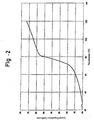
- the crystal transition is accompanied with a volume change, which can be seen from a dramatic rise of a linear expansion coefficient in the vicinity of the crystal transition point (see Fig. 2).
- the crystalline polymer that can be used suitably includes crystalline trans-diene polymers showing crystal transition, such as trans-1,4-polybutadiene, trans-1,4-polyisoprene, and trans-2,3-dichlorobutadiene, with trans-1,4-polybutadiene being particularly preferred.
- Trans-1,4-polybutadiene shows phase transition at around 50 to 80°C.
- the mechanism of PTC characteristics manifestation of PTC elements using the conductive polymer composition of the invention does not rely on polymer's melting as in those using the conventional conductive polymers but on the crystal transition of the crystalline polymer.
- the trans-1,4-polybutadiene used as a crystalline polymer has a trans-1,4-bond content of 85% or more, particularly 90% or more, especially 99% or more, as calculated from IR, 1 H-NMR, 13 C-NMR or like spectra.
- a lower trans-1,4-bond content results in reduced polymer regularity, leading to a reduced crystallinity.
- the weight average molecular weight of the trans-1,4-polybutadiene is preferably, but not limited to, 10,000 to 120,000. Greater weight average molecular weights can reduce the crystallinity or make processing difficult. Smaller weight average molecular weights can result in poor strength or toughness.
- the term "weight average molecular weight” as referred to herein is one obtained by gel-permeation chromatography (GPC) using styrene as standards and o-dichlorobenzene as a solvent.
- the trans-1,4-polybutadiene preferably has a molecular weight distribution, i.e., the ratio of weight average molecular weight (Mw) to number average molecular weight (Mn), Mw/Mn, of 3 or less.
- the trans-1,4-polybutadiene preferably has a melting point of 120 to 145°C.
- the trans-1,4-polybutadiene exhibits crystal transition from a low-temperature crystal structure to a high-temperature crystal structure, which is observable as heat generation accompanying crystal transition in the measurement with a differential scanning calorimeter (DSC).
- the crystal transition temperature which ranges from 50 to 80°C, can be varied with variations in molecular weight, microstructure, and the like.
- the trans-1,4-polybutadiene has a high transition rate between the two crystal structures and therefore exhibits excellent PTC characteristics when formulated as a conductive polymer composition.
- the heat generation accompanying phase transition is preferably 50 to 250 J/g, still preferably 80 to 200 J/g.
- the crystallinity of the trans-1,4-polybutadiene which can be evaluated from heat generation at the melting point in DSC measurement, is preferably 5% or more.
- the melting point and crystal transition point of the trans-1,4-polybutadiene can be measured with a differential scanning calorimeter (DSC) as follows. In a nitrogen atmosphere, a sample is heated at a constant rate to once melt completely at 200°C, then cooled at a constant rate to 30°C to recrystallize, and again heated up to 200°C. The differential calories are measured in the second temperature rise, and the peak temperatures corresponding to the melting and the crystal transition are taken as the melting point and the crystal transition point, respectively.
- DSC differential scanning calorimeter
- the trans-1,4-polybutadiene can have improved stability and a prolonged life by addition of antioxidants, photo stabilizers, thermal stabilizers, flame retardants, and the like, which include amine-ketone types, aromatic secondary amine types, monophenol types, bisphenol types, polyphenol types, benzimidazole types, dithiocarbamic acid types, thiourea types, phosphorous acid types, organic thio acid types, special wax types, and mixed systems comprising two or more of these types.
- the antioxidants include, for example, tris(nonylphenyl) phosphite and 2,6-di-t-butyl-4-methylphenol.
- the trans-1,4-polybutadiene can further contain 0.01 to 6% by weight of nucleating agents, such as organic ones, inorganic ones, and high-melting point polymeric ones.
- the trans-1,4-polybutadiene can be prepared by known polymerization methods.
- Catalysts based on vanadium, titanium, nickel, cobalt, barium, lithium or the like can be used. Preferred of them are vanadium- or titanium-based catalysts. Vanadium catalysts include triacetylacetonatovanadium, vanadium trichloride-THF complex, vanadium oxytrichloride, and vanadium naphthenate. Cocatalysts which can be used in the catalyst systems include organometallic compounds, organometallic halides, and organometallic hydrides of the metals belonging to the groups I to III of the Periodic Table and an alumoxane.
- organometallic halides specifically chlorinated organoaluminum compounds such as ethylaluminum sesquichloride (EASC) and diethylaluminum chloride (DEAC), are preferably used.
- EASC ethylaluminum sesquichloride
- DEAC diethylaluminum chloride
- catalysts or cocatalysts may be used either individually or as a mixture thereof.
- Polymerization methods which can be adopted include solution polymerization using a solvent, gas-phase polymerization using a supported catalyst, and bulk polymerization using a butadiene monomer as a medium.
- Solvents which can be used in solution polymerization include aliphatic hydrocarbons, such as pentane, hexane, heptane, and cyclohexane; aromatic hydrocarbons, such as benzene, toluene, and xylene; halogenated hydrocarbons, such as chloroform, methylene chloride, dichloroethane, and chlorobenzene; and mineral oil.
- aliphatic hydrocarbons such as pentane, hexane, heptane, and cyclohexane
- aromatic hydrocarbons such as benzene, toluene, and xylene
- halogenated hydrocarbons such as chloroform, methylene chloride, dichloroethane, and chlorobenzene
- mineral oil such as mineral oil.
- polymerization is usually carried out at a temperature of -20 to 100°C, preferably -10 to 70°C, for a period of 1 minute to 12 hours, preferably 5 minutes to 2 hours.
- butadiene can be polymerized in the presence of the above-described catalyst system, it is possible to copolymerize butadiene with a small amount of an olefin of different kind, a conjugated diene or a non-conjugated diene as long as such does not impair the polymer physical properties.
- the olefin includes ethylene, propylene, butene-1, 4-methylpentene-1, hexene-1, octene-1, norbornene, cyclopentene, and trimethylvinylsilane.
- the conjugated diene includes isoprene, 2,3-dimethylbutadiene, 1,3-pentadiene, 2-methyl-1,3-pentadiene, 4-methyl-1,3-pentadiene, and 2,4-hexadiene.
- the non-conjugated diene includes dicyclopentadiene, 5-ethylidene-2-norbornene, and 1,5-hexadiene.
- the conductive powder (B) used in the present invention includes graphite, carbon black, carbon fiber, carbon whisker, conductive metal powder, and inorganic compounds coated with a thin film of carbon or metal. Carbon black is especially preferred of them.
- Carbon blacks which can be used include commercially available acetylene black (e.g., Denka Black from Denki Kagaku Kogyo K.K.) and Ketjen black (available from Mitsubishi Chemical Corp.). It is preferred for the carbon blacks to be fine with a small particle size, to have a high structure, and to have a high degree of graphitization. Carbon blacks of various shapes and properties can be used. For example, carbon black having a pH of 6 to 10 is preferably used.
- the conductive metal powder includes metals, e.g., nickel (Ni), silver (Ag), copper (Cu), titanium (Ti), iron (Fe), tungsten (W), and tin (Sn), and alloys thereof. These powders can be used either individually or as a mixture thereof.
- a mixture of the above-described carbon black and conductive metal powder can be used as a conductive powder.
- the carbon black and the conductive metal powder are preferably used at a weight ratio of 0.1 to 20:1.
- the conductive polymer composition of the present invention comprises 100 parts by weight of the crystalline polymer (A) and 5 to 150 parts by weight, preferably 5 to 70 parts by weight, of the conductive powder (B). If the proportion of the conductive powder (B) is less than 5 parts by weight, the conductivity at room temperature would be insufficient. If it exceeds 150 parts by weight, the conductive powder is difficult to disperse in the polymer, which results in reduction of mechanical strength of the composition.
- the components are mixed by methods commonly employed for compounding a resin composition by kneading.
- Useful kneading machines include a Brabender, a single-screw extruder, a twin-screw extruder, a Banbury mixer, a heat roll, a kneader, a mixing roll, a three-roll, and a planetary mixer.
- the conductive polymer composition of the present invention which is obtained by kneading the above-recited components can be molded into an arbitrary shape, such as sheeting, molded parts, film, pipes, and tubing, by injection molding, blow molding, extrusion, and the like techniques.
- the conductive polymer composition of the present invention can also be molded into sheeting or film by dissolving the composition in a good solvent for the polymer to prepare an ink and applying the ink to a substrate by means of, for example, a doctor blade.
- the PTC element according to the present invention comprises a conductive sheet, prepared by molding the conductive polymer composition of the invention into sheeting, having formed on each side thereof a metal plate electrode made of gold, silver, copper, aluminum, nickel, stainless steel, iron, an iron alloy, a copper alloy, etc. with or without an adhesive layer interposed therebetween. It is the same as conventional PTC elements, except that the conductive sheet is made of the conductive polymer composition of the present invention.
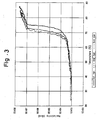
- the conductive polymer composition of the present invention exhibits PTC behavior at relatively low temperatures (lower than 90°C) and maintains excellent performance showing only a small increase of resistance after repeated operation (PTC behavior stability to repetition).
- PTC behavior denotes the character of the conductive polymer composition such that there is at least one temperature T x at which the ratio of specific resistance R 1 at 25°C to specific resistance R 2 at temperature T x satisfies relationship: log(R 2 /R 1 ) ⁇ 1.5, desirably log(R 2 /R 1 ) ⁇ 4.
- the conductive polymer composition of the invention has such a T x in a range above the phase transition temperature of the crystalline polymer and below the melting point of the crystalline polymer.
- the conductive polymer composition of the invention exhibits a specific resistance of 10 -1 to 10 4 ⁇ cm in low temperature (0 to 60°C) and of 10 3 to 10 10 ⁇ cm in high temperature (80 to 100°C).
- the conductive polymer composition of the invention is characterized by undergoing little change in resistance when used repeatedly as a PTC element.
- the conductive polymer composition of the invention when used as a PTC element, shows continuity of temperature T x over a width of 40 to 50°C.
- the PTC element has a latitude of temperature in which it exhibits high resistance.
- the conductive polymer composition of the invention when used as a PTC element, exhibits a steep PTC characteristic curve.
- the PTC element is characterized in that the rate of resistance increase is sensitive to temperature. For example, a low-to-high change in resistivity of the order of 10 3 occurs with a temperature change within 15°C.
- the conductive polymer composition of the present invention manifests PTC characteristics through crystal conversion, differing in terms of PTC characteristics manifestation mechanism from conventional crystalline polymer compositions which count on melting of the crystalline polymer. Hence, the conductive polymer composition of the invention exhibits PTC characteristics in a relatively lower temperature range than its melting point, in which range it is capable of retaining its shape. Accordingly, the conductive polymer composition of the invention does not require such a step as crosslinking for shape retention that has been needed for the conventional polyethylene compositions.
- the PTC element comprising the conductive polymer composition of the invention is suited for use as circuit protective elements, temperature-sensing switches, and the like, more particularly for protection of transformers and motors from overheat, protection of ICs or LSIs from overheat and overcurrent, protection of battery packs from overheat and overcurrent, and protection of computers and peripheral equipment thereof from overheat and overcurrent.
- the conductive polymer composition of the present invention undergoes only small deformation under pressure application in the vicinity of the switching temperature of the PTC characteristics as compared with the conventional ones and are therefore fit for a variety of applications.
- trans-1,4-bond content was calculated based on the IR spectrum obtained by KBr tablet method with a diffraction grating infrared spectrophotometer (FT-IR) JIR-5500 manufactured by JEOL Ltd. More specifically, the area of a peak in the vicinity of 966 cm -1 that is assigned to trans-1,4-bonds, the area of a peak in the vicinity of 730 cm -1 that is assigned to cis-1,4-bonds, and the area of a peak in the vicinity of 912 cm -1 that is assigned to vinyl bonds are measured, and the peak area corresponding to trans-1,4-bonds is divided by the sum of these peak areas to give the content of trans-1,4-bonds.
- FT-IR diffraction grating infrared spectrophotometer
- the melting point and crystal transition point were measured as follows.
- a differential scanning calorimeter (DSC) SSC5200 supplied by Seiko Instruments Inc. was used. In a nitrogen atmosphere, a 10 mg sample sealed into an aluminum-made sample pan was heated from room temperature at a rate of 10°C/min up to 200°C, at which it was kept for 5 minutes to melt completely, then cooled at a rate of 10°C/min to 30°C, at which it was kept for 5 minutes to recrystallize, and reheated up to 200°C at a rate of 10°C/min. The differential heat was measured in the second temperature rise. The temperatures of the peaks corresponding to melting and crystal transition were taken as melting point and crystal transition point, respectively.
- VOCl 3 vanadium oxytrichloride
- DEC diethylaluminum chloride
- the resulting polybutadiene weighed 4.8 kg and had a weight average molecular weight of 112,000, a trans-1,4-bond content of 99%, a melting point of 131°C, and a crystal transition point of 72°C.
- the heat generated on crystal transition was 112 J/g, and that on melting was 55 J/g.
- the crystallinity of the polybutadiene was 65%.
- the DSC chart of the polybutadiene is shown in Fig. 1.
- Fig. 2 shows the linear expansion coefficient (vs. temperature) of the polybutadiene measured by heating from room temperature up to 120°C at a rate of 5°C/min with TMA-50 supplied by Shimadzu Corp.
- the linear expansion coefficient of the polybutadiene abruptly increases in the vicinity of the crystal transition point, proving that the polybutadiene increases its volume around the crystal transition point.
- Example 1 To 100 parts by weight of the trans-1,4-polybutadiene prepared in Reference Example 1 was added a prescribed amount of a conductive polymer as shown in Table 1 below, and the mixture was kneaded in a Brabender at 190°C for 15 minutes to prepare a conductive polymer composition. Each of the resulting compositions was molded into a 1 mm thick sheet, which was fabricated into a PTC element in the same manner as in Example 1. As is seen from Table 2 below, every PTC element exhibited PTC characteristics. The properties of the conductive powders used in Examples are shown in Table 3 below. Example No.
- the conductive polymer composition according to the present invention exhibits PTC behavior in relatively low temperature, shows sharp PTC behavior with stability to repetition, does not flow with temperature elevation and therefore needs no processing step for retaining the shape of a PTC element, and has a wide temperature latitude for producing high resistivity, and is therefore useful as a PTC element material.
Landscapes
- Chemical & Material Sciences (AREA)
- Physics & Mathematics (AREA)
- Dispersion Chemistry (AREA)
- Engineering & Computer Science (AREA)
- Spectroscopy & Molecular Physics (AREA)
- Microelectronics & Electronic Packaging (AREA)
- Electromagnetism (AREA)
- Ceramic Engineering (AREA)
- Health & Medical Sciences (AREA)
- Chemical Kinetics & Catalysis (AREA)
- Medicinal Chemistry (AREA)
- Polymers & Plastics (AREA)
- Organic Chemistry (AREA)
- Compositions Of Macromolecular Compounds (AREA)
- Thermistors And Varistors (AREA)
Applications Claiming Priority (3)
| Application Number | Priority Date | Filing Date | Title |
|---|---|---|---|
| JP2000023942 | 2000-02-01 | ||
| JP2000023942 | 2000-02-01 | ||
| PCT/JP2001/000666 WO2001057889A1 (en) | 2000-02-01 | 2001-01-31 | Conductive polymer composition and ptc element |
Publications (2)
| Publication Number | Publication Date |
|---|---|
| EP1253603A1 true EP1253603A1 (de) | 2002-10-30 |
| EP1253603A4 EP1253603A4 (de) | 2006-03-08 |
Family
ID=18550022
Family Applications (1)
| Application Number | Title | Priority Date | Filing Date |
|---|---|---|---|
| EP01902705A Withdrawn EP1253603A4 (de) | 2000-02-01 | 2001-01-31 | Leitende polymerzusammensetzung und ptc element |
Country Status (5)
| Country | Link |
|---|---|
| US (1) | US6773634B2 (de) |
| EP (1) | EP1253603A4 (de) |
| JP (1) | JP3659226B2 (de) |
| AU (1) | AU2001230551A1 (de) |
| WO (1) | WO2001057889A1 (de) |
Cited By (4)
| Publication number | Priority date | Publication date | Assignee | Title |
|---|---|---|---|---|
| EP1505118A1 (de) * | 2003-08-01 | 2005-02-09 | Arkema | PTC-Effekt-Zusammensetzungen auf Basis von PVDF und ihre Anwendungen für selbstregulierende Heizsysteme |
| DE102005025210A1 (de) * | 2005-06-01 | 2006-12-21 | Siemens Ag | Elektronisches Gerät mit einem Widerstand |
| EP1642912A4 (de) * | 2003-07-07 | 2008-03-12 | Ube Industries | Kristallines polymer mit festphasenübergangsphänomen und verwendung davon |
| WO2018215534A1 (de) * | 2017-05-24 | 2018-11-29 | Webasto SE | Heizgerät sowie verfahren zur herstellung, verfahren zum betreiben und verwendung eines solchen |
Families Citing this family (14)
| Publication number | Priority date | Publication date | Assignee | Title |
|---|---|---|---|---|
| MXPA03003550A (es) * | 2000-10-27 | 2003-10-14 | Milliken & Co | Tejido termico. |
| US20040177016A1 (en) * | 2002-09-30 | 2004-09-09 | Jones Emerson P. | Method and system for analyzing a capital structure for a company |
| US7064299B2 (en) * | 2003-09-30 | 2006-06-20 | Milliken & Company | Electrical connection of flexible conductive strands in a flexible body |
| US7049557B2 (en) | 2003-09-30 | 2006-05-23 | Milliken & Company | Regulated flexible heater |
| US7193179B2 (en) * | 2005-01-12 | 2007-03-20 | Milliken & Company | Channeled under floor heating element |
| US7180032B2 (en) * | 2005-01-12 | 2007-02-20 | Milliken & Company | Channeled warming mattress and mattress pad |
| US20060150331A1 (en) * | 2005-01-12 | 2006-07-13 | Child Andrew D | Channeled warming blanket |
| US7038170B1 (en) | 2005-01-12 | 2006-05-02 | Milliken & Company | Channeled warming blanket |
| US7189944B2 (en) * | 2005-05-18 | 2007-03-13 | Milliken & Company | Warming mattress and mattress pad |
| US7193191B2 (en) | 2005-05-18 | 2007-03-20 | Milliken & Company | Under floor heating element |
| US7034251B1 (en) | 2005-05-18 | 2006-04-25 | Milliken & Company | Warming blanket |
| US8728354B2 (en) * | 2006-11-20 | 2014-05-20 | Sabic Innovative Plastics Ip B.V. | Electrically conducting compositions |
| KR101009526B1 (ko) * | 2008-12-10 | 2011-01-18 | 삼성에스디아이 주식회사 | 배터리 팩 |
| CN110233013B (zh) * | 2018-03-05 | 2021-07-16 | 中国振华集团云科电子有限公司 | 一种温补衰减器及其制备方法 |
Family Cites Families (25)
| Publication number | Priority date | Publication date | Assignee | Title |
|---|---|---|---|---|
| US3760495A (en) * | 1970-01-27 | 1973-09-25 | Texas Instruments Inc | Process for making conductive polymers |
| US4304987A (en) | 1978-09-18 | 1981-12-08 | Raychem Corporation | Electrical devices comprising conductive polymer compositions |
| JPH0744086B2 (ja) * | 1987-03-10 | 1995-05-15 | 出光興産株式会社 | 高分子正温度特性抵抗体 |
| JP2631117B2 (ja) | 1988-01-18 | 1997-07-16 | 出光興産株式会社 | 正温度特性発熱素子の製造方法 |
| JPH01304704A (ja) * | 1988-06-01 | 1989-12-08 | Mitsubishi Cable Ind Ltd | Ptc挙動有機高分子組成物 |
| US5181006A (en) | 1988-09-20 | 1993-01-19 | Raychem Corporation | Method of making an electrical device comprising a conductive polymer composition |
| US5093036A (en) | 1988-09-20 | 1992-03-03 | Raychem Corporation | Conductive polymer composition |
| US4980541A (en) | 1988-09-20 | 1990-12-25 | Raychem Corporation | Conductive polymer composition |
| JPH0688350B2 (ja) * | 1990-01-12 | 1994-11-09 | 出光興産株式会社 | 正温度係数特性成形体の製造方法 |
| US5090313A (en) * | 1990-07-02 | 1992-02-25 | Textile Graphics Unlimited, Inc. | Multi-color silk screen printer having separable two-piece platen for removal and replacement of printed material without loss of registry |
| JPH053103A (ja) | 1991-06-26 | 1993-01-08 | Matsushita Electric Ind Co Ltd | サーミスタ磁器 |
| JP3709613B2 (ja) | 1996-01-31 | 2005-10-26 | 宇部興産株式会社 | 蓄熱材 |
| JPH09233687A (ja) * | 1996-02-20 | 1997-09-05 | Ngk Insulators Ltd | 中性点接地方式 |
| JPH09288993A (ja) * | 1996-04-19 | 1997-11-04 | Sharp Corp | 照明装置及びこの照明装置を利用した表示装置 |
| US5985182A (en) | 1996-10-08 | 1999-11-16 | Therm-O-Disc, Incorporated | High temperature PTC device and conductive polymer composition |
| US5837164A (en) | 1996-10-08 | 1998-11-17 | Therm-O-Disc, Incorporated | High temperature PTC device comprising a conductive polymer composition |
| JPH10208902A (ja) | 1997-01-21 | 1998-08-07 | Tdk Corp | 有機ptcサーミスタの製造方法 |
| JPH10270204A (ja) * | 1997-03-26 | 1998-10-09 | Tokin Corp | 有機ptc複合材料 |
| JPH115915A (ja) | 1997-06-16 | 1999-01-12 | Tokin Corp | 導電性組成物 |
| DE19754976A1 (de) * | 1997-12-11 | 1999-06-17 | Abb Research Ltd | Schutzelement |
| JPH11214203A (ja) | 1998-01-29 | 1999-08-06 | Unitika Ltd | Ptc素子及びその製造方法 |
| US6074576A (en) | 1998-03-24 | 2000-06-13 | Therm-O-Disc, Incorporated | Conductive polymer materials for high voltage PTC devices |
| JP2000021605A (ja) | 1998-06-26 | 2000-01-21 | Tokin Corp | Ptc組成物 |
| US6396384B1 (en) * | 2000-10-10 | 2002-05-28 | Therm-O-Disc, Incorporated | Conductive polymer compositions containing perhydrotriphenylene |
| JP4487455B2 (ja) * | 2001-07-31 | 2010-06-23 | 宇部興産株式会社 | 導電性ポリマー組成物およびptc素子 |
-
2001
- 2001-01-31 WO PCT/JP2001/000666 patent/WO2001057889A1/ja not_active Ceased
- 2001-01-31 JP JP2001557055A patent/JP3659226B2/ja not_active Expired - Fee Related
- 2001-01-31 US US10/169,252 patent/US6773634B2/en not_active Expired - Fee Related
- 2001-01-31 EP EP01902705A patent/EP1253603A4/de not_active Withdrawn
- 2001-01-31 AU AU2001230551A patent/AU2001230551A1/en not_active Abandoned
Cited By (4)
| Publication number | Priority date | Publication date | Assignee | Title |
|---|---|---|---|---|
| EP1642912A4 (de) * | 2003-07-07 | 2008-03-12 | Ube Industries | Kristallines polymer mit festphasenübergangsphänomen und verwendung davon |
| EP1505118A1 (de) * | 2003-08-01 | 2005-02-09 | Arkema | PTC-Effekt-Zusammensetzungen auf Basis von PVDF und ihre Anwendungen für selbstregulierende Heizsysteme |
| DE102005025210A1 (de) * | 2005-06-01 | 2006-12-21 | Siemens Ag | Elektronisches Gerät mit einem Widerstand |
| WO2018215534A1 (de) * | 2017-05-24 | 2018-11-29 | Webasto SE | Heizgerät sowie verfahren zur herstellung, verfahren zum betreiben und verwendung eines solchen |
Also Published As
| Publication number | Publication date |
|---|---|
| JP3659226B2 (ja) | 2005-06-15 |
| WO2001057889A1 (en) | 2001-08-09 |
| EP1253603A4 (de) | 2006-03-08 |
| AU2001230551A1 (en) | 2001-08-14 |
| US6773634B2 (en) | 2004-08-10 |
| US20030015285A1 (en) | 2003-01-23 |
Similar Documents
| Publication | Publication Date | Title |
|---|---|---|
| US6773634B2 (en) | Conductive polymer composition and PTC element | |
| JPWO2001057889A1 (ja) | 導電性ポリマー組成物およびptc素子 | |
| US6358438B1 (en) | Electrically conductive polymer composition | |
| US7286038B1 (en) | Over-current protection device | |
| JP5711365B2 (ja) | 正温度係数抵抗を有する導電性複合材料及び過電流保護素子 | |
| CA1142342A (en) | Low resistivity ptc compositions | |
| US6294257B1 (en) | Conductive elastomer film, method for production thereof, and conductive elastomer composition | |
| EP0224903B1 (de) | Polymerzusammensetzung mit positiven Temperaturkoeffizienten-Charakteristiken | |
| US6274852B1 (en) | Conductive polymer compositions containing N-N-M-phenylenedimaleimide and devices | |
| TWI529753B (zh) | 過電流保護元件 | |
| JP5481098B2 (ja) | 後硬化性樹脂組成物及びそれを用いた電気絶縁材料 | |
| KR20100123759A (ko) | 수지 조성물 및 그것을 이용한 시트 | |
| WO2003081607A1 (en) | Ptc conductive composition containing a low molecular weight polyethylene processing aid | |
| TWI440616B (zh) | 過電流保護元件 | |
| JP3896232B2 (ja) | 有機質正特性サーミスタおよびその製造方法 | |
| JP3564442B2 (ja) | 過電流保護装置 | |
| TWI298598B (en) | Over-current protection device | |
| WO1999002585A1 (en) | Conductive resin film, conductive resin composition, and process for producing the film | |
| JP2024510003A (ja) | バッテリ電極プレート用の導電性組成物 | |
| JP2011153214A (ja) | 導電性樹脂組成物及び導電性シ−ト | |
| CA2170186A1 (en) | Ptc element and process for producing the same | |
| JP4487455B2 (ja) | 導電性ポリマー組成物およびptc素子 | |
| TWI413991B (zh) | 過電流保護元件 | |
| Tanrattanakul et al. | Microwave absorbing rubber composites containing carbon black and aluminum powder | |
| WO2020034979A1 (zh) | 高分子基导电复合材料及过流保护元件 |
Legal Events
| Date | Code | Title | Description |
|---|---|---|---|
| PUAI | Public reference made under article 153(3) epc to a published international application that has entered the european phase |
Free format text: ORIGINAL CODE: 0009012 |
|
| 17P | Request for examination filed |
Effective date: 20020625 |
|
| AK | Designated contracting states |
Kind code of ref document: A1 Designated state(s): AT BE CH CY DE DK ES FI FR GB GR IE IT LI LU MC NL PT SE TR |
|
| AX | Request for extension of the european patent |
Free format text: AL;LT;LV;MK;RO;SI |
|
| A4 | Supplementary search report drawn up and despatched |
Effective date: 20060123 |
|
| GRAP | Despatch of communication of intention to grant a patent |
Free format text: ORIGINAL CODE: EPIDOSNIGR1 |
|
| RTI1 | Title (correction) |
Free format text: CONDUCTIVE POLYMER COMPOSITION EXHIBITING PTC PROPERTIES AND A PTC ELEMENT COMPRISING THIS POLYMER COMPOSITION |
|
| STAA | Information on the status of an ep patent application or granted ep patent |
Free format text: STATUS: THE APPLICATION IS DEEMED TO BE WITHDRAWN |
|
| 18D | Application deemed to be withdrawn |
Effective date: 20071026 |