EP1259414B1 - Verfahren und vorrichtung zur entfernung von flüssigkeit von der heckscheibe eines motorfahrzeuges - Google Patents
Verfahren und vorrichtung zur entfernung von flüssigkeit von der heckscheibe eines motorfahrzeuges Download PDFInfo
- Publication number
- EP1259414B1 EP1259414B1 EP01910980A EP01910980A EP1259414B1 EP 1259414 B1 EP1259414 B1 EP 1259414B1 EP 01910980 A EP01910980 A EP 01910980A EP 01910980 A EP01910980 A EP 01910980A EP 1259414 B1 EP1259414 B1 EP 1259414B1
- Authority
- EP
- European Patent Office
- Prior art keywords
- coating
- carbon
- backlite
- air
- hydrophobic coating
- Prior art date
- Legal status (The legal status is an assumption and is not a legal conclusion. Google has not performed a legal analysis and makes no representation as to the accuracy of the status listed.)
- Expired - Lifetime
Links
- 238000000034 method Methods 0.000 title claims abstract description 22
- 239000007788 liquid Substances 0.000 title description 15
- 238000000576 coating method Methods 0.000 claims abstract description 190
- 239000011248 coating agent Substances 0.000 claims abstract description 185
- 239000000758 substrate Substances 0.000 claims abstract description 63
- 230000002209 hydrophobic effect Effects 0.000 claims abstract description 53
- XLYOFNOQVPJJNP-UHFFFAOYSA-N water Substances O XLYOFNOQVPJJNP-UHFFFAOYSA-N 0.000 claims abstract description 38
- 229910052799 carbon Inorganic materials 0.000 claims abstract description 25
- OKTJSMMVPCPJKN-UHFFFAOYSA-N Carbon Chemical compound [C] OKTJSMMVPCPJKN-UHFFFAOYSA-N 0.000 claims abstract description 17
- 239000011203 carbon fibre reinforced carbon Substances 0.000 claims description 41
- 239000011521 glass Substances 0.000 claims description 24
- 229910052710 silicon Inorganic materials 0.000 claims description 16
- 229910052760 oxygen Inorganic materials 0.000 claims description 15
- VYPSYNLAJGMNEJ-UHFFFAOYSA-N Silicium dioxide Chemical compound O=[Si]=O VYPSYNLAJGMNEJ-UHFFFAOYSA-N 0.000 claims description 13
- 229910052739 hydrogen Inorganic materials 0.000 claims description 12
- 229910052731 fluorine Inorganic materials 0.000 claims description 9
- QVGXLLKOCUKJST-UHFFFAOYSA-N atomic oxygen Chemical compound [O] QVGXLLKOCUKJST-UHFFFAOYSA-N 0.000 claims description 8
- 239000001301 oxygen Substances 0.000 claims description 8
- 239000001257 hydrogen Substances 0.000 claims description 7
- XUIMIQQOPSSXEZ-UHFFFAOYSA-N Silicon Chemical compound [Si] XUIMIQQOPSSXEZ-UHFFFAOYSA-N 0.000 claims description 6
- 239000010703 silicon Substances 0.000 claims description 6
- 239000000377 silicon dioxide Substances 0.000 claims description 6
- PXGOKWXKJXAPGV-UHFFFAOYSA-N Fluorine Chemical compound FF PXGOKWXKJXAPGV-UHFFFAOYSA-N 0.000 claims description 5
- KKCBUQHMOMHUOY-UHFFFAOYSA-N Na2O Inorganic materials [O-2].[Na+].[Na+] KKCBUQHMOMHUOY-UHFFFAOYSA-N 0.000 claims description 5
- PNEYBMLMFCGWSK-UHFFFAOYSA-N aluminium oxide Inorganic materials [O-2].[O-2].[O-2].[Al+3].[Al+3] PNEYBMLMFCGWSK-UHFFFAOYSA-N 0.000 claims description 5
- 229910052681 coesite Inorganic materials 0.000 claims description 5
- 229910052593 corundum Inorganic materials 0.000 claims description 5
- 229910052906 cristobalite Inorganic materials 0.000 claims description 5
- 239000011737 fluorine Substances 0.000 claims description 5
- 229910052682 stishovite Inorganic materials 0.000 claims description 5
- 229910052905 tridymite Inorganic materials 0.000 claims description 5
- 229910001845 yogo sapphire Inorganic materials 0.000 claims description 5
- UFHFLCQGNIYNRP-UHFFFAOYSA-N Hydrogen Chemical compound [H][H] UFHFLCQGNIYNRP-UHFFFAOYSA-N 0.000 claims description 4
- 238000007664 blowing Methods 0.000 claims description 2
- 229910003460 diamond Inorganic materials 0.000 claims description 2
- 239000010432 diamond Substances 0.000 claims description 2
- 239000010410 layer Substances 0.000 description 46
- 125000004435 hydrogen atom Chemical class [H]* 0.000 description 19
- CREMABGTGYGIQB-UHFFFAOYSA-N carbon carbon Chemical compound C.C CREMABGTGYGIQB-UHFFFAOYSA-N 0.000 description 16
- 239000007789 gas Substances 0.000 description 16
- 125000004429 atom Chemical group 0.000 description 14
- 150000002500 ions Chemical class 0.000 description 14
- 238000010884 ion-beam technique Methods 0.000 description 12
- LIVNPJMFVYWSIS-UHFFFAOYSA-N silicon monoxide Inorganic materials [Si-]#[O+] LIVNPJMFVYWSIS-UHFFFAOYSA-N 0.000 description 12
- 238000000151 deposition Methods 0.000 description 9
- 238000004833 X-ray photoelectron spectroscopy Methods 0.000 description 8
- 238000004140 cleaning Methods 0.000 description 7
- 230000008021 deposition Effects 0.000 description 7
- HSFWRNGVRCDJHI-UHFFFAOYSA-N Acetylene Chemical compound C#C HSFWRNGVRCDJHI-UHFFFAOYSA-N 0.000 description 6
- 239000013256 coordination polymer Substances 0.000 description 6
- 238000005137 deposition process Methods 0.000 description 6
- 238000002834 transmittance Methods 0.000 description 5
- 238000004458 analytical method Methods 0.000 description 4
- 125000004432 carbon atom Chemical group C* 0.000 description 4
- 238000003682 fluorination reaction Methods 0.000 description 4
- 230000003993 interaction Effects 0.000 description 4
- 229920003023 plastic Polymers 0.000 description 4
- 239000005361 soda-lime glass Substances 0.000 description 4
- 239000000126 substance Substances 0.000 description 4
- CDBYLPFSWZWCQE-UHFFFAOYSA-L Sodium Carbonate Chemical compound [Na+].[Na+].[O-]C([O-])=O CDBYLPFSWZWCQE-UHFFFAOYSA-L 0.000 description 3
- 238000005299 abrasion Methods 0.000 description 3
- 229910003481 amorphous carbon Inorganic materials 0.000 description 3
- 230000005540 biological transmission Effects 0.000 description 3
- 230000003247 decreasing effect Effects 0.000 description 3
- 230000000694 effects Effects 0.000 description 3
- 125000001153 fluoro group Chemical group F* 0.000 description 3
- 239000000178 monomer Substances 0.000 description 3
- 238000009832 plasma treatment Methods 0.000 description 3
- 239000004033 plastic Substances 0.000 description 3
- 230000008569 process Effects 0.000 description 3
- 230000002829 reductive effect Effects 0.000 description 3
- XKRFYHLGVUSROY-UHFFFAOYSA-N Argon Chemical compound [Ar] XKRFYHLGVUSROY-UHFFFAOYSA-N 0.000 description 2
- UQSXHKLRYXJYBZ-UHFFFAOYSA-N Iron oxide Chemical compound [Fe]=O UQSXHKLRYXJYBZ-UHFFFAOYSA-N 0.000 description 2
- 229910018557 Si O Inorganic materials 0.000 description 2
- 238000005260 corrosion Methods 0.000 description 2
- 230000007797 corrosion Effects 0.000 description 2
- 230000007423 decrease Effects 0.000 description 2
- 238000009792 diffusion process Methods 0.000 description 2
- 239000002019 doping agent Substances 0.000 description 2
- 230000007613 environmental effect Effects 0.000 description 2
- 239000012530 fluid Substances 0.000 description 2
- 238000007737 ion beam deposition Methods 0.000 description 2
- 239000000463 material Substances 0.000 description 2
- 239000011159 matrix material Substances 0.000 description 2
- 239000000203 mixture Substances 0.000 description 2
- 238000012986 modification Methods 0.000 description 2
- 230000004048 modification Effects 0.000 description 2
- 230000003287 optical effect Effects 0.000 description 2
- 239000002243 precursor Substances 0.000 description 2
- 239000011253 protective coating Substances 0.000 description 2
- 239000007921 spray Substances 0.000 description 2
- CZDYPVPMEAXLPK-UHFFFAOYSA-N tetramethylsilane Chemical compound C[Si](C)(C)C CZDYPVPMEAXLPK-UHFFFAOYSA-N 0.000 description 2
- 241000872834 Ephemerum sessile Species 0.000 description 1
- FUJCRWPEOMXPAD-UHFFFAOYSA-N Li2O Inorganic materials [Li+].[Li+].[O-2] FUJCRWPEOMXPAD-UHFFFAOYSA-N 0.000 description 1
- 238000001069 Raman spectroscopy Methods 0.000 description 1
- 229910018540 Si C Inorganic materials 0.000 description 1
- 229910052581 Si3N4 Inorganic materials 0.000 description 1
- 238000005411 Van der Waals force Methods 0.000 description 1
- 230000001133 acceleration Effects 0.000 description 1
- 239000002253 acid Substances 0.000 description 1
- 230000002180 anti-stress Effects 0.000 description 1
- 229910052786 argon Inorganic materials 0.000 description 1
- 230000008033 biological extinction Effects 0.000 description 1
- 239000005388 borosilicate glass Substances 0.000 description 1
- 230000005587 bubbling Effects 0.000 description 1
- -1 carbon ion Chemical class 0.000 description 1
- 239000012159 carrier gas Substances 0.000 description 1
- 229910052729 chemical element Inorganic materials 0.000 description 1
- 239000011247 coating layer Substances 0.000 description 1
- 239000003086 colorant Substances 0.000 description 1
- 230000032798 delamination Effects 0.000 description 1
- XUCJHNOBJLKZNU-UHFFFAOYSA-M dilithium;hydroxide Chemical compound [Li+].[Li+].[OH-] XUCJHNOBJLKZNU-UHFFFAOYSA-M 0.000 description 1
- 239000000428 dust Substances 0.000 description 1
- 238000005430 electron energy loss spectroscopy Methods 0.000 description 1
- 125000002534 ethynyl group Chemical group [H]C#C* 0.000 description 1
- 239000005329 float glass Substances 0.000 description 1
- 125000000524 functional group Chemical group 0.000 description 1
- 229910002804 graphite Inorganic materials 0.000 description 1
- 239000010439 graphite Substances 0.000 description 1
- 238000010438 heat treatment Methods 0.000 description 1
- 238000003384 imaging method Methods 0.000 description 1
- 239000012535 impurity Substances 0.000 description 1
- 230000002452 interceptive effect Effects 0.000 description 1
- 230000000670 limiting effect Effects 0.000 description 1
- 238000004519 manufacturing process Methods 0.000 description 1
- 238000005259 measurement Methods 0.000 description 1
- 125000004430 oxygen atom Chemical group O* 0.000 description 1
- 238000006116 polymerization reaction Methods 0.000 description 1
- 230000009257 reactivity Effects 0.000 description 1
- 238000006748 scratching Methods 0.000 description 1
- 230000002393 scratching effect Effects 0.000 description 1
- 229910010271 silicon carbide Inorganic materials 0.000 description 1
- HQVNEWCFYHHQES-UHFFFAOYSA-N silicon nitride Chemical compound N12[Si]34N5[Si]62N3[Si]51N64 HQVNEWCFYHHQES-UHFFFAOYSA-N 0.000 description 1
- 229910052814 silicon oxide Inorganic materials 0.000 description 1
- 238000009751 slip forming Methods 0.000 description 1
- HUAUNKAZQWMVFY-UHFFFAOYSA-M sodium;oxocalcium;hydroxide Chemical compound [OH-].[Na+].[Ca]=O HUAUNKAZQWMVFY-UHFFFAOYSA-M 0.000 description 1
- 239000002904 solvent Substances 0.000 description 1
- 238000010183 spectrum analysis Methods 0.000 description 1
- 238000005507 spraying Methods 0.000 description 1
- 230000001629 suppression Effects 0.000 description 1
- 230000003746 surface roughness Effects 0.000 description 1
- 238000004381 surface treatment Methods 0.000 description 1
- 238000009827 uniform distribution Methods 0.000 description 1
- 238000010792 warming Methods 0.000 description 1
- 238000005406 washing Methods 0.000 description 1
Images


Classifications
-
- B—PERFORMING OPERATIONS; TRANSPORTING
- B05—SPRAYING OR ATOMISING IN GENERAL; APPLYING FLUENT MATERIALS TO SURFACES, IN GENERAL
- B05D—PROCESSES FOR APPLYING FLUENT MATERIALS TO SURFACES, IN GENERAL
- B05D5/00—Processes for applying liquids or other fluent materials to surfaces to obtain special surface effects, finishes or structures
- B05D5/08—Processes for applying liquids or other fluent materials to surfaces to obtain special surface effects, finishes or structures to obtain an anti-friction or anti-adhesive surface
- B05D5/083—Processes for applying liquids or other fluent materials to surfaces to obtain special surface effects, finishes or structures to obtain an anti-friction or anti-adhesive surface involving the use of fluoropolymers
-
- B—PERFORMING OPERATIONS; TRANSPORTING
- B08—CLEANING
- B08B—CLEANING IN GENERAL; PREVENTION OF FOULING IN GENERAL
- B08B17/00—Methods preventing fouling
- B08B17/02—Preventing deposition of fouling or of dust
- B08B17/06—Preventing deposition of fouling or of dust by giving articles subject to fouling a special shape or arrangement
-
- B—PERFORMING OPERATIONS; TRANSPORTING
- B08—CLEANING
- B08B—CLEANING IN GENERAL; PREVENTION OF FOULING IN GENERAL
- B08B17/00—Methods preventing fouling
- B08B17/02—Preventing deposition of fouling or of dust
- B08B17/06—Preventing deposition of fouling or of dust by giving articles subject to fouling a special shape or arrangement
- B08B17/065—Preventing deposition of fouling or of dust by giving articles subject to fouling a special shape or arrangement the surface having a microscopic surface pattern to achieve the same effect as a lotus flower
-
- B—PERFORMING OPERATIONS; TRANSPORTING
- B32—LAYERED PRODUCTS
- B32B—LAYERED PRODUCTS, i.e. PRODUCTS BUILT-UP OF STRATA OF FLAT OR NON-FLAT, e.g. CELLULAR OR HONEYCOMB, FORM
- B32B17/00—Layered products essentially comprising sheet glass, or glass, slag, or like fibres
- B32B17/06—Layered products essentially comprising sheet glass, or glass, slag, or like fibres comprising glass as the main or only constituent of a layer, next to another layer of a specific material
- B32B17/10—Layered products essentially comprising sheet glass, or glass, slag, or like fibres comprising glass as the main or only constituent of a layer, next to another layer of a specific material of synthetic resin
- B32B17/10005—Layered products essentially comprising sheet glass, or glass, slag, or like fibres comprising glass as the main or only constituent of a layer, next to another layer of a specific material of synthetic resin laminated safety glass or glazing
- B32B17/10009—Layered products essentially comprising sheet glass, or glass, slag, or like fibres comprising glass as the main or only constituent of a layer, next to another layer of a specific material of synthetic resin laminated safety glass or glazing characterized by the number, the constitution or treatment of glass sheets
- B32B17/10018—Layered products essentially comprising sheet glass, or glass, slag, or like fibres comprising glass as the main or only constituent of a layer, next to another layer of a specific material of synthetic resin laminated safety glass or glazing characterized by the number, the constitution or treatment of glass sheets comprising only one glass sheet
-
- B—PERFORMING OPERATIONS; TRANSPORTING
- B32—LAYERED PRODUCTS
- B32B—LAYERED PRODUCTS, i.e. PRODUCTS BUILT-UP OF STRATA OF FLAT OR NON-FLAT, e.g. CELLULAR OR HONEYCOMB, FORM
- B32B17/00—Layered products essentially comprising sheet glass, or glass, slag, or like fibres
- B32B17/06—Layered products essentially comprising sheet glass, or glass, slag, or like fibres comprising glass as the main or only constituent of a layer, next to another layer of a specific material
- B32B17/10—Layered products essentially comprising sheet glass, or glass, slag, or like fibres comprising glass as the main or only constituent of a layer, next to another layer of a specific material of synthetic resin
- B32B17/10005—Layered products essentially comprising sheet glass, or glass, slag, or like fibres comprising glass as the main or only constituent of a layer, next to another layer of a specific material of synthetic resin laminated safety glass or glazing
- B32B17/10165—Functional features of the laminated safety glass or glazing
- B32B17/1033—Laminated safety glass or glazing containing temporary protective coatings or layers
-
- B—PERFORMING OPERATIONS; TRANSPORTING
- B32—LAYERED PRODUCTS
- B32B—LAYERED PRODUCTS, i.e. PRODUCTS BUILT-UP OF STRATA OF FLAT OR NON-FLAT, e.g. CELLULAR OR HONEYCOMB, FORM
- B32B17/00—Layered products essentially comprising sheet glass, or glass, slag, or like fibres
- B32B17/06—Layered products essentially comprising sheet glass, or glass, slag, or like fibres comprising glass as the main or only constituent of a layer, next to another layer of a specific material
- B32B17/10—Layered products essentially comprising sheet glass, or glass, slag, or like fibres comprising glass as the main or only constituent of a layer, next to another layer of a specific material of synthetic resin
- B32B17/10005—Layered products essentially comprising sheet glass, or glass, slag, or like fibres comprising glass as the main or only constituent of a layer, next to another layer of a specific material of synthetic resin laminated safety glass or glazing
- B32B17/1055—Layered products essentially comprising sheet glass, or glass, slag, or like fibres comprising glass as the main or only constituent of a layer, next to another layer of a specific material of synthetic resin laminated safety glass or glazing characterized by the resin layer, i.e. interlayer
- B32B17/10559—Shape of the cross-section
- B32B17/10577—Surface roughness
-
- B—PERFORMING OPERATIONS; TRANSPORTING
- B60—VEHICLES IN GENERAL
- B60J—WINDOWS, WINDSCREENS, NON-FIXED ROOFS, DOORS, OR SIMILAR DEVICES FOR VEHICLES; REMOVABLE EXTERNAL PROTECTIVE COVERINGS SPECIALLY ADAPTED FOR VEHICLES
- B60J1/00—Windows; Windscreens; Accessories therefor
- B60J1/20—Accessories, e.g. wind deflectors, blinds
- B60J1/2002—Wind deflectors specially adapted for preventing soiling, e.g. for side windows
- B60J1/2008—Wind deflectors specially adapted for preventing soiling, e.g. for side windows for rear windows
-
- B—PERFORMING OPERATIONS; TRANSPORTING
- B60—VEHICLES IN GENERAL
- B60S—SERVICING, CLEANING, REPAIRING, SUPPORTING, LIFTING, OR MANOEUVRING OF VEHICLES, NOT OTHERWISE PROVIDED FOR
- B60S1/00—Cleaning of vehicles
- B60S1/02—Cleaning windscreens, windows or optical devices
- B60S1/54—Cleaning windscreens, windows or optical devices using gas, e.g. hot air
-
- B—PERFORMING OPERATIONS; TRANSPORTING
- B60—VEHICLES IN GENERAL
- B60S—SERVICING, CLEANING, REPAIRING, SUPPORTING, LIFTING, OR MANOEUVRING OF VEHICLES, NOT OTHERWISE PROVIDED FOR
- B60S1/00—Cleaning of vehicles
- B60S1/02—Cleaning windscreens, windows or optical devices
- B60S1/56—Cleaning windscreens, windows or optical devices specially adapted for cleaning other parts or devices than front windows or windscreens
- B60S1/58—Cleaning windscreens, windows or optical devices specially adapted for cleaning other parts or devices than front windows or windscreens for rear windows
-
- B—PERFORMING OPERATIONS; TRANSPORTING
- B62—LAND VEHICLES FOR TRAVELLING OTHERWISE THAN ON RAILS
- B62D—MOTOR VEHICLES; TRAILERS
- B62D35/00—Vehicle bodies characterised by streamlining
- B62D35/007—Rear spoilers
-
- C—CHEMISTRY; METALLURGY
- C03—GLASS; MINERAL OR SLAG WOOL
- C03C—CHEMICAL COMPOSITION OF GLASSES, GLAZES OR VITREOUS ENAMELS; SURFACE TREATMENT OF GLASS; SURFACE TREATMENT OF FIBRES OR FILAMENTS MADE FROM GLASS, MINERALS OR SLAGS; JOINING GLASS TO GLASS OR OTHER MATERIALS
- C03C17/00—Surface treatment of glass, not in the form of fibres or filaments, by coating
- C03C17/22—Surface treatment of glass, not in the form of fibres or filaments, by coating with other inorganic material
-
- C—CHEMISTRY; METALLURGY
- C03—GLASS; MINERAL OR SLAG WOOL
- C03C—CHEMICAL COMPOSITION OF GLASSES, GLAZES OR VITREOUS ENAMELS; SURFACE TREATMENT OF GLASS; SURFACE TREATMENT OF FIBRES OR FILAMENTS MADE FROM GLASS, MINERALS OR SLAGS; JOINING GLASS TO GLASS OR OTHER MATERIALS
- C03C17/00—Surface treatment of glass, not in the form of fibres or filaments, by coating
- C03C17/34—Surface treatment of glass, not in the form of fibres or filaments, by coating with at least two coatings having different compositions
- C03C17/3411—Surface treatment of glass, not in the form of fibres or filaments, by coating with at least two coatings having different compositions with at least two coatings of inorganic materials
- C03C17/3429—Surface treatment of glass, not in the form of fibres or filaments, by coating with at least two coatings having different compositions with at least two coatings of inorganic materials at least one of the coatings being a non-oxide coating
- C03C17/3441—Surface treatment of glass, not in the form of fibres or filaments, by coating with at least two coatings having different compositions with at least two coatings of inorganic materials at least one of the coatings being a non-oxide coating comprising carbon, a carbide or oxycarbide
-
- C—CHEMISTRY; METALLURGY
- C03—GLASS; MINERAL OR SLAG WOOL
- C03C—CHEMICAL COMPOSITION OF GLASSES, GLAZES OR VITREOUS ENAMELS; SURFACE TREATMENT OF GLASS; SURFACE TREATMENT OF FIBRES OR FILAMENTS MADE FROM GLASS, MINERALS OR SLAGS; JOINING GLASS TO GLASS OR OTHER MATERIALS
- C03C17/00—Surface treatment of glass, not in the form of fibres or filaments, by coating
- C03C17/34—Surface treatment of glass, not in the form of fibres or filaments, by coating with at least two coatings having different compositions
- C03C17/36—Surface treatment of glass, not in the form of fibres or filaments, by coating with at least two coatings having different compositions at least one coating being a metal
-
- C—CHEMISTRY; METALLURGY
- C03—GLASS; MINERAL OR SLAG WOOL
- C03C—CHEMICAL COMPOSITION OF GLASSES, GLAZES OR VITREOUS ENAMELS; SURFACE TREATMENT OF GLASS; SURFACE TREATMENT OF FIBRES OR FILAMENTS MADE FROM GLASS, MINERALS OR SLAGS; JOINING GLASS TO GLASS OR OTHER MATERIALS
- C03C17/00—Surface treatment of glass, not in the form of fibres or filaments, by coating
- C03C17/34—Surface treatment of glass, not in the form of fibres or filaments, by coating with at least two coatings having different compositions
- C03C17/36—Surface treatment of glass, not in the form of fibres or filaments, by coating with at least two coatings having different compositions at least one coating being a metal
- C03C17/3602—Surface treatment of glass, not in the form of fibres or filaments, by coating with at least two coatings having different compositions at least one coating being a metal the metal being present as a layer
- C03C17/3634—Surface treatment of glass, not in the form of fibres or filaments, by coating with at least two coatings having different compositions at least one coating being a metal the metal being present as a layer one layer at least containing carbon, a carbide or oxycarbide
-
- C—CHEMISTRY; METALLURGY
- C03—GLASS; MINERAL OR SLAG WOOL
- C03C—CHEMICAL COMPOSITION OF GLASSES, GLAZES OR VITREOUS ENAMELS; SURFACE TREATMENT OF GLASS; SURFACE TREATMENT OF FIBRES OR FILAMENTS MADE FROM GLASS, MINERALS OR SLAGS; JOINING GLASS TO GLASS OR OTHER MATERIALS
- C03C17/00—Surface treatment of glass, not in the form of fibres or filaments, by coating
- C03C17/34—Surface treatment of glass, not in the form of fibres or filaments, by coating with at least two coatings having different compositions
- C03C17/36—Surface treatment of glass, not in the form of fibres or filaments, by coating with at least two coatings having different compositions at least one coating being a metal
- C03C17/3602—Surface treatment of glass, not in the form of fibres or filaments, by coating with at least two coatings having different compositions at least one coating being a metal the metal being present as a layer
- C03C17/3644—Surface treatment of glass, not in the form of fibres or filaments, by coating with at least two coatings having different compositions at least one coating being a metal the metal being present as a layer the metal being silver
-
- C—CHEMISTRY; METALLURGY
- C03—GLASS; MINERAL OR SLAG WOOL
- C03C—CHEMICAL COMPOSITION OF GLASSES, GLAZES OR VITREOUS ENAMELS; SURFACE TREATMENT OF GLASS; SURFACE TREATMENT OF FIBRES OR FILAMENTS MADE FROM GLASS, MINERALS OR SLAGS; JOINING GLASS TO GLASS OR OTHER MATERIALS
- C03C17/00—Surface treatment of glass, not in the form of fibres or filaments, by coating
- C03C17/34—Surface treatment of glass, not in the form of fibres or filaments, by coating with at least two coatings having different compositions
- C03C17/36—Surface treatment of glass, not in the form of fibres or filaments, by coating with at least two coatings having different compositions at least one coating being a metal
- C03C17/3602—Surface treatment of glass, not in the form of fibres or filaments, by coating with at least two coatings having different compositions at least one coating being a metal the metal being present as a layer
- C03C17/3652—Surface treatment of glass, not in the form of fibres or filaments, by coating with at least two coatings having different compositions at least one coating being a metal the metal being present as a layer the coating stack containing at least one sacrificial layer to protect the metal from oxidation
-
- C—CHEMISTRY; METALLURGY
- C03—GLASS; MINERAL OR SLAG WOOL
- C03C—CHEMICAL COMPOSITION OF GLASSES, GLAZES OR VITREOUS ENAMELS; SURFACE TREATMENT OF GLASS; SURFACE TREATMENT OF FIBRES OR FILAMENTS MADE FROM GLASS, MINERALS OR SLAGS; JOINING GLASS TO GLASS OR OTHER MATERIALS
- C03C17/00—Surface treatment of glass, not in the form of fibres or filaments, by coating
- C03C17/34—Surface treatment of glass, not in the form of fibres or filaments, by coating with at least two coatings having different compositions
- C03C17/36—Surface treatment of glass, not in the form of fibres or filaments, by coating with at least two coatings having different compositions at least one coating being a metal
- C03C17/3602—Surface treatment of glass, not in the form of fibres or filaments, by coating with at least two coatings having different compositions at least one coating being a metal the metal being present as a layer
- C03C17/3657—Surface treatment of glass, not in the form of fibres or filaments, by coating with at least two coatings having different compositions at least one coating being a metal the metal being present as a layer the multilayer coating having optical properties
- C03C17/366—Low-emissivity or solar control coatings
-
- C—CHEMISTRY; METALLURGY
- C03—GLASS; MINERAL OR SLAG WOOL
- C03C—CHEMICAL COMPOSITION OF GLASSES, GLAZES OR VITREOUS ENAMELS; SURFACE TREATMENT OF GLASS; SURFACE TREATMENT OF FIBRES OR FILAMENTS MADE FROM GLASS, MINERALS OR SLAGS; JOINING GLASS TO GLASS OR OTHER MATERIALS
- C03C23/00—Other surface treatment of glass not in the form of fibres or filaments
- C03C23/0075—Cleaning of glass
-
- C—CHEMISTRY; METALLURGY
- C03—GLASS; MINERAL OR SLAG WOOL
- C03C—CHEMICAL COMPOSITION OF GLASSES, GLAZES OR VITREOUS ENAMELS; SURFACE TREATMENT OF GLASS; SURFACE TREATMENT OF FIBRES OR FILAMENTS MADE FROM GLASS, MINERALS OR SLAGS; JOINING GLASS TO GLASS OR OTHER MATERIALS
- C03C3/00—Glass compositions
- C03C3/04—Glass compositions containing silica
- C03C3/076—Glass compositions containing silica with 40% to 90% silica, by weight
-
- C—CHEMISTRY; METALLURGY
- C03—GLASS; MINERAL OR SLAG WOOL
- C03C—CHEMICAL COMPOSITION OF GLASSES, GLAZES OR VITREOUS ENAMELS; SURFACE TREATMENT OF GLASS; SURFACE TREATMENT OF FIBRES OR FILAMENTS MADE FROM GLASS, MINERALS OR SLAGS; JOINING GLASS TO GLASS OR OTHER MATERIALS
- C03C2217/00—Coatings on glass
- C03C2217/20—Materials for coating a single layer on glass
- C03C2217/28—Other inorganic materials
- C03C2217/282—Carbides, silicides
-
- C—CHEMISTRY; METALLURGY
- C03—GLASS; MINERAL OR SLAG WOOL
- C03C—CHEMICAL COMPOSITION OF GLASSES, GLAZES OR VITREOUS ENAMELS; SURFACE TREATMENT OF GLASS; SURFACE TREATMENT OF FIBRES OR FILAMENTS MADE FROM GLASS, MINERALS OR SLAGS; JOINING GLASS TO GLASS OR OTHER MATERIALS
- C03C2217/00—Coatings on glass
- C03C2217/70—Properties of coatings
- C03C2217/76—Hydrophobic and oleophobic coatings
-
- C—CHEMISTRY; METALLURGY
- C03—GLASS; MINERAL OR SLAG WOOL
- C03C—CHEMICAL COMPOSITION OF GLASSES, GLAZES OR VITREOUS ENAMELS; SURFACE TREATMENT OF GLASS; SURFACE TREATMENT OF FIBRES OR FILAMENTS MADE FROM GLASS, MINERALS OR SLAGS; JOINING GLASS TO GLASS OR OTHER MATERIALS
- C03C2218/00—Methods for coating glass
- C03C2218/10—Deposition methods
- C03C2218/15—Deposition methods from the vapour phase
- C03C2218/151—Deposition methods from the vapour phase by vacuum evaporation
-
- C—CHEMISTRY; METALLURGY
- C03—GLASS; MINERAL OR SLAG WOOL
- C03C—CHEMICAL COMPOSITION OF GLASSES, GLAZES OR VITREOUS ENAMELS; SURFACE TREATMENT OF GLASS; SURFACE TREATMENT OF FIBRES OR FILAMENTS MADE FROM GLASS, MINERALS OR SLAGS; JOINING GLASS TO GLASS OR OTHER MATERIALS
- C03C2218/00—Methods for coating glass
- C03C2218/30—Aspects of methods for coating glass not covered above
- C03C2218/31—Pre-treatment
-
- Y—GENERAL TAGGING OF NEW TECHNOLOGICAL DEVELOPMENTS; GENERAL TAGGING OF CROSS-SECTIONAL TECHNOLOGIES SPANNING OVER SEVERAL SECTIONS OF THE IPC; TECHNICAL SUBJECTS COVERED BY FORMER USPC CROSS-REFERENCE ART COLLECTIONS [XRACs] AND DIGESTS
- Y02—TECHNOLOGIES OR APPLICATIONS FOR MITIGATION OR ADAPTATION AGAINST CLIMATE CHANGE
- Y02T—CLIMATE CHANGE MITIGATION TECHNOLOGIES RELATED TO TRANSPORTATION
- Y02T10/00—Road transport of goods or passengers
- Y02T10/80—Technologies aiming to reduce greenhouse gasses emissions common to all road transportation technologies
- Y02T10/82—Elements for improving aerodynamics
Definitions
- This invention relates to a system and method for removing liquid from a rear window (i.e., backlite) of a vehicle such as a car, truck, or sport utility vehicle. More particularly, the system and/or method may include a rear spoiler or air deflector designed to accelerate air/wind flow and direct the same toward the backlite which may include a hydrophobic coating provided thereon, so that liquid (e.g., rain) and/or dirt may he easily removed from the backlite.
- a rear spoiler or air deflector designed to accelerate air/wind flow and direct the same toward the backlite which may include a hydrophobic coating provided thereon, so that liquid (e.g., rain) and/or dirt may he easily removed from the backlite.
- FIG. 1 is a perspective view of vehicle 3 including the '788 rear spoiler 5 mounted thereon.
- spoiler 5 diverts air flowing along upper vehicle body surface 7 (i.e., roof) upwardly so as to exert a downward force and enhance traction of vehicular wheels 9.
- a rear window i.e., backlite 11 surface so as to remove rain water, dust and so forth from the major exterior surface thereof.
- the system of the '788 patent is less than desirable for at least the following reasons.
- the '772 patent which shows the features of the preambles of claims 1 and 17 and the '960 patent also disclose rear spoilers designed to direct air flow toward backlites.
- the '772 and '960 patents suffer from the same problem as the '788 patent in that the backlite appears to be of conventional glass thus having an inherently low contact angle ⁇ .
- the backlite appears to be of conventional glass thus having an inherently low contact angle ⁇ .
- An object of this invention is to provide a system and/or method for efficiently removing liquid such as rain from an exterior surface of a vehicle backlite (i.e., rear window).
- Another object of this invention is to reduce the need for a rear wiper on a vehicle by providing a system and/or method which may remove a significant amount of liquid such as rain from the backlite without the need for a wiper.
- Another object of this invention is to provide a rear spoiler including a plurality of venturi-like channels or passages therein for accelerating air flow and directing the accelerated air flow toward a surface of the backlite.
- Another object of this invention is to provide a hydrophobic coating on the exterior major surface of a vehicle backlite so as to enable air flowing over the surface to more easily remove (or blow off) liquid such as rain therefrom.
- Yet another object of this invention is to provide a hydrophobic coating on a vehicle backlite to be used in combination with a spoiler designed to accelerate air flow and/or direct the same toward the backlite with hydrophobic coating thereon, in order to efficiently remove liquid such as rain from the coated surface of the backlite.
- This may eliminate the need for a rear wiper in certain embodiments. and in other embodiments where a rear wiper is provided on the vehicle may reduce the need for its use to remove rain and/or dirt from the backlite's exterior major surface.
- Another object of this invention is to provide the backlite with a hydrophobic coating including sp 3 carbon-carbon bonds and a wettabilily W with regard to water of less than or equal to about 23 mN/m, more preferably less than or equal to about 21 mN/m, and most preferably less than or equal to about 20 mN/m, and in most preferred embodiments less than or equal to about 19 mN/meter (these units may also be explained or measured in Joules per unit area (mJ/m 2 )).
- Another object of this invention is to provide the backlite with a hydrophobic coating including sp 3 carbon-carbon bonds and a surface energy ⁇ c of less than or equal to about 20.2 mN/m, more preferably less than or equal to about 19.5 mN/m, and most preferably less than or equal to about 18 mN/m.
- Another object of this invention is to provide the backlite with a hydrophobic coating thereon, the backlite with coating having an initial (i.e. prior to being exposed to environmental tests, rubbing tests, acid tests, UV tests, or the like) water contact angle ⁇ of at least about 70 degrees, more preferably of at least about 100 degrees, even more preferably of at least about 110 degrees, and most preferably of at least about 125 degrees.
- Another object of this invention is to provide a hydrophobic coating for a vehicle backlite, wherein at least about 15% (more preferably at least about 25%, and most preferably at least about 30%) of the bonds in the coating are sp 3 carbon-carbon (C-C) bonds; and wherein the coating includes by atomic percentage at least about 5% silicon (Si) atoms (more preferably at least about 15%, and most preferably at least about 20% Si), at least about 5% oxygen (O) atoms (more preferably at least about 15% and most preferably at least about 20%), at least about 5% hydrogen (H) atoms (more preferably at least about 10% and most preferably at least about 15%) taking into consideration either the coating's entire thickness or only a thin layer portion thereof.
- an increased percentage of H atoms may be provided near the coating's outermost surface.
- the coating has approximately the same amounts of C and Si atoms.
- Another object of this invention is to provide a coating for a vehicle backlite, wherein the coating includes a greater number of sp 3 carbon-carbon (C-C) bonds than sp 2 carbon-carbon (C-C) bonds.
- the coating need not include any sp 2 carbon-carbon (C-C) bonds.
- Another object of this invention is to provide a diamond-like carbon (DLC) coating on the major exterior surface of a vehicle backlite, wherein the coating includes different portions or layers with different densities and different sp 3 carbon-carbon bond percentages.
- the ratio of sp 3 to sp 2 carbon-carbon bonds may be different in different layers or portions of the coating.
- Such a coating with varying compositions therein may be continuously formed by varying the ion energy used in the deposition process so that stresses in the coating are reduced in the interfacial portion/layer of the DLC coating immediately adjacent the underlying substrate.
- a DLC coating may have therein an interfacial layer with a given density and sp 3 carbon-carbon bond percentage, and another layer portion proximate a mid-section of the coating having a higher density of sp 3 carbon-carbon (C-C) bonds.
- the outermost layer portion at the surface of the coating may be doped (e.g. addition of Si, O and/or F) so that this surface portion of the coating is less dense which increases contact angle and decreases the dispersive component of surface energy so as to improve hydrophobic characteristics of the coating.
- Still another object of this invention is to fulfill any or all of the above-listed objects and/or needs.
- this invention fulfills any or all of the above described needs or objects by providing a method of blowing water off of a rear window of a vehicle, the method comprising the steps of:
- This invention further fulfills any of all of the above listed needs and/or objects by providing a system for enabling rain water to be removed from a major exterior surface of a backlite (i.e., rear window) of a vehicle, the system comprising:
- Figure 2 illustrates vehicle upper surface or roof section 7 in cross section, vehicle rear window or backlite 13 in cross section, and rear spoiler or air deflector 15 in an elevational manner.
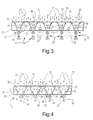
- Figures 3-4 are elevational or plan view of a portion of deflector 15 as viewed from approximately point "A" in Figure 2, according to different embodiments of this invention.
- deflector 15 functions to (i) redirect air 17 flowing across the roof 7 of the vehicle downwardly in a direction 18 toward the exterior major surface 19 of backlite 13, (ii) accelerate the speed of air flow as the air is directed toward surface 19 of backlite 13, and/or (iii) support one or more spray nozzles 21 for spraying or otherwise directing cleaning fluid (e.g., water or cleanser) 23 onto surface 19 of backlite 13 so that dirt and the like may be more easily removed therefrom (i.c., blown off) by airflow 18 passing over the surface of backlite 13.
- cleaning fluid e.g., water or cleanser
- a portion of rear air deflector 15 may define a plane 25 which is angled ⁇ from about 25-60 degrees, more preferably from about 40-50 degrees, relative to the horizontal 27. This causes the air deflecting surfaces of deflector 15 to be aligned in similar angle(s) relative to the horizontal so that air 17 can be redirected 18 toward surface 19 of backlite 13 to be cleaned.
- Deflector alignment angle ⁇ is chosen for each application as a function of the inclination of the backlite and/or roof of the vehicle.
- This combination i.e., hydrophobic coating on the backlite with an air flow accelerating deflector
- deflector 15 cause acceleration of air flow (i.e., air flow 18 flows at a higher speed or rate than air flow 17). Each involves the area of air input to the area of deflector 15 area being greater than the area of air output from the area of deflector 15 (while the volume of air at each is approximately equal).
- distance d1 the distance between an air input end of deflector 15 and the vehicle surface
- distance d2 the distance between an air output end of deflector 15 and the vehicle surface. Because d1>d2, the mass of the air flowing by the deflector is compacted by the deflector into a significantly smaller area so that the rate of How increases as it is directed toward backlite 13.
- the array of air flow channels 31 defined in the bottom surface 32 of the deflector also creates a venturi-like effect so as to increase the air flow speed as the air is directed toward surface 19 of the backlite.
- channels 31 are defined in the lower surface 32 of air deflector 15.
- channels 31 may be said to he cut out of the main body of the deflector, so that each channel 31 is defined by sidewalls 34 on opposing sides thereof and by a wall 36 of the main deflector body on another side thereof. Therefore, each channel 31 is enclosed on three elongated sides thereof, and open on a fourth elongated side along the length of the channel closest to the vehicle.
- channels 31 cause air output therefrom at outlets 37 to flow in high rate jet-like streams (which do not cover the entire backlite surface 19), the channels being open at one major side thereof may enable the air flow across surface 19 to cover more of the surface area of the backlite and therefor do a better job of cleaning than if the channels were entirely enclosed along their respective lengths.
- channels 31 are open along one elongated side thereof in the illustrated embodiments, it is recognized that in other embodiments of this invention, channels 31 may he entirely enclosed along their respective lengths, with the only openings being those of the respective air inlets and air outlets. Moreover, while channels 31 are illustrated in Figures 3-4 as being approximately triangular in shape, such channels may he of any other suitable shape in other embodiments of this invention so long as air flow rate is increased thereby.
- a plurality of window washing spray jets 21 may be provided on, e.g., an underneath side/surface of deflector 15, as shown in Figures 2 and 3. This enables the cleaning fluid output by jets 21 to be more efficiently inserted into the air flow streams 18 being directed toward the backlite in the direction of air flow.
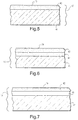
- the backlite includes a hydrophobic coating as illustrated in any of Figures 5-7 and 9.
- FIG. 5 is a side cross-sectional view of a coated backlite 13 according to an embodiment of this invention, wherein at least one diamond-like carbon (DLC) inclusive protective coating(s) 43 is provided directly on substrate 41.
- substrate 41 may be of glass, plastic, or the like.
- DLC inclusive coating 43 in the Fig. 5 embodiment includes at least one layer including highly tetrahedral amorphous carbon (ta-C).
- Coating 43 functions in a hydrophobic manner (i.e. it is characterized by high water contact angles ⁇ and/or low surface energies as described below).
- coating 43 may be from about 50-1,000 angstroms (A) thick, more preferably from about 100-500 angstroms (A) thick, and most preferably from about 150-200 angstroms (A) thick.
- hydrophobic coating 43 may have an approximately uniform distribution of sp 3 carbon-carbon bonds throughout a large portion of its thickness, so that much of the coating has approximately the same density.
- hydrophobic coating 43 may include a lesser percentage of sp 3 carbon-carbon bonds near the interface with substrate 41, with the percentage or ratio of sp 3 carbon-carbon bonds increasing throughout the thickness of the coating toward the outermost surface.
- coating 43 may include at least one interfacing layer directly adjacent substrate 41, this interfacing layer having a lesser density and a lesser percentage of sp 3 carbon-carbon bonds than the middle portion of DLC inclusive coating 43.
- the network of sp 3 carbon-carbon bonds functions to hold the other atoms (e.g.
- Si, O, F, and/or H atoms around it in the coating.
- at least about 50% (more preferably at least about 75%, and most preferably at least about 90%) or the carbon-carbon bonds in coating 43 are of the sp 3 carbon-carbon type.
- sp 3 carbon-carbon bonds in coating 43 increases the density and hardness of the coating, thereby enabling it to satisfactorily function in automotive environments.
- at least about 15% (more preferably at least about 25%, and most preferably at least about 30%) of the bonds in the coating or coating layer portion are sp 3 carbon-carbon (C-C) bonds (as opposed to sp 2 carbon-carbon bonds).
- Coating 43 may or may not include sp 2 carbon-carbon bonds in different embodiments (if so, most sp 2 carbon-carbon bonds may be provided at the portion of the coating interfacing with the underlying substrate).
- coating 43 may include in addition to the carbon atoms of the sp 3 carbon-carbon bonds, by atomic percentage, at least about 5% silicon (Si) atoms (more preferably at least about 15%, and most preferably at least about 20% Si), at least about 5% oxygen (O) atoms (more preferably at least about 15% and most preferably at least about 20% O), at least about 5% hydrogen (H) atoms (more preferably at least about 10% and most preferably at least about 15% H).
- Si silicon
- O oxygen
- H hydrogen
- coating 43 may include and from about 0-10% (atomic percentage) fluorine (F) (more preferably from about 0-5% F) in order to further enhance hydrophobic characteristics of the coating.
- the outermost thin layer portion of hydrophobic coating 43 may also include a larger percentage of H atoms deposited via plasma ion beam treatment relative to the rest of the coating in order to reduce the number of polar bonds at the coating's surface, thereby improving the coating's hydrophobic properties by reducing the polar component of the surface energy.
- the outermost 5 angstroms (A) layer portion of coating 43 may include at least about 10% H atoms, more preferably at least about 25% H atoms, and most preferably at least about 50% H atoms. This higher concentration or percentage of H atoms near the surface of coating 43 is illustrated in Figures 5-7 by the dots which become more concentrated near the coating's surface 19.
- H atoms near the coating's surface 19 results in a more passive or non-polar coating surface. It is noted that deposition of the H atoms near the coating's surface 19 may tend to etch away any sp 2 or graphite C-C bonds in that area. This increase in H near the coating's surface also decreases the coating's density at this outermost 5 angstroms (A) layer portion.
- coating 43 as a whole or any 10 angstroms (A) thick layer portion thereof may include in atomic percentage: from about 15-80% carbon (C) (mostly via sp 3 bonds), from about 5-45% oxygen (O), from about 5-45% silicon (Si), from about 0-30% hydrogen (H), and from about 0-10% fluorine (F).
- the outermost 5 angstroms (A) layer portion of coating 43 may include in atomic percentage: from about 5-60% carbon (C) (mostly via sp 3 bonds), from about 0-40% oxygen (O), from about 0-40% silicon (Si), from about 10-60% hydrogen (H), and from about 0-10% fluorine (F).
- additional H may be provided at the outermost portion of layer 43, largely at the expense of C, in order to reduce surface energy.
- An example of a 10 A thick layer portion near the middle of coating 43 is as follows, by atomic percentage: 35% C, 30% Si, 15% H, and 20% O.
- An example of the outermost 5 A thick layer portion of coating 43 is as follows, by atomic percentage: 20% C, 15% Si, 50% H, and 15% O.
- from about 0-5% F may also be provided in this outermost 5 A thick layer portion.
- many of the Si. H, O, and F atoms in the coating are connected to many carbon atoms via sp 3 bonds.
- a substantial number of Si-O, C-C sp 3 , Si-C sp 3 , and C-H sp 3 bonds are thus present.
- the Si-O bonds tend to cancel out some of the charge due to the carbon thereby reducing surface energy.
- the presence of the O also reduces density and permits the dispersive component of surface energy to be reduced.
- coating 43 has an average hardness of at least about 10 GPa, more preferably at least about 20 GPa, and most preferably from about 20-50 GPa. Such hardness renders coating 43 resistant to scratching, solvents, and the like. It is noted that the hardness and density of coating 43 and/or layer 47 may be adjusted by varying the ion energy of the depositing apparatus or process described below.
- Figure 6 is a side cross sectional view of a coated backlite 13 according to another embodiment of this invention, including substrate 41 (e.g. glass), hydrophobic DLC inclusive coating 43 as described above with regard to the Fig. 5 embodiment, and intermediate DLC inclusive layer 47 sandwiched therebetween.
- substrate 41 e.g. glass
- hydrophobic DLC inclusive coating 43 as described above with regard to the Fig. 5 embodiment
- intermediate DLC inclusive layer 47 sandwiched therebetween.
- at least about 35% of the bonds in layer 47 may be of the sp 3 C-C type, more preferably at least about 70%, and most preferably at least about 80%.
- Any of the DLC inclusive layers described in Serial No. 09/303,548 may be used as layer 47.
- layer 47 may function in certain embodiments to reduce corrosion of the coated backlite (e.g. when the substrate includes Na, or is soda-lime-silica glass), while overlying coating 43 provides a hydrophobic function.
- a low-E or other coating 49 is provided between substrate 41 and hydrophobic DLC inclusive coating 43.
- coating 43 is still on substrate 41 in the Fig. 7 embodiment.
- the term "on” herein means that substrate 41 supports DLC coating 43 or any layer portion thereof, regardless of whether or not other layer(s) (e.g. 47, 49) are provided therebetween.
- protective coating 43 may be provided directly on substrate 41 as shown in Fig. 5, or may be provided on substrate 41 with a low-E or other coating(s) 47 therebetween as shown in Figs. 6-7.
- a low-E coating(s) 49 may be provided between hydrophobic coating 43 and DLC layer 47 of the Fig. 6 embodiment).
- Exemplar coatings in full or any portion of these coatings) that may be used as low-E or other coating(s) 49 are shown and/or described in any of U.S. Patents Nos. 5,837,108, 5,800,933, 5,770,321, 5,557,462, 5,514,476, 5,425,861, 5,344,718, 5,376,455, 5,298,048, 5,242,560, 5,229,194, 5,188,887 and 4,960,645, which are all hereby incorporated herein by reference. Silicon oxide and/or silicon nitride coating(s) may also be used as coating(s) 49.
- ta-C highly tetrahedral amorphous carbon
- DLC diamond-like carbon
- the amounts of sp 3 bonds may be measured using Raman finger-printing and/or electron energy loss spectroscopy.
- a high amount of sp 3 bonds increases the density of a layer, thereby making it stronger and allowing it to reduce soda diffusion to the surface of the coated article.
- hydrophobic coating 43 is at least about 75% transparent to or transmissive of visible light rays, preferably at least about 85%, and most preferably at least about 95%.
- substrate 41 When substrate 41 is of glass, it may be from about 1.5 to 5.0 mm thick, preferably from about 2.3 to 4.8 mm thick, and most preferably from about 3.7 to 4.8 mm thick. Thus, ta-C inclusive coating 43 and/or layer 47 reduce the amount of soda that can reach the surface of the coated article and cause stains/corrosion.
- substrate 41 includes, on a weight basis, from about 60-80% SiO 2 , from about 10-20% Na 2 O, from about 0-16% CaO, from about 0-10% K 2 O, from about 0-10% MgO, and from about 0-5% Al 2 O 3 .
- substrate 41 may be soda lime silica glass including, on a weight basis, from about 66-75% SiO 2 , from about 10-20% Na 2 O, from about 5-15% CaO, from about 0-5% MgO, from about 0-5% Al 2 O 3 , and from about 0-5% K 2 O. Most preferably, substrate 41 is soda lime silica glass including, by weight, from about 70-74% SiO 2 , from about 12-16% Na 2 O, from about 7-12% CaO, from about 3.5 to 4.5% MgO, from about 0 to 2.0% Al 2 O 3 , from about 0-5% K 2 O, and from about 0.08 to 0.15% iron oxide. In certain embodiments, any glass disclosed in U.S. Patent No. 5,214,008 or Patent No. 5,877,103, each incorporated herein by reference, may he used as substrate 41. Also, soda lime silica float glass available from Guardian Industries Corp., Auburn Hills, Michigan, may be used as substrate 41.
- any such aforesaid glass substrate 41 may be, for example, green, blue or grey in color when appropriate colorant(s) are provided in the glass in certain embodiments.
- substrate 41 may be of borosilicate glass, or of substantially transparent plastic.
- the substrate 41 may include from about 75-85% SiO 2 , from about 0-5% Na 2 O, from about 0 to 4% Al 2 O 3 , from about 0-5% K 2 O, from about 8-15% B 2 O 3 , and from about 0-5% Li 2 O.
- the resulting coated backlite 13 may have the following characteristics in certain embodiments: visible transmittance (III. A) greater than about 60% (preferably greater than about 70%, and most preferably greater than about 80%), UV (ultraviolet) transmittance less than about 38%, total solar transmittance less than about 45%, and IR (infrared) transmittance less than about 35% (preferably less than about 25%, and most preferably less than about 21%). Visible, "total solar”. UV, and IR transmittance measuring techniques are set forth in Pat. No. 5.800,933, as well as the '008 patent, incorporated herein by reference.
- Hydrophobic performance of coating 43 in any of the above embodiments is a function of contact angle 0, surface energy ⁇ , and wettability or adhesion energy W.
- the surface energy ⁇ of coating 43 may be calculated by measuring its contact angle ⁇ (contact angle ⁇ is illustrated in Figs. 8-9).
- a sessile drop 51 of a liquid such as water is placed on the coating as shown in Fig. 9.
- a contact angle ⁇ between the drop 51 and underlying coating 43 appears, defining an angle depending upon the interface tension between the three phases in the point of contact.
- the surface energy ⁇ C of coating 43 can be determined by the addition of a polar and a dispersive component.
- ⁇ C ⁇ CP + ⁇ CD
- ⁇ CP the coating's polar component
- ⁇ CD the coating's dispersive component.
- the polar component of the surface energy represents the interactions of the surface which is mainly based on dipoles, while the dispersive component represents, for example, van der Waals forces, based upon electronic interactions.
- Adhesion energy (or wettability) W can be understood as an interaction between polar with polar, and dispersive with dispersive forces, between coating 43 and a liquid thereon such as water.
- ⁇ P is the product of the polar aspects of liquid tension and coaling/substrate tension
- ⁇ D is the product of the dispersive forces of liquid tension and coating/substrate tension.
- ⁇ P ⁇ LP * ⁇ CP
- ⁇ D ⁇ LD * ⁇ CD ; where ⁇ LP is the polar aspect of the liquid (e.g. water), ⁇ CP is the polar aspect of coating 43; ⁇ LD is the dispersive aspect of liquid (e.g.
- W of two materials e.g. coating 43 and water thereon
- W is a measure of wettability indicative of how hydrophobic the coating is.
- ⁇ LP is 51 mN/m and ⁇ LD is 22 mN/m.
- the polar aspect ⁇ CP of surface energy of coating 43 is from about 0 to 0.2 (more preferably variable or tunable between 0 and 0.1) and the dispersive aspect ⁇ CD of the surface energy of coating 43 is from about 16-22 mN/m (more preferably from about 16-20 mN/m).
- the surface energy ⁇ C of coating 43 is less than or equal to about 20.2 mN/m, more preferably less than or equal to about 19.5 mN/m, and most preferably less than or equal to about 18.0 mN/m; and the adhesion energy W between water and coating 43 is less than about 25 mN/m, more preferably less than about 23 mN/m, even more preferably less than about 20 mN/m, and most preferably less than about 19 mN/m.
- the initial contact angle ⁇ of a conventional glass substrate 41 with sessile water drop 51 thereon is typically from about 22-24 degrees, as illustrated in Figure 8.
- conventional glass substrates are not particularly hydrophobic in nature.
- the provision of coating(s) 43 on substrate 41 causes the contact angle ⁇ to increase to the angles discussed above, as shown in Fig. 9 for example, thereby improving the hydrophobic nature of the backlite 13.
- the contact angle ⁇ of a ta-C DLC layer is typically from about 5 to 50 degrees.
- the makeup of DLC-inclusive coating 43 described herein enables the initial contact angle ⁇ between coating 43 and a water drop (i.e.
- sessile drop 51 of water to be increased in certain embodiments to at least about 100 degrees, more preferably at least about 110 degrees, even more preferably at least about 115 degrees, and most preferably at least about 125 degrees, thereby improving the hydrophobic characteristics of the DLC-inclusive material and enabling air flow 18 to more easily remove rain and the like from the surface of backlite 13.
- An "initial" contact angle ⁇ means prior to exposure to environmental conditions such as sun, rain, humidity, etc.
- the top surface of substrate 41 is preferably cleaned by way of a first linear or direct ion beam source.
- a glow discharge in argon (Ar) gas or mixtures of Ar/O 2 (alternatively CF 4 plasma) may be used to remove any impurities on the substrate surface.
- Ar argon
- CF 4 plasma alternatively CF 4 plasma
- the power used may be from about 100-300 Watts.
- Substrate 41 may also be cleaned by, for example, sputter cleaning the substrate prior to actual deposition of coating 43; using oxygen and/or carbon atoms at an ion energy of from about 800 to 1200 eV, most preferably about 1,000 eV.
- the deposition process begins using a linear ion beam deposition technique via a second ion beam source: with a conveyor having moved the cleaned substrate 41 from the first source to a position under the second source.
- the second ion beam source functions to deposit a ta-C/SiO (or ta-C/SiO:F in alternative embodiments) coating 43 onto substrate 41, as follows.
- the ratio of C to Si in coating 43 is approximately 1:1 (i.e. 1:1 plus/minus about 20%).
- the ratio of C to Si in coating 43 may be from about 1:1 to 4:1.
- the dopant gas may be produced by bubbling a carrier gas (e.g.
- C 2 H 2 through the precursor monomer (e.g. TMS or 3MS) held at about 70 degrees C (well below the flashing point).
- Acetylene feedstock gas (C 2 H 2 ) is used in certain embodiments to prevent or minimize/reduce polymerization and to obtain an appropriate energy to allow the ions to penetrate the substrate 41 or other surface and subimplant therein, thereby causing coating 43 atoms to intermix with the surface of substrate 41 (or the surface of the growing coating) a few atom layers thereinto.
- the dopant gas may be produced by heating or warming the monomer (e.g. to about 25-30 degrees C) so that vapor therefrom proceeds through a mass flow controller to the ion beam source; so that C 2 H 2 is not needed.
- the actual gas flow may be controlled by a mass flow controller (MFC) which may be heated to about 70 degrees C.
- Oxygen (O 2 ) gas is independently flowed through an MFC.
- a target consisting essentially of approximately equal molar percentages of C and Si may be isostatically compressed at about 20 MPa.
- the temperature of substrate 41 may be room temperature; an arc power of about 1000 W may be used; precursor gas flow may be about 25 sccm; the base pressure may be about 10 -6 Torr, and a Hoescht type carbon electrode may be used.
- Coating 43 is preferably free of pinholes to achieve satisfactory water repulsion and/or suppression of soda diffusion.
- the C-C sp 3 bonding in coating 43 is preferably formed by having a predetermined range of ion energy prior to reaching substrate 41, or prior to reaching a coating or layer growing on the substrate.
- the optimal ion energy window for the majority of coating 43 is from about 100-200 eV (preferably from about 100-150 eV) per carbon ion. At these energies, the carbon in coating 43 (and layer 47) emulates diamond, and sp 3 C-C bonds form in coating 43.
- compressive stresses can develop in ta-C when being deposited at 100-150eV. Such stress can reach as high as 10 GPa and can potentially cause delamination from many substrates.
- the first 1-40% thickness (preferably the first 1-20% and most preferably the first 5-10% thickness) of coating 43 (or layer 47) is deposited on substrate 41 using high anti-stress energy levels of from about 200-1,000 eV, preferably from about 400-500 eV.
- the ion energy in the ion deposition process is decreased (either quickly or gradually while deposition continues) to about 100-200 eV, preferably from about 100-150 eV, to grow the remainder of coating 43 (or layer 47).
- DLC inclusive coating 43 in Figs. 5-7 has different densities and different percentages of sp 3 C-C bonds at different layer portions thereof (the lower the ion energy, the more sp 3 C-C bonds and the higher the density).
- filtered cathodic vacuum arc ion beam techniques may he used to deposit coating 43 and/or layer 47.
- CH 4 may be used as a feedstock gas during the deposition process instead of or in combination with the aforesaid C 2 H 2 gas.
- any of the deposition methods disclosed in U.S. Patent No. 5,858,477 may be used to deposit coating 43 and/or layer 47, the disclosure of Patent No. 5,858,477 hereby being incorporated herein by reference.
- the second source may deposit a ta-C:SiO:F coating 43 on substrate 41 instead of a ta-C:SiO coating.
- the n, k and Tauc optical bandgap may be tailored by doping the bulk of coating 43 with F and/or H: where "n" is refractive index and "k” is extinction coefficient.
- n refractive index
- k extinction coefficient
- the refractive index of coating 43 is from about 1.4 to 2.0, more preferably no greater than about 1.75, and most preferably from about 1.5 to 1.7.
- the refractive index n of the coating can also be altered using CF 4 or CF 6 as the doping gas. Fluorination of no more than about 5% atomic is preferred.
- the table below shows variation of n & k with atomic F content: F% n@543nm k@543nm Eg(eV) 0 2.2 0.02 2.0 1.5 1.75 0.007 2.9 3.0 1.65 0.0001 3.7
- fluorination provides a way in which to independently tune the n & k to match desired optical properties of the substrate 41 in order to improve transmission and the like. Fluorination may also scavenge a graphitic sp 2 fraction within the carbon matrix thus leaving mostly sp 3 enriched carbon matrix.
- a third ion beam source is optional.
- the hydrophobicity of coating 43 can be further enhanced using a plasma treatment by a third source or grafting procedure after the main portion of DLC-inclusive coating 43 has been deposited.
- This technique using a third source removes certain polar functional groups at the outermost surface, thereby altering the surface chemical reactivity (i.e. lowering surface energy) while the bulk of coating 43 remains the same or substantially unaffected.
- the plasma treatment by the third source introduces hydrogen (H) atoms into the outermost surface of coating 43. thereby making the coating's surface substantially non-polar and less dense than the rest of the coating 43.
- H atoms are introduced, because H 2 or ArH 2 feedstock gas is used by source 63 instead of the C 2 H 2 gas.
- the third source does not deposit any significant amounts of C atoms or Si atoms; but instead treats the outermost surface of the ta-C:SiO coating by adding H atoms thereto in order to improve its hydrophobic characteristics. This plasma treatment may also function to roughen the otherwise smooth surface.
- H 2 feedstock gas is preferred in the third ion beam source when it is not desired to roughen the surface of coating 43, while ArH 2 feedstock gas is preferred in surface roughing embodiments.
- a CF 4 RF induced plasma may be used to provide a striation process with RMS roughness of at least about 100 angstroms (A).
- the third source may be used to introduce F atoms to the outermost 5 A layer portion of coating 43 (in addition to or instead of the H atoms) in order to reduce surface energy. Fluorination of no more than about 5% (atomic percent) is preferred.
- a single ion beam source (linear, curved, or the like) may be used to perform each of the cleaning step, the deposition step of DLC-inclusive coating 43, and the plasma surface treatment for introducing H and/or F atoms into the outermost surface area of the coating.
- the feedstock gas may be changed between each such process.
- Sample Nos. 1-3 each including a coating 43 according to an embodiment of this invention deposited on glass using tetramethyl-silane (TMS) and O 2 gas introduced within the linear ion beam. All sample coatings 43 were of approximately the same thickness of about 750 A.
- a low energy electron flood gun was used to sharpen the spectral analysis conducted by x-ray photo-electron spectroscopy (XPS) for chemical analysis.
- XPS x-ray photo-electron spectroscopy
- XPS x-ray photo-electron spectroscopy
- XPS x-ray photo-electron spectroscopy
- Electrons from the surface are ejected and their energy and number (count) measured. With these measurements, one can deduce the electron binding energy. From the binding energy, one can determine three things:
- H was excluded from the XPS analysis because of its difficulty to measure. Thus. H atoms present in the coating Sample Nos. 1-3 were not taken into consideration for these results. For example, if Sample No. 1 included 9% H by atomic percentage, then the atomic percentages of each of the above-listed elements C, O, Si and F would be reduced by an amount so that all five atomic percentages totaled 100%.
- coated backlites 13 have a contact angle 0 of at least about 70°, more preferably at least about 80°, and even more preferably at least about 100° after a taber abrasion resistance test has been performed pursuant to ANSI Z26.1.
- the test utilizes 1,000 rubbing cycles of coating 43, with a load a specified in Z26.1 on the wheel(s).
- Another purpose of this abrasion resistance test is to determine whether the backlite is resistive to abrasion (e.g. whether hazing is less than 4% afterwards).
- ANSI Z26.1 is hereby incorporated into this application by reference.
Landscapes
- Chemical & Material Sciences (AREA)
- Engineering & Computer Science (AREA)
- Materials Engineering (AREA)
- Organic Chemistry (AREA)
- Life Sciences & Earth Sciences (AREA)
- Chemical Kinetics & Catalysis (AREA)
- General Chemical & Material Sciences (AREA)
- Geochemistry & Mineralogy (AREA)
- Mechanical Engineering (AREA)
- Transportation (AREA)
- Combustion & Propulsion (AREA)
- Surface Treatment Of Glass (AREA)
- Laminated Bodies (AREA)
- Automobile Manufacture Line, Endless Track Vehicle, Trailer (AREA)
- Vehicle Cleaning, Maintenance, Repair, Refitting, And Outriggers (AREA)
- Application Of Or Painting With Fluid Materials (AREA)
- Non-Portable Lighting Devices Or Systems Thereof (AREA)
Claims (18)
- Ein System zum Ermöglichen, dass Regenwasser von einer äußeren Oberfläche einer rückwärtigen Scheibe (13) eines Fahrzeugs entfernt wird, wobei dieses System umfasst:einen Luftablenker (15) zum Ablenken von Luft von dem Strömen in einer ersten Richtung über eine Oberfläche des Fahrzeugs in eine zweite Richtung, in der Luft abwärts zu der rückwärtigen Scheibe strömt, und um zu bewirken, dass zumindest ein Teil der Luft, die in der zweiten Richtung strömt, schneller als die Luft in der ersten Richtung strömt; dadurch gekennzeichnet, dassdie rückwärtige Scheibe ein Substrat mit einer hydrophoben Beschichtung darauf enthält, so dass die äußere Oberfläche der rückwärtigen Scheibe mit der Kontur eines Wassertropfens einen anfänglichen Kontaktwinkel von zumindest ungefähr 70 ° aufweist.
- Das System von Anspruch 1, wobei das Substrat ein Glassubstrat ist aufweisend auf Gewichtsbasis:und wobei die hydrophobe Beschichtung Diamant-ähnlichen Kohlenstoff (diamond-like carbon = DLC) mit sp3-Kohlenstoff-Kohlenstoff-Bindungen enthält und wobei diese hydrophobe Beschichtung einen anfänglichen Kontaktwinkel mit einem ruhenden Tropfen Wasser darauf von zumindest ungefähr 100° und eine mittlere Härte von zumindest ungefähr 10 GPa aufweist.SiO2 von ungefähr 60 bis 80 %,Na2O von ungefähr 10 bis 20 %,CaO von ungefähr 0 bis 16 %,K2O von ungefähr 0 bis 10 %,MgO von ungefähr 0 bis 10 %,Al2O3 von ungefähr 0 bis 5 %,
- Das System von Anspruch 1, wobei der anfängliche Kontaktwinkel zumindest ungefähr 110° ist.
- Das System von Anspruch 2, wobei der anfängliche Kontaktwinkel zumindest ungefähr 125 ° ist.
- Das System von Anspruch 1, wobei die hydrophobe Beschichtung eine Oberflächenenergie ϒC von weniger als oder gleich ungefähr 20,2 mN/m aufweist.
- Das System von Anspruch 5, wobei die hydrophobe Beschichtung eine Oberflächenenergie ϒC von weniger als oder gleich ungefähr 19,5 mN/m aufweist.
- Das System von Anspruch 1, wobei die hydrophobe Beschichtung eine Oberflächenenergie ϒC von weniger als oder gleich ungefähr 18,0 mN/m aufweist und wobei der refraktive Index "n" der Beschichtung ungefähr 1,5 bis 1,7 ist.
- Das System von Anspruch 1, wobei die hydrophobe Beschichtung in direktem Kontakt mit dem Glassubstrat steht.
- Das System von Anspruch 1, wobei die hydrophobe Beschichtung eine mittlere Härte von zumindest ungefähr 20 GPa aufweist.
- Das System von Anspruch 9, wobei die hydrophobe Beschichtung eine mittlere Härte von ungefähr 20 bis 80 GPa aufweist.
- Das System von Anspruch 1, wobei die hydrophobe Beschichtung Diamant-ähnlichen Kohlenstoff (diamond-like carbon = DLC) enthält und wobei zumindest ungefähr 50 % der Kohlenstoff-Kohlenstoff-Bindungen in der hydrophoben Beschichtung hoch tetraedrische sp3-Kohlenstoff-Kohlenstoff-Bindungen sind.
- Das System von Anspruch 1, wobei der äußerste 10 Angström (Å)-Schichtbereich der hydrophoben Beschichtung in Atomprozent ungefähr 5 bis 60 % Kohlenstoff (C), ungefähr 0 bis 40 % Sauerstoff (O), ungefähr 0 bis 40 % Silizium (Si), ungefähr 10 bis 95 % Wasserstoff (H) und ungefähr 0 bis 10 % Fluor (F) enthält.
- Das System von Anspruch 1, wobei zumindest ein 10 Angström (Å) dicker Schichtbereich der hydrophoben Beschichtung in Atomprozent ungefähr 15 bis 80 % Kohlenstoff (C), ungefähr 5 bis 45 % Sauerstoff (O), ungefähr 5 bis 45 % Silizium (Si), ungefähr 0 bis 30 % Wasserstoff (H) und ungefähr 0 bis 10 % Fluor (F) enthält.
- Das System von Anspruch 1, wobei der äußerste 5 Angström (Å)-Schichtbereich der hydrophoben Beschichtung in Atomprozent zumindest ungefähr 25 % H enthält.
- Das System von Anspruch 1, wobei der Luftablenker eine Anordnung von Kanälen aufweist, die in einer unteren Oberfläche davon definiert sind, um die Geschwindigkeit des Luftstroms zu erhöhen.
- Das System von Anspruch 15, wobei jeder der Kanäle einen Einlass und einen Auslass aufweist und wobei ein Luftstromgebiet an diesem Einlass größer ist als ein Luftstromgebiet an dem Auslass, so dass Luft diese Kanäle mit einer höheren Rate verlassen kann, als sie in die Kanäle eintritt.
- Ein Verfahren zum Herunterblasen von Wasser von einer Heckscheibe eines Fahrzeugs, wobei das Verfahren die folgenden Schritte umfasst:Bereitstellen eines Fahrzeuges umfassend eine Heckscheibe und einen Luftablenker (15), der in einer erhöhten Position über zumindest einem Teil der Heckscheibe (13) befestigt ist, Bereitstellen eines Substrates mit einer hydrophoben Beschichtung auf der Heckscheibe, so dass die äußere Oberfläche der Heckscheibe einen Kontaktwinkel mit der Kontur eines Wassertropfens von zumindest ungefähr 70 ° aufweist; wobeider Luflablenker (15) den Luftstrom ablenkt, der über eine obere Oberfläche des Fahrzeugs strömt, und bewirkt, dass der abgelenkte Luftstrom in einer gesteigerten Rate zu der Heckscheibe strömt; und wobeider abgelenkte Luftstrom über die äußere Oberfläche der Heckscheibe strömt, wobei Wasser von der Oberfläche der Heckscheibe entfernt wird.
- Das Verfahren von Anspruch 19, wobei die Heckscheibe ein Glassubstrat mit einer Diamant-ähnlichen Kohlenstoff enthaltenen Beschichtung darauf aufweist.
Applications Claiming Priority (3)
| Application Number | Priority Date | Filing Date | Title |
|---|---|---|---|
| US512798 | 2000-02-25 | ||
| US09/512,798 US6273488B1 (en) | 1999-05-03 | 2000-02-25 | System and method for removing liquid from rear window of a vehicle |
| PCT/US2001/005376 WO2001062577A1 (en) | 2000-02-25 | 2001-02-21 | System and method for removing liquid from rear window of vehicle |
Publications (2)
| Publication Number | Publication Date |
|---|---|
| EP1259414A1 EP1259414A1 (de) | 2002-11-27 |
| EP1259414B1 true EP1259414B1 (de) | 2003-10-01 |
Family
ID=24040609
Family Applications (1)
| Application Number | Title | Priority Date | Filing Date |
|---|---|---|---|
| EP01910980A Expired - Lifetime EP1259414B1 (de) | 2000-02-25 | 2001-02-21 | Verfahren und vorrichtung zur entfernung von flüssigkeit von der heckscheibe eines motorfahrzeuges |
Country Status (7)
| Country | Link |
|---|---|
| US (2) | US6273488B1 (de) |
| EP (1) | EP1259414B1 (de) |
| AT (1) | ATE251063T1 (de) |
| AU (1) | AU2001238530A1 (de) |
| DE (1) | DE60100893T2 (de) |
| ES (1) | ES2206409T3 (de) |
| WO (1) | WO2001062577A1 (de) |
Families Citing this family (40)
| Publication number | Priority date | Publication date | Assignee | Title |
|---|---|---|---|---|
| US6713179B2 (en) * | 2000-05-24 | 2004-03-30 | Guardian Industries Corp. | Hydrophilic DLC on substrate with UV exposure |
| JP3516235B2 (ja) * | 2001-10-15 | 2004-04-05 | 本田技研工業株式会社 | 車両のリヤスポイラー構造 |
| US6610360B2 (en) * | 2001-11-28 | 2003-08-26 | Guardian Industries Corp. | Buffing diamond-like carbon (DLC) to improve scratch resistance |
| US6867854B1 (en) | 2002-01-02 | 2005-03-15 | The United States Of America As Represented By The Secretary Of The Air Force | Liquid to solid angle of contact measurement |
| US6982787B1 (en) | 2002-01-02 | 2006-01-03 | The United States Of America As Represented By The Secretary Of The Air Force | Modification of the degree of liquid contact with a solid by control of surface and micro-channel capillary geometry |
| US10502448B1 (en) | 2002-01-02 | 2019-12-10 | United States Of America As Represented By The Secretary Of The Air Force | Self-clearing vents based on droplet expulsion |
| US6770321B2 (en) * | 2002-01-25 | 2004-08-03 | Afg Industries, Inc. | Method of making transparent articles utilizing protective layers for optical coatings |
| GB2401022A (en) * | 2002-06-18 | 2004-11-03 | Mark Dean Jagger | A device to remove water droplets from a visor of a helmet |
| US6702364B2 (en) * | 2002-08-12 | 2004-03-09 | Vor-Tex Industries | Method and apparatus for reducing drag on a vehicle in motion and channeling air flow to form a bug shield |
| US6685256B1 (en) * | 2002-12-23 | 2004-02-03 | Carl L. Shermer | Trailer drag reduction system |
| FR2855479A1 (fr) * | 2003-06-02 | 2004-12-03 | Valeo Systemes Dessuyage | Agencement pour le nettoyage d'un panneau vitre par association de revetements photocatalytique et hydrophile |
| FR2869860B1 (fr) * | 2004-05-06 | 2006-06-16 | Peugeot Citroen Automobiles Sa | Dispositif de lavage de la vitre de custode arriere d'un vehicule automobile |
| DE102004041720A1 (de) * | 2004-08-28 | 2006-03-02 | Dr.Ing.H.C. F. Porsche Ag | Heckseitige Luftleitvorrichtung für ein Vollheck-Kraftfahrzeug |
| US20060107599A1 (en) * | 2004-11-24 | 2006-05-25 | Guardian Industries Corp. | Flush-mounted slider window for pick-up truck with hydrophilic coating on interior surface thereof, and method of making same |
| US20060110605A1 (en) * | 2004-11-24 | 2006-05-25 | Guardian Industries Corp. | Hydrophilic coating and method of making same |
| FR2912977B1 (fr) | 2007-02-27 | 2009-04-10 | Renault Sas | Element de carrosserie d'un vehicule automobilie pourvu d'une surface reflechissante ou transparente a visibilite amelioree en presence de gouttelettes |
| CN101663558B (zh) | 2007-04-05 | 2011-06-22 | 富士通半导体股份有限公司 | 表面形状传感器及其制造方法 |
| FR2935326B1 (fr) * | 2008-08-28 | 2011-11-04 | Peugeot Citroen Automobiles Sa | Vehicule automobile comportant une face exposee au ruisselement de l'eau |
| FR2936202A1 (fr) * | 2008-09-19 | 2010-03-26 | Mohammed Boubahri | Systeme anti-pluie et ses applications |
| GB2477763A (en) | 2010-02-11 | 2011-08-17 | Thorn Security | Fire detector with a component including a contaminant-resistant surface |
| US8303024B2 (en) * | 2010-02-22 | 2012-11-06 | Florida State University Research Foundation | Microjet control for flow and noise reduction in automotive applications |
| USD638337S1 (en) * | 2010-07-27 | 2011-05-24 | Dennis Francisco | Rear roof visor |
| JP5248582B2 (ja) * | 2010-12-13 | 2013-07-31 | 株式会社ホンダアクセス | リアスポイラー |
| USD641297S1 (en) * | 2011-01-07 | 2011-07-12 | Chrysler Group Llc | Vehicle rear deck spoiler |
| US8480161B2 (en) * | 2011-10-11 | 2013-07-09 | Raimund Pfaff | Drag reduction apparatus for a trailer |
| DE112012005465T5 (de) * | 2011-12-26 | 2014-09-11 | Aisin Seiki Kabushiki Kaisha | Fahrzeugheckspoilereinrichtung |
| JP6004175B2 (ja) * | 2012-09-24 | 2016-10-05 | アイシン精機株式会社 | デフレクタ装置 |
| JP5896299B2 (ja) * | 2012-10-26 | 2016-03-30 | 本田技研工業株式会社 | 空力騒音低減装置 |
| CN103434575B (zh) * | 2013-09-16 | 2016-02-03 | 东风柳州汽车有限公司 | 汽车包角扰流装置 |
| DE102014104159A1 (de) * | 2014-03-26 | 2015-10-01 | Dr. Ing. H.C. F. Porsche Aktiengesellschaft | Luftleitvorrichtung |
| EP3059146B1 (de) * | 2015-02-19 | 2020-09-09 | FERRARI S.p.A. | Fahrzeug mit heckspoiler |
| CA2985703C (en) * | 2015-05-27 | 2023-10-17 | Pella Corporation | Water management systems for fenestration products |
| CN113401232B (zh) * | 2016-09-05 | 2023-05-16 | Ogab有限公司 | 一种主动减阻系统和减少车辆阻力的方法 |
| USD826119S1 (en) * | 2017-03-07 | 2018-08-21 | Turn 5, Inc. | Roof spoiler |
| US10744859B2 (en) * | 2018-05-17 | 2020-08-18 | GM Global Technology Operations LLC | Method for mitigating backglass contamination |
| US11313952B2 (en) * | 2018-12-17 | 2022-04-26 | Waymo Llc | Sensor housing with particle blocking feature |
| CN111572651A (zh) * | 2020-05-19 | 2020-08-25 | 东风汽车有限公司 | 一种汽车尾翼及汽车 |
| FR3111603B1 (fr) * | 2020-06-19 | 2022-08-05 | Alstom Transp Tech | Ensemble de pare-brise pour véhicule dépourvu d’essuie-glace et véhicule associé |
| DE102021111199A1 (de) | 2021-04-30 | 2022-11-03 | Bayerische Motoren Werke Aktiengesellschaft | Reinigung eines optischen Elements an einem Fahrzeug |
| DE102021122884B4 (de) | 2021-09-03 | 2024-05-29 | Webasto SE | Dachmodul zur Bildung eines Fahrzeugdachs mit einer Reinigungsdüse |
Family Cites Families (47)
| Publication number | Priority date | Publication date | Assignee | Title |
|---|---|---|---|---|
| US2919952A (en) | 1958-11-25 | 1960-01-05 | John W Riddle | Rear window cleaning device |
| US3015518A (en) | 1959-08-05 | 1962-01-02 | Marvin O Nelson | Rear window cleaner |
| US3276811A (en) | 1964-05-26 | 1966-10-04 | Arthur L Schmidt | Vehicle air deflector |
| US3488215A (en) * | 1968-06-21 | 1970-01-06 | Nat Patent Dev Corp | Nonfogging transparent material |
| GB1293374A (en) | 1969-06-03 | 1972-10-18 | Chrysler Uk | Improvements in or relating to vehicle bodies |
| DE2013277C3 (de) | 1970-03-20 | 1979-08-30 | Volkswagenwerk Ag, 3180 Wolfsburg | Fahrzeugaufbau, insbesondere für Kraftfahrzeuge, mit einer Heckklappe |
| US4060660A (en) | 1976-01-15 | 1977-11-29 | Rca Corporation | Deposition of transparent amorphous carbon films |
| DE2649953C2 (de) | 1976-10-30 | 1985-07-04 | Daimler-Benz Ag, 7000 Stuttgart | Luftleitvorrichtung für Kraftfahrzeuge |
| JPS6038236A (ja) | 1983-08-10 | 1985-02-27 | Nippon Denso Co Ltd | 車両用エアスポイラ |
| US4603898A (en) | 1983-08-24 | 1986-08-05 | Honda Giken Kogyo Kabushiki Kaisha | Apparatus for inhibiting foreign material from being deposited on rear window of a motorcar |
| US4674788A (en) | 1984-02-29 | 1987-06-23 | Nissan Motor Company, Limited | Vehicular air flow control device with variable angle air flow control fin |
| JPS6212480A (ja) | 1985-07-09 | 1987-01-21 | Fuji Heavy Ind Ltd | 自動車のリヤエアスポイラ |
| US4935303A (en) | 1987-10-15 | 1990-06-19 | Canon Kabushiki Kaisha | Novel diamond-like carbon film and process for the production thereof |
| DE3739591A1 (de) | 1987-11-23 | 1989-06-01 | Daimler Benz Ag | Dachteil, insbesondere fuer kraftfahrzeuge |
| US4881772A (en) | 1988-10-11 | 1989-11-21 | Feinberg Lee N | Rear-window wind deflector for a vehicle |
| JPH02178630A (ja) | 1988-12-29 | 1990-07-11 | Sharp Corp | ポリイミド薄膜の製法及びその装置 |
| US5527596A (en) * | 1990-09-27 | 1996-06-18 | Diamonex, Incorporated | Abrasion wear resistant coated substrate product |
| US5268217A (en) | 1990-09-27 | 1993-12-07 | Diamonex, Incorporated | Abrasion wear resistant coated substrate product |
| US5637353A (en) | 1990-09-27 | 1997-06-10 | Monsanto Company | Abrasion wear resistant coated substrate product |
| US5190807A (en) | 1990-10-18 | 1993-03-02 | Diamonex, Incorporated | Abrasion wear resistant polymeric substrate product |
| JP2929779B2 (ja) | 1991-02-15 | 1999-08-03 | トヨタ自動車株式会社 | 炭素被膜付撥水ガラス |
| US5249836A (en) | 1991-08-13 | 1993-10-05 | Dfm Corporation | Rear air deflector for motor vehicles |
| US5338088A (en) | 1991-08-13 | 1994-08-16 | Dfm Corporation | Rear air deflector shield for cargo-style door vehicle |
| US5199762A (en) | 1991-12-02 | 1993-04-06 | Scheele Rick L | Square-backed vehicle air foil system |
| US5344718A (en) | 1992-04-30 | 1994-09-06 | Guardian Industries Corp. | High performance, durable, low-E glass |
| US5314723A (en) | 1992-06-09 | 1994-05-24 | Gte Products Corporation | Method of coating phosphors on fluorescent lamp glass |
| US5234248A (en) | 1992-07-08 | 1993-08-10 | Bosh Robert L | Vehicular rear window air deflector apparatus |
| US5425983A (en) | 1992-08-10 | 1995-06-20 | Santa Barbara Research Center | Infrared window protected by multilayer antireflective coating |
| US5318806A (en) | 1992-10-02 | 1994-06-07 | Becton, Dickinson And Company | Tube having regions of different surface chemistry and method therefor |
| CA2081825C (en) | 1992-10-19 | 1998-08-18 | Douglas Alan Turner | Aero deflector for vehicles |
| GB9224697D0 (en) | 1992-11-25 | 1993-01-13 | Amaratunga Gehan A J | Doping of highly tetrahedral diamond-like amorphous carbon |
| US5470661A (en) | 1993-01-07 | 1995-11-28 | International Business Machines Corporation | Diamond-like carbon films from a hydrocarbon helium plasma |
| US5688585A (en) | 1993-08-05 | 1997-11-18 | Guardian Industries Corp. | Matchable, heat treatable, durable, IR-reflecting sputter-coated glasses and method of making same |
| US5508368A (en) | 1994-03-03 | 1996-04-16 | Diamonex, Incorporated | Ion beam process for deposition of highly abrasion-resistant coatings |
| US5846649A (en) | 1994-03-03 | 1998-12-08 | Monsanto Company | Highly durable and abrasion-resistant dielectric coatings for lenses |
| FR2722493B1 (fr) | 1994-07-13 | 1996-09-06 | Saint Gobain Vitrage | Vitrage hydrophobe multicouches |
| US5688020A (en) | 1994-11-14 | 1997-11-18 | Burg; Donald E. | Tailgate mounted drag reducing aerostabilizer |
| US5514476A (en) | 1994-12-15 | 1996-05-07 | Guardian Industries Corp. | Low-E glass coating system and insulating glass units made therefrom |
| US5557462A (en) | 1995-01-17 | 1996-09-17 | Guardian Industries Corp. | Dual silver layer Low-E glass coating system and insulating glass units made therefrom |
| DE19603122C2 (de) | 1995-01-30 | 2002-07-25 | Aisin Seiki | Heckspoiler |
| MX9605168A (es) | 1995-11-02 | 1997-08-30 | Guardian Industries | Sistema de recubrimiento con vidrio de baja emisividad, durable, de alto funcionamiento, neutro, unidades de vidrio aislante elaboradas a partir del mismo, y metodos para la fabricacion de los mismos. |
| US5770321A (en) | 1995-11-02 | 1998-06-23 | Guardian Industries Corp. | Neutral, high visible, durable low-e glass coating system and insulating glass units made therefrom |
| US5900342A (en) | 1996-04-26 | 1999-05-04 | Eastman Kodak Company | Photoconductive element having an outermost layer of a fluorinated diamond-like carbon and method of making the same |
| US5941595A (en) | 1996-05-14 | 1999-08-24 | Chrysler Corporation | Method and apparatus for reducing lift and drag of a soft top passenger vehicle |
| US5858477A (en) | 1996-12-10 | 1999-01-12 | Akashic Memories Corporation | Method for producing recording media having protective overcoats of highly tetrahedral amorphous carbon |
| AUPO613797A0 (en) | 1997-04-09 | 1997-05-08 | University Of Sydney, The | Digital information storage |
| US6261693B1 (en) * | 1999-05-03 | 2001-07-17 | Guardian Industries Corporation | Highly tetrahedral amorphous carbon coating on glass |
-
2000
- 2000-02-25 US US09/512,798 patent/US6273488B1/en not_active Expired - Lifetime
-
2001
- 2001-02-21 EP EP01910980A patent/EP1259414B1/de not_active Expired - Lifetime
- 2001-02-21 DE DE60100893T patent/DE60100893T2/de not_active Expired - Lifetime
- 2001-02-21 AT AT01910980T patent/ATE251063T1/de not_active IP Right Cessation
- 2001-02-21 ES ES01910980T patent/ES2206409T3/es not_active Expired - Lifetime
- 2001-02-21 AU AU2001238530A patent/AU2001238530A1/en not_active Abandoned
- 2001-02-21 WO PCT/US2001/005376 patent/WO2001062577A1/en not_active Ceased
- 2001-05-14 US US09/853,601 patent/US6340192B2/en not_active Expired - Lifetime
Also Published As
| Publication number | Publication date |
|---|---|
| DE60100893T2 (de) | 2004-05-19 |
| ES2206409T3 (es) | 2004-05-16 |
| US6340192B2 (en) | 2002-01-22 |
| US20010035662A1 (en) | 2001-11-01 |
| DE60100893D1 (de) | 2003-11-06 |
| US6273488B1 (en) | 2001-08-14 |
| EP1259414A1 (de) | 2002-11-27 |
| WO2001062577A1 (en) | 2001-08-30 |
| AU2001238530A1 (en) | 2001-09-03 |
| ATE251063T1 (de) | 2003-10-15 |
Similar Documents
| Publication | Publication Date | Title |
|---|---|---|
| EP1259414B1 (de) | Verfahren und vorrichtung zur entfernung von flüssigkeit von der heckscheibe eines motorfahrzeuges | |
| US6338901B1 (en) | Hydrophobic coating including DLC on substrate | |
| US6638570B2 (en) | Method of making coated article including layer(s) of diamond-like carbon which may be hydrophobic | |
| US6531182B2 (en) | Method of making a coated article including DLC and FAS | |
| US6472017B2 (en) | Method of making coated article including diamond-like carbon (DLC) and FAS | |
| US6663753B2 (en) | Method of making coated article including DLC inclusive layer over low-E coating | |
| US6764579B2 (en) | Solar management coating system including protective DLC | |
| US6368664B1 (en) | Method of ion beam milling substrate prior to depositing diamond like carbon layer thereon | |
| US6284377B1 (en) | Hydrophobic coating including DLC on substrate | |
| US6277480B1 (en) | Coated article including a DLC inclusive layer(s) and a layer(s) deposited using siloxane gas, and corresponding method | |
| US6475573B1 (en) | Method of depositing DLC inclusive coating on substrate | |
| US6491987B2 (en) | Process for depositing DLC inclusive coating with surface roughness on substrate |
Legal Events
| Date | Code | Title | Description |
|---|---|---|---|
| PUAI | Public reference made under article 153(3) epc to a published international application that has entered the european phase |
Free format text: ORIGINAL CODE: 0009012 |
|
| 17P | Request for examination filed |
Effective date: 20020918 |
|
| AK | Designated contracting states |
Kind code of ref document: A1 Designated state(s): AT BE CH CY DE DK ES FI FR GB GR IE IT LI LU MC NL PT SE TR |
|
| AX | Request for extension of the european patent |
Free format text: AL;LT;LV;MK;RO;SI |
|
| GRAH | Despatch of communication of intention to grant a patent |
Free format text: ORIGINAL CODE: EPIDOS IGRA |
|
| GRAS | Grant fee paid |
Free format text: ORIGINAL CODE: EPIDOSNIGR3 |
|
| GRAA | (expected) grant |
Free format text: ORIGINAL CODE: 0009210 |
|
| AK | Designated contracting states |
Kind code of ref document: B1 Designated state(s): AT BE CH CY DE DK ES FI FR GB GR IE IT LI LU MC NL PT SE TR |
|
| PG25 | Lapsed in a contracting state [announced via postgrant information from national office to epo] |
Ref country code: TR Free format text: LAPSE BECAUSE OF FAILURE TO SUBMIT A TRANSLATION OF THE DESCRIPTION OR TO PAY THE FEE WITHIN THE PRESCRIBED TIME-LIMIT Effective date: 20031001 Ref country code: CH Free format text: LAPSE BECAUSE OF FAILURE TO SUBMIT A TRANSLATION OF THE DESCRIPTION OR TO PAY THE FEE WITHIN THE PRESCRIBED TIME-LIMIT Effective date: 20031001 Ref country code: AT Free format text: LAPSE BECAUSE OF FAILURE TO SUBMIT A TRANSLATION OF THE DESCRIPTION OR TO PAY THE FEE WITHIN THE PRESCRIBED TIME-LIMIT Effective date: 20031001 Ref country code: BE Free format text: LAPSE BECAUSE OF FAILURE TO SUBMIT A TRANSLATION OF THE DESCRIPTION OR TO PAY THE FEE WITHIN THE PRESCRIBED TIME-LIMIT Effective date: 20031001 Ref country code: CY Free format text: LAPSE BECAUSE OF FAILURE TO SUBMIT A TRANSLATION OF THE DESCRIPTION OR TO PAY THE FEE WITHIN THE PRESCRIBED TIME-LIMIT Effective date: 20031001 Ref country code: FI Free format text: LAPSE BECAUSE OF FAILURE TO SUBMIT A TRANSLATION OF THE DESCRIPTION OR TO PAY THE FEE WITHIN THE PRESCRIBED TIME-LIMIT Effective date: 20031001 Ref country code: LI Free format text: LAPSE BECAUSE OF FAILURE TO SUBMIT A TRANSLATION OF THE DESCRIPTION OR TO PAY THE FEE WITHIN THE PRESCRIBED TIME-LIMIT Effective date: 20031001 Ref country code: NL Free format text: LAPSE BECAUSE OF FAILURE TO SUBMIT A TRANSLATION OF THE DESCRIPTION OR TO PAY THE FEE WITHIN THE PRESCRIBED TIME-LIMIT Effective date: 20031001 |
|
| REG | Reference to a national code |
Ref country code: GB Ref legal event code: FG4D |
|
| REG | Reference to a national code |
Ref country code: CH Ref legal event code: EP |
|
| REG | Reference to a national code |
Ref country code: IE Ref legal event code: FG4D |
|
| REF | Corresponds to: |
Ref document number: 60100893 Country of ref document: DE Date of ref document: 20031106 Kind code of ref document: P |
|
| PG25 | Lapsed in a contracting state [announced via postgrant information from national office to epo] |
Ref country code: DK Free format text: LAPSE BECAUSE OF FAILURE TO SUBMIT A TRANSLATION OF THE DESCRIPTION OR TO PAY THE FEE WITHIN THE PRESCRIBED TIME-LIMIT Effective date: 20040101 Ref country code: SE Free format text: LAPSE BECAUSE OF FAILURE TO SUBMIT A TRANSLATION OF THE DESCRIPTION OR TO PAY THE FEE WITHIN THE PRESCRIBED TIME-LIMIT Effective date: 20040101 Ref country code: GR Free format text: LAPSE BECAUSE OF FAILURE TO SUBMIT A TRANSLATION OF THE DESCRIPTION OR TO PAY THE FEE WITHIN THE PRESCRIBED TIME-LIMIT Effective date: 20040101 |
|
| PG25 | Lapsed in a contracting state [announced via postgrant information from national office to epo] |
Ref country code: LU Free format text: LAPSE BECAUSE OF NON-PAYMENT OF DUE FEES Effective date: 20040221 |
|
| PG25 | Lapsed in a contracting state [announced via postgrant information from national office to epo] |
Ref country code: IE Free format text: LAPSE BECAUSE OF NON-PAYMENT OF DUE FEES Effective date: 20040223 |
|
| PG25 | Lapsed in a contracting state [announced via postgrant information from national office to epo] |
Ref country code: MC Free format text: LAPSE BECAUSE OF NON-PAYMENT OF DUE FEES Effective date: 20040228 |
|
| NLV1 | Nl: lapsed or annulled due to failure to fulfill the requirements of art. 29p and 29m of the patents act | ||
| LTIE | Lt: invalidation of european patent or patent extension |
Effective date: 20031001 |
|
| REG | Reference to a national code |
Ref country code: CH Ref legal event code: PL |
|
| REG | Reference to a national code |
Ref country code: ES Ref legal event code: FG2A Ref document number: 2206409 Country of ref document: ES Kind code of ref document: T3 |
|
| ET | Fr: translation filed | ||
| PLBE | No opposition filed within time limit |
Free format text: ORIGINAL CODE: 0009261 |
|
| STAA | Information on the status of an ep patent application or granted ep patent |
Free format text: STATUS: NO OPPOSITION FILED WITHIN TIME LIMIT |
|
| 26N | No opposition filed |
Effective date: 20040702 |
|
| REG | Reference to a national code |
Ref country code: IE Ref legal event code: MM4A |
|
| PG25 | Lapsed in a contracting state [announced via postgrant information from national office to epo] |
Ref country code: PT Free format text: LAPSE BECAUSE OF NON-PAYMENT OF DUE FEES Effective date: 20040301 |
|
| REG | Reference to a national code |
Ref country code: FR Ref legal event code: PLFP Year of fee payment: 16 |
|
| PGFP | Annual fee paid to national office [announced via postgrant information from national office to epo] |
Ref country code: DE Payment date: 20160226 Year of fee payment: 16 Ref country code: IT Payment date: 20160223 Year of fee payment: 16 |
|
| PGFP | Annual fee paid to national office [announced via postgrant information from national office to epo] |
Ref country code: GB Payment date: 20160226 Year of fee payment: 16 |
|
| REG | Reference to a national code |
Ref country code: FR Ref legal event code: PLFP Year of fee payment: 17 |
|
| PGFP | Annual fee paid to national office [announced via postgrant information from national office to epo] |
Ref country code: FR Payment date: 20170112 Year of fee payment: 17 |
|
| PGFP | Annual fee paid to national office [announced via postgrant information from national office to epo] |
Ref country code: ES Payment date: 20170112 Year of fee payment: 17 |
|
| REG | Reference to a national code |
Ref country code: DE Ref legal event code: R119 Ref document number: 60100893 Country of ref document: DE |
|
| GBPC | Gb: european patent ceased through non-payment of renewal fee |
Effective date: 20170221 |
|
| PG25 | Lapsed in a contracting state [announced via postgrant information from national office to epo] |
Ref country code: DE Free format text: LAPSE BECAUSE OF NON-PAYMENT OF DUE FEES Effective date: 20170901 |
|
| PG25 | Lapsed in a contracting state [announced via postgrant information from national office to epo] |
Ref country code: IT Free format text: LAPSE BECAUSE OF NON-PAYMENT OF DUE FEES Effective date: 20170221 Ref country code: GB Free format text: LAPSE BECAUSE OF NON-PAYMENT OF DUE FEES Effective date: 20170221 |
|
| REG | Reference to a national code |
Ref country code: FR Ref legal event code: ST Effective date: 20181031 |
|
| PG25 | Lapsed in a contracting state [announced via postgrant information from national office to epo] |
Ref country code: FR Free format text: LAPSE BECAUSE OF NON-PAYMENT OF DUE FEES Effective date: 20180228 |
|
| REG | Reference to a national code |
Ref country code: ES Ref legal event code: FD2A Effective date: 20190801 |
|
| PG25 | Lapsed in a contracting state [announced via postgrant information from national office to epo] |
Ref country code: ES Free format text: LAPSE BECAUSE OF NON-PAYMENT OF DUE FEES Effective date: 20180222 |