EP1260935B1 - Gerät zur Gesichtsdetektion, Gerät zur Detektion der Gesichtspose, Gerät zur Extraktion von Teilbildern und Verfahren für diese Geräte - Google Patents
Gerät zur Gesichtsdetektion, Gerät zur Detektion der Gesichtspose, Gerät zur Extraktion von Teilbildern und Verfahren für diese Geräte Download PDFInfo
- Publication number
- EP1260935B1 EP1260935B1 EP02010289A EP02010289A EP1260935B1 EP 1260935 B1 EP1260935 B1 EP 1260935B1 EP 02010289 A EP02010289 A EP 02010289A EP 02010289 A EP02010289 A EP 02010289A EP 1260935 B1 EP1260935 B1 EP 1260935B1
- Authority
- EP
- European Patent Office
- Prior art keywords
- face
- image
- partial
- evaluation function
- pose
- Prior art date
- Legal status (The legal status is an assumption and is not a legal conclusion. Google has not performed a legal analysis and makes no representation as to the accuracy of the status listed.)
- Expired - Lifetime
Links
Images



Classifications
-
- G—PHYSICS
- G06—COMPUTING OR CALCULATING; COUNTING
- G06T—IMAGE DATA PROCESSING OR GENERATION, IN GENERAL
- G06T7/00—Image analysis
- G06T7/70—Determining position or orientation of objects or cameras
- G06T7/73—Determining position or orientation of objects or cameras using feature-based methods
- G06T7/74—Determining position or orientation of objects or cameras using feature-based methods involving reference images or patches
-
- G—PHYSICS
- G06—COMPUTING OR CALCULATING; COUNTING
- G06V—IMAGE OR VIDEO RECOGNITION OR UNDERSTANDING
- G06V40/00—Recognition of biometric, human-related or animal-related patterns in image or video data
- G06V40/10—Human or animal bodies, e.g. vehicle occupants or pedestrians; Body parts, e.g. hands
- G06V40/16—Human faces, e.g. facial parts, sketches or expressions
- G06V40/161—Detection; Localisation; Normalisation
Definitions
- This invention concerns a face detection device, face pose detection device, and arts related to these devices.
- Reference 1 (Unexamined Japanese Patent Publication No. Hei-9-73544) discloses an art with which the face region is approximated by an ellipse. That is, with this art, the center coordinates, radii, ratio of the major axis and minor axis, and the angle formed by the major axis and the X axis of an ellipse, with which a face region is approximated, are used as parameters. These parameters are changed successively to search for optimal values.
- Reference 3 (A.Samal and P.A.Iyengar: "Human face detection using silhouettes", International Journal of Pattern Recognition and Artificial Intelligence, Vol. 9, N° 6 (1995), 845-867) discloses a face detection method comprising an edge image extraction from a subject image and a face/non-face identification of an extracted edge image, by reference to a training set of face and non-face images.
- Reference 4 discloses a face locator for locating human faces in a photograph, comprising an edge image extraction means to extract an edge image from a subject image, a filtering means (to eliminate contours of objects that could not be part of a human face) to filter an extracted edge image, capable of framing candidate regions (in which a human face could be found) of the filtered edge image by using a generic model of human face and by using a cost function to decide (based on that generic human face model) if a candidate region extracted can possibly contain a human face.
- Reference 5 discloses a face verifier for verifying if a candidate region, found by the face locator of Reference 4, is a true facial image, based on a scoring method to measure the matching between the image features of the candidate region and model features.
- an object of this invention is to provide a face detection device, face pose detection device, and arts related to these devices that are high in the precision of detection.
- the invention is set out in the claims, especially independent claims 1, 11 and 19.
- a face detection device of a first aspect of this invention comprises a face learning dictionary, which holds learned information for identification between a facial image and a non-facial image, an image input unit, which inputs a subject image, an edge image extraction unit, which extracts an edge image from the subject image, an image extraction unit, based on the edge image, which extracts partial images that are considered to contain facial images from the subject image, and a face/non-face identification unit, which references the learning dictionary and identifies whether or not each extracted partial image contains a facial image.
- the face/non-face identification unit references the learned information in an adequately taught face learning dictionary to identify whether or not a partial image contains a facial image, the possibility of erroneous detection is low and a face can be detected accurately.
- the processing amount is low and the process can be completed in a short time in comparison to the prior art.
- the image input unit inputs a subject image comprising a moving image and the edge image extraction unit extracts an edge image by time subtraction of frames of the moving image.
- an edge image can be extracted efficiently from a moving image.
- the image input unit inputs a subject image comprising a still image and the edge image extraction unit extracts an edge image by applying a differential filter to the still image.
- the partial image extraction unit determines a contour that joins upper end parts of the edge image and extracts partial images from the subject image based on peaks and valleys of this contour.
- partial images can be extracted in a rational manner since a facial image normally exists in a region between a peak and valley of the contour.
- the face learning dictionary contains both learned information based on facial images and learned information based on non-facial images.
- the face/non-face identification unit can obtain grounds for positively recognizing that an image is not a facial image by the learned information based on non-facial images, thereby improving the reliability of the identification results.
- the face/non-face identification unit calculates a predefined evaluation function value and identifies between a face and a non-face based on this evaluation function value.
- the face/non-face identification unit can identify between a face and non-face objectively based on the evaluation function value.
- a characteristic vector having luminance information on a partial image as components, is used in the evaluation function.
- a characteristic vector having the angles of edge normal direction vectors, determined by applying Sobel filters to a partial image, as components, is used in the evaluation function.
- a characteristic vector having the histogram of the angles of edge normal direction vectors, determined by applying Sobel filters to a partial image, as components, is used in the evaluation function.
- the characteristic vector components When luminance values are used as components of the characteristic vector, the characteristic vector components will be affected when the overall brightness of the image changes. However, when the angles of the edge normal direction vectors are used as components of the characteristic vector, since these angles themselves will not change even when the overall brightness of the image changes, face detection that is robust with respect to brightness can be performed.
- a face pose detection device of a tenth aspect of this invention comprises a face learning dictionary, which holds learned information for identification between a facial image and a non-facial image, an image input unit, which inputs a subject image, an edge image extraction unit, which extracts an edge image from the subject image, an image extraction unit, based on the edge image, which extracts partial images that are considered to contain facial images from the subject image, a face pose learning dictionary, which holds learned information on a plurality of predefined face poses according to each face pose, an evaluation function value calculation unit, which calculates evaluation function values for all predefined face poses based on the learned information on the face poses and on the extracted partial images, and a face pose calculation unit, based on the plurality of evaluation function values that have been calculated, which determines the face pose, including a face pose that is intermediate among the predefined face poses.
- the face pose calculation unit can detect not only a priorly defined face pose, such as the front or the right side, but also a face pose that is intermediate among these predefined face poses, thereby enabling detailed face pose detection to be realized.
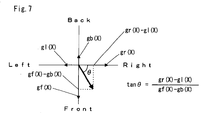
- the plurality of predefined face poses are those of the four directions of front, back, right, and left and the face pose calculation unit determines the difference vector between the evaluation function values for the front and back orientations and the difference vector between the evaluation function values for the right and left orientations and determines the direction of the synthetic vector of these difference vectors as the face pose to be determined.
- the face pose can be detected from the direction of the synthetic vector.
- This face pose includes not only priorly defined poses, such as the front, right side, etc., but includes poses of all directions in 360 degrees. More detailed detection of the face pose can thus be achieved using just simple vector operations.
- Fig. 1 is a block diagram of a face pose detection device of an embodiment of this invention.
- the part inside the broken lines corresponds to being the face detection device of this embodiment.
- input unit 1 comprises a keyboard or mouse, etc., and an operator uses input unit 1 to input operation information concerning the device and to input the necessary information for preparing the two dictionaries to be described below.
- Display unit 2 comprises a CRT or LCD, etc. and displays the subject image, processing conditions, detection results, etc. to the operator.
- Control unit 3 controls the various elements shown in Fig. 1.
- Storage unit 4 comprises a hard disk device, etc. and stores the subject image, detection results, etc.
- Image input unit 5 comprises a camera (may be a CCD camera or CMOS camera) or an image scanner, etc. and inputs a moving image or a still image.
- a moving image the image of a noted frame becomes the subject image
- a still image the still image itself becomes the subject image.
- Image memory 6 stores the current subject image.
- Edge image extraction unit 7 extracts an edge image from the subject image.
- edge image extraction unit 7 performs time subtraction between the image (subject image) of a noted frame and a frame image that is n frames prior (n can be selected as suited) and uses the difference image as the edge image.
- edge image extraction unit 7 applies a differential filter on the input still image to extract the edge image.
- this differential filter may be an ordinary differential filter that is commonly used for contour extraction.
- a partial image extraction unit 8 determines a frame for each partial image, which is considered to contain a facial image (for which there is a possibility that a facial image is contained) based on the edge image extracted by edge image extraction unit 7 (an edge image is handled in the same manner regardless of whether it is extracted from a moving image or from a still image).
- this frame is determined based on peaks and valleys of a contour that joins upper end parts (the uppermost pixels in the Y direction) of the edge image.
- Figs. 2 and Fig. 3 Here, let the subject image be that which is shown in Fig. 2(a). Two men are captured in the image of Fig. 2(a). The man at the left side is standing while facing towards a left, frontal direction and the man at the right side is walking while facing towards the left.
- edge image extraction unit 7 extracts the edge image shown in Fig. 2(b) from the subject image of Fig. 2(a).
- Partial image extraction unit 8 applies a spatial low-pass filter to the edge image of Fig. 2(b) in order to eliminate the fine noise, performs a search in the x direction on the image after application of the low-pass filter to plot the points, (x, max(x)), and determine the contour. A contour with peaks and valleys, such as shown in Fig. 2(c), is thus obtained.
- partial image extraction unit 8 applies a low-pass filter to the contour of Fig. 2(c) to obtain the contour of Fig. 2(d). This process is performed since high frequency components that are unnecessary are superimposed in the contour of Fig. 2(c), and such high frequency components are eliminated to obtain a general contour.
- Partial image extraction unit 8 thus determines the coordinates of peaks P1 and P3 and valley P2 as shown in Fig. 3 and determines the x-direction distance len between peak P1 and valley P2 and the x-direction distance len2 between valley P2 and peak P3.
- Partial image extraction unit 8 then multiplies these distances len1 and len2 by suitable factors to determine the positions and sizes of frames A1 and A2. Partial image extraction unit 8 extracts the rectangular images positioned within these frames A1 and A2 as partial images (two in the present case).
- Partial image extraction unit 8 extracts partial images (which may be just one image or a plurality of images) from the subject image by the procedures described above.
- the above is just an example and the procedures may be changed suitably, such as dividing the subject image into blocks and extracting only the applicable blocks, etc.
- a face learning dictionary 10 holds learned information for recognizing between a facial image and a non-facial image and this learned information includes both information based on facial images and information based on non-facial images.
- a face/non-face identification unit 9 references face learning dictionary 10 and identifies whether or not an extracted partial image contains a facial image based on a predefined evaluation function value.
- face learning dictionary 10 Prior to face detection, face learning dictionary 10 is prepared at first. For preparing face learning dictionary 10, an adequate number of sample images Fi are prepared.
- sample images Fi (1 ⁇ i ⁇ N).
- sample images include not only facial images but also non-facial images. These sample images generally have no relevance to the subject image and may be completely different images.
- the images are normalized to a 10 ⁇ 10 pixel (100 dimensions; this dimension value is only an example and may be changed as suited) size.
- normalize means that if the original image data are of 10 ⁇ 10 pixels, the original data are used as they are while if the original image data are not of 10 ⁇ 10 pixels, expansion or contraction is performed while maintaining the vertical to horizontal ratio to change the size to provide data of 10 ⁇ 10 pixels.
- a single characteristic vector Si (1 ⁇ i ⁇ N) is set for each image.
- the luminance values of the respective pixels are used as the respective components of this characteristic vector Si.
- a characteristic vector Si of this embodiment is thus a 100-dimensional vector.
- luminance values are preferably of approximately 8 bits, in the extreme case, binary values of black and white may be used as well. If color images are premised, hue or saturation, etc. may be used instead of luminance values.
- Lagrange coefficients ⁇ i are determined for each sample image Fi.
- Support Vector Machines are pattern identification machines proposed by Cortes and Vapnik in 1995. These machines project an input vector onto a higher-order characteristic space by a nonlinear projection and constructs an identification hyperplane for which the generalization performance is maximized as the solution of a mathematical programming problem.
- Support Vector Machines are described in detail in "The Institute of Electronics, Information, and Communication Engineers, Technical Report of IEICE PRMU98-36, "Identification of Multiple Categories by Support Vector Machines," Shimodaira, et al., and this reference material should be referred to for details.
- ⁇ i and b are determined uniquely when w is defined.
- face/non-face identification process in face/non-face identification unit 9 shall now be described. To perform this identification, the above-described face learning dictionary 10 must be completed and the partial images must be normalized in the same manner as the above-described sample images.
- a characteristic vector X is then determined in the same manner as was determined for the sample images for each partial image.
- the luminance values of the respective pixels are used as the respective components of the characteristic vector X and the characteristic vector X of this embodiment is thus a 100-dimensional vector.
- K(Si, X) is a kernel function. Also, an image is judged to be a face if g(X) > 0 and an image is judged not to be a face when g(X) ⁇ 0.
- K ( Si , X ) exp ( - ⁇ Si - X ⁇ 2 / 2 ⁇ 2 ) is preferably used as the kernel function K(Si, X).
- Support Vector Machines When Support Vector Machines are thus used, the generalization performance can be increased and the stability of detection of a facial image can be improved by maximizing the margin.
- step 1 of Fig. 4 face/non-face identification unit 9 inputs a partial image from partial image extraction unit 8. Face/non-face identification unit 9 then normalizes this partial image into 10 ⁇ 10 pixels (step 2) and determines a characteristic vector X using the luminance values of the 10 ⁇ 10 pixels (step 3).
- Face/non-face identification unit 9 references face learning dictionary 10 and acquires the necessary parameters ⁇ i, Yi, and b (step 4) and calculates the kernel function K (Si, X). This is repeated and the sum of the products is determined to determine the evaluation function g(X) value (step 5).
- face/non-face identification unit 9 checks whether or not this value is positive (step 6). If the value is positive, face/non-face identification unit 9 judges that the subject image contains a facial image (step 7) while if the value is not positive, face/non-face identification unit 9 judges that the subject image does not contain a facial image (step 8).
- face/non-face identification unit 9 stores the evaluation function g(X) value and the judgment result in storage unit 4 (step 9).
- Fig. 5 shows examples of the results of such a face/non-face identification process.
- the evaluation function g(X) value was 0.750877 and the judgment that a facial image is contained is made by the positive value.
- the evaluation function g(X) value is negative and it is judged that a facial image is not contained.
- FIG. 5 shows that as the absolute value of a negative value increases as a shape differs more and more from a human face.
- the values are -1.039976 for a daruma (potbellied doll) figure, -1.750879 for a light bulb, and -3.674887 for a round clock.
- a daruma figure, light bulb, and clock tended to be readily identified erroneously as being a face by the prior art, they are clearly and correctly identified as not being a face by this invention.
- the components of the characteristic vectors Si and X may be set to:
- a Sobel filter is defined for example as follows for the x direction: [ Eq . 1 ] [ ⁇ 1 0 1 ⁇ 2 0 2 ⁇ 1 0 1 ] and as follows for the y direction: [ Eq . 2 ] [ ⁇ 1 ⁇ 2 ⁇ 1 0 0 0 1 2 1 ]
- a vector is determined that has the intensity in the x direction of each image and the intensity in the y direction of each image as the x and y components. Just the angle of the vector is used and the magnitude of the vector is ignored.
- this angle is normalized using 256 gradations as the basis and used for characteristic vector Si or X.
- the characteristic vector can thus be changed in the above manner.
- luminance values are used as components of the characteristic vector
- the characteristic vector components will be affected when the overall brightness of the image changes.
- this face pose detection device has, in addition to the above-described face detection device, a face pose learning dictionary 11, a face pose calculation unit 12, and a four-direction evaluation function value calculation unit 13.
- face pose learning dictionary 11 is made to hold, for a plurality of predefined face poses (the face poses of the four directions of front, back, right, and left in the present embodiment), learned information independently according to each face pose. That is, four types of sample image (for the number of directions) are prepared separately as shown in Fig. 6 and four sets of learned information corresponding to the learned information in face learning dictionary 10 are prepared.
- learned information dedicated to the identification between a frontal facial image and non-frontal facial image are prepared.
- Dedicated learned information are likewise prepared for the backward pose, rightward pose, and leftward pose.
- Four-direction evaluation function value calculation unit 13 independently references the subject image extracted by partial image extraction unit 8 and the learned information for each of the four directions independently and determines, in the same manner as was carried out by face/non-face identification unit 9, four evaluation function g(X) values (here, the evaluation function g(x) value for the frontal pose shall be referred to as "gf(X)”, that for the backward pose shall be referred to as "gb(X)”, that for the rightward pose shall be referred to as "gr(X)”, and that for the leftward pose shall be referred to as "gl(X)").
- face pose calculation unit 12 calculates the two difference vectors:
- Face pose calculation unit 12 determines the direction of the synthetic vector (dx(X), dy(X)), having the abovementioned difference vectors as the x and y components, as the face pose.
- This pose may take on that of any direction in 360 degrees and the face pose can thus be determined with good precision.
- step 11 face pose calculation unit 12 hands over the partial image to four-direction evaluation function value calculation unit 13 and four-direction evaluation function value calculation unit 13 determines the four evaluation function values (gf(X), gb(X), gr(X), gl(X)) and returns these values to face pose calculation unit 12 (steps 11 through 14).
- the order of operation may be changed arbitrarily.
- Face pose calculation unit 12 determines the difference vectors dx(X) and dy(X) in step 15 and stores the direction of the synthetic vector (dx(X), dy(X)) as the face pose in storage unit 4 in step 16.
- evaluation function values are used as the evaluation function values in the present embodiment, correlation coefficients, etc. that are generally used may be used instead.
Landscapes
- Engineering & Computer Science (AREA)
- Theoretical Computer Science (AREA)
- Physics & Mathematics (AREA)
- General Physics & Mathematics (AREA)
- General Health & Medical Sciences (AREA)
- Health & Medical Sciences (AREA)
- Computer Vision & Pattern Recognition (AREA)
- Oral & Maxillofacial Surgery (AREA)
- Human Computer Interaction (AREA)
- Multimedia (AREA)
- Image Processing (AREA)
- Image Analysis (AREA)
- Collating Specific Patterns (AREA)
Claims (19)
- Teilbild-Gewinnungsgerät mit:Bildeingabemitteln (5), die ein Objektbild eingeben; undRandbild-Gewinnungsmitteln (7), die ein Randbild aus dem Objektbild gewinnen,dadurch gekennzeichnet, dass das Teilbild-Gewinnungsgerät weiterhin Teilbild-Gewinnungsmittel (8) aufweist, die aufgrund des Randbilds Teilbilder gewinnen, die mutmaßlich Gesichtsbilder aus dem Objektbild enthalten, und wobei die Teilbild-Gewinnungsmittel (8) eine Kontur bestimmen, die obere Endteile des Randbilds verbindet, und aufgrund der Erhöhungen (P1, P3) und Vertiefungen (P2) der Kontur Teilbilder aus dem Objektbild gewinnen.
- Gesichtserkennungsgerät mit:einem Gesichts-Lernwörterbuch (10), das gelernte Informationen zur Identifikation zwischen einem Gesichtsbild und einem Nichtgesichtsbild hält; undGesichts-/Nichtgesichts-Identifikationsmitteln (9), die das Gesichts-Lernwörterbuch (10) referenzieren,dadurch gekennzeichnet, dass das Gesichtserkennungsgerät weiterhin ein Teilbild-Gewinnungsgerät nach Anspruch 1 aufweist, das Teilbilder gewinnt, die mutmaßlich Gesichtsbilder von einem Objektbild enthalten, wobei die Gesichts-/Nichtgesichts-Identifikationsmittel (9) ermitteln, ob jedes gewonnene Teilbild ein Gesichtsbild enthält oder nicht.
- Gesichtserkennungsgerät nach Anspruch 2, dadurch gekennzeichnet, dass die Bildeingabemittel (5) ein Objektbild mit einem Bewegtbild eingeben und die Bildgewinnungsmittel (7) ein Randbild durch Zeitsubtraktion von Einzelbildern des Bewegtbilds gewinnen.
- Gesichtserkennungsgerät nach Anspruch 2, dadurch gekennzeichnet, dass die Bildeingabemittel (5) ein Objektbild mit einem Stehbild eingeben und die Randbild-Gewinnungsmittel (7) ein Randbild durch Auflegen eines Differentialfilters auf das Stehbild gewinnen.
- Gesichtserkennungsgerät nach Anspruch 2, dadurch gekennzeichnet, dass das Gesichts-Lernwörterbuch (10) sowohl aufgrund von Gesichtsbildern gelernte Informationen als auch aufgrund von Nichtgesichtsbildern gelernte Informationen enthält.
- Gesichtserkennungsgerät nach Anspruch 2, dadurch gekennzeichnet, dass die Gesichts-/Nichtgesichts-Identifikationsmittel (9) einen vordefinierten Auswertefunktionswert berechnen und aufgrund dieses Auswertefunktionswerts zwischen einem Gesicht und einem Nichtgesicht identifizieren.
- Gesichtserkennungsgerät nach Anspruch 6, dadurch gekennzeichnet, dass ein Eigenvektor, der Leuchtdichte-Informationen zu einem Teilbild als Komponenten hat, in der Auswertefunktion verwendet wird.
- Gesichtserkennungsgerät nach Anspruch 6, dadurch gekennzeichnet, dass ein Eigenvektor, der die Winkel von Randsenkrechtvektoren, die von einem Teilbild abgeleitet wurden, als Komponenten hat, in der Auswertefunktion verwendet wird.
- Gesichtserkennungsgerät nach Anspruch 6, dadurch gekennzeichnet, dass ein Eigenvektor durch das Histogramm ausgedrückt wird, das von einem Teilbild abgeleitet wurde.
- Gesichtshaltungs-Erkennungsgerät mit einem Gesichts-Lernwörterbuch (10), das gelernte Informationen zur Identifikation zwischen einem Gesichtsbild und einem Nichtgesichtsbild hält,
dadurch gekennzeichnet, dass das Gesichtshaltungs-Erkennungsgerät weiterhin Folgendes aufweist:ein Teilbild-Gewinnungsgerät nach Anspruch 1, das Teilbilder, die mutmaßlich Gesichtsbilder enthalten, aus einem Objektbild gewinnt;ein Gesichtshaltungs-Lernwörterbuch (11), das aufgrund der gelernten Informationen zu den Gesichtshaltungen und der gewonnenen Teilbilder gelernte Informationen zu einer Vielzahl von vordefinierten Gesichtshaltungen hält;Auswertefunktionswert-Berechnungsmittel (13), die aufgrund der gelernten Informationen zu den Gesichtshaltungen und der gewonnenen Teilbilder Auswertefunktionswerte für alle vordefinierten Gesichtshaltungen berechnen; undGesichtshaltungs-Berechnungsmittel (12), die aufgrund der Vielzahl von berechneten Auswertefunktionswerten die Gesichtshaltung berechnen, die eine Gesichtshaltung aufweist, die unter den vordefinierten Gesichtshaltungen dazwischen liegt,wobei die vordefinierte Vielzahl von Gesichtshaltungen die Gesichtshaltungen der vier Richtungen vorn, hinten, rechts und links umfasst und die Gesichtshaltungs-Berechnungsmittel (12) die Richtung eines synthetischen Vektors der Auswertefunktionswerte für diese vier Richtungen als die zu bestimmende Gesichtshaltung bestimmen. - Gesichtserkennungsverfahren mit:einem Bildeingabeschritt, in dem ein Objektbild eingeben wird; undeinem Randbild-Gewinnungsschritt, in dem ein Randbild aus dem Objektbild gewonnen wird,dadurch gekennzeichnet, dass das Gesichtserkennungsverfahren weiterhin Folgendes aufweist:einen Teilbild-Gewinnungsschritt, in dem aufgrund des Randbilds eine Kontur, die obere Endteile des Randbilds verbindet, bestimmt wird und aufgrund von Erhöhungen und Vertiefungen dieser Kontur Teilbilder, die mutmaßlich Gesichtsbilder enthalten, aus dem Objektbild gewonnen werden; undeinen Gesichts-/Nichtgesichts-Identifikationsschritt, in dem ein Lernwörterbuch (10), das gelernte Informationen zur Identifikation zwischen einem Gesichtsbild und einem Nichtgesichtsbild hält, referenziert wird und ermittelt wird, ob jedes gewonnene Teilbild ein Gesichtsbild enthält oder nicht.
- Gesichtserkennungsverfahren nach Anspruch 11, dadurch gekennzeichnet, dass ein Objektbild mit einem Bewegtbild eingegeben wird und ein Randbild durch Zeitsubtraktion von Einzelbildern des Bewegtbilds gewonnen wird.
- Gesichtserkennungsverfahren nach Anspruch 11, dadurch gekennzeichnet, dass ein Objektbild mit einem Stehbild eingegeben wird und ein Randbild durch Auflegen eines Differentialfilters auf das Stehbild gewonnen wird.
- Gesichtserkennungsverfahren nach Anspruch 11, dadurch gekennzeichnet, dass das Gesichts-Lernwörterbuch (10) sowohl aufgrund von Gesichtsbildern gelernte Informationen als auch aufgrund von Nichtgesichtsbildern gelernte Informationen enthält.
- Gesichtserkennungsverfahren nach Anspruch 11, dadurch gekennzeichnet, dass ein vordefinierter Auswertefunktionswert berechnet wird und aufgrund dieses Auswertefunktionswerts eine Identifikation zwischen einem Gesicht und einem Nichtgesicht vorgenommen wird.
- Gesichtserkennungsverfahren nach Anspruch 15, dadurch gekennzeichnet, dass ein Eigenvektor, der Leuchtdichte-Informationen zu einem Teilbild als Komponenten hat, in der Auswertefunktion verwendet wird.
- Gesichtserkennungsverfahren nach Anspruch 15, dadurch gekennzeichnet, dass ein Eigenvektor, der die Winkel von Randsenkrechtvektoren, die von einem Teilbild abgeleitet wurden, als Komponenten hat, in der Auswertefunktion verwendet wird.
- Gesichtserkennungsverfahren nach Anspruch 15, dadurch gekennzeichnet, dass ein Eigenvektor durch das Histogramm ausgedrückt wird, das von einem Teilbild abgeleitet wurde.
- Gesichtshaltungs-Erkennungsverfahren mit:einem Bildeingabeschritt, in dem ein Objektbild eingeben wird; undeinem Randbild-Gewinnungsschritt, in dem ein Randbild aus dem Objektbild gewonnen wird,dadurch gekennzeichnet, dass das Gesichtshaltungs-Erkennungsverfahren weiterhin Folgendes aufweist:einen Teilbild-Gewinnungsschritt, in dem aufgrund des Randbilds eine Kontur, die obere Endteile des Randbilds verbindet, bestimmt wird und aufgrund von Erhöhungen und Vertiefungen dieser Kontur Teilbilder, die mutmaßlich Gesichtsbilder enthalten, aus dem Objektbild gewonnen werden;einen Auswertefunktionswert-Berechnungsschritt, in dem ein Gesichtshaltungs-Lernwörterbuch (11), das gelernte Informationen zu einer Vielzahl von vordefinierten Gesichtshaltungen entsprechend jeder Gesichtshaltung hält, referenziert wird und aufgrund der gelernten Informationen zu den Gesichtshaltungen und der gewonnenen Teilbilder Auswertefunktionswerte für alle vordefinierten Gesichtshaltungen berechnet werden; undeinen Gesichtshaltungs-Berechnungsschritt, in dem aufgrund der Vielzahl von berechneten Auswertefunktionswerten die Gesichtshaltung bestimmt wird, die eine Gesichtshaltung aufweist, die unter den vordefinierten Gesichtshaltungen dazwischen liegt,wobei die vordefinierte Vielzahl von Gesichtshaltungen die Gesichtshaltungen der vier Richtungen vorn, hinten, rechts und links umfasst und der Gesichtshaltungs-Berechnungsschritt die Richtung eines synthetischen Vektors der Auswertefunktionswerte für diese vier Richtungen als die zu bestimmende Gesichtshaltung bestimmt.
Applications Claiming Priority (2)
| Application Number | Priority Date | Filing Date | Title |
|---|---|---|---|
| JP2001151828 | 2001-05-22 | ||
| JP2001151828 | 2001-05-22 |
Publications (3)
| Publication Number | Publication Date |
|---|---|
| EP1260935A2 EP1260935A2 (de) | 2002-11-27 |
| EP1260935A3 EP1260935A3 (de) | 2004-01-14 |
| EP1260935B1 true EP1260935B1 (de) | 2006-07-12 |
Family
ID=18996597
Family Applications (1)
| Application Number | Title | Priority Date | Filing Date |
|---|---|---|---|
| EP02010289A Expired - Lifetime EP1260935B1 (de) | 2001-05-22 | 2002-05-21 | Gerät zur Gesichtsdetektion, Gerät zur Detektion der Gesichtspose, Gerät zur Extraktion von Teilbildern und Verfahren für diese Geräte |
Country Status (3)
| Country | Link |
|---|---|
| US (1) | US7123754B2 (de) |
| EP (1) | EP1260935B1 (de) |
| DE (1) | DE60213032T2 (de) |
Families Citing this family (57)
| Publication number | Priority date | Publication date | Assignee | Title |
|---|---|---|---|---|
| DE10043460C2 (de) * | 2000-09-04 | 2003-01-30 | Fraunhofer Ges Forschung | Auffinden von Körperpartien durch Auswerten von Kantenrichtungsinformation |
| KR100473598B1 (ko) * | 2002-11-04 | 2005-03-11 | 삼성전자주식회사 | 가려진 얼굴영상을 판단하는 시스템 및 방법 |
| JP2004213087A (ja) * | 2002-12-26 | 2004-07-29 | Toshiba Corp | 個人認証装置および個人認証方法 |
| WO2004106856A1 (ja) * | 2003-05-29 | 2004-12-09 | Olympus Corporation | ステレオカメラ支持装置、ステレオカメラ支持方法及びキャリブレーション検出装置及びキャリブレーション補正装置並びにステレオカメラシステム |
| JP2005122351A (ja) * | 2003-10-15 | 2005-05-12 | Seiko Epson Corp | 顔画像候補領域検索方法及び検索システム並びに検索プログラム |
| JP2005134966A (ja) * | 2003-10-28 | 2005-05-26 | Seiko Epson Corp | 顔画像候補領域検索方法及び検索システム並びに検索プログラム |
| JP4085959B2 (ja) * | 2003-11-14 | 2008-05-14 | コニカミノルタホールディングス株式会社 | 物体検出装置、物体検出方法、および記録媒体 |
| KR100601933B1 (ko) * | 2003-11-18 | 2006-07-14 | 삼성전자주식회사 | 사람검출방법 및 장치와 이를 이용한 사생활 보호방법 및 시스템 |
| US7415140B2 (en) * | 2004-01-27 | 2008-08-19 | Seiko Epson Corporation | Method of correcting deviation of detection position for human face, correction system, and correction program |
| US7627148B2 (en) * | 2004-07-06 | 2009-12-01 | Fujifilm Corporation | Image data processing apparatus and method, and image data processing program |
| JP4378261B2 (ja) * | 2004-10-27 | 2009-12-02 | キヤノン株式会社 | 画像処理方法、画像処理装置 |
| KR100608596B1 (ko) * | 2004-12-28 | 2006-08-03 | 삼성전자주식회사 | 얼굴 검출을 기반으로 하는 휴대용 영상 촬영 기기 및영상 촬영 방법 |
| JP4588575B2 (ja) * | 2005-08-09 | 2010-12-01 | 富士フイルム株式会社 | デジタル画像の複数対象物検出方法および装置並びにプログラム |
| US7599527B2 (en) * | 2005-09-28 | 2009-10-06 | Facedouble, Inc. | Digital image search system and method |
| US8369570B2 (en) * | 2005-09-28 | 2013-02-05 | Facedouble, Inc. | Method and system for tagging an image of an individual in a plurality of photos |
| US8311294B2 (en) | 2009-09-08 | 2012-11-13 | Facedouble, Inc. | Image classification and information retrieval over wireless digital networks and the internet |
| US7587070B2 (en) * | 2005-09-28 | 2009-09-08 | Facedouble, Inc. | Image classification and information retrieval over wireless digital networks and the internet |
| US7450740B2 (en) | 2005-09-28 | 2008-11-11 | Facedouble, Inc. | Image classification and information retrieval over wireless digital networks and the internet |
| US8600174B2 (en) * | 2005-09-28 | 2013-12-03 | Facedouble, Inc. | Method and system for attaching a metatag to a digital image |
| JP4412552B2 (ja) * | 2005-10-05 | 2010-02-10 | 富士フイルム株式会社 | 画像レイアウト装置および方法並びにプログラム |
| JP4556891B2 (ja) * | 2006-03-17 | 2010-10-06 | ソニー株式会社 | 情報処理装置および方法、記録媒体、並びにプログラム |
| US20080107341A1 (en) * | 2006-11-02 | 2008-05-08 | Juwei Lu | Method And Apparatus For Detecting Faces In Digital Images |
| JP4775306B2 (ja) * | 2007-04-23 | 2011-09-21 | ソニー株式会社 | 画像処理装置、撮像装置、および画像表示制御方法、並びにコンピュータ・プログラム |
| CN101472133B (zh) * | 2007-12-28 | 2010-12-08 | 鸿富锦精密工业(深圳)有限公司 | 影像校正装置及影像校正方法 |
| CN102016882B (zh) | 2007-12-31 | 2015-05-27 | 应用识别公司 | 利用脸部签名来标识和共享数字图像的方法、系统和计算机程序 |
| US9721148B2 (en) | 2007-12-31 | 2017-08-01 | Applied Recognition Inc. | Face detection and recognition |
| US9639740B2 (en) | 2007-12-31 | 2017-05-02 | Applied Recognition Inc. | Face detection and recognition |
| JP5159390B2 (ja) * | 2008-03-28 | 2013-03-06 | キヤノン株式会社 | 物体検知方法及びその装置 |
| US8855360B2 (en) * | 2008-07-23 | 2014-10-07 | Qualcomm Technologies, Inc. | System and method for face tracking |
| US9104984B2 (en) * | 2008-11-13 | 2015-08-11 | Sony Corporation | Method and device relating to information management |
| JP4710978B2 (ja) * | 2009-01-09 | 2011-06-29 | ソニー株式会社 | 対象物検出装置、撮像装置、対象物検出方法およびプログラム |
| JP2010165052A (ja) * | 2009-01-13 | 2010-07-29 | Canon Inc | 画像処理装置及び画像処理方法 |
| JP5247480B2 (ja) * | 2009-01-13 | 2013-07-24 | キヤノン株式会社 | オブジェクト識別装置及びオブジェクト識別方法 |
| JP5361524B2 (ja) * | 2009-05-11 | 2013-12-04 | キヤノン株式会社 | パターン認識システム及びパターン認識方法 |
| TWI466034B (zh) * | 2009-12-23 | 2014-12-21 | Altek Corp | Methods to Improve Face Recognition |
| US20110293189A1 (en) * | 2010-05-28 | 2011-12-01 | Microsoft Corporation | Facial Analysis Techniques |
| CN101930540A (zh) * | 2010-09-08 | 2010-12-29 | 大连古野软件有限公司 | 基于视频的多特征融合的火焰检测装置和方法 |
| US9552376B2 (en) | 2011-06-09 | 2017-01-24 | MemoryWeb, LLC | Method and apparatus for managing digital files |
| US8548207B2 (en) | 2011-08-15 | 2013-10-01 | Daon Holdings Limited | Method of host-directed illumination and system for conducting host-directed illumination |
| US9202105B1 (en) | 2012-01-13 | 2015-12-01 | Amazon Technologies, Inc. | Image analysis for user authentication |
| US9235928B2 (en) | 2012-01-24 | 2016-01-12 | University Of Southern California | 3D body modeling, from a single or multiple 3D cameras, in the presence of motion |
| US8965046B2 (en) | 2012-03-16 | 2015-02-24 | Qualcomm Technologies, Inc. | Method, apparatus, and manufacture for smiling face detection |
| US9418475B2 (en) | 2012-04-25 | 2016-08-16 | University Of Southern California | 3D body modeling from one or more depth cameras in the presence of articulated motion |
| JP6256165B2 (ja) | 2014-04-09 | 2018-01-10 | 富士通株式会社 | 視線検出装置、視線検出プログラム及び視線検出方法 |
| US9940727B2 (en) | 2014-06-19 | 2018-04-10 | University Of Southern California | Three-dimensional modeling from wide baseline range scans |
| US11256792B2 (en) | 2014-08-28 | 2022-02-22 | Facetec, Inc. | Method and apparatus for creation and use of digital identification |
| US12130900B2 (en) | 2014-08-28 | 2024-10-29 | Facetec, Inc. | Method and apparatus to dynamically control facial illumination |
| US10614204B2 (en) | 2014-08-28 | 2020-04-07 | Facetec, Inc. | Facial recognition authentication system including path parameters |
| US10698995B2 (en) | 2014-08-28 | 2020-06-30 | Facetec, Inc. | Method to verify identity using a previously collected biometric image/data |
| US10803160B2 (en) | 2014-08-28 | 2020-10-13 | Facetec, Inc. | Method to verify and identify blockchain with user question data |
| CA2902093C (en) | 2014-08-28 | 2023-03-07 | Kevin Alan Tussy | Facial recognition authentication system including path parameters |
| US10915618B2 (en) | 2014-08-28 | 2021-02-09 | Facetec, Inc. | Method to add remotely collected biometric images / templates to a database record of personal information |
| WO2016117475A1 (ja) * | 2015-01-19 | 2016-07-28 | シャープ株式会社 | 映像処理装置 |
| USD1074689S1 (en) | 2016-04-26 | 2025-05-13 | Facetec, Inc. | Display screen or portion thereof with animated graphical user interface |
| USD987653S1 (en) | 2016-04-26 | 2023-05-30 | Facetec, Inc. | Display screen or portion thereof with graphical user interface |
| US10297059B2 (en) | 2016-12-21 | 2019-05-21 | Motorola Solutions, Inc. | Method and image processor for sending a combined image to human versus machine consumers |
| US10936178B2 (en) | 2019-01-07 | 2021-03-02 | MemoryWeb, LLC | Systems and methods for analyzing and organizing digital photos and videos |
Family Cites Families (21)
| Publication number | Priority date | Publication date | Assignee | Title |
|---|---|---|---|---|
| US5012522A (en) * | 1988-12-08 | 1991-04-30 | The United States Of America As Represented By The Secretary Of The Air Force | Autonomous face recognition machine |
| US5164992A (en) * | 1990-11-01 | 1992-11-17 | Massachusetts Institute Of Technology | Face recognition system |
| JPH06208622A (ja) | 1992-01-10 | 1994-07-26 | Nippon Telegr & Teleph Corp <Ntt> | 物体領域切り出し装置 |
| JP2973676B2 (ja) * | 1992-01-23 | 1999-11-08 | 松下電器産業株式会社 | 顔画像特徴点抽出装置 |
| JPH0723012A (ja) | 1993-06-30 | 1995-01-24 | Takahashi Takeshi | 視聴率調査システム |
| ES2171432T3 (es) * | 1993-12-10 | 2002-09-16 | Ricoh Kk | Aparato y metodos para reconocer una imagen especifica a partir de una señal de imagen de entrada. |
| JP3557659B2 (ja) | 1994-08-22 | 2004-08-25 | コニカミノルタホールディングス株式会社 | 顔抽出方法 |
| JPH08153187A (ja) | 1994-09-27 | 1996-06-11 | Oki Electric Ind Co Ltd | 画像認識方法 |
| US5497430A (en) * | 1994-11-07 | 1996-03-05 | Physical Optics Corporation | Method and apparatus for image recognition using invariant feature signals |
| JP3797686B2 (ja) | 1995-09-07 | 2006-07-19 | 株式会社東芝 | 形状認識装置及びその方法 |
| JPH09138471A (ja) * | 1995-09-13 | 1997-05-27 | Fuji Photo Film Co Ltd | 特定形状領域の抽出方法、特定領域の抽出方法及び複写条件決定方法 |
| JPH1051755A (ja) * | 1996-05-30 | 1998-02-20 | Fujitsu Ltd | テレビ会議端末の画面表示制御装置 |
| JPH10307923A (ja) | 1997-05-01 | 1998-11-17 | Mitsubishi Electric Corp | 顔部品抽出装置および顔の向き検出装置 |
| US6188777B1 (en) * | 1997-08-01 | 2001-02-13 | Interval Research Corporation | Method and apparatus for personnel detection and tracking |
| JP4432262B2 (ja) | 1999-03-12 | 2010-03-17 | ソニー株式会社 | 画像処理装置、画像処理方法及び記録媒体 |
| US6526161B1 (en) * | 1999-08-30 | 2003-02-25 | Koninklijke Philips Electronics N.V. | System and method for biometrics-based facial feature extraction |
| US6741756B1 (en) * | 1999-09-30 | 2004-05-25 | Microsoft Corp. | System and method for estimating the orientation of an object |
| KR100343223B1 (ko) * | 1999-12-07 | 2002-07-10 | 윤종용 | 화자 위치 검출 장치 및 그 방법 |
| JP2001216515A (ja) * | 2000-02-01 | 2001-08-10 | Matsushita Electric Ind Co Ltd | 人物の顔の検出方法およびその装置 |
| JP3561463B2 (ja) * | 2000-08-11 | 2004-09-02 | コナミ株式会社 | 3dビデオゲームにおける擬似カメラ視点移動制御方法及び3dビデオゲーム装置 |
| US6804391B1 (en) * | 2000-11-22 | 2004-10-12 | Microsoft Corporation | Pattern detection methods and systems, and face detection methods and systems |
-
2002
- 2002-05-21 DE DE60213032T patent/DE60213032T2/de not_active Expired - Fee Related
- 2002-05-21 EP EP02010289A patent/EP1260935B1/de not_active Expired - Lifetime
- 2002-05-22 US US10/154,404 patent/US7123754B2/en not_active Expired - Lifetime
Also Published As
| Publication number | Publication date |
|---|---|
| EP1260935A2 (de) | 2002-11-27 |
| DE60213032T2 (de) | 2006-12-28 |
| US20020191818A1 (en) | 2002-12-19 |
| US7123754B2 (en) | 2006-10-17 |
| DE60213032D1 (de) | 2006-08-24 |
| EP1260935A3 (de) | 2004-01-14 |
Similar Documents
| Publication | Publication Date | Title |
|---|---|---|
| EP1260935B1 (de) | Gerät zur Gesichtsdetektion, Gerät zur Detektion der Gesichtspose, Gerät zur Extraktion von Teilbildern und Verfahren für diese Geräte | |
| US11775056B2 (en) | System and method using machine learning for iris tracking, measurement, and simulation | |
| US7995805B2 (en) | Image matching apparatus, image matching method, computer program and computer-readable storage medium | |
| EP1729244B1 (de) | Verfahren und Vorrichtung zur Bildverarbeitung | |
| CN113449606B (zh) | 一种目标对象识别方法、装置、计算机设备及存储介质 | |
| Vezhnevets et al. | Robust and accurate eye contour extraction | |
| US9881204B2 (en) | Method for determining authenticity of a three-dimensional object | |
| US6611613B1 (en) | Apparatus and method for detecting speaking person's eyes and face | |
| EP1693782B1 (de) | Verfahren zum Detektieren von Gesichtsmerkmalen | |
| US7035461B2 (en) | Method for detecting objects in digital images | |
| EP1693783B1 (de) | Schnelles Verfahren zum Detektieren von Objekten durch statistischen Mustervergleich | |
| CN105205480B (zh) | 一种复杂场景中人眼定位方法及系统 | |
| US11232586B2 (en) | Line-of-sight estimation device, line-of-sight estimation method, and program recording medium | |
| US20070242856A1 (en) | Object Recognition Method and Apparatus Therefor | |
| CN108416291B (zh) | 人脸检测识别方法、装置和系统 | |
| CN108549886A (zh) | 一种人脸活体检测方法及装置 | |
| EP1059608A2 (de) | Vorrichtung mit Eigenvektorraummethode zur Erkennung von Gestalt und Position einer Hand | |
| CN110363047A (zh) | 人脸识别的方法、装置、电子设备和存储介质 | |
| Levinshtein et al. | Hybrid eye center localization using cascaded regression and hand-crafted model fitting | |
| CN112633221A (zh) | 一种人脸方向的检测方法及相关装置 | |
| JP3970573B2 (ja) | 顔画像認識装置および方法 | |
| JP2003044853A (ja) | 顔検出装置、顔向き検出装置、部分画像抽出装置及びそれらの方法 | |
| KR20100121817A (ko) | 눈의 영역을 추적하는 방법 | |
| CN111738930A (zh) | 人脸图像的合成方法、装置、电子设备及存储介质 | |
| Bauckhage et al. | Detecting abnormal gait |
Legal Events
| Date | Code | Title | Description |
|---|---|---|---|
| PUAI | Public reference made under article 153(3) epc to a published international application that has entered the european phase |
Free format text: ORIGINAL CODE: 0009012 |
|
| AK | Designated contracting states |
Kind code of ref document: A2 Designated state(s): AT BE CH CY DE DK ES FI FR GB GR IE IT LI LU MC NL PT SE TR |
|
| AX | Request for extension of the european patent |
Free format text: AL;LT;LV;MK;RO;SI |
|
| PUAL | Search report despatched |
Free format text: ORIGINAL CODE: 0009013 |
|
| AK | Designated contracting states |
Kind code of ref document: A3 Designated state(s): AT BE CH CY DE DK ES FI FR GB GR IE IT LI LU MC NL PT SE TR |
|
| AX | Request for extension of the european patent |
Extension state: AL LT LV MK RO SI |
|
| 17P | Request for examination filed |
Effective date: 20040217 |
|
| 17Q | First examination report despatched |
Effective date: 20040420 |
|
| AKX | Designation fees paid |
Designated state(s): DE FR GB |
|
| GRAP | Despatch of communication of intention to grant a patent |
Free format text: ORIGINAL CODE: EPIDOSNIGR1 |
|
| GRAS | Grant fee paid |
Free format text: ORIGINAL CODE: EPIDOSNIGR3 |
|
| GRAA | (expected) grant |
Free format text: ORIGINAL CODE: 0009210 |
|
| AK | Designated contracting states |
Kind code of ref document: B1 Designated state(s): DE FR GB |
|
| REG | Reference to a national code |
Ref country code: GB Ref legal event code: FG4D |
|
| REF | Corresponds to: |
Ref document number: 60213032 Country of ref document: DE Date of ref document: 20060824 Kind code of ref document: P |
|
| ET | Fr: translation filed | ||
| PLBE | No opposition filed within time limit |
Free format text: ORIGINAL CODE: 0009261 |
|
| STAA | Information on the status of an ep patent application or granted ep patent |
Free format text: STATUS: NO OPPOSITION FILED WITHIN TIME LIMIT |
|
| 26N | No opposition filed |
Effective date: 20070413 |
|
| PGFP | Annual fee paid to national office [announced via postgrant information from national office to epo] |
Ref country code: DE Payment date: 20090514 Year of fee payment: 8 Ref country code: FR Payment date: 20090515 Year of fee payment: 8 |
|
| PGFP | Annual fee paid to national office [announced via postgrant information from national office to epo] |
Ref country code: GB Payment date: 20090520 Year of fee payment: 8 |
|
| GBPC | Gb: european patent ceased through non-payment of renewal fee |
Effective date: 20100521 |
|
| REG | Reference to a national code |
Ref country code: FR Ref legal event code: ST Effective date: 20110131 |
|
| PG25 | Lapsed in a contracting state [announced via postgrant information from national office to epo] |
Ref country code: DE Free format text: LAPSE BECAUSE OF NON-PAYMENT OF DUE FEES Effective date: 20101201 |
|
| PG25 | Lapsed in a contracting state [announced via postgrant information from national office to epo] |
Ref country code: FR Free format text: LAPSE BECAUSE OF NON-PAYMENT OF DUE FEES Effective date: 20100531 |
|
| PG25 | Lapsed in a contracting state [announced via postgrant information from national office to epo] |
Ref country code: GB Free format text: LAPSE BECAUSE OF NON-PAYMENT OF DUE FEES Effective date: 20100521 |