EP1277505A1 - Appareil, procédé et système d'analyse de flux pour capter des particules immunogènes - Google Patents
Appareil, procédé et système d'analyse de flux pour capter des particules immunogènes Download PDFInfo
- Publication number
- EP1277505A1 EP1277505A1 EP02014932A EP02014932A EP1277505A1 EP 1277505 A1 EP1277505 A1 EP 1277505A1 EP 02014932 A EP02014932 A EP 02014932A EP 02014932 A EP02014932 A EP 02014932A EP 1277505 A1 EP1277505 A1 EP 1277505A1
- Authority
- EP
- European Patent Office
- Prior art keywords
- measuring cell
- signal
- immunogenic particles
- filtration measuring
- filter part
- Prior art date
- Legal status (The legal status is an assumption and is not a legal conclusion. Google has not performed a legal analysis and makes no representation as to the accuracy of the status listed.)
- Granted
Links
Images


Classifications
-
- B—PERFORMING OPERATIONS; TRANSPORTING
- B01—PHYSICAL OR CHEMICAL PROCESSES OR APPARATUS IN GENERAL
- B01D—SEPARATION
- B01D61/00—Processes of separation using semi-permeable membranes, e.g. dialysis, osmosis or ultrafiltration; Apparatus, accessories or auxiliary operations specially adapted therefor
- B01D61/14—Ultrafiltration; Microfiltration
- B01D61/18—Apparatus therefor
-
- G—PHYSICS
- G01—MEASURING; TESTING
- G01N—INVESTIGATING OR ANALYSING MATERIALS BY DETERMINING THEIR CHEMICAL OR PHYSICAL PROPERTIES
- G01N15/00—Investigating characteristics of particles; Investigating permeability, pore-volume or surface-area of porous materials
- G01N15/10—Investigating individual particles
- G01N15/14—Optical investigation techniques, e.g. flow cytometry
- G01N15/1456—Optical investigation techniques, e.g. flow cytometry without spatial resolution of the texture or inner structure of the particle, e.g. processing of pulse signals
- G01N15/1459—Optical investigation techniques, e.g. flow cytometry without spatial resolution of the texture or inner structure of the particle, e.g. processing of pulse signals the analysis being performed on a sample stream
-
- G—PHYSICS
- G01—MEASURING; TESTING
- G01N—INVESTIGATING OR ANALYSING MATERIALS BY DETERMINING THEIR CHEMICAL OR PHYSICAL PROPERTIES
- G01N1/00—Sampling; Preparing specimens for investigation
- G01N1/28—Preparing specimens for investigation including physical details of (bio-)chemical methods covered elsewhere, e.g. G01N33/50, C12Q
- G01N1/40—Concentrating samples
- G01N1/4077—Concentrating samples by other techniques involving separation of suspended solids
-
- G—PHYSICS
- G01—MEASURING; TESTING
- G01N—INVESTIGATING OR ANALYSING MATERIALS BY DETERMINING THEIR CHEMICAL OR PHYSICAL PROPERTIES
- G01N15/00—Investigating characteristics of particles; Investigating permeability, pore-volume or surface-area of porous materials
- G01N15/06—Investigating concentration of particle suspensions
- G01N15/075—Investigating concentration of particle suspensions by optical means
Definitions
- the present invention relates to an apparatus, a method and a Flow analysis system for the detection of immunogenic particles according to the generic term of claim 1.
- Immunogenic particles such as bacteria, with a diameter> 0.2 ⁇ m must be used for many fields of application in gases or liquids, in the following as a fluid designated, with high sensitivity regardless of a laboratory, d. H. in front Location, can be detected automatically.
- Essential areas of application for the proof immunogenic particles are drinking, industrial and wastewater analysis, food analysis, medical diagnostics, detection of biological warfare agents and related Areas in which microbiological analyzes are carried out.
- Immunological methods are used for the detection and identification of immunogenic particles, such as bacteria, generally well suited and widespread. she are based on the highly specific antigen-antibody reaction and offer the possibility quickly and specifically detect the immunogenic particles sought. Since the Sensitivity of common immunological methods for many microbiological applications, such as drinking water analysis, is usually insufficient Enrichment procedure absolutely necessary. Such an enrichment of Bacteria can be separated in a conventional manner by membrane filtration, using the pore size of the filter is smaller than the diameter of the immunogenic particles, and / or by cultural increase can be achieved. Compared to the classic microbiological Culture and identification procedures can be achieved through the use of immunological The procedure shortens the time of preparation considerably since there are no visually visible reactions must be waited for.
- the company Riedel-de Ha ⁇ n offers an immunological microtiter plate test for Enterobacteriaceae (ECA) in drinking water, which is a 16 to 20-hour cultural enrichment process is connected upstream. The test is based on a sandwich ELISA, at the catcher and detector antibodies are identical. Furthermore, the company Riedel-de Have a Legionella test in which the water samples are membrane filtered and open a legionella-selective culture medium. The after several days grown colonies are transferred to a nitrocellulose filter and labeled with peroxidase monoclonal antibodies. Legionella colonies on the Nitrocellulose filters turn blue and through the reaction product of the marker enzyme can be identified visually by trained laboratory personnel.
- ECA Enterobacteriaceae
- a major disadvantage of commercial testing is that enrichment and the immunological detection of bacteria only in a laboratory can be, since several complex work steps by trained personnel must be carried out sequentially. The time and manpower required for such Test is relatively high. An automated on-site verification can be do not perform with such tests.
- immunofiltration has the disadvantage that additional capture antibodies on the filter material.
- a complex immobilization of these capture antibodies on the filter material is therefore necessary and if the preparation this filter is not used immediately before use, ensure that the immobilized antibodies retain their affinity until they are used.
- the bond a reaction equilibrium of the immunogenic particles to the antibodies on the filter material owns, some of the bacteria sought during the incubation step through the pores of the filter, the diameter of which is larger than the diameter the particle, rinsed and therefore does not contribute to the measurement signal.
- Another Disadvantage of immunofiltration is that the immunoassay is not directly on the filter surface, but is carried out in the filter pores.
- the evaluation of the implemented Substrate solution must therefore always be carried out in a downstream measuring chamber. An additional transport step from the filter to the measuring chamber is required Both the analysis time is extended and the diluted substrate solution is diluted and thus leads to a reduction in sensitivity.
- the object of the present invention based on a device and a method for detecting immunogenic particles in specify a sample fluid that is more accurate, faster, and less expensive Determination of immunogenic particles also allowed outside of a laboratory.
- the invention is based on the idea of immunogenic particles in a filtration measuring cell enrich and specific by the immunogenic in a filter material Particles generated signals received with a sensor element that way is arranged that it is located near the filter part.
- a major advantage of the device according to the invention is that it is immunogenic Particles such as bacteria with high sensitivity and independent from a laboratory, d. H. can be automatically verified on site.
- the Detection limits achieved with this device are due to bacteria due to the integrated enrichment step significantly below that of conventional immunoassays.
- the time for a test can be significant compared to conventional immunoassays be reduced.
- the non-specific enrichment of the immunogenic particles and the both find specific immunological evidence of the immunogenic particles on the Surface of the filter instead.
- a manual transfer of the immunogenic particles from the filter to another carrier is no longer necessary. Through immunological detection the use of the immunogenic particles directly on the filter surface becomes very sensitive optical measurement methods.
- this is in the presence immunogenic particles generated signal around a light radiation and the filtration measuring cell is at least partially translucent.
- This is a very wide one widespread possibility of signal generation, for which very many and well characterized Reagents and sensor elements are available.
- the result of the immune test can be detected directly at the reaction site, since that generated on the filter surface Light emits in all directions of the room.
- the photodetector or the fluorescence measuring head can therefore be placed directly opposite the filter surface. An imperative Separation of reaction site and detection site and a related transport step, how he z. B. in immunofiltration due to the substrate conversion in the Pores is required is eliminated.
- the automated detection of light radiation is done by a photo detector as a sensor element allows.
- photodetectors are, for example, photodiodes, avalanche diodes, Photo multiplier or CCDs.
- the pore size of the filter part becomes smaller than the diameter of the one to be detected immunogenic particles selected, so the enrichment of the immunogenic particles unspecific due to their size on the filter (surface filtration) and a coating of the filter part with an additional capture antibody is not more needed.
- Round filters with a pore diameter of are preferred as the filter part 0.2 ⁇ m made of polycarbonate, nitrocellulose, PVDF, nylon or modified nylon.
- a fluid mechanical and manufacturing technology particularly favorable form for the Filtration measuring cell is essentially cylindrical in shape.
- the filtration measuring cell has a bottom part, a lid part and a substantially perpendicular between the bottom part and the Cover part extending wall.
- This has the advantage of being particularly simple Production.
- the filter part lies on the bottom part and is thus between Base part and cover part.
- the number of parts can be reduced by integrating the cover part and the wall are executed.
- the filter cell should be permeable to light radiation an at least partial production of the filtration measuring cell Acrylic glass (polymethyl methacrylate, PMMA) a particularly simple and inexpensive Variant.
- materials such as polystyrene or polycarbonate can be used become.
- the filtration measuring cell can be used in an automated flow analysis system operate.
- a fluid outlet located under the filter part so that the fluid is substantially flowing vertically through the filter part ensures a fluid mechanic optimal fluid flow for the enrichment of the immunogenic particles on the filter surface.
- a structurally particularly simple solution for holding the filter part is the training the bottom part through a filter frit held in a housing.
- the sample fluid consists of an aqueous solution. Basically, however, is also conceivable to enrich immunogenic particles from a gas stream in the filter part. On Such gaseous sample fluid occurs, for example, when monitoring gas flows in air conditioners.
- FIG 1 shows a schematic representation of a flow analysis system 100 with a Filtration measuring cell 102 according to the invention for detecting immunogenic particles in a sample fluid.
- the filtration measuring cell 102 has a replaceable one in its interior Filter part 104, which can be flowed through perpendicular to the filter surface.
- the Pore size of the filter part 104 is smaller than the diameter of the one to be detected immunogenic particles, so that these are in an enrichment step in which the Sample fluid is passed through the filter part 104 on the surface of the filter part Collect 104 as a filter cake (this is called surface filtration).
- the filtration measuring cell 102 is designed such that it faces the surface of the filter part 104 a translucent window 106 is arranged.
- Filter surface and window 106 thus form the bottom and cover of the essentially cylindrical measuring cell.
- Photodetector 108 detects what is passing through the translucent window 106 Light.
- the immunological detection of the immunogenic particles 112 takes place after the Enrichment step directly on the surface of the filter part 104 immunogenic particles to be detected 112 specific antibodies 114 to which a Enzyme (shown here in a circle), such as horseradish peroxidase is passed through the filter cake and the filter part 104.
- the labeled antibody 114 specifically binds only to the immunogenic particles 112 to be detected the surface of the filter part 104, but not to those that may also be present in the sample fluid unspecific particles 116 or 117.
- two peristaltic pumps are used to convey fluid 120 and 122 are provided.
- the pump 120 serves to convey fluid perpendicular to the filter part 104, while the pump 122 is pumping in parallel to the filter surface.
- the fluid path parallel to the filter surface essentially serves to fill the filtration measuring cell with liquid without bubbles or air bubbles, that have collected in the filtration measuring cell 102. Moreover this fluid path allows the volume of liquid in the filtration cell 102 in to be replaced completely in a short time and thus the necessary rinsing times essential To shorten.
- a fluid distributor 124 in combination with various valves 126 enables automated optionally supplying various fluids to the filtration measuring cell 102.
- the flow analysis system 100 further comprises a measurement data evaluation device and a system controller 128, shown as a block in Figure 1 are.
- the measurement data evaluation device determines from the recorded measurement values Concentration data.
- the system control device controls, for example the peristaltic pumps 120, 122 and the valves 126 in accordance with adjustable parameters, which are emitted by the control device.
- the system also includes a data entry device 130 and a data display device 132.
- the data entry device 130 is used for the input of control parameters by a user, these are both parameters for the system control device and parameters for the measurement data evaluation device.
- the data display device 132 sets both the set system parameters and the recorded and further processed Measured values.
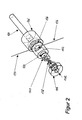
- FIG. 2 shows, in a preferred embodiment, a device according to the invention for detecting immunogenic particles, which can be integrated into a flow analysis system.
- the cylindrical filtration measuring cell 102 the wall of which is preferably made of polyether ether ketone (PEEK), has three fluid connections: two connections 134 and 136 mounted on the side serve for fluid delivery parallel to the filter part 104.
- the fluid connections 134 and 136 are formed by steel capillaries which are fitted into corresponding openings in the filtration measuring cell 102.
- Another fluid connection 138 is provided on the bottom part 140 of the filtration measuring cell 102. This fluid connection 138 allows fluid to be conveyed perpendicular to the filter part 104.
- the bottom part 140 of the filtration measuring cell 102 consists of a stamp with a filter frit for receiving the filter part 104.
- the fluid connection 138 opens into a Teflon capillary 142.
- a pressure screw 144 enables the filter part 104 to be exchanged quickly
- a translucent window 106 which is preferably made of glass or plastic, is arranged as the cover part.
- a photomultiplier can be used as the photodetector 108, which detects the radiation emanating from the filter surface through the translucent window 106.
- a detector holder 146 serves to fix the detector 108 to the filtration measuring cell 102.
- the filtration measuring cell 102 is constructed in such a way that the bottom part 140 can be removed for changing the filter part 104.
- the base part 140 is fastened via a screw connection; alternatively, a snap lock or a bayonet lock can be used.
- the automatic changing of the filter part 104 can e.g. B. done with the help of a band filter, which is unwound with the help of a motor from a roll and wound onto a second roll and is thereby pulled through the interior of the filtration measuring cell. In this way, a stand-alone device for continuous monitoring such. B. realize a water reservoir.
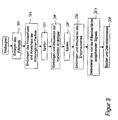
- FIG. 3 shows a flow diagram of a test sequence according to a preferred embodiment.
- a fresh filter part is first inserted.
- the sample fluid is introduced into the filtration measuring cell and vertically conveyed to the filter surface to accumulate immunogenic particles (step 302).
- step 303 removes all that are not held by the filter part Components from the filtration measuring cell.
- step 304 the enzyme labeled Antibodies are introduced into the filtration cell and incubated. The marked ones bind Antibodies essentially only to the sought-after immunogenic particles. Not bound Articles are removed in rinse step 305.
- the cell is rinsed and decontaminated.
- test duration is partly significantly less than a conventional immunoassay without an enrichment step lasts.
- FIG. 4 A second test variant, in which the test times can be reduced further, is in Figure 4 shown.
- the immunogenic particles are marked with the specific enzyme-labeled antibody before the enrichment step in homogeneous Distribution directly in the sample fluid (step 402).
- step 403 Sample fluid introduced into the filtration measuring cell and the labeled immunogenic Particles accumulated when the filter part flows vertically. Not bound Components are removed in rinse step 404.
- step 405 this is done by the marker enzyme convertible enzyme substrate introduced into the filtration measuring cell and incubated.
- the signal emanating from the filter surface is detected in step 406.
- a fluorescence measurement can also be used.
- suitable fluorescent substrate solution is implemented enzymatically or the immunogenic Particles with an antibody to which a fluorescent dye molecule is coupled is marked.
- a suitable fluorescence measuring head is used instead of a photodetector arranged on the translucent window.
Landscapes
- Chemical & Material Sciences (AREA)
- Water Supply & Treatment (AREA)
- Engineering & Computer Science (AREA)
- Life Sciences & Earth Sciences (AREA)
- Health & Medical Sciences (AREA)
- Analytical Chemistry (AREA)
- Biochemistry (AREA)
- General Health & Medical Sciences (AREA)
- General Physics & Mathematics (AREA)
- Immunology (AREA)
- Pathology (AREA)
- Physics & Mathematics (AREA)
- Dispersion Chemistry (AREA)
- Chemical Kinetics & Catalysis (AREA)
- Investigating Or Analysing Materials By The Use Of Chemical Reactions (AREA)
- Apparatus Associated With Microorganisms And Enzymes (AREA)
Applications Claiming Priority (2)
| Application Number | Priority Date | Filing Date | Title |
|---|---|---|---|
| DE10134860 | 2001-07-18 | ||
| DE10134860A DE10134860A1 (de) | 2001-07-18 | 2001-07-18 | Vorrichtung, Verfahren und Durchflussanalysensystem zum Erfassen immunogener Partikel |
Publications (2)
| Publication Number | Publication Date |
|---|---|
| EP1277505A1 true EP1277505A1 (fr) | 2003-01-22 |
| EP1277505B1 EP1277505B1 (fr) | 2009-03-11 |
Family
ID=7692163
Family Applications (1)
| Application Number | Title | Priority Date | Filing Date |
|---|---|---|---|
| EP02014932A Expired - Lifetime EP1277505B1 (fr) | 2001-07-18 | 2002-07-08 | Appareil, procédé et système d'analyse de flux pour capter des particules immunogènes |
Country Status (2)
| Country | Link |
|---|---|
| EP (1) | EP1277505B1 (fr) |
| DE (2) | DE10134860A1 (fr) |
Cited By (2)
| Publication number | Priority date | Publication date | Assignee | Title |
|---|---|---|---|---|
| FR2859531A1 (fr) * | 2003-09-08 | 2005-03-11 | Univ Nantes | Procede et dispositif de mesure en ligne des caracteristiques d'un systeme disperse liquide-liquide ou liquide-solide contenu dans une installation principale |
| WO2017029332A1 (fr) * | 2015-08-17 | 2017-02-23 | Dieter Ebert | Test rapide pour déceler des bactéries |
Families Citing this family (2)
| Publication number | Priority date | Publication date | Assignee | Title |
|---|---|---|---|---|
| DE102005010096B3 (de) | 2005-03-04 | 2006-11-09 | Fraunhofer-Gesellschaft zur Förderung der angewandten Forschung e.V. | Assay mit osmotisch induzierter Abtrennung und Anreicherung hochmolekularer nachzuweisender Substanzen und fluidisches Mikrosystem zu seiner Durchführung |
| DE102006026559A1 (de) | 2006-06-06 | 2007-12-20 | Eads Deutschland Gmbh | Mikromechanischer Filter für Mikropartikel, insbesondere für pathogene Bakterien und Viren, sowie Verfahren zu seiner Herstellung |
Citations (1)
| Publication number | Priority date | Publication date | Assignee | Title |
|---|---|---|---|---|
| US6130097A (en) * | 1998-02-28 | 2000-10-10 | Drager Sicherheitstechnik Gmbh | Process and device for detecting dust-associated substances |
-
2001
- 2001-07-18 DE DE10134860A patent/DE10134860A1/de not_active Ceased
-
2002
- 2002-07-08 DE DE50213341T patent/DE50213341D1/de not_active Expired - Lifetime
- 2002-07-08 EP EP02014932A patent/EP1277505B1/fr not_active Expired - Lifetime
Patent Citations (1)
| Publication number | Priority date | Publication date | Assignee | Title |
|---|---|---|---|---|
| US6130097A (en) * | 1998-02-28 | 2000-10-10 | Drager Sicherheitstechnik Gmbh | Process and device for detecting dust-associated substances |
Non-Patent Citations (3)
| Title |
|---|
| KOCH SABINE ET AL: "Optical flow-cell multichannel immunosensor for the detection of biological warfare agents.", BIOSENSORS & BIOELECTRONICS., vol. 14, no. 10-11, January 2000 (2000-01-01), pages 779 - 784, XP002218431, ISSN: 0956-5663 * |
| PAFFARD SEAN M ET AL: "Amplified enzyme-linked-immunofilter assays enable detection of 50-10-5 bacterial cells within 1 hour.", ANALYTICAL BIOCHEMISTRY, vol. 248, no. 2, 1997, pages 265 - 268, XP002218430, ISSN: 0003-2697 * |
| YACOUB-GEORGE ERWIN ET AL: "Chemiluminescence multichannel immunosensor for biodetection.", ANALYTICA CHIMICA ACTA, vol. 457, no. 1, 2002, 15 April, 2002, pages 3 - 12, XP002218432, ISSN: 0003-2670 * |
Cited By (8)
| Publication number | Priority date | Publication date | Assignee | Title |
|---|---|---|---|---|
| FR2859531A1 (fr) * | 2003-09-08 | 2005-03-11 | Univ Nantes | Procede et dispositif de mesure en ligne des caracteristiques d'un systeme disperse liquide-liquide ou liquide-solide contenu dans une installation principale |
| WO2005026700A1 (fr) * | 2003-09-08 | 2005-03-24 | Universite De Nantes | Mesure en ligne des caracteristiques d'un systeme disperse s'ecoulant |
| WO2017029332A1 (fr) * | 2015-08-17 | 2017-02-23 | Dieter Ebert | Test rapide pour déceler des bactéries |
| CN108431602A (zh) * | 2015-08-17 | 2018-08-21 | 瑞士菌分析股份公司 | 细菌快速试验 |
| US10823719B2 (en) | 2015-08-17 | 2020-11-03 | Swiss Analyze Bacteria Ag | Rapid test for bacteria |
| EP3748359A1 (fr) * | 2015-08-17 | 2020-12-09 | Swiss Analyze Bacteria AG | Test bactérien rapide |
| CN108431602B (zh) * | 2015-08-17 | 2022-04-08 | 瑞士菌分析股份公司 | 细菌快速试验 |
| US11906497B2 (en) | 2015-08-17 | 2024-02-20 | Swiss Analyze Bacteria Ag | Rapid bacteria test |
Also Published As
| Publication number | Publication date |
|---|---|
| DE10134860A1 (de) | 2003-02-06 |
| DE50213341D1 (de) | 2009-04-23 |
| EP1277505B1 (fr) | 2009-03-11 |
Similar Documents
| Publication | Publication Date | Title |
|---|---|---|
| EP2152913B1 (fr) | Dispositif de détection permettant la détection de microparticules biologiques telles que des bactéries, des virus, des spores, du pollen ou des toxines biologiques, et procédé de détection | |
| DE102012108989B3 (de) | Detektionsvorrichtung sowie Verfahren zur automatischen Detektion von Partikeln | |
| DE69420962T2 (de) | Vorrichtung zur analyse einer flüssigkeit | |
| DE3688297T2 (de) | Verfahren zur nichtsegmentierten Durchflussanalyse unter Benutzung der Wechselwirkung von Strahlung mit einem in einer Durchflusszelle angebrachten festen Material. | |
| DE102011088959B4 (de) | Vorrichtung zum Entgasen einer Flüssigkeit und Verwendung dieser Vorrichtung in einem Analysegerät | |
| DE69914164T2 (de) | Testsäule mit mehreren lagen | |
| DE4126436C2 (fr) | ||
| DE102008035770A1 (de) | Optischer Partikeldetektor sowie Detektionsverfahren | |
| DE9421731U1 (de) | Vorrichtung zum Analysieren eines Fluidmediums | |
| DE19710525C2 (de) | Passiv-Diffusionssammler für in Gasen enthaltene Analyte sowie Verfahren zur passiven Probenahme und Analyse | |
| EP0634015B1 (fr) | Reacteur a usage unique pour l'analyse immunologique en phase solide et procede visant a mesurer les composants dosables par immunoreactions | |
| EP1397672A1 (fr) | Capteurs d'oxygene sur plaque de microtration | |
| DE69808895T2 (de) | Leistungssteigerung von bindungsassays mit verwendung mehr als einer markierungsmittel | |
| EP1277505B1 (fr) | Appareil, procédé et système d'analyse de flux pour capter des particules immunogènes | |
| DE60219429T2 (de) | Biochemisches verfahren und vorrichtung zur bestimmung von eigenschaften von proteinen | |
| EP0995098B1 (fr) | Procede et dispositif pour prelever en serie des echantillons | |
| EP3655128A1 (fr) | Dispositif de filtration, procédé d'assemblage d'un dispositif de filtration modulaire, et procédé permettant de caractériser un milieu filtrant et/ou un milieu à filtrer | |
| EP3720943A1 (fr) | Dispositif et procédé d'analyse d'un milieu | |
| DE102008009185A1 (de) | Einrichtung und Verfahren zum Nachweis von Flüssigkeiten oder Substanzen aus Flüssigkeiten sowie Verwendung der Einrichtung | |
| DE2736527A1 (de) | Verfahren und vorrichtung zum nachweis eines spezifischen bindeproteins oder einer damit bindefaehigen substanz | |
| DE212020000628U1 (de) | Vorrichtung zur Messung der Permeabilität von Membranen | |
| DE102021118418A1 (de) | Verfahren zur Analyse und/oder Detektion von biologischen Strukturen | |
| EP3273234B1 (fr) | Porte échantillons, procédé d'analyse et dispositif de mesure optique | |
| DE10329539A1 (de) | Verfahren und Vorrichtung zur Charakterisierung einer Kulturflüssigkeit | |
| DE102005010096B3 (de) | Assay mit osmotisch induzierter Abtrennung und Anreicherung hochmolekularer nachzuweisender Substanzen und fluidisches Mikrosystem zu seiner Durchführung |
Legal Events
| Date | Code | Title | Description |
|---|---|---|---|
| PUAI | Public reference made under article 153(3) epc to a published international application that has entered the european phase |
Free format text: ORIGINAL CODE: 0009012 |
|
| AK | Designated contracting states |
Kind code of ref document: A1 Designated state(s): AT BE BG CH CY CZ DE DK EE ES FI FR GB GR IE IT LI LU MC NL PT SE SK TR |
|
| AX | Request for extension of the european patent |
Free format text: AL;LT;LV;MK;RO;SI |
|
| 17P | Request for examination filed |
Effective date: 20030305 |
|
| AKX | Designation fees paid |
Designated state(s): CH DE FR GB IT LI |
|
| RAP1 | Party data changed (applicant data changed or rights of an application transferred) |
Owner name: FRAUNHOFER-GESELLSCHAFT ZUR FOERDERUNG DERANGEWAND |
|
| RAP1 | Party data changed (applicant data changed or rights of an application transferred) |
Owner name: FRAUNHOFER-GESELLSCHAFT ZUR FOERDERUNG DER ANGEWAN |
|
| GRAP | Despatch of communication of intention to grant a patent |
Free format text: ORIGINAL CODE: EPIDOSNIGR1 |
|
| GRAS | Grant fee paid |
Free format text: ORIGINAL CODE: EPIDOSNIGR3 |
|
| GRAA | (expected) grant |
Free format text: ORIGINAL CODE: 0009210 |
|
| AK | Designated contracting states |
Kind code of ref document: B1 Designated state(s): CH DE FR GB IT LI |
|
| REG | Reference to a national code |
Ref country code: GB Ref legal event code: FG4D Free format text: NOT ENGLISH |
|
| REG | Reference to a national code |
Ref country code: CH Ref legal event code: EP Ref country code: CH Ref legal event code: NV Representative=s name: ISLER & PEDRAZZINI AG |
|
| REF | Corresponds to: |
Ref document number: 50213341 Country of ref document: DE Date of ref document: 20090423 Kind code of ref document: P |
|
| PLBE | No opposition filed within time limit |
Free format text: ORIGINAL CODE: 0009261 |
|
| STAA | Information on the status of an ep patent application or granted ep patent |
Free format text: STATUS: NO OPPOSITION FILED WITHIN TIME LIMIT |
|
| 26N | No opposition filed |
Effective date: 20091214 |
|
| PGFP | Annual fee paid to national office [announced via postgrant information from national office to epo] |
Ref country code: CH Payment date: 20130723 Year of fee payment: 12 |
|
| PGFP | Annual fee paid to national office [announced via postgrant information from national office to epo] |
Ref country code: FR Payment date: 20130719 Year of fee payment: 12 Ref country code: GB Payment date: 20130723 Year of fee payment: 12 |
|
| PGFP | Annual fee paid to national office [announced via postgrant information from national office to epo] |
Ref country code: IT Payment date: 20130729 Year of fee payment: 12 |
|
| REG | Reference to a national code |
Ref country code: CH Ref legal event code: PL |
|
| GBPC | Gb: european patent ceased through non-payment of renewal fee |
Effective date: 20140708 |
|
| REG | Reference to a national code |
Ref country code: FR Ref legal event code: ST Effective date: 20150331 |
|
| PG25 | Lapsed in a contracting state [announced via postgrant information from national office to epo] |
Ref country code: CH Free format text: LAPSE BECAUSE OF NON-PAYMENT OF DUE FEES Effective date: 20140731 Ref country code: IT Free format text: LAPSE BECAUSE OF NON-PAYMENT OF DUE FEES Effective date: 20140708 Ref country code: LI Free format text: LAPSE BECAUSE OF NON-PAYMENT OF DUE FEES Effective date: 20140731 |
|
| REG | Reference to a national code |
Ref country code: DE Ref legal event code: R084 Ref document number: 50213341 Country of ref document: DE |
|
| PG25 | Lapsed in a contracting state [announced via postgrant information from national office to epo] |
Ref country code: FR Free format text: LAPSE BECAUSE OF NON-PAYMENT OF DUE FEES Effective date: 20140731 Ref country code: GB Free format text: LAPSE BECAUSE OF NON-PAYMENT OF DUE FEES Effective date: 20140708 |
|
| REG | Reference to a national code |
Ref country code: DE Ref legal event code: R084 Ref document number: 50213341 Country of ref document: DE Effective date: 20150512 |
|
| PGFP | Annual fee paid to national office [announced via postgrant information from national office to epo] |
Ref country code: DE Payment date: 20180725 Year of fee payment: 17 |
|
| REG | Reference to a national code |
Ref country code: DE Ref legal event code: R119 Ref document number: 50213341 Country of ref document: DE |
|
| PG25 | Lapsed in a contracting state [announced via postgrant information from national office to epo] |
Ref country code: DE Free format text: LAPSE BECAUSE OF NON-PAYMENT OF DUE FEES Effective date: 20200201 |