EP1281982B1 - Procédé et circuit d'évaluation de la cohérence des ondes acoustiques - Google Patents
Procédé et circuit d'évaluation de la cohérence des ondes acoustiques Download PDFInfo
- Publication number
- EP1281982B1 EP1281982B1 EP20020012275 EP02012275A EP1281982B1 EP 1281982 B1 EP1281982 B1 EP 1281982B1 EP 20020012275 EP20020012275 EP 20020012275 EP 02012275 A EP02012275 A EP 02012275A EP 1281982 B1 EP1281982 B1 EP 1281982B1
- Authority
- EP
- European Patent Office
- Prior art keywords
- electroacoustic
- coherence
- receivers
- phase
- values
- Prior art date
- Legal status (The legal status is an assumption and is not a legal conclusion. Google has not performed a legal analysis and makes no representation as to the accuracy of the status listed.)
- Expired - Lifetime
Links
Images



Classifications
-
- G—PHYSICS
- G01—MEASURING; TESTING
- G01S—RADIO DIRECTION-FINDING; RADIO NAVIGATION; DETERMINING DISTANCE OR VELOCITY BY USE OF RADIO WAVES; LOCATING OR PRESENCE-DETECTING BY USE OF THE REFLECTION OR RERADIATION OF RADIO WAVES; ANALOGOUS ARRANGEMENTS USING OTHER WAVES
- G01S3/00—Direction-finders for determining the direction from which infrasonic, sonic, ultrasonic or electromagnetic waves, or particle emission, not having a directional significance, are being received
- G01S3/80—Direction-finders for determining the direction from which infrasonic, sonic, ultrasonic or electromagnetic waves, or particle emission, not having a directional significance, are being received using ultrasonic, sonic or infrasonic waves
- G01S3/802—Systems for determining direction or deviation from predetermined direction
- G01S3/808—Systems for determining direction or deviation from predetermined direction using transducers spaced apart and measuring phase or time difference between signals therefrom, i.e. path-difference systems
- G01S3/8083—Systems for determining direction or deviation from predetermined direction using transducers spaced apart and measuring phase or time difference between signals therefrom, i.e. path-difference systems determining direction of source
-
- G—PHYSICS
- G01—MEASURING; TESTING
- G01S—RADIO DIRECTION-FINDING; RADIO NAVIGATION; DETERMINING DISTANCE OR VELOCITY BY USE OF RADIO WAVES; LOCATING OR PRESENCE-DETECTING BY USE OF THE REFLECTION OR RERADIATION OF RADIO WAVES; ANALOGOUS ARRANGEMENTS USING OTHER WAVES
- G01S3/00—Direction-finders for determining the direction from which infrasonic, sonic, ultrasonic or electromagnetic waves, or particle emission, not having a directional significance, are being received
- G01S3/80—Direction-finders for determining the direction from which infrasonic, sonic, ultrasonic or electromagnetic waves, or particle emission, not having a directional significance, are being received using ultrasonic, sonic or infrasonic waves
- G01S3/801—Details
Definitions
- the invention relates to a method and a circuit arrangement for evaluating the coherence of sound waves, which propagate over a spatially extended receiving base with a plurality of spaced-apart, electroacoustic receiver of a sonar system.
- the coherence of sound waves received at the site by the sonar's receiving base plays a significant role in the accuracy and reliability of the measurement results.
- the confidence of the measurement results thus depends on the knowledge of the extent to which a signal received at a specific receiver of the reception base belongs to the same sound source.
- a number of successive antenna segments of predetermined length are defined, with the segment fed, side angle channels are formed by the location of the sensors on the antenna, by the frequency and by the propagation velocity of the waves in the fluid, at each pair of Calculates the cross-spectrum as a function of time and frequency for each channel and calculates the difference in the Kolinearticianswinkeldifferenz between the two segments for each pair of segments and each channel and then the full shape of the antenna, starting from the individual Kolinearticianswinkeldifferenzen calculated in this way, certainly.
- the post-published DE 100 36 291 A and EP 1 176 428 A show a further method for eliminating interference of group signals or for improving the signal / interference ratio of a sonar group, in which group signals are multiplied by a weighting signal that takes into account phase deviations of the grouped to the group signal reception signals.
- the weighting signal is calculated by adding together the received signals of a direction-forming group signal with a time delay with respect to their phases.
- a reception base with three electro-acoustic transducers is used, which are arranged on a straight line and have a distance from each other which is a multiple of the wavelength of the sound emitted by the sound source.
- the electrical output signals of the middle transducer are compared to the output signals of each outer one Converter cross-correlates and so determines the time difference between the output signals of the converter.
- R 0 arc sin L 2 ⁇ cos 2 ⁇ 0 c ⁇ ⁇ 2 . 3 - ⁇ 1 . 2 where c is the speed of sound and L is the transducer spacing.
- the invention has for its object to provide a method and a circuit arrangement with which indicate the coherence of the sound waves received from a receiving base of a sonar system with low signal processing effort and thus can check the quality of the measurement results.
- the invention has the advantage that it can be used with little additional effort in parallel with known methods of detection, location and classification of sound-emitting targets while already existing hardware and software components of the sonar system can be used.
- the invention makes it possible to control the measurement results supplied by the measurement methods and indicates to the user with which confidence measure he can assume the reliability of the measured, current sonar data, so that he is much more likely to use the quality assessment of a large number of measured sonar data filter out the right sonata data and base it on an early decision.
- a normalized, complex signal is formed from each output signal of the two selected receivers, the two normalized complex signals are sampled at the same time in a time window and the two sampling values associated with the same time points are added. The amount is formed from the resulting sum. Then, the sums of the sums are added and an average value is formed from the addition result and issued as a weighting factor.
- the respective sampled values belonging to the same points in time are additionally subtracted from one another and the amount is formed by the difference.
- the amounts of the differences are added, a second average is formed from the result of addition, and the second average is subtracted from the first average obtained as described above.
- the difference between the two mean values is output as a modified weighting factor C *.
- the amounts of the sums or differences are not directly added and averaged and then the mean values are subtracted, but after the amount of the sum and the amount of the difference of every two samples has already been formed, the amount of the difference from the amount is subtracted from the sums and the addition and averaging applied to the subtraction results thus obtained.
- the complex signal is generated by means of a Hilbert transform and its normalization is performed by dividing the complex signal by its magnitude.
- the Hilbert transformation and normalization can take place at any point in the signal processing of the output signals, so that existing hardware and software components for an existing measurement method for measuring sonar data can be used optimally for implementing the method according to the invention with minimal additional effort.
- the Hilbert transformation can be applied to the digital data records of the output signals and be effected by FIR filter structures.
- electroacoustic receivers individual electroacoustic transducers with dipole or omnidirectional characteristics can be used. Also, groups of electroacoustic transducers spaced apart in a horizontal or vertical direction may serve as receivers. The electrical output signal of the receiver subjected to the signal processing according to the invention is then the preprocessed group signal of the transducer group.
- the method according to the invention in conjunction with a method for passive location of a sound source located in the water by means of three spaced apart linearly arranged electroacoustic transducers, the so-called.
- PRS method used by the middle transducer and forming a selected pair of electroacoustic receivers for each external transducer, and determining the time or phase shifts between the central transducer and the two external transducers from the evaluation factors as described and used in a known manner for calculating the bearing angle and sound source distance.
- a spatially extended reception base remote from the sound source and having a plurality of spaced-apart, electroacoustic receivers is used.
- This reception base 10 has three receivers each formed by an electroacoustic transducer 11.
- the three transducers 11 are arranged at a distance L from each other exactly on a straight line.
- the phase or time shifts between the electrical output signals of the central transducer 11-2 and each of the outer transducers 11-1 and 11-3 are determined and from this the bearing angle ⁇ 0 and the distance R 0 according to the above Eq. (1) and (2) calculated.
- the coherence of the sound wave propagated via the reception base 10 and received by the transducers 11 is evaluated.
- the evaluation factor obtained is an indication of the probability with which the correctness of the sonar data can be assumed.
- at least one transducer pair is selected in the reception base 10 with the three transducers 11, and the coherence of the phases of the electrical output signals of the two selected transducers 11 is determined.
- a j (t) describes the envelope of s j (t) and ⁇ j (t) the instantaneous phase.
- the formation of the complex analytical signals c j (t) by means of the Hilbert transform H (s j (t)) and the subsequent normalization can be inserted at any point in the direct processing path of the (real) output signals of the two receivers.
- the Hilbert transform is applied to the digital samples of the sample signals using samples of the time window as the digital samples.
- each electrical output signal of the selected pair of electro-acoustic receivers are formed by two transducers 11 of the reception base 10, amplified, sampled and digitized.
- an amplifier 15 and a sampling unit 16 (sample and hold) and an analog-to-digital converter 17 are provided in each case.
- the A / D converter 17 is dispensed with.
- the sampling unit 16 samples the amplified output signal at fixed time intervals ⁇ t and the digitized data sets of the samples become a Hilbert transformer 18, at whose outputs both the real and the imaginary part of the complex analytical signal c j (t) can be taken.
- the real and imaginary parts are fed separately on the one hand to an absolute value generator 19 and on the other hand to a divider 20 or 21 whose other input is connected to the output of the absolute value generator 19.
- the normalized real part and the normalized imaginary part are reassembled in the adder 22 to the sample of the normalized, complex signal p j (t).
- the calculation of the above-mentioned G1. (6) is realized.
- the samples or samples of the two normalized complex signals p 1 (t) and p 2 (t) are fed on the one hand to an adder 23 and on the other hand to a subtracter 24.
- the amount is formed in the absolute value formers 25 and 26, and the two amounts of sum and Difference is supplied to a subtractor 27 which subtracts the amount of the difference from the sum of the sum.
- the subtraction results of the N samples are added in the summer 29, and in the divider 30 the result of addition is divided by the number 2N of the total of the two signals p j (t) delivered samples.
- the removable at the output of the divider 30 weighting factor for the phase coherence of the two output signals assumes the value +1, if both signals are exactly correlated, and the value -1, if both signals are completely anticorrelated. An intervening value indicates a lesser degree of coincidence of the two signals.
- the evaluation factor C * ( ⁇ ) thus determined for the coherence of a received sound wave is described in US Pat Fig. 3 sonar system described for locating a sound source for the evaluation of the output from the sonar system results for bearing angle and distance of the sound source used.
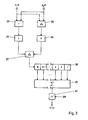
- a transducer pair is selected in the existing of three electroacoustic transducers 11 receiving base 10 of the sonar, in the embodiment of Fig. 3 the transducer pair from the two outer transducers 11-1 and 11-3.
- the electrical output signals of the two outer transducers are subjected to a signal processing as described above, wherein the blocks 31 and 32, the in Fig. 1 represented part of the circuit arrangement and block 34 in the Fig. 2 represented part of the circuit arrangement corresponds.
- the evaluation factor C * ( ⁇ 1.3 ) which can be removed at the output from block 34, which is a function of the time shift ⁇ 1.3 between the signals to be compared, is described in the exemplary embodiment of FIG Fig. 3 is used to recognize the calculated sonar data ⁇ 0 , R 0 as good or false values and, if necessary, to suppress the calculation or the output of the sonar data recognized as false values.
- the sonar data are displayed as incorrect values if the weighting factor C * ( ⁇ 1.3 ) is below a default value, eg 0.5.
- the weighting factor C * ( ⁇ 1.3) via a corresponding threshold 35 is fed to the computer 14, so that the computer 14 only the sonar data ⁇ 0 calculated R 0 if C * ( ⁇ 1.3), the threshold 35 exceeds.
- the output evaluation factor C * ( ⁇ 1.3 ) can also be assigned as a confidence measure to the calculated sonar data ⁇ 0 , R 0 , so that the user himself can use the assigned confidence measures to score the measured sonar data.
- each converter 11 is associated with a block 31, 32, 33, in which a signal processing is performed, as they are to Fig. 1 and 2 has been described.
- the normalized complex signal p 1 (t), the normalized complex signal p 2 (t) is generated in block 32 and the normalized complex signal p 3 (t) in block 33.
- Signal p 1 (t) is applied to block 35, signal p 3 (t) to block 36, and signal p 2 (t) to both block 35 and block 36.
- Each block 35 or 36 corresponds to the phase correlator, the circuit in Fig. 2 is specified.
- Block 35 provides the weighting factor C * ( ⁇ 1,2 ), which is dependent on the time difference between the outputs of the transducers 11-1 and 11-2
- block 36 provides the weighting factor C * ( ⁇ 2,3 ). which is a function of the time shift between the signals of the transducers 11-2 and 11-3.
- Each block 35, 36 is followed by a calibration stage 38 and 39, respectively.
- the weighting factor ( ⁇ 1.2) C * stored as a function of the time shift ( ⁇ 1.2).
- the factor C * ( ⁇ 2.3) is stored as a function of the time shift ( ⁇ 2.3).
- the time shifts ( ⁇ 1,2 ) and ( ⁇ 2,3 ) are calculated from the calibration stages 38, 39 read and fed to the computer 14.
- the calculator 14 calculates according to the G1. (1) and (2) the sonar data, bearing angle ⁇ 0 and distance R 0 .
- a threshold 40 or 41 is respectively inserted between the block 35 and the calibration stage 38 or the block 36 and the calibration stage 39.
- the receivers of the reception base 10 may be formed by individual transducers 11 having a dipole or omnidirectional characteristic.
- electroacoustic receivers of the reception base 10 it is also possible to use groups of electroacoustic transducers 11 which are arranged linearly spaced from one another in the horizontal direction or in the vertical direction. In the case of the vertical arrangement one speaks of so-called staves.
- a group signal derived from the output signals of the transducer groups is used as the output signal of the receiver to be processed as described.
- the invention can also be used to evaluate the linear orientation of the electro-acoustic transducers arranged in a so-called drag antenna.
- the weighting factor allows conclusions about the offset of a transducer with respect to the linear orientation.
Landscapes
- Physics & Mathematics (AREA)
- Engineering & Computer Science (AREA)
- General Physics & Mathematics (AREA)
- Radar, Positioning & Navigation (AREA)
- Remote Sensing (AREA)
- Measurement Of Velocity Or Position Using Acoustic Or Ultrasonic Waves (AREA)
Claims (13)
- Procédé d'évaluation de la cohérence d'ondes acoustiques, qui se propagent sur une base de réception (10) étendue dans l'espace, présentant plusieurs récepteurs électroacoustiques (11) espacés les uns des autres, d'une installation sonar, dans lequela) dans la base de réception (10) une paire de récepteurs électroacoustiques (11) est sélectionnée parmi les récepteurs électroacoustiques (11) de la base de réception (10) de l'installation sonar etb) la cohérence des phases des signaux de sortie électriques des deux récepteurs (11) est déterminée, caractérisé en ce que pour la détermination de la cohérence de phaseb'1) un signal complexe normalisé (pj(t)) est formé respectivement à partir de chaque signal de sortie des deux récepteurs (11),b'2) les deux signaux complexes normalisés sont balayés dans une fenêtre de temps (t = t0 à t = t0 + N·Δt) à des instants identiques etb'3) respectivement les deux échantillons associés aux mêmes instants sont additionnés etb'4) le montant de la somme est formé etb'5) les montants des sommes sont additionnés etb'6) une première valeur moyenne est formée à partir du résultat de l'addition etc) un facteur d'évaluation pour l'évaluation de la cohérence des ondes acoustiques se propageant sur la base de réception est dérivé à partir de cette cohérence des phases, en ce quec') la valeur moyenne est sortie en tant que facteur d'évaluation (C).
- Procédé selon la revendication 1, caractérisé en ce qu'en outre, les échantillons associés aux mêmes instants sont soustraits respectivement les uns des autres et le montant de la différence est formé, en ce que les montants des différences sont additionnés et une seconde valeur moyenne est formée à partir du résultat de l'addition, en ce que les deux valeurs moyennes sont soustraites l'une de l'autre et en ce que la différence des deux valeurs moyennes est sortie en tant que facteur d'évaluation modifié (C*).
- Procédé selon les revendications 1 et 2, caractérisé en ce qu'après la formation du montant de la somme et du montant de la différence de respectivement deux échantillons associés l'un à l'autre, le montant de la différence est déjà soustrait du montant de la somme et l'addition et la formation de la valeur moyenne sont appliquées aux résultats de soustraction ainsi obtenus de tous les échantillons.
- Procédé selon l'une des revendications 1 à 3, caractérisé en ce que le signal complexe est généré au moyen d'une transformée de Hilbert et sa normalisation est effectuée par la division du signal complexe par sa grandeur.
- Procédé selon la revendication 4, caractérisé en ce que la formation du signal complexe normalisé et son balayage dans la fenêtre de temps sont exécutés de sorte que les signaux de sortie de préférence amplifiés sont balayés dans des intervalles de temps de préférence fixes et les échantillons sont numérisés et la transformée de Hilbert et la normalisation sont appliquées aux échantillons numérisés.
- Procédé selon l'une des revendications 1 à 5, caractérisé en ce qu'à partir du facteur d'évaluation (C*), le décalage de phase ou le décalage temporel (T) entre les signaux de sortie de la paire de récepteurs sélectionnée est déterminé.
- Procédé selon la revendication 6, caractérisé en ce que la détermination du décalage de phase ou du décalage temporel (T) est effectuée uniquement quand le facteur d'évaluation (C*) dépasse une valeur spécifiée.
- Procédé selon l'une des revendications 1 à 7, caractérisé en ce qu'un transducteur électroacoustique (11) unique est utilisé en tant que récepteur électroacoustique.
- Procédé selon l'une des revendications 1 à 7, caractérisé en ce qu' en tant que récepteur électroacoustique un groupe de transducteurs électroacoustiques espacés de préférence à équidistance les uns des autres est utilisé, qui sont disposés de manière linéaire dans le sens horizontal ou dans le sens vertical et en ce qu'un signal de groupe dérivé des signaux de sortie du groupe de transducteurs est utilisé en tant que signal de sortie du récepteur.
- Procédé selon l'une des revendications 1 à 5 et la revendication 8, caractérisé par son application à un procédé pour la localisation passive d'une source acoustique se trouvant dans l'eau, dans lequel au moyen de trois transducteurs électroacoustiques (11) disposés de manière linéaire espacés les uns des autres le son émis par la source acoustique est reçu, le décalage de phase ou le décalage temporel (T1,2, T2,3) entre les signaux de sortie électriques du transducteur (11-2) central et chaque transducteur extérieur (11-1, 11-3) est déterminé et à partir des deux décalages de phase ou décalages temporels (T1,2, T2,3) l'angle de relèvement (θ0) par rapport à la source acoustique et la distance (R0) entre celle-ci et le transducteur central (2) sont calculés, en ce qu'avec deux des transducteurs, de préférence avec les deux transducteurs extérieurs (11-1, 11-3) une paire de récepteurs électroacoustiques est formée et le facteur d'évaluation (C*(T1,3)) sorti est assigné aux valeurs calculées pour l'angle de relèvement (θ0) et la distance (R0) en tant que mesure de confiance.
- Procédé selon la revendication 10, caractérisé en ce que les valeurs calculées pour l'angle de relèvement (θ0) et la distance (R0) sont présentées comme des valeurs erronées quand le facteur d'évaluation (C*(T1,3)) n'atteint pas une valeur spécifiée.
- Procédé selon les revendications 7 et 8, caractérisé par son application sur un procédé pour la localisation passive d'une source acoustique se trouvant dans l'eau, dans lequel au moyen de trois transducteurs électroacoustiques (11) disposés de manière linéaire espacés les uns des autres le son émis par la source acoustique est reçu, les décalages de phase ou décalages temporels (T1,2, T2,3) entre les signaux de sortie électriques du transducteur (11-2) central et chaque transducteur extérieur (11-1, 11-3) sont déterminés et à partir des deux décalages de phase ou décalages temporels (T1,2, T2,3) l'angle de relèvement (θ0) par rapport à la source acoustique et la distance (R0) entre celle-ci et le transducteur central (11-2) sont calculés, en ce qu'avec le transducteur central (11-2) et chacun des transducteurs extérieurs (11-1, 11-3) respectivement une paire sélectionnée de récepteurs électroacoustiques est formée et les décalages de phase ou décalages temporels (T1,2, T2,3) déterminés à partir des facteurs d'évaluation (C*( T1,2)), (C*( T2,3)) sont utilisés pour le calcul de l'angle de relèvement (00) et de la distance (R0).
- Circuit d'évaluation de la cohérence d'ondes acoustiques se propageant sur une base de réception (10) étendue dans l'espace, présentant plusieurs récepteurs électroacoustiques (11) espacés les uns des autres, d'une installation sonar, dans lequela) une paire de récepteurs électroacoustiques (11) des récepteurs électroacoustiques (11) de la base de réception (10) de l'installation sonar peut être sélectionnée etb) le circuit présente un corrélateur de phase (34) qui est conçu de façon à ce queb') la cohérence des phases des signaux de sortie électriques des deux récepteurs (11) est déterminée par corrélation de phase, caractérisé en ce que pour la détermination de la cohérence de phaseb"1) un signal complexe normalisé (pj(t)) est formé respectivement à partir de chaque signal de sortie des deux récepteurs (11),b"2) les deux signaux complexes normalisés sont balayés dans une fenêtre de temps (t = t0 à t = t0 + N·Δt) à des instants identiques etb"3) respectivement les deux échantillons associés aux mêmes instants sont additionnés etb"4) le montant de la somme est formé etb"5) les montants des sommes sont additionnés etb"6) une première valeur moyenne est formée à partir du résultat de l'addition, etc) un facteur d'évaluation pour l'évaluation de la cohérence des ondes acoustiques se propageant sur la base de réception peut être dérivé à partir de cette cohérence des phases, en ce quec') la valeur moyenne est sortie en tant que facteur d'évaluation (C).
Applications Claiming Priority (2)
| Application Number | Priority Date | Filing Date | Title |
|---|---|---|---|
| DE2001136026 DE10136026A1 (de) | 2001-07-25 | 2001-07-25 | Verfahren zur Bewertung der Kohärenz von Schallwellen |
| DE10136026 | 2001-07-25 |
Publications (3)
| Publication Number | Publication Date |
|---|---|
| EP1281982A2 EP1281982A2 (fr) | 2003-02-05 |
| EP1281982A3 EP1281982A3 (fr) | 2004-01-07 |
| EP1281982B1 true EP1281982B1 (fr) | 2013-01-09 |
Family
ID=7692913
Family Applications (1)
| Application Number | Title | Priority Date | Filing Date |
|---|---|---|---|
| EP20020012275 Expired - Lifetime EP1281982B1 (fr) | 2001-07-25 | 2002-06-05 | Procédé et circuit d'évaluation de la cohérence des ondes acoustiques |
Country Status (2)
| Country | Link |
|---|---|
| EP (1) | EP1281982B1 (fr) |
| DE (1) | DE10136026A1 (fr) |
Families Citing this family (1)
| Publication number | Priority date | Publication date | Assignee | Title |
|---|---|---|---|---|
| CN111856474B (zh) * | 2020-07-30 | 2023-07-25 | 重庆大学 | 一种基于子阵的空时域条件相干系数超声成像方法 |
Family Cites Families (4)
| Publication number | Priority date | Publication date | Assignee | Title |
|---|---|---|---|---|
| FR2614427B1 (fr) * | 1987-04-24 | 1989-06-09 | Thomson Csf | Procede de telemetrie sonore passive |
| DE4432532A1 (de) * | 1994-09-13 | 1996-03-14 | Stn Atlas Elektronik Gmbh | Verfahren zur Befreiung von Körperschallstörungen |
| FR2800879B1 (fr) * | 1999-11-09 | 2007-03-02 | France Etat | Procedes et dispositifs associes de determination de la forme d'une antenne lineaire et de lever d'ambiguite conique |
| DE10036291C1 (de) * | 2000-07-26 | 2001-10-31 | Stn Atlas Elektronik Gmbh | Verfahren zur Störbefreiung von Gruppensignalen |
-
2001
- 2001-07-25 DE DE2001136026 patent/DE10136026A1/de not_active Withdrawn
-
2002
- 2002-06-05 EP EP20020012275 patent/EP1281982B1/fr not_active Expired - Lifetime
Also Published As
| Publication number | Publication date |
|---|---|
| DE10136026A1 (de) | 2003-02-20 |
| EP1281982A3 (fr) | 2004-01-07 |
| EP1281982A2 (fr) | 2003-02-05 |
Similar Documents
| Publication | Publication Date | Title |
|---|---|---|
| DE60224905T2 (de) | Überwachung von Umgebungsgeräuschen | |
| EP2391895B1 (fr) | Mesure de précision de formes d'onde | |
| EP4196818B1 (fr) | Procédé et dispositif permettant de déterminer des perturbations de fréquence dans un signal reçu d'un système sar à canaux multiples actif | |
| DE102018109247A1 (de) | Verfahren zur genauen Berechnung der Ankunftsrichtung von Schall an einer Mikrofon-Anordnung | |
| US9600445B2 (en) | Precision measurement of waveforms | |
| AT510359B1 (de) | Verfahren zur akustischen signalverfolgung | |
| EP3610289B1 (fr) | Unité de traitement pour un système sonar servant à traiter des signaux d'hydrophone ainsi que système sonar et procédé | |
| DE3520398C2 (fr) | ||
| EP1184680B1 (fr) | Méthode pour repositioner des cibles en mouvement dans des images SAR | |
| EP1281982B1 (fr) | Procédé et circuit d'évaluation de la cohérence des ondes acoustiques | |
| EP1271175A1 (fr) | Procédé pour déterminer la position d'une cible émettant du son | |
| DE102022201395B4 (de) | Ermitteln einer Ursprungsrichtung von Schallsignalen | |
| EP2472282B1 (fr) | Procédé de détermination d'une ou plusieurs directions relatives comme relèvement de cible ou relèvements de cible ainsi que dispositif d'exécution du procédé | |
| DE102019211404A1 (de) | Verfahren zur Bestimmung einer Einfallsrichtung einer Sondersignal-Schallquelle | |
| DE3345021C2 (fr) | ||
| EP1500953B1 (fr) | Procédé pour la détermination des données cibles utilisant un sonar actif | |
| EP2480907B1 (fr) | Procédé et dispositif de localisation de cibles émettant un rayonnement | |
| EP1308745B1 (fr) | Procédé de localisation passif des cibles rayonnants des ondes sonores | |
| EP0715182B1 (fr) | Procédé pour déterminer le gisement d'une cible rayonnant or réfléchissant des ondes sonores | |
| EP1176428B1 (fr) | Procede pour ameliorer le rapport signal sur bruit d'un réseau d'antennes sonar | |
| EP0962784B1 (fr) | Procédé passif de détermination de données de cibles | |
| EP2659281B1 (fr) | Procédé et dispositif servant à augmenter la précision de repérage radiogoniométrique d'un système de réception | |
| DE4104699B3 (de) | Verfahren zum Eliminieren von Störsignalen aus Empfangssignalen einer Empfangsanlage | |
| DE10207824A1 (de) | Verfahren und Einrichtung zur Erkennung der Herkunftsrichtung von Schall | |
| DE3817627A1 (de) | Anordnung zur passiven akustischen ortung von zielen mittels laufzeitauswertung |
Legal Events
| Date | Code | Title | Description |
|---|---|---|---|
| PUAI | Public reference made under article 153(3) epc to a published international application that has entered the european phase |
Free format text: ORIGINAL CODE: 0009012 |
|
| AK | Designated contracting states |
Designated state(s): AT BE CH CY DE DK ES FI FR GB GR IE IT LI LU MC NL PT SE TR |
|
| AX | Request for extension of the european patent |
Extension state: AL LT LV MK RO SI |
|
| RAP1 | Party data changed (applicant data changed or rights of an application transferred) |
Owner name: ATLAS ELEKTRONIK GMBH |
|
| PUAL | Search report despatched |
Free format text: ORIGINAL CODE: 0009013 |
|
| AK | Designated contracting states |
Kind code of ref document: A3 Designated state(s): AT BE CH CY DE DK ES FI FR GB GR IE IT LI LU MC NL PT SE TR |
|
| AX | Request for extension of the european patent |
Extension state: AL LT LV MK RO SI |
|
| 17P | Request for examination filed |
Effective date: 20031203 |
|
| AKX | Designation fees paid |
Designated state(s): AT BE CH CY DE DK ES FI FR GB GR IE IT LI LU MC NL PT SE TR |
|
| 17Q | First examination report despatched |
Effective date: 20080711 |
|
| GRAP | Despatch of communication of intention to grant a patent |
Free format text: ORIGINAL CODE: EPIDOSNIGR1 |
|
| GRAS | Grant fee paid |
Free format text: ORIGINAL CODE: EPIDOSNIGR3 |
|
| GRAA | (expected) grant |
Free format text: ORIGINAL CODE: 0009210 |
|
| AK | Designated contracting states |
Kind code of ref document: B1 Designated state(s): AT BE CH CY DE DK ES FI FR GB GR IE IT LI LU MC NL PT SE TR |
|
| REG | Reference to a national code |
Ref country code: GB Ref legal event code: FG4D Free format text: NOT ENGLISH |
|
| REG | Reference to a national code |
Ref country code: CH Ref legal event code: EP Ref country code: AT Ref legal event code: REF Ref document number: 593053 Country of ref document: AT Kind code of ref document: T Effective date: 20130115 |
|
| REG | Reference to a national code |
Ref country code: IE Ref legal event code: FG4D Free format text: LANGUAGE OF EP DOCUMENT: GERMAN |
|
| REG | Reference to a national code |
Ref country code: DE Ref legal event code: R096 Ref document number: 50215678 Country of ref document: DE Effective date: 20130307 |
|
| REG | Reference to a national code |
Ref country code: SE Ref legal event code: TRGR |
|
| REG | Reference to a national code |
Ref country code: NL Ref legal event code: VDEP Effective date: 20130109 |
|
| PG25 | Lapsed in a contracting state [announced via postgrant information from national office to epo] |
Ref country code: ES Free format text: LAPSE BECAUSE OF FAILURE TO SUBMIT A TRANSLATION OF THE DESCRIPTION OR TO PAY THE FEE WITHIN THE PRESCRIBED TIME-LIMIT Effective date: 20130420 Ref country code: CY Free format text: LAPSE BECAUSE OF FAILURE TO SUBMIT A TRANSLATION OF THE DESCRIPTION OR TO PAY THE FEE WITHIN THE PRESCRIBED TIME-LIMIT Effective date: 20130109 |
|
| PG25 | Lapsed in a contracting state [announced via postgrant information from national office to epo] |
Ref country code: FI Free format text: LAPSE BECAUSE OF FAILURE TO SUBMIT A TRANSLATION OF THE DESCRIPTION OR TO PAY THE FEE WITHIN THE PRESCRIBED TIME-LIMIT Effective date: 20130109 Ref country code: GR Free format text: LAPSE BECAUSE OF FAILURE TO SUBMIT A TRANSLATION OF THE DESCRIPTION OR TO PAY THE FEE WITHIN THE PRESCRIBED TIME-LIMIT Effective date: 20130410 Ref country code: NL Free format text: LAPSE BECAUSE OF FAILURE TO SUBMIT A TRANSLATION OF THE DESCRIPTION OR TO PAY THE FEE WITHIN THE PRESCRIBED TIME-LIMIT Effective date: 20130109 Ref country code: PT Free format text: LAPSE BECAUSE OF FAILURE TO SUBMIT A TRANSLATION OF THE DESCRIPTION OR TO PAY THE FEE WITHIN THE PRESCRIBED TIME-LIMIT Effective date: 20130509 |
|
| PG25 | Lapsed in a contracting state [announced via postgrant information from national office to epo] |
Ref country code: DK Free format text: LAPSE BECAUSE OF FAILURE TO SUBMIT A TRANSLATION OF THE DESCRIPTION OR TO PAY THE FEE WITHIN THE PRESCRIBED TIME-LIMIT Effective date: 20130109 |
|
| PLBE | No opposition filed within time limit |
Free format text: ORIGINAL CODE: 0009261 |
|
| STAA | Information on the status of an ep patent application or granted ep patent |
Free format text: STATUS: NO OPPOSITION FILED WITHIN TIME LIMIT |
|
| 26N | No opposition filed |
Effective date: 20131010 |
|
| BERE | Be: lapsed |
Owner name: ATLAS ELEKTRONIK G.M.B.H. Effective date: 20130630 |
|
| PG25 | Lapsed in a contracting state [announced via postgrant information from national office to epo] |
Ref country code: IT Free format text: LAPSE BECAUSE OF FAILURE TO SUBMIT A TRANSLATION OF THE DESCRIPTION OR TO PAY THE FEE WITHIN THE PRESCRIBED TIME-LIMIT Effective date: 20130109 |
|
| PG25 | Lapsed in a contracting state [announced via postgrant information from national office to epo] |
Ref country code: MC Free format text: LAPSE BECAUSE OF FAILURE TO SUBMIT A TRANSLATION OF THE DESCRIPTION OR TO PAY THE FEE WITHIN THE PRESCRIBED TIME-LIMIT Effective date: 20130109 |
|
| REG | Reference to a national code |
Ref country code: CH Ref legal event code: PL |
|
| REG | Reference to a national code |
Ref country code: DE Ref legal event code: R097 Ref document number: 50215678 Country of ref document: DE Effective date: 20131010 |
|
| REG | Reference to a national code |
Ref country code: IE Ref legal event code: MM4A |
|
| PG25 | Lapsed in a contracting state [announced via postgrant information from national office to epo] |
Ref country code: BE Free format text: LAPSE BECAUSE OF NON-PAYMENT OF DUE FEES Effective date: 20130630 |
|
| PG25 | Lapsed in a contracting state [announced via postgrant information from national office to epo] |
Ref country code: CH Free format text: LAPSE BECAUSE OF NON-PAYMENT OF DUE FEES Effective date: 20130630 Ref country code: IE Free format text: LAPSE BECAUSE OF NON-PAYMENT OF DUE FEES Effective date: 20130605 Ref country code: LI Free format text: LAPSE BECAUSE OF NON-PAYMENT OF DUE FEES Effective date: 20130630 |
|
| REG | Reference to a national code |
Ref country code: AT Ref legal event code: MM01 Ref document number: 593053 Country of ref document: AT Kind code of ref document: T Effective date: 20130605 |
|
| PG25 | Lapsed in a contracting state [announced via postgrant information from national office to epo] |
Ref country code: AT Free format text: LAPSE BECAUSE OF NON-PAYMENT OF DUE FEES Effective date: 20130605 |
|
| PG25 | Lapsed in a contracting state [announced via postgrant information from national office to epo] |
Ref country code: LU Free format text: LAPSE BECAUSE OF NON-PAYMENT OF DUE FEES Effective date: 20130605 |
|
| REG | Reference to a national code |
Ref country code: FR Ref legal event code: PLFP Year of fee payment: 15 |
|
| PGFP | Annual fee paid to national office [announced via postgrant information from national office to epo] |
Ref country code: GB Payment date: 20160621 Year of fee payment: 15 Ref country code: DE Payment date: 20160621 Year of fee payment: 15 |
|
| PGFP | Annual fee paid to national office [announced via postgrant information from national office to epo] |
Ref country code: FR Payment date: 20160627 Year of fee payment: 15 Ref country code: TR Payment date: 20160524 Year of fee payment: 15 Ref country code: SE Payment date: 20160620 Year of fee payment: 15 |
|
| REG | Reference to a national code |
Ref country code: DE Ref legal event code: R119 Ref document number: 50215678 Country of ref document: DE |
|
| REG | Reference to a national code |
Ref country code: SE Ref legal event code: EUG |
|
| GBPC | Gb: european patent ceased through non-payment of renewal fee |
Effective date: 20170605 |
|
| PG25 | Lapsed in a contracting state [announced via postgrant information from national office to epo] |
Ref country code: SE Free format text: LAPSE BECAUSE OF NON-PAYMENT OF DUE FEES Effective date: 20170606 |
|
| REG | Reference to a national code |
Ref country code: FR Ref legal event code: ST Effective date: 20180228 |
|
| PG25 | Lapsed in a contracting state [announced via postgrant information from national office to epo] |
Ref country code: GB Free format text: LAPSE BECAUSE OF NON-PAYMENT OF DUE FEES Effective date: 20170605 Ref country code: DE Free format text: LAPSE BECAUSE OF NON-PAYMENT OF DUE FEES Effective date: 20180103 |
|
| PG25 | Lapsed in a contracting state [announced via postgrant information from national office to epo] |
Ref country code: FR Free format text: LAPSE BECAUSE OF NON-PAYMENT OF DUE FEES Effective date: 20170630 |
|
| PG25 | Lapsed in a contracting state [announced via postgrant information from national office to epo] |
Ref country code: TR Free format text: LAPSE BECAUSE OF NON-PAYMENT OF DUE FEES Effective date: 20170605 |