EP1282037A1 - Echtzeitschnittstellentreiber - Google Patents
Echtzeitschnittstellentreiber Download PDFInfo
- Publication number
- EP1282037A1 EP1282037A1 EP01402104A EP01402104A EP1282037A1 EP 1282037 A1 EP1282037 A1 EP 1282037A1 EP 01402104 A EP01402104 A EP 01402104A EP 01402104 A EP01402104 A EP 01402104A EP 1282037 A1 EP1282037 A1 EP 1282037A1
- Authority
- EP
- European Patent Office
- Prior art keywords
- real
- computer
- primitives
- operating system
- pilot
- Prior art date
- Legal status (The legal status is an assumption and is not a legal conclusion. Google has not performed a legal analysis and makes no representation as to the accuracy of the status listed.)
- Withdrawn
Links
Images


Classifications
-
- G—PHYSICS
- G06—COMPUTING OR CALCULATING; COUNTING
- G06F—ELECTRIC DIGITAL DATA PROCESSING
- G06F9/00—Arrangements for program control, e.g. control units
- G06F9/06—Arrangements for program control, e.g. control units using stored programs, i.e. using an internal store of processing equipment to receive or retain programs
- G06F9/44—Arrangements for executing specific programs
- G06F9/445—Program loading or initiating
- G06F9/44521—Dynamic linking or loading; Link editing at or after load time, e.g. Java class loading
-
- G—PHYSICS
- G06—COMPUTING OR CALCULATING; COUNTING
- G06F—ELECTRIC DIGITAL DATA PROCESSING
- G06F9/00—Arrangements for program control, e.g. control units
- G06F9/06—Arrangements for program control, e.g. control units using stored programs, i.e. using an internal store of processing equipment to receive or retain programs
- G06F9/44—Arrangements for executing specific programs
- G06F9/445—Program loading or initiating
Definitions
- the present invention relates to a program computer control and command for a test bench, particularly for a test bench with an engine thermal, as well as a computer pilot program to control a computer peripheral connected to a test bench.
- test benches for testing engines and to measure during their different operation physical parameters.
- a test bench including a try, is equipped with many sensors arranged at different points of the test bench to collect data on the state of the system, for example, temperatures, pressures, torques, openings or valve closures, etc.
- Such a test bench also includes actuators for controlling different components of the test bench, such as that an accelerator, a controlled injection device, a machine load such as a dynamometer, etc. , in order to modify according to a special test procedure for operating parameters of the system, such as fuel flow, braking torque, etc.
- a multitasking operating system has a hierarchy of several functional layers, each layer with elementary or primitive functions, to perform the tasks dedicated to the operating system.
- primitives of a layer are used to support the primitives belonging to layers above it.
- there is a layer operating system kernel which is a first layer with the most basic primitives, then a second software layer, called application layer.
- the application layer is the one who manages the application programs by offering ergonomics specific to the multitasking system.
- the application layer uses primitives defined in the core layer, while the core layer of course does not use the primitives defined specifically in the application layer.
- the kernel layer of a multitasking operating system includes in particular a task manager, i.e. scheduling process to manage, beyond the control of the user, the allocation of machine time (CPU time) of the processor to the different processes of the current application layer of execution, according to priority levels which are assigned to different processes. So the execution of the different stages of a application layer process by these systems takes effect in deferred time, after deadlines depending in particular on the charge of processor work and process priority.
- a task manager i.e. scheduling process to manage, beyond the control of the user, the allocation of machine time (CPU time) of the processor to the different processes of the current application layer of execution, according to priority levels which are assigned to different processes. So the execution of the different stages of a application layer process by these systems takes effect in deferred time, after deadlines depending in particular on the charge of processor work and process priority.
- the primary object of the invention is to provide a program computer control and command for a test bench that is able to operate in real time on a computer system equipped of a multitasking operating system and by getting rid of aforementioned drawbacks.
- the invention provides a computer program of control and command for test bench, said program computer with instruction codes suitable for reading or stored on a recording medium and suitable for execution, by a computer with an operating system, to control and order a test bench in real time according to a procedure test, said test procedure comprising a chronological sequence command statements to be executed with execution instants provided, said test procedure being intended to be defined by a operator and to be stored in said storage means computer, said operating system comprising several layers which contain primitives capable of performing tasks specific to said operating system, said layers functional including a core layer which contains functions scheduling and an application layer including primitives depend on the primitives of the kernel layer, said functions being able to defer the execution of the primitives of the application layer by said computer, said computer program including an application module that uses primitives specific to the application layer and a real-time module capable of be executed in real time, immediately upon each occurrence of a predefined priority interrupt, periodically generated by a means of generation on a bus of said computer at a frequency predetermined FI, characterized in that said application module
- uses a Windows® type operating system produced by Microsoft® with the advantage that such an operating system very widespread is well known to those skilled in the art, which facilitates the installation of the computer program on the computer intended for run.
- the term immediacy is understood to mean of execution the absence of any delay introduced by the functions operating system scheduling, i.e. the operating system behavior towards a process maximum priority level.
- the applied representation of the successive states of the bench test results from the test. It can be operated by a technician to identify malfunctions or improve the motor adjustment.
- This applied representation can take multiple forms, such as that of tables of values and chronograms, and have different supports, screen, files, paper, etc.
- the step of generating the sort values ie includes mathematical operations coded in floating point.
- the step of processing the raw records by said application module includes a step of calculating system state variables from values successive measurement signals.
- the processing by the module of application of said raw records is made according to configuration parameters of said input and output channels, said configuration parameters defining properties of the signals put implemented during said test on said channels, and of parameters of representation of said test, said representation parameters defining a format of said applied representation, said configuration and representation parameters being intended to be defined by an operator and to be stored in said means of storage.
- the execution of said real-time module comprises, after the step acquisition of the current values of measurement signals, the steps consisting in evaluating at least one logical trigger condition at least one security procedure, said logical condition depending on said current acquired values then, when said logical condition is satisfied, to substitute said test procedure by said security procedure to perform the following steps of test bench control, said safety procedure comprising separate ordering instructions from procedure also intended to be defined by an operator and to be stored in said storage means.
- Conditions safety trigger logic may be conditions instantaneous, the evaluation of which consists, for example, in comparing a current measurement value at a predetermined threshold which should not be exceeded, or time-averaged conditions, the evaluation of which consists, for example, in comparing several successive values of a same measurement signal at a predetermined threshold not to be exceeded for more than a predetermined period.
- the raw state records of the test bench are stored in a buffer memory said computer in the form of a first queue of variable length.
- each raw state record of said test bench is accompanied by an information message and / or instructions and stored chronologically in said memory buffer of said computer in a second length queue variable, the execution of said application module comprising a step for reading said messages and a step for executing said messages instructions included.
- the execution of said application module includes a step of executing instructions sent from interactively during a test by said operator, by through man-machine interfacing means connected to said audit computer, such as a keyboard, mouse, and monitor.
- man-machine interfacing means connected to said audit computer, such as a keyboard, mouse, and monitor.
- said module application and said real-time module invoke variables commons stored in a shared memory block.
- the frequency value FI of said priority interruption is an operating parameter of said computer program intended to be defined by an operator and to be stored in said storage means.
- said instants of occurrence are measured by a counter of occurrence of said priority interruptions.
- the frequency value FI can vary from 1 H z to more than 1000 Hz and is preferably equal to around 100 Hz.
- control and command program consists of a main program and at least a pilot program for controlling at least one peripheral of said computer, said peripheral being intended to be connected to said bench test.
- pilot program For this, we can design a pilot program with a real-time module calling directly on kernel layer primitives. However, such a pilot program is difficult and time consuming to develop, debug and install, so ultimately expensive.
- a second object of the invention is to provide a program pilot who is able to pilot in real time a device intended for be connected to a test bench and does not have the disadvantages supra.
- the invention provides a pilot program computing for computer peripheral, said pilot program comprising instruction codes capable of being read or stored on a recording medium capable of being executed by a computer provided with an operating system and storage means, for control at least one peripheral intended to be connected to a test bench, said operating system comprising several layers which contain primitives capable of performing tasks specific to said operating system, said layers functional including a core layer which contains functions scheduling and an application layer including primitives depend on the primitives of the kernel layer, said functions being able to delay the execution of the primitives of the application layer by said computer, said pilot program comprising at least one real-time function capable of being called by a real-time module of a main program and to run in real time, immediately during said call, characterized in that said real-time function does not invoke the specific primitives of the kernel layer, nor the specific primitives of the application layer, to be able to be copied in an addressable way in a block of memory of said real-time module, before being called by this latest.
- An atomic instruction is an indivisible instruction executed by the real-time function of the pilot program so as to, for example, writing a value to an output channel, sending a command, or execute a cycle function.
- the execution of said real time function then comprises the step of memorizing each of said current values in said storage means.
- the execution of said real time function includes the step of reading said predetermined value from said storage means.
- the pilot program according to the invention has an application part able to call a module main program application, said application part and said application module invoking layer primitives application of the operating system.
- the pilot program according to the invention is able to format the measurement and / or control signals in function of configuration parameters of said channel (s) input and / or output, said configuration parameters being intended to be defined by an operator and stored in said means of memorization.
- the pilot program according to the invention is present in the form of a library of routines belonging to the application layer.
- said real-time function does not invoke data statically declared in said library.
- said operating system is a version without real-time extension of a type operating system Windows® produced by Microsoft®.
- a test bench 1 comprising a motor 2 is provided with sensors 3 and 4 and actuators 5 and 6.
- the sensor 3 is an analog sensor for measuring a quantity physical, such as temperature, pressure, flow, chemical composition, etc. It produces an analog measurement signal MA in an analog input channel 9a of an acquisition card 7 a computer, generally designated by the number 10, by via an analog signal transmission means 8a can be an electrical, optical or other connection.
- the sensor 3 includes material means for signal conditioning MA measurement to adapt this signal to the properties of the input channel 9a, for example by normalizing the amplitude of the MA signal in a authorized voltage range, for example between 0 and 10V.
- the map 7 includes means of analog-digital conversion 11 to digitize the MA measurement signal in order to allow its software processing, which will be explained below.
- the sensor 4 is an all or nothing sensor, for example a two position rocker position sensor, which produces a logic measurement signal ML in a logic input channel 9b of the acquisition card 7 by means of a transmission means logic signal 8b.
- Actuators 5 and 6 are intelligent actuators to control, for example, the engine accelerator 2 and a valve controlled. They are connected to input channels - output 13a and 13b a communication card 14 of the computer 10 by links bidirectional signal transmission 12a and 12b for transmit logic or analog SC control signals from the communication card 14 to the actuators 5 and 6 and transmit logic or analog SE status signals from the actuators 5 and 6 to the communication card 14.
- the communications between card 14 and actuators 5 and 6 can be performed by a serial link to RS232 or RS 485 standard or any other standard serial or parallel link.
- the communication card 14 also includes digital-analog conversion means 90 to send analog SC control signals to actuators 5 and 6.
- the test bench can also include sensors intelligent, in which case these are also connected to input-output channels of the communication card, to exchange signals bidirectionally with this one in the same way as the intelligent actuators 5 and 6.
- Cards 7 and 14 are respectively connected to a bus main 16 of a motherboard 15 of computer 10 and serve as interfacing means between the computer 10 and, respectively, the sensors 3 and 4 and the actuators 5 and 6 of the test bench.
- the motherboard 15 comprises, between others, the main bus 16, a processor 17, an internal clock 18, at least one interrupt controller 89 and a central memory 21, which includes RO M read only and memory units Long live RAM (not shown).
- motherboard 15 Via main bus 16, motherboard 15 is connected to a hard disk 19, and to human interfacing means - machine 20, for example a screen, a keyboard and a mouse. other devices can still be connected to the computer 10.
- the computer 10 is provided of a multitasking operating system 86 comprising a layer core 87 and an application layer 88.
- computer 10 is a PC compatible microcomputer and the operating system 86 is from the Windows® family of systems, produced by Microsoft®.
- the computer 10 is also provided with a generator card 22 to generate on the bus 16 a specific priority interrupt IPS, that is to say particular electrical signals, intended to cause executing a sequence of instructions in real time, as it will explained below.
- the specific IPS priority interrupt is generated periodically at an IF frequency, for example equal to 100 Hz, at by means of a second clock 23 integrated into the generator card 22.
- the generator card 22 can be dispensed with using the interrupt generated periodically by clock 18 on the motherboard 15 as an IPS priority interrupt.
- test bench 1 is checked and controlled by means of a monitoring and control program which consists of a main program 24 and pilot programs 85, 25 and 26 to drive the generator card 22, the card respectively 7 and the communication card 14.
- This program is stored in the main memory 21 to be executed by the computer 10.
- the computer 10 is provided with as much of pilot programs that it has from different devices.
- This input data notably includes a procedure 27 which defines the course of the test in the form of a chronological sequence of control instructions to be executed at predetermined times from the start of the trial.
- this test procedure defines a first engine operating speed, to be maintained for ten first minutes of the test, then a second higher diet, to be held for the next half hour, and so on.
- the input data also include procedures for security 28 which define chronological sequences of instructions command to be executed at predetermined times from validation of predetermined logical trigger criteria. These security trigger criteria are intended to detect entry of the test stand into an abnormal operating state and presenting a risk. Security procedures are intended, if applicable if necessary, to replace the planned test procedure or to intercalate between instructions of the test procedure to bring back the bench test in normal operating condition, before continuing, restart or abort the current test.
- the input data also includes parameters of operation 29 of main program 24, such as frequency FI or its inverse, the period PI separating two successive occurrences of the IPS interrupt.
- the input data also includes parameters of configuration 30 of main program 24 and pilot programs 25 and 26, in order to define the number and type of entry and output used during the test and the pilot program responsible for the interface between the main program 24 and each channel.
- the input data finally include parameters of representation 31, in order to define the nature and format of representation of the information intended to be provided by the main program 24 intended for the operator or a user during and at the end of the test.
- the PP pilot program is intended for control a device with input and output channels.
- the pilot program 26 works like the PP pilot program.
- the invention also relates to a pilot program (not shown) intended to control a peripheral having only output channels. The latter works like the PP pilot program except for concerns entry routes.
- the main program 24 consists of an application module 32 which uses the primitives of the application layer of the operating system, and a real-time module 33 which uses the primitives of the kernel layer at the exclusion of primitives from the application layer.
- the two modules 32 and 33 invoke common variables 34 which are stored in a block 35 of shared memory between the module 32 and the module 33 to allow writing and reading (arrows 36) by each of them.
- the test procedure 27 is compiled in the form of a series of elementary operations OP 1 , OP 2 , OP k , etc. forming an operating program 47 also stored in block 35 of shared memory.
- IPS interrupt is received and interpreted by the interrupt controller 89 according to a known method, using an interrupt table (not shown) which matches the IPS interrupt an address leading directly or indirectly to entry point of a sequence of instructions 37.
- the controller interrupt 89 appropriately sends a signal to the processor 17 to immediately divert it to this address.
- the sequence of instructions 37 is then immediately executed by the processor 17.
- the interrupt table being included in the Windows® operating system, the pilot program 85 of the generator card 22 includes the means necessary to the interpretation of the IPS interrupt in the initial interrupt table by the operating system. This modification of the table interrupt takes place at program initialization main 24.
- Step 61 ends the sequence of instructions 37, which is executed again at the next occurrence of the IPS interrupt. Being interruptible only by interrupts of very high priority level, the sequence 37 mobilizes almost all of the machine time of the processor 17 during its execution. Between two executions of the sequence of instructions 37, the processor 17 is available to execute the application module 32 of the main program 24, as well as any other program simultaneously active on the computer 10.
- the first task of the application module 32 is to read 68 of the raw records E 0 , E 1 , ..., E k and reading 69 of the messages M 0 , M 1 , ..., M k of the queues, in chronological order , to continue a treatment explained below.
- steps 68 and 69 the records and messages read are unstacked, that is to say they are deleted from the queues 64 and 67.
- the queues 64 and 67 are emptied, by the top of figure 2, during the execution of steps 68 and 69 and are filled, from the bottom of figure 2, during the execution of steps 63 and 66.
- Variables common to both modules 32 and 33 include real-time module status indicators 33 by which the application module 32 constantly knows the activity of the module real time 33.
- the time division -machine of the processor 17 is shown between successive executions of the sequence of instructions 37. These executions take place at times t 0 to t 4 separated each time by a period PI .
- the execution time TR 0 , TR 1 , ..., TR 4 of sequence 37 varies from one occurrence to another depending on the instructions of the test procedure, which condition the number of elementary operations to execute, calculations of instructions to be performed, current values to read or write, etc. Due to the irregularity of the sharing of machine time between the real time module 33 and the application module 32, the length of the queues 64 and 67 is variable.
- the size of the maximum memory area allocated to queues 64 and 67 is defined as an operating parameter of program 24.
- each PP pilot program a device with input and / or output channels used during the test includes acquisition functions 40, cycle 51 and output 59 to be called and executed in real time within instruction sequence 37.
- each PP pilot program, 25, 26 consists of a part of application PPa, 25a, 26a which uses the primitives of the layer operating system application and part of real time respective PPb, 25b, 26b which does not use the primitives of the application layer, nor to the primitives of the kernel layer of the system operating.
- the real-time portion of the pilot programs uses processor functions independent of the application layer and of the operating system kernel layer.
- each of them is designed under the form of a library of routines comprising both its part of real time as its application part.
- the real time part of each pilot program does not invoke reported data statically in the corresponding library.
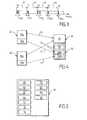
- this function is copied 71 in a block memory 70 so as to be addressable from the real time module 33.
- Copy 71 is a special way to the preferred embodiment edit the links between the real time parts 25b, 26b of the pilot programs and the real time module 33 of the program principal 24.
- any call to real time of this routine or pilot program function by the real time module 33 is actually a call 73 to the respective copy 125b or 126b of this routine or function in memory block 70.
- the real-time parts of the pilot programs are configured at the time of their respective execution substantially as if they were part of main program 24 at the time of its compilation.
- the shared memory block 70 is dimensioned and allocated at the start of execution by the main program 24 after this one received 74 data from each relevant PP pilot program defining the memory space necessary for its part of real time Respective PPb, as shown in Figure 2.
- Figure 5 shows the different tasks performed by the application module 32 of the main program 24. All the tasks performed by module 32 are done in deferred time, under the control of the scheduling functions of the operating system. AT As an indication, the delay between the acquisition of a measurement by the real-time module 33 and the subsequent processing of this measurement by the application module 32 is generally less than a second, but depends on the workload of processor 17.
- the application module 32 completes the processing of the data transmitted via the queues 64 and 67 in order to provide an applied representation of the successive states of the test bench 1 during the test and to make it available to the operator or user. For this, the task of unstacking the raw records E 0 , E 1 , ... continues until a complete emptying of the queue 64 and is followed by a step 75 of formatting the current values which they contain , to express these values in a format relevant to the user and different from the format used in raw records.
- This formatting comprises the conversion of the measurement values in the corresponding units predefined in the representation parameters 31, and the conversion of the occurrence counter 76 of the IPS interruption into a time value for dating the corresponding measurements.
- Task 77 consists in executing the instructions included in the messages M 0 , M 1 , ... read in step 69, for example to display a warning on the screen.
- Task 78 corresponds to a calculation step, from raw record data, bench state parameters 1 which are not directly acquired by the sensors.
- Task 79 consists of evaluating other criteria for safety trip dependent on the current values read, for order the execution of a corresponding safety procedure when a trigger criterion is validated. These other criteria are different from those evaluated in step 45.
- the application module 32 communicates the instructions necessary for real-time module 33 via memory block 35 shared.
- Task 80 consists of monitoring the signal ML, MA or SE state or SC command measurement against monitoring criteria predefined by the operator. This surveillance involves comparing a signal with another signal or with a predefined constant. When a monitoring criterion is validated, predefined conditional actions, such as writing a message are executed.
- Task 81 consists of displaying on the screen, over the progress of the test, successive states of the test bench in the applied representation, for example graphic, chosen by the operator in the representation parameters 31 and modifiable in test course via interface means 20.
- Task 82 consists of performing requested services by pilot programs 25 and 26 by calls 72 to the module 32, as shown in Figure 4. When initializing the control and command program, these services serve in particular to establish the functional connection of the programs pilots 25 and 26 on main program 24 and identification by this last of the entry and exit paths.
- Task 83 consists of executing instructions data interactively by the user under test, by interface means 20. For example, these instructions allow to interrupt the course of the test, to modify instructions for the test procedure, to change the format of the representation applied, to request the acquisition of additional measures by compared to those provided for in the test procedure, edit or modify the results files.
- Task 84 consists of storing the hard disk 19 of results files.
- the invention is not limited to a number or a type determined of sensors, actuators and interface means.
- FIG. 1 is a representation schematic that does not limit computer 10 to an architecture specific computing.
- the invention encompasses the use of any architecture known to those skilled in the art for arranging the components of a computer necessary for the implementation of the invention.
- control and control according to the invention having been described in relation to a bench test, it is nevertheless obvious that the program according to the invention can be used in combination with any physical system with at least one sensor or actuator to control and / or order in real time.
Landscapes
- Engineering & Computer Science (AREA)
- Software Systems (AREA)
- Theoretical Computer Science (AREA)
- Physics & Mathematics (AREA)
- General Engineering & Computer Science (AREA)
- General Physics & Mathematics (AREA)
- Test And Diagnosis Of Digital Computers (AREA)
- Debugging And Monitoring (AREA)
Priority Applications (3)
| Application Number | Priority Date | Filing Date | Title |
|---|---|---|---|
| EP01402104A EP1282037A1 (de) | 2001-08-03 | 2001-08-03 | Echtzeitschnittstellentreiber |
| AU2002336152A AU2002336152A1 (en) | 2001-08-03 | 2002-07-22 | Real-time interface monitoring computer programme |
| PCT/FR2002/002610 WO2003014922A2 (fr) | 2001-08-03 | 2002-07-22 | Programme informatique de pilotage d'interface en temps reel |
Applications Claiming Priority (1)
| Application Number | Priority Date | Filing Date | Title |
|---|---|---|---|
| EP01402104A EP1282037A1 (de) | 2001-08-03 | 2001-08-03 | Echtzeitschnittstellentreiber |
Publications (1)
| Publication Number | Publication Date |
|---|---|
| EP1282037A1 true EP1282037A1 (de) | 2003-02-05 |
Family
ID=8182841
Family Applications (1)
| Application Number | Title | Priority Date | Filing Date |
|---|---|---|---|
| EP01402104A Withdrawn EP1282037A1 (de) | 2001-08-03 | 2001-08-03 | Echtzeitschnittstellentreiber |
Country Status (3)
| Country | Link |
|---|---|
| EP (1) | EP1282037A1 (de) |
| AU (1) | AU2002336152A1 (de) |
| WO (1) | WO2003014922A2 (de) |
Citations (5)
| Publication number | Priority date | Publication date | Assignee | Title |
|---|---|---|---|---|
| EP0440446A2 (de) * | 1990-01-31 | 1991-08-07 | Hewlett-Packard Company | Anordnung und Verfahren zur Schattenspeicherverwaltung und Wiederabbildung eines reservierten Speichers in einem Mikrocomputer |
| FR2674634A1 (fr) * | 1991-03-26 | 1992-10-02 | Rosnoblet Yves | Systeme de mesure numerique de la puissance des moteurs a combustion interne. |
| US5435192A (en) * | 1992-12-07 | 1995-07-25 | Eagan; Thomas E. | Method and apparatus for controlling an engine |
| EP0871115A2 (de) * | 1997-04-04 | 1998-10-14 | Microsoft Corporation | Gebrauchsmodusproxy von Kernmodusoperationen in einem Rechnerverwaltungssystem |
| WO1999039254A2 (en) * | 1998-01-30 | 1999-08-05 | 3Com Corporation | Providing low level hardware device driver from user mode under multi-tasking operating systems |
-
2001
- 2001-08-03 EP EP01402104A patent/EP1282037A1/de not_active Withdrawn
-
2002
- 2002-07-22 AU AU2002336152A patent/AU2002336152A1/en not_active Abandoned
- 2002-07-22 WO PCT/FR2002/002610 patent/WO2003014922A2/fr not_active Ceased
Patent Citations (5)
| Publication number | Priority date | Publication date | Assignee | Title |
|---|---|---|---|---|
| EP0440446A2 (de) * | 1990-01-31 | 1991-08-07 | Hewlett-Packard Company | Anordnung und Verfahren zur Schattenspeicherverwaltung und Wiederabbildung eines reservierten Speichers in einem Mikrocomputer |
| FR2674634A1 (fr) * | 1991-03-26 | 1992-10-02 | Rosnoblet Yves | Systeme de mesure numerique de la puissance des moteurs a combustion interne. |
| US5435192A (en) * | 1992-12-07 | 1995-07-25 | Eagan; Thomas E. | Method and apparatus for controlling an engine |
| EP0871115A2 (de) * | 1997-04-04 | 1998-10-14 | Microsoft Corporation | Gebrauchsmodusproxy von Kernmodusoperationen in einem Rechnerverwaltungssystem |
| WO1999039254A2 (en) * | 1998-01-30 | 1999-08-05 | 3Com Corporation | Providing low level hardware device driver from user mode under multi-tasking operating systems |
Also Published As
| Publication number | Publication date |
|---|---|
| AU2002336152A1 (en) | 2003-02-24 |
| WO2003014922A2 (fr) | 2003-02-20 |
| WO2003014922A3 (fr) | 2004-02-26 |
Similar Documents
| Publication | Publication Date | Title |
|---|---|---|
| JP7007425B2 (ja) | 部分的にオフロードされた仮想化マネージャにおけるメモリ割当て技術 | |
| JP6845264B2 (ja) | オポチュニスティックハイパーバイザを用いたパフォーマンスの変動の低減 | |
| EP2150897B1 (de) | Verfahren zur simulation eines systems an bord eines flugzeugs zum testen und betreiben eines software-programms und vorrichtung zur anwendung dieses verfahrens | |
| US20210294896A1 (en) | Endpoint detection and response attack process tree auto-play | |
| FR2882448A1 (fr) | Procede de gestion, de journalisation ou de rejeu du deroulement d'un processus applicatif | |
| EP2160682A2 (de) | Elektronische karte mit der fähigkeit zur ausführung eines aus einem simulationssystem stammenden befehls und eines aus einem diagnostikmodul stammenden befehls und diesbezügliches simulationsverfahren | |
| JP6283096B2 (ja) | プログラム試験サービス | |
| EP1281948A1 (de) | Rechnerprogramm zur Kontrolle und Steuerung eines Prüfstandes | |
| EP3620928B1 (de) | Vorrichtung und verfahren zur anlayse des verhaltens eines anwendungsbausteins, der einer ressourcenverknappung ausgesetzt ist | |
| FR2881306A1 (fr) | Procede de journalisation non intrusive d'evenements externes aupres d'un processus applicatif, et systeme mettant en oeuvre ce procede | |
| FR3078791A1 (fr) | Outil de diagnostic calculateur | |
| FR2881247A1 (fr) | Procede de gestion semantique, de journalisation ou de rejeu d'operations non deterministes au sein du deroulement d'un processus applicatif | |
| EP3304226A1 (de) | Verfahren zur überwachung und beurteilung des betriebs einer industrieanlage, die von einem programmierbaren steuergerät angesteuert wird, und ausrüstung zur implementierung des besagten verfahrens | |
| US20180300195A1 (en) | Method and system to decrease measured usage license charges for diagnostic data collection | |
| US10783059B2 (en) | Method and system to decrease measured usage license charges for diagnostic data collection | |
| WO2003014922A2 (fr) | Programme informatique de pilotage d'interface en temps reel | |
| FR2881308A1 (fr) | Procede d'acceleration de la transmission de donnees de journalisation en environnement multi ordinateurs et systeme utilisant ce procede | |
| FR2908909A1 (fr) | Procede de gestion d'une unite de calcul | |
| FR2767399A1 (fr) | Procede de determination du temps de demarrage d'un systeme informatique | |
| FR2871592A1 (fr) | Procede de recherche et de transmission des temps d'execution de programmes dans des systemes embarques | |
| EP3767475A1 (de) | Vorrichtung und verfahren für die analyse der leistungen einer web-anwendung | |
| EP3767476A1 (de) | Vorrichtung und verfahren für die analyse der leistungen einer mehrschichtigen anwendung (n-tier-app) | |
| RU2832250C1 (ru) | Способ и система синергетической дистанционной калибровки транспортных средств в нескольких местоположениях | |
| FR3002663A1 (fr) | Surveillance distribuee de mesure de performance d'une architecture informatique | |
| FR2822561A1 (fr) | Procede d'emulation d'un microprocesseur enfoui |
Legal Events
| Date | Code | Title | Description |
|---|---|---|---|
| PUAI | Public reference made under article 153(3) epc to a published international application that has entered the european phase |
Free format text: ORIGINAL CODE: 0009012 |
|
| AK | Designated contracting states |
Designated state(s): AT BE CH CY DE DK ES FI FR GB GR IE IT LI LU MC NL PT SE TR |
|
| AX | Request for extension of the european patent |
Extension state: AL LT LV MK RO SI |
|
| 17P | Request for examination filed |
Effective date: 20030306 |
|
| AKX | Designation fees paid |
Designated state(s): AT BE CH CY DE DK ES FI FR GB GR IE IT LI LU MC NL PT SE TR |
|
| 17Q | First examination report despatched |
Effective date: 20070914 |
|
| STAA | Information on the status of an ep patent application or granted ep patent |
Free format text: STATUS: THE APPLICATION IS DEEMED TO BE WITHDRAWN |
|
| 18D | Application deemed to be withdrawn |
Effective date: 20080326 |