EP1282100A2 - Abtastschaltung und Bildanzeigegerät - Google Patents
Abtastschaltung und Bildanzeigegerät Download PDFInfo
- Publication number
- EP1282100A2 EP1282100A2 EP02017142A EP02017142A EP1282100A2 EP 1282100 A2 EP1282100 A2 EP 1282100A2 EP 02017142 A EP02017142 A EP 02017142A EP 02017142 A EP02017142 A EP 02017142A EP 1282100 A2 EP1282100 A2 EP 1282100A2
- Authority
- EP
- European Patent Office
- Prior art keywords
- circuit
- scanning
- output
- signal
- compensation
- Prior art date
- Legal status (The legal status is an assumption and is not a legal conclusion. Google has not performed a legal analysis and makes no representation as to the accuracy of the status listed.)
- Granted
Links
- 239000004065 semiconductor Substances 0.000 claims description 29
- 239000004020 conductor Substances 0.000 claims description 20
- 239000000872 buffer Substances 0.000 abstract description 73
- 239000011159 matrix material Substances 0.000 abstract description 35
- 238000010586 diagram Methods 0.000 description 23
- 238000000034 method Methods 0.000 description 18
- 230000008569 process Effects 0.000 description 14
- 238000001514 detection method Methods 0.000 description 11
- 230000015654 memory Effects 0.000 description 9
- 238000006243 chemical reaction Methods 0.000 description 8
- 230000007274 generation of a signal involved in cell-cell signaling Effects 0.000 description 7
- 230000006870 function Effects 0.000 description 6
- 238000005070 sampling Methods 0.000 description 5
- XAGFODPZIPBFFR-UHFFFAOYSA-N aluminium Chemical compound [Al] XAGFODPZIPBFFR-UHFFFAOYSA-N 0.000 description 4
- 229910052782 aluminium Inorganic materials 0.000 description 4
- PCHJSUWPFVWCPO-UHFFFAOYSA-N gold Chemical compound [Au] PCHJSUWPFVWCPO-UHFFFAOYSA-N 0.000 description 3
- 230000004044 response Effects 0.000 description 3
- 238000009792 diffusion process Methods 0.000 description 2
- 239000004973 liquid crystal related substance Substances 0.000 description 2
- 238000004519 manufacturing process Methods 0.000 description 2
- 230000009467 reduction Effects 0.000 description 2
- 230000001360 synchronised effect Effects 0.000 description 2
- OAICVXFJPJFONN-UHFFFAOYSA-N Phosphorus Chemical compound [P] OAICVXFJPJFONN-UHFFFAOYSA-N 0.000 description 1
- 230000005856 abnormality Effects 0.000 description 1
- 230000006872 improvement Effects 0.000 description 1
- 239000000463 material Substances 0.000 description 1
- 230000002093 peripheral effect Effects 0.000 description 1
- 238000000926 separation method Methods 0.000 description 1
- 230000007704 transition Effects 0.000 description 1
Images



Classifications
-
- G—PHYSICS
- G09—EDUCATION; CRYPTOGRAPHY; DISPLAY; ADVERTISING; SEALS
- G09G—ARRANGEMENTS OR CIRCUITS FOR CONTROL OF INDICATING DEVICES USING STATIC MEANS TO PRESENT VARIABLE INFORMATION
- G09G3/00—Control arrangements or circuits, of interest only in connection with visual indicators other than cathode-ray tubes
- G09G3/20—Control arrangements or circuits, of interest only in connection with visual indicators other than cathode-ray tubes for presentation of an assembly of a number of characters, e.g. a page, by composing the assembly by combination of individual elements arranged in a matrix no fixed position being assigned to or needed to be assigned to the individual characters or partial characters
- G09G3/34—Control arrangements or circuits, of interest only in connection with visual indicators other than cathode-ray tubes for presentation of an assembly of a number of characters, e.g. a page, by composing the assembly by combination of individual elements arranged in a matrix no fixed position being assigned to or needed to be assigned to the individual characters or partial characters by control of light from an independent source
- G09G3/36—Control arrangements or circuits, of interest only in connection with visual indicators other than cathode-ray tubes for presentation of an assembly of a number of characters, e.g. a page, by composing the assembly by combination of individual elements arranged in a matrix no fixed position being assigned to or needed to be assigned to the individual characters or partial characters by control of light from an independent source using liquid crystals
-
- G—PHYSICS
- G09—EDUCATION; CRYPTOGRAPHY; DISPLAY; ADVERTISING; SEALS
- G09G—ARRANGEMENTS OR CIRCUITS FOR CONTROL OF INDICATING DEVICES USING STATIC MEANS TO PRESENT VARIABLE INFORMATION
- G09G3/00—Control arrangements or circuits, of interest only in connection with visual indicators other than cathode-ray tubes
- G09G3/20—Control arrangements or circuits, of interest only in connection with visual indicators other than cathode-ray tubes for presentation of an assembly of a number of characters, e.g. a page, by composing the assembly by combination of individual elements arranged in a matrix no fixed position being assigned to or needed to be assigned to the individual characters or partial characters
- G09G3/22—Control arrangements or circuits, of interest only in connection with visual indicators other than cathode-ray tubes for presentation of an assembly of a number of characters, e.g. a page, by composing the assembly by combination of individual elements arranged in a matrix no fixed position being assigned to or needed to be assigned to the individual characters or partial characters using controlled light sources
-
- G—PHYSICS
- G09—EDUCATION; CRYPTOGRAPHY; DISPLAY; ADVERTISING; SEALS
- G09G—ARRANGEMENTS OR CIRCUITS FOR CONTROL OF INDICATING DEVICES USING STATIC MEANS TO PRESENT VARIABLE INFORMATION
- G09G2300/00—Aspects of the constitution of display devices
- G09G2300/06—Passive matrix structure, i.e. with direct application of both column and row voltages to the light emitting or modulating elements, other than LCD or OLED
-
- G—PHYSICS
- G09—EDUCATION; CRYPTOGRAPHY; DISPLAY; ADVERTISING; SEALS
- G09G—ARRANGEMENTS OR CIRCUITS FOR CONTROL OF INDICATING DEVICES USING STATIC MEANS TO PRESENT VARIABLE INFORMATION
- G09G2310/00—Command of the display device
- G09G2310/02—Addressing, scanning or driving the display screen or processing steps related thereto
- G09G2310/0264—Details of driving circuits
- G09G2310/0267—Details of drivers for scan electrodes, other than drivers for liquid crystal, plasma or OLED displays
-
- G—PHYSICS
- G09—EDUCATION; CRYPTOGRAPHY; DISPLAY; ADVERTISING; SEALS
- G09G—ARRANGEMENTS OR CIRCUITS FOR CONTROL OF INDICATING DEVICES USING STATIC MEANS TO PRESENT VARIABLE INFORMATION
- G09G2320/00—Control of display operating conditions
- G09G2320/02—Improving the quality of display appearance
- G09G2320/0223—Compensation for problems related to R-C delay and attenuation in electrodes of matrix panels, e.g. in gate electrodes or on-substrate video signal electrodes
Definitions
- the present invention relates to an image display device and to a scanning circuit used in the image display device.
- the method of increasing the semiconductor chip area is known.
- the area occupied by the chip is increased. That is, an area of about 1 mm 2 is occupied in the case of obtaining an output on resistance (Ron) of 100 m ⁇ .
- JP-A 6-230338 A discloses an arrangement in which feedback control is performed to apply a bias voltage with stability to semiconductor devices for driving a liquid crystal display device.
- JP-A 10-153759 A discloses a correction circuit in which dummy wiring is provided in parallel with scanning lines in a liquid crystal panel, a signal line drive current flowing through the dummy wiring is converted into a distortion voltage, and the difference between the distortion voltage and a reference voltage is fed back to a scanning line drive circuit to correct a distortion of the signal line drive voltage.
- JP-A 5-212905 A discloses a device for forming an image with a printing head using an LED array and discloses, in particular, an arrangement in which a voltage detection resistor is connected in parallel with an LED array drive transistor to detect an abnormality of the printing head.
- the resistance of bonding wires is not negligible.
- the method of using a pair of the bonding wire may be used. However, the influence cannot be completely eliminated by this method.
- the present invention has been made in view of the above, and an object of the present invention is therefore to realize a scanning circuit and an image display device in which the influence of losses in a signal path to scanning wiring and a scanning signal output circuit can be reduced.
- a scanning circuit which is used in a display device having a plurality of scanning wiring lines and a plurality of modulation wiring lines, and which sequentially applies a scanning signal to the scanning wiring lines, the scanning signal being applied to part of the scanning wiring lines at a time
- the scanning circuit being characterized by comprising: an output circuit which outputs the scanning signal; and conductors forming paths for the scanning signal between the output circuit and the scanning wiring lines, the output circuit outputting the scanning signal on the basis of a compensation signal for compensation for a loss in the scanning signal in: at least a portion of the output circuit, at least a portion of the conductors, or at least a portion of the output circuit and at least a portion of the conductors.
- a compensation signal for compensation for the loss a compensation signal for predicting the loss and for compensating for the predicted loss may be used. More specifically, a feedback control arrangement may be adopted in which feedback control is performed by detecting the loss and by making compensation with respect to the resulting output on the basis of the result of the detection.
- At least part of the conductor may be a semiconductor.
- the scanning circuit according to the present invention further comprises a compensation signal output circuit which outputs the compensation signal according to the signal level at one of the conductors to which the scanning signal is output.
- the signal level at the conductor is, for example, a potential at the conductor or a current flowing through the conductor.
- the compensation signal output circuit may include a feedback circuit constituted by an analog operational amplifier.
- the compensation signal output circuit may include first conversion means for converting an analog signal input to the compensation signal output circuit into a digital signal, digital computation means for obtaining the compensation signal from the digital signal converted by the first conversion means by performing computational processing and for outputting the compensation signal, and second conversion means for converting the digital compensation signal output from the digital computation means into an analog signal and for outputting the analog compensation signal.
- An A/D converter can be suitably used as the first conversion means, and a D/A converter can be suitably used as the second conversion means. Further, a hardware logic circuit or software operational processing using a microcomputer can be suitably used as the digital computation means.
- the conductors may be provided in correspondence with the plurality of scanning wiring lines, and the compensation signal output circuit outputs the compensation signal according to the signal level at one of the plurality of conductors to which the scanning signal is output.
- the scanning circuit according to the present invention further comprises a selecting circuit which outputs a selection signal for selecting one of the scanning wiring lines to which the scanning signal should be applied, in which the output circuits are provided in correspondence with the scanning wiring lines, and the output circuit outputs the scanning signal on the basis of the compensation signal and the selection signal.
- a shift register can be suitably used as the selecting circuit.
- a non-selecting potential be applied to the scanning wiring lines not designated by the selecting circuit to be selected.
- An arrangement in which the output circuit also functions as a circuit for applying the non-selecting potential to the unselected scanning wiring lines can be preferably adopted.
- the scanning circuit according to the present invention is characterized in that at least a portion of a circuit constituting the scanning circuit is integrated to form a semiconductor integrated circuit.
- the semiconductor circuit thus arranged is formed by a CMOS process or a bipolar process.
- the scanning circuit according to the present invention is characterized in that at least a portion of a circuit constituting the scanning circuit and including the output circuit is integrated to form a semiconductor integrated circuit, and the loss in the scanning signal includes a voltage drop due to the on resistance of a driver in the output circuit.
- the above-mentioned loss also includes a voltage drop due to the resistance of wiring for supplying the scanning signal form the output circuit to a bonding pad, a voltage drop due to the electrical resistance of a bonding wire electrically connected to the bonding pad, and a voltage drop due to the resistance of external wiring electrically connected to the semiconductor integrated circuit main unit.
- an image display device characterized by comprising: a plurality of scanning wiring lines; a plurality of modulation wiring lines; one of the above-described scanning circuits; and a modulation circuit which applies a plurality of modulation signals to the plurality of modulation wiring lines corresponding to the plurality of scanning wiring lines to which the scanning signal is applied, the modulation signals being applied while the scanning signal being applied.
- the image display device further comprises display elements driven by the scanning signal applied through the scanning wiring lines, and the modulation signals applied through the modulation wiring lines.
- an electron emitting device used in combination with a luminescent member capable of producing light when irradiated with electrons, an electroluminecent element, or a cell constituting a plasma display can be suitably used.
- a semiconductor integrated circuit (IC) and an image display device having the semiconductor integrated circuit which represent a first embodiment of the present invention will be described with reference to Figs. 1 to 6.
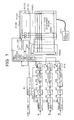
- Fig. 1 is a block diagram of a drive circuit of the image display device (cold cathode display panel) representing the embodiment of the present invention.
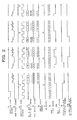
- Fig. 2 is a diagram showing drive waveforms in the image display device representing the embodiment of the present invention.
- a display panel P2000 is a display panel of a cold cathode display.
- 480 ⁇ 2160 cold cathode elements P2001 are connected in a matrix by 480-row wiring lines P2002 arranged in a vertical direction and 2160-column wiring lines P2003 arranged in a horizontal direction.
- Each cold cathode element P2001 emits electrons when a voltage of over ten volts is applied to it. Therefore the potential of a scanning signal applied to the row wiring lines (scanning wiring lines) is controlled so that the potential difference between the scanning signal applied to one of the row wiring lines to be selected and that of a modulated signal applied to the column wiring lines (modulation wiring lines) is over ten volts (a value exceeding an electron emission threshold voltage) while the potential difference between the potential at the scanning wiring lines which are not selected and that of the modulated signal is lower than the threshold value, thus enabling selection of the cold cathode elements P2001 in any one of the rows for emission of electrons.
- Electrons emitted from each cold cathode element P2001 are accelerated by an anode electrode to which a high voltage is applied from a high-voltage supply P11 and irradiates a phosphor (not shown) to produce light.
- This embodiment is an example of application in which an NTSC television image is displayed on the display panel having rows of 2160 pixels (RGB trio) extending in the horizontal direction and columns of 480 pixels extending in the vertical direction.
- the display panel of this embodiment can be adapted to display of any of high-resolution images other than the NTSC image, e.g., a high-definition television (HDTV) image and an extended graphics array (XGA) image, and computer output images.
- HDTV high-definition television
- XGA extended graphics array
- a timing generation unit P1 is supplied with an external sync signal or a sync signal from a sync separation circuit (sync separator) (not shown) , and outputs a clamp pulse (CLP) and a blanking pulse (BLK) required for analog processing units P6.
- sync separator sync separator
- the timing generation unit P1 also outputs a clock signal required for analog-to-digital (A/D) converters P8, inverse ⁇ tables P9, and line memories P10 by using its internal phase-locked loop (hereafter referred to as "PLL"). This clock is synchronized with a horizontal sync signal T3 described below. Further, the timing generation unit P1 outputs the horizontal sync signal T3 and a vertical sync signal T1 shown in Fig. 2. Each of the horizontal sync signal T3 and the vertical sync signal T1 is used as a reference for a panel control reference signal generation unit P2.
- the panel control reference signal generation unit P2 is a reference signal generation unit for controlling panel peripheral circuits.
- the panel control reference signal generation unit P2 outputs horizontal and vertical sync control signals to a X control P3, a memory control P4 and a Y control P5. Further, the panel control reference signal generation unit P2 incorporates a PLL and outputs a clock signal in synchronization with the horizontal sync signal.
- the X control P3 outputs a shift clock T6, a load (LD) signal T7, and a pulse-width modulation (PWM) clock signal T8 each shown in Fig. 2 on the basis of the signal from the panel control reference signal generation unit P2.
- the shift clock T6, the LD signal T7 and the PWM clock signal T8 are required for an X drive module P1100, which is a modulation circuit.
- the memory control P4 is a control unit which outputs control signals for controlling reading timing of the line memories P10.
- the memory control P4 outputs a memory read clock (not shown) and a read address control signal (not shown) on the basis of the signal from the panel control reference signal generation unit P2.
- the Y control P5 outputs a Y shift clock (not shown) required for a Y drive module P1001, which is a scanning circuit.
- the analog processing units P6 amplify analog RGB video signal inputs to a level for input to the A/D converters P8 by using the clamp pulse (CLP) and the blanking pulse (BLK) from the timing generation unit P1.
- the analog processing units P6 shift the levels of the amplified analog RGB video signals to the voltage level required in the A/D converters and perform blanking processing for reducing noise in the retrace period.
- Low-pass filters P7 are used for the purpose of removing, from the analog video signals from the analog processing units P6, high-frequency signal components which cause aliasing undesired in A/D conversion processing in the A/D converters P8.
- the A/D converters P8 covert the analog video signals (T2 in Fig. 2) into digital signals with the period of the clock from the timing generation unit P1.
- Each of the inverse ⁇ tables P9 is a table for restoring to a non- ⁇ -corrected linear video signal, a ⁇ -corrected video signal sent from a broadcasting station.
- This processing is required in the PWM drive type of cold cathode display which has a luminance output which is linear with respect to an input video signal unlike an image display device using a cathode ray tube (CRT).
- CTR cathode ray tube
- the line memories P10 temporarily store sampling RGB signals (T4 in Fig. 2) obtained by inverse ⁇ conversion after analog-to-digital conversion in the A/D converters P8. At the time of reading from the line memories P10, the RGB memories are successively called up to obtain a serial RGB signal (T5 shown in Fig. 2) having RGB components in the same order as the RGB arrangement of phosphors in the panel.
- the serial RGB signal is input to the X drive module P1100 and is shifted in a shift register P1103 from left to right by the shift clock output from the X control P3. After shifting of all data items corresponding to 2160 dots, all the data in the shift register are latched by latches P1102 by the LD signal T7 shown in Fig. 2.
- the data latched by the latches P1102 is compared with outputs from internal counters to output PWM signals (T8A in Fig. 2) varying in PWM pulse width according to the level of the data.
- the Y drive module P1001 is constituted by a shift register P1002 and an output buffer P1003.
- the Y drive module P1001 shifts, by the shift register P1002, a first-line row selection signal T9 shown in Fig. 2 for each horizontal period as in a second-line row selection signal T10 shown in Fig. 2.
- the output buffer P1003 has been provided in the form of a hybrid IC or an IC of a large chip area, which is disadvantageous in terms of cost etc.
- a circuit configuration described below is used to supply the Y drive module P1001 at a low cost without using discrete power MOSFET or a large output buffer of a low output on resistance (Ron).
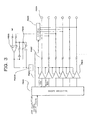
- Fig. 3 is a circuit diagram of an example of an IC integrating the Y drive module P1001 shown in Fig. 1.
- the row selection signal (for selection of one of the Y wiring lines corresponding to 480 rows) is shifted successively from the top position to the bottom position in a shift register P3000 provided as a selecting circuit to drive each of the rows of the elements.
- Outputs of the shift register P3000 are connected to output buffers P3002 forming output circuits and supplied through output terminals P3004 of the IC to the matrix wiring outside the IC to perform drive through the matrix wiring.
- the on resistances (Ron) of drivers in the output buffers P3002 are indicated by P3007. Inactuality, the on resistances exist in the output buffers P3002 forming output circuits. However, for ease of understanding, the on resistances are shown outside the output buffers P3002. Since the output current is large as mentioned above, there is a need to avoid the influence of the voltage drop due to the on resistance. Conventionally, as described above, the on resistance of each output buffer is limited to a small value of several hundred milliohms or less.
- the 480 rows are divided into six modules and one feedback circuit is provided in correspondence with each module to perform feedback control of the output buffers P3002 corresponding to 80 rows.
- the X drive module P1100 causes a current of, for example, 1 mA per channel, the total current is about 2 A since there are 2160 channels in this embodiment, and the voltage drop of 1 V is caused at the minimum.
- a switch P3003 outputs voltage information with respect to the first row on the basis of row information (row selection information) obtained from the shift register P3000 through a parallel signal line P3001. Since the switch P3003 is used for the purpose of obtaining a detected potential, it is not necessary for the switch P3003 to have a reduced resistance value, and there is no problem even if the resistance value of the switch P3003 is several ten kilohms. Therefore the proportion of the area of switch circuit in the total area of the IC is extremely small.
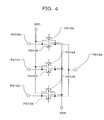
- Pairs of p-channel and n-channel FETs P3103 and P3106, P3104 and P3107, and P3105 andP3108 are respectively connected to input terminals P3100, P3101, and P3102.
- One of the inputs is selected according to which gates of the FET pairs are turned on to output potential information to an output terminal P3109.
- the output from the switch P3003 is amplified by an operational amplifier (OPAMP) P3005 and is supplied as a compensation signal to all the output buffers through an output voltage compensation circuit P3008.
- the operational amplifier (OPAMP) P3005 and the output voltage compensation circuit P3008 function as compensation signal output means.
- theabove-described voltage drop can be compensated for by the compensation signal for an increase in voltage such that the apparent voltage drop due to the output current is limited to a small value.
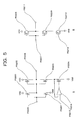
- Fig. 5A is a diagram showing a circuit formed by a CMOS process
- Fig. 5B is a diagram showing a circuit formed by a bipolar process.
- a drive signal waveform input to an input terminal P3205 is current-amplified by a prebuffer formed by a p-channel FET P3200 and an n-channel FET P3201 since the gate capacity of the output buffer is large.
- the current-amplified drive signal waveform is applied to a gate of an output buffer formed by a p-channel FET P3202 and an n-channel FET P3203 to perform driving through an output terminal P3206.
- the selecting potential is determined by the gate potential of an FET P3204.
- the stability of the gate-source voltage Vgs of the FET is not sufficiently high. Therefore voltage feedback is made thereon by an OPAMP P3214.
- the compensation signal is applied to an input terminal P3212 of the OPAMP P3214 to achieve output voltage compensation.
- a drive waveform input to an input terminal P3207 is input to a base of an output buffer formed by a pnp transistor P3208 and an npn transistor P3209.
- the selecting potential at an output terminal P3211 is determined by the potential at the emitter of the npn transistor P3209, i.e., the base potential of a pnp transistor P3210. Therefore the compensation signal is applied to the base (input terminal P3213) of the pnp transistor P3210, thus enabling output voltage compensation.
- correction with respect to the on resistance of the output is also made by operating the switch P3003 and making feedback through the OPAMP P3005 in the same manner.
- a switch means P3006 for turning on/off the feedback is provided. Details of the switch P3006 is explained hereafter The switch means P3006 is turned on to stop the feedback operation and to output the reference voltage.
- the waveform for driving the matrix is a signal having two potentials: selecting potential VS and non-selecting potential VNS, as represented by a signal T100 (first row selection signal) or a signal T101 (second row selection signal) shown in Fig. 6.
- an internal section of an IC is constituted by a switch means, an output buffer of a large resistance value (i.e., of a small chip size) and a feedback circuit to obtain the multiple-output low-resistance drive circuit that has been realized by using a large output buffer in the prior art.
- a low-cost matrix driver can be realized.
- the present invention has been described with respect to an example of the configuration of a multiple-output matrix driver using a switch and one compensation signal output means. However, it is also possible to make compensation with respect to the output potential by using compensation signal output means for each output buffer without using the switch P3003, and to thereby realize a low-cost matrix driver. In such a case, it is preferable to use the switch P3006 shown in Fig. 3 in correspondence with each row to cut the feedback of the OPAMP P3005.
- Fig. 7 shows a second embodiment of the present invention.
- the compensation signal output circuit is also provided in the semiconductor integrated circuit. This embodiment will be described with respect to an arrangement in which a compensation signal output circuit is provided outside a semiconductor integrated circuit.
- this embodiment is the same as the first embodiment.
- the description of the same components will not be repeated.
- the entire cold cathode panel drive circuit is generally the same as that of the first embodiment and the description for it will not be repeated. A description will be made only of a Y matrix drive module with reference to Fig. 7.
- Fig. 7 is a circuit diagram of an example of an IC integrating the Y drive module P1001 shown in Fig. 1.
- the row selection signal is shifted successively from the top position to the bottom position in a shift register P5000 to drive each of the rows of the elements.
- Outputs of the shift register P5000 are connected to output buffers P5002 and supplied through output terminals P5004 of the IC to the matrix wiring outside the IC to perform drive through the matrix wiring.
- Ron The on resistances (Ron) of drivers in the output buffers P5002 are indicated by P5007. Since the output current is large as mentioned above, there is a need to avoid the influence of the voltage drop due to the on resistance. Conventionally, as described above, the on resistance of each output buffer is limited to a small value of several hundred milliohms or less.
- a switch P5003 outputs voltage information with respect to the first row on the basis of row information obtained from the shift register P5000 through a parallel signal line P5001. Since the switch P5003 is used for the purpose of obtaining a detected potential, it is not necessary for the switch P5003 to have a reduced resistance value, and there is no problem even if the resistance value of the switch P5003 is several ten kilohms. Therefore the proportion of the area of switch circuit in the total area of the IC is extremely small.
- an output terminal P5006 for output from the switch circuit is provided. Also, a compensation signal input terminal of an output voltage compensation circuit P5009 is connected to an input terminal P5005 to enable control from the outside of the IC.
- parameters relating to the performance of the OPAMP, the configuration of the feedback circuit, etc. can be selected. Therefore it is possible to adjust the feedback circuit even after fabrication of the IC.
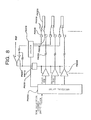
- Fig. 8 shows a third embodiment of the present invention. While the first embodiment has been described as an arrangement devised mainly for compensation for the voltage drop due to the on resistance, this embodiment will be described as an arrangement in which compensation with respect to the voltage drop caused by other than the on resistance is also made.
- this embodiment is the same as the first embodiment.
- the description of the same components will not be repeated.
- a cold cathode display driver is realized which is capable of output voltage compensation including compensation for voltage drops due to the resistances of bonding wires connecting bonding pads and IC leads.
- the entire cold cathode panel drive circuit is generally the same as that of the first embodiment and the description for it will not be repeated. A description will be made only of a Y matrix drive module with reference to Fig. 8.
- Fig. 8 is a circuit diagram of an example of an IC integrating the Y drive module P1001 shown in Fig. 1.
- the row selection signal is shifted successively from the top position to the bottom position in a shift register P5000 to drive each of the rows of the elements.
- Outputs of the shift register P6000 are connected to output buffers P6004 and supplied through IC lead P6009 which are output terminals of the IC to the matrix wiring outside the IC to perform drive through the matrix wiring.
- Ron The on resistances (Ron) of drivers in the output buffers P6004 are indicated by P6002. Since the output current is large as mentioned above, there is a need to avoid the influence of the voltage drop due to the on resistance. Conventionally, as described above, the on resistance of each output buffer is limited to a small value of several hundred milliohms or less.
- the output of the output buffer P6004 is connected to a bonding pad P6003 by an aluminum wiring conductor (not shown), and the bonding pad P6003 is connected to the IC lead P6009 by a bonding wire P6008.
- a gold wire having a thickness of about 30 microns is used as the bonding wire P6008.
- the aluminum conductor (not shown) and the bonding wire P6008 a potential detected from the IC lead P6009 through the bonding wire P6008 is taken into a switch P6006 via a bonding pad P6005 for detection.
- the switch P6006 is operated on the basis of row information obtained from the shift register P6000 through a parallel signal line P6001 to select the potential detected from the row currently driven among detected potentials in response to the signal input to the switch P6006.
- the detection signal selected by the switch P6006 is amplified by an OPAMP P6007 and input to an output voltage compensation circuit P6010.
- the output voltage compensation circuit P6010 outputs a compensation signal to the output buffer P6004.
- the bonding pad P6005 and the bonding wire P6008 for potential feedback from the IC lead, the switch means P6006, the feedback circuit P6007, and the output compensation circuit P6010 are provided to enable detection of the voltage drop due to all the resistances: the on resistance (Ron) of the output buffer P6004, the aluminum wiring resistance, and the bonding wire resistance. It is possible to bring the apparent resistance value closer to 0 ⁇ by compensating this voltage drop. Consequently, the chip area can be reduced and a low-cost semiconductor integrated circuit can be formed.
- a flexible wiring is often used for connection between an IC and column wiring.
- the influence of a voltage drop due to a resistance in such wiring is not negligible.
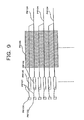
- connections as shown in Fig. 9 are made outside the bonding pads shown in Fig. 8, compensation can also be made with respect to the resistance of flexible wiring, as described below.
- Bonding pads P6100 shown in Fig. 9 are connected to voltage output means. Each bonding pad P6100 is connected to an output IC lead P6102 by a bonding wire P6101.
- a bonding pad P6106 for potential detection is also connected by a bonding wire P6101 to an IC lead P6105 for input of potential information outside the IC.
- the bonding pad P6106 is connected to switch means in the IC chip, as in Fig. 8.
- a voltage output from the output IC lead P6102 is connected to the row wiring lines P6104 through the flexible wiring P6103.
- the resistance of flexile wiring in the prior art has been reduced as much as possible.
- a certain degree of influence of the resistance has become unavoidable.
- a potential is detected at a point before the row wiring (particularly between the end of the flexible wiring on the row wiring side and the end of the row wiring), wiring for feedback is provided in the flexible wiring, and the potential before the row wiring is taken into the IC chip through the detected potential input IC lead P6105, the bonding wire P6101 and the potential detection bonding pad P6106, thus enabling output potential compensation in the same manner as in the arrangement shown in Fig. 8 and thereby avoiding the influence of the resistance accompanying an improvement in resolution.
- Fig. 10 shows a fourth embodiment of the present invention. While the first embodiment has been described with respect to a case where the compensation circuit, etc., are formed exclusively as an analog circuit, this embodiment will be described with respect to a case where a circuit including a digital circuit is formed as a compensation circuit.
- this embodiment is the same as the first embodiment.
- the description of the same components will not be repeated.
- a cold cathode display driver is realized by using a semiconductor integrated circuit having output potential compensation means formed as a digital circuit in the IC.
- the entire cold cathode panel drive circuit is generally the same as that of the first embodiment and the description for it will not be repeated. A description will be made only of a Y matrix drive module with reference to Fig. 10.
- Fig. 10 is a circuit diagram of an example of an IC integrating the Y drive module P1001 shown in Fig. 1.
- the row selection signal is shifted successively from the top position to the bottom position in a shift register P5000 to drive each of the rows of the elements.
- Outputs of the shift register P7000 are connected to output buffers P7002 and supplied through output terminals P7004 of the IC to the matrix wiring outside the IC to perform drive through the matrix wiring.
- Ron The on resistances (Ron) of drivers in the output buffers P7002 are indicated by P7007. Since the output current is large as mentioned above, there is a need to avoid the influence of the voltage drop due to the on resistance. Conventionally, as described above, the on resistance of each output buffer is limited to a small value of several hundred milliohms or less.
- a switch P7003 outputs voltage information with respect to the first row on the basis of row information obtained from the shift register P7000 through a parallel signal line P7001. Since the switch P7003 is used for the purpose of obtaining a detected potential, it is not necessary for the switch P7003 to have a reduced resistance value, and there is no problem even if the resistance value of the switch P7003 is several ten kilohms. Therefore the proportion of the area of switch circuit in the total area of the IC is extremely small.
- An output from the switch circuit is converted from an analog signal form into a digital signal form by an A/D converter P7009.
- a sampling clock for the A/D converter P7009 is generated by an oscillator (not shown) in a clock generator P7010.
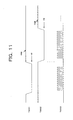
- the sampling clock may be synchronized with the horizontal or vertical sync signal in the input video signal by using a PLL. However, this synchronization is not necessarily required. Further, the sampling clock may be output only during a period corresponding to the period of row selection by signal T8001 or T8002 shown in Fig. 11, as shown in a waveform T8003 in Fig. 11.
- the output from the A/D converter P7009 is compared by a digital comparator P7006 with reference data P7008, which is a Y output voltage reference.
- the difference between the Y output voltage and the reference data P7008 is output to a D/A converter P7005.
- a hardware comparator is used in this embodiment, a microprocessor may alternatively be used to perform comparison processing.
- the D/A converter P7005 converts the output from the comparator P7006 from a digital signal form into an analog signal form and outputs the converted signal with timing of the clock generated by the clock generator P7010.
- the output from the D/A converter P7005 is current-amplified by an output voltage correction circuit P7011 formed of a current amplifier circuit constituted by bipolar transistors, etc., and is thereafter used to control the power supply voltage applied to the output buffer P7002.
- Feedback control is performed by using the feedback loop formed by the A/D converter P7009, the comparator P7006 and the D/A converter P7005 so that the on resistance (Ron) of the output buffer P7002 is apparently minimized.
- the switch means and the feedback circuit using digital components are provided to enable detection of the voltage drop due to the on resistance (Ron) of the output buffer. It is possible to bring the apparent resistance value closer to 0 ⁇ by correcting this voltage drop. Consequently, the chip area can be reduced and a low-cost semiconductor integrated circuit can be formed.
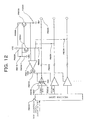
- Fig. 12 shows a fifth embodiment of the present invention. This embodiment will be described with respect to the configuration of a semiconductor integrated circuit in which a diode is used as a switch, and which is formed by bipolar process.
- this embodiment is the same as the first embodiment.
- the description of the same components will not be repeated.
- a semiconductor integrated circuit in which a diode is used as a switch means and which is formed by bipolar process is used to realize a cold cathode display driver.
- the entire cold cathode panel drive circuit is generally the same as that of the first embodiment and the description for it will not be repeated. A description will be made only of a Y matrix drive module with reference to Fig. 12.
- Fig. 12 is a circuit diagram of an example of an IC integrating the Y drive module P1001 shown in Fig. 1.
- the row selection signal is shifted successively from the top position to the bottom position in a shift register P9000.
- Outputs of the shift register P9000 are connected to output buffers P9001.
- the output buffer P9001 is constituted by an npn transistor P9013 and a pnp transistor P9014 in an inverter configuration. Therefore the emitter potential of the pnp transistor P9014 is dominant in the non-selecting voltage (VNS in Fig. 11) of the output buffer P9001, and the emitter potential of the npn transistor P9013 is dominant in the selecting voltage (VS in Fig. 8) of the output buffer P9001.
- the output from the output buffer P9001 is supplied via an output terminal P9003 to matrix wiring provided outside the IC to perform driving through the matrix wiring.
- Ron The on resistances (Ron) of drivers in the output buffers P9001 are indicated by P9002. Since the output current is large as mentioned above, there is a need to avoid the influence of the voltage drop due to the on resistance. Conventionally, the on resistance of each output buffer is limited to a small value of several hundred milliohms or less.
- a constant-current supply circuit constituted by a pnp transistor P9007, resistors P9008 and P9009, and a constant-voltage diode P9010 causes a constant current of, for example, 1 mA to flow through one of diodes P9004.
- Parallel connections to the rows for supply of the currents from the constant-current supply are established by the diodes P9004. Since as mentioned above matrix drive is performed such that one row is driven at a time and two or more of the rows are not simultaneously driven, the shift register selects only one row at a time and only the selected row has VS potential while the other unselected rows have VNS potential, as described above with reference to Fig. 8. Accordingly, the diodes P9004 corresponding to the unselected rows are reverse-biased to cut off the current.
- the output current from the output buffer P9001 is approximately equal to 2 A, as mentioned above in the description of the first embodiment. Therefore the influence of the 1 mA current from the constant-current supply upon the output buffer P9001 and the matrix panel is not considerably large.
- the positive input terminal of the OPAMP P9011 is connected to the anode of a diode P9005 forming a reference potential connection through which a current flows from another constant-current supply constituted by a pnp transistor P9006 and resistors P9008, P9009, and P9010.
- the output of the OPAMP P9011 pulls the base potential of the pnp-transistor P9012 in the minus direction to perform control of the npn transistor P9013 of the output buffer P9001 such that the influence of the voltage drop in the output due to the on resistance P9002 of the output buffer P9001 is compensated for.
- Output voltage compensation is made in the same manner with respect to each of the second and other subsequent rows to minimize the influence of the on resistance P9002 of the output buffer P9001.
- the switch means and the feedback circuit are provided to enable detection of the voltage drop due to the on resistance (Ron) of the output buffer. It is possible to bring the apparent resistance value closer to 0 ⁇ by correcting this voltage drop. Consequently, the chip area can be reduced and a low-cost semiconductor integrated circuit can be formed.
- the matrix drive in which one row is driven at time is described.
- the present invention is applicable to the matrix drive in which two rows or more are driven at a time.
- current which flows into each of lines can be made substantially equal each other. It is possible to make compensation (to perform feedback) at a time with respect to two or more lines driven at a time on the basis of the detection of voltage (level of signal)of a part of the lines driven at a time, a line of two lines driven at a time, for example.
- the present invention enables compensation for the influence of a voltage drop.
- a scanning circuit and an image display device in which the influence of losses in a signal path to scanning wiring and a scanning signal output circuit can be reduced.
- the 480 rows are divided into six modules and one feedback circuit is provided in correspondence with each module to perform feedback control of the output buffers corresponding to 80 rows.
- An output from a switch is amplified by an operational amplifier and is input as a compensation signal to all the output buffers by an output voltage compensation circuit. Compensation for a voltage drop is made by using the compensation signal for an increase in voltage such that the apparent voltage drop due to the output current is limited to a small value.
Landscapes
- Engineering & Computer Science (AREA)
- Physics & Mathematics (AREA)
- Computer Hardware Design (AREA)
- General Physics & Mathematics (AREA)
- Theoretical Computer Science (AREA)
- Chemical & Material Sciences (AREA)
- Crystallography & Structural Chemistry (AREA)
- Control Of Indicators Other Than Cathode Ray Tubes (AREA)
- Liquid Crystal Display Device Control (AREA)
Applications Claiming Priority (4)
| Application Number | Priority Date | Filing Date | Title |
|---|---|---|---|
| JP2001232593 | 2001-07-31 | ||
| JP2001232593 | 2001-07-31 | ||
| JP2002207966A JP3647426B2 (ja) | 2001-07-31 | 2002-07-17 | 走査回路及び画像表示装置 |
| JP2002207966 | 2002-07-17 |
Publications (3)
| Publication Number | Publication Date |
|---|---|
| EP1282100A2 true EP1282100A2 (de) | 2003-02-05 |
| EP1282100A3 EP1282100A3 (de) | 2007-06-20 |
| EP1282100B1 EP1282100B1 (de) | 2008-11-05 |
Family
ID=26619718
Family Applications (1)
| Application Number | Title | Priority Date | Filing Date |
|---|---|---|---|
| EP02017142A Expired - Lifetime EP1282100B1 (de) | 2001-07-31 | 2002-07-30 | Abtastschaltung und Bildanzeigegerät |
Country Status (6)
| Country | Link |
|---|---|
| US (2) | US7126597B2 (de) |
| EP (1) | EP1282100B1 (de) |
| JP (1) | JP3647426B2 (de) |
| KR (1) | KR100591412B1 (de) |
| CN (2) | CN1228666C (de) |
| DE (1) | DE60229694D1 (de) |
Cited By (5)
| Publication number | Priority date | Publication date | Assignee | Title |
|---|---|---|---|---|
| EP2096621A2 (de) | 2008-02-29 | 2009-09-02 | Canon Kabushiki Kaisha | Ansteuerungsschaltung für Anzeigetafel und Anzeigevorrichtung |
| EP2088573A3 (de) * | 2008-02-06 | 2010-04-14 | Canon Kabushiki Kaisha | Ansteuerungsschaltung für Anzeigefeld und Anzeigevorrichtung |
| EP2088574A3 (de) * | 2008-02-06 | 2010-04-14 | Canon Kabushiki Kaisha | Ansteuerungsschaltung für Anzeigefeld und Anzeigevorrichtung |
| US7746338B2 (en) | 2001-07-31 | 2010-06-29 | Canon Kabushiki Kaisha | Scanning circuit and image display device |
| US8730220B2 (en) | 2007-03-21 | 2014-05-20 | Semiconductor Energy Laboratory Co., Ltd. | Display device |
Families Citing this family (25)
| Publication number | Priority date | Publication date | Assignee | Title |
|---|---|---|---|---|
| JP3681121B2 (ja) * | 2001-06-15 | 2005-08-10 | キヤノン株式会社 | 駆動回路及び表示装置 |
| JP3715967B2 (ja) * | 2002-06-26 | 2005-11-16 | キヤノン株式会社 | 駆動装置及び駆動回路及び画像表示装置 |
| JP4332358B2 (ja) * | 2003-01-30 | 2009-09-16 | キヤノン株式会社 | 駆動回路 |
| KR100909055B1 (ko) * | 2003-06-09 | 2009-07-23 | 엘지디스플레이 주식회사 | 액정표시장치의 구동 회로 |
| KR100933452B1 (ko) * | 2003-11-19 | 2009-12-23 | 엘지디스플레이 주식회사 | 액정표시장치의 구동장치 및 구동방법 |
| KR101050347B1 (ko) * | 2003-12-30 | 2011-07-19 | 엘지디스플레이 주식회사 | 게이트드라이버, 액정표시장치 및 그 구동방법 |
| JP4543725B2 (ja) * | 2004-03-30 | 2010-09-15 | セイコーエプソン株式会社 | 表示装置 |
| TWI268713B (en) * | 2005-04-21 | 2006-12-11 | Realtek Semiconductor Corp | Display device and display method thereof a display device comprising a zoom-scaling module and a digital display module |
| JP2006301413A (ja) * | 2005-04-22 | 2006-11-02 | Hitachi Ltd | 画像表示装置及びその駆動方法 |
| JP4817915B2 (ja) * | 2005-06-03 | 2011-11-16 | 株式会社日立製作所 | 画像表示装置及びその駆動方法 |
| CN100583227C (zh) * | 2006-11-27 | 2010-01-20 | 中华映管股份有限公司 | 适应补偿电源装置及其驱动方法 |
| CN101290409B (zh) * | 2007-04-17 | 2010-05-19 | 北京京东方光电科技有限公司 | 栅极驱动电路及液晶显示器 |
| KR20090058712A (ko) * | 2007-12-05 | 2009-06-10 | 주식회사 동부하이텍 | 액정표시장치의 구동장치 및 그 구동방법 |
| CN101620832B (zh) * | 2008-06-30 | 2011-07-13 | 中华映管股份有限公司 | 液晶显示器及其开关电压控制电路 |
| CN101388199B (zh) * | 2008-11-07 | 2010-06-02 | 上海广电光电子有限公司 | 液晶显示装置的预加强模块及其驱动方法 |
| JP2010271365A (ja) * | 2009-05-19 | 2010-12-02 | Sony Corp | 表示制御装置、表示制御方法 |
| CN101739937B (zh) * | 2010-01-15 | 2012-02-15 | 友达光电股份有限公司 | 栅极驱动电路 |
| TWI518660B (zh) * | 2010-04-07 | 2016-01-21 | 友達光電股份有限公司 | 閘極驅動器及其所應用之液晶顯示器 |
| WO2011145360A1 (ja) * | 2010-05-21 | 2011-11-24 | シャープ株式会社 | 表示装置およびその駆動方法、ならびに表示システム |
| US9872606B2 (en) | 2013-12-27 | 2018-01-23 | University Of Washington Through Its Center For Commercialization | Adaptive control of a fiber scanner with piezoelectric sensing |
| CN103943058B (zh) * | 2014-04-28 | 2017-04-05 | 华南理工大学 | 一种行栅极扫描器及其驱动方法 |
| CN105139824B (zh) | 2015-10-16 | 2018-02-06 | 重庆京东方光电科技有限公司 | 栅极驱动器及其配置系统和调节配置方法 |
| US11238819B2 (en) * | 2019-03-04 | 2022-02-01 | Beijing Boe Optoelectronics Technology Co., Ltd. | Display-driving circuit, display apparatus, and display method based on time-division data output |
| KR102950053B1 (ko) * | 2020-10-06 | 2026-04-08 | 삼성전자주식회사 | 출력 버퍼 회로 및 이를 포함하는 디스플레이 장치의 소스 드라이버 |
| JP2022163267A (ja) * | 2021-04-14 | 2022-10-26 | シャープディスプレイテクノロジー株式会社 | 発光装置、表示装置、およびled表示装置 |
Citations (5)
| Publication number | Priority date | Publication date | Assignee | Title |
|---|---|---|---|---|
| JPH02171718A (ja) | 1988-12-23 | 1990-07-03 | Fujitsu Ltd | 液晶表示パネルの駆動方法及び駆動装置 |
| JPH05212905A (ja) | 1992-01-31 | 1993-08-24 | Kyocera Corp | 画像形成装置 |
| JPH06230338A (ja) | 1993-01-28 | 1994-08-19 | Kyocera Corp | 液晶表示装置の駆動回路 |
| US5646643A (en) | 1992-05-14 | 1997-07-08 | Kabushiki Kaisha Toshiba | Liquid crystal display device |
| JPH10153759A (ja) | 1996-11-26 | 1998-06-09 | Matsushita Electric Ind Co Ltd | 液晶表示装置 |
Family Cites Families (44)
| Publication number | Priority date | Publication date | Assignee | Title |
|---|---|---|---|---|
| US4904895A (en) * | 1987-05-06 | 1990-02-27 | Canon Kabushiki Kaisha | Electron emission device |
| EP0299461B1 (de) * | 1987-07-15 | 1995-05-10 | Canon Kabushiki Kaisha | Elektronenemittierende Vorrichtung |
| JPS6431332A (en) | 1987-07-28 | 1989-02-01 | Canon Kk | Electron beam generating apparatus and its driving method |
| US5442370A (en) * | 1987-08-13 | 1995-08-15 | Seiko Epson Corporation | System for driving a liquid crystal display device |
| JPH0518585Y2 (de) | 1987-08-13 | 1993-05-18 | ||
| JPH02257551A (ja) | 1989-03-30 | 1990-10-18 | Canon Inc | 画像形成装置 |
| JP3044382B2 (ja) * | 1989-03-30 | 2000-05-22 | キヤノン株式会社 | 電子源及びそれを用いた画像表示装置 |
| JPH0349061U (de) | 1989-09-07 | 1991-05-13 | ||
| US5682085A (en) * | 1990-05-23 | 1997-10-28 | Canon Kabushiki Kaisha | Multi-electron beam source and image display device using the same |
| JP2967288B2 (ja) | 1990-05-23 | 1999-10-25 | キヤノン株式会社 | マルチ電子ビーム源及びこれを用いた画像表示装置 |
| GB9115401D0 (en) * | 1991-07-17 | 1991-09-04 | Philips Electronic Associated | Matrix display device and its method of operation |
| EP0542307B1 (de) * | 1991-11-15 | 1997-08-06 | Asahi Glass Company Ltd. | Bildanzeigevorrichtung und Verfahren zu ihrer Steuerung |
| JP3175784B2 (ja) | 1991-11-15 | 2001-06-11 | 旭硝子株式会社 | 画像表示装置 |
| JPH075836A (ja) * | 1993-04-05 | 1995-01-10 | Canon Inc | 画像形成装置及び画像形成方法 |
| JP3205167B2 (ja) * | 1993-04-05 | 2001-09-04 | キヤノン株式会社 | 電子源の製造方法及び画像形成装置の製造方法 |
| WO1995000874A1 (en) * | 1993-06-18 | 1995-01-05 | Hitachi, Ltd. | Liquid crystal matrix display device and method of driving the same |
| US5594463A (en) * | 1993-07-19 | 1997-01-14 | Pioneer Electronic Corporation | Driving circuit for display apparatus, and method of driving display apparatus |
| FR2708129B1 (fr) | 1993-07-22 | 1995-09-01 | Commissariat Energie Atomique | Procédé et dispositif de commande d'un écran fluorescent à micropointes. |
| JPH0784554A (ja) * | 1993-09-20 | 1995-03-31 | Toshiba Corp | 液晶表示装置 |
| JP3171418B2 (ja) * | 1994-01-31 | 2001-05-28 | 富士通株式会社 | 演算増幅器及びこれを内蔵した半導体集積回路並びにその使用方法 |
| JPH07281151A (ja) | 1994-04-06 | 1995-10-27 | Toshiba Corp | 液晶表示装置 |
| JP3311201B2 (ja) * | 1994-06-08 | 2002-08-05 | キヤノン株式会社 | 画像形成装置 |
| JP3251466B2 (ja) * | 1994-06-13 | 2002-01-28 | キヤノン株式会社 | 複数の冷陰極素子を備えた電子線発生装置、並びにその駆動方法、並びにそれを応用した画像形成装置 |
| US5477110A (en) | 1994-06-30 | 1995-12-19 | Motorola | Method of controlling a field emission device |
| JP3278375B2 (ja) * | 1996-03-28 | 2002-04-30 | キヤノン株式会社 | 電子線発生装置、それを備える画像表示装置、およびそれらの駆動方法 |
| JPH09281928A (ja) | 1996-04-16 | 1997-10-31 | Pioneer Electron Corp | 表示装置 |
| JPH1039825A (ja) | 1996-07-23 | 1998-02-13 | Canon Inc | 電子発生装置、画像表示装置およびそれらの駆動回路、駆動方法 |
| JP4059537B2 (ja) | 1996-10-04 | 2008-03-12 | 三菱電機株式会社 | 有機薄膜el表示装置及びその駆動方法 |
| JP3156045B2 (ja) | 1997-02-07 | 2001-04-16 | 株式会社日立製作所 | 液晶表示装置 |
| JPH10301541A (ja) * | 1997-04-30 | 1998-11-13 | Sony Corp | 液晶駆動回路 |
| JPH1115430A (ja) | 1997-06-19 | 1999-01-22 | Yamaha Corp | 電界放出型ディスプレイ装置 |
| JP3049061B1 (ja) | 1999-02-26 | 2000-06-05 | キヤノン株式会社 | 画像表示装置及び画像表示方法 |
| US6489940B1 (en) * | 1998-07-31 | 2002-12-03 | Canon Kabushiki Kaisha | Display device driver IC |
| JP3747142B2 (ja) * | 1999-02-24 | 2006-02-22 | キヤノン株式会社 | 画像表示装置 |
| JP3611293B2 (ja) * | 1999-02-24 | 2005-01-19 | キヤノン株式会社 | 電子線装置及び画像形成装置 |
| JP2000250425A (ja) * | 1999-02-25 | 2000-09-14 | Fujitsu Ltd | ドライバic実装モジュール |
| GB9914808D0 (en) * | 1999-06-25 | 1999-08-25 | Koninkl Philips Electronics Nv | Active matrix electroluminscent device |
| JP3609649B2 (ja) * | 1999-06-29 | 2005-01-12 | 三洋電機株式会社 | ブラシレスdcモータ及びこのモータを用いた冷媒圧縮機 |
| JP2001223074A (ja) * | 2000-02-07 | 2001-08-17 | Futaba Corp | 有機エレクトロルミネッセンス素子及びその駆動方法 |
| JP3681121B2 (ja) * | 2001-06-15 | 2005-08-10 | キヤノン株式会社 | 駆動回路及び表示装置 |
| JP3647426B2 (ja) | 2001-07-31 | 2005-05-11 | キヤノン株式会社 | 走査回路及び画像表示装置 |
| US6970162B2 (en) * | 2001-08-03 | 2005-11-29 | Canon Kabushiki Kaisha | Image display apparatus |
| US6882329B2 (en) * | 2001-09-28 | 2005-04-19 | Canon Kabushiki Kaisha | Drive signal generator and image display apparatus |
| JP3715967B2 (ja) * | 2002-06-26 | 2005-11-16 | キヤノン株式会社 | 駆動装置及び駆動回路及び画像表示装置 |
-
2002
- 2002-07-17 JP JP2002207966A patent/JP3647426B2/ja not_active Expired - Fee Related
- 2002-07-30 KR KR1020020044795A patent/KR100591412B1/ko not_active Expired - Fee Related
- 2002-07-30 US US10/207,222 patent/US7126597B2/en not_active Expired - Fee Related
- 2002-07-30 EP EP02017142A patent/EP1282100B1/de not_active Expired - Lifetime
- 2002-07-30 DE DE60229694T patent/DE60229694D1/de not_active Expired - Lifetime
- 2002-07-31 CN CNB021274096A patent/CN1228666C/zh not_active Expired - Fee Related
- 2002-07-31 CN CN2005101037979A patent/CN1744166B/zh not_active Expired - Fee Related
-
2006
- 2006-07-24 US US11/491,120 patent/US7746338B2/en not_active Expired - Fee Related
Patent Citations (5)
| Publication number | Priority date | Publication date | Assignee | Title |
|---|---|---|---|---|
| JPH02171718A (ja) | 1988-12-23 | 1990-07-03 | Fujitsu Ltd | 液晶表示パネルの駆動方法及び駆動装置 |
| JPH05212905A (ja) | 1992-01-31 | 1993-08-24 | Kyocera Corp | 画像形成装置 |
| US5646643A (en) | 1992-05-14 | 1997-07-08 | Kabushiki Kaisha Toshiba | Liquid crystal display device |
| JPH06230338A (ja) | 1993-01-28 | 1994-08-19 | Kyocera Corp | 液晶表示装置の駆動回路 |
| JPH10153759A (ja) | 1996-11-26 | 1998-06-09 | Matsushita Electric Ind Co Ltd | 液晶表示装置 |
Cited By (7)
| Publication number | Priority date | Publication date | Assignee | Title |
|---|---|---|---|---|
| US7746338B2 (en) | 2001-07-31 | 2010-06-29 | Canon Kabushiki Kaisha | Scanning circuit and image display device |
| US8730220B2 (en) | 2007-03-21 | 2014-05-20 | Semiconductor Energy Laboratory Co., Ltd. | Display device |
| EP2088573A3 (de) * | 2008-02-06 | 2010-04-14 | Canon Kabushiki Kaisha | Ansteuerungsschaltung für Anzeigefeld und Anzeigevorrichtung |
| EP2088574A3 (de) * | 2008-02-06 | 2010-04-14 | Canon Kabushiki Kaisha | Ansteuerungsschaltung für Anzeigefeld und Anzeigevorrichtung |
| US8154540B2 (en) | 2008-02-06 | 2012-04-10 | Canon Kabushiki Kaisha | Drive circuit of display panel and display apparatus |
| EP2096621A2 (de) | 2008-02-29 | 2009-09-02 | Canon Kabushiki Kaisha | Ansteuerungsschaltung für Anzeigetafel und Anzeigevorrichtung |
| EP2096621A3 (de) * | 2008-02-29 | 2010-07-28 | Canon Kabushiki Kaisha | Ansteuerungsschaltung für Anzeigetafel und Anzeigevorrichtung |
Also Published As
| Publication number | Publication date |
|---|---|
| EP1282100B1 (de) | 2008-11-05 |
| EP1282100A3 (de) | 2007-06-20 |
| DE60229694D1 (de) | 2008-12-18 |
| CN1744166B (zh) | 2010-05-05 |
| US20060256101A1 (en) | 2006-11-16 |
| CN1744166A (zh) | 2006-03-08 |
| JP3647426B2 (ja) | 2005-05-11 |
| US20030025687A1 (en) | 2003-02-06 |
| CN1228666C (zh) | 2005-11-23 |
| CN1400489A (zh) | 2003-03-05 |
| US7126597B2 (en) | 2006-10-24 |
| KR100591412B1 (ko) | 2006-06-21 |
| JP2003131611A (ja) | 2003-05-09 |
| KR20030011670A (ko) | 2003-02-11 |
| US7746338B2 (en) | 2010-06-29 |
Similar Documents
| Publication | Publication Date | Title |
|---|---|---|
| EP1282100B1 (de) | Abtastschaltung und Bildanzeigegerät | |
| JP3715967B2 (ja) | 駆動装置及び駆動回路及び画像表示装置 | |
| US11568799B2 (en) | Driving circuit and related driving method | |
| US20030201955A1 (en) | Organic electroluminescent (EL) display device and method for driving the same | |
| US20040104870A1 (en) | Display device and method of driving the same | |
| CN111816108A (zh) | 扫描驱动部以及显示装置 | |
| US11741915B2 (en) | Display driver suppressing color unevenness of liquid crystal display | |
| US20060007211A1 (en) | Image display apparatus | |
| US8269695B2 (en) | Self-emission type display device | |
| US11562685B2 (en) | LED driving apparatus for driving an LED array | |
| JP3796510B2 (ja) | 駆動装置及び駆動回路及び画像表示装置 | |
| US20110234552A1 (en) | Image display apparatus | |
| JP2007011284A (ja) | 画像表示装置及びその駆動方法 | |
| JP3507356B2 (ja) | 列配線駆動回路及び画像表示装置 | |
| US12112710B2 (en) | Display driver and display device | |
| KR102851664B1 (ko) | 제어회로 및 그를 포함하는 표시장치 | |
| CN116469344A (zh) | 显示设备、面板驱动电路及显示驱动方法 | |
| JP4617284B2 (ja) | 表示装置 | |
| KR20060095721A (ko) | 데이터 구동부의 출력 전위가 단계적인 전자 방출 디스플레이 장치 | |
| JP2005284088A (ja) | 平面表示装置および表示用駆動方法 |
Legal Events
| Date | Code | Title | Description |
|---|---|---|---|
| PUAI | Public reference made under article 153(3) epc to a published international application that has entered the european phase |
Free format text: ORIGINAL CODE: 0009012 |
|
| 17P | Request for examination filed |
Effective date: 20020730 |
|
| AK | Designated contracting states |
Designated state(s): AT BE BG CH CY CZ DE DK EE ES FI FR GB GR IE IT LI LU MC NL PT SE SK TR |
|
| AX | Request for extension of the european patent |
Extension state: AL LT LV MK RO SI |
|
| PUAL | Search report despatched |
Free format text: ORIGINAL CODE: 0009013 |
|
| AK | Designated contracting states |
Kind code of ref document: A3 Designated state(s): AT BE BG CH CY CZ DE DK EE ES FI FR GB GR IE IT LI LU MC NL PT SE SK TR |
|
| AX | Request for extension of the european patent |
Extension state: AL LT LV MK RO SI |
|
| 17Q | First examination report despatched |
Effective date: 20070927 |
|
| AKX | Designation fees paid |
Designated state(s): DE FR GB IT NL |
|
| GRAJ | Information related to disapproval of communication of intention to grant by the applicant or resumption of examination proceedings by the epo deleted |
Free format text: ORIGINAL CODE: EPIDOSDIGR1 |
|
| GRAP | Despatch of communication of intention to grant a patent |
Free format text: ORIGINAL CODE: EPIDOSNIGR1 |
|
| GRAP | Despatch of communication of intention to grant a patent |
Free format text: ORIGINAL CODE: EPIDOSNIGR1 |
|
| GRAS | Grant fee paid |
Free format text: ORIGINAL CODE: EPIDOSNIGR3 |
|
| GRAA | (expected) grant |
Free format text: ORIGINAL CODE: 0009210 |
|
| RAP1 | Party data changed (applicant data changed or rights of an application transferred) |
Owner name: CANON KABUSHIKI KAISHA |
|
| AK | Designated contracting states |
Kind code of ref document: B1 Designated state(s): DE FR GB IT NL |
|
| REG | Reference to a national code |
Ref country code: GB Ref legal event code: FG4D |
|
| REF | Corresponds to: |
Ref document number: 60229694 Country of ref document: DE Date of ref document: 20081218 Kind code of ref document: P |
|
| PLBE | No opposition filed within time limit |
Free format text: ORIGINAL CODE: 0009261 |
|
| STAA | Information on the status of an ep patent application or granted ep patent |
Free format text: STATUS: NO OPPOSITION FILED WITHIN TIME LIMIT |
|
| 26N | No opposition filed |
Effective date: 20090806 |
|
| PGFP | Annual fee paid to national office [announced via postgrant information from national office to epo] |
Ref country code: FR Payment date: 20110804 Year of fee payment: 10 |
|
| PGFP | Annual fee paid to national office [announced via postgrant information from national office to epo] |
Ref country code: GB Payment date: 20110726 Year of fee payment: 10 Ref country code: DE Payment date: 20110731 Year of fee payment: 10 |
|
| PGFP | Annual fee paid to national office [announced via postgrant information from national office to epo] |
Ref country code: IT Payment date: 20110711 Year of fee payment: 10 Ref country code: NL Payment date: 20110718 Year of fee payment: 10 |
|
| REG | Reference to a national code |
Ref country code: NL Ref legal event code: V1 Effective date: 20130201 |
|
| GBPC | Gb: european patent ceased through non-payment of renewal fee |
Effective date: 20120730 |
|
| REG | Reference to a national code |
Ref country code: FR Ref legal event code: ST Effective date: 20130329 |
|
| PG25 | Lapsed in a contracting state [announced via postgrant information from national office to epo] |
Ref country code: NL Free format text: LAPSE BECAUSE OF NON-PAYMENT OF DUE FEES Effective date: 20130201 Ref country code: FR Free format text: LAPSE BECAUSE OF NON-PAYMENT OF DUE FEES Effective date: 20120731 Ref country code: DE Free format text: LAPSE BECAUSE OF NON-PAYMENT OF DUE FEES Effective date: 20130201 Ref country code: GB Free format text: LAPSE BECAUSE OF NON-PAYMENT OF DUE FEES Effective date: 20120730 |
|
| PG25 | Lapsed in a contracting state [announced via postgrant information from national office to epo] |
Ref country code: IT Free format text: LAPSE BECAUSE OF NON-PAYMENT OF DUE FEES Effective date: 20120730 |
|
| REG | Reference to a national code |
Ref country code: DE Ref legal event code: R119 Ref document number: 60229694 Country of ref document: DE Effective date: 20130201 |