EP1283658A2 - Système de reproduction sonore à plusieurs canaux - Google Patents
Système de reproduction sonore à plusieurs canaux Download PDFInfo
- Publication number
- EP1283658A2 EP1283658A2 EP02255135A EP02255135A EP1283658A2 EP 1283658 A2 EP1283658 A2 EP 1283658A2 EP 02255135 A EP02255135 A EP 02255135A EP 02255135 A EP02255135 A EP 02255135A EP 1283658 A2 EP1283658 A2 EP 1283658A2
- Authority
- EP
- European Patent Office
- Prior art keywords
- audio signal
- signal
- center
- frequency
- synthetic
- Prior art date
- Legal status (The legal status is an assumption and is not a legal conclusion. Google has not performed a legal analysis and makes no representation as to the accuracy of the status listed.)
- Withdrawn
Links
Images



Classifications
-
- H—ELECTRICITY
- H04—ELECTRIC COMMUNICATION TECHNIQUE
- H04S—STEREOPHONIC SYSTEMS
- H04S3/00—Systems employing more than two channels, e.g. quadraphonic
-
- H—ELECTRICITY
- H04—ELECTRIC COMMUNICATION TECHNIQUE
- H04R—LOUDSPEAKERS, MICROPHONES, GRAMOPHONE PICK-UPS OR LIKE ACOUSTIC ELECTROMECHANICAL TRANSDUCERS; ELECTRIC HEARING AIDS; PUBLIC ADDRESS SYSTEMS
- H04R2499/00—Aspects covered by H04R or H04S not otherwise provided for in their subgroups
- H04R2499/10—General applications
- H04R2499/13—Acoustic transducers and sound field adaptation in vehicles
-
- H—ELECTRICITY
- H04—ELECTRIC COMMUNICATION TECHNIQUE
- H04S—STEREOPHONIC SYSTEMS
- H04S1/00—Two-channel systems
- H04S1/002—Non-adaptive circuits, e.g. manually adjustable or static, for enhancing the sound image or the spatial distribution
Definitions
- the present invention relates to an audio reproducing system for realizing a sound field with a reality sensation by correcting an interaural correlation for the listener.
- the multi-channel stereo system intends to realize the sound field space with a reality sensation by supplying multi-channel audio signals to a plurality of loudspeakers to sound them.
- multi-channel stereo system called the "5.1-channel system” is cited as the typical example.
- multi-channel audio signals FL, Cn, FR, LS, RS, LFE of 6 channels are power-amplified by the audio amplifiers AMP FL , AMP Cn , AMP FR , AMP LS , AMP RS , AMP LFE respectively, and then supplied to the loudspeakers SP L , SP C , SP R , SP Ls , SP Rs , SP SW of independent 6 channels.
- the front-left loudspeaker SP L , the center-channel loudspeaker SP C and the front-right loudspeaker SP R are arranged in front of the listener A, and the left surround loudspeaker SP Ls and the right surround loudspeaker SP Rs are arranged in the back of the listener A, and the heavy low sound reproducing loudspeaker SP SW called as the sub-woofer (referred to as the "sub-woofer" hereinafter) is arranged at the appropriate position.
- the sub-woofer the heavy low sound reproducing loudspeaker SP SW called as the sub-woofer
- all the audio signals FL, Cn, FR, LS, RS of five channels except the sub-woofer channel audio signal LFE are set to cover the full range (about 20 Hz to about 20 kHz) of the audio frequency band.
- the sub-woofer channel audio signal LFE is set to cover the low frequency range of about 20 Hz to about 120 Hz.
- the "5.1-channel system” intends to realize the sound field space with the reality sensation by sounding the center loudspeaker SP c and the sub-woofer SP SW in addition to the above loudspeakers.
- the center-channel audio signal Cn based on the "5.1-channel system” is attenuated by the attenuator ATT, then the synthesized signal SL that is produced by synthesizing its attenuated signal Cn' to the left channel audio signal FL by virtue of the adder ADD FL is supplied to the front-left loudspeaker SP L via the audio amplifier AMP FL , and then the synthesized signal SR that is produced by synthesizing its attenuated signal Cn' to the right-channel audio signal FR by virtue of the adder ADD FR is supplied to the front-right loudspeaker SP R via the audio amplifier AMP FR .
- the audio signals LFE, LS, RS based on the "5.1-channel system" are supplied to the sub-woofer SP SW , the rear-left surround loudspeaker SP Ls , and the rear-right surround loudspeaker SP Rs respectively.
- such pseudo system can provide the sound field that is able to give the reality sensation to the listener A, who is positioned in the almost center of four loudspeakers (so-called main loudspeakers) SP L , SP R , SP Ls , SP Rs arranged in front left, front right, rear left, and rear right sites, not to provide the center- channel loudspeaker SP c .
- main loudspeakers so-called main loudspeakers
- the center-channel audio signal Cn is reproduced via the front-left and front-right loudspeakers SP L , SP R and thus the phase differences are generated when the regenerated sound waves reach both ears of the listener (the driver, or the like) . Therefore, the listener is caused to feel the unnatural sound image normal, or the unclearness of the sound image normal and the dangling-about of the sound, etc. are generated. As a result, there is the problem that the reality sensation is considerably disturbed.
- FIG.2A shows the result of the influence of the phase difference in the sound waves that reach both ears of the driver (listener), which is measured quantitatively by using the binaural correlation coefficient ⁇ LR when the loudspeakers SP L , SP R , SP Ls , SP Rs , SP SW in the compartment are caused to sound based on the pseudo system.
- the binaural correlation coefficient ⁇ LR has the negative value in the range of about 200 Hz to about 600 Hz around about 400 Hz. This phenomenon signifies that the phase difference in the sound waves between both ears of the driver comes close to the opposite phase. It may be considered that this phenomenon causes the driver to feel the unnatural sound image normal or causes the unclearness of the sound image normal and the dangling-about of the sound, etc.
- the range of about 200 Hz to about 600 Hz is used mainly as the vocal sound, the talk in the movie, etc. Therefore, there is the problem that the unclearness of the sound image normal and the dangling-about of the sound, etc. are generated. For instance, although essentially the driver hears the vocal sound (the speech of human beings, etc.) emitted from the front-left and front-right loudspeakers SP L , SP R from the front side, such driver feels to hear the vocal sound from the back of the driver's head.
- the vocal sound the speech of human beings, etc.
- the invention is made in view of the problems in the prior art, and it is an object of the invention to provide an audio reproducing system for realizing the natural sound image normal, etc. by correcting the listener's interaural correlation of the audio signal.
- an audio synthetic system including:
- the audio synthetic system wherein the dividing section sets the phase difference of the one of the two divided third signals and the other of the two divided third signals to 180 degree at maximum in the one frequency range, which is from 200 Hz to 2 kHz, and adjusts the phase difference from 180 degree at maximum to 0 degree toward frequencies of 200 Hz and 2 kHz.
- the audio reproducing system having such configuration, two center-channel audio signals that have a phase difference mutually are generated from the center-channel audio signal supplied from the sound source.
- the phase difference is set -180 (deg) at maximum in the frequency range of 200 Hz to 2 kHz, and the phase difference is adjusted from -180 (deg) at maximum to 0 (deg) toward the frequencies of 200 Hz and 2 kHz.
- the first synthesized audio signal which is generating by synthesizing one center-channel audio signal being subjected to the phase adjustment and the front-left channel audio signal, is supplied to the front- left channel loudspeaker.
- the second synthesized audio signal which is generating by synthesizing the other center- channel audio signal being subjected to the phase adjustment and the front-right channel audio signal, is supplied to the front-right channel loudspeaker.
- the binaural correlation coefficient of the sound being output from both front channel loudspeakers is corrected by supplying the center channel audio signal having the phase difference to the front-left channel loudspeaker and the front-right channel loudspeaker, and the natural sound image normal, etc. can be realized, and thus the sound field with the reality sensation can be provided.
- an audio synthetic system including:
- the audio synthetic system wherein the dividing section sets the phase difference of the one of the two divided low frequency signals and the other of the two divided low frequency signals to 180 degree at maximum in the one frequency range, which is from 200 Hz to 2 kHz, and adjusts the phase difference from 180 degree at maximum to 0 degree toward frequencies of 200 Hz and 2 kHz.
- the audio synthetic system wherein the separating section sets the predetermined frequency, from which the high frequency signal and the low frequency signal are separated, within a frequency range from a frequency, at which a phase is adjusted into 180 degree at maximum by the dividing section, to 2 kHz.
- the predetermined high frequency component of the center channel audio signal is supplied to the center channel loudspeaker, the phase of the predetermined low frequency component of the center channel audio signal is adjusted, and the component is supplied to the front-left channel loudspeaker and the front-right channel loudspeaker. That is, two low frequency components that have a phase difference mutually in the predetermined frequency range are generated from the low frequency component. Then, the first synthesized audio signal, which is generating by synthesizing one low frequency component being subjected to the phase adjustment and the front-left channel audio signal, is supplied to the front-left channel loudspeaker. Also, the second synthesized audio signal, which is generating by synthesizing the other low frequency component being subjected to the phase adjustment and the front-right channel audio signal, is supplied to the front-right channel loudspeaker.
- the phase difference of two low frequency components is set -180 (deg) at maximum in the frequency range of 200 Hz to 2 kHz, and the phase difference is adjusted from -180 (deg) at maximum to 0 (deg) toward the frequencies of 200 Hz and 2 kHz.
- the high frequency component and the low frequency component are separated within a frequency range from a frequency, at which the phase difference is adjusted into -180 (deg) at maximum, to 2 kHz.
- an audio synthetic method including:
- an audio synthetic method including:
- the binaural correlation coefficient of the sound being output from both front channel loudspeakers is corrected by supplying the low frequency component having the phase difference to the front-left channel loudspeaker and the front-right channel loudspeaker and also supplying the high frequency component of the center channel audio signal to the center channel loudspeaker, and the sound image of the vocal sound being output from the center channel loudspeaker can be positioned at the natural position, and thus the sound field with the reality sensation can be provided.
- Embodiments of an audio reproducing system according to the present invention will be explained with reference to FIGS.1 to 6 hereinafter.
- an audio reproducing system provided in the compartment of the vehicle will be explained.
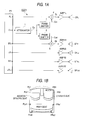
- FIG.1A is a block diagram showing a configuration of the present audio reproducing system CQT1.
- a sound source PY such as the CD (Compact Disc) player, the DVD (Digital Versatile Disc) player, the MD (Mini Disc) player, or the like provided to the vehicle-equipped audio system or the vehicle-equipped navigation system
- such audio reproducing system CQT1 applies the predetermined signal processing to these audio signals and supplies these signals to the loudspeakers SP L , SP R , SP Ls , SP Rs , SP SW .
- an attenuator 1 for attenuating the center-channel audio signal Cn to an appropriate level, phase shifters 2, 3 for adjusting a phase of the attenuated center-channel audio signal Cn' output from the attenuator 1, and adders 4, 5 are provided.
- the phase shifters 2, 3 consist of the secondary variable phase shifter having a phase-frequency characteristic shown in FIG.3A, and their natural frequencies f1, f2 and their Q values can be finely adjusted respectively by the external adjustment.
- phase shifters 2, 3 cause respective phase shift amounts to lag in the span of 0 (deg) to -360 (deg) .
- the phase shifter 2 changes the phase shift amount with respect to the supplied center-channel audio signal Cn' in the range of almost 0 (deg) to -360 (deg) at the frequency f (f ⁇ f1) that is lower than the natural frequency f1 and also changes such phase shift amount in the range of almost -180 (deg) to -360 (deg) at the frequency f (f>f1) that is higher than the natural frequency f1.
- the phase shifter 3 changes the phase shift amount with respect to the supplied center-channel audio signal Cn' in the range of almost 0 (deg) to -180 (deg) at the frequency f (f ⁇ f2) that is lower than the natural frequency f2, and also changes such phase shift amount in the range of almost -180 (deg) to -360 (deg) at the frequency f (f>f2) that is higher than the natural frequency f2.
- phase shifters 2, 3 change their natural frequencies f1, f2 and their Q values in response to the operation amount.
- phase shifters 2, 3 output center-channel audio signals C nL , C nR to which the phase adjustment is applied by giving the phase shift amount to the center-channel audio signal Cn' on the basis of the natural frequencies f1, f2 respectively.
- phase difference the phase difference between respective phase-frequency characteristics (phase difference) of the phase shifters 2, 3 shown in FIG.3A
- the negative peak value is generated between the natural frequencies f1, f2, as shown in FIG.3B. Accordingly, the phase difference between the center- channel audio signals C nL , C nR , that are subjected to the phase adjustment, output from the phase shifters 2, 3 can be adjusted in accordance with the phase shift amount of the above difference.
- the adder 4 synthesizes the center-channel audio signal C nL from the phase shifter 2 and the front-left channel audio signal FL from the sound source PY to generate the front-left channel synthesized audio signal S L .
- the adder 5 synthesizes the center-channel audio signal C nR from the phase shifter 3 and the front-right channel audio signal FR to generate the front-right channel synthesized audio signal S R .
- the audio amplifier AMP FL power-amplifies the front-left channel synthesized audio signal S L and supplies the resultant signal to the front-left loudspeaker SP L .
- the audio amplifier AMP FR power-amplifies the front-right channel synthesized audio signal S R and supplies the resultant signal to the front-right loudspeaker SP R .
- a left-surround channel audio signal LS and a right-surround channel audio signal RS supplied from the sound source PY are power-amplified by the audio amplifiers AMP LS , AMP RS respectively and then supplied to the left surround loudspeaker SP Ls and the right surround loudspeaker SP Rs .
- the sub-woofer channel audio signal LFE is power-amplified by the audio amplifier AMP LFE and then supplied to the sub-woofer SP SW .
- the loudspeakers SP L , SP R , SP Ls , SP Rs , SP SW of five channels, as already described, are arranged in the compartment of the vehicle.
- the front-left loudspeaker SP L is arranged near the front dash board on the assistant driver's seat side or the front door indicated by the symbol PL1 or PL2 in FIG.1B
- the front-right loudspeaker SP R is arranged near the front dash board on the driver's seat side or the front door indicated by the symbol PR1 or PR2.
- the left surround loudspeaker SP Ls is arranged near the left-side door on the rear seat side and the back of the rear seat indicated by the symbol PLs1 or PLs2
- the right surround loudspeaker SP Rs is arranged near the right-side door on the rear seat side and the back of the 5 rear seat indicated by the symbol PRs1 or PRs2.
- the sub-woofer SP SW is provided at the appropriate position in the compartment.
- the present audio reproducing system CQT1 having such configuration, even in the situation that the listening position of the passenger is not at the center position with respect to the loudspeakers SP L , SP R , SP Ls , SP Rs arranged in the compartment, if the natural frequencies f1, f2 and the Q values of the phase shifter 2, 3 are adjusted by adjusting the operation amount of the adjusting knob described above, the binaural correlation coefficient ⁇ LR indicating the effect of the sound waves emitted from respective loudspeakers SP L , SP R , SP Ls , SP Rs on both ears of the passenger can be corrected. Therefore, the unnatural sound image normal, or the unclearness of the sound image normal and the dangling-about of the sound, etc. can be suppressed, and thus the sound with the reality sensation can be achieved.
- FIG.2A shows the measured result of the binaural correlation coefficient ⁇ LR of in the prior art, as described above.
- FIG.2B shows the measured result of the binaural correlation coefficient ⁇ LR obtained when the loudspeakers SP L , SP R , SP Ls , SP Rs , which are arranged as shown in FIG.1B, and the sub-woofer SP SW are sounded by the present audio reproducing system CQT1.
- FIG.2C shows the measured results of the binaural correlation coefficient ⁇ LR in FIGS.2A and 2B to overlap.
- the binaural correlation coefficient ⁇ LR of the driver as shown in FIGS.2A and 2B can be derived.
- the binaural correlation coefficient ⁇ LR takes the substantially positive value in the range of about 200 Hz to about 600 Hz.
- phase shifters 2, 3 if the natural frequencies f1, f2 of the phase shifters 2, 3 are adjusted to about 200 Hz and about 600 Hz respectively, the phase-frequency characteristics of the phase shifters 2, 3 are brought into the overlapped state, as shown in FIG.3A. As a result, the phase difference between the center-channel audio signals C nL , C nR is given as shown in FIG.3B.
- the front-left channel synthesized audio signal SL containing the center-channel audio signal C nL having the above phase difference and the front-right channel synthesized audio signal SR containing the center-channel audio signal C nR are generated by synthesizing the center-channel audio signals C nL , C nR , both having such phase difference, to the front left-channel audio signal FL and the front right-channel audio signal FR.
- the sound waves, which are output from the front-right loudspeaker SP R based on the front-right channel synthesized audio signal S R comes up to both ears of the driver.
- the binaural correlation coefficient ⁇ LR takes the positive value in the actually measured range of about 200 Hz to about 600 Hz. Consequently, generations of the unnatural sound image normal, and the unclearness of the sound image normal and the dangling-about of the sound, etc., which are the problems in the prior art, can be suppressed, and thus it is possible to provide the sound with the reality sensation.
- the binaural correlation coefficient ⁇ LR can be corrected with respect to the passenger who seated on the assistant driver's seat side.
- the seated position of the driver and the seated position of the passenger are almost symmetrical with respect to the loudspeakers SP L , SP R , SP Ls , SP Rs .
- the sound waves that are reproduced based on the center-channel audio signals C nL , C nR to which the phase difference is allocated mutually by the phase shifters 2, 3, reach both ears of the passenger from the front-left and front-right loudspeakers SP L , SP R , the sound images that are generated by the sound waves, which come into the right and left ears of the passenger from the front-left loudspeaker SP L based on the center-channel audio signal C nL , and the sound waves, which come into the right and left ears of the passenger from the front-right loudspeaker SP R based on the center-channel audio signal C nR , can be fixedly positioned on the front side of the passenger.
- the binaural correlation coefficient ⁇ LR with respect to the passenger takes the positive value in the range of about 200 Hz to about 600 Hz. Consequently, like the case of the driver, generations of the unnatural sound image normal, and the unclearness of the sound image normal and the dangling-about of the sound, etc., which are the problems in the prior art, can be suppressed against the passenger who sits in the assistant driver's seat, and thus it is possible to provide the sound with the reality sensation.
- the binaural correlation coefficient ⁇ LR can also be corrected in the audio system provided to the house, etc.
- the present audio reproducing system CQT1 can correct the binaural correlation coefficient ⁇ LR by applying the predetermined phase control described above to the center-channel audio signals Cn and then supplying the resultant signals to the front-left and front-right loudspeakers SP L , SP R .
- the present audio reproducing system CQT1 may have at least a configuration that can generate the synthesized audio signals S L , S R to be supplied to the front-left and front-right loudspeakers SP L , SP R .
- phase shifters 2, 3 that are incorporated into the present audio reproducing system CQT1 have a configuration that can finely adjust the natural frequencies f1, f2. But a configuration in which their natural frequencies f1, f2 are fixed to above 200 Hz and 600 Hz respectively may be employed. (Second Embodiment)
- FIG.4 is a block diagram showing a configuration of an audio reproducing system according to the second embodiment, and portions that are same as or equivalent to those in FIG.1A are denoted by the same symbols.
- the phase shifter 2 for applying the phase adjustment to the center-channel audio signal Cn' output from the attenuator 1 is provided to one channel only.
- the adder 4 provided on the front-left channel side synthesizes the center channel audio signal C nL , which is output from the phase shifter 2 and is subjected to the phase adjustment, and the front-left channel audio signal FL from the sound source (not shown) to generate the front-left channel synthesized audio signal S L .
- the adder 5 provided on the front-right channel side synthesizes the center channel audio signal Cn' from the attenuator 1 and the front-right channel audio signal FR from the sound source to generate the front-right channel synthesized audio signal S R .
- the phase shifter 2 is constructed by a variable phase shifter having the phase-frequency characteristic shown in FIG.3B. More particularly, the phase shifter 2 is constructed by the variable phase shifter that is constructed by using two phase shifters having the adjustable natural frequencies f1, f2 shown in FIG.3A in combination, etc.
- the binaural correlation coefficient ⁇ LR of the driver as shown in FIGS.2A and 2B can be derived.
- the binaural correlation coefficient ⁇ LR can be corrected similarly with respect to the passenger who sits on the assistant driver's seat. That is, since the seated position of the driver and the seated position of the passenger are almost symmetrical with respect to the loudspeakers SP L , SP R , SP Ls , SP Rs , the binaural correlation coefficient ⁇ LR with respect to the passenger takes the positive value in the range of about 200 Hz to about 600 Hz, like the case shown in FIGS.2B and 2C. Therefore, like the case of the driver, the generations of the unnatural sound image normal, and the unclearness of the sound image normal and the dangling-about of the sound, etc. can be suppressed against the passenger who sits on the assistant driver's seat, and thus it is possible to provide the sound with the reality sensation.
- the correction of the binaural correlation coefficient ⁇ LR is not limited in the compartment of the vehicle, and such binaural correlation coefficient ⁇ LR can be corrected similarly in the audio system provided to the house, etc.
- a configuration in which the phase shifter 2 is interposed between the attenuator 1 and the adder 4 and also the attenuator 1 is directly connected to the adder 5 is employed.
- a configuration that is opposite to such configuration may be employed, i.e., the configuration in which the phase shifter 2 is interposed between the attenuator 1 and the adder 5 and also the attenuator 1 is directly connected to the adder 4 may be employed.
- the phase characteristic of the phase shifter 2 is constructed by the variable phase shifter having the phase-frequency characteristic shown in FIG.3B.
- the phase shifter 2 shown in FIG.4 may be constructed by the phase shifter 2 shown in FIG.1 or the phase shifter 3 shown in FIG.1. That is, the phase shifter 2 shown in FIG.4 may be set to have the phase-frequency characteristic indicated by the characteristic curve 2 in FIG.3A.
- any phase shifter that has the phase-frequency characteristic to invert the phase in the range of about 200 Hz to about 600 Hz may be employed.
- the phase difference of the center-channel audio signal C nL , which is subjected to the phase adjustment, to the center-channel audio signal Cn' in FIG.4 gives the phase-frequency characteristic in FIG.3A. That is, in the frequency band in excess of about 1 kHz, the phase difference of the center-channel audio signal C nL to the center-channel audio signal Cn' does not come close to 0 (deg) as shown in FIG.3B, but comes close to about -360 (deg) as shown in FIG.3A.
- the phase difference of the center-channel audio signal C nL , which is subjected to the phase adjustment, to the center-channel audio signal Cn' becomes similar to the phase-frequency characteristic shown in FIG. 3B in the frequency band that is lower than about 1 kHz.
- the binaural correlation coefficient ⁇ LR having the positive value can be obtained like the case in FIGS.2B and 2C in this low frequency band, and thus the problems such as the generations of the unnatural sound image normal feeling, the unclearness of the sound image normal, the dangling- about of the sound, etc. can be overcome.
- the seated position of the driver and the seated position of the passenger are almost symmetrical with respect to the loudspeakers SP L , SP R , SP Ls , SP Rs . Therefore, even if the phase-frequency characteristic of the phase shifter 2 is set to the phase-frequency characteristic given by the characteristic curve 2 in FIG.3A, it is possible to provide the sound field with the reality sensation equally to both the driver and the passenger.
- phase shifter 2 is interposed between the attenuator 1 and the adder 5, and the attenuator 1 and the adder 4 are directly connected
- phase-frequency characteristic of the phase shifter 2 may be set to the phase-frequency characteristic given by the characteristic curve 2 in FIG.3A.
- phase shifter 2 incorporated into the present audio reproducing system may be fixed to the phase-frequency characteristic given in FIG.3B.
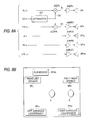
- FIG.5A is a block diagram showing a configuration of the audio reproducing system CQT3 according to the third embodiment, and portions that are same as or equivalent to those in FIG.1A are denoted by the same symbols.
- the present audio reproducing system CQT3 supplies the center-channel audio signal Cn output from the sound source PY to a high-pass filter HPF and a low-pass filter LPF via the attenuator (the symbol is not affixed), and then outputs the high-frequency component C n1 of the center- channel audio signal Cn that is passed through the high-pass filter HPF (referred to as a "high-frequency center-channel audio signal” hereinafter) to the center loudspeaker SP C side without the phase compensation and also supplies the low-frequency component C n2 of the center-channel audio signal Cn that is passed through the low-pass filter LPF (referred to as a "low-frequency center-channel audio signal” hereinafter) to the phase shifters 2, 3 to apply the phase compensation.
- a high-frequency center-channel audio signal referred to as a "high-frequency center-channel audio signal” hereinafter
- the low-frequency center-channel audio signal C n2L whose phase is adjusted by the phase shifter 2 is supplied to the adder 4 on the front-left channel side.
- the low-frequency center-channel audio signal C n2R whose phase is adjusted by the phase shifter 3 is supplied to the adder 5 on the front-right channel side.
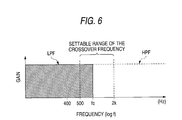
- both the high-pass filter HPF and the low-pass filter LPF have the cut-off characteristic of the primary frequency or more. These cut-off frequencies are set to any crossover frequency fc in the range of about 500 Hz to about 2 kHz. That is, the high-pass filter HPF has the frequency that is over the crossover frequency fc as the passing frequency band, and the low-pass filter LPF has the frequency that is under the crossover frequency fc as the passing frequency band.
- phase shifters 2, 3 have the phase-frequency characteristic that is the same as the variable phase shifter shown in FIG.1A, and the adders 4, 5 are the same as the adders shown in FIG.1A.
- the adder 4 synthesizes the low-frequency center-channel audio signal C n2L supplied from the phase shifter 2 and the front-left channel audio signal FL supplied from the sound source PY to generate the front-left channel synthesized audio signal S L . Also, the adder 5 synthesizes the high-frequency center-channel audio signal C n2R supplied from the phase shifter 3 and the front-right channel audio signal FR supplied from the sound source PY to generate the front-right channel synthesized audio signal SR.
- the audio amplifier AMP FL power-amplifies the front-left channel synthesized audio signal S L to supply to the front-left loudspeaker SP L .
- the audio amplifier AMP FR power-amplifies the front-right channel synthesized audio signal S R to supply to the front-right loudspeaker SP R .
- the left-surround channel audio signal LS and the right-surround channel audio signal RS are power-amplified by the audio amplifiers AMP LS , AMP RS respectively and then supplied to the left surround loudspeaker SP LS and the right surround loudspeaker SP Rs .
- the sub-woofer channel audio signal LFE is power-amplified by the audio amplifier AMP LFE and then supplied to the sub-woofer SP SW .
- the front-left and the front-right loudspeakers SP L , SP R and the left and right surround loudspeakers SP Ls , SP Rs are arranged at the predetermined positions in the compartment, like the case shown in FIG.1A.
- the center loudspeaker SP C is provided at the center portion of the instrument panel of the vehicle (the so-called center panel) or its neighboring area.
- the small diameter loudspeaker that is providedpreviously to the vehicle- equipped audio system or the vehicle-equipped navigation system can be utilized.
- the sound image can be fixed at the more natural position than the audio reproducing systems CQT1, CQT2 in the above-mentioned first and second embodiments, and the generations of the dangling-about of the sound, etc. can be suppressed, and thus the sound with the reality sensation can be provided.
- the driver and the passenger who sit on the driver's seat and the assistant driver's seat which are provided to the positions deviated from the center panel, respectively can listen the vocal sound (the voice of the human beings, etc.), which is emitted from the center loudspeaker SP C provided to the center panel, as the vocal sound emitted from the center loudspeaker SP C .
- the listener is positioned as the position B shown in FIG. 7B (the position deviated from the center loudspeaker SP C ), sometimes there occurs the unnatural case such that the sound image of the vocal sound emitted from the center loudspeaker SP C is normally positioned at the back of the head of the listener.
- the sound image of the vocal sound emitted from the center loudspeaker SP C can be positioned fixedly in front of the listener and on the center loudspeaker SP C side.
- the sound image of the vocal sound can be positioned at the more natural position against the listener (the driver and the passenger) .
- this sound image can be positioned fixedly at the more natural position than the first and second embodiments and in turn the sound with the reality sensation can be realized.
- the passing frequency bands of the high-pass filter HPF and the low-pass filter LPF are decided by using the crossover frequency fc as the boarder.
- the phase shift amount of the difference between the phase shifters 2, 3 has the negative peak value in vicinity of about 400 Hz, and the frequency range in which the phase shift amount is reduced to almost 0 (deg) extends over about 200 Hz to about 1 kHz.
- the phase shifters 2, 3 apply the phase adjustment in the range of about 200 Hz to about 1 kHz shown in FIG.3B to the low-frequency center-channel audio signal C n2 as the low frequency component that is passed through the low-pass filter LPF.
- the phase shifters 2, 3 do not apply the phase adjustment to the high- frequency center-channel audio signal C n1 that is passed through the high-pass filter HPF.
- the front-left channel synthesized audio signal S L is generated by synthesizing the low-frequency center-channel audio signal C n2L as the low frequency component, which is passed through the low-pass filter LPF and to which the phase adjustment is applied from the phase shifter 2, and the front-left channel audio signal FL by virtue of the adder 4.
- the front-right channel synthesized audio signal S R is generated by synthesizing the low-frequency center-channel audio signal C n2R as the low frequency component, which is passed through the low-pass filter LPF and to which the phase adjustment is applied from the phase shifter 3, and the front-right channel audio signal FR by virtue of the adder 5.
- the sound image of the vocal sound can be normally positioned at the position that is suited to the hearing sense of the listener (the driver and the passenger).
- the sound image position of the low frequency component is brought close to the actual position of the center loudspeaker SP C in the pseudo-manner by correcting the phase of the low frequency component of the center-channel audio signal Cn, that is insensitive to the sound image normal, to sound the front loudspeakers SP L , SP R , and also the high frequency component.
- the center-channel audio signal Cn that is sensitive to the sound image normal, is sounded by the actual center loudspeaker SP C . Therefore, the listener (the driver and the passenger) can get the feeling such that the sound of the low frequency component, that is insensitive to the sound image normal, is emitted from the center loudspeaker SP C .
- the small-size center loudspeaker SP C can be employed, and thus the effect for not-narrowing the inside of the compartment with the limited volume, etc. can be achieved. Therefore, the small-size loudspeaker that is built in the monitor of the vehicle-equipped navigation system, etc. can be utilized as the center loudspeaker SP C , and thus the effect of eliminating the provision of the new center loudspeaker, etc. can be achieved.
- the diameters of the front-left and front-right loudspeakers SP L , SP R are in excess of 16 cm, if the diameter of the small-size loudspeaker that is equipped previously in the vehicle- equipped navigation system, or the like, for example, is more than about 50 mm, the above-mentioned effect can be achieved by utilizing such loudspeaker as the center loudspeaker SP C .
- the above-mentioned effect can be obtained by setting the cut-off frequencies (crossover frequencies) fc of the high-pass filter HPF and the low-pass filter LPF to about 1 kHz.
- the synthesized voice (the voice sound) generated by the voice synthesizer, that is equipped in the vehicle-equipped navigation system, can be clearly listened at the driver' s seat and the assistant driver' s seat as the sound that is positioned fixedly on the center loudspeaker side.
- the reproduced frequency band is shifted to the higher frequency side as the diameter of the loudspeaker becomes smaller, so that such loudspeaker cannot reproduce the sound at the low frequency. Therefore, if the small- diameter loudspeaker having the reproduced frequency band that is equivalent to the passing frequency band of the high-pass filter HPF is utilized as the center loudspeaker SP C , the high-pass filter HPF provided to the present audio reproducing system CQT3 may be omitted and also the center- channel audio signal Cn may be directly supplied to the center loudspeaker SP C via the audio amplifier AMP Cn .
- the audio reproducing system provided to the compartment of the vehicle is explained. But the present audio reproducing systemmay be applied to the audio system provided to the housing, etc.
- the center-channel audio signals C nL , C nR which have the above phase difference, are generated by providing two independent phase shifters 2, 3.
- the present invention can be constructed by grasping these phase shifters 2, 3 as one phase-shifting section.
- the center-channel audio signal C nL that has the predetermined phase difference with respect to the center-channel audio signal Cn' is generated by one phase shifter 2.
- the present invention can be constructed by grasping the phase shifter 2 as one phase-shifting section that generates the center-channel audio signal Cn' and the center-channel audio signal C nL .
- the high-frequency component C n1 and the low-frequency component C n2 are generated by providing the high-pass filter HPF and the low-pass filter LPF.
- the present invention can be constructed by combining the high-pass filter HPF and the low-pass filter LPF as one filtering section.
- the present invention can be constructed by grasping two phase shifters 2, 3 shown in FIG.5 as one phase-shifting section.
- the audio reproducing system in which the audio signal is supplied from the sound source such as the CD player, the DVD player, the MD player, etc. is explained. But the present audio reproducing system can utilize the audio signal that is streamed via the communicating section such as the Internet, etc.
- the storage medium for recording the above computer program may be fabricated and then supplied to the user, etc., and then the above computer program may be installed into the personal computer, etc. and executed by the microprocessor (MPU).
- the above computer program may be streamed via the communicating section such as the Internet, etc., and then such computer program may be downloaded into the personal computer, etc. and executed by the microprocessor (MPU).
- the audio reproducing system of the present invention generates two center-channel audio signals, which have the phase difference mutually in the predetermined frequency range, from the center-channel audio signal supplied from the sound source, and supplies the first synthesized audio signal, which is generated by synthesizing one center-channel audio signal that is subjected to the phase adjustment and the front-left channel audio signal, to the front-left channel loudspeaker and also supplies the second synthesized audio signal, which is generated by synthesizing the other center-channel audio signal that is subjected to the phase adjustment and the front-right channel audio signal, to the front-right channel loudspeaker. Therefore, the natural sound image normal, etc. can be realized by correcting the binaural correlation coefficient of the sounds that are output from the loudspeakers on both the front-left and front-right channels, and thus the sound field with the reality sensation can be provided.
- the audio reproducing system of the invention supplies the predetermined high frequency component of the center-channel audio signal to the center- channel loudspeaker, generates two low frequency components, which have the different phase mutually in the predetermined frequency range, from the predetermined low frequency component of the center-channel audio signal, supplies the first synthesized audio signal, which is generated by synthesizing one low frequency component that is subjected to the phase adjustment and the front-left channel audio signal, to the front-left channel loudspeaker, and supplies the second synthesized audio signal, which is generated by synthesizing the other low frequency component that is subjected to the phase adjustment and the front-right channel audio signal, to the front-right channel loudspeaker.
- the binaural correlation coefficient of the sounds that are output from the loudspeakers on both the front-left and front-right channels can be corrected, and the sound image of the vocal sound being output from the center channel loudspeaker can be positioned fixedly at the natural position, and thus the sound field with the reality sensation can be provided.
Landscapes
- Physics & Mathematics (AREA)
- Engineering & Computer Science (AREA)
- Acoustics & Sound (AREA)
- Signal Processing (AREA)
- Stereophonic System (AREA)
- Fittings On The Vehicle Exterior For Carrying Loads, And Devices For Holding Or Mounting Articles (AREA)
Applications Claiming Priority (2)
| Application Number | Priority Date | Filing Date | Title |
|---|---|---|---|
| JP2001244733A JP2003061198A (ja) | 2001-08-10 | 2001-08-10 | オーディオ再生装置 |
| JP2001244733 | 2001-08-10 |
Publications (2)
| Publication Number | Publication Date |
|---|---|
| EP1283658A2 true EP1283658A2 (fr) | 2003-02-12 |
| EP1283658A3 EP1283658A3 (fr) | 2004-01-21 |
Family
ID=19074618
Family Applications (1)
| Application Number | Title | Priority Date | Filing Date |
|---|---|---|---|
| EP02255135A Withdrawn EP1283658A3 (fr) | 2001-08-10 | 2002-07-23 | Système de reproduction sonore à plusieurs canaux |
Country Status (3)
| Country | Link |
|---|---|
| US (2) | US7292697B2 (fr) |
| EP (1) | EP1283658A3 (fr) |
| JP (1) | JP2003061198A (fr) |
Cited By (1)
| Publication number | Priority date | Publication date | Assignee | Title |
|---|---|---|---|---|
| EP1771039A3 (fr) * | 2005-09-30 | 2007-11-07 | Sony Corporation | Système de commande audio |
Families Citing this family (26)
| Publication number | Priority date | Publication date | Assignee | Title |
|---|---|---|---|---|
| JP4480335B2 (ja) * | 2003-03-03 | 2010-06-16 | パイオニア株式会社 | 複数チャンネル音声信号の処理回路、処理プログラム及び再生装置 |
| JP2005086486A (ja) * | 2003-09-09 | 2005-03-31 | Alpine Electronics Inc | オーディオ装置およびオーディオ処理方法 |
| TW200522761A (en) * | 2003-12-25 | 2005-07-01 | Rohm Co Ltd | Audio device |
| JP4150749B2 (ja) * | 2004-03-16 | 2008-09-17 | パイオニア株式会社 | 立体音響再生システムおよび立体音響再生装置 |
| US8565447B2 (en) * | 2004-07-08 | 2013-10-22 | James K. Waller, Jr. | Active instrument subwoofer system for low frequency enhancement |
| US20070165890A1 (en) * | 2004-07-16 | 2007-07-19 | Matsushita Electric Industrial Co., Ltd. | Sound image localization device |
| JP4063269B2 (ja) * | 2004-10-29 | 2008-03-19 | ヤマハ株式会社 | オーディオアンプ及びオーディオシステム |
| US20060115101A1 (en) * | 2004-11-18 | 2006-06-01 | Schoenberger Michael A | Multiple amplifier synchronization system |
| JP4041154B2 (ja) * | 2005-05-13 | 2008-01-30 | 松下電器産業株式会社 | 混合音分離装置 |
| JP2007208679A (ja) * | 2006-02-02 | 2007-08-16 | Matsushita Electric Ind Co Ltd | 音響再生装置 |
| CN101145386B (zh) * | 2006-09-14 | 2012-01-18 | 鸿富锦精密工业(深圳)有限公司 | 多路独立音频输出的音频播放器 |
| JP4946305B2 (ja) | 2006-09-22 | 2012-06-06 | ソニー株式会社 | 音響再生システム、音響再生装置および音響再生方法 |
| KR101336237B1 (ko) * | 2007-03-02 | 2013-12-03 | 삼성전자주식회사 | 멀티 채널 스피커 시스템의 멀티 채널 신호 재생 방법 및장치 |
| FR2918532B1 (fr) * | 2007-07-05 | 2015-04-24 | Arkamys | Procede de traitement sonore d'un signal stereophonique a l'interieur d'un vehicule automobile et vehicule automobile mettant en oeuvre ce procede |
| US8204235B2 (en) | 2007-11-30 | 2012-06-19 | Pioneer Corporation | Center channel positioning apparatus |
| KR101439205B1 (ko) * | 2007-12-21 | 2014-09-11 | 삼성전자주식회사 | 오디오 매트릭스 인코딩 및 디코딩 방법 및 장치 |
| JP2010087783A (ja) * | 2008-09-30 | 2010-04-15 | Pioneer Electronic Corp | 音響装置、音響信号処理方法、音響信号処理プログラム及び記録媒体 |
| JP5666249B2 (ja) * | 2010-11-04 | 2015-02-12 | アルパイン株式会社 | 音声出力装置 |
| WO2013051085A1 (fr) * | 2011-10-03 | 2013-04-11 | パイオニア株式会社 | Dispositif de traitement du signal audio, procédé de traitement du signal audio et programme de traitement du signal audio |
| JP5884013B2 (ja) * | 2012-03-26 | 2016-03-15 | パナソニックIpマネジメント株式会社 | 車載用音響再生装置 |
| JP2014168228A (ja) * | 2013-01-30 | 2014-09-11 | Yamaha Corp | 放音装置 |
| US9930469B2 (en) | 2015-09-09 | 2018-03-27 | Gibson Innovations Belgium N.V. | System and method for enhancing virtual audio height perception |
| TWI584274B (zh) * | 2016-02-02 | 2017-05-21 | 美律實業股份有限公司 | 具逆相位衰減特性之共腔體式背箱設計揚聲器系統的音源訊號處理方法及其裝置 |
| CN106375905B (zh) * | 2016-11-30 | 2019-01-25 | 北京酷我科技有限公司 | 一种多路音频的合成和调节的方法 |
| CN109286451A (zh) * | 2018-11-20 | 2019-01-29 | 成都仕芯半导体有限公司 | 多通道相控阵系统通道间的参数校准方法 |
| FR3091636B1 (fr) | 2019-01-04 | 2020-12-11 | Parrot Faurecia Automotive Sas | Procédé de traitement d’un signal audio multicanal |
Family Cites Families (12)
| Publication number | Priority date | Publication date | Assignee | Title |
|---|---|---|---|---|
| JPS53114201U (fr) * | 1977-02-18 | 1978-09-11 | ||
| JP2536044Y2 (ja) * | 1986-09-19 | 1997-05-21 | パイオニア株式会社 | 両耳相関係数補正装置 |
| JP2708105B2 (ja) * | 1989-04-26 | 1998-02-04 | 富士通テン 株式会社 | 車載用音響再生装置 |
| US5872851A (en) * | 1995-09-18 | 1999-02-16 | Harman Motive Incorporated | Dynamic stereophonic enchancement signal processing system |
| US5677957A (en) * | 1995-11-13 | 1997-10-14 | Hulsebus; Alan | Audio circuit producing enhanced ambience |
| TW411723B (en) * | 1996-11-15 | 2000-11-11 | Koninkl Philips Electronics Nv | A mono-stereo conversion device, an audio reproduction system using such a device and a mono-stereo conversion method |
| JPH10210599A (ja) * | 1997-01-17 | 1998-08-07 | Toyota Motor Corp | 車載用オーディオ装置 |
| US5974153A (en) * | 1997-05-19 | 1999-10-26 | Qsound Labs, Inc. | Method and system for sound expansion |
| US6038323A (en) * | 1997-11-17 | 2000-03-14 | Harman Motive Inc. | Stereophonic image enhancement system for use in automobiles |
| US6016473A (en) * | 1998-04-07 | 2000-01-18 | Dolby; Ray M. | Low bit-rate spatial coding method and system |
| JP3880236B2 (ja) * | 1999-02-05 | 2007-02-14 | 株式会社アーニス・サウンド・テクノロジーズ | ステレオ再生用のオーディオ信号の再生音をスピーカ外に音像定位させる方法 |
| JP2001025099A (ja) * | 1999-07-07 | 2001-01-26 | Matsushita Electric Ind Co Ltd | 音響再生装置 |
-
2001
- 2001-08-10 JP JP2001244733A patent/JP2003061198A/ja active Pending
-
2002
- 2002-07-23 EP EP02255135A patent/EP1283658A3/fr not_active Withdrawn
- 2002-07-25 US US10/201,971 patent/US7292697B2/en not_active Expired - Fee Related
-
2007
- 2007-05-07 US US11/797,734 patent/US7369666B2/en not_active Expired - Fee Related
Non-Patent Citations (1)
| Title |
|---|
| None * |
Cited By (1)
| Publication number | Priority date | Publication date | Assignee | Title |
|---|---|---|---|---|
| EP1771039A3 (fr) * | 2005-09-30 | 2007-11-07 | Sony Corporation | Système de commande audio |
Also Published As
| Publication number | Publication date |
|---|---|
| US7369666B2 (en) | 2008-05-06 |
| JP2003061198A (ja) | 2003-02-28 |
| US20070206823A1 (en) | 2007-09-06 |
| EP1283658A3 (fr) | 2004-01-21 |
| US7292697B2 (en) | 2007-11-06 |
| US20030031332A1 (en) | 2003-02-13 |
Similar Documents
| Publication | Publication Date | Title |
|---|---|---|
| US7369666B2 (en) | Audio reproducing system | |
| US7386139B2 (en) | Sound image control system | |
| EP0977464B1 (fr) | Circuit de traitement du signal sonore | |
| JP2708105B2 (ja) | 車載用音響再生装置 | |
| US8116458B2 (en) | Acoustic image localization apparatus, acoustic image localization system, and acoustic image localization method, program and integrated circuit | |
| EP1680941B1 (fr) | Son d'ambiance audio multivoie provenant de hauts-parleurs situes a l'avant | |
| EP1545154A2 (fr) | Haut-parleur virtuel paramétrique et système de son multivoie | |
| JP2002528020A (ja) | 擬似立体音響出力をモノラル入力から合成する装置および方法 | |
| JP2004521541A (ja) | サウンドシステム及びサウンド再生方法 | |
| US7978860B2 (en) | Playback apparatus and playback method | |
| WO2009144781A1 (fr) | Dispositif de reproduction audio | |
| JP2005525022A (ja) | 家庭および自動車聴取のためのディスクリートサラウンド音響システム | |
| US8009834B2 (en) | Sound reproduction apparatus and method of enhancing low frequency component | |
| JP2004064739A (ja) | 音像制御システム | |
| JP2011228956A (ja) | 車載用音場制御装置 | |
| US20060262936A1 (en) | Virtual surround decoder apparatus | |
| JP4943098B2 (ja) | 音響再生システム及び音響再生方法 | |
| JPH0767196A (ja) | 車載用スピーカ装置 | |
| JPH0834653B2 (ja) | 音場拡大制御装置 | |
| KR100279710B1 (ko) | 실조화음향공간구현장치 | |
| JP3942914B2 (ja) | ステレオ信号処理装置 | |
| JPH01223895A (ja) | 音響再生装置 | |
| US20110033070A1 (en) | Sound image localization processing apparatus and others | |
| JP2000050398A (ja) | 音響信号処理回路 | |
| JPH05153698A (ja) | 音場拡大制御装置 |
Legal Events
| Date | Code | Title | Description |
|---|---|---|---|
| PUAI | Public reference made under article 153(3) epc to a published international application that has entered the european phase |
Free format text: ORIGINAL CODE: 0009012 |
|
| AK | Designated contracting states |
Designated state(s): AT BE BG CH CY CZ DE DK EE ES FI FR GB GR IE IT LI LU MC NL PT SE SK TR |
|
| AX | Request for extension of the european patent |
Extension state: AL LT LV MK RO SI |
|
| PUAL | Search report despatched |
Free format text: ORIGINAL CODE: 0009013 |
|
| AK | Designated contracting states |
Kind code of ref document: A3 Designated state(s): AT BE BG CH CY CZ DE DK EE ES FI FR GB GR IE IT LI LU MC NL PT SE SK TR |
|
| AX | Request for extension of the european patent |
Extension state: AL LT LV MK RO SI |
|
| 17P | Request for examination filed |
Effective date: 20040709 |
|
| AKX | Designation fees paid |
Designated state(s): DE FR GB |
|
| 17Q | First examination report despatched |
Effective date: 20050718 |
|
| STAA | Information on the status of an ep patent application or granted ep patent |
Free format text: STATUS: THE APPLICATION IS DEEMED TO BE WITHDRAWN |
|
| 18D | Application deemed to be withdrawn |
Effective date: 20070719 |