EP1288612A2 - Surveillance de fil - Google Patents
Surveillance de fil Download PDFInfo
- Publication number
- EP1288612A2 EP1288612A2 EP02255783A EP02255783A EP1288612A2 EP 1288612 A2 EP1288612 A2 EP 1288612A2 EP 02255783 A EP02255783 A EP 02255783A EP 02255783 A EP02255783 A EP 02255783A EP 1288612 A2 EP1288612 A2 EP 1288612A2
- Authority
- EP
- European Patent Office
- Prior art keywords
- light
- yam
- operable
- measuring
- frequency distribution
- Prior art date
- Legal status (The legal status is an assumption and is not a legal conclusion. Google has not performed a legal analysis and makes no representation as to the accuracy of the status listed.)
- Withdrawn
Links
Images

Classifications
-
- G—PHYSICS
- G01—MEASURING; TESTING
- G01N—INVESTIGATING OR ANALYSING MATERIALS BY DETERMINING THEIR CHEMICAL OR PHYSICAL PROPERTIES
- G01N33/00—Investigating or analysing materials by specific methods not covered by groups G01N1/00 - G01N31/00
- G01N33/36—Textiles
- G01N33/365—Filiform textiles, e.g. yarns
-
- B—PERFORMING OPERATIONS; TRANSPORTING
- B65—CONVEYING; PACKING; STORING; HANDLING THIN OR FILAMENTARY MATERIAL
- B65H—HANDLING THIN OR FILAMENTARY MATERIAL, e.g. SHEETS, WEBS, CABLES
- B65H63/00—Warning or safety devices, e.g. automatic fault detectors, stop-motions ; Quality control of the package
- B65H63/06—Warning or safety devices, e.g. automatic fault detectors, stop-motions ; Quality control of the package responsive to presence of irregularities in running material, e.g. for severing the material at irregularities ; Control of the correct working of the yarn cleaner
- B65H63/062—Electronic slub detector
- B65H63/065—Electronic slub detector using photo-electric sensing means, i.e. the defect signal is a variation of light energy
-
- D—TEXTILES; PAPER
- D01—NATURAL OR MAN-MADE THREADS OR FIBRES; SPINNING
- D01H—SPINNING OR TWISTING
- D01H13/00—Other common constructional features, details or accessories
- D01H13/32—Counting, measuring, recording or registering devices
-
- B—PERFORMING OPERATIONS; TRANSPORTING
- B65—CONVEYING; PACKING; STORING; HANDLING THIN OR FILAMENTARY MATERIAL
- B65H—HANDLING THIN OR FILAMENTARY MATERIAL, e.g. SHEETS, WEBS, CABLES
- B65H2701/00—Handled material; Storage means
- B65H2701/30—Handled filamentary material
- B65H2701/31—Textiles threads or artificial strands of filaments
Definitions
- This invention relates to the monitoring of yam whilst it is being processed, and in particular to the monitoring of the regularity of a multifilament yarn in order to detect broken filaments or protruding filament loops.
- Such monitoring also serves to draw attention to factors during the processing of the yarn that affect the incidence of broken filaments or loops, so that attempts can be made to change the processing parameters or modify the apparatus in order to reduce the number of broken filaments or loops and produce an ideal yarn.
- ideal yam is intended to mean a yam without any broken filaments or filament loops protruding to an unacceptable level from the surface of the yam.
- a light beam is directed adjacent the surface of the moving yam as it is being processed. If a broken filament or filament loop protrudes from the surface of the yam it is likely to intrude briefly into the light beam and the amount of light received by a receiving device is temporarily reduced.
- a light beam is directed at the moving yam during processing, the light passing either side of the yam being received by a receiving device.
- the first method detection of a broken filament or filament loop is achieved only if that filament protrudes from the surface of the yam in a plane such that it intrudes into the light beam. Also, the clearance between the light beam and the surface of the yam is critical, and has to be altered for different yarns since the regularity of the 'cylindrical surface' presented by the yam is dependent on the type of yarn, the twist level, and/or the degree of texturing, interlacing and the like. In an attempt to overcome the first problem, the light beam may be directed adjacent the yam as it passes around a roller, so that the broken filaments or filament loops tend to be directed outwardly into the light beam.
- the invention seeks to distinguish the effects of the above-described disturbances on the shadowed yam signal from those of broken filaments.
- the invention provides a method of monitoring the processing of a multifilament yarn, in which a light beam is directed from a light emitting device to a light receiving device, a multifilament yarn is passed through the light beam and the amount of light received by the light receiving device is measured, comprising measuring the amount of light received at predetermined time intervals, producing a frequency distribution from the measured amounts of light over a predetermined time period, calculating from the frequency distribution a threshold level representative of an ideal yam, and recording the number of measurements that fall outside that threshold level to indicate the number of protrusions in the yarn.
- the predetermined intervals may be such that measurements are recorded at between 10000 and 50000 times per second depending on process speed, e.g. substantially 25000 times per second.
- the predetermined time period may be between 10 and 1000 milliseconds, preferably substantially 100 milliseconds.
- the calculation may comprise calculating a normal value, which is that measurement within which a predetermined number of the measurements fall.
- the predetermined number may be between 95% and 100%, and may be 99%.
- the calculation may also include adjusting the normal value by a sensitivity factor to determine the threshold level.
- the sensitivity factor may be between 1% and 50% of the normal value, depending on the size of the broken filaments or loops to be recorded.
- the method may also include differentiating, by analogue or digital means, the measured amounts of light with respect to time.
- the differentiation may include determining the first derivative of the measured amounts of light, from which the frequency distribution is produced.
- the invention also provides apparatus for monitoring the processing of a multifilament yam, comprising a light emitting device operable to direct a light beam to a light receiving device operable to measure the amount of light received, further comprising a measuring and computing device operable to:
- the measuring and computing device may be operable to measure the amount of light received at between 10000 and 50000 times per second depending on process speed, e.g. substantially 25000 times per second.
- the measuring and computing device may be operable to produce a frequency distribution of the measured amounts of light over a time period of between 10 and 1000 milliseconds, preferably substantially 100 milliseconds.
- the measuring and computing device may be operable to calculate a normal value, which is that measurement within which a predetermined number of the measurements fall.
- the predetermined number may be between 95% and 100%, and may be 99%.
- the measuring and computing device may record the "normal values" of several distributions and take the mean or minimum values to get a true representation of the complete signal.
- the measuring and computing device may also be operable to adjust the normal value by a sensitivity factor to determine the threshold level.
- the sensitivity factor may be between 1% and 50% of the basic measurements.
- the measuring and computing device may be operable to determine the first derivative of the measured amounts of light, from which the frequency distribution is produced.
- the apparatus 10 for monitoring the processing of a single multifilament yarn 11.
- the apparatus 10 comprises a light emitting diode 12, which directs a beam of light 13 to a light receiving diode 14.
- the diodes 12 and 14 are positioned so that the beam of light 13 impinges on the running yam 11, which casts a shadow 15 on the light receiving diode 14. If the yarn 11 is of constant diameter, the amount of light received by the diode 14 will be constant. However, if a section of yam 11 having a broken filament or filament loop extending from its surface passes through the beam of light 13, the amount of light received by the diode 14 at that instant will be reduced.
- a device 16 receives a signal from the light receiving diode 14 proportional to the amount of light received by the diode 14. If, as in the known arrangement described above, device 16 were such that it simply measures the signal and counts the number of reduced measurements representing the broken filaments or filament loops, such an arrangement would perform the conventional second method referred to above. However, due to the degradation over a period of time of the signal received by the device 16 as a result of contamination effects, for example oil splashes, the threshold value representing an ideal yam will diminish. This can lead to inaccuracies in recording the number of filament breaks or loops present in the yam.
- the device 16 is a measuring and computing device, which is operable to measure, and record the amount of light received by the diode 14 at predetermined intervals between 10000 and 50000 times per second depending on process speed, for example 25000 times per second.
- the signals from the diode 14 are passed to an amplifier 17 and then to an analogue detector 18.
- the amplified signals are also passed to an analogue/digital converter 19, which forwards digital signals to a microprocessor 20.
- all of the measurements would be the same as shown by line 21 in Fig. 2.
- the actual measurements will show variations since the diameter of a textile yam 11 varies along its length with the type of yarn, twist level, degree of texturing, interlacing or other process parameters, as shown by line 22 in Fig. 2.
- the microprocessor 20 produces a frequency distribution 30, in this case directly from the measurements, as shown in Fig. 3. From the frequency distribution 30 it will be seen that the recorded measurements that occur with the greatest frequency are distributed around a measurement 31 representing the nominal diameter of the yam 11. Since the diameter of a textile yam 11 is not constant for the reasons mentioned above, measurements above and below the measurement 31 occur, with reducing frequency for those measurements differing from the measurement 31 by greater amounts.
- the microprocessor 20 calculates the normal value 32 over a predetermined period of time, for example 100 milliseconds.
- the normal value 32 may be regarded as the value above which a predetermined number of the measurements fall, e.g. above which 99% of the measurements fall.
- This threshold value 34 is transmitted to the analogue detector 18, which continuously compares the amplified signal from the light-receiving device 16 with the current threshold value 34.
- the line 22 also exhibits measurements at 23 (Fig. 2), occurring at frequencies shown at 35 (Fig. 3), representing the passage through the light beam 13 of a broken filament or filament loop protruding from the surface of the yam 11. These measurements 23 fall outside the calculated threshold value and are counted.
- the apparatus 10 Since the normal value 32 is calculated with reference to the variation of actual measurements recorded for the yarn 11 being processed during a particular time period, the apparatus 10 is suitable for use with any type of yarn 11 having any twist level, and/or the degree of texturing, interlacing and the like.
- the value of the sensitivity factor 33 may be adjusted to cater for yarns having greater or lesser diameter variation in their ideal state.
- the threshold value 34 is calculated for successive periods of time so that any variation in signal strength with time is compensated for.
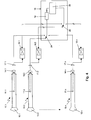
- the apparatus is shown in Fig. 4.
- a corresponding apparatus 10.1, 10.2...10.n which comprises a light emitting diode 12.1, 12.2....12.n, and a light receiving diode 14.1, 14.2....14.n.
- the signals from the diodes 14.1, 14.2 Vietnamese containers.1, 12.2...12.n are passed to respective amplifiers 17.1, 17.2 Vietnamese containers.n. and then to respective analogue detectors 18.1, 18.2 Vietnamese containers.n.
- the amplified signals are also passed via a multiplexer switch 24 successively to the analogue/digital converter 19, which forwards digital signals to a microprocessor 20.
- the microprocessor 20 produces a frequency distribution 30 of the measurements for each of the yam positions in tum, and respective calculations of the normal values 32 and threshold values 34 over a predetermined period of time.
- Each threshold value 34 is transmitted via a second multiplexer switch 25 successively to the respective analogue detector 18.1, 18.2 etc.n, which continuously compares the amplified signal from the light receiving device 16 with the threshold value 34 last transmitted to it.
- the main feature of a broken filament compared with these other disturbances, is that it's effect on the light signal of the detector is very brief since the filament is carried past the sensor at the speed of the yam.
- the time for a broken filament to cross the entire field of the optics is measured in microseconds. This means that the base frequency of a passing filament is measured in kHz and any rising or falling edges are measured in tens of kHz. Frequencies associated with yarn vibration and jet pulsing tend to be much lower than this, perhaps a few hundred Hz at the most and often much lower.
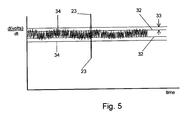
- the measuring and computing device 16 determines, by analogue or digital means, the first derivative of the readings shown in Fig. 2, and this is shown in Fig. 5.
- Fig. 2 several large disturbances 23 can be seen as well as many smaller ones.
- the single, short duration dip 23 at the centre of the trace in Fig. 2 is caused by a broken filament whereas the other large but longer duration disturbances are effectively noise, caused by the vibration and pulsing present in high speed processing as described previously.
- Fig. 5 shows the first derivative of the data in Fig. 2.
- the apparatus 10 may be used to measure the regularity of twist, interlace or the like in the yarn 11.
- the predetermined number used in the calculation of the basic measurements 32, and reducing the sensitivity factor 33 to a small value small changes in diameter of the yam 11 due to variations in twist, interlace or the like may be detected and recorded.
- the same apparatus 10 may be used for recording either broken filaments or process quality, i.e. yarn regularity, as desired.
Landscapes
- Engineering & Computer Science (AREA)
- Textile Engineering (AREA)
- Chemical & Material Sciences (AREA)
- Health & Medical Sciences (AREA)
- Life Sciences & Earth Sciences (AREA)
- Physics & Mathematics (AREA)
- Food Science & Technology (AREA)
- Medicinal Chemistry (AREA)
- Quality & Reliability (AREA)
- Analytical Chemistry (AREA)
- Biochemistry (AREA)
- General Health & Medical Sciences (AREA)
- General Physics & Mathematics (AREA)
- Immunology (AREA)
- Pathology (AREA)
- Mechanical Engineering (AREA)
- Treatment Of Fiber Materials (AREA)
- Investigating Materials By The Use Of Optical Means Adapted For Particular Applications (AREA)
Applications Claiming Priority (2)
| Application Number | Priority Date | Filing Date | Title |
|---|---|---|---|
| GB0120771 | 2001-08-25 | ||
| GBGB0120771.1A GB0120771D0 (en) | 2001-08-25 | 2001-08-25 | Yarn monitoring |
Publications (2)
| Publication Number | Publication Date |
|---|---|
| EP1288612A2 true EP1288612A2 (fr) | 2003-03-05 |
| EP1288612A3 EP1288612A3 (fr) | 2003-03-19 |
Family
ID=9921047
Family Applications (1)
| Application Number | Title | Priority Date | Filing Date |
|---|---|---|---|
| EP02255783A Withdrawn EP1288612A3 (fr) | 2001-08-25 | 2002-08-20 | Surveillance de fil |
Country Status (4)
| Country | Link |
|---|---|
| US (1) | US6817170B2 (fr) |
| EP (1) | EP1288612A3 (fr) |
| JP (1) | JP2003155658A (fr) |
| GB (1) | GB0120771D0 (fr) |
Cited By (5)
| Publication number | Priority date | Publication date | Assignee | Title |
|---|---|---|---|---|
| DE102010010324A1 (de) | 2010-03-04 | 2011-09-08 | Vienco Gmbh | Verfahren zur Erfassung von Fehlstellen in einem laufenden Faden mit Plausibilitätskontrolle |
| DE102010010323A1 (de) | 2010-03-04 | 2011-09-08 | Vienco Gmbh | Verfahren zur Erfassung von Fehlstellen in einem laufenden Faden mit verbesserter Arbeitspunkteinstellung |
| DE102010010326A1 (de) | 2010-03-04 | 2011-09-08 | Vienco Gmbh | Verbessertes Verfahren zur Erfassung von Fehlstellen in einem laufenden Faden |
| WO2011107600A1 (fr) | 2010-03-04 | 2011-09-09 | Vienco Gmbh | Procédé de détection de défauts dans un fil en circulation, mettant en oeuvre un ajustement amélioré du point de fonctionnement |
| CN108474751A (zh) * | 2016-01-22 | 2018-08-31 | Mg传感器有限公司 | 纱线成像装置 |
Families Citing this family (8)
| Publication number | Priority date | Publication date | Assignee | Title |
|---|---|---|---|---|
| DE10348741A1 (de) * | 2003-10-16 | 2005-05-12 | Saurer Gmbh & Co Kg | Verfahren zum visuellen Darstellen der Einhaltung vorgegebener Effekte |
| JP4805666B2 (ja) * | 2005-12-12 | 2011-11-02 | 帝人テクノプロダクツ株式会社 | 毛羽検出装置及び毛羽検出方法 |
| US9896786B2 (en) | 2012-08-23 | 2018-02-20 | Columbia Insurance Company | Systems and methods for improving and controlling yarn texture |
| US9951445B2 (en) | 2012-08-23 | 2018-04-24 | Columbia Insurance Company | Systems and methods for improving and controlling yarn texture |
| IT201700042506A1 (it) * | 2017-04-18 | 2018-10-18 | Btsr Int Spa | Metodo, sistema e sensore per rilevare una caratteristica di un filo tessile o metallico alimentato ad una macchina operatrice |
| CZ2019196A3 (cs) * | 2019-03-29 | 2020-10-07 | Rieter Cz S.R.O. | Způsob bezdotykové optické detekce příze na pracovním místě textilního stroje pro výrobu příze, optický snímač příze a textilní stroj |
| CN110656409B (zh) * | 2019-09-30 | 2021-09-07 | 三峡大学 | 线材旋转外径判断装置及方法 |
| US20230234806A1 (en) * | 2022-01-24 | 2023-07-27 | Cvd Equipment Corporation | Fiber handling system with fuzz detection |
Family Cites Families (11)
| Publication number | Priority date | Publication date | Assignee | Title |
|---|---|---|---|---|
| JPS51116255A (en) * | 1975-04-07 | 1976-10-13 | Asahi Chemical Ind | Tester for yarn quality |
| CH615404A5 (fr) * | 1977-03-22 | 1980-01-31 | Zellweger Uster Ag | |
| DE3641816A1 (de) * | 1986-12-06 | 1988-06-16 | Robert Prof Dr Ing Massen | Verfahren und anordnung zur messung und/oder ueberwachung von eigenschaften von garnen und seilen |
| US5119308A (en) * | 1988-08-26 | 1992-06-02 | Murata Kikai Kabushiki Kaisha | Control system for spinning machine |
| CH681462A5 (fr) * | 1989-08-31 | 1993-03-31 | Zellweger Uster Ag | |
| GB9010862D0 (en) * | 1990-05-15 | 1990-07-04 | Rieter Scragg Ltd | Yarn quality grading method |
| US5319578A (en) * | 1992-09-24 | 1994-06-07 | Lawson-Hemphill, Inc. | Yarn profile analyzer and method |
| JP2626465B2 (ja) * | 1993-04-27 | 1997-07-02 | 村田機械株式会社 | 糸監視器の診断方法及び同装置 |
| CN1228840A (zh) * | 1996-08-20 | 1999-09-15 | 泽韦格路瓦有限公司 | 用于光学测定在一个纵向运动的线形物体上的一种参数的装置 |
| US6038021A (en) * | 1997-12-11 | 2000-03-14 | Scientific Technologies, Inc. | Optically based on-line fiber monitoring system with drift compensation |
| GB9816604D0 (en) * | 1998-07-30 | 1998-09-30 | Fibrevision Limited | Yarn monitoring |
-
2001
- 2001-08-25 GB GBGB0120771.1A patent/GB0120771D0/en not_active Ceased
-
2002
- 2002-08-20 EP EP02255783A patent/EP1288612A3/fr not_active Withdrawn
- 2002-08-21 US US10/225,312 patent/US6817170B2/en not_active Expired - Fee Related
- 2002-08-26 JP JP2002244453A patent/JP2003155658A/ja active Pending
Cited By (7)
| Publication number | Priority date | Publication date | Assignee | Title |
|---|---|---|---|---|
| DE102010010324A1 (de) | 2010-03-04 | 2011-09-08 | Vienco Gmbh | Verfahren zur Erfassung von Fehlstellen in einem laufenden Faden mit Plausibilitätskontrolle |
| DE102010010323A1 (de) | 2010-03-04 | 2011-09-08 | Vienco Gmbh | Verfahren zur Erfassung von Fehlstellen in einem laufenden Faden mit verbesserter Arbeitspunkteinstellung |
| DE102010010326A1 (de) | 2010-03-04 | 2011-09-08 | Vienco Gmbh | Verbessertes Verfahren zur Erfassung von Fehlstellen in einem laufenden Faden |
| WO2011107600A1 (fr) | 2010-03-04 | 2011-09-09 | Vienco Gmbh | Procédé de détection de défauts dans un fil en circulation, mettant en oeuvre un ajustement amélioré du point de fonctionnement |
| CN102906560A (zh) * | 2010-03-04 | 2013-01-30 | 威克股份有限公司 | 具有改进的操作点调整的、检测运转纱线中的缺陷的方法 |
| CN102906560B (zh) * | 2010-03-04 | 2015-03-04 | 威克股份有限公司 | 具有改进的操作点调整的、检测运转纱线中的缺陷的方法 |
| CN108474751A (zh) * | 2016-01-22 | 2018-08-31 | Mg传感器有限公司 | 纱线成像装置 |
Also Published As
| Publication number | Publication date |
|---|---|
| US6817170B2 (en) | 2004-11-16 |
| EP1288612A3 (fr) | 2003-03-19 |
| JP2003155658A (ja) | 2003-05-30 |
| US20030037531A1 (en) | 2003-02-27 |
| GB0120771D0 (en) | 2001-10-17 |
Similar Documents
| Publication | Publication Date | Title |
|---|---|---|
| US6817170B2 (en) | Yarn monitoring | |
| US4491831A (en) | Method and apparatus for analysis of information about yarn eveness | |
| JP3040246B2 (ja) | 繊維材料の捩じれ角決定方法及びその装置 | |
| US3731069A (en) | Apparatus for detecting yarn quality information | |
| SK283831B6 (sk) | Spôsob zisťovania hrúbky a/alebo homogenity pohybujúceho sa lineárneho textilného útvaru a zariadenie na uskutočňovanie tohto spôsobu | |
| US4213056A (en) | Method and apparatus for determining the state of interlacing _in interlaced multifilament yarns | |
| EP3947793B1 (fr) | Procédé de détection optique sans contact de fil dans un poste de travail d'une machine textile de fabrication de fil, capteur optique de fil et machine textile | |
| US11459206B2 (en) | Method, system and sensor for detecting a characteristic of a textile or metal thread fed to an operating machine | |
| JPS6028933B2 (ja) | 糸製造機の糸形成ステ−ジと糸巻取りステ−ジの間に位置する糸に含まれる糸むらの周期的特性を検出する方法およびその方法を実施するための装置 | |
| US4246748A (en) | Method and apparatus for detecting the faulty operation of spinning units open-end spinning machines | |
| CA1254279A (fr) | Methode et systeme de detection de la rupture de filaments | |
| JP4049107B2 (ja) | 紡績機における繊維束の品質管理方法 | |
| US5181374A (en) | Method for setting the sensitivity limits of electronic yarn clearers, and device for carrying out the method | |
| WO1989004887A1 (fr) | Dispositif de determination optique de periodicites dans des bandes ou voiles de textile | |
| US5182457A (en) | Device for photo-electrically monitoring a moving yarn using two sensor heads | |
| US4888944A (en) | Process and apparatus for production and quality control in multi-spindle textile machines | |
| US5420802A (en) | System and method for testing yarn altering devices | |
| EP0976855B1 (fr) | Fadenüberwachung | |
| US5490308A (en) | Monitoring the uniformity of tows | |
| JPH02221427A (ja) | 紡績機の管理装置 | |
| JP2002327368A (ja) | 合成繊維糸条のオンライン品質モニター方法 | |
| US20020157223A1 (en) | Method for detecting break point of thread and apparatus therefor | |
| JP3658522B2 (ja) | 断糸位置検出方法及び測定装置 | |
| JPS6158590B2 (fr) | ||
| JP6447699B2 (ja) | 繊維束の測定方法、この測定方法を用いた測定装置及び、この測定方法または測定装置を用いた繊維束の製造方法 |
Legal Events
| Date | Code | Title | Description |
|---|---|---|---|
| PUAI | Public reference made under article 153(3) epc to a published international application that has entered the european phase |
Free format text: ORIGINAL CODE: 0009012 |
|
| PUAL | Search report despatched |
Free format text: ORIGINAL CODE: 0009013 |
|
| AK | Designated contracting states |
Kind code of ref document: A2 Designated state(s): AT BE BG CH CY CZ DE DK EE ES FI FR GB GR IE IT LI LU MC NL PT SE SK TR Designated state(s): AT BE BG CH CY CZ DE DK EE ES FI FR GB GR IE IT LI LU MC NL PT SE SK TR |
|
| AX | Request for extension of the european patent |
Extension state: AL LT LV MK RO SI |
|
| AK | Designated contracting states |
Kind code of ref document: A3 Designated state(s): AT BE BG CH CY CZ DE DK EE ES FI FR GB GR IE IT LI LU MC NL PT SE SK TR Designated state(s): AT BE BG CH CY CZ DE DK EE ES FI FR GB GR IE IT LI LU MC NL PT SE SK TR |
|
| AX | Request for extension of the european patent |
Extension state: AL LT LV MK RO SI |
|
| 17P | Request for examination filed |
Effective date: 20030903 |
|
| AKX | Designation fees paid |
Designated state(s): AT BE BG CH CY CZ DE DK EE ES FI FR GB GR IE IT LI LU MC NL PT SE SK TR |
|
| 17Q | First examination report despatched |
Effective date: 20041026 |
|
| GRAP | Despatch of communication of intention to grant a patent |
Free format text: ORIGINAL CODE: EPIDOSNIGR1 |
|
| RTI1 | Title (correction) |
Free format text: YARN MONITORING WITH FREQUENCY DISTRIBUTION |
|
| STAA | Information on the status of an ep patent application or granted ep patent |
Free format text: STATUS: THE APPLICATION IS DEEMED TO BE WITHDRAWN |
|
| 18D | Application deemed to be withdrawn |
Effective date: 20050707 |