EP1289066A2 - Borne de connexion et boítier de guidage - Google Patents
Borne de connexion et boítier de guidage Download PDFInfo
- Publication number
- EP1289066A2 EP1289066A2 EP02012431A EP02012431A EP1289066A2 EP 1289066 A2 EP1289066 A2 EP 1289066A2 EP 02012431 A EP02012431 A EP 02012431A EP 02012431 A EP02012431 A EP 02012431A EP 1289066 A2 EP1289066 A2 EP 1289066A2
- Authority
- EP
- European Patent Office
- Prior art keywords
- contact
- guide sleeve
- conductor
- guide
- terminal block
- Prior art date
- Legal status (The legal status is an assumption and is not a legal conclusion. Google has not performed a legal analysis and makes no representation as to the accuracy of the status listed.)
- Granted
Links
- 239000004020 conductor Substances 0.000 claims abstract description 56
- 238000009413 insulation Methods 0.000 claims abstract description 13
- 238000003780 insertion Methods 0.000 claims description 20
- 230000037431 insertion Effects 0.000 claims description 20
- 239000011810 insulating material Substances 0.000 claims description 20
- 230000000284 resting effect Effects 0.000 claims description 2
- 239000000463 material Substances 0.000 description 3
- 238000005516 engineering process Methods 0.000 description 2
- 239000002184 metal Substances 0.000 description 2
- 229910052751 metal Inorganic materials 0.000 description 2
- 229910000831 Steel Inorganic materials 0.000 description 1
- 238000005553 drilling Methods 0.000 description 1
- 238000000034 method Methods 0.000 description 1
- 230000000149 penetrating effect Effects 0.000 description 1
- 230000001681 protective effect Effects 0.000 description 1
- 230000003716 rejuvenation Effects 0.000 description 1
- 239000010959 steel Substances 0.000 description 1
- 238000003756 stirring Methods 0.000 description 1
Images



Classifications
-
- H—ELECTRICITY
- H01—ELECTRIC ELEMENTS
- H01R—ELECTRICALLY-CONDUCTIVE CONNECTIONS; STRUCTURAL ASSOCIATIONS OF A PLURALITY OF MUTUALLY-INSULATED ELECTRICAL CONNECTING ELEMENTS; COUPLING DEVICES; CURRENT COLLECTORS
- H01R9/00—Structural associations of a plurality of mutually-insulated electrical connecting elements, e.g. terminal strips or terminal blocks; Terminals or binding posts mounted upon a base or in a case; Bases therefor
- H01R9/22—Bases, e.g. strip, block, panel
- H01R9/24—Terminal blocks
- H01R9/26—Clip-on terminal blocks for side-by-side rail- or strip-mounting
-
- H—ELECTRICITY
- H01—ELECTRIC ELEMENTS
- H01R—ELECTRICALLY-CONDUCTIVE CONNECTIONS; STRUCTURAL ASSOCIATIONS OF A PLURALITY OF MUTUALLY-INSULATED ELECTRICAL CONNECTING ELEMENTS; COUPLING DEVICES; CURRENT COLLECTORS
- H01R4/00—Electrically-conductive connections between two or more conductive members in direct contact, i.e. touching one another; Means for effecting or maintaining such contact; Electrically-conductive connections having two or more spaced connecting locations for conductors and using contact members penetrating insulation
- H01R4/24—Connections using contact members penetrating or cutting insulation or cable strands
- H01R4/2416—Connections using contact members penetrating or cutting insulation or cable strands the contact members having insulation-cutting edges, e.g. of tuning fork type
- H01R4/242—Connections using contact members penetrating or cutting insulation or cable strands the contact members having insulation-cutting edges, e.g. of tuning fork type the contact members being plates having a single slot
- H01R4/2425—Flat plates, e.g. multi-layered flat plates
- H01R4/2429—Flat plates, e.g. multi-layered flat plates mounted in an insulating base
- H01R4/2433—Flat plates, e.g. multi-layered flat plates mounted in an insulating base one part of the base being movable to push the cable into the slot
Definitions
- the invention relates to a terminal block according to the preamble of claim 1 and a guide sleeve for such a terminal block.
- a generic terminal block is known from EP 0 936 697 A1.
- the contact springs are each formed at the two ends of a busbar, which is oriented in the insulating material housing such that the insertion openings of the two Point contact springs away from each other, i.e. a conductor becomes relative to the mounting rail inserted into the contact springs from the outside.
- contact actuators are provided, which are arranged on the top of the insulating material housing.
- the contact actuators are designed like a slider and are in during the first assembly from the outside the insulating housing is used. They each have a conductor insertion opening and under an essentially U-shaped recess in the foot area lateral driving surfaces as well as a depth stop for the conductor.
- the contact actuator In the upper opening area of the insulating material housing are dovetail-like Guides formed on which the contact actuator with corresponding on both sides Dovetail grooves are slidably guided.
- the contact actuator is between a conductor insertion position using a screwdriver and a contact position, these two positions by a Rest position are defined.
- the object of the invention is to solve this problem.
- the insulating material housing and / or one in the insulating material housing - preferably displaceable or, for example, pivotable - guided contact actuating piece a hole for inserting a conductor into which a guide sleeve can be used - or used - which is a central hole for inserting the conductor having.
- the guide sleeve allows the conductor to be precisely at the mouth of the Lead slot of the contact spring. In this way, incorrect operation becomes safe avoided.
- the guide sleeve is also an extraordinary one Inexpensive part, the cost of using the terminal block is only insignificant increased, whereas the assembly of thin conductors is significantly simplified. In particular it becomes possible, especially with terminal blocks of larger width to wire thin conductors safely, so that with only one terminal block conductors with very different diameters can be wired ..
- the bore of the guide sleeve is essentially constant or has a widening diameter in the direction of insertion. Under no circumstances may the diameter of the guide sleeve should be so narrow that the conductor insulation is not can be pushed completely through the guide sleeve.
- insertion grommets as they are known from G 87 04 473, for example mandatory for IDC contacts, including insulation up to the area of the actual contact.
- IDC contacts including insulation up to the area of the actual contact.
- the guide grommets of the state mentioned Technology is intended to prevent insulation from penetrating through the guide sleeve become.
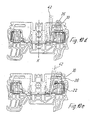
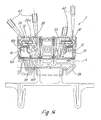
- Fig. 10 shows a terminal block 2 - here a feed-through terminal - with one here one-piece insulating material housing 4 made of plastic, which in its lower in Fig. 1 Area snap-in feet 6, 8 for snapping the terminal block onto a - not shown here - mounting rail and in its upper area two connection devices 10, 12 for contacting electrical conductors.
- the connection devices 10, 12 are conductively connected to each other here via a busbar 14, the ends of which first pointing upwards at right angles and then pointing at right angles to each other are bent. The ends of the busbar thus point towards the middle of the terminal or each other and each form a type of "U" on the side.
- busbar 14 it is also conceivable for the busbar 14 to have multiple parts train and / or to implement further terminal variants electronic Components to switch between the connecting devices 10, 12.
- connection devices 10, 12 are each implemented in so-called IDC technology. They each encompass the slotted ones facing each other Ends of the busbar 14 have a contact spring 15. These each have one mouth-like widening, also slotted contact cutting edge 16 and a relative to the contact cutting edge 16 along the slot 18 of the busbar 14 offset contacting area 20, wherein the contact cutting edge 16 and the contacting area 20 of the busbar 14 in one piece and / or from a uniform material or in several pieces, e.g. made of two different materials can be, the different materials specific to the functions Cutting (e.g. steel cutting) and contacting (e.g. copper) are adapted.
- the contact springs 15 are in the contacting area 20 of a cross section bordered essentially U-shaped spring 22.
- the force spring 22 has essentially flat spring legs 54, 56 on, with the substantially flat spring legs 54, 56 substantially perpendicular to the contact cutting edge 16 and the contacting area 20 and encompass them along the contacting area 20.
- the conductor is inserted into the contact springs 15 with the aid of an im Insulated plastic housing with slidably guided and also oscillating contact actuator 26.
- the operation with a contact actuator 26 is indeed already known per se from EP 0 926 697. Unlike in this document, it is with the 1 but by the measure, the ends of the busbar with align the contact blades towards each other towards the "middle of the clamp", possible, the contact actuating pieces 26 between the contact springs 15 - that is Arrange the middle of the terminal.
- the contact actuating pieces 26 are in each case during the initial assembly from above Openings 28 of the preferably one-piece insulating material housing 4 are used and there displaceably guided essentially parallel to the contact springs 15.
- the contact actuating pieces 26 have one in the side view of FIGS. 10 and 15a in the broadest sense from “top” to “bottom", i.e. towards the mounting rail widening, e.g. "Pear-like” shape and are from an insertion hole 34 for passes through the conductor 36 (see Fig. 10, 12). They are somewhat behind the opening 28 above from the insulating material housing 4, so that their respective switching position in the insulating material housing 4 can be seen from the outside, which facilitates the insertion of the conductor 36. In their area facing the contact cutting edge 16, they are also provided with a recess 38 provided. They also have a conductor contact surface 39 and a receptacle 40 for the contact blade 16 after cutting the conductor insulation.
- a conductor (not shown in Fig. 10a) is inserted into the opening 34 of the contact actuator 26 introduced.
- Fig. 10a it is possible on the of the contacting area 16 facing away from the contact actuating pieces 26 in the openings 28 of the insulating housing 4 between the insulating housing 4 and the Contact actuator 26 an actuator tool 42 like the tip of a screwdriver insert into the insulating material housing.
- the actuating tool hits here purely by way of example the screwdriver 42, on a guide bevel 44 in Isolierstoffgepuruse and urges the contact actuator 26 (see Fig. 10b) the conductor inserted therein in the direction of the contact cutting edge 16, the contact actuating piece - See Fig. 10b - first lightly on its guide pin 30 is pivoted and then performing a combined rotation and swinging Linear movement shifted further in the guide groove 32.
- the conductor insulation becomes the contact insulation severed and when the conductor 36 is inserted further into the slot 18 expanded until the contact actuator 26 with the conductor inserted therein 10e with the receptacle 40 overlaps the contact blades 16, the Line core (s) of the conductor 36, the contacting areas 20 of the connection devices Contact 10, 12.
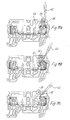
- the screwdriver 42 When switching off, the screwdriver 42 is fastened to the rail relative to the mounting rail or Terminal center (level K) outer side of the contact actuating piece 26 in the opening 28 of the insulating housing 4 inserted (Fig. 11a) until it on one Metal parts of the contact spring 15 protecting stop 46 of the contact actuation piece 26 comes to the plant.
- the contact actuating piece 26 pulls the conductor 36 out of the contacting area 20 from the contact spring 15 until it finally passes the contact cutting edge 16 11c slides out of the contact spring into the position in FIG. 11c, in which the conductor 36 follows can be pulled out from the top of the contact actuator 26.
- the leadership of the contact actuator 26 in the manner of a superimposed rotary or Pendulum and a linear movement with the guide pin 30 in the guide grooves 32 particularly reliably prevents the contact actuating pieces 26 from tilting when Switching the terminal block on and off. It is also possible for the guide grooves 32 to be shorter than with a purely linear movement of the contact actuating pieces 26 in the guide grooves 32 would be conceivable. Especially during an apprenticeship of the guide grooves 32 as elongated holes (possibly also curved), but it is advantageous that compared to training the contact actuators as alone Slidable elements can be shortened, as this increases the stability of the insulating housing in this area compared to a receiving groove with a length as in a pure linear guide is necessary.
- a taper 47 in the guide groove 32 divides it into locking positions for the Guide pin 30, which are formed on both sides of the taper and into which the guide pin noticeably engages when actuated.
- the actuator 26 in its lower, in the insulating housing engaging area 26 'at least one, preferably two - here on both sides - lateral, facing the inner walls of the insulating material housing has slot-like openings 15a, b, so that the conductor to be connected essentially can extend to the inner wall of the insulating material housing.
- the insulation of the conductor can pass through these slot-like openings 15a, b.
- the web 30 bridges the slot-like openings.
- the webs 30 fully engage in the guide grooves 32 can also in the area the webs 30 of the conductors have at least one diameter which is the Width of the opening 28 or the distance between the two webs 30 corresponds to each other.
- the contact actuator 26 is essentially guided linearly in the guide grooves 32.
- grip the contact actuator 26 and the insulating housing 4 in the upper area by means of a dovetail joint 88, i.e. the top edges of the Web 30 of the contact actuating pieces 26 and the lower edges of the upper section 26o of the contact actuator and the associated sections of the Isolierstoffgeophuses 2 are with mutually corresponding guide slopes 90a, b, 92 a, b provided. This ensures safe linear guidance of the management or Contact actuating piece even when torque is applied by moving of the actuating tool 42 (e.g. a screwdriver).
- the actuating tool 42 e.g. a screwdriver
- busbar runs not U-shaped inside the power spring 22 but it first penetrates the Power spring 22 in the contacting area 20 then extends outside the power spring 22 in the direction of the mounting rail 94 vertically downward and finally turns from the power spring 22 vertically, so that the busbar in the view of FIG. 14 in Area of the power spring essentially has a z-like geometry.
- the busbar 14 With the lower leg of the Z, the busbar 14 is placed on a further busbar 96, which the various connection devices 10, 12 or their busbar pieces 14 connects together.
- the force spring 22 is on its facing towards the contact cutting edge 16 Side in the area of the lower corner relative to the mounting rail with a projection 98 on Approach 48 provided which engages under an abutment 100 in the insulating housing. Since the busbar 14 and the busbar 96 together form another abutment Reach under 101 in the insulating housing and also other sides of the power spring 22 abut on walls of the insulating material housing, is a simple Defined fit of the power spring 22 ensured in the insulating housing 2.
- a conductor (not shown) is also shown in FIG. 14 in the exemplary embodiments the opening 34 of the contact actuator 26 inserted.
- an operating tool 42 in insert the insulating housing.
- the actuating tool 42 meets one Guide bevel 44 in the insulating material housing and urges the contact actuating piece 26 with the conductor inserted therein in the direction of the contact cutting edge 16, the Contact actuator with a linear movement further in the guide groove 32 is moved.
- the actuating tool 42 is inserted further into the opening 28, it comes finally at the ready e.g. with the busbar 14. Then it is on the Busbar 14 or a housing stop in the direction of the connecting device 10 or 12 pivoted.
- the actuating tool 42 When disconnected, the actuating tool 42 is on the relative to the mounting rail or the middle of the terminal (level K) on the outside of the contact actuator 26 inserted into the opening 28 of the insulating housing 4 until it is on the metal parts the contact spring 15 protective stop 102 of the insulating housing System comes on which the contact actuator 26 "rail-like" with the operating tool 42 moved to the middle of the terminal or in the direction of the mounting rail becomes. It should also be emphasized that switching off is also possible if the Screwdriver not to the left as shown in the left part of FIG. 13 but pivoted to the right placed on the stop 102 and then pivoted to the left becomes.
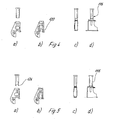
- a guide sleeve 110 in the contact actuator Use 26 which has a central bore 112, and an upper here, for example, flange-like stop 114, to which there is a cylindrical section 116 with a smaller diameter than the flange.
- the Guide sleeve 110 becomes the insertion opening 34 of the Inserted contact actuator 26 (see Figure 1b), the flange-like Stop 114, which has a larger diameter than the insertion bore 34, comes to rest on the upper end of the contact actuating piece 26.
- the diameter of the bore 112 must be larger than the maximum at all points Wire insulation diameter.
- the bore 112 has a funnel-shaped tapering only in its upper region Has insertion section 118, to which a cylindrical bore section 120 connects, even a relatively thin conductor is always safe in the area of the slot 18 out or is inserted into the contact blade 16 such that the cutting areas 16a and 16b securely contact the conductor. It almost cannot more come that the conductor laterally on the spring legs 15a, 15b of the contact spring rests or is guided past it.
- the exemplary embodiment in FIG. 2 differs from the exemplary embodiment in FIG Figure 1 characterized in that the cylindrical section 116 has yet another section 122 of smaller diameter, which connects directly to the spring legs 15a, 15b of the contact spring 15 is feasible, which increases the security against insertion elevated.
- an area 124 is provided on the cylindrical section 116 to form, in one of its views (Figure 3c) a smaller diameter has as the cylindrical portion 116 and that in a view rotated 90 ° thereto (Figure 3d) has the diameter of the cylindrical portion, so that it is possible, the guide sleeve in one of its orientations (Figure 3c) except for the spring legs 15a, b or between the upper ends of the power spring 22.
- the otherwise cylindrical bore 120 widens on its Contact spring 15 facing end, wherein - as can be seen from Figure 4c and 4d - the Otherwise, the diameter of the bore 120 at the lower end in the view in FIG. 4c constant diameter of the cylindrical bore 120 corresponds and the expansion only in the view rotated by 90 ° for this purpose in FIG is that the conductor in the guide sleeve 110 to the contact spring 15 becomes.
- Figure 5 differs from the embodiment of Figure 4 in that 3, a lower region 124 is again provided, which is in a View of the guide sleeve (Figure 5c) is tapered and in the Another view of Figure 5d again has a diameter which is essentially corresponds to the diameter of the remaining cylindrical section 116.
- FIGS. 6 to 9 show possibilities of the guide sleeves 110 being easy to handle embody.
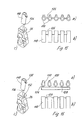
- FIGS. 6 to 9 have in common that the guide sleeves can be arranged in rows and each via film hinge-like connections 126 are interconnected. In this way it is possible, such as when mounting on the control cabinet, to store a whole band of guide sleeves 110 and then each time the guide sleeves are inserted into the contact actuating pieces Tear off 26 of the guide sleeves 110 from the tape. These are the Guide sleeves 110 in the band at predetermined breaking points - e.g. connections 126 - manual or separable from each other by machine.
- the flange-like sections 114 are for resting on the contact actuating pieces trained round. 7 and 8, these sections 114, on the other hand, have a substantially rectangular basic shape in the plan view of Figures 7 and 8 on.
- FIG. 6 and FIG. 7 have in common that the flange-like sections 114 each lie in a straight line, whereas according to Figure 8 it is provided that the individual guide sleeves are offset from one another in a zigzag fashion.
- Figure 8 a particularly easy assembly ensures, because the film hinges are special just let it cut during assembly.
- Figure 9 shows a further idea or variant of the film hinge, the individual Guide sleeves are slightly axially offset from each other.
- the film hinges or connections 126 are in each case between the upper and the lower axial end adjacent flange-like sections 114 are arranged.
- the guide sleeves 110 when designed as a band prefabricated unit can be assembled, the connections 126 after assembly are severable and / or separate connecting elements, which the connections train, are removable from the unit after assembly / (not shown.
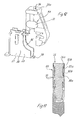
- 15 and 16 again show exemplary embodiments in which the guide sleeves 110 are arranged in rows. 15 is again between the guide sleeves 110 each have a film-hinge-like, band-like connection 126 provided. 16, the guide sleeves 110, however, are film-hinge-like Connections 126 each connected to a band 128 which extends laterally from the guide sleeves 110.
- the guide sleeves 110 each have one formed on the side latching shoulder 130, which for latching engagement in a correspondingly shaped catch recess 132 in the contact actuating piece 26 is formed and on the one hand the seat of the guide sleeve 110 in the contact actuating piece 26 improved and on the other hand the severing of the connections 126 after mounting a plurality of guide sleeves 110.
- Another approach 134 to that facing away from the wire insertion end End of the guide sleeve 110 both facilitates the stirring of the wire into the cutting device as well as the alignment of the guide sleeve 110 in the contact actuator 26.
Landscapes
- Connections Arranged To Contact A Plurality Of Conductors (AREA)
- Connector Housings Or Holding Contact Members (AREA)
- Coupling Device And Connection With Printed Circuit (AREA)
- Multi-Conductor Connections (AREA)
- Pens And Brushes (AREA)
- Piezo-Electric Or Mechanical Vibrators, Or Delay Or Filter Circuits (AREA)
- Connections By Means Of Piercing Elements, Nuts, Or Screws (AREA)
Applications Claiming Priority (2)
| Application Number | Priority Date | Filing Date | Title |
|---|---|---|---|
| DE20110839U DE20110839U1 (de) | 2001-06-30 | 2001-06-30 | Reihenklemme und Führungshülse |
| DE20110839U | 2001-06-30 |
Publications (3)
| Publication Number | Publication Date |
|---|---|
| EP1289066A2 true EP1289066A2 (fr) | 2003-03-05 |
| EP1289066A3 EP1289066A3 (fr) | 2004-01-02 |
| EP1289066B1 EP1289066B1 (fr) | 2005-04-13 |
Family
ID=7958747
Family Applications (1)
| Application Number | Title | Priority Date | Filing Date |
|---|---|---|---|
| EP02012431A Expired - Lifetime EP1289066B1 (fr) | 2001-06-30 | 2002-06-10 | Borne de connexion et boítier de guidage |
Country Status (4)
| Country | Link |
|---|---|
| EP (1) | EP1289066B1 (fr) |
| AT (1) | ATE293294T1 (fr) |
| DE (2) | DE20110839U1 (fr) |
| ES (1) | ES2237633T3 (fr) |
Cited By (1)
| Publication number | Priority date | Publication date | Assignee | Title |
|---|---|---|---|---|
| US7857655B2 (en) | 2008-07-11 | 2010-12-28 | Reichle & De-Massari Ag | Insulation displacement contact and contacting device |
Families Citing this family (2)
| Publication number | Priority date | Publication date | Assignee | Title |
|---|---|---|---|---|
| DE20118666U1 (de) * | 2001-11-15 | 2003-03-27 | Weidmüller Interface GmbH & Co., 32760 Detmold | Reihenklemme und Führungshülse |
| DE10347668B4 (de) * | 2003-10-09 | 2005-12-29 | Phoenix Contact Gmbh & Co. Kg | Elektrische Klemme |
Family Cites Families (5)
| Publication number | Priority date | Publication date | Assignee | Title |
|---|---|---|---|---|
| FR2503464A1 (fr) * | 1981-04-03 | 1982-10-08 | Alsthom Cgee | Bloc de jonction a raccordement electrique sans denudage |
| DE8704473U1 (de) * | 1987-03-25 | 1987-05-27 | WAGO Verwaltungsgesellschaft mbH, 4950 Minden | Anschluß- oder Verbindungsklemme |
| EP0848457A3 (fr) * | 1996-12-13 | 1999-05-06 | Siemens Aktiengesellschaft | Dispositif de raccordement électrique |
| DE29802674U1 (de) * | 1998-02-17 | 1998-04-16 | Weidmueller Interface | Reihenklemme mit isolationsdurchdringendem Leiteranschluß |
| DE19921775B4 (de) * | 1999-05-11 | 2011-06-01 | Phoenix Contact Gmbh & Co. Kg | Verbindungsklemme in Schneid-Klemmtechnik |
-
2001
- 2001-06-30 DE DE20110839U patent/DE20110839U1/de not_active Expired - Lifetime
-
2002
- 2002-06-10 ES ES02012431T patent/ES2237633T3/es not_active Expired - Lifetime
- 2002-06-10 EP EP02012431A patent/EP1289066B1/fr not_active Expired - Lifetime
- 2002-06-10 AT AT02012431T patent/ATE293294T1/de not_active IP Right Cessation
- 2002-06-10 DE DE50202767T patent/DE50202767D1/de not_active Expired - Lifetime
Cited By (1)
| Publication number | Priority date | Publication date | Assignee | Title |
|---|---|---|---|---|
| US7857655B2 (en) | 2008-07-11 | 2010-12-28 | Reichle & De-Massari Ag | Insulation displacement contact and contacting device |
Also Published As
| Publication number | Publication date |
|---|---|
| EP1289066A3 (fr) | 2004-01-02 |
| ES2237633T3 (es) | 2005-08-01 |
| ATE293294T1 (de) | 2005-04-15 |
| DE50202767D1 (de) | 2005-05-19 |
| DE20110839U1 (de) | 2002-11-07 |
| EP1289066B1 (fr) | 2005-04-13 |
Similar Documents
| Publication | Publication Date | Title |
|---|---|---|
| EP1956684B1 (fr) | Contact universel | |
| EP1191634B1 (fr) | Barette à bornes avec contacts autodénudants et dispositif de connexion | |
| EP0554810B1 (fr) | Connecteur électrique | |
| EP1191633B1 (fr) | Barette à borne à déplacement d'isolation avec pièces pour contacter les fils avec les bornes | |
| DE4419055A1 (de) | Chip-Schmelzsicherung | |
| DE102015119407B4 (de) | Anschlussklemme und Mehrfachklemme | |
| EP2242082A1 (fr) | Support pour fixations | |
| EP2953213A1 (fr) | Système de connecteur à fiches et élément de codage associé et procédé de codage d'un système de connecteur à fiches | |
| EP1813003A1 (fr) | Outil pour monter des conducteurs de cables | |
| DE3300697C2 (de) | Elektrische Klemme | |
| DE3807191A1 (de) | Schraubanschlussvorrichtung fuer elektrische leiter | |
| EP1181745B1 (fr) | Borne de raccordement sans vis | |
| EP1523065B1 (fr) | Borne électrique | |
| EP0141957B1 (fr) | Fiche pour câbles plats électriques | |
| EP1086513B1 (fr) | Borne de connexion | |
| EP1289066B1 (fr) | Borne de connexion et boítier de guidage | |
| EP1611853B1 (fr) | Pince chirurgicale notamment pour les vaisseaux sanguins | |
| DE19949386C2 (de) | Geräte-Anschlusskasten mit Schneidtechnik | |
| EP1149400A1 (fr) | Appareil electrique a dispositif de raccordement pour le raccordement a un deuxieme appareil electrique | |
| DE9310650U1 (de) | Kabelsteckverbinder | |
| EP3273543A1 (fr) | Dispositif de raccordement d'un conducteur à une barre omnibus | |
| DE20106525U1 (de) | Reihenklemme mit Schneidkontakten und Kontaktbetätigungsstücken | |
| DE20106523U1 (de) | Reihenklemme mit Schneidkontakten und Anschlußvorrichtung | |
| DE29909822U1 (de) | Verbindungsvorrichtung für elektrische Kabel | |
| DE60014346T2 (de) | Elektrische kabelverbindungsanordnung mit schneidklemm- und halterungsspalt |
Legal Events
| Date | Code | Title | Description |
|---|---|---|---|
| PUAI | Public reference made under article 153(3) epc to a published international application that has entered the european phase |
Free format text: ORIGINAL CODE: 0009012 |
|
| AK | Designated contracting states |
Kind code of ref document: A2 Designated state(s): AT BE CH CY DE DK ES FI FR GB GR IE IT LI LU MC NL PT SE TR |
|
| AX | Request for extension of the european patent |
Extension state: AL LT LV MK RO SI |
|
| PUAL | Search report despatched |
Free format text: ORIGINAL CODE: 0009013 |
|
| AK | Designated contracting states |
Kind code of ref document: A3 Designated state(s): AT BE CH CY DE DK ES FI FR GB GR IE IT LI LU MC NL PT SE TR |
|
| AX | Request for extension of the european patent |
Extension state: AL LT LV MK RO SI |
|
| RIC1 | Information provided on ipc code assigned before grant |
Ipc: 7H 01R 9/26 B Ipc: 7H 01R 4/48 A Ipc: 7H 01R 4/24 B |
|
| 17P | Request for examination filed |
Effective date: 20040115 |
|
| 17Q | First examination report despatched |
Effective date: 20040324 |
|
| AKX | Designation fees paid |
Designated state(s): AT BE CH CY DE DK ES FI FR GB GR IE IT LI LU MC NL PT SE TR |
|
| GRAP | Despatch of communication of intention to grant a patent |
Free format text: ORIGINAL CODE: EPIDOSNIGR1 |
|
| GRAS | Grant fee paid |
Free format text: ORIGINAL CODE: EPIDOSNIGR3 |
|
| GRAA | (expected) grant |
Free format text: ORIGINAL CODE: 0009210 |
|
| AK | Designated contracting states |
Kind code of ref document: B1 Designated state(s): AT BE CH CY DE DK ES FI FR GB GR IE IT LI LU MC NL PT SE TR |
|
| PG25 | Lapsed in a contracting state [announced via postgrant information from national office to epo] |
Ref country code: FI Free format text: LAPSE BECAUSE OF FAILURE TO SUBMIT A TRANSLATION OF THE DESCRIPTION OR TO PAY THE FEE WITHIN THE PRESCRIBED TIME-LIMIT Effective date: 20050413 Ref country code: TR Free format text: LAPSE BECAUSE OF FAILURE TO SUBMIT A TRANSLATION OF THE DESCRIPTION OR TO PAY THE FEE WITHIN THE PRESCRIBED TIME-LIMIT Effective date: 20050413 Ref country code: NL Free format text: LAPSE BECAUSE OF FAILURE TO SUBMIT A TRANSLATION OF THE DESCRIPTION OR TO PAY THE FEE WITHIN THE PRESCRIBED TIME-LIMIT Effective date: 20050413 Ref country code: IE Free format text: LAPSE BECAUSE OF FAILURE TO SUBMIT A TRANSLATION OF THE DESCRIPTION OR TO PAY THE FEE WITHIN THE PRESCRIBED TIME-LIMIT Effective date: 20050413 |
|
| REG | Reference to a national code |
Ref country code: GB Ref legal event code: FG4D Free format text: NOT ENGLISH |
|
| RIN1 | Information on inventor provided before grant (corrected) |
Inventor name: DIEKMANN, TORSTEN Inventor name: DIEKMANN, JOERG |
|
| REG | Reference to a national code |
Ref country code: CH Ref legal event code: EP |
|
| REG | Reference to a national code |
Ref country code: IE Ref legal event code: FG4D Free format text: LANGUAGE OF EP DOCUMENT: GERMAN |
|
| REF | Corresponds to: |
Ref document number: 50202767 Country of ref document: DE Date of ref document: 20050519 Kind code of ref document: P |
|
| PG25 | Lapsed in a contracting state [announced via postgrant information from national office to epo] |
Ref country code: AT Free format text: LAPSE BECAUSE OF NON-PAYMENT OF DUE FEES Effective date: 20050610 Ref country code: LU Free format text: LAPSE BECAUSE OF NON-PAYMENT OF DUE FEES Effective date: 20050610 Ref country code: CY Free format text: LAPSE BECAUSE OF FAILURE TO SUBMIT A TRANSLATION OF THE DESCRIPTION OR TO PAY THE FEE WITHIN THE PRESCRIBED TIME-LIMIT Effective date: 20050610 |
|
| GBT | Gb: translation of ep patent filed (gb section 77(6)(a)/1977) |
Effective date: 20050523 |
|
| PG25 | Lapsed in a contracting state [announced via postgrant information from national office to epo] |
Ref country code: BE Free format text: LAPSE BECAUSE OF NON-PAYMENT OF DUE FEES Effective date: 20050630 Ref country code: MC Free format text: LAPSE BECAUSE OF NON-PAYMENT OF DUE FEES Effective date: 20050630 |
|
| REG | Reference to a national code |
Ref country code: SE Ref legal event code: TRGR |
|
| PG25 | Lapsed in a contracting state [announced via postgrant information from national office to epo] |
Ref country code: DK Free format text: LAPSE BECAUSE OF FAILURE TO SUBMIT A TRANSLATION OF THE DESCRIPTION OR TO PAY THE FEE WITHIN THE PRESCRIBED TIME-LIMIT Effective date: 20050713 Ref country code: GR Free format text: LAPSE BECAUSE OF FAILURE TO SUBMIT A TRANSLATION OF THE DESCRIPTION OR TO PAY THE FEE WITHIN THE PRESCRIBED TIME-LIMIT Effective date: 20050713 |
|
| REG | Reference to a national code |
Ref country code: ES Ref legal event code: FG2A Ref document number: 2237633 Country of ref document: ES Kind code of ref document: T3 |
|
| PG25 | Lapsed in a contracting state [announced via postgrant information from national office to epo] |
Ref country code: PT Free format text: LAPSE BECAUSE OF FAILURE TO SUBMIT A TRANSLATION OF THE DESCRIPTION OR TO PAY THE FEE WITHIN THE PRESCRIBED TIME-LIMIT Effective date: 20050913 |
|
| NLV1 | Nl: lapsed or annulled due to failure to fulfill the requirements of art. 29p and 29m of the patents act | ||
| REG | Reference to a national code |
Ref country code: IE Ref legal event code: FD4D |
|
| PLBE | No opposition filed within time limit |
Free format text: ORIGINAL CODE: 0009261 |
|
| STAA | Information on the status of an ep patent application or granted ep patent |
Free format text: STATUS: NO OPPOSITION FILED WITHIN TIME LIMIT |
|
| ET | Fr: translation filed | ||
| 26N | No opposition filed |
Effective date: 20060116 |
|
| PG25 | Lapsed in a contracting state [announced via postgrant information from national office to epo] |
Ref country code: CH Free format text: LAPSE BECAUSE OF NON-PAYMENT OF DUE FEES Effective date: 20060630 Ref country code: LI Free format text: LAPSE BECAUSE OF NON-PAYMENT OF DUE FEES Effective date: 20060630 |
|
| REG | Reference to a national code |
Ref country code: CH Ref legal event code: PL |
|
| BERE | Be: lapsed |
Owner name: WEIDMULLER INTERFACE G.M.B.H. & CO. Effective date: 20050630 |
|
| PGFP | Annual fee paid to national office [announced via postgrant information from national office to epo] |
Ref country code: GB Payment date: 20120622 Year of fee payment: 11 Ref country code: FR Payment date: 20120705 Year of fee payment: 11 Ref country code: SE Payment date: 20120621 Year of fee payment: 11 |
|
| PGFP | Annual fee paid to national office [announced via postgrant information from national office to epo] |
Ref country code: IT Payment date: 20120627 Year of fee payment: 11 Ref country code: ES Payment date: 20120627 Year of fee payment: 11 |
|
| PG25 | Lapsed in a contracting state [announced via postgrant information from national office to epo] |
Ref country code: SE Free format text: LAPSE BECAUSE OF NON-PAYMENT OF DUE FEES Effective date: 20130611 |
|
| REG | Reference to a national code |
Ref country code: SE Ref legal event code: EUG |
|
| GBPC | Gb: european patent ceased through non-payment of renewal fee |
Effective date: 20130610 |
|
| REG | Reference to a national code |
Ref country code: FR Ref legal event code: ST Effective date: 20140228 |
|
| PG25 | Lapsed in a contracting state [announced via postgrant information from national office to epo] |
Ref country code: GB Free format text: LAPSE BECAUSE OF NON-PAYMENT OF DUE FEES Effective date: 20130610 |
|
| PG25 | Lapsed in a contracting state [announced via postgrant information from national office to epo] |
Ref country code: IT Free format text: LAPSE BECAUSE OF NON-PAYMENT OF DUE FEES Effective date: 20130610 Ref country code: FR Free format text: LAPSE BECAUSE OF NON-PAYMENT OF DUE FEES Effective date: 20130701 |
|
| REG | Reference to a national code |
Ref country code: ES Ref legal event code: FD2A Effective date: 20140707 |
|
| PGFP | Annual fee paid to national office [announced via postgrant information from national office to epo] |
Ref country code: DE Payment date: 20140619 Year of fee payment: 13 |
|
| PG25 | Lapsed in a contracting state [announced via postgrant information from national office to epo] |
Ref country code: ES Free format text: LAPSE BECAUSE OF NON-PAYMENT OF DUE FEES Effective date: 20130611 |
|
| REG | Reference to a national code |
Ref country code: DE Ref legal event code: R119 Ref document number: 50202767 Country of ref document: DE |
|
| PG25 | Lapsed in a contracting state [announced via postgrant information from national office to epo] |
Ref country code: DE Free format text: LAPSE BECAUSE OF NON-PAYMENT OF DUE FEES Effective date: 20160101 |