EP1298925A2 - Méthode et appareil de communication d'images animées - Google Patents
Méthode et appareil de communication d'images animées Download PDFInfo
- Publication number
- EP1298925A2 EP1298925A2 EP02020304A EP02020304A EP1298925A2 EP 1298925 A2 EP1298925 A2 EP 1298925A2 EP 02020304 A EP02020304 A EP 02020304A EP 02020304 A EP02020304 A EP 02020304A EP 1298925 A2 EP1298925 A2 EP 1298925A2
- Authority
- EP
- European Patent Office
- Prior art keywords
- user
- self
- communication apparatus
- moving picture
- picture information
- Prior art date
- Legal status (The legal status is an assumption and is not a legal conclusion. Google has not performed a legal analysis and makes no representation as to the accuracy of the status listed.)
- Withdrawn
Links
Images






Classifications
-
- H—ELECTRICITY
- H04—ELECTRIC COMMUNICATION TECHNIQUE
- H04N—PICTORIAL COMMUNICATION, e.g. TELEVISION
- H04N7/00—Television systems
- H04N7/14—Systems for two-way working
- H04N7/141—Systems for two-way working between two video terminals, e.g. videophone
- H04N7/142—Constructional details of the terminal equipment, e.g. arrangements of the camera and the display
-
- H—ELECTRICITY
- H04—ELECTRIC COMMUNICATION TECHNIQUE
- H04N—PICTORIAL COMMUNICATION, e.g. TELEVISION
- H04N7/00—Television systems
- H04N7/14—Systems for two-way working
- H04N7/141—Systems for two-way working between two video terminals, e.g. videophone
- H04N7/142—Constructional details of the terminal equipment, e.g. arrangements of the camera and the display
- H04N2007/145—Handheld terminals
Definitions
- the present invention relates to a moving picture communication method and apparatus for communicating moving picture information.
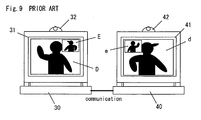
- Fig. 9 illustrates a pair of a typical stationary moving picture communication apparatus by way of illustration.
- stationary TV phones 30, 40 include image displays 31, 41 and cameras 32, 42, respectively.
- the image display 31 displays a self-picture "E” of a user and a picture “D” of a user's party.
- the image display 41 displays a self-picture "e” of the user's party and a picture “d” of the user.
- the TV phones 30, 40 are usually locked against rotation. Therefore, the image displays 31, 41 are oriented in fixed directions.
- the cameras 32, 42 are locked against rotation about respective optical axes thereof.
- the TV phones 30, 40 both of which remain positioned substantially vertically, are used to provide TV phone communication therebetween, thereby communicating moving pictures therebetween.
- a cell-phone type moving picture communication apparatus provides different modes of TV phone-to-TV phone communication.
- Fig. 10 is a descriptive illustration, showing how a pair of conventional cell-phone type moving picture communication apparatus is used.
- the pair of cell-phone type moving picture communication apparatus 35, 45 is usually vertically positioned to provide TV phone communication therebetween.
- the pair of moving picture communication apparatus 35, 45 is horizontally positioned to communicate with one another.
- the cell-phone type moving picture communication apparatus 35, 45 are pivoted at an angle of 90 degrees in an either rightward or leftward direction of the same communication apparatus 35, 45 when respective users face image displays 36, 46 thereof.
- the cell-phone type moving picture communication apparatus 35, 45 includes the image displays 36, 46 and cameras 37, 47, respectively,
- the display image 36 displays a self-picture "E” of a user and a picture “D” of a user's party.
- the display image 46 displays a self-picture “e” of the user's party and a picture “d” of the user.
- the displayed self-pictures "E” and “e” are downsized as mirror images that are obtained by inverting the respective self-pictures to be sent to the party's cell-phone type communication apparatus.
- the cameras 37, 47 are locked against rotation about respective optical axis thereof.
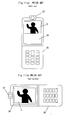
- Fig. 11 is a descriptive illustration, showing how the conventional cell-phone type moving picture communication apparatus of the user displays a picture of the user's party. As illustrated in Fig. 11 (a), when the user's moving picture communication apparatus 35 is vertically positioned to communicate with the party's communication apparatus 45, then the party's picture "D" is displayed on the image display 36 that has an aspect ratio defined by different horizontal and vertical lengths in which the vertical length is greater than the other.
- Fig. 12 is a descriptive illustration, showing the problem that is encountered when a pair of conventional cell-phone type moving picture communication apparatus is used.to provide TV phone communication.
- Fig. 12 presupposes that the user uses the leftward pivoted cell-phone type moving picture communication apparatus 35 as shown in Fig. 11 (b), while the user's party uses the vertically positioned cell-phone type moving picture communication apparatus 45 as illustrated in Fig. 12 (a)
- a user's self-picture "f" displayed on the image display 46 of the party' s moving picture communication apparatus45 is pivoted at a right angle.
- the user's party usually pivots the party's communication apparatus 45 at a right angle in order to render the user's self-picture "f" easy to view.
- a problem with the conventional cell-phone type moving picture communication apparatus is that proper moving picture communication fails to be established when the enlarged party's picture is displayed on the user's communication apparatus 35 that has been pivoted at an angle of 90 degrees.
- an object of the present invention is to provide a moving picture communication method and apparatus designed to provide proper moving picture communication, even when party's picture information enlarged and pivoted at an angle of 90 degrees is displayed on an image display of the moving picture communication apparatus that has been pivoted.
- a first aspect of the present invention provides a moving picture communication method comprising the steps of: communicating moving picture information between a moving picture communication apparatus of a user and another moving picture communication apparatus of a user's party, in which an image display on the user's moving picture communication apparatus has an aspect ratio defined by different vertical and horizontal lengths; pivoting party's picture information through an angle of substantially 90 degrees, the party's picture information being received from the party' s moving picture communication apparatus; enlarging the party's picture information received from the party's moving picture communication apparatus; displaying the pivoted and enlarged party's picture information on the image display of the user's moving picture communication apparatus that has been pivoted in an either rightward or leftward direction of the user's moving picture communication apparatus when the user faces the image display of the user's moving picture communication apparatus; producing user's self-picture information; pivoting the user's self-picture information as first pivotal processing in response to pivotal movement of the user's moving picture communication apparatus; encoding the pivoted user's self-picture information
- This system allows the pivoted user's self-picture information to be transmitted to the party's moving picture communication apparatus when the party's picture information enlarged and pivoted at an angle of nearly 90 degrees is displayed on the image display of the user's moving picture communication apparatus that has been pivoted in an either rightward or leftward direction of the same apparatus when the user faces the image display.
- This feature allows moving picture information properly oriented with respect to the vertical axis of the earth to be displayed on the party's moving picture communication apparatus.
- a second aspect of the present invention provides a moving picture communication method, comprising the steps of: communicating moving picture information between a moving picture communication apparatus of a user and another moving picture communication apparatus of a user's party, in which an image display on the user's moving picture communication apparatus has an aspect ratio defined by different vertical and horizontal lengths; pivoting party's picture information through an angle of substantially 90 degrees, the party's picture information being received from the party's moving picture communication apparatus; enlarging the party's picture information received from the party's moving picture communication apparatus; displaying the pivoted and enlarged party's picture information on the image display of the user's moving picture communication apparatus that has been pivoted in an either rightward or leftward direction of the user's moving picture communication apparatus when the user faces the image display of the user's moving picture communication apparatus; producing user's self-picture information; pivoting the user's self-picture information as first pivotal processing in response to pivotal movement of the user's moving picture communication apparatus; enlarging the user's self-picture information
- This system allows the pivoted and enlarged user's self-picture information to be transmitted to the party's moving picture communication apparatus when the party's picture information enlarged and pivoted at an angle of nearly 90 degrees is displayed on the image display of the user's moving picture communication apparatus that has been pivoted in an either rightward or leftward direction of the same apparatus when the user faces the image display.
- This feature allows moving picture information properly oriented with respect the vertical axis of the earth is displayed on the party's moving picture communication apparatus, and further allows the user's self-picture information that matches in display size with the party's moving picture communication apparatus to be transmitted to the party's moving picture communication apparatus.
- a third aspect of the present invention provides a moving picture communication method comprising the steps of: communicating moving picture information between a moving picture communication apparatus of a user and another moving picture communication apparatus of a user's party, in which an image display on the user's moving picture communication apparatus has an aspect ratio defined by different vertical and horizontal lengths; pivoting party's picture information through an angle of substantially 90 degrees, the party's picture information being received from the party's moving picture communication apparatus; enlarging the party's picture information received from the party's moving picture communication apparatus; displaying the pivoted and enlarged party's picture information on the image display of the user's moving picture communication apparatus that has been pivoted in an either rightward or leftward direction of the user's moving picture communication apparatus when the user faces the image display of the user's moving picture communication apparatus; producing user's self-picture information; pivoting the user's self-picture information as first pivotal processing in response to pivotal movement of the user's moving picture communication apparatus; providing additional image-plotting information to the user's self-pic
- This system allows the pivoted user's self-picture information to be transmitted to the party's moving picture communication apparatus when the party's picture information enlarged and pivoted at an angle of nearly 90 degrees is displayed on the image display of the user's moving picture communication apparatus that has been pivoted in an either rightward or leftward direction of the same apparatus when the user faces the image display.
- This feature allows moving picture information properly oriented with respect to the vertical axis of the earth is displayed on the party's moving picture communication apparatus.
- the additional image-plotting information is provided to the user's self-picture information. This means that other information such as character information in addition to moving pictures can be transmitted to the party's moving picture communication apparatus.
- a fourth aspect of the present invention provides a moving picture communication method comprising the steps of: communicating moving picture information between a moving picture communication apparatus of a user and another moving picture communication apparatus of a user's party, in which an image display on the user's moving picture communication apparatus has an aspect ratio defined by different vertical and horizontal lengths; displaying party's picture information on the image display of the user's moving picture communication apparatus, the party's picture information being received from the party's moving picture communication apparatus; producing user's self-picture information; providing additional image-plotting information to the user's self-picture information; encoding the user's self-picture information that has the additional image-plotting information provided thereto; and transmitting the encoded user's self-picture information to the party's moving picture communication apparatus.
- This system allows additional image-plotting information to be provided to the user's self-picture information.
- other information such as character information in addition to moving images can be sent to the party's moving picture communication apparatus.
- the addition of the additional image-plotting information to the user's self-picture information reduces a moving picture area or rather the user's self-picture information. As a result, the resulting coding amount can be inhibited when an interframe predictive coding system is used.
- a fifth aspect of the present invention provides a moving picture communication method as defined in the fourth aspect thereof, further comprising the step of pivoting the user's self-picture information as first pivotal processing in response to pivotal movement of the user's moving picture communication apparatus, wherein the step of displaying the party's picture information received from the party's moving picture communication apparatus includes the steps of pivoting the party's picture information through an angle of substantially 90 degrees; enlarging the party's picture information; and displaying the pivoted and enlarged party's picture information on the image display of the user's moving picture communication apparatus that has been pivoted in an either rightward or leftward direction of the user's moving picture communication apparatus when the user faces the image display of the user's moving picture communication apparatus, and wherein the step of providing additional image-plotting information to the user's self-picture information includes the step of providing additional image-plotting information to the user's self-picture information that has been pivoted as the first pivotal processing.
- This system allows the pivoted user's self-picture information to be transmitted to the party's moving picture communication apparatus when the party's picture information enlarged and pivoted at an angle of nearly 90 degrees is displayed on the image display of the user's moving picture communication apparatus that has been pivoted in an either rightward or leftward direction of the same apparatus when the user faces the image display.
- This feature allows moving picture information properly positioned with respect to the vertical axis of the earth to be displayed on the party's moving picture communication apparatus.
- the additional image-plotting information is provided to the user's self-picture information, regardless of whether the user's moving picture communication apparatus is pivoted.
- This feature allows the user's self-picture information to be transmitted to the party's moving picture communication apparatus in a similar form between when the user's moving picture communication apparatus is pivoted to communicate with the party's moving picture communication apparatus and when the user's communication apparatus is non-pivoted to communicate therewith.
- a sixth aspect of the present invention provides a moving picture communication method as defined in the third or fourth aspect of the present invention, wherein the step of providing additional image-plotting information includes the step of providing different image-plotting information to the user's self-picture information in dependence upon a communication state.
- This system permits different amounts of image-plotting information to be provided to the user's self-picture information to further reduce a moving picture area or rather the user's self-picture information when a poor moving picture communication state reduces communication data speeds. This feature reduces the resulting code amount. As a result, the user's self-picture information can be sent to the party's moving picture communication apparatus while the number of frames to be transferred per second is retained.
- a seventh aspect of the present invention provides a moving picture communication method as defined in the third or fourth aspect of the present invention, wherein the step of producing user's self-picture information includes the step of generating a square of user's self-picture information.
- This system requires at least only a square zone as an area of a moving image (or rather a self-picture) to be picked up, even with moving picture communication environments in which moving picture information having an aspect ratio defined by different horizontal and vertical lengths is communicated.
- This feature is realized by the addition of image-plotting information to the user's self-picture information.
- an image pick-up unit can include a reduced volume of memory.
- the square of self-picture information can be pivoted in a simplified manner, and can be processed at steps that require less man-hour rates.
- An eighth aspect of the present invention provides a moving picture communication method as defined in the first or third aspect of the present invention, further comprising the steps of: pivoting, as second pivotal processing, the user's self-picture information that has been pivoted as the first pivotal processing; inverting the user's self-picture information that has been pivoted as the first pivotal processing, in order to provide a mirror image of the user's self-picture information; downsizing the inverted user's self-picture information that has been pivoted as the second pivotal processing; and displaying the downsized user's self-picture information on the image display of the user's moving picture communication apparatus.
- This system allows moving picture communication to be held while the user's self-picture information to be transmitted to the party's moving picture communication apparatus is checked to see how it looks like.
- a ninth aspect of the present invention provides a moving picture communication method as defined in the second aspect of the present invention, further comprising the steps of: pivoting, as second pivoting processing, the enlarged user's self-picture information that has been pivoted as the first pivotal processing; inverting the enlarged user's self-picture information that has been pivoted as the first pivotal processing, in order to provide a mirror image of the user's self-picture information; downsizing the inverted user's self-picture information that has been pivoted as the second pivotal processing; and displaying the downsized user's self-picture information on the image display of the user's moving picture communication apparatus.
- This system allows moving picture communication to be held while the user's self-picture information to be transmitted to the party's moving picture communication apparatus is checked to see how it looks like.
- a tenth aspect of the present invention provides a moving picture communication method as defined in the fourth aspect of the present invention, further comprising the steps of: inverting the user's self-picture information in order to provide a mirror image of the user's self-picture information; downsizing the user's self-picture information; and displaying the inverted and downsized user's self-picture information on the image display of the user's moving picture communication apparatus.
- This system allows moving picture communication to be held while the user's self-picture information to be transmitted to the party's moving picture communication apparatus is checked to see how it looks like.
- moving picture information is communicated as image information in the embodiments.
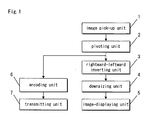
- Fig. 1 is a block diagram, illustrating a cell-phone type moving picture communication apparatus according to a first embodiment of the present invention.
- the moving picture communication apparatus includes an image pick-up unit 1, a pivoting unit 2, a rightward-leftward inverting unit 3, a downsizing unit 4, an image-displaying unit 5, an encoding unit 6, and a transmitting unit 7.
- the image pick-up unit 1 includes a camera or equivalent for generating self-picture information.
- Fig. 2 is a descriptive illustration, showing how the pivoting unit 2 of Fig. 1 works.
- Fig. 2 (a) illustrates a step in which the pivoting unit 2 does not pivot the self-picture information.
- Fig. 2 (b) illustrates another step in which the pivoting unit 2 pivots the self-picture information.
- Fig. 2 (c) illustrates results from the step in which the pivoting unit 2 pivots the self-picture information.
- the cell-phone type moving picture communication apparatus 10 includes a camera 12 and an image display 11.
- the image display 11 has an aspect ratio defined by different vertical and horizontal lengths in which the vertical length is greater than the other.
- the image-displaying unit 5 of Fig. 1 includes the image display 11.
- the image pick-up unit 1 of Fig. 1 includes the camera 12.
- self-picture information "G" a user's moving image picked up by the camera 12, is encoded without being pivoted by the pivoting unit 2.
- the encoded self-picture information "G” is sent to a cell-phone type moving picture communication apparatus that is carried with a user's party.
- the reason why the self-picture information "G" need not be pivoted is that the self-picture information "G” is properly oriented with reference to the vertical axis of the earth.
- the pivoting unit 2 pivots the user's self-picture information in a direction responsive to the direction in which the user's communication apparatus 10 is pivoted.
- rightward and leftward refer to rightward and leftward directions of the communication apparatus 10 when the user faces the image display 11, respectively.
- Fig. 2 (b) the user's moving image is picked up using the moving picture communication apparatus 10 that has been pivoted leftward at a right angle, thereby providing self-picture information "H”.
- the pivoting unit 2 pivots the self-picture information "H” rightward at a right angle, thereby providing self-picture information "J”.
- the self-picture information "H” has a user's self-picture leftward pivoted at an angle of 90 degrees.
- Such a pivoted self-picture is obviously improperly oriented with respect to the vertical axis of the earth. Therefore, as illustrated in Fig. 2 (c), the improperly oriented self-picture is pivoted in an attempt to be directed properly with respect to the vertical axis of the earth.
- the self-picture information "J" containing such a properly oriented self-picture is provided.
- the pivoting unit 2 pivots the self-picture information "H" in response to self-picture pivoting instructions from the user. Therefore, the self-picture pivoting is not limited to cases where the moving picture communication apparatus 10 is pivoted either rightward or leftward at a right angle.
- the self-picture pivoting instructions are entered to the user's cell-phone type moving picture communication apparatus 10 in order to start pivoting the self-picture information "H" when the user's communication apparatus 10 is pivoted either rightward or leftward at an angle of 90 degrees according to a user's sense of pivotal angle.
- the moving picture communication apparatus 10 may be provided with an angle sensor for permitting the pivoting unit 2 to pivot the self-picture information "H" when the communication apparatus 10 is pivoted either leftward or rightward at an angle of 90 degrees.
- a pivotal angle of the moving picture communication apparatus 10 is not limited to 90 degrees, but may be confined to a wider range of angles.
- the pivotal angle of the communication apparatus 10 is set to be 90 degrees or otherwise a predetermined range of angles including 90 degrees.
- the user's self-picture information pivoted by the pivoting unit 2 is delivered to both of the encoding unit 6 and the rightward-leftward inverting unit 3.
- the self-picture information "J" pivoted as illustrated in Fig. 2 (c) is brought to the encoding unit 6 and the leftward-rightward inverting unit 3.
- the encoding unit 6 encodes the pivoted self-picture information.
- the encoded self-picture information is carried to the transmitting unit 7.
- the transmitting unit 7 transmits the encoded self-picture information to the party's cell-phone type moving picture communication apparatus.
- the rightward-leftward inverting unit 3 pivots the self-picture information that has been pivoted by the pivoting unit 2.
- the self-picture information is turned at a right angle in a direction opposite to the direction in which the pivoting unit 2 pivots the self-picture information.
- the rightward-leftward inverting unit 3 pivots the self-picture information "J" of Fig. 2 (c) leftward at an angle of 90 degrees.
- the rightward-leftward inverting unit 3 inverts the self-picture information that has just been pivoted by the rightward-leftward inverting unit 3, in order to provide a mirror image of the self-picture information.
- the inverted self-picture information is brought to the downsizing unit 4.
- the downsizing unit 4 downsizes the inverted self-picture information in order to match in size with a subsidiary image display on the image display 11.
- the downsized self-picture information is carried to the image-displaying unit 5.
- the image-displaying unit 5 displays the downsized user's self-picture information on the image display 11.
- the rightward-leftward inverting unit 3 pivots the user's self-picture information that has been pivoted by the pivoting unit 2.
- the user's self-picture information is inverted to provide a mirror image thereof without being pivoted by the rightward-leftward inverting unit 3 and subsequently the inverted self-picture information is downsized, then the user's self-picture information that has been pivoted either leftward or rightward at a right angle and further that is improperly oriented with reference to the vertical axis of the earth is displayed on the user's cell-type phone moving picture communication apparatus 10.
- the cell-phone type moving picture communication apparatus 10 includes a receiving unit for receiving encoded party's picture information from the party's moving picture communication apparatus, and a decoding unit for decoding the encoded party's picture information.
- the image-displaying unit 5 displays the decoded party's picture information on the image display 11.
- the party's picture information can typically be displayed on the vertically positioned cell-phone type moving picture communication apparatus.
- the enlarged party's picture information can be displayed on the horizontally positioned cell-phone type moving picture communication apparatus.
- the cell-phone type moving picture communication apparatus 10 includes a function of communicating oral information other than the function of communicating the moving picture information.
- Fig. 3 illustrates, by way of illustration, how the user's cell-phone type moving picture communication apparatus according to the present embodiment is used to communicate with the party's communication apparatus.
- the same components as those of Fig. 2 are identified by the same reference characters.
- the party's cell-phone type moving picture communication apparatus 20 includes a camera 22 and an image display 21 as well.
- the user's cell-phone type moving picture communication apparatus 10 When the user's communication apparatus 10 is pivoted leftward at a right angle, then the user's cell-phone type moving picture communication apparatus 10 enlarges and pivots party's picture information at a right angle upon receipt of the party's picture information, which is transmitted from the party's cell-phone type moving picture communication apparatus 20.
- the enlarged and pivoted party's picture information is displayed as party's picture information "A" on the image display 11 of the user's cell-phone type moving picture communication apparatus 10.
- the camera 12 on the user's communication apparatus 10 picks up the user's moving image, thereby producing user's self-picture information.
- the pivoting unit 2 pivots the self-picture information.
- the pivoted self-picture information is delivered to both of the encoding unit 6 and the rightward-leftward inverting unit 3.
- the encoding unit 6 encodes the self-picture information that has been pivoted by the pivoting unit 2.
- the transmitting unit 7 sends the encoded self-picture information to the party's moving picture communication apparatus 20.
- the user's self-picture information transmitted from the user's moving picture communication apparatus 10 is displayed as party's picture information "a" on the image display 21 of the party's moving picture communication apparatus 20.
- the rightward-leftward inverting unit 3 pivots the user's self-picture information that has been pivoted by the pivoting unit 2, thereby turning the user's self-picture information at a right angle in a direction opposite to the direction in which the pivoting unit 2 pivots the user's self-picture information.
- the rightward-leftward inverting unit 3 inverts the user's self-picture information that has just been pivoted by the rightward-leftward inverting unit 3, thereby providing a mirror image of the user's self-picture information.
- the downsizing unit 4 downsizes the inverted user's self-picture information.
- the image-displaying unit 5 displays the inverted and downsized user's self-picture information as user's self-picture information "B" on the image display 11 of the user's communication apparatus 10.
- the party's communication apparatus 20 has downsized party's self-picture information "b" displayed on the image display 21.
- This system allows moving picture information properly positioned with reference to the vertical axis of the earth to be displayed on the party's cell-phone type moving picture communication apparatus 20.
- the downsized user's self-picture information derived from the user's self-picture information to be sent to the party's communication apparatus 20 is displayed on the image display 11 of the user's communication apparatus 10. This system permits moving picture communication to be held while the user's self-picture information to be sent to the party's communication apparatus 20 is checked to see how it looks like.
- a pair of vertically positioned cell-phone type moving picture communication apparatus as illustrated in Figs. 10 (a) as well as a pair of horizontally positioned communication apparatus as illustrated in Fig. 10 (b) may be used to communicate with one another when the cell-phone type moving picture communication apparatus 10 according to the present embodiment is used to provide TV phone-to-TV phone communication.
- the pivoting unit 2 does not pivot the self-picture information.
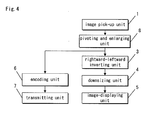
- Fig. 4 is a block diagram, illustrating a cell-phone type moving picture communication apparatus according to a second embodiment.
- the moving picture communication apparatus has a pivoting and enlarging unit 8 substituted for the pivoting unit 2 according to the previous embodiment.
- the other components of the moving picture communication apparatus according to the present embodiment are similar to those of the cell-phone type moving picture communication apparatus of Fig. 1 according to the previous embodiment, and descriptions related thereto are herein omitted.
- Fig. 5 is a descriptive illustration, showing how the pivoting and enlarging unit 8 of Fig. 4 operates.
- Fig. 5 presupposes that a display size has an aspect ratio of Y:X.
- Fig. 5 (a) illustrates user's self-picture information produced using the user's moving picture communication apparatus that has been pivoted leftward at a right angle as illustrated in Fig. 2(b).
- the self-picture information has an aspect ratio of Y:X.
- the pivoting and enlarging unit 8 pivots the user's self-picture information by an angle of 90 degrees.
- Fig. 5 (b) illustrates the pivoted user's self-picture information.
- the pivoting and enlarging unit 8 enlarges part of the 90-degree pivoted self-picture information in accordance with the aspect ratio (Y:X) of the display size.
- the pivoting and enlarging unit 8 enlarges part of the self-picture information as defined by a bold line having an aspect ratio of x:y (see Fig. 5 (b)) in such a manner that the variables y, x are equal to Y and X, respectively.
- Fig. 5 (c) illustrates enlarged self-picture information that results from the above-described enlarging step as shown in Fig. 5 (b) using the pivoting and enlarging unit 8.
- pivoting and enlarging steps as discussed above may be taken either in this order or in opposite order.
- the encoding unit 6 encodes the enlarged and pivoted self-picture information.
- the transmitting unit 7 transmits the encoded self-picture information to the party's moving picture communication apparatus.
- the rightward-leftward inverting unit 3 pivots the enlarged and pivoted self-picture information as well as inverting the enlarged and pivoted self-picture information in order to provide a mirror image of the self-picture information.
- the downsizing unit 4 downsizes the pivoted and inverted self-picture information.
- the image-displaying unit 5 displays the downsized self-picture information on the image display of the user's moving picture communication apparatus.
- the party's picture information enlarged and pivoted at a right angle is displayed on the image display of the user's cell-phone type moving picture communication apparatus that has been pivoted at a right angle in an either leftward or rightward direction of the same communication apparatus when the user faces the image display, then the user's self-picture information enlarged and pivoted by the pivoting and enlarging unit 8 is transmitted to the party's cell-phone type moving picture communication apparatus.
- This system allows moving image information properly positioned with reference to the vertical axis of the earth to be displayed on the party's cell-phone type moving picture communication apparatus, and further allows the user's self-picture information in compliance with a display size of the party's cell-phone type moving picture communication apparatus to be transmitted to the party's moving picture communication apparatus.
- the downsized self-picture information resulting from the user's self-picture information to be sent to the party's cell-phone type moving picture communication apparatus is displayed on the image display of the user's cell-phone type moving picture communication apparatus.
- This system permits moving picture communication to be held while the user's self-picture information to be sent to the party' communication apparatus is checked to see how it looks like.
- Fig. 6 is a block diagram, illustrating a cell-phone type moving picture communication apparatus according to a third embodiment.
- the moving picture communication apparatus includes an image-plotting unit 9 in addition to the components of Fig. 1 according to the first embodiment. Since the other components of the moving picture communication apparatus according to the present embodiment are similar to those of the cell-phone type moving picture communication apparatus of Fig.1 according to the first embodiment, description related thereto are omitted.
- a pivoting unit 2 pivots user's self-picture information produced by an image pick-up unit 1.
- the pivoted self-picture information is delivered to both of the image-plotting unit 9 and a rightward-leftward inverting unit 3.
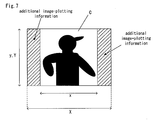
- Fig. 7 is a descriptive illustration, showing how the image-plotting unit 9 of Fig. 6 works.
- a display size has an aspect ratio of Y:X.
- the image-plotting unit 9 provides additional image-plotting information (see hatched lines) to pivoted user's self-picture information "C".
- the image-plotting unit 9 is designed to add various pieces of information such as figure information and character information by way of added image-plotting information.
- an encoding unit 6 encodes the user's self-picture information that has the additional image-plotting information provided thereto by the image-plotting unit 9.
- a transmitting unit 7 transmits the encoded self-picture information to a cell-phone type moving picture communication apparatus of the user's party.
- the rightward-leftward inverting unit 3 pivots the pivoted user's self-picture information as well as inverting the pivoted user's self-picture information in order to provide a mirror image of the pivoted self-picture information.
- a downsizing unit 4 downsizes the inverted and pivoted self-picture information.
- An image-displaying unit 5 displays the downsized self-picture information on the image display of the user's cell-phone type moving picture communication apparatus.
- the party's picture information enlarged and pivoted at a right angle is displayed on the image display of the user's cell-phone type moving picture communication apparatus that has been pivoted at a right angle in an either leftward or rightward direction of the same communication apparatus when the user faces the image display, then the user's self-picture information pivoted by the pivoting unit 2 is transmitted to the party's cell-phone type moving picture communication apparatus.
- This system allows moving picture information properly oriented with respect to the vertical axis of the earth to be displayed on the party's moving picture communication apparatus.
- the image-plotting unit 9 provides additional image-plotting information to the user's self-picture information.
- This system allows other information such as character information in addition to moving pictures to be transmitted to the party's cell-phone type moving picture communication apparatus.
- the downsized self-picture information derived from the user's self-picture information to be sent to the party's moving picture communication apparatus is displayed on the image display of the user's moving picture communication apparatus.
- This system permits moving picture communication to be held while the user's self-picture information to be sent to the party's communication apparatus is checked to see how it looks like.
- the image pick-up unit 1 produces a square of self-picture information.
- the square of self-picture information is carried to the pivoting unit 2.
- the other steps are similar to those of Fig. 6 according to present embodiment.
- the term "square of self-picture information" refers to self-picture information "C" having an aspect ratio of y:x equivalent to 1:1, respectively.
- the present variation requires at least only a square as an area that contains a moving image (or rather a self-picture) to be picked up, even with moving picture communication environments in which moving picture information having an aspect ratio defined by different vertical and horizontal lengths is communicated.
- This feature is realized by the addition of image-plotting information.
- the image pick-up unit 1 can include a reduced capacity of memory.
- the square of self-picture information provides simplified coordinate calculation for use in pivoting the self-picture information. This feature allows the pivoting unit 2 to pivot the self-picture information in a simplified manner and allows the self-picture information to be processed at steps that requires less man-hour rates.
- a cell-phone type moving picture communication apparatus is entirely similar in structure to that of Fig. 6 according to the third embodiment. Therefore, the moving picture communication apparatus according to the present embodiment is now described with reference to Fig. 6.
- the moving picture communication apparatus differs from that according to the third embodiment in that the image-plotting unit 9 provides additional image-plotting information to self-picture information other than when an enlarged picture of a user's party is displayed on the pivoted cell-phone type moving picture communication apparatus of a user.
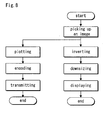
- Fig. 8 is a flowchart, illustrating the steps to be taken in the user's communication apparatus according to the present embodiment, which is non-pivoted at a right angle either in a rightward or leftward direction of the same communication apparatus when the user faces the image display of the user's communication apparatus.
- an image pick-up unit1 produces user's self-picture information.
- the self-picture information is delivered to both an image-plotting unit 9 and a rightward-leftward inverting unit 3.
- the image-plotting unit 9 removes part of the self-picture information produced by the image pick-up unit 1, and then provides additional image-plotting information to the self-picture information.
- the image-plotting unit 9 is designed to add various pieces of information such as figure information and character information as added image-plotting information.
- the image-plotting unit 9 provides additional image-plotting information to the self-picture information on both sides thereof, or alternatively on only either side thereof.
- the image-plotting unit 9 is free to add different amounts of additional image-plotting information to the self-picture information.
- the image-plotting unit 9 varies the amount of additional image-plotting information in response to a communication state. More specifically, when a poor moving picture communication state reduces communication data speeds, then the image-plotting unit 9 provides an increased amount of additional image-plotting information to the self-picture information. This means that a stationary picture area is increased, while a moving picture area or rather the self-picture information is further decreased.
- This system makes it feasible to reduce the resulting coding amount when an interframe predictive coding system is used.
- the user's self-picture information can be transmitted to the party's cell-hone type moving picture communication apparatus while the number of frames to be transferred per second is retained.
- moving pictures whose quality is retained to a certain level can be transmitted to the party's cell-phone type moving picture communication apparatus.
- the user's self-picture information having the additional image-plotting information provided thereto is delivered to the encoding unit 6.
- the encoding unit 6 encodes the self-picture information having the additional image-plotting information carried thereon.
- the encoded self-picture information is brought to the transmitting unit 7.
- the transmitting unit 7 transmits the encoded user's self-picture information to the party's cell-phone type moving picture communication apparatus.
- the rightward-leftward inverting unit 3 inverts the user's self-picture information that is produced by the image pick-up unit 1, thereby providing a mirror image of the self-picture information.
- the inverted self-picture information is delivered to the downsizing unit 4.
- the downsizing unit 4 downsizes the inverted self-picture information so as to match in size with a subsidiary image display on the user's moving picture communication apparatus.
- the downsized user's self-picture information is carried to the image-displaying unit 5.
- the image-displaying unit 5 displays the downsized user's self-picture information on the image display of the user's cell-phone type moving picture communication apparatus.
- This system allows moving picture information properly oriented with respect to the vertical axis of the earth to be displayed on the party's communication apparatus.
- the image-plotting unit 9 is designed to provide additional image-plotting information to the user's self-picture information, regardless of whether the user's cell-phone type moving picture communication apparatus is pivoted. This feature allows the user's self-picture information to be transmitted to the party's communication apparatus in the same form between when the user's moving picture communication apparatus is pivoted to communicate with the party's communication apparatus and when the user's communication apparatus is non-pivoted to communicate therewith.
- the self-picture information having additional image-plotting information provided thereto at both sides thereof can be transmitted to the party's communication apparatus when the user's moving picture communication apparatus is pivoted to communicate with the party's communication apparatus and when the user's communication apparatus is non-pivoted to communicated therewith.
- the image-plotting unit 9 is capable of providing different amounts of image-plotting information to the self-picture information in accordance with a communication state.
- the image-plotting unit 9 When a bad moving picture communication status reduces communication data speeds, then the image-plotting unit 9 provides a different amount of image-plotting information to the self-picture information, thereby further reducing a moving picture area. The reduction in moving picture area decreases the resulting coding amount. As a result, the user's self-picture information can be transmitted to the party's communication apparatus while the number of frames to be transferred per second is retained.
- the downsized self-picture information derived from the user's self-picture information to be sent to the party's moving picture communication apparatus is displayed on the image display of the user's cell-phone type moving picture communication apparatus This system allows moving picture communication to be held while the user's self-picture information to be sent to the party's communication apparatus is checked to see how it looks like.
- the image pick-up unit 1 produces a square of self-picture information.
- the first variation requires at least only a square as an area that contains a moving image (or rather a self-picture) to be picked up, even with moving picture communication environments in which moving picture information having an aspect ratio defined by different vertical and horizontal lengths is communicated.
- This feature is realized by the addition of image-plotting information.
- the image pick-up unit 1 can include a reduced capacity of memory.
- the square of self-picture information provides simplified coordinate calculation for use in pivoting the self-picture information. This feature allows the pivoting unit 2 to pivot the self-picture information in a simplified manner, and allows the self-picture information to be processed at steps that require less man-hour rates.
- a second variation of the cell-phone type moving picture communication apparatus according to the present embodiment is now described.
- the second variation deletes the pivoting unit 2 from the cell-phone type moving picture communication apparatus according to the present embodiment.
- the self-picture information produced by the image pick-up unit 1 is always brought to both of the image-plotting unit 9 and the rightward-leftward inverting unit 3.
- the second variation also provides beneficial effects based on the image-plotting unit 9 in a manner similar to the way in which the cell-phone type moving picture communication apparatus according to the present embodiment provides beneficial effects.
Landscapes
- Engineering & Computer Science (AREA)
- Multimedia (AREA)
- Signal Processing (AREA)
- Two-Way Televisions, Distribution Of Moving Picture Or The Like (AREA)
- Studio Circuits (AREA)
- Image Processing (AREA)
- Mobile Radio Communication Systems (AREA)
Applications Claiming Priority (2)
| Application Number | Priority Date | Filing Date | Title |
|---|---|---|---|
| JP2001300990A JP2003111040A (ja) | 2001-09-28 | 2001-09-28 | 動画像通信方法及び動画像通信装置 |
| JP2001300990 | 2001-09-28 |
Publications (2)
| Publication Number | Publication Date |
|---|---|
| EP1298925A2 true EP1298925A2 (fr) | 2003-04-02 |
| EP1298925A3 EP1298925A3 (fr) | 2004-04-07 |
Family
ID=19121473
Family Applications (1)
| Application Number | Title | Priority Date | Filing Date |
|---|---|---|---|
| EP02020304A Withdrawn EP1298925A3 (fr) | 2001-09-28 | 2002-09-11 | Méthode et appareil de communication d'images animées |
Country Status (4)
| Country | Link |
|---|---|
| US (1) | US6833857B2 (fr) |
| EP (1) | EP1298925A3 (fr) |
| JP (1) | JP2003111040A (fr) |
| CN (1) | CN1409555A (fr) |
Cited By (4)
| Publication number | Priority date | Publication date | Assignee | Title |
|---|---|---|---|---|
| EP1549067A3 (fr) * | 2003-12-26 | 2005-10-12 | Lg Electronics Inc. | Appareil de communication mobile avec capacité améliorée pour la communication d'image. |
| US9065997B2 (en) | 2004-07-27 | 2015-06-23 | Lg Electronics Inc. | Image signal processing apparatus and method thereof in mobile communications terminal |
| EP2811739A4 (fr) * | 2012-02-03 | 2016-01-20 | Samsung Sds Co Ltd | Terminal, serveur de commande de communication d'image et système ainsi que procédé de communication d'image l'utilisant |
| EP3082336A4 (fr) * | 2013-12-31 | 2017-01-11 | Huawei Technologies Co., Ltd. | Procédé et dispositif d'adaptation à un changement d'orientation d'écran pendant un appel vidéo |
Families Citing this family (24)
| Publication number | Priority date | Publication date | Assignee | Title |
|---|---|---|---|---|
| JP4346925B2 (ja) * | 2003-02-25 | 2009-10-21 | キヤノン株式会社 | 表示装置、表示装置の制御方法、プログラム及びコンピュータ読み取り可能な記録媒体 |
| JP2004333957A (ja) * | 2003-05-09 | 2004-11-25 | Hitachi Ltd | 携帯端末 |
| JP2004363892A (ja) * | 2003-06-04 | 2004-12-24 | Canon Inc | 携帯機器 |
| EP1704156A1 (fr) * | 2003-11-25 | 2006-09-27 | Platco Technologies (Proprietary) Limited | Complexes de platine-ii, preparation et utilisation |
| AU2007201325B2 (en) * | 2003-12-26 | 2010-07-22 | Lg Electronics Inc | Mobile communication device with enhanced image communication capability |
| USD509496S1 (en) * | 2004-06-11 | 2005-09-13 | Robert J. Petcavich | Handheld wireless videoconferencing device |
| KR100608835B1 (ko) * | 2004-12-09 | 2006-08-08 | 엘지전자 주식회사 | 휴대단말기의 이미지 전송방법 |
| KR100703364B1 (ko) * | 2005-01-10 | 2007-04-03 | 삼성전자주식회사 | 화상 통화 이미지 출력 방법 |
| KR100606744B1 (ko) * | 2005-05-17 | 2006-08-01 | 엘지전자 주식회사 | 정지화상 디스플레이 기능을 갖는 이동통신 단말기 및 이를이용한 정지화상 디스플레이 방법 |
| US8081684B2 (en) * | 2005-08-19 | 2011-12-20 | Qualcomm Incorporated | Picture-in-picture processing for video telephony |
| US7822338B2 (en) * | 2006-01-20 | 2010-10-26 | Sony Ericsson Mobile Communications Ab | Camera for electronic device |
| TWI313426B (en) * | 2006-06-13 | 2009-08-11 | Sunplus Technology Co Ltd | Method for screen browsing and portable electronic device using the same |
| KR101387479B1 (ko) * | 2007-03-16 | 2014-04-21 | 엘지전자 주식회사 | 이동통신 단말기의 화상 처리방법 및 이동통신 단말기 |
| US8994731B2 (en) * | 2007-12-19 | 2015-03-31 | Temporal Llc | Apparatus, system, and method for organizing information by time and place |
| US8520979B2 (en) * | 2008-08-19 | 2013-08-27 | Digimarc Corporation | Methods and systems for content processing |
| US20100312630A1 (en) * | 2009-06-08 | 2010-12-09 | Tammy Krutchik | Method and system for transmitting and redeeming electronic coupons through use of mobile device |
| KR20110090164A (ko) * | 2010-02-03 | 2011-08-10 | 삼성전자주식회사 | 영상 데이터 송신 방법, 그리고 이를 이용한 디스플레이 장치 및 디스플레이 방법 |
| US8824806B1 (en) * | 2010-03-02 | 2014-09-02 | Amazon Technologies, Inc. | Sequential digital image panning |
| JP5740972B2 (ja) * | 2010-09-30 | 2015-07-01 | ソニー株式会社 | 情報処理装置および情報処理方法 |
| KR101852433B1 (ko) * | 2012-02-07 | 2018-04-26 | 엘지전자 주식회사 | 이동 단말기 및 그것의 제어방법 |
| JP2013183389A (ja) * | 2012-03-04 | 2013-09-12 | Yoozma Corp | 縦横変換機能付きエリア放送システム及び放送送出装置 |
| CN106027910B (zh) * | 2013-01-22 | 2019-08-16 | 华为终端有限公司 | 预览画面呈现方法、装置及终端 |
| JP2017092558A (ja) * | 2015-11-04 | 2017-05-25 | シャープ株式会社 | 通信装置およびプログラム |
| JP7117521B2 (ja) * | 2018-03-14 | 2022-08-15 | パナソニックIpマネジメント株式会社 | 携帯端末、画像送信方法、およびプログラム |
Family Cites Families (7)
| Publication number | Priority date | Publication date | Assignee | Title |
|---|---|---|---|---|
| JP3603409B2 (ja) | 1995-09-19 | 2004-12-22 | 松下電器産業株式会社 | 画像通信装置 |
| EP1071285A1 (fr) * | 1999-07-19 | 2001-01-24 | Texas Instruments Inc. | Compensation verticale dans une caméra en mouvement |
| JP2001054084A (ja) * | 1999-08-09 | 2001-02-23 | Matsushita Electric Ind Co Ltd | テレビ電話装置 |
| JP4697500B2 (ja) * | 1999-08-09 | 2011-06-08 | ソニー株式会社 | 送信装置および送信方法、受信装置および受信方法、並びに記録媒体 |
| JP2001136500A (ja) * | 1999-11-05 | 2001-05-18 | Matsushita Electric Ind Co Ltd | 画像通信装置及び画像通信方法 |
| US7046287B2 (en) * | 1999-12-24 | 2006-05-16 | Nec Corporation | Portable information terminal equipped with camera |
| JP2001197462A (ja) * | 2000-01-17 | 2001-07-19 | Nec Corp | テレビ電話装置及びそれを備えるテレビ電話システム |
-
2001
- 2001-09-28 JP JP2001300990A patent/JP2003111040A/ja active Pending
-
2002
- 2002-09-11 EP EP02020304A patent/EP1298925A3/fr not_active Withdrawn
- 2002-09-27 CN CN02144421A patent/CN1409555A/zh active Pending
- 2002-09-30 US US10/259,875 patent/US6833857B2/en not_active Expired - Fee Related
Cited By (8)
| Publication number | Priority date | Publication date | Assignee | Title |
|---|---|---|---|---|
| EP1549067A3 (fr) * | 2003-12-26 | 2005-10-12 | Lg Electronics Inc. | Appareil de communication mobile avec capacité améliorée pour la communication d'image. |
| US7499074B2 (en) | 2003-12-26 | 2009-03-03 | Lg Electronics Inc | Mobile communication device with enhanced image communication capability |
| US8032177B2 (en) | 2003-12-26 | 2011-10-04 | Lg Electronics Inc. | Mobile communication device with enhanced image communication capability |
| US8115798B2 (en) | 2003-12-26 | 2012-02-14 | Lg Electronics Inc. | Mobile communication device with enhanced image communication capability |
| US9065997B2 (en) | 2004-07-27 | 2015-06-23 | Lg Electronics Inc. | Image signal processing apparatus and method thereof in mobile communications terminal |
| EP2811739A4 (fr) * | 2012-02-03 | 2016-01-20 | Samsung Sds Co Ltd | Terminal, serveur de commande de communication d'image et système ainsi que procédé de communication d'image l'utilisant |
| US9307194B2 (en) | 2012-02-03 | 2016-04-05 | Samsung Sds Co., Ltd. | System and method for video call |
| EP3082336A4 (fr) * | 2013-12-31 | 2017-01-11 | Huawei Technologies Co., Ltd. | Procédé et dispositif d'adaptation à un changement d'orientation d'écran pendant un appel vidéo |
Also Published As
| Publication number | Publication date |
|---|---|
| CN1409555A (zh) | 2003-04-09 |
| US20030112358A1 (en) | 2003-06-19 |
| EP1298925A3 (fr) | 2004-04-07 |
| JP2003111040A (ja) | 2003-04-11 |
| US6833857B2 (en) | 2004-12-21 |
Similar Documents
| Publication | Publication Date | Title |
|---|---|---|
| US6833857B2 (en) | Moving picture communication method and apparatus | |
| US6593955B1 (en) | Video telephony system | |
| US7313418B2 (en) | Portable device | |
| EP2811739B1 (fr) | Terminal, serveur de commande de communication d'image et système ainsi que procédé de communication d'image l'utilisant | |
| US6850267B2 (en) | Video telephone system and terminal device therefor | |
| EP1148725A2 (fr) | Visiophone avec protection de la confidentialité | |
| US20050146621A1 (en) | Digital camera system, image storage apparatus, and digital camera | |
| US20040001091A1 (en) | Method and apparatus for video conferencing system with 360 degree view | |
| JP4448177B2 (ja) | Tv電話機能の撮影画像処理切り替え装置 | |
| US20020122605A1 (en) | Visual terminal apparatus having a pseudo background function and method of obtaining the same | |
| JPH0851611A (ja) | 画像処理装置および画像処理方法 | |
| US8717410B2 (en) | Video communication method, apparatus, and system | |
| US7646929B2 (en) | Signal-transmitting system, data-transmitting apparatus and data-receiving apparatus | |
| JP6004978B2 (ja) | 被写体画像抽出装置および被写体画像抽出・合成装置 | |
| US20230140114A1 (en) | Removing reflected information from within a video capture feed during a videoconference | |
| CN117546460A (zh) | 3d图像数据流的交互式处理 | |
| JPH04120889A (ja) | テレビ電話装置 | |
| KR101887380B1 (ko) | 복수 개의 카메라를 이용한 촬영 이미지의 전송 및 처리를 위한 장치 및 방법 | |
| KR20120078649A (ko) | 카메라를 구비한 휴대용 영상 통화 장치 및 그 방법 | |
| JP2006148767A (ja) | 映像配信システム、映像配信装置、映像受信装置、映像配信装置の通信方法、映像受信装置の表示方法、プログラム、及び記憶媒体 | |
| JP3072901B2 (ja) | 静止画伝送機 | |
| JP2001008231A (ja) | 3次元空間における物体の多視点画像伝送方法及びシステム | |
| JPH0316390A (ja) | 画像伝送装置 | |
| KR101328932B1 (ko) | 화상 통신용 단말기, 화상 데이터 전송방법 및 화상 데이터처리방법 | |
| KR100298185B1 (ko) | 동영상통신시스템에서의동영상통신방법 |
Legal Events
| Date | Code | Title | Description |
|---|---|---|---|
| PUAI | Public reference made under article 153(3) epc to a published international application that has entered the european phase |
Free format text: ORIGINAL CODE: 0009012 |
|
| AK | Designated contracting states |
Kind code of ref document: A2 Designated state(s): AT BE BG CH CY CZ DE DK EE ES FI FR GB GR IE IT LI LU MC NL PT SE SK TR Designated state(s): AT BE BG CH CY CZ DE DK EE ES FI FR GB GR IE IT LI LU MC NL PT SE SK TR |
|
| AX | Request for extension of the european patent |
Extension state: AL LT LV MK RO SI |
|
| PUAL | Search report despatched |
Free format text: ORIGINAL CODE: 0009013 |
|
| AK | Designated contracting states |
Kind code of ref document: A3 Designated state(s): AT BE BG CH CY CZ DE DK EE ES FI FR GB GR IE IT LI LU MC NL PT SE SK TR |
|
| AX | Request for extension of the european patent |
Extension state: AL LT LV MK RO SI |
|
| 17P | Request for examination filed |
Effective date: 20040623 |
|
| AKX | Designation fees paid |
Designated state(s): DE FR GB |
|
| 17Q | First examination report despatched |
Effective date: 20041202 |
|
| STAA | Information on the status of an ep patent application or granted ep patent |
Free format text: STATUS: THE APPLICATION IS DEEMED TO BE WITHDRAWN |
|
| 18D | Application deemed to be withdrawn |
Effective date: 20050413 |