EP1298929A2 - Commande à distance d'un systéme d'affichage - Google Patents
Commande à distance d'un systéme d'affichage Download PDFInfo
- Publication number
- EP1298929A2 EP1298929A2 EP01128525A EP01128525A EP1298929A2 EP 1298929 A2 EP1298929 A2 EP 1298929A2 EP 01128525 A EP01128525 A EP 01128525A EP 01128525 A EP01128525 A EP 01128525A EP 1298929 A2 EP1298929 A2 EP 1298929A2
- Authority
- EP
- European Patent Office
- Prior art keywords
- video signal
- graphics data
- target
- recited
- display
- Prior art date
- Legal status (The legal status is an assumption and is not a legal conclusion. Google has not performed a legal analysis and makes no representation as to the accuracy of the status listed.)
- Withdrawn
Links
Images



Classifications
-
- H—ELECTRICITY
- H04—ELECTRIC COMMUNICATION TECHNIQUE
- H04N—PICTORIAL COMMUNICATION, e.g. TELEVISION
- H04N21/00—Selective content distribution, e.g. interactive television or video on demand [VOD]
- H04N21/80—Generation or processing of content or additional data by content creator independently of the distribution process; Content per se
- H04N21/81—Monomedia components thereof
- H04N21/8146—Monomedia components thereof involving graphical data, e.g. 3D object, 2D graphics
-
- H—ELECTRICITY
- H04—ELECTRIC COMMUNICATION TECHNIQUE
- H04N—PICTORIAL COMMUNICATION, e.g. TELEVISION
- H04N21/00—Selective content distribution, e.g. interactive television or video on demand [VOD]
- H04N21/20—Servers specifically adapted for the distribution of content, e.g. VOD servers; Operations thereof
- H04N21/23—Processing of content or additional data; Elementary server operations; Server middleware
- H04N21/234—Processing of video elementary streams, e.g. splicing of video streams or manipulating encoded video stream scene graphs
- H04N21/2343—Processing of video elementary streams, e.g. splicing of video streams or manipulating encoded video stream scene graphs involving reformatting operations of video signals for distribution or compliance with end-user requests or end-user device requirements
- H04N21/234318—Processing of video elementary streams, e.g. splicing of video streams or manipulating encoded video stream scene graphs involving reformatting operations of video signals for distribution or compliance with end-user requests or end-user device requirements by decomposing into objects, e.g. MPEG-4 objects
-
- H—ELECTRICITY
- H04—ELECTRIC COMMUNICATION TECHNIQUE
- H04N—PICTORIAL COMMUNICATION, e.g. TELEVISION
- H04N21/00—Selective content distribution, e.g. interactive television or video on demand [VOD]
- H04N21/40—Client devices specifically adapted for the reception of or interaction with content, e.g. set-top-box [STB]; Operations thereof
- H04N21/41—Structure of client; Structure of client peripherals
- H04N21/426—Internal components of the client ; Characteristics thereof
-
- H—ELECTRICITY
- H04—ELECTRIC COMMUNICATION TECHNIQUE
- H04N—PICTORIAL COMMUNICATION, e.g. TELEVISION
- H04N21/00—Selective content distribution, e.g. interactive television or video on demand [VOD]
- H04N21/40—Client devices specifically adapted for the reception of or interaction with content, e.g. set-top-box [STB]; Operations thereof
- H04N21/43—Processing of content or additional data, e.g. demultiplexing additional data from a digital video stream; Elementary client operations, e.g. monitoring of home network or synchronising decoder's clock; Client middleware
- H04N21/431—Generation of visual interfaces for content selection or interaction; Content or additional data rendering
- H04N21/4312—Generation of visual interfaces for content selection or interaction; Content or additional data rendering involving specific graphical features, e.g. screen layout, special fonts or colors, blinking icons, highlights or animations
-
- H—ELECTRICITY
- H04—ELECTRIC COMMUNICATION TECHNIQUE
- H04N—PICTORIAL COMMUNICATION, e.g. TELEVISION
- H04N21/00—Selective content distribution, e.g. interactive television or video on demand [VOD]
- H04N21/40—Client devices specifically adapted for the reception of or interaction with content, e.g. set-top-box [STB]; Operations thereof
- H04N21/43—Processing of content or additional data, e.g. demultiplexing additional data from a digital video stream; Elementary client operations, e.g. monitoring of home network or synchronising decoder's clock; Client middleware
- H04N21/431—Generation of visual interfaces for content selection or interaction; Content or additional data rendering
- H04N21/4312—Generation of visual interfaces for content selection or interaction; Content or additional data rendering involving specific graphical features, e.g. screen layout, special fonts or colors, blinking icons, highlights or animations
- H04N21/4314—Generation of visual interfaces for content selection or interaction; Content or additional data rendering involving specific graphical features, e.g. screen layout, special fonts or colors, blinking icons, highlights or animations for fitting data in a restricted space on the screen, e.g. EPG data in a rectangular grid
-
- H—ELECTRICITY
- H04—ELECTRIC COMMUNICATION TECHNIQUE
- H04N—PICTORIAL COMMUNICATION, e.g. TELEVISION
- H04N21/00—Selective content distribution, e.g. interactive television or video on demand [VOD]
- H04N21/40—Client devices specifically adapted for the reception of or interaction with content, e.g. set-top-box [STB]; Operations thereof
- H04N21/43—Processing of content or additional data, e.g. demultiplexing additional data from a digital video stream; Elementary client operations, e.g. monitoring of home network or synchronising decoder's clock; Client middleware
- H04N21/436—Interfacing a local distribution network, e.g. communicating with another STB or one or more peripheral devices inside the home
- H04N21/4363—Adapting the video stream to a specific local network, e.g. a Bluetooth® network
- H04N21/43632—Adapting the video stream to a specific local network, e.g. a Bluetooth® network involving a wired protocol, e.g. IEEE 1394
-
- H—ELECTRICITY
- H04—ELECTRIC COMMUNICATION TECHNIQUE
- H04N—PICTORIAL COMMUNICATION, e.g. TELEVISION
- H04N21/00—Selective content distribution, e.g. interactive television or video on demand [VOD]
- H04N21/40—Client devices specifically adapted for the reception of or interaction with content, e.g. set-top-box [STB]; Operations thereof
- H04N21/43—Processing of content or additional data, e.g. demultiplexing additional data from a digital video stream; Elementary client operations, e.g. monitoring of home network or synchronising decoder's clock; Client middleware
- H04N21/442—Monitoring of processes or resources, e.g. detecting the failure of a recording device, monitoring the downstream bandwidth, the number of times a movie has been viewed, the storage space available from the internal hard disk
- H04N21/44231—Monitoring of peripheral device or external card, e.g. to detect processing problems in a handheld device or the failure of an external recording device
-
- H—ELECTRICITY
- H04—ELECTRIC COMMUNICATION TECHNIQUE
- H04N—PICTORIAL COMMUNICATION, e.g. TELEVISION
- H04N5/00—Details of television systems
- H04N5/44—Receiver circuitry for the reception of television signals according to analogue transmission standards
- H04N5/445—Receiver circuitry for the reception of television signals according to analogue transmission standards for displaying additional information
- H04N5/44504—Circuit details of the additional information generator, e.g. details of the character or graphics signal generator, overlay mixing circuits
Definitions
- the present invention relates generally to data exchange and processing thereof; more particularly, the present invention relates to a method and apparatus where a source delivers graphics data to a target, which receives and displays the graphics data, particularly where the source of the graphics data controls how the graphics data is to be displayed at the target.
- video signal receiver products may range from products that receive and process video signals only in analog form, to products that receive and process video signals in digital form, and to products that are capable of receiving and processing video signals in analog and digital form.
- Some products are equipped with other integrated features, e.g., recording capabilities, or the like.
- the available features for displaying e.g., picture-in-picture (PIP), picture-in-graphics (PIG), double screen, or the like
- PIP picture-in-picture
- PAG picture-in-graphics
- double screen or the like
- Video signals There are equally diverse products or sources for delivering the video signals, e.g., over-the-air broadcasting stations, cable operators, direct satellite services, live video feed services, or the like. Many of these sources send, in addition to the video signals, graphics data to be displayed at a receiver for providing programming guide, advertisement, value added services (e.g., stock quotes, news service, etc.), or the like.
- Graphics data can be in any visual form, e.g., a text, a still picture, an interactive menu screen, or the graphics data may itself be another video stream.
- FIG. 1A shows a conventional video/graphics data transmission and reception arrangement 100, where a source of video signal, an AV source 101 sends graphics data together with the video signal to a receiver product, e.g., an AV target 102.
- a receiver product e.g., an AV target 102.
- the graphics data and video signal are combined by a mixer 104 in the AV target 102, and the combined signal is sent to a display 103, which provides a display of the graphics data and/or the video to a viewer.
- the A/V target 102 since the A/V source 101 does not send information regarding how the video and graphics data are to be combined, the A/V target 102 must decide how the graphics data is to be displayed, particularly in relation to the video signal, which may be simultaneously displayed with the graphics data.
- the mixer 104 combines the received video signal and the graphics data without knowing how the source of the graphics data, e.g., the A/V source 101, intended to display the graphics data.
- the mixer 104 typically resorts to the most simple method of combining the two signals, e.g., simple overlaying, even if the A/V target 102 is capable of more advanced display features, e.g., the PIP, PIG, Double Screen, or the like.
- DTV digital television
- STB set-top-box
- IEEE1394 serial interface as specified by "IEEE 1394, Standard for High Performance Serial Bus", published 1995, which is incorporated herein by reference
- the DTV receives the graphics data and the video signal (i.e., an MPEG transport stream) from an STB.
- the transmission of the video signal and the graphics data is governed by standards, e.g., in the United States, The Electronics Industries Alliance (EIA) Standards, EIA-775-A, "DTV 1394 Interface Specification,” published April 2000, and/or EIA-799, "On Screen Display Specification,” published June 1999, both of which are incorporated herein by reference. Because these standards do not provide means for the STB to send control information with respect to the manner in which the graphics combined with the video signal or by itself are to be displayed, the task of deciding how the two displays are to be proportioned and combined with respect to each other is nevertheless still left up to the receiver product, i.e., the DTV.
- EIA Electronics Industries Alliance
- the existing standards at best provide overlaying the graphics data display over the video display by allowing specifications of "pixel definition," which may define the location, size, and gain factors of pixels for the graphics data, and thereby allow simultaneous display and blending of the two displays, i.e., by attenuating the graphics data so as to make the graphics data appear somewhat transparent in the foreground with the video display visible in the background.
- pixel definition may define the location, size, and gain factors of pixels for the graphics data, and thereby allow simultaneous display and blending of the two displays, i.e., by attenuating the graphics data so as to make the graphics data appear somewhat transparent in the foreground with the video display visible in the background.
- the pixel definition is part of the graphics data, and does not define the relationship between the video display and the graphics display.
- these conventional systems heretofore do not allow the source of the graphics data to specify how the video display is to be proportioned in relation to the graphics data display.
- the DTV in a conventional system typically performs a simple overlaying of one display, e.g., the graphics, over the other display, e.g., the video signal, and the graphics data/video signal is displayed as shown in Figs. 1A and 1B.
- the receiver product may display 105 only the graphics data over the entire screen as shown in Fig. 1B, or at best simultaneously display 106, 107 the graphics data and the video signal in a manner in which the graphics display covers, and thus, obscuring a portion of the video display as shown in Fig. 1C.
- the above-described conventional graphics/video transmission and display method and system do not utilize available display features of the receiver/display product, and thus, do not provide the most effective and the most user-friendly display of the graphics/video.
- the conventional method and system heretofore does not allow the source of the graphics data, which can determine a most desirable way in which the graphics data is to be displayed to specify how the graphics data display is to be proportioned with respect to the video display to be presented to a viewer.
- an apparatus transmitting a video signal and graphics data to a target device includes a controller generating a display control signal prescribing a manner in which said video signal is to be displayed in relation to said graphics data in a combined display and transmitting said display control signal to said target device, said combined display to be formed by combining said video signal and said graphics data at said target device based on said display control signal.
- an apparatus displaying a video signal and graphics data received from a source includes: a mixer combining said video signal and said graphics data to form a combined display; and a processing unit receiving a display control signal from said source, to control said mixer by prescribing a manner in which said video signal is to be displayed in relation to said graphics data in said combined display.
- a system displaying a video signal and graphics data includes: a source of said video signal and said graphics data, said source transmitting a display control signal prescribing a manner in which said video signal is to be displayed in relation to said graphics data; and a target receiving said video signal, said graphics signal, and said display control signal, and combining said video signal and said graphics data in said manner prescribed by said display control signal to form a combined display at said target.
- a method of transmitting a video signal and graphics data from a source to a target includes: sending a display control signal from said source to said target, said display control signal prescribing a manner in which said video signal is to be displayed in relation to said graphics data within a combined display formed by combining said video signal and said graphics data at said target.
- a computer readable storage medium having stored thereon a computer program for implementing a method of transmitting a video signal and graphics data from a source to a target, said computer program including a process of: sending a display control signal from said source to said target, said display control signal prescribing a manner in which said video signal is to be displayed in relation to said graphics data within a combined display formed by combining said video signal and said graphics data at said target.
- a source of a video signal may also send graphics data to be displayed together with the video signal to a target device.
- the graphics data represents information, which may be in any visual form, e.g., texts, still pictures, interactive menus, video streams, or the like, and may be related or unrelated to the video signal.
- the source of the video signal also sends control information relating to how the graphics data is to be displayed in relation to the display of the video signal.
- the video signal source may provide the relative sizes and proportions of the graphics data display and the video signal display in, e.g., a picture-in-graphics (PIG), a double screen display, or the like.
- POG picture-in-graphics
- the source may query the target for the display capabilities of the target, and, accordingly, send appropriate control signals that efficiently utilize the available display feature(s) of the target.
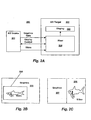
- Fig. 2A shows the relevant portions of a graphics data transmission/display system in accordance with an exemplary embodiment of the present invention.
- the graphics data transmission/display system 200 includes an A/V source 201, which provides the graphics data and the video signal to an A/V target 202 via any communication unit known to those in the art.
- the A/V source 201 may include a controller (not shown), which may be any microprocessor, micro-controller, or the like well known in the art, which generates a display control signal representing information regarding how the graphics data and the video signal are to be output to and displayed by the A/V target 202.
- the display control signal may include, e.g., an identification of a display feature (e.g., PIG, PIP, double screen, or the like) to be utilized for displaying the graphics data and the video signal, respective relative sizes and/or proportions of the graphics data and video displays, or the like.
- a display feature e.g., PIG, PIP, double screen, or the like
- the AN source 201 may receive from the A/V target 202 information regarding display capabilities, e.g., a screen size, resolution, or the like, and/or available display features, e.g., PIG, PIP, double screen, color and/or chroma keying, or the like, of the A/V target 202.
- display capabilities e.g., a screen size, resolution, or the like
- available display features e.g., PIG, PIP, double screen, color and/or chroma keying, or the like.
- the information may be provided by the A/V target 202 upon a request from the A/V source 201, or the information may be automatically sent by the A/V target 202, e.g., periodically, or upon a predetermined event, e.g., during a reset/power up, upon an initial connections between the A/V source 201 and the A/N target 202, or the like.
- the A/V source 201 processes the information received from the A/V target 202 to generate appropriate display control signals to the A/V target 202 that best suit the capabilities and/or features of the A/V target 202 according to the graphics data and the video signal also provided to the A/V target 202, thereby providing the most user-friendly and efficient display to a viewer.
- the source 201 determines a composite format of the video signal and the graphics data and the size of a screen to be displayed using the information received from the target 202. For instance, if the size and the resolution of a display unit or a screen at the A/V target 202 (DTV) are 60 inches and 1920x1200, respectively, and the double screen function is supported, the source 201 refers to this information to generate an appropriate composite screen of the video signal and the graphics data that best suits the screen size and resolution of the A/V target 202. In this instance, the screen composition is the same as that of FIG. 2C, to be later described.
- the information received from the A/V target 202 is stored in a storage unit (not shown) in the A/V source 201, and thus, need not be queried each time a particular graphics data is sent to the A/V target 202.
- the information may be updated from time to time, e.g., periodically or upon a prompt by the A/V target 202 when any of the capabilities and/or features of the A/V target 202 are changed.
- a mixer 204 receives the video signal, graphics data and the display control signal, and combines the video signal and the graphics data to form a composite signal according to the display control signal, and the mixer 204 sends the composite signal to a display unit or screen 203, which displays the composite video and graphics to a viewer/user of the A/V target 202.
- the signals may be transmitted using any transmission method, e.g., over a serial communication/transmission line.
- the video signal, graphics data, and the display control signal is sent over a serial interface, e.g., an IEEE1394 serial interface, as packet(s) of bits as is familiar to those skilled in digital communications.
- a packet may include any combination of the video signal, graphics data and the display control signal, or in the alternative, each of the video signal, graphics data and the display control signal each include a separate and distinct packet.
- Figs. 2B illustrate some of the advantages of the present invention.
- Fig 2B illustrates the display unit 203 displaying the graphics data produced by the A/V source 201 enabling the picture-in-graphics (PIG) feature through the display control signals.
- graphics data 205 and video data 206 are simultaneously displayed, and at the same time, the size and/or position of the video display window is set according to the display control signals from the A/V source 201.
- the video data 206 may be presented as a viewer selectable icon, which, when selected causes the video data 206 to appear on the screen,
- Fig. 2C illustrates a display unit 203 displaying the graphics data produced by the A/V source 201 enabling the double screen feature of the A/V target 202 through the display control signals from the A/V source 201.
- a display simultaneously displays the entire graphics data 207 and video data 208 in respective portions of the display unit 203 without the graphics data 207 obscuring portions of the video data 208, thereby allowing the viewer to appreciate the entire content of the video data 208.
- the system in accordance with the principles of the present invention as thus far described allows the A/V source 201 to process and define how the graphics data is to be displayed in relation to the video signal.
- the A/V source 201 provides a viewer-friendly display and/or graphical user interface (GUI), which allow efficient use of the display capabilities and/or display features of the A/V target 202.
- GUI graphical user interface
- Figs. 3 and 4 illustrate an exemplary embodiment of the present invention in which the source of the video/graphics is a set-top-box (STB) and the A/N target is a digital television set (DTV).
- STB set-top-box
- DTV digital television set
- a system 300 shown in Fig. 3 includes an STB 301 and a DTV 302, communicating with each other via an IEEE1394 serial interface 309.
- IEEE1394 interface is described, it should be readily apparent to and understood by one of ordinary skill in the art that any communication interface, standard and/or protocol, may be used.
- Communication between the STB 301 and the DTV 302 may be governed by The Electronics Industry Association (EIA) Standards, EIA-775A and/or EIA-799, by way of example and not as a limitation.
- EIA Electronics Industry Association
- the STB 301 receives from the DTV 302 via the IEEE1394 serial interface, feature information that provides information regarding display capabilities and features of the DTV 302.
- the STB 301 sends to the DTV 302 the graphics data, the video signal (e.g., an MPEG-2 transport stream), and the display control signal, which is based on the display features and/or the display capabilities of the DTV 302 received therefrom.
- the video signal e.g., an MPEG-2 transport stream
- the display control signal which is based on the display features and/or the display capabilities of the DTV 302 received therefrom.
- the DTV 302 may further include a video decoder 308 for decoding the received video signal to produce a decoded video signal.
- the video decoder 308 may be an MPEG-2 decoder.
- the graphics data is received and processed by a graphics processor 306, which produces, from the received graphics data, processed graphics data that is compatible in format with the decoded video signal output from the video decoder 308, allowing the processed graphics data to be mixed together with the decoded video signal.
- the DTV 302 may further include a mixer 305 that receives the decoded video signal from the video decoder 308 and the graphics data from the graphics processor 306, and combines the two signals to produce a composite video signal.
- the mixer 305 outputs the composite video signal to a format conversion unit 304, which converts the composite video signal, e.g., from analog to digital, and sends the converted video signal, e.g., RGB, CVBS, Y, C signals, or the like, to a display 303, which displays the video and/or graphics to a viewer.
- a format conversion unit 304 which converts the composite video signal, e.g., from analog to digital, and sends the converted video signal, e.g., RGB, CVBS, Y, C signals, or the like, to a display 303, which displays the video and/or graphics to a viewer.
- the graphics processor 306, the video decoder 308, and the mixer 305 each are controlled by a CPU 307 in the DTV 302, at least in part, based on the display control signal received from the STB 301.
- the CPU 307 also sends the feature and/or capabilities information of the DTV 302 to the STB 301, e.g., upon a request therefore from the STB 301.
- the CPU 307 or controller includes a processing unit such as a microprocessor or a like integrated circuit.
- the process begins, e.g., upon initial installation of the STB 301 or alternatively, upon power-up of the STB 301 where memories are cleared, initial flag conditions are set, etc., as is well known in the art.
- the STB 301 requests and reads the display capabilities and/or the display features information from the DTV 302.
- the request of the display capabilities and/or the display features information may include a ⁇ Open Descriptor/ Read Descriptor> command available from an Audio/Visual Control Transaction Set (AV/C CTS) as defined in The AV/C Digital Interface Command Set General Specification, Version 3.0, published April 15, 1998, which is incorporated herein by reference.
- AV/C CTS Audio/Visual Control Transaction Set
- the DTV 302 sends the display capabilities and/or the display features information to the STB 301.
- the display capabilities and/or the display features information may include an information block with respect to the display capabilities and features of the DTV 302, and may take the form, e.g., as shown in Table 1 below.
- the information block may include a ⁇ Compound_Length> field, an ⁇ Info_Block_Type> field, and a ⁇ Primary_Fields_Length> field, which collectively identifies size and type of the particular information block.
- a ⁇ Specifier_Id> field includes the identity of the supplier of the information, e.g., the manufacturer of the DTV 302.
- a field ⁇ PIG> indicates whether the DTV 302 supports PIG feature, or if the feature is supported by a PIG standard the DTV 302 follows.
- a ⁇ Video min X position>, a ⁇ Video max X position>, a ⁇ Video min Y position>, and a ⁇ Video max Y position> together specify a range of a definable position of the screen.
- a ⁇ Video Size> field indicates scale factors, e.g., 1/2, 1/8, 1/16, and/or the like, supported by the DTV 302.
- a ⁇ Double Screen> field indicates whether the DTV 302 supports a double screen (or split screen) feature.
- a ⁇ Left or Right Enable> field indicates which side of the double screen the video signal is to be displayed.
- a ⁇ Chroma Keying> field and a ⁇ Color Keying> field specify whether chroma keying and color keying features, respectively, are supported by the DTV 302, and an appropriate syntax by which applicable color information may be described. It should be readily apparent that the width of each field in the information block may be different from the other fields, and may comprise any number of bits.
- the STB 301 obtains the display capabilities and features of the DTV 302 from the information block received and react, and stores the capabilities/features information in a storage area, e.g., a memory, (not shown) STB 301.
- the STB 301 determines whether there is graphics data to be sent to the DTV 302. If there is no data to be sent, the process returns to operation 404 until such a time when there is graphics data to be sent.
- the STB 301 If at operation 404 it is determined that graphics data is to be sent to the DTV 302, at operation 405, the STB 301 reads the capabilities/features information previously stored in operation 403. At operation 406, STB 301 generates a display control signal that is appropriate based on the nature of the graphics data to be sent and the available display capabilities/features of the DTV 302.
- the display control signal includes a control command following the syntax of a "vendor dependent command" as provided in the AV/C CTS. It should, however, be understood and readily apparent to those skilled in the art that any other signal providing display control information may be used in place of the above-described command(s).
- An exemplary embodiment of the control command is shown in Table 2.
- the control command illustrated in Table 2 is a command that causes the DTV 302 to utilize the PIG feature, to place the video window at the position (1000, 600), and make the size of the video window to be 1/8. More particularly, an ⁇ AV/C CTS (0,x0)> field, a ⁇ Ctype> field, a ⁇ Subunit> field, a ⁇ Subunit_Id> field, and an ⁇ Opcode(0x00)> field together specify the type, e.g., a vendor dependent type, of the command.
- a ⁇ Company_Id> field identifies the vendor(s) that support the particular command.
- Two Video X position fields identify the most significant bits and the least significant bits, respectively, of a starting X coordinate of the video window.
- Two Video Y position fields identify the most significant bits and the least significant bits, respectively, of a starting Y coordinate of the video window.
- ⁇ Video Size> filed specifies a scale factor, shown to be 1/8 in this example, for
- commands e.g., double screen, chroma keying, color keying features or the like, may be provided using the vendor dependent command with the PIG command illustrated above or using any other suitable available commands.
- the formulated display control signal, the graphics data, and the video signal are sent to the DTV 302, which displays the video and graphics according to the display control signal received.
- the capabilities/feature information is stored in the set-top-box, it should be readily apparent and understood by those skilled in the art that the storage of the information may not be necessary if the information is obtained, e.g., periodically or even each time graphics data is sent.
Landscapes
- Engineering & Computer Science (AREA)
- Multimedia (AREA)
- Signal Processing (AREA)
- Computer Graphics (AREA)
- Computer Networks & Wireless Communication (AREA)
- Automation & Control Theory (AREA)
- Databases & Information Systems (AREA)
- Controls And Circuits For Display Device (AREA)
- Studio Circuits (AREA)
- Digital Computer Display Output (AREA)
- Two-Way Televisions, Distribution Of Moving Picture Or The Like (AREA)
- Processing Of Color Television Signals (AREA)
Applications Claiming Priority (2)
| Application Number | Priority Date | Filing Date | Title |
|---|---|---|---|
| US917272 | 2001-07-30 | ||
| US09/917,272 US7224404B2 (en) | 2001-07-30 | 2001-07-30 | Remote display control of video/graphics data |
Publications (2)
| Publication Number | Publication Date |
|---|---|
| EP1298929A2 true EP1298929A2 (fr) | 2003-04-02 |
| EP1298929A3 EP1298929A3 (fr) | 2009-10-07 |
Family
ID=25438560
Family Applications (1)
| Application Number | Title | Priority Date | Filing Date |
|---|---|---|---|
| EP01128525A Withdrawn EP1298929A3 (fr) | 2001-07-30 | 2001-11-29 | Commande à distance d'un systéme d'affichage |
Country Status (8)
| Country | Link |
|---|---|
| US (1) | US7224404B2 (fr) |
| EP (1) | EP1298929A3 (fr) |
| JP (1) | JP3801942B2 (fr) |
| CN (1) | CN1245019C (fr) |
| AU (1) | AU771588B2 (fr) |
| CA (1) | CA2360214C (fr) |
| MY (1) | MY129100A (fr) |
| TW (1) | TW540244B (fr) |
Families Citing this family (69)
| Publication number | Priority date | Publication date | Assignee | Title |
|---|---|---|---|---|
| US7139799B2 (en) * | 2000-02-07 | 2006-11-21 | Net2Phone, Inc. | System for enabling multiple clients to interact together over a network with a secure web page |
| US6905733B2 (en) * | 2001-07-24 | 2005-06-14 | University Of Pittsburgh | Irreversible immobilization of enzymes into polyurethane coatings |
| US20030074660A1 (en) * | 2001-10-12 | 2003-04-17 | Liberate Technologies | System method and apparatus for portable digital identity |
| JP2003153080A (ja) * | 2001-11-09 | 2003-05-23 | Matsushita Electric Ind Co Ltd | 映像合成装置 |
| PL376934A1 (pl) * | 2002-11-27 | 2006-01-09 | Samsung Electronics Co., Ltd. | Urządzenie i sposób odtwarzania zawartości interakcyjnej przez sterowanie fontem zgodnie z przekształceniem współczynnika kształtu obrazu |
| WO2004090860A1 (fr) * | 2003-04-01 | 2004-10-21 | Matsushita Electric Industrial Co., Ltd. | Circuit de combinaison video |
| US7468735B2 (en) * | 2003-07-24 | 2008-12-23 | Sony Corporation | Transitioning between two high resolution images in a slideshow |
| US7705859B2 (en) * | 2003-12-03 | 2010-04-27 | Sony Corporation | Transitioning between two high resolution video sources |
| US8190003B2 (en) * | 2004-01-14 | 2012-05-29 | Samsung Electronics Co., Ltd. | Storage medium storing interactive graphics stream activated in response to user's command, and reproducing apparatus for reproducing from the same |
| TWI244333B (en) * | 2004-07-23 | 2005-11-21 | Realtek Semiconductor Corp | Video composing circuit and method thereof |
| US7375768B2 (en) * | 2004-08-24 | 2008-05-20 | Magix Ag | System and method for automatic creation of device specific high definition material |
| KR100609916B1 (ko) * | 2004-11-25 | 2006-08-08 | 삼성전자주식회사 | 디스플레이장치 및 그 제어방법 |
| KR100743520B1 (ko) * | 2005-01-04 | 2007-07-27 | 삼성전자주식회사 | 비디오 스케일러 및 스케일링 방법 |
| EP1897368B1 (fr) * | 2005-06-22 | 2018-02-21 | Koninklijke Philips N.V. | Procede et appareil d'affichage de contenu numerique |
| TWI266534B (en) * | 2005-07-29 | 2006-11-11 | Optoma Corp | Control system for synchronously controlling displaying apparatus and playing apparatus |
| US20070035665A1 (en) * | 2005-08-12 | 2007-02-15 | Broadcom Corporation | Method and system for communicating lighting effects with additional layering in a video stream |
| JP4757571B2 (ja) * | 2005-09-02 | 2011-08-24 | Necパーソナルプロダクツ株式会社 | 情報処理装置、および情報処理装置におけるtv映像の処理方法 |
| US7774430B2 (en) * | 2005-11-14 | 2010-08-10 | Graphics Properties Holdings, Inc. | Media fusion remote access system |
| JP2007163725A (ja) * | 2005-12-13 | 2007-06-28 | Seiko Epson Corp | 画像表示システム、画像表示方法、情報処理装置、画像表示装置、制御プログラム、および記録媒体 |
| KR100705974B1 (ko) * | 2006-01-25 | 2007-04-10 | 주식회사 휴맥스 | 디스플레이 시스템 및 디스플레이 패널에 따른 영상 신호출력 방법 |
| US7624417B2 (en) | 2006-01-27 | 2009-11-24 | Robin Dua | Method and system for accessing media content via the internet |
| US9071787B2 (en) * | 2006-06-07 | 2015-06-30 | Advanced Micro Devices, Inc. | Display information feedback |
| JP2008011085A (ja) * | 2006-06-28 | 2008-01-17 | Toshiba Corp | デジタルtvキャプチャユニット、情報処理装置、および信号伝送方法 |
| US8098330B2 (en) * | 2006-07-28 | 2012-01-17 | International Business Machines Corporation | Mapping of presentation material |
| JP2008058574A (ja) | 2006-08-31 | 2008-03-13 | Seiko Epson Corp | 画像表示システムおよび画像表示装置 |
| KR100846450B1 (ko) * | 2006-08-31 | 2008-07-16 | 삼성전자주식회사 | 해상도 자동 선택방법 및 이를 적용한 영상수신장치 |
| WO2008031262A1 (fr) * | 2006-09-06 | 2008-03-20 | Intel Corporation | Outil de lecture de support à modèle de lecture de supports multiples |
| KR20080030901A (ko) * | 2006-10-02 | 2008-04-07 | 엘지전자 주식회사 | 맞춤형 방송 신호 수신기 및 방송 수신 방법 |
| BRPI0718670A2 (pt) * | 2006-12-05 | 2013-11-26 | Thomson Licensing | Método, aparelho e sistema para controle e otimização de dispositivo de playout |
| KR100858318B1 (ko) | 2007-01-25 | 2008-09-11 | 주식회사 디엠테크놀로지 | 디스플레이 특성정보의 복구 기능을 구비한 디스플레이장치 및 그 복구방법 |
| EP1954006A1 (fr) * | 2007-01-31 | 2008-08-06 | Koninklijke KPN N.V. | Serveur de messages interactif |
| CA2619157A1 (fr) * | 2007-02-08 | 2008-08-08 | Michel Serrano | Composition contre le papillomavirus |
| JP2008288823A (ja) * | 2007-05-17 | 2008-11-27 | Panasonic Corp | 視聴システム |
| US8054382B2 (en) * | 2007-05-21 | 2011-11-08 | International Business Machines Corporation | Apparatus, method and system for synchronizing a common broadcast signal among multiple television units |
| US8599315B2 (en) * | 2007-07-25 | 2013-12-03 | Silicon Image, Inc. | On screen displays associated with remote video source devices |
| US8890874B2 (en) * | 2007-12-14 | 2014-11-18 | Microsoft Corporation | Changing visual content communication |
| US8918808B2 (en) * | 2008-02-07 | 2014-12-23 | At&T Intellectual Property I, Lp | Method and apparatus for presenting media content |
| WO2009118851A1 (fr) * | 2008-03-27 | 2009-10-01 | パイオニア株式会社 | Dispositif d'émission de contenu |
| JP4517311B2 (ja) * | 2008-04-08 | 2010-08-04 | ソニー株式会社 | 情報処理装置および方法、並びにプログラム |
| GB2459475B (en) * | 2008-04-23 | 2012-11-07 | Norland Technology Ltd | Method and means for transmitting and receiving an image |
| GB2491716B (en) * | 2008-04-23 | 2013-04-10 | Norland Technology Ltd | Method and means for transmitting and receiving an image |
| JP4564557B2 (ja) * | 2008-08-28 | 2010-10-20 | 株式会社東芝 | 映像表示装置および映像表示方法 |
| GB2464094A (en) * | 2008-09-30 | 2010-04-07 | Rapid Mobile Media Ltd | Method and apparatus for displaying content at a mobile device |
| US20100128181A1 (en) * | 2008-11-25 | 2010-05-27 | Advanced Micro Devices, Inc. | Seam Based Scaling of Video Content |
| EP2239700A1 (fr) * | 2009-02-13 | 2010-10-13 | Rapid Mobile Media Ltd. | Système et procédé pour déterminer la réponse d'un utilisateur à des messages sans fil |
| JP2010193247A (ja) * | 2009-02-19 | 2010-09-02 | Sanyo Electric Co Ltd | Hdmi機器 |
| JP2011059351A (ja) * | 2009-09-09 | 2011-03-24 | Toshiba Corp | 映像信号処理装置および映像信号処理方法 |
| JP5285781B2 (ja) * | 2009-09-29 | 2013-09-11 | シャープ株式会社 | 周辺機器情報表示システム、表示装置、及び周辺機器 |
| JP5290425B2 (ja) * | 2009-09-29 | 2013-09-18 | シャープ株式会社 | 周辺機器制御システム、表示装置、及び周辺機器 |
| WO2011039962A1 (fr) * | 2009-09-29 | 2011-04-07 | パナソニック株式会社 | Dispositif d'affichage |
| US9491432B2 (en) * | 2010-01-27 | 2016-11-08 | Mediatek Inc. | Video processing apparatus for generating video output satisfying display capability of display device according to video input and related method thereof |
| WO2011145701A1 (fr) * | 2010-05-19 | 2011-11-24 | シャープ株式会社 | Dispositif source, dispositif récepteur, système, programme et support d'enregistrement |
| JP2012004923A (ja) * | 2010-06-18 | 2012-01-05 | Funai Electric Co Ltd | テレビ装置およびスピーカシステム |
| JP5170264B2 (ja) * | 2011-01-18 | 2013-03-27 | オンキヨー株式会社 | 映像処理装置及び映像処理プログラム |
| JP2012156797A (ja) * | 2011-01-26 | 2012-08-16 | Sony Corp | 画像処理装置及び画像処理方法 |
| US9571888B2 (en) * | 2011-02-15 | 2017-02-14 | Echostar Technologies L.L.C. | Selection graphics overlay of matrix code |
| KR101801141B1 (ko) * | 2011-04-19 | 2017-11-24 | 엘지전자 주식회사 | 영상표시장치 및 그 동작방법 |
| CN102262861A (zh) * | 2011-07-15 | 2011-11-30 | 鸿富锦精密工业(深圳)有限公司 | 显示装置 |
| US9589540B2 (en) * | 2011-12-05 | 2017-03-07 | Microsoft Technology Licensing, Llc | Adaptive control of display refresh rate based on video frame rate and power efficiency |
| US8789095B2 (en) | 2012-05-15 | 2014-07-22 | At&T Intellectual Property I, Lp | Apparatus and method for providing media content |
| CN103324456B (zh) * | 2013-06-06 | 2016-03-02 | 京东方科技集团股份有限公司 | 一种显示模式的设置方法及显示模式配置系统 |
| EP3540725A1 (fr) * | 2013-09-27 | 2019-09-18 | Koninklijke Philips N.V. | Affichage simultané de données vidéo de plusieurs sources vidéo |
| CN103489424B (zh) * | 2013-10-08 | 2016-01-13 | 东南大学 | 一种图文视频混合显示驱动器的实现方法 |
| KR101427552B1 (ko) * | 2014-03-31 | 2014-08-07 | (주) 넥스트칩 | 영상 신호 전송 방법 및 장치 |
| US20160352814A1 (en) * | 2015-05-28 | 2016-12-01 | Brillio LLC | Method and system for template based content projection |
| CN105657485A (zh) * | 2015-08-21 | 2016-06-08 | 乐视致新电子科技(天津)有限公司 | 一种音视频播放设备 |
| CN105141876B (zh) * | 2015-09-24 | 2019-02-22 | 京东方科技集团股份有限公司 | 视频信号转换方法、视频信号转换装置以及显示系统 |
| US10319336B2 (en) * | 2016-02-16 | 2019-06-11 | Samsung Electronics Co., Ltd. | Electronic device and control method thereof |
| US20190180475A1 (en) * | 2017-12-08 | 2019-06-13 | Qualcomm Incorporated | Dynamic camera calibration |
Family Cites Families (40)
| Publication number | Priority date | Publication date | Assignee | Title |
|---|---|---|---|---|
| JPH01246978A (ja) * | 1988-03-28 | 1989-10-02 | Toshiba Corp | 画像情報受信表示装置 |
| DE69026666T2 (de) | 1989-09-07 | 1997-01-09 | Hitachi Car Engineering Co.,Ltd., Hitachinaka, Ibaraki | Bildanzeigegerät mit einem nichtverschachtelten Abtastsystem |
| DE4231158C5 (de) | 1991-09-17 | 2006-09-28 | Hitachi, Ltd. | Verfahren und Einrichtung für die Zusammensetzung und Anzeige von Bildern |
| US5243447A (en) | 1992-06-19 | 1993-09-07 | Intel Corporation | Enhanced single frame buffer display system |
| US5621429A (en) * | 1993-03-16 | 1997-04-15 | Hitachi, Ltd. | Video data display controlling method and video data display processing system |
| JPH077662A (ja) | 1993-06-16 | 1995-01-10 | Toshiba Corp | テレビ受像機 |
| JP3048812B2 (ja) | 1993-12-15 | 2000-06-05 | 三菱電機株式会社 | ディスプレイモニタ |
| JPH07184138A (ja) | 1993-12-24 | 1995-07-21 | Toshiba Corp | 2画面映像処理回路 |
| CA2147301A1 (fr) | 1994-04-19 | 1995-10-20 | Robert O. Banker | Systeme de television a peage et terminal connexe permettant l'affichage simultane de plusieurs services |
| EP0695086B1 (fr) | 1994-07-27 | 1999-12-29 | GRUNDIG Aktiengesellschaft | Procédé de transmission d'un signal de télévision, d'un signal d'accompagnement et d'un signal de commande pour un affichage en image grande ou réduite |
| US5760838A (en) * | 1994-09-30 | 1998-06-02 | Intel Corporation | Method and system for configuring a display |
| US5826102A (en) * | 1994-12-22 | 1998-10-20 | Bell Atlantic Network Services, Inc. | Network arrangement for development delivery and presentation of multimedia applications using timelines to integrate multimedia objects and program objects |
| US5729279A (en) | 1995-01-26 | 1998-03-17 | Spectravision, Inc. | Video distribution system |
| JP3589743B2 (ja) | 1995-05-26 | 2004-11-17 | 株式会社日立製作所 | 情報処理装置および情報処理方法 |
| TW293981B (fr) | 1995-07-21 | 1996-12-21 | Philips Electronics Nv | |
| US6157413A (en) * | 1995-11-20 | 2000-12-05 | United Video Properties, Inc. | Interactive special events video signal navigation system |
| CN1110190C (zh) * | 1996-11-01 | 2003-05-28 | 国际商业机器公司 | 视频中热连接的指示方法 |
| US6510557B1 (en) | 1997-01-03 | 2003-01-21 | Texas Instruments Incorporated | Apparatus for the integration of television signals and information from an information service provider |
| JPH10326091A (ja) | 1997-01-31 | 1998-12-08 | Hitachi Ltd | 画像表示システムにおける情報処理装置の制御方法及びその実施の為のプログラムの記録媒体 |
| US6075528A (en) * | 1997-10-20 | 2000-06-13 | International Business Machines Corporation | Graphical user interface stream processor |
| JPH11196386A (ja) * | 1997-10-30 | 1999-07-21 | Toshiba Corp | コンピュータシステムおよびクローズドキャプション表示方法 |
| US6545722B1 (en) * | 1998-01-09 | 2003-04-08 | Douglas G. Brown | Methods and systems for providing television related services via a networked personal computer |
| IL137435A0 (en) | 1998-01-23 | 2001-07-24 | Princeton Video Image Inc | Event linked insertion of indicia into video |
| EP0935385A3 (fr) * | 1998-02-04 | 2002-06-19 | Hitachi, Ltd. | Dispositif de décodage et récepteur l'utilisant |
| US6247048B1 (en) * | 1998-04-30 | 2001-06-12 | Openwave Systems Inc | Method and apparatus for transcoding character sets between internet hosts and thin client devices over data networks |
| US6266369B1 (en) * | 1998-06-09 | 2001-07-24 | Worldgate Service, Inc. | MPEG encoding technique for encoding web pages |
| US6501480B1 (en) * | 1998-11-09 | 2002-12-31 | Broadcom Corporation | Graphics accelerator |
| US6331852B1 (en) * | 1999-01-08 | 2001-12-18 | Ati International Srl | Method and apparatus for providing a three dimensional object on live video |
| JP4508330B2 (ja) * | 1999-01-25 | 2010-07-21 | キヤノン株式会社 | 表示装置 |
| JP2000284776A (ja) * | 1999-03-30 | 2000-10-13 | Fuji Film Microdevices Co Ltd | 画像処理装置 |
| US6657646B2 (en) * | 1999-06-08 | 2003-12-02 | Amx Corporation | System and method for multimedia display |
| AU771204B2 (en) * | 1999-06-16 | 2004-03-18 | Universal Electronics Inc. | Digital interconnection of electronics entertainment equipment |
| US6753928B1 (en) * | 1999-11-17 | 2004-06-22 | Thomson Licensing S.A. | Method and apparatus for providing feedback during programming of a television apparatus |
| WO2001043431A2 (fr) | 1999-12-09 | 2001-06-14 | Morecom, Inc. | Affichage ameliore de pages web sur une television |
| US6848075B1 (en) * | 2000-02-10 | 2005-01-25 | International Business Machines Corporation | Internet web browser with memory enhanced hyperlink display |
| KR20010087603A (ko) | 2000-03-08 | 2001-09-21 | 고대수 | 인터넷 광고화면 표시장치 |
| JP3670934B2 (ja) * | 2000-06-01 | 2005-07-13 | 三洋電機株式会社 | デジタルテレビ放送受信機における文字データの表示方法 |
| JP4859154B2 (ja) | 2000-06-09 | 2012-01-25 | キヤノン株式会社 | 表示制御装置、表示制御システム、表示制御方法および記憶媒体 |
| JP4401542B2 (ja) | 2000-07-04 | 2010-01-20 | キヤノン株式会社 | 画像処理装置、画像処理装置の制御方法及び記録媒体 |
| US6573946B1 (en) * | 2000-08-31 | 2003-06-03 | Intel Corporation | Synchronizing video streams with different pixel clock rates |
-
2001
- 2001-07-30 US US09/917,272 patent/US7224404B2/en not_active Expired - Fee Related
- 2001-10-03 MY MYPI20014623A patent/MY129100A/en unknown
- 2001-10-04 TW TW090124485A patent/TW540244B/zh not_active IP Right Cessation
- 2001-10-24 AU AU83595/01A patent/AU771588B2/en not_active Ceased
- 2001-10-25 CN CNB011359366A patent/CN1245019C/zh not_active Expired - Fee Related
- 2001-10-26 CA CA002360214A patent/CA2360214C/fr not_active Expired - Fee Related
- 2001-11-29 EP EP01128525A patent/EP1298929A3/fr not_active Withdrawn
-
2002
- 2002-03-29 JP JP2002096786A patent/JP3801942B2/ja not_active Expired - Fee Related
Also Published As
| Publication number | Publication date |
|---|---|
| CN1399422A (zh) | 2003-02-26 |
| JP3801942B2 (ja) | 2006-07-26 |
| CN1245019C (zh) | 2006-03-08 |
| EP1298929A3 (fr) | 2009-10-07 |
| AU8359501A (en) | 2003-02-06 |
| MY129100A (en) | 2007-03-30 |
| AU771588B2 (en) | 2004-03-25 |
| US20030025836A1 (en) | 2003-02-06 |
| TW540244B (en) | 2003-07-01 |
| JP2003060986A (ja) | 2003-02-28 |
| US7224404B2 (en) | 2007-05-29 |
| CA2360214A1 (fr) | 2003-01-30 |
| CA2360214C (fr) | 2009-02-03 |
Similar Documents
| Publication | Publication Date | Title |
|---|---|---|
| US7224404B2 (en) | Remote display control of video/graphics data | |
| KR101079586B1 (ko) | 신호수신장치, 디스플레이장치 및 그 제어방법 | |
| JP5373125B2 (ja) | 現在番組視聴中における新たな番組情報の自動表示 | |
| US6490002B1 (en) | Supplemental data path for supporting on-screen displays from external sources in a monitor/TV receiver using a secondary analog signal path | |
| US8640180B2 (en) | Apparatus and method for client-side compositing of video streams | |
| CA2824638A1 (fr) | Table de canaux virtuels pour protocole de radiodiffusion et methode d'emission et de reception de signaux de radiodiffusion a l'aide de cette table | |
| US20020186327A1 (en) | Digital broadcasting receiver | |
| US7240113B1 (en) | Networked conditional access module | |
| KR100917880B1 (ko) | 비디오 신호 및 그래픽 데이터를 타겟 디바이스로 전송하는 영상 소스 장치, 소스로부터 수신된 비디오 신호 및 그래픽 데이터를 디스플레이하는 장치, 비디오 신호 및 그래픽 데이터를 디스플레이하는 시스템, 비디오 신호 및 그래픽 데이터 전송 방법, 및 컴퓨터로 읽을 수 있는 기록매체 | |
| KR100757865B1 (ko) | 디지털 방송 수신기에서의 영상 처리 장치 및 방법 | |
| US8804041B2 (en) | Method of controlling resolution of digital data broadcasting receiver, apparatus therefor, and digital data broadcasting receiver using the same | |
| JP6423411B2 (ja) | 受信システム及び番組表示方法 | |
| US20090007175A1 (en) | Image displaying method and display apparatus using the same | |
| KR100870403B1 (ko) | 부가정보 표시 방법 및 그 장치 | |
| US9621942B2 (en) | Display apparatus, paid broadcast processing apparatus, and control method thereof | |
| US20090113470A1 (en) | Content management method, and broadcast receiving apparatus and video apparatus using the same | |
| KR20090046199A (ko) | 사용자 주문에 의한 채널 구성 방법 및 그 디지털 티브이 | |
| KR20030044687A (ko) | 디지털 방송 표시 장치 및 그 운용방법 | |
| JP2004357188A (ja) | 制御システム、制御装置、データ出力装置、制御方法、記録媒体およびプログラム | |
| KR20070035284A (ko) | 방송수신장치, 그 제어방법, 및 데이터방송 시청용프로그램이 기록된 기록매체 | |
| KR20110047759A (ko) | 티브이 메시징 시스템 |
Legal Events
| Date | Code | Title | Description |
|---|---|---|---|
| PUAI | Public reference made under article 153(3) epc to a published international application that has entered the european phase |
Free format text: ORIGINAL CODE: 0009012 |
|
| 17P | Request for examination filed |
Effective date: 20011129 |
|
| AK | Designated contracting states |
Kind code of ref document: A2 Designated state(s): AT BE CH CY DE DK ES FI FR GB GR IE IT LI LU MC NL PT SE TR Designated state(s): AT BE CH CY DE DK ES FI FR GB GR IE IT LI LU MC NL PT SE TR |
|
| AX | Request for extension of the european patent |
Extension state: AL LT LV MK RO SI |
|
| PUAL | Search report despatched |
Free format text: ORIGINAL CODE: 0009013 |
|
| AK | Designated contracting states |
Kind code of ref document: A3 Designated state(s): AT BE CH CY DE DK ES FI FR GB GR IE IT LI LU MC NL PT SE TR |
|
| AX | Request for extension of the european patent |
Extension state: AL LT LV MK RO SI |
|
| AKX | Designation fees paid |
Designated state(s): DE ES FR GB NL |
|
| STAA | Information on the status of an ep patent application or granted ep patent |
Free format text: STATUS: THE APPLICATION IS DEEMED TO BE WITHDRAWN |
|
| 18D | Application deemed to be withdrawn |
Effective date: 20100408 |