EP1299342B1 - Verfahren zur herstellung von 3,3-diarylpropylaminen - Google Patents
Verfahren zur herstellung von 3,3-diarylpropylaminen Download PDFInfo
- Publication number
- EP1299342B1 EP1299342B1 EP01962840A EP01962840A EP1299342B1 EP 1299342 B1 EP1299342 B1 EP 1299342B1 EP 01962840 A EP01962840 A EP 01962840A EP 01962840 A EP01962840 A EP 01962840A EP 1299342 B1 EP1299342 B1 EP 1299342B1
- Authority
- EP
- European Patent Office
- Prior art keywords
- arom
- mmol
- acid
- diphenylphosphanyl
- bis
- Prior art date
- Legal status (The legal status is an assumption and is not a legal conclusion. Google has not performed a legal analysis and makes no representation as to the accuracy of the status listed.)
- Expired - Lifetime
Links
- 238000004519 manufacturing process Methods 0.000 title claims 2
- 238000000034 method Methods 0.000 claims abstract description 33
- 239000003054 catalyst Substances 0.000 claims abstract description 11
- 229910052723 transition metal Inorganic materials 0.000 claims abstract description 7
- 150000003624 transition metals Chemical class 0.000 claims abstract description 7
- -1 hydroxymethylene moiety Chemical group 0.000 claims description 54
- UGFAIRIUMAVXCW-UHFFFAOYSA-N Carbon monoxide Chemical compound [O+]#[C-] UGFAIRIUMAVXCW-UHFFFAOYSA-N 0.000 claims description 23
- 229910002091 carbon monoxide Inorganic materials 0.000 claims description 22
- 125000001424 substituent group Chemical group 0.000 claims description 22
- 150000001875 compounds Chemical class 0.000 claims description 20
- 239000003446 ligand Substances 0.000 claims description 20
- 150000005840 aryl radicals Chemical class 0.000 claims description 18
- 125000000008 (C1-C10) alkyl group Chemical group 0.000 claims description 17
- 125000002252 acyl group Chemical group 0.000 claims description 17
- 229940024606 amino acid Drugs 0.000 claims description 15
- 150000001413 amino acids Chemical class 0.000 claims description 15
- 238000006243 chemical reaction Methods 0.000 claims description 14
- 239000010948 rhodium Substances 0.000 claims description 14
- TUQOTMZNTHZOKS-UHFFFAOYSA-N tributylphosphine Chemical compound CCCCP(CCCC)CCCC TUQOTMZNTHZOKS-UHFFFAOYSA-N 0.000 claims description 14
- 150000001298 alcohols Chemical class 0.000 claims description 13
- 125000004453 alkoxycarbonyl group Chemical group 0.000 claims description 13
- 229910052739 hydrogen Inorganic materials 0.000 claims description 13
- 239000002253 acid Substances 0.000 claims description 11
- 125000000217 alkyl group Chemical group 0.000 claims description 11
- 125000003236 benzoyl group Chemical group [H]C1=C([H])C([H])=C(C([H])=C1[H])C(*)=O 0.000 claims description 11
- 125000000753 cycloalkyl group Chemical group 0.000 claims description 11
- MTCFGRXMJLQNBG-REOHCLBHSA-N (2S)-2-Amino-3-hydroxypropansäure Chemical compound OC[C@H](N)C(O)=O MTCFGRXMJLQNBG-REOHCLBHSA-N 0.000 claims description 10
- KJCVRFUGPWSIIH-UHFFFAOYSA-N 1-naphthol Chemical compound C1=CC=C2C(O)=CC=CC2=C1 KJCVRFUGPWSIIH-UHFFFAOYSA-N 0.000 claims description 10
- JWAZRIHNYRIHIV-UHFFFAOYSA-N 2-naphthol Chemical compound C1=CC=CC2=CC(O)=CC=C21 JWAZRIHNYRIHIV-UHFFFAOYSA-N 0.000 claims description 10
- DCXYFEDJOCDNAF-REOHCLBHSA-N L-asparagine Chemical compound OC(=O)[C@@H](N)CC(N)=O DCXYFEDJOCDNAF-REOHCLBHSA-N 0.000 claims description 10
- ROHFNLRQFUQHCH-YFKPBYRVSA-N L-leucine Chemical compound CC(C)C[C@H](N)C(O)=O ROHFNLRQFUQHCH-YFKPBYRVSA-N 0.000 claims description 10
- OUYCCCASQSFEME-QMMMGPOBSA-N L-tyrosine Chemical compound OC(=O)[C@@H](N)CC1=CC=C(O)C=C1 OUYCCCASQSFEME-QMMMGPOBSA-N 0.000 claims description 10
- KZSNJWFQEVHDMF-BYPYZUCNSA-N L-valine Chemical compound CC(C)[C@H](N)C(O)=O KZSNJWFQEVHDMF-BYPYZUCNSA-N 0.000 claims description 10
- 150000001732 carboxylic acid derivatives Chemical group 0.000 claims description 10
- 239000001257 hydrogen Substances 0.000 claims description 10
- MUALRAIOVNYAIW-UHFFFAOYSA-N binap Chemical group C1=CC=CC=C1P(C=1C(=C2C=CC=CC2=CC=1)C=1C2=CC=CC=C2C=CC=1P(C=1C=CC=CC=1)C=1C=CC=CC=1)C1=CC=CC=C1 MUALRAIOVNYAIW-UHFFFAOYSA-N 0.000 claims description 9
- GGRQQHADVSXBQN-FGSKAQBVSA-N carbon monoxide;(z)-4-hydroxypent-3-en-2-one;rhodium Chemical compound [Rh].[O+]#[C-].[O+]#[C-].C\C(O)=C\C(C)=O GGRQQHADVSXBQN-FGSKAQBVSA-N 0.000 claims description 9
- KWGRBVOPPLSCSI-WPRPVWTQSA-N (-)-ephedrine Chemical compound CN[C@@H](C)[C@H](O)C1=CC=CC=C1 KWGRBVOPPLSCSI-WPRPVWTQSA-N 0.000 claims description 8
- XDTMQSROBMDMFD-UHFFFAOYSA-N Cyclohexane Chemical compound C1CCCCC1 XDTMQSROBMDMFD-UHFFFAOYSA-N 0.000 claims description 8
- QNAYBMKLOCPYGJ-UWTATZPHSA-N D-alanine Chemical compound C[C@@H](N)C(O)=O QNAYBMKLOCPYGJ-UWTATZPHSA-N 0.000 claims description 8
- HNDVDQJCIGZPNO-YFKPBYRVSA-N L-histidine Chemical compound OC(=O)[C@@H](N)CC1=CN=CN1 HNDVDQJCIGZPNO-YFKPBYRVSA-N 0.000 claims description 8
- AYFVYJQAPQTCCC-GBXIJSLDSA-N L-threonine Chemical compound C[C@@H](O)[C@H](N)C(O)=O AYFVYJQAPQTCCC-GBXIJSLDSA-N 0.000 claims description 8
- 125000001797 benzyl group Chemical group [H]C1=C([H])C([H])=C(C([H])=C1[H])C([H])([H])* 0.000 claims description 8
- 229910052703 rhodium Inorganic materials 0.000 claims description 8
- MHOVAHRLVXNVSD-UHFFFAOYSA-N rhodium atom Chemical compound [Rh] MHOVAHRLVXNVSD-UHFFFAOYSA-N 0.000 claims description 8
- CKLJMWTZIZZHCS-UWTATZPHSA-N D-aspartic acid Chemical compound OC(=O)[C@H](N)CC(O)=O CKLJMWTZIZZHCS-UWTATZPHSA-N 0.000 claims description 7
- 150000007513 acids Chemical class 0.000 claims description 7
- 239000012018 catalyst precursor Substances 0.000 claims description 7
- 239000000203 mixture Substances 0.000 claims description 7
- QNAYBMKLOCPYGJ-UHFFFAOYSA-N D-alpha-Ala Natural products CC([NH3+])C([O-])=O QNAYBMKLOCPYGJ-UHFFFAOYSA-N 0.000 claims description 6
- WHUUTDBJXJRKMK-VKHMYHEASA-N L-glutamic acid Chemical compound OC(=O)[C@@H](N)CCC(O)=O WHUUTDBJXJRKMK-VKHMYHEASA-N 0.000 claims description 6
- 229960003767 alanine Drugs 0.000 claims description 6
- 229910052786 argon Inorganic materials 0.000 claims description 6
- 229960002429 proline Drugs 0.000 claims description 6
- 150000003254 radicals Chemical group 0.000 claims description 6
- ICZHJFWIOPYQCA-HNNXBMFYSA-N (1s)-1-anthracen-9-yl-2,2,2-trifluoroethanol Chemical compound C1=CC=C2C([C@H](O)C(F)(F)F)=C(C=CC=C3)C3=CC2=C1 ICZHJFWIOPYQCA-HNNXBMFYSA-N 0.000 claims description 5
- KWGRBVOPPLSCSI-PSASIEDQSA-N (1s,2r)-2-(methylamino)-1-phenylpropan-1-ol Chemical compound CN[C@H](C)[C@@H](O)C1=CC=CC=C1 KWGRBVOPPLSCSI-PSASIEDQSA-N 0.000 claims description 5
- YWAPUOWZHRVOBO-MRXNPFEDSA-N (2r)-1-diphenylphosphanylpyrrolidine-2-carboxylic acid Chemical compound OC(=O)[C@H]1CCCN1P(C=1C=CC=CC=1)C1=CC=CC=C1 YWAPUOWZHRVOBO-MRXNPFEDSA-N 0.000 claims description 5
- FGIXRLWCMLQLRU-HXUWFJFHSA-N (2r)-2-(diphenylphosphanylamino)-3-phenylpropanoic acid Chemical compound C([C@H](C(=O)O)NP(C=1C=CC=CC=1)C=1C=CC=CC=1)C1=CC=CC=C1 FGIXRLWCMLQLRU-HXUWFJFHSA-N 0.000 claims description 5
- PCEZUHRQNOOFTI-GFCCVEGCSA-N (2r)-2-(diphenylphosphanylamino)propanoic acid Chemical compound C=1C=CC=CC=1P(N[C@H](C)C(O)=O)C1=CC=CC=C1 PCEZUHRQNOOFTI-GFCCVEGCSA-N 0.000 claims description 5
- OBCUSTCTKLTMBX-SECBINFHSA-N (2r)-2-acetyloxy-2-phenylacetic acid Chemical compound CC(=O)O[C@@H](C(O)=O)C1=CC=CC=C1 OBCUSTCTKLTMBX-SECBINFHSA-N 0.000 claims description 5
- DIWVBIXQCNRCFE-QMMMGPOBSA-N (2s)-2-methoxy-2-phenylacetic acid Chemical compound CO[C@H](C(O)=O)C1=CC=CC=C1 DIWVBIXQCNRCFE-QMMMGPOBSA-N 0.000 claims description 5
- BCJVBDBJSMFBRW-UHFFFAOYSA-N 4-diphenylphosphanylbutyl(diphenyl)phosphane Chemical compound C=1C=CC=CC=1P(C=1C=CC=CC=1)CCCCP(C=1C=CC=CC=1)C1=CC=CC=C1 BCJVBDBJSMFBRW-UHFFFAOYSA-N 0.000 claims description 5
- DCXYFEDJOCDNAF-UWTATZPHSA-N D-Asparagine Chemical compound OC(=O)[C@H](N)CC(N)=O DCXYFEDJOCDNAF-UWTATZPHSA-N 0.000 claims description 5
- XUJNEKJLAYXESH-UWTATZPHSA-N D-Cysteine Chemical compound SC[C@@H](N)C(O)=O XUJNEKJLAYXESH-UWTATZPHSA-N 0.000 claims description 5
- AGPKZVBTJJNPAG-RFZPGFLSSA-N D-Isoleucine Chemical compound CC[C@@H](C)[C@@H](N)C(O)=O AGPKZVBTJJNPAG-RFZPGFLSSA-N 0.000 claims description 5
- ONIBWKKTOPOVIA-SCSAIBSYSA-N D-Proline Chemical compound OC(=O)[C@H]1CCCN1 ONIBWKKTOPOVIA-SCSAIBSYSA-N 0.000 claims description 5
- MTCFGRXMJLQNBG-UWTATZPHSA-N D-Serine Chemical compound OC[C@@H](N)C(O)=O MTCFGRXMJLQNBG-UWTATZPHSA-N 0.000 claims description 5
- 229930195711 D-Serine Natural products 0.000 claims description 5
- 229930182846 D-asparagine Natural products 0.000 claims description 5
- WHUUTDBJXJRKMK-GSVOUGTGSA-N D-glutamic acid Chemical compound OC(=O)[C@H](N)CCC(O)=O WHUUTDBJXJRKMK-GSVOUGTGSA-N 0.000 claims description 5
- 229930182847 D-glutamic acid Natural products 0.000 claims description 5
- ZDXPYRJPNDTMRX-GSVOUGTGSA-N D-glutamine Chemical compound OC(=O)[C@H](N)CCC(N)=O ZDXPYRJPNDTMRX-GSVOUGTGSA-N 0.000 claims description 5
- 229930195715 D-glutamine Natural products 0.000 claims description 5
- HNDVDQJCIGZPNO-RXMQYKEDSA-N D-histidine Chemical compound OC(=O)[C@H](N)CC1=CN=CN1 HNDVDQJCIGZPNO-RXMQYKEDSA-N 0.000 claims description 5
- 229930195721 D-histidine Natural products 0.000 claims description 5
- ROHFNLRQFUQHCH-RXMQYKEDSA-N D-leucine Chemical compound CC(C)C[C@@H](N)C(O)=O ROHFNLRQFUQHCH-RXMQYKEDSA-N 0.000 claims description 5
- 229930182819 D-leucine Natural products 0.000 claims description 5
- FFEARJCKVFRZRR-SCSAIBSYSA-N D-methionine Chemical compound CSCC[C@@H](N)C(O)=O FFEARJCKVFRZRR-SCSAIBSYSA-N 0.000 claims description 5
- 229930182818 D-methionine Natural products 0.000 claims description 5
- COLNVLDHVKWLRT-MRVPVSSYSA-N D-phenylalanine Chemical compound OC(=O)[C@H](N)CC1=CC=CC=C1 COLNVLDHVKWLRT-MRVPVSSYSA-N 0.000 claims description 5
- 229930182820 D-proline Natural products 0.000 claims description 5
- AYFVYJQAPQTCCC-STHAYSLISA-N D-threonine Chemical compound C[C@H](O)[C@@H](N)C(O)=O AYFVYJQAPQTCCC-STHAYSLISA-N 0.000 claims description 5
- 229930182822 D-threonine Natural products 0.000 claims description 5
- QIVBCDIJIAJPQS-SECBINFHSA-N D-tryptophane Chemical compound C1=CC=C2C(C[C@@H](N)C(O)=O)=CNC2=C1 QIVBCDIJIAJPQS-SECBINFHSA-N 0.000 claims description 5
- OUYCCCASQSFEME-MRVPVSSYSA-N D-tyrosine Chemical compound OC(=O)[C@H](N)CC1=CC=C(O)C=C1 OUYCCCASQSFEME-MRVPVSSYSA-N 0.000 claims description 5
- 229930195709 D-tyrosine Natural products 0.000 claims description 5
- KZSNJWFQEVHDMF-SCSAIBSYSA-N D-valine Chemical compound CC(C)[C@@H](N)C(O)=O KZSNJWFQEVHDMF-SCSAIBSYSA-N 0.000 claims description 5
- 229930182831 D-valine Natural products 0.000 claims description 5
- ONIBWKKTOPOVIA-BYPYZUCNSA-N L-Proline Chemical compound OC(=O)[C@@H]1CCCN1 ONIBWKKTOPOVIA-BYPYZUCNSA-N 0.000 claims description 5
- QNAYBMKLOCPYGJ-REOHCLBHSA-N L-alanine Chemical compound C[C@H](N)C(O)=O QNAYBMKLOCPYGJ-REOHCLBHSA-N 0.000 claims description 5
- ZDXPYRJPNDTMRX-VKHMYHEASA-N L-glutamine Chemical compound OC(=O)[C@@H](N)CCC(N)=O ZDXPYRJPNDTMRX-VKHMYHEASA-N 0.000 claims description 5
- 229930182816 L-glutamine Natural products 0.000 claims description 5
- FFEARJCKVFRZRR-BYPYZUCNSA-N L-methionine Chemical compound CSCC[C@H](N)C(O)=O FFEARJCKVFRZRR-BYPYZUCNSA-N 0.000 claims description 5
- 229930195722 L-methionine Natural products 0.000 claims description 5
- 229930182821 L-proline Natural products 0.000 claims description 5
- 150000001412 amines Chemical class 0.000 claims description 5
- 125000005129 aryl carbonyl group Chemical group 0.000 claims description 5
- KWGRBVOPPLSCSI-UHFFFAOYSA-N d-ephedrine Natural products CNC(C)C(O)C1=CC=CC=C1 KWGRBVOPPLSCSI-UHFFFAOYSA-N 0.000 claims description 5
- 229960002179 ephedrine Drugs 0.000 claims description 5
- 229910052727 yttrium Inorganic materials 0.000 claims description 5
- PXHVJJICTQNCMI-UHFFFAOYSA-N Nickel Chemical compound [Ni] PXHVJJICTQNCMI-UHFFFAOYSA-N 0.000 claims description 4
- KDLHZDBZIXYQEI-UHFFFAOYSA-N Palladium Chemical compound [Pd] KDLHZDBZIXYQEI-UHFFFAOYSA-N 0.000 claims description 4
- HRJABHWZEQHPFS-UHFFFAOYSA-N [1-[2-(12,14-dioxa-13-phosphapentacyclo[13.8.0.02,11.03,8.018,23]tricosa-1(15),2(11),3,5,7,9,16,18,20,22-decaen-13-yloxy)naphthalen-1-yl]naphthalen-2-yl]-diphenylphosphane Chemical compound O1C=2C=CC3=CC=CC=C3C=2C(C2=CC=CC=C2C=C2)=C2OP1OC1=CC=C2C=CC=CC2=C1C(C1=CC=CC=C1C=C1)=C1P(C=1C=CC=CC=1)C1=CC=CC=C1 HRJABHWZEQHPFS-UHFFFAOYSA-N 0.000 claims description 4
- 229910052794 bromium Inorganic materials 0.000 claims description 4
- 229910052801 chlorine Inorganic materials 0.000 claims description 4
- 125000004122 cyclic group Chemical group 0.000 claims description 4
- 125000004435 hydrogen atom Chemical group [H]* 0.000 claims description 4
- 229910052740 iodine Inorganic materials 0.000 claims description 4
- 238000005580 one pot reaction Methods 0.000 claims description 4
- 230000003287 optical effect Effects 0.000 claims description 4
- BASFCYQUMIYNBI-UHFFFAOYSA-N platinum Chemical compound [Pt] BASFCYQUMIYNBI-UHFFFAOYSA-N 0.000 claims description 4
- 125000003367 polycyclic group Chemical group 0.000 claims description 4
- PZKXBZZGQBOGSH-JTQLQIEISA-N (2s)-2-acetyloxy-2-cyclohexyl-2-hydroxyacetic acid Chemical compound CC(=O)O[C@](O)(C(O)=O)C1CCCCC1 PZKXBZZGQBOGSH-JTQLQIEISA-N 0.000 claims description 3
- KHTMPCKSGRQBBG-JTQLQIEISA-N (2s)-2-acetyloxy-2-hydroxy-2-phenylacetic acid Chemical compound CC(=O)O[C@](O)(C(O)=O)C1=CC=CC=C1 KHTMPCKSGRQBBG-JTQLQIEISA-N 0.000 claims description 3
- 125000006552 (C3-C8) cycloalkyl group Chemical group 0.000 claims description 3
- PWKSKIMOESPYIA-UHFFFAOYSA-N 2-acetamido-3-sulfanylpropanoic acid Chemical compound CC(=O)NC(CS)C(O)=O PWKSKIMOESPYIA-UHFFFAOYSA-N 0.000 claims description 3
- QDGAVODICPCDMU-UHFFFAOYSA-N 2-amino-3-[3-[bis(2-chloroethyl)amino]phenyl]propanoic acid Chemical compound OC(=O)C(N)CC1=CC=CC(N(CCCl)CCCl)=C1 QDGAVODICPCDMU-UHFFFAOYSA-N 0.000 claims description 3
- FWXAUDSWDBGCMN-UHFFFAOYSA-N 3-diphenylphosphanylbutan-2-yl(diphenyl)phosphane Chemical compound C=1C=CC=CC=1P(C=1C=CC=CC=1)C(C)C(C)P(C=1C=CC=CC=1)C1=CC=CC=C1 FWXAUDSWDBGCMN-UHFFFAOYSA-N 0.000 claims description 3
- AGVIYNMVSYPQQG-UHFFFAOYSA-N 4,5-bis(benzo[b]phosphindol-5-ylmethyl)-2,2-dimethyl-1,3-dioxolane Chemical compound C12=CC=CC=C2C2=CC=CC=C2P1CC1C(CP2C3=CC=CC=C3C3=CC=CC=C32)OC(C)(C)O1 AGVIYNMVSYPQQG-UHFFFAOYSA-N 0.000 claims description 3
- SARRSLHFPSMLLK-UHFFFAOYSA-N 5-[[2-(benzo[b]phosphindol-5-ylmethyl)cyclobutyl]methyl]benzo[b]phosphindole Chemical compound C12=CC=CC=C2C2=CC=CC=C2P1CC1C(CP2C3=CC=CC=C3C3=CC=CC=C32)CC1 SARRSLHFPSMLLK-UHFFFAOYSA-N 0.000 claims description 3
- GBYSDRJRLKCXRF-UHFFFAOYSA-N 5-[[2-(benzo[b]phosphindol-5-ylmethyl)cyclohexyl]methyl]benzo[b]phosphindole Chemical compound C12=CC=CC=C2C2=CC=CC=C2P1CC1C(CP2C3=CC=CC=C3C3=CC=CC=C32)CCCC1 GBYSDRJRLKCXRF-UHFFFAOYSA-N 0.000 claims description 3
- 229930182845 D-isoleucine Natural products 0.000 claims description 3
- 229930182832 D-phenylalanine Natural products 0.000 claims description 3
- 229930195710 D‐cysteine Natural products 0.000 claims description 3
- FFEARJCKVFRZRR-UHFFFAOYSA-N L-Methionine Natural products CSCCC(N)C(O)=O FFEARJCKVFRZRR-UHFFFAOYSA-N 0.000 claims description 3
- AGPKZVBTJJNPAG-WHFBIAKZSA-N L-isoleucine Chemical compound CC[C@H](C)[C@H](N)C(O)=O AGPKZVBTJJNPAG-WHFBIAKZSA-N 0.000 claims description 3
- 229930182844 L-isoleucine Natural products 0.000 claims description 3
- 239000004395 L-leucine Substances 0.000 claims description 3
- 235000019454 L-leucine Nutrition 0.000 claims description 3
- 239000004473 Threonine Substances 0.000 claims description 3
- XMTOWQUMUFVIJV-UHFFFAOYSA-N [2,2-dimethyl-5-(phenylphosphanylmethyl)-1,3-dioxolan-4-yl]methyl-phenylphosphane Chemical compound C=1C=CC=CC=1PCC1OC(C)(C)OC1CPC1=CC=CC=C1 XMTOWQUMUFVIJV-UHFFFAOYSA-N 0.000 claims description 3
- KMTTUERWIBEAEN-UHFFFAOYSA-N [2-(diphenylphosphanylmethyl)cyclobutyl]methyl-diphenylphosphane Chemical compound C=1C=CC=CC=1P(C=1C=CC=CC=1)CC1CCC1CP(C=1C=CC=CC=1)C1=CC=CC=C1 KMTTUERWIBEAEN-UHFFFAOYSA-N 0.000 claims description 3
- UZHMFQJEUXFZSS-UHFFFAOYSA-N [2-(diphenylphosphanylmethyl)cyclohexyl]methyl-diphenylphosphane Chemical compound C=1C=CC=CC=1P(C=1C=CC=CC=1)CC1CCCCC1CP(C=1C=CC=CC=1)C1=CC=CC=C1 UZHMFQJEUXFZSS-UHFFFAOYSA-N 0.000 claims description 3
- 229960001230 asparagine Drugs 0.000 claims description 3
- ZMKOZQRDFHXOIH-UHFFFAOYSA-N cyclohexyl-[(2-methoxyphenyl)methyl]-methylphosphane Chemical compound COC1=CC=CC=C1CP(C)C1CCCCC1 ZMKOZQRDFHXOIH-UHFFFAOYSA-N 0.000 claims description 3
- 229960002989 glutamic acid Drugs 0.000 claims description 3
- 229960002885 histidine Drugs 0.000 claims description 3
- 229960000310 isoleucine Drugs 0.000 claims description 3
- 229960003136 leucine Drugs 0.000 claims description 3
- 229960004452 methionine Drugs 0.000 claims description 3
- 125000000896 monocarboxylic acid group Chemical group 0.000 claims description 3
- 229960001153 serine Drugs 0.000 claims description 3
- BFMKBYZEJOQYIM-UCGGBYDDSA-N tert-butyl (2s,4s)-4-diphenylphosphanyl-2-(diphenylphosphanylmethyl)pyrrolidine-1-carboxylate Chemical compound C([C@@H]1C[C@@H](CN1C(=O)OC(C)(C)C)P(C=1C=CC=CC=1)C=1C=CC=CC=1)P(C=1C=CC=CC=1)C1=CC=CC=C1 BFMKBYZEJOQYIM-UCGGBYDDSA-N 0.000 claims description 3
- 229960002898 threonine Drugs 0.000 claims description 3
- 229960004441 tyrosine Drugs 0.000 claims description 3
- 229960004295 valine Drugs 0.000 claims description 3
- WGHMKSPHCLPBTN-UHFFFAOYSA-N (2-methoxyphenyl)methyl-methyl-phenylphosphane Chemical compound COC1=CC=CC=C1CP(C)C1=CC=CC=C1 WGHMKSPHCLPBTN-UHFFFAOYSA-N 0.000 claims description 2
- JJYKJUXBWFATTE-VIFPVBQESA-N (2s)-3,3,3-trifluoro-2-methoxy-2-phenylpropanoic acid Chemical compound CO[C@@](C(O)=O)(C(F)(F)F)C1=CC=CC=C1 JJYKJUXBWFATTE-VIFPVBQESA-N 0.000 claims description 2
- HMBHAQMOBKLWRX-QMMMGPOBSA-N (3s)-2,3-dihydro-1,4-benzodioxine-3-carboxylic acid Chemical compound C1=CC=C2O[C@H](C(=O)O)COC2=C1 HMBHAQMOBKLWRX-QMMMGPOBSA-N 0.000 claims description 2
- QVADRSWDTZDDGR-VKHMYHEASA-N (S)-alpha-hydroxyglutaric acid-gamma-lactone Chemical compound OC(=O)[C@@H]1CCC(=O)O1 QVADRSWDTZDDGR-VKHMYHEASA-N 0.000 claims description 2
- CILPHQCEVYJUDN-VWYCJHECSA-N 2-[(1s,2s,5r)-5-methyl-2-propan-2-ylcyclohexyl]oxyacetic acid Chemical compound CC(C)[C@@H]1CC[C@@H](C)C[C@@H]1OCC(O)=O CILPHQCEVYJUDN-VWYCJHECSA-N 0.000 claims description 2
- KJTLSVCANCCWHF-UHFFFAOYSA-N Ruthenium Chemical compound [Ru] KJTLSVCANCCWHF-UHFFFAOYSA-N 0.000 claims description 2
- QZHPTGXQGDFGEN-UHFFFAOYSA-N chromene Chemical compound C1=CC=C2C=C[CH]OC2=C1 QZHPTGXQGDFGEN-UHFFFAOYSA-N 0.000 claims description 2
- 229910017052 cobalt Inorganic materials 0.000 claims description 2
- 239000010941 cobalt Substances 0.000 claims description 2
- GUTLYIVDDKVIGB-UHFFFAOYSA-N cobalt atom Chemical compound [Co] GUTLYIVDDKVIGB-UHFFFAOYSA-N 0.000 claims description 2
- 238000011065 in-situ storage Methods 0.000 claims description 2
- 229910052741 iridium Inorganic materials 0.000 claims description 2
- GKOZUEZYRPOHIO-UHFFFAOYSA-N iridium atom Chemical compound [Ir] GKOZUEZYRPOHIO-UHFFFAOYSA-N 0.000 claims description 2
- 229910052759 nickel Inorganic materials 0.000 claims description 2
- 229910052763 palladium Inorganic materials 0.000 claims description 2
- IDYVIRRMXMJBIG-UHFFFAOYSA-N phenyl(2-phenylethyl)phosphane Chemical compound C=1C=CC=CC=1PCCC1=CC=CC=C1 IDYVIRRMXMJBIG-UHFFFAOYSA-N 0.000 claims description 2
- 229910052697 platinum Inorganic materials 0.000 claims description 2
- 229910052707 ruthenium Inorganic materials 0.000 claims description 2
- CKLJMWTZIZZHCS-REOHCLBHSA-N L-aspartic acid Chemical compound OC(=O)[C@@H](N)CC(O)=O CKLJMWTZIZZHCS-REOHCLBHSA-N 0.000 claims 1
- QIVBCDIJIAJPQS-VIFPVBQESA-N L-tryptophane Chemical compound C1=CC=C2C(C[C@H](N)C(O)=O)=CNC2=C1 QIVBCDIJIAJPQS-VIFPVBQESA-N 0.000 claims 1
- 239000007795 chemical reaction product Substances 0.000 claims 1
- 229960004799 tryptophan Drugs 0.000 claims 1
- 238000006268 reductive amination reaction Methods 0.000 abstract description 6
- RTZKZFJDLAIYFH-UHFFFAOYSA-N Diethyl ether Chemical compound CCOCC RTZKZFJDLAIYFH-UHFFFAOYSA-N 0.000 description 56
- UAOMVDZJSHZZME-UHFFFAOYSA-N diisopropylamine Chemical compound CC(C)NC(C)C UAOMVDZJSHZZME-UHFFFAOYSA-N 0.000 description 36
- CSCPPACGZOOCGX-UHFFFAOYSA-N Acetone Chemical compound CC(C)=O CSCPPACGZOOCGX-UHFFFAOYSA-N 0.000 description 24
- YXFVVABEGXRONW-UHFFFAOYSA-N Toluene Chemical compound CC1=CC=CC=C1 YXFVVABEGXRONW-UHFFFAOYSA-N 0.000 description 24
- BZLVMXJERCGZMT-UHFFFAOYSA-N Methyl tert-butyl ether Chemical compound COC(C)(C)C BZLVMXJERCGZMT-UHFFFAOYSA-N 0.000 description 23
- 239000000243 solution Substances 0.000 description 22
- 238000002360 preparation method Methods 0.000 description 21
- 238000001644 13C nuclear magnetic resonance spectroscopy Methods 0.000 description 18
- 238000005160 1H NMR spectroscopy Methods 0.000 description 18
- BWHMMNNQKKPAPP-UHFFFAOYSA-L potassium carbonate Chemical compound [K+].[K+].[O-]C([O-])=O BWHMMNNQKKPAPP-UHFFFAOYSA-L 0.000 description 16
- 239000002904 solvent Substances 0.000 description 15
- RYHBNJHYFVUHQT-UHFFFAOYSA-N 1,4-Dioxane Chemical compound C1COCCO1 RYHBNJHYFVUHQT-UHFFFAOYSA-N 0.000 description 13
- HCNPBPFOKXAHAM-UHFFFAOYSA-N 4-methyl-2-(1-phenylethenyl)phenol Chemical compound CC1=CC=C(O)C(C(=C)C=2C=CC=CC=2)=C1 HCNPBPFOKXAHAM-UHFFFAOYSA-N 0.000 description 13
- 150000001336 alkenes Chemical class 0.000 description 13
- 238000004440 column chromatography Methods 0.000 description 13
- 239000012043 crude product Substances 0.000 description 13
- 239000003480 eluent Substances 0.000 description 13
- JRZJOMJEPLMPRA-UHFFFAOYSA-N olefin Natural products CCCCCCCC=C JRZJOMJEPLMPRA-UHFFFAOYSA-N 0.000 description 13
- VYPSYNLAJGMNEJ-UHFFFAOYSA-N Silicium dioxide Chemical compound O=[Si]=O VYPSYNLAJGMNEJ-UHFFFAOYSA-N 0.000 description 12
- ZMANZCXQSJIPKH-UHFFFAOYSA-N Triethylamine Chemical compound CCN(CC)CC ZMANZCXQSJIPKH-UHFFFAOYSA-N 0.000 description 12
- 229940043279 diisopropylamine Drugs 0.000 description 12
- 239000000741 silica gel Substances 0.000 description 12
- 229910002027 silica gel Inorganic materials 0.000 description 12
- LFQSCWFLJHTTHZ-UHFFFAOYSA-N Ethanol Chemical compound CCO LFQSCWFLJHTTHZ-UHFFFAOYSA-N 0.000 description 11
- 235000001014 amino acid Nutrition 0.000 description 11
- 125000001495 ethyl group Chemical group [H]C([H])([H])C([H])([H])* 0.000 description 11
- 238000001816 cooling Methods 0.000 description 10
- YMWUJEATGCHHMB-UHFFFAOYSA-N Dichloromethane Chemical compound ClCCl YMWUJEATGCHHMB-UHFFFAOYSA-N 0.000 description 9
- 239000012074 organic phase Substances 0.000 description 9
- PTDNXXXPSRQWEU-UHFFFAOYSA-N 4-methyl-2-(1-phenylethenyl)-1-phenylmethoxybenzene Chemical compound C=1C=CC=CC=1C(=C)C1=CC(C)=CC=C1OCC1=CC=CC=C1 PTDNXXXPSRQWEU-UHFFFAOYSA-N 0.000 description 8
- 230000015572 biosynthetic process Effects 0.000 description 8
- 230000000694 effects Effects 0.000 description 8
- 238000000921 elemental analysis Methods 0.000 description 8
- 125000002496 methyl group Chemical group [H]C([H])([H])* 0.000 description 8
- 229910000027 potassium carbonate Inorganic materials 0.000 description 8
- 239000011541 reaction mixture Substances 0.000 description 8
- 238000004611 spectroscopical analysis Methods 0.000 description 8
- 238000003786 synthesis reaction Methods 0.000 description 8
- 239000000460 chlorine Substances 0.000 description 7
- 239000007789 gas Substances 0.000 description 7
- 238000010992 reflux Methods 0.000 description 7
- OBUKEOAAQYMMTB-UHFFFAOYSA-N 1-methoxy-4-methyl-2-(1-phenylethenyl)benzene Chemical compound COC1=CC=C(C)C=C1C(=C)C1=CC=CC=C1 OBUKEOAAQYMMTB-UHFFFAOYSA-N 0.000 description 6
- PZMBKFIXSDSCBH-UHFFFAOYSA-N 2-[[4-methyl-2-(1-phenylethenyl)phenoxy]methyl]pyrrolidine Chemical compound C=1C=CC=CC=1C(=C)C1=CC(C)=CC=C1OCC1CCCN1 PZMBKFIXSDSCBH-UHFFFAOYSA-N 0.000 description 6
- UEXCJVNBTNXOEH-UHFFFAOYSA-N Ethynylbenzene Chemical group C#CC1=CC=CC=C1 UEXCJVNBTNXOEH-UHFFFAOYSA-N 0.000 description 6
- UFHFLCQGNIYNRP-UHFFFAOYSA-N Hydrogen Chemical compound [H][H] UFHFLCQGNIYNRP-UHFFFAOYSA-N 0.000 description 6
- MZRVEZGGRBJDDB-UHFFFAOYSA-N N-Butyllithium Chemical compound [Li]CCCC MZRVEZGGRBJDDB-UHFFFAOYSA-N 0.000 description 6
- 238000005481 NMR spectroscopy Methods 0.000 description 6
- AGEZXYOZHKGVCM-UHFFFAOYSA-N benzyl bromide Chemical compound BrCC1=CC=CC=C1 AGEZXYOZHKGVCM-UHFFFAOYSA-N 0.000 description 6
- 238000007037 hydroformylation reaction Methods 0.000 description 6
- TWNQGVIAIRXVLR-UHFFFAOYSA-N oxo(oxoalumanyloxy)alumane Chemical compound O=[Al]O[Al]=O TWNQGVIAIRXVLR-UHFFFAOYSA-N 0.000 description 6
- 239000003208 petroleum Substances 0.000 description 6
- 125000001997 phenyl group Chemical group [H]C1=C([H])C([H])=C(*)C([H])=C1[H] 0.000 description 6
- 239000000725 suspension Substances 0.000 description 6
- IJYYUMWZQJJQJP-UHFFFAOYSA-N tert-butyl 2-[[4-methyl-2-(1-phenylethenyl)phenoxy]methyl]pyrrolidine-1-carboxylate Chemical compound C=1C=CC=CC=1C(=C)C1=CC(C)=CC=C1OCC1CCCN1C(=O)OC(C)(C)C IJYYUMWZQJJQJP-UHFFFAOYSA-N 0.000 description 6
- WYURNTSHIVDZCO-UHFFFAOYSA-N tetrahydrofuran Substances C1CCOC1 WYURNTSHIVDZCO-UHFFFAOYSA-N 0.000 description 6
- ZSTOXXBHUBYMMY-UHFFFAOYSA-N (2-methoxy-5-methylphenyl)-phenylmethanone Chemical compound COC1=CC=C(C)C=C1C(=O)C1=CC=CC=C1 ZSTOXXBHUBYMMY-UHFFFAOYSA-N 0.000 description 5
- 0 *C(*)CCC(c1c(*)cccc1)[Al] Chemical compound *C(*)CCC(c1c(*)cccc1)[Al] 0.000 description 5
- YNAVUWVOSKDBBP-UHFFFAOYSA-N Morpholine Chemical group C1COCCN1 YNAVUWVOSKDBBP-UHFFFAOYSA-N 0.000 description 5
- 125000000539 amino acid group Chemical group 0.000 description 5
- 239000013256 coordination polymer Substances 0.000 description 5
- 238000005930 hydroaminomethylation reaction Methods 0.000 description 5
- VLKZOEOYAKHREP-UHFFFAOYSA-N n-Hexane Chemical compound CCCCCC VLKZOEOYAKHREP-UHFFFAOYSA-N 0.000 description 5
- 125000004430 oxygen atom Chemical group O* 0.000 description 5
- 239000000758 substrate Substances 0.000 description 5
- CZDYPVPMEAXLPK-UHFFFAOYSA-N tetramethylsilane Chemical compound C[Si](C)(C)C CZDYPVPMEAXLPK-UHFFFAOYSA-N 0.000 description 5
- OQERFUGURPLBQH-UHFFFAOYSA-N (2-hydroxy-5-methylphenyl)-phenylmethanone Chemical compound CC1=CC=C(O)C(C(=O)C=2C=CC=CC=2)=C1 OQERFUGURPLBQH-UHFFFAOYSA-N 0.000 description 4
- NQKKAGIVNUMNFM-UHFFFAOYSA-N (5-methyl-2-phenylmethoxyphenyl)-phenylmethanone Chemical compound C=1C=CC=CC=1C(=O)C1=CC(C)=CC=C1OCC1=CC=CC=C1 NQKKAGIVNUMNFM-UHFFFAOYSA-N 0.000 description 4
- 229930182827 D-tryptophan Natural products 0.000 description 4
- XUJNEKJLAYXESH-REOHCLBHSA-N L-Cysteine Chemical compound SC[C@H](N)C(O)=O XUJNEKJLAYXESH-REOHCLBHSA-N 0.000 description 4
- CSNNHWWHGAXBCP-UHFFFAOYSA-L Magnesium sulfate Chemical compound [Mg+2].[O-][S+2]([O-])([O-])[O-] CSNNHWWHGAXBCP-UHFFFAOYSA-L 0.000 description 4
- DTQVDTLACAAQTR-UHFFFAOYSA-N Trifluoroacetic acid Chemical compound OC(=O)C(F)(F)F DTQVDTLACAAQTR-UHFFFAOYSA-N 0.000 description 4
- LTHOQBOIHAMFBR-UHFFFAOYSA-N [1-[[4-methyl-2-(1-phenylethenyl)phenoxy]methyl]pyrrolidin-2-yl]-diphenylphosphane Chemical compound C=1C=CC=CC=1C(=C)C1=CC(C)=CC=C1OCN1CCCC1P(C=1C=CC=CC=1)C1=CC=CC=C1 LTHOQBOIHAMFBR-UHFFFAOYSA-N 0.000 description 4
- 125000003118 aryl group Chemical group 0.000 description 4
- 150000001735 carboxylic acids Chemical class 0.000 description 4
- 125000003754 ethoxycarbonyl group Chemical group C(=O)(OCC)* 0.000 description 4
- 238000004128 high performance liquid chromatography Methods 0.000 description 4
- 125000002887 hydroxy group Chemical group [H]O* 0.000 description 4
- 125000004029 hydroxymethyl group Chemical group [H]OC([H])([H])* 0.000 description 4
- 238000002844 melting Methods 0.000 description 4
- 230000008018 melting Effects 0.000 description 4
- 125000001160 methoxycarbonyl group Chemical group [H]C([H])([H])OC(*)=O 0.000 description 4
- IFGCUJZIWBUILZ-UHFFFAOYSA-N sodium 2-[[2-[[hydroxy-(3,4,5-trihydroxy-6-methyloxan-2-yl)oxyphosphoryl]amino]-4-methylpentanoyl]amino]-3-(1H-indol-3-yl)propanoic acid Chemical compound [Na+].C=1NC2=CC=CC=C2C=1CC(C(O)=O)NC(=O)C(CC(C)C)NP(O)(=O)OC1OC(C)C(O)C(O)C1O IFGCUJZIWBUILZ-UHFFFAOYSA-N 0.000 description 4
- RIOQSEWOXXDEQQ-UHFFFAOYSA-N triphenylphosphine Chemical compound C1=CC=CC=C1P(C=1C=CC=CC=1)C1=CC=CC=C1 RIOQSEWOXXDEQQ-UHFFFAOYSA-N 0.000 description 4
- WSLDOOZREJYCGB-UHFFFAOYSA-N 1,2-Dichloroethane Chemical compound ClCCCl WSLDOOZREJYCGB-UHFFFAOYSA-N 0.000 description 3
- CILPHQCEVYJUDN-UHFFFAOYSA-N 2-(5-methyl-2-propan-2-ylcyclohexyl)oxyacetic acid Chemical compound CC(C)C1CCC(C)CC1OCC(O)=O CILPHQCEVYJUDN-UHFFFAOYSA-N 0.000 description 3
- OOGJQPCLVADCPB-UHFFFAOYSA-N 2-[3-[di(propan-2-yl)amino]-1-phenylpropyl]-4-methylphenol Chemical compound C=1C(C)=CC=C(O)C=1C(CCN(C(C)C)C(C)C)C1=CC=CC=C1 OOGJQPCLVADCPB-UHFFFAOYSA-N 0.000 description 3
- PUHAQEWSWDUHDD-UHFFFAOYSA-N 4-methyl-2-(3-morpholin-4-yl-1-phenylpropyl)phenol Chemical compound CC1=CC=C(O)C(C(CCN2CCOCC2)C=2C=CC=CC=2)=C1 PUHAQEWSWDUHDD-UHFFFAOYSA-N 0.000 description 3
- JGRSOLBFAHJDTL-UHFFFAOYSA-N 6-methyl-4-phenyl-3,4-dihydro-2h-chromen-2-ol Chemical compound C12=CC(C)=CC=C2OC(O)CC1C1=CC=CC=C1 JGRSOLBFAHJDTL-UHFFFAOYSA-N 0.000 description 3
- XEKOWRVHYACXOJ-UHFFFAOYSA-N Ethyl acetate Chemical compound CCOC(C)=O XEKOWRVHYACXOJ-UHFFFAOYSA-N 0.000 description 3
- HEMHJVSKTPXQMS-UHFFFAOYSA-M Sodium hydroxide Chemical compound [OH-].[Na+] HEMHJVSKTPXQMS-UHFFFAOYSA-M 0.000 description 3
- 229910021627 Tin(IV) chloride Inorganic materials 0.000 description 3
- 239000008346 aqueous phase Substances 0.000 description 3
- 150000002148 esters Chemical class 0.000 description 3
- 150000002431 hydrogen Chemical class 0.000 description 3
- 125000001449 isopropyl group Chemical group [H]C([H])([H])C([H])(*)C([H])([H])[H] 0.000 description 3
- CSYWRNCJTCUNSC-UHFFFAOYSA-N methyl 4-hydroxy-3-(1-phenylethenyl)benzoate Chemical compound COC(=O)C1=CC=C(O)C(C(=C)C=2C=CC=CC=2)=C1 CSYWRNCJTCUNSC-UHFFFAOYSA-N 0.000 description 3
- LSEFCHWGJNHZNT-UHFFFAOYSA-M methyl(triphenyl)phosphanium;bromide Chemical compound [Br-].C=1C=CC=CC=1[P+](C=1C=CC=CC=1)(C)C1=CC=CC=C1 LSEFCHWGJNHZNT-UHFFFAOYSA-M 0.000 description 3
- 238000000746 purification Methods 0.000 description 3
- 230000035484 reaction time Effects 0.000 description 3
- 230000002829 reductive effect Effects 0.000 description 3
- 125000000467 secondary amino group Chemical group [H]N([*:1])[*:2] 0.000 description 3
- HPGGPRDJHPYFRM-UHFFFAOYSA-J tin(iv) chloride Chemical compound Cl[Sn](Cl)(Cl)Cl HPGGPRDJHPYFRM-UHFFFAOYSA-J 0.000 description 3
- IMFACGCPASFAPR-UHFFFAOYSA-N tributylamine Chemical compound CCCCN(CCCC)CCCC IMFACGCPASFAPR-UHFFFAOYSA-N 0.000 description 3
- PZKXBZZGQBOGSH-SNVBAGLBSA-N (2r)-2-acetyloxy-2-cyclohexyl-2-hydroxyacetic acid Chemical compound CC(=O)O[C@@](O)(C(O)=O)C1CCCCC1 PZKXBZZGQBOGSH-SNVBAGLBSA-N 0.000 description 2
- DIWVBIXQCNRCFE-MRVPVSSYSA-N (2r)-2-methoxy-2-phenylacetic acid Chemical compound CO[C@@H](C(O)=O)C1=CC=CC=C1 DIWVBIXQCNRCFE-MRVPVSSYSA-N 0.000 description 2
- JJYKJUXBWFATTE-SECBINFHSA-M (2r)-3,3,3-trifluoro-2-methoxy-2-phenylpropanoate Chemical compound CO[C@](C([O-])=O)(C(F)(F)F)C1=CC=CC=C1 JJYKJUXBWFATTE-SECBINFHSA-M 0.000 description 2
- QVADRSWDTZDDGR-GSVOUGTGSA-N (2r)-5-oxooxolane-2-carboxylic acid Chemical compound OC(=O)[C@H]1CCC(=O)O1 QVADRSWDTZDDGR-GSVOUGTGSA-N 0.000 description 2
- OBCUSTCTKLTMBX-VIFPVBQESA-N (2s)-2-acetyloxy-2-phenylacetic acid Chemical compound CC(=O)O[C@H](C(O)=O)C1=CC=CC=C1 OBCUSTCTKLTMBX-VIFPVBQESA-N 0.000 description 2
- HMBHAQMOBKLWRX-MRVPVSSYSA-N (3r)-2,3-dihydro-1,4-benzodioxine-3-carboxylic acid Chemical compound C1=CC=C2O[C@@H](C(=O)O)COC2=C1 HMBHAQMOBKLWRX-MRVPVSSYSA-N 0.000 description 2
- GVNVAWHJIKLAGL-UHFFFAOYSA-N 2-(cyclohexen-1-yl)cyclohexan-1-one Chemical compound O=C1CCCCC1C1=CCCCC1 GVNVAWHJIKLAGL-UHFFFAOYSA-N 0.000 description 2
- KISZTEOELCMZPY-UHFFFAOYSA-N 3,3-diphenylpropylamine Chemical class C=1C=CC=CC=1C(CCN)C1=CC=CC=C1 KISZTEOELCMZPY-UHFFFAOYSA-N 0.000 description 2
- JOOXCMJARBKPKM-UHFFFAOYSA-N 4-oxopentanoic acid Chemical compound CC(=O)CCC(O)=O JOOXCMJARBKPKM-UHFFFAOYSA-N 0.000 description 2
- 102100032814 ATP-dependent zinc metalloprotease YME1L1 Human genes 0.000 description 2
- 101150065749 Churc1 gene Proteins 0.000 description 2
- CKLJMWTZIZZHCS-UHFFFAOYSA-N D-OH-Asp Natural products OC(=O)C(N)CC(O)=O CKLJMWTZIZZHCS-UHFFFAOYSA-N 0.000 description 2
- AGPKZVBTJJNPAG-UHNVWZDZSA-N L-allo-Isoleucine Chemical compound CC[C@@H](C)[C@H](N)C(O)=O AGPKZVBTJJNPAG-UHNVWZDZSA-N 0.000 description 2
- COLNVLDHVKWLRT-QMMMGPOBSA-N L-phenylalanine Chemical compound OC(=O)[C@@H](N)CC1=CC=CC=C1 COLNVLDHVKWLRT-QMMMGPOBSA-N 0.000 description 2
- 101800000795 Proadrenomedullin N-20 terminal peptide Proteins 0.000 description 2
- 102100038239 Protein Churchill Human genes 0.000 description 2
- CUJRVFIICFDLGR-UHFFFAOYSA-N acetylacetonate Chemical compound CC(=O)[CH-]C(C)=O CUJRVFIICFDLGR-UHFFFAOYSA-N 0.000 description 2
- 125000004448 alkyl carbonyl group Chemical group 0.000 description 2
- PNEYBMLMFCGWSK-UHFFFAOYSA-N aluminium oxide Inorganic materials [O-2].[O-2].[O-2].[Al+3].[Al+3] PNEYBMLMFCGWSK-UHFFFAOYSA-N 0.000 description 2
- 150000008378 aryl ethers Chemical class 0.000 description 2
- 229960005261 aspartic acid Drugs 0.000 description 2
- 125000004432 carbon atom Chemical group C* 0.000 description 2
- FWXAUDSWDBGCMN-ZEQRLZLVSA-N chiraphos Chemical compound C=1C=CC=CC=1P([C@@H](C)[C@H](C)P(C=1C=CC=CC=1)C=1C=CC=CC=1)C1=CC=CC=C1 FWXAUDSWDBGCMN-ZEQRLZLVSA-N 0.000 description 2
- XGRJZXREYAXTGV-UHFFFAOYSA-N chlorodiphenylphosphine Chemical compound C=1C=CC=CC=1P(Cl)C1=CC=CC=C1 XGRJZXREYAXTGV-UHFFFAOYSA-N 0.000 description 2
- FAMRKDQNMBBFBR-BQYQJAHWSA-N diethyl azodicarboxylate Substances CCOC(=O)\N=N\C(=O)OCC FAMRKDQNMBBFBR-BQYQJAHWSA-N 0.000 description 2
- VURFVHCLMJOLKN-UHFFFAOYSA-N diphosphane Chemical compound PP VURFVHCLMJOLKN-UHFFFAOYSA-N 0.000 description 2
- FAMRKDQNMBBFBR-UHFFFAOYSA-N ethyl n-ethoxycarbonyliminocarbamate Chemical compound CCOC(=O)N=NC(=O)OCC FAMRKDQNMBBFBR-UHFFFAOYSA-N 0.000 description 2
- NUVBSKCKDOMJSU-UHFFFAOYSA-N ethylparaben Chemical compound CCOC(=O)C1=CC=C(O)C=C1 NUVBSKCKDOMJSU-UHFFFAOYSA-N 0.000 description 2
- 125000005842 heteroatom Chemical group 0.000 description 2
- 239000000543 intermediate Substances 0.000 description 2
- INQOMBQAUSQDDS-UHFFFAOYSA-N iodomethane Chemical compound IC INQOMBQAUSQDDS-UHFFFAOYSA-N 0.000 description 2
- 229910052943 magnesium sulfate Inorganic materials 0.000 description 2
- 235000019341 magnesium sulphate Nutrition 0.000 description 2
- LAVPFSVQPBBOFX-UHFFFAOYSA-N methyl 3-(1-phenylethenyl)-4-phenylmethoxybenzoate Chemical compound C=1C=CC=CC=1C(=C)C1=CC(C(=O)OC)=CC=C1OCC1=CC=CC=C1 LAVPFSVQPBBOFX-UHFFFAOYSA-N 0.000 description 2
- YRJYQILAWNHFTB-UHFFFAOYSA-N methyl 3-[3-[di(propan-2-yl)amino]-1-phenylpropyl]-4-phenylmethoxybenzoate Chemical compound C=1C=CC=CC=1C(CCN(C(C)C)C(C)C)C1=CC(C(=O)OC)=CC=C1OCC1=CC=CC=C1 YRJYQILAWNHFTB-UHFFFAOYSA-N 0.000 description 2
- LXCFILQKKLGQFO-UHFFFAOYSA-N methylparaben Chemical compound COC(=O)C1=CC=C(O)C=C1 LXCFILQKKLGQFO-UHFFFAOYSA-N 0.000 description 2
- 230000007935 neutral effect Effects 0.000 description 2
- 229910052757 nitrogen Inorganic materials 0.000 description 2
- PIRWNASAJNPKHT-SHZATDIYSA-N pamp Chemical compound C([C@@H](C(=O)N[C@@H](CCCNC(N)=N)C(=O)N[C@@H](CCCCN)C(=O)N[C@@H](CCCCN)C(=O)N[C@@H](CC=1C2=CC=CC=C2NC=1)C(=O)N[C@@H](CC(N)=O)C(=O)N[C@@H](CCCCN)C(=O)N[C@@H](CC=1C2=CC=CC=C2NC=1)C(=O)N[C@@H](C)C(=O)N[C@@H](CC(C)C)C(=O)N[C@@H](CO)C(=O)N[C@@H](CCCNC(N)=N)C(N)=O)NC(=O)[C@H](CCC(O)=O)NC(=O)[C@H](CO)NC(=O)[C@H](C)NC(=O)[C@@H](NC(=O)[C@H](CC(O)=O)NC(=O)[C@H](CC(C)C)NC(=O)[C@H](CCCNC(N)=N)NC(=O)[C@H](C)N)C(C)C)C1=CC=CC=C1 PIRWNASAJNPKHT-SHZATDIYSA-N 0.000 description 2
- 239000000047 product Substances 0.000 description 2
- 238000006722 reduction reaction Methods 0.000 description 2
- 150000003335 secondary amines Chemical class 0.000 description 2
- 239000011877 solvent mixture Substances 0.000 description 2
- 230000000707 stereoselective effect Effects 0.000 description 2
- BFFLLBPMZCIGRM-QMMMGPOBSA-N tert-butyl (2s)-2-(hydroxymethyl)pyrrolidine-1-carboxylate Chemical compound CC(C)(C)OC(=O)N1CCC[C@H]1CO BFFLLBPMZCIGRM-QMMMGPOBSA-N 0.000 description 2
- WHRNULOCNSKMGB-UHFFFAOYSA-N tetrahydrofuran thf Chemical compound C1CCOC1.C1CCOC1 WHRNULOCNSKMGB-UHFFFAOYSA-N 0.000 description 2
- XLYOFNOQVPJJNP-UHFFFAOYSA-N water Substances O XLYOFNOQVPJJNP-UHFFFAOYSA-N 0.000 description 2
- JJYKJUXBWFATTE-UHFFFAOYSA-N (+)-(S)-MTPA chloride Natural products COC(C(O)=O)(C(F)(F)F)C1=CC=CC=C1 JJYKJUXBWFATTE-UHFFFAOYSA-N 0.000 description 1
- VYXHVRARDIDEHS-QGTKBVGQSA-N (1z,5z)-cycloocta-1,5-diene Chemical compound C\1C\C=C/CC\C=C/1 VYXHVRARDIDEHS-QGTKBVGQSA-N 0.000 description 1
- JJYKJUXBWFATTE-SECBINFHSA-N (2r)-3,3,3-trifluoro-2-methoxy-2-phenylpropanoic acid Chemical compound CO[C@](C(O)=O)(C(F)(F)F)C1=CC=CC=C1 JJYKJUXBWFATTE-SECBINFHSA-N 0.000 description 1
- JJYKJUXBWFATTE-VIFPVBQESA-M (2s)-3,3,3-trifluoro-2-methoxy-2-phenylpropanoate Chemical compound CO[C@@](C([O-])=O)(C(F)(F)F)C1=CC=CC=C1 JJYKJUXBWFATTE-VIFPVBQESA-M 0.000 description 1
- YQTCQNIPQMJNTI-UHFFFAOYSA-N 2,2-dimethylpropan-1-one Chemical group CC(C)(C)[C]=O YQTCQNIPQMJNTI-UHFFFAOYSA-N 0.000 description 1
- QJTACWHLSGWVPR-UHFFFAOYSA-N 2-(2-methoxyphenyl)ethyl-phenylphosphane Chemical compound COC1=CC=CC=C1CCPC1=CC=CC=C1 QJTACWHLSGWVPR-UHFFFAOYSA-N 0.000 description 1
- BWEICTHJUIJQPH-SCSAIBSYSA-N 2-[(2r)-5-oxooxolan-2-yl]acetic acid Chemical compound OC(=O)C[C@H]1CCC(=O)O1 BWEICTHJUIJQPH-SCSAIBSYSA-N 0.000 description 1
- BWEICTHJUIJQPH-BYPYZUCNSA-N 2-[(2s)-5-oxooxolan-2-yl]acetic acid Chemical compound OC(=O)C[C@@H]1CCC(=O)O1 BWEICTHJUIJQPH-BYPYZUCNSA-N 0.000 description 1
- NPEFMXMRSFIHKN-SSDOTTSWSA-N 2-[(3r)-2,3-dihydro-1,4-benzodioxin-3-yl]acetic acid Chemical compound C1=CC=C2O[C@H](CC(=O)O)COC2=C1 NPEFMXMRSFIHKN-SSDOTTSWSA-N 0.000 description 1
- NPEFMXMRSFIHKN-ZETCQYMHSA-N 2-[(3s)-2,3-dihydro-1,4-benzodioxin-3-yl]acetic acid Chemical compound C1=CC=C2O[C@@H](CC(=O)O)COC2=C1 NPEFMXMRSFIHKN-ZETCQYMHSA-N 0.000 description 1
- 125000003541 2-chlorobenzoyl group Chemical group ClC1=C(C(=O)*)C=CC=C1 0.000 description 1
- 125000006282 2-chlorobenzyl group Chemical group [H]C1=C([H])C(Cl)=C(C([H])=C1[H])C([H])([H])* 0.000 description 1
- CCXFTVHDCYNKJH-UHFFFAOYSA-N 3-(2-methoxy-5-methylphenyl)-3-phenyl-n,n-di(propan-2-yl)propan-1-amine Chemical compound COC1=CC=C(C)C=C1C(CCN(C(C)C)C(C)C)C1=CC=CC=C1 CCXFTVHDCYNKJH-UHFFFAOYSA-N 0.000 description 1
- DKVFUIQWDZMTOU-UHFFFAOYSA-N 3-(5-methyl-2-phenylmethoxyphenyl)-3-phenyl-n,n-di(propan-2-yl)propan-1-amine Chemical compound C=1C(C)=CC=C(OCC=2C=CC=CC=2)C=1C(CCN(C(C)C)C(C)C)C1=CC=CC=C1 DKVFUIQWDZMTOU-UHFFFAOYSA-N 0.000 description 1
- 125000001999 4-Methoxybenzoyl group Chemical group [H]C1=C([H])C(=C([H])C([H])=C1OC([H])([H])[H])C(*)=O 0.000 description 1
- 125000000242 4-chlorobenzoyl group Chemical group ClC1=CC=C(C(=O)*)C=C1 0.000 description 1
- 125000006283 4-chlorobenzyl group Chemical group [H]C1=C([H])C(=C([H])C([H])=C1Cl)C([H])([H])* 0.000 description 1
- 125000004217 4-methoxybenzyl group Chemical group [H]C1=C([H])C(=C([H])C([H])=C1OC([H])([H])[H])C([H])([H])* 0.000 description 1
- 125000006181 4-methyl benzyl group Chemical group [H]C1=C([H])C(=C([H])C([H])=C1C([H])([H])[H])C([H])([H])* 0.000 description 1
- ZCYVEMRRCGMTRW-UHFFFAOYSA-N 7553-56-2 Chemical compound [I] ZCYVEMRRCGMTRW-UHFFFAOYSA-N 0.000 description 1
- NLXLAEXVIDQMFP-UHFFFAOYSA-N Ammonium chloride Substances [NH4+].[Cl-] NLXLAEXVIDQMFP-UHFFFAOYSA-N 0.000 description 1
- VHUUQVKOLVNVRT-UHFFFAOYSA-N Ammonium hydroxide Chemical compound [NH4+].[OH-] VHUUQVKOLVNVRT-UHFFFAOYSA-N 0.000 description 1
- WKBOTKDWSSQWDR-UHFFFAOYSA-N Bromine atom Chemical compound [Br] WKBOTKDWSSQWDR-UHFFFAOYSA-N 0.000 description 1
- ZAMOUSCENKQFHK-UHFFFAOYSA-N Chlorine atom Chemical compound [Cl] ZAMOUSCENKQFHK-UHFFFAOYSA-N 0.000 description 1
- PAFZNILMFXTMIY-UHFFFAOYSA-N Cyclohexylamine Natural products NC1CCCCC1 PAFZNILMFXTMIY-UHFFFAOYSA-N 0.000 description 1
- 241000790917 Dioxys <bee> Species 0.000 description 1
- PXGOKWXKJXAPGV-UHFFFAOYSA-N Fluorine Chemical compound FF PXGOKWXKJXAPGV-UHFFFAOYSA-N 0.000 description 1
- DGTXHPQIOHFCFZ-UHFFFAOYSA-N OC(C(CC1)OC1=O)O Chemical compound OC(C(CC1)OC1=O)O DGTXHPQIOHFCFZ-UHFFFAOYSA-N 0.000 description 1
- DUKYTHGUKRZRKM-UHFFFAOYSA-N OC(CC1[AlH2])Oc2c1cccc2 Chemical compound OC(CC1[AlH2])Oc2c1cccc2 DUKYTHGUKRZRKM-UHFFFAOYSA-N 0.000 description 1
- 206010046543 Urinary incontinence Diseases 0.000 description 1
- QCKHNPZEYFDUCI-UHFFFAOYSA-N [AlH2]C1c(cccc2)c2OC=C1 Chemical compound [AlH2]C1c(cccc2)c2OC=C1 QCKHNPZEYFDUCI-UHFFFAOYSA-N 0.000 description 1
- 125000002777 acetyl group Chemical group [H]C([H])([H])C(*)=O 0.000 description 1
- 125000002723 alicyclic group Chemical group 0.000 description 1
- 125000003545 alkoxy group Chemical group 0.000 description 1
- 150000003862 amino acid derivatives Chemical class 0.000 description 1
- 235000011114 ammonium hydroxide Nutrition 0.000 description 1
- 125000005428 anthryl group Chemical group [H]C1=C([H])C([H])=C2C([H])=C3C(*)=C([H])C([H])=C([H])C3=C([H])C2=C1[H] 0.000 description 1
- 239000012300 argon atmosphere Substances 0.000 description 1
- 239000012298 atmosphere Substances 0.000 description 1
- QVGXLLKOCUKJST-UHFFFAOYSA-N atomic oxygen Chemical group [O] QVGXLLKOCUKJST-UHFFFAOYSA-N 0.000 description 1
- UHOVQNZJYSORNB-UHFFFAOYSA-N benzene Substances C1=CC=CC=C1 UHOVQNZJYSORNB-UHFFFAOYSA-N 0.000 description 1
- LSDSTZMZQGGDOP-UHFFFAOYSA-N benzyl-methyl-phenylphosphane Chemical compound C=1C=CC=CC=1P(C)CC1=CC=CC=C1 LSDSTZMZQGGDOP-UHFFFAOYSA-N 0.000 description 1
- 125000001584 benzyloxycarbonyl group Chemical group C(=O)(OCC1=CC=CC=C1)* 0.000 description 1
- 239000012267 brine Substances 0.000 description 1
- GDTBXPJZTBHREO-UHFFFAOYSA-N bromine Substances BrBr GDTBXPJZTBHREO-UHFFFAOYSA-N 0.000 description 1
- 125000000484 butyl group Chemical group [H]C([*])([H])C([H])([H])C([H])([H])C([H])([H])[H] 0.000 description 1
- 229910052799 carbon Inorganic materials 0.000 description 1
- 125000002843 carboxylic acid group Chemical group 0.000 description 1
- USJRLGNYCQWLPF-UHFFFAOYSA-N chlorophosphane Chemical compound ClP USJRLGNYCQWLPF-UHFFFAOYSA-N 0.000 description 1
- 239000012230 colorless oil Substances 0.000 description 1
- 125000006254 cycloalkyl carbonyl group Chemical group 0.000 description 1
- 230000001419 dependent effect Effects 0.000 description 1
- 125000005266 diarylamine group Chemical group 0.000 description 1
- 125000004185 ester group Chemical group 0.000 description 1
- 125000001033 ether group Chemical group 0.000 description 1
- 150000002170 ethers Chemical class 0.000 description 1
- MMQAHGICEAZYJK-UHFFFAOYSA-N ethyl 3-[3-[di(propan-2-yl)amino]-1-phenylpropyl]-4-phenylmethoxybenzoate Chemical compound C=1C=CC=CC=1C(CCN(C(C)C)C(C)C)C1=CC(C(=O)OCC)=CC=C1OCC1=CC=CC=C1 MMQAHGICEAZYJK-UHFFFAOYSA-N 0.000 description 1
- 235000010228 ethyl p-hydroxybenzoate Nutrition 0.000 description 1
- 239000004403 ethyl p-hydroxybenzoate Substances 0.000 description 1
- 229940043351 ethyl-p-hydroxybenzoate Drugs 0.000 description 1
- 239000000706 filtrate Substances 0.000 description 1
- 238000001914 filtration Methods 0.000 description 1
- 239000011737 fluorine Substances 0.000 description 1
- 229910052731 fluorine Inorganic materials 0.000 description 1
- 238000002290 gas chromatography-mass spectrometry Methods 0.000 description 1
- 150000004820 halides Chemical class 0.000 description 1
- 229910052736 halogen Inorganic materials 0.000 description 1
- 150000002367 halogens Chemical class 0.000 description 1
- 125000004051 hexyl group Chemical class [H]C([H])([H])C([H])([H])C([H])([H])C([H])([H])C([H])([H])C([H])([H])* 0.000 description 1
- 150000002430 hydrocarbons Chemical group 0.000 description 1
- 239000011630 iodine Substances 0.000 description 1
- 125000000959 isobutyl group Chemical group [H]C([H])([H])C([H])(C([H])([H])[H])C([H])([H])* 0.000 description 1
- 238000002955 isolation Methods 0.000 description 1
- 125000000741 isoleucyl group Chemical group [H]N([H])C(C(C([H])([H])[H])C([H])([H])C([H])([H])[H])C(=O)O* 0.000 description 1
- 229950003188 isovaleryl diethylamide Drugs 0.000 description 1
- 125000001909 leucine group Chemical group [H]N(*)C(C(*)=O)C([H])([H])C(C([H])([H])[H])C([H])([H])[H] 0.000 description 1
- 238000001819 mass spectrum Methods 0.000 description 1
- 125000001360 methionine group Chemical group N[C@@H](CCSC)C(=O)* 0.000 description 1
- 125000000956 methoxy group Chemical group [H]C([H])([H])O* 0.000 description 1
- 229960002216 methylparaben Drugs 0.000 description 1
- HZAXFHJVJLSVMW-UHFFFAOYSA-N monoethanolamine hydrochloride Natural products NCCO HZAXFHJVJLSVMW-UHFFFAOYSA-N 0.000 description 1
- 125000001624 naphthyl group Chemical group 0.000 description 1
- 150000002825 nitriles Chemical class 0.000 description 1
- 125000000449 nitro group Chemical group [O-][N+](*)=O 0.000 description 1
- IJGRMHOSHXDMSA-UHFFFAOYSA-N nitrogen Substances N#N IJGRMHOSHXDMSA-UHFFFAOYSA-N 0.000 description 1
- 125000004433 nitrogen atom Chemical group N* 0.000 description 1
- QJGQUHMNIGDVPM-UHFFFAOYSA-N nitrogen group Chemical group [N] QJGQUHMNIGDVPM-UHFFFAOYSA-N 0.000 description 1
- 238000000655 nuclear magnetic resonance spectrum Methods 0.000 description 1
- 229910052760 oxygen Inorganic materials 0.000 description 1
- 239000001301 oxygen Chemical group 0.000 description 1
- 125000003232 p-nitrobenzoyl group Chemical group [N+](=O)([O-])C1=CC=C(C(=O)*)C=C1 0.000 description 1
- 125000006503 p-nitrobenzyl group Chemical group [H]C1=C([H])C(=C([H])C([H])=C1[N+]([O-])=O)C([H])([H])* 0.000 description 1
- 125000001147 pentyl group Chemical class C(CCCC)* 0.000 description 1
- 125000000405 phenylalanyl group Chemical group 0.000 description 1
- UYWQUFXKFGHYNT-UHFFFAOYSA-N phenylmethyl ester of formic acid Natural products O=COCC1=CC=CC=C1 UYWQUFXKFGHYNT-UHFFFAOYSA-N 0.000 description 1
- 150000003141 primary amines Chemical class 0.000 description 1
- 125000001500 prolyl group Chemical group [H]N1C([H])(C(=O)[*])C([H])([H])C([H])([H])C1([H])[H] 0.000 description 1
- 125000001501 propionyl group Chemical group O=C([*])C([H])([H])C([H])([H])[H] 0.000 description 1
- 125000001436 propyl group Chemical group [H]C([*])([H])C([H])([H])C([H])([H])[H] 0.000 description 1
- 125000004742 propyloxycarbonyl group Chemical group 0.000 description 1
- 150000003283 rhodium Chemical class 0.000 description 1
- 150000003839 salts Chemical class 0.000 description 1
- 238000000926 separation method Methods 0.000 description 1
- 125000002072 seryl group Chemical group 0.000 description 1
- HPALAKNZSZLMCH-UHFFFAOYSA-M sodium;chloride;hydrate Chemical compound O.[Na+].[Cl-] HPALAKNZSZLMCH-UHFFFAOYSA-M 0.000 description 1
- 239000007787 solid Substances 0.000 description 1
- 230000003033 spasmogenic effect Effects 0.000 description 1
- 239000007858 starting material Substances 0.000 description 1
- 238000003756 stirring Methods 0.000 description 1
- 239000000126 substance Substances 0.000 description 1
- 125000000999 tert-butyl group Chemical group [H]C([H])([H])C(*)(C([H])([H])[H])C([H])([H])[H] 0.000 description 1
- 150000003512 tertiary amines Chemical class 0.000 description 1
- 125000000341 threoninyl group Chemical group [H]OC([H])(C([H])([H])[H])C([H])(N([H])[H])C(*)=O 0.000 description 1
- OOGJQPCLVADCPB-HXUWFJFHSA-N tolterodine Chemical compound C1([C@@H](CCN(C(C)C)C(C)C)C=2C(=CC=C(C)C=2)O)=CC=CC=C1 OOGJQPCLVADCPB-HXUWFJFHSA-N 0.000 description 1
- 229960004045 tolterodine Drugs 0.000 description 1
- ILWRPSCZWQJDMK-UHFFFAOYSA-N triethylazanium;chloride Chemical compound Cl.CCN(CC)CC ILWRPSCZWQJDMK-UHFFFAOYSA-N 0.000 description 1
- BDIAUFOIMFAIPU-UHFFFAOYSA-N valepotriate Natural products CC(C)CC(=O)OC1C=C(C(=COC2OC(=O)CC(C)C)COC(C)=O)C2C11CO1 BDIAUFOIMFAIPU-UHFFFAOYSA-N 0.000 description 1
- 125000002114 valyl group Chemical group 0.000 description 1
Classifications
-
- C—CHEMISTRY; METALLURGY
- C07—ORGANIC CHEMISTRY
- C07D—HETEROCYCLIC COMPOUNDS
- C07D207/00—Heterocyclic compounds containing five-membered rings not condensed with other rings, with one nitrogen atom as the only ring hetero atom
- C07D207/02—Heterocyclic compounds containing five-membered rings not condensed with other rings, with one nitrogen atom as the only ring hetero atom with only hydrogen or carbon atoms directly attached to the ring nitrogen atom
- C07D207/04—Heterocyclic compounds containing five-membered rings not condensed with other rings, with one nitrogen atom as the only ring hetero atom with only hydrogen or carbon atoms directly attached to the ring nitrogen atom having no double bonds between ring members or between ring members and non-ring members
- C07D207/08—Heterocyclic compounds containing five-membered rings not condensed with other rings, with one nitrogen atom as the only ring hetero atom with only hydrogen or carbon atoms directly attached to the ring nitrogen atom having no double bonds between ring members or between ring members and non-ring members with hydrocarbon radicals, substituted by hetero atoms, attached to ring carbon atoms
-
- C—CHEMISTRY; METALLURGY
- C07—ORGANIC CHEMISTRY
- C07C—ACYCLIC OR CARBOCYCLIC COMPOUNDS
- C07C213/00—Preparation of compounds containing amino and hydroxy, amino and etherified hydroxy or amino and esterified hydroxy groups bound to the same carbon skeleton
- C07C213/02—Preparation of compounds containing amino and hydroxy, amino and etherified hydroxy or amino and esterified hydroxy groups bound to the same carbon skeleton by reactions involving the formation of amino groups from compounds containing hydroxy groups or etherified or esterified hydroxy groups
-
- C—CHEMISTRY; METALLURGY
- C07—ORGANIC CHEMISTRY
- C07C—ACYCLIC OR CARBOCYCLIC COMPOUNDS
- C07C227/00—Preparation of compounds containing amino and carboxyl groups bound to the same carbon skeleton
- C07C227/04—Formation of amino groups in compounds containing carboxyl groups
- C07C227/10—Formation of amino groups in compounds containing carboxyl groups with simultaneously increasing the number of carbon atoms in the carbon skeleton
-
- C—CHEMISTRY; METALLURGY
- C07—ORGANIC CHEMISTRY
- C07C—ACYCLIC OR CARBOCYCLIC COMPOUNDS
- C07C45/00—Preparation of compounds having >C = O groups bound only to carbon or hydrogen atoms; Preparation of chelates of such compounds
- C07C45/61—Preparation of compounds having >C = O groups bound only to carbon or hydrogen atoms; Preparation of chelates of such compounds by reactions not involving the formation of >C = O groups
- C07C45/67—Preparation of compounds having >C = O groups bound only to carbon or hydrogen atoms; Preparation of chelates of such compounds by reactions not involving the formation of >C = O groups by isomerisation; by change of size of the carbon skeleton
- C07C45/68—Preparation of compounds having >C = O groups bound only to carbon or hydrogen atoms; Preparation of chelates of such compounds by reactions not involving the formation of >C = O groups by isomerisation; by change of size of the carbon skeleton by increase in the number of carbon atoms
- C07C45/70—Preparation of compounds having >C = O groups bound only to carbon or hydrogen atoms; Preparation of chelates of such compounds by reactions not involving the formation of >C = O groups by isomerisation; by change of size of the carbon skeleton by increase in the number of carbon atoms by reaction with functional groups containing oxygen only in singly bound form
- C07C45/71—Preparation of compounds having >C = O groups bound only to carbon or hydrogen atoms; Preparation of chelates of such compounds by reactions not involving the formation of >C = O groups by isomerisation; by change of size of the carbon skeleton by increase in the number of carbon atoms by reaction with functional groups containing oxygen only in singly bound form being hydroxy groups
-
- C—CHEMISTRY; METALLURGY
- C07—ORGANIC CHEMISTRY
- C07C—ACYCLIC OR CARBOCYCLIC COMPOUNDS
- C07C49/00—Ketones; Ketenes; Dimeric ketenes; Ketonic chelates
- C07C49/76—Ketones containing a keto group bound to a six-membered aromatic ring
- C07C49/84—Ketones containing a keto group bound to a six-membered aromatic ring containing ether groups, groups, groups, or groups
-
- C—CHEMISTRY; METALLURGY
- C07—ORGANIC CHEMISTRY
- C07D—HETEROCYCLIC COMPOUNDS
- C07D295/00—Heterocyclic compounds containing polymethylene-imine rings with at least five ring members, 3-azabicyclo [3.2.2] nonane, piperazine, morpholine or thiomorpholine rings, having only hydrogen atoms directly attached to the ring carbon atoms
- C07D295/04—Heterocyclic compounds containing polymethylene-imine rings with at least five ring members, 3-azabicyclo [3.2.2] nonane, piperazine, morpholine or thiomorpholine rings, having only hydrogen atoms directly attached to the ring carbon atoms with substituted hydrocarbon radicals attached to ring nitrogen atoms
- C07D295/08—Heterocyclic compounds containing polymethylene-imine rings with at least five ring members, 3-azabicyclo [3.2.2] nonane, piperazine, morpholine or thiomorpholine rings, having only hydrogen atoms directly attached to the ring carbon atoms with substituted hydrocarbon radicals attached to ring nitrogen atoms substituted by singly bound oxygen or sulfur atoms
- C07D295/096—Heterocyclic compounds containing polymethylene-imine rings with at least five ring members, 3-azabicyclo [3.2.2] nonane, piperazine, morpholine or thiomorpholine rings, having only hydrogen atoms directly attached to the ring carbon atoms with substituted hydrocarbon radicals attached to ring nitrogen atoms substituted by singly bound oxygen or sulfur atoms with the ring nitrogen atoms and the oxygen or sulfur atoms separated by carbocyclic rings or by carbon chains interrupted by carbocyclic rings
-
- C—CHEMISTRY; METALLURGY
- C07—ORGANIC CHEMISTRY
- C07F—ACYCLIC, CARBOCYCLIC OR HETEROCYCLIC COMPOUNDS CONTAINING ELEMENTS OTHER THAN CARBON, HYDROGEN, HALOGEN, OXYGEN, NITROGEN, SULFUR, SELENIUM OR TELLURIUM
- C07F9/00—Compounds containing elements of Groups 5 or 15 of the Periodic Table
- C07F9/02—Phosphorus compounds
- C07F9/547—Heterocyclic compounds, e.g. containing phosphorus as a ring hetero atom
- C07F9/553—Heterocyclic compounds, e.g. containing phosphorus as a ring hetero atom having one nitrogen atom as the only ring hetero atom
- C07F9/572—Five-membered rings
-
- C—CHEMISTRY; METALLURGY
- C07—ORGANIC CHEMISTRY
- C07F—ACYCLIC, CARBOCYCLIC OR HETEROCYCLIC COMPOUNDS CONTAINING ELEMENTS OTHER THAN CARBON, HYDROGEN, HALOGEN, OXYGEN, NITROGEN, SULFUR, SELENIUM OR TELLURIUM
- C07F9/00—Compounds containing elements of Groups 5 or 15 of the Periodic Table
- C07F9/02—Phosphorus compounds
- C07F9/547—Heterocyclic compounds, e.g. containing phosphorus as a ring hetero atom
- C07F9/6564—Heterocyclic compounds, e.g. containing phosphorus as a ring hetero atom having phosphorus atoms, with or without nitrogen, oxygen, sulfur, selenium or tellurium atoms, as ring hetero atoms
- C07F9/6571—Heterocyclic compounds, e.g. containing phosphorus as a ring hetero atom having phosphorus atoms, with or without nitrogen, oxygen, sulfur, selenium or tellurium atoms, as ring hetero atoms having phosphorus and oxygen atoms as the only ring hetero atoms
- C07F9/6574—Esters of oxyacids of phosphorus
- C07F9/65744—Esters of oxyacids of phosphorus condensed with carbocyclic or heterocyclic rings or ring systems
Definitions
- the invention relates to a novel process for the preparation of substituted 3,3-diarylpropylamine derivatives.
- it relates to the preparation of such compounds by hydrocarbonylation / hydroformylation with subsequent reductive amination.
- the aforementioned 3,3-diarylpropylamine derivatives are used for the treatment of urinary incontinence and other spasmogenic conditions (see WO 99/58478).
- the processes described there for the preparation of the 3,3-diphenylpropylamine derivatives are generally multistage and usually require an enantiomer separation for the preparation of optically active compounds.
- the substituent X is hydrogen (H), hydroxy (OH) or the group OR 3 .
- the substituent R 3 may have the meaning given for the substituents R and R 'in claim 1 of WO 99/58478.
- the substituent Y according to the general formula I is Cl, Br, I, CN, COOH, COOR, CHO, CH 2 OR or C 1 -C 10 -alkyl.
- the substituent R is a linear or branched C 1 -C 10 -alkyl group or a substituted or unsubstituted aryl radical.
- the substituent Y is chosen so that it can be converted into a hydroxymethyl group by simple, well-known methods. For example, an ester or carboxylic acid group is reduced directly, a halide can be converted to the corresponding carboxylic acid via a Grignard intermediate and then reduced, and a nitrile can first be hydrolyzed, for example, to the carboxylic acid and then reduced to a hydroxymethyl group.
- Y is an ester group which is in paraposition to the substituent X.
- substituents R 1 and R 2 which may be the same or different, are a C 1 -C 10 alkyl group or a C 3 -C 8 cycloalkyl group, wherein R 1 and R 2 are linked together to form a cyclic structure can.
- This cyclic structure may contain heteroatoms such as nitrogen, oxygen, etc. so that R 1 and R 2, together with the nitrogen atom to which they are attached, may form, for example, a morpholine moiety.
- R 1 and R 2 are isopropyl and Ar is phenyl.
- alkyl denotes a linear or branched hydrocarbon chain having preferably 1 to 10 C atoms.
- alkyl groups include methyl, ethyl, propyl, isopropyl, butyl, isobutyl, t-butyl and corresponding isomers of pentyl and hexyl, with the isopropyl group being preferred.
- cycloalkyl or "cycloalkyl group” describes cyclic hydrocarbon radicals having preferably 3 to 10 carbon atoms, which may be optionally substituted.
- substituents are understood per se to those skilled in the art as alkyl, alkoxy, halogen (fluorine, chlorine, bromine, iodine), nitro and the like.
- substituted or unsubstituted benzyl describes a benzyl group whose phenyl ring is optionally mono- or polysubstituted.
- Substituted benzyl groups are preferably 4-methylbenzyl, 4-methoxybenzyl, 4-nitrobenzyl, 2-nitrobenzyl, 4-chlorobenzyl and 2-chlorobenzyl.
- Preferred alkylcarbonyl groups are acetyl, propionyl, isobutyryl, valeroyl and pivaloyl.
- aryl refers to an aromatic hydrocarbon radical such as phenyl (C 6 H 5 -), naphthyl (C 10 H 7 -) and anthryl (C 14 H 9 -). Preference is given to phenyl and Napthyl phenomenon, in particular phenyl groups, these groups may be monosubstituted or polysubstituted. Optionally, two or more aryl radicals may be bridged or condensed together to form polycyclic structures.
- substituted acyl groups include 4-methoxybenzoyl, 2-methoxybenzoyl, 4-chlorobenzoyl, 2-chlorobenzoyl, 4-nitrobenzoyl and 2-nitrobenzoyl.
- Preferred alkoxycarbonyl groups are methoxycarbonyl, ethoxycarbonyl, propoxycarbonyl, t-butyloxycarbonyl and benzyloxycarbonyl and alicyclic alkoxycarbonyl groups.
- amino acid or “amino acid residue” describes residues derived from naturally occurring or synthetic amino acids (each including all optical antipodes). Preferred amino acid residues are valyl, leucyl, isoleucyl, phenylalanyl, prolyl, seryl, threonyl, methionyl and hydroxyprolyl.
- amino acid residue may be substituted by an appropriate group.
- substituted amino acid residues are, for example, N-benzoylprolyl, N-tert-butoxycarbonylprolyl, N-alkyl, N-acyl or N-diphenylphosphanylprolyl.
- the process according to the invention is based on the hydrocarbonylation / hydroformylation of compounds of the general formula wherein X, Y and Ar are as defined above, and a subsequent reductive amination of the corresponding oxo compounds.
- the oxo compounds are reacted in a one-pot reaction directly to the corresponding diarylamines.
- the method according to the invention comprises that is, the hydrocarbonylation / hydroformylation by synthesis gas, ie a mixture of carbon monoxide (CO) and hydrogen (H 2 ) and the reductive amination with amines of the general formula HNR 1 R 2 , wherein R 1 and R 2 are as defined above.
- the Hydroaminomethyl ist leads in the presence of primary amines to secondary amines while the reaction with secondary amine components leads to tertiary amines.
- Diisopropylamine is preferably used as the amine component in the process according to the invention.
- the substituent X is hydroxy (OH). This allows, starting from 1,1-diarylethene compounds, the hydroformylation to chromene / lactol systems according to the general formula scheme shown below
- 1,1-diarylethene compounds according to general formula II can be prepared by processes known per se, as described, for example, in Yamaguchi M; Arisawa M; Omata K; Kabuto K; Hirama M; Uchimaru T; Journal of Organic Chemistry 1998, 63 (21), 7298-7305 and Yamaguchi M; Hayashi A; Hirama M; Journal of the American Chemical Society 1995, 117 (3), 1151-2.
- the process according to the invention is generally carried out at a temperature in the range from 50 to 200.degree. C. and preferably from 100 to 140.degree.
- the reaction pressure is 40 to 200 bar and preferably 80 to 120 bar.
- a mixture of carbon monoxide and hydrogen (synthesis gas) is used, wherein the ratio of carbon monoxide (CO) to hydrogen (H 2 ) is generally 10/90 to 90/10 and preferably 70/30 to 90/10.
- the breadth of the pressure ratios is due to the need for the ratios of ligand and catalyst to be separately optimized for each substrate and therefore dependent on substrate, catalyst precursor and ligand, etc.
- the reaction time is generally in the range of 2 hours to 4 days, and preferably in the range of 1 to 3 days.
- reaction times are influenced by the respective equipment. With an optimal introduction of gas also shorter reaction times can be realized.
- the catalyst used in the process of the invention comprises one or more transition metals selected from the group consisting of ruthenium, rhodium, platinum, cobalt, iridium, palladium, nickel, with rhodium being preferred.
- the catalyst is formed in situ from a catalyst precursor and a ligand.
- Suitable catalyst precursors are preferably [Rh (cod) Cl] 2 and / or Rh (acac) (CO) 2 or comparable rhodium complexes.
- Preferred ligands are tributylphosphine, (+) - or (-) - (2,2-dimethyl-4,5-diphenylphosphinomethyl) -1,3-dioxolane, (R) or (S) -BINAP and / or (R, S) -BINAPHOS.
- the ratio of ligand to rhodium is generally 1: 1 to 25: 1 and preferably 4: 1 to 10: 1.
- the inventive method is based, as already stated above, on the Hydroaminomethylierung of 1,1-diarylethenes using a suitable catalyst system. It has the advantage that it is carried out as a one-pot reaction, which allows the direct isolation of the desired diarylpropylamine derivatives.
- the chiral center in position 3 of the 3,3-diarylpropylamine derivatives can be generated in a stereoselective manner by suitable choice of chiral ligands for the metallic catalyst center (ligand control).
- chiral ligands for the metallic catalyst center
- chiral synthesis is controlled by the substrate (substrate control). This can be compared with homoallylic alcohols whose conformation is prefixed by the planar aromatic.
- the NMR spectra were recorded with a Bruker DRX 400. TMS was used as an internal standard.
- Mass spectra were measured on a Finnigan CA 5.
- the elemental composition was determined with a Leco CHNS-932.
- the lactol obtained can be converted to the desired diarylpropylamines by reductive amination by processes known per se.
- the aqueous phase is extracted twice with 10 ml dichloromethane and the combined organic Phases are dried over MgSO 4 .
- the spectroscopic data correspond to those of the literature PG Andersson, HE Schenk, K. ⁇ sterlund J. Org. Chem. 1998 , 63, 8067.
Landscapes
- Chemical & Material Sciences (AREA)
- Organic Chemistry (AREA)
- Chemical Kinetics & Catalysis (AREA)
- Health & Medical Sciences (AREA)
- Life Sciences & Earth Sciences (AREA)
- Biochemistry (AREA)
- General Health & Medical Sciences (AREA)
- Molecular Biology (AREA)
- Organic Low-Molecular-Weight Compounds And Preparation Thereof (AREA)
- Low-Molecular Organic Synthesis Reactions Using Catalysts (AREA)
- Pyrane Compounds (AREA)
- Pyrrole Compounds (AREA)
Description
- Die Erfindung betrifft ein neues Verfahren zur Herstellung von substituierten 3,3-Diarylpropylaminderivaten. Insbesondere betrifft sie die Herstellung solcher Verbindungen durch Hydrocarbonylierung/Hydroformylierung mit anschließender reduktiver Aminierung.
- Die vorgenannten 3,3-Diarylpropylaminderivate werden zur Behandlung von Harndrang-Inkontinenz und anderen spasmogenen Leiden eingesetzt (vgl. WO 99/58478). Die dort beschriebenen Verfahren zur Herstellung der 3,3-Diphenylpropylaminderivate sind zumeist mehrstufig und erfordern zur Herstellung optisch aktiver Verbindungen zumeist eine Enantiomerentrennung.
- Der Erfindung liegt daher die Aufgabe zugrunde, neue Verfahren zur Herstellung substituierter 3,3-Diarylpropylaminderivate bereitzustellen, die einfacher sind als die im Stand der Technik beschriebenen, d.h. weniger Stufen umfassen, und die überdies eine stereoselektive Synthese der Zielverbindungen ermöglichen.
- Gegenstand der Erfindung ist ein Verfahren zur Herstellung von 3,3-Diarylpropylaminen der allgemeinen Formel I

Ar für einen substituierten oder unsubstituierten Arylrest steht,
X für OH oder OR3 steht,
Y für Cl, Br, I, CN, CHO, CH2OR, COOH, COOR, worin R für C1-C10-Alkyl oder einen substituierten oder unsubstituierten Arylrest steht, oder C1-C10-Alkyl steht,
R1, R2 für C1-C10-Alkyl oder C3-C8-Cycloalkyl steht, wobei R1 und R2 unter Bildung einer cyclischen Struktur verknüpft sein können,
und wobei R3 für einen Rest steht, der von einer der folgenden Verbindungen abgeleitet ist: - (i) den Aminosäuren D-Prolin, L-Prolin, D-Alanin, L-Alanin, D-Asparagin, L-Asparagin, D-Asparaginsäure, L-Asparaginsäure, D-Glutamin, L-Glutamin, D-Glutaminsäure, L-Glutaminsäure, D-Phenylalanin, L-Phenylalanin, D-Histidin, L-Histidin, D-Leucin, L-Leucin, D-Serin, L-Serin, L-Threonin, D-Threonin, D-Tryptophan, L-Tryptophan, D-Tyrosin, L-Tyrosin, D-Valin, L-Valin, D-Cystein, L-Cystein, D-Methionin, L-Methionin, D-Isoleucin, L-Isoleucin, oder den Alkoholen, die sich aus diesen Aminosäuren durch Reduktion der Carbonsäurefunktion zur Hydroxymethyleneinheit ergeben,
- (ii) den Aminosäuren N-Diphenylphosphanyl-D-alanin, N-Diphenylphosphanyl-L-alanin, N-Diphenylphosphanyl-D-prolin, N-Diphenylphosphanyl-L-prolin, N-Diphenylphosphanyl-D-phenylalanin, N-Diphenylphosphanyl-L-phenylalanin, sowie den Alkoholen, die sich aus diesen Aminosäuren durch Reduktion der Carbonsäurefunktion zur Hydroxymethyleneinheit ergeben,
- (iii) α-Hydroxycarbonsäurederivaten der allgemeinen Formel

- (iv) den Verbindungen der allgemeinen Formeln

- (v) den Verbindungen der allgemeinen Formeln

- (vi) den Säuren
(R)-Acetoxyphenylessigsäure,
(R)- und (S)-1,4-Benzodioxan-2-carbonsäure,
(R)-(-)- und (S)-(+)-Hexahydro-acetoxymandelsäure,
(2R,3S)-2,3-O-Isopropyliden-2,3-dihydroxybuttersäure und deren Stereoisomere,
(+)- und (-)-Menthyloxyessigsäure,
(R)- und (S)-3-Phenyl-2-acyloxypropionsäure,
(R)- und (S)-Acetoxymandelsäure,
(R)- und (S)-α-Methoxy-α-trifluormethylphenylessigsäure,
(S)-(+)-alpha-Methoxyphenylessigsäure,
(R)- und (S)-5-Oxo-tetrahydrofuran-2-carbonsäure, sowie den Alkoholen, die sich aus diesen Säuren durch
Reduktion der Carbonsäurefunktion zur Hydroxymethyleneinheit ergeben, - (vii) Verbindungen der allgemeinen Formel

- (viii) α-Naphthol, β-Naphthol oder (R)- oder (S)-1-(9-Anthryl)-2,2,2-trifluoroethanol,
- (ix) 2-Methylamino-1-phenyl-propan-1-ol (Ephedrin) aller stereomerer Formen,
oder R3 für einen der folgenden Reste steht: - (x) Phosphitreste der allgemeinen Formel -P(OR10)(OR11), worin R10 und R11 gleich oder verschieden sein können und für einen gegebenenfalls polycyclischen oder verbrückten Arylrest stehen,
- (xi) C1-C10-Alkyl, verzweigt oder linear,
- (xii) Acyl,
- (xiii) Benzyl oder substituierte Benzylreste,
- In der Formel I steht der Substituent X für Wasserstoff (H), Hydroxy (OH) oder die Gruppe OR3.
- Der Substituent R3 kann dabei die für die Substituenten R und R' in Patentanspruch 1 der WO 99/58478 angegebene Bedeutung haben.
- Vorzugsweise steht R3 für einen Rest, der sich von den folgenden Verbindungen und Alkoholen ableitet:
- (i) den Aminosäuren D-Prolin, L-Prolin, D-Alanin, L-Alanin, D-Asparagin, L-Asparagin, D-Asparaginsäure, L-Asparaginsäure, D-Glutamin, L-Glutamin, D-Glutaminsäure, L-Glutaminsäure, D-Phenylalanin, L-Phenylalanin, D-Histidin, L-Histidin, D-Leucin, L-Leucin, D-Serin, L-Serin, L-Threonin, D-Threonin, D-Tryptophan, L-Tryptophan, D-Tyrosin, L-Tyrosin, D-Valin, L-Valin, D-Cystein, L-Cystein, D-Methionin, L-Methionin, D-Isoleucin, L-Isoleucin, oder den Alkoholen, die sich aus diesen Aminosäuren durch Reduktion der Carbonsäurefunktion zur Hydroxymethyleneinheit ergeben.
Bei diesen Aminosäureresten erfolgt die Anbindung an das Sauerstoffatom gemäß der Formel -O-R3 über die OH-Gruppe der vorgenannten Aminosäuren, wie das in dem nachfolgenden Formelschema dargestellt ist:
- (ii) Weiterhin kann sich der Substituent R3 von den folgenden Aminosäurederivaten ableiten:
- den Aminosäuren N-Diphenylphosphanyl-D-alanin, N-Diphenylphosphanyl-L-alanin, N-Diphenylphosphanyl-D-prolin, N-Diphenylphosphanyl-L-prolin, N-Diphenylphosphanyl-D-phenylalanin, N-Diphenylphosphanyl-L-phenylalanin, sowie den Alkoholen, die sich aus diesen Aminosäuren durch Reduktion der Carbonsäurefunktion zur Hydroxymethyleneinheit ergeben.
- (iii) Gemäß einer weiteren Ausführungsform kann sich R3 von den folgenden α-Hydroxycarbonsäuren ableiten:
- α-Hydroxycarbonsäurederivaten der allgemeinen Formel

- Bevorzugte Beispiele sind (R)- und (S)-Acetoxyphenylessigsäure, (S)-(+)- und R-(-)-alpha-Methoxyphenylessigsäure, (R)- und (S)-3-Phenyl-2-acyloxypropionsäure.
- α-Hydroxycarbonsäurederivaten der allgemeinen Formel
- (iv) R3 kann sich weiterhin von den nachstehend dargestellten Carbonsäuren bzw. Alkoholen ableiten:

- (v) Weiterhin kann sich R3 von den nachstehend dargestellten Carbonsäuren bzw. Alkoholen ableiten:

- (vi) Weiterhin kann sich der Substituent R3 von einer der nachfolgend dargestellten Carbonsäuren ableiten:
- 1. (R)-Acetoxyphenylessigsäure oder das Enantiomer
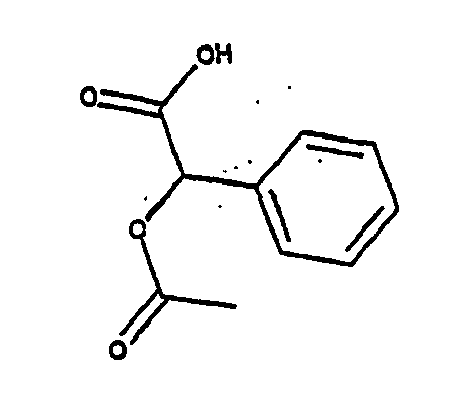
- 2. (R)-1,4-Benzodioxan-2-carbonsäure oder das Enantiomer

- 3. (R)-(-)-Hexahydroacetoxymandelsäure oder das Enantiomer

- 4. (2R,3S)-2,3-O-Isopropyliden-2,3-dihydroxy-buttersäure oder das Enantiomer

- 5. (+)-Menthyloxyessigsäure oder das Enantiomer
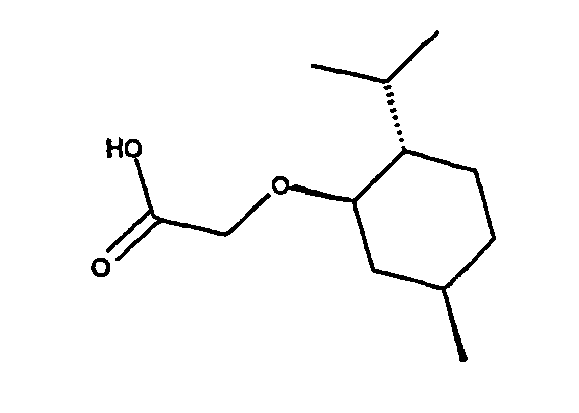
- 6. (S)-(+)-alpha-Methoxyphenylessigsäure oder das Enantiomer
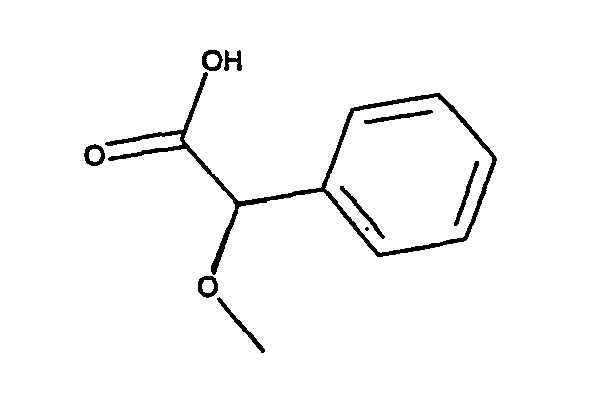
- 7. (R)-5-Oxo-tetrahydrofuran-2-carbonsäure oder das Enantiomer

- 8. (R)-3-Phenyl-2-acyloxypropionsäure oder das Enantiomer

- 9. (R)-α-Methoxy-α-trifluormethylphenylessigsäure oder das Enantiomer

Die Anbindung der Säuren an das Sauerstoffatom gemäß der Formel -O-R3 erfolgt wiederum wie bei den anderen zuvor genannten Carbonsäuren bzw. Alkoholen über die OH-Gruppe, so dass allgemein Ester bzw. Ether mit der folgenden Struktur resultieren:
- 1. (R)-Acetoxyphenylessigsäure oder das Enantiomer
- (vii) Der Rest R3 kann sich weiterhin von Verbindungen der allgemeinen Formel

Wiederum erfolgt die Anbindung des Substituenten R3 über das Sauerstoffatom, so dass Arylether entstehen. - (viii) Der Substituent R3 kann sich weiterhin von α-Naphthol, β-Naphthol oder (R)- oder (S)-1-(9-Anthryl)-2,2,2-trifluorethanol ableiten.
Auch hier erfolgt die Anbindung über das Sauerstoffatom. - (ix) Gemäß einer weiteren Ausführungsform kann sich R3 von Ephedrin, d.h. 2-Methylamino-1-phenylpropan-1-ol, ableiten. Diese Verbindung ist chiral und im Rahmen der vorliegenden Erfindung sollen sämtliche stereoisomere Formen mitumfasst werden.
Die Anbindung von R3 erfolgt wiederum über das Sauerstoffatom, so dass eine Etherstruktur resultiert. - (x) Schließlich kann R3 auch für einen Phosphitrest der allgemeinen Formel -P(OR10)(OR11) stehen, worin R10 und R11' gleich oder verschieden sein können und für einen gegebenenfalls polycyclischen oder verbrückten Arylrest stehen.
Bevorzugte Beispiele sind Phosphitreste der Formeln
- (xi) C1-C10-Alkyl, linear oder verzweigt,
- (xii) Acyl,
- (xiii) Benzyl oder substituierte Benzylreste stehen.
- Der Substituent Y gemäß der allgemeinen Formel I steht für Cl, Br, I, CN, COOH, COOR, CHO, CH2OR oder C1-C10-Alkyl.
- In der Gruppe COOR bzw. CH2OR steht der Substituent R für eine lineare oder verzweigte C1-C10-Alkylgruppe oder einen substituierten oder unsubstituierten Arylrest.
- Der Substituent Y ist so gewählt, dass er durch einfache, allgemein bekannte Verfahren in eine Hydroxymethylgruppe umgewandelt werden kann. Beispielsweise wird eine Ester- oder Carbonsäuregruppe direkt reduziert, ein Halogenid kann über eine Grignard-Zwischenstufe in die entsprechende Carbonsäure umgewandelt und anschließend reduziert werden, und ein Nitril kann zunächst beispielsweise zur Carbonsäure hydrolysiert und anschließend zu einer Hydroxymethylgruppe reduziert werden.
- Durch diese Umwandlung des Substituenten Y in eine Hydroxymethylgruppe können die in der WO 99/58478 beschriebenen 3,3-Diphenylpropylaminderivate in einfacher Weise hergestellt werden. Dort sind auch entsprechende Verfahren zur Umwandlung des Substituenten Y in eine Hydroxymethylgruppe beschrieben.
- Gemäß einer bevorzugten Ausführungsform des erfindungsgemäßen Verfahrens steht Y für eine Estergruppe, die sich in Paraposition zu dem Substituenten X befindet.
- Schließlich stehen die Substituenten R1 und R2, die gleich oder verschieden sein können, für eine C1-C10-Alkylgruppe oder eine C3-C8-Cycloalkylgruppe, wobei R1 und R2 unter Bildung einer cyclischen Struktur miteinander verknüpft sein können. Diese cyclische Struktur kann Heteroatome, wie z.B. Stickstoff, Sauerstoff, etc., enthalten, so dass R1 und R2 zusammen mit dem Stickstoffatom, an das sie gebunden sind, beispielsweise einen Morpholin-Rest bilden können.
- Gemäß einer bevorzugten Ausführungsform des erfindungsgemäßen Verfahrens stehen R1 und R2 für Isopropyl und Ar für Phenyl.
- Im Rahmen der vorliegenden Erfindung bezeichnet der Begriff "Alkyl" eine lineare oder verzweigte Kohlenwasserstoffkette mit vorzugsweise 1 bis 10 C-Atomen. Beispiele für solche Alkylgruppen umfassen Methyl, Ethyl, Propyl, Isopropyl, Butyl, Isobutyl, t-Butyl und entsprechende Isomere von Pentyl und Hexyl, wobei die Isopropylgruppe bevorzugt ist.
- Der Begriff "Cycloalkyl" bzw. "Cycloalkylgruppe" beschreibt cyclische Kohlenwasserstoffreste mit vorzugsweise 3 bis 10 Kohlenstoffatomen, die gegebenenfalls substituiert sein können.
- Im Rahmen der vorliegenden Erfindung werden unter Substituenten dem Fachmann an sich bekannte Gruppen wie Alkyl, Alkoxy, Halogen (Fluor, Chlor, Brom, Iod), Nitro und dergleichen verstanden.
- Der Begriff "substituiertes oder unsubstituiertes Benzyl" beschreibt eine Benzylgruppe, deren Phenylring gegebenenfalls ein- oder mehrfach substituiert ist. Substituierte Benzylgruppen sind vorzugsweise 4-Methylbenzyl, 4-Methoxybenzyl, 4-Nitrobenzyl, 2-Nitrobenzyl, 4-Chlorbenzyl und 2-Chlorbenzyl.
- Der Begriff "Alkylcarbonyl" beschreibt Gruppen der Formel R-C(=O), worin R für eine Alkylgruppe steht. Bevorzugte Alkylcarbonylgruppen sind Acetyl, Propionyl, Isobutyryl, Valeroyl und Pivaloyl.
- Der Begriff "Cycloalkylcarbonyl" beschreibt eine Gruppe der Formel R-C(=O), worin R für eine Cycloalkylgruppe steht.
- Der Begriff "Aryl" bezeichnet einen aromatischen Kohlenwasserstoffrest, wie z.B. Phenyl (C6H5-), Naphthyl (C10H7-) und Anthryl (C14H9-). Bevorzugt werden Phenyl- und Napthylgruppen, insbesondere Phenylgruppen, wobei diese Gruppen einfach oder mehrfach substituiert sein können. Gegebenenfalls können zwei oder mehrere Arylreste zur Bildung polycyclischer Strukturen miteinander verbrückt bzw. kondensiert sein.
- Der Begriff "Benzoyl" beschreibt Acylgruppen der Formel -C(=O)-Ph, wobei der Phenylring wiederum einfach oder mehrfach substituiert sein kann. Beispiele für solche substituierten Acylgruppen umfassen 4-Methoxybenzoyl, 2-Methoxybenzoyl, 4-Chlorbenzoyl, 2-Chlorbenzoyl, 4-Nitrobenzoyl und 2-Nitrobenzoyl.
- Der Begriff "Alkoxycarbonyl" steht für R-OC(=O)-Gruppen, worin R für eine Alkylgruppe steht. Bevorzugte Alkoxycarbonylgruppen sind Methoxycarbonyl, Ethoxycarbonyl, Propoxycarbonyl, t-Butyloxycarbonyl und Benzyloxycarbonyl sowie alicyclische Alkoxycarbonylgruppen.
- Der Begriff "Aminosäure" bzw. "Aminosäurerest" beschreibt Reste, welche sich von natürlich vorkommenden oder synthetischen Aminosäuren (wobei jeweils alle optischen Antipoden eingeschlossen sind) ableiten. Bevorzugte Aminosäurereste sind Valyl, Leucyl, Isoleucyl, Phenylalanyl, Prolyl, Seryl, Threonyl, Methionyl und Hydroxyprolyl.
- Der Aminosäurerest kann durch eine geeignete Gruppe substituiert sein. Solche substituierten Aminosäurereste sind beispielsweise N-Benzoylprolyl, N-tert.-Butoxycarbonylprolyl, N-Alkyl, N-Acyl oder N-Diphenylphosphanylprolyl.
- Das erfindungsgemäße Verfahren beruht auf der Hydrocarbonylierung/Hydroformylierung von Verbindungen der allgemeinen Formel
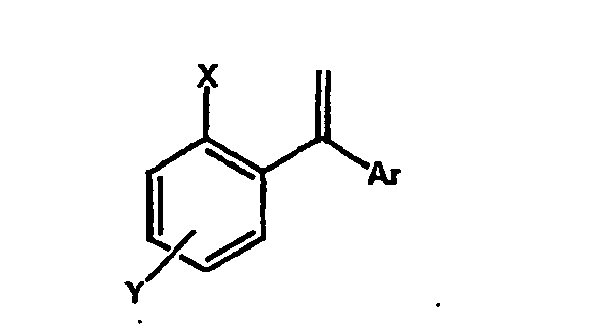
- Gemäß einer Ausführungsform des erfindungsgemäßen Verfahrens steht der Substituent X für Hydroxy (OH). Dies erlaubt, ausgehend von 1,1-Diarylethenverbindungen, die Hydroformylierung zu Chromen/Lactol-Systemen gemäß dem nachstehend dargestellten allgemeinen Formelschema

- Diese Zwischenprodukte werden durch bekannte Reaktionen in Derivate des 2-[(3R)-3-(+)-(diisopropylamino)-1-phenylpropyl]-4-(hydroxymethyl)phenol, deren acylierte Verbindungen und Salze überführt. Eine genaue Beschreibung dieser Reaktionen sind in der EP 0 957 073 zusammengefasst.
- Verfahrensvorschriften zur reduktiven Aminierung von Verbindungen des Lactoltyps finden sich auch in der WO 99/58478.
- Die vorgenannten 1,1-Diarylethen-Verbindungen gemäß allgemeiner Formel II können nach an sich bekannten Verfahren hergestellt werden wie sie beipielsweise in Yamaguchi M; Arisawa M; Omata K; Kabuto K; Hirama M; Uchimaru T; Journal of Organic Chemistry 1998, 63(21), 7298-7305 und Yamaguchi M; Hayashi A; Hirama M; Journal of the American Chemical Society 1995, 117(3), 1151-2 beschrieben sind.
- Das erfindungsgemäße Verfahren wird im allgemeinen bei einer Temperatur im Bereich von 50 bis 200°C und vorzugsweise 100 bis 140°C durchgeführt.
- Der Reaktionsdruck beträgt dabei 40 bis 200 bar und vorzugsweise 80 bis 120 bar.
- Bei der Hydroformylierung wird ein Gemisch aus Kohlenmonoxid und Wasserstoff (Synthesegas) verwendet, wobei das Verhältnis von Kohlenmonoxid (CO) zu Wasserstoff (H2) im allgemeinen 10/90 bis 90/10 und vorzugsweise 70/30 bis 90/10 beträgt.
- Die Breite der Druckverhältnisse ergibt sich aus der Notwendigkeit, dass die Verhältnisse von Ligand und Katalysator für jedes Substrat separat optimiert werden und daher abhängig sind von Substrat, Katalysatorvorstufe und Ligand etc.
- Die Reaktionsdauer liegt im allgemeinen im Bereich von 2 Stunden bis 4 Tagen und vorzugsweise im Bereich von 1 bis 3 Tagen.
- Die vorgenannten Reaktionszeiten werden von der jeweiligen Geräteausstattung beeinflusst. Bei einer optimalen Gaseinführung können auch kürzere Reaktionszeiten realisiert werden.
- Der bei dem erfindungsgemäßen Verfahren verwendete Katalysator umfasst ein oder mehrere Übergangsmetalle ausgewählt aus der Gruppe bestehend aus Ruthenium, Rhodium, Platin, Cobalt, Iridium, Palladium, Nickel, wobei Rhodium bevorzugt ist.
- In dem erfindungsgemäßen Verfahren wird der Katalysator in situ aus einem Katalysatorvorläufer und einem Liganden gebildet.
- Geeignete Katalysatorvorläufer sind vorzugsweise [Rh(cod)Cl]2 und/oder Rh(acac)(CO)2 oder vergleichbare Rhodiumkomplexe.
- Die Liganden sind nachfolgend zusammen mit der einschlägigen Abkürzung aufgelistet:
- BINAPHOS = R-2-(Diphenylphosphino)-1,2'-binaphthalen-2'-yl-(S)-1,1'-binaphthalen-2,2'-diylphosphit,
- DIOP = (2,2-Dimethyl-4,5-diphenylphosphinomethyl)-1,3-dioxolan,
- DIOP-DBP = (2,2-Dimethyl-4,5-bis(5H-dibenzophosphol-5-ylmethyl)-1,3-dioxolan,
- DPPB = 1,4-Bis(diphenylphosphino)butan,
- CHIRAPHOS = 2,3-Bis(diphenylphosphino)butan,
- CBDPP = 1,2-Bis(diphenylphosphinomethyl)cyclobutan,
- CBDBP = 1,2-Bis(5H-dibenzophosphol-5-ylmethyl)cyclobutan,
- CHDPP = 1,2-Bis(diphenylphosphinomethyl)cyclohexan,
- CHDBP = 1,2-Bis(5H-dibenzophosphol-5-ylmethyl)cyclohexan,
- CHDPPO = 1,2-Bis(diphenylphosphinoxy)cyclohexan,
- BzMePhP* = Benzyl-methyl-phenylphosphin,
- CAMP = Cyclohexyl-o-anisyl-methylphosphin,
- NMDPP = Neomenthyldiphenylphosphin,
- PAMP = Phenyl-o-anisyl-methylphosphin,
- BPPM = (2S,4S)-N-tert.Butoxycarbonyl-4-diphenylphosphino-2-diphenylphosphinomethylpyrrolidin,
- o-DPPB = ortho-Diphenylphosphanylbenzoyl,
- PBu3 = Tributylphosphin,
- BINAP = 2,2'-Bis-(diphenylphosphino)-1,1'-binaphthyl.
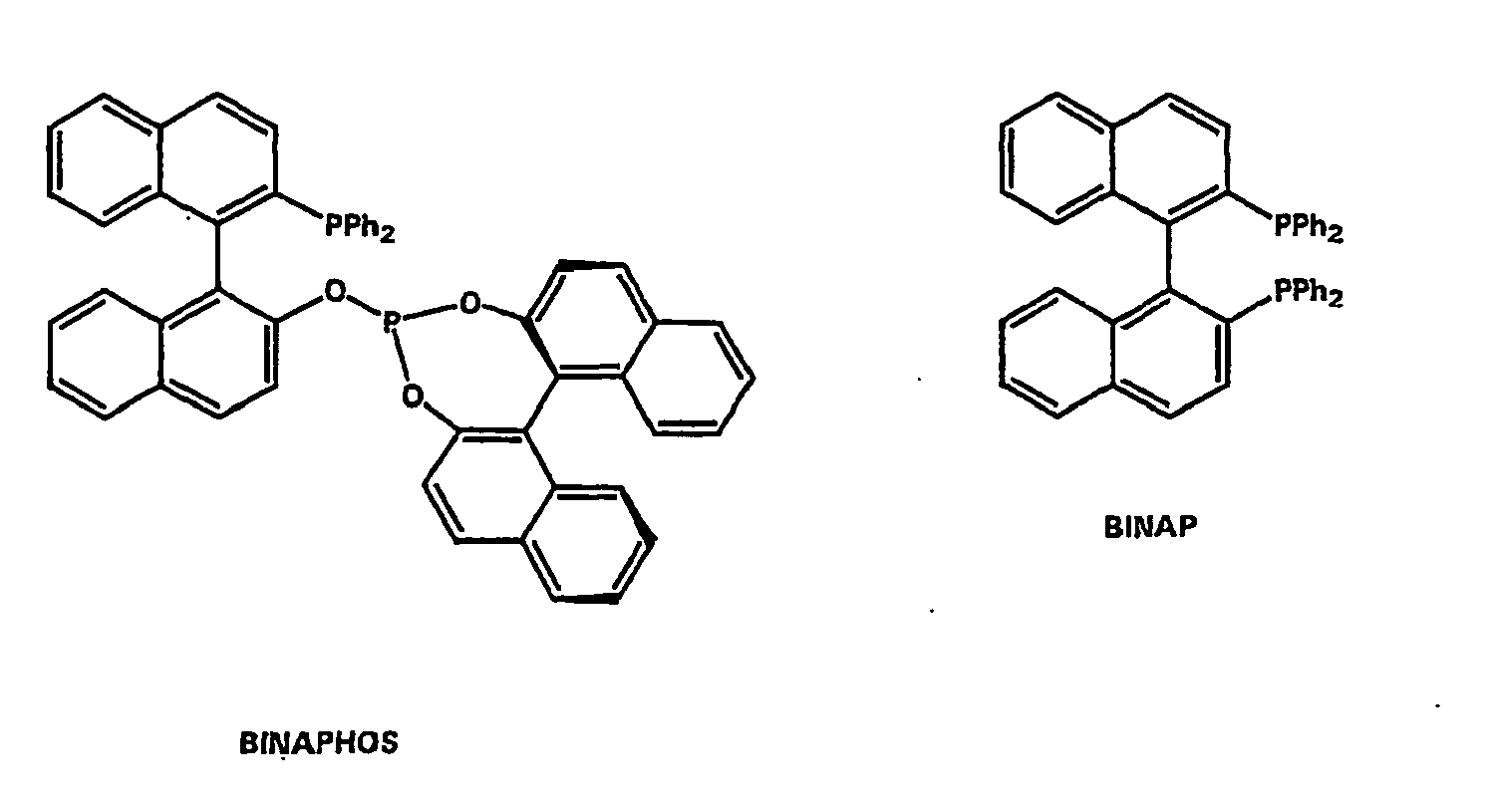
- Bevorzugte Liganden sind Tributylphosphin, (+)- oder (-)-(2,2-Dimethyl-4,5-diphenylphosphinomethyl)-1,3-dioxolan, (R)-oder (S)-BINAP und/oder (R,S)-BINAPHOS.
- Wird als Ligand Tributylphosphin verwendet, so beträgt das Verhältnis von Ligand zu Rhodium im allgemeinen 1:1 bis 25:1 und vorzugsweise 4:1 bis 10:1.
- Bei Verwendung von (R)- oder (S)-BINAP beträgt es 1:1 bis 6:1 und vorzugsweise 1:1 bis 2:1.
- Bei (R,S)-BINAPHOS schließlich beträgt es 1:1 bis 6:1 und vorzugsweise 1:1 bis 2:1.
- Das erfindungsgemäße Verfahren beruht, wie bereits voranstehend ausgeführt, auf der Hydroaminomethylierung von 1,1-Diarylethenen unter Verwendung eines geeigneten Katalysatorsystems. Es weist den Vorteil auf, daß es als Eintopfreaktion durchgeführt wird, was die direkte Isolierung der gewünschten Diarylpropylaminderivate ermöglicht.
- Das Chiralitätszentrum in Position 3 der 3,3-Diarylpropylaminderivate läßt sich durch geeignete Wahl von chiralen Liganden für das metallische Katalysatorzentrum in stereoselektiver Weise erzeugen (Ligandensteuerung). Ist eine der Arylgruppen in dem als Ausgangmaterial verwendeten 1,1-Diarylethen in ortho-Position durch ein Heteroatom substituiert, welches mit chiralen Gruppen modifiziert ist, wird die chirale Synthese durch das Substrat gesteuert (Substratsteuerung). Dies lässt sich mit Homoallylalkoholen vergleichen, deren Konformation durch den planaren Aromaten vorfixiert ist. Schließlich lässt die Kombination dieser Methoden (Liganden- und Substratsteuerung) die doppelte Stereoseitendifferenzierung zu.
- Das erfindungsgemäße Verfahren wird durch die folgenden Beispiele näher erläutert. Hierin werden die folgenden Definitionen verwendet:
- DC
- Dünnschichtchromatographie
- HPLC
- High Performance Liquid Chromatography
- NMR
- kernmagnetische Resonanz
- °C
- Grad Celsius
- RT
- Raumtemperatur
- THF
- Tetrahydrofuran
- acac
- Acetonylacetat
- cod
- cis, cis-1,5-Cyclooctadien
- abs.
- absolut(em)
- MTBE
- Methyl-tert.Butylether
- h
- Stunde(n)
- TMS
- Tetramethylsilan
- Die NMR-Spektren wurden mit einem DRX 400 der Firma Bruker aufgenommen. TMS wurde als interner Standard eingesetzt.
- Massenspektren wurden auf einem Finnigan CA 5 gemessen. Die Elementarzusammensetzung wurde mit einem Leco CHNS-932 bestimmt.
- Gaschromatographische Untersuchungen wurden mit einem CarloErba GC-4160 mit 25 m oder mit einem Fisous GC-8130 mit 30 m CP sil-5 Kapillaren durchgeführt.
- Ansatz:
- 5.00 g (23.5 mmol) 2-Hydroxy-5-methyl-benzophenon
- 6.67 g (47.1 mmol) Methyliodid
- 4.50 g (32.6 mmol) Kaliumcarbonat
- 50 ml abs. Aceton

- Durchführung:
Zu einer Lösung aus 5.00 g (23.5 mmol) 2-Hydroxy-5-methyl-benzophenon und 6.67 g (47.1 mmol) Methyliodid in 50 ml abs. Aceton werden 4.50 g (32.6 mmol) Kaliumcarbonat gegeben. Das Reaktionsgemisch erhitzt man anschließend 5 h unter Rückfluss. Nach Abkühlen werden zu der Suspension 50 ml Wasser und 50 ml Petrolether (30/60) gegeben. Man trennt die organische Phase ab, extrahiert die wässrige Phase zweimal mit 75 ml Petrolether (30/60) und wäscht die vereinigten organischen Phasen zweimal mit 50 ml 10 %iger NaOH-Lösung. Die organische Phase wird anschließend über Magnesiumsulfat getrocknet und das Lösungsmittel wird entfernt. Man erhält 3.80 g (16.8 mmol, 71 %) 2-Methoxy-5-methyl-benzophenon. - Ausbeute: 3.80 g (16.8 mmol, 71 %) 2-Methoxy-5-methyl-benzophenon
1H-NMR (400 MHz, CDCl 3 ): δ [ppm] = 2.21 (s, 3H, CH3), 3.56 (s, 3H, OCH3), 6.77 (d, 3J = 8.4 Hz, 1H, PhH), 7.06 (d, 4J = 1.9 Hz, 1H, PhH), 7.15 (m, 1H, PhH), 7.31 (t, 3J = 7.7 Hz, 2H, PhH), 7.43 (m, 1H, PhH), 7.71 (dd, 3J = 8.3 Hz, 2J = 1.2 Hz, 2H, PhH).
13C-NMR (100 MHz, CDCl 3 ): δ [ppm] = 20.3 (CH3), 55.6 (OCH3), 111.4 (CHarom), 128.1 (2 x CHarom), 128.5 (Cqarom), 129.7 (2 x CHarom), 129.8 (Cqarom), 129.9 (CHarom), 132.2 (CHarom), 132.8 (CHarom), 137.8 (Cqarom), 155.2 (Cqarom), 196.6 (C=O). - Ansatz:
- 2.00 g (9.4 mmol) 2-Hydroxy-5-methyl-benzophenon
- 1.66 g (9.7 mmol) Benzylbromid
- 1.73 g (12.5 mmol) Kaliumcarbonat
- 12 ml abs. Aceton

- Durchführung:
Zu einer Lösung aus 2.00 g (9.4 mmol) 2-Hydroxy-5-methyl-benzophenon und
1.66 g (9.7 mmol) Benzylbromid in 12 ml abs. Aceton werden 1.73 g (12.5 mmol) Kaliumcarbonat gegeben. Das Reaktionsgemisch erhitzt man anschließend 16 h unter Rückfluss. Nach Abkühlen der Suspension wird diese filtriert und der Rückstand mit 50 ml Diethylether gewaschen. Nach Entfernen des Lösungsmittels am Rotationsverdampfer erhält man 2.74 g (9.1 mmol, 96 %) 2-Benzyloxy-5-methyl-benzophenon. - Ausbeute: 2.74 g (9.1 mmol, 96 %) 2-Benzyloxy-5-methyl-benzophenon
1H-NMR (400 MHz, CDCl 3 ): δ [ppm] = 2.31 (s, 3H, CH3), 4.94 (s, 2H, OCH2), 6.92 (m, 3H, PhH), 7.17 (m, 3H, PhH), 7.23 (m, 2H, PhH), 7.41 (t, 3J = 7.6 Hz, 2H, PhH), 7.53 (m, 1H, PhH), 7.81 (m, 2H, PhH).
13C-NMR (100 MHz, CDCl 3 ): δ [ppm] = 20.3 (CH3), 70.1 (OCH2), 112.8 (CHarom), 126.5 (2 x CHarom), 127.4 (CHarom), 128.2 (4 x CHarom), 129.1 (Cqarom), 129.6 (2 x CHarom), 130.1 (CHarom), 130.4 (Cqarom), 132.4 (CHarom), 132.6 (CHarom), 136.5 (Cqarom), 138.3 (Cqarom), 154.3 (Cqarom), 196.9 (C=O). - Schmelzpunkt: 78°C
Elementaranalyse: ber.: C 83.4 H 6.0 gef.: C 83.2 H 5.8 - Ansatz:
- 3.70 g (16.3 mmol) 2-Methoxy-5-methyl-benzophenon
- 7.58 g (21.2 mmol) Methyltriphenylphosphonium-bromid
- 17.0 ml (21.2 mmol) n-Butyllithium (1.25M in n-Hexan)
- 20 ml abs. THF

- Durchführung:
Zu einer Suspension aus 7.58 g (21.2 mmol) Methyltriphenylphosphoniumbromid in 15 ml abs. THF werden bei Raumtemperatur innerhalb von 10 min 17.0 ml (21.2) n-Butyllithium (1.25M in n-Hexan) zugetropft. Die erhaltene rötliche Lösung kühlt man auf -78 °C und gibt anschließend innerhalb von 15 min eine Lösung aus 3.70 g (16.3 mmol) 2-Methoxy-5-methyl-benzophenon in 5 ml abs. THF hinzu. Es wird zunächst 20 min bei -78 °C und weitere 8 h bei Raumtemperatur gerührt. Anschließend gibt man zu dem Reaktionsgemisch 80 ml Wasser und extrahiert zweimal mit je 50 ml Diethylether. Die vereinigten organischen Phasen werden über Magnesiumsulfat getrocknet und das Lösungsmittel wird entfernt. Die Reinigung des erhaltenen Rohproduktes erfolgt säulenchromatographisch an Kieselgel mit Toluol als Laufmittel. Man erhält 3.03 g (13.5 mmol, 83 %) 1-Methoxy-4-methyl-2-(1-phenylvinyl)-benzol. - Ausbeute: 3.03 g (13.5 mmol, 83 %) 1-Methoxy-4-methyl-2-(1-phenylvinyl)-benzol
1H-NMR (400 MHz, CDCl 3 ): δ [ppm] = 2.22 (s, 3H, CH3), 3.51 (s, 3H, OCH3), 5.22 (s, 1H, =CH2), 5.63 (s, 1H, =CH2), 6.71 (d, 3J = 8.3 Hz, 1H, PhH), 6.97 (s, 1H, PhH), 7.01 (d, 3J = 8.0 Hz, 1H, PhH), 7.16 (m, 5H, PhH).
13C-NMR (100 MHz, CDCl 3 ): δ [ppm] = 20.4 (CH3) , 55.8 (OCH3), 111.3 (CHarom), 115.2 (=CH2), 126.3 (2 x CHarom), 127.2 (CHarom), 128.0 (2 x CHarom), 129.2 (CHarom), 129.8 (Cqarom), 130.8 (Cqarom), 131.8 (CHarom), 141.0 (Cqarom), 147.0 (Cqolefin), 155.0 (Cqarom).Elementaranalyse: ber.: C 85.7 H 7.2 gef.: C 85.7 H 7.2 - Ansatz:
- 1.41 g (4.7 mmol) 2-Benzyloxy-5-methyl-benzophenon
- 2.16 g (6.1 mmol) Methyltriphenylphosphoniumbromid
- 4.9 ml (6.i mmol) n-Butyllithium (1.25M in n-Hexan)
- 17 ml abs. THF

- Durchführung:
analog Beispiel 3 - Ausbeute: 1.23 g (4.1 mmol, 88 %) 1-Benzyloxy-4-methyl-2-(1-phenylvinyl)-benzol
1H-NMR (400 MHz, CDCl 3 ): δ [ppm] = 2.32 (s, 3H, CH3), 4.84 (s, 2H, OCH2), 5.32 (d, 3J = 1.4 Hz, 1H, =CH2), 5.65 (d, 3J = 1.4 Hz, 1H, =CH2), 6.83 (m, 3H, PhH), 7.07 -7.37 (m, 10H, PhH).
13C-NMR (100 MHz, CDCl 3 ): δ [ppm] = 20.5 (CH3), 70.1 (OCH2), 112.5 (CHarom), 115.5 (=CH2), 126.5 (2 x CHarom), 126.8 (2 x CHarom), 127.2 (CHarom), 127.3 (CHarom), 128.1 (4 x CHarom), 129.3 (CHarom), 130.1 (Cqarom), 131.3 (Cqarom), 132.1 (CHarom), 137.1 (Cqarom), 141.6 (Cqarom), 147. 6 (Cqolefin), 153. 9 (Cqarom).
MS (EI, 70 eV) : m/z [%] = 300 (39, M+), 285 (11), 262 (6), 251 (9), 209 (100), 200 (9), 195 (20), 181 (20), 165 (19), 115 (3), 91 (95), 65 (9).Elementaranalyse: ber.: C 88.0 H 6.7 gef.: C 87.6 H 6.7 - Ansatz:
- 0.700 g (3.1 mmol) 1-Methoxy-4-methyl-2-(1-phenyl-vinyl)-benzol
- 0.354 g (3.5 mmol) Diisopropylamin
- s. Tab. 1 Katalysatorvorläufer
- s. Tab. 1 Tributylphosphin
- 10 ml abs. Dioxan
- Durchführung:
0.700 g (3.1 mmol) 1-Methoxy-4-methyl-2-(1-phenylvinyl)-benzol, 0.354 g (3.5 mmol) Diisopropylamin, eine definierte Menge Katalysatorvorläufer (s. Tab. 1), eine definierte Menge Tributylphosphin (s. Tab. 1) und 10 ml abs. Dioxan werden in einem Druckbehälter in einer CO/H2-Atmosphäre unter den in Tab. 1 angegebenen Bedingungen gerührt. Nach Abkühlen und Entspannen des Druckbehälters wird die Reaktionslösung über Aluminiumoxid (Aktivität II - III, basisch) absorptiv filtriert (Elutionsmittel: MTBE). Nach Entfernen des Lösungsmittels erfolgt die Reinigung des Rohproduktes säulenchromatographisch an Aluminiumoxid (Aktivität I, neutral) mit Petrolether (30/60) / MTBE = 5/1 (v/v) als Elutionsmittel.Tabelle 1: Ergebnisse der Hydroaminomethylierung mit 1-Methoxy-4-methyl-2-(1-phenylvinyl)-benzol Nr. PBu3/Rh T [°C] p (CO/H2) [bar] t [d] hydr.Edu kt [%]* Produkt [%]* 1** 25/1 115 80/20 4 - - 2** 6/1 135 90/10 4 ca. 1 38 (22) 3** 6/1 140 90/10 5 11 49 (37) 4*** 16/1 110 90/10 3 ca. 2 12 5*** 8/1 130 90/10 3 6 85 6*** - 130 90/10 3 11 70 * : GC-Anteile (Werte in Klammern entsprechen isolierten Ausbeuten)
**: [Rh(cod)Cl]2 (0.5 mol-% bezogen auf Olefin)
*** : Rh(acac)(CO)2 (1 mol-% bezogen auf Olefin)
13C-NMR (100 MHz, CDCl 3 ): δ [ppm] = 20.5 (2 x CHCH3 ), 20.7 (2 x CHCH3 ), 20.7 (PhCH3), 37.0 (CHCH2), 41.3 (PhCH), 44.1 (NCH2), 48.7 (2 X NCH), 55.5 (OCH3), 110.6 (CHarom), 125.6 (CHarom), 127.1 (CHarom), 128.0 (2 x CHarom), 128.2 (2 x CHarom), 128.3 (CHarom), 129.5 (Cqarom), 133.4 (Cqarom), 145.1 (Cqarom), 154.9 (Cqarom).
GC-MS (EI, 70EV): m/z [%] = 340 (M++1, 45), 324 (6), 296 (1), 211 (3), 126 (3), 114 (100), 100 (20), 91 (7), 72 (13).Elementaranalyse: C23H33NO (339.26) ber.: C 81.4 H 9.8 N 4.1 gef.: C 80.9 H 9.4 N 4.3 - Ansatz:
- 0.601 g (2.00 mmol) 1-Benzyloxy-4-methyl-2-(1-phenylvinyl)-benzol
- 0.229 g (2.26 mmol) Diisopropylamin
- 5.2 mg (0.02 mmol) Rh(acac)(CO)2 s. Tab. 2 Tributylphosphin 10 ml abs. Dioxan'

- Durchführung:
analog Beispiel 5Tabelle 2: Ergebnisse der Hydroaminomethylierung mit 1-Benzyloxy-4-methyl-2-(1-phenylvinyl)-benzol Nr. PBu3/Rh T [°C] p (CO/H2) [bar] t [d] Produkt [%]* 7** 8/1 130 90/10 3 84 (79) 8** 2/1 100 90/10 3 4 9** - 130 90/10 1 49 10** - 130 90/10 3 76 * : GC-Anteile (Werte in Klammern entspricht isolierter Ausbeute)
**: Rh(acac)(CO)2 (1 mol-% bezogen auf Olefin)
2 x CHMe2), 4.39 (t, 3J = 7.7 Hz, 1H, CHPh2), 4.94 (d, 2J = 15.5 Hz , 1H, OCH2), 4.97 (d, 2J = 15.5 Hz , 1H, OCH2), 6.73 (d, 3J = 8.2 Hz, 1H, PhH), 6.91 (dd, 3J = 8.2 Hz, 4J = 1.7 Hz, 1H, PhH), 7.10 - 7.36 (m, 11H, PhH).
13C-NMR (100 MHz, CDCl 3 ) : δ [ppm] = 20.5 (2 x CHCH 3), 20.6 (2 x CHCH 3), 20.7 (PhCH3), 37.0 (CHCH2), 41.5 (PhCH), 44.1 (NCH2), 48.8 (2 X NCH), 70.1 (OCH2), 111.7 (CHarom), 125.6 (CHarom), 127.1 (CHarom), 127.3 (2 x CHarom), 127.6 (CHarom), 128.0 (2 x CHarom), 128.3 (2 x CHarom), 128.3 (2 x Charom), 128.4 (CHarom), 129.8 (Cqarom), 133.6 (Cqarom), 137.5 (Cqarom), 145.1 (Cqarom), 153.9 (Cqarom).
MS (EI, 70EV): m/z [%] = 415 (M+, 23), 400 (25), 339 (4), 324 (6), 287 (1), 223 (3), 197 (3), 165 (1), 114 (100), 99 (4), 91 (18), 72 (11).Elementaranalyse: (C29H37NO, M = 415.29) ber.: C 83.8 H 9.0 N 3.4 gef.: C 84.0 H 9.0 N 3.4 - Ansatz:
- 4.98 g (30 mmol) p-Hydroxybenzoesäureethylester
- 3.06 g (30 mmol) Phenylacetylen
- 31.26 g (120 mmol) Zinntetrachlorid
- 22.24 g (120 mmol) Tributylamin
- 150 ml 1,2-Dichlorethan

- Durchführung:
Unter einer Argonatmosphäre wird eine Lösung aus 4.98 g (30 mmol) p-Hydroxy-benzoesäureethylester, 3.06 g (30 mmol) Phenylacetylen, 31.26 g (120 mmol) Zinntetrachlorid und 22.24 (120 mmol) Tributylamin in 150 ml 1,2-Dichlorethan 1 h unter Rückfluss erhitzt. Anschließend gibt man zu dem Reaktionsgemisch 60 ml 4 M KOH und 30 ml Ethanol und erhitzt 1h unter Rückfluss. Nach Abkühlen wird die Lösung mit 4 M HCl angesäuert und zweimal mit je 150 ml Diethylether extrahiert. Die vereinigten organischen Phasen trocknet man über MgSO4 und entfernt das Lösungsmittel am Rotationsverdampfer. Der verbleibende Rückstand wird absorptiv filtriert (Kieselgel, MTBE) und das so erhaltene Rohprodukt säulenchromatographisch gereinigt (Kieselgel, Toluol/MTBE = 8/1 (v/v)). Man erhält 2.63 g (9.8 mmol, 33 %) 4-Hydroxy-3-(1-phenyl-vinyl)-benzoesäure-ethylester. - Ausbeute: 2.63 g (9.8 mmol, 33 %) 4-Hydroxy-3-(1-phenyl-vinyl)-benzoesäure-ethylester.
1H-NMR (400 MHz, CDCl 3 ): δ [ppm] = 1.36 (t, 3J = 7.1 Hz, 3H, CH3), 4.33 ( q, 3J = 7.1 Hz, 2H, OCH2), 5.44 (d, 2J = 0.9 Hz, 1H, =CH2), 5.91 (d, 2J = 0.9 Hz, 1H, =CH2), 6.97 (d, 3J = 8.5 Hz, 1H, PhH), 7.34 (m, 5H, PhH), 7.89 (d, 4J = 2.1 Hz, 1H, PhH), 7.96 (dd, 3J = 8.5 Hz, 4J = 2.1 Hz, 1H, PhH).
13C-NMR (100 MHz, CDCl 3 ): δ [ppm] = 14.3 (CH3), 60.8 (OCH2), 115.8 (CHarom), 117.5 (=CH2), 122.9 (Cqarom), 126.9 (2 x CHarom), 127.5 (Cqarom), 128.8 (3 x CHarom), 131.3 (CHarom), 132.3 (CHarom), 138.7 (Cqarom), 144.3 (Cqolefin), 157.1 (Cqarom), 166.3 (COOEt).
MS (EI, 70EV): m/z [%] = 268 (M+, 98), 267 (100), 253 (35), 239 (32), 225 (13), 223 (24), 194 (6), 165 (20), 152 (12), 115 (5), 111 (6), 104 (7). - Ansatz:
- 0.990 g (3.7 mmol) 4-Hydroxy-3-(1-phenylvinyl)-benzoesäureethylester
- 0.652 g (3.8 mmol) Benzylbromid
- 0.680 g (4.9 mmol) Kaliumcarbonat
- 7 ml abs. Aceton

- Durchführung:
Zu einer Lösung aus 0.990 g (3.7 mmol) 4-Hydroxy-3-(1-phenylvinyl)-benzoesäureethylester und 0.652 g (3.8 mmol) Benzylbromid in 7 ml abs. Aceton werden 0.680 g (4.9 mmol) Kaliumcarbonat gegeben. Das Reaktionsgemisch erhitzt man anschließend 4 h unter Rückfluss. Nach Abkühlen der Suspension wird diese filtriert und der Rückstand mit 50 ml Diethylether gewaschen. Nach Entfernen des Lösungsmittels am Rotationsverdampfer erhält man 1.280 g (3.6 mmol, 97 %) 4-Benzyloxy-3-(1-phenylvinyl)-benzoesäureethylester als farbloses Öl. - Ausbeute: 1.280 g (3.6 mmol, 97 %) 4-Benzyloxy-3-(1-phenylvinyl)-benzoesäureethylester.
1H-NMR (400 MHz, CDCl 3 ): δ [ppm] = 1.38 (t, 3J = 7.1 Hz, 3H, CH3), 4.36 (q, 3J = 7.1 Hz, 2H, OCH2 CH3), 4.93 (s, 2H, OCH2Ph), 5.36 (d, 2J = 1.2 Hz, 1H, =CH2), 5.70 (d, 2J = 1.2 Hz, 1H, =CH2), 6.80 (dd, 3J = 7.6 Hz, 4J = 1.6 Hz, 2H, PhH), 6.94 (d, 3J = 9.3 Hz, 1H, PhH), 7.18 (m, 3H, PhH), 7.29 (m, 5H, PhH), 8.03 (m, 2H, PhH).
13C-NMR (100 MHz, CDCl 3 ): δ [ppm] = 14.4 (CH3), 60.7 (OCH2CH3), 69.9 (OCH2Ph), 111.4 (CHarom), 116.3 (=CH2), 123.0 (Cqarom), 126.4 (2 x CHarom), 126.7 (2 x CHarom), 127.4 (CHarom), 127.6 (CHarom), 128.2 (4 x CHarom), 131.2 (CHarom), 131.3 (Cqarom), 132.8 (CHarom), 136.0 (Cqarom), 141.0 (Cqarom), 146.8 (Cqolefin), 159.6 (Cqarom), 166.3 (COOEt).
MS (EI, 70 eV): m/z [%] = 358 (37, M+), 343 (9), 329 (6), 313 (10), 285 (13), 267 (95), 253 (11), 239 (6), 207 (3), 194 (12), 165 (14), 139 (2), 105 (3), 91 (100), 65 (10). - Ansatz:
- 1.222 g (3.41 mmol) 4-Benzyloxy-3-(1-phenylvinyl)-benzoesäureethylester
- 0.390 g (3.85 mmol) Diisopropylamin
- 8.8 mg (0.03 mmol) Rh(acac)(CO)2
- 68 µl (0.27 mmol) Tributylphosphin 15 ml abs. Dioxan

- Durchführung:
analog Beispiel 5 mit p(CO/H2) = 90/10 bar, 130°C, 65 h. Die Reinigung des Rohproduktes erfolgt säulenchromatographisch (Kieselgel, Petrolether/MTBE/NEt3 (Lösungsmittelgemisch mit steigender Polarität; PE/MTBE = 1/1 → PE/MTBE/NEt3 = 5/5/1). - Ausbeute: 1.155 g (2.4 mmol, 72 %) 4-Benzyloxy-3-(3-diisopropylamino-1-phenyl-propyl)-benzoesäureethylester.
1H-NMR (400 MHz, CDCl 3 ): δ [ppm] = 0.90 (*t, 3J = 6.3 Hz, 12H, 4 x CHCH 3), 1.37 (t, 3J = 7.1 Hz, 3H, CH2CH 3), 2.17 (m, 2H, CHCH 2), 2.33 (m, 2H, NCH2), 2.95 (sept, 3J = 6.3 Hz, 2H, 2 x CHMe2), 4.36 (m, 3H, CHPh2, CH 2CH3), 5.02 (d, 2J = 15.3 Hz, 1H, OCH2Ph), 5.05 (d, 2J = 15.3 Hz, 1H, OCH2Ph), 6.85 (d, 3J = 8.6 Hz, 1H, PhH), 7.16 (m, 1H, PhH), 7.20 - 7.25 (m, 6H, PhH), 7.32 (m, 3H, PhH), 7.87 (dd, 3J = 8.6 Hz, 4J = 2.1 Hz, 1H, PhH), 8.09 (d, 4J = 2.1 Hz, 1H, PhH).
13C-NMR (100 MHz, CDCl 3 ): δ [ppm] = 14.4 (CH2CH3) 20.5 (2 x CHCH3), 20.6 (2 x CHCH3), 36.6 (CHCH2), 41.7 (PhCH), 43.9 (NCH2), 48.6 (2 X NCH) , 60.6 (CH2CH3), 70.0 (OCH2Ph), 111.0 (CHarom), 122.7 (Cqarom), 125.8 (CHarom), 127.4 (2 x CHarom), 127.9 (CHarom), 128.0 (2 x CHarom), 128.2 (2 x CHarom), 128.4 (2 X CHarom), 129.1 (CHarom), 129.3 (CHarom), 133.5 (Cqarom), 136.3 (Cqarom), 144.5 (Cqarom), 159.7 (Cqarom), 166.6 (COOEt).
MS (EI, 70EV) : m/z [%] = 473 (M+, 15), 458 (23), 428 (2), 360 (3) , 345 (2), 267 (4), 165 (2), 114 (100), 91 (41), 72 (90). - Ansatz:
- 4.56 g (30 mmol) p-Hydroxybenzoesäuremethylester
- 6.13 g (60 mmol) Phenylacetylen
- 31.26 g (120 mmol) Zinntetrachlorid
- 22.24 g (120 mmol) Tributylamin
- 150 ml 1,2-Dichlorethan

- Durchführung: analog Beispiel 7
- Ausbeute: 2.67 g (10.5 mmol, 35 %) 4-Hydroxy-3-(1-phenylvinyl)-benzoesäure-methylester.
1H-NMR (400 MHz, CDCl 3 ) : δ [ppm] = 3.84 (s, 3H, CH3), 5.42 (d, 2J = 1.0 Hz, 1H, =CH2), 5.88 (d, 2J = 1.0 Hz, 1H, =CH2), 6.97 (d, 3J = 8.5 Hz, 1H, PhH), 7.32 (m, 5H, PhH), 7.88 (d, 4J = 2.3 Hz, 1H, PhH), 7.94 (dd, 3J = 8.5 Hz, 4J = 2.3 Hz, 1H, PhH).
13C-NMR (100 MHz, CDCl 3 ): δ [ppm] = 51.9 (CH3), 115.8 (CHarom), 117.4 (=CH2), 122.4 (Cqarom), 126.8 (2 x CHarom), 127.6 (Cqarom), 128.7 (CHarom), 128.7 (2 x CHarom), 131.3 (CHarom), 132.4 (CHarom), 138.8 (Cqarom), 144.3 (Cqolefin), 157.3 (Cqarom), 166.8 (COOMe).
MS (EI, 70EV) : m/z [%] = 254 (M+, 5), 253 (7), 239 (3) , 223 (1), 165 (1), 152 (1), 131 (1), 120 (22), 105 (44), 91 (100), 77 (37), 65 (13), 59 (16), 51 (20), 45 (17). - Ansatz:
- 1.50 g (5.9 mmol) 4-Hydroxy-3-(1-phenyl-vinyl)-benzoesäuremethylester
- 1.04 g (6.1 mmol) Benzylbromid
- 1.24 g (8.9 mmol) Kaliumcarbonat
- 10 ml abs. Aceton

- Durchführung:
Zu einer Lösung aus 1.50 g (5.9 mmol) 4-Hydroxy-3-(1-phenylvinyl)-benzoe-säuremethylester und 1.04 g (6.1 mmol) Benzylbromid in 10 ml abs. Aceton werden 1.24 g (8.9 mmol) Kaliumcarbonat gegeben. Das Reaktionsgemisch erhitzt man anschließend 4 h unter Rückfluss. Nach Abkühlen der Suspension wird diese filtriert und der Rückstand mit 50 ml Diethylether gewaschen. Das Lösungsmittel wird entfernt und das erhaltene Rohprodukt säulenchromatographisch (Kieselgel, Petrolether/MTBE = 5/1 (v/v)) gereinigt. Man erhält 1.62 g (4.7 mmol, 80 %) 4-Benzyloxy-3-(1-phenyl-vinyl)-benzoesäuremethylester. - Ausbeute: 1.62 g (4.7 mmol, 80 %) 4-Benzyloxy-3-(1-phenylvinyl)-benzoesäure-methylester.
1H-NMR (400 MHz, CDCl 3 ) : δ [ppm] = 3.89 (s, 3H, CH3), 4.93 (s, 2H, OCH2), 5.36 (d, 2J = 1.1 Hz, 1H, =CH2), 5.70 (d, 2J = 1.1 Hz, 1H, =CH2), 6.80 (dd, 3J = 7.6 Hz, 4J = 1.6 Hz, 2H, PhH), 6.95 (d, 3J = 9.0 Hz, 1H, PhH), 7.18 (m, 3H, PhH), 7.29 (m, 5H, PhH), 8.04 (m, 2H, PhH).
13C-NMR (100 MHz, CDCl 3 ): δ [ppm] = 51.9 (CH3), 69.9 (OCH2), 111.5 (CHarom), 116.3 (=CH2), 122.7 (Cqarom), 126.4 (2 x CHarom), 126.7 (2 x CHarom), 127.4 (CHarom), 127.6 (CHarom), 128.2 (4 x CHarom), 131.3 (CHarom, Cqarom), 132.8 (CHarom), 136.0 (Cqarom), 141.0 (Cqarom), 146.7 (Cqolefin), 159.7 (Cqarom), 166.8 (COOMe). - Schmelzpunkt: 77-78°C
- Ansatz:
- 1.50 g (4.3 mmol) 4-Benzyloxy-3-(1-phenyl-vinyl)-benzoesäuremethylester
- 0.45 g (4.9 mmol) Diisopropylamin
- 11.2 mg (0.04 mmol) Rh(acac)(CO)2
- 86 µl (0.34 mmol) Tributylphosphin
- 15 ml abs. Dioxan

- Durchführung:
analog Beispiel 5 mit p (CO/H2) = 90/10 bar, 130°C, 65 h Die Reinigung des Rohproduktes erfolgt säulenchromatographisch (Kieselgel, Petrolether/MTBE/NEt3 (Lösungsmittelgemisch mit steigender Polarität; PE/MTBE = 1/1 → PE/MTBE/NEt3 = 5/5/1). - Ausbeute: 1.262 g (2.75 mmol, 63 %) 4-Benzyloxy-3-(3-diisopropylamino-1-phenyl-propyl)-benzoesäuremethylester.
1H-NMR (400 MHz, CDCl 3 ): δ [ppm] = 0.89 (d, 3J = 6.5 Hz, 6H, 2 x CHCH3 ), 0.90 (d, 3J = 6.5 Hz, 6H, 2 x CHCH3 ), 2.17 (m, 2H, CHCH2 ), 2.33 (m, 2H, NCH2), 2.95 (sept, 3J = 6.5 Hz, 2H, 2 x CHMe2), 3.87 (s, 3H, OCH3), 4.39 (t, 3J = 7.6 Hz, 1H, CHPh2), 5.02 (d, 2J = 15.6 Hz, 1H, OCH2Ph), 5.05 (d, 2J = 15.6 Hz, 1H, OCH2Ph), 6.85 (d, 3J = 8.5 Hz, 1H, PhH), 7.14 (m, 1H, PhH), 7.20 - 7.25 (m, 6H, PhH), 7.32 (m, 3H, PhH), 7.86 (dd, 3J = 8.5 Hz, 4J = 2.1 Hz, 1H, PhH), 8.09 (d, 4J = 2.1 Hz, 1H, PhH).
13C-NMR (100 MHz, CDCl 3 ): δ [ppm] = 20.5 (2 x CHCH3), 20.6 (2 x CHCH3), 36.6 (CHCH2), 41.6 (PhCH), 43.8 (NCH2), 48.6 (2 X NCH), 51.8 (OCH3), 70.0 (OCH2Ph), 111.0 (CHarom), 122.3 (Cqarom), 125.8 (CHarom), 127.4 (2 x CHarom), 127.9 (CHarom), 128.0 (2 x CHarom), 128.3 (2 x CHarom), 128.4 (2 x CHarom), 129.1 (CHarom), 129.4 (CHarom), 133.6 (Cqarom), 136.3 (Cqarom), 144.4 (Cqarom), 159.8 (Cqarom), 167.0 (COOMe).
MS (EI, 70EV): m/z [%] = 459 (M+, 32), 444 (49), 428 (3), 416 (1), 267 (2), 241(2), 209 (2), 165 (2), 114 (100), 91 (28), 72 (18), 57 (7). - Schmelzpunkt: 84°C
Elementaranalyse: (C30H37NO3, M = 459.28) ber.: C 78.4 H 8.1 N 3.0 gef.: C 78.4 H 7.8 N 2.9 - Ansatz:
- 0.421 g (2.0 mmol) 4-Methyl-2-(1-phenylvinyl)-phenol
- 5.0 mg (0.01 mmol) [RhCl(cod)]2
- 10 ml abs. Dioxan
- Durchführung:
0.421 g (2.0 mmol) 4-Methyl-2-(1-phenylvinyl)-phenol, 5.0 mg (0.01 mmol) [RhCl(cod)]2 und 10 ml abs. Dioxan werden in einem Druckbehälter 3 Tage bei 120 °C und einem Druck von 50 bar Synthesegas (CO:H2 = 3:2) gerührt. Nach Abkühlen und Entspannen des Druckbehälters wird die Reaktionslösung über Aluminiumoxid (Aktivität II - III, basisch) absorptiv filtriert (Elutionsmittel: Diethylether). Nach Entfernen des Lösungsmittels erfolgt die Reinigung des Rohproduktes säulenchromatographisch an Kieselgel mit Toluol/MTBE (Volumenverhältnis = 3/1) als Elutionsmittel. Man erhält 310 mg (1.3 mmol, 64 %) 4-Methyl-2-(1-phenylvinyl)-phenol als Gemisch zweier Diastereomere im Verhältnis 4:1. - Ausbeute: 310 mg (1.3 mmol, 64 %) 6-Methyl-4-phenyl-chroman-2-ol.
- Spektroskopische Daten: 6-Methyl-4-phenyl-chroman-2-ol.

13C-NMR (100 MHz, CDCl3): δ [ppm] = 20.5 (CH3), 36.3 (CH2), 36.9 (CHArAr'), 91.2/90.7 (CHOH), 116.5/116.6 (CHarom), 124.8/124.7 (Cqarom), 126.6/126.8 (CHarom), 128.5/128.7 (2 x CHarom), 128.5/128.4 (CHarom), 128.8/128.4 (2 x CHarom), 129.8/129.5 (CHarom), 130.1/130.2 (Cqarom), 144.4/144.0 (Cqarom), 149.6/151.1 (Cqarom). - Das erhaltene Lactol läßt sich nach an sich bekannten Verfahren zu den gewünschten Diarylpropylaminen durch reduktive Aminierung umsetzen.
- Ansatz:
- 0.250 g (0.83 mmol) 1-Benzyloxy-4-methyl-2-(1-phenylvinyl)-benzol
- 0.095 g (0.94 mmol) Diisopropylamin
- 4.3 mg (0.02 mmol) Rh(acac)(CO)2
- s. Tabelle 4 Ligand
- 10 ml abs. Dioxan
- Durchführung:
0.250 g (0.83 mmol) 1-Benzyloxy-4-methyl-2-(1-phenylvinyl)-benzol, 0.095 g (0.94 mmol) Diisopropylamin, 4.3 mg (0.02 mmol) Rh(acac)(CO)2, eine definierte Menge Ligand (s. Tabelle 4) und 10 ml abs. Dioxan werden in einem Druckbehälter unter den in Tabelle 4 angegebenen Bedingungen gerührt. Nach Abkühlen und Entspannen des Druckbehälters wird die Reaktionslösung über Aluminiumoxid (Aktivität II - III, basisch) absorptiv filtriert (Elutionsmittel: MTBE). Nach Entfernen des Lösungsmittels erfolgt die Reinigung des Rohproduktes säulenchromatographisch an Aluminiumoxid (Aktivität II-III, neutral) mit Cyclohexan/MTBE (Volumenverhältnis = 5/1) als Elutionsmittel.Tabelle 4: Hydroaminomethylierung mit 1-Benzyloxy-4-methyl-2-(1-phenylvinyl)-benzol unter Verwendung chiraler Diphosphinliganden Nr. Ligand L/Rh CO/H2 [bar T [ba t [d Pro- [%] * [α]D 20 [°] ee** [%] 0 3 (R)-BINAP 4/1 90/1 130 3 57 + < 2 0 0.54 4 (R)-BINAP 4/1 90/1 130 1 58 + < 2 0 0.53 5 (R)-BINAP 2/1 70/3 115 3 60 + < 2 0 0.26 6 (R)-BINAP 2/1 60/2 105 3 45 + < 2 0 0.28 *: GC-Anteile
**: hydriertes Edukt jeweils nur untergeordnet zu detektieren (< 5 %) - Ansatz:
- 0.50 g (2.4 mmol) 1-Hydroxy-4-methyl-2-(1-phenylvinyl)-benzol
- 1.05 g (3.0 mmol) (S)-(1,1-Binaphtalen-2,2'-dioxy)-chloro-phosphin
- 0.33 g (3.3 mmol) Triethylamin
- 55 ml Diethylether
- Durchführung:
Zu einer Lösung aus 0.50 g (2.4 mmol) 1-Hydroxy-4-methyl-2-(1-phenylvinyl)-benzol und 1.05 g (3.0 mmol) (S)-(1,1-Binaphthalen-2,2'-dioxy)chloro-phosphin in 45 ml Diethylether werden bei 0 °C 0.33 g (3.3 mmol) Triethylamin in 10 ml Diethylether zugegeben. Die so erhaltene Suspension rührt man 18 h bei RT und quencht anschliessend mit 50 ml Brine. Die organische Phase wird abgetrennt und die wässrige Phase zweimal mit je 50 ml Diethylether extrahiert. Die vereinigten organischen Phasen trocknet man über MgSO4 und entfernt das Lösungsmittel anschliessend am Rotationsverdampfer. Die Reinigung erfolgt säulenchromatographisch an Kieselgel mit Cyclohexan/Ethylacetat (Verhältnis 2/1) als Elutionsmittel. Man erhält 0.73 g (1.4 mmol, 59 %) 4-[4-Methyl-2-(1-phenyl-vinyl)-phenoxy]-3,5-dioxa-4-phospha-cyclohepta[2,1-a-3,4-a']dinaphthalin als weissen Feststoff. - Ausbeute: 0.73 g (1.4 mmol, 59 %) 4-[4-Methyl-2-(1-phenyl-vinyl)-phenoxy]-3,5-dioxa-4-phospha-cyclohepta[2,1-a-3,4-a']dinaphthalin.
- Spektroskopische Daten: 4-[4-Methyl-2-(1-phenyl-vinyl)-phenoxy]-3,5-dioxa-4-phospha-cyclohepta[2,1-a-3,4-a']dinaphtalen
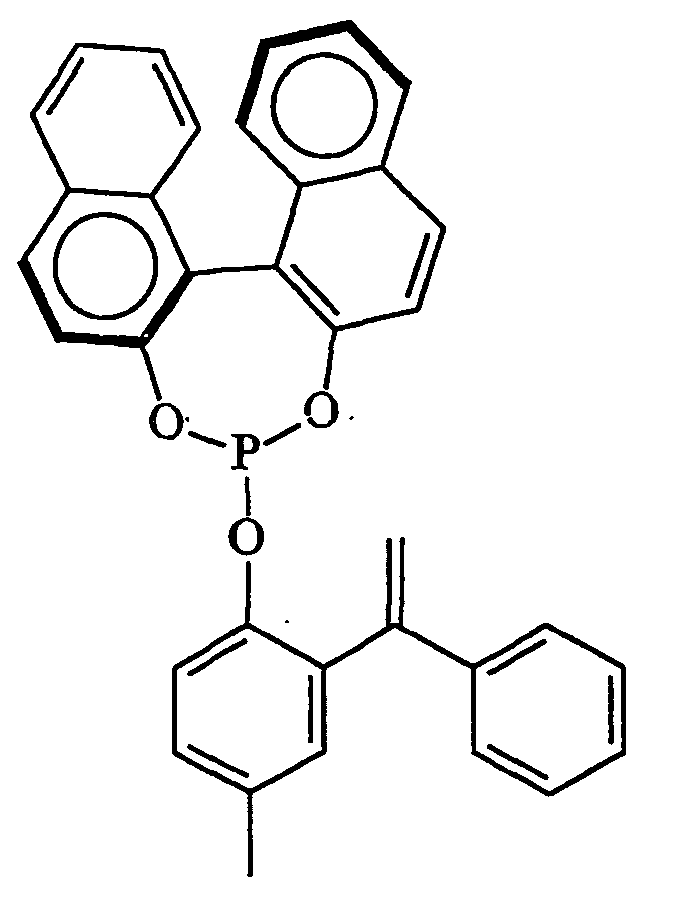
13C-NMR (100 MHz, CDCl3): δ [ppm] = 20.7 (CH3), 116. 9 (=CH2), 121.1 (2 x CHarom), 121.8 (CHarom), 124.8 (CHarom), 126.1 (2 x CHarom), 126.8 (2 x CHarom), 126.9 ( 2 x CHarom), 127.7 (CHarom), 128.2 (2 x CHarom), 128.4 (2 x CHarom), 129.6 (2 x CHarom), 130.2 (CHarom), 131.3 (2 x Cqarom), 132.2 (2 x CHarom), 132.6 (2 x Cqarom), 134.1 (Cqarom), 134.2 (Cqarom), 140.5 (Cqarom), 146.1 (2 x Cqarom), 146.7 (Cqarom, 2JP-C = 7.8 Hz), 147.0 (Cqolefin), 147.7 (2 x Cqarom, 2JP-C = 4.9 Hz).
31P-NMR (202 MHz, CDCl3): δ [ppm] = 158. 6
MS (EI, 70EV) : m/z [%] = 524 (M+, 100), 447 (13), 315 (13), 268 (59), 239 (42), 209 (7), 105 (5), 77 (2). - Ansatz:
- 2.09 g (9.9 mmol) 1-Hydroxy-4-methyl-2-(1-phenylvinyl)-benzol
- 2.00 g (9.9 mmol) N-Boc-(S)-prolinol
- 1.90 g (10.9 mmol) Diethylazodicarboxylat
- 2.86 g (10.9 mmol) Triphenylphosphin
- 50 ml abs. THF
- Durchführung:
Zu einer Lösung aus 2.09 g (9.9 mmol) 1-Hydroxy-4-methyl-2-(1-phenylvinyl)-benzol, 2.00 g (9.9 mmol) N-Boc-(S)-prolinol und 2.86 g (10.9 mmol) Triphenylphosphin in 50 ml THF werden 1.90 g (10.9 mmol) Diethylazodicarboxylat getropft. Das Reaktionsgemisch wird 20 h unter Rückfluss erhitzt. Anschliessend entfernt man das Lösungsmitel am Rotationsverdampfer, nimmt den Rückstand in Dichlormethan auf und filtriert die Lösung durch Aluminiumoxid (basisch, Aktivität II - III). Nach Entfernen des Lösungsmittels wird das so erhaltene Rohprodukt säulenchromatographisch an Kieselgel mit Toluol/MTBE (Volumenverhältnis = 20/1) als Elutionsmittel gereinigt. Man erhält 3.13 g (7.9 mmol, 80 %) 2-[4-Methyl-2-(1-phenyl-vinyl)-phenoxymethyl]-pyrrolidin-1-carbonsäure-tert-butylester. - Ausbeute: 3.13 g (7.9 mmol, 80 %) 2-[4-Methyl-2-(1-phenyl-vinyl)-phenoxymethyl]-pyrrolidin-1-carbonsäure-tert-butylester
- Spektroskopische Daten: 2-[4-Methyl-2-(1-phenyl-vinyl)-phenoxymethyl]-pyrrolidin-1-carbonsäure-tert-butylester (1.5/1 Diastereomerengemisch)

13C-NMR (100 MHz, CDCl3): δ [ppm] = 20.4 (CH3), 22.6 und 23.7 (CH2), 27.3 und 28.0 (CH2), 28.5 (3 x C(CH3)3), 46.4 und 46.8 (NCH2), 55.7 und 55.9 (NCH), 68.0 und 68.3 (OCH2), 79.0 und 79.4 (CMe3), 111.9 (CHarom), 114.9 und 115.2 (=CH2), 125.7 und 126.0 (CHarom), 126.3 (2 x CHarom), 128.0 (2 x CHarom), 128.2 und 128.9 (CHarom), 130.0 und 130.7 (Cqarom), 131.8 und 132.0 (CHarom), 137.7 (Cqarom), 141.4 (Cqarom), 147.5 (Cqolefin), 154.0 (Cqarom), 154.4 und 154.5 (NCOOtBu).
MS (EI, 70EV) : m/z [%] = 393 (M+, 15) , 337 (4) , 320 (5), 293 (33), 278 (2), 226 (4), 209 (44), 195 (16), 165 (19), 128 (42), 114 (62), 70 (87), 57 (100). - spezifische Drehung:
[α]D 20 = - 45.5 ° (c = 0.89, Diethylether)Elementaranalyse: (C25H31NO3, M = 393.23) ber.: C 76.3 H 7.9 N 3.6 gef.: C 76.0 H 8.0 N 3.5 - Ansatz:
- 1.76 g (4.5 mmol) 2-[4-Methyl-2-(1-phenyl-vinyl)-phenoxymethyl]-pyrrolidin-1-carbonsäure-tert-butylester
- 5.4 ml Trifluoressigsäure
- 22 ml abs. CH2Cl2
- Durchführung:
Zu einer Lösung aus 1.76 g (4.5 mmol) 2-[4-Methyl-2-(1-phenyl-vinyl)-phenoxymethyl]-pyrrolidin-1-carbonsäure-tert-butylester in 22 ml abs. CH2Cl2 werden bei 0 °C 5.4 ml Trifluoressigsäure gegeben und man rührt die Reaktionslösung 1 h bei derselben Temperatur. Anschließend engt man das Reaktionsgemisch am Rotationsverdampfer ein und nimmt den Rückstand in 20 ml Dichlormethan auf. Die Lösung wird mit 20 ml konzentrierter Ammoniaklösung versetzt und man trennt die organische Phase ab. Die wässrige Phase wird zweimal mit je 10 ml Dichlormethan extrahiert und die vereinigten organischen Phasen werden über MgSO4 getrocknet. Das Lösungsmittel entfernt man am Rotationsverdampfer und das so erhaltene Rohprodukt wird säulenchromatographisch an Kieselgel mit MTBE/Cyclohexan/Ethanol/Diisopropylamin (Volumenverhältnis = 3/1/1 + Vol.-%) als Elutionsmittel gereinigt. Man erhält 1.31 g (4.5 mmol, 100 %) 2-[4-Methyl-2-(1-phenyl-vinyl)-phenoxymethyl]-pyrrolidin. - Ausbeute: 1.31 g (4.5 mmol, 100 %) 2-[4-Methyl-2-(1-phenyl-vinyl)-phenoxymethyl]-pyrrolidin.
- Spektroskopische Daten: 2-[4-Methyl-2-(1-phenyl-vinyl)-phenoxymethyl]-pyrrolidin.

13C-NMR (100 MHz, CDCl3): δ [ppm] = 20.4 (CH3), 24.8 (CH2), 26.9 (CH2), 46.2 (NCH2), 57.4 (NCH), 69.7 (OCH2), 111.4 (CHarom), 115.4 (=CH2), 126.2 (2 x CHarom), 127.2 (CHarom), 128.1 (2 X CHarom), 129.4 (CHarom), 129.8 (Cqarom), 130.6 (Cqarom), 131.9 (CHarom), 141.8 (Cqarom), 147.9 (Cqolefin), 153.8 (Cqarom).
MS (EI, 70EV) : m/z [%] = 293 (M+, 15), 211 (4), 209 (4), 195 (1), 178 (3), 165 (6), 152 (2), 70 (100). - spezifische Drehung:
[α]D 20 = + 15.3 ° (c = 1.00, Diethylether)Elementaranalyse: (C20H23NO, M = 239.2) ber.: C 81.9 H 7.9 N 4.8 gef.: C 81.3 H 7.9 N 4.5 - Ansatz:
- 1.31 g (4.5 mmol) 2-[4-Methyl-2-(1-phenyl-vinyl)-phenoxymethyl]-pyrrolidin
- 1.00 g (4.6 mmol) P-Chlordiphenylphosphin
- 1.13 g (11.2 mmol) Triethylamin
- 15 ml abs. Toluol
- Durchführung:
Zu einer Lösung aus 1.31 g (4.5 mmol) 2-[4-Methyl-2-(1-phenyl-vinyl)-phenoxymethyl]-pyrrolidin und 1.13 g (11.2 mmol) Triethylamin in 12 ml abs. Toluol werden bei 0 °C innerhalb 30 min 1.00 g (4.6 mml) P-Chlordiphenylphosphin in 3 ml abs. Toluol getropft. Die Reaktionslösung lässt man 20 h bei RT rühren. Anschliessend wird von entstandenem Triethylammoniumchlorid abfiltriert, der Rückstand mit 20 ml Toluol nachgewaschen und die Filtrate am Rotionsverdampfer eingeengt. Die Reinigung des erhaltenen Rohproduktes erfolgt säulenchromatographisch an Kieselgel mit MTBE/Cyclohexan/Diisopropylamin (Volumenverhältnis = 5/1 + 10 Vol-%) als Elutiosmittel. Man erhält 1.31 g (2.7 mmol, 61 %) Diphenylphosphanyl-[4-methyl-2-(1-phenyl-vinyl)-phenoxymethyl]-pyrrolidin. - Ausbeute: 1.31 g (2.7 mmol, 61 %) Diphenylphosphanyl-[4-methyl-2-(1-phenyl-vinyl)-phenoxymethyl]-pyrrolidin.
- Spektroskopische Daten: Diphenylphosphanyl-[4-methyl-2-(1-phenyl-vinyl)-phenoxymethyl]-pyrrolidin

13C-NMR (100 MHz, CDCl3): δ [ppm] = 20.4 (CH3), 25.1 (NCH2CH2), 28.9 (NCHCH2, 3JC-P = 5.8Hz), 47.0 (NCH2, 2JC-P = 8.7 Hz), 61.4 (NCH, 2JC-P = 29.2 Hz), 70.8 (OCH2, 3JC-P = 5.8 Hz), 112.0 (CHarom), 115.1 (=CH2), 126.4 (3 x CHarom), 127.1 (CHarom), 127.8 (CHarom), 127.9 (3 x CHarom), 128.0 (2 x CHarom), 128.9 (2 x CHarom), 129.6 (Cqarom), 130.8 (Cqarom), 131.2 (2 x CHarom), 131.9 (CHarom), 132.7 (2 x CHarom), 138.5 (P-Cqarom, 1JP-C = 16.5 Hz), 139.5 (P-Cqarom, 1J = 6.8 Hz), 141.6 (Cqarom), 147.7 (Cqolefin), 154.1 (Cqarom). 31P-NMR (202 MHz, CDCl3): δ [ppm] = 46.2.
MS (EI, 70EV): m/z [%] = 477 (M+, 15), 395 (37), 379 (15), 317 (1), 292 (6), 280 (5), 267 (11), 254 (54), 185 (100), 152 (10), 91 (9). - Ansatz:
- 0.210 g (1.0 mmol) 4-Methyl-2-(1-phenylvinyl)-phenol
- 0.10 ml (1.15 mmol) Morpholin
- 6.0 mg (12 µmol) [RhCl(cod]]2
- 10 ml abs. Dioxan
- Durchführung:
0.421 g (2.0 mmol) 4-Methyl-2-(1-phenylvinyl)-phenol, 0.10 ml (1.15 mmol) Morpholin, 6.0 mg (12 µmol) [RhCl(cod)]2 und 10 ml abs. Dioxan werden in einem Druckbehälter 3 Tage bei 120 °C und einem Druck von 90 bar Synthesegas (CO:H2 = 7:2) gerührt. Nach Abkühlen und Entspannen des Druckbehälters wird die Reaktionslösung über Aluminiumoxid (Aktivität II - III, basisch) absorptiv filtriert (Elutionsmittel: Diethylether, anschließend Ethanol). Nach Entfernen der Lösemittels erfolgt die Reinigung des Rohproduktes säulenchromatographisch an Kieselgel mit Cyclohexan/MTBE (Volumenverhältnis = 1/1) als Elutionsmittel. Man erhält 255 mg (0.82 mmol, 82 %) 4-Methyl-2-(3-morpholin-4-yl-1-phenyl-propyl)-phenol. - Ausbeute: 255 mg (0.82 mmol, 82 %) 4-Methyl-2-(3-morpholin-4-yl-1-phenyl-propyl)-phenol.
- Spektroskopische Daten: 4-Methyl-2-(3-morpholin-4-yl-1-phenylpropyl)-phenol.

13C-NMR (100 MHz, CDCl3): δ [ppm] = 20.6 (CH3), 30.4 (CH2), 38.1 (CHArAr'), 54.5 (2x NCH2), 58.3 (NCH2), 66.3 (2x OCH2), 117.4 (CHarom), 126.2 (CHarom), 128.0 (2x CHarom), 128.3 (2x CHarom), 129.2 (2x CHarom), 129.5 (Cqarom), 130.7 (Cqarom), 144.5 (Cqarom), 153.4 (Cqarom). - Ansatz:
- 0.210 g (1.0 mmol) 4-Methyl-2-(1-phenylvinyl)-phenol
- 0.17 ml (1.2 mmol) Diisopropylamin
- 6.0 mg (12 µmol) [RhCl(cod]]2
- 10 ml abs. Dioxan
- Durchführung:
0.210 g (1.0 mmol) 4-Methyl-2-(1-phenylvinyl)-phenol, 0.17 ml (1.2 mmol) Diisopropylamin, 6.0 mg (12 µmol) [RhCl(cod)]2 und 10 ml abs. Dioxan werden in einem Druckbehälter 3 Tage bei 120 °C und einem Druck von 90 bar Synthesegas (CO:H2 = 7:2) gerührt. Nach Abkühlen und Entspannen des Druckbehälters wird die Reaktionslösung über Aluminiumoxid (Aktivität II - III, basisch) absorptiv filtriert (Elutionsmittel: Diethylether, anschließend Ethanol). Die Lösemittel werden abdestilliert. Man erhält 295 mg eines Rohprodukts, das lt. NMR zu 71 % 2-(3-Diisopropylamino-1-phenyl-propyl)-4-methyl-phenol und zu 29 % 6-Methyl-4-phenyl-chroman-2-ol enthält. - Ausbeute: 228 mg (0.70 mmol, 70 %) 2-(3-Diisopropylamino-1-phenyl-propyl)-4-methyl-phenol
Spektroskopische Daten:
2-(3-Diisopropylamino-1-phenyl-propyl)-4-methyl-phenol
- Die spektroskopischen Daten entsprechen denen der Literatur P.G. Andersson, H. E. Schenk, K. Österlund J. Org. Chem. 1998, 63, 8067.


Claims (12)
- Verfahren zur Herstellung von 3,3-Diarylpropylaminen der allgemeinen Formel (I)
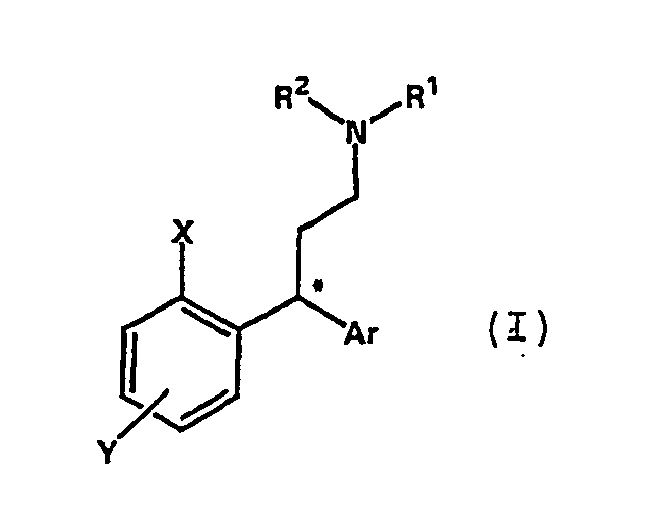
Ar für einen substituierten oder unsubstituierten Arylrest steht,
X für OH oder OR3 steht,
Y für Cl, Br, I, CN, CHO, CH2OR, COOH, COOR, worin R für C1-C10-Alkyl oder einen substituierten oder unsubstituierten Arylrest steht, oder C1-C10-Alkyl steht,
R1, R2 für C1-C10-Alkyl oder C3-C8-Cycloalkyl steht, wobei R1 und R2 unter Bildung einer cyclischen Struktur verknüpft sein können,
und wobei R3 für einen Rest steht, der von einer der folgenden Verbindungen abgeleitet ist:(i) den Aminosäuren D-Prolin, L-Prolin, D-Alanin, L-Alanin, D-Asparagin, L-Asparagin, D-Asparaginsäure, L-Asparaginsäure, D-Glutamin, L-Glutamin, D-Glutaminsäure, L-Glutaminsäure, D-Phenylalanin, L-Phenylalanin, D-Histidin, L-Histidin, D-Leucin, L-Leucin, D-Serin, L-Serin, L-Threonin, D-Threonin, D-Tryptophan, L-Tryptophan, D-Tyrosin, L-Tyrosin, D-Valin, L-Valin, D-Cystein, L-Cystein, D-Methionin, L-Methionin, D-Isoleucin, L-Isoleucin, oder den Alkoholen, die sich aus diesen Aminosäuren durch Reduktion der Carbonsäurefunktion zur Hydroxymethyleneinheit ergeben,(ii) den Aminosäuren N-Diphenylphosphanyl-D-alanin, N-Diphenylphosphanyl-L-alanin, N-Diphenylphosphanyl-D-prolin, N-Diphenylphosphanyl-L-prolin, N-Diphenylphosphanyl-D-phenylalanin, N-Diphenylphosphanyl-L-phenylalanin, sowie den Alkoholen, die sich aus diesen Aminosäuren durch Reduktion der Carbonsäurefunktion zur Hydroxymethyleneinheit ergeben,(iii) α-Hydroxycarbonsäurederivaten der allgemeinen Formel (iv) den Verbindungen der allgemeinen Formeln
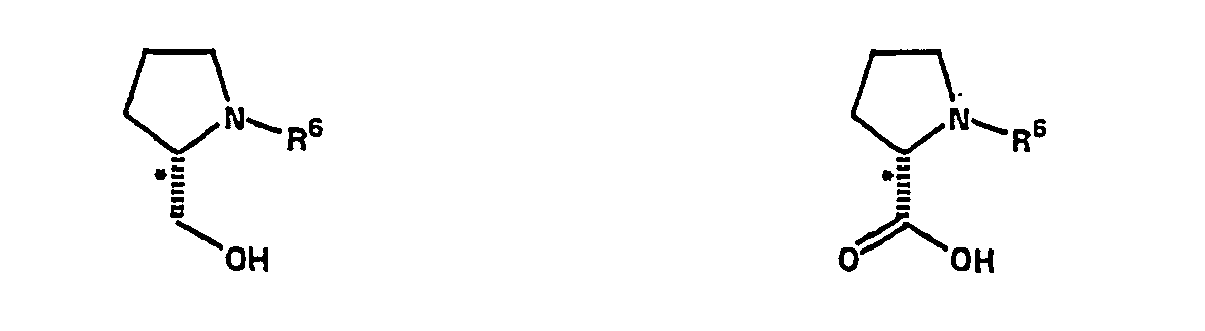 (v) den Verbindungen der allgemeinen Formeln
 (vi) den Säuren
(R)-Acetoxyphenylessigsäure,
(R)- und (S)-1,4-Benzodioxan-2-carbonsäure,
(R)-(-)- und (S)-(+)-Hexahydro-acetoxymandelsäure,
(2R,3S)-2,3-O-Isopropyliden-2,3-dihydroxybuttersäure und deren Stereoisomere,
(+)- und (-)-Menthyloxyessigsäure,
(R)- und (S)-3-Phenyl-2-acyloxypropionsäure,
(R)- und (S)-Acetoxymandelsäure,
(R)- und (S)-α-Methoxy-α-trifluormethylphenylessigsäure,
(S)-(+)-alpha-Methoxyphenylessigsäure,
(R)- und (S)-5-Oxo-tetrahydrofuran-2-carbonsäure, sowie den Alkoholen, die sich aus diesen Säuren durch Reduktion der Carbonsäurefunktion zur Hydroxymethyleneinheit ergeben,(vii) Verbindungen der allgemeinen Formel (viii) α-Naphthol, β-Naphthol oder (R)- oder (S)-1-(9-Anthryl)-2,2,2-trifluoroethanol,(ix) 2-Methylamino-1-phenyl-propan-1-ol (Ephedrin) aller stereomerer Formen,
oder R3 für einen der folgenden Reste steht:(x) Phosphitreste der allgemeinen Formel -P(OR10) (OR11), worin R10 und R11 gleich oder verschieden sein können und für einen gegebenenfalls polycyclischen oder verbrückten Arylrest stehen,(xi) C1-C10-Alkyl, verzweigt oder linear,(xii) Acyl,(xiii) Benzyl oder substituierte Benzylreste,dadurch gekennzeichnet, dass man Verbindungen der allgemeiner Formel (II)
(2-(Diphenylphosphino)-1,1'-binaphthalen-2'-yl)-1,2'-binaphthalen-2,2'-diyl-phosphit (BINAPHOS),
(2,2-Dimethyl-4,5-diphenylphosphinomethyl)-1,3-dioxolan (DIOP),
(2,2-Dimethyl-4,5-bis(5H-dibenzophosphol-5-ylmethyl)-1,3-dioxolan,
1,4-Bis(diphenylphosphino)butan,
2,3-Bis(diphenylphosphino)butan,
1,2-Bis(diphenylphosphinomethyl)cyclobutan,
1,2-Bis(5H-dibenzophosphcl-5-ylmethyl)cyclobutan,
1,2-Bis(diphenylphosphinomethyl)cyclohexan,
1,2-Bis(5H-dibenzophosphol-5-ylmethyl)cyclohexan,
(2S,4S)-N-tert.-Butoxycarbonyl-4-diphenylphosphino-2-diphenylphosphinomethyl-pyrrolicin (BPPM),
1,2-Bis(diphenylphosphinoxy)cyclohexan,
Benzyl-methyl-phenylphosphin,
Cyclohexyl-o-anisyl-methylphosphin,
Neomenthyldiphenylphosphin,
Phenyl-o-anisyl-methylphosphin,
ortho-Diphenylphosphanylbenzoyl
Tributylphosphin,
2,2'-Bis(diphenylphosphino)-1,1'-binaphthyl (BINAP) und Gemischen bzw. Stereoisomeren davon, gebildet wird. - Verfahren nach Anspruch 1, dadurch gekennzeichnet, dass man Verbindungen der allgemeinen Formel (IV)


- Verfahren nach Anspruch 1 oder 2, dadurch gekennzeichnet, dass man es bei einer Temperatur von 50 bis 200°C, vorzugsweise 100 bis 140°C, durchführt.
- Verfahren nach den Ansprüchen 1 bis 3, dadurch gekennzeichnet, dass man es bei einem Druck von 40 bis 200 bar, vorzugsweise 80 bis 120 bar, durchführt.
- Verfahren nach Anspruch 4, dadurch gekennzeichnet, dass das Druckverhältnis CO/H2 10/90 bis 90/10, vorzugsweise 70/30 bis 90/10, beträgt.
- Verfahren nach den Ansprüchen 1 bis 5, dadurch gekennzeichnet, dass man die Reaktion über einen Zeitraum von 2 Stunden bis 4 Tagen, vorzugsweise 1 bis 3 Tagen, durchführt.
- Verfahren nach den Ansprüchen 1 bis 6, dadurch gekennzeichnet, dass der Katalysator Rhodium umfasst.
- Verfahren nach den Ansprüchen 1 bis 7, dadurch gekennzeichnet, dass der Katalysatorvorläufer [Rh(cod)Cl]2 und/oder Rh(acac)(CO)2 ist.
- Verfahren nach den Ansprüchen 1 bis 8, dadurch gekennzeichnet, dass der Ligand Tributylphosphin, (+)- oder (-)-(2,2-Dimethyl-4,5-diphenylphosphinomethyl)-1,3-dioxolan, (R)- oder (S)-BINAP und/oder (R,S)-BINAPHOS und deren Stereoisomere ist.
- Verfahren nach Anspruch 9, dadurch gekennzeichnet, dass der Ligand Tributylphosphin ist und das Molverhältnis von Tributylphosphin zu Rhodium 1:1 bis 25:1, vorzugsweise 4:1 bis 10:1, beträgt.
- Verfahren nach Anspruch 9, dadurch gekennzeichnet, dass der Ligand (R)- oder (S)-BINAP ist und das Molverhältnis von BINAP zu Rhodium 1:1 bis 6:1, vorzugsweise 1:1 bis 2:1, beträgt.
- Verfahren nach Anspruch 9, dadurch gekennzeichnet, dass der Ligand (R,S)-BINAPHOS oder dessen Stereoisomere ist und das Molverhältnis von BINAPHOS zu Rhodium 1:1 bis 6:1, vorzugsweise 1:1 bis 2:1, beträgt.
Applications Claiming Priority (3)
| Application Number | Priority Date | Filing Date | Title |
|---|---|---|---|
| DE10033016 | 2000-07-07 | ||
| DE10033016A DE10033016A1 (de) | 2000-07-07 | 2000-07-07 | Verfahren zur Herstellung von 3,3-Diarylpropylaminen |
| PCT/EP2001/007803 WO2002004399A1 (de) | 2000-07-07 | 2001-07-06 | Verfahren zur herstellung von 3,3-diarylpropylaminen |
Publications (2)
| Publication Number | Publication Date |
|---|---|
| EP1299342A1 EP1299342A1 (de) | 2003-04-09 |
| EP1299342B1 true EP1299342B1 (de) | 2007-05-02 |
Family
ID=7648103
Family Applications (1)
| Application Number | Title | Priority Date | Filing Date |
|---|---|---|---|
| EP01962840A Expired - Lifetime EP1299342B1 (de) | 2000-07-07 | 2001-07-06 | Verfahren zur herstellung von 3,3-diarylpropylaminen |
Country Status (9)
| Country | Link |
|---|---|
| US (1) | US6809225B2 (de) |
| EP (1) | EP1299342B1 (de) |
| JP (1) | JP2004502748A (de) |
| CN (1) | CN1269793C (de) |
| AT (1) | ATE361272T1 (de) |
| AU (1) | AU2001283932A1 (de) |
| DE (2) | DE10033016A1 (de) |
| ES (1) | ES2283427T3 (de) |
| WO (1) | WO2002004399A1 (de) |
Families Citing this family (8)
| Publication number | Priority date | Publication date | Assignee | Title |
|---|---|---|---|---|
| EP0957073A1 (de) * | 1998-05-12 | 1999-11-17 | Schwarz Pharma Ag | 3,3-Diphenylpropylaminderivate |
| DE10315917A1 (de) * | 2003-04-08 | 2004-11-18 | Schwarz Pharma Ag | Hochreine Basen von 3,3-Diphenylpropylaminmonoestern |
| JP4513535B2 (ja) * | 2004-12-03 | 2010-07-28 | 住友化学株式会社 | トルテロジンの製造方法 |
| ATE480531T1 (de) * | 2006-05-24 | 2010-09-15 | Pfizer Ltd | Verfahren zur herstellung von benzopyran-2- olderivaten |
| US7767862B2 (en) * | 2008-08-11 | 2010-08-03 | Shell Oil Company | Ligand, catalyst and process for hydroformylation |
| EP2364966A1 (de) | 2010-03-09 | 2011-09-14 | LEK Pharmaceuticals d.d. | Verfahren zur Herstellung von 3-(2-hydroxy-5-substituierten phenyl)-3-phenylpropylaminen, Zwischenprodukte zur Herstellung von Hydroxytolterodin |
| CN104744514B (zh) * | 2013-12-27 | 2018-03-23 | 中国科学院上海药物研究所 | 一种手性磷烯配体、合成方法及其在不对称反应中的应用 |
| CN118496302B (zh) * | 2024-05-17 | 2025-01-24 | 广东医科大学 | 一种多肽色氨酸残基吲哚c2位膦酰化修饰的化合物及其制备方法与应用 |
Family Cites Families (5)
| Publication number | Priority date | Publication date | Assignee | Title |
|---|---|---|---|---|
| SE8800207D0 (sv) * | 1988-01-22 | 1988-01-22 | Kabivitrum Ab | Nya aminer, deras anvendning och framstellning |
| SE9203318D0 (sv) * | 1992-11-06 | 1992-11-06 | Kabi Pharmacia Ab | Novel 3,3-diphenylpropylamines, their use and preparation |
| US6686353B1 (en) | 1996-05-20 | 2004-02-03 | Teijin Intellectual Property Center Limited | Diarylalkyl cyclic diamine derivatives as chemokine receptor antagonists |
| KR20000057548A (ko) * | 1996-12-13 | 2000-09-25 | 알프레드 엘. 미첼슨 | 광학적 전송물질 및 결합재 |
| EP0957073A1 (de) | 1998-05-12 | 1999-11-17 | Schwarz Pharma Ag | 3,3-Diphenylpropylaminderivate |
-
2000
- 2000-07-07 DE DE10033016A patent/DE10033016A1/de not_active Ceased
-
2001
- 2001-07-06 ES ES01962840T patent/ES2283427T3/es not_active Expired - Lifetime
- 2001-07-06 CN CNB018125425A patent/CN1269793C/zh not_active Expired - Fee Related
- 2001-07-06 AT AT01962840T patent/ATE361272T1/de not_active IP Right Cessation
- 2001-07-06 EP EP01962840A patent/EP1299342B1/de not_active Expired - Lifetime
- 2001-07-06 US US10/332,290 patent/US6809225B2/en not_active Expired - Fee Related
- 2001-07-06 WO PCT/EP2001/007803 patent/WO2002004399A1/de not_active Ceased
- 2001-07-06 AU AU2001283932A patent/AU2001283932A1/en not_active Abandoned
- 2001-07-06 JP JP2002509068A patent/JP2004502748A/ja active Pending
- 2001-07-06 DE DE50112449T patent/DE50112449D1/de not_active Expired - Fee Related
Also Published As
| Publication number | Publication date |
|---|---|
| DE50112449D1 (de) | 2007-06-14 |
| AU2001283932A1 (en) | 2002-01-21 |
| US20040034080A1 (en) | 2004-02-19 |
| ATE361272T1 (de) | 2007-05-15 |
| CN1269793C (zh) | 2006-08-16 |
| EP1299342A1 (de) | 2003-04-09 |
| WO2002004399A1 (de) | 2002-01-17 |
| HK1051178A1 (en) | 2003-07-25 |
| CN1441771A (zh) | 2003-09-10 |
| ES2283427T3 (es) | 2007-11-01 |
| JP2004502748A (ja) | 2004-01-29 |
| DE10033016A1 (de) | 2002-01-24 |
| US6809225B2 (en) | 2004-10-26 |
Similar Documents
| Publication | Publication Date | Title |
|---|---|---|
| EP0794957B1 (de) | Verfahren zur herstellung optisch aktiver metallocenylphosphine | |
| AU2011295171B2 (en) | New process for the preparation of intermediates useful for the manufacture NEP inhibitors | |
| EP0643065A1 (de) | Neue Bisphosphine für asymmetrische Hydrierkatalysatoren | |
| WO2008132057A1 (de) | Verfahren zur herstellung optisch aktiver carbonylverbindungen | |
| EP1299342B1 (de) | Verfahren zur herstellung von 3,3-diarylpropylaminen | |
| DE602004008478T2 (de) | Biphosphinrutheniumkomplexe mit chiralen diaminliganden als katalysatoren | |
| EP0158875A2 (de) | Chirale Rhodium-diphosphinkomplexe für asymmetrische Hydrierungen | |
| DE602005003572T2 (de) | Ferrocenylliganden für homogene, enantioselektive hydrierungskatalysatoren | |
| DE60109484T2 (de) | P-chirale bisphospholane ligande, deren übergangsmetall-komplexe | |
| US8624024B2 (en) | Phosphoramide compound, method for producing the same, ligand, complex, catalyst and method for producing optically active alcohol | |
| DE3302697A1 (de) | Phosphorverbindungen | |
| DE3935910A1 (de) | Verfahren zur herstellung von optisch reinen 1,2,3,4-tetrahydro-3-carboxyisochinolinen | |
| DE69300826T2 (de) | Hydrierung. | |
| EP0744401B1 (de) | Verfahren zur Herstellung von optisch aktiven 2-Piperazincarbonsäurederivaten | |
| EP1692151B1 (de) | Ferrocenyl-1, 2-diphosphine, deren herstellung und deren verwendung | |
| EP1692149B1 (de) | Verfahren zur herstellung von orthometallierten und orthosubstituierten aromatischen verbindungen | |
| EP0512416B1 (de) | Neue homochirale Diphosphine | |
| EP0512415B1 (de) | Verfahren zur enantioselektiven Synthese von 2(R)-Benzylbernsteinsäuremonoamid-Derivaten | |
| DE102008033165A1 (de) | Verfahren zum Herstellen eines optisch aktiven ß-Hydroxycarbonsäurederivats | |
| DE4232505A1 (de) | Verfahren zur Reduktion von Carbonsäuren oder Carbonsäurederivaten sowie neue Verbindungen | |
| EP0470702B1 (de) | Optisch aktives Morpholinooxobutansäure-Hydroxybinaphthalinderivat und seine Herstellung | |
| DE3124091A1 (de) | Neue n(alpha)-(3-cyano-propanoyl)-aminocarbonsaeure-derivate und deren verwendung | |
| EP0798289B1 (de) | Alpha-Iminocarbonsäurederivate | |
| HK1051178B (en) | Method for producing 3,3-diarylpropylamines | |
| DE10327109A1 (de) | Liganden zur Anwendung in stereoselektiven Synthesen |
Legal Events
| Date | Code | Title | Description |
|---|---|---|---|
| PUAI | Public reference made under article 153(3) epc to a published international application that has entered the european phase |
Free format text: ORIGINAL CODE: 0009012 |
|
| 17P | Request for examination filed |
Effective date: 20021220 |
|
| AK | Designated contracting states |
Kind code of ref document: A1 Designated state(s): AT BE CH CY DE DK ES FI FR GB GR IE IT LI LU MC NL PT SE TR |
|
| AX | Request for extension of the european patent |
Extension state: AL LT LV MK RO SI |
|
| RIN1 | Information on inventor provided before grant (corrected) |
Inventor name: SCHMIDT, ANDREAS Inventor name: DONSBACH, MARTINSCHWARZ BIOSCIENCES INCSUITE 100 Inventor name: BUSS, CHRISTIAN Inventor name: EILBRACHT, PETER |
|
| GRAP | Despatch of communication of intention to grant a patent |
Free format text: ORIGINAL CODE: EPIDOSNIGR1 |
|
| GRAS | Grant fee paid |
Free format text: ORIGINAL CODE: EPIDOSNIGR3 |
|
| RIN1 | Information on inventor provided before grant (corrected) |
Inventor name: DONSBACH, MARTINS Inventor name: SCHMIDT, ANDREAS Inventor name: EILBRACHT, PETER Inventor name: BUSS, CHRISTIAN |
|
| GRAA | (expected) grant |
Free format text: ORIGINAL CODE: 0009210 |
|
| RIN1 | Information on inventor provided before grant (corrected) |
Inventor name: DONSBACH, MARTIN Inventor name: BUSS, CHRISTIAN Inventor name: SCHMIDT, ANDREAS Inventor name: EILBRACHT, PETER |
|
| AK | Designated contracting states |
Kind code of ref document: B1 Designated state(s): AT BE CH CY DE DK ES FI FR GB GR IE IT LI LU MC NL PT SE TR |
|
| PG25 | Lapsed in a contracting state [announced via postgrant information from national office to epo] |
Ref country code: FI Free format text: LAPSE BECAUSE OF FAILURE TO SUBMIT A TRANSLATION OF THE DESCRIPTION OR TO PAY THE FEE WITHIN THE PRESCRIBED TIME-LIMIT Effective date: 20070502 |
|
| REG | Reference to a national code |
Ref country code: GB Ref legal event code: FG4D Free format text: NOT ENGLISH |
|
| REG | Reference to a national code |
Ref country code: CH Ref legal event code: EP |
|
| REG | Reference to a national code |
Ref country code: IE Ref legal event code: FG4D Free format text: LANGUAGE OF EP DOCUMENT: GERMAN |
|
| REF | Corresponds to: |
Ref document number: 50112449 Country of ref document: DE Date of ref document: 20070614 Kind code of ref document: P |
|
| GBT | Gb: translation of ep patent filed (gb section 77(6)(a)/1977) |
Effective date: 20070607 |
|
| REG | Reference to a national code |
Ref country code: HK Ref legal event code: GR Ref document number: 1051178 Country of ref document: HK |
|
| PG25 | Lapsed in a contracting state [announced via postgrant information from national office to epo] |
Ref country code: SE Free format text: LAPSE BECAUSE OF FAILURE TO SUBMIT A TRANSLATION OF THE DESCRIPTION OR TO PAY THE FEE WITHIN THE PRESCRIBED TIME-LIMIT Effective date: 20070802 |
|
| ET | Fr: translation filed | ||
| NLV1 | Nl: lapsed or annulled due to failure to fulfill the requirements of art. 29p and 29m of the patents act | ||
| REG | Reference to a national code |
Ref country code: ES Ref legal event code: FG2A Ref document number: 2283427 Country of ref document: ES Kind code of ref document: T3 |
|
| BERE | Be: lapsed |
Owner name: SCHWARZ PHARMA A.G. Effective date: 20070731 |
|
| PG25 | Lapsed in a contracting state [announced via postgrant information from national office to epo] |
Ref country code: NL Free format text: LAPSE BECAUSE OF FAILURE TO SUBMIT A TRANSLATION OF THE DESCRIPTION OR TO PAY THE FEE WITHIN THE PRESCRIBED TIME-LIMIT Effective date: 20070502 Ref country code: PT Free format text: LAPSE BECAUSE OF FAILURE TO SUBMIT A TRANSLATION OF THE DESCRIPTION OR TO PAY THE FEE WITHIN THE PRESCRIBED TIME-LIMIT Effective date: 20071002 Ref country code: DK Free format text: LAPSE BECAUSE OF FAILURE TO SUBMIT A TRANSLATION OF THE DESCRIPTION OR TO PAY THE FEE WITHIN THE PRESCRIBED TIME-LIMIT Effective date: 20070502 |
|
| PLBE | No opposition filed within time limit |
Free format text: ORIGINAL CODE: 0009261 |
|
| STAA | Information on the status of an ep patent application or granted ep patent |
Free format text: STATUS: NO OPPOSITION FILED WITHIN TIME LIMIT |
|
| REG | Reference to a national code |
Ref country code: CH Ref legal event code: PL |
|
| 26N | No opposition filed |
Effective date: 20080205 |
|
| PG25 | Lapsed in a contracting state [announced via postgrant information from national office to epo] |
Ref country code: MC Free format text: LAPSE BECAUSE OF NON-PAYMENT OF DUE FEES Effective date: 20070731 Ref country code: GR Free format text: LAPSE BECAUSE OF FAILURE TO SUBMIT A TRANSLATION OF THE DESCRIPTION OR TO PAY THE FEE WITHIN THE PRESCRIBED TIME-LIMIT Effective date: 20070803 Ref country code: LI Free format text: LAPSE BECAUSE OF NON-PAYMENT OF DUE FEES Effective date: 20070731 Ref country code: CH Free format text: LAPSE BECAUSE OF NON-PAYMENT OF DUE FEES Effective date: 20070731 |
|
| PG25 | Lapsed in a contracting state [announced via postgrant information from national office to epo] |
Ref country code: BE Free format text: LAPSE BECAUSE OF NON-PAYMENT OF DUE FEES Effective date: 20070731 |
|
| PG25 | Lapsed in a contracting state [announced via postgrant information from national office to epo] |
Ref country code: AT Free format text: LAPSE BECAUSE OF NON-PAYMENT OF DUE FEES Effective date: 20070706 |
|
| PG25 | Lapsed in a contracting state [announced via postgrant information from national office to epo] |
Ref country code: CY Free format text: LAPSE BECAUSE OF FAILURE TO SUBMIT A TRANSLATION OF THE DESCRIPTION OR TO PAY THE FEE WITHIN THE PRESCRIBED TIME-LIMIT Effective date: 20070502 |
|
| PG25 | Lapsed in a contracting state [announced via postgrant information from national office to epo] |
Ref country code: LU Free format text: LAPSE BECAUSE OF NON-PAYMENT OF DUE FEES Effective date: 20070706 |
|
| PG25 | Lapsed in a contracting state [announced via postgrant information from national office to epo] |
Ref country code: TR Free format text: LAPSE BECAUSE OF FAILURE TO SUBMIT A TRANSLATION OF THE DESCRIPTION OR TO PAY THE FEE WITHIN THE PRESCRIBED TIME-LIMIT Effective date: 20070502 |
|
| PGFP | Annual fee paid to national office [announced via postgrant information from national office to epo] |
Ref country code: ES Payment date: 20090812 Year of fee payment: 9 Ref country code: FR Payment date: 20090710 Year of fee payment: 9 Ref country code: IE Payment date: 20090717 Year of fee payment: 9 |
|
| PGFP | Annual fee paid to national office [announced via postgrant information from national office to epo] |
Ref country code: DE Payment date: 20090702 Year of fee payment: 9 Ref country code: GB Payment date: 20090701 Year of fee payment: 9 |
|
| PGFP | Annual fee paid to national office [announced via postgrant information from national office to epo] |
Ref country code: IT Payment date: 20090721 Year of fee payment: 9 |
|
| GBPC | Gb: european patent ceased through non-payment of renewal fee |
Effective date: 20100706 |
|
| REG | Reference to a national code |
Ref country code: FR Ref legal event code: ST Effective date: 20110331 |
|
| PG25 | Lapsed in a contracting state [announced via postgrant information from national office to epo] |
Ref country code: DE Free format text: LAPSE BECAUSE OF NON-PAYMENT OF DUE FEES Effective date: 20110201 |
|
| REG | Reference to a national code |
Ref country code: DE Ref legal event code: R119 Ref document number: 50112449 Country of ref document: DE Effective date: 20110201 |
|
| PG25 | Lapsed in a contracting state [announced via postgrant information from national office to epo] |
Ref country code: IT Free format text: LAPSE BECAUSE OF NON-PAYMENT OF DUE FEES Effective date: 20100706 Ref country code: FR Free format text: LAPSE BECAUSE OF NON-PAYMENT OF DUE FEES Effective date: 20100802 |
|
| PG25 | Lapsed in a contracting state [announced via postgrant information from national office to epo] |
Ref country code: GB Free format text: LAPSE BECAUSE OF NON-PAYMENT OF DUE FEES Effective date: 20100706 Ref country code: IE Free format text: LAPSE BECAUSE OF NON-PAYMENT OF DUE FEES Effective date: 20100706 |
|
| REG | Reference to a national code |
Ref country code: ES Ref legal event code: FD2A Effective date: 20110818 |
|
| PG25 | Lapsed in a contracting state [announced via postgrant information from national office to epo] |
Ref country code: ES Free format text: LAPSE BECAUSE OF NON-PAYMENT OF DUE FEES Effective date: 20100707 |