EP1308977A2 - Actionneur électrostatique, et relais électrostatique et autres dispositifs utilisant le même - Google Patents
Actionneur électrostatique, et relais électrostatique et autres dispositifs utilisant le même Download PDFInfo
- Publication number
- EP1308977A2 EP1308977A2 EP02102543A EP02102543A EP1308977A2 EP 1308977 A2 EP1308977 A2 EP 1308977A2 EP 02102543 A EP02102543 A EP 02102543A EP 02102543 A EP02102543 A EP 02102543A EP 1308977 A2 EP1308977 A2 EP 1308977A2
- Authority
- EP
- European Patent Office
- Prior art keywords
- electrode
- insulating film
- electrostatic actuator
- electrostatic
- film
- Prior art date
- Legal status (The legal status is an assumption and is not a legal conclusion. Google has not performed a legal analysis and makes no representation as to the accuracy of the status listed.)
- Granted
Links
- 150000004767 nitrides Chemical class 0.000 claims abstract description 51
- 239000000463 material Substances 0.000 claims abstract description 16
- 238000000926 separation method Methods 0.000 claims description 4
- VYPSYNLAJGMNEJ-UHFFFAOYSA-N Silicium dioxide Chemical compound O=[Si]=O VYPSYNLAJGMNEJ-UHFFFAOYSA-N 0.000 abstract description 3
- 229910052681 coesite Inorganic materials 0.000 abstract 1
- 229910052906 cristobalite Inorganic materials 0.000 abstract 1
- 239000000377 silicon dioxide Substances 0.000 abstract 1
- 229910052682 stishovite Inorganic materials 0.000 abstract 1
- 229910052905 tridymite Inorganic materials 0.000 abstract 1
- 239000000758 substrate Substances 0.000 description 37
- 238000012546 transfer Methods 0.000 description 16
- 238000000034 method Methods 0.000 description 13
- 238000004519 manufacturing process Methods 0.000 description 11
- 238000012360 testing method Methods 0.000 description 10
- 239000011521 glass Substances 0.000 description 9
- 230000005684 electric field Effects 0.000 description 7
- 150000002500 ions Chemical class 0.000 description 7
- 230000000694 effects Effects 0.000 description 6
- 230000008569 process Effects 0.000 description 6
- 230000008859 change Effects 0.000 description 5
- 239000002184 metal Substances 0.000 description 5
- 229910052751 metal Inorganic materials 0.000 description 5
- 238000012545 processing Methods 0.000 description 5
- 238000005530 etching Methods 0.000 description 4
- 238000004544 sputter deposition Methods 0.000 description 4
- 150000001450 anions Chemical class 0.000 description 3
- 238000005452 bending Methods 0.000 description 3
- 230000015572 biosynthetic process Effects 0.000 description 3
- 230000015556 catabolic process Effects 0.000 description 3
- 239000004020 conductor Substances 0.000 description 3
- 238000006731 degradation reaction Methods 0.000 description 3
- 239000011810 insulating material Substances 0.000 description 3
- 239000012212 insulator Substances 0.000 description 3
- 230000002093 peripheral effect Effects 0.000 description 3
- 239000000470 constituent Substances 0.000 description 2
- 230000009467 reduction Effects 0.000 description 2
- 229910052581 Si3N4 Inorganic materials 0.000 description 1
- 230000008901 benefit Effects 0.000 description 1
- 230000003139 buffering effect Effects 0.000 description 1
- 150000001768 cations Chemical class 0.000 description 1
- 230000001413 cellular effect Effects 0.000 description 1
- 239000011248 coating agent Substances 0.000 description 1
- 238000000576 coating method Methods 0.000 description 1
- 238000010494 dissociation reaction Methods 0.000 description 1
- 230000005593 dissociations Effects 0.000 description 1
- 239000007772 electrode material Substances 0.000 description 1
- 238000005304 joining Methods 0.000 description 1
- 238000005259 measurement Methods 0.000 description 1
- 150000002739 metals Chemical class 0.000 description 1
- 238000005459 micromachining Methods 0.000 description 1
- 238000012544 monitoring process Methods 0.000 description 1
- 239000011295 pitch Substances 0.000 description 1
- 239000003566 sealing material Substances 0.000 description 1
- 230000008054 signal transmission Effects 0.000 description 1
- 229910052710 silicon Inorganic materials 0.000 description 1
- 239000010703 silicon Substances 0.000 description 1
- HQVNEWCFYHHQES-UHFFFAOYSA-N silicon nitride Chemical compound N12[Si]34N5[Si]62N3[Si]51N64 HQVNEWCFYHHQES-UHFFFAOYSA-N 0.000 description 1
- 229910052814 silicon oxide Inorganic materials 0.000 description 1
- 230000003068 static effect Effects 0.000 description 1
Images










Classifications
-
- H—ELECTRICITY
- H01—ELECTRIC ELEMENTS
- H01H—ELECTRIC SWITCHES; RELAYS; SELECTORS; EMERGENCY PROTECTIVE DEVICES
- H01H59/00—Electrostatic relays; Electro-adhesion relays
- H01H59/0009—Electrostatic relays; Electro-adhesion relays making use of micromechanics
-
- H—ELECTRICITY
- H01—ELECTRIC ELEMENTS
- H01H—ELECTRIC SWITCHES; RELAYS; SELECTORS; EMERGENCY PROTECTIVE DEVICES
- H01H59/00—Electrostatic relays; Electro-adhesion relays
-
- H—ELECTRICITY
- H01—ELECTRIC ELEMENTS
- H01H—ELECTRIC SWITCHES; RELAYS; SELECTORS; EMERGENCY PROTECTIVE DEVICES
- H01H1/00—Contacts
- H01H1/0036—Switches making use of microelectromechanical systems [MEMS]
- H01H2001/0084—Switches making use of microelectromechanical systems [MEMS] with perpendicular movement of the movable contact relative to the substrate
-
- H—ELECTRICITY
- H01—ELECTRIC ELEMENTS
- H01H—ELECTRIC SWITCHES; RELAYS; SELECTORS; EMERGENCY PROTECTIVE DEVICES
- H01H59/00—Electrostatic relays; Electro-adhesion relays
- H01H59/0009—Electrostatic relays; Electro-adhesion relays making use of micromechanics
- H01H2059/0018—Special provisions for avoiding charge trapping, e.g. insulation layer between actuating electrodes being permanently polarised by charge trapping so that actuating or release voltage is altered
-
- H—ELECTRICITY
- H01—ELECTRIC ELEMENTS
- H01H—ELECTRIC SWITCHES; RELAYS; SELECTORS; EMERGENCY PROTECTIVE DEVICES
- H01H59/00—Electrostatic relays; Electro-adhesion relays
- H01H59/0009—Electrostatic relays; Electro-adhesion relays making use of micromechanics
- H01H2059/0072—Electrostatic relays; Electro-adhesion relays making use of micromechanics with stoppers or protrusions for maintaining a gap, reducing the contact area or for preventing stiction between the movable and the fixed electrode in the attracted position
Definitions
- the present invention relates to an electrostatic actuator, an electrostatic micro-relay and other devices using the same.
- Fig. 1 is an exploded perspective view that shows a structure of a conventional electrostatic actuator and Fig. 2 shows a cross-sectional view thereof.
- This electrostatic actuator 1 which is disclosed in Japanese Laid-Open Patent Application No. 2000-164104, is mainly constituted by a fixed substrate 2 and a movable substrate 3.
- the fixed substrate 2 is made of a glass substrate having a fixed electrode 4 and a pair of fixed contacts 5, 6 formed on the upper face thereof.
- the surface of the fixed electrode 4 is coated with an insulating film 7 made from an oxide.
- the fixed contacts 5, 6 are respectively connected to connection pads 10, 11 on the fixed substrate 2 through respective wires 8, 9.
- the movable substrate 3 made from an Si substrate is provided with a movable electrode 13 supported by four elastic beams 12 in the center portion thereof, and a movable contact 15 is placed on the center portion of the lower face of the movable electrode 13 through an insulating layer 14.
- An anchor 16 protrudes from a peripheral portion of the lower face of the movable substrate 3 so that, when the movable substrate 3 is fixed on the upper face of the fixed substrate 2 by the anchor 16, the movable electrode 13 and the fixed electrode 4 are aligned face to face with each other with a space in between; thus, the movable contact 15 is aligned face to face with the fixed contacts 5, 6 with a space in between in a manner so as to bridge a space between the fixed contacts 5 and 6.
- the movable electrode 13 when a driving voltage, applied between the fixed electrode 4 and the movable electrode 13, has reached a predetermined voltage value, the movable electrode 13 is attracted toward the fixed electrode 4 side by an electrostatic attracting force that is exerted between the fixed electrode 4 and the movable electrode 13 so that the movable electrode 13 is allowed to adhere to the fixed electrode 4 through the insulating film 7 with the elastic beam 12 being distorted.
- the movable contact 15 is pressed between the fixed contacts 5 and 6 so that the fixed contacts 5, 6 are electrically closed by the movable contact 15 so that a pair of connection pads 10 and 11 are allowed to conduct to each other.
- Fig. 3 the CV characteristic of the electrostatic actuator is represented by the relationship between a driving voltage Vdrive applied between the fixed electrode 4 and the movable electrode 13 and a capacitance C between the two electrodes 4 and 13.
- Vdrive applied between the fixed electrode 4 and the movable electrode 13
- C capacitance
- C1 represents a value of the capacitance C in a state where no driving voltage is applied between the movable electrode 13 and the fixed electrode 4
- C2 represents a value of the capacitance C in a state where the movable electrode 13 adheres to the fixed electrode 4 through the insulating film 7
- on-voltage Von is a value of the driving voltage Vdrive at the time when the movable electrode 13 is made to adhere to the fixed electrode 4 (or is released from the fixed electrode 4)
- the ways of charging are classified into two ways. Here, these ways are respectively referred to as a plus shift and a minus shift.
- the plus shift refers to a charging in which the center value of the CV characteristic is shifted toward the plus side of the driving voltage (see Fig. 6).
- the cause of the plus shift is that a charge transfer (transfer of charge) occurs at a portion on which the insulating film on the fixed electrode and the movable electrode come into contact with each other with the result that the insulating film is charged.
- the charge transfer is a phenomenon in which, when the contact portion of an insulator and a conductor is subjected to an electric field and heat, a charge is accumulated in the insulator, thereby charging the insulator.
- the minus shift refers to a charging in which the center value of the CV characteristic is shifted toward the minus side of the driving voltage (see Fig. 6).
- the minus shift is caused by an ionic charging. In other words, this is caused by the fact that ions, generated in processes such as an anodic bonding, are diffused in the insulating film of the oxide so that positive and negative ions diffused in the insulating film are shifted by an electric field applied between the movable electrode and the fixed electrode toward the mutually opposite sides.
- the problem with the minus shift is exerted as a decrease in the minimum driving voltage (apparent on-voltage) to be used for opening the fixed contacts, with the result that, even when the driving voltage Vdrive is set to 0 volt, the electrostatic actuator fails to turn off or hardly turns off (that is, the electrostatic actuator is stuck, or susceptible to sticking).
- Fig. 6 shows a change in the CV characteristic before and after a thermal endurance test carried out on an electrostatic actuator.
- the CV characteristic F0 indicated by broken lines and rhomboidal shape points in Fig. 6, represents an initial characteristic prior to the conduction of the thermal endurance test, which shows a characteristic that is symmetrical with the driving voltage Vdrive.
- the present invention relates to an electrostatic actuator which is provided with means for controlling charging phenomena such as plus shift and minus shift so that it becomes possible to control operational voltage characteristics such as on-voltage and off-voltage.
- the present invention provide s an electrostatic micro-relay using the above-mentioned electrostatic actuator and other devices.
- an electrostatic actuator of the present invention is provided with: a first electrode and a second electrode that are placed face to face with each other; and an insulating film that is formed on an opposite face of at least one electrode of the two electrodes at an area where the first electrode and the second electrode are made face to face with each other so that at least one of the first electrode and the second electrode is driven by an electrostatic force that is exerted when a voltage is applied between the first electrode and second electrode to allow the first electrode and second electrode to contact each other with the insulating film being interpolated in between, and in this arrangement, at least one of the first electrode and second electrode has a structure for controlling charge quantity.
- an electro static actuator of the present invention since the charge-quantity controlling structure is provided, it is possible to control the quantities of positive and negative charges in the insulating film. For example, it becomes possible to reduce the quantity of a positive or negative charge caused by, for example, charge transfer and the like, or it becomes possible to reduce the quantity of a positive or negative charge caused by ionic charging and the like. As a result, it is possible to control the operational voltage characteristics such as on-voltage and off-voltage of the electrostatic actuator by controlling the charging phenomena such as plus shift and minus shift.
- the above-mentioned charge-quantity controlling structure has such an arrangement that the quantities of positive and negative charges, exerted when a voltage is applied between the first and second electrodes, are respectively controlled so that the sum of the quantities of charge in the insulating film is desirably controlled.
- the quantity of positive charge and the quantity of negative charge are mutually cancelled so that the entire charge quantity (total quantity) generated in the insulating film is controlled.
- the thickness of the insulating film is adjusted so that the charge quantity in the insulating film is controlled.
- the thickness of the insulating layer in particular, the thickness of the oxide film
- the quantity of positive or negative charge of the insulating film due to, for example, ionic charging can be controlled.
- the charge quantity in the insulating film is preferably controlled based upon the thickness of a layer that is directly made in contact with the first electrode or the second electrode.
- the insulating film comprises an oxide film and a nitride film; thus, another effect for reducing the charge quantity due to ionic charging is obtained, and it becomes possible to optimize the manufacturing processes and consequently to manufacture an electrostatic actuator easily with high yield.
- the nitride film has a property of hardly transmitting ions, and since the application of a nitride film makes it possible to reduce the thickness of the oxide film while a proper voltage-resistant property is maintained, it becomes possible to reduce the charge quantity in the insulating film due to the ionic charging.
- the film is formed as a silicon oxide film or a silicon nitride film so that it becomes possible to manufacture an electrostatic actuator easily with high yield.
- the surface of the above-mentioned nitride film is preferably coated with the above-mentioned oxide film.
- the nitride film surface on the side opposite to the electrode fixing the insulating film is preferably covered with the oxide film.
- the nitride film is susceptible to damages upon manufacturing, causing degradation in the processing precision; however, it is possible to prevent damages to the nitride film by coating the nitride film with the oxide film.
- the above-mentioned insulating layer may be formed by a single material.
- the formation of the insulating film using a single material makes it possible to simplify the structure of the insulating film, and consequently to easily manufacture the insulating film.
- the charge quantity in the insulating film is controlled based upon a contact area of a portion with and from which the first electrode and the second electrode are made in contact and separated with the insulating film being interpolated in between, in the area on which the first electrode and the second electrode are aligned face to face with each other.
- the contact area of a portion with and from which those electrodes are made in contact and separated it is possible to control the quantity of positive or negative charge of the insulating film due to, for example, a charge transfer.
- At least one protrusion may be formed on at least one of the surfaces of the electrodes to and from which the contact and separation are made; thus, it is possible to control the entire contact area of the portion to and from which the contact and separation are made by using the protrusion (for example, the number and the respective contact areas of the protrusions).
- the surface of this protrusion is preferably formed into a spherical shape. The formation of the surface of the protrusion into a spherical shape makes it possible to reduce the contact area to the other electrode, and consequently to reduce the charge quantity due to a charge transfer effectively; thus, it is also possible to increase the space filling rate, and to strengthen the electrostatic force between the two electrodes.
- an area which corresponds to a contact surface at a portion with and from which the first electrode and the second electrode are made in contact and separated lacks at least one of the electrodes.
- An electrostatic actuator according to embodiments of the present invention may be applied to an electrostatic micro-relay.
- this electrostatic micro-relay it is possible to transmit dc currents as well as high-frequency signals with low loss, and consequently to maintain a stable characteristic for a long time.
- an electrostatic actuator may be applied to various devices; and examples thereof include a radio device in which the electrostatic micro-relay is installed so as to open and close an electric signal between the antenna and the inner circuit, a measuring device in which the electrostatic micro-relay is installed so as to open and close an electric signal between a measuring subject and the inner circuit, and a personal digital assistance in which the electrostatic micro-relay is installed so as to open and close the inner electric signal.
- a radio device in which the electrostatic micro-relay is installed so as to open and close an electric signal between the antenna and the inner circuit
- a measuring device in which the electrostatic micro-relay is installed so as to open and close an electric signal between a measuring subject and the inner circuit
- a personal digital assistance in which the electrostatic micro-relay is installed so as to open and close the inner electric signal.
- Fig. 1 shows an exploded perspective view that indicates a structure of a conventional electrostatic actuator.
- Fig. 2 shows a cross-sectional view of the conventional electrostatic actuator.
- Fig. 3 shows a drawing that indicates a CV characteristic of an optimal electrostatic actuator.
- Fig. 4 shows a schematic drawing that explains a state in which a plus-shift charge is generated between a movable electrode and an insulating film.
- Fig. 5 shows a schematic drawing that indicates a state in which a minus-shift charge is generated in an insulating film.
- Fig. 6 shows a drawing that indicates a change in the CV characteristic before and after a thermal endurance test.
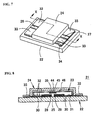
- Fig. 7 shows a perspective view of an electrostatic actuator in accordance with one embodiment of the present invention.
- Fig. 8 shows a cross-sectional view taken along line X-X of Fig. 7.
- Fig. 9 shows an exploded perspective view that indicates a structure of the electrostatic actuator of Fig. 7.
- Fig. 10 shows a schematic cross-sectional view that indicates a structure of an insulating film formed on a fixed electrode in the electrostatic actuator of Fig. 7.
- Fig. 11 shows a schematic drawing that indicates a principle which suppresses the plus shift by forming a protrusion on the insulating film.
- Fig. 12 shows a schematic drawing that indicates a principle which suppresses the minus shift by forming a nitride film in the insulating film.
- Fig. 13 shows a schematic cross-sectional view that indicates an electrostatic actuator having another structure in accordance with the present invention.
- Fig. 14 shows a schematic cross-sectional view that indicates an electrostatic actuator having still another structure in accordance with the present invention.
- Fig. 15 shows a schematic cross-sectional view that indicates an electrostatic actuator having still another structure in accordance with the present invention.
- Fig. 16 shows a schematic cross-sectional view that indicates an electrostatic actuator having still another structure in accordance with the present invention.
- Fig. 17 shows a schematic cross-sectional view that indicates an electrostatic actuator having still another structure in accordance with the present invention.
- Fig. 18 shows a schematic cross-sectional view that indicates an electrostatic actuator having still another structure in accordance with the present invention.
- Fig. 19 shows a schematic cross-sectional view that indicates an electrostatic actuator having still another structure in accordance with the present invention.
- Fig. 20 shows a schematic cross-sectional view that indicates an electrostatic actuator having still another structure in accordance with the present invention.
- Fig. 21 shows a schematic cross-sectional view that indicates an electrostatic actuator having still another structure in accordance with the present invention.
- Fig. 22 shows a schematic cross-sectional view that indicates an electrostatic actuator having still another structure in accordance with the present invention.
- Fig. 23 shows a schematic cross-sectional view that indicates an electrostatic actuator having still another structure in accordance with the present invention.
- Fig. 24 shows a schematic cross-sectional view that indicates an electrostatic actuator having still another structure in accordance with the present invention.
- Fig. 25 shows a schematic cross-sectional view that indicates an electrostatic actuator having still another structure in accordance with the present invention.
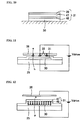
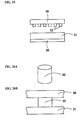
- Fig. 26A shows a perspective view that indicates a protrusion having a cylinder shape
- Fig. 26B shows a schematic drawing that explains a state in which the protrusion occupies a space between the insulating film and the movable electrode.
- Fig. 27A shows a perspective view that indicates a protrusion having a cone shape
- Fig. 27B shows a schematic drawing that explains a state in which the protrusion occupies a space between the insulating film and the movable electrode.
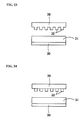
- Fig. 28A shows a perspective view that indicates a protrusion having a spherical shape
- Fig. 28B shows a schematic drawing that explains a state in which the protrusion occupies a space between the insulating film and the movable electrode.
- Figs. 29A and 29B show schematic cross-sectional views that respectively indicate modified examples of the protrusion having a spherical shape.
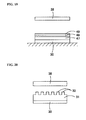
- Figs. 30A, 30B and 30C show cross-sectional views that explain a method for forming the protrusion having the structure shown in Fig. 29B.
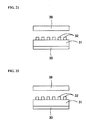
- Figs. 31A, 31B and 31C show cross-sectional views that explain a method for forming a protrusion having a structure similar to the structure shown in Fig. 29B.
- Fig. 32 shows a side view that indicates an electrostatic actuator having another structure in accordance with the present invention.
- Fig. 33 shows a side view that indicates an electrostatic actuator having still another structure in accordance with the present invention.
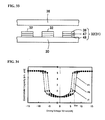
- Fig. 34 shows a drawing that indicates a change in the CV characteristic before and after a thermal endurance test carried out on an electrostatic actuator having protrusions on an insulating film.
- Fig. 35 shows a drawing that explains an electrostatic actuator that has been subjected to the test of Fig. 34.
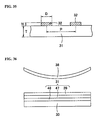
- Fig. 36 shows a schematic cross-sectional view that indicates a structure of an electrostatic actuator relating to still another embodiment of the present invention.
- Fig. 37 shows a schematic cross-sectional view that indicates a structure of an electrostatic actuator relating to still another embodiment of the present invention.
- Fig. 38 shows a schematic cross-sectional view that indicates a structure of an electrostatic actuator relating to still another embodiment of the present invention.
- Fig. 39 shows a schematic cross-sectional view that indicates a structure of an electrostatic actuator relating to still another embodiment of the present invention.
- Fig. 40 shows a schematic cross-sectional view that indicates a structure of an electrostatic actuator relating to still another embodiment of the present invention.
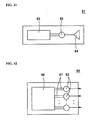
- Fig. 41 shows a schematic drawing that indicates a radio device using an electrostatic micro-relay in accordance with the present invention.
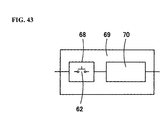
- Fig. 42 shows a schematic drawing that indicates a measuring device using an electrostatic micro-relay in accordance with the present invention.
- Fig. 43 shows a schematic drawing that indicates a temperature-controlling device using an electrostatic micro-relay in accordance with the present invention.
- Fig. 44 shows a schematic drawing that indicates a portable terminal using an electrostatic micro-relay in accordance with the present invention.
- Fig. 7 shows a perspective view of an electrostatic actuator in accordance with one embodiment of the present invention
- Fig. 8 shows a cross-sectional view taken along line X-X
- Fig. 9 shows an exploded perspective view that shows a structure of the electrostatic actuator.
- This electrostatic actuator 21 comprises a micro-machined relay manufactured by using a micro-machining technique, and includes a fixed substrate 22, a movable substrate 23 and a cap 24.
- two signal lines 26, 27 are formed on a substrate 25 (which may be a glass substrate or the like) by using a metal film, and ends of the respective signal lines 26, 27 are aligned face to face with each other with a small gap in between so that respective ends of the signal lines 26, 27 form fixed contacts 28, 29 on the center portion of the upper face of the substrate 25.
- fixed electrodes 30 are placed on both of the right and left sides of each signal line 26, 27, and the fixed electrodes 30 on both of the sides are connected to each other through a gap between the fixed contacts 28, 29.
- the surface of each of the fixed electrodes 30 is coated with an insulating film 31.
- a plurality of fine protrusions 32 are formed on the upper surface of the insulating film 31.
- Fixed electrode pads 33 which are respectively conductive to the fixed electrodes 30, are formed on both of the right and left sides of the end of each signal line 26, 27. Moreover, a movable electrode pad 34 is placed on one of the corner portions of the upper surface of the substrate 25.
- the size of the protrusions 32 is set to several 100 to several 1000 angstroms; however, in Fig. 9, for convenience of explanation, both of the diameter and protrusion height of the protrusion 32 are depicted in an enlarged manner in comparison with the actual relative dimension.
- the movable substrate 23 is made of Si and has conductivity, and movable electrodes 38 are formed on both sides of a movable contact area 35 formed virtually in the center thereof through elastic supporting portions 36, and anchors 42 are formed on the respective movable electrodes 38 through elastic bending portions 40. Moreover, a movable contact 45, made of a conductive material such as metal, is formed on the lower surface of the movable contact area 35 from an insulating layer 44 made of an oxide film (SiO 2 ) and a nitride film (SiN).
- the movable substrate 23 is elastically supported above the fixed substrate 22 by securing the anchor 42 onto the fixed substrate 22 by an anode joining process or the like; thus, the movable electrode 38 is aligned face to face with the fixed electrode 30 through the insulating film 31, with the movable contact 45 facing both of the fixed contacts 28, 29 in a manner so as to bridge over these.
- the movable substrate 23 is secured onto the upper surface of the fixed substrate 22 so that it is electrically connected to the movable electrode pad 34.
- the cap 24 is put on the fixed substrate 22 over the movable substrate 23 that is joined to the upper surface of the fixed substrate 22, and joined to the upper surface of the fixed substrate 22 by using a sealing material such as low-melting-point glass in a manner so as to surround the peripheral portion of the lower surface. Consequently, the movable substrate 23, the fixed contacts 28, 29, the fixed electrode 30, etc. are sealed in the recessed section 46 of the cap 24 in an air-tight manner.
- Fig. 10 shows a structure of the insulating film 31 that is used for preventing short-circuiting between the fixed electrode 30 and the movable electrode 38.
- the insulating film 31 has a multi-layer structure, and comprises an oxide film (SiO 2 ) 48, a nitride film (SiN) 47 and an oxide film (SiO 2 ) 39 placed in this order from the electrode side.
- the film thickness of the oxide film 48 closest to the electrode is preferably made thinner so that the charge quantity due to ions is minimized as small as possible, with the thickness of the nitride film 47 that is hardly chargeable being set to a comparatively great value, so that proper properties such as voltage resistant property are maintained, and the nitride film 47 is covered with the oxide film 39 so that processing properties upon forming the insulating film 31 are properly maintained.
- a driving voltage Vdrive which is higher than an on-voltage, is applied between the fixed electrode 30 and the movable electrode 38 so that an electrostatic force is generated.
- Vdrive which is higher than an on-voltage
- the elastic bending portion 40 of the movable substrate 23 is distorted to allow the movable electrode 38 to shift toward the fixed electrode 30 side.
- the movable contact 45 is first allowed to contact the fixed contacts 28, 29 to close the fixed contacts 28, 29; thus, the two signal lines 26, 27 are electrically conducted to each other.
- the movable contact 45 comes into contact with the fixed contacts 28, 29, the movable electrode 38 is further attracted to the fixed electrode 30, and allowed to adhere to the fixed electrode 30 with the insulating film 31 being interpolated in between.
- the movable contact 45 is made in press-contact with the fixed contacts 28, 29 through an elastic force by the elastic supporting portion 36.
- the driving voltage Vdrive is removed to eliminate the electrostatic force so that the movable electrode 38 is returned to its original shape through an elastic force to be separated from the fixed electrode 30 with the movable contact 45 being substantially simultaneously separated from the fixed contacts 28, 29; thus, the signal lines 26 and 27 are electrically disconnected.
- the fixed contacts 28, 29 are opened, the contact opening force is increased by the elastic force of the elastic supporting portion 36 so that the fixed contacts 28 and 29 are immediately disconnected.
- the fine protrusions 32 are formed on the surface of the insulating film 31 so that, when the electrostatic actuator 21 is driven and the movable electrode 38 is allowed to adhere to the fixed electrode 30 through the insulating film 31, the movable electrode 38 and the insulating film 31 are not allowed to contact each other over the entire faces thereof, but only allowed to contact each other at the protrusions 32.
- the area of the protrusions 32 formed on the insulating film 31 is allowed to change the quantity of positive charge due to the charge transfer as shown in Fig. 11.
- the total area of the protrusions 32 (the number of the protrusions 32 and the individual areas thereof) is adjusted so that the charge quantity between the movable electrode 38 and the insulating film 31 is controlled and the degree of the plus shift is adjusted.
- the charge transfer is reduced by making the contact area between the insulating film 31 and the movable electrode 38 through the protrusions 32 smaller so that it is possible to reduce the occurrence of the charging due to the plus shift.
- the minus shift is caused by a biased state of ions inside the oxide film 48 as described above, it is possible to control the minus shift by adjusting the thickness of the oxide film 48. In particular, it is possible to reduce the charge quantity due to the minus shift by reducing the thickness of the oxide film 48.
- the oxide film 48 (the insulating film 31) is made thinner, the voltage proof between the movable electrode 38 and the fixed electrode 30 is lowered. Therefore, in this electrostatic actuator 21, a layer of a nitride film 47 that hardly transmits ions is formed in the insulating film 31, and as shown in Fig. 12, by making the oxide film 48 thinner in a corresponding manner, the biased states of cations p and anions n are alleviated with the voltage proof property being maintained in the same manner to suppress the minus shift.
- this electrostatic actuator 21 it is possible to control the plus shift and the minus shift, to improve the CV characteristic of the electrostatic actuator 21, and consequently to control the charging phenomenon due to the plus shift and minus shift and the like.
- operational voltage characteristics such as on-voltage and off-voltage, and consequently to reduce variations thereof.
- neither the control of the plus shift by the use of the protrusions 32 nor the control of the minus shift by the use of the thickness of the oxide film 48 intend to reduce the charge quantity of the insulating film 31 due to the plus shift or the charge quantity of the insulating film 31 due to the minus shift.
- the charge quantity due to the plus shift and the charge quantity due to the minus shift are allowed to cancel each other to be set to zero; thus, as a whole, the charge quantity in the insulating film 31 is set to zero.
- the plus shift is determined by using the sum of the contact areas of the protrusions 32 and the movable electrode 38 as a main factor so that the plus shift is controlled by adjusting the number and the contact areas of the protrusions 32, and the minus shift is determined by the total film thickness of the insulating film 31, and in particular, the film thickness of the oxide film 48 closest to the electrode forms a main factor so that the minus shift is controlled by adjusting the film thickness of the oxide film 48. Therefore, the plus shift is controlled by the protrusions 32, the minus shift is adjusted by the thickness of the oxide film 48, and the charge quantity due to the plus shift and the charge quantity due to the minus shift are allowed to cancel each other to set the sum of the two factors to zero.
- the electrical potential difference caused by the charge of the plus shift may be arranged to cancel the electrical potential difference caused by the charge of the minus shift.
- the shift toward the plus side and the shift toward the minus side are set to cancel each other so as to eliminate the shift of the center value of the CV characteristic.
- the insulating film 31 is formed on the fixed electrode 30; however, as shown in Fig. 13, the insulating film 31 may be formed on the movable electrode 38. Moreover, as shown in Fig. 14, the insulating films 31 may be formed on both of the fixed electrode 30 and the movable electrode 38 (for example, the nitride film 47 is formed on the movable electrode 38 with the oxide film 48 being formed on the fixed electrode 30); in this case, the protrusions 32 are formed on either one of them. Moreover, as shown in Fig. 15, the insulating film 31 and the protrusions 32 may be separated, and the insulating film 31 may be formed on one of the fixed electrode 30 and the movable electrode 38, with the protrusions 32 being formed on the other.
- an electrostatic actuator in which only either the plus shift or the minus shift occurs.
- an electrostatic actuator having a contact area of zero for example, the elasticity of the elastic bending portion is too high so that the movable electrode is not allowed to contact the fixed electrode and the insulating film.
- such an electrostatic actuator has problems that it needs to have a greater size, and that it needs a greater electrode size to compensate for the reduction in the driving force (torque) so as to obtain the same driving force, so no plus shift due to the charge transfer occurs.
- the present invention can be widely applied as an electrostatic actuator in which the fixed electrode and the movable electrode are aligned face to face with each other with an insulating film interpolated in between.
- the electrostatic actuators, shown in Figs. 7 to 9, have structures to be applied to electrostatic micro-relays, and in general, the electrostatic actuator of the present invention does not require the fixed contact and the movable contact.
- the explanation will be given by using the same reference numerals as those used in the electrostatic actuators of Figs. 7 to 9, the subject of application is not intended to be limited to an electrostatic actuator shown in Figs. 7 to 9, etc.
- an insulating film 31 is formed on the fixed electrode 30 by stacking an oxide film 48 and a nitride film 47 thereon from the lower surface side. Moreover, in the insulating film 31 shown in Fig. 17, a nitride film 47 and an oxide film 48 are stacked on the fixed electrode 30 from the lower surface side. In the insulating film 31 shown in Fig. 18, a nitride film 47, an oxide film 48 and a nitride film 47 are stacked on the fixed electrode 30 from the lower surface side. Moreover, as shown in Fig.
- an oxide film 48 and a nitride film 47 may be stacked on the fixed electrode 30 in a desired order, and a third insulating film 49 other than the nitride film 47 and the oxide film 48 may be stacked thereon.
- an insulating film constituted by not less than four layers including a nitride film and an oxide film may be used.
- the oxide film and the nitride film are compared with respect to easiness of charging, the oxide film is charged not less than 100 times as easily as the nitride film.
- the contact area between the movable electrode 38 and the fixed electrode 30 is extremely small (for example, when the protrusion has a cone shape as shown in Fig. 27)
- the amount of plus shift becomes smaller.
- the oxide film 48 is easily charged, with the result that, even when this is made thinner, imbalance between the charge quantity due to the plus shift and the charge quantity due to the minus shift tends to occur.
- the nitride film 47 which is hardly charged, is placed closest to the electrode to control the charge quantity.
- the explanation has exemplified a case in which the insulating film 31 is formed on the fixed electrode 30; however, this may of curse be formed on the movable electrode 38.
- the first and second embodiments have exemplified an insulating film constituted by a nitride film and an oxide film; however, the material for the insulating film which is formed on the electrode is not limited to a nitride film and an oxide film.
- the charge quantity in the insulating film 31 is mainly determined by the film thickness of the oxide film 48, with the nitride film 47 being only used for maintaining a film thickness required for a proper voltage proof characteristic or the like; therefore, not limited to the nitride film 47 and the oxide film 48, any kind of material may be used as long as it has these functions.
- the application of a combination of an oxide film (SiO 2 ) and a nitride film (SiN) makes it possible to obtain the effect of controlling the minus shift, to optimize the manufacturing technique, and consequently to easily manufacture an electrostatic actuator with high yield.
- the effect of the former film that is, the controlling function of the minus shift
- the film thickness of the oxide film 48 closest to the electrode side is controlled by controlling the film thickness of the oxide film 48 closest to the electrode side, and the film thickness of the insulating film 48 is made thinner so that it hardly contains ions.
- the characteristic of the latter film, that is, to provide a high yield is obtained by compensating for the property of the nitride film 47, that is, difficulty in processing, by the use of the oxide film 39.
- the nitride film Upon etching, the nitride film has problems with processing in that it has a low selectivity with respect to glass and silicon, and in that no effective wet-etchant is available; therefore, when all the portion of the insulating film 31 is made of a nitride film 47, over-etching occurs on the substrate 25 made of glass and other metal layers, and unnecessary damages are caused, resulting in degradation in the processing precision.
- One of the solutions of these is to provide a structure which makes it possible to prevent the nitride film 47 from directly contacting the glass and other metals; and with respect to such a buffering layer, an oxide film 39, which is easily processed and has necessary dielectric constant and insulating property, is used to coat the surface of the nitride film 47.
- the protrusions 32 may be formed on the same side as the insulating film 31 of the fixed electrode 30 and the movable electrode 38, or may be formed on the opposite side thereof.
- these may be formed integrally with the insulating film 31 or may be formed in a separate manner.
- the protrusions 32 may be formed by the same material as the constituent material of the insulating film 31, that is, for example, an oxide (SiO 2 ) and a nitride (SiN), or may be formed by a material different from the insulating film 31, for example, a metal.
- the protrusions 32 when the protrusions 32 are formed on the side different from the insulating film 31, for example, on the movable electrode 38, the protrusions 32 may be formed on the surface of the electrode (for example, the movable electrode 38) by an electrode material.
- an insulating film 31 is formed on either one of the fixed electrode 30 and the movable electrode 38, and protrusions 32 are formed integrally with the insulating film 31 on the upper surface of the insulating film 31 by using the same material as the insulating film 31 (the uppermost layer).
- protrusions 32 are independently formed on the upper surface of the insulating film 31 by using an insulating material different from the insulating film 31 (the uppermost layer).
- protrusions 32 are formed on the upper surface of the insulating film 31 by using a conductive film.
- an insulating film 31 is formed on either one of the fixed electrode 30 and the movable electrode 38, and protrusions 32 are formed on an opposite face of the other electrode integrally with the corresponding electrode by the same material as the corresponding electrode.
- protrusions 32 are formed on an opposite face of an electrode different from the electrode on which an insulating film 31 has been formed, that is, either one of the fixed electrode 30 and the movable electrode 38, by using an insulating material.
- protrusions 32 are formed on an opposite face of an electrode different from the electrode on which an insulating film 31 has been formed, that is, either one of the fixed electrode 30 and the movable electrode 38, by using a conductive material that is different from the material of the electrode. Additionally, in Figs. 20 to 25, the insulating film 31 is located on the fixed electrode side; however, the insulating film 31 may be located on the movable electrode side, with the fixed electrode 30 and the movable electrode 38 being replaced by each other.
- Fig. 26A shows a cylinder-shaped protrusion 32
- Fig. 27A shows a cone-shaped protrusion 32
- Fig. 28A shows a protrusion 32 whose surface has a spherical shape.
- the space filling rate between the electrodes is high as shown in Fig. 26B; however, this causes a greater contact area to the movable electrode 38, resulting in a reduction in the suppressing effect of the plus shift.
- the contact area to the movable electrode 38 is small as shown in Fig.
- a column-shaped base post 32a is formed on the insulating film 31, and an uncured protrusion material is dropped thereon to form a curved portion 32b having a spherical shape by utilizing surface tension; thus, a protrusion 32 is formed by the base post 32a and the curved portion 32b.
- a column-shaped base post 32a is formed on the insulating film 31, and a protrusion material is deposited on the insulating film 31 over this structure by sputtering or the like to form a curved portion 32b; thus, a protrusion 32 is formed by the base post 32a and the curved portion 32b.
- Figs. 30A, 30B, 30C are cross-sectional views that explain a manufacturing method of the structure shown in Fig. 29B.
- an oxide film 48 is formed on a fixed electrode 30 by a primary sputtering process, a nitride film 47 is formed thereon, and an oxide film 50 is further formed thereon (Fig. 30A).
- the upper oxide film 50 is processed by etching or the like so that a plurality of base posts 32a having a column shape are formed on the nitride film 47 (Fig. 30B).
- Figs. 31A, 31B and 31C are cross-sectional views that explain a manufacturing method of a structure that is similar to the structure shown in Fig. 29B.
- an oxide film 50 is formed on the fixed electrode 30 by a primary sputtering process (Fig. 31A).
- the oxide film 50 is processed by etching, etc. so that a plurality of base posts 32a having a column shape are formed on the fixed electrode 30 (Fig. 31B).
- each curved portion 32b has a virtually spherical shape at a portion of each base post 32a to achieve a structure similar to the structure of Fig. 29B.
- each protrusion 32, formed by each base post 32a and the oxide film (curved portion 32b) on the upper surface thereof as described in Figs. 31A, 31B and 31C, nor the oxide film between the base posts 32a is formed on the insulating film 31 so that each base post 32a and the oxide film itself also have functions as the insulating film 31.
- each protrusion 32 itself forms the insulating film 31.
- the protrusions 32 shown in Fig. 32 are formed on the fixed electrodes 30 by using an insulating material such as an oxide so that each protrusion 32 also serves as the insulating film 31.
- each protrusion 32 shown in Fig. 33 is formed by stacking the oxide film 48, the nitride film 47 and the oxide film 39 on the fixed electrode 30 so that each protrusion 32 is also allowed to serve as the insulating film 31.
- the insulating film 31 and the protrusion 32 are explained in a separate manner, and in the case when the protrusions 32 are formed simultaneously as the nitride film 47 is formed on the insulating film 31, the structures of the insulating film and the structures of the protrusions, as described above (including those not described above), may be desirably combined.
- the insulating film 31 containing the nitride film 47, as described in the second embodiment, and the protrusions 32, as described in the third embodiment may be respectively used in an independent manner.
- the film thickness of the oxide film 48 may be made thinner so as to reduce the minus shift.
- the film thickness of the oxide film 48 is made thinner so as to control only the charge quantity caused by the minus shift, and the charge quantity of the plus shift that is not controlled is cancelled by using the charge quantity due to the controlled minus shift; thus, the charge quantity as a whole is set to zero.
- the film thickness of the insulating film 31 as a whole may be controlled.
- the plus shift may be reduced by forming the protrusion 32.
- the charge quantity due to the plus shift is controlled by the contact area of the protrusion 32 so that the charge quantity of the minus shift that is not controlled is cancelled by using the charge quantity due to the controlled plus shift; thus, the charge quantity as a whole is set to zero.
- Fig. 34 shows a drawing that indicates a change in the CV characteristic before and after the thermal endurance test of an electrostatic actuator so as to confirm the effects of the protrusions 32.
- an insulating film 31 made of an oxide film (SiO 2 ) is formed on the fixed electrode, with the protrusion 32 made of an oxide film (SiO 2 ) being formed on the insulating film 31 in the same manner, so that an electrostatic actuator is formed.
- the thickness T of the insulating film 31 is set to 2000 to 2500 angstroms
- the height H of each protrusion 32 is set to 400 to 600 angstroms
- the diameter D of each protrusion 32 is set to 25 to 35 ⁇ m
- a plurality of protrusions 32 are formed with pitches P set to 100 to 110 ⁇ m.
- those indicated by broken lines and rhomboidal shape points represent an initial CV characteristic F0 of an electrostatic actuator.
- the characteristic F+ indicated by solid lines and square points represents the CV characteristic of the electrostatic actuator having the plus shift
- the characteristic F- indicated by solid lines and triangular points represents the CV characteristic of the electrostatic actuator having the minus shift.
- Figs. 36 and 37 show portions of the fixed electrode 30 and the movable electrode 38 of an electrostatic actuator in accordance with still another embodiment of the present invention.
- at least one electrode of the fixed electrode 30 and the movable electrode 38 is curved so that the contact area of the insulating film 31 and the electrode is made smaller to suppress the plus shift.
- Fig. 36 will be explained.
- an insulating film 31 including a nitride film 47 is formed on a flat fixed electrode 30, and the movable electrode 38 is curved into a groove shape or a spherical shape so as to make the center portion stick toward the fixed electrode 30 side.
- the contact area of the movable electrode 38 and the insulating film 31 is made smaller so that the plus shift is suppressed, and the film thickness of the oxide film 48 is made thinner so that the minus shift is also suppressed.
- the contact area of the movable electrode 38 and the insulating film 31 is made smaller so that the plus shift is suppressed, and the film thickness of the oxide film 48 is made thinner so that the minus shift is also suppressed.
- the fixed electrode 30 is curved into a groove shape or a spherical shape so as to stick toward the movable electrode 38 side, and an insulating film 31 including a nitride film 47 is formed on the fixed electrode 30.
- the fixed electrode 30 and the insulating film 31 are curved, with the result that the contact area of the movable electrode 38 and the insulating film 31 is made smaller so that the plus shift is suppressed, and the film thickness of the oxide film 48 is made thinner so that the minus shift is suppressed.
- the movable electrode 38 may be attracted toward the fixed electrode side, and elastically distorted into a groove shape or a spherical shape.
- the movable electrode 38 which is supported in a cantilever fashion, may be attracted toward the fixed electrode 30 side so that the movable electrode 38 is diagonally tilted so that the movable electrode 38 is made in contact with the fixed electrode 30 or the insulating film 31 with a small contact area.
- Fig. 38 is a cross-sectional view that shows the structure of an electrostatic actuator in still another embodiment of the present invention.
- a plurality of post-shaped or line-shaped fixed electrodes 30 that are separated with intervals from each other are formed on the upper surface of a substrate 25 made of a glass substrate or the like, and an insulating film 31 is formed on the upper surface of the fixed electrodes 30 in a manner so as to cover the entire fixed electrodes 30.
- a plurality of post-shaped or line-shaped protrusions 32 are formed on the lower face of the movable electrode 38 in a manner so as not to face the fixed electrodes 30.
- either of the fixed electrodes 30 and the protrusions 32 may be formed into a lattice shape or a net shape as long as the fixed electrodes 30 and the protrusions 32 are made face to face with each other without overlapping each other.
- an electric field, exerted between the fixed electrode 30 and the movable electrode 38 is only limited to a portion at which the fixed electrode 30 is formed; therefore, the contact portion between the electrodes, that is, a portion at which each protrusion 32 and the insulating film 31 are made in contact with each other is less susceptible to a great electric field. Therefore, this structure makes it possible to reduce the occurrence of charging due to charge transfer, and consequently to reduce the charge quantity of the plus shift due to charge transfer.
- Fig. 39 is a cross-sectional view that shows a structure of an electrostatic actuator in accordance with still another embodiment of the present invention.
- a plurality of post-shaped or line-shaped fixed electrodes 30 that are separated with intervals from each other are formed on the upper surface of a substrate 25 made of a glass substrate or the like, and the upper surface of the substrate 25 is coated with an insulating film 31 in a manner so as to cover the fixed electrodes 30.
- a plurality of post-shaped or line-shaped protrusions 32 are formed on the upper surface of the insulating film 31 in a manner so as not to face the fixed electrodes 30.
- either of the fixed electrodes 30 and the protrusions 32 may be formed into a lattice shape or a net shape as long as the fixed electrodes 30 and the protrusions 32 are made face to face with each other without overlapping each other.
- an electric field, exerted between the fixed electrode 30 and the movable electrode 38 is only limited to a portion at which the fixed electrode 30 is formed; therefore, the contact portion between the electrodes, that is, a portion at which each protrusion 32 and the insulating film 31 are made in contact with each other is less susceptible to a great electric field. Therefore, this structure makes it possible to reduce the occurrence of charging due to charge transfer, and consequently to reduce the charge quantity of the plus shift due to charge transfer.
- the fixed electrodes 30 are formed partially so as not to overlap the protrusions 32; however, the movable electrode 38 may be formed partially so as not to overlap the protrusion 32 (not shown).
- Fig. 40 is a cross-sectional view that shows the structure of an electrostatic actuator in still another embodiment of the present invention.
- this electrostatic actuator two movable portions 52, each having a diaphragm shape, are supported by a frame 51 along the peripheral portion thereof, and movable electrodes 38 are respectively formed on the opposite faces of the two movable portions 52 so that the surface of at least one of the movable electrodes 38 is coated with an insulating film 31.
- This embodiment shows an example of an electrostatic actuator without any fixed electrode.
- protrusions may be formed on the insulating film 31, or may be formed in a manner so as to face the insulating film 31.
- Fig. 41 shows a schematic drawing that indicates a radio device 61 in which an electrostatic micro-relay 62 of the present invention is used.
- the electrostatic micro-relay 62 is connected between an inner circuit 63 and an antenna 64; thus, by carrying out on-off operations on the electrostatic micro-relay 62, the inner circuit 63 is switched between a transmittable or receivable state and an un-transmittable or un-receivable state through the antenna 64.
- Fig. 42 is a schematic drawing that shows a measuring device 65 using an electrostatic micro-relay 62 in accordance with the present invention.
- the electrostatic micro-relay 62 is connected in the middle of each signal line 67 that reaches each measuring subject (not shown) from the inner circuit 66; thus, the electrostatic micro-relays 62 are turned on and off so that the measuring subjects are switched.
- Fig. 43 is a schematic drawing that shows a temperature controlling device (temperature sensor) 68 using an electrostatic micro-relay 62 in accordance with the present invention.
- This temperature controlling device 68 is attached to a device 69 that requires a safety function with respect to the temperature of the power-supply, control device and the like so that it turns on and off the circuit 70 of the subject device 69, while monitoring the temperature of the subject device 69.
- the temperature controlling device 68 measures the temperature of the subject device 69, and when it detects that the device 69 has been operated for one hour at not less than 100°C, the electrostatic micro-relay 62 inside the temperature controlling device 68 forcefully cuts off the circuit 70.
- Fig. 44 is a schematic drawing that shows a portable terminal 71 such as a cellular phone in which an electrostatic micro-relay in accordance with the present invention is used.
- a portable terminal 71 such as a cellular phone in which an electrostatic micro-relay in accordance with the present invention is used.
- two electrostatic micro-relays 62a, 62b are used.
- One electrostatic micro-relay 62a has a function for switching an inner antenna 72 and an outer antenna 73
- the other electrostatic micro-relay 62b has a function for switching signal flows to a power amplifier 74 on the signal transmission circuit side and a low-noise amplifier 75 on the signal receiving circuit side.
- the electrostatic micro-relay of the present invention makes it possible to transmit dc currents as well as high-frequency signals with low loss, and consequently to maintain a stable characteristic for a long time; thus, by applying this to the above-mentioned radio device 61, the measuring device 65 and the like, it becomes possible to transmit signals with high precision for a long time while reducing the load imposed on the amplifier, etc. used in the inner circuit. Moreover, it is possible to miniaturize the device and also to reduce power consumption; thus, the present invention is highly effective in radio devices that are driven by batteries and measuring devices a plurality of which are used.
- the electrostatic actuator of the present invention it is possible to control the quantities of positive and negative charges in the insulating film by utilizing its charge-quantity controlling structure. For example, it is possible to reduce the quantity of positive or negative charge due to charge transfer and the like, or to reduce the quantity of positive or negative charge due to ionic charging and the like.
- the quantities of positive and negative charges to be generated in the above-mentioned insulating film when a voltage is applied between the first and second electrodes are respectively controlled so that the sum of the quantities of charge in the insulating film is desirably controlled; thus, the quantity of positive charge and the quantity of negative charge are mutually cancelled so that the entire charge quantity (total quantity) generated in the insulating film is controlled.
- the electrostatic actuator of the present invention makes it possible to control the charging phenomena such as plus shift and minus shift, and consequently to control the operational voltage characteristics such as on-voltage and off-voltage.
Landscapes
- Micromachines (AREA)
- Waveguide Connection Structure (AREA)
- Waveguide Switches, Polarizers, And Phase Shifters (AREA)
- Apparatus For Radiation Diagnosis (AREA)
- Seal Device For Vehicle (AREA)
- Vehicle Body Suspensions (AREA)
Applications Claiming Priority (2)
| Application Number | Priority Date | Filing Date | Title |
|---|---|---|---|
| JP2001340293A JP4045090B2 (ja) | 2001-11-06 | 2001-11-06 | 静電アクチュエータの調整方法 |
| JP2001340293 | 2001-11-06 |
Publications (3)
| Publication Number | Publication Date |
|---|---|
| EP1308977A2 true EP1308977A2 (fr) | 2003-05-07 |
| EP1308977A3 EP1308977A3 (fr) | 2005-01-19 |
| EP1308977B1 EP1308977B1 (fr) | 2007-08-29 |
Family
ID=19154516
Family Applications (1)
| Application Number | Title | Priority Date | Filing Date |
|---|---|---|---|
| EP02102543A Expired - Lifetime EP1308977B1 (fr) | 2001-11-06 | 2002-11-06 | Actionneur électrostatique, et relais électrostatique et autres dispositifs utilisant le même |
Country Status (7)
| Country | Link |
|---|---|
| US (1) | US7161273B2 (fr) |
| EP (1) | EP1308977B1 (fr) |
| JP (1) | JP4045090B2 (fr) |
| KR (1) | KR100499823B1 (fr) |
| CN (1) | CN1258795C (fr) |
| AT (1) | ATE371947T1 (fr) |
| DE (1) | DE60222075T2 (fr) |
Cited By (6)
| Publication number | Priority date | Publication date | Assignee | Title |
|---|---|---|---|---|
| WO2004017350A1 (fr) * | 2002-08-14 | 2004-02-26 | Intel Corporation | Configuration d'electrodes en un commutateur de mems |
| FR2868591A1 (fr) * | 2004-04-06 | 2005-10-07 | Commissariat Energie Atomique | Microcommutateur a faible tension d'actionnement et faible consommation |
| EP1703531A3 (fr) * | 2005-03-18 | 2007-08-15 | Omron Corporation | Microinterrupteur électrostatique, procédé de production correspondant et appareil comprotant le même. |
| CN102044380A (zh) * | 2010-12-31 | 2011-05-04 | 航天时代电子技术股份有限公司 | 一种金属mems电磁继电器 |
| CN103626115A (zh) * | 2013-03-29 | 2014-03-12 | 南京邮电大学 | 超薄氮化物微纳静电驱动器及其制备方法 |
| TWI457270B (zh) * | 2009-02-13 | 2014-10-21 | Wolfson Microelectronics Plc | 微機電系統裝置及製程 |
Families Citing this family (42)
| Publication number | Priority date | Publication date | Assignee | Title |
|---|---|---|---|---|
| WO2004102744A1 (fr) * | 2003-05-14 | 2004-11-25 | Koninklijke Philips Electronics N.V. | Perfectionnements apportes ou relatifs a des terminaux sans fil |
| WO2006014929A1 (fr) | 2004-07-29 | 2006-02-09 | Idc, Llc | Systeme et procede pour le fonctionnement micro-electromecanique d'un modulateur interferometrique |
| US7373026B2 (en) * | 2004-09-27 | 2008-05-13 | Idc, Llc | MEMS device fabricated on a pre-patterned substrate |
| US7327510B2 (en) * | 2004-09-27 | 2008-02-05 | Idc, Llc | Process for modifying offset voltage characteristics of an interferometric modulator |
| US7369296B2 (en) | 2004-09-27 | 2008-05-06 | Idc, Llc | Device and method for modifying actuation voltage thresholds of a deformable membrane in an interferometric modulator |
| JP4540443B2 (ja) * | 2004-10-21 | 2010-09-08 | 富士通コンポーネント株式会社 | 静電リレー |
| JP2006210843A (ja) * | 2005-01-31 | 2006-08-10 | Fujitsu Ltd | 可変キャパシタ及びその製造方法 |
| JP4008453B2 (ja) * | 2005-04-13 | 2007-11-14 | ファナック株式会社 | 静電モータ用電極の製造方法、静電モータ用電極及び静電モータ |
| JP4507965B2 (ja) * | 2005-04-15 | 2010-07-21 | セイコーエプソン株式会社 | 液滴吐出ヘッドの製造方法 |
| EP2495212A3 (fr) * | 2005-07-22 | 2012-10-31 | QUALCOMM MEMS Technologies, Inc. | Dispositifs MEMS comportant des structures de support et procédés de fabrication associés |
| FR2889371A1 (fr) * | 2005-07-29 | 2007-02-02 | Commissariat Energie Atomique | Dispositif de conversion de l'energie mecanique en energie electrique par cycle de charges et de decharges electriques sur les peignes d'un condensateur |
| US20070040637A1 (en) * | 2005-08-19 | 2007-02-22 | Yee Ian Y K | Microelectromechanical switches having mechanically active components which are electrically isolated from components of the switch used for the transmission of signals |
| US7580172B2 (en) | 2005-09-30 | 2009-08-25 | Qualcomm Mems Technologies, Inc. | MEMS device and interconnects for same |
| US7652814B2 (en) | 2006-01-27 | 2010-01-26 | Qualcomm Mems Technologies, Inc. | MEMS device with integrated optical element |
| US7751173B2 (en) * | 2006-02-09 | 2010-07-06 | Kabushiki Kaisha Toshiba | Semiconductor integrated circuit including circuit for driving electrostatic actuator, micro-electro-mechanical systems, and driving method of electrostatic actuator |
| US7547568B2 (en) * | 2006-02-22 | 2009-06-16 | Qualcomm Mems Technologies, Inc. | Electrical conditioning of MEMS device and insulating layer thereof |
| US7450295B2 (en) | 2006-03-02 | 2008-11-11 | Qualcomm Mems Technologies, Inc. | Methods for producing MEMS with protective coatings using multi-component sacrificial layers |
| US7643203B2 (en) * | 2006-04-10 | 2010-01-05 | Qualcomm Mems Technologies, Inc. | Interferometric optical display system with broadband characteristics |
| US7417784B2 (en) | 2006-04-19 | 2008-08-26 | Qualcomm Mems Technologies, Inc. | Microelectromechanical device and method utilizing a porous surface |
| US7369292B2 (en) * | 2006-05-03 | 2008-05-06 | Qualcomm Mems Technologies, Inc. | Electrode and interconnect materials for MEMS devices |
| US7566664B2 (en) | 2006-08-02 | 2009-07-28 | Qualcomm Mems Technologies, Inc. | Selective etching of MEMS using gaseous halides and reactive co-etchants |
| US7706042B2 (en) * | 2006-12-20 | 2010-04-27 | Qualcomm Mems Technologies, Inc. | MEMS device and interconnects for same |
| US7535621B2 (en) | 2006-12-27 | 2009-05-19 | Qualcomm Mems Technologies, Inc. | Aluminum fluoride films for microelectromechanical system applications |
| JP4611323B2 (ja) | 2007-01-26 | 2011-01-12 | 富士通株式会社 | 可変キャパシタ |
| JP2008204768A (ja) * | 2007-02-20 | 2008-09-04 | Omron Corp | マイクロリレー、無線通信機、計測器、携帯情報端末 |
| US7733552B2 (en) | 2007-03-21 | 2010-06-08 | Qualcomm Mems Technologies, Inc | MEMS cavity-coating layers and methods |
| US7719752B2 (en) | 2007-05-11 | 2010-05-18 | Qualcomm Mems Technologies, Inc. | MEMS structures, methods of fabricating MEMS components on separate substrates and assembly of same |
| US8115577B2 (en) * | 2007-06-14 | 2012-02-14 | Panasonic Corporation | Electromechanical switch, filter using the same, and communication apparatus |
| US7570415B2 (en) | 2007-08-07 | 2009-08-04 | Qualcomm Mems Technologies, Inc. | MEMS device and interconnects for same |
| CN101827781B (zh) * | 2007-10-31 | 2012-05-30 | 富士通株式会社 | 微型可动元件以及微型可动元件阵列 |
| WO2010032156A2 (fr) * | 2008-09-16 | 2010-03-25 | Koninklijke Philips Electronics N.V. | Transducteur ultrasonore micro-usiné capacitif |
| US8723061B2 (en) | 2009-09-17 | 2014-05-13 | Panasonic Corporation | MEMS switch and communication device using the same |
| WO2011033729A1 (fr) * | 2009-09-17 | 2011-03-24 | パナソニック株式会社 | Commutateur mems et dispositif de communication utilisant ce commutateur |
| JP5338615B2 (ja) | 2009-10-27 | 2013-11-13 | 富士通株式会社 | 可変容量デバイスおよび可変容量素子の駆動方法 |
| JP5402823B2 (ja) * | 2010-05-13 | 2014-01-29 | オムロン株式会社 | 音響センサ |
| JP5609271B2 (ja) * | 2010-05-28 | 2014-10-22 | 大日本印刷株式会社 | 静電アクチュエータ |
| US9708177B2 (en) * | 2011-09-02 | 2017-07-18 | Cavendish Kinetics, Inc. | MEMS device anchoring |
| JP2013090442A (ja) * | 2011-10-18 | 2013-05-13 | Murata Mfg Co Ltd | 静電駆動型アクチュエータ、可変容量素子、および、それらの製造方法 |
| US8629360B2 (en) * | 2012-04-30 | 2014-01-14 | Raytheon Company | RF micro-electro-mechanical system (MEMS) capacitive switch |
| JP5921477B2 (ja) * | 2013-03-25 | 2016-05-24 | 株式会社東芝 | Mems素子 |
| JP2016059191A (ja) * | 2014-09-11 | 2016-04-21 | ソニー株式会社 | 静電型デバイス |
| US10043687B2 (en) * | 2016-12-27 | 2018-08-07 | Palo Alto Research Center Incorporated | Bumped electrode arrays for microassemblers |
Family Cites Families (30)
| Publication number | Priority date | Publication date | Assignee | Title |
|---|---|---|---|---|
| ZA773340B (en) | 1976-06-15 | 1978-04-26 | Beecham Group Ltd | Antibacterial compounds |
| US5428259A (en) * | 1990-02-02 | 1995-06-27 | Nec Corporation | Micromotion mechanical structure and a process for the production thereof |
| JP2804196B2 (ja) * | 1991-10-18 | 1998-09-24 | 株式会社日立製作所 | マイクロセンサ及びそれを用いた制御システム |
| US5479042A (en) * | 1993-02-01 | 1995-12-26 | Brooktree Corporation | Micromachined relay and method of forming the relay |
| US5619061A (en) | 1993-07-27 | 1997-04-08 | Texas Instruments Incorporated | Micromechanical microwave switching |
| JP3393678B2 (ja) * | 1993-07-27 | 2003-04-07 | 松下電工株式会社 | 静電リレー |
| FR2717690B1 (fr) * | 1994-03-24 | 1996-04-26 | Roussel Uclaf | Application de stéroïdes aromatiques 3 substitués par un aminoalcoxy substitué à l'obtention d'un médicament pour contrôler la stérilité, notamment masculine. |
| US5665997A (en) * | 1994-03-31 | 1997-09-09 | Texas Instruments Incorporated | Grated landing area to eliminate sticking of micro-mechanical devices |
| JP3222319B2 (ja) | 1994-06-24 | 2001-10-29 | アスモ株式会社 | 静電アクチュエータ |
| JP3095642B2 (ja) | 1994-11-11 | 2000-10-10 | 株式会社東芝 | 静電アクチュエータおよびその駆動方法 |
| JPH0918020A (ja) | 1995-06-28 | 1997-01-17 | Nippondenso Co Ltd | 半導体力学量センサとその製造方法 |
| US5999306A (en) * | 1995-12-01 | 1999-12-07 | Seiko Epson Corporation | Method of manufacturing spatial light modulator and electronic device employing it |
| JP2928752B2 (ja) | 1995-12-07 | 1999-08-03 | 株式会社東芝 | 静電アクチュエータ及びその駆動方法 |
| JP3452714B2 (ja) | 1996-03-01 | 2003-09-29 | アスモ株式会社 | 静電アクチュエータ |
| JPH09257833A (ja) * | 1996-03-26 | 1997-10-03 | Matsushita Electric Works Ltd | エレクトレット応用装置及びその製造方法 |
| DE19730715C1 (de) * | 1996-11-12 | 1998-11-26 | Fraunhofer Ges Forschung | Verfahren zum Herstellen eines mikromechanischen Relais |
| JP3050163B2 (ja) * | 1997-05-12 | 2000-06-12 | 日本電気株式会社 | マイクロアクチュエータおよびその製造方法 |
| US5903428A (en) * | 1997-09-25 | 1999-05-11 | Applied Materials, Inc. | Hybrid Johnsen-Rahbek electrostatic chuck having highly resistive mesas separating the chuck from a wafer supported thereupon and method of fabricating same |
| US6054659A (en) * | 1998-03-09 | 2000-04-25 | General Motors Corporation | Integrated electrostatically-actuated micromachined all-metal micro-relays |
| JP2000031397A (ja) | 1998-07-10 | 2000-01-28 | Toshiba Corp | 半導体装置 |
| US6391675B1 (en) | 1998-11-25 | 2002-05-21 | Raytheon Company | Method and apparatus for switching high frequency signals |
| JP3796988B2 (ja) * | 1998-11-26 | 2006-07-12 | オムロン株式会社 | 静電マイクロリレー |
| JP2000173375A (ja) | 1998-12-07 | 2000-06-23 | Omron Corp | マイクロリレー用接点構造 |
| JP2000188049A (ja) * | 1998-12-22 | 2000-07-04 | Nec Corp | マイクロマシンスイッチおよびその製造方法 |
| US6307452B1 (en) * | 1999-09-16 | 2001-10-23 | Motorola, Inc. | Folded spring based micro electromechanical (MEM) RF switch |
| JP3538109B2 (ja) * | 2000-03-16 | 2004-06-14 | 日本電気株式会社 | マイクロマシンスイッチ |
| US6480646B2 (en) * | 2000-05-12 | 2002-11-12 | New Jersey Institute Of Technology | Micro-mirror and actuator with extended travel range |
| AU2001268742A1 (en) * | 2000-06-28 | 2002-01-08 | The Regents Of The University Of California | Capacitive microelectromechanical switches |
| US6635919B1 (en) * | 2000-08-17 | 2003-10-21 | Texas Instruments Incorporated | High Q-large tuning range micro-electro mechanical system (MEMS) varactor for broadband applications |
| US6376787B1 (en) * | 2000-08-24 | 2002-04-23 | Texas Instruments Incorporated | Microelectromechanical switch with fixed metal electrode/dielectric interface with a protective cap layer |
-
2001
- 2001-11-06 JP JP2001340293A patent/JP4045090B2/ja not_active Expired - Fee Related
-
2002
- 2002-10-30 KR KR10-2002-0066394A patent/KR100499823B1/ko not_active Expired - Fee Related
- 2002-11-04 US US10/287,355 patent/US7161273B2/en not_active Expired - Fee Related
- 2002-11-05 CN CNB021502331A patent/CN1258795C/zh not_active Expired - Fee Related
- 2002-11-06 DE DE60222075T patent/DE60222075T2/de not_active Expired - Lifetime
- 2002-11-06 AT AT02102543T patent/ATE371947T1/de not_active IP Right Cessation
- 2002-11-06 EP EP02102543A patent/EP1308977B1/fr not_active Expired - Lifetime
Cited By (13)
| Publication number | Priority date | Publication date | Assignee | Title |
|---|---|---|---|---|
| US6850133B2 (en) | 2002-08-14 | 2005-02-01 | Intel Corporation | Electrode configuration in a MEMS switch |
| US6972650B2 (en) | 2002-08-14 | 2005-12-06 | Intel Corporation | System that includes an electrode configuration in a MEMS switch |
| CN1842884B (zh) * | 2002-08-14 | 2010-12-15 | 英特尔公司 | 一种mems开关及其计算机系统 |
| WO2004017350A1 (fr) * | 2002-08-14 | 2004-02-26 | Intel Corporation | Configuration d'electrodes en un commutateur de mems |
| US7782170B2 (en) | 2004-04-06 | 2010-08-24 | Commissariat A L'energie Atomique | Low consumption and low actuation voltage microswitch |
| FR2868591A1 (fr) * | 2004-04-06 | 2005-10-07 | Commissariat Energie Atomique | Microcommutateur a faible tension d'actionnement et faible consommation |
| WO2005101434A3 (fr) * | 2004-04-06 | 2006-01-12 | Commissariat Energie Atomique | Microcommutateur a faible tension d’actionnement et faible consommation |
| US7719066B2 (en) | 2005-03-18 | 2010-05-18 | Omron Corporation | Electrostatic micro switch, production method thereof, and apparatus provided with electrostatic micro switch |
| EP1703531A3 (fr) * | 2005-03-18 | 2007-08-15 | Omron Corporation | Microinterrupteur électrostatique, procédé de production correspondant et appareil comprotant le même. |
| TWI457270B (zh) * | 2009-02-13 | 2014-10-21 | Wolfson Microelectronics Plc | 微機電系統裝置及製程 |
| CN102044380A (zh) * | 2010-12-31 | 2011-05-04 | 航天时代电子技术股份有限公司 | 一种金属mems电磁继电器 |
| CN103626115A (zh) * | 2013-03-29 | 2014-03-12 | 南京邮电大学 | 超薄氮化物微纳静电驱动器及其制备方法 |
| CN103626115B (zh) * | 2013-03-29 | 2016-09-28 | 南京邮电大学 | 超薄氮化物微纳静电驱动器及其制备方法 |
Also Published As
| Publication number | Publication date |
|---|---|
| KR20030038387A (ko) | 2003-05-16 |
| JP4045090B2 (ja) | 2008-02-13 |
| ATE371947T1 (de) | 2007-09-15 |
| US20030102771A1 (en) | 2003-06-05 |
| US7161273B2 (en) | 2007-01-09 |
| CN1417826A (zh) | 2003-05-14 |
| KR100499823B1 (ko) | 2005-07-08 |
| JP2003136496A (ja) | 2003-05-14 |
| DE60222075D1 (de) | 2007-10-11 |
| CN1258795C (zh) | 2006-06-07 |
| EP1308977B1 (fr) | 2007-08-29 |
| DE60222075T2 (de) | 2008-06-12 |
| EP1308977A3 (fr) | 2005-01-19 |
Similar Documents
| Publication | Publication Date | Title |
|---|---|---|
| US7161273B2 (en) | Antistatic mechanism of an electrostatic actuator | |
| US6734770B2 (en) | Microrelay | |
| US6483395B2 (en) | Micro-machine (MEMS) switch with electrical insulator | |
| US6486425B2 (en) | Electrostatic microrelay | |
| US6753487B2 (en) | Static relay and communication device using static relay | |
| US6307169B1 (en) | Micro-electromechanical switch | |
| EP1395516B1 (fr) | Membrane pour interrupteur mécanique microélectrique, et ses procédés de fabrication et d'utilisation | |
| EP0608816B1 (fr) | Relais électrostatique | |
| Sakata et al. | Micromachined relay which utilizes single crystal silicon electrostatic actuator | |
| US6621135B1 (en) | Microrelays and microrelay fabrication and operating methods | |
| US20070115081A1 (en) | RF MEMS switch and method for fabricating the same | |
| CN100555499C (zh) | 向下类型mems开关及其制造方法 | |
| US20050062566A1 (en) | High cycle MEMS device | |
| CN108604517A (zh) | 有源开口mems开关装置 | |
| EP2200064A1 (fr) | Commutateur de système micro-électromécanique | |
| US20060091983A1 (en) | Electrostatic microswitch for low-voltage-actuation component | |
| EP1672661A2 (fr) | Commutateur microélectromécanique (MEMS) et procédé de fabrication | |
| US20120055769A1 (en) | Mems switch and communication device using the same | |
| KR100668614B1 (ko) | 압전 구동 방식 저항형 rf mems 스위치 및 그 제조방법 | |
| EP1314687A2 (fr) | Microdispositif de commutation activé par une basse tension | |
| EP1474817B1 (fr) | Microrupteur a systeme micro-electromecanique | |
| KR100636351B1 (ko) | 정전기력 구동 rf mems 스위치 및 그 제조 방법 | |
| JP2003242850A (ja) | 電気開閉器用接点およびその製造方法並びに電気開閉器 | |
| JPH05274953A (ja) | 静電駆動式トグルスイッチ | |
| Masuda et al. | Development of electrostatic actuator, which enables the stable contact resistance, driven at low voltage |
Legal Events
| Date | Code | Title | Description |
|---|---|---|---|
| PUAI | Public reference made under article 153(3) epc to a published international application that has entered the european phase |
Free format text: ORIGINAL CODE: 0009012 |
|
| AK | Designated contracting states |
Designated state(s): AT BE BG CH CY CZ DE DK EE ES FI FR GB GR IE IT LI LU MC NL PT SE SK TR |
|
| AX | Request for extension of the european patent |
Extension state: AL LT LV MK RO SI |
|
| PUAL | Search report despatched |
Free format text: ORIGINAL CODE: 0009013 |
|
| AK | Designated contracting states |
Kind code of ref document: A3 Designated state(s): AT BE BG CH CY CZ DE DK EE ES FI FR GB GR IE IT LI LU MC NL PT SE SK TR |
|
| AX | Request for extension of the european patent |
Extension state: AL LT LV MK RO SI |
|
| 17P | Request for examination filed |
Effective date: 20050712 |
|
| AKX | Designation fees paid |
Designated state(s): AT BE BG CH CY CZ DE DK EE ES FI FR GB GR IE IT LI LU MC NL PT SE SK TR |
|
| 17Q | First examination report despatched |
Effective date: 20060704 |
|
| GRAP | Despatch of communication of intention to grant a patent |
Free format text: ORIGINAL CODE: EPIDOSNIGR1 |
|
| GRAS | Grant fee paid |
Free format text: ORIGINAL CODE: EPIDOSNIGR3 |
|
| GRAA | (expected) grant |
Free format text: ORIGINAL CODE: 0009210 |
|
| AK | Designated contracting states |
Kind code of ref document: B1 Designated state(s): AT BE BG CH CY CZ DE DK EE ES FI FR GB GR IE IT LI LU MC NL PT SE SK TR |
|
| REG | Reference to a national code |
Ref country code: GB Ref legal event code: FG4D |
|
| REG | Reference to a national code |
Ref country code: CH Ref legal event code: EP |
|
| REG | Reference to a national code |
Ref country code: IE Ref legal event code: FG4D |
|
| REF | Corresponds to: |
Ref document number: 60222075 Country of ref document: DE Date of ref document: 20071011 Kind code of ref document: P |
|
| PG25 | Lapsed in a contracting state [announced via postgrant information from national office to epo] |
Ref country code: ES Free format text: LAPSE BECAUSE OF FAILURE TO SUBMIT A TRANSLATION OF THE DESCRIPTION OR TO PAY THE FEE WITHIN THE PRESCRIBED TIME-LIMIT Effective date: 20071210 Ref country code: FI Free format text: LAPSE BECAUSE OF FAILURE TO SUBMIT A TRANSLATION OF THE DESCRIPTION OR TO PAY THE FEE WITHIN THE PRESCRIBED TIME-LIMIT Effective date: 20070829 Ref country code: NL Free format text: LAPSE BECAUSE OF FAILURE TO SUBMIT A TRANSLATION OF THE DESCRIPTION OR TO PAY THE FEE WITHIN THE PRESCRIBED TIME-LIMIT Effective date: 20070829 |
|
| NLV1 | Nl: lapsed or annulled due to failure to fulfill the requirements of art. 29p and 29m of the patents act | ||
| PG25 | Lapsed in a contracting state [announced via postgrant information from national office to epo] |
Ref country code: LI Free format text: LAPSE BECAUSE OF FAILURE TO SUBMIT A TRANSLATION OF THE DESCRIPTION OR TO PAY THE FEE WITHIN THE PRESCRIBED TIME-LIMIT Effective date: 20070829 Ref country code: CH Free format text: LAPSE BECAUSE OF FAILURE TO SUBMIT A TRANSLATION OF THE DESCRIPTION OR TO PAY THE FEE WITHIN THE PRESCRIBED TIME-LIMIT Effective date: 20070829 Ref country code: AT Free format text: LAPSE BECAUSE OF FAILURE TO SUBMIT A TRANSLATION OF THE DESCRIPTION OR TO PAY THE FEE WITHIN THE PRESCRIBED TIME-LIMIT Effective date: 20070829 |
|
| REG | Reference to a national code |
Ref country code: CH Ref legal event code: PL |
|
| ET | Fr: translation filed | ||
| PG25 | Lapsed in a contracting state [announced via postgrant information from national office to epo] |
Ref country code: BE Free format text: LAPSE BECAUSE OF FAILURE TO SUBMIT A TRANSLATION OF THE DESCRIPTION OR TO PAY THE FEE WITHIN THE PRESCRIBED TIME-LIMIT Effective date: 20070829 |
|
| PG25 | Lapsed in a contracting state [announced via postgrant information from national office to epo] |
Ref country code: DK Free format text: LAPSE BECAUSE OF FAILURE TO SUBMIT A TRANSLATION OF THE DESCRIPTION OR TO PAY THE FEE WITHIN THE PRESCRIBED TIME-LIMIT Effective date: 20070829 Ref country code: GR Free format text: LAPSE BECAUSE OF FAILURE TO SUBMIT A TRANSLATION OF THE DESCRIPTION OR TO PAY THE FEE WITHIN THE PRESCRIBED TIME-LIMIT Effective date: 20071130 |
|
| PG25 | Lapsed in a contracting state [announced via postgrant information from national office to epo] |
Ref country code: SK Free format text: LAPSE BECAUSE OF FAILURE TO SUBMIT A TRANSLATION OF THE DESCRIPTION OR TO PAY THE FEE WITHIN THE PRESCRIBED TIME-LIMIT Effective date: 20070829 Ref country code: PT Free format text: LAPSE BECAUSE OF FAILURE TO SUBMIT A TRANSLATION OF THE DESCRIPTION OR TO PAY THE FEE WITHIN THE PRESCRIBED TIME-LIMIT Effective date: 20080129 Ref country code: CZ Free format text: LAPSE BECAUSE OF FAILURE TO SUBMIT A TRANSLATION OF THE DESCRIPTION OR TO PAY THE FEE WITHIN THE PRESCRIBED TIME-LIMIT Effective date: 20070829 |
|
| PG25 | Lapsed in a contracting state [announced via postgrant information from national office to epo] |
Ref country code: MC Free format text: LAPSE BECAUSE OF NON-PAYMENT OF DUE FEES Effective date: 20071130 Ref country code: SE Free format text: LAPSE BECAUSE OF FAILURE TO SUBMIT A TRANSLATION OF THE DESCRIPTION OR TO PAY THE FEE WITHIN THE PRESCRIBED TIME-LIMIT Effective date: 20071129 |
|
| PLBE | No opposition filed within time limit |
Free format text: ORIGINAL CODE: 0009261 |
|
| STAA | Information on the status of an ep patent application or granted ep patent |
Free format text: STATUS: NO OPPOSITION FILED WITHIN TIME LIMIT |
|
| GBPC | Gb: european patent ceased through non-payment of renewal fee |
Effective date: 20071129 |
|
| 26N | No opposition filed |
Effective date: 20080530 |
|
| PG25 | Lapsed in a contracting state [announced via postgrant information from national office to epo] |
Ref country code: IE Free format text: LAPSE BECAUSE OF NON-PAYMENT OF DUE FEES Effective date: 20071106 |
|
| PG25 | Lapsed in a contracting state [announced via postgrant information from national office to epo] |
Ref country code: GB Free format text: LAPSE BECAUSE OF NON-PAYMENT OF DUE FEES Effective date: 20071129 |
|
| PG25 | Lapsed in a contracting state [announced via postgrant information from national office to epo] |
Ref country code: EE Free format text: LAPSE BECAUSE OF FAILURE TO SUBMIT A TRANSLATION OF THE DESCRIPTION OR TO PAY THE FEE WITHIN THE PRESCRIBED TIME-LIMIT Effective date: 20070829 |
|
| PG25 | Lapsed in a contracting state [announced via postgrant information from national office to epo] |
Ref country code: CY Free format text: LAPSE BECAUSE OF FAILURE TO SUBMIT A TRANSLATION OF THE DESCRIPTION OR TO PAY THE FEE WITHIN THE PRESCRIBED TIME-LIMIT Effective date: 20070829 |
|
| PG25 | Lapsed in a contracting state [announced via postgrant information from national office to epo] |
Ref country code: LU Free format text: LAPSE BECAUSE OF NON-PAYMENT OF DUE FEES Effective date: 20071106 Ref country code: BG Free format text: LAPSE BECAUSE OF FAILURE TO SUBMIT A TRANSLATION OF THE DESCRIPTION OR TO PAY THE FEE WITHIN THE PRESCRIBED TIME-LIMIT Effective date: 20071129 |
|
| PG25 | Lapsed in a contracting state [announced via postgrant information from national office to epo] |
Ref country code: TR Free format text: LAPSE BECAUSE OF FAILURE TO SUBMIT A TRANSLATION OF THE DESCRIPTION OR TO PAY THE FEE WITHIN THE PRESCRIBED TIME-LIMIT Effective date: 20070829 |
|
| PGFP | Annual fee paid to national office [announced via postgrant information from national office to epo] |
Ref country code: DE Payment date: 20131030 Year of fee payment: 12 Ref country code: FR Payment date: 20131108 Year of fee payment: 12 |
|
| PGFP | Annual fee paid to national office [announced via postgrant information from national office to epo] |
Ref country code: IT Payment date: 20131119 Year of fee payment: 12 |
|
| REG | Reference to a national code |
Ref country code: DE Ref legal event code: R119 Ref document number: 60222075 Country of ref document: DE |
|
| REG | Reference to a national code |
Ref country code: FR Ref legal event code: ST Effective date: 20150731 |
|
| PG25 | Lapsed in a contracting state [announced via postgrant information from national office to epo] |
Ref country code: DE Free format text: LAPSE BECAUSE OF NON-PAYMENT OF DUE FEES Effective date: 20150602 |
|
| PG25 | Lapsed in a contracting state [announced via postgrant information from national office to epo] |
Ref country code: FR Free format text: LAPSE BECAUSE OF NON-PAYMENT OF DUE FEES Effective date: 20141201 |
|
| PG25 | Lapsed in a contracting state [announced via postgrant information from national office to epo] |
Ref country code: IT Free format text: LAPSE BECAUSE OF NON-PAYMENT OF DUE FEES Effective date: 20141106 |