EP1337044A2 - Circuit génerateur de code - Google Patents
Circuit génerateur de code Download PDFInfo
- Publication number
- EP1337044A2 EP1337044A2 EP02027412A EP02027412A EP1337044A2 EP 1337044 A2 EP1337044 A2 EP 1337044A2 EP 02027412 A EP02027412 A EP 02027412A EP 02027412 A EP02027412 A EP 02027412A EP 1337044 A2 EP1337044 A2 EP 1337044A2
- Authority
- EP
- European Patent Office
- Prior art keywords
- digits
- circuit
- output
- skip
- remainder
- Prior art date
- Legal status (The legal status is an assumption and is not a legal conclusion. Google has not performed a legal analysis and makes no representation as to the accuracy of the status listed.)
- Withdrawn
Links
Images


Classifications
-
- H—ELECTRICITY
- H03—ELECTRONIC CIRCUITRY
- H03M—CODING; DECODING; CODE CONVERSION IN GENERAL
- H03M13/00—Coding, decoding or code conversion, for error detection or error correction; Coding theory basic assumptions; Coding bounds; Error probability evaluation methods; Channel models; Simulation or testing of codes
- H03M13/03—Error detection or forward error correction by redundancy in data representation, i.e. code words containing more digits than the source words
- H03M13/05—Error detection or forward error correction by redundancy in data representation, i.e. code words containing more digits than the source words using block codes, i.e. a predetermined number of check bits joined to a predetermined number of information bits
- H03M13/13—Linear codes
- H03M13/15—Cyclic codes, i.e. cyclic shifts of codewords produce other codewords, e.g. codes defined by a generator polynomial, Bose-Chaudhuri-Hocquenghem [BCH] codes
Definitions
- the present invention relates to a code generator circuit that generates cyclic codes by using generator polynomials.
- Cyclic codes generated by using generator polynomials have been subject to a great number of researches and technical developments. A variety of codes are used in wide applications such as telecommunications and digital media recording.
- the coefficient of I(X)X ⁇ b+R(X) is a codeword of a cyclic code generated from the coding-target data and comprises a bits as coding-target data coupled with each coefficient b bits of R(X).
- a polynomial P(X) using coding-target data as a coefficient multiplied by X ⁇ b is divided by a generator polynomial G(X) to obtain the remainder R(X).
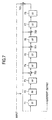
- Fig. 7 is a circuit diagram showing the example of a related art divider circuit for executing the aforementioned procedure.
- F1 through F8 represent flip-flops configured as a shift register and 707-703 exclusive-OR circuits.
- the time required to obtain a remainder is the time required for all the a-bit input data to be input and a times the shift clock cycle.
- respective coding-target data often has certain characteristics. Thus it may be possible to reduce the division time by utilizing the characteristics of the coding-target data input to a divider circuit.
- a-bit coding-target data is comprises c-bit random information data 400 and additional part 401 comprising d-bit 0s.
- additional part 401 comprising successive 0s may reach several hundreds of bits.
- the division method using the related art divider circuit for performing division to generate codewords for data having such characteristics will be examined using specific values as shown in Fig. 5.
- the remainder obtained by dividing the 8-bit information data part represented by 500 becomes "010" represented by 503.
- a value obtained by adding 10-bit 0s to the remainder of the immediately preceding step is divided, as shown in numerals 504 through 509.
- the quotient of division is 0 and the remainder bit value stays unchanged when only 1-bit 0 is added. Thus, 0s are added for 2 bits or more until the quotient reaches 1.
- the related art method required d-bit shift operation to calculate a remainder necessary for generating a codeword.
- the operation time for shift operation of a bits as the number of bits of the coding-target data was required in dividing the data shown in Fig. 4 by a generation polynomial to calculate a remainder.
- the invention has been proposed in view of this problem and aims at providing a code generator circuit for generating cyclic codes capable of considering the characteristics of input data thus reducing the division time.
- a code generator circuit is a code generator circuit for dividing input data input to a bit serial by a predetermined generator polynomial to generate a division remainder, comprising division means configured as a shift register where a plurality of flip-flops (F1-F8), selector circuits (selectors 130-137) respectively added immediately after the flip flops, and exclusive-OR circuits (110, 111, 112, 113) inserted according to the generator polynomial are serially connected, andmeans (division remainder decision circuit 101) including a remainder shift circuit for comparing the number of digits of leading 0s (number of digits of successive 0s from the data head) of the value on the shift register with the number of leading 0s of the subsequent input data, assuming the number of digits of the smaller as the number of skip digits, then outputting the value on the shift register shifted by the number of skip digits, in that the selector circuits select the output of the remainder shift circuit when the number of
- the quotient output of the divider circuit becomes 0 by obtaining the number of skip digits based on the number of leading 0s of the remainder in the middle of the division and the number of leading 0s of the subsequent input data, and by using a value obtained by shifting the value on the shift register by the number of skip digits in case the number of skip digits is 1 or more in the division operation.
- the code generator circuit further comprises count means (counter 201) for counting the number of shifts of the shift register and decision means (division remainder generation end decision circuit 212) for detecting that the count means has counted the number of skip digits additionally in case the selector circuits have selected the output of the remainder shift circuit and detecting that the count means has counted up to a value equal to the total number of digits of the input data to terminate the generation of division remainder.
- a code generator circuit comprises storage means (FF310-FF318) for storing the quotients obtained by dividing the input data by the generator polynomial, in that, in case the selector circuits have not selected the output of the remainder shift circuit, the code generator circuit sets the quotient output of the divider circuit to the digit position of the storage means corresponding to the digit position of the input data and, in case the selector circuits have selected the output of the remainder shift circuit, inserts 0s as many as the number of the skip digits than sets the quotient output of the divider circuit to the digit position of the storage means corresponding to the digit position of the input data.
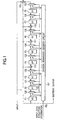
- Fig. 1 is a circuit diagram showing a code generator circuit according to the first embodiment of the invention.
- F1 through F8 represent flip-flops configured as a shift register, 101 a division remainder decision circuit, 110 through 113 exclusive-OR circuits, 130 though 137 selector circuits for selecting the output of the flip-flops or output of the division remainder decision circuit 101, 140 a control signal from the division remainder decision circuit 101, 150 a signal to externally input the input data structure information.
- the division remainder decision circuit 101 detects the number of digits of leading 0s of the value on the shift register or flip-flops F8 through F1 and detects the number of digits of leading 0s of the subsequent input data, then compares the number of leading 0s of the subsequent input data with the number of digits of leading 0s of the value on the shift register and assumes the number of digits of the smaller as the number of skip digits, then switches over the selection of the selector circuits 130 through 137 by using the control signal 140 depending on whether the number of skip digits is 1 or more.
- the selector circuits 130 through 137 select the output of each flip-flop.
- the circuit in Fig. 1 is connected the same way as the divider circuit in Fig. 7 and operates the same as the divider circuit in Fig. 7. That is, 1-bit data z from input data is multiplied by X ⁇ 8 in the exclusive-OR circuit 113 and added to a value obtained by shifting the flip-flops F8 through F1 by one bit. The resulting value serves as a quotient output, which is divided using G(X) by the exclusive-OR circuits 110 through 112.
- the selector circuits 130 through 137 select the output of the division remainder decision circuit 101.
- the division remainder decision circuit 101 outputs the value on the shift register shifted by the remainder shift circuit by the number of skip digits. It is guaranteed that the quotient output of division equals 0 until the value is shifted by the number of skip digits.
- the selector circuits 130 through 137 may select the output of each flip-flop.
- the input data is skipped as many as the number of skip digits.
- the subsequent input data z is multiplied by X ⁇ 8 in the exclusive-OR circuit 113.
- the resulting value is added to a value obtained by shifting the flip-flops F8 through F1 output by the division remainder decision circuit 101 by the number of skip digits.
- the value thus obtained is used as the quotient output, which is then divided by G(X) by the exclusive-OR circuits 100 through 112.
- the subsequent input data is all 0.
- the number of digits of leading 0s of the subsequent input data is equal to the remaining digits of the input data.
- a circuit is provided for decrementing the number of digits of input data input from a counter where the number of all the digits of input data is set to a divider circuit in order to determine the end of generation of division remainder, it is possible, based on the counter value, to obtain the number of the remaining digits of the input data, or the number of digits of leading 0s of the subsequent input data.
- the flip-flops have values shown below.
- the division remainder decision circuit 101 detects that the leading 0s are three digits, F8 through F6. Assuming that the number of remaining digits of input data is three or more, the value output by the division remainder decision circuit 101 is a value obtaining by shifting the flip-flops F8 through F1 by three digits as shown below.
- a circuit is required for detecting the number of digits of leading 0s of the subsequent input data at an arbitrary time point.
- This circuit may be the same as the circuit for detecting the number of digits of leading 0s of the value on the shift register. A value exceeding the number of digits of the shift register is not necessary. Data within the range of the number of digits of the shift register from the head of the subsequent input data is required. The number of digits of leading 0s does not exceed the number of remaining digits of the input data.
- the output of the circuit for detecting the number of digits of leading 0s is compared with the number of remaining digits of the input data and the smaller is output as the number of digits of leading 0s detected.
- a circuit is added for detecting the number of digits of leading 0s of the subsequent input data, and the output is compared with the number of digits of leading 0s of the value on the shift register and the smaller is determined as the number of skip digits.
- the selector circuits 130 through 137 select the output of the remainder shift circuit 101 when the number of skip digits is 1 or more and select the output of the flip-flops connected immediately before the respective selector circuits when the number of skip digits is 0.
- Fig. 2 is a circuit diagram showing the division remainder decision circuit 101.
- a numeral 201 represents a register used as a counter, 202 an adder for the counter, 203 a circuit for detecting the number of digits of leading 0s of the flip-flops F8 through F1 composing a shift register, 204 a remainder shift circuit for shifting the value on the shift register by the number of skip digits, 205 a circuit for detecting the number of digits of leading 0s of the subsequent input data, 206 a comparator circuit for comparing the value of the counter 201 with the output of the circuit for detecting the number of digits of leading 0s, 207 a selector circuit for selecting the smaller value of the value of the counter 201 and the output of the circuit 205 for detecting the number of digits of leading 0s based on the output of the comparator circuit 206, 208 a comparator circuit for comparing the output of the selector circuit 207 with the output of the circuit 203 for detecting the
- the output of the selector circuit 209 gives the number of skip digits and controls the number of shift digits in the remainder shift circuit 204.
- the output of the selector circuit 210 indicates that the number of skip digits is 1 or more and given as a control signal 140 to the selector circuits 130 through 137.
- the complementer circuit of 1 211 By obtaining the complement of 1 of the number of skip digits in the complementer circuit of 1 211 and inputting the resulting value to the adder 202, it is possible to reduce the number of skip digits plus 1 from the value of the counter 201.
- the division remainder generation end decision circuit 212 can be used to determine the end of generation of division remainder.
- the remainder shift circuit selects one of the seven values obtained by shifting the value of flip-flops F8 through F1 by one to seven digits, depending on the number of skip digits.
- This example shows that the number of digits of leading 0s on the shift register serves as the number of skip digits.
- the value on then shift register is all 0 for right digits, meaning that the subsequent input data is successive 0s in eight or more digits.
- 8-digit 0s may be output from the remainder shift circuit or selector circuits 130 through 137 may select the output of each flip-flop.
- the circuit for detecting the number of digits of leading 0s converts the detected value into a binary code for comparison of the detected data with another value.
- the logical conjunction sign is represented by + to omit the logical inclusive disjunction sign
- the logical expression of 4-bit binary codes S3 through S0 representing the number-of-digit detection value of leading 0s of the flip-flops F8 through F1 will be as shown below.
- the circuit 205 for detecting the number of digits of leading 0s is deleted from Fig. 2. Then, instead of the output of the circuit 205 for detecting the number of digits of leading 0s, the value d is input into the comparator circuit 206 and 0 into the selector circuit 207. In case the value of the counter 201 is greater than d, 0 is selected. When the value of the counter 201 has dropped to d or below, the counter value is selected. In this way, the number of skip digits is 0 until the end of input of c-bit information data. After the end of input of c-bit information data, the necessary number of skip digits is obtained.
- the quotient of a division result may be used as ca codeword in certain encoding.
- the quotient of the aforementioned division leaves the 0 of the number of skip digits dropped.
- Fig. 3 is a circuit diagram showing a code generator circuit according to the second embodiment. This configuration gives a quotient of division in a code generator circuit according to the first embodiment.
- a numeral 301 represents a code generator circuit according to the first embodiment, 302 a quotient output signal from the code generator circuit 301, 303 an output from the counter 201, 304 a decoder circuit for decoding the value of the counter 201, 310 through 318 flip-flops comprising a register for storing the quotients of the division, 320 through 328 enable signal for individually controlling the input of the flip-flops 310 through 318.
- the number of bits of the quotient of division in generating cyclic codes is equal to the number of input bits.
- the output of the counter 201 representing the number of the remaining digits of input data shows the bit position where the quotient output is stored.
- the flip-flops 31-0 through 318 are reset to 0.
- the output of the counter 201 is decoded in the decoder circuit 304.
- the resulting outputs 320 through 328 are used to individually control the inputs of the flip-flops 310 through 318 to input the quotient output 303. This procedure inserts the quotient output and 0 of the number of skip digits into correct bit position and obtains the quotient of correct division on the flip-flops 310 through 318.
- the circuit scale is too large depending on the number of bits of input data.
- the degree of the generator polynomial is bth
- flip-flops of 2 (n + 1) bits where n is a natural number satisfying 2 n ⁇ b is provided.
- the flip-flops are reset to 0 and the decoder circuit 304 decodes the lower n + 1 bits of the output of the counter 201 and stores the quotient output into the flip-flop for the decoding section.
- the decoder stores into memory the quotient of the upper 2 n bits each time it is obtained, resets the n-bit flip-flops to 0, and replaces the position of the flip-flops for the upper 2 n bits with that of the flip-flops for the lower 2 n bits in order to alternate their roles. This configures a circuit that obtains a correct quotient in memory with small circuit scale.
- a code generator circuit for performing division by using a generator polynomial it is possible to reduce the division time, especially for the input data having a characteristic of including a great number of successive 0s, by obtaining the number of skip digits from the number of digits of leading 0s of the remainder in the middle of the division and the number of digits of leading 0s of the subsequent input data, and by skipping the simple shift processing not requiring division operation.
Landscapes
- Physics & Mathematics (AREA)
- Algebra (AREA)
- General Physics & Mathematics (AREA)
- Mathematical Physics (AREA)
- Pure & Applied Mathematics (AREA)
- Probability & Statistics with Applications (AREA)
- Engineering & Computer Science (AREA)
- Theoretical Computer Science (AREA)
- Error Detection And Correction (AREA)
- Detection And Correction Of Errors (AREA)
Applications Claiming Priority (2)
| Application Number | Priority Date | Filing Date | Title |
|---|---|---|---|
| JP2002036796A JP2003243992A (ja) | 2002-02-14 | 2002-02-14 | 符号生成回路 |
| JP2002036796 | 2002-02-14 |
Publications (2)
| Publication Number | Publication Date |
|---|---|
| EP1337044A2 true EP1337044A2 (fr) | 2003-08-20 |
| EP1337044A3 EP1337044A3 (fr) | 2004-01-28 |
Family
ID=27621424
Family Applications (1)
| Application Number | Title | Priority Date | Filing Date |
|---|---|---|---|
| EP02027412A Withdrawn EP1337044A3 (fr) | 2002-02-14 | 2002-12-09 | Circuit génerateur de code |
Country Status (4)
| Country | Link |
|---|---|
| US (1) | US20030154439A1 (fr) |
| EP (1) | EP1337044A3 (fr) |
| JP (1) | JP2003243992A (fr) |
| CN (1) | CN1230987C (fr) |
Families Citing this family (1)
| Publication number | Priority date | Publication date | Assignee | Title |
|---|---|---|---|---|
| CN1787415B (zh) * | 2004-12-08 | 2011-05-25 | 中兴通讯股份有限公司 | 实现伪随机码相位偏移的装置及其生成伪随机码的方法 |
Family Cites Families (3)
| Publication number | Priority date | Publication date | Assignee | Title |
|---|---|---|---|---|
| US5280488A (en) * | 1990-11-08 | 1994-01-18 | Neal Glover | Reed-Solomon code system employing k-bit serial techniques for encoding and burst error trapping |
| JPH09116541A (ja) * | 1995-10-16 | 1997-05-02 | Toshiba Corp | 通信制御装置 |
| US6701479B2 (en) * | 2001-05-15 | 2004-03-02 | Network Elements, Inc. | Fast cyclic redundancy check (CRC) generation |
-
2002
- 2002-02-14 JP JP2002036796A patent/JP2003243992A/ja active Pending
- 2002-12-09 EP EP02027412A patent/EP1337044A3/fr not_active Withdrawn
- 2002-12-27 US US10/329,341 patent/US20030154439A1/en not_active Abandoned
-
2003
- 2003-01-06 CN CN03101434.8A patent/CN1230987C/zh not_active Expired - Fee Related
Also Published As
| Publication number | Publication date |
|---|---|
| US20030154439A1 (en) | 2003-08-14 |
| JP2003243992A (ja) | 2003-08-29 |
| CN1230987C (zh) | 2005-12-07 |
| EP1337044A3 (fr) | 2004-01-28 |
| CN1438768A (zh) | 2003-08-27 |
Similar Documents
| Publication | Publication Date | Title |
|---|---|---|
| US6928602B2 (en) | Encoding method and encoder | |
| US6079041A (en) | Digital modulation circuit and digital demodulation circuit | |
| KR100659265B1 (ko) | 패리티비트가 역순으로 부가된 씨.알.씨. 코드의에러검출장치 및 방법 | |
| KR100745863B1 (ko) | 씨알씨 연산장치 및 씨알씨 연산방법 | |
| JPS63123232A (ja) | 単一ビットの誤り検出方法とそれを用いた算術デコ−ダ | |
| KR101583165B1 (ko) | 오류 정정 복호 장치 | |
| JPH10107646A (ja) | Crc符号発生回路、符号誤り検出回路、及びcrc回路 | |
| JP2009094605A (ja) | 符号誤り検出装置および誤り検出符号生成装置 | |
| EP1337044A2 (fr) | Circuit génerateur de code | |
| US7209593B2 (en) | Apparatus, method, and programs for arithmetic encoding and decoding | |
| KR20040044589A (ko) | 다수결 논리를 이용한 rm 부호의 연판정 복호 방법 및그 장치 | |
| US20100295713A1 (en) | Coding apparatus, decoding apparatus, code transforming apparatus, and program | |
| EP0661841A2 (fr) | Générateur de parité et de syndrome pour la détection et la correction d'erreur dans les systèmes de transmission numérique | |
| KR100429737B1 (ko) | 업/다운 그레이코드 카운터 및 이 카운터를 구비한 고체상이미지센서 | |
| JP4799514B2 (ja) | 符号化処理装置、符号化処理方法、及び符号化処理プログラム | |
| EP1300954A1 (fr) | Dispositif et méthode d'encodage, dispositif et méthode de décodage, support de fourniture et méthode pour générer des informations sur la position de données de substitution | |
| US6138134A (en) | Computational method and apparatus for finite field multiplication | |
| JP2694794B2 (ja) | 誤り訂正処理方法 | |
| JP2710917B2 (ja) | ヘッダ検出器及びこれを用いた復号装置 | |
| CN114895868A (zh) | 基于两位商计算的除法运算单元及除法器 | |
| KR101134806B1 (ko) | 부호 복호 방법 | |
| KR0155762B1 (ko) | 효율적인 에러정정 능력을 가진 리드-솔로몬 복호기 | |
| KR100396827B1 (ko) | 데이터 전송 시스템에서 병렬 길쌈 부호화 장치 | |
| JP3521558B2 (ja) | 伝送装置 | |
| JPH07111597A (ja) | ランレングス検出装置 |
Legal Events
| Date | Code | Title | Description |
|---|---|---|---|
| PUAI | Public reference made under article 153(3) epc to a published international application that has entered the european phase |
Free format text: ORIGINAL CODE: 0009012 |
|
| AK | Designated contracting states |
Designated state(s): AT BE BG CH CY CZ DE DK EE ES FI FR GB GR IE IT LI LU MC NL PT SE SI SK TR |
|
| AX | Request for extension of the european patent |
Extension state: AL LT LV MK RO |
|
| PUAL | Search report despatched |
Free format text: ORIGINAL CODE: 0009013 |
|
| AK | Designated contracting states |
Kind code of ref document: A3 Designated state(s): AT BE BG CH CY CZ DE DK EE ES FI FR GB GR IE IT LI LU MC NL PT SE SI SK TR |
|
| AX | Request for extension of the european patent |
Extension state: AL LT LV MK RO |
|
| RIC1 | Information provided on ipc code assigned before grant |
Ipc: 7H 04L 1/00 B Ipc: 7G 06F 7/72 B Ipc: 7H 03M 13/09 B Ipc: 7H 03M 13/15 A |
|
| 17P | Request for examination filed |
Effective date: 20040326 |
|
| AKX | Designation fees paid |
Designated state(s): DE FR GB |
|
| 17Q | First examination report despatched |
Effective date: 20040921 |
|
| STAA | Information on the status of an ep patent application or granted ep patent |
Free format text: STATUS: THE APPLICATION IS DEEMED TO BE WITHDRAWN |
|
| 18D | Application deemed to be withdrawn |
Effective date: 20041103 |