EP1359976B1 - Fluidretentionsanordnung für die iontophoretische abgabe - Google Patents
Fluidretentionsanordnung für die iontophoretische abgabe Download PDFInfo
- Publication number
- EP1359976B1 EP1359976B1 EP02703049A EP02703049A EP1359976B1 EP 1359976 B1 EP1359976 B1 EP 1359976B1 EP 02703049 A EP02703049 A EP 02703049A EP 02703049 A EP02703049 A EP 02703049A EP 1359976 B1 EP1359976 B1 EP 1359976B1
- Authority
- EP
- European Patent Office
- Prior art keywords
- matrix
- excipient
- fluid retention
- providing
- retention assembly
- Prior art date
- Legal status (The legal status is an assumption and is not a legal conclusion. Google has not performed a legal analysis and makes no representation as to the accuracy of the status listed.)
- Expired - Lifetime
Links
- 239000011159 matrix material Substances 0.000 claims description 54
- 239000000546 pharmaceutical excipient Substances 0.000 claims description 54
- 239000003814 drug Substances 0.000 claims description 19
- 238000000034 method Methods 0.000 claims description 16
- 230000036571 hydration Effects 0.000 claims description 10
- 238000006703 hydration reaction Methods 0.000 claims description 10
- 229920001223 polyethylene glycol Polymers 0.000 claims description 10
- 239000002202 Polyethylene glycol Substances 0.000 claims description 9
- 238000012377 drug delivery Methods 0.000 claims description 9
- 239000003623 enhancer Substances 0.000 claims description 9
- 238000001035 drying Methods 0.000 claims description 8
- 239000002562 thickening agent Substances 0.000 claims description 8
- DHKHKXVYLBGOIT-UHFFFAOYSA-N acetaldehyde Diethyl Acetal Natural products CCOC(C)OCC DHKHKXVYLBGOIT-UHFFFAOYSA-N 0.000 claims description 7
- 150000001241 acetals Chemical class 0.000 claims description 7
- 229920002554 vinyl polymer Polymers 0.000 claims description 7
- 108091023037 Aptamer Proteins 0.000 claims description 6
- 102000003996 Interferon-beta Human genes 0.000 claims description 6
- 108090000467 Interferon-beta Proteins 0.000 claims description 6
- 102000008070 Interferon-gamma Human genes 0.000 claims description 6
- 108010074328 Interferon-gamma Proteins 0.000 claims description 6
- 102000005789 Vascular Endothelial Growth Factors Human genes 0.000 claims description 6
- 108010019530 Vascular Endothelial Growth Factors Proteins 0.000 claims description 6
- 238000007605 air drying Methods 0.000 claims description 6
- LKCWBDHBTVXHDL-RMDFUYIESA-N amikacin Chemical compound O([C@@H]1[C@@H](N)C[C@H]([C@@H]([C@H]1O)O[C@@H]1[C@@H]([C@@H](N)[C@H](O)[C@@H](CO)O1)O)NC(=O)[C@@H](O)CCN)[C@H]1O[C@H](CN)[C@@H](O)[C@H](O)[C@H]1O LKCWBDHBTVXHDL-RMDFUYIESA-N 0.000 claims description 6
- 229960004821 amikacin Drugs 0.000 claims description 6
- 229960002344 dexamethasone sodium phosphate Drugs 0.000 claims description 6
- PLCQGRYPOISRTQ-FCJDYXGNSA-L dexamethasone sodium phosphate Chemical compound [Na+].[Na+].C1CC2=CC(=O)C=C[C@]2(C)[C@]2(F)[C@@H]1[C@@H]1C[C@@H](C)[C@@](C(=O)COP([O-])([O-])=O)(O)[C@@]1(C)C[C@@H]2O PLCQGRYPOISRTQ-FCJDYXGNSA-L 0.000 claims description 6
- 229940044627 gamma-interferon Drugs 0.000 claims description 6
- 230000002401 inhibitory effect Effects 0.000 claims description 6
- 229960004393 lidocaine hydrochloride Drugs 0.000 claims description 6
- YECIFGHRMFEPJK-UHFFFAOYSA-N lidocaine hydrochloride monohydrate Chemical compound O.[Cl-].CC[NH+](CC)CC(=O)NC1=C(C)C=CC=C1C YECIFGHRMFEPJK-UHFFFAOYSA-N 0.000 claims description 6
- 229920002153 Hydroxypropyl cellulose Polymers 0.000 claims description 5
- 229920003086 cellulose ether Polymers 0.000 claims description 5
- 239000001863 hydroxypropyl cellulose Substances 0.000 claims description 5
- 235000010977 hydroxypropyl cellulose Nutrition 0.000 claims description 5
- 239000000203 mixture Substances 0.000 claims description 5
- 125000005702 oxyalkylene group Chemical group 0.000 claims description 5
- 229920000642 polymer Polymers 0.000 claims description 5
- 238000010438 heat treatment Methods 0.000 claims description 3
- 239000002904 solvent Substances 0.000 claims description 3
- 238000004108 freeze drying Methods 0.000 claims description 2
- 238000007710 freezing Methods 0.000 claims description 2
- 230000008014 freezing Effects 0.000 claims description 2
- 230000000712 assembly Effects 0.000 description 3
- 238000000429 assembly Methods 0.000 description 3
- 230000007794 irritation Effects 0.000 description 3
- 239000000654 additive Substances 0.000 description 2
- 125000000129 anionic group Chemical group 0.000 description 2
- 125000002091 cationic group Chemical group 0.000 description 2
- 241000452734 Eudoraea Species 0.000 description 1
- 239000000872 buffer Substances 0.000 description 1
- 239000003795 chemical substances by application Substances 0.000 description 1
- 239000004020 conductor Substances 0.000 description 1
- 238000007796 conventional method Methods 0.000 description 1
- 239000003792 electrolyte Substances 0.000 description 1
- 239000012530 fluid Substances 0.000 description 1
- 239000000463 material Substances 0.000 description 1
- 238000012986 modification Methods 0.000 description 1
- 230000004048 modification Effects 0.000 description 1
- 239000002798 polar solvent Substances 0.000 description 1
- 239000008213 purified water Substances 0.000 description 1
- 230000001105 regulatory effect Effects 0.000 description 1
- 239000000126 substance Substances 0.000 description 1
- 230000000153 supplemental effect Effects 0.000 description 1
- 230000001225 therapeutic effect Effects 0.000 description 1
- XLYOFNOQVPJJNP-UHFFFAOYSA-N water Chemical compound O XLYOFNOQVPJJNP-UHFFFAOYSA-N 0.000 description 1
Images
Classifications
-
- A—HUMAN NECESSITIES
- A61—MEDICAL OR VETERINARY SCIENCE; HYGIENE
- A61N—ELECTROTHERAPY; MAGNETOTHERAPY; RADIATION THERAPY; ULTRASOUND THERAPY
- A61N1/00—Electrotherapy; Circuits therefor
- A61N1/02—Details
- A61N1/04—Electrodes
- A61N1/0404—Electrodes for external use
- A61N1/0408—Use-related aspects
- A61N1/0428—Specially adapted for iontophoresis, e.g. AC, DC or including drug reservoirs
- A61N1/0448—Drug reservoir
-
- A—HUMAN NECESSITIES
- A61—MEDICAL OR VETERINARY SCIENCE; HYGIENE
- A61K—PREPARATIONS FOR MEDICAL, DENTAL OR TOILETRY PURPOSES
- A61K9/00—Medicinal preparations characterised by special physical form
- A61K9/0012—Galenical forms characterised by the site of application
- A61K9/0048—Eye, e.g. artificial tears
Definitions
- the present invention relates in general to a fluid retention assembly, and more particularly, to a fluid retention assembly having a matrix for use in association with an iontophoretic delivery device which, is configured for, among other things, ocular applications.
- Fluid retention assemblies having a matrix for use in association with iontophoretic delivery devices have been known in the art for several years (see for example US-A-5 730 716 and WO-A-9 712 644 ). While conventional matrices of fluid retention assemblies have become commercially available, their use in especially sensitive applications, such as the ophthalmic administration of a medicament, or the administration a medicament to broken or otherwise damaged skin remains problematic. In particular, conventional matrices used in non-sensitive applications are fabricated from materials which can be too abrasive, contain too many particulates, and/or facilitate a undesirable degree of irritation for especially sensitive applications.
- conventional matrices may scratch the surface of a patient's eye, or may further irritate a broken or damaged surface of a patient's body. Furthermore, conventional matrices may leave residual particulates and/or lint, which can be especially troublesome for ophthalmic applications. As such, there is a demand for a fluid retention assembly having a matrix, which is configured for sensitive iontophoretic applications, including ocular iontophoretic applications.
- the present invention is directed to a fluid retention assembly for use in association with an iontophoretic drug delivery device comprising: (a) a matrix, wherein the matrix is fabricated from a hydroxylated polyvinyl acetal; (b) a first excipient associated with the matrix, wherein the first excipient comprises a substantially non-ionic thickening agent; and (c) a second excipient associated with the matrix, wherein the second excipient comprises a hydration enhancer.
- the first excipient comprises a cellulose ether, such as a hydroxypropylcellulose.
- the second excipient comprises an oxyalkylene polymer, such as a polyethylene glycol.
- the polyethylene glycol has an average molecular weight ranging from approximately 1,000 to approximately 9,000.
- the matrix further comprises a therapeutic amount of a medicament, such as, but not limited to, a VEGF-inhibiting aptamer, an alpha-interferon, a beta-interferon, a gamma-interferon, dexamethasone sodium phosphate, lidocaine hydrochloride, amikacin, and/or gangcyclovir.
- a medicament such as, but not limited to, a VEGF-inhibiting aptamer, an alpha-interferon, a beta-interferon, a gamma-interferon, dexamethasone sodium phosphate, lidocaine hydrochloride, amikacin, and/or gangcyclovir.
- the present invention is also directed to an ocular iontophoretic drug delivery device comprising: (a) a fluid retention assembly comprising: (1) a matrix, wherein the matrix is fabricated from a hydroxylated polyvinyl acetal; (2) a first excipient associated with the matrix, wherein the first excipient comprises a substantially non-ionic thickening agent; and (3) a second excipient associated with the matrix, wherein the second excipient comprises a hydration enhancer; (b) an active electrode assembly associated with the fluid retention assembly; (c) a counter electrode assembly, wherein the counter electrode assembly is configured for completing an electrical circuit between the active electrode assembly and an energy source; and (d) an energy source for generating an electrical potential difference.
- a fluid retention assembly comprising: (1) a matrix, wherein the matrix is fabricated from a hydroxylated polyvinyl acetal; (2) a first excipient associated with the matrix, wherein the first excipient comprises a substantially non-ionic thickening agent; and
- the present invention is further directed to a method for preparing a fluid retention assembly for use in association with an iontophoretic drug delivery device comprising the steps of: (a) providing a first excipient, wherein the first excipient comprises a substantially non-ionic thickening agent; (b) providing a second excipient, wherein the second excipient comprises a hydration enhancer; (c) preparing a solution of the first and second excipients in a solvent; (d) impregnating a matrix fabricated from a hydroxylated polyvinyl acetal with the prepared solution; and (e) drying the matrix.
- the method further comprises the steps of associating a medicament with the matrix, such as a VEGF-inhibiting aptamer, an alpha-interferon, a beta-interferon, a gamma-interferon, dexamethasone sodium phosphate, lidocaine hydrochloride, amikacin, gangcyclovir, and/or mixtures thereof.
- a medicament such as a VEGF-inhibiting aptamer, an alpha-interferon, a beta-interferon, a gamma-interferon, dexamethasone sodium phosphate, lidocaine hydrochloride, amikacin, gangcyclovir, and/or mixtures thereof.
- the step of drying the matrix includes the steps of: (a) air drying the matrix at ambient temperature for approximately 15 hours; and (b) heating the matrix in an oven to approximately 50 degrees centigrade for approximately 2 hours after the step of air drying the same.
- the method further comprises the step of freezing the matrix after the step of drying the same.
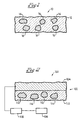
- a first embodiment of a fluid retention assembly 10 is shown, which generally comprises matrix 12, first excipient 14, and second excipient 16. It will be understood that Fig. 1 is merely a cross-sectional schematic representation of fluid retention assembly 10. As such, some of the components have been distorted from their actual scale for pictorial clarity. As will be discussed in greater detail below, fluid retention assembly 10 is configured for use in association an iontophoretic drug delivery device.
- Matrix 12 is fabricated from a hydroxylated polyvinyl acetal, which is commercially available from, among other chemical vendors, M-Pact Worldwide, Inc., of Eudora, Kansas. Prior to association with the first and second excipients, matrix 12 is relatively non-malleable. However, after association with first and second excipients, matrix 12 is malleable, non-abrasive ⁇ even to highly sensitive areas, such as the surface of a patient's eye or a broken or otherwise damaged surface of a patient's body. Moreover, matrix 12 leaves little or no residual particulates or lint, facilitates little or no irritation to the administered area of the patient, and exhibits high hydration capacity - greater then approximately 7X w/w. Matrix 12 may be configured into any one of a number of geometric configurations depending upon the particular application.
- first excipient 14 is associated with matrix 12 and comprises a substantially non-ionic thickening agent.
- first excipient 14 may comprise a cellulose ether, such as hydroxypropylcellulose, which is commercially available from Hercules, Inc., of Wilmington, Delaware.
- First excipient 14 primary serves to increase the viscosity of a medicament so that during administration of the medicament, weeping or dripping is minimized.
- First excipient 14 also serves to increase the lubricity of the matrix.
- first excipient 14 While specific examples of first excipient 14 have been disclosed, for illustrative purposes only, it will be understood that other substantially non-ionic thickening agents that would be known to those having ordinary skill in the art having the present disclosure before them are likewise contemplated for use.
- Second excipient 16 is also associated with matrix 12 and comprises a hydration enhancer.
- hydration enhancers include oxyalkylene polymers, such as polyethylene glycol, which is commercially available from Union Carbide Corporation of Danbury, Connecticut. Although, polyethylene glycol having various average molecular weights are operable in accordance with the present invention, polyethylene glycols having an average molecular weight ranging from approximately 1,000 to approximately 9,000 are preferred.
- Second excipient 16 primary serves to increase the lubricity of the matrix so that during administration of the medicament, irritation and/or dryness is minimized. While specific examples of second excipient 16 have been disclosed, for illustrative purposes only, it will be understood that other hydration enhancers that would be known to those having ordinary skill in the art having the present disclosure before them are likewise contemplated for use.
- matrix 12 may also include a medicament to treat an affected area of a living being's body, such as an eye.
- medicaments include a VEGF-inhibiting aptamer, an alpha-interferon, a beta-interferon, a gamma-interferon, dexamethasone sodium phosphate, lidocaine hydrochloride, amikacin, gangcyclovir, and/or mixtures thereof.
- Matrix 12 may also contain supplemental agents, such as electrolytes, stability additives, medicament preserving additives, pH regulating buffers - just to name a few.
- supplemental agents such as electrolytes, stability additives, medicament preserving additives, pH regulating buffers - just to name a few.
- ocular iontophoretic drug delivery device 100 which generally comprises fluid retention assembly 102, active electrode assembly 104, counter electrode assembly 106, and energy source 108.
- Fluid retention assembly 102 is configured in an analogous manner to fluid retention assembly 12 and includes matrix 110, first excipient 112, and second excipient 114.
- Active electrode assembly 104 generally comprises a conductive material, which upon application of an electrical potential difference thereto, drives an ionic medicament, within matrix 110 and delivers the medicament into predetermined tissues and surrounding structures of a living being. It will be understood that active electrode assembly 104 may comprise an anode or a cathode depending upon whether the medicament is cationic or anionic in form. It will be further understood that active electrode assembly may include an open-faced or high current density electrode. As would be readily understood to those having ordinary skill in the art, any one of a number of conventional active electrode assemblies are contemplated for use in accordance with the present invention. The only contemplated limitation relative to active electrode assembly 104 is that it must be geometrically and compositionally compatible for ocular and/or non-ocular applications of living beings, most relevantly, humans.
- Counter electrode assembly 106 may be housed within ocular iontophoretic device 100, or alternatively, may be remotely associated with ocular iontophoretic device 100 via conventional electrical conduit. Counter electrode assembly 106 is configured for completing an electrical circuit between active electrode assembly 104 and energy source 108. As with active electrode assembly 104, counter electrode assembly 106 may comprise an anode or a cathode depending upon whether the medicament is cationic or anionic in form. As would be readily understood to those having ordinary skill in the art, any one of a number of counter electrodes are contemplated for use in accordance with the present invention.
- energy source 108 may be housed within ocular iontophoretic device 100, or alternatively, may be remotely associated with ocular iontophoretic device 100 via conventional electrical conduit.
- Energy source 108 preferably supplies low voltage direct current between approximately 0.1 milliamps (mA) and approximately 10 mA for generating an electrical potential difference.
- the energy source may also provide for an initial higher voltage during current ramp-up to break down higher initial tissue resistance as in commercial power supply units used for transdermal iontophoresis.
- energy source 108 may include one or more primary or secondary electrochemical cells. While specific examples of energy source 108 have been disclosed, for illustrative purpose only, it will be understood that other energy sources known to those having ordinary skill in the art having the present disclosure before them are likewise contemplated for use.
- the present invention is also directed to a method for preparing a fluid retention assembly for use in association with an iontophoretic drug delivery device comprising the following steps.
- a first excipient is provided which comprises a substantially non-ionic thickening agent, including cellulose ethers, such as hydroxypropylcellulose.
- a second excipient is provided which comprises a hydration enhancer, including oxyalkylene polymers, such as polyethylene glycol having an average molecular weight ranging from approximately 1,000 to approximately 9,000.
- a solution is prepared by dissolving the second and first excipients in a solvent, such as purified water or other polar solvents.
- the concentration of the excipients ranges from approximately 0.5% to approximately 2% by weight. More preferably the concentration of the first excipient is approximately 1.75% by weight and the concentration of the second excipient is approximately 1.25% by weight.
- a matrix fabricated from a hydroxylated polyvinyl acetal is impregnated with the solution. Once the matrix has been impregnated, it is dried.
- drying the matrix may be carried using numerous methods, it has been found that freeze drying or air drying the matrix at ambient temperature for approximately 15 hours, followed by heating the matrix in an oven to approximately 50 degrees centigrade for approximately 2 hours substantially prevents any warping that may otherwise occur if the matrix is dried at elevated temperatures without first air-drying at ambient temperatures.
- the matrix After the matrix has been dried, it may be placed in a freezer for storage until used at a later time.
- a medicament may be associated thereto using conventional techniques.
- examples of some medicaments include a VEGF-inhibiting aptamer, an alpha-interferon, a beta-interferon, a gamma-interferon, dexamethasone sodium phosphate, lidocaine hydrochloride, amikacin, gangcyclovir, and/or mixtures thereof.
Landscapes
- Health & Medical Sciences (AREA)
- Engineering & Computer Science (AREA)
- General Health & Medical Sciences (AREA)
- Bioinformatics & Cheminformatics (AREA)
- Pharmacology & Pharmacy (AREA)
- Veterinary Medicine (AREA)
- Public Health (AREA)
- Life Sciences & Earth Sciences (AREA)
- Animal Behavior & Ethology (AREA)
- Nuclear Medicine, Radiotherapy & Molecular Imaging (AREA)
- Radiology & Medical Imaging (AREA)
- Biomedical Technology (AREA)
- Ophthalmology & Optometry (AREA)
- Chemical & Material Sciences (AREA)
- Medicinal Chemistry (AREA)
- Epidemiology (AREA)
- Pharmaceuticals Containing Other Organic And Inorganic Compounds (AREA)
- Acyclic And Carbocyclic Compounds In Medicinal Compositions (AREA)
- Electrotherapy Devices (AREA)
- Medicinal Preparation (AREA)
Claims (20)
- Anordnung zur Retention von Fluid zur Verwendung in Verbindung mit einer iontophoretischen Einrichtung zur Arzneimittelabgabe, welche umfasst:- eine Matrix, wobei die Matrix aus einem hydroxylierten Polyvinylacetal hergestellt ist;- einen ersten mit der Matrix verbundenen Arzneistoffträger, wobei der erste Arzneistoffträger ein im Wesentlichen nicht ionisches Verdickungsmittel umfasst; und- einen zweiten mit der Matrix verbundenen Arzneistoffträger, wobei der zweite Arzneistoffsträger einen Hydratationsverstärker umfasst.
- Anordnung zur Retention von Fluid nach Anspruch 1, bei welcher der erste Arzneistoffträger einen Celluloseether umfasst.
- Anordnung zur Retention von Fluid nach Anspruch 2, bei welcher der erste Arzneistoffträger eine Hydroxypropylcellulose umfasst.
- Anordnung zur Retention von Fluid nach einem der Ansprüche 1 bis 3, bei welcher der zweite Arzneistoffträger ein Oxyalkylenpolymer umfasst.
- Anordnung zur Retention von Fluid nach Anspruch 4, bei welcher der zweite Arzneistoffträger ein Polyethylenglycol umfasst.
- Anordnung zur Retention von Fluid nach Anspruch 5, bei welcher der zweite Arzneistoffträger ein Polyethylenglycol umfasst, welches ein mittleres Molekulargewicht im Bereich von annähernd 1000 bis annähernd 9000 hat.
- Anordnung zur Retention von Fluid nach einem der Ansprüche 1 bis 6, welche außerdem ein Arzneimittel umfasst.
- Anordnung zur Retention von Fluid nach Anspruch 7, bei welcher das Medikament aus wenigstens einem derjenigen Gruppe ausgewählt ist, die aus einem VEGFinhibierenden Aptamer, einem alpha-Interferon, einem beta-Interferon, einem gamma-Interferon, Dexamethasonnatriumphosphat, Lidocainhydrochlorid, Amikacin, Gangcyclovir und/oder aus Mischungen aus diesen besteht.
- Okulare iontophoretische Einrichtung zur Arzneimittelabgabe, welche umfasst:- die Anordnung zur Retention von Fluid nach Anspruch 1;- eine Aktivelektroden-Anordnung, welche mit der Anordnung zur Retention von Fluid verbunden ist;- eine Gegenelektroden-Anordnung, wobei die Gegenelektroden-Anordnung so konfiguriert ist, dass ein elektrischer Schaltkreis zwischen der Aktivelektroden-Anordnung und einer Energiequelle vervollständigt ist; und- eine Energiequelle zur Erzeugung einer elektrischen Potentialdifferenz.
- Verfahren zur Vorbereitung einer Anordnung zur Retention von Fluid zur Verwendung in Verbindung mit einer iontophoretischen Einrichtung zur Arzneimittelabgabe, welches folgende Schritte umfasst:- Bereitstellen eines ersten Arzneistoffträgers, wobei der erste Arzneistoffträger ein im Wesentlichen nicht ionisches Verdickungsmittel umfasst;- Bereitstellen eines zweiten Arzneistoffträgers, wobei der zweite Arzneistoffträger einen Hydratationsbeschleuniger umfasst;- Vorbereiten einer Lösung des ersten und des zweiten Arzneistoffträgers in einem Lösemittel;- Tränken einer Matrix, welche aus einem hydroxylierten Polyvinylacetat hergestellt ist, mit der vorbereiteten Lösung; und- Trocknen der Matrix.
- Verfahren nach Anspruch 10, bei welchem der Schritt der Bereitstellung eines ersten Arzneistoffträgers den Schritt der Bereitstellung eines Celluloseethers umfasst.
- Verfahren nach Anspruch 11, bei welchem der Schritt der Bereitstellung eines ersten Arzneistoffträgers den Schritt der Bereitstellung einer Hydroxypropylcellulose umfasst.
- Verfahren nach einem der Ansprüche 10 bis 12, bei welchem der Schritt zur Bereitstellung eines zweiten Arzneistoffträgers den Schritt der Bereitstellung eines Oxyalkylenpolymers umfasst.
- Verfahren nach Anspruch 13, bei welchem der Schritt der Bereitstellung eines zweiten Arzneistoffträgers den Schritt der Bereitstellung eines Polyethylenglycols umfasst.
- Verfahren nach Anspruch 14, bei welchem der Schritt der Bereitstellung eines zweiten Arzneistoffträgers den Schritt der Bereitstellung eines Polyethylenglycols umfasst, welches ein mittleres Molekulargewicht im Bereich von annähernd 1000 bis annähernd 9000 hat.
- Verfahren nach einem der Ansprüche 10 bis 15, welches außerdem den Schritt der Verbindung eines Arzneimittels mit der Matrix umfasst.
- Verfahren nach einem der Ansprüche 10 bis 16, welches außerdem den Schritt der Verbindung eines VEGFinhibierenden Aptamers, eines alpha-Interferons, eines beta-Interferons, eines gamma-Interferons, von Dexamethasonnatriumphosphat, von Lidocainhydrochlorid, von Amikacin, von Gangcyclovir und/oder Mischungen aus diesen umfasst.
- Verfahren nach Anspruch 10, bei welchem der Schritt des Trocknens der Matrix folgende Schritte umfasst:- Lufttrocknen der Matrix bei Umgebungstemperatur über annähernd 15 Stunden; und- Erhitzen der Matrix in einem Ofen auf annähernd 50°C über annähernd zwei Stunden nach dem Schritt der Lufttrocknung derselben.
- Verfahren nach Anspruch 10, welches außerdem den Schritt des Kühlens der Matrix nach dem Schritt des Trocknens derselben umfasst.
- Verfahren nach Anspruch 10, bei welchem der Schritt des Trocknens der Matrix den Schritt des Gefriertrocknens der Matrix umfasst.
Applications Claiming Priority (3)
| Application Number | Priority Date | Filing Date | Title |
|---|---|---|---|
| US769657 | 2001-01-25 | ||
| US09/769,657 US6546284B2 (en) | 2001-01-25 | 2001-01-25 | Fluid retention assembly for an iontophoretic delivery device and associated method for preparing the same |
| PCT/US2002/000044 WO2002058790A1 (en) | 2001-01-25 | 2002-01-03 | Fluid retention assembly for an iontophoretic delivery |
Publications (3)
| Publication Number | Publication Date |
|---|---|
| EP1359976A1 EP1359976A1 (de) | 2003-11-12 |
| EP1359976A4 EP1359976A4 (de) | 2005-08-03 |
| EP1359976B1 true EP1359976B1 (de) | 2009-11-18 |
Family
ID=25086139
Family Applications (1)
| Application Number | Title | Priority Date | Filing Date |
|---|---|---|---|
| EP02703049A Expired - Lifetime EP1359976B1 (de) | 2001-01-25 | 2002-01-03 | Fluidretentionsanordnung für die iontophoretische abgabe |
Country Status (5)
| Country | Link |
|---|---|
| US (1) | US6546284B2 (de) |
| EP (1) | EP1359976B1 (de) |
| JP (1) | JP3940780B2 (de) |
| DE (1) | DE60234422D1 (de) |
| WO (1) | WO2002058790A1 (de) |
Families Citing this family (4)
| Publication number | Priority date | Publication date | Assignee | Title |
|---|---|---|---|---|
| FR2830766B1 (fr) * | 2001-10-12 | 2004-03-12 | Optis France Sa | Dispositif de delivrance de medicaments par iontophorese transpalpebrale |
| US8197844B2 (en) | 2007-06-08 | 2012-06-12 | Activatek, Inc. | Active electrode for transdermal medicament administration |
| US8862223B2 (en) | 2008-01-18 | 2014-10-14 | Activatek, Inc. | Active transdermal medicament patch and circuit board for same |
| KR101674904B1 (ko) | 2009-02-26 | 2016-11-10 | 더 유니버시티 오브 노쓰 캐롤라이나 엣 채플 힐 | 중재형 약물전달 시스템과 그 방법 |
Family Cites Families (10)
| Publication number | Priority date | Publication date | Assignee | Title |
|---|---|---|---|---|
| JPS5810066A (ja) * | 1981-07-10 | 1983-01-20 | 株式会社アドバンス | イオントフオレ−ゼ用プラスタ−構造体 |
| US4553966A (en) | 1983-09-19 | 1985-11-19 | Americal Corporation | Device for draining body fluids and irrigating solutions |
| US4927408A (en) * | 1988-10-03 | 1990-05-22 | Alza Corporation | Electrotransport transdermal system |
| US5178635A (en) * | 1992-05-04 | 1993-01-12 | Allergan, Inc. | Method for determining amount of medication in an implantable device |
| US6315772B1 (en) * | 1993-09-24 | 2001-11-13 | Transmedica International, Inc. | Laser assisted pharmaceutical delivery and fluid removal |
| JPH09511671A (ja) * | 1994-08-22 | 1997-11-25 | イオメド インコーポレイテッド | 水和水段を組み込んだイオントフォレティック(iontophoretic)デリバリー装置 |
| WO1997012644A1 (en) * | 1995-09-29 | 1997-04-10 | Becton Dickinson And Company | Improved iontophoretic reservoir apparatus |
| US5645527A (en) * | 1996-02-09 | 1997-07-08 | Iomed, Inc. | Hydration assembly for hydrating a bioelectrode element |
| US5904144A (en) * | 1996-03-22 | 1999-05-18 | Cytotherapeutics, Inc. | Method for treating ophthalmic diseases |
| US6275728B1 (en) * | 1998-12-22 | 2001-08-14 | Alza Corporation | Thin polymer film drug reservoirs |
-
2001
- 2001-01-25 US US09/769,657 patent/US6546284B2/en not_active Expired - Lifetime
-
2002
- 2002-01-03 EP EP02703049A patent/EP1359976B1/de not_active Expired - Lifetime
- 2002-01-03 DE DE60234422T patent/DE60234422D1/de not_active Expired - Lifetime
- 2002-01-03 JP JP2002559120A patent/JP3940780B2/ja not_active Expired - Lifetime
- 2002-01-03 WO PCT/US2002/000044 patent/WO2002058790A1/en not_active Ceased
Also Published As
| Publication number | Publication date |
|---|---|
| EP1359976A1 (de) | 2003-11-12 |
| EP1359976A4 (de) | 2005-08-03 |
| WO2002058790A1 (en) | 2002-08-01 |
| US6546284B2 (en) | 2003-04-08 |
| JP3940780B2 (ja) | 2007-07-04 |
| DE60234422D1 (de) | 2009-12-31 |
| US20020099321A1 (en) | 2002-07-25 |
| JP2004530459A (ja) | 2004-10-07 |
Similar Documents
| Publication | Publication Date | Title |
|---|---|---|
| EP0481042B1 (de) | Amphoteres hydrogel für medizinische gegenstände | |
| US6275728B1 (en) | Thin polymer film drug reservoirs | |
| US20020062102A1 (en) | Electrodes and method for manufacturing electrodes for electrically assisted drug delivery | |
| JP3549540B2 (ja) | 電気的移送式投与中の皮膚刺激状態の軽減 | |
| EP0693953B1 (de) | Elektroden für iontophorese | |
| RU2290216C2 (ru) | Устройство для трансдермального электротранспортного введения, содержащее резервуар с противомикробной совместимой композицией | |
| US6862473B2 (en) | Iontophoretic drug delivery device and reservoir and method of making same | |
| JP4090072B2 (ja) | 経皮電気的移送式作用剤投与を促進するための組成物と方法 | |
| KR100534512B1 (ko) | 전기적으로 보조되는 리도케인 및 에피네프린의 전달을 위한제제 | |
| JP2001506263A (ja) | 電気輸送放出装置用のポリマーフォーム貯蔵槽 | |
| CA2716390A1 (en) | Enhanced delivery of a therapeutic to ocular tissues through iontophoresis | |
| US7043297B2 (en) | Iontophoretic drug delivery device and reservoir and method of making same | |
| US6546284B2 (en) | Fluid retention assembly for an iontophoretic delivery device and associated method for preparing the same | |
| JP2009530032A (ja) | 薬剤電気輸送のための水和可能な高分子量エステルマトリックス | |
| US20050197618A1 (en) | Improved buffer gel for iontophoresis electrodes | |
| JPH0217187B2 (de) | ||
| KR20010080563A (ko) | 이온침투요법용 점착겔 조성물 및 그 장치 | |
| WO2008116143A2 (en) | Water electrolysis to facilitate drug delivery by iontophoresis |
Legal Events
| Date | Code | Title | Description |
|---|---|---|---|
| PUAI | Public reference made under article 153(3) epc to a published international application that has entered the european phase |
Free format text: ORIGINAL CODE: 0009012 |
|
| 17P | Request for examination filed |
Effective date: 20030731 |
|
| AK | Designated contracting states |
Kind code of ref document: A1 Designated state(s): AT BE CH CY DE DK ES FI FR GB GR IE IT LI LU MC NL PT SE TR |
|
| AX | Request for extension of the european patent |
Extension state: AL LT LV MK RO SI |
|
| A4 | Supplementary search report drawn up and despatched |
Effective date: 20050622 |
|
| RIC1 | Information provided on ipc code assigned before grant |
Ipc: 7A 61N 1/30 A |
|
| 17Q | First examination report despatched |
Effective date: 20070425 |
|
| GRAP | Despatch of communication of intention to grant a patent |
Free format text: ORIGINAL CODE: EPIDOSNIGR1 |
|
| GRAS | Grant fee paid |
Free format text: ORIGINAL CODE: EPIDOSNIGR3 |
|
| GRAA | (expected) grant |
Free format text: ORIGINAL CODE: 0009210 |
|
| AK | Designated contracting states |
Kind code of ref document: B1 Designated state(s): DE FR GB IT |
|
| REG | Reference to a national code |
Ref country code: GB Ref legal event code: FG4D |
|
| REF | Corresponds to: |
Ref document number: 60234422 Country of ref document: DE Date of ref document: 20091231 Kind code of ref document: P |
|
| PLBE | No opposition filed within time limit |
Free format text: ORIGINAL CODE: 0009261 |
|
| STAA | Information on the status of an ep patent application or granted ep patent |
Free format text: STATUS: NO OPPOSITION FILED WITHIN TIME LIMIT |
|
| 26N | No opposition filed |
Effective date: 20100819 |
|
| PGFP | Annual fee paid to national office [announced via postgrant information from national office to epo] |
Ref country code: FR Payment date: 20120130 Year of fee payment: 11 |
|
| PGFP | Annual fee paid to national office [announced via postgrant information from national office to epo] |
Ref country code: DE Payment date: 20120127 Year of fee payment: 11 |
|
| PGFP | Annual fee paid to national office [announced via postgrant information from national office to epo] |
Ref country code: IT Payment date: 20120123 Year of fee payment: 11 Ref country code: GB Payment date: 20120126 Year of fee payment: 11 |
|
| GBPC | Gb: european patent ceased through non-payment of renewal fee |
Effective date: 20130103 |
|
| REG | Reference to a national code |
Ref country code: FR Ref legal event code: ST Effective date: 20130930 |
|
| PG25 | Lapsed in a contracting state [announced via postgrant information from national office to epo] |
Ref country code: DE Free format text: LAPSE BECAUSE OF NON-PAYMENT OF DUE FEES Effective date: 20130801 |
|
| PG25 | Lapsed in a contracting state [announced via postgrant information from national office to epo] |
Ref country code: FR Free format text: LAPSE BECAUSE OF NON-PAYMENT OF DUE FEES Effective date: 20130131 Ref country code: GB Free format text: LAPSE BECAUSE OF NON-PAYMENT OF DUE FEES Effective date: 20130103 |
|
| REG | Reference to a national code |
Ref country code: DE Ref legal event code: R119 Ref document number: 60234422 Country of ref document: DE Effective date: 20130801 |
|
| PG25 | Lapsed in a contracting state [announced via postgrant information from national office to epo] |
Ref country code: IT Free format text: LAPSE BECAUSE OF NON-PAYMENT OF DUE FEES Effective date: 20130103 |