EP1369725B1 - Câble à fibre optique comprenant une composition absorbant l'hydrogène - Google Patents
Câble à fibre optique comprenant une composition absorbant l'hydrogène Download PDFInfo
- Publication number
- EP1369725B1 EP1369725B1 EP03291322A EP03291322A EP1369725B1 EP 1369725 B1 EP1369725 B1 EP 1369725B1 EP 03291322 A EP03291322 A EP 03291322A EP 03291322 A EP03291322 A EP 03291322A EP 1369725 B1 EP1369725 B1 EP 1369725B1
- Authority
- EP
- European Patent Office
- Prior art keywords
- cable according
- hydrogen
- hydrocarbon
- optical fiber
- cable
- Prior art date
- Legal status (The legal status is an assumption and is not a legal conclusion. Google has not performed a legal analysis and makes no representation as to the accuracy of the status listed.)
- Expired - Lifetime
Links
- 0 NC(CC=CC1)*1N Chemical compound NC(CC=CC1)*1N 0.000 description 1
Images

Classifications
-
- C—CHEMISTRY; METALLURGY
- C08—ORGANIC MACROMOLECULAR COMPOUNDS; THEIR PREPARATION OR CHEMICAL WORKING-UP; COMPOSITIONS BASED THEREON
- C08K—Use of inorganic or non-macromolecular organic substances as compounding ingredients
- C08K5/00—Use of organic ingredients
- C08K5/01—Hydrocarbons
-
- G—PHYSICS
- G02—OPTICS
- G02B—OPTICAL ELEMENTS, SYSTEMS OR APPARATUS
- G02B6/00—Light guides; Structural details of arrangements comprising light guides and other optical elements, e.g. couplings
- G02B6/44—Mechanical structures for providing tensile strength and external protection for fibres, e.g. optical transmission cables
- G02B6/4401—Optical cables
- G02B6/4429—Means specially adapted for strengthening or protecting the cables
- G02B6/44382—Means specially adapted for strengthening or protecting the cables the means comprising hydrogen absorbing materials
Definitions
- the present invention relates to an optical fiber cable comprising a composition capable of absorbing hydrogen.
- the optical fiber comprises a portion serving as a waveguide, generally in optionally doped silica, composed of a core (core) surrounded by an optical cladding (cladding).
- the guide portion is usually covered with a coating (coating) protection, usually polymer and possibly multilayer, to protect it from its environment. This coating can be colored to distinguish the fibers from each other.
- a coating (coating) protection usually polymer and possibly multilayer, to protect it from its environment. This coating can be colored to distinguish the fibers from each other.
- Such coated fiber is most often intended to be incorporated in a cable, especially for telecommunications.
- a telecommunication cable is a cable comprising at least one coated optical fiber and a casing (housing tube), possibly multilayer, arranged around the fiber. The free space between the optical fiber and the envelope is most often filled by a filling gel (filling gel).
- the problem of attenuation of the transmission of the optical signal due to the absorption of hydrogen by the silica network of the optical fibers is known.
- the hydrogen can be generated by the components of the cable themselves or by an external phenomenon, for example corrosion.
- the detrimental effect of hydrogen on optical fibers leads to a degradation of the optical and mechanical performances of the fibers with which it is in contact. Therefore the hydrogen partial pressure must be minimized to preserve the life expectancy of the cable.
- This detrimental effect exists even if the hydrogen is present as traces in the cable, so it is very important to remove any traces of hydrogen, even when the cable is in an atmosphere saturated with hydrogen.
- substances which can bind hydrogen are generally incorporated in some coating layers.
- This hydrocarbon has long chains, the double bonds being located at the end of the chain.
- Such an absorbent composition has a viscosity that varies with the amount of hydrogen absorbed and is no longer acceptable to the user.
- the document EP-0 402 895 in order to solve the problem of the initial mechanical strength of a sealed optical free optical system and its aging, proposes an optical fiber comprising a core surrounded by an optical quartz cladding whose outer layer contains fluorine.
- the fluorinated layer is surrounded by a carbon layer comprising at least one saturated, unsaturated or aromatic hydrocarbon compound.
- the present invention aims to provide a hydrogen absorbing composition for use in a fiber optic cable, the viscosity remains substantially equal regardless of the amount of hydrogen absorbed.
- the object of the present invention is an optical fiber cable comprising at least one optical fiber surrounded by a coating, an envelope, and a hydrogen absorbing composition comprising a catalyst and a hydrogen absorber component (getter), characterized in that said hydrogen-absorbing component is a mixture of a non-absorbent polymer matrix and an organic hydrogen-absorbing compound having at least one carbon-carbon triple bond.
- the organic hydrogen-absorbing compound according to the present invention is an acetylenic hydrocarbon, i.e. an acyclic (branched or linear) or cyclic hydrocarbon (with or without a side chain having one or more carbon-carbon triple bonds. Hydrogenation catalyst is present, hydrogen adds to the triple bond.
- the organic compound according to the invention comprises an acetylenic bond and is derived from acetylene by substitution of at least one of the hydrogen atoms.
- the organic compound has the general formula: R 1 - C ⁇ C-R 2 , in which R 1 and R 2 , which are identical or different, are chosen from a linear or branched acyclic hydrocarbon, a cyclic hydrocarbon , a saturated hydrocarbon, an unsaturated hydrocarbon, a hydrocarbon substituted with a heteroatom.
- the organic compound has the general formula: R 1 - C ⁇ C-R 2 , in which R 1 is a hydrogen atom and R 2 is chosen from a linear or branched acyclic hydrocarbon, a hydrocarbon cyclic, saturated hydrocarbon, unsaturated hydrocarbon, hydrocarbon substituted with a heteroatom.
- the saturated or unsaturated cyclic hydrocarbon may be selected from a monocyclic hydrocarbon, a polycyclic hydrocarbon, a heterocyclic hydrocarbon, an aromatic hydrocarbon, a condensed hydrocarbon, a spirohydrocarbon and a bridged hydrocarbon.
- the aliphatic or cyclic hydrocarbon may optionally be substituted with a foreign atom, or hetero atom, other than C or H.
- the organic compound according to the invention can be in solid or liquid form.
- the organic compound that absorbs hydrogen is chosen from 1,4-bis (phenylethynyl) benzene, 1,2-bis (phenylethynyl) benzene, 9,10-bis (phenylethynyl) anthracene, 5,12- bis (phenylethynyl) naphthacene, which have the following formulas:
- the organic compound absorbing hydrogen according to the invention is 1,4-bis (phenylethynyl) benzene (DEB). It is a crystalline solid which has the advantage of being neither toxic nor mutagenic.
- One mole of 1,4-bis (phenylethynyl) benzene can therefore react with four hydrogen atoms. Its absorption capacity is 240 to 330 cm 3 of hydrogen per gram. The absorption mechanism is based on a series of sequential hydrogen addition on triple bonds, each step having its own rate constant.
- DEB melts at 179 ° C. Once fully hydrogenated, it melts at 87 ° C. Thus it retains the solid form irrespective of the degree of hydrogenation and its viscosity varies very little. By mixing it with a matrix that does not react, a composition is obtained whose viscosity remains substantially constant.
- the organic compound absorbing hydrogen represents at most 25% by weight of said absorber component, preferably at most 10% by weight of said hydrogen-absorbing component.
- the known catalysts can be used as the hydrogenation catalyst.
- a transition metal, a complex or a salt of a transition metal will preferably be selected.
- platinum Pt or palladium Pd dispersed on activated charcoal or Raney nickel will be used.
- the matrix is chosen from the usual polymers suitable for the location of the composition in the cable.
- composition according to the invention can be used in an optical fiber cable as filling gel.
- the matrix is preferably a silicone material or a polyolefinic material, and more preferably a saturated material.
- a silicone material it is possible to use a saturated silicone-type organic compound corresponding to the general formula below:
- R and R ' are the same or different and represent alkyl, alkenyl or aryl groups; R “and R” 'are the same or different and represent an alkenyl group, and n is an integer.
- R and R ' from saturated or unsaturated aliphatic radicals, and aromatic radicals; in this case, R "and R" 'are unsaturated aliphatic radicals.
- the hydrogen absorbing composition according to the invention may also be used for producing the envelope surrounding the fiber or fibers forming the cable.
- the matrix is preferably a thermoplastic polymer, such as polybutylene terephthalate (PBTP).
- PBTP polybutylene terephthalate
- the composition may be deposited in the form of a layer on the inner surface of the envelope.
- This composition can also be used to produce the secondary coating of an isolated optical fiber or the sheath of a ribbon of a plurality of optical fibers.
- the matrix is then preferably a polyurethane (PU) acrylate.
- optical component comprising a hydrogen absorbing composition as described above. It can be a component for both terrestrial and submarine applications.
- optical component is meant a component containing an optical fiber which acts as a filter or an optical amplifier. The composition is then preferably in the coating of the optical fiber.
- the optical fiber cable 1 shown in the figure 1 comprises optical fibers 2 comprising a guiding portion 3 surrounded by a protective coating 4 .
- the optical fibers 2 are surrounded by a common envelope 5 .
- the volume left free between the optical fibers 2 and the envelope 5 is filled by a filling gel 6 which prevents the displacement of the fibers, protects them from shocks and contributes to the sealing of the cable with respect to moisture.
- the filling gel 6 consists of a hydrogen absorbing composition according to the invention.
- the catalyst is palladium Pd deposited on activated carbon at a rate of 5% by weight of Pd.
- the hydrogen-absorbing component comprises a hydrocarbon-based reference matrix "OPTIFILL 5300" provided by the company BP and a hydrogen-absorbing compound which is a DEB (1,4-bis (phenylethynyl) benzene) reference "S870927" provided by SIGMA-ALDRICH.
- the hydrogen-absorbing compound is first mixed with the catalyst mechanically, for example in a jar for a few hours, for example in respective mass proportions of 75% of compound and 25% of catalyst.
- composition according to the invention is thus obtained which is used as filling gel and placed in the cable in the free space inside the envelope.
- optical fiber cable similar to that described in Example 1 of the document was manufactured.
- FR-2,803,045 This cable includes an outer casing and includes optical fibers.
- a filling gel occupies the space around the optical fibers inside the envelope.
- the intermetallic compound used for the absorption of hydrogen is incorporated in the filling gel placed inside the casing.
- This gel may be a hydrocarbon-based commercial gel such as the reference "OPTIFILL 5300" supplied by BP.
- the composition is such that 5% of intermetallic compound powder, previously milled, with an average diameter of 30 ⁇ m, is introduced into the gel using a Werner arm kneader. Then, the gel and intermetallic compound powder assembly is put in place in the cable.
- This cable includes an outer casing and includes optical fibers.
- a filling gel occupies the space around the optical fibers at inside the envelope.
- This filling gel is a commercial material based on polybutene containing a catalyst, reference "R1865" supplied by MASTER ADHESIVES.
- FIG. 2 Another type of optical fiber cable 20 comprising coated optical fibers 21 gathered in bundles 22 held by a sheath.
- the beams 22 are assembled in a common envelope 23 to form the cable 20 .
- the volume left free between the bundles 22 of optical fibers 21 and the envelope 23 is filled by a filling gel 24 which is a saturated silicone type organic compound.
- the envelope 23 consists of a hydrogen absorbing composition according to the invention.
- the catalyst analogous to that of Example 1.
- the hydrogen-absorbing component comprises a thermoplastic polymer matrix which is reference PBTP (polybutylene terephthalate) "VESTODUR 3000" and a hydrogen-absorbing compound which is a reference DEB. S870927 "provided by SIGMA-ALDRICH.
- the hydrogen-absorbing compound is first mixed with the catalyst mechanically, for example in a jar for a few hours, for example in respective mass proportions of 75% of compound and 25% of catalyst.
- This mixture is then incorporated in the thermoplastic polymer matrix mechanically, for example using a "Brabender" type mixer, for example in respective mass proportions of 5% of mixture and 95% of thermoplastic polymer, optionally accompanied by lubricant to mitigate the abrasion effect and surfactants.
- the composition according to the invention is obtained which is used for producing the cable casing, for example by extrusion.
- an optical fiber cable similar to that described in Example 2 of the document was manufactured.
- FR-2,803,045 This cable includes an outer shell of thermoplastic polymer material and includes optical fibers.
- a filling gel occupies the space around the optical fibers inside the envelope.
- the intermetallic compound used for the absorption of hydrogen is incorporated in the thermoplastic material of the envelope.
- the thermoplastic may be, for example, standard PBTP "VESTODUR 3000" in the form of granules, and the intermetallic compound is in the form of a 30 ⁇ m powder.
- the mixture between the thermoplastic and the intermetallic compound powder is made using a Brabender type mixer, optionally accompanied by lubricant to reduce the abrasion effect of the intermetallic compound and surfactants.
- the composition is such that 5% by weight of intermetallic compound is introduced into the thermoplastic prior to extrusion of the thermoplastic and intermetallic compound.
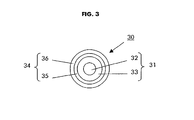
- An optical fiber 30 is shown in section on the figure 3 which is usable in a cable of a type similar to that of the figure 1 or that of the figure 2 . It comprises a guiding portion 31 , composed of a core 32 and an optical sheath 33 , and a coating 34 surrounding the guiding portion 31 .
- the coating 34 has an inner layer 35 in contact with the guiding portion 31 and an outer layer 36 .
- the outer layer 36 consists of a hydrogen absorbing composition according to the invention.
- the catalyst analogous to that of Example 1.
- the hydrogen-absorbing component comprises an acrylate polyurethane matrix reference "DSM 3471-2-102" and the hydrogen-absorbing compound which is a reference DEB "S870927" supplied by SIGMA-ALDRICH.
- composition is prepared in the same manner as in Example 1. It is used to make the outer layer of the coating of the fiber.
- a cable is made using fibers 30. This cable is similar to cable 1 except that the filling gel is a conventional gel which is a saturated silicone type organic compound.
- optical fiber cable similar to that described in Example 5, including optical fibers similar to that described in Example 3 of the document was manufactured.
- FR-2,803,045 This cable comprises an outer envelope, and a filling gel occupies the space around the optical fibers inside the envelope.
- the optical fiber includes a guiding portion and a coating having an inner layer and an outer layer.
- the intermetallic compound is incorporated into a polymeric matrix which is a reference acrylate polyurethane "DSM 3471-2-102".
- the mixture of the polymeric matrix and the intermetallic compound is deposited around the optical fiber, as a secondary coating of the fiber, by means of a coating process.
- the thickness of this coating is 30 ⁇ m and the average diameter of the intermetallic compound is 5 ⁇ m.
- the composition is such that 3% by weight of intermetallic compound is introduced into the polymer matrix before the deposition.
- a cable similar to that of Example 1 is made except that the hydrogen-absorbing organic compound is 1,2-bis (phenylethynyl) benzene.
- a cable similar to that of Example 1 is made except that the organic hydrogen-absorbing compound is 9,10-bis (phenylethynyl) anthracene.
- a cable similar to that of Example 1 is made except that the hydrogen-absorbing organic compound is 5,12-bis (phenylethynyl) naphthacene.
Landscapes
- Physics & Mathematics (AREA)
- Chemical & Material Sciences (AREA)
- General Physics & Mathematics (AREA)
- Optics & Photonics (AREA)
- Health & Medical Sciences (AREA)
- Chemical Kinetics & Catalysis (AREA)
- Medicinal Chemistry (AREA)
- Polymers & Plastics (AREA)
- Organic Chemistry (AREA)
- Compositions Of Macromolecular Compounds (AREA)
- Optical Fibers, Optical Fiber Cores, And Optical Fiber Bundles (AREA)
- Artificial Filaments (AREA)
Description
- La présente invention se rapporte à un câble à fibre optique comprenant une composition capable d'absorber l'hydrogène.
- La fibre optique comporte une partie servant de guide d'onde, généralement en silice éventuellement dopée, composé d'un coeur (core) entouré d'une gaine optique (cladding). La partie guidante est habituellement recouverte d'un revêtement (coating) de protection, habituellement en polymère et éventuellement multicouche, pour la protéger de son environnement. Ce revêtement peut être coloré pour permettre de distinguer les fibres les unes des autres. Une telle fibre revêtue est le plus souvent destinée à être incorporée dans un câble, notamment destiné aux télécommunications. Un câble de télécommunication est un câble comprenant au moins une fibre optique revêtue et une enveloppe (housing tube), éventuellement multicouche, disposée autour de la fibre. L'espace libre entre la fibre optique et l'enveloppe est le plus souvent comblé par un gel de remplissage (filling gel).
- Le problème de l'atténuation de la transmission du signal optique due à l'absorption de l'hydrogène par le réseau de la silice des fibres optiques est connu. L'hydrogène peut être généré par les composants du câble eux-mêmes ou par un phénomène extérieur, par exemple la corrosion. L'effet préjudiciable de l'hydrogène sur les fibres optiques entraîne une dégradation des performances optiques et mécaniques des fibres avec lesquelles il est en contact. Par conséquent la pression partielle d'hydrogène doit être minimisée pour préserver l'espérance de vie du câble. Cet effet préjudiciable existe même si l'hydrogène est présent sous forme de traces dans le câble, c'est pourquoi il est très important d'éliminer toute trace d'hydrogène, même lorsque le câble se trouve dans une atmosphère saturée en hydrogène. Pour ôter l'hydrogène de l'environnement de la fibre, on incorpore généralement dans certaines couches de revêtement des substances susceptibles de fixer l'hydrogène. Plusieurs solutions ont été évoquées.
- Le document
FR-2 803 045 - A est constitué d'au moins un élément des colonnes IIa, IIIb, ou IVb de la Classification Périodique des Eléments (version CAS),
- B est constitué d'au moins un élément des colonnes Vb, VIII ou IIIa de la Classification Périodique des Eléments (version CAS), et
- Et M contient au moins un élément des colonnes VIb, VIIb, Ib ou IIb de la Classification Périodique des Eléments (version CAS),
avec:- 0 ≤ x ≤ 10 et
- 0 ≤ y ≤ 3 si A ne contient que des éléments de la colonne lia, ou
- 0,2 ≤ y ≤ 3 si A contient au moins un élément des colonnes IIIb ou IVb
- Le document
EP-0 632 301 décrit un câble de télécommunications à fibres optique dont l'âme comporte au moins une fibre optique dans une enveloppe. Le câble comprend, dans au moins une partie de son volume interne, une composition absorbant l'hydrogène. Ce document propose d'utiliser une composition absorbante comprenant un catalyseur tel qu'un métal de transition, un sel ou un complexe organique ou minéral d'un métal de transition, et un composé hydrocarboné particulier. Le composé hydrocarboné contient au moins 90% d'un hydrocarbure insaturé non-aromatique exempt de silicium qui est un hydrocarbure insaturé que l'on n'obtient pas par polymérisation de monomères englobant des diènes conjugués, l'hydrocarbure insaturé présentant : - i) une distribution de masse moléculaire valant environ une valeur moyenne qui se situe dans un intervalle restreint tel qu'il ne montrera aucun phénomène de séparation de phase significative par décantation ou par chromatographie sur un support fibreux,
- ii) une viscosité à température ambiante comprise entre 500 et 70000 cSt,
- iii) une viscosité à température ambiante inférieure à 70 000 cSt après un vieillissement par exposition à l'air en couche mince pendant au moins 7 jours à 100°C.
- Cet hydrocarbure comporte des chaînes longues, les doubles liaisons étant localisées en bout de chaîne. Une telle composition absorbante a une viscosité qui varie avec la quantité d'hydrogène absorbée et n'est plus acceptable pour l'utilisateur.
- Le document
EP-0 402 895 , afin de résoudre le problème de la résistance mécanique initiale d'une libre optique à revêtement étanché et de son vieillissement, propose une fibre optique comportant un coeur entouré d'une gaine optique de quartz dont la couche externe contient du fluor. La couche fluorée est entourée d'une couche de carbone comprenant au moins un composé hydrocarboné saturé, insaturé ou aromatique. - La présente invention a pour but de proposer une composition absorbant l'hydrogène, destinée à être utilisée dans un câble à fibre optique, dont la viscosité reste sensiblement égale quelle que soit la quantité d'hydrogène absorbée.
- L'objet de la présente invention est un câble à fibre optique comportant au moins une fibre optique entourée d'un revêtement, une enveloppe, et une composition absorbant l'hydrogène comprenant un catalyseur et un composant absorbeur d'hydrogène (getter), caractérisé en ce que ledit composant absorbeur d'hydrogène est un mélange d'une matrice polymère non-absorbante et d'un composé organique absorbant l'hydrogène comportant au moins une triple liaison carbone-carbone.
- Le composé organique absorbant l'hydrogène selon la présente invention est un hydrocarbure acétylénique, c'est-à-dire un hydrocarbure acyclique (ramifié ou linéaire) ou cyclique (avec ou sans chaîne latérale comportant une ou plusieurs triples liaison carbone-carbone. En présence d'un catalyseur d'hydrogénation, l'hydrogène s'additionne sur la triple liaison.
- Le composé organique selon l'invention comporte une liaison acétylénique et dérive de l'acétylène par substitution d'au moins un des atomes d'hydrogène. Selon un premier mode de réalisation, le composé organique a pour formule générale : R1 - C ≡ C - R2, dans laquelle R1 et R2, identiques ou différents, sont choisis parmi un hydrocarbure acyclique linéaire ou ramifié, un hydrocarbure cyclique, un hydrocarbure saturé, un hydrocarbure insaturé, un hydrocarbure substitué par un hétéroatome.
- Selon un deuxième mode de réalisation, le composé organique a pour formule générale : R1 - C ≡ C - R2, dans laquelle R1 est un atome d'hydrogène et R2 est choisi parmi un hydrocarbure acyclique linéaire ou ramifié, un hydrocarbure cyclique, un hydrocarbure saturé, un hydrocarbure insaturé, un hydrocarbure substitué par un hétéroatome.
- L'hydrocarbure cyclique, saturé ou insaturé, peut être choisi parmi un hydrocarbure monocyclique, un hydrocarbure polycyclique, un hydrocarbure hétérocyclique, un hydrocarbure aromatique, un hydrocarbure condensé, un hydrocarbure spirannique et un hydrocarbure ponté.
- L'hydrocarbure aliphatique ou cyclique peut éventuellement être substitué par un atome étranger, ou hétéro-atome, autre que C ou H.
- Le composé organique selon l'invention peut se présenter sous forme solide ou liquide.
- De préférence le composé organique absorbant l'hydrogène est choisi parmi le 1,4-bis(phényléthynyl)benzène, le 1,2-bis(phényléthynyl)benzène, le 9,10-bis(phényléthynyl)anthracène, le 5,12-bis(phényléthynyl)naphtacène, qui ont les formules suivantes:


- De préférence encore, le composé organique absorbant l'hydrogène selon l'invention est le 1,4-bis(phényléthynyl)benzène (DEB). C'est un solide cristallin qui a l'avantage de n'être ni toxique, ni mutagène. Une mole de 1,4-bis(phényléthynyl)benzène peut donc réagir avec quatre atomes d'hydrogène. Sa capacité d'absorption est de 240 à 330 cm3 d'hydrogène par gramme. Le mécanisme d'absorption est basé sur une série d'addition séquentielle d'hydrogène sur les triples liaisons, chaque étape ayant sa propre constante de vitesse.
- Le DEB fond à 179°C. Un fois totalement hydrogéné, il fond à 87°C. Ainsi il conserve la forme solide quel que soit le taux d'hydrogénation et sa viscosité varie très peu. En le mélangeant avec une matrice qui ne réagit pas, on obtient une composition dont la viscosité reste sensiblement constante.
- Avantageusement, le composé organique absorbant l'hydrogène représente au plus 25% en poids dudit composant absorbeur, de préférence au plus 10% en poids dudit composant absorbeur d'hydrogène. Une fois le composé organique mélangé à une matrice qui rempli la fonction de diluant, on obtient un composant absorbeur dont le coût est inférieur à celui du composé organique.
- On peut utiliser comme catalyseur d'hydrogénation, les catalyseurs connus. On choisira de préférence un métal de transition, un complexe ou un sel d'un métal de transition. On utilisera par exemple du platine Pt ou du palladium Pd dispersé sur du charbon actif ou du nickel de Raney.
- La matrice est choisie parmi les polymères usuels adaptés à la localisation de la composition dans le câble.
- La composition selon l'invention peut être utilisée dans un câble à fibre optique comme gel de remplissage. Dans ce cas la matrice est de préférence un matériau siliconé ou un matériau polyoléfinique, et de préférence encore un matériau saturé. A titre d'exemple, comme matériau siliconé, on peut utiliser un composé organique de type silicone saturé correspondant à la formule générale ci-dessous :

- Dans cette formule, R et R' sont identiques ou différents et représentent des groupes alkyle, alcényle ou aryle; R" et R"' sont identiques ou différents et représentent un groupe alcényle, et n est un nombre entier. Dans la formule ci-dessus, on peut aussi choisir R et R' parmi les radicaux aliphatiques saturés ou insaturés, et les radicaux aromatiques ; dans ce cas, R" et R"' sont des radicaux aliphatiques insaturés.
- La composition absorbant l'hydrogène selon l'invention peut aussi être utilisée pour la réalisation de l'enveloppe entourant la ou les fibres formant le câble. Dans ce cas la matrice est de préférence un polymère thermoplastique, comme le polytéréphtalate de butylène (PBTP).
Selon une forme particulière d'exécution de l'invention, la composition peut être déposée sous forme de couche sur la surface interne de l'enveloppe. - On peut encore utiliser cette composition pour réaliser le revêtement extérieur (secondary coating) d'une fibre optique isolée ou la gaine d'un ruban de plusieurs fibres optiques. La matrice est alors de préférence un polyuréthane (PU) acrylate.
- L'invention a aussi pour objet un composant optique comprenant une composition absorbant l'hydrogène comme décrite précédemment.
Il peut s'agit d'un composant destiné aussi bien aux applications terrestres que sous-marines. On entend par "composant optique" un composant contenant une fibre optique qui joue le rôle d'un filtre ou d'un amplificateur optique. La composition se trouve alors de préférence dans le revêtement de la fibre optique. - D'autres caractéristiques et avantages de la présente invention apparaîtront au cours des exemples suivants de réalisation, donnés bien entendu à titre illustratif et non limitatif, et dans le dessin annexé sur lequel
- la
figure 1 représente une vue en coupe d'un câble à fibre optique comportant comme gel de remplissage une composition selon la présente invention, - la
figure 2 montre une vue en coupe d'une variante d'un câble à fibre optique comportant une enveloppe constituée de la composition selon la présente invention, - la
figure 3 est une vue en coupe d'une fibre optique dont le couche externe du revêtement est constitué de la composition selon la présente invention. - Le câble à fibres optique 1 représenté sur la
figure 1 comporte des fibres optiques 2 comprenant une partie guidante 3 entourée d'un revêtement de protection 4. Les fibres optiques 2 sont entourée d'une enveloppe commune 5. Le volume laissé libre entre les fibres optiques 2 et l'enveloppe 5 est comblée par un gel de remplissage 6 qui empêche le déplacement des fibres, les protège des chocs et contribue à l'étanchéité du câble vis à vis de l'humidité. - Dans le câble 1, le gel de remplissage 6 est constitué d'une composition absorbant l'hydrogène selon l'invention. Le catalyseur est du palladium Pd déposé sur du charbon actif à raison de 5% en poids de Pd. Le composant absorbeur d'hydrogène comprend une matrice à base hydrocarbonée de référence "OPTIFILL 5300" fourni par la société BP et un composé absorbant l'hydrogène qui est un DEB (1,4-bis(phényléthynyl)benzène) de référence "S870927" fourni par SIGMA-ALDRICH.
Le composé absorbant l'hydrogène est d'abord mélangé avec le catalyseur de façon mécanique, par exemple dans une jarre pendant quelques heures, par exemple dans des proportions massiques respectives de 75% de composé et 25% de catalyseur. Ce mélange est ensuite incorporé dans la matrice polymère de façon mécanique, par exemple à l'aide d'un malaxeur, par exemple dans des proportions massiques respectives de 5% de mélange et 95% de matrice polymère. On obtient ainsi la composition selon l'invention qui est utilisée comme gel de remplissage et mise en place dans le câble dans l'espace libre à l'intérieur de l'enveloppe. - A titre de comparaison, on a fabriqué un câble à fibre optique analogue à celui décrit dans l'exemple 1 du document
FR-2 803 045 - Le composé intermétallique utilisé pour l'absorption de l'hydrogène est incorporé au gel de remplissage placé à l'intérieur de l'enveloppe. Ce gel peut être un gel commercial à base hydrocarbonée comme celui de référence "OPTIFILL 5300" fourni par la société BP. La composition est telle que 5% de poudre de composé intermétallique, préalablement broyée, avec un diamètre moyen de 30 µm, est introduite dans le gel à l'aide d'un malaxeur à bras de Werner. Puis, l'ensemble gel et poudre de composé intermétallique est mis en place dans le câble.
- A titre de comparaison, on a fabriqué un câble à fibre optique de la manière suivante. Ce câble comprend une enveloppe extérieure et inclut des fibres optiques. Un gel de remplissage occupe l'espace autour des fibres optiques à l'intérieur de l'enveloppe. Ce gel de remplissage est un matériau commercial à base de polybutène contenant un catalyseur, de référence "R1865" fourni par la société MASTER ADHESIVES.
- On a représenté sur la
figure 2 un autre type de câble à fibre optique 20 comprenant des fibres optiques revêtues 21 rassemblées en faisceaux 22 maintenus par une gaine. Les faisceaux 22 sont assemblés dans une enveloppe 23 commune pour former le câble 20. Le volume laissé libre entre les faisceaux 22 de fibres optiques 21 et l'enveloppe 23 est comblé par un gel de remplissage 24 qui est un composé organique type silicone saturé. - Dans le câble 20, l'enveloppe 23 est constitué d'une composition absorbant l'hydrogène selon l'invention. Le catalyseur analogue à celui de l'exemple 1. Le composant absorbeur d'hydrogène comprend une matrice en polymère thermoplastique qui est du PBTP (polybutylènetéréphtalate) de référence "VESTODUR 3000" et un composé absorbant l'hydrogène qui est un DEB de référence "S870927" fourni par SIGMA-ALDRICH.
- Le composé absorbant l'hydrogène est d'abord mélangé avec le catalyseur de façon mécanique, par exemple dans une jarre pendant quelques heures, par exemple dans des proportions massiques respectives de 75% de composé et 25% de catalyseur. Ce mélange est ensuite incorporé dans la matrice polymère thermoplastique de façon mécanique, par exemple à l'aide d'un mélangeur de type "Brabender", par exemple dans des proportions massiques respectives de 5% de mélange et 95% de polymère thermoplastique, éventuellement accompagné de lubrifiant pour atténuer l'effet d'abrasion et de tensioactifs. On obtient la composition selon l'invention qui est utilisée pour réaliser l'enveloppe du câble, par exemple par extrusion.
- A titre de comparaison, on a fabriqué un câble à fibre optique analogue à celui décrit dans l'exemple 2 du document
FR-2 803 045 - Le thermoplastique peut être par exemple du PBTP de référence "VESTODUR 3000" sous forme de granulés, et le composé intermétallique est sous forme de poudre de 30 µm. Le mélange entre le thermoplastique et la poudre de composé intermétallique est réalisé à l'aide d'un mélangeur de type Brabender, éventuellement accompagné de lubrifiant pour atténuer l'effet d'abrasion du composé intermétallique et de tensioactifs. La composition est telle que 5% en poids de composé intermétallique est introduite dans le thermoplastique avant l'extrusion de l'ensemble thermoplastique et composé intermétallique.
- Une fibre optique 30 est représentée en coupe sur la
figure 3 qui est utilisable dans un câble de type analogue à celui de lafigure 1 ou à celui de lafigure 2 . Elle comprend une partie guidante 31, composée d'un coeur 32 et d'une gaine optique 33, et un revêtement 34 entourant la partie guidante 31. Le revêtement 34 comporte une couche interne 35 au contact de la partie guidante 31 et une couche externe 36.
Dans la fibre 30, la couche externe 36 est constitué d'une composition absorbant l'hydrogène selon l'invention. Le catalyseur analogue à celui de l'exemple 1. Le composant absorbeur d'hydrogène comprend une matrice de polyuréthanne acrylate référence "DSM 3471-2-102" et le composé absorbant l'hydrogène qui est un DEB de référence "S870927" fourni par SIGMA-ALDRICH. - La composition est préparée de la même manière que dans l'exemple 1. Elle est utilisée pour réaliser la couche externe du revêtement de la fibre. Un câble est réalisé en utilisant des fibres 30. Ce câble est analogue au câble 1 à l'exception du fait que le gel de remplissage est un gel classique qui est un composé organique type silicone saturé.
- A titre de comparaison, on a fabriqué un câble à fibre optique analogue à celui décrit dans l'exemple 5 incluant des fibres optiques analogue à celle décrite dans l'exemple 3 du document
FR-2 803 045 - Le composé intermétallique est incorporé à une matrice polymérique qui est un polyuréthanne acrylate de référence "DSM 3471-2-102". Le mélange de la matrice polymérique et du composé intermétallique est déposé autour de la fibre optique, en tant que revêtement secondaire de la fibre, à l'aide d'un procédé d'enduction. L'épaisseur de ce revêtement est de 30 µm et le diamètre moyen du composé intermétallique est de 5 µm. La composition est telle que 3% en poids de composé intermétallique est introduite dans la matrice polymérique avant le dépôt.
- On a évalué la capacité d'absorption de l'hydrogène des différentes compositions précédemment décrites. Les résultats sont exprimés en cm3 par gramme de la composition dans des conditions normales de température et de pression (STP), et rassemblés dans le tableau suivant :
TABLEAU Exemple Capacité d'absorption d'hydrogène
en cm3 (STP) par gramme de composition1 10,4 2 7,5 3 5,4 4 8,6 5 6,2 6 9,8 7 7,0 - Les capacités d'absorption de l'hydrogène des compositions selon l'invention, décrites dans les exemples 1, 4, et 6, sont nettement plus importantes que celles des compositions connues de l'art antérieur (exemples 2, 3, 5, et 7).
A titre de comparaison, les compositions décrites dans les exemples 2 à 6 du documentEP-0 632 301 , correspondant à des polybutènes de caractéristiques différentes, conduisent à des capacités d'absorption comprises entre 0,51 et 2,24cm3(STP)/g. - On réalise un câble analogue à celui de l'exemple 1 à l'exception du fait que le composé organique absorbant l'hydrogène est le 1,2-bis(phényléthynyl)benzène.
- On réalise un câble analogue à celui de l'exemple 1 à l'exception du fait que le composé organique absorbant l'hydrogène est le 9,10-bis(phényléthynyl)anthracène.
- On réalise un câble analogue à celui de l'exemple 1 à l'exception du fait que le composé organique absorbant l'hydrogène est le 5,12-bis(phényléthynyl)naphtacène.
- Les capacités d'absorption de l'hydrogène des compositions des exemples 8, 9 et 10 sont égales ou supérieures à celles des compositions de l'art antérieur.
Claims (16)
- Câble à fibre optique (1) comportant au moins une fibre optique (2) entourée d'un revêtement (4), une enveloppe (5) et une composition absorbant l'hydrogène (6) comprenant un catalyseur et un composant absorbeur d'hydrogène, caractérisé en ce que ledit composant absorbeur d'hydrogène est un mélange d'une matrice polymère non-absorbante et d'un composé organique absorbant l'hydrogène comportant au moins une triple liaison carbone-carbone.
- Câble selon la revendication 1, dans lequel ledit composé organique a pour formule générale: R1 - C ≡ C - R2, dans laquelle R1 est un atome d'hydrogène et R2 est choisi parmi un hydrocarbure acyclique linéaire ou ramifié, un hydrocarbure cyclique, un hydrocarbure saturé, un hydrocarbure insaturé, un hydrocarbure substitué par un hétéroatome.
- Câble selon la revendication 1, dans lequel ledit composé organique a pour formule générale : R1 - C ≡ C - R2, dans laquelle R1 et R2, identiques ou différents sont choisis parmi un hydrocarbure acyclique linéaire ou ramifié, un hydrocarbure cyclique, un hydrocarbure saturé, un hydrocarbure insaturé, un hydrocarbure substitué par un hétéroatome.
- Câble selon l'une des revendications précédentes, dans lequel ledit composé organique est sous forme solide ou liquide.
- Câble selon la revendication 3, dans lequel ledit composé organique est choisi parmi le 1,4-bis(phényléthynyl)benzène, le 1,2-bis(phényléthynyl)benzène, le 9,10-bis(phényléthynyl)anthracène, le 5,12-bis(phenyléthynyl)naphtacène.
- Câble selon l'une des revendications précédentes, dans lequel ledit composé organique représente au plus 25% en poids dudit composant absorbeur.
- Câble selon la revendications 6, dans lequel ledit composé organique représente au plus 10% en poids dudit composant absorbeur.
- Câblé selon l'une des revendications précédentes, dans lequel ledit catalyseur est choisi parmi un métal de transition, un complexe ou un sel d'un métal de transition.
- Câble selon l'une des revendications précédentes, dans lequel ladite composition est introduite entre ladite fibre optique et ladite enveloppe, constituant un gel de remplissage.
- Câble selon la revendication 9, dans lequel ladite matrice est choisie parmi un matériau siliconé et un matériau polyoléfinique.
- Câble selon l'une des revendications précédentes, dans lequel ladite composition constitue ladite enveloppe.
- Câble selon la revendication 11, dans lequel ladite matrice est un polymère thermoplastique.
- Câble selon l'une des revendications précédentes, dans lequel ladite composition constitue la couche externe dudit revêtement de la fibre optique.
- Câble selon l'une des revendications précédentes, dans lequel ladite composition constitue la gaine d'un ruban de fibre optique.
- Câble selon l'une des revendications 13 et 14, dans lequel ladite matrice est un polyuréthane acrylate.
- Câble selon l'une des revendications précédentes, dans lequel ladite composition est déposée sous forme de couche sur la surface interne de ladite enveloppe.
Applications Claiming Priority (2)
| Application Number | Priority Date | Filing Date | Title |
|---|---|---|---|
| FR0206963A FR2840690B1 (fr) | 2002-06-06 | 2002-06-06 | Cable a fibre optique comprenant une composition absorbant l'hydrogene |
| FR0206963 | 2002-06-06 |
Publications (2)
| Publication Number | Publication Date |
|---|---|
| EP1369725A1 EP1369725A1 (fr) | 2003-12-10 |
| EP1369725B1 true EP1369725B1 (fr) | 2008-11-19 |
Family
ID=29433332
Family Applications (1)
| Application Number | Title | Priority Date | Filing Date |
|---|---|---|---|
| EP03291322A Expired - Lifetime EP1369725B1 (fr) | 2002-06-06 | 2003-06-03 | Câble à fibre optique comprenant une composition absorbant l'hydrogène |
Country Status (5)
| Country | Link |
|---|---|
| US (1) | US6845199B2 (fr) |
| EP (1) | EP1369725B1 (fr) |
| AT (1) | ATE414925T1 (fr) |
| DE (1) | DE60324735D1 (fr) |
| FR (1) | FR2840690B1 (fr) |
Families Citing this family (4)
| Publication number | Priority date | Publication date | Assignee | Title |
|---|---|---|---|---|
| GB2466422A (en) * | 2007-10-23 | 2010-06-23 | Fiber Optics Res Ct | Optical fibre having resistance to hydrogen-induced attenuation |
| US8369671B2 (en) | 2010-02-26 | 2013-02-05 | General Electric Company | Hermetically sealed fiber sensing cable |
| CN103033894B (zh) * | 2011-09-30 | 2015-04-22 | 中国海洋石油总公司 | 一种光缆及其制备方法 |
| CN115232429B (zh) * | 2022-07-06 | 2023-10-27 | 中国工程物理研究院材料研究所 | 一种自支撑柔性消氢材料和一种薄膜及其制备方法与应用 |
Citations (1)
| Publication number | Priority date | Publication date | Assignee | Title |
|---|---|---|---|---|
| US5000541A (en) * | 1987-09-18 | 1991-03-19 | At&T Bell Laboratories | Hermetically sealed optical fibers |
Family Cites Families (7)
| Publication number | Priority date | Publication date | Assignee | Title |
|---|---|---|---|---|
| US2828A (en) * | 1842-10-22 | Bat-trap | ||
| US3299016A (en) * | 1963-09-03 | 1967-01-17 | Phillips Petroleum Co | Polymers of 1-monoolefins and an alkenyl acetylene and process for preparing same |
| US5686520A (en) * | 1988-06-15 | 1997-11-11 | Aerojet-General Corporation | Substituted 1,4-diphenylbutadiynes and oligomers thereof as polymer fluidizers and resins |
| AU629648B2 (en) * | 1989-06-13 | 1992-10-08 | Nippon Telegraph & Telephone Corporation | Hermetically coated optical fiber and production of the same |
| DE4108032A1 (de) * | 1991-03-13 | 1992-09-17 | Bayer Ag | Palladiumhaltige polymerzusammensetzung sowie verfahren zu ihrer herstellung |
| IT1264902B1 (it) * | 1993-06-29 | 1996-10-17 | Pirelli Cavi Spa | Composizione idrogeno-assorbente per cavi a fibre ottiche e cavo a fibre ottiche includente la suddetta composizione |
| FR2803045B1 (fr) | 1999-12-22 | 2002-10-11 | Cit Alcatel | Fibre optique et cable a fibre optique comprenant au moins un element intermetallique absorbant l'hydrogene |
-
2002
- 2002-06-06 FR FR0206963A patent/FR2840690B1/fr not_active Expired - Fee Related
-
2003
- 2003-06-03 AT AT03291322T patent/ATE414925T1/de not_active IP Right Cessation
- 2003-06-03 EP EP03291322A patent/EP1369725B1/fr not_active Expired - Lifetime
- 2003-06-03 DE DE60324735T patent/DE60324735D1/de not_active Expired - Lifetime
- 2003-06-06 US US10/455,437 patent/US6845199B2/en not_active Expired - Lifetime
Patent Citations (1)
| Publication number | Priority date | Publication date | Assignee | Title |
|---|---|---|---|---|
| US5000541A (en) * | 1987-09-18 | 1991-03-19 | At&T Bell Laboratories | Hermetically sealed optical fibers |
Also Published As
| Publication number | Publication date |
|---|---|
| FR2840690A1 (fr) | 2003-12-12 |
| EP1369725A1 (fr) | 2003-12-10 |
| ATE414925T1 (de) | 2008-12-15 |
| US6845199B2 (en) | 2005-01-18 |
| FR2840690B1 (fr) | 2004-08-27 |
| DE60324735D1 (de) | 2009-01-02 |
| US20040037520A1 (en) | 2004-02-26 |
Similar Documents
| Publication | Publication Date | Title |
|---|---|---|
| JP3676830B2 (ja) | 光学繊維ケーブル用水素吸収性組成物 | |
| EP1242839B1 (fr) | Fibre optique et cable a fibre optique comprenant au moins un element intermetallique absorbant l'hydrogene | |
| CA1283314C (fr) | Cable a fibres optiques, et sa fabrication | |
| EP1347011A1 (fr) | Gaine de câble comprenant une composition intumescente non-halogénée | |
| US5621838A (en) | Resins for coated optical fiber units | |
| FR2492990A1 (fr) | Fibre optique de matiere plastique revetue a l'etat isole ou a l'etat d'assemblage | |
| FR2549970A1 (fr) | Cable a fibres optiques | |
| FR3024873A1 (fr) | ||
| FR2505509A1 (fr) | Procede et emballage de protection de parties epissees de fibres optiques | |
| FR2722203A1 (fr) | Procede de revetement d'un substrat a l'aide de fluorosilicone, substrat ainsi revetu et composition pour le revetement | |
| JPH0618753A (ja) | 気密シール光ファイバケーブル | |
| EP1369725A1 (fr) | Câble à fibre optique comprenant une composition absorbant l'hydrogène | |
| FR2588388A1 (fr) | Cable pour telecommunications a fibres optiques, dans lequel est incorpore un melange absorbeur d'hydrogene, et melange absorbeur d'hydrogene pour cable a fibres optiques | |
| EP1435534B1 (fr) | Fibre optique à au moins un réseau de bragg obtenue par inscription directe à travers le revêtement recouvrant la gaine | |
| JPS60239702A (ja) | 光フアイバにおける水素ガスの吸収防止措置を施した光フアイバ・ケーブル | |
| EP1424703A1 (fr) | Câble ignifugé | |
| FR2563634A1 (fr) | Fibre optique protegee contre l'absorption d'hydrogene gazeux | |
| EP1437613B1 (fr) | Fibre optique à réseau de Bragg inscrit directement à travers un revêtement recouvrant la gaine | |
| FR2780165A1 (fr) | Fibre optique munie d'un revetement de protection et procede de fabrication de cette fibre | |
| EP0886154A1 (fr) | Conducteur optique et ruban de conducteurs optiques | |
| FR2847347A1 (fr) | Procede de fabrication d'un ruban a fibres optiques et ruban a fibres optiques | |
| BE1010246A3 (fr) | Connecteur pour liaison optique sur base d'un film polymere autoportant d'indice donne et procede de fabrication d'un tel film. | |
| EP1801817B1 (fr) | Cable comportant une couche de matière fibreuse imprégnée et procédé d'imprégnation correspondant | |
| FR3140201A1 (fr) | Appareil électrique comprenant au moins un matériau gélifié | |
| FR2684192A1 (fr) | Cable optique multi-fibres, et son procede de fabrication. |
Legal Events
| Date | Code | Title | Description |
|---|---|---|---|
| PUAI | Public reference made under article 153(3) epc to a published international application that has entered the european phase |
Free format text: ORIGINAL CODE: 0009012 |
|
| AK | Designated contracting states |
Kind code of ref document: A1 Designated state(s): AT BE BG CH CY CZ DE DK EE ES FI FR GB GR HU IE IT LI LU MC NL PT RO SE SI SK TR |
|
| AX | Request for extension of the european patent |
Extension state: AL LT LV MK |
|
| 17P | Request for examination filed |
Effective date: 20040611 |
|
| AKX | Designation fees paid |
Designated state(s): AT BE BG CH CY CZ DE DK EE ES FI FR GB GR HU IE IT LI LU MC NL PT RO SE SI SK TR |
|
| 17Q | First examination report despatched |
Effective date: 20060919 |
|
| RAP1 | Party data changed (applicant data changed or rights of an application transferred) |
Owner name: ALCATEL LUCENT |
|
| 17Q | First examination report despatched |
Effective date: 20060919 |
|
| GRAP | Despatch of communication of intention to grant a patent |
Free format text: ORIGINAL CODE: EPIDOSNIGR1 |
|
| GRAS | Grant fee paid |
Free format text: ORIGINAL CODE: EPIDOSNIGR3 |
|
| GRAA | (expected) grant |
Free format text: ORIGINAL CODE: 0009210 |
|
| AK | Designated contracting states |
Kind code of ref document: B1 Designated state(s): AT BE BG CH CY CZ DE DK EE ES FI FR GB GR HU IE IT LI LU MC NL PT RO SE SI SK TR |
|
| REG | Reference to a national code |
Ref country code: GB Ref legal event code: FG4D Free format text: NOT ENGLISH |
|
| REG | Reference to a national code |
Ref country code: CH Ref legal event code: EP |
|
| REG | Reference to a national code |
Ref country code: IE Ref legal event code: FG4D Free format text: LANGUAGE OF EP DOCUMENT: FRENCH |
|
| REF | Corresponds to: |
Ref document number: 60324735 Country of ref document: DE Date of ref document: 20090102 Kind code of ref document: P |
|
| PG25 | Lapsed in a contracting state [announced via postgrant information from national office to epo] |
Ref country code: ES Free format text: LAPSE BECAUSE OF FAILURE TO SUBMIT A TRANSLATION OF THE DESCRIPTION OR TO PAY THE FEE WITHIN THE PRESCRIBED TIME-LIMIT Effective date: 20090301 Ref country code: AT Free format text: LAPSE BECAUSE OF FAILURE TO SUBMIT A TRANSLATION OF THE DESCRIPTION OR TO PAY THE FEE WITHIN THE PRESCRIBED TIME-LIMIT Effective date: 20081119 |
|
| NLV1 | Nl: lapsed or annulled due to failure to fulfill the requirements of art. 29p and 29m of the patents act | ||
| PG25 | Lapsed in a contracting state [announced via postgrant information from national office to epo] |
Ref country code: FI Free format text: LAPSE BECAUSE OF FAILURE TO SUBMIT A TRANSLATION OF THE DESCRIPTION OR TO PAY THE FEE WITHIN THE PRESCRIBED TIME-LIMIT Effective date: 20081119 Ref country code: NL Free format text: LAPSE BECAUSE OF FAILURE TO SUBMIT A TRANSLATION OF THE DESCRIPTION OR TO PAY THE FEE WITHIN THE PRESCRIBED TIME-LIMIT Effective date: 20081119 Ref country code: SI Free format text: LAPSE BECAUSE OF FAILURE TO SUBMIT A TRANSLATION OF THE DESCRIPTION OR TO PAY THE FEE WITHIN THE PRESCRIBED TIME-LIMIT Effective date: 20081119 |
|
| REG | Reference to a national code |
Ref country code: IE Ref legal event code: FD4D |
|
| PG25 | Lapsed in a contracting state [announced via postgrant information from national office to epo] |
Ref country code: BG Free format text: LAPSE BECAUSE OF FAILURE TO SUBMIT A TRANSLATION OF THE DESCRIPTION OR TO PAY THE FEE WITHIN THE PRESCRIBED TIME-LIMIT Effective date: 20090219 Ref country code: EE Free format text: LAPSE BECAUSE OF FAILURE TO SUBMIT A TRANSLATION OF THE DESCRIPTION OR TO PAY THE FEE WITHIN THE PRESCRIBED TIME-LIMIT Effective date: 20081119 Ref country code: RO Free format text: LAPSE BECAUSE OF FAILURE TO SUBMIT A TRANSLATION OF THE DESCRIPTION OR TO PAY THE FEE WITHIN THE PRESCRIBED TIME-LIMIT Effective date: 20081119 Ref country code: IE Free format text: LAPSE BECAUSE OF FAILURE TO SUBMIT A TRANSLATION OF THE DESCRIPTION OR TO PAY THE FEE WITHIN THE PRESCRIBED TIME-LIMIT Effective date: 20081119 Ref country code: DK Free format text: LAPSE BECAUSE OF FAILURE TO SUBMIT A TRANSLATION OF THE DESCRIPTION OR TO PAY THE FEE WITHIN THE PRESCRIBED TIME-LIMIT Effective date: 20081119 |
|
| PG25 | Lapsed in a contracting state [announced via postgrant information from national office to epo] |
Ref country code: SE Free format text: LAPSE BECAUSE OF FAILURE TO SUBMIT A TRANSLATION OF THE DESCRIPTION OR TO PAY THE FEE WITHIN THE PRESCRIBED TIME-LIMIT Effective date: 20090219 Ref country code: CZ Free format text: LAPSE BECAUSE OF FAILURE TO SUBMIT A TRANSLATION OF THE DESCRIPTION OR TO PAY THE FEE WITHIN THE PRESCRIBED TIME-LIMIT Effective date: 20081119 Ref country code: PT Free format text: LAPSE BECAUSE OF FAILURE TO SUBMIT A TRANSLATION OF THE DESCRIPTION OR TO PAY THE FEE WITHIN THE PRESCRIBED TIME-LIMIT Effective date: 20090420 |
|
| PLBE | No opposition filed within time limit |
Free format text: ORIGINAL CODE: 0009261 |
|
| STAA | Information on the status of an ep patent application or granted ep patent |
Free format text: STATUS: NO OPPOSITION FILED WITHIN TIME LIMIT |
|
| PG25 | Lapsed in a contracting state [announced via postgrant information from national office to epo] |
Ref country code: SK Free format text: LAPSE BECAUSE OF FAILURE TO SUBMIT A TRANSLATION OF THE DESCRIPTION OR TO PAY THE FEE WITHIN THE PRESCRIBED TIME-LIMIT Effective date: 20081119 |
|
| 26N | No opposition filed |
Effective date: 20090820 |
|
| BERE | Be: lapsed |
Owner name: ALCATEL LUCENT Effective date: 20090630 |
|
| PG25 | Lapsed in a contracting state [announced via postgrant information from national office to epo] |
Ref country code: MC Free format text: LAPSE BECAUSE OF NON-PAYMENT OF DUE FEES Effective date: 20090630 |
|
| REG | Reference to a national code |
Ref country code: CH Ref legal event code: PL |
|
| PG25 | Lapsed in a contracting state [announced via postgrant information from national office to epo] |
Ref country code: LI Free format text: LAPSE BECAUSE OF NON-PAYMENT OF DUE FEES Effective date: 20090630 Ref country code: CH Free format text: LAPSE BECAUSE OF NON-PAYMENT OF DUE FEES Effective date: 20090630 |
|
| PG25 | Lapsed in a contracting state [announced via postgrant information from national office to epo] |
Ref country code: BE Free format text: LAPSE BECAUSE OF NON-PAYMENT OF DUE FEES Effective date: 20090630 |
|
| PG25 | Lapsed in a contracting state [announced via postgrant information from national office to epo] |
Ref country code: GR Free format text: LAPSE BECAUSE OF FAILURE TO SUBMIT A TRANSLATION OF THE DESCRIPTION OR TO PAY THE FEE WITHIN THE PRESCRIBED TIME-LIMIT Effective date: 20090220 |
|
| PG25 | Lapsed in a contracting state [announced via postgrant information from national office to epo] |
Ref country code: LU Free format text: LAPSE BECAUSE OF NON-PAYMENT OF DUE FEES Effective date: 20090603 |
|
| PG25 | Lapsed in a contracting state [announced via postgrant information from national office to epo] |
Ref country code: HU Free format text: LAPSE BECAUSE OF FAILURE TO SUBMIT A TRANSLATION OF THE DESCRIPTION OR TO PAY THE FEE WITHIN THE PRESCRIBED TIME-LIMIT Effective date: 20090520 |
|
| PG25 | Lapsed in a contracting state [announced via postgrant information from national office to epo] |
Ref country code: TR Free format text: LAPSE BECAUSE OF FAILURE TO SUBMIT A TRANSLATION OF THE DESCRIPTION OR TO PAY THE FEE WITHIN THE PRESCRIBED TIME-LIMIT Effective date: 20081119 |
|
| PG25 | Lapsed in a contracting state [announced via postgrant information from national office to epo] |
Ref country code: CY Free format text: LAPSE BECAUSE OF FAILURE TO SUBMIT A TRANSLATION OF THE DESCRIPTION OR TO PAY THE FEE WITHIN THE PRESCRIBED TIME-LIMIT Effective date: 20081119 |
|
| REG | Reference to a national code |
Ref country code: GB Ref legal event code: 732E Free format text: REGISTERED BETWEEN 20130926 AND 20131002 |
|
| REG | Reference to a national code |
Ref country code: FR Ref legal event code: GC Effective date: 20131018 |
|
| REG | Reference to a national code |
Ref country code: FR Ref legal event code: RG Effective date: 20141016 |
|
| REG | Reference to a national code |
Ref country code: FR Ref legal event code: PLFP Year of fee payment: 13 |
|
| REG | Reference to a national code |
Ref country code: FR Ref legal event code: CA Effective date: 20150521 |
|
| REG | Reference to a national code |
Ref country code: FR Ref legal event code: CA Effective date: 20150521 |
|
| REG | Reference to a national code |
Ref country code: FR Ref legal event code: PLFP Year of fee payment: 14 |
|
| REG | Reference to a national code |
Ref country code: FR Ref legal event code: PLFP Year of fee payment: 15 |
|
| PGFP | Annual fee paid to national office [announced via postgrant information from national office to epo] |
Ref country code: FR Payment date: 20170621 Year of fee payment: 15 Ref country code: DE Payment date: 20170621 Year of fee payment: 15 Ref country code: GB Payment date: 20170620 Year of fee payment: 15 |
|
| PGFP | Annual fee paid to national office [announced via postgrant information from national office to epo] |
Ref country code: IT Payment date: 20170622 Year of fee payment: 15 |
|
| REG | Reference to a national code |
Ref country code: DE Ref legal event code: R119 Ref document number: 60324735 Country of ref document: DE |
|
| GBPC | Gb: european patent ceased through non-payment of renewal fee |
Effective date: 20180603 |
|
| PG25 | Lapsed in a contracting state [announced via postgrant information from national office to epo] |
Ref country code: IT Free format text: LAPSE BECAUSE OF NON-PAYMENT OF DUE FEES Effective date: 20180603 Ref country code: GB Free format text: LAPSE BECAUSE OF NON-PAYMENT OF DUE FEES Effective date: 20180603 Ref country code: DE Free format text: LAPSE BECAUSE OF NON-PAYMENT OF DUE FEES Effective date: 20190101 Ref country code: FR Free format text: LAPSE BECAUSE OF NON-PAYMENT OF DUE FEES Effective date: 20180630 |