EP1373115B1 - Falzapparat und verfahren - Google Patents
Falzapparat und verfahren Download PDFInfo
- Publication number
- EP1373115B1 EP1373115B1 EP02718284A EP02718284A EP1373115B1 EP 1373115 B1 EP1373115 B1 EP 1373115B1 EP 02718284 A EP02718284 A EP 02718284A EP 02718284 A EP02718284 A EP 02718284A EP 1373115 B1 EP1373115 B1 EP 1373115B1
- Authority
- EP
- European Patent Office
- Prior art keywords
- sheet
- folding
- rollers
- fold
- nip
- Prior art date
- Legal status (The legal status is an assumption and is not a legal conclusion. Google has not performed a legal analysis and makes no representation as to the accuracy of the status listed.)
- Expired - Lifetime
Links
- 238000000034 method Methods 0.000 title claims description 42
- 230000007246 mechanism Effects 0.000 claims abstract description 89
- 239000000463 material Substances 0.000 claims abstract description 44
- 230000008569 process Effects 0.000 claims description 20
- 238000003780 insertion Methods 0.000 claims description 6
- 230000037431 insertion Effects 0.000 claims description 6
- 230000003287 optical effect Effects 0.000 claims description 3
- 230000007423 decrease Effects 0.000 claims description 2
- 238000005336 cracking Methods 0.000 description 3
- 239000000843 powder Substances 0.000 description 3
- 230000003247 decreasing effect Effects 0.000 description 2
- 230000001419 dependent effect Effects 0.000 description 2
- 238000001035 drying Methods 0.000 description 2
- 230000009471 action Effects 0.000 description 1
- 230000003213 activating effect Effects 0.000 description 1
- 230000002411 adverse Effects 0.000 description 1
- 230000004075 alteration Effects 0.000 description 1
- 238000013473 artificial intelligence Methods 0.000 description 1
- 238000005452 bending Methods 0.000 description 1
- 230000008859 change Effects 0.000 description 1
- 230000002301 combined effect Effects 0.000 description 1
- 238000010276 construction Methods 0.000 description 1
- 230000008021 deposition Effects 0.000 description 1
- 238000001514 detection method Methods 0.000 description 1
- 230000000694 effects Effects 0.000 description 1
- 238000010438 heat treatment Methods 0.000 description 1
- 230000007420 reactivation Effects 0.000 description 1
- 230000009467 reduction Effects 0.000 description 1
- 230000003068 static effect Effects 0.000 description 1
- 230000001360 synchronised effect Effects 0.000 description 1
- 239000010409 thin film Substances 0.000 description 1
Images






Classifications
-
- B—PERFORMING OPERATIONS; TRANSPORTING
- B65—CONVEYING; PACKING; STORING; HANDLING THIN OR FILAMENTARY MATERIAL
- B65H—HANDLING THIN OR FILAMENTARY MATERIAL, e.g. SHEETS, WEBS, CABLES
- B65H45/00—Folding thin material
- B65H45/12—Folding articles or webs with application of pressure to define or form crease lines
- B65H45/18—Oscillating or reciprocating blade folders
Definitions
- the present invention relates to a folding apparatus and method.
- the apparatus and method can be used to fold flexible sheet materials and in particular to fold paper and paper like materials containing printed matter.
- Traditional printing techniques such as letterpress and offset litho deposit a thin film of ink on the surface of a stock material.
- the ink is absorbed by the stock material leaving an indelible mark.
- the Xerography approach used by modem digital print engines is a dry process in which a powder is deposited on the surface of the media to be printed.
- the powder is bonded to the surface of the media, which is commonly paper, by for example, a heating process.
- the control of the deposition of powder on the stock material to form words and pictures is typically performed automatically by a computer system.
- Digital printing machines have several advantages over the offset litho machine.
- the offset litho setup process is long requiring plates to be made by a skilled technician, and the printed stock requires time to dry before it can be finished.
- digital printing machines have very short setup times, no ink drying time and require a lower level of skill to operate the digital printing process.
- the fastest growing area in the print industry is for on demand short runs of high quality full colour printing. This is currently best satisfied by digital printing machines
- the current finishing equipment available to the digital printing market sector such as folding and creasing machines have been developed for printed matter produced by traditional printing techniques.
- This type of equipment is unable to handle digitally printed matter without damaging it.
- high quality digitally produced print requires the use of specially treated paper or card stock material.
- This type of paper is of such a quality that it is extremely sensitive to marking when articles scrape the surface and to cracking when folded or creased.
- the toner on the surface of the paper is a brittle layer with a very low elastic limit that breaks when it is subjected to the tensile stresses created in the bending process by existing folding machines. When broken the toner loses its adhesion and flakes off.
- One type of existing folding machine is a buckle folder which has buckle plates for guiding the stock material through the folding machine. These are usually set at about 45 ° to the paper path and include an end stop. The paper is fed between the buckle plates by rollers and collides with the end stop which causes the paper to buckle towards a nip formed by a pair of fold rollers, The paper is caught in the nip between the fold rollers which exert a force on the paper to create a permanent fold.
- This type of folding machine causes extensive marking on stock materials appropriate for digital print engines. Also, the position of the fold is not closely controlled and can vary with the type of paper stock used and the atmospheric conditions. This type of machine has to operate continuously at a constant speed otherwise the folding process becomes unpredictable.
- a piece of paper is fed on a conveyer above fold rollers until it collides with an end stop, halting the movement of the paper.
- a knife then pushes the paper into the nip between folding rollers. This is a static process since the sheet material has to be stationary before the knife directs the paper into the nip between the folding rollers.
- fold rollers are used to fold sheets into the required form. Fold rollers typically have a diameter of around 30-40mm and in the folding process the sheet being folded can be wrapped up to halfway round the roller.
- the stock material used by digital print engines is usually thicker than stock material used by conventional printing techniques. This means that the strain in the surface of the digitally printed media is greater than in traditional stock material which exacerbates the toner and paper surface cracking problem, exposing one or more layers of the materials construction. This is commonly referred to as 'white show through'.
- the present invention seeks to provide an improved folding apparatus and method.
- a folding apparatus for folding sheets of flexible sheet materials
- the apparatus including a feeding mechanism for feeding sheets of material, a folding mechanism including a pair of rollers having a nip into which a sheet of material is inserted to create a fold, and an inserter mechanism for inserting a sheet into the nip, said inserter mechanism including a knife element having an edge that is arranged to engage a sheet along a designated fold line and to insert said sheet into the nip to produce a fold along said fold line; wherein said inserter mechanism is constructed and arranged to insert the sheet into the nip while the sheet is positively engaged by the feeding mechanism.
- the knife edge moves in a curved path and the centre of curvature of the curved path is adjustable.
- the sheet material moves continuously throughout the folding process and therefore the folding apparatus folds sheet materials dynamically and the knife acts as a dynamic deflector.
- the feeding mechanism controllably feeds the sheet of paper along a feed path where it can be engaged by the knife element.
- the dynamic folding process significantly reduces the amount of damage caused to the sheet materials by avoiding the dragging action of some traditional devices.
- the inserter mechanism is constructed and arranged such that during the insertion operation there is substantially no relative movement between the knife edge and the region where it contacts the sheet. Preferably this is achieved by matching the position of the knife edge with the rotational position of the rollers, and hence the position of the sheet of paper.
- the position of the sheet and the position of the knife edge are controlled by a control system that takes into account the geometry of the paper feed path, the rollers and the knife to ensure that there is no substantial relative movement between the knife edge and the sheet of paper, in the region of contact, when the knife edge is engaged with the sheet. This arrangement leads to a reduction in the amount of damage to the paper as it passes through the folding apparatus.
- the knife element moves in a direction having a component of movement in the feed direction of the sheet material.
- the knife element moves rotationally and translationally.
- the knife edge follows a path such that the distance between the knife edge and a first fold roller decreases as the knife edge inserts the sheet into the nip.
- the folding apparatus also includes a sensor for sensing an initial position of a sheet, which is preferably an optical sensor, and a control device for determining the position of the sheet according to the rotational position of the rollers.
- the control device controls the rotation of the rollers, and hence the position of the sheet of paper, via an incrementally controlled motor, for example, a stepper motor, servo motor or brushless DC motor.
- the feed mechanism includes a fold roller that co-operates with a feed roller. This is an efficient arrangement which reduces the number of components required.
- the sheet feed direction and the insertion direction for each folding mechanism are substantially perpendicular. It is also preferred to use fold rollers which have a diameter in the range 50 to 80mm, which is larger than conventional folding machines. It has been found that a 50mm diameter roller is best suited for providing the minimum acceptable fold length, whereas an 80mm diameter roller is best suited for influencing paper curl and toner surface cracking. A roller having a 60mm diameter has been found to offer a good compromise for these requirements.
- the knife element includes profiled surfaces arranged to guide the sheet material towards the folding means.
- the distance between at least one pair of rollers can be adjusted automatically.
- the distance between at least one pair ofrollers can be adjusted manually.
- the folding apparatus includes a first folding mechanism for producing folds in one direction (i.e. on one side of a sheet), and a second folding mechanism for producing folds in a second direction (i.e. on the second side of a sheet), which is constructed and arranged to receive a sheet fed to it from the first folding mechanism.
- the folding apparatus can also include subsequent folding mechanisms which are preferably arranged in series with the first and second folding mechanisms.
- a folding apparatus having four folding mechanisms can be arranged such that the first and third folding mechanisms produce folds in a first direction and the second and fourth folding mechanisms produce folds in a second direction.
- a method of folding sheets of flexible sheet materials comprising the steps: feeding a sheet with a feeding mechanism towards a folding mechanism that includes a pair of fold rollers which form a nip and an inserter mechanism, said inserter mechanism having a knife element including a knife edge; moving the knife element such that the knife edge engages the sheet along a predetermined fold line; inserting the sheet with the inserter mechanism into the nip; and folding the sheet material along the predetermined fold line with the fold rollers; wherein, as the sheet is inserted into the nip, the sheet is positively engaged by the feeding mechanism.
- the knife edge moves in a curved path and the centre of curvature of the curved path is adjustable.
- the method includes the additional step of gripping the sheet by at least one pair of rollers throughout the folding process.
- the knife element moves in a direction having a component of movement in the feed direction of the sheet.
- the sheet is detected by a sensor at the known starting position and preferably the sensor detects at least one of the leading and trailing edge of the sheet.
- the position of the sheet within the apparatus is determined according to the distance the sheet has been fed relative to a known starting position.
- actuation of the inserter mechanism is controlled according to the position of the sheet material within the apparatus.
- the actuation of the inserter mechanism is controlled according to the position of at least one of the edges of the sheet material within the apparatus, for example, the leading edge.
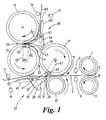
- Figure 1 shows a folding machine having upper and lower contra-rotating input rollers 1, 3 arranged in parallel and in close proximity to one another such that the curved surfaces of the input rollers 1, 3 form a first nip 5.
- the input rollers 1, 3 are arranged to receive a sheet of paper 7 from a supply mechanism (not shown) and to feed the sheet of paper 7 horizontally along a feed path to a folding mechanism.
- a sensor 9 Downstream of the first nip 5 is a sensor 9 which detects the leading edge of a sheet of paper 7 as it travels along the feed path.
- the sensor 9 can be arranged to detect the trailing edge of a sheet of paper 7.
- the sensor 9 is an optical sensor having a light transmitting element below the paper feed path and a light detecting element above the paper feed path.
- first, second, and third fold rollers 11, 13, 15 and a fold input roller 17 Downstream of the sensor 9 are first, second, and third fold rollers 11, 13, 15 and a fold input roller 17.
- the first fold roller 11 and the fold input roller 17 are arranged in parallel and in close proximity such that the curved surfaces of the rollers 11,17 form a second nip 19 which is arranged to receive a sheet of paper 7 from the input rollers 1, 3 and then feed the sheet of paper 7 substantially horizontally towards a first inserter mechanism 21.
- the diameter of the fold input roller 17 is typically in the range 30 - 60mm.
- the first and second fold rollers 11, 13 are arranged in parallel and in close proximity such that the curved surfaces of the fold rollers 11, 13 form a third nip 23, which is arranged to feed a sheet of paper 7 vertically towards a second inserter mechanism 25.
- the second and third fold rollers 13,15 are arranged in parallel and in close proximity such that the curved surfaces of the fold rollers 13, 15 form a fourth nip 27, which is arranged to feed a sheet of paper 7 horizontally.
- the diameters of the first, second and third fold rollers are substantially equal and are preferably in the range approximately 50 to 80mm, for example 60mm.
- the distance between the operational pairs of rollers (commonly known as 'roller gap') at each nip 5, 19, 23, 27 is in the range 0 - 3mm, and is determined by the thickness and number of layers of the paper 7 expected to pass through each particular nip.
- the rollers 1, 3, 11, 13, 15, 17 are interlinked by a gear mechanism and are driven by a stepper motor to rotate with the same tangential speed at the curved surfaces of the rollers.
- the stepper motor is controlled by a microprocessor which receives information from a rotary encoder that is mounted on either the motor or one of the rollers to monitor the true rotational position of the rollers.
- the upper input roller 1, the first fold roller 11 and the third fold roller 15 rotate in a first direction (clockwise in Figure 1 ), while the lower input roller 3, the fold input roller 17 and the second fold roller 13 all rotate in a second direction (anti-clockwise in Figure 1 ).
- the drive direction of the rollers can be reversed, for example, to clear miss-feeds or paper jams, but this is not done during normal operation.
- Use of a stepper motor and the associated control system enables the exact rotational position of the rollers, and hence the sheet of paper 7, to be known.
- the first inserter mechanism 21 is arranged to insert a sheet of paper 7 into the third nip 23 formed by the first and second fold rollers 11, 13.
- the second inserter mechanism 25 is arranged to insert a sheet of paper 7 into the fourth nip 27 formed by the second and third fold rollers 13, 15.
- the first inserter mechanism 21 includes a blade 29 having a substantially triangular section, a blade edge 31 and two concave guide surfaces 33 and 35 which extend from the blade edge 31 towards a convex base 37.
- the blade 29 has a high stiffness and a low inertia.
- the blade carrier 39 includes an L shaped plate which extends from the knife base 37 beyond the blade edge 31.
- Each blade carrier 39 is supported by two pins 41, 43.
- the first pin 41 is positioned towards the rear edge of the blade carrier 39 and is located for free sliding movement in a blade slide 45, which is positioned below the second fold roller 13.
- the second pin 43 is located on the blade carrier 39 ahead of the blade edge 31 and is attached by means of a pivot link to the free end of a rotatable blade drive 47.
- the blade drive 47 is mounted at its opposite end for rotation about an axis of rotation that is located slightly below the axis of rotation of the first fold roller 11 such that when the blade drive 47 rotates, the blade edge 31 follows a curved path into the third nip 23 formed by the first and second fold rollers 11, 13, converging towards a point substantially equidistant between the first and second fold rollers 11, 13.
- the second inserter mechanism 25 is similar to the first inserter mechanism 21 and includes a blade 49 having concave guide surfaces 51 and 53 and a blade edge 55, a blade slide 57, a blade carrier 59 having a first pin 61 located in a longitudinal slot in the blade slide 57 and having a second pin 63 rotatably attached to a blade drive 65.
- the second inserter mechanism 25 is arranged such that the blade edge 55 follows a curved path into the fourth nip 27 formed by the second and third fold rollers 13, 15.
- the components in the second stage folding apparatus are substantially the same as equivalent components in the first folding stage.
- the first and second inserter mechanisms 21, 25 are driven simultaneously by a blade drive stepper motor. Operation of the first and second inserter mechanisms 21, 25 is 180 degrees out of phase such that as the blade edge 31 of the first inserter mechanism 21 moves towards the third nip 23 formed by the first and second fold rollers 11, 13 from the home position, the blade edge 55 of the second inserter mechanism 25 moves away from the fourth nip 27 formed by the second and third fold rollers 13, 15.
- the blade drive stepper motor does not rotate continuously in one direction but rather reverses direction to alternately drive the blade edge 31 of the first inserter mechanism 21 towards the third nip 23 and the blade edge 55 of the second inserter mechanism 25 towards the fourth nip 27.
- the sensor 9, the roller drive stepper motor and the blade drive stepper motor are linked to a control unit (not shown) which controls the speed and direction of rotation of both motors, and synchronises the operation of the inserter mechanisms with the rotation of the rollers 1, 3, 11, 13, 15, 17.
- the folding machine includes a number of guide plates. These include, a first pair of guide plates 67 located beneath the second fold roller 13 to receive, guide and support a sheet of paper 7 fed through the first nip 5 formed by the first fold roller 11 and the fold input roller 17. A second pair of guide plates 69 is located above the third nip 23 formed by the first and second fold rollers 11,13 to receive, guide and support a sheet 7 fed between the rollers 11, 13.
- the folding machine may also include additional sensors to sense paper jams and, if necessary, to re-synchronise operation of the inserter and fold rollers.
- additional sensors 71 are provided along the paper feed path after the first inserter mechanism 21 and after the second inserter mechanism 25.
- the gap between each operational pair of rollers is typically set before the folding process begins and may be set manually or by automatic means.
- the gap between operational pairs of rollers may be altered dynamically during the folding process by detecting the thickness of the stock material 7 being fed into the apparatus and adjusting the gap between the rollers automatically.
- the gap between the rollers is such that operational pairs of rollers can grip the paper 7 without damaging the printed surface of the paper 7.
- a sheet of paper 7 is received by the upper and lower input rollers 1, 3 from a feeding mechanism and is controllably fed along a horizontal feed path to the second nip 19 via the sensor 9.
- the sensor 9 detects the leading edge of the sheet of paper 7 and sends a signal to the microprocessor control unit which synchronises the rotation of the rollers, and operation of the inserter mechanism, to the position of the sheet of paper 7.
- the sheet of paper 7 is received at the second nip 19 by the first fold roller 11 and the fold input roller 17 before it is released from the grip of the upper and lower input rollers 1, 3, to ensure that the position of the sheet 7 is known as it moves through the mechanism.
- the first fold roller 11 and the fold input roller 17 feed the sheet of paper 7 along a horizontal path which is below the first and second fold rollers 11,13 and is substantially perpendicular to axes of rotation of the first and second fold rollers 11, 13.
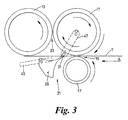
- the blade 29 of the inserter mechanism 21 is in a home position which is located below the paper feed path. In this position the blade drive 47 is at the anti-clockwise limit of its range of movement.
- the blade edge 31 is arranged parallel to the axes of rotation of the first and second fold rollers 11, 13.
- the blade drive 47 rotates clockwise, drawing the blade edge 31 into the third nip 23 between the fold rollers.
- the rotation of the rollers, and hence the movement of the sheet of paper 7 is synchronised with the movement of the blade 29, and the blade edge 31 is driven into engagement with the sheet of paper 7 along a predetermined fold line 7a.
- This is achieved by controlling the position of the paper 7 and / or the position of the blade 29.
- the position of the blade edge 31 is matched to the position of the paper 7, and hence the rotational position of the rollers, to ensure that there is substantially no relative movement between the blade edge 31 and the paper 7 in the region of contact 7a. This avoids marking the printed surface of the paper.
- the relationship between the paper speed and blade speed is however dependent only on the geometries of the blade and roller and once established does not subsequently have to be adjusted for that particular blade and roller combination.
- the blade edge 31 travels along an accurate path that converges with the third nip 23 formed by the first and second fold rollers 11, 13.
- the motion of the blade 29 is accommodated by linear reciprocating motion of the pin 41 along the slot in the blade slide 45 and by rotation of the blade 29 about pin 41 (see, for example, Figure 4 ).
- the blade 29 rotates anti-clockwise the blade edge 31 rises above the feed path of the paper, engaging the sheet 7 along a predetermined line 7a, and lifting the sheet 7 upwards towards the third nip 23. As the blade 29 rotates the sheet of paper 7 starts to fold about the blade edge 31.
- the combined effect of the linear and rotational motion of the blade 29, locates the blade edge 31 in a position substantially in line with the third nip 23 and substantially perpendicular to the direction of the paper feed path as indicated by the arrow A, wherein the blade edge 31 is adjacent to the third nip 23 and equidistant between the first and second fold rollers 11, 13.
- This position represents the maximum height position of the blade edge 31 (see Figure 6 ).
- the distance between the blade edge 31 and the first and second fold rollers 11, 13 in the maximum height position can be controlled according to properties of the paper 7 being folded, in particular the thickness dimension of the paper 7, and the gap between the first and second fold rollers 11, 13.
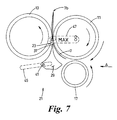
- the sheet of paper 7 is engaged by the first and second fold rollers 11, 13 and is drawn into the third nip 23 (see Figure 7 ).
- the first and second fold rollers 11,13 create a permanent fold 7b in the paper 7 substantially along the predetermined fold line 7a.
- the position of the blade edge 31 is matched to the rotational position of the rollers, and hence the position of the paper 7, by the control system via the stepper motors such that there is no relative movement between the sheet of paper 7 and the blade edge 31 in the region of contact 7a.
- the blade edge 31 moves continuously with the paper 7 and thus provides a dynamic folding process. This has the effect of considerably reducing the amount of damage caused to the surface of the paper 7 compared with traditional folding machines.
- position of the blade 29 is matched to the position of the paper 7 by the control system it is possible to change the paper feed speed without affecting the folding process. This includes fully stopping and restarting the process without adversely affecting the outcome. This is because the rollers grip the sheet of paper 7 throughout the folding process and thereby accurately control the position of the paper 7, and since the knife position is matched to the position of the sheet 7, if the paper feed speed is increased or decreased, the knife speed is increased or decreased in proportion.
- the paper 7 After passing between the first and second fold rollers 11, 13 the paper 7 can be fed to a stacking unit and the blade 29 is returned to the home position by reversing the direction of the knife stepper motor and hence the rotational directions of the blade drive 47 and the blade 29.
- the blade 29 awaits reactivation by the detection of subsequent sheets of paper 7 by the sensing device 9.
- the rollers are still driven in their respective original directions during the blade 29 reversing operation since they are driven by a separate stepper motor.
- the paper 7 can be fed to a second (or subsequent) folding station to produce a second (or subsequent) fold 7d in the opposite direction (i.e. on the opposite side of the paper 7).
- a second folding station to produce a second (or subsequent) fold 7d in the opposite direction (i.e. on the opposite side of the paper 7).
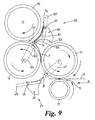
- This embodiment is shown in Figures 1 and 8 to 11 .
- the second folding process is performed by the second and third fold rollers 13, 15.
- the folded sheet of paper 7 is guided into the fourth nip 27 by the second inserter mechanism 25.
- the sheet of paper 7, having a permanent fold 7b, is drawn between the first and second fold rollers 11,13 and the knife stepper motor is reversed driving the first stage blade 29 toward the home position and the second stage blade 49 into engagement with the sheet of paper 7 via the blade drive 65.
- the blade 49 engages the paper 7 with the blade edge 55 along a predetermined line 7c wherein a second (or subsequent) permanent fold 7d will be produced in the opposite direction by the second and third fold rollers 13, 15.
- the blade edge 55 engages the paper 7 such that there is no substantial relative movement between the paper 7 and the blade edge 55 in the region of contact 7c.
- the blade 49 rotates in a clockwise direction driven by the blade drive 65 which rotates in an anti-clockwise direction.
- the paper 7 folds about the blade edge 55 and is guided towards the fourth nip 27 formed by the curved surfaces of the second and third fold rollers 13, 15.
- the sheet of paper 7 is guided by the blade 49 substantially in accordance with the principle of operation of the blade 29 described above.
- the blades 29 and 49 can provide a guiding function. This is achieved by the control system activating the blade so as to engage the sheet of paper 7 at or adjacent its leading edge (i.e. as though it were trying to place a fold on the leading edge of the sheet).
- the system works in the same manner as described above except that, due to the relative positions of the leading edge of the sheet and the blade edge 31, 55, a fold is not formed. Instead, the knife 29,49 simply guides the leading edge of the sheet into the nip 23, 27 so that the sheet passes between the fold rollers without forming a fold in the sheet 7.
- the blade 29 of the first inserter mechanism 21 can simply guide the sheet 7 through the first fold rollers 11, 13, without creating a fold, to the second inserter mechanism 25 which can insert the sheet 7 into the nip 27 so that the second and third fold rollers 13, 15 create a fold in the sheet.
- Figure 10 shows that the first stage blade 29 is in its home position when the second stage blade edge 55 is in its maximum height position. Therefore a second sheet of paper 7 can travel through the first stage folding process as the first sheet of paper 7 is engaged by the second and third fold rollers 13, 15 at the fourth nip 27. As the first stage blade 29 moves from the home position towards engagement with the sheet of paper 7 the second stage blade 49 moves from the maximum height position towards its home position.
- folding apparatus can be arranged to have three or four folding mechanisms.
- the invention can include any practicable number of folding mechanisms.
- the folding apparatus can be arranged for folding sheet material in a number of ways such as the so called 'Z' shape and 'V' shape folding techniques.
- the folding apparatus control system is microprocessor based.
- the control system uses artificial intelligence techniques to set up and run the machine from data relating to the different types of fold that will normally be required by the operator.
- this reduces the skill level required to operate the folding apparatus, bringing the skills required by the operator in line with the skills required to operate other machines within digital print rooms.
- rollers can be arranged to rotate in opposite directions, the shape of the blade can be altered and the sheet material folded is not restricted to paper.
Landscapes
- Folding Of Thin Sheet-Like Materials, Special Discharging Devices, And Others (AREA)
- Auxiliary Devices For And Details Of Packaging Control (AREA)
Claims (26)
- Falzvorrichtung zum Falzen von Bögen biegsamer Bogenmateriallen (7), wobei die Vorrichtung Folgendes umfasst: einen Vorschubmechanismus zum Vorschieben von Bögen des Materials, einen Falzmechanismus, der ein Paar von Walzen (11, 13) mit einem Spalt (23), in den ein Bogen (7) des Materials eingebracht wird, um einen Falz zu erzeugen, und einen Einbringungsmechanismus (21) zum Einbringen eines Bogens in den Spalt (23), wobei der Einbringungsmechanismus (21) ein Messerelement (29) mit einer Kante (31), die dazu eingerichtet ist, entlang einer bestimmten Falzlinie mit einem Bogen (7) einzugreifen und den Bogen (7) in den Spalt (23) einzubringen, um einen Falz entlang der Falzlinie zu erzeugen, umfasst, wobei die Messerkante (31) so angeordnet ist, dass sie sich entlang eines gekrümmten Wegs bewegt; wobei der Einbringungsmechanismus (21) dazu aufgebaut und eingerichtet ist, den Bogen (7) in den Spalt (23) einzubringen, während der Bogen einen formschlüssigen Eingriff durch den Vorschubmechanismus erfährt, dadurch gekennzeichnet, dass die Mitte der Krümmung des gekrümmten Wegs einstellbar ist.
- Falzvorrichtung nach Anspruch 1, wobei der Einbringungsmechanismus (21) so aufgebaut und eingerichtet ist, dass während der Einbringungstätigkeit im Wesentlichen keine relative Bewegung zwischen der Messerkante (31) und dem Bereich, in dem sie mit dem Bogen (7) in Kontakt steht, besteht.
- Falzvorrichtung nach Anspruch 2, wobei die Position der Messerkante (31) mit der Drehposition der Falzwalzen (11, 13) und daher der Position des Bogens (7) abgestimmt ist.
- Falzvorrichtung nach einem der vorhergehenden Ansprüche, wobei sich das Messerelement (29) in eine Richtung bewegt, die eine Bewegungskomponente in der Vorschubrichtung des Bogenmaterials (7) aufweist,
- Falzvorrichtung nach einem der vorhergehenden Ansprüche, wobei sich das Messerelement (29) drehend und verschiebend bewegt.
- Falzvorrichtung nach einem der vorhergehenden Ansprüche, wobei die Messerkante (31) einem Weg derart folgt, dass der Abstand zwischen der Messerkante (31) und einer ersten Falzwalze (11) abnimmt, während die Messerkante (31) den Bogen in den Spalt (23) einbringt.
- Falzvorrichtung nach einem der vorhergehenden Ansprüche, wobei die Paare von Walzen (11, 13; 13, 15) so angeordnet sind, dass das Bogenmaterial (7) während des ganzen Falzprozesses durch zumindest ein Paar von Walzen (11, 13; 13, 15) erfasst wird, um die Position des Bogenmaterials (7) genau zu steuern.
- Falzvorrichtung nach einem der vorhergehenden Ansprüche, umfassend einen Sensor (9), um eine Anfangsposition eines Bogens (7) zu erfassen.
- Falzvorrichtung nach Anspruch 8, wobei der Sensor (9) ein optischer Sensor ist.
- Falzvorrichtung nach Anspruch 8 oder 9, umfassend eine Steuervorrichtung, um die Position des Bogens (7) gemäß der Drehung der Walzen zu bestimmen.
- Falzvorrichtung nach einem der vorhergehenden Ansprüche, wobei der Vorschubmechanismus eine Falzwalze (11) umfasst, die mit einer Vorschubwalze (17) zusammenwirkt.
- Falzvorrichtung nach einem der vorhergehenden Ansprüche, wobei die Bogenvorschubrichtung und die Einbringungsrichtung für jeden Falzmechanismus im Wesentlichen rechtwinkelig sind.
- Falzvorrichtung nach einem der vorhergehenden Ansprüche, wobei das Messerelement (29) profilierte Flächen (33, 35) umfasst, um das Bogenmaterial (7) zum Falzmittel zu führen,
- Falzvorrichtung nach einem der vorhergehenden Ansprüche, wobei die Größe des Abstands zwischen zumindest einem Paar von Walzen automatisch eingestellt werden kann.
- Falzvorrichtung nach einem der vorhergehenden Ansprüche, wobei die Falzwalzen (11, 13, 15) einen Durchmesser im Bereich von 50 bis 80 mm und vorzugsweise von ungefähr 60 mm aufweisen.
- Falzvorrichtung nach einem der vorhergehenden Ansprüche, umfassend einen ersten Falzmechanismus, um Falze in einer ersten Richtung zu erzeugen, und einen zweiten Falzmechanismus, um Falze in einer zweiten Richtung zu erzeugen, der so aufgebaut und angeordnet ist, dass er einen Bogen (7) erhält, der ihm vom ersten Falzmechanismus zugeführt wird.
- Falzvorrichtung nach einem der vorhergehenden Ansprüche, wobei das Messerelement (29) über einen Stift (41) an einem Gleitstück (45) angebracht ist, wobei die Bewegung des Messerelements (29) durch eine geradlinige hin und her laufende Bewegung des Stifts (41) entlang des Gleitstücks (45) und durch eine Drehung des Messerelements (29) um den Stift (41) aufgenommen wird.
- Verfahren zum Falzen von Bögen biegsamer Bogenmaterialien, umfassend die folgenden Schritte: Vorschieben eines Bogens (7) mit einem Vorschubmechanismus zu einem Falzmechanismus, der ein Paar von Falzwalzen (11, 13), die einen Spalt (23) bilden, und einen Einbringungsmechanismus (21) umfasst, wobei der Einbringungmechanismus (21) ein Messerelement (29) aufweist, das eine Messerkante (31) umfasst; derartiges Bewegen der Messerkante (31) entlang eines gekrümmten Wegs, dass die Messerkante (31) entlang einer vorherbestimmten Falzlinie mit dem Bogen (7) eingreift; Einbringen des Bogens (7) mit dem Einbringungsmechanismus (21) in den Spalt (23); Falzen des Bogenmaterials (7) mit den Falzwalzen (11, 13) entlang der vorherbestimmten Falzlinie; und wobei der Bogen (7) während des Einbringens des Bogens (7) in den Spalt (23) einen formschlüssigen Eingriff durch den Vorschubmechanismus erfährt, gekennzeichnet durch Einstellen der Mitte der Krümmung des gekrümmten Wegs, entlang dem sich die Messerkante (31) bewegt.
- Falzverfahren nach Anspruch 18, umfassend den zusätzlichen Schritt des Erfassens des Bogens (7) während des gesamten Falzprozesses durch zumindest ein Paar von Walzen (11, 13; 13, 15).
- Falzverfahren nach Anspruch 18 oder 19, wobei während der Einbringung des Bogens (7) in den Falzmechanismus im Bereich des Kontakts keine wesentliche relative Bewegung zwischen der Messerkante (31) und dem Bogen (7) besteht.
- Falzverfahren nach einem der Ansprüche 18 bis 20, wobei sich das Messerelement (29) in eine Richtung bewegt, die eine Bewegungskomponente in der Vorschubrichtung des Bogens (7) aufweist.
- Falzverfahren nach einem der Ansprüche 18 bis 21, wobei die Position des Bogens (7) in der Vorrichtung gemäß der Strecke, die der Bogen (7) in Bezug auf eine bekannte Anfangsposition vorgeschoben wurde, bestimmt wird.
- Falzverfahren nach Anspruch 22, wobei der Bogen (7) an der bekannten Anfangsposition durch einen Sensor (9) erfasst wird.
- Falzverfahren nach Anspruch 23, wobei der Sensor (9) die Vorder- und/oder Hinterkante des Bogens erfasst.
- Falzverfahren nach einem der Ansprüche 18 bis 24, wobei die Betätigung des Einbringungsmechanismus (21) gemäß der Position des Bogenmaterials (7) in der Vorrichtung gesteuert wird.
- Falzverfahren nach einem der Ansprüche 18 bis 25, wobei das Messerelement (29) über einen Stift (41) in einem Gleitstück (45) angebracht ist, und wobei das Verfahren das Aufnehmen der Bewegung des Messerelements (29) durch eine geradlinige hin und her laufende Bewegung des Stifts (41) entlang des Gleitstücks (45) und durch Drehen des Messerelements (29) um den Stift (41) aufgenommen wird.
Applications Claiming Priority (3)
| Application Number | Priority Date | Filing Date | Title |
|---|---|---|---|
| GBGB0107883.1A GB0107883D0 (en) | 2001-03-29 | 2001-03-29 | Folding machine |
| GB0107883 | 2001-03-29 | ||
| PCT/GB2002/001232 WO2002079066A1 (en) | 2001-03-29 | 2002-03-28 | Folding apparatus and method |
Publications (2)
| Publication Number | Publication Date |
|---|---|
| EP1373115A1 EP1373115A1 (de) | 2004-01-02 |
| EP1373115B1 true EP1373115B1 (de) | 2011-05-25 |
Family
ID=9911840
Family Applications (1)
| Application Number | Title | Priority Date | Filing Date |
|---|---|---|---|
| EP02718284A Expired - Lifetime EP1373115B1 (de) | 2001-03-29 | 2002-03-28 | Falzapparat und verfahren |
Country Status (6)
| Country | Link |
|---|---|
| US (1) | US7040612B2 (de) |
| EP (1) | EP1373115B1 (de) |
| AT (1) | ATE510791T1 (de) |
| ES (1) | ES2365503T3 (de) |
| GB (1) | GB0107883D0 (de) |
| WO (1) | WO2002079066A1 (de) |
Families Citing this family (14)
| Publication number | Priority date | Publication date | Assignee | Title |
|---|---|---|---|---|
| US20060180970A1 (en) * | 2004-09-13 | 2006-08-17 | Nisca Corporation | Sheet finishing apparatus and image forming apparatus equipped with the same |
| JP4544112B2 (ja) * | 2005-09-20 | 2010-09-15 | コニカミノルタビジネステクノロジーズ株式会社 | 後処理装置、後処理方法 |
| US8393620B2 (en) * | 2006-08-03 | 2013-03-12 | Goss International Americas, Inc. | Transport device including an actuating tape nip |
| US11297984B2 (en) | 2006-10-31 | 2022-04-12 | Gpcp Ip Holdings Llc | Automatic napkin dispenser |
| US8590880B2 (en) * | 2009-10-30 | 2013-11-26 | Nisca Corporation | Sheet folding apparatus and image formation system provided with the apparatus |
| JP5024425B2 (ja) * | 2010-05-11 | 2012-09-12 | コニカミノルタビジネステクノロジーズ株式会社 | 用紙折り装置並びにこれを用いた用紙後処理装置 |
| CH705358A1 (de) * | 2011-08-15 | 2013-02-15 | Ferag Ag | Vorrichtung und Verfahren zum Bearbeiten von Bogen aus Papier oder einem anderen flexiblen Material. |
| JP5488559B2 (ja) * | 2011-10-06 | 2014-05-14 | コニカミノルタ株式会社 | シート後処理装置およびシート折り方法 |
| US20140357463A1 (en) * | 2012-05-01 | 2014-12-04 | Horizon International Inc. | Creasing and folding machine |
| JP6217690B2 (ja) * | 2015-05-20 | 2017-10-25 | コニカミノルタ株式会社 | 用紙後処理装置及び画像形成装置 |
| CN110494070A (zh) * | 2017-05-10 | 2019-11-22 | Gpcp知识产权控股有限责任公司 | 自动纸产品分配器及相关联的方法 |
| KR20190023319A (ko) * | 2017-08-28 | 2019-03-08 | 에이치피프린팅코리아 유한회사 | 용지 접이 장치 및 이를 채용한 화상형성장치 |
| CN111056362B (zh) * | 2019-11-18 | 2024-10-25 | 佛山市宝索机械制造有限公司 | 连续片材的分割折叠机构 |
| WO2021246168A1 (ja) * | 2020-06-03 | 2021-12-09 | 京セラドキュメントソリューションズ株式会社 | 後処理装置 |
Family Cites Families (9)
| Publication number | Priority date | Publication date | Assignee | Title |
|---|---|---|---|---|
| US4643705A (en) * | 1985-07-29 | 1987-02-17 | Xerox Corporation | Positive drive knife folder |
| NL8702456A (nl) * | 1987-10-14 | 1989-05-01 | Hadewe Bv | Werkwijze en inrichting voor het vouwen van vouwgoed, zoals documenten, die onderling een verschillende kwaliteit en lengte kunnen hebben en tot een pakket verzameld dan wel achtereenvolgens worden aangevoerd. |
| US4905977A (en) * | 1988-05-10 | 1990-03-06 | Robert Vijuk | Combination collator folder |
| DE3830656C1 (de) * | 1988-09-09 | 1989-11-23 | Mathias Baeuerle Gmbh, 7742 St Georgen, De | |
| NL8902476A (nl) * | 1989-10-05 | 1991-05-01 | Hadewe Bv | Werkwijze en inrichting voor het vouwen van vellen. |
| EP0511488A1 (de) * | 1991-03-26 | 1992-11-04 | Mathias Bäuerle GmbH | Papierfalzmaschine mit einstellbaren Falzwalzen |
| IT1293390B1 (it) * | 1997-06-27 | 1999-03-01 | Giorgio Petratto | Macchina e procedimento di piegatura in continuo di fogli di carta e simili, particolarlmente per la formazione di segnature stampate. |
| DE19843872B4 (de) * | 1998-09-25 | 2007-11-29 | Maschinenbau Oppenweiler Binder Gmbh & Co. Kg | Verfahren zur Steuerung und Regelung eines Falzmesserantriebs |
| US6132352A (en) * | 1998-11-23 | 2000-10-17 | Xerox Corporation | Dual mode inverter and automatic variable fold position sheet folding system |
-
2001
- 2001-03-29 GB GBGB0107883.1A patent/GB0107883D0/en not_active Ceased
-
2002
- 2002-03-28 ES ES02718284T patent/ES2365503T3/es not_active Expired - Lifetime
- 2002-03-28 WO PCT/GB2002/001232 patent/WO2002079066A1/en not_active Ceased
- 2002-03-28 EP EP02718284A patent/EP1373115B1/de not_active Expired - Lifetime
- 2002-03-28 AT AT02718284T patent/ATE510791T1/de not_active IP Right Cessation
- 2002-03-28 US US10/473,486 patent/US7040612B2/en not_active Expired - Lifetime
Also Published As
| Publication number | Publication date |
|---|---|
| EP1373115A1 (de) | 2004-01-02 |
| GB0107883D0 (en) | 2001-05-23 |
| WO2002079066A1 (en) | 2002-10-10 |
| US20040155394A1 (en) | 2004-08-12 |
| ES2365503T3 (es) | 2011-10-06 |
| US7040612B2 (en) | 2006-05-09 |
| ATE510791T1 (de) | 2011-06-15 |
Similar Documents
| Publication | Publication Date | Title |
|---|---|---|
| US7040612B2 (en) | Folding apparatus and method | |
| US5090671A (en) | Method and device for folding sheets | |
| US5449164A (en) | Sheet inverter apparatus | |
| JPH07215580A (ja) | 積み重ねられる長尺物切取り片を下ろして案内する方法および装置 | |
| JP4140896B2 (ja) | シート加工装置 | |
| CN110203751B (zh) | 用于对根据顺序地印刷的印张进行继续加工的装置和方法 | |
| EP1425239B1 (de) | Rill- und faltvorrichtung und verfahren | |
| US4504259A (en) | Folding machine | |
| CN101175684B (zh) | 片材处理和间歇式传动系统 | |
| US5711521A (en) | Conveying apparatus for printed products | |
| ITTO970562A1 (it) | Macchina e procedimento di piegatura in continuo di fogli di carta e simili, particolarlmente per la formazione di segnature stampate. | |
| JP4805449B2 (ja) | 線形折り装置及び方法 | |
| JP2002029648A (ja) | 基準縁部で枚葉紙状材料を整列するための方法 | |
| JP2002068574A (ja) | 後処理装置 | |
| US6644186B2 (en) | Copy-guiding device for flat copies in folders | |
| JPH03266668A (ja) | 連続記録紙の記録方法 | |
| JP2005314090A (ja) | 折機の平行折装置 | |
| JP3242714B2 (ja) | 紙折機 | |
| JPH05319684A (ja) | 紙片折り畳み装置 | |
| JP2000044115A (ja) | 紙折り装置 | |
| JPH075495Y2 (ja) | 複写装置 | |
| JP2005082306A5 (de) | ||
| JPH0569618A (ja) | 手差し給紙装置 | |
| JPH04235846A (ja) | 用紙方向変換装置 | |
| JP2731778B2 (ja) | 連続用紙の排出装置 |
Legal Events
| Date | Code | Title | Description |
|---|---|---|---|
| PUAI | Public reference made under article 153(3) epc to a published international application that has entered the european phase |
Free format text: ORIGINAL CODE: 0009012 |
|
| 17P | Request for examination filed |
Effective date: 20030923 |
|
| AK | Designated contracting states |
Kind code of ref document: A1 Designated state(s): AT BE CH CY DE DK ES FI FR GB GR IE IT LI LU MC NL PT SE TR |
|
| AX | Request for extension of the european patent |
Extension state: AL LT LV MK RO SI |
|
| RAP1 | Party data changed (applicant data changed or rights of an application transferred) |
Owner name: MORGANA SYSTEMS LIMITED |
|
| 17Q | First examination report despatched |
Effective date: 20091009 |
|
| GRAP | Despatch of communication of intention to grant a patent |
Free format text: ORIGINAL CODE: EPIDOSNIGR1 |
|
| GRAS | Grant fee paid |
Free format text: ORIGINAL CODE: EPIDOSNIGR3 |
|
| GRAA | (expected) grant |
Free format text: ORIGINAL CODE: 0009210 |
|
| AK | Designated contracting states |
Kind code of ref document: B1 Designated state(s): AT BE CH CY DE DK ES FI FR GB GR IE IT LI LU MC NL PT SE TR |
|
| REG | Reference to a national code |
Ref country code: GB Ref legal event code: FG4D |
|
| REG | Reference to a national code |
Ref country code: CH Ref legal event code: EP |
|
| REG | Reference to a national code |
Ref country code: IE Ref legal event code: FG4D |
|
| REG | Reference to a national code |
Ref country code: DE Ref legal event code: R096 Ref document number: 60240135 Country of ref document: DE Effective date: 20110707 |
|
| REG | Reference to a national code |
Ref country code: NL Ref legal event code: T3 |
|
| REG | Reference to a national code |
Ref country code: SE Ref legal event code: TRGR |
|
| REG | Reference to a national code |
Ref country code: ES Ref legal event code: FG2A Ref document number: 2365503 Country of ref document: ES Kind code of ref document: T3 Effective date: 20111006 |
|
| PG25 | Lapsed in a contracting state [announced via postgrant information from national office to epo] |
Ref country code: PT Free format text: LAPSE BECAUSE OF FAILURE TO SUBMIT A TRANSLATION OF THE DESCRIPTION OR TO PAY THE FEE WITHIN THE PRESCRIBED TIME-LIMIT Effective date: 20110926 |
|
| PG25 | Lapsed in a contracting state [announced via postgrant information from national office to epo] |
Ref country code: GR Free format text: LAPSE BECAUSE OF FAILURE TO SUBMIT A TRANSLATION OF THE DESCRIPTION OR TO PAY THE FEE WITHIN THE PRESCRIBED TIME-LIMIT Effective date: 20110826 Ref country code: AT Free format text: LAPSE BECAUSE OF FAILURE TO SUBMIT A TRANSLATION OF THE DESCRIPTION OR TO PAY THE FEE WITHIN THE PRESCRIBED TIME-LIMIT Effective date: 20110525 Ref country code: FI Free format text: LAPSE BECAUSE OF FAILURE TO SUBMIT A TRANSLATION OF THE DESCRIPTION OR TO PAY THE FEE WITHIN THE PRESCRIBED TIME-LIMIT Effective date: 20110525 Ref country code: CY Free format text: LAPSE BECAUSE OF FAILURE TO SUBMIT A TRANSLATION OF THE DESCRIPTION OR TO PAY THE FEE WITHIN THE PRESCRIBED TIME-LIMIT Effective date: 20110525 |
|
| PG25 | Lapsed in a contracting state [announced via postgrant information from national office to epo] |
Ref country code: DK Free format text: LAPSE BECAUSE OF FAILURE TO SUBMIT A TRANSLATION OF THE DESCRIPTION OR TO PAY THE FEE WITHIN THE PRESCRIBED TIME-LIMIT Effective date: 20110525 |
|
| PLBE | No opposition filed within time limit |
Free format text: ORIGINAL CODE: 0009261 |
|
| STAA | Information on the status of an ep patent application or granted ep patent |
Free format text: STATUS: NO OPPOSITION FILED WITHIN TIME LIMIT |
|
| 26N | No opposition filed |
Effective date: 20120228 |
|
| REG | Reference to a national code |
Ref country code: DE Ref legal event code: R097 Ref document number: 60240135 Country of ref document: DE Effective date: 20120228 |
|
| PG25 | Lapsed in a contracting state [announced via postgrant information from national office to epo] |
Ref country code: MC Free format text: LAPSE BECAUSE OF NON-PAYMENT OF DUE FEES Effective date: 20120331 |
|
| REG | Reference to a national code |
Ref country code: CH Ref legal event code: PL |
|
| REG | Reference to a national code |
Ref country code: IE Ref legal event code: MM4A |
|
| PG25 | Lapsed in a contracting state [announced via postgrant information from national office to epo] |
Ref country code: CH Free format text: LAPSE BECAUSE OF NON-PAYMENT OF DUE FEES Effective date: 20120331 Ref country code: LI Free format text: LAPSE BECAUSE OF NON-PAYMENT OF DUE FEES Effective date: 20120331 Ref country code: IE Free format text: LAPSE BECAUSE OF NON-PAYMENT OF DUE FEES Effective date: 20120328 |
|
| PG25 | Lapsed in a contracting state [announced via postgrant information from national office to epo] |
Ref country code: TR Free format text: LAPSE BECAUSE OF FAILURE TO SUBMIT A TRANSLATION OF THE DESCRIPTION OR TO PAY THE FEE WITHIN THE PRESCRIBED TIME-LIMIT Effective date: 20110525 |
|
| PG25 | Lapsed in a contracting state [announced via postgrant information from national office to epo] |
Ref country code: LU Free format text: LAPSE BECAUSE OF NON-PAYMENT OF DUE FEES Effective date: 20120328 |
|
| REG | Reference to a national code |
Ref country code: FR Ref legal event code: PLFP Year of fee payment: 15 |
|
| PGFP | Annual fee paid to national office [announced via postgrant information from national office to epo] |
Ref country code: ES Payment date: 20160309 Year of fee payment: 15 Ref country code: NL Payment date: 20160321 Year of fee payment: 15 |
|
| PGFP | Annual fee paid to national office [announced via postgrant information from national office to epo] |
Ref country code: BE Payment date: 20160321 Year of fee payment: 15 |
|
| PGFP | Annual fee paid to national office [announced via postgrant information from national office to epo] |
Ref country code: IT Payment date: 20160323 Year of fee payment: 15 |
|
| REG | Reference to a national code |
Ref country code: FR Ref legal event code: PLFP Year of fee payment: 16 |
|
| REG | Reference to a national code |
Ref country code: NL Ref legal event code: MM Effective date: 20170401 |
|
| PG25 | Lapsed in a contracting state [announced via postgrant information from national office to epo] |
Ref country code: NL Free format text: LAPSE BECAUSE OF NON-PAYMENT OF DUE FEES Effective date: 20170401 |
|
| REG | Reference to a national code |
Ref country code: FR Ref legal event code: PLFP Year of fee payment: 17 |
|
| PG25 | Lapsed in a contracting state [announced via postgrant information from national office to epo] |
Ref country code: IT Free format text: LAPSE BECAUSE OF NON-PAYMENT OF DUE FEES Effective date: 20170328 |
|
| REG | Reference to a national code |
Ref country code: BE Ref legal event code: MM Effective date: 20170331 |
|
| PG25 | Lapsed in a contracting state [announced via postgrant information from national office to epo] |
Ref country code: BE Free format text: LAPSE BECAUSE OF NON-PAYMENT OF DUE FEES Effective date: 20170331 |
|
| REG | Reference to a national code |
Ref country code: ES Ref legal event code: FD2A Effective date: 20180705 |
|
| PG25 | Lapsed in a contracting state [announced via postgrant information from national office to epo] |
Ref country code: ES Free format text: LAPSE BECAUSE OF NON-PAYMENT OF DUE FEES Effective date: 20170329 |
|
| PGFP | Annual fee paid to national office [announced via postgrant information from national office to epo] |
Ref country code: FR Payment date: 20210215 Year of fee payment: 20 |
|
| PGFP | Annual fee paid to national office [announced via postgrant information from national office to epo] |
Ref country code: GB Payment date: 20210216 Year of fee payment: 20 Ref country code: DE Payment date: 20210216 Year of fee payment: 20 Ref country code: SE Payment date: 20210215 Year of fee payment: 20 |
|
| REG | Reference to a national code |
Ref country code: DE Ref legal event code: R071 Ref document number: 60240135 Country of ref document: DE |
|
| REG | Reference to a national code |
Ref country code: GB Ref legal event code: PE20 Expiry date: 20220327 |
|
| PG25 | Lapsed in a contracting state [announced via postgrant information from national office to epo] |
Ref country code: GB Free format text: LAPSE BECAUSE OF EXPIRATION OF PROTECTION Effective date: 20220327 |
|
| REG | Reference to a national code |
Ref country code: SE Ref legal event code: EUG |