EP1380754A2 - Pompe à engrenages internes - Google Patents
Pompe à engrenages internes Download PDFInfo
- Publication number
- EP1380754A2 EP1380754A2 EP03254305A EP03254305A EP1380754A2 EP 1380754 A2 EP1380754 A2 EP 1380754A2 EP 03254305 A EP03254305 A EP 03254305A EP 03254305 A EP03254305 A EP 03254305A EP 1380754 A2 EP1380754 A2 EP 1380754A2
- Authority
- EP
- European Patent Office
- Prior art keywords
- clearance
- tooth
- inner rotor
- clearances
- rotor
- Prior art date
- Legal status (The legal status is an assumption and is not a legal conclusion. Google has not performed a legal analysis and makes no representation as to the accuracy of the status listed.)
- Granted
Links
Images



Classifications
-
- F—MECHANICAL ENGINEERING; LIGHTING; HEATING; WEAPONS; BLASTING
- F04—POSITIVE - DISPLACEMENT MACHINES FOR LIQUIDS; PUMPS FOR LIQUIDS OR ELASTIC FLUIDS
- F04C—ROTARY-PISTON, OR OSCILLATING-PISTON, POSITIVE-DISPLACEMENT MACHINES FOR LIQUIDS; ROTARY-PISTON, OR OSCILLATING-PISTON, POSITIVE-DISPLACEMENT PUMPS
- F04C15/00—Component parts, details or accessories of machines, pumps or pumping installations, not provided for in groups F04C2/00 - F04C14/00
- F04C15/0042—Systems for the equilibration of forces acting on the machines or pump
- F04C15/0049—Equalization of pressure pulses
-
- F—MECHANICAL ENGINEERING; LIGHTING; HEATING; WEAPONS; BLASTING
- F04—POSITIVE - DISPLACEMENT MACHINES FOR LIQUIDS; PUMPS FOR LIQUIDS OR ELASTIC FLUIDS
- F04C—ROTARY-PISTON, OR OSCILLATING-PISTON, POSITIVE-DISPLACEMENT MACHINES FOR LIQUIDS; ROTARY-PISTON, OR OSCILLATING-PISTON, POSITIVE-DISPLACEMENT PUMPS
- F04C2/00—Rotary-piston machines or pumps
- F04C2/08—Rotary-piston machines or pumps of intermeshing-engagement type, i.e. with engagement of co-operating members similar to that of toothed gearing
- F04C2/082—Details specially related to intermeshing engagement type machines or pumps
- F04C2/084—Toothed wheels
-
- F—MECHANICAL ENGINEERING; LIGHTING; HEATING; WEAPONS; BLASTING
- F04—POSITIVE - DISPLACEMENT MACHINES FOR LIQUIDS; PUMPS FOR LIQUIDS OR ELASTIC FLUIDS
- F04C—ROTARY-PISTON, OR OSCILLATING-PISTON, POSITIVE-DISPLACEMENT MACHINES FOR LIQUIDS; ROTARY-PISTON, OR OSCILLATING-PISTON, POSITIVE-DISPLACEMENT PUMPS
- F04C2/00—Rotary-piston machines or pumps
- F04C2/08—Rotary-piston machines or pumps of intermeshing-engagement type, i.e. with engagement of co-operating members similar to that of toothed gearing
- F04C2/10—Rotary-piston machines or pumps of intermeshing-engagement type, i.e. with engagement of co-operating members similar to that of toothed gearing of internal-axis type with the outer member having more teeth or tooth-equivalents, e.g. rollers, than the inner member
- F04C2/102—Rotary-piston machines or pumps of intermeshing-engagement type, i.e. with engagement of co-operating members similar to that of toothed gearing of internal-axis type with the outer member having more teeth or tooth-equivalents, e.g. rollers, than the inner member the two members rotating simultaneously around their respective axes
Definitions
- the present invention relates to a trochoidal pump comprising an inner rotor and an outer rotor having a trochoidal toothed shape, wherein noise caused by pulsation generated when a fluid is discharged can be reduced.
- a trochoidal pump is widely used as a lubricating oil pump fitted in an automobile engine, or the like.
- This trochoidal pump is fitted with an inner rotor and an outer rotor having a trochoidal toothed shape.
- JP Utility Model No. (Sho)64-56589 discloses a trochoidal pump of this kind, having a composition wherein the rear side face of each tooth of the inner rotor in the direction of rotation is formed into a simple arc about a single central point, and the height of this section is made lower than the tooth shape based on the trochoidal curve.
- Japanese Patent Laid-open No. (Hei)2-95787 discloses a pump wherein the faces of the tips of the inner teeth of the outer rotor and the outer teeth of the inner rotor are formed so as to follow a partial circumference of a circular cylinder drawn about the centre of rotation of the respective rotor, the interval between the front ends of the teeth of the inner rotor and the outer rotor, in other words, the tip clearance, which has an effect on the sealing properties, being maintained at a prescribed value, whilst the front faces of the rotor teeth are adjusted.
- the two foregoing patents specify the shape of the teeth in such a manner that a prescribed tip clearance is set, equally for each of the teeth.
- the foregoing disclosures propose devices wherein the shape of the teeth is changed in order to set a prescribed tip clearance equally for each of the teeth, thereby reducing the pulsation of the fluid, reducing the noise, and also increasing the pump performance.
- the noise is certainly restricted by reduction of fluid pulsation, in reducing the pulsation, the state where the fluid is enclosed in the spaces between the inner rotor and outer rotor is eliminated, and furthermore, it becomes necessary to provide a tip clearance between the ends of the teeth of the inner rotor and the outer rotor, in such a manner that the fluid can be introduced into the spaces and expelled therefrom, smoothly and readily.
- this tip clearance By setting this tip clearance to a suitable value, it is possible to reduce pulsation and hence to reduce noise. However, increasing the tip clearance simultaneously produces a drawback in that pump performance declines. Moreover, if the tip clearance is set to a small value in order to maintain pump performance, it then becomes difficult to reduce pulsation and noise.
- the prior art technology sets the same prescribed tip clearance equally for each of the respective teeth, and therefore the setting of the tip clearance is important, but since this tip clearance is set uniformly at the respective teeth of the inner rotor and outer rotor when the pump rotates, a systematic pulsation is generated by the uniformly established tip clearances.
- the object of the present invention lies in reducing pulsation of this kind whilst at the same time maintaining pump efficiency at a uniform level.
- the present inventors devised the present invention concerning a trochoidal pump wherein an inner rotor and an outer rotor having trochoidal toothed shapes are provided in a mutually intermeshing state, in such a manner that a tip clearance is created between each tooth crest of the inner rotor and the outer rotor, a large clearance forming a large interval being provided in at least one location of the group of said tip clearances, whereby pulsation during expulsion of fluid can be reduced markedly by means of an extremely simple structure, and hence the aforementioned problems are resolved.
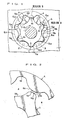
- the trochoidal pump according to the present invention comprises an inner rotor 5 and an outer rotor 6 having a trochoidal toothed shape installed in a rotor chamber 1 formed inside a casing, similarly to a general trochoidal pump.
- the rotor chamber 1 is formed with an intake port 2 and an outlet port 3 extending in the circumferential direction in the vicinity of the outer circumference.
- the intake port 2 and the outlet port 3 are formed in laterally symmetrical positions about the centre of the rotor chamber 1.
- the inner rotor 5 has a number of teeth one fewer than the outer rotor 6, and a relationship is formed whereby each time the inner rotor 5 performs one whole revolution, the outer rotor 6 rotates with a delay equivalent to one tooth behind the inner rotor.
- the inner rotor 5 comprises tooth crests 5a which project in an outward direction and concave shaped tooth valleys 5b
- the outer rotor 6 comprises tooth crests 6a which project towards the centre from the inner circumference thereof, and concave shaped tooth valleys 6b.
- the inner rotor 5 and outer rotor 6 always intermesh at one point, tooth crests 5a of the inner rotor 5 being introduced into tooth valleys 6b of the outer rotor 6 and tooth crests 6a of the outer rotor 6 being introduced into tooth valleys 5b of the inner rotor 5.
- a plurality of demarcated spaces s, s, ⁇ are formed between the inner rotor 5 and the outer rotor 6 when they are operated, and by means of the rotating inner rotor 5 and outer rotor 6, fluid is taken in via the intake port 2 whilst the spaces on the input port 2 side gradually increase in volume, and furthermore, fluid is expelled from the outlet port 3 whilst the spaces s on the outlet port 3 side gradually decrease in volume.
- a clearance which is greater than the normally set tip clearance d 0 in other words, a large clearance d 1 , is set as illustrated in Fig. 1 and Fig. 2.
- the tooth crests for achieving this large clearance d 1 are formed on either the outer rotor 6 or the inner rotor 5.
- a large clearance tip 5a 1 is formed on a suitable one or plurality of the crest ends of the plurality of tooth crests 5a of the inner rotor 5.
- a large clearance tip 6a 1 is formed on a suitable one or plurality of the crest ends of the plurality of tooth crests 6a of the outer rotor 6.
- the tooth shape of the large clearance tips 5a 1 , 6a 1 is achieved by processing for removing the front end of the tooth crest, or forming a tooth shape having a low front end on the tooth crest when forming the rotor, or the like.
- the generally established tip clearance d 0 is set uniformly, and by providing a tooth crest set especially to a large clearance d 1 in the rotor teeth, the tip clearance d 0 of the intermeshing rotors becomes non-uniform.
- the tooth crests are set in such a manner that a large clearance d 1 is provided in two places on an inner rotor 5 having four teeth, then the large clearance is provided every other tooth and there will be tooth crests having the normally established tip clearance of d 0 between these tooth crests.
- tooth crests having a large clearance d 1 are provided in two places in an inner rotor having six teeth, then they will be provided at intervals of three teeth, or an intervals of two teeth and fourth teeth.
- the tooth crests set to have a large tip clearance d 0 are set at least every other tooth position, and hence there will be tooth crests having a large tip clearance d 0 set every other tooth position, or at intervals of one teeth and three teeth, as described previously, depending on the number of such teeth set.
- a tooth crest having a large clearance d 1 should be set in at least one position, but desirably a suitable number of such tooth crests are provided, according to the number of teeth on the rotors. Setting a large clearance d 1 on a rotor having six teeth or more is desirable, since it allows pulsation to be suppressed without reducing volume efficiency.
- Tooth crests having an enlarged clearance d 1 make it possible to reduce the number of enclosed space volumes by interconnecting the spatial volumes formed between the intermeshing rotors, thus reducing pulsation, and hence pulsation can be suppressed to a low value. Furthermore, any reduction in volume efficiency caused by interconnection of the spatial volume between the rotors can be restricted by designing the rotors to have six or more teeth. In other words, adjacent spaces s, s are interconnected by means of the large clearance d 1 , thereby permitting the passage of fluid and preventing enclosure of the fluid.
- a number of tooth crests equal to n/2 are set to have a large clearance d 1 .
- the tooth crests formed with a large clearance d 1 are set at the least every other tooth. If the number of teeth n is even, then by setting the number of tooth crests formed with a large clearance d 1 to n/2, it is possible to a well balanced arrangement, and pulsation can be suppressed whilst maintaining volume efficiency.
- the inner rotor 5 or outer rotor 6 has an odd number of teeth
- a number of tooth crests (n-1)/2 are set to have a large clearance d 1 , these being disposed at the least every other tooth, similarly to the foregoing description.
- the ratio of the number of tooth crests having a standard tip clearance d 0 is set to a larger ratio, and furthermore, the tooth crests formed with a large clearance d 1 are not arranged equidistantly.
- the tip clearance d 0 of the rotors ceases to be uniform, and assumes a non-uniform state.
- the large clearance d 1 moves in accordance with the meshing rotation of the outer rotor 6 and inner rotor 5, thereby changing phase. If the number of large clearances d 1 is more than one, then the positioning thereof may be uniform or non-uniform with respect to the number of rotor teeth, or it may be non-uniform, regardless of the number of rotor teeth.
- the regularity of the hydraulic pulsation of the pump is disturbed, thus making it possible to prevent resonance due to pulsation and to reduce noise.
- This is now described on the basis of a graph illustrating this effect.
- the value of the hydraulic pulsation plotted on the Y axis is as shown in the graph, the units being decibels (dB).
- the graph relates to a rotational speed of 2000 rpm.
- the waveform of the graph is achieved by measuring the frequency of the hydraulic pulsation (the resonance speed).
- the standard value graph shows data for a normal trochoidal type oil pump.
- the frequency of the hydraulic pulsations in this graph is determined by the rotational speed of the pump and the number of teeth of the rotors.
- the pump speed is 2000 rpm
- the number of teeth n of the inner rotor 5 is 6
- the number of teeth n of the outer rotor 6 is 7, and the graph shows the frequency generated by these rotors.
- graphs are illustrated for a pump having a standard tip clearance d 0 (standard value) (see Fig. 10), a pump wherein the large clearance d 1 is set in two places (on two teeth) (see Fig. 8), and a pump wherein the large clearance d 1 is set in three places (three teeth) (see Fig. 9), each graph depicting the corresponding state of the hydraulic pulsation.
- the standard value (STD) graph has a waveform of regular pulsations.
- the graphs for pumps having a large clearance d 1 on two teeth and three teeth each show a significant variation in waveform compared to the standard value.
- the variation in waveforms also differs according to the three toothed arrangement wherein a large clearance d 1 is provided every other tooth or the two toothed arrangement wherein it is provided every three teeth.
- the pumps provided with tooth crests formed with large clearances d 1 on two or three teeth achieve a reduction with respect to the oscillation at 324 Hz which is indicated as a frequency where a strong hydraulic pulsation is obtained in the standard value.
- the pulsation is stronger at a lower frequency than 324 Hz.
- Both the two and three tooth versions have a maximum pulsation at some 175 Hz lower than the standard value.
- the tooth crests 5a formed with a large clearance d 1 are tooth crests 5a which have a large clearance d 1 compared to the tooth crests 5a having a standard tip clearance d 0 .
- the standard tip clearance d 0 is the clearance required to achieve a rotational sliding motion whilst respectively sealing the volume spaces created by the intermeshing of the outer rotor 6 and inner rotor 5.
- the large clearance d 1 is set appropriately to value whereby two volume spaces are connected.
- the characteristics of the graph in Fig. 10 illustrating the standard value comprising a standard tip clearance d 0 only are such that a regular pointed waveform is created.
- This waveform is shown in first, second and third order sections in the graph.
- the pointed waveform is such that only the particular frequency projects significantly.
- the graph shows hydraulic pulsation (oscillation), but if this pulsation causes resonance with the oil filter, and the like, via the piping of the pump, thus appearing as sound, then this sound will be a particular sound having the particular frequency which projects in the graph, and it will be heard continually, thus creating an annoying noise.
- the graph for the two tooth non-uniform composition shows the waveform in a case where the rotational speed is maintained at a uniform 2000 rpm and the tip clearance d 0 in two of the six tooth crests of the inner rotor 5 is increased to a large clearance of d in a rotor of the standard value (STD) described above.
- the waveform wherein a particular frequency projects in a peaked shape is reduced in comparison with the standard value.
- the frequencies surrounding the first, second and third-order frequencies are also increased, and the projecting state of a particular frequency is eased (see corresponding portions of the graphs). Since a sound is generated at a particular frequency in the standard value design, this sound is readily audible and creates a bothersome noise.
- the surrounding frequencies are also increased, and hence a variety of sounds are combined together, forming a diverse sound which is not readily audible. As a result, the noise is reduced.
- the inner rotor 5 and outer rotor 6 support each other mutually at contact point t caused by the intermeshing of the respective tooth crests of the inner rotor 5 and the outer rotor 6, and hence play in the radial direction of the rotors can be prevented. Thereby, pulsation becomes less liable to occur and a stable rotational state can be achieved.
- the mutual support between the inner rotor 5 and the outer rotor 6 due to the standard tip clearance d 0 is also performed in the region outside the scope of the intake port 2, as illustrated in Fig.7(C).
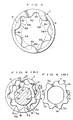
- the plurality of large clearances d 1 , d 1 , ⁇ are arranged uniformly. For example, as shown in Fig. 15(A), if the number of teeth in the inner rotor 5 is eight, then large clearance tips 5a 1 on tooth crests 5a formed with a large clearance d 1 are provided every other tooth.
- this plurality of large clearances d 1 , d 1 , ⁇ are arranged in a non-uniform fashion.
- the inner rotor 5 has eight teeth, similarly to the first pattern, then as shown in Fig. 15(B), after a first large clearance tip 5a 1 where a tooth crest 5a is formed with a large clearance d 1 , the next large clearance tip 5a 1 is formed at a spacing of three teeth. Thereupon, the next large clearance tip 5a 1 is formed at a further spacing of two teeth.
- Fig. 15(B) after a first large clearance tip 5a 1 where a tooth crest 5a is formed with a large clearance d 1 , the next large clearance tip 5a 1 is formed at a spacing of three teeth. Thereupon, the next large clearance tip 5a 1 is formed at a further spacing of two teeth.
- the next large clearance tip 5a 1 may be formed at a spacing of two teeth. Thereupon, the next large clearance tip 5a 1 is formed at a further spacing of four teeth.
- the large clearance tips 5a 1 where tooth crests 5a are provided with a large clearance d 1 are formed appropriately, in such a manner that there is no regularity in the positioning of the large clearance tips 5a 1 , 5a 1 , ⁇ forming the large clearances d 1 , d 1 , ⁇ .
- This non-uniform arrangement of the large clearances d 1 , d 1 , ⁇ is also performed if the inner rotor 5 has an odd number of teeth.
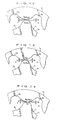
- the large clearance d 1 in the position of region (A) in Fig. 16 is taken to be the same large clearance d 1 as the large clearances d 1 in the positions of regions (B) and (C).
- a space s is formed between the inner rotor 5 and outer rotor 6, if the minimum space between the tooth crest 5a of the inner rotor 5 and the tooth crest 6a of the outer rotor 6 enclosing the space s is greater than the standard tip clearance d 0 , then this is taken as a large clearance d 1 .
- region (A), region (B) and region (C) illustrated in Fig. 16 are mixed together appropriately, and they are distributed in a uniform or non-uniform manner.
- the interval dimensions of the plurality of large clearances d 1 , d 1 , ⁇ there are the following plurality of patterns.
- the interval dimensions of all of the large clearances d 1 , d 1 , ⁇ formed are taken to be the same.
- the respective large clearances d 1 , d 1 , ⁇ at region (A), region (B) and region (C) in Fig. 16 all have the mutually equal interval dimensions, as described previously.
- the fluid interconnected between the spaces s via the large clearance d 1 is the same in each of the locations of the large clearances d 1 , d 1 , ⁇ . Consequently, the non-regularity of the pulsation during operation of the pump is generated at two different positions, those of the tip clearance d 0 and the large clearance d 1 , thus producing a simple non-regularity.
- the interval dimensions of all of the large clearances d 11 , d 12 , ⁇ formed are mutually different, and there exist no large clearances d 1 , d 1 , ⁇ which have the same interval dimensions.
- the addition of suffixes to the large clearances d 11 , d 12 , ⁇ makes it easier to distinguish between the respective large clearances d 1 , d 1 , ⁇ , in cases where the interval dimensions thereof are mutually different, as described above.
- the amount of fluid connected between spaces s via the large clearance d 1 is different in each of the respective large clearances d 11 , d 12 , ⁇ .
- the non-regularity of the pulsation during pump operation is generated not only by the tip clearance d 0 and the large clearance d 1 , but also by the plurality of different large clearances d 11 , d 12 , ⁇ . In this second pattern of interval dimensions, the non-regularity of the pulsation is enhanced.
- the interval dimension of at least one large clearance d 1 ' of the plurality of large clearances d 1 , d 1 , ⁇ formed is different from the interval dimensions of the other large clearances d 1 , d 1 , ⁇ .
- the non-regularity of pulsation is approximately midway between that of the first pattern and the second pattern.
- the (') symbol in the large clearance d 1 ' described above is used to distinguish it readily from the other large clearances d 1 , d 1 , ⁇ .
- large clearances d 1 are created by forming large clearance tips 5a 1 on tooth crests 5a of the inner rotor 5, or by forming large clearance tips 6a 1 on the tooth crests 6a of the outer rotor.
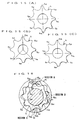
- the large clearances d 1 are formed only on large clearance tips 5a 1 on the inner rotor 5 (see Fig. 13), or they are formed only on large clearance tips 6a 1 on the outer rotor 6 (see Fig. 14).
- the large clearances d 1 , d 1 , ⁇ are formed in such a manner that all have the same interval dimensions, as described in the interval dimension patterns for the large clearances d 1 mentioned above.
- the tooth crests 5a are retracted by mutually different amounts, thereby causing the size of a plurality of large clearance tips 5a 11 , 5a 12 , ⁇ to be mutually different, and hence the interval dimensions of all of the large clearances d 11 , d 12 , ⁇ formed are mutually different, as described previously.
- the addition of the suffixes makes it easier to distinguish between a plurality of large clearance tips 5a 1 , 5a 1 , ⁇ each of which has been retracted by a different amount.
- the large clearances d 11 , d 12 , ⁇ were constituted by forming a plurality of large clearance tips 5a 11 , 5a 12 , ⁇ on the inner rotor 5, but it is also possible to set a plurality of large clearance tips 6a 11 , 6a 12 , ⁇ on the outer rotor 6 to mutually different sizes, or to set a suitable one large clearance tip 6a 1 of a plurality of large clearance tips 6a 11 , 6a 12 , ⁇ on the outer rotor 6 to a different size from the other large clearance tips 6a 1 , 6a 1 , ⁇ .
- the addition of suffixes to the large clearance tips 6a 11 , 6a 12 , ⁇ makes it easier to distinguish between the large clearance tips 6a 1 , 6a 1 , ⁇ of mutually different sizes.
- large clearance tips 5a 1 are formed on tooth crests 5a of the inner rotor 5, and furthermore, large clearance tips 6a 1 are formed on the tooth crests 6a of the outer rotor 6.
- the maximum clearance d max has an interval dimension which is greater than the standard large clearance d 1 , in other words, the large clearance d 1 created by the retraction of the circumferential edge of one only of either a tooth crest 5a of the inner rotor 5 or a tooth crest 6a of the outer rotor 6.
- the large clearance d 1 may be formed by means of a large clearance tip 5a 1 on the inner rotor 5 and a large clearance tip 6a 1 on the outer rotor 6.
- the relative magnitudes of the retraction amounts q 1 , q 2 , q 3 are as follows. (6) q 1 > q 2 , (7) q 1 ⁇ q 2 , (8) q 2 > q 3 , (9) q 2 ⁇ q 3 , (10) q 1 > q 3 , (11) q 1 ⁇ q 3 .
- the relative magnitudes of the retraction amounts q 1 , q 2 , q 3 are as follows. (6) q 1 ' > q 2 ', (7) q 1 ' ⁇ q 2 ', (8) q 2 ' > q 3 ', (9) q 2 ' ⁇ q 3 ', (10) q 1 ' > q 3 ', (11) q 1 ' ⁇ q 3 ' .
- the maximum clearance d max in the fourth pattern will be of a varying size, whilst the large clearance d 1 in the fifth pattern will be of uniform size.
- the large clearance d 1 in the fifth pattern although the large clearances d 1 created by the combination of rotors will be of uniform size, since the amounts of retraction forming these clearances are different on the inner rotor 5 and the outer rotor 6, the large clearance d 1 greater than the tip clearance d 0 , which is formed when opposing the tooth crest 5a of the inner rotor 5 or the tooth crest 6a of the outer rotor 6, will be of varying size.
- the combinations of maximum clearance d max in the fourth pattern and the respective amounts of retraction in the large clearance d 1 in the fifth pattern are as described below.
- the plurality of large clearances d 1 , d 1 , ⁇ or the maximum clearance d max are constituted by the aforementioned combinations, and the interval dimensions of the respective large clearances d 1 , d 1 , ⁇ based on the respective amounts of retraction described above are respectively different, which means that when the pump operates, since the large clearances d 1 , d 1 , ⁇ each have mutually different interval dimensions, it is possible to generate non-regularity in the pulsing action.
- the invention according to a first claim concerns a trochoidal pump wherein an inner rotor 5 and an outer rotor 6 having trochoidal toothed shapes are provided in a mutually intermeshing state, in such a manner that a tip clearance d 0 is created between each tooth crest 5a of the inner rotor 5 and the outer rotor 6, a large clearance d 1 forming a large interval being provided in at least one location of the group of the tip clearances d 0 , whereby pulsation can be suppressed whilst maintaining volume efficiency.
- the invention according to a second claim concerns the trochoidal pump of the first claim, wherein the number of teeth of the inner rotor 5 is six or more, and a large clearance d 1 is formed between the inner rotor 5 and the outer rotor 6, on the plurality of tooth crests 5a of the inner rotor 5, at least at every other tooth position, whereby, if the inner rotor 5 (or outer rotor 6) has six or more teeth, the positions at which the clearance created between a tooth crest 5 of the inner rotor and the outer rotor 6 becomes a large clearance d 1 are set to be at least every other tooth position of the inner rotor 5, and by selecting the number and arrangement thereof appropriately, a variety of pump performances can be provided readily.
- the large clearances d 1 , d 1 , ⁇ form a tooth shape which does not perform rotational drive of the rotors, since they form an interconnected state during intermeshing of the rotors, they allow a well balanced arrangement of the tip clearances d 0 which maintain rotational drive intermeshing of the rotors, and hence the rotation of the rotors can be stabilized.
- the inner rotor 5 and outer rotor 6 support each other mutually due to intermeshing between the respective tooth crests of the inner rotor 5 and the outer rotor 6, and hence play in the radial direction of the rotors can be prevented, thereby making pulsation becomes less liable to occur and making it possible to achieve a stable rotational state.
- the invention according to the third claim concerns the trochoidal pump according to claims 1 or 2, wherein, taking the number of teeth of the inner rotor 5 or outer rotor 6 as n, large clearances d 1 , d 1 , ⁇ are arranged in a uniform or non-uniform fashion on appropriate tooth crests 5a, 6a of the teeth, whereby the large clearances d 1 , d 1 , ⁇ are arranged in a uniform or non-uniform fashion, and together with the standard tip clearances d 0 , they are able to generate non-regularity in the pulsation caused by the operation of the pump, thus increasing the degree to which resonance can be prevented and noise can be reduced to a low level.
- the invention according to the fourth claim concerns the trochoidal pump according to claim 1, 2 or 3, wherein the number of teeth, n, of the inner rotor 5 is set to an even number, and a large clearance d 1 is provided every other tooth on (n/2) tooth crests, whereby, if the number of teeth, n, of the inner rotor (or the outer rotor 6) is an even number, then the tooth crests forming a large clearance d 1 can be set to be at least in every other tooth position.
- the regions formed with a large clearance d 1 can be set to n/2 regions, and a well-balanced arrangement between the tip clearance d 0 and the large clearance d 1 can be achieved, thus making it possible to suppress pulsation whilst maintaining volume efficiency.
- the invention according to the fifth claim concerns the trochoidal pump according to claim 1, 2 or 3, wherein the number of teeth, n, of the inner rotor 5 is set to an odd number, and a large clearance d 1 is provided at least every other tooth position or every other two tooth positions, on ((n-1)/2) tooth crests, whereby the sequence of the positions of the tip clearances d 0 and large clearances d 1 becomes non-uniform, rather than being systematic, in addition to which the positioning of the tooth crests having large clearance d 1 becomes non-uniform, thereby disturbing the regularity of the hydraulic pulsations, avoiding resonance, and hence making it possible suppress pulsation whilst ensuring volume efficiency.
- the invention according to the sixth claim concerns the trochoidal pump according claim 1, 2, 3, 4 or 5, wherein there are a plurality of the large clearances d 1 , and all of these large clearances d 1 , d 1 , ⁇ have the same interval dimension, whereby a non-regularity in the pulsation caused when the pump operates can be generated by the standard tip clearances d 0 , d 0 , ⁇ and the large clearances d 1 , d 1 , ⁇ , and moreover, since the plurality of large clearances d 1 , d 1 , ⁇ are formed with the same interval dimensions, the composition becomes extremely simple, and the structure of the inner rotor 5 or outer rotor 6 for forming the large clearances d 1 , d 1 , ⁇ can be achieved in a comparatively easy fashion.
- the invention according to the seventh claim concerns the trochoidal pump according to claim 1, 2, 3, 4 or 5, wherein there are a plurality of the large clearances d 1 , and all of these large clearances d 1 , d 1 , ⁇ have mutually different interval dimensions, whereby, in addition to the non-regularity of the pulsation caused by the tip clearances d 0 and the large clearances d 1 , the non-regularity of the pulsation caused when the pump operates is further increased by the non-regularity of the pulsation caused by the plurality of large clearances d 1 , thereby increasing the degree to which resonance can be prevented and noise can be reduced to a low level.
- the invention according to the eighth claim concerns the trochoidal pump according to claim 1, 2, 3, 4, or 5, wherein there are a plurality of the large clearances d 1 , and at least one of all of these large clearances d 1 , d 1 , ⁇ has a different interval dimension to the other large clearances d 1 , whereby, in addition to the non-regularity of the pulsation caused by the tip clearances d 0 and the large clearances d 1 , since at least one large clearance d 1 of the plurality of large clearances d 1 , d 1 , ⁇ has a different interval dimension to the other large clearances d 1 , it is also possible to generate non-regularity in the pulsation by means of the large clearances d 1 , d 1 , ⁇ alone, thus increasing the degree to which resonance can be prevented and the noise can be suppressed to a low level.
- the invention according to the ninth claim concerns the trochoidal pump according to claim 1, 2, 3, 4, 5, 6, 7 or 8, wherein the large clearances d 1 are formed by retracting the circumferential edges of either tooth crests 5a of the inner rotor 5 or tooth crests 6a of the outer rotor 6, whereby the structure can be achieved in an extremely easy fashion, since the circumferential edges of tooth crests of either the inner rotor 5 or outer rotor 6 are retracted.
- the invention according to the tenth claim concerns the trochoidal pump according to claim 1, 2, 3, 4, 5, 6, 7 or 8, wherein the large clearances d 1 are formed by retracting the circumferential edges of both tooth crests 5a of the inner rotor 5 and tooth crests 6a of the outer rotor 6, whereby there will exist large clearances d 1 of the plurality of large clearances d 1 , d 1 , ⁇ , which are formed by a large clearance tip 5a 1 of the inner rotor 5 and a large clearance tip 6a 1 of the outer rotor 6.
- a particularly big large clearance d 1 (in other words, a maximum clearance d max ) will occur amongst the large clearances d 1 , d 1 , ⁇ , and by retracting the tooth crests 5a of the inner rotor 5 and the tooth crests 6a of the outer rotor appropriately, it is possible to provide large clearances d 1 of a variety of sizes, whereby the non-regularity of the pulsation caused by pump operation becomes even more pronounced, thus increasing the degree to which the resonance can be prevented and noise can be reduced to a low level.
- d max q + q'.
Landscapes
- Engineering & Computer Science (AREA)
- Mechanical Engineering (AREA)
- General Engineering & Computer Science (AREA)
- Rotary Pumps (AREA)
- Details And Applications Of Rotary Liquid Pumps (AREA)
Applications Claiming Priority (4)
| Application Number | Priority Date | Filing Date | Title |
|---|---|---|---|
| JP2002203264 | 2002-07-11 | ||
| JP2002203264 | 2002-07-11 | ||
| JP2003174279A JP2004092637A (ja) | 2002-07-11 | 2003-06-19 | トロコイドポンプ |
| JP2003174279 | 2003-06-19 |
Publications (3)
| Publication Number | Publication Date |
|---|---|
| EP1380754A2 true EP1380754A2 (fr) | 2004-01-14 |
| EP1380754A3 EP1380754A3 (fr) | 2004-03-31 |
| EP1380754B1 EP1380754B1 (fr) | 2005-11-02 |
Family
ID=29738481
Family Applications (1)
| Application Number | Title | Priority Date | Filing Date |
|---|---|---|---|
| EP03254305A Expired - Lifetime EP1380754B1 (fr) | 2002-07-11 | 2003-07-07 | Pompe à engrenages internes |
Country Status (6)
| Country | Link |
|---|---|
| US (1) | US7052258B2 (fr) |
| EP (1) | EP1380754B1 (fr) |
| JP (1) | JP2004092637A (fr) |
| CN (1) | CN100430601C (fr) |
| DE (1) | DE60302110T2 (fr) |
| ES (1) | ES2252624T3 (fr) |
Cited By (4)
| Publication number | Priority date | Publication date | Assignee | Title |
|---|---|---|---|---|
| EP1674727A1 (fr) | 2004-12-27 | 2006-06-28 | Yamada Manufacturing Co., Ltd. | Pompe à engrenage interne |
| EP2123914A4 (fr) * | 2007-03-09 | 2012-06-27 | Aisin Seiki | Rotor de pompe à huile |
| WO2013092966A3 (fr) * | 2011-12-22 | 2014-02-13 | Robert Bosch Gmbh | Pompe à roue dentée intérieure |
| EP2567069A4 (fr) * | 2010-05-05 | 2014-04-16 | Ener G Rotors Inc | Dispositif de transfert d'énergie de fluide |
Families Citing this family (11)
| Publication number | Priority date | Publication date | Assignee | Title |
|---|---|---|---|---|
| JP2006107601A (ja) * | 2004-10-04 | 2006-04-20 | Pioneer Electronic Corp | ディスク装置 |
| JP4584770B2 (ja) * | 2005-05-20 | 2010-11-24 | ペガサスミシン製造株式会社 | ミシンの給油装置 |
| JP4796035B2 (ja) * | 2007-10-21 | 2011-10-19 | 株式会社山田製作所 | トロコイド型ポンプの製造法及びそのトロコイド型ポンプ |
| JP4967180B2 (ja) * | 2009-09-04 | 2012-07-04 | 住友電工焼結合金株式会社 | 内接歯車ポンプ |
| JP5479934B2 (ja) * | 2010-02-05 | 2014-04-23 | アイシン・エィ・ダブリュ株式会社 | オイルポンプ |
| JP5795726B2 (ja) * | 2011-06-27 | 2015-10-14 | 株式会社山田製作所 | オイルポンプ |
| US8714951B2 (en) * | 2011-08-05 | 2014-05-06 | Ener-G-Rotors, Inc. | Fluid energy transfer device |
| JP5982935B2 (ja) * | 2012-03-27 | 2016-08-31 | トヨタ自動車株式会社 | 内燃機関の制御装置 |
| CN104454521A (zh) * | 2014-12-05 | 2015-03-25 | 西安航空动力控制科技有限公司 | 一种内啮合摆线泵摆线外转子 |
| DE102015004984A1 (de) | 2015-04-18 | 2016-10-20 | Man Truck & Bus Ag | Innenzahnradpumpe und Fahrzeug mit einer Innenzahnradpumpe |
| US10895257B2 (en) * | 2018-02-13 | 2021-01-19 | GM Global Technology Operations LLC | Lubrication strategy for dry run pump system |
Family Cites Families (12)
| Publication number | Priority date | Publication date | Assignee | Title |
|---|---|---|---|---|
| JPS55148991A (en) * | 1979-05-09 | 1980-11-19 | Sumitomo Electric Ind Ltd | Method of correcting rotor curve of rotary pump utilizing trochoidal curve |
| JPS5920591A (ja) * | 1982-07-23 | 1984-02-02 | Sumitomo Electric Ind Ltd | 回転ポンプ用焼結ロ−タ−およびその製造法 |
| JPS59173584A (ja) * | 1983-03-23 | 1984-10-01 | Sumitomo Electric Ind Ltd | 内燃機関潤滑オイルポンプ用回転ポンプおよびそのロ−タ− |
| JPS61210282A (ja) * | 1985-03-13 | 1986-09-18 | Yamada Seisakusho:Kk | トロコイド噛み合いする内接歯車ポンプのロ−タ−曲線修正方法 |
| JPS6456589A (en) | 1987-08-28 | 1989-03-03 | Mitsubishi Rayon Co | Optical recording material |
| JPH01249971A (ja) * | 1988-03-31 | 1989-10-05 | Suzuki Motor Co Ltd | トロコイドポンプ |
| US5030072A (en) * | 1988-06-20 | 1991-07-09 | Eaton Corporation | Constant radial clearance gerotor design |
| JP2805769B2 (ja) * | 1988-09-30 | 1998-09-30 | スズキ株式会社 | オイルポンプ |
| JPH0295787A (ja) | 1988-09-30 | 1990-04-06 | Suzuki Motor Co Ltd | オイルポンプ |
| JPH02163485A (ja) * | 1988-12-16 | 1990-06-22 | Mitsubishi Metal Corp | 内接型トロコイドロータ |
| DE4200883C1 (fr) * | 1992-01-15 | 1993-04-15 | Siegfried A. Dipl.-Ing. 7960 Aulendorf De Eisenmann | |
| US5554020A (en) * | 1994-10-07 | 1996-09-10 | Ford Motor Company | Solid lubricant coating for fluid pump or compressor |
-
2003
- 2003-06-19 JP JP2003174279A patent/JP2004092637A/ja active Pending
- 2003-07-07 DE DE60302110T patent/DE60302110T2/de not_active Expired - Lifetime
- 2003-07-07 ES ES03254305T patent/ES2252624T3/es not_active Expired - Lifetime
- 2003-07-07 EP EP03254305A patent/EP1380754B1/fr not_active Expired - Lifetime
- 2003-07-10 US US10/616,509 patent/US7052258B2/en not_active Expired - Lifetime
- 2003-07-11 CN CNB031545041A patent/CN100430601C/zh not_active Expired - Lifetime
Cited By (6)
| Publication number | Priority date | Publication date | Assignee | Title |
|---|---|---|---|---|
| EP1674727A1 (fr) | 2004-12-27 | 2006-06-28 | Yamada Manufacturing Co., Ltd. | Pompe à engrenage interne |
| EP2123914A4 (fr) * | 2007-03-09 | 2012-06-27 | Aisin Seiki | Rotor de pompe à huile |
| US8360762B2 (en) | 2007-03-09 | 2013-01-29 | Aisin Seiki Kabushiki Kaisha | Oil pump rotor |
| EP2567069A4 (fr) * | 2010-05-05 | 2014-04-16 | Ener G Rotors Inc | Dispositif de transfert d'énergie de fluide |
| US9068456B2 (en) | 2010-05-05 | 2015-06-30 | Ener-G-Rotors, Inc. | Fluid energy transfer device with improved bearing assemblies |
| WO2013092966A3 (fr) * | 2011-12-22 | 2014-02-13 | Robert Bosch Gmbh | Pompe à roue dentée intérieure |
Also Published As
| Publication number | Publication date |
|---|---|
| JP2004092637A (ja) | 2004-03-25 |
| US20040057860A1 (en) | 2004-03-25 |
| DE60302110D1 (de) | 2005-12-08 |
| US7052258B2 (en) | 2006-05-30 |
| ES2252624T3 (es) | 2006-05-16 |
| HK1061880A1 (en) | 2004-10-08 |
| EP1380754A3 (fr) | 2004-03-31 |
| EP1380754B1 (fr) | 2005-11-02 |
| DE60302110T2 (de) | 2006-06-08 |
| CN1482361A (zh) | 2004-03-17 |
| CN100430601C (zh) | 2008-11-05 |
Similar Documents
| Publication | Publication Date | Title |
|---|---|---|
| EP1380754B1 (fr) | Pompe à engrenages internes | |
| US4673342A (en) | Rotary pump device having an inner rotor with an epitrochoidal envelope tooth profile | |
| KR101029624B1 (ko) | 내접 기어식 펌프 및 그 펌프의 내측 회전자 | |
| JPH0310040B2 (fr) | ||
| US7766634B2 (en) | Crescent gear pump with novel rotor set | |
| JP2010196582A (ja) | シングルスクリュー圧縮機 | |
| JP2006183569A (ja) | トロコイド型オイルポンプ | |
| JP4169724B2 (ja) | トロコイド型オイルポンプ | |
| JP4309952B2 (ja) | トロコイド型オイルポンプ | |
| JP2009036194A (ja) | 内接歯車ポンプ | |
| JP4028774B2 (ja) | トロコイドポンプ | |
| JP3127973B2 (ja) | トロコイド歯型を用いた内接歯車式液体ポンプの運転騒音低減構造 | |
| JP2003227474A (ja) | 内接歯車ポンプ | |
| JP6080300B2 (ja) | ギヤポンプおよびインナーロータの製造方法 | |
| JP6080635B2 (ja) | ギヤポンプおよびインナーロータの製造方法 | |
| JPH0419375A (ja) | 内接型オイルモータ及び内接型オイルポンプ | |
| JP2007502932A (ja) | ドライポンプの排気脈動の減少 | |
| JPH0718416B2 (ja) | 回転ポンプ用ロ−タ | |
| JP3860125B2 (ja) | オイルポンプロータ | |
| JP6669554B2 (ja) | オイルポンプ | |
| JPH03134279A (ja) | トロコイド型オイルポンプ | |
| JP3644796B2 (ja) | 容積式ポンプ | |
| HK1061880B (en) | Trochoidal pump | |
| JP2003214356A (ja) | 内接歯車ポンプ | |
| JPH08128392A (ja) | 内接型オイルポンプロータ |
Legal Events
| Date | Code | Title | Description |
|---|---|---|---|
| PUAI | Public reference made under article 153(3) epc to a published international application that has entered the european phase |
Free format text: ORIGINAL CODE: 0009012 |
|
| AK | Designated contracting states |
Kind code of ref document: A2 Designated state(s): AT BE BG CH CY CZ DE DK EE ES FI FR GB GR HU IE IT LI LU MC NL PT RO SE SI SK TR |
|
| AX | Request for extension of the european patent |
Extension state: AL LT LV MK |
|
| PUAL | Search report despatched |
Free format text: ORIGINAL CODE: 0009013 |
|
| AK | Designated contracting states |
Kind code of ref document: A3 Designated state(s): AT BE BG CH CY CZ DE DK EE ES FI FR GB GR HU IE IT LI LU MC NL PT RO SE SI SK TR |
|
| AX | Request for extension of the european patent |
Extension state: AL LT LV MK |
|
| RIC1 | Information provided on ipc code assigned before grant |
Ipc: 7F 04C 2/10 A |
|
| 17P | Request for examination filed |
Effective date: 20040917 |
|
| 17Q | First examination report despatched |
Effective date: 20041102 |
|
| AKX | Designation fees paid |
Designated state(s): DE ES FR GB IT |
|
| GRAP | Despatch of communication of intention to grant a patent |
Free format text: ORIGINAL CODE: EPIDOSNIGR1 |
|
| GRAS | Grant fee paid |
Free format text: ORIGINAL CODE: EPIDOSNIGR3 |
|
| GRAA | (expected) grant |
Free format text: ORIGINAL CODE: 0009210 |
|
| AK | Designated contracting states |
Kind code of ref document: B1 Designated state(s): DE ES FR GB IT |
|
| REG | Reference to a national code |
Ref country code: GB Ref legal event code: FG4D |
|
| REF | Corresponds to: |
Ref document number: 60302110 Country of ref document: DE Date of ref document: 20051208 Kind code of ref document: P |
|
| REG | Reference to a national code |
Ref country code: DE Ref legal event code: R096 Ref document number: 60302110 Country of ref document: DE Effective date: 20051208 |
|
| REG | Reference to a national code |
Ref country code: ES Ref legal event code: FG2A Ref document number: 2252624 Country of ref document: ES Kind code of ref document: T3 |
|
| ET | Fr: translation filed | ||
| PLBE | No opposition filed within time limit |
Free format text: ORIGINAL CODE: 0009261 |
|
| STAA | Information on the status of an ep patent application or granted ep patent |
Free format text: STATUS: NO OPPOSITION FILED WITHIN TIME LIMIT |
|
| 26N | No opposition filed |
Effective date: 20060803 |
|
| REG | Reference to a national code |
Ref country code: DE Ref legal event code: R097 Ref document number: 60302110 Country of ref document: DE Effective date: 20060802 |
|
| PGFP | Annual fee paid to national office [announced via postgrant information from national office to epo] |
Ref country code: ES Payment date: 20110817 Year of fee payment: 9 |
|
| PGFP | Annual fee paid to national office [announced via postgrant information from national office to epo] |
Ref country code: IT Payment date: 20120713 Year of fee payment: 10 |
|
| REG | Reference to a national code |
Ref country code: ES Ref legal event code: FD2A Effective date: 20131022 |
|
| PG25 | Lapsed in a contracting state [announced via postgrant information from national office to epo] |
Ref country code: ES Free format text: LAPSE BECAUSE OF NON-PAYMENT OF DUE FEES Effective date: 20120708 Ref country code: IT Free format text: LAPSE BECAUSE OF NON-PAYMENT OF DUE FEES Effective date: 20130707 |
|
| PGFP | Annual fee paid to national office [announced via postgrant information from national office to epo] |
Ref country code: FR Payment date: 20140708 Year of fee payment: 12 Ref country code: GB Payment date: 20140702 Year of fee payment: 12 |
|
| GBPC | Gb: european patent ceased through non-payment of renewal fee |
Effective date: 20150707 |
|
| PG25 | Lapsed in a contracting state [announced via postgrant information from national office to epo] |
Ref country code: GB Free format text: LAPSE BECAUSE OF NON-PAYMENT OF DUE FEES Effective date: 20150707 |
|
| REG | Reference to a national code |
Ref country code: FR Ref legal event code: ST Effective date: 20160331 |
|
| PG25 | Lapsed in a contracting state [announced via postgrant information from national office to epo] |
Ref country code: FR Free format text: LAPSE BECAUSE OF NON-PAYMENT OF DUE FEES Effective date: 20150731 |
|
| PGFP | Annual fee paid to national office [announced via postgrant information from national office to epo] |
Ref country code: DE Payment date: 20220531 Year of fee payment: 20 |
|
| REG | Reference to a national code |
Ref country code: DE Ref legal event code: R071 Ref document number: 60302110 Country of ref document: DE |