EP1384643A2 - Lenksäule und Verstellverfahren für eine Lenksäule - Google Patents
Lenksäule und Verstellverfahren für eine Lenksäule Download PDFInfo
- Publication number
- EP1384643A2 EP1384643A2 EP03017865A EP03017865A EP1384643A2 EP 1384643 A2 EP1384643 A2 EP 1384643A2 EP 03017865 A EP03017865 A EP 03017865A EP 03017865 A EP03017865 A EP 03017865A EP 1384643 A2 EP1384643 A2 EP 1384643A2
- Authority
- EP
- European Patent Office
- Prior art keywords
- steering column
- devices
- occupant
- column according
- load
- Prior art date
- Legal status (The legal status is an assumption and is not a legal conclusion. Google has not performed a legal analysis and makes no representation as to the accuracy of the status listed.)
- Granted
Links
- 238000000034 method Methods 0.000 title claims abstract description 23
- 239000000725 suspension Substances 0.000 claims abstract description 42
- 238000001514 detection method Methods 0.000 claims abstract description 32
- 230000001960 triggered effect Effects 0.000 claims abstract description 15
- 238000013016 damping Methods 0.000 claims abstract description 12
- 238000010521 absorption reaction Methods 0.000 claims description 13
- 230000000694 effects Effects 0.000 claims description 4
- 230000003287 optical effect Effects 0.000 claims description 4
- 238000012546 transfer Methods 0.000 claims description 3
- 238000011161 development Methods 0.000 description 9
- 239000002360 explosive Substances 0.000 description 7
- 238000013461 design Methods 0.000 description 5
- 230000007246 mechanism Effects 0.000 description 5
- 230000008901 benefit Effects 0.000 description 4
- 206010000369 Accident Diseases 0.000 description 3
- 230000001419 dependent effect Effects 0.000 description 3
- 238000010586 diagram Methods 0.000 description 3
- 230000009467 reduction Effects 0.000 description 3
- 238000004904 shortening Methods 0.000 description 3
- 238000006073 displacement reaction Methods 0.000 description 2
- 238000012544 monitoring process Methods 0.000 description 2
- 208000027418 Wounds and injury Diseases 0.000 description 1
- 238000013459 approach Methods 0.000 description 1
- 230000000903 blocking effect Effects 0.000 description 1
- 238000010276 construction Methods 0.000 description 1
- 230000006378 damage Effects 0.000 description 1
- 230000003111 delayed effect Effects 0.000 description 1
- 208000014674 injury Diseases 0.000 description 1
- 238000009434 installation Methods 0.000 description 1
- 238000012986 modification Methods 0.000 description 1
- 230000004048 modification Effects 0.000 description 1
- 238000006467 substitution reaction Methods 0.000 description 1
Images



Classifications
-
- B—PERFORMING OPERATIONS; TRANSPORTING
- B62—LAND VEHICLES FOR TRAVELLING OTHERWISE THAN ON RAILS
- B62D—MOTOR VEHICLES; TRAILERS
- B62D1/00—Steering controls, i.e. means for initiating a change of direction of the vehicle
- B62D1/02—Steering controls, i.e. means for initiating a change of direction of the vehicle vehicle-mounted
- B62D1/16—Steering columns
- B62D1/18—Steering columns yieldable or adjustable, e.g. tiltable
- B62D1/19—Steering columns yieldable or adjustable, e.g. tiltable incorporating energy-absorbing arrangements, e.g. by being yieldable or collapsible
- B62D1/195—Yieldable supports for the steering column
-
- F—MECHANICAL ENGINEERING; LIGHTING; HEATING; WEAPONS; BLASTING
- F16—ENGINEERING ELEMENTS AND UNITS; GENERAL MEASURES FOR PRODUCING AND MAINTAINING EFFECTIVE FUNCTIONING OF MACHINES OR INSTALLATIONS; THERMAL INSULATION IN GENERAL
- F16F—SPRINGS; SHOCK-ABSORBERS; MEANS FOR DAMPING VIBRATION
- F16F7/00—Vibration-dampers; Shock-absorbers
- F16F7/12—Vibration-dampers; Shock-absorbers using plastic deformation of members
- F16F7/127—Vibration-dampers; Shock-absorbers using plastic deformation of members by a blade element cutting or tearing into a quantity of material; Pultrusion of a filling material
Definitions
- the invention relates to a steering column according to the preamble of claim 1 and an adjustment method for a steering column according to the preamble of claim 26.
- the older German utility model applications based on the present applicant / owner 298 08 317.5, 299 01 657.9 and 299 00 289.6 and the one based thereon PCT registration PCT / DE 99/01000 generally deal with a safety steering column, a security system for a vehicle, a vehicle with a security system, and a safety procedure to protect occupants in the event of an accident.
- the present The invention relates to improvements to all of those discussed in the earlier application Techniques and exemplary embodiments, in particular with regard to the triggering control of the Steering column and especially for different occupants and belt conditions.
- the complete Disclosure content of these older applications, particularly with regard to triggering control the steering column and specifically for different occupants and belt conditions fully incorporated into the available documents by the references.
- a vehicle steering column is known, for example, from the older applications mentioned, which is adjusted in the event of an accident so that the steering wheel end of one Occupants is moved away.
- a steering device for a vehicle is known, one Steering column and / or a steering wheel moved in the event of a crash in the vehicle front direction becomes.
- This steering column is supported on the vehicle body by a force limiter.
- the Force-displacement identification of the force limiter can be influenced via a throttle valve, which is controlled by a Control unit can be acted upon.
- For influencing the force-displacement identifier of the Force limiters can take different parameters into account individually or in combination be such.
- WO 98/58831 A discloses a steering column for a vehicle with a two-part steering column holder and an energy absorption mechanism between the two parts thereof.
- This energy absorption mechanism includes two or more longitudinal grooves and one Cutting member that is designed to run along one of the grooves when relative adjustment occurs between the two parts of the steering column bracket.
- a steering column for a vehicle is known from WO 98/22325 A, the steering column is adjustable in the event of an accident with respect to a load suspension structure, namely under Use of a first energy absorption unit to absorb energy during the Verstellens. Furthermore, a sensor for detecting a state is provided that is representative for that is that an occupant has put on a belt. It is also between the steering column and a second energy absorption unit is arranged in the load suspension structure and is the Sensor connected to a blocking unit, which is designed so that when the above Condition is detected, an adjustment of the second energy absorption unit compared to the Allows load absorption structure, whereby energy is absorbed.
- the present invention aims to protect this steering column and its adjustment method to further improve the occupants and especially the retraction behavior of a steering column in an accident to be optimally designed depending on the situation and reliably.
- This goal is achieved with a steering column according to claim 1 and an adjustment method for reached a steering column according to claim 26.
- a steering column for a vehicle is created, with adjusting devices, which can be triggered in the event of an accident, around at least one steering wheel end region to move the steering column away from an occupant, the adjusting devices Load suspension devices for damping movement of at least the steering wheel end region the steering column away from an occupant and for at least two modes of operation are designed, and wherein a controller for detecting occupant parameters by means of detection devices and triggering an operating mode of the adjusting devices depending is provided by the occupant parameters, and further the load suspension devices Deformation devices included that are dependent on the controller from the occupant's parameters to implement a specific operating mode of the adjustment devices can be brought into or out of effect, and at least the deformation devices a cutting knife cutting along a movement path for load absorption included, which can be brought into a load suspension position by tilting.
- each cutting knife a tipping point is mounted so that it cuts in when the adjustment devices are driven.
- This can be developed in that each cutting knife in a slot an inner tube ring piston of the steering column is mounted on a tilting point such that it when the adjustment devices are driven via the inner tube ring piston into a wall cuts a steering column outer tube of the steering column.
- each cutting knife has a Stop is assigned by which the cutting depth of the chip is determined.
- a pressurized one for the at least one cutting knife Control pin is provided through which the tilting of the cutting knife into the load-bearing position is preventable.
- a pressurized control pin is provided for the at least one cutting knife which is designed to tilt the cutting knife out of function in order to take up the load to dub.
- the adjusting devices for causing the movement of at least the steering wheel end region the steering column away from an occupant and that the drive devices in the event of an accident, depending on the occupant parameters can be triggered.
- the drive devices contain a pyrotechnic gas generator and / or can be triggered electrically are.
- the load suspension devices at least contain two stages, depending on the control in the event of an accident can be operated directly or indirectly by the occupant parameters, preferably the steps of the load suspension devices individually, each with different load suspension properties and / or can be operated simultaneously with added load suspension properties are.
- the load suspension devices or, if necessary, each step individually depending on the control in the event of an accident can be switched off directly or indirectly from the occupant parameters. More with these Versions that can be combined are that the load suspension devices or possibly a step thereof deformation devices, in particular with along a movement path cutting blades, and / or braking devices, in particular a brake carriage with preferably at least two braking force levels.
- control can preferably be used to trigger the drive devices depending on the seating position of the occupant and especially for Detection of a predeterminable distance or falling below a predeterminable distance the position of the seat for the occupant from the steering wheel by means of the detection devices be designed.
- control for Triggering such an operating mode of the adjusting devices is designed, in which In the event of an accident in the case of a predeterminable distance or a shortfall a predetermined distance of the position of the seat for the occupant from the steering wheel Drive devices of the adjustment devices are triggered.
- the controller for operating the load suspension devices or, if necessary, each step individually depending on the state of the belt and / or the Sitting position of the occupant is designed, the controller in particular to trigger a such operating mode of the adjusting devices is designed in the event of an accident in the case of a non-belted occupant, the load suspension devices or at least one Level of which are effective.
- the control can be used to trigger a be designed such operating mode of the adjustment devices, in which in the case of a Accident when a predeterminable distance is recorded or a value is undershot Predeterminable distance of the position of the seat for the occupant from the steering wheel the load suspension devices or at least one stage of it is / is ineffective.
- the detection devices position detection devices of the seat for the occupant, condition detection devices of the belt buckle for the seat belt of the occupant, height, weight and / or posture detection devices contained regarding the occupant.
- the position detection devices can the seat for the occupant, in particular at least one electrical or optical switch contained in or in connection with seat guide rails, and / or the condition detection devices the buckle for the seat belt of the occupant at least one electrical or optical lock usage switch included.
- the object of the present invention specified above is also achieved with an adjustment method for a steering column of a vehicle, in the event of an accident, at least one end of the steering wheel of the steering column is moved away from an occupant by means of adjusting devices, occupant parameters are detected by means of detection devices, and wherein the movement of at least the steering wheel end region of the steering column away from the occupant takes place by means of a control as a function of the occupant parameters in accordance with an operating mode of a plurality of operating modes of the adjusting devices, and furthermore to implement a specific operating mode of the adjusting devices by means of the control, depending on the occupant parameters, deformation devices for movement-damping load suspension are brought into or out of effect, and, if the deformation devices are effective, in the event of an accident, at least cutting cutting knife of the deformation devices for movement-damping load suspension is adjusted along a movement path by tilting into a load suspension position.
- each cutting knife a tipping point is mounted so that it cuts in when the adjustment devices are driven.
- each cutting knife is in one Slit of an inner tube ring piston of the steering column mounted in such a way on a tipping point is that when the adjustment devices are driven via the inner tube ring piston, it is deliberately integrated into a Cut wall of a steering column outer tube of the steering column.
- Another development is that the cutting depth of the chip of each cutting knife is determined by a stop.
- the cutting knife is tilted into the load suspension position is prevented by a pressurized control pin.
- the at least one cutting knife by a pressurized control pin is tilted out of function in order to transfer the load suspension.
- a drive of the adjusting devices can preferably also be used to effect the movement at least the steering wheel end region of the steering column away from the occupant in the event of a Accident triggered depending on the occupant parameters and / or at least a movement the steering wheel end area of the steering column away from an occupant in the event of an accident depending on the occupant parameters.
- a further development of the last-mentioned method variant involves damping the movement at least the steering wheel end region of the steering column away from an occupant in the event of a Accident depending on the occupant parameters, in particular optionally in individual Stages switched off.
- the sitting position, the state of the seat belt, the size, the weight and / or the posture of the occupant as occupant parameters to be recorded.
- the adjustment devices in Depending on the seating position of the occupant are driven, in particular the Adjustment devices in the event of an accident at a predetermined distance or a detected detected falling below a predetermined distance of the position of the seat for the occupant are not driven by the steering wheel according to an operating mode.
- the adjustment devices can be dependent on the state of the seat belt and / or be cushioned from the seating position of the occupant.
- the present invention thus provides a steering column and an adjustment method for a steering column according to earlier applications mentioned in the introduction in an advantageous manner further improved.
- one of the two load limits e.g. load receiver A
- the weight detection of the tall driver and the position detection e.g. a small one
- Drivers can of course also use electronic weight and position sensors, which are currently be developed in many places, or other suitable ones, to the person skilled in the art without further ado known or accessible species are identified.
- a steering column 1 for a vehicle (not shown), which is only indicated, has a conventional one telescopic structure, due to its popularity in numerous versions is not further discussed here, since the present invention applies to all known Designs also retractable overall, not telescopically collapsible Steering columns can be used and the present invention is not the actual design relates to such steering columns.
- the steering column 1 has a steering wheel end area 2 and is provided with adjusting devices 3 provided, which can be triggered in the event of an accident to at least the To move the steering wheel end region 2 of the steering column 1 away from an occupant (not shown), who sits on a seat 4.
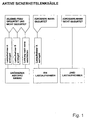
- the adjusting devices 3 are illustrated in the figure for the three Operating modes designed.
- a controller 5 detects occupant parameters by means of detection devices 6 and triggers an operating mode depending on the occupant parameters Adjustment devices 3 from.
- the adjustment devices 3 contain load suspension devices 7 with a first and a second load suspension device or limiter 8 (A) or 9 (B), each with its own bolt 10 and 11 and a common load-bearing plate 12 contain the deformation devices (D) form.
- the load receiving plate 12 With one Carriage 13 connected.
- the load receiving plate 12 is with a telescopic part (not shown) the steering column 1 is firmly connected, and the carriage 13 is with the other telescopic part (not shown) of the steering column 1 firmly connected.
- the bolts 10 and 11 each have an explosive charge S, which the controller 5, which, for example, is connected to or integrated in an overall control system (not shown) for an airbag, each of which can be ignited independently of one another, to render each of the bolts 10 and 11 ineffective accordingly.
- the controller 5 To the controller 5 are as detection devices 6 state detection devices 13 of a belt buckle 14 connected in the form of a belt or buckle switch 15. This belt usage switch 15 results in a belt usage signal when the occupant is wearing his seat belt (not shown). If the belt usage signal is not generated, it is Control informs that the occupant is not properly buckled up.
- position detection devices 16 are contained in the detection devices 6, which are formed by a position switch 17 in a seat rail 18 of the seat 4.
- This position switch 17 leads to a near position signal when the seat 4 is in the position the position switch 17 has reached or closer than the position switch 17 on the steering column 1 is.
- the controller 5 receives the information that the occupant is one small person acts. If the near position signal is not generated, the control is above it informs that the occupant is a tall person.
- controller 5 set each of the three operating modes of the adjusting devices 3 according to FIG. 1.
- the controller 5 If the controller 5 has received the near position signal, it initiates the operating mode for a buckled or unbuckled "little woman".
- the controller fires in this mode 5 the explosive charges S of the two bolts 10 and 11, so that they become ineffective and the load receiving plate 12 and the slide 13 are decoupled.
- the controller also fires 5 shows a pyrotechnic explosive device 19 of a gas generator 20, and the one generated by it Gas acts on a piston 21 with a piston rod 22 connected to the end of the steering wheel 2 containing telescopic part (not shown) of the steering column 1 firmly connected is that the two telescopic parts (not shown) of the steering column 5 are pulled together.
- the parts 19 to 22 are components of the adjusting devices 3 and form together Drive devices 23.
- the controller 5 If the controller 5 has not received the near position signal, it checks whether the belt usage signal given is. If the belt usage signal is present, the controller 5 initiates the Operating mode for a buckled "big man". The controller fires in this mode 5 the explosive charge S only of the bolt 11, so that only this is ineffective and that Load receiving plate 12 and the carriage 13 are still coupled by the bolt 10.
- the Load suspension device 8 (A) is thus effective to dissipate energy that occurs when the seat belt strikes "Big man” occurs on the steering wheel (not labeled).
- the drive devices 23 are not triggered.
- the controller 5 If the controller 5 receives neither the near position signal nor the belt usage signal, the controller 5 thus initiates the operating mode for an unbuckled "tall man". In this mode, the controller 5 does not ignite an explosive charge S, so that the load-receiving plate 12 and the carriage 13 are coupled by both bolts 10 and 11.
- the load lifter 8 (A) and the load receiver 9 (B) are thus effective to dissipate energy that Impact of the unbuckled "big man” on the steering wheel (not labeled) occurs.
- the drive devices 23 are not triggered.
- Signal lines between the controller 5 and the explosive charges S, the pyrotechnic The explosive device 19 and the detection devices 6 are shown as lines or lines in FIG. 2 located.
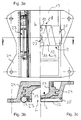
- 3a, 3b and 3c show a carriage 13 for receiving the steering (not shown) in its carriage holder 24 in Fig. 3a left from below and right from above and in the 3b and 3c each cut.
- the pyrotechnic gas generator 20 of the drive devices 23 is attached to the carriage receptacle 24 on the one hand and to the carriage 13 on the other hand.
- the load receiver 8 (A) and the load receiver 9 (B) are on the right side of FIG. 3a. shown in one piece in installation position.
- the load suspension devices 8 and 9 are on the one hand with the bolts 10 or 11 on the slide 13 and on the other hand on the slide receptacle 24 with screw connections 25 provided.
- the sliding telescopic part (not shown) of the steering column 1 is in the Recess L fixed.
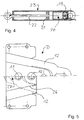
- the drive devices 23 are shown separately in FIG. 4, as they are already in connection were explained with FIG. 2.
- FIG. 5 shows above, i.e. in a ready-to-install condition, and below after actuation both load suspension 8 and 9, the load receiving plate 12, which is a stamped part is.
- the load limiter 8 (A) is designed such that it is by means of of the bolt 10 immediately tears at tear lines 26 when the load is exceeded. there the end of the load limiter 8 (A) inevitably slides over the load limiter 9 (B), whose bolt 11 initially moves in a slot 27 of the load limiter 9 (B).
- This Design advantageously leads to the pull-out forces of the two load sensors Add 8 (A) and 9 (B). If they ripped apart in parallel, only one would of the two load hanger A or B.
- the invention thus in particular makes a safety steering column created with a crash sled that has two load sensors for buckled and not buckled tall and small people.
- a control with a lock usage switch is a control with a lock usage switch.
- the crash slide for small people is called “Ab-. stationary sled "and its load sensors are taken out of operation Smaller people can preferably use an electrical seat position detection.
- the load suspension devices are of this type are built in a row, e.g. by means of a slot in a connection to the delayed Start-up that the load frames add up with the load.
- this embodiment relates to a safety steering column with pyrotechnic driven shortening for small drivers and peak load reduction for large drivers.
- this embodiment relates to a safety steering column with pyrotechnic driven shortening for small drivers and peak load reduction for large drivers.
- Steering columns are already partially supplemented to an airbag with a peak load reduction equipped for heavy persons.
- Practice has also shown that small and too dense Drivers positioned on the airbag may die to some extent as a result.
- the second embodiment also creates a solution for reducing peak loads for large drivers and in same system a shortening of the steering column for small drivers in the event of an accident.
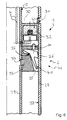
- 6 to 8 show a steering column outer tube 28 and a steering column inner tube 29, which Represent telescopic parts of a steering column 1, the steering column inner tube 29 the steering wheel end region 2 of the steering column 1 contains.
- On the steering column outer tube 28 is an outer tube ring piston 30 attached, for example, by a clinch connection 31.
- the outer tube ring piston 30 contains a pyrotechnic cartridge 32 which is connected to control cables K with the control 5 (see Fig. 2) is connected.
- With the steering column inner tube 29 is an inner tube ring piston 33 firmly connected by a clinching connection 34 as well.
- This inner tube ring piston 33 contains one or more in slots in the second embodiment 35 mounted, correspondingly shaped cutting knife 36 as parts of deformation devices 6.
- the cutting knives 36 are mounted on a "tipping point" 37 such that they are at Drive via the inner tube ring piston 33 into the wall 38 of the steering column outer tube Cut 28 of the steering column 1.
- the cutting depth 39 of the chip 40 is by a correspondingly shaped stop 41 determined.
- the size of the chip 40 is proportional to that desired load bearing.
- the deformation devices 6 form load receivers 42.
- the outer tubular ring piston 30 and the inner tubular ring piston 33 form drive devices 23, which, like the load receivers 42, are components of the adjusting devices 3 of the Steering column 1 are.
- Fig. 7 shows the function with small drivers.
- the charge 43 presses the pyrotechnic Cartridge 32 connects the inner tube ring piston 33 to the steering column inner tube 29 down and away from an occupant (not shown).
- the pyrotechnic Cartridge 32 connects the inner tube ring piston 33 to the steering column inner tube 29 down and away from an occupant (not shown).
- one pressurized control pin 44 tilting the cutter 36 into position "Load bearing", i.e. for chip removal in the wall 38 of the steering column outer tube 28 the steering column 1.
- FIGS. 6 to 8 explain the invention as follows:
- Steering column tubes that can be pushed into each other are provided with “ring pistons", which are used by small drivers shorten the steering column by means of a pyrotechnic pressure build-up and to bring an inflating airbag a greater distance.
- ring pistons In one of the ring pistons a load-bearing mechanism is built in, which is used by tall drivers instead of shortening the steering column is effective and for small drivers using pyrotechnic pressure Function is set.
- the second ring piston is equipped with a load suspension mechanism. In the example shown, these are appropriately shaped and stored tiltable Knife. It can also be corrugated pipes, material-deforming balls or similar. act (in the figures not shown).
- the function of the load-bearing ring piston is fundamentally such that it automatically picks up and breaks down load when the inner steering column tube is relative is moved to the outside.
- the knife is machined into the outside Steering column tube pressed.
- this load pick-up can be used with a pyrotechnic ignition with the appropriate performance "overplayed", or the "knife” as in the example tilted out of function by a pressurized control pin.
- the inner and outer steering column tube designed for the largest possible difference in diameter.
- the outer steering column tube is positioned in bearings (not shown in the figures).
- the inner Steering column tube is form-fitting to the outside with corresponding ring pistons (grooves / shape) connected.
- the pair of ring pistons is e.g. by linking with one outer and one each inner tube connected.
- An annular piston contains a pyrotechnic charge, the pressure of which press the ring pistons away from each other and thus shorten the steering column or the steering wheel can pull away from the occupant in the direction of travel.
- Small drivers can also be found in the second embodiment example e.g. through appropriate electronic monitoring systems or seat position detection using switches in the seat rail.
Landscapes
- Engineering & Computer Science (AREA)
- General Engineering & Computer Science (AREA)
- Mechanical Engineering (AREA)
- Chemical & Material Sciences (AREA)
- Combustion & Propulsion (AREA)
- Transportation (AREA)
- Steering Controls (AREA)
- Air Bags (AREA)
Abstract
Description
wobei im Falle eines Unfalls zumindest ein Lenkrad-Endbereich der Lenksäule mittels Verstelleinrichtungen von einem Insassen weg bewegt wird,
wobei mittels Detektionseinrichtungen Insassenparameter erfaßt werden, und
wobei die Bewegung zumindest des Lenkrad-Endbereiches der Lenksäule vom Insassen weg mittels einer Steuerung in Abhängigkeit von den Insassenparametern gemäß einem Betriebsmodus von mehreren Betriebsmodi der Verstelleinrichtungen erfolgt, und wobei ferner
zur Realisierung eines bestimmten Betriebsmodus der Verstelleinrichtungen mittels der Steuerung in Abhängigkeit von den Insassenparametern Deformationseinrichtungen zur bewegungsdämpfenden Lastaufhahme in oder ausser Wirkung gebracht werden, und,
wenn die Deformationseinrichtungen wirksam sind, im Falle eines Unfalls wenigstens spanabhebendes Schneidmesser der Deformationseinrichtungen zur bewegungsdämpfenden Lastaufhahme längs eines Bewegungsweges durch Kippen in eine Lastaufnahmestellung verstellt wird.
- Fig. 1
- zeigt schematisch Betriebsmodi von Verstelleinrichtungen eines ersten Ausführungsbeispiels einer Lenksäule,
- Fig. 2
- zeigen schematisch ein Schalt- und Aufbauschema der Steuerung des ersten Ausführungsbeispiels der Lenksäule von Fig. 1,
- Fig. 3a, 3b und 3c
- zeigen schematisch die Verstelleinrichtungen des ersten Ausführungsbeispiels der Lenksäule von Fig. 1 in einer Ansicht von unten (linke Hälfte von Fig. 3a) und oben (rechte Hälfte von Fig. 3a) bzw. entsprechende Querschnitte,
- Fig. 4
- zeigen schematisch die Antriebseinrichtungen des ersten Ausführungsbeispiels der Lenksäule von Fig. 1,
- Fig. 5
- zeigen schematisch die Lastaufnahmeeinrichtungen des ersten Ausführungsbeispiels der Lenksäule von Fig. 1, und
- Fig. 6 bis 8
- zeigen schematisch in einer Querschnittsansicht ein zweites Ausführungsbeispiel einer Lenksäule vor einer Auslösung, nach einer Auslösung bei einem kleinen Insassen bzw. nach einer Auslösung bei einem grossen.
Claims (41)
- Lenksäule für ein Fahrzeug, mit Verstelleinrichtungen (3), die im Falle eines Unfalls auslösbar sind, um zumindest einen Lenkrad-Endbereich (2) der Lenksäule (1) von einem Insassen weg zu bewegen, wobei die Verstelleinrichtungen (3) Lastaufnahmeeinrichtungen (7) zum Dämpfen einer Bewegung zumindest des Lenkrad-Endbereiches (2) der Lenksäule (1) von einem Insassen weg enthalten und für wenigstens zwei Betriebsmodi ausgelegt sind, und wobei eine Steuerung (5) zum Erfassen von Insassenparametern mittels Detektionseinrichtungen (6) und Auslösen eines Betriebsmodus der Verstelleinrichtungen (3) in Abhängigkeit von den Insassenparametern vorgesehen ist,
dadurch gekennzeichnet, dass die Lastaufnahmeeinrichtungen (7) Deformationseinrichtungen (6) enthalten, die mittels der Steuerung (5) in Abhängigkeit von den Insassenparametern zur Realisierung eines bestimmten Betriebsmodus der Verstelleinrichtungen (3) in oder ausser Wirkung bringbar sind, und
dass die Deformationseinrichtungen (6) wenigstens ein längs eines Bewegungsweges zur Lastaufnahme spanabhebendes Schneidmesser (36) enthalten, das durch Kippen wahlweise in eine Lastaufnahmestellung bringbar ist. - Lenksäule nach Anspruch 1, dadurch gekennzeichnet, dass jedes Schneidmesser (36) auf einem Kipppunkt (37) gelagert ist, so dass es bei Antrieb der Verstelleinrichtungen (3) gezielt einschneidet.
- Lenksäule nach Anspruch 2, dadurch gekennzeichnet, dass jedes Schneidmesser (36) in einem Schlitz (35) eines Innenrohr-Ringkolbens (33) der Lenksäule (1) derart auf einem Kipppunkt (37) gelagert ist, dass es bei Antrieb der Verstelleinrichtungen (3) über den Innenrohr-Ringkolben (33) gezielt in eine Wandung (38) eines Lenksäulenaussenrohrs (28) der Lenksäule (1) einschneidet.
- Lenksäule nach einem der vorhergehenden Ansprüche, dadurch gekennzeichnet, dass jedem Schneidmesser (36) ein Anschlag (41) zugeordnet ist, durch den die Schneidtiefe (39) des Spanes (40) bestimmt ist.
- Lenksäule nach einem der vorhergehenden Ansprüche, dadurch gekennzeichnet, dass für das wenigstens eine Schneidmesser (36) ein druckbeaufschlagter Steuerstift (44) vorgesehen ist, durch den das Kippen des Schneidemessers (36) in die Lastaufnahmestellung verhinderbar ist.
- Lenksäule nach einem der Ansprüche 1 bis 4, dadurch gekennzeichnet, dass für das wenigstens eine Schneidmesser (36) ein druckbeaufschlagter Steuerstift (44) vorgesehen ist, der ausgelegt ist, das Schneidmesser (36) außer Funktion zu kippen, um die Lastaufnahme zu überspielen.
- Lenksäule nach einem der vorhergehenden Ansprüche, dadurch gekennzeichnet, dass die Verstelleinrichtungen (3) Antriebseinrichtungen (23) zum Bewirken der Bewegung zumindest des Lenkrad-Endbereiches (2) der Lenksäule (1) von einem Insassen weg enthalten, und
dass die Antriebseinrichtungen (23) im Falle eines Unfalls von der Steuerung (5) in Abhängigkeit von den Insassenparametern auslösbar sind. - Lenksäule nach Anspruch 7, dadurch gekennzeichnet, dass die Antriebseinrichtungen einen pyrotechnischen Gasgenerator (20; 32) enthalten und/oder elektrisch auslösbar sind.
- Lenksäule nach einem der vorhergehenden Ansprüche, dadurch gekennzeichnet, dass die Verstelleinrichtungen (3) Lastaufnahmeeinrichtungen (7) zum Dämpfen einer Bewegung zumindest des Lenkrad-Endbereiches (2) der Lenksäule (1) von einem Insassen weg enthalten, und
dass die Lastaufnahmeeinrichtungen (7) im Falle eines Unfalls von der Steuerung (5) in Abhängigkeit von den Insassenparametern direkt oder indirekt betreibbar sind. - Lenksäule nach Anspruch 9, dadurch gekennzeichnet, dass die Lastaufnahmeeinrichtungen (7) wenigstens zwei Stufen (A, B) enthalten, die im Falle eines Unfalls von der Steuerung (5) in Abhängigkeit von den Insassenparametern direkt oder indirekt betreibbar sind,
- Lenksäule nach Anspruch 10, dadurch gekennzeichnet, dass die Stufen (A, B) der Lastaufnahmeeinrichtungen (7) einzeln oder gleichzeitig mit addierten Lastaufnahmeeigenschaften betreibbar sind.
- Lenksäule nach Anspruch 11, dadurch gekennzeichnet, dass die Stufen (A, B) der Lastaufnahmeeinrichtungen (7) jeweils unterschiedliche Lastaufnahmeeigenschaften aufweisen.
- Lenksäule nach einem der Ansprüche 9 bis 12, dadurch gekennzeichnet, dass die Lastaufnahmeeinrichtungen (7) oder ggf. jede Stufe (A, B) davon einzeln im Falle eines Unfalls von der Steuerung (5) in Abhängigkeit von den Insassenparametern direkt oder indirekt abschaltbar sind.
- Lenksäule nach einem der Ansprüche 9 bis 13, dadurch gekennzeichnet, dass die Lastaufnahmeeinrichtungen (7) oder ggf. eine Stufe (A, B) davon Deformationseinrichtungen (6) mit längs eines Bewegungsweges spanabhebenden Schneidmessern (36) enthalten, und/oder Bremseinrichtungen enthalten.
- Lenksäule nach Anspruch 14, dadurch gekennzeichnet, dass die Bremseinrichtungen einen Bremsschlitten enthalten.
- Lenksäule nach Anspruch 15, dadurch gekennzeichnet, dass der Bremsschlitten wenigstens zwei Bremskraftstufen aufweist.
- Lenksäule nach einem der vorhergehenden Ansprüche, dadurch gekennzeichnet, dass die Steuerung (5) zum Erfassen der Sitzposition, des Angurtzustandes, der Grösse, des Gewichts und/oder der Körperhaltung des Insassen mittels der Detektionseinrichtungen (6) ausgelegt ist.
- Lenksäule nach Anspruch 17 in Verbindung mit einem der Ansprüche 7 oder 8, dadurch gekennzeichnet, dass die Steuerung (5) zum Auslösen der Antriebseinrichtungen (23) in Abhängigkeit von der Sitzposition des Insassen ausgelegt ist.
- Lenksäule nach Anspruch 18, dadurch gekennzeichnet, dass die Steuerung (5) zum Erfassen eines vorgebbaren Abstandes oder einer Unterschreitung eines vorgebbaren Abstandes der Position des Sitzes (4) für den Insassen vom Lenkrad mittels der Detektionseinrichtungen (6) ausgelegt ist.
- Lenksäule nach Anspruch 19, dadurch gekennzeichnet, dass die Steuerung (5) zum Auslösen eines solchen Betriebsmodus der Verstelleinrichtungen (3) ausgelegt ist, bei dem im Falle eines Unfalls bei einem erfaßten vorgebbaren Abstand oder einer erfaßten Unterschreitung eines vorgebbaren Abstandes der Position des Sitzes (4) für den Insassen vom Lenkrad die Antriebseinrichtungen (23) der Verstelleinrichtungen (3) ausgelöst werden.
- Lenksäule nach Anspruch 19 oder 20 in Verbindung mit einem der Ansprüche 9 bis 16,
dadurch gekennzeichnet, dass die Steuerung (5) zum Betreiben der Lastaufnahmeeinrichtungen (7) oder ggf. jeder Stufe (A, B) davon einzeln in Abhängigkeit vom Angurtzustand und/oder der Sitzposition des Insassen ausgelegt ist. - Lenksäule nach Anspruch 21, dadurch gekennzeichnet, dass die Steuerung (5) zum Auslösen eines solchen Betriebsmodus der Verstelleinrichtungen (3) ausgelegt ist, bei dem im Falle eines Unfalls bei einem nicht angegurteten Insassen die Lastaufnahmeeinrichtungen (7) oder zumindest eine Stufe (A, B) davon wirksam sind/ist.
- Lenksäule nach Anspruch 21 oder 22, dadurch gekennzeichnet, dass die Steuerung (5) zum Auslösen eines solchen Betriebsmodus der Verstelleinrichtungen (3) ausgelegt ist, bei dem im Falle eines Unfalls bei einem erfaßten vorgebbaren Abstand oder einer erfaßten Unterschreitung eines vorgebbaren Abstandes der Position des Sitzes (4) für den Insassen vom Lenkrad die Lastaufnahmeeinrichtungen (7) oder zumindest eine Stufe (A, B) davon unwirksam sind/ist.
- Lenksäule nach einem der vorhergehenden Ansprüche, dadurch gekennzeichnet, dass die Detektionseinrichtungen (6) Positionserkennungseinrichtungen (16) des Sitzes (4) für den Insassen, Zustandserkennungseinrichtungen (13) des Gurtschlosses (14) für den Anschnallgurt des Insassen, Grössen-, Gewichts- und/oder Körperhaltungserkennungseinrichtungen bezüglich des Insassen enthalten.
- Lenksäule nach Anspruch 24, dadurch gekennzeichnet, dass die Positionserkennungseinrichtungen (16) des Sitzes (4) für den Insassen wenigstens einen elektrischen oder optischen Schalter (17) in oder im Zusammenhang mit Sitzführungsschienen (18) enthalten, und/oder dass die Zustandserkennungseinrichtungen (13) des Gurtschlosses (14) für den Anschnallgurt des Insassen wenigstens einen elektrischen oder optischen Schloßnutzungsschalter (15) enthalten.
- Verstellverfahren für eine Lenksäule (1) eines Fahrzeuges,
wobei im Falle eines Unfalls zumindest ein Lenkrad-Endbereich (2) der Lenksäule (1) mittels Verstelleinrichtungen (3) von einem Insassen weg bewegt wird,
wobei mittels Detektionseinrichtungen (6) Insassenparameter erfaßt werden, und
wobei die Bewegung zumindest des Lenkrad-Endbereiches (2) der Lenksäule (1) vom Insassen weg mittels einer Steuerung (5) in Abhängigkeit von den Insassenparametern gemäß einem Betriebsmodus von mehreren Betriebsmodi der Verstelleinrichtungen (3) erfolgt,
dadurch gekennzeichnet, dass zur Realisierung eines bestimmten Betriebsmodus der Verstelleinrichtungen (3) mittels der Steuerung (5) in Abhängigkeit von den Insassenparametern Deformationseinrichtungen (6) zur bewegungsdämpfenden Lastaufnahme in oder ausser Wirkung gebracht werden, und
dass, wenn die Deformationseinrichtungen wirksam sind, im Falle eines Unfalls wenigstens spanabhebendes Schneidmesser (36) der Deformationseinrichtungen (6) zur bewegungsdämpfenden Lastaufnahme längs eines Bewegungsweges durch Kippen in eine Lastaufnahmestellung verstellt wird. - Lenksäule nach Anspruch 26, dadurch gekennzeichnet, dass jedes Schneidmesser (36) auf einem Kipppunkt (37) gelagert ist, so dass es bei Antrieb der Verstelleinrichtungen (3) gezielt einschneidet.
- Lenksäule nach Anspruch 27, dadurch gekennzeichnet, dass jedes Schneidmesser (36) in einem Schlitz (35) eines Innenrohr-Ringkolbens (33) der Lenksäule (1) derart auf einem Kipppunkt (37) gelagert ist, dass es bei Antrieb der Verstelleinrichtungen (3) über den Innenrohr-Ringkolben (33) gezielt in eine Wandung (38) eines Lenksäulenaussenrohrs (28) der Lenksäule (1) einschneidet.
- Lenksäule nach einem der Ansprüche 26 bis 28, dadurch gekennzeichnet, dass die Schneidtiefe (39) des Spanes (40) jedes Schneidmessers (36) durch einen Anschlag (41) bestimmt ist.
- Lenksäule nach einem der Ansprüche 26 bis 29, dadurch gekennzeichnet, dass das Kippen des Schneidemessers (36) in die Lastaufnahmestellung durch einen druckbeaufschlagten Steuerstift (44) verhindert wird.
- Lenksäule nach einem der Ansprüche 26 bis 29, dadurch gekennzeichnet, dass das wenigstens eine Schneidmesser (36) durch einen druckbeaufschlagten Steuerstift (44) außer Funktion gekippt wird, um die Lastaufhahme zu überspielen.
- Verstellverfahren für eine Lenksäule nach einem der Ansprüche 26 bis 31, dadurch gekennzeichnet, dass ein Antrieb der Verstelleinrichtungen (3) zum Bewirken der Bewegung zumindest des Lenkrad-Endbereiches (2) der Lenksäule (1) vom Insassen weg im Falle eines Unfalls in Abhängigkeit von den Insassenparametern ausgelöst wird.
- Verstellverfahren für eine Lenksäule nach einem der Ansprüche 26 bis 32, dadurch gekennzeichnet, dass eine Bewegung zumindest des Lenkrad-Endbereiches (2) der Lenksäule (1) von einem Insassen weg im Falle eines Unfalls in Abhängigkeit von den Insassenparametern gedämpft wird.
- Verstellverfahren für eine Lenksäule nach Anspruch 33, dadurch gekennzeichnet, dass eine Dämpfung der Bewegung zumindest des Lenkrad-Endbereiches (2) der Lenksäule (1) von einem Insassen weg im Falle eines Unfalls in Abhängigkeit von den Insassenparametern abgeschaltet wird.
- Verstellverfahren für eine Lenksäule nach Anspruch 33, dadurch gekennzeichnet, dass das Abschalten der Dämpfung der Bewegung zumindest des Lenkrad-Endbereiches (2) der Lenksäule (1) von einem Insassen weg im Falle eines Unfalls in Abhängigkeit von den Insassenparametern wahlweise in einzelnen Stufen (A, B) abgeschaltet wird.
- Verstellverfahren für eine Lenksäule nach einem der Ansprüche 26 bis 35, dadurch gekennzeichnet, dass die Sitzposition, der Angurtzustand, die Grösse, das Gewicht und/oder die Körperhaltung des Insassen als Insassenparameter erfaßt werden/wird.
- Verstellverfahren für eine Lenksäule nach Anspruch 36, dadurch gekennzeichnet, dass die Verstelleinrichtungen (3) in Abhängigkeit von der Sitzposition des Insassen angetrieben werden.
- Verstellverfahren für eine Lenksäule nach Anspruch 37, dadurch gekennzeichnet, dass die Verstelleinrichtungen (3) im Falle eines Unfalls bei einem erfaßten vorgebbaren Abstand oder einer erfaßten Unterschreitung eines vorgebbaren Abstandes der Position des Sitzes (4) für den Insassen vom Lenkrad gemäß einem Betriebsmodus nicht angetrieben werden.
- Verstellverfahren für eine Lenksäule nach einem der Ansprüche 36 bis 38, dadurch gekennzeichnet, dass die Verstelleinrichtungen (3) in Abhängigkeit vom Angurtzustand und/oder von der Sitzposition des Insassen gedämpft werden.
- Verstellverfahren für eine Lenksäule nach Anspruch 39, dadurch gekennzeichnet, dass die Verstelleinrichtungen (3) im Falle eines Unfalls bei einem nicht angegurteten Insassen gemäß einem Betriebsmodus ganz oder teilweise gedämpft werden.
- Verstellverfahren für eine Lenksäule nach Anspruch 39 oder 40, dadurch gekennzeichnet, dass die Verstelleinrichtungen (3) im Falle eines Unfalls bei einem erfaßten vorgebbaren Abstand oder einer erfaßten Unterschreitung eines vorgebbaren Abstandes der Position des Sitzes (4) für den Insassen vom Lenkrad gemäß einem Betriebsmodus ganz oder teilweise gedämpft werden.
Applications Claiming Priority (5)
| Application Number | Priority Date | Filing Date | Title |
|---|---|---|---|
| DE29910058 | 1999-06-09 | ||
| DE29910056U | 1999-06-09 | ||
| DE29910056 | 1999-06-09 | ||
| DE29910058U | 1999-06-09 | ||
| EP00945629A EP1187752B1 (de) | 1999-06-09 | 2000-06-09 | Lenksäule und verstellverfahren für eine lenksäule |
Related Parent Applications (1)
| Application Number | Title | Priority Date | Filing Date |
|---|---|---|---|
| EP00945629.4 Division | 2000-06-09 |
Publications (3)
| Publication Number | Publication Date |
|---|---|
| EP1384643A2 true EP1384643A2 (de) | 2004-01-28 |
| EP1384643A3 EP1384643A3 (de) | 2004-02-04 |
| EP1384643B1 EP1384643B1 (de) | 2005-08-31 |
Family
ID=26062564
Family Applications (3)
| Application Number | Title | Priority Date | Filing Date |
|---|---|---|---|
| EP03017865A Expired - Lifetime EP1384643B1 (de) | 1999-06-09 | 2000-06-09 | Lenksäule und Verstellverfahren für eine Lenksäule |
| EP04021210.2A Expired - Lifetime EP1510435B1 (de) | 1999-06-09 | 2000-06-09 | Lenksäule und Verstellverfahren für eine Lenksäule |
| EP00945629A Expired - Lifetime EP1187752B1 (de) | 1999-06-09 | 2000-06-09 | Lenksäule und verstellverfahren für eine lenksäule |
Family Applications After (2)
| Application Number | Title | Priority Date | Filing Date |
|---|---|---|---|
| EP04021210.2A Expired - Lifetime EP1510435B1 (de) | 1999-06-09 | 2000-06-09 | Lenksäule und Verstellverfahren für eine Lenksäule |
| EP00945629A Expired - Lifetime EP1187752B1 (de) | 1999-06-09 | 2000-06-09 | Lenksäule und verstellverfahren für eine lenksäule |
Country Status (5)
| Country | Link |
|---|---|
| EP (3) | EP1384643B1 (de) |
| AU (1) | AU5964500A (de) |
| DE (2) | DE50011087D1 (de) |
| ES (3) | ES2226874T3 (de) |
| WO (1) | WO2000076832A1 (de) |
Families Citing this family (5)
| Publication number | Priority date | Publication date | Assignee | Title |
|---|---|---|---|---|
| US6581966B2 (en) * | 2001-01-05 | 2003-06-24 | Ford Global Technologies, Inc. | Twin axis steering wheel system |
| US7048305B2 (en) * | 2002-05-07 | 2006-05-23 | Thyssenkrupp Presta Ag | Safety steering and mechanism and a method of operating |
| DE102009009577B3 (de) * | 2009-02-19 | 2010-05-27 | Thyssenkrupp Presta Ag | Lenksäule für eine Kraftfahrzeug |
| DE102012100626B3 (de) * | 2012-01-25 | 2013-02-21 | Thyssenkrupp Presta Aktiengesellschaft | Lenksäule für ein Kraftfahrzeug |
| DE102012111890B3 (de) * | 2012-12-06 | 2013-12-24 | Thyssenkrupp Presta Aktiengesellschaft | Lenksäule für ein Kraftfahrzeug |
Citations (3)
| Publication number | Priority date | Publication date | Assignee | Title |
|---|---|---|---|---|
| WO1998022325A1 (en) | 1996-11-21 | 1998-05-28 | Ab Volvo | Device and method for occupant protection in vehicles |
| WO1998058831A1 (en) | 1997-06-23 | 1998-12-30 | Volvo Personvagnar Ab | Impact-absorbing device for protection of passengers in a vehicle |
| DE19829237A1 (de) | 1997-06-30 | 1999-01-07 | Volkswagen Ag | Lenkvorrichtung für ein Fahrzeug |
Family Cites Families (3)
| Publication number | Priority date | Publication date | Assignee | Title |
|---|---|---|---|---|
| NL7502142A (en) * | 1975-02-21 | 1976-08-24 | Noord Nederlandsche Maschf | Impact-absorbing device for rail vehicle - has telescopic elements of which one cuts into the other on impact |
| JP2776102B2 (ja) * | 1991-12-11 | 1998-07-16 | 日産自動車株式会社 | 車両用安全装置 |
| CN1303340A (zh) * | 1998-05-11 | 2001-07-11 | 伊诺瓦技术开发有限责任公司 | 汽车安全转向柱、安全系统和带安全系统的汽车及安全方法 |
-
2000
- 2000-06-09 ES ES00945629T patent/ES2226874T3/es not_active Expired - Lifetime
- 2000-06-09 EP EP03017865A patent/EP1384643B1/de not_active Expired - Lifetime
- 2000-06-09 AU AU59645/00A patent/AU5964500A/en not_active Abandoned
- 2000-06-09 DE DE50011087T patent/DE50011087D1/de not_active Expired - Lifetime
- 2000-06-09 ES ES03017865T patent/ES2248691T3/es not_active Expired - Lifetime
- 2000-06-09 WO PCT/DE2000/001889 patent/WO2000076832A1/de not_active Ceased
- 2000-06-09 EP EP04021210.2A patent/EP1510435B1/de not_active Expired - Lifetime
- 2000-06-09 DE DE50007693T patent/DE50007693D1/de not_active Expired - Lifetime
- 2000-06-09 ES ES04021210.2T patent/ES2440465T3/es not_active Expired - Lifetime
- 2000-06-09 EP EP00945629A patent/EP1187752B1/de not_active Expired - Lifetime
Patent Citations (3)
| Publication number | Priority date | Publication date | Assignee | Title |
|---|---|---|---|---|
| WO1998022325A1 (en) | 1996-11-21 | 1998-05-28 | Ab Volvo | Device and method for occupant protection in vehicles |
| WO1998058831A1 (en) | 1997-06-23 | 1998-12-30 | Volvo Personvagnar Ab | Impact-absorbing device for protection of passengers in a vehicle |
| DE19829237A1 (de) | 1997-06-30 | 1999-01-07 | Volkswagen Ag | Lenkvorrichtung für ein Fahrzeug |
Also Published As
| Publication number | Publication date |
|---|---|
| ES2248691T3 (es) | 2006-03-16 |
| EP1384643B1 (de) | 2005-08-31 |
| WO2000076832A1 (de) | 2000-12-21 |
| EP1187752A1 (de) | 2002-03-20 |
| ES2440465T3 (es) | 2014-01-29 |
| ES2226874T3 (es) | 2005-04-01 |
| DE50011087D1 (de) | 2005-10-06 |
| EP1384643A3 (de) | 2004-02-04 |
| AU5964500A (en) | 2001-01-02 |
| EP1510435B1 (de) | 2013-09-25 |
| EP1510435A2 (de) | 2005-03-02 |
| EP1510435A3 (de) | 2009-09-30 |
| EP1187752B1 (de) | 2004-09-08 |
| DE50007693D1 (de) | 2004-10-14 |
| WO2000076832A8 (de) | 2001-04-19 |
Similar Documents
| Publication | Publication Date | Title |
|---|---|---|
| DE19938938B4 (de) | Fahrzeuginsassen-Schutzsystem | |
| DE69409664T2 (de) | Fahrzeugsitz | |
| DE19847385C1 (de) | Stoßfängeranordnung | |
| EP0691910B1 (de) | Sicherheitseinrichtung für fahrzeuge | |
| DE69715235T2 (de) | Vorrichtung und verfahren zum insassenschutz in fahrzeugen | |
| DE19931804A1 (de) | Fahrzeuginsassenschutzvorrichtung | |
| DE2338026C3 (de) | Aufprallschutzvorrichtung für den Fahrer eines Kraftfahrzeuges | |
| EP1016567A2 (de) | Fahrzeugsicherheitsvorrichtung zum Schutz der Füsse des Insassen | |
| DE102010062550A1 (de) | Insassensicherheitssystem | |
| WO2000069708A1 (de) | Fronthaubenanordnung | |
| WO2019180213A1 (de) | Fahrzeugsitzanordnung | |
| DE102008043617A1 (de) | Fahrzeugsitz | |
| EP2096007A1 (de) | Fußgängerschutzeinrichtung an der Frontklappe eines Kraftfahrzeugs | |
| EP1077863B1 (de) | Sicherheitslenksäule, sicherheitssystem für ein fahrzeug und fahrzeug mit einem sicherheitssystem sowie sicherheitsverfahren | |
| DE4414432A1 (de) | Kraftfahrzeug | |
| DE60025984T2 (de) | Einrichtung zum Schutz der Insassen | |
| DE10261870A1 (de) | Kraftfahrzeug mit Vorrichtungen zum Anheben eines Deckels oder Deckelteils bei einer Fußgängerkollision sowie zur Rückführung desselben | |
| DE602004008322T2 (de) | Sicherheitsanordnung | |
| DE102005021725B4 (de) | Fahrzeug | |
| EP1187752B1 (de) | Lenksäule und verstellverfahren für eine lenksäule | |
| DE69700078T2 (de) | Aktive Kontrolle des Insassenkörpers mit einem Rückhaltesystem mit begrenzter Zugkraft während eines Frontalaufpralls | |
| EP1369297B1 (de) | Kraftfahrzeug und Verfahren zur Reduzierung der Belastung von Insassen eines Kraftfahrzeugs bei einem Zusammenstoss mit einem Hindernis | |
| DE10020660A1 (de) | Fahrzeug, insbesondere Kraftfahrzeug | |
| EP1202897B1 (de) | Lenksäule und verstellverfahren für eine lenksäule | |
| DE19820214B4 (de) | Kraftfahrzeug mit einem Fahrersitz |
Legal Events
| Date | Code | Title | Description |
|---|---|---|---|
| PUAI | Public reference made under article 153(3) epc to a published international application that has entered the european phase |
Free format text: ORIGINAL CODE: 0009012 |
|
| PUAL | Search report despatched |
Free format text: ORIGINAL CODE: 0009013 |
|
| AC | Divisional application: reference to earlier application |
Ref document number: 1187752 Country of ref document: EP Kind code of ref document: P |
|
| AK | Designated contracting states |
Kind code of ref document: A2 Designated state(s): DE ES FR GB IT |
|
| AK | Designated contracting states |
Kind code of ref document: A3 Designated state(s): DE ES FR GB IT |
|
| 17P | Request for examination filed |
Effective date: 20040329 |
|
| AKX | Designation fees paid |
Designated state(s): DE ES FR GB IT |
|
| GRAP | Despatch of communication of intention to grant a patent |
Free format text: ORIGINAL CODE: EPIDOSNIGR1 |
|
| GRAS | Grant fee paid |
Free format text: ORIGINAL CODE: EPIDOSNIGR3 |
|
| GRAA | (expected) grant |
Free format text: ORIGINAL CODE: 0009210 |
|
| AC | Divisional application: reference to earlier application |
Ref document number: 1187752 Country of ref document: EP Kind code of ref document: P |
|
| AK | Designated contracting states |
Kind code of ref document: B1 Designated state(s): DE ES FR GB IT |
|
| REG | Reference to a national code |
Ref country code: GB Ref legal event code: FG4D Free format text: NOT ENGLISH |
|
| GBT | Gb: translation of ep patent filed (gb section 77(6)(a)/1977) |
Effective date: 20050831 |
|
| REF | Corresponds to: |
Ref document number: 50011087 Country of ref document: DE Date of ref document: 20051006 Kind code of ref document: P |
|
| REG | Reference to a national code |
Ref country code: ES Ref legal event code: FG2A Ref document number: 2248691 Country of ref document: ES Kind code of ref document: T3 |
|
| ET | Fr: translation filed | ||
| PLBE | No opposition filed within time limit |
Free format text: ORIGINAL CODE: 0009261 |
|
| STAA | Information on the status of an ep patent application or granted ep patent |
Free format text: STATUS: NO OPPOSITION FILED WITHIN TIME LIMIT |
|
| 26N | No opposition filed |
Effective date: 20060601 |
|
| PGFP | Annual fee paid to national office [announced via postgrant information from national office to epo] |
Ref country code: DE Payment date: 20140829 Year of fee payment: 15 |
|
| PGFP | Annual fee paid to national office [announced via postgrant information from national office to epo] |
Ref country code: ES Payment date: 20141120 Year of fee payment: 15 Ref country code: GB Payment date: 20141120 Year of fee payment: 15 |
|
| PGFP | Annual fee paid to national office [announced via postgrant information from national office to epo] |
Ref country code: FR Payment date: 20141118 Year of fee payment: 15 |
|
| PGFP | Annual fee paid to national office [announced via postgrant information from national office to epo] |
Ref country code: IT Payment date: 20141125 Year of fee payment: 15 |
|
| REG | Reference to a national code |
Ref country code: DE Ref legal event code: R119 Ref document number: 50011087 Country of ref document: DE |
|
| PG25 | Lapsed in a contracting state [announced via postgrant information from national office to epo] |
Ref country code: IT Free format text: LAPSE BECAUSE OF NON-PAYMENT OF DUE FEES Effective date: 20150609 |
|
| GBPC | Gb: european patent ceased through non-payment of renewal fee |
Effective date: 20150609 |
|
| REG | Reference to a national code |
Ref country code: FR Ref legal event code: ST Effective date: 20160229 |
|
| PG25 | Lapsed in a contracting state [announced via postgrant information from national office to epo] |
Ref country code: DE Free format text: LAPSE BECAUSE OF NON-PAYMENT OF DUE FEES Effective date: 20160101 Ref country code: GB Free format text: LAPSE BECAUSE OF NON-PAYMENT OF DUE FEES Effective date: 20150609 |
|
| PG25 | Lapsed in a contracting state [announced via postgrant information from national office to epo] |
Ref country code: FR Free format text: LAPSE BECAUSE OF NON-PAYMENT OF DUE FEES Effective date: 20150630 |
|
| REG | Reference to a national code |
Ref country code: ES Ref legal event code: FD2A Effective date: 20160729 |
|
| PG25 | Lapsed in a contracting state [announced via postgrant information from national office to epo] |
Ref country code: ES Free format text: LAPSE BECAUSE OF NON-PAYMENT OF DUE FEES Effective date: 20150610 |