EP1394149A1 - Verfahren zur Herstellung von 1-(6-Methylpyridin-3-yl)-2-[4-(methylsulfonyl)-phenyl]ethanon - Google Patents
Verfahren zur Herstellung von 1-(6-Methylpyridin-3-yl)-2-[4-(methylsulfonyl)-phenyl]ethanon Download PDFInfo
- Publication number
- EP1394149A1 EP1394149A1 EP03024787A EP03024787A EP1394149A1 EP 1394149 A1 EP1394149 A1 EP 1394149A1 EP 03024787 A EP03024787 A EP 03024787A EP 03024787 A EP03024787 A EP 03024787A EP 1394149 A1 EP1394149 A1 EP 1394149A1
- Authority
- EP
- European Patent Office
- Prior art keywords
- methylsulfonyl
- methyl
- methylpyridin
- preparation
- phenyl
- Prior art date
- Legal status (The legal status is an assumption and is not a legal conclusion. Google has not performed a legal analysis and makes no representation as to the accuracy of the status listed.)
- Granted
Links
Classifications
-
- C—CHEMISTRY; METALLURGY
- C07—ORGANIC CHEMISTRY
- C07D—HETEROCYCLIC COMPOUNDS
- C07D213/00—Heterocyclic compounds containing six-membered rings, not condensed with other rings, with one nitrogen atom as the only ring hetero atom and three or more double bonds between ring members or between ring members and non-ring members
- C07D213/02—Heterocyclic compounds containing six-membered rings, not condensed with other rings, with one nitrogen atom as the only ring hetero atom and three or more double bonds between ring members or between ring members and non-ring members having three double bonds between ring members or between ring members and non-ring members
- C07D213/04—Heterocyclic compounds containing six-membered rings, not condensed with other rings, with one nitrogen atom as the only ring hetero atom and three or more double bonds between ring members or between ring members and non-ring members having three double bonds between ring members or between ring members and non-ring members having no bond between the ring nitrogen atom and a non-ring member or having only hydrogen or carbon atoms directly attached to the ring nitrogen atom
- C07D213/24—Heterocyclic compounds containing six-membered rings, not condensed with other rings, with one nitrogen atom as the only ring hetero atom and three or more double bonds between ring members or between ring members and non-ring members having three double bonds between ring members or between ring members and non-ring members having no bond between the ring nitrogen atom and a non-ring member or having only hydrogen or carbon atoms directly attached to the ring nitrogen atom with substituted hydrocarbon radicals attached to ring carbon atoms
- C07D213/54—Radicals substituted by carbon atoms having three bonds to hetero atoms with at the most one bond to halogen, e.g. ester or nitrile radicals
- C07D213/57—Nitriles
-
- A—HUMAN NECESSITIES
- A61—MEDICAL OR VETERINARY SCIENCE; HYGIENE
- A61P—SPECIFIC THERAPEUTIC ACTIVITY OF CHEMICAL COMPOUNDS OR MEDICINAL PREPARATIONS
- A61P29/00—Non-central analgesic, antipyretic or antiinflammatory agents, e.g. antirheumatic agents; Non-steroidal antiinflammatory drugs [NSAID]
-
- C—CHEMISTRY; METALLURGY
- C07—ORGANIC CHEMISTRY
- C07D—HETEROCYCLIC COMPOUNDS
- C07D213/00—Heterocyclic compounds containing six-membered rings, not condensed with other rings, with one nitrogen atom as the only ring hetero atom and three or more double bonds between ring members or between ring members and non-ring members
- C07D213/02—Heterocyclic compounds containing six-membered rings, not condensed with other rings, with one nitrogen atom as the only ring hetero atom and three or more double bonds between ring members or between ring members and non-ring members having three double bonds between ring members or between ring members and non-ring members
- C07D213/04—Heterocyclic compounds containing six-membered rings, not condensed with other rings, with one nitrogen atom as the only ring hetero atom and three or more double bonds between ring members or between ring members and non-ring members having three double bonds between ring members or between ring members and non-ring members having no bond between the ring nitrogen atom and a non-ring member or having only hydrogen or carbon atoms directly attached to the ring nitrogen atom
- C07D213/24—Heterocyclic compounds containing six-membered rings, not condensed with other rings, with one nitrogen atom as the only ring hetero atom and three or more double bonds between ring members or between ring members and non-ring members having three double bonds between ring members or between ring members and non-ring members having no bond between the ring nitrogen atom and a non-ring member or having only hydrogen or carbon atoms directly attached to the ring nitrogen atom with substituted hydrocarbon radicals attached to ring carbon atoms
- C07D213/44—Radicals substituted by doubly-bound oxygen, sulfur, or nitrogen atoms, or by two such atoms singly-bound to the same carbon atom
- C07D213/46—Oxygen atoms
- C07D213/50—Ketonic radicals
Definitions
- the invention relates to the compound 1- (6-methylpyridin-3-yl) -2 - [(4- (methylsulfonyl) phenyl] ethanone of the formula and a process for their manufacture.
- the object of the present invention was to provide a new starting product To provide production of pharmaceutically active compounds. Another The task was to develop a technically feasible process for producing this To provide the starting product.
- the method according to the invention represents the last stage of a four-stage method, wherein in a first stage a) 2-methyl-5-ethylpyridine is converted into 2-methyl-5-vinylpyridine at 500 ° C. to 700 ° C.
- the 2-methyl-5-vinylpyridine is converted with ozone and then by reduction into the 2-methylpyridine-5-carbaldehyde, in a third step c) the 2-methylpyridine-5-carbaldehyde is converted into the corresponding N, N-dialkylamino- (6-methyl-3-pyridyl) acetonitrile with a dialkylamine and a cyano compound, and finally in a final stage d) the N, N-dialkylamino- (6-methyl-3-pyridyl) acetonitrile in the presence of a base with a 4- (methylsulfonyl) benzyl halide to give 1- (6-methylpyridin-3-yl) -2- [(4- (methylsulfonyl) phenyl] ethanone is reacted as the end product.
- a considerable advantage of this embodiment of the method according to the invention is based based on the fact that the commercially available 2-methyl-5-ethylpyridine is used can be.
- the reaction takes place at 500 ° C to 700 ° C, preferably at 600 ° C to 700 ° C
- Catalysts based on silicon dioxide, silica gel, iron oxide, zinc oxide, chromium oxide, Copper chromite, magnesium oxide, potassium oxide, aluminum oxide or boron phosphate, individually or as a mixture, optionally applied to a carrier. Good results can be achieved with a zinc oxide catalyst applied to pumice stone as a carrier. It is also advantageous for the implementation of the 2-methylpyridine with water vapor or an inert gas, but preferably with water vapor.
- the 2-methyl-5-vinylpyridine can be easily, e.g. by separating the Water phase and subsequent steam distillation or by vacuum distillation so cleaned so that it can be made available for the subsequent stage b).
- the reaction with ozone is expediently carried out in the presence of a mineral acid at a temperature of from -20 ° C. to 0 ° C., preferably at a temperature of from -15 ° C. to -5 ° C.
- Suitable mineral acids are sulfuric acid or phosphoric acid, especially sulfuric acid.
- Water and / or a polar solvent is suitable as the reaction medium.
- a C 1-6 alcohol such as methanol, ethanol, propanol, butanol, pentanol or hexanol can be used as the polar solvent. Mixtures of a C 1-6 alcohol, such as methanol or ethanol with water, have proven particularly useful.
- the intermediate ozone complex is reductively worked up to obtain the 2-methyl-5-carbaldehyde, preferably with an alkali hydrogen sulfite.
- Suitable alkali hydrogen sulfites are sodium or potassium hydrogen sulfite. It is however, it is also possible to use other known reducing agents such as e.g. dimethyl sulfide, Thiourea or trimethyl phosphite or hydrogen in the presence of an appropriate one Catalyst to choose.
- the 2-methylpyridine-5-carbaldehyde or an adduct of alkali hydrogen sulfite with the 2-methylpyridine-5-carbaldehyde are, namely a 1-hydroxy- (6-methylpyridin-3-yl) methanesulfonic acid salt.
- a selective extraction of the Reaction mixture at a pH of about 4 to 5 with a suitable organic Solvents such as B. with ethyl acetate can first an adduct of alkali hydrogen sulfite with the 2-methylpyridine-5-carbaldehyde are formed, which is then at a pH of about 10 in the 2-methyl-5-carbaldehyde is split.
- the adduct of is particularly preferred for the further conversion in step c) Alkali hydrogen sulfite used with the 2-methylpyridine-5-carbaldehyde.
- the adducts of alkali hydrogen sulfite with the 2-methylpyridine-5-carbaldehyde are new and not known from the literature and are therefore the subject of the invention as is the process for their preparation.
- the adducts have the general formula where M is an alkali metal and are referred to as 1-hydroxy- (6-methylpyridin-3-yl) methanesulfonic acid salts.
- Preferred alkali metals M are Na and K.
- reaction of the 2-methylpyridine-5-carbaldehyde or the adduct of Alkali hydrogen sulfite with the 2-methylpyridine-5-carbaldehyde is based on the principle of Strecker synthesis with a cyano compound and a dialkylamine to the corresponding N, N-dialkylamino (6-methyl-3-pyridyl) acetonitrile.
- aqueous HCN solution or an aqueous solution of an alkali metal cyanide can serve as the cyan compound.
- Particularly suitable dialkylamines are C 1-4 dialkylamine, in which C 1-4 alkyl specifically means methyl, ethyl, n-propyl, iso-propyl, n-butyl, iso-butyl or tert-butyl.
- Preferred dialkylamines are dimethylamine and diethylamine.
- the reaction temperature is advantageously in the range from 0 ° C. to 30 ° C.
- N, N-dialkylamino- (6-methyl-3-pyridyl) acetonitrile can then be worked up and isolated by a simple phase separation.
- the N, N-dialkylamino- (6-methyl-3-pyridyl) acetonitrile of the general formula wherein R 1 and R 2 are the same or different and are C 1-4 alkyl, are new compounds not known from the literature and thus, like the process for their preparation, the subject of the invention.
- C 1-4 alkyl means methyl, ethyl, n-propyl, iso-propyl, n-butyl, iso-butyl or tert-butyl.
- the preferred meaning of alkyl is methyl or ethyl.
- the conversion of the N, N-dialkylamino- (6-methyl-3-pyridyl) acetonitrile by reaction with the 4- (methylsulfonyl) benzyl halide to the end product of formula I is carried out in the presence a base.
- a preferred 4- (methylsulfonyl) benzyl halide is that 4- (methylsulfonyl) benzyl chloride.
- An aqueous alkali hydroxide solution preferably an aqueous one
- Sodium hydroxide solution are used, in which case the presence of a usual phase transfer catalyst is useful.
- Suitable phase transfer catalysts are z.
- the reaction temperature moves in the Range from 40 ° C to 70 ° C. It may be beneficial to have a water-immiscible one Solvents such as toluene, methylene chloride or t-butyl methyl ether add.
- an alkali metal alcoholate can also be used as the base.
- Suitable alkali alcoholates are e.g. B. the sodium or potassium tert-butoxide or Sodium tert-pentylate, but preferably the potassium tert-butoxide.
- As a solvent recommend ethers such as. B. the tetrahydrofuran.
- the reaction temperature at this Variant is usually 15 ° C to 25 ° C.
- the 1- (6-methylpyridin-3-yl) -2 - [(4- (methylsulfonyl) phenyl] ethanone can be prepared in a manner usual way, e.g. B. by acidifying the reaction mixture and subsequent extraction with z. B. toluene can be isolated. A further purification can be done by recrystallization e.g. B. in acetonitrile.
- Pumice stone with a grain size of 6 to 8 mm is moistened with water and mixed with 25% of its dry weight with powdered zinc oxide, filled into the reactor when wet (pipe length 750mm, pipe diameter 60mm) and in a nitrogen stream at 650 ° C to 700 ° C left for 24h.
- 76 ml / h of 2-methyl-5-ethylpyridine were passed over the aforementioned catalyst together with 87 ml / h of steam at 670 ° C. to 680 ° C. and 665 mbar.
- a product stream consisting of 40.6% by weight of 2-methyl-5-vinylpyridine and 56.3% of 2-methyl-5-ethylpyridine was removed.
Landscapes
- Chemical & Material Sciences (AREA)
- Organic Chemistry (AREA)
- Health & Medical Sciences (AREA)
- Nuclear Medicine, Radiotherapy & Molecular Imaging (AREA)
- Life Sciences & Earth Sciences (AREA)
- Chemical Kinetics & Catalysis (AREA)
- General Chemical & Material Sciences (AREA)
- Medicinal Chemistry (AREA)
- Pain & Pain Management (AREA)
- Pharmacology & Pharmacy (AREA)
- Rheumatology (AREA)
- Animal Behavior & Ethology (AREA)
- General Health & Medical Sciences (AREA)
- Public Health (AREA)
- Veterinary Medicine (AREA)
- Pyridine Compounds (AREA)
- Pharmaceuticals Containing Other Organic And Inorganic Compounds (AREA)
- Low-Molecular Organic Synthesis Reactions Using Catalysts (AREA)
Abstract

Description

in einer ersten Stufe a) 2-Methyl-5-ethylpyridin bei 500°C bis 700°C in Gegenwart eines Katalysators in das 2-Methyl-5-vinylpyridin überführt wird,
in einer zweiten Stufe b) das 2-Methyl-5-vinylpyridin mit Ozon und anschließend durch Reduktion in den 2-Methylpyridin-5-carbaldehyd überführt wird,
in einer dritten Stufe c) der 2-Methylpyridin-5-carbaldehyd mit einem Dialkylamin und einer Cyanverbindung in das entsprechende N,N-Dialkylamino-(6-methyl-3-pyridyl)acetonitril überführt wird, und schliesslich
in einer letzten Stufe d) das N,N-Dialkylamino-(6-methyl-3-pyridyl)acetonitril in Gegenwart einer Base mit einem 4-(Methylsulfonyl)benzylhalogenid zum 1-(6-Methylpyridin-3-yl)-2-[(4-(methylsulfonyl)phenyl]ethanon als Endprodukt umgesetzt wird.


76ml/h 2-Methyl-5-ethylpyridin wurden zusammen mit 87ml/h Wasserdampf bei 670°C bis 680°C und 665 mbar über den vorgenannten Katalysator geleitet. Am Reaktorende wurde ein Produktstrom bestehend aus 40,6 Gew.% 2-Methyl-5-vinylpyridin und 56,3% 2-Methyl-5-ethylpyridin entnommen. Bezogen auf umgesetztes 2-Methyl-5-ethylpyridin wurde eine Ausbeute von 93,0% erreicht.
Zur Reindarstellung des 2-Methyl-5-vinylpyridins wurde das Produktgemisch anschliessend wasserdampfdestilliert (266mbar, Kopftemperatur 59°C-60°C).
Die Reinigung von 2-Methyl-5-vinylpyridin kann auch mittels Vakuumdestillation (20 mbar, Temperatur ca. 90 °C) erfolgen.
- 1H-NMR (CDCl3) :
- 2,66 (s, 3H);
7,35 (d, J= 8 Hz, 1H);
8,07 (dd, J= 8 Hz and 2,1 Hz, 1 H);
8,96 (d, J= 2,1 Hz, 1 H);
10,08 (s, 1H). - 13C-NMR (CDCl3) :
- 24,98 (CH3);
123,72 (C-5);
129,32 (C-3);
135,88 (C-4);
151,87 (C-2);
164,87 (C-6);
190,51 (C=O).
Die Phasen wurden darauf getrennt und die Wasserphase mit 2 mal 100 ml Toluol extrahiert. Die organischen Phasen wurden zusammengenommen und dann das Toluol entfernt, worauf das Titelprodukt in Form eines gelblichen Öls und in einer Ausbeute von 172,3g (90,1 %) resultierte.
- 1H-NMR (CDCl3) :
- 8,65 (1H, s);
7,75 (1H, d);
7,20 (1H, d);
5,00 (1H, s);
2, 68 (2H, m);
2,59 (13H, s);
2,50 (2H, m);
1,10 (6H, t). - 1H-NMR (D6-DMSO) :
- 8,50 (1H, s);
7,70 (1H, d);
7,32 (1H, d);
5,45 (1H, s);
2,58 (2H, m);
2,50 (3H, s);
2,40 (2H, m);
1,02 (6H, t).
Die vereinigten Extrakte wurden eingeengt. Erhalten: 37,4 g N,N-Diethylamino-(6-methylpyridin-3-yl)acetonitril als oranges Öl. Gehalt : 83,7 % (GC, Gewicht-%), 0,34 % Aldehyd). Ausbeute : 92,7 % bezogen auf 2-Methyl-5-vinylpyridin.
- 1H-NMR (CDCl3) :
- 1,08 (t, 6H);
2,50 (m, 2H);
2,58 (s, 3H);
2,65 (m, 2H);
5,00 (s, 1H);
7,18 (d, J= 8 Hz, 1H);
7,74 (dd, J= 8 Hz, 2 Hz, 1H);
8,66 (d, J= 2 Hz, 1H).
- 1H-NMR (DMSO-d6) :
- 1,96 (s, 3H);
5,01 (s, 1H);
6,85 (d, J= 8 Hz, 1H);
7,45 (dd, J= 8 and 2 Hz, 1H);
7,93 (d, J= 2 Hz, 1H). - 13C-NMR (DMSO-d6) :
- 20,23 (CH3);
81,78 (CH);
124,14 (C-5);
130,02 (C-3);
138,76 (C-4);
143,08 (C-2);
156,04 (C-6).
Unmittelbar darauf gab man während 1,5h eine Lösung 0,32g Tetra-n-butylammoniumbromid und 44,52g (1,2eq.) 4-(Methylsulfonyl)benzylchlorid in 200ml Toluol zu. Nach der Hälfte der Zugabe wird eine dritte Portion von 0,32g Tetra n-butyl ammonium bromid zugegeben und während 6h bei 45°C weitergerührt.
Das Reaktionsgemisch wurde darauf auf Raumtemperatur gebracht, dann wurden 100ml Wasser und 100ml Toluol zugegeben. Nach Filtration und Waschen des Rückstands mit 25 ml Toluol wurden die Phasen getrennt. Die Wasserphase wurde mit 2 mal 50 ml Toluol extrahiert. Die kombinierten organischen Phasen wurden darauf mit 380 ml 1N HCl extrahiert. Neutralisation mit 29,6g 50% wässriger NaOH-Lösung bis pH 4,5 führte zur Auskristallisation des Titelprodukts. Die Suspension wurde filtriert, das Produkt mit 2 mal 100ml Wasser und 2 mal 80 ml Isopropanol/Wasser 1:1 gewaschen und anschliessend bei 20°C / 20mbar getrocknet.
Man erhielt 40,19 g (76,4%) des Titelproduktes mit einem Gehalt von 99,0%.
Fp. 182°C-183°C
- 1H-NMR (CDCl3) :
- 9,15 (1H, s);
8,18 (1H, d);
7,92 (2H, d);
7,47 (2H, d);
7,30 (1H, d);
4,39 (2H, s);
3,04 (3H, s);
2,63 (3H, s).
Nach 0,5h Rühren bei 20°C wurde das Reaktionsgemisch mit 100ml Wasser verdünnt und mit 180ml 2N HCl während einer Stunde auf pH 2 gebracht. Nach weiteren 0,5h bei 20°C wurde mit 10g einer 30% wässrigen NaOH-Lösung auf pH 3 gestellt. Nach einer Stunde Rühren bei 20 °C wurde die Suspension filtriert, das Produkt mit 2 mal 150 ml Wasser und 2 mal 100 ml Wasser/Isopropanol 1:1 gewaschen. Nach dem Trocknen bei 20°C/20mbar wurden 53,72g (92%) des Titelproduktes mit einem Gehalt von 99,1% erhalten.
Fp. 182°C-183°C
- 1H-NMR (CDCl3) :
- 9,15 (1H, s);
8,18 (1H, d);
7,92 (2H, d);
7,47 (2H, d);
7,30 (1H, d);
4,39 (2H, s);
3,04 (3H, s);
2,63 (3H, s).
Claims (7)
- Verfahren zur Herstellung von 1-(6-Methylpyridin-3-yl)-2-[(4-(methylsulfonyl)phenyl]-ethanon der Formeldadurch gekennzeichnet, dass N,N-Dialkylamino-(6-methyl-3-pyridyl)acetonitril, wobei die beiden Alkylreste C1-C4-Alkyl sind und gleich oder verschieden sind, in Gegenwart einer Base mit einem 4-(Methylsulfonyl)benzylhalogenid zum 1-(6-Methylpyridin-3-yl)-2-[(4-(methylsulfonyl)phenyl]-ethanon reagiert, wobei
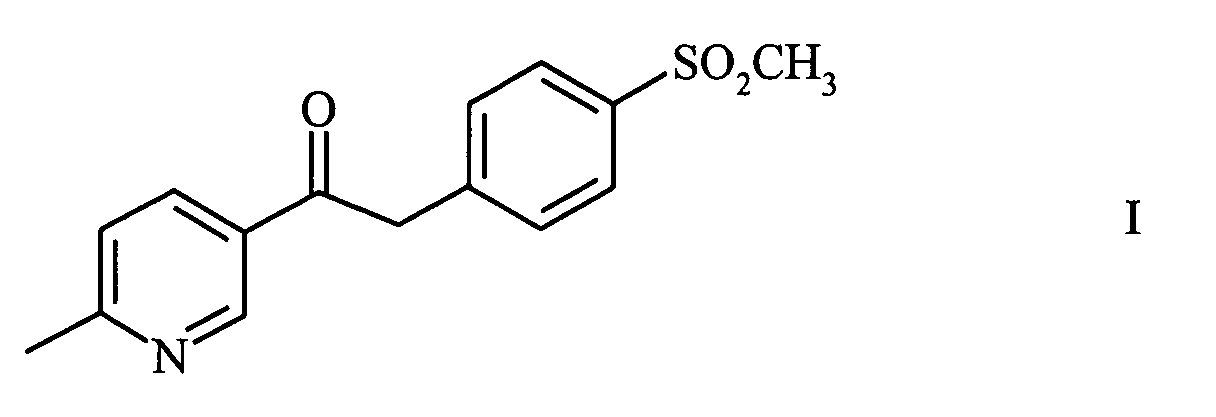
als Base ein Alkalialkoholat in Gegenwart eines organischen Lösungsmittels bei einer Reaktionstemperatur von 15 °C bis 25 °C verwendet wird. - Verfahren gemäss Patentanspruch 1, dadurch gekennzeichnet, dass das 4-(methylsulfonyl)benzylhalogenid 4-(Methylsulfonyl)benzylchlorid ist.
- Verfahren gemäss einem der Patentansprüche 1 und 2, dadurch gekennzeichnet, dass das Acetonitril zu einer Suspension des wasserfreien Alkalialkoholates zugegeben wird.
- Verfahren gemäss einem der Patentansprüche 1 bis 3, dadurch gekennzeichnet, dass das Alkalialkoholat ausgewählt ist aus der Gruppe umfassend Natrium tert-Butanolat, Kalium tert-Butanolat und Natrium tert-Pentylat.
- Verfahren gemäss Anspruch 4, dadurch gekennzeichnet, dass das Alkalialkoholat Kalium tert-Butanolat ist.
- Verfahren gemäss Anspruch 1 bis 5, dadurch gekennzeichnet, dass das organische Lösungsmittel ein Ether ist.
- Verfahren gemäss Anspruch 6, dadurch gekennzeichnet, dass der Ether Tetrahydrofuran ist.
Priority Applications (4)
| Application Number | Priority Date | Filing Date | Title |
|---|---|---|---|
| EP03024787A EP1394149B1 (de) | 1999-01-14 | 2000-01-13 | Verfahren zur Herstellung von 1-(6-Methylpyridin-3-yl)-2-[4-(methylsulfonyl)-phenyl]ethanon |
| ES03024787T ES2235138T3 (es) | 1999-01-14 | 2000-01-13 | Procedimiento para preparar 1-(6-metilpiridin-3-il)-2-((4-(metilsulfonil)-fenil)etanona. |
| PT03024787T PT1394149E (pt) | 1999-01-14 | 2000-01-13 | Processo para a producao de 1-(6-metilpiridin-3-il)-2-[4-(metilsulfonil)fenil]etanona |
| DK03024787T DK1394149T3 (da) | 1999-01-14 | 2000-01-13 | Fremgangsmåde til fremstilling af 1-(6-methylpyridin-3-yl)-2-[4-(methylsulfonyl)phenyl]ethanon |
Applications Claiming Priority (4)
| Application Number | Priority Date | Filing Date | Title |
|---|---|---|---|
| EP99100590 | 1999-01-14 | ||
| EP99100590 | 1999-01-14 | ||
| EP03024787A EP1394149B1 (de) | 1999-01-14 | 2000-01-13 | Verfahren zur Herstellung von 1-(6-Methylpyridin-3-yl)-2-[4-(methylsulfonyl)-phenyl]ethanon |
| EP00901555A EP1159270B1 (de) | 1999-01-14 | 2000-01-13 | Verfahren zur herstellung von 1-(6-methylpyridin-3-yl)-2- 4-(methylsulfonyl phenyl)ethanon |
Related Parent Applications (1)
| Application Number | Title | Priority Date | Filing Date |
|---|---|---|---|
| EP00901555A Division EP1159270B1 (de) | 1999-01-14 | 2000-01-13 | Verfahren zur herstellung von 1-(6-methylpyridin-3-yl)-2- 4-(methylsulfonyl phenyl)ethanon |
Publications (2)
| Publication Number | Publication Date |
|---|---|
| EP1394149A1 true EP1394149A1 (de) | 2004-03-03 |
| EP1394149B1 EP1394149B1 (de) | 2005-01-19 |
Family
ID=34089809
Family Applications (2)
| Application Number | Title | Priority Date | Filing Date |
|---|---|---|---|
| EP03024787A Expired - Lifetime EP1394149B1 (de) | 1999-01-14 | 2000-01-13 | Verfahren zur Herstellung von 1-(6-Methylpyridin-3-yl)-2-[4-(methylsulfonyl)-phenyl]ethanon |
| EP00901555A Expired - Lifetime EP1159270B1 (de) | 1999-01-14 | 2000-01-13 | Verfahren zur herstellung von 1-(6-methylpyridin-3-yl)-2- 4-(methylsulfonyl phenyl)ethanon |
Family Applications After (1)
| Application Number | Title | Priority Date | Filing Date |
|---|---|---|---|
| EP00901555A Expired - Lifetime EP1159270B1 (de) | 1999-01-14 | 2000-01-13 | Verfahren zur herstellung von 1-(6-methylpyridin-3-yl)-2- 4-(methylsulfonyl phenyl)ethanon |
Country Status (15)
| Country | Link |
|---|---|
| EP (2) | EP1394149B1 (de) |
| JP (1) | JP4765167B2 (de) |
| CN (2) | CN1170820C (de) |
| AT (2) | ATE287396T1 (de) |
| AU (1) | AU2290800A (de) |
| CA (2) | CA2359958C (de) |
| CZ (1) | CZ302270B6 (de) |
| DE (2) | DE50009312D1 (de) |
| DK (2) | DK1394149T3 (de) |
| ES (2) | ES2209807T3 (de) |
| HU (1) | HUP0105124A3 (de) |
| IL (1) | IL143981A0 (de) |
| PT (2) | PT1159270E (de) |
| SK (1) | SK284903B6 (de) |
| WO (1) | WO2000042014A2 (de) |
Families Citing this family (1)
| Publication number | Priority date | Publication date | Assignee | Title |
|---|---|---|---|---|
| CN104725300A (zh) * | 2015-02-28 | 2015-06-24 | 宁波九胜创新医药科技有限公司 | 一种1-(6-甲基吡啶-3-基)-2-(4-甲磺酰基苯基)乙酮的制备方法 |
Citations (3)
| Publication number | Priority date | Publication date | Assignee | Title |
|---|---|---|---|---|
| WO1998047871A1 (en) * | 1997-04-18 | 1998-10-29 | Merck & Co., Inc. | Process for making 2-aryl-3-aryl-5-halo pyridines useful as cox-2 inhibitors |
| WO1999015503A2 (en) * | 1997-09-25 | 1999-04-01 | Merck & Co., Inc. | Process for making diaryl pyridines useful as cox-2 inhibitors |
| WO1999055830A2 (en) * | 1998-04-24 | 1999-11-04 | Merck & Co., Inc. | Process for synthesizing cox-2 inhibitors |
Family Cites Families (5)
| Publication number | Priority date | Publication date | Assignee | Title |
|---|---|---|---|---|
| US3313683A (en) * | 1963-04-22 | 1967-04-11 | Lilly Co Eli | Nematocidal and fungicidal methods |
| FR2074674A1 (en) * | 1970-01-16 | 1971-10-08 | Simafex | Sulphonamide/aldehyde-bisulphite complexes - antibacterials with very high solubility in water |
| US4155909A (en) * | 1977-06-13 | 1979-05-22 | Philip Morris Incorporated | 2-Alkyl nicotinoids and processes for their production |
| US5596008A (en) * | 1995-02-10 | 1997-01-21 | G. D. Searle & Co. | 3,4-Diaryl substituted pyridines for the treatment of inflammation |
| IL127441A (en) * | 1996-07-18 | 2003-02-12 | Merck Frosst Canada Inc | Substituted pyridines, pharmaceutical compositions comprising them and their use in the preparation of anti-inflammatory medicaments or as selective cyclooxygenase-2 inhibitors |
-
2000
- 2000-01-13 WO PCT/EP2000/000240 patent/WO2000042014A2/de not_active Ceased
- 2000-01-13 IL IL14398100A patent/IL143981A0/xx active IP Right Grant
- 2000-01-13 JP JP2000593582A patent/JP4765167B2/ja not_active Expired - Fee Related
- 2000-01-13 DK DK03024787T patent/DK1394149T3/da active
- 2000-01-13 PT PT00901555T patent/PT1159270E/pt unknown
- 2000-01-13 DE DE50009312T patent/DE50009312D1/de not_active Expired - Lifetime
- 2000-01-13 CA CA002359958A patent/CA2359958C/en not_active Expired - Fee Related
- 2000-01-13 CN CNB008027218A patent/CN1170820C/zh not_active Expired - Fee Related
- 2000-01-13 HU HU0105124A patent/HUP0105124A3/hu unknown
- 2000-01-13 SK SK972-2001A patent/SK284903B6/sk not_active IP Right Cessation
- 2000-01-13 ES ES00901555T patent/ES2209807T3/es not_active Expired - Lifetime
- 2000-01-13 AU AU22908/00A patent/AU2290800A/en not_active Abandoned
- 2000-01-13 AT AT03024787T patent/ATE287396T1/de active
- 2000-01-13 CZ CZ20012457A patent/CZ302270B6/cs not_active IP Right Cessation
- 2000-01-13 ES ES03024787T patent/ES2235138T3/es not_active Expired - Lifetime
- 2000-01-13 EP EP03024787A patent/EP1394149B1/de not_active Expired - Lifetime
- 2000-01-13 DK DK00901555T patent/DK1159270T3/da active
- 2000-01-13 AT AT00901555T patent/ATE253559T1/de active
- 2000-01-13 CN CNB200410069946XA patent/CN1281589C/zh not_active Expired - Fee Related
- 2000-01-13 PT PT03024787T patent/PT1394149E/pt unknown
- 2000-01-13 EP EP00901555A patent/EP1159270B1/de not_active Expired - Lifetime
- 2000-01-13 DE DE50004327T patent/DE50004327D1/de not_active Expired - Lifetime
- 2000-01-13 CA CA002485739A patent/CA2485739C/en not_active Expired - Fee Related
Patent Citations (3)
| Publication number | Priority date | Publication date | Assignee | Title |
|---|---|---|---|---|
| WO1998047871A1 (en) * | 1997-04-18 | 1998-10-29 | Merck & Co., Inc. | Process for making 2-aryl-3-aryl-5-halo pyridines useful as cox-2 inhibitors |
| WO1999015503A2 (en) * | 1997-09-25 | 1999-04-01 | Merck & Co., Inc. | Process for making diaryl pyridines useful as cox-2 inhibitors |
| WO1999055830A2 (en) * | 1998-04-24 | 1999-11-04 | Merck & Co., Inc. | Process for synthesizing cox-2 inhibitors |
Non-Patent Citations (2)
| Title |
|---|
| BADIA D ET AL: "UNSYMMETRICALLY SUBSTITUTED DEOXYBENZOINS; AN IMPROVED PREPARATIVE ROUTE", BULLETIN DES SOCIETES CHIMIQUES BELGES,GB,PERGAMON PRESS, vol. 98, no. 1, 1989, pages 77 - 81, XP000886342 * |
| BRAY B L ET AL: "SYNTHESIS OF ACYLPYRROLES VIA ALPHA-(DIMETHYLAMINO)-ALPHA-PYRROLYLACETONITRILES", JOURNAL OF ORGANIC CHEMISTRY,US,AMERICAN CHEMICAL SOCIETY, vol. 53, no. 26, 1988, pages 6115 - 6118, XP000886363 * |
Also Published As
| Publication number | Publication date |
|---|---|
| CN1583723A (zh) | 2005-02-23 |
| ES2209807T3 (es) | 2004-07-01 |
| DE50009312D1 (de) | 2005-02-24 |
| CZ20012457A3 (cs) | 2002-01-16 |
| ATE287396T1 (de) | 2005-02-15 |
| HUP0105124A2 (hu) | 2002-04-29 |
| SK9722001A3 (en) | 2001-12-03 |
| DK1394149T3 (da) | 2005-04-04 |
| ATE253559T1 (de) | 2003-11-15 |
| IL143981A0 (en) | 2002-04-21 |
| CN1170820C (zh) | 2004-10-13 |
| PT1159270E (pt) | 2004-03-31 |
| JP4765167B2 (ja) | 2011-09-07 |
| DE50004327D1 (de) | 2003-12-11 |
| CA2485739A1 (en) | 2000-07-20 |
| CN1359374A (zh) | 2002-07-17 |
| CA2485739C (en) | 2009-09-22 |
| EP1159270A2 (de) | 2001-12-05 |
| CZ302270B6 (cs) | 2011-01-19 |
| SK284903B6 (sk) | 2006-02-02 |
| EP1394149B1 (de) | 2005-01-19 |
| WO2000042014A3 (de) | 2000-12-07 |
| CA2359958C (en) | 2006-04-04 |
| ES2235138T3 (es) | 2005-07-01 |
| DK1159270T3 (da) | 2004-02-23 |
| HUP0105124A3 (en) | 2002-05-28 |
| AU2290800A (en) | 2000-08-01 |
| CA2359958A1 (en) | 2000-07-20 |
| JP2003518002A (ja) | 2003-06-03 |
| CN1281589C (zh) | 2006-10-25 |
| PT1394149E (pt) | 2005-05-31 |
| WO2000042014A2 (de) | 2000-07-20 |
| EP1159270B1 (de) | 2003-11-05 |
Similar Documents
| Publication | Publication Date | Title |
|---|---|---|
| Baskaran et al. | A general approach to the synthesis of butanolides: synthesis of the sex pheromone of the Japanese beetle | |
| DE2812713C2 (de) | ||
| EP1219591B1 (de) | Verbessertes Verfahren zur Herstellung von 2-(4-Trifluormethoxyphenyl)ethylamin | |
| EP1159270B1 (de) | Verfahren zur herstellung von 1-(6-methylpyridin-3-yl)-2- 4-(methylsulfonyl phenyl)ethanon | |
| CH702298B1 (de) | Verfahren zur Herstellung von Cyanoalkylpropionat-Derivaten. | |
| EP0052314B2 (de) | Herstellung von Monoalkyläthern von Hydroxyphenolen | |
| DE2315355A1 (de) | Verfahren zur herstellung von oximen | |
| EP2526081B1 (de) | Verfahren zur herstellung von aryl- und heteroarylessigsäure-derivaten | |
| DE60007133T2 (de) | Verfahren zur herstellung von 1-(6-methylpyridin-3-yl)-2-[(4-(methylsulfonyl)phenyl] ethanon | |
| EP0093425B1 (de) | Ungesättigte, cyclische Ketone | |
| EP0825168B1 (de) | Herstellung eines gamma-Halogentiglinaldehyds | |
| EP0025939B1 (de) | Aliphatische Methoxy- und Hydroxynitrile, deren Herstellung und deren Verwendung als Riechstoff | |
| DE60304226T2 (de) | Verfahren zur herstellung 2,5-disubstituierter 3-alkylthiophenen | |
| DE3137802A1 (de) | Verfahren zur herstellung von derivaten des 1-formyl-2,6,6-trimethyl-cyclohex-1-ens | |
| DE3044904A1 (de) | Fluorierte anthranilsaeure und anthranilsaeurenitril sowie verfahren zu ihrer herstellung | |
| EP0542086B1 (de) | Verfahren zur Herstellung von N-[(2-Chlor-pyridin-5-yl)methyl]-ethylendiamin | |
| DE69613256T2 (de) | Verfahren zur Herstellung von Ketonitril-Derivaten und Hexenon-Derivaten | |
| DE2630837C3 (de) | Verfahren zur Herstellung von Dihydro-β -pyronen | |
| EP0175264B1 (de) | Verfahren zur Herstellung von 2-Amino-3-cyano-5-dialkoxymethyl-pyrazinen und Zwischenprodukte für dieses Verfahren | |
| DE2646445A1 (de) | Bicycloheptan-derivate, verfahren zu ihrer herstellung und diese enthaltende arzneimittel | |
| DD150057A5 (de) | Verfahren zur herstellung von 2-aminopyrazinen | |
| DE2264663C3 (de) | Ungesättigte Sulfoxyde und Verfahren zu ihrer Herstellung | |
| DE3214546C2 (de) | 15-Sulfonyl-12-Pentadecanolide und deren Verwendung in einem Verfahren zur Herstellung von 5-Hydroxy-cyclopentadecanonen | |
| AT360992B (de) | Verfahren zur herstellung neuer phenylazacyclo- alkane und von deren salzen und optisch aktiven verbindungen | |
| JPH0225907B2 (de) |
Legal Events
| Date | Code | Title | Description |
|---|---|---|---|
| PUAI | Public reference made under article 153(3) epc to a published international application that has entered the european phase |
Free format text: ORIGINAL CODE: 0009012 |
|
| AC | Divisional application: reference to earlier application |
Ref document number: 1159270 Country of ref document: EP Kind code of ref document: P |
|
| AK | Designated contracting states |
Kind code of ref document: A1 Designated state(s): AT BE CH CY DE DK ES FI FR GB GR IE IT LI LU MC NL PT SE |
|
| RIN1 | Information on inventor provided before grant (corrected) |
Inventor name: KUO, DAVID Inventor name: LERESCHE, JAMES Inventor name: BESSARD, YVES Inventor name: ARMBRUSTER, ERICH Inventor name: RODUIT, JEAN-PAUL Inventor name: PROPLESCH, RALF |
|
| RAP1 | Party data changed (applicant data changed or rights of an application transferred) |
Owner name: LONZA AG |
|
| RIN1 | Information on inventor provided before grant (corrected) |
Inventor name: LERESCHE, JAMES Inventor name: KUO, DAVID Inventor name: ARMBRUSTER, ERICH Inventor name: RODUIT, JEAN-PAUL Inventor name: BESSARD, YVES Inventor name: PROPLESCH, RALF |
|
| GRAP | Despatch of communication of intention to grant a patent |
Free format text: ORIGINAL CODE: EPIDOSNIGR1 |
|
| 17P | Request for examination filed |
Effective date: 20040505 |
|
| AKX | Designation fees paid |
Designated state(s): AT BE CH CY DE DK ES FI FR GB GR IE IT LI LU MC NL PT SE |
|
| GRAS | Grant fee paid |
Free format text: ORIGINAL CODE: EPIDOSNIGR3 |
|
| GRAA | (expected) grant |
Free format text: ORIGINAL CODE: 0009210 |
|
| AC | Divisional application: reference to earlier application |
Ref document number: 1159270 Country of ref document: EP Kind code of ref document: P |
|
| AK | Designated contracting states |
Kind code of ref document: B1 Designated state(s): AT BE CH CY DE DK ES FI FR GB GR IE IT LI LU MC NL PT SE |
|
| PG25 | Lapsed in a contracting state [announced via postgrant information from national office to epo] |
Ref country code: IT Free format text: LAPSE BECAUSE OF NON-PAYMENT OF DUE FEES Effective date: 20050119 Ref country code: FI Free format text: LAPSE BECAUSE OF FAILURE TO SUBMIT A TRANSLATION OF THE DESCRIPTION OR TO PAY THE FEE WITHIN THE PRESCRIBED TIME-LIMIT Effective date: 20050119 |
|
| REG | Reference to a national code |
Ref country code: GB Ref legal event code: FG4D Free format text: NOT ENGLISH |
|
| REG | Reference to a national code |
Ref country code: CH Ref legal event code: EP |
|
| REG | Reference to a national code |
Ref country code: IE Ref legal event code: FG4D Free format text: GERMAN |
|
| REF | Corresponds to: |
Ref document number: 50009312 Country of ref document: DE Date of ref document: 20050224 Kind code of ref document: P |
|
| REG | Reference to a national code |
Ref country code: DK Ref legal event code: T3 |
|
| PG25 | Lapsed in a contracting state [announced via postgrant information from national office to epo] |
Ref country code: GR Free format text: LAPSE BECAUSE OF FAILURE TO SUBMIT A TRANSLATION OF THE DESCRIPTION OR TO PAY THE FEE WITHIN THE PRESCRIBED TIME-LIMIT Effective date: 20050419 |
|
| GBT | Gb: translation of ep patent filed (gb section 77(6)(a)/1977) |
Effective date: 20050330 |
|
| REG | Reference to a national code |
Ref country code: SE Ref legal event code: TRGR |
|
| REG | Reference to a national code |
Ref country code: PT Ref legal event code: SC4A Free format text: AVAILABILITY OF NATIONAL TRANSLATION Effective date: 20050408 |
|
| REG | Reference to a national code |
Ref country code: ES Ref legal event code: FG2A Ref document number: 2235138 Country of ref document: ES Kind code of ref document: T3 |
|
| PLBE | No opposition filed within time limit |
Free format text: ORIGINAL CODE: 0009261 |
|
| STAA | Information on the status of an ep patent application or granted ep patent |
Free format text: STATUS: NO OPPOSITION FILED WITHIN TIME LIMIT |
|
| ET | Fr: translation filed | ||
| 26N | No opposition filed |
Effective date: 20051020 |
|
| PG25 | Lapsed in a contracting state [announced via postgrant information from national office to epo] |
Ref country code: MC Free format text: LAPSE BECAUSE OF NON-PAYMENT OF DUE FEES Effective date: 20060131 Ref country code: LU Free format text: LAPSE BECAUSE OF NON-PAYMENT OF DUE FEES Effective date: 20060131 |
|
| PG25 | Lapsed in a contracting state [announced via postgrant information from national office to epo] |
Ref country code: CY Free format text: LAPSE BECAUSE OF FAILURE TO SUBMIT A TRANSLATION OF THE DESCRIPTION OR TO PAY THE FEE WITHIN THE PRESCRIBED TIME-LIMIT Effective date: 20050119 |
|
| PGRI | Patent reinstated in contracting state [announced from national office to epo] |
Ref country code: IT Effective date: 20091201 |
|
| PGFP | Annual fee paid to national office [announced via postgrant information from national office to epo] |
Ref country code: FR Payment date: 20101125 Year of fee payment: 12 Ref country code: DK Payment date: 20101116 Year of fee payment: 12 Ref country code: NL Payment date: 20101112 Year of fee payment: 12 |
|
| PGFP | Annual fee paid to national office [announced via postgrant information from national office to epo] |
Ref country code: CH Payment date: 20101215 Year of fee payment: 12 Ref country code: PT Payment date: 20101111 Year of fee payment: 12 |
|
| PGFP | Annual fee paid to national office [announced via postgrant information from national office to epo] |
Ref country code: GB Payment date: 20101112 Year of fee payment: 12 Ref country code: SE Payment date: 20101115 Year of fee payment: 12 Ref country code: BE Payment date: 20101112 Year of fee payment: 12 |
|
| PGRI | Patent reinstated in contracting state [announced from national office to epo] |
Ref country code: IT Effective date: 20091201 |
|
| PGFP | Annual fee paid to national office [announced via postgrant information from national office to epo] |
Ref country code: IE Payment date: 20110125 Year of fee payment: 12 |
|
| PGFP | Annual fee paid to national office [announced via postgrant information from national office to epo] |
Ref country code: AT Payment date: 20101112 Year of fee payment: 12 Ref country code: DE Payment date: 20101116 Year of fee payment: 12 |
|
| PGFP | Annual fee paid to national office [announced via postgrant information from national office to epo] |
Ref country code: IT Payment date: 20110119 Year of fee payment: 12 Ref country code: ES Payment date: 20110120 Year of fee payment: 12 |
|
| PGRI | Patent reinstated in contracting state [announced from national office to epo] |
Ref country code: IT Effective date: 20110616 |
|
| REG | Reference to a national code |
Ref country code: PT Ref legal event code: MM4A Free format text: LAPSE DUE TO NON-PAYMENT OF FEES Effective date: 20120713 |
|
| BERE | Be: lapsed |
Owner name: *LONZA A.G. Effective date: 20120131 |
|
| REG | Reference to a national code |
Ref country code: NL Ref legal event code: V1 Effective date: 20120801 |
|
| REG | Reference to a national code |
Ref country code: CH Ref legal event code: PL |
|
| REG | Reference to a national code |
Ref country code: SE Ref legal event code: EUG |
|
| REG | Reference to a national code |
Ref country code: DK Ref legal event code: EBP |
|
| GBPC | Gb: european patent ceased through non-payment of renewal fee |
Effective date: 20120113 |
|
| REG | Reference to a national code |
Ref country code: FR Ref legal event code: ST Effective date: 20120928 |
|
| REG | Reference to a national code |
Ref country code: IE Ref legal event code: MM4A |
|
| PG25 | Lapsed in a contracting state [announced via postgrant information from national office to epo] |
Ref country code: DE Free format text: LAPSE BECAUSE OF NON-PAYMENT OF DUE FEES Effective date: 20120801 Ref country code: LI Free format text: LAPSE BECAUSE OF NON-PAYMENT OF DUE FEES Effective date: 20120131 Ref country code: CH Free format text: LAPSE BECAUSE OF NON-PAYMENT OF DUE FEES Effective date: 20120131 Ref country code: SE Free format text: LAPSE BECAUSE OF NON-PAYMENT OF DUE FEES Effective date: 20120114 Ref country code: GB Free format text: LAPSE BECAUSE OF NON-PAYMENT OF DUE FEES Effective date: 20120113 |
|
| REG | Reference to a national code |
Ref country code: DE Ref legal event code: R119 Ref document number: 50009312 Country of ref document: DE Effective date: 20120801 |
|
| PG25 | Lapsed in a contracting state [announced via postgrant information from national office to epo] |
Ref country code: PT Free format text: LAPSE BECAUSE OF NON-PAYMENT OF DUE FEES Effective date: 20120713 Ref country code: IT Free format text: LAPSE BECAUSE OF NON-PAYMENT OF DUE FEES Effective date: 20120113 |
|
| REG | Reference to a national code |
Ref country code: AT Ref legal event code: MM01 Ref document number: 287396 Country of ref document: AT Kind code of ref document: T Effective date: 20120113 |
|
| PG25 | Lapsed in a contracting state [announced via postgrant information from national office to epo] |
Ref country code: BE Free format text: LAPSE BECAUSE OF NON-PAYMENT OF DUE FEES Effective date: 20120131 Ref country code: FR Free format text: LAPSE BECAUSE OF NON-PAYMENT OF DUE FEES Effective date: 20120131 |
|
| PG25 | Lapsed in a contracting state [announced via postgrant information from national office to epo] |
Ref country code: NL Free format text: LAPSE BECAUSE OF NON-PAYMENT OF DUE FEES Effective date: 20120801 Ref country code: AT Free format text: LAPSE BECAUSE OF NON-PAYMENT OF DUE FEES Effective date: 20120113 Ref country code: IE Free format text: LAPSE BECAUSE OF NON-PAYMENT OF DUE FEES Effective date: 20120113 Ref country code: DK Free format text: LAPSE BECAUSE OF NON-PAYMENT OF DUE FEES Effective date: 20120131 |
|
| REG | Reference to a national code |
Ref country code: ES Ref legal event code: FD2A Effective date: 20130705 |
|
| PG25 | Lapsed in a contracting state [announced via postgrant information from national office to epo] |
Ref country code: ES Free format text: LAPSE BECAUSE OF NON-PAYMENT OF DUE FEES Effective date: 20120114 |