EP1401799B1 - Herstellungsverfahren für halogenierte aromatische methylamine - Google Patents
Herstellungsverfahren für halogenierte aromatische methylamine Download PDFInfo
- Publication number
- EP1401799B1 EP1401799B1 EP02736129A EP02736129A EP1401799B1 EP 1401799 B1 EP1401799 B1 EP 1401799B1 EP 02736129 A EP02736129 A EP 02736129A EP 02736129 A EP02736129 A EP 02736129A EP 1401799 B1 EP1401799 B1 EP 1401799B1
- Authority
- EP
- European Patent Office
- Prior art keywords
- halogenated aromatic
- production process
- methylamine
- solvent
- aromatic methylamine
- Prior art date
- Legal status (The legal status is an assumption and is not a legal conclusion. Google has not performed a legal analysis and makes no representation as to the accuracy of the status listed.)
- Expired - Lifetime
Links
- BAVYZALUXZFZLV-UHFFFAOYSA-N Methylamine Chemical compound NC BAVYZALUXZFZLV-UHFFFAOYSA-N 0.000 title claims abstract description 100
- 125000003118 aryl group Chemical group 0.000 title claims abstract description 50
- 238000004519 manufacturing process Methods 0.000 title claims abstract description 43
- 239000002904 solvent Substances 0.000 claims abstract description 33
- -1 halogenated aromatic nitrile Chemical class 0.000 claims abstract description 23
- 239000003054 catalyst Substances 0.000 claims abstract description 18
- 238000000034 method Methods 0.000 claims abstract description 12
- 229910052801 chlorine Inorganic materials 0.000 claims abstract description 7
- 229910052731 fluorine Chemical group 0.000 claims abstract description 7
- 125000001309 chloro group Chemical group Cl* 0.000 claims abstract description 6
- 125000001153 fluoro group Chemical group F* 0.000 claims abstract description 6
- 150000007524 organic acids Chemical class 0.000 claims abstract description 3
- PXHVJJICTQNCMI-UHFFFAOYSA-N Nickel Chemical compound [Ni] PXHVJJICTQNCMI-UHFFFAOYSA-N 0.000 claims description 36
- YXFVVABEGXRONW-UHFFFAOYSA-N Toluene Chemical compound CC1=CC=CC=C1 YXFVVABEGXRONW-UHFFFAOYSA-N 0.000 claims description 30
- 238000006243 chemical reaction Methods 0.000 claims description 29
- QTBSBXVTEAMEQO-UHFFFAOYSA-N Acetic acid Chemical compound CC(O)=O QTBSBXVTEAMEQO-UHFFFAOYSA-N 0.000 claims description 27
- XLYOFNOQVPJJNP-UHFFFAOYSA-N water Substances O XLYOFNOQVPJJNP-UHFFFAOYSA-N 0.000 claims description 26
- XEKOWRVHYACXOJ-UHFFFAOYSA-N Ethyl acetate Chemical compound CCOC(C)=O XEKOWRVHYACXOJ-UHFFFAOYSA-N 0.000 claims description 18
- UFHFLCQGNIYNRP-UHFFFAOYSA-N Hydrogen Chemical compound [H][H] UFHFLCQGNIYNRP-UHFFFAOYSA-N 0.000 claims description 15
- 229910052759 nickel Inorganic materials 0.000 claims description 15
- PCRSJGWFEMHHEW-UHFFFAOYSA-N 2,3,5,6-tetrafluorobenzene-1,4-dicarbonitrile Chemical compound FC1=C(F)C(C#N)=C(F)C(F)=C1C#N PCRSJGWFEMHHEW-UHFFFAOYSA-N 0.000 claims description 14
- ITWVFCRJCQTFSX-UHFFFAOYSA-N [6-(aminomethyl)-2,3,5,6-tetrafluorocyclohexa-2,4-dien-1-yl]methanamine Chemical compound NCC1C(F)=C(F)C=C(F)C1(F)CN ITWVFCRJCQTFSX-UHFFFAOYSA-N 0.000 claims description 13
- 239000001257 hydrogen Substances 0.000 claims description 13
- 229910052739 hydrogen Inorganic materials 0.000 claims description 13
- YNQLUTRBYVCPMQ-UHFFFAOYSA-N Ethylbenzene Chemical compound CCC1=CC=CC=C1 YNQLUTRBYVCPMQ-UHFFFAOYSA-N 0.000 claims description 12
- UHOVQNZJYSORNB-UHFFFAOYSA-N Benzene Chemical compound C1=CC=CC=C1 UHOVQNZJYSORNB-UHFFFAOYSA-N 0.000 claims description 11
- 150000001732 carboxylic acid derivatives Chemical class 0.000 claims description 10
- OKKJLVBELUTLKV-UHFFFAOYSA-N Methanol Chemical compound OC OKKJLVBELUTLKV-UHFFFAOYSA-N 0.000 claims description 9
- 235000011054 acetic acid Nutrition 0.000 claims description 9
- VLKZOEOYAKHREP-UHFFFAOYSA-N n-Hexane Chemical compound CCCCCC VLKZOEOYAKHREP-UHFFFAOYSA-N 0.000 claims description 9
- LFQSCWFLJHTTHZ-UHFFFAOYSA-N Ethanol Chemical compound CCO LFQSCWFLJHTTHZ-UHFFFAOYSA-N 0.000 claims description 8
- 150000004945 aromatic hydrocarbons Chemical class 0.000 claims description 8
- 229910017052 cobalt Inorganic materials 0.000 claims description 8
- 239000010941 cobalt Substances 0.000 claims description 8
- GUTLYIVDDKVIGB-UHFFFAOYSA-N cobalt atom Chemical compound [Co] GUTLYIVDDKVIGB-UHFFFAOYSA-N 0.000 claims description 8
- XBDQKXXYIPTUBI-UHFFFAOYSA-N dimethylselenoniopropionate Natural products CCC(O)=O XBDQKXXYIPTUBI-UHFFFAOYSA-N 0.000 claims description 8
- BDAGIHXWWSANSR-UHFFFAOYSA-N methanoic acid Natural products OC=O BDAGIHXWWSANSR-UHFFFAOYSA-N 0.000 claims description 8
- CTQNGGLPUBDAKN-UHFFFAOYSA-N O-Xylene Chemical compound CC1=CC=CC=C1C CTQNGGLPUBDAKN-UHFFFAOYSA-N 0.000 claims description 7
- 239000008096 xylene Substances 0.000 claims description 7
- WYURNTSHIVDZCO-UHFFFAOYSA-N Tetrahydrofuran Chemical compound C1CCOC1 WYURNTSHIVDZCO-UHFFFAOYSA-N 0.000 claims description 6
- 239000003960 organic solvent Substances 0.000 claims description 6
- 229910052751 metal Inorganic materials 0.000 claims description 5
- 239000002184 metal Substances 0.000 claims description 5
- 125000002560 nitrile group Chemical group 0.000 claims description 5
- OSWFIVFLDKOXQC-UHFFFAOYSA-N 4-(3-methoxyphenyl)aniline Chemical compound COC1=CC=CC(C=2C=CC(N)=CC=2)=C1 OSWFIVFLDKOXQC-UHFFFAOYSA-N 0.000 claims description 4
- ZOKXTWBITQBERF-UHFFFAOYSA-N Molybdenum Chemical group [Mo] ZOKXTWBITQBERF-UHFFFAOYSA-N 0.000 claims description 4
- 150000002148 esters Chemical class 0.000 claims description 4
- 235000019253 formic acid Nutrition 0.000 claims description 4
- 229910052750 molybdenum Inorganic materials 0.000 claims description 4
- 239000011733 molybdenum Substances 0.000 claims description 4
- 235000019260 propionic acid Nutrition 0.000 claims description 4
- IUVKMZGDUIUOCP-BTNSXGMBSA-N quinbolone Chemical compound O([C@H]1CC[C@H]2[C@H]3[C@@H]([C@]4(C=CC(=O)C=C4CC3)C)CC[C@@]21C)C1=CCCC1 IUVKMZGDUIUOCP-BTNSXGMBSA-N 0.000 claims description 4
- WNXJIVFYUVYPPR-UHFFFAOYSA-N 1,3-dioxolane Chemical compound C1COCO1 WNXJIVFYUVYPPR-UHFFFAOYSA-N 0.000 claims description 3
- RYHBNJHYFVUHQT-UHFFFAOYSA-N 1,4-Dioxane Chemical compound C1COCCO1 RYHBNJHYFVUHQT-UHFFFAOYSA-N 0.000 claims description 3
- WVHMPQKZPHOCRD-UHFFFAOYSA-N 2,4,5,6-tetrafluorobenzene-1,3-dicarbonitrile Chemical compound FC1=C(F)C(C#N)=C(F)C(C#N)=C1F WVHMPQKZPHOCRD-UHFFFAOYSA-N 0.000 claims description 3
- XDTMQSROBMDMFD-UHFFFAOYSA-N Cyclohexane Chemical compound C1CCCCC1 XDTMQSROBMDMFD-UHFFFAOYSA-N 0.000 claims description 3
- APQPGGDUHGZHKZ-UHFFFAOYSA-N [6-(aminomethyl)-2,4,5,6-tetrafluorocyclohexa-2,4-dien-1-yl]methanamine Chemical compound NCC1C(F)=CC(F)=C(F)C1(F)CN APQPGGDUHGZHKZ-UHFFFAOYSA-N 0.000 claims description 3
- 150000001298 alcohols Chemical class 0.000 claims description 3
- 150000001338 aliphatic hydrocarbons Chemical class 0.000 claims description 3
- 150000002170 ethers Chemical class 0.000 claims description 3
- 238000002203 pretreatment Methods 0.000 claims description 3
- BDERNNFJNOPAEC-UHFFFAOYSA-N propan-1-ol Chemical compound CCCO BDERNNFJNOPAEC-UHFFFAOYSA-N 0.000 claims description 3
- YLQBMQCUIZJEEH-UHFFFAOYSA-N tetrahydrofuran Natural products C=1C=COC=1 YLQBMQCUIZJEEH-UHFFFAOYSA-N 0.000 claims description 3
- 239000003905 agrochemical Substances 0.000 abstract description 3
- 238000002360 preparation method Methods 0.000 abstract 1
- 238000004817 gas chromatography Methods 0.000 description 10
- 239000000243 solution Substances 0.000 description 9
- 238000010813 internal standard method Methods 0.000 description 7
- 230000000694 effects Effects 0.000 description 5
- 150000001412 amines Chemical class 0.000 description 4
- 125000003277 amino group Chemical group 0.000 description 4
- 238000003756 stirring Methods 0.000 description 4
- LYCAIKOWRPUZTN-UHFFFAOYSA-N Ethylene glycol Chemical compound OCCO LYCAIKOWRPUZTN-UHFFFAOYSA-N 0.000 description 3
- MUBZPKHOEPUJKR-UHFFFAOYSA-N Oxalic acid Chemical compound OC(=O)C(O)=O MUBZPKHOEPUJKR-UHFFFAOYSA-N 0.000 description 3
- DNIAPMSPPWPWGF-UHFFFAOYSA-N Propylene glycol Chemical compound CC(O)CO DNIAPMSPPWPWGF-UHFFFAOYSA-N 0.000 description 3
- HEMHJVSKTPXQMS-UHFFFAOYSA-M Sodium hydroxide Chemical compound [OH-].[Na+] HEMHJVSKTPXQMS-UHFFFAOYSA-M 0.000 description 3
- QAOWNCQODCNURD-UHFFFAOYSA-N Sulfuric acid Chemical compound OS(O)(=O)=O QAOWNCQODCNURD-UHFFFAOYSA-N 0.000 description 3
- 239000002253 acid Substances 0.000 description 3
- 238000004458 analytical method Methods 0.000 description 3
- KRKNYBCHXYNGOX-UHFFFAOYSA-N citric acid Chemical compound OC(=O)CC(O)(C(O)=O)CC(O)=O KRKNYBCHXYNGOX-UHFFFAOYSA-N 0.000 description 3
- 150000001875 compounds Chemical class 0.000 description 3
- 229910052736 halogen Inorganic materials 0.000 description 3
- 150000002367 halogens Chemical class 0.000 description 3
- 238000002955 isolation Methods 0.000 description 3
- 238000011084 recovery Methods 0.000 description 3
- 238000006722 reduction reaction Methods 0.000 description 3
- 238000007086 side reaction Methods 0.000 description 3
- QGZKDVFQNNGYKY-UHFFFAOYSA-N Ammonia Chemical compound N QGZKDVFQNNGYKY-UHFFFAOYSA-N 0.000 description 2
- IJGRMHOSHXDMSA-UHFFFAOYSA-N Atomic nitrogen Chemical compound N#N IJGRMHOSHXDMSA-UHFFFAOYSA-N 0.000 description 2
- DKPFZGUDAPQIHT-UHFFFAOYSA-N Butyl acetate Natural products CCCCOC(C)=O DKPFZGUDAPQIHT-UHFFFAOYSA-N 0.000 description 2
- PEDCQBHIVMGVHV-UHFFFAOYSA-N Glycerine Chemical compound OCC(O)CO PEDCQBHIVMGVHV-UHFFFAOYSA-N 0.000 description 2
- AEMRFAOFKBGASW-UHFFFAOYSA-N Glycolic acid Chemical compound OCC(O)=O AEMRFAOFKBGASW-UHFFFAOYSA-N 0.000 description 2
- LRHPLDYGYMQRHN-UHFFFAOYSA-N N-Butanol Chemical compound CCCCO LRHPLDYGYMQRHN-UHFFFAOYSA-N 0.000 description 2
- KDLHZDBZIXYQEI-UHFFFAOYSA-N Palladium Chemical compound [Pd] KDLHZDBZIXYQEI-UHFFFAOYSA-N 0.000 description 2
- GKXVJHDEWHKBFH-UHFFFAOYSA-N [2-(aminomethyl)phenyl]methanamine Chemical compound NCC1=CC=CC=C1CN GKXVJHDEWHKBFH-UHFFFAOYSA-N 0.000 description 2
- 230000002378 acidificating effect Effects 0.000 description 2
- BHXFKXOIODIUJO-UHFFFAOYSA-N benzene-1,4-dicarbonitrile Chemical compound N#CC1=CC=C(C#N)C=C1 BHXFKXOIODIUJO-UHFFFAOYSA-N 0.000 description 2
- WPYMKLBDIGXBTP-UHFFFAOYSA-N benzoic acid Chemical compound OC(=O)C1=CC=CC=C1 WPYMKLBDIGXBTP-UHFFFAOYSA-N 0.000 description 2
- WERYXYBDKMZEQL-UHFFFAOYSA-N butane-1,4-diol Chemical compound OCCCCO WERYXYBDKMZEQL-UHFFFAOYSA-N 0.000 description 2
- 229940043232 butyl acetate Drugs 0.000 description 2
- 150000001735 carboxylic acids Chemical class 0.000 description 2
- 238000001914 filtration Methods 0.000 description 2
- 125000005843 halogen group Chemical group 0.000 description 2
- FUZZWVXGSFPDMH-UHFFFAOYSA-N hexanoic acid Chemical compound CCCCCC(O)=O FUZZWVXGSFPDMH-UHFFFAOYSA-N 0.000 description 2
- 238000006467 substitution reaction Methods 0.000 description 2
- 239000000758 substrate Substances 0.000 description 2
- YXWJGZQOGXGSSC-UHFFFAOYSA-N 2,3,4,5,6-pentafluorobenzonitrile Chemical compound FC1=C(F)C(F)=C(C#N)C(F)=C1F YXWJGZQOGXGSSC-UHFFFAOYSA-N 0.000 description 1
- GLTGXIGJLCSEAM-UHFFFAOYSA-N 2,3,4,5-tetrafluorobenzonitrile Chemical compound FC1=CC(C#N)=C(F)C(F)=C1F GLTGXIGJLCSEAM-UHFFFAOYSA-N 0.000 description 1
- XWDUWNUFQUWNNG-UHFFFAOYSA-N 2,3,4,6-tetrafluorobenzonitrile Chemical compound FC1=CC(F)=C(C#N)C(F)=C1F XWDUWNUFQUWNNG-UHFFFAOYSA-N 0.000 description 1
- TXRVDQMSXQKAPG-UHFFFAOYSA-N 2,3,5,6-tetrachlorobenzene-1,4-dicarbonitrile Chemical compound ClC1=C(Cl)C(C#N)=C(Cl)C(Cl)=C1C#N TXRVDQMSXQKAPG-UHFFFAOYSA-N 0.000 description 1
- IOQMWOBRUDNEOA-UHFFFAOYSA-N 2,3,5,6-tetrafluorobenzonitrile Chemical compound FC1=CC(F)=C(F)C(C#N)=C1F IOQMWOBRUDNEOA-UHFFFAOYSA-N 0.000 description 1
- XNWFRZJHXBZDAG-UHFFFAOYSA-N 2-METHOXYETHANOL Chemical compound COCCO XNWFRZJHXBZDAG-UHFFFAOYSA-N 0.000 description 1
- OQHXZZGZASQSOB-UHFFFAOYSA-N 3,4,5,6-tetrachlorobenzene-1,2-dicarbonitrile Chemical compound ClC1=C(Cl)C(Cl)=C(C#N)C(C#N)=C1Cl OQHXZZGZASQSOB-UHFFFAOYSA-N 0.000 description 1
- OFLRJMBSWDXSPG-UHFFFAOYSA-N 3,4,5,6-tetrafluorobenzene-1,2-dicarbonitrile Chemical compound FC1=C(F)C(F)=C(C#N)C(C#N)=C1F OFLRJMBSWDXSPG-UHFFFAOYSA-N 0.000 description 1
- GBKXRWNDORMHSG-UHFFFAOYSA-N 5-chloro-2,4,6-trifluorobenzene-1,3-dicarbonitrile Chemical compound FC1=C(Cl)C(F)=C(C#N)C(F)=C1C#N GBKXRWNDORMHSG-UHFFFAOYSA-N 0.000 description 1
- 239000005711 Benzoic acid Substances 0.000 description 1
- ZAMOUSCENKQFHK-UHFFFAOYSA-N Chlorine atom Chemical compound [Cl] ZAMOUSCENKQFHK-UHFFFAOYSA-N 0.000 description 1
- PXGOKWXKJXAPGV-UHFFFAOYSA-N Fluorine Chemical compound FF PXGOKWXKJXAPGV-UHFFFAOYSA-N 0.000 description 1
- 238000010521 absorption reaction Methods 0.000 description 1
- 238000007259 addition reaction Methods 0.000 description 1
- 125000002723 alicyclic group Chemical group 0.000 description 1
- 229910021529 ammonia Inorganic materials 0.000 description 1
- 239000007864 aqueous solution Substances 0.000 description 1
- 235000010233 benzoic acid Nutrition 0.000 description 1
- 239000006227 byproduct Substances 0.000 description 1
- 150000001734 carboxylic acid salts Chemical class 0.000 description 1
- 239000012159 carrier gas Substances 0.000 description 1
- 238000009903 catalytic hydrogenation reaction Methods 0.000 description 1
- 239000000460 chlorine Substances 0.000 description 1
- CRQQGFGUEAVUIL-UHFFFAOYSA-N chlorothalonil Chemical compound ClC1=C(Cl)C(C#N)=C(Cl)C(C#N)=C1Cl CRQQGFGUEAVUIL-UHFFFAOYSA-N 0.000 description 1
- 235000015165 citric acid Nutrition 0.000 description 1
- 230000000052 comparative effect Effects 0.000 description 1
- 238000009833 condensation Methods 0.000 description 1
- 230000005494 condensation Effects 0.000 description 1
- YMGUBTXCNDTFJI-UHFFFAOYSA-N cyclopropanecarboxylic acid Chemical class OC(=O)C1CC1 YMGUBTXCNDTFJI-UHFFFAOYSA-N 0.000 description 1
- 238000004821 distillation Methods 0.000 description 1
- 238000000605 extraction Methods 0.000 description 1
- 239000011737 fluorine Substances 0.000 description 1
- 239000007789 gas Substances 0.000 description 1
- 235000011187 glycerol Nutrition 0.000 description 1
- 238000010438 heat treatment Methods 0.000 description 1
- 238000005984 hydrogenation reaction Methods 0.000 description 1
- 239000011261 inert gas Substances 0.000 description 1
- 230000000977 initiatory effect Effects 0.000 description 1
- 230000000749 insecticidal effect Effects 0.000 description 1
- 239000012528 membrane Substances 0.000 description 1
- 229910044991 metal oxide Inorganic materials 0.000 description 1
- 150000004706 metal oxides Chemical class 0.000 description 1
- 150000002825 nitriles Chemical class 0.000 description 1
- 229910052757 nitrogen Inorganic materials 0.000 description 1
- 238000010534 nucleophilic substitution reaction Methods 0.000 description 1
- 235000006408 oxalic acid Nutrition 0.000 description 1
- 229910052763 palladium Inorganic materials 0.000 description 1
- 229920000642 polymer Polymers 0.000 description 1
- 239000000047 product Substances 0.000 description 1
- 238000010926 purge Methods 0.000 description 1
- 125000000467 secondary amino group Chemical class [H]N([*:1])[*:2] 0.000 description 1
- 238000000926 separation method Methods 0.000 description 1
- 239000007858 starting material Substances 0.000 description 1
- 239000000725 suspension Substances 0.000 description 1
Classifications
-
- C—CHEMISTRY; METALLURGY
- C07—ORGANIC CHEMISTRY
- C07C—ACYCLIC OR CARBOCYCLIC COMPOUNDS
- C07C209/00—Preparation of compounds containing amino groups bound to a carbon skeleton
- C07C209/44—Preparation of compounds containing amino groups bound to a carbon skeleton by reduction of carboxylic acids or esters thereof in presence of ammonia or amines, or by reduction of nitriles, carboxylic acid amides, imines or imino-ethers
- C07C209/48—Preparation of compounds containing amino groups bound to a carbon skeleton by reduction of carboxylic acids or esters thereof in presence of ammonia or amines, or by reduction of nitriles, carboxylic acid amides, imines or imino-ethers by reduction of nitriles
-
- C—CHEMISTRY; METALLURGY
- C07—ORGANIC CHEMISTRY
- C07C—ACYCLIC OR CARBOCYCLIC COMPOUNDS
- C07C211/00—Compounds containing amino groups bound to a carbon skeleton
- C07C211/01—Compounds containing amino groups bound to a carbon skeleton having amino groups bound to acyclic carbon atoms
- C07C211/26—Compounds containing amino groups bound to a carbon skeleton having amino groups bound to acyclic carbon atoms of an unsaturated carbon skeleton containing at least one six-membered aromatic ring
- C07C211/27—Compounds containing amino groups bound to a carbon skeleton having amino groups bound to acyclic carbon atoms of an unsaturated carbon skeleton containing at least one six-membered aromatic ring having amino groups linked to the six-membered aromatic ring by saturated carbon chains
Definitions
- the present invention relates to a novel production process for a halogenated aromatic methylamine which is useful as an intermediate in the production of an agrochemical or pharmaceutical compound or the like.
- 2,3,5,6-tetrafluoroxylylenediamine and 2,3,4,6-tetrafluoroxylylenediamine are useful as an intermediate in the production of cyclopropanecarboxylic acid esters having excellent insecticidal activity.
- JP-B-4-14096/1992 describes a method for producing halogenated xylylenediamine by reacting halogenated terephthalonitrile in the presence of a hydrogenation catalyst under inorganic acidic conditions.
- this method has a problem in that since the acid used is a strong acid such as sulfuric acid, a metal which readily dissolves under acidic conditions, such as nickel or cobalt, cannot be used as the catalyst and expensive palladium is used.
- One of the objects of the present invention is to provide a process for producing a halogenated aromatic methylamine useful as an intermediate in the production of an agrochemical or pharmaceutical compound or the like.
- One of the objects of the present invention is to provide an industrially advantageous process for producing a halogenated aromatic methylamine.
- the present invention has been accomplished based on this finding.
- a carboxylic acid is used, a metal which readily dissolves in a strong acid, such as nickel or cobalt, can be used as the catalyst. Furthermore, the amino group of an amine produced by the above-described reaction is formed into a carboxylic acid salt, so that a side reaction such as addition reaction of the amino group to a nitrile group or substitution reaction of a halogen atom by the amino group can be inhibited.
- the present invention relates to the following matters.
- halogenated aromatic nitriles used as a starting material of the present invention are commercially available and can be easily purchased.
- the nitrile group and the halogen each is not limited on the bonding number and the bonding position.
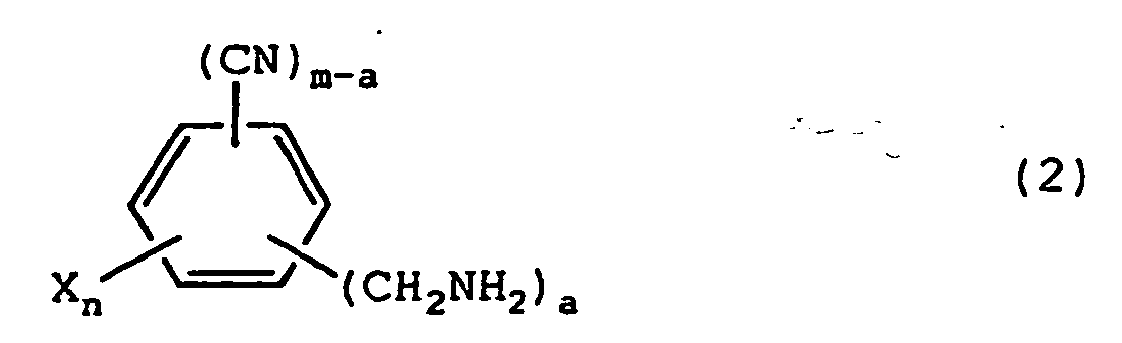
- the halogen include chlorine and fluorine. (wherein X represents a chlorine atom or a fluorine atom, m represents an integer of 1 to 5, n represents an integer of 1 to 5, m+n ⁇ 6, and when n is 2 or more, each X may be the same or different).
- halogenated aromatic nitriles represented by formula (1) include tetrafluorophthalonitrile, tetrafluoroisophthalonitrile,tetrafluoroterephthalonitrile, pentafluorobenzonitrile, 2,3,5,6-tetrafluorobenzonitrile, 2,3,4,6-tetrafluorobenzonitrile, 2,3,4,5-tetrafluorobenzonitrile, 2,4,6-trifluoro-5-chloroisophthalonitrile, tetrachlorophthalonitrile, tetrachloroisophthalonitrile and tetrachloroterephthalonitrile.
- the halogenated aromatic nitrile represented by formula (1) is reduced in the presence of a carboxylic acid in a solvent using sponge nickel or sponge cobalt, whereby a halogenated aromatic methylamine represented by formula (2) can be obtained.
- X represents a chlorine atom or a fluorine atom
- m represents an integer of 1 to 5
- n represents an integer of 1 to 5
- m+n ⁇ 6 when n is 2 or more, each X may be the same or different
- a represents an integer of 1 to m).
- the carboxylic acid for use in the present invention is e.g. formic acid, acetic acid, propionic acid, oxalic acid, citric acid, glycolic acid or benzoic acid. Among these, preferred are formic acid, acetic acid and propionic acid. These carboxylic acids may be used individually or in combination of two or more thereof.
- the amount of the carboxylic acid used is from 50 to 500 mol%, preferably from 100 to 300 mol%, based on the nitrile group of the halogenated aromatic nitrile represented by formula (1).
- the carboxylic acid may be added in one lot at the initiation of reaction or may be continuously or intermittently added with the progress of the reaction.
- the hydrogenating catalyst used in the present invention sponge nickel or sponge cobalt.
- modified sponge catalyst may be used.
- Modified sponge catalyst is obtained by modifying nickel or cobalt with other metal or metal oxide than nickel or cobalt.
- sponge nickel catalyst modified with molybdenum is exemplified.
- the amount of the catalyst used is from 0.01 to 1 times in mass, more preferably from 0.02 to 0.5 times in mass, based on the halogenated aromatic nitrile represented by formula (1) .
- Activity of the catalyst can be enhanced by pre-treating the catalyst in solvent under hydrogen atmosphere. Temperature of the pre-treatment is 100°C or less, preferably 40 °C or less.
- the pressure at this time is, in terms of the hydrogen partial pressure, from 0.1 to 5 MPa, preferably from 0.2 to 3 MPa.
- the solvent used in the present invention is not particularly limited insofar as it does not affect the reduction reaction.
- the solvent is a sole or combined solvent containing at least one member selected from aromatic hydrocarbons such as benzene, toluene, xylene and ethylbenzene; aliphatic hydrocarbons such as hexane and cyclohexane; alcohols such as methanol, ethanol, propanol, butanol, ethylene glycol, propylene glycol, glycerin and ethylene glycol methyl ether; ethers such as tetrahydrofuran, dioxane and dioxolane; esters such as ethyl acetate and butyl acetate; and water.
- aromatic hydrocarbons such as benzene, toluene, xylene and ethylbenzene
- aliphatic hydrocarbons such as hexane and cyclohexane
- alcohols such
- water alone and a combined solvent of water and a solvent which is not completely miscible with water are preferred.
- the solvent which is not completely miscible with water is a solvent such that when mixed with water at least in a certain ratio, separation into two layers occurs. Examples thereof include aromatic hydrocarbons such as toluene, xylene and ethylbenzene, and esters such as ethyl acetate and butylacetate.
- This - combined solvent system is expected to provide an effect of, when the reaction substrate has low solubility inwater, allowing the organic solvent to dissolve the substrate in the organic solvent phase and thereby increasing the reaction rate.
- the amount of the solvent used is not particularly limited but is preferably from 2 to 20 times in mass based on the halogenated aromatic nitrile represented by formula (1).
- the reaction temperature is from room temperature to 100°C, preferably from room temperature to 60°C.
- the pressure is, in terms of the hydrogen partial pressure, from 0.1 to 5 MPa, preferably from 0.2 to 3 MPa.
- the hydrogen gas for use in the reaction of the present invention needs not be necessarily a high-purity gas and may contain an inert gas having no particular effect on the reduction reaction.
- reaction form is not particularly limited, however, a method such as catalyst suspension flow system, fixed bed flow system, trickle bed or batch system is preferably used.
- the halogenated aromatic methylamine represented by formula (2) obtained according to the production process of the present invention can be isolated using a usual isolation method such as condensation; extraction or distillation.
- the resulting reaction solution was analyzed by a gas chromatography internal standard method, as a result, the conversion of tetrafluoroterephthalonitrile was 99% or more and the yield of 2,3,5,6-tetrafluoroxylylenediamine was 83%.
- Example 2 The same operation as in Example 1 was performed except for changing toluene to xylene.
- the resulting reaction solution was analyzed by a gas chromatography internal standard method as a result, the conversion of tetrafluoroterephthalonitrile was 99% or more and the yield of 2,3,5,6-tetrafluoroxylylenediamine was 80%.
- Example 2 The same operation as in Example 1 was performed except for charging 30 g of water, 2.0 g of sponge nickel catalyst, 3.0 g of acetic acid and 4. 0 g of tetrafluoroterephthalonitrile into a 100 cc-volume autoclave.
- the resulting reaction solution was analyzed by a gas chromatography internal standard method, as a result, the conversion of tetrafluoroterephthalonitrile was 99% or more and the yield of 2,3,5,6-tetrafluoroxylylenediamine was 90%.
- Example 2 The same operation as in Example 1 was performed except for charging 200 g of water, 12.5 g of sponge nickel catalyst, 37.5 g of acetic acid and 50.0 g of tetra-fluoroterephthalonitrile into a 500 cc-volume autoclave.
- the resulting reaction solution was analyzed by a gas chromatography internal standard method, as a result, the conversion of tetrafluoroterephthalonitrile was 99% or more and the wield of 2,3,5,6-tetrafluoroxylylenediamine was 95%.
- Example 1 Into a 500 cc-volume autoclave, 100 cc of water and 10.0 g of sponge nickel catalyst were charged, and hydrogen pressure was set to be 0.5 MPa at 15 °C. The stirring of the autoclave was started, and continuing the stirring for 1 hour while keeping the temperature at 15 °C. To the autoclave, were further charged 100 cc of water, 37.5 g of acetic acid and 50.0 g of tetrafluoroterephthalonitrile, then, procedure of Example 1 was repeated.
- the resulting reaction solution was analyzed by a gas chromatography internal standard method, as a result, the conversion of tetrafluoroterephthalonitrile was 99% or more and the yield of 2, 3, 5, 6-tetrafluoroxylylenediamine was 94 %.
- Example 4 The same operation as in Example 4 was performed except for using 12. 5 g of sponge nickel catalyst added with molybdenum.
- the resulting reaction solution was analyzed by a gas chromatography internal standard method, as a result, the conversion of tetrafluoroterephthalonitrile was 99% or more and the yield of 2, 3, 5, 6-tetrafluoroxylylenediamine was 96%.
- Example 4 The same operation as in Example 4 was performed except for using 37.5 g sulfuric acid in place of acetic acid.
- the resulting reaction solution was analyzed by a gas chromatography internal standard method, as a result, the conversion of tetrafluoroterephthalonitrile was 23% and the yield of 2,3,5,6-tetrafluoroxylylenediamine was 12%.
- the halogenated aromatic methylamine represented by formula (2) can be produced in a high yield by an industrially advantageous method.
Landscapes
- Chemical & Material Sciences (AREA)
- Organic Chemistry (AREA)
- Organic Low-Molecular-Weight Compounds And Preparation Thereof (AREA)
- Low-Molecular Organic Synthesis Reactions Using Catalysts (AREA)
Claims (17)
- Verfahren zum Herstellen eines halogenierten aromatischen Methylamins, welches die mit Wasserstoff durchgeführte Reduktion eines halogenierten aromatischen Nitrils der Formel (1):

- Herstellungsverfahren für ein halogeniertes aromatisches Methylamin nach Anspruch 1, wobei das halogenierte aromatische Nitril der Formel (1) Tetrafluorterephthalnitril oder Tetrafluorisophthalnitril ist und das halogenierte aromatische Methylamin der Formel (2) 2,3,5,6-Tetrafluoroxylylendiamin oder 2,3,4,6-Tetrafluoroxylylendiamin ist.
- Herstellungsverfahren für ein halogeniertes aromatisches Methylamin nach Anspruch 1 oder 2, wobei das Lösungsmittel ein einziges Lösungsmittel oder ein kombiniertes Lösungsmittel ist, das mindestens ein aus der Gruppe, die aus aromatischen Kohlenwasserstoffe, aliphatischen Kohlenwasserstoffen, Alkoholen, Ethern, Estern und Wasser besteht, ausgewähltes Mitglied ist.
- Herstellungsverfahren für ein halogeniertes aromatisches Methylamin nach Anspruch 1 oder 2, wobei das Lösungsmittel ein einziges Lösungsmittel oder ein kombiniertes Lösungsmittel ist, das mindestens ein aus der Gruppe, die aus Benzol, Toluol, Xylol, Ethylbenzol, Hexan, Cyclohexan, Methanol, Ethanol, Propanol, Tetrahydrofuran, Dioxan, Dioxolan, Ethylacetat und Wasser besteht, ausgewähltes Mitglied ist.
- Herstellungsverfahren für ein halogeniertes aromatisches Methylamin nach Anspruch 3 oder 4, wobei das Lösungsmittel ein kombiniertes Lösungsmittel aus Wasser und einem organischen Lösungsmittel ist, das mit Wasser nicht vollständig mischbar ist.
- Herstellungsverfahren für ein halogeniertes aromatisches Methylamin nach Anspruch 5, wobei das organische Lösungsmittel, das mit Wasser nicht vollständig mischbar ist, ein aromatischer Kohlenwasserstoff ist.
- Herstellungsverfahren für ein halogeniertes aromatisches Methylamin nach Anspruch 6, wobei der aromatische Kohlenwasserstoff Toluol, Xylol oder Ethylbenzol ist.
- Herstellungsverfahren für ein halogeniertes aromatisches Methylamin nach Anspruch 1 oder 2, wobei das Lösungsmittel Wasser ist.
- Herstellungsverfahren für ein halogeniertes aromatisches Methylamin nach einem der Ansprüche 1 bis 8, wobei die Carbonsäure mindestens ein aus der Gruppe, die aus Ameisensäure, Essigsäure und Propionsäure besteht, ausgewähltes Mitglied ist.
- Herstellungsverfahren für ein halogeniertes aromatisches Methylamin nach Anspruch 1, wobei der Katalysator schwammartiges Nickel ist.
- Herstellungsverfahren für ein halogeniertes aromatisches Methylamin nach Anspruch 10, wobei das schwammartige Nickel mit einem anderen Metall als Nickel modifiziert ist.
- Herstellungsverfahren für ein halogeniertes aromatisches Methylamin nach Anspruch 11, wobei das schwammartige Nickel mit Molybdän modifiziert ist.
- Herstellungsverfahren für ein halogeniertes aromatisches Methylamin nach einem der Ansprüche 1 bis 12, wobei der Katalysator nach Vorbehandlung in einem Lösungsmittel unter einer Wasserstoffatmosphäre bei 40°C oder weniger eingesetzt wird.
- Herstellungsverfahren für ein halogeniertes aromatisches Methylamin nach einem der Ansprüche 1 bis 13, wobei die Menge des eingesetzten Lösungsmittels die 1- bis 20-fache Masse, bezogen auf das halogenierte aromatische Nitril, ist.
- Herstellungsverfahren für ein halogeniertes aromatisches Methylamin nach einem der Ansprüche 1 bis 14, wobei die Menge der eingesetzten organischen Säure 50 bis 500 Mol-%, bezogen auf die Nitrilgruppe des halogenierten aromatischen Nitrils, ist.
- Herstellungsverfahren für ein halogeniertes aromatisches Methylamin nach einem der Ansprüche 1 bis 15, wobei die Menge des eingesetzten Katalysators die 0,01- bis 1-fache Masse, bezogen auf das halogenierte aromatische Nitril, ist.
- Herstellungsverfahren für ein halogeniertes aromatisches Methylamin nach einem der Ansprüche 1 bis 15, wobei die mit Wasserstoff durchgeführte Reduktion bei einer Reaktionstemperatur von Raumtemperatur bis 100 °C unter einem Wasserstoffpartialdruck von 0,1 bis 5 MPa durchgeführt wird.
Applications Claiming Priority (7)
| Application Number | Priority Date | Filing Date | Title |
|---|---|---|---|
| JP2001183006 | 2001-06-18 | ||
| JP2001183006 | 2001-06-18 | ||
| US30114401P | 2001-06-28 | 2001-06-28 | |
| US301144P | 2001-06-28 | ||
| JP2001115549 | 2002-04-18 | ||
| JP2002115549A JP4147809B2 (ja) | 2001-06-18 | 2002-04-18 | ハロゲン化芳香族メチルアミン類の製造方法 |
| PCT/JP2002/006008 WO2002102760A1 (en) | 2001-06-18 | 2002-06-17 | Production process for halogenated aromatic methylamine |
Publications (2)
| Publication Number | Publication Date |
|---|---|
| EP1401799A1 EP1401799A1 (de) | 2004-03-31 |
| EP1401799B1 true EP1401799B1 (de) | 2009-05-13 |
Family
ID=27346966
Family Applications (1)
| Application Number | Title | Priority Date | Filing Date |
|---|---|---|---|
| EP02736129A Expired - Lifetime EP1401799B1 (de) | 2001-06-18 | 2002-06-17 | Herstellungsverfahren für halogenierte aromatische methylamine |
Country Status (9)
| Country | Link |
|---|---|
| US (1) | US6960691B2 (de) |
| EP (1) | EP1401799B1 (de) |
| KR (1) | KR100817816B1 (de) |
| CN (1) | CN100427456C (de) |
| AT (1) | ATE431330T1 (de) |
| DE (1) | DE60232330D1 (de) |
| HU (1) | HUP0300805A3 (de) |
| IL (2) | IL154500A0 (de) |
| WO (1) | WO2002102760A1 (de) |
Family Cites Families (12)
| Publication number | Priority date | Publication date | Assignee | Title |
|---|---|---|---|---|
| GB810530A (en) | 1957-01-08 | 1959-03-18 | Distillers Co Yeast Ltd | The production of aromatic amines |
| GB852972A (en) | 1958-04-02 | 1960-11-02 | Basf Ag | Production of xylylene diamines |
| US3409681A (en) * | 1964-06-25 | 1968-11-05 | Exxon Research Engineering Co | Method of making novel bimetallic heterogeneous catalysts and their use in hydrocarbon conversions |
| GB1149251A (en) | 1965-09-24 | 1969-04-23 | Columbian Carbon | Hydrogenation of nitrogenous carbon compounds |
| GB2120666B (en) * | 1982-05-27 | 1985-12-18 | Ici Plc | Hydrogenation process |
| DE3361399D1 (en) * | 1982-05-27 | 1986-01-16 | Ici Plc | Process for the hydrogenation of perhalogenated terephthalonitriles to amines, 2,3,5,6-tetrafluoroxylylene diamine and salts thereof |
| JP3128145B2 (ja) * | 1991-06-26 | 2001-01-29 | 三井化学株式会社 | 脂環式モノメチルアミン類の製造方法 |
| US5874625A (en) * | 1996-11-04 | 1999-02-23 | Henkel Corporation | Process to hydrogenate organic nitriles to primary amines |
| JP2000086583A (ja) | 1998-09-17 | 2000-03-28 | Asahi Glass Co Ltd | 含フッ素ベンジル誘導体の製造方法 |
| JP3425389B2 (ja) | 1999-05-06 | 2003-07-14 | 花王株式会社 | 1級アミンの製造法 |
| ATE420848T1 (de) | 2000-07-04 | 2009-01-15 | Showa Denko Kk | Verfahren zur herstellung einer benzoldimethanol- verbindung |
| GB0026349D0 (en) | 2000-10-27 | 2000-12-13 | Zeneca Ltd | Chemical process |
-
2002
- 2002-06-17 IL IL15450002A patent/IL154500A0/xx active IP Right Grant
- 2002-06-17 HU HU0300805A patent/HUP0300805A3/hu unknown
- 2002-06-17 KR KR1020037002338A patent/KR100817816B1/ko not_active Expired - Fee Related
- 2002-06-17 AT AT02736129T patent/ATE431330T1/de not_active IP Right Cessation
- 2002-06-17 WO PCT/JP2002/006008 patent/WO2002102760A1/en not_active Ceased
- 2002-06-17 CN CNB02802124XA patent/CN100427456C/zh not_active Expired - Fee Related
- 2002-06-17 EP EP02736129A patent/EP1401799B1/de not_active Expired - Lifetime
- 2002-06-17 US US10/344,263 patent/US6960691B2/en not_active Expired - Fee Related
- 2002-06-17 DE DE60232330T patent/DE60232330D1/de not_active Expired - Lifetime
-
2003
- 2003-02-17 IL IL154500A patent/IL154500A/en not_active IP Right Cessation
Also Published As
| Publication number | Publication date |
|---|---|
| ATE431330T1 (de) | 2009-05-15 |
| CN100427456C (zh) | 2008-10-22 |
| HUP0300805A2 (hu) | 2003-10-28 |
| IL154500A (en) | 2007-08-19 |
| KR100817816B1 (ko) | 2008-03-31 |
| IL154500A0 (en) | 2003-09-17 |
| CN1463267A (zh) | 2003-12-24 |
| WO2002102760A1 (en) | 2002-12-27 |
| EP1401799A1 (de) | 2004-03-31 |
| KR20030059105A (ko) | 2003-07-07 |
| US20030158444A1 (en) | 2003-08-21 |
| US6960691B2 (en) | 2005-11-01 |
| DE60232330D1 (de) | 2009-06-25 |
| HUP0300805A3 (en) | 2007-02-28 |
Similar Documents
| Publication | Publication Date | Title |
|---|---|---|
| JP2001294559A (ja) | トリフルオロメチルベンジルアミンの製造方法 | |
| US20120203033A1 (en) | Preparation of primary diamines having a linear main chain for polyamide syntheses | |
| US7355080B2 (en) | Method of preparing memantine hydrochloride | |
| US6960691B2 (en) | Production process for halogenated aromatic methylamine | |
| JP4147809B2 (ja) | ハロゲン化芳香族メチルアミン類の製造方法 | |
| JP4409057B2 (ja) | ベンゼンジメタノール化合物の製造方法 | |
| JP4291483B2 (ja) | シクロヘキサンビス(メチルアミン)類の製造方法 | |
| EP0124780B1 (de) | Verfahren zur Herstellung von 2-Alkyl-4-amino-5-aminomethyl-pyrimidin | |
| JPH07138209A (ja) | 含ハロゲンアミノメチル化合物の製造法 | |
| JP4099630B2 (ja) | パーフルオロアルキル化合物の製造方法 | |
| CN101745424A (zh) | 一种手性二胺-质子酸催化剂及其制备和应用 | |
| EP1893556B1 (de) | Verfahren zur herstellung von tetrafluorbenzolcarbaldehydalkylacetal | |
| JP3930207B2 (ja) | ノルボルナンジメチレンアミン類の製造方法 | |
| JP2000273069A (ja) | トリフルオロメチルベンジルアミンの製造方法 | |
| JP2004083495A (ja) | 2−アミノメチルピリミジン及びその塩の製造法 | |
| JPH061758A (ja) | アミノ化合物の製造方法 | |
| JP2944793B2 (ja) | アミンの製造方法 | |
| JP2727359B2 (ja) | 4,4′―ジフルオロジベンジルアミンおよびその製法 | |
| US20120136173A1 (en) | Process for improving the catalytic activity of catalyst systems for reductive amination of aliphatic cyanoaldehydes to aliphatic diamines | |
| WO2025027469A2 (en) | A method of preparing 2-aminopropan-1-ol from hydroxyacetone by reductive amination | |
| JPH05255210A (ja) | テトラメチルジアミノポリオキシエチレンの製法 | |
| WO2004050603A1 (ja) | 1,5−ジアミノナフタレンの製造方法 | |
| JP4314603B2 (ja) | 光学活性3−アルコキシカルボニルアミノピロリジン誘導体の製造方法 | |
| JPS60260544A (ja) | 1,4−ジアミノブタンの製造方法 | |
| JP2003238499A (ja) | ベンジルアミン類の製造方法 |
Legal Events
| Date | Code | Title | Description |
|---|---|---|---|
| PUAI | Public reference made under article 153(3) epc to a published international application that has entered the european phase |
Free format text: ORIGINAL CODE: 0009012 |
|
| 17P | Request for examination filed |
Effective date: 20040210 |
|
| AK | Designated contracting states |
Kind code of ref document: A1 Designated state(s): AT BE CH CY DE DK ES FI FR GB GR IE IT LI LU MC NL PT SE TR |
|
| AX | Request for extension of the european patent |
Extension state: AL LT LV MK RO SI |
|
| R17P | Request for examination filed (corrected) |
Effective date: 20030217 |
|
| 17Q | First examination report despatched |
Effective date: 20070717 |
|
| GRAP | Despatch of communication of intention to grant a patent |
Free format text: ORIGINAL CODE: EPIDOSNIGR1 |
|
| GRAP | Despatch of communication of intention to grant a patent |
Free format text: ORIGINAL CODE: EPIDOSNIGR1 |
|
| GRAS | Grant fee paid |
Free format text: ORIGINAL CODE: EPIDOSNIGR3 |
|
| GRAA | (expected) grant |
Free format text: ORIGINAL CODE: 0009210 |
|
| AK | Designated contracting states |
Kind code of ref document: B1 Designated state(s): AT BE CH CY DE DK ES FI FR GB GR IE IT LI LU MC NL PT SE TR |
|
| REG | Reference to a national code |
Ref country code: GB Ref legal event code: FG4D |
|
| REG | Reference to a national code |
Ref country code: CH Ref legal event code: EP |
|
| REG | Reference to a national code |
Ref country code: IE Ref legal event code: FG4D |
|
| REF | Corresponds to: |
Ref document number: 60232330 Country of ref document: DE Date of ref document: 20090625 Kind code of ref document: P |
|
| PG25 | Lapsed in a contracting state [announced via postgrant information from national office to epo] |
Ref country code: ES Free format text: LAPSE BECAUSE OF FAILURE TO SUBMIT A TRANSLATION OF THE DESCRIPTION OR TO PAY THE FEE WITHIN THE PRESCRIBED TIME-LIMIT Effective date: 20090824 Ref country code: PT Free format text: LAPSE BECAUSE OF FAILURE TO SUBMIT A TRANSLATION OF THE DESCRIPTION OR TO PAY THE FEE WITHIN THE PRESCRIBED TIME-LIMIT Effective date: 20090913 Ref country code: FI Free format text: LAPSE BECAUSE OF FAILURE TO SUBMIT A TRANSLATION OF THE DESCRIPTION OR TO PAY THE FEE WITHIN THE PRESCRIBED TIME-LIMIT Effective date: 20090513 Ref country code: AT Free format text: LAPSE BECAUSE OF FAILURE TO SUBMIT A TRANSLATION OF THE DESCRIPTION OR TO PAY THE FEE WITHIN THE PRESCRIBED TIME-LIMIT Effective date: 20090513 |
|
| NLV1 | Nl: lapsed or annulled due to failure to fulfill the requirements of art. 29p and 29m of the patents act | ||
| PG25 | Lapsed in a contracting state [announced via postgrant information from national office to epo] |
Ref country code: NL Free format text: LAPSE BECAUSE OF FAILURE TO SUBMIT A TRANSLATION OF THE DESCRIPTION OR TO PAY THE FEE WITHIN THE PRESCRIBED TIME-LIMIT Effective date: 20090513 Ref country code: SE Free format text: LAPSE BECAUSE OF FAILURE TO SUBMIT A TRANSLATION OF THE DESCRIPTION OR TO PAY THE FEE WITHIN THE PRESCRIBED TIME-LIMIT Effective date: 20090813 |
|
| PG25 | Lapsed in a contracting state [announced via postgrant information from national office to epo] |
Ref country code: MC Free format text: LAPSE BECAUSE OF NON-PAYMENT OF DUE FEES Effective date: 20090630 Ref country code: DK Free format text: LAPSE BECAUSE OF FAILURE TO SUBMIT A TRANSLATION OF THE DESCRIPTION OR TO PAY THE FEE WITHIN THE PRESCRIBED TIME-LIMIT Effective date: 20090513 |
|
| REG | Reference to a national code |
Ref country code: CH Ref legal event code: PL |
|
| PG25 | Lapsed in a contracting state [announced via postgrant information from national office to epo] |
Ref country code: BE Free format text: LAPSE BECAUSE OF FAILURE TO SUBMIT A TRANSLATION OF THE DESCRIPTION OR TO PAY THE FEE WITHIN THE PRESCRIBED TIME-LIMIT Effective date: 20090513 |
|
| PLBE | No opposition filed within time limit |
Free format text: ORIGINAL CODE: 0009261 |
|
| STAA | Information on the status of an ep patent application or granted ep patent |
Free format text: STATUS: NO OPPOSITION FILED WITHIN TIME LIMIT |
|
| REG | Reference to a national code |
Ref country code: IE Ref legal event code: MM4A |
|
| 26N | No opposition filed |
Effective date: 20100216 |
|
| PG25 | Lapsed in a contracting state [announced via postgrant information from national office to epo] |
Ref country code: CH Free format text: LAPSE BECAUSE OF NON-PAYMENT OF DUE FEES Effective date: 20090630 Ref country code: IE Free format text: LAPSE BECAUSE OF NON-PAYMENT OF DUE FEES Effective date: 20090617 Ref country code: LI Free format text: LAPSE BECAUSE OF NON-PAYMENT OF DUE FEES Effective date: 20090630 |
|
| PG25 | Lapsed in a contracting state [announced via postgrant information from national office to epo] |
Ref country code: GR Free format text: LAPSE BECAUSE OF FAILURE TO SUBMIT A TRANSLATION OF THE DESCRIPTION OR TO PAY THE FEE WITHIN THE PRESCRIBED TIME-LIMIT Effective date: 20090814 |
|
| PG25 | Lapsed in a contracting state [announced via postgrant information from national office to epo] |
Ref country code: IT Free format text: LAPSE BECAUSE OF FAILURE TO SUBMIT A TRANSLATION OF THE DESCRIPTION OR TO PAY THE FEE WITHIN THE PRESCRIBED TIME-LIMIT Effective date: 20090513 |
|
| PG25 | Lapsed in a contracting state [announced via postgrant information from national office to epo] |
Ref country code: LU Free format text: LAPSE BECAUSE OF NON-PAYMENT OF DUE FEES Effective date: 20090617 |
|
| PGFP | Annual fee paid to national office [announced via postgrant information from national office to epo] |
Ref country code: FR Payment date: 20110621 Year of fee payment: 10 |
|
| PG25 | Lapsed in a contracting state [announced via postgrant information from national office to epo] |
Ref country code: TR Free format text: LAPSE BECAUSE OF FAILURE TO SUBMIT A TRANSLATION OF THE DESCRIPTION OR TO PAY THE FEE WITHIN THE PRESCRIBED TIME-LIMIT Effective date: 20090513 |
|
| PGFP | Annual fee paid to national office [announced via postgrant information from national office to epo] |
Ref country code: GB Payment date: 20110615 Year of fee payment: 10 |
|
| PG25 | Lapsed in a contracting state [announced via postgrant information from national office to epo] |
Ref country code: CY Free format text: LAPSE BECAUSE OF FAILURE TO SUBMIT A TRANSLATION OF THE DESCRIPTION OR TO PAY THE FEE WITHIN THE PRESCRIBED TIME-LIMIT Effective date: 20090513 |
|
| PGFP | Annual fee paid to national office [announced via postgrant information from national office to epo] |
Ref country code: DE Payment date: 20110615 Year of fee payment: 10 |
|
| GBPC | Gb: european patent ceased through non-payment of renewal fee |
Effective date: 20120617 |
|
| REG | Reference to a national code |
Ref country code: FR Ref legal event code: ST Effective date: 20130228 |
|
| REG | Reference to a national code |
Ref country code: DE Ref legal event code: R119 Ref document number: 60232330 Country of ref document: DE Effective date: 20130101 |
|
| PG25 | Lapsed in a contracting state [announced via postgrant information from national office to epo] |
Ref country code: GB Free format text: LAPSE BECAUSE OF NON-PAYMENT OF DUE FEES Effective date: 20120617 Ref country code: FR Free format text: LAPSE BECAUSE OF NON-PAYMENT OF DUE FEES Effective date: 20120702 Ref country code: DE Free format text: LAPSE BECAUSE OF NON-PAYMENT OF DUE FEES Effective date: 20130101 |