EP1421010B2 - Wasserlösliche verpackung - Google Patents
Wasserlösliche verpackung Download PDFInfo
- Publication number
- EP1421010B2 EP1421010B2 EP02716217A EP02716217A EP1421010B2 EP 1421010 B2 EP1421010 B2 EP 1421010B2 EP 02716217 A EP02716217 A EP 02716217A EP 02716217 A EP02716217 A EP 02716217A EP 1421010 B2 EP1421010 B2 EP 1421010B2
- Authority
- EP
- European Patent Office
- Prior art keywords
- packaging
- release
- substance
- water
- agents
- Prior art date
- Legal status (The legal status is an assumption and is not a legal conclusion. Google has not performed a legal analysis and makes no representation as to the accuracy of the status listed.)
- Expired - Lifetime
Links
- 238000009463 water soluble packaging Methods 0.000 title description 7
- 239000000126 substance Substances 0.000 claims abstract description 150
- 238000004806 packaging method and process Methods 0.000 claims abstract description 110
- 239000005022 packaging material Substances 0.000 claims abstract description 80
- XLYOFNOQVPJJNP-UHFFFAOYSA-N water Substances O XLYOFNOQVPJJNP-UHFFFAOYSA-N 0.000 claims abstract description 73
- 238000013270 controlled release Methods 0.000 claims abstract description 10
- 230000004044 response Effects 0.000 claims abstract description 8
- 230000036961 partial effect Effects 0.000 claims abstract description 4
- 239000003795 chemical substances by application Substances 0.000 claims description 39
- 238000000034 method Methods 0.000 claims description 31
- 239000002775 capsule Substances 0.000 claims description 26
- 239000000203 mixture Substances 0.000 claims description 20
- 239000007787 solid Substances 0.000 claims description 20
- 238000004090 dissolution Methods 0.000 claims description 15
- 239000000243 solution Substances 0.000 claims description 15
- 238000009472 formulation Methods 0.000 claims description 14
- 239000000463 material Substances 0.000 claims description 13
- 230000002093 peripheral effect Effects 0.000 claims description 13
- 239000007788 liquid Substances 0.000 claims description 12
- 238000007789 sealing Methods 0.000 claims description 12
- 229920002678 cellulose Polymers 0.000 claims description 11
- 239000001913 cellulose Substances 0.000 claims description 11
- 239000000306 component Substances 0.000 claims description 10
- 239000002904 solvent Substances 0.000 claims description 10
- 238000004519 manufacturing process Methods 0.000 claims description 9
- 230000008859 change Effects 0.000 claims description 8
- 239000012141 concentrate Substances 0.000 claims description 8
- 239000003599 detergent Substances 0.000 claims description 8
- 239000012530 fluid Substances 0.000 claims description 8
- 235000013305 food Nutrition 0.000 claims description 7
- 229920000159 gelatin Polymers 0.000 claims description 7
- 235000019322 gelatine Nutrition 0.000 claims description 7
- 239000000383 hazardous chemical Substances 0.000 claims description 7
- 230000002028 premature Effects 0.000 claims description 7
- 238000003860 storage Methods 0.000 claims description 7
- 238000007598 dipping method Methods 0.000 claims description 6
- -1 monoliths Substances 0.000 claims description 6
- 239000000843 powder Substances 0.000 claims description 6
- 239000002689 soil Substances 0.000 claims description 6
- 239000011877 solvent mixture Substances 0.000 claims description 6
- 239000004372 Polyvinyl alcohol Substances 0.000 claims description 5
- 201000010099 disease Diseases 0.000 claims description 5
- 208000037265 diseases, disorders, signs and symptoms Diseases 0.000 claims description 5
- 239000002270 dispersing agent Substances 0.000 claims description 5
- 230000000694 effects Effects 0.000 claims description 5
- 238000004049 embossing Methods 0.000 claims description 5
- 231100001261 hazardous Toxicity 0.000 claims description 5
- 230000008635 plant growth Effects 0.000 claims description 5
- 229920002451 polyvinyl alcohol Polymers 0.000 claims description 5
- 241000196324 Embryophyta Species 0.000 claims description 4
- 229920000881 Modified starch Polymers 0.000 claims description 4
- 241000607479 Yersinia pestis Species 0.000 claims description 4
- 230000009471 action Effects 0.000 claims description 4
- 229920003086 cellulose ether Polymers 0.000 claims description 4
- 239000003086 colorant Substances 0.000 claims description 4
- 239000005428 food component Substances 0.000 claims description 4
- 239000000499 gel Substances 0.000 claims description 4
- 238000002156 mixing Methods 0.000 claims description 4
- 235000019426 modified starch Nutrition 0.000 claims description 4
- 230000000717 retained effect Effects 0.000 claims description 4
- 230000001235 sensitizing effect Effects 0.000 claims description 4
- 239000002356 single layer Substances 0.000 claims description 4
- 238000005507 spraying Methods 0.000 claims description 4
- 241000894006 Bacteria Species 0.000 claims description 3
- 239000002253 acid Substances 0.000 claims description 3
- 239000003513 alkali Substances 0.000 claims description 3
- QVGXLLKOCUKJST-UHFFFAOYSA-N atomic oxygen Chemical compound [O] QVGXLLKOCUKJST-UHFFFAOYSA-N 0.000 claims description 3
- 239000012459 cleaning agent Substances 0.000 claims description 3
- 239000000796 flavoring agent Substances 0.000 claims description 3
- 235000019634 flavors Nutrition 0.000 claims description 3
- 235000012041 food component Nutrition 0.000 claims description 3
- 239000008187 granular material Substances 0.000 claims description 3
- 230000006872 improvement Effects 0.000 claims description 3
- 238000000465 moulding Methods 0.000 claims description 3
- 239000012457 nonaqueous media Substances 0.000 claims description 3
- 229910052760 oxygen Inorganic materials 0.000 claims description 3
- 239000001301 oxygen Substances 0.000 claims description 3
- 230000008961 swelling Effects 0.000 claims description 3
- 239000001828 Gelatine Substances 0.000 claims description 2
- 241000238631 Hexapoda Species 0.000 claims description 2
- 240000007594 Oryza sativa Species 0.000 claims description 2
- 235000007164 Oryza sativa Nutrition 0.000 claims description 2
- 102000035195 Peptidases Human genes 0.000 claims description 2
- 108091005804 Peptidases Proteins 0.000 claims description 2
- 229920003171 Poly (ethylene oxide) Polymers 0.000 claims description 2
- 241000700605 Viruses Species 0.000 claims description 2
- 239000006096 absorbing agent Substances 0.000 claims description 2
- 230000003213 activating effect Effects 0.000 claims description 2
- 239000003905 agrochemical Substances 0.000 claims description 2
- 238000005266 casting Methods 0.000 claims description 2
- 239000003518 caustics Substances 0.000 claims description 2
- 239000003153 chemical reaction reagent Substances 0.000 claims description 2
- 238000004140 cleaning Methods 0.000 claims description 2
- 239000000356 contaminant Substances 0.000 claims description 2
- 238000001816 cooling Methods 0.000 claims description 2
- 239000013078 crystal Substances 0.000 claims description 2
- 235000013365 dairy product Nutrition 0.000 claims description 2
- 239000008380 degradant Substances 0.000 claims description 2
- 239000000645 desinfectant Substances 0.000 claims description 2
- 239000007884 disintegrant Substances 0.000 claims description 2
- 239000006185 dispersion Substances 0.000 claims description 2
- 238000005553 drilling Methods 0.000 claims description 2
- 238000010410 dusting Methods 0.000 claims description 2
- 239000000839 emulsion Substances 0.000 claims description 2
- 230000007613 environmental effect Effects 0.000 claims description 2
- 238000009313 farming Methods 0.000 claims description 2
- 235000013312 flour Nutrition 0.000 claims description 2
- 235000011194 food seasoning agent Nutrition 0.000 claims description 2
- 239000003205 fragrance Substances 0.000 claims description 2
- 230000004927 fusion Effects 0.000 claims description 2
- 239000007789 gas Substances 0.000 claims description 2
- 239000003292 glue Substances 0.000 claims description 2
- 235000008216 herbs Nutrition 0.000 claims description 2
- 238000002844 melting Methods 0.000 claims description 2
- 230000008018 melting Effects 0.000 claims description 2
- 239000003094 microcapsule Substances 0.000 claims description 2
- 229920005615 natural polymer Polymers 0.000 claims description 2
- 230000003472 neutralizing effect Effects 0.000 claims description 2
- 235000014593 oils and fats Nutrition 0.000 claims description 2
- 239000003960 organic solvent Substances 0.000 claims description 2
- 230000000149 penetrating effect Effects 0.000 claims description 2
- 229920002401 polyacrylamide Polymers 0.000 claims description 2
- 229920000642 polymer Polymers 0.000 claims description 2
- 229920000036 polyvinylpyrrolidone Polymers 0.000 claims description 2
- 239000001267 polyvinylpyrrolidone Substances 0.000 claims description 2
- 235000013855 polyvinylpyrrolidone Nutrition 0.000 claims description 2
- 238000001556 precipitation Methods 0.000 claims description 2
- 239000012460 protein solution Substances 0.000 claims description 2
- 238000000746 purification Methods 0.000 claims description 2
- 238000009877 rendering Methods 0.000 claims description 2
- 235000009566 rice Nutrition 0.000 claims description 2
- 150000003839 salts Chemical class 0.000 claims description 2
- 238000007493 shaping process Methods 0.000 claims description 2
- 239000000725 suspension Substances 0.000 claims description 2
- 229920001059 synthetic polymer Polymers 0.000 claims description 2
- 230000001131 transforming effect Effects 0.000 claims description 2
- 239000003039 volatile agent Substances 0.000 claims description 2
- 239000002699 waste material Substances 0.000 claims description 2
- 238000003466 welding Methods 0.000 claims description 2
- 230000000977 initiatory effect Effects 0.000 claims 1
- 230000008901 benefit Effects 0.000 description 20
- 235000010980 cellulose Nutrition 0.000 description 9
- 239000000047 product Substances 0.000 description 8
- 229920002472 Starch Polymers 0.000 description 6
- 235000019698 starch Nutrition 0.000 description 6
- 108010010803 Gelatin Proteins 0.000 description 5
- 238000011049 filling Methods 0.000 description 5
- 239000008273 gelatin Substances 0.000 description 5
- 235000011852 gelatine desserts Nutrition 0.000 description 5
- 239000002245 particle Substances 0.000 description 5
- 208000010392 Bone Fractures Diseases 0.000 description 4
- 206010017076 Fracture Diseases 0.000 description 4
- 230000006866 deterioration Effects 0.000 description 4
- 238000010790 dilution Methods 0.000 description 4
- 239000012895 dilution Substances 0.000 description 4
- 230000001976 improved effect Effects 0.000 description 4
- 230000002787 reinforcement Effects 0.000 description 4
- 125000000217 alkyl group Chemical group 0.000 description 3
- KRKNYBCHXYNGOX-UHFFFAOYSA-N citric acid Chemical compound OC(=O)CC(O)(C(O)=O)CC(O)=O KRKNYBCHXYNGOX-UHFFFAOYSA-N 0.000 description 3
- 238000011109 contamination Methods 0.000 description 3
- 238000010586 diagram Methods 0.000 description 3
- 239000003814 drug Substances 0.000 description 3
- 229920003088 hydroxypropyl methyl cellulose Polymers 0.000 description 3
- 235000010979 hydroxypropyl methyl cellulose Nutrition 0.000 description 3
- 239000004615 ingredient Substances 0.000 description 3
- 230000002829 reductive effect Effects 0.000 description 3
- 230000003014 reinforcing effect Effects 0.000 description 3
- RTZKZFJDLAIYFH-UHFFFAOYSA-N Diethyl ether Chemical compound CCOCC RTZKZFJDLAIYFH-UHFFFAOYSA-N 0.000 description 2
- UIIMBOGNXHQVGW-UHFFFAOYSA-M Sodium bicarbonate Chemical compound [Na+].OC([O-])=O UIIMBOGNXHQVGW-UHFFFAOYSA-M 0.000 description 2
- 239000000654 additive Substances 0.000 description 2
- 150000001298 alcohols Chemical class 0.000 description 2
- 239000007864 aqueous solution Substances 0.000 description 2
- 238000002788 crimping Methods 0.000 description 2
- 238000005516 engineering process Methods 0.000 description 2
- 230000002708 enhancing effect Effects 0.000 description 2
- 239000005021 flexible packaging material Substances 0.000 description 2
- 239000000417 fungicide Substances 0.000 description 2
- 230000012010 growth Effects 0.000 description 2
- 239000012602 primary packaging material Substances 0.000 description 2
- 230000002035 prolonged effect Effects 0.000 description 2
- 238000009517 secondary packaging Methods 0.000 description 2
- 239000008107 starch Substances 0.000 description 2
- 229940032147 starch Drugs 0.000 description 2
- 239000000021 stimulant Substances 0.000 description 2
- 239000011782 vitamin Substances 0.000 description 2
- 229930003231 vitamin Natural products 0.000 description 2
- 229940088594 vitamin Drugs 0.000 description 2
- 235000013343 vitamin Nutrition 0.000 description 2
- TURGQPDWYFJEDY-UHFFFAOYSA-N 1-hydroperoxypropane Chemical compound CCCOO TURGQPDWYFJEDY-UHFFFAOYSA-N 0.000 description 1
- IXPNQXFRVYWDDI-UHFFFAOYSA-N 1-methyl-2,4-dioxo-1,3-diazinane-5-carboximidamide Chemical compound CN1CC(C(N)=N)C(=O)NC1=O IXPNQXFRVYWDDI-UHFFFAOYSA-N 0.000 description 1
- RPZANUYHRMRTTE-UHFFFAOYSA-N 2,3,4-trimethoxy-6-(methoxymethyl)-5-[3,4,5-trimethoxy-6-(methoxymethyl)oxan-2-yl]oxyoxane;1-[[3,4,5-tris(2-hydroxybutoxy)-6-[4,5,6-tris(2-hydroxybutoxy)-2-(2-hydroxybutoxymethyl)oxan-3-yl]oxyoxan-2-yl]methoxy]butan-2-ol Chemical compound COC1C(OC)C(OC)C(COC)OC1OC1C(OC)C(OC)C(OC)OC1COC.CCC(O)COC1C(OCC(O)CC)C(OCC(O)CC)C(COCC(O)CC)OC1OC1C(OCC(O)CC)C(OCC(O)CC)C(OCC(O)CC)OC1COCC(O)CC RPZANUYHRMRTTE-UHFFFAOYSA-N 0.000 description 1
- JDFDHBSESGTDAL-UHFFFAOYSA-N 3-methoxypropan-1-ol Chemical compound COCCCO JDFDHBSESGTDAL-UHFFFAOYSA-N 0.000 description 1
- 229920002261 Corn starch Polymers 0.000 description 1
- 229920001353 Dextrin Polymers 0.000 description 1
- 239000004375 Dextrin Substances 0.000 description 1
- 229920000663 Hydroxyethyl cellulose Polymers 0.000 description 1
- 239000004354 Hydroxyethyl cellulose Substances 0.000 description 1
- 229920001479 Hydroxyethyl methyl cellulose Polymers 0.000 description 1
- 229920002153 Hydroxypropyl cellulose Polymers 0.000 description 1
- 235000019759 Maize starch Nutrition 0.000 description 1
- 229920002774 Maltodextrin Polymers 0.000 description 1
- 241001465754 Metazoa Species 0.000 description 1
- 229910019142 PO4 Inorganic materials 0.000 description 1
- 241001646398 Pseudomonas chlororaphis Species 0.000 description 1
- 239000004902 Softening Agent Substances 0.000 description 1
- 240000008042 Zea mays Species 0.000 description 1
- 235000005824 Zea mays ssp. parviglumis Nutrition 0.000 description 1
- 235000002017 Zea mays subsp mays Nutrition 0.000 description 1
- 239000000642 acaricide Substances 0.000 description 1
- DPXJVFZANSGRMM-UHFFFAOYSA-N acetic acid;2,3,4,5,6-pentahydroxyhexanal;sodium Chemical compound [Na].CC(O)=O.OCC(O)C(O)C(O)C(O)C=O DPXJVFZANSGRMM-UHFFFAOYSA-N 0.000 description 1
- 239000013543 active substance Substances 0.000 description 1
- 230000000996 additive effect Effects 0.000 description 1
- 125000004183 alkoxy alkyl group Chemical group 0.000 description 1
- 230000000507 anthelmentic effect Effects 0.000 description 1
- 230000000844 anti-bacterial effect Effects 0.000 description 1
- 239000005667 attractant Substances 0.000 description 1
- 230000001580 bacterial effect Effects 0.000 description 1
- 239000003899 bactericide agent Substances 0.000 description 1
- 230000004888 barrier function Effects 0.000 description 1
- 125000004432 carbon atom Chemical group C* 0.000 description 1
- 230000015556 catabolic process Effects 0.000 description 1
- 238000004040 coloring Methods 0.000 description 1
- 150000001875 compounds Chemical class 0.000 description 1
- 238000007596 consolidation process Methods 0.000 description 1
- 238000010276 construction Methods 0.000 description 1
- 235000005822 corn Nutrition 0.000 description 1
- 238000004132 cross linking Methods 0.000 description 1
- 239000002837 defoliant Substances 0.000 description 1
- 238000006731 degradation reaction Methods 0.000 description 1
- 239000002274 desiccant Substances 0.000 description 1
- 235000019425 dextrin Nutrition 0.000 description 1
- 239000003651 drinking water Substances 0.000 description 1
- 235000020188 drinking water Nutrition 0.000 description 1
- 229940079593 drug Drugs 0.000 description 1
- 239000000428 dust Substances 0.000 description 1
- 239000000975 dye Substances 0.000 description 1
- 238000009447 edible packaging Methods 0.000 description 1
- 238000005538 encapsulation Methods 0.000 description 1
- 239000010419 fine particle Substances 0.000 description 1
- 230000009969 flowable effect Effects 0.000 description 1
- 230000037406 food intake Effects 0.000 description 1
- 239000012634 fragment Substances 0.000 description 1
- 230000005089 fruit drop Effects 0.000 description 1
- 230000005094 fruit set Effects 0.000 description 1
- 230000002068 genetic effect Effects 0.000 description 1
- 239000007902 hard capsule Substances 0.000 description 1
- 230000036541 health Effects 0.000 description 1
- 239000004009 herbicide Substances 0.000 description 1
- 125000002768 hydroxyalkyl group Chemical group 0.000 description 1
- 235000019447 hydroxyethyl cellulose Nutrition 0.000 description 1
- 229920013819 hydroxyethyl ethylcellulose Polymers 0.000 description 1
- 239000001863 hydroxypropyl cellulose Substances 0.000 description 1
- 235000010977 hydroxypropyl cellulose Nutrition 0.000 description 1
- 239000001866 hydroxypropyl methyl cellulose Substances 0.000 description 1
- UFVKGYZPFZQRLF-UHFFFAOYSA-N hydroxypropyl methyl cellulose Chemical compound OC1C(O)C(OC)OC(CO)C1OC1C(O)C(O)C(OC2C(C(O)C(OC3C(C(O)C(O)C(CO)O3)O)C(CO)O2)O)C(CO)O1 UFVKGYZPFZQRLF-UHFFFAOYSA-N 0.000 description 1
- 239000003112 inhibitor Substances 0.000 description 1
- 239000000976 ink Substances 0.000 description 1
- 239000002917 insecticide Substances 0.000 description 1
- 238000002955 isolation Methods 0.000 description 1
- 239000010410 layer Substances 0.000 description 1
- 230000000670 limiting effect Effects 0.000 description 1
- 230000014759 maintenance of location Effects 0.000 description 1
- 230000000873 masking effect Effects 0.000 description 1
- 229920000609 methyl cellulose Polymers 0.000 description 1
- 239000001923 methylcellulose Substances 0.000 description 1
- 235000010981 methylcellulose Nutrition 0.000 description 1
- 244000005700 microbiome Species 0.000 description 1
- 239000003750 molluscacide Substances 0.000 description 1
- 230000002013 molluscicidal effect Effects 0.000 description 1
- 229930014626 natural product Natural products 0.000 description 1
- 230000001069 nematicidal effect Effects 0.000 description 1
- 239000005645 nematicide Substances 0.000 description 1
- 231100000956 nontoxicity Toxicity 0.000 description 1
- 235000012149 noodles Nutrition 0.000 description 1
- 235000015074 other food component Nutrition 0.000 description 1
- 235000021485 packed food Nutrition 0.000 description 1
- 239000003016 pheromone Substances 0.000 description 1
- 235000021317 phosphate Nutrition 0.000 description 1
- 150000003013 phosphoric acid derivatives Chemical class 0.000 description 1
- 244000062645 predators Species 0.000 description 1
- 238000004321 preservation Methods 0.000 description 1
- 235000013324 preserved food Nutrition 0.000 description 1
- 125000002924 primary amino group Chemical group [H]N([H])* 0.000 description 1
- 238000007639 printing Methods 0.000 description 1
- 230000008569 process Effects 0.000 description 1
- 230000001681 protective effect Effects 0.000 description 1
- 239000005871 repellent Substances 0.000 description 1
- 230000002940 repellent Effects 0.000 description 1
- 239000011138 rigid packaging material Substances 0.000 description 1
- 239000003128 rodenticide Substances 0.000 description 1
- 230000035945 sensitivity Effects 0.000 description 1
- 238000000926 separation method Methods 0.000 description 1
- 235000010413 sodium alginate Nutrition 0.000 description 1
- 239000000661 sodium alginate Substances 0.000 description 1
- 229940005550 sodium alginate Drugs 0.000 description 1
- 229910000030 sodium bicarbonate Inorganic materials 0.000 description 1
- 235000017557 sodium bicarbonate Nutrition 0.000 description 1
- 239000008109 sodium starch glycolate Substances 0.000 description 1
- 229920003109 sodium starch glycolate Polymers 0.000 description 1
- 229940079832 sodium starch glycolate Drugs 0.000 description 1
- 239000006283 soil fumigant Substances 0.000 description 1
- 239000007921 spray Substances 0.000 description 1
- 238000005728 strengthening Methods 0.000 description 1
- 125000001424 substituent group Chemical group 0.000 description 1
- 239000000758 substrate Substances 0.000 description 1
- 239000013589 supplement Substances 0.000 description 1
- 230000008093 supporting effect Effects 0.000 description 1
- 230000002522 swelling effect Effects 0.000 description 1
- 239000012815 thermoplastic material Substances 0.000 description 1
- 239000011864 timber preservative Substances 0.000 description 1
- 229910021654 trace metal Inorganic materials 0.000 description 1
- 230000007704 transition Effects 0.000 description 1
- 238000005406 washing Methods 0.000 description 1
Images




Classifications
-
- B—PERFORMING OPERATIONS; TRANSPORTING
- B65—CONVEYING; PACKING; STORING; HANDLING THIN OR FILAMENTARY MATERIAL
- B65D—CONTAINERS FOR STORAGE OR TRANSPORT OF ARTICLES OR MATERIALS, e.g. BAGS, BARRELS, BOTTLES, BOXES, CANS, CARTONS, CRATES, DRUMS, JARS, TANKS, HOPPERS, FORWARDING CONTAINERS; ACCESSORIES, CLOSURES, OR FITTINGS THEREFOR; PACKAGING ELEMENTS; PACKAGES
- B65D81/00—Containers, packaging elements, or packages, for contents presenting particular transport or storage problems, or adapted to be used for non-packaging purposes after removal of contents
- B65D81/32—Containers, packaging elements, or packages, for contents presenting particular transport or storage problems, or adapted to be used for non-packaging purposes after removal of contents for packaging two or more different materials which must be maintained separate prior to use in admixture
- B65D81/3216—Rigid containers disposed one within the other
-
- B—PERFORMING OPERATIONS; TRANSPORTING
- B65—CONVEYING; PACKING; STORING; HANDLING THIN OR FILAMENTARY MATERIAL
- B65D—CONTAINERS FOR STORAGE OR TRANSPORT OF ARTICLES OR MATERIALS, e.g. BAGS, BARRELS, BOTTLES, BOXES, CANS, CARTONS, CRATES, DRUMS, JARS, TANKS, HOPPERS, FORWARDING CONTAINERS; ACCESSORIES, CLOSURES, OR FITTINGS THEREFOR; PACKAGING ELEMENTS; PACKAGES
- B65D65/00—Wrappers or flexible covers; Packaging materials of special type or form
- B65D65/38—Packaging materials of special type or form
- B65D65/46—Applications of disintegrable, dissolvable or edible materials
Definitions
- the present invention relates to improved packaging which is at least partially or substantially completely dissolvable in water for controlled release of substances, methods for controlled release using the packaging, methods for the production thereof, the use for release of a wide range of substances and novel products comprising the packaging.
- Water soluble packaging is known in the literature for dispensing substances, with partial or complete dissolution thereof leaving little or no residue.
- Such packaging materials are used in isolation as self supporting packaging or are used in combination with non soluble dispensers. These packaging materials release contained substances such as, hazardous substances, fungicides etc., concentrates such as detergents and the like on dissolution in water.
- DE 79 10 284 relates to a transportation water insoluble bag made of polyvinyl alcohol.
- the bag discloses a reinforcement band that is soluble in hot water. This reinforcement band covers a physical weakness zone that will open in a washing machine when the reinforcement band is dissolved in hot water.
- the bag is reusable by covering the physical weakness zone with a new reinforcement band.
- Encapsulation technology using water soluble capsule material is known in the pharmaceutical industry for delivery of pharmaceuticals, vitamins, supplements and the like by oral ingestion using gelatin, cellulose and derivatives as encapsulating materials.
- Gelatin, cellulose and derivatives and the like are substantially completely dissolvable in water and are approved capsule material for food and drug use. These capsules are intended for dissolving over a range of periods under different conditions within the body.
- Dissolvable gelatin sachets are known in the literature for containing and preserving powdered flavouring, colouring and other substantially dried food components as part of pre-packed food such as dehydrated noodles in a pot into which hot water is added in order to prepare the food for consumption. Failure or fracture of such sachets can lead to deterioration of contents.
- packaging comprising materials which are at least partially or substantially completely dissolvable in water-containing materials may be adapted according to the present invention to provide novel combinations of formulation and configuration suited for release of contained or enclosed substances in manner to meet the objective as hereinbefore defined.
- Controlled release packaging comprising all the features of claim 1.
- the substance to be released may be in the form of solid or liquid and is preferably selected from powders, granules, crystals, microcapsules, monoliths, suspensions, dispersions, concentrates, gels, thixotropes, non-aqueous solutions and the like and mixtures thereof.
- Solid substances may be in a desired grade or range of grades. For certain applications it is desired to provide substance in fine and course form for prolonged effect. It is an advantage of the present invention that individual doses of substance contain the desired range of solid grade and are not subject to the disadvantages of "settling" which result from transport and storage of volumes of the substance, or with combinations of substances having different particle grades.
- Substance to be released may be integral with the water-dispersible or soluble packaging material which is defined as in claim 1.
- the packaging is characterised by novel selection of features or combinations of features of packaging conformation and/or configuration, packaging material formulation and the like, in manner to provide novel selection of properties or combinations of properties. More specifically the packaging is characterised by novel selection of features or combinations relating to handling and storage, for example in manner to resist influences leading to premature release by means of package formulation conformation or configuration including sealing and reinforcing thereof; nature of comprised, contained or enclosed substances which may be viscous or non viscous fluid, non compactable flowable powder and other forms of substance which are not easily manipulated or controlled; nature and/or timing of release for example for releasing one or a combination of substances in simultaneous or subsequent fashion, or for releasing substances in manner to contact other substances in the desired locus for improved substance performance or quality for the intended use; nature of predetermined release stimulus and the like, for example being the water-containing substance itself, a physical or chemical stimulus in the desired locus or a combination thereof.
- features and properties may derive from the water-soluble or dispersible packaging material and/or from additional materials or substances formulated, conformed or configured with the water-dispersible or soluble packaging material, or from the conformation or configuration of the packaging, and are selected according to the intended use.
- the packaging may consist substantially entirely of water-dispersible or soluble packaging material or combinations thereof as hereinbefore defined or may comprise additional materials as hereinbefore defined which are at least partially dispersible or dissolvable or otherwise.
- the packaging is substantially completely dissolvable as hereinbefore defined.
- a water-containing substance is to any solid, semi-solid, liquid or gaseous (vapour) fluid which comprises water in effective dispersing or dissolving amount.
- Water may be chemically or physically releasably bound or may be freely available and may be gathered or accumulated from the substance or readily and instantly taken up by the material.
- a water-containing substance as hereinbefore defined comprises liquid- or vapour-form water, or aqueous solutions or vapour mixtures thereof with liquids or vapours such as alcohols and the like, or comprises solids or semi-solids having bound or available water.
- Water may be accumulated by the water-dispersible or soluble packaging material which at least partially disperses or dissolves to release the comprised, contained or enclosed substance into the accumulated water and the dispersed or dissolved packaging material may be retained in the locus or dispersed therefrom in the course of the intended use or otherwise.
- Reference herein to a predetermined stimulus is to any stimulus causing release of contained or enclosed substance.
- the stimulus may comprise chemical or physical stimulus for dissolving or dispersing, transforming by precipitation or morphology change, fracturing, rupturing or otherwise rendering permeable the packaging or a part thereof to release contained or enclosed substance.
- the stimulus may be the same as or different to the water-containing substance which serves to disperse or dissolve.
- Packaging materials may be dispersible or soluble in hot or cold water-containing substance and/or may release substance by dissolution or by other physical or chemical means such as exposure to heat, acid or alkali, solvents and solvent mixtures, oxidising conditions, radiant energy including UV, microwave and the like or biological degradants.
- locus is to any place, area or the like into or at which it is desired to release the substance.
- the locus may be the same as or may be different to but connecting with a locus at which the substance is to have a desired effect.
- the packaging comprises a primary and secondary component in terms of conformation, configuration or formulation adapted to dissolve and release the substance to the desired locus and to control stimulus or external influences to which the release element is subjected in manner to provide release with pre-determined timing and in pre-determined manner.
- the packaging may comprise any suitable material which is capable of being formed into packaging, and which is dispersible or dissolvable in water-containing substance to leave only a part thereof as residue or to leave substantially no residue.
- the water-dispersible or soluble packaging material comprises a natural or synthetic polymer or mixtures thereof selected from: Polyvinyl alcohol (PVA), polyethyleneoxide, chemically modified cellulose or cellulose ethers and other cellulose derivatives, modified starches, polyvinylpyrrolidone, polyacrylamide or gelatine or derivative thereof.
- PVA Polyvinyl alcohol
- polyethyleneoxide polyethyleneoxide
- chemically modified cellulose or cellulose ethers and other cellulose derivatives modified starches
- polyvinylpyrrolidone polyacrylamide or gelatine or derivative thereof.
- Chemically modified cellulose and cellulose ethers include alkyl- and/or hydroxyalkyl substituted cellulose or cellulose ether with 1 to 4 carbon atoms in the alkyl chain preferably methyl cellulose (ether), hydroxyethyl cellulose, hydroxyethylmethyl cellulose, hydroxyethylethyl cellulose, hydroxypropyl cellulose (having the chemical name cellulose hydroxypropylether), hydroxypropylmethyl cellulose (HPMC, having the chemical name cellulose hydroxypropylmethylether), hydroxybutylmethyl cellulose and the like.
- Modified starches include destructurised starch, cross-linked granular starches, chemically modified starches including alkyl substituted starches, amino starches and oxidised starches, dextrin and maltodextrins.
- Water-dispersible or soluble packaging material is suitably selected or adapted according to independent mechanical properties or combinations thereof ("soft” or “hard” and/or self-supporting or non self-supporting, resilient to premature fracture or otherwise and the like) and/or independent chemical properties and combinations thereof (slow or rapid, complete or partial dissolving, responsive to desired release stimulus and the like), requirements of non-toxicity (for environment, human or animal health or food-related uses and the like).
- water dispersible or soluble packaging material(s) may be provided having desired combination of properties by varying or selecting the moisture content, pH, moisture retention, swelling properties, gel strength, gel point, viscosity, concentration, reacting substituent groups (cross-linking) and sensitivity to a number of external stimuli such as temperature, pH, solvents and solvent mixtures, oxidising conditions, radiant energy such as UV or microwave, biological degradation by moulds and bacteria and the like.
- external stimuli such as temperature, pH, solvents and solvent mixtures, oxidising conditions, radiant energy such as UV or microwave, biological degradation by moulds and bacteria and the like.
- Formulations and formulation techniques are known for example as disclosed in Hard Capsules, ed. Ridgeway, WO 98/27151 (Warner Lambert ) the contents of which are incorporated herein by reference.
- Preferred packaging materials include gelatin, starch or cellulose or derivatives and mixtures thereof which are substantially completely soluble in water. Natural or synthetic gelatin and HPMC are found to have particularly useful properties.
- the packaging of the present invention may be of any desired conformation and configuration suited to contain or enclose a solid or fluid substance as defined in the claims.
- the conformation or configuration may be selected according to control requirements, storage requirements (stackable or able to be stored in space efficient manner i.e. cubes), use (adapted to be configured to locate in or in association with a support means of an environment), dispensable (adapted to be releaseably attached to a dispensing line, hook, rack or the like for convenient access), and the like.
- the packaging as hereinbefore defined may provide a primary structure or region of packaging material for strengthening, reinforcing, retaining package integrity during release or other such purpose, such as a skeleton, frame work, fibres, mesh, ribbing, webbing, seal or the like integral with or at least partially (co)-continuous with a secondary structure of substantially continuous packaging material in desired configuration.
- the packaging may comprise primary packaging material having secondary points of weakness in the form of packaging material formulated for rapid or easy dissolving or fracture, or of flaws or water entraining features such as moulding or embossing in the form of non-penetrating perforations, tear-off strip lines and the like.
- Primary and secondary structures and layers and point of weakness packaging material as hereinbefore defmed may be comprised of the same or different packaging materials and combinations thereof as hereinbefore defmed, having same or different properties such as thickness and the like.
- Different packaging materials include at least one packaging material being a water-dispersible or soluble packaging material which may be the same as or different to at least one being a packaging material adapted for release as hereinbefore defined.
- the packaging may comprise means for locating or positioning within the locus into which a contained substance is to be released in manner to secure it at the optimum position for storing, or for timing or activating the release stimulus for example for the operation of dissolving water in the locus on the release element, or to maintain the packaging in desired position in manner to withstand influences such as impact force during handling and storage and the like.
- Such locating means may comprise packaging material as hereinbefore defined adapted to engage a suitable support, for example may comprise an elongate substantially resilient or flexible portion adapted to be tied or hooked onto or located around a suitable projection or received within a recess of an effective support in the environment in which the packaging is contained, or may comprise resiliently deformable projections extending in opposing directions from the containing or enclosing packaging material as hereinbefore defined and adapted to be deformed to locate between opposing retaining means, surfaces and the like of an effective support means and be retained by resilience.
- the packaging comprises a specific configuration, conformation or formulation adapted to absorb or dispel external influences to which the packaging may be subjected and which may lead to premature release of contained or enclosed substance.
- the packaging may confer a protective shape on contained or enclosed fluid substance to minimise turbulence in storage and handling and/or may comprise packaging material of thickness, strength, resilience, flexibility and the like adapted to withstand external influences.
- Packaging as hereinbefore defined may be adapted to be self-supporting.
- packaging as hereinbefore defined comprises means to aid rapid release of contained or enclosed substance.
- the packaging comprises means to enhance the response thereof to release stimulus, by means of formulation or of additional components incorporated in or contained within the packaging.
- response enhancing means are adapted to cause release by expanding on contact with water-containing substances, for example comprise swelling or expanding agents (maize starch), effervescent agents (sodium bicarbonate and citric acid), disintegrants (Explotab TM available from Penwest Pharmaceuticals or Primojel TM available from Avebe), dispersing agents (sodium starch glycolate, sodium alginate, carboxymethylcellulose sodium salt and the like) or contained gases, such as air at a positive overpressure and the like, stimulus sensitising agents, for example adapted to cause release on change of pH (change in degree of acid or alkali conditions or transition therebetween), change in temperature, subjecting to microwave, UV, solvents and solvent mixtures and the like.
- Response enhancing means may be integral with packaging packaging material or contained in open or closed porosity therein to provide increased surface area and weak points as hereinbefore defined for release for example by dissolving action on contact with water, and to provide expansion of contained air on change of temperature, contact of effervescent agents with water, microwaves, UV, solvents and solvent mixtures and the like.
- a method for the production of packaging as defined in claim 13.
- the manufacture may be carried out in a single operation or in desired sequence, depending on the intended use, substance to be released and form of packaging.
- the production method may be adapted to confer any features of formulation conformation, configuration and the like as hereinbefore defined.
- the packaging may be formed by any known means for forking packaging materials as hereinbefore defined. Suitable means include any means for forming thermoplastic materials including residue free sealing one or more sheets, deforming one or more sheets by action of heat, solvents such as water, vacuum, pressure and the like, extruding, shaping from solution or molten, for example by dipping or spraying onto a former, casting, embossing etc.
- Substance(s) may be comprised, contained or enclosed within the packaging material by any known mechanical or chemical means including coforming the material and substance for example by fusing, blending or mixing into a molten packaging material or a solution thereof, or sealing the packaging material about the substance(s) for example by softening the packaging material with water or a sensitising agent and self bonding to unsoftened or similarly softened packaging material, bonding or welding with solvent, glue and the like with or without application of heat or pressure.
- any known mechanical or chemical means including coforming the material and substance for example by fusing, blending or mixing into a molten packaging material or a solution thereof, or sealing the packaging material about the substance(s) for example by softening the packaging material with water or a sensitising agent and self bonding to unsoftened or similarly softened packaging material, bonding or welding with solvent, glue and the like with or without application of heat or pressure.
- Preferably sealing is by techniques as disclosed in patent publications in the name of Capsugel, specifically by contacting edges of packaging material with a melting point depression sealing fluid such as organic solvents for example alkyl substituted C 1-5 alcohols, water, a polymer solution or emulsion, a solution of a proteolytic enzyme producing a protein solution and the like, and applying thermal energy or the like to cause fusion, for example as disclosed in relation to sealing of capsules in EP 0 152 517 , EP 0 180 543 , EP 0 116 744 , and EP 0 116 743 , the contents of which are incorporated herein by reference.
- a melting point depression sealing fluid such as organic solvents for example alkyl substituted C 1-5 alcohols, water, a polymer solution or emulsion, a solution of a proteolytic enzyme producing a protein solution and the like, and applying thermal energy or the like to cause fusion, for example as disclosed in relation to sealing of capsules in EP 0 152 517 , EP 0
- Points of weakness as hereinbefore defined may be provided in the packaging material by known means, for example embossing or moulding in the shape of the packaging by necking and the like, by laser exposure or by pre-determined orientation or ordering of molecules within the chemical structure of the packaging.
- Packaging as hereinbefore defined may be adapted to contain any desired quantity or volume of solid or liquid substance.
- the form and configuration of package is selected in part with reference to the desired volume and the nature of the substance to be contained or enclosed.
- the packaging is adapted to contain volumes of up to 10 litres of substance, for example in the range 0.1 ml up to 10 litres. Sub ranges for envisaged applications are preferably in the range of 0.1-5 ml, 5-50 ml, 50-500 ml, 500 ml - 5 litres and 5-10 litres.
- the packaging may be adapted to have a volume substantially equal to that of the substance to be contained or greater than, e.g. up to three times the volume of the substance to be contained.
- the packaging volume may be selected according to ease of filling with substances.
- packaging is adapted to contain or enclose a single measure dose of one or more substances to be released.
- Packaging may be adapted for clustering or may include a clustering element.
- Packaged substance may be clustered or aggregated by means of self adhesion, clustering attachment and the like in the case that a single measure exceeds the volume of substance which it is possible to contain or enclose or in the event that dosing is according to preference, or in the case that a selection of substances are to be released simultaneously or in controlled sequence.
- Packaging may comprise multiple compartments to segregate substances prior to release, or to provide sequential release.
- Packaging as hereinbefore defined may include an identification element, for example may be printed, moulded directly or indirectly for example by forming flexible packaging material tightly about a contained substance having moulded protrusions, or embossed, laser-marked or the like to indicate the nature or origin of the contents, the mode of use, or to incorporate features of design.
- Printing is preferably by means of inks, dyes and the like which are completely dissolvable in water and which are adapted to be printed from non aqueous solutions or from aqueous solutions.
- Packaging as hereinbefore defined may be adapted to release substances substantially instantaneously on contact with water-containing substances as hereinbefore defined or in a controlled period of the order of minutes for immediate use, quarter or a half hour period for example when it is desired to prime the packaging and evacuate the environment for release, hours or days for example where it is desired to prime the packaging for release during a period at which it is inconvenient or impossible to access the locus, or on response to a stimulus, for example where it is desired to release substances in the event of natural or artificial water release, such as to coincide with rain or intentional or unintentional water release that is part of any chemical, mechanical, construction, manufacturing or the like process.
- the packaging may be provided with additional agents adapted to enhance barrier properties for example to confer or enhance impermeability to oxygen and the like.
- Packaging may be provided as one piece or as a plurality of pieces to be assembled at the time of filling with substrate, for example using conventional or modified capsule technology.
- Packaging may be of any desired thickness, for example in the range 0.01 - 10 mm. It is a particular advantage of the present invention that minimal thickness for example in the range 0.01 - 1.0 mm may be attained with resilience to unintentional rupture, and that maximum thickness for example in the range 2 - 10 mm may be attained with desired precision of timing of release, by means of the selection of properties and features of formulations of packaging material, conformations such as solid mass of packaging material or configurations such as structures and points of weakness of packaging of the invention as hereinbefore defined.
- packaging material as hereinbefore defined may be adapted to maintain the integrity of the packaging prior to release of substances and to dissolve or disperse simultaneously with release or to subsequently disperse or dissolve over a prolonged period whilst still contained within the desired locus in contact with water-containing substance, during the period that the substance which has been released is effective, or thereafter.
- Packaging may be provided within an additional film or container if it is important to keep the surface free from contamination.
- Packaging or substance to be contained may comprise an additional indicating element, for example a component which indicates when dissolution is complete or when the substance has achieved its desired effect.
- a colorant within the substance is detectable in the aqueous locus once dissolution is sufficiently advanced to release substance.
- the colorant may be associated with the substance whereby the colour disappears once substance is consumed in use.
- the method provides advantages of reducing splash or spillage risk with hazardous substances during dilution, containing hazardous powder substances prior to dissolution and preventing the risk of inhalation, avoiding the need for safe disposal of used packaging material for hazardous substances and the like, providing pre-metered dosing in prescribed quantities as individual packages, convenient handling, minimising wastage of substance dregs, package disposal and the like.
- the method for controlled release as hereinbefore defined may be for any desired use for which it is intended to release a substance into an environment with any of the advantages as hereinbefore mentioned.
- the packaging may be located directly in the desired locus or may be transported to the desired locus by suitable means, maintained out of contact with water-containing substance.
- the packaging of the invention may be adapted to sink or float in water when added to a reservoir of water at the desired locus, or to initially sink or float and subsequently after a pre-determined interval float or sink prior to or at the time of release of contents, for example as indicating means or to maximise or minimise water content prior to release and the like.
- the method may be for release of agrochemical substances including pest or plant growth control agents, plant disease control agents, soil improvement agents and the like.
- pest growth control agents include insecticides, miticides, rodenticides, molluscicides, slugicides, vermicides (nematocides, antihelminthics), soil fumigants, pest repellents and attractants such as pheromones etc., and biological control agents such as microorganisms, predators and natural products
- plant growth control agents include herbicides, defoliants, desiccants, fruit drop and set controllers, rooting compounds, sprouting inhibitors, growth stimulants and retardants, moss and lichen controllers and plant genetic controllers or agents
- plant disease control agents include fungicides, viricides, timber preservatives and bactericides
- soil improvements agents include fertilisers, trace metal additives, bacterial action control stimulants and soil consolidation agents.
- the method may be for farming, greenhouse, horticultural, forestry and like applications on industrial or domestic scale by means of spraying, dusting, drilling and like techniques.
- the advantages of the method include advantages as hereinabove defined and may include further advantages of safe handling including reduced risk of contamination or carry over and no skin contact with active substance, convenience and ease of use, without measuring, decanting or re-sealing of part used sachets, dispensing with the need to dispose of contaminated packaging, precise dose control, avoiding user exposure to dust particles, providing solubility in cold water, providing greater flexibility in selection of dose amounts and with commercially available granules, reducing the risk of product deterioration once opened, optimising particle size for dissolution and use of minimal packaging. Further advantages include non clogging with spray nozzles and the like, no need for using a stirrer, no residue remaining, leak proof robust packaging and low cost per dose per unit area.
- the method is also suited for release of environmental treatment agents such as water purification agents, disinfectants, waste treatment agents and the like, including control agents for water borne viruses, bacterium, organisms and insects which carry disease, natural and industrial contaminants including water borne plant growth control agents, soil run off dispersant agents, cooling and recycled water neutralising agents and the like.
- environmental treatment agents such as water purification agents, disinfectants, waste treatment agents and the like, including control agents for water borne viruses, bacterium, organisms and insects which carry disease, natural and industrial contaminants including water borne plant growth control agents, soil run off dispersant agents, cooling and recycled water neutralising agents and the like.
- Advantages are as given above for agricultural use and include advantages of employing approved substances for use in purifying drinking water, and providing high quality of water which is not contaminated by particles or undissolved solid packaging material or residue, and speed of purifying action.
- Substances may be released into water or the desired locus in desired concentration suited for the desired effect, for example in lower amounts to render safe for consumption or in higher amounts to create
- the method may be used for handling safe-to-the-point-of-use substances, for example hazardous substances including caustics, chemical reagents, drain clearing substances and the like which may be used in diluted form, which are relatively safe although unpleasant in powdered, non-aqueous or concentrate form but which become hazardous in solution.
- a unit dose packaging may be provided which is safe to handle and which ensures correct dilution, and safety to the point of use. This may provide advantages as aboved defined in addition to further advantages such as eliminating the need to transport bulk substances in hazardous diluted form, by providing a means for the safe dilution by the end user.
- the method may be used for releasing detergents and their components in the form of solids or liquids such as concentrates, including domestic and industrial detergents for cleaning premises, objects and clothing and for personal hygiene using any known detergents or cleaning agents.
- the advantages include those given above, and additionally include aesthetic advantages by which the packaging leaves no deposit on the hands and is more pleasant to handle than powders or tablets, is structurally of high integrity preventing break up or spillage risk of the substance, has a reduced risk of product deterioration once a primary pack is opened and associated extended shelf life, has potentially more efficient and effective delivery of key ingredients, is easier to manufacture, formulate and use and gives a reduced risk of concentrate damage to clothes, skin and other articles, and renders optional the use of bags or devices from which to release the substance, additionally having the advantages of minimising the required amount of softening agents, bleaches, brighteners, dispersants, effervescent and other solubilising agents including phosphates.
- the method may also be used to release food components including flavours and fragrances in the form of dried or powdered solids, liquids and volatiles, texturising agents, colorants, moisture absorbers such as rice, corn flour, salt and the packaging material itself, oils and fats, dried dairy products and other food products which deteriorate in the presence of oxygen, seasoning and herbs and the like.
- food components including flavours and fragrances in the form of dried or powdered solids, liquids and volatiles, texturising agents, colorants, moisture absorbers such as rice, corn flour, salt and the packaging material itself, oils and fats, dried dairy products and other food products which deteriorate in the presence of oxygen, seasoning and herbs and the like.
- the method for releasing food substances has advantages as indicated above and additional advantages in terms of precise dose control providing sizes linked to standard culinary measures for example, separation of ingredients without using packs that need to be opened by the user, for example in instant food packs, environmentally friendly avoiding non edible secondary packaging, microwaveable, no risk of contamination with secondary packaging fragments, clean and easy handling, edible packaging, no susceptible residue in hot water, sealing from air, preserving freshness and shelf life, taste and smell masking until required, for example to avoid contaminating other food components or the like, preservation of vitamins, colour, purity of flavour and the like.
- packaging may be used to minimise deterioration of substances due to contact in storage by separating and simultaneously may provide for improved dispersibility and contact on release by positioning food components in manner for optimum contact on release.
- novel products comprising packaging as hereinbefore defined.
- novel products include products adapted for the specific methods as hereinbefore defined with the associated advantages.
- the products may be provided for filling with substance(s) for release or may be provided containing the substance(s).
- the products may comprise packaging having features of conformation, configuration and formulation as hereinbefore defined.
- Figure 1 in each case packaging in the form of conformation and configurations typically obtained by dipping from molten or solutions of packaging materials.
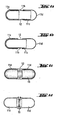
- Figures 1a to 1g capsules comprising water-dispersible or soluble multiple layers and/or multiple sections of material in the form of peripheral shells (11) and linking portions (12, 13).
- Figure 1a shows a capsule having central monolayer of rapid dissolve packaging material and peripheral bilayers of rapid-slow and slow-rapid dissolve packaging material respectively, adapted to provide a weak link or point of weakness as hereinbefore defined.
- Figure 1b is shown a capsule having central and peripheral monolayers of rapid dissolve and slow dissolve packaging materials respectively and peripheral bilayer of rapid-slow dissolve packaging material, as an alternative to the configuration of Figure 1a . Variations of these configurations are envisaged and may be determined according to the desired ease of manufacture and desired release characteristics.
- the capsule of Figure 1a may be manufactured for example by forming peripheral shells (11a inner, 11d outer) by dipping a former to a first depth into respective solutions of or molten slow and rapid dissolve packaging material respectively, then forming shell (11a outer) by dipping to a greater depth into a solution of or molten rapid dissolve packaging material, simultaneously creating portion (11b) and finally filling and overlap capping the portion (11b) with shell (11d outer), simultaneously creating seal (11c).
- the capsule of Figure 1b may be manufactured for example by forming shells (11e inner, 11d) as for 11a inner and 11d outer above, then forming shell (11e outer) by dipping the inner to a lesser depth in slow dissolve packaging material, and filling and overlap capping shell (11d) simultaneously forming seal (11c).
- Figures 1c and 1d show capsules peripheral shells which are shrunk fit about (shaped or moulded) substance and have therebetween secondary points of weakness in the form of an easy dissolving region (12) having an area adapted to peel back, for example on swelling in the form of an unsealed abutment of the two peripheral shells (11d).
- Figures 1e and 1f show capsules comprising an easy dissolving packaging material band (13) bridging a gap between shells (11d). Solid or liquid ingredients are enclosed within the capsule (11d, 11d) and released via the easy dissolving region (13) on rapid dissolution in water.
- Figures 1g relates to the present invention and shows a capsule comprising a rapid dissolve monolayer peripheral shell (11f) enclosing substance and inner secondary peripheral shell (11d), abutting or overlap sealed to the capsules remote peripheral shell (11d).
- the capsule may be suited to enclose two same or different substances with staged release, with rapid release of one substance via the rapid dissolve shell (11f) and subsequent release of the second substance by slow dissolve of capsule (11d, 11d).
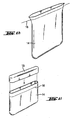
- Figures 1h and 1i are shown packaging in the form of a primary dipped bag or wallet (14) which is filled and sealed, with a separate cap portion (15) or by self-sealing by crimping (16) as illustrated.
- Crimping may optionally provide a release feature in the form of a primary structure as a point of strength portion to prevent premature release or as a secondary point of weakness portion which is for example adapted for rapid dissolving in water to release contents of the bag with subsequent dissolution of the bag or wallet.
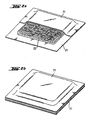
- Figures 2a and 2b are shown a sachet in the form of secondary structure packaging material (21) located around a primary structure mesh bag of slow dissolving reinforcing packaging material (22) which may be fused or otherwise with the packaging material (21).
- Packaging material (21) is sealed at the edges.
- This packaging is suited for delivery of graded substances whereby rapid dissolving of packaging material (21) releases fine particles from within the primary structure mesh bag (22), large particles being released later on slow dissolving of mesh bag (22).
- the sachet may comprise packaging material (21) as flexible or rigid packaging material or a combination thereof which may be flat or formed, for example by vacuum. This configuration may also be employed in other embodiments according to the present disclosure using any packaging material as desired.
- FIG 3a In Figure 3a is shown water-soluble capsule (31) in the form of a first capsule portion, retained by means of a resiliently deformable capsule shell (32) on a support means (33) in locus (34).
- a resiliently deformable capsule shell (32) By locating the water soluble capsule (31) on support means (33) external influences of locus (34) leading to premature release are minimised.
- the shell (31) dissolves releasing contents, with subsequent dissolution of the locating shell (32).
- a capsule which may be made of water soluble packaging material adapted to be located by means of resiliently deformable wings (36), thereby locating a capsule in position and potentially damaging external influences within the locus.
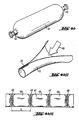
- FIGs 4a - 4c are shown configurations of packaging constructed of packaging material (41) with soluble seal or crimp (42).
- Packaging may be constructed by means including flow wrapping or extruding to form a seamed or seamless tube with seamed sectioning along the length, as shown in Figures 4b(i) and 4b(ii) .
- Figures 5a and 5b are shown clustering elements comprising water soluble packaging material (52) according to the invention and clustered water-soluble packaging in the form of capsules (51). On contact with water the clustered capsules dissolve rapidly to release their contents with subsequent dissolution of the clustering element which serves to aid withstanding external influences leading to premature release prior to contact with water.
Landscapes
- Engineering & Computer Science (AREA)
- Mechanical Engineering (AREA)
- Wrappers (AREA)
- Packages (AREA)
- Medicinal Preparation (AREA)
Claims (23)
- Verpackung zur kontrollierten Freisetzung in Form einer Kapsel, die Verpackungsmaterial umfasst,
das im Wesentlichen in einer wirksamen Menge einer wasserhaltigen Substanz vollständig dispergierbar oder löslich
und dazu geeignet ist, eine oder mehrere Substanzen zu enthalten oder einzuschließen,
wobei
die Verpackung zur Freisetzung von darin enthaltenen oder eingeschlossenen Substanzen in einer vorgegeben Weise an einen gewünschten Ort als Reaktion auf einen vorgegebenen Auslöseimpuls geeignet ist, wobei die Substanzen im Wesentlichen gleichzeitig oder aufeinanderfolgend teilweise oder vollständig dispergiert oder gelöst werden.
wobei die Verpackung Folgendes umfasst:mindestens eine primäre und eine sekundäre Komponente, die zur Auflösung und Freisetzung der Substanz am gewünschten Ort geeignet sind, so dass sie eine Freisetzung innerhalb einer vorgegebenen Zeit und in einer vorgegebenen Weise ermöglichen, wobei die mindestens primären und sekundären Komponenten Bereiche mit mehrschichtigen (11a, 11e) und einschichtigen (11b, 11d) Strukturen aufweisen,undeine der primären oder sekundären Komponenten Schwachstellen (12) aufweist, entweder in Form von Verpackungsmaterial, das zum schnellen oder langsamen Lösen oder Brechen konzipiert ist, oder von Rissen oder Wasser mitführenden Elementen wie Formung oder Prägung in Form nicht durchgehender Perforierung, um das Lösen der Verpackung einzuleiten,undwobei das Verpackungsmaterial eine schnell lösliche einschichtige periphere Hülle (11f) umfasst, die eine Substanz einschließt, und eine innere sekundäre periphere Hülle (11d), die auf Stoß oder überlappend mit der entfernten peripheren Hülle (11d) der Verpackung versiegelt ist, wobei eine Substanz über die schnell lösliche Hülle (11f) rasch und die zweite Substanz durch das langsame Lösen der Verpackung (11d) anschließend freigesetzt wird. - Verpackung gemäß Anspruch 1, wobei die freizusetzende Substanz als Feststoff oder Flüssigkeit vorliegt und vorzugsweise aus Pulvern, Granulaten, Kristallen, Mikrokapseln, Monolithen, Suspensionen, Dispersionen, Konzentraten, Gels, thixotropen Substanzen, wasserfreien Lösungen und dergleichen sowie Gemischen daraus in einer gewünschten Abstufung oder einer Reihe von Abstufungen ausgewählt wird.
- Verpackung gemäß einem der Ansprüche 1 bis 2, die im Wesentlichen vollständig löslich ist.
- Verpackung gemäß einem der Ansprüche 1 bis 3, die dispergierbar oder löslich ist in einer wasserhaltigen Substanz, die ein beliebiges festes, halbfestes, flüssiges oder gasförmiges (Dampf) Medium umfasst, das Wasser in einer zum Dispergieren oder Lösen wirksamen Menge umfasst, das chemisch oder physikalisch freisetzbar gebunden oder frei verfügbar sein kann und das aus der Substanz gewonnen oder kumuliert werden und vom Verpackungsmaterial sofort und problemlos aufgenommen werden kann.
- Verpackung gemäß einem der Ansprüche 1 bis 4, die zur Freisetzung als Reaktion auf einen vorgegebenen Auslöseimpuls geeignet ist, der jeden beliebigen chemischen oder physikalischen Auslöseimpuls zum Lösen oder Dispergieren, Umwandeln durch Ausfällung oder morphologische Veränderung, Brechen, Reißen oder auf andere Weise Durchlässigmachen der Verpackung ganz oder teilweise umfasst, um die enthaltene oder eingeschlossene Substanz freizusetzen.
- Verpackung gemäß einem der Ansprüche 1 bis 5, wobei der Auslöseimpuls mit der wasserhaltigen Substanz, die zum Dispergieren oder Lösen dient, übereinstimmen oder sich von dieser unterscheiden kann, wobei Materialien in heißen oder kalten wasserhaltigen Substanzen dispergierbar oder löslich sind bzw. die Substanz durch Lösen oder durch andere physikalische und chemische Mittel wie Einwirkung von Hitze, Säure oder Lauge, Lösemitteln und Lösemittelgemischen, oxidierende Bedingungen, Strahlungsenergie einschließlich UV, Mikrowellen und dergleichen oder biologische Abbaumittel freigesetzt wird.
- Verpackung gemäß einem der Ansprüche 1 bis 6 zur Freisetzung einer Substanz an einen Ort, der jeden beliebigen Ort, Bereich oder dergleichen umfasst, in den oder an dem die Freisetzung der Substanz erwünscht ist und der mit dem Ort, an dem die Substanz eine gewünschte Wirkung entfalten soll, übereinstimmen oder sich von diesem unterscheiden kann.
- Verpackung gemäß einem der Ansprüche 1 bis 7, wobei das in Wasser dispergierbare oder lösliche Verpackungsmaterial ein natürliches oder synthetisches Polymer oder Gemische daraus umfasst, die aus Polyvinylalkohol (PVA), Polyethylenoxid, chemisch modifizierter Cellulose oder Celluloseethern oder anderen Cellulosederivaten, modifizierten Stärken, Polyvinylpyrrolidon, Polyacrylamid oder Gelatine oder deren Derivaten ausgewählt ist.
- Verpackung gemäß einem der Ansprüche 1 bis 8, die Mittel (36) zur Lokalisierung und Positionierung innerhalb des Ortes umfasst, an den eine enthaltene Substanz in einer Weise freigesetzt werden soll, dass sie an der optimalen Position eingelagert werden kann, oder zur Zeitsteuerung oder Aktivierung des Auslöseimpulses zum Beispiel für den Vorgang des Lösens von Wasser am Ort an dem freizusetzenden Element, oder um die Verpackung in der gewünschten Position zu halten, so dass sie Einflussfaktoren wie Aufprall bei der Handhabung und Lagerung standhält.
- Verpackung gemäß einem der Ansprüche 1 bis 9, wobei Lokalisierungsmittel (36) einen länglichen, im Wesentlichen elastischen oder biegsamen Teil umfassen, der dazu geeignet ist, an einem entsprechenden Überstand angebunden, in diesen eingehängt oder um diesen herum angeordnet zu werden oder in einer Vertiefung einer effektiven Halterung in der Umgebung, in der die Verpackung enthalten ist, aufgenommen zu werden, oder elastisch verformbare Überstände, die in gegensätzlichen Richtungen vom Verpackungsmaterial wie vorstehend definiert verlaufen und dazu geeignet sind, sich so zu verformen, dass sie zwischen einander gegenüberliegenden Haltemitteln, Oberflächen und dergleichen einer effektiven Haltevorrichtung angeordnet sind und durch Federwirkung gehalten werden.
- Verpackung gemäß einem der Ansprüche 1 bis 10, die eine Konformation, Konfiguration oder Formulierung umfasst, die geeignet ist, externe Einflussfaktoren, denen die Verpackung ausgesetzt sein kann und die zu vorzeitiger Freisetzung der enthaltenen oder eingeschlossenen Substanz führen können, zu absorbieren oder zu beseitigen.
- Verpackung gemäß einem der Ansprüche 1 bis 11, die Mittel umfasst, um die Reaktion der Verpackung auf den Freisetzungs-Auslöseimpuls durch Formulierung oder zusätzlich enthaltene Komponenten, die in der Verpackung eingeschlossen oder darin enthalten sind, zu verbessern; diese werden aus Mitteln ausgewählt, die dazu geeignet sind, Freisetzung durch Ausdehnen bei Kontakt mit wasserhaltigen Substanzen zu bewirken, wie zum Beispiel Schwell- oder Ausdehnungsmittel, Schäumungsmittel, Sprengmittel, Dispergiermittel oder enthaltene Gase wie Luft bei positivem Überdruck und dergleichen, Mittel zur Erhöhung der Sensibilität auf den Auslöseimpuls, die zum Beispiel dazu geeignet sind, Freisetzung bei Veränderung des pH-Werts, bei Temperaturänderung, Einwirkung von Mikrowellen, UV, Lösemitteln und Lösemittelgemischen und dergleichen zu bewirken.
- Methode für die Herstellung einer Verpackung zur kontrollierten Freisetzung, die das Formen einer Verpackung aus Verpackungsmaterial wie in diesem Schriftstück in einem der Ansprüche 1 bis 12 beschrieben umfasst, sowie das Formen von Verpackungsmaterial und das Zusetzen von einer oder mehreren freizusetzenden Substanzen, die darin enthalten oder eingeschlossen werden.
- Methode gemäß Anspruch 13, wobei das Formen von Verpackungsmaterial aus rückstandsfreiem Siegeln von einer oder mehreren Schichten, Verformen einer oder mehrerer Schichten durch Einwirken von Wärme, Lösemitteln wie Wasser, Vakuum, Druck und dergleichen, Strangpressen, Formen durch Lösung oder Schmelzen, zum Beispiel durch Eintauchen oder Sprühen in eine Form, Gießen, Prägen ausgewählt wird.
- Methode gemäß einem der Ansprüche 13 und 14, wobei die Substanz(en) innerhalb des Verpackungsmaterials enthalten oder eingeschlossen sein kann (können) durch mechanische oder chemische Mittel, die ausgewählt werden aus gemeinsamer Formgebung des Materials und der Substanz durch Verschmelzen, Vermischen oder Mischen zu einem geschmolzenen Verpackungsmaterial oder einer Lösung daraus, oder Versiegeln des Verpackungsmaterials um die Substanz(en) herum durch Erweichen des Verpackungsmaterials mit Wasser oder einem Sensibilisierungsmittel und Selbstkleben auf nicht erweichtem oder ebenso erweichtem Verpackungsmaterial, Kleben oder Schweißen mit Lösemittel, Klebstoff und dergleichen mit oder ohne Anwendung von Wärme oder Druck, Verbinden der Ränder des Verpackungsmaterials mit einer Siegelflüssigkeit mit abgesenktem Schmelzpunkt wie einem organischen Lösemittel, Wasser, einer Polymerlösung oder -emulsion, einer Lösung eines proteolyitschen Enzyms, das eine Proteinlösung ergibt, und dergleichen sowie Anwendung thermischer Energie oder dergleichen, um Verschmelzen zu bewirken.
- Methode gemäß einem der Ansprüche 13 bis 15, wobei die Verpackung ein Identifizierungselement umfasst, das zum Beispiel gedruckt, geformt, geprägt oder mit dem Laser erzeugt sein kann, um Art und Herkunft des Inhalts, die Art der Verwendung anzugeben oder um Gestaltungsmerkmale einzuschließen.
- Methode gemäß einem der Ansprüche 13 bis 16, wobei die Verpackung oder die darin zu enthaltende Substanz ein zusätzliches Indikatorelement umfasst, zum Beispiel eine Komponente, die anzeigt, wann das Auflösen abgeschlossen ist oder wann die Substanz ihre gewünschte Wirkung erreicht hat.
- Methode für die kontrollierte Freisetzung einer Substanz wie vorstehend definiert, wobei eine in Wasser dispergierbare oder lösliche Verpackung wie in einem der Ansprüche 1 bis 12 definiert verwendet wird, die die Positionierung der Verpackung an einem Ort für die gewünschte Freisetzung sowie die Einwirkung eines die Freisetzung auslösenden Impulses umfasst, zum Beispiel Herstellung eines Kontakts mit einer wasserhaltigen Substanz in für das Dispergieren oder Lösen wirksamer Menge, Aktivieren der Freisetzung über einen wirksamen Zeitraum wie vorstehend definiert und Freisetzung der Substanz an einen Ort, wobei die Verpackung gleichzeitig oder anschließend im Wesentlichen vollständig in der wasserhaltigen Substanz gelöst wird.
- Methode gemäß Anspruch 18 für die Freisetzung agrochemischer Substanzen einschließlich Schädlingsbekämpfungsmittel oder Wirkstoffe zur Regulierung des Pflanzenwachstums, Wirkstoffe gegen Pflanzenkrankheiten, Bodenverbesserungsmittel und dergleichen Anwendungen für Ackerbau, Treibhaus, Gartenbau, Forstwirtschaft und dergleichen auf industrieller Ebene oder für den Hausgebrauch durch Techniken wie Sprühen, Bestäuben, Bohren oder dergleichen.
- Methode gemäß Anspruch 18 für die Freisetzung von Umweltbehandlungsmitteln wie Wasserreinigungsmitteln, Desinfektionsmitteln, Abfallbehandlungsmitteln und dergleichen, einschließlich Steuerungsmitteln für im Wasser enthaltene Viren, Bakterien, Lebewesen und Insekten, die Krankheitsträger darstellen können, natürlichen und industriellen Kontaminanten einschließlich im Wasser enthaltener Mittel zur Steuerung des Pflanzenwachstums, Bodenabfluss-Dispergiermittel, Mittel zur Neutralisierung von Kühl- und Recyclingwasser und dergleichen.
- Methode gemäß Anspruch 18 für die Handhabung und Freisetzung von Substanzen, die sicher zum Ort der Verwendung transportiert werden sollen, zum Beispiel gefährliche Substanzen wie Ätzmittel, chemische Reagenzien, Substanzen zur Abflussreinigung und dergleichen, die in gelöster Form verwendet werden können, die zwar in Pulverform, wasserfreier Form oder als Konzentrat relativ sicher, wenn auch unangenehm sind, jedoch in Lösung gefährlich werden.
- Methode gemäß Anspruch 18 zur Freisetzung von Detergenzien oder anderen Reinigungsmitteln in fester oder flüssiger Form wie Konzentraten, einschließlich Detergenzien für den Hausgebrauch und industrielle Detergenzien zur Reinigung von Geschäftsräumen, Gegenständen und Kleidungsstücken und für die persönliche Hygiene unter Verwendung aller bekannten Detergenzien oder Reinigungsmittel.
- Methode gemäß Anspruch 18 für die Freisetzung von Lebensmittelbestandteilen einschließlich Aroma- und Duftstoffen in Form von Feststoffen in getrockneter oder Pulverform, von Flüssigkeiten und flüchtigen Stoffen, Texturierungsmitteln, Farbstoffen, Flüssigkeit absorbierenden Mitteln wie Reis, Maismehl, Salz und dem Verpackungsmaterial als solchem, Ölen und Fetten, Trockenmilchprodukten und anderen Lebensmitteln, die im Beisein von Sauerstoff, Gewürzen, Kräutern und dergleichen verderben.
Priority Applications (1)
| Application Number | Priority Date | Filing Date | Title |
|---|---|---|---|
| DE60223691T DE60223691T3 (de) | 2001-08-16 | 2002-01-22 | Wasserlösliche verpackung |
Applications Claiming Priority (3)
| Application Number | Priority Date | Filing Date | Title |
|---|---|---|---|
| US31287901P | 2001-08-16 | 2001-08-16 | |
| PCT/IB2002/000230 WO2003016165A1 (en) | 2001-08-16 | 2002-01-22 | Water soluble packaging |
| US312879P | 2010-03-11 |
Publications (3)
| Publication Number | Publication Date |
|---|---|
| EP1421010A1 EP1421010A1 (de) | 2004-05-26 |
| EP1421010B1 EP1421010B1 (de) | 2007-11-21 |
| EP1421010B2 true EP1421010B2 (de) | 2012-01-18 |
Family
ID=23213412
Family Applications (1)
| Application Number | Title | Priority Date | Filing Date |
|---|---|---|---|
| EP02716217A Expired - Lifetime EP1421010B2 (de) | 2001-08-16 | 2002-01-22 | Wasserlösliche verpackung |
Country Status (10)
| Country | Link |
|---|---|
| EP (1) | EP1421010B2 (de) |
| JP (1) | JP3936699B2 (de) |
| KR (1) | KR20040021698A (de) |
| CN (1) | CN100351151C (de) |
| BR (1) | BR0211947A (de) |
| CA (1) | CA2454432A1 (de) |
| DE (1) | DE60223691T3 (de) |
| ES (1) | ES2294123T5 (de) |
| MX (1) | MXPA04001395A (de) |
| WO (1) | WO2003016165A1 (de) |
Families Citing this family (45)
| Publication number | Priority date | Publication date | Assignee | Title |
|---|---|---|---|---|
| PL202692B1 (pl) * | 2002-07-03 | 2009-07-31 | Obrist Closures Switzerland | Pojemnik rozpuszczalny w wodzie |
| GB2401848A (en) * | 2003-05-20 | 2004-11-24 | Reckitt Benckiser | Two-compartment water-soluble container |
| MY137973A (en) | 2003-10-31 | 2009-04-30 | Obrist Closures Switzerland | A tamper-evident closure |
| GB2429691B (en) * | 2005-09-06 | 2007-09-26 | Monosol Af Ltd | Closable, water-soluble or water-dispersible bags |
| GB0608433D0 (en) | 2006-04-28 | 2006-06-07 | Obrist Closures Switzerland | Closure with RFID device |
| HUE052058T2 (hu) | 2007-04-20 | 2021-04-28 | Zenon Tech Partnership | Membrán által tartott biofilm berendezés és eljárás |
| US20080263797A1 (en) * | 2007-04-30 | 2008-10-30 | Berger Maggie V | Single-use toilet brush head |
| KR20100049577A (ko) * | 2007-07-05 | 2010-05-12 | 다우 글로벌 테크놀로지스 인크. | 검출 기능을 가진 용해성 필름 |
| GB2450940B (en) | 2007-07-13 | 2011-11-30 | Obrist Closures Switzerland | Tamper-evident closure |
| GB2450939B (en) | 2007-07-13 | 2012-02-01 | Obrist Closures Switzerland | Tamper-Evident closure |
| GB0721330D0 (en) | 2007-10-31 | 2007-12-12 | Obrist Closures Switzerland | Tamper Evident closure |
| GB0806190D0 (en) | 2008-04-04 | 2008-05-14 | Obrist Closures Switzerland | A closure |
| EP2451961A1 (de) * | 2009-07-07 | 2012-05-16 | Novozymes A/S | Verfahren zur behandlung eines substrats mit einem enzym |
| DE202009012547U1 (de) * | 2009-09-17 | 2010-02-11 | Rapp, Günther | Reinigungsprodukt, insbesondere für die Scheibenwaschanlage eines Kraftfahrzeugs |
| JP2011140333A (ja) * | 2010-01-08 | 2011-07-21 | Tsukioka:Kk | 即席食品収容容器 |
| KR101311697B1 (ko) * | 2010-12-13 | 2013-09-26 | 조건환 | 수소생성사탕용기 |
| KR101237957B1 (ko) * | 2010-04-15 | 2013-02-27 | 조건환 | 연질피막 수소보관용기 및 그 제조 방법 |
| USD630093S1 (en) | 2010-06-11 | 2011-01-04 | Obrist Closures Switzerland Gmbh | Closure |
| US8684619B2 (en) | 2010-10-26 | 2014-04-01 | The Procter & Gamble Company | Cleaning device having plural and customizable cleaning surfaces |
| AU2010366243A1 (en) * | 2010-12-20 | 2013-06-27 | General Electric Company | Water soluble package films for acidic product and method for adding acidic product to water system |
| KR101306944B1 (ko) * | 2011-03-18 | 2013-09-10 | 정웅섭 | 다기능 젤라틴 캡슐 |
| CN102205772A (zh) * | 2011-03-30 | 2011-10-05 | 莫雄勋 | 一种水溶性生物降解型工艺礼品及其使用方法 |
| ITMI20120601A1 (it) * | 2012-04-13 | 2013-10-14 | Getters Spa | Composizione essiccante per dispositivi elettronici sensibili all'umidità |
| US9394092B2 (en) * | 2012-04-16 | 2016-07-19 | Monosol, Llc | Powdered pouch and method of making same |
| CN103239420B (zh) * | 2013-05-14 | 2014-09-03 | 海南卫康制药(潜山)有限公司 | 笼状结构片剂及其制备方法 |
| US20150074916A1 (en) * | 2013-09-18 | 2015-03-19 | John Miller | Method and aparatus for applying nanoparticle surface treatments inside a container |
| USD739106S1 (en) | 2013-09-23 | 2015-09-15 | The Procter & Gamble Company | Cleaning pad |
| US9670440B2 (en) * | 2013-10-07 | 2017-06-06 | Monosol, Llc | Water-soluble delayed release capsules, related methods, and related articles |
| CN105722768B (zh) * | 2013-10-07 | 2019-02-19 | 蒙诺苏尔有限公司 | 水溶性延迟释放胶囊、相关方法和相关制品 |
| CN105707068B (zh) * | 2016-01-26 | 2018-05-18 | 刘圣泉 | 一种用于无人机喷撒的农药及制备方法 |
| DE102016115927A1 (de) | 2016-08-26 | 2018-03-01 | Brauns-Heitmann GmbH & Co Kommanditgesellschaft | Färbesystem für textile Materialien |
| CN108872558B (zh) * | 2018-04-26 | 2020-03-31 | 烟台芥子生物技术有限公司 | 利用可溶解膜进行化学反应的方法及包括可溶解膜的检测试剂盒 |
| KR102080785B1 (ko) * | 2018-05-11 | 2020-02-24 | 김성준 | 장내 미생물 표적 채취용 캡슐 |
| CN108587204A (zh) * | 2018-05-14 | 2018-09-28 | 重庆路维康交通科技有限公司 | 一种沥青混合料的温拌再生剂及其制备和使用方法 |
| JP7195837B2 (ja) * | 2018-09-20 | 2022-12-26 | 株式会社フジシール | 角錐包装体 |
| CN109777634A (zh) * | 2019-01-25 | 2019-05-21 | 关汉杰 | 一种遇水发泡胶囊及其制备方法 |
| KR102236214B1 (ko) * | 2019-03-11 | 2021-04-05 | 경북대학교 산학협력단 | 지반 고결 시스템 |
| US20200345039A1 (en) * | 2019-05-02 | 2020-11-05 | Verily Life Sciences Llc | Reformatted insect food product for aquatic environments |
| DE102020120706A1 (de) | 2020-08-05 | 2022-02-10 | Rovema Gmbh | Schlauchbeutel zur Verpackung einer Pflanze |
| US11484806B2 (en) | 2020-08-14 | 2022-11-01 | Moose Creative Management Pty Limited | Buoyancy assisted toy packaging |
| KR20230025209A (ko) | 2021-08-13 | 2023-02-21 | 삼성전자주식회사 | 반도체 패키지 |
| CN113477494A (zh) * | 2021-08-20 | 2021-10-08 | 刘海霞 | 一种染料的环保使用方法 |
| CN114772051B (zh) * | 2022-04-08 | 2024-02-20 | 汕头市佳宏纸制品有限公司 | 一种高强度防水自降解纸袋 |
| CN118890960A (zh) * | 2022-05-11 | 2024-11-01 | 阿萨达股份公司 | 单剂量消毒剂 |
| CN119660972A (zh) * | 2024-12-12 | 2025-03-21 | 山东省高速养护集团有限公司 | 用于合流制排口污水的好氧微生物在线培养及投加设备 |
Citations (4)
| Publication number | Priority date | Publication date | Assignee | Title |
|---|---|---|---|---|
| EP0479404A2 (de) † | 1990-10-03 | 1992-04-08 | Unilever Plc | Verpackungsfilm und Beutel |
| EP0607316B1 (de) † | 1991-10-16 | 1997-02-26 | Rhone-Poulenc Agriculture Ltd. | Abgedichtete verpackung |
| WO2001044433A1 (de) † | 1999-12-13 | 2001-06-21 | Henkel Kommanditgesellschaft Auf Aktien | Waschmittel-, spülmittel- oder reinigungsmittel-portionen mit kontrollierter wirkstoff-freisetzung |
| WO2001060340A1 (en) † | 2000-02-16 | 2001-08-23 | Bioprogress Technology International Inc. | Delivery capsules |
Family Cites Families (14)
| Publication number | Priority date | Publication date | Assignee | Title |
|---|---|---|---|---|
| US3580390A (en) * | 1968-02-20 | 1971-05-25 | Nat Gypsum Co | Plaster colorant system |
| US3762454A (en) * | 1971-11-15 | 1973-10-02 | R Wilkins | Disposable garbage container |
| US3915296A (en) * | 1974-01-24 | 1975-10-28 | Richard Hugh H Spencer | Container for mixing liquid with a material |
| DE7910284U1 (de) * | 1979-04-09 | 1979-07-12 | Seibt & Kapp Gmbh Maschf | Transportsack |
| EP0116744A1 (de) | 1982-12-20 | 1984-08-29 | Warner-Lambert Company | Vorrichtung und Verfahren zum Versiegeln von Kapseln |
| US4656066A (en) | 1982-12-20 | 1987-04-07 | Warner-Lambert Company | Apparatus and method for sealing capsules |
| US4539060A (en) | 1983-02-18 | 1985-09-03 | Warner-Lambert Company | Apparatus and method of sealing capsules |
| IE58468B1 (en) | 1984-10-25 | 1993-09-22 | Warner Lambert Co | Method for sealing capsules and capsule |
| IL90585A (en) | 1988-06-15 | 1996-05-14 | May & Baker Ltd | Package releasing its contents on contact with water |
| NZ244818A (en) * | 1991-10-24 | 1994-09-27 | Rhone Poulenc Agrochimie | Package containing a toxic composition which comprises two compartments formed by two sheets of water-soluble dispersible material by means of a water-soluble/dispersible heat seal and a third sheet |
| DE19537671A1 (de) * | 1995-10-10 | 1997-04-17 | Bosch Gmbh Robert | Wasch-, Spül- oder Reinigungsmittelverpackung |
| FR2757173A1 (fr) | 1996-12-17 | 1998-06-19 | Warner Lambert Co | Compositions polymeres d'origine non-animale pour la formation de films |
| CA2236869A1 (en) * | 1998-03-10 | 1999-09-10 | Howard Kimel | Soluble package or container |
| ATE356045T1 (de) * | 1999-11-17 | 2007-03-15 | Reckitt Benckiser Uk Ltd | Spritzgegossener wasserlöslicher behälter |
-
2002
- 2002-01-22 DE DE60223691T patent/DE60223691T3/de not_active Expired - Lifetime
- 2002-01-22 CN CNB028160363A patent/CN100351151C/zh not_active Expired - Fee Related
- 2002-01-22 KR KR10-2004-7002192A patent/KR20040021698A/ko not_active Ceased
- 2002-01-22 JP JP2003521106A patent/JP3936699B2/ja not_active Expired - Fee Related
- 2002-01-22 CA CA002454432A patent/CA2454432A1/en not_active Abandoned
- 2002-01-22 MX MXPA04001395A patent/MXPA04001395A/es active IP Right Grant
- 2002-01-22 BR BR0211947-1A patent/BR0211947A/pt not_active IP Right Cessation
- 2002-01-22 ES ES02716217T patent/ES2294123T5/es not_active Expired - Lifetime
- 2002-01-22 EP EP02716217A patent/EP1421010B2/de not_active Expired - Lifetime
- 2002-01-22 WO PCT/IB2002/000230 patent/WO2003016165A1/en not_active Ceased
Patent Citations (4)
| Publication number | Priority date | Publication date | Assignee | Title |
|---|---|---|---|---|
| EP0479404A2 (de) † | 1990-10-03 | 1992-04-08 | Unilever Plc | Verpackungsfilm und Beutel |
| EP0607316B1 (de) † | 1991-10-16 | 1997-02-26 | Rhone-Poulenc Agriculture Ltd. | Abgedichtete verpackung |
| WO2001044433A1 (de) † | 1999-12-13 | 2001-06-21 | Henkel Kommanditgesellschaft Auf Aktien | Waschmittel-, spülmittel- oder reinigungsmittel-portionen mit kontrollierter wirkstoff-freisetzung |
| WO2001060340A1 (en) † | 2000-02-16 | 2001-08-23 | Bioprogress Technology International Inc. | Delivery capsules |
Also Published As
| Publication number | Publication date |
|---|---|
| MXPA04001395A (es) | 2004-05-27 |
| DE60223691T3 (de) | 2012-07-19 |
| JP3936699B2 (ja) | 2007-06-27 |
| DE60223691D1 (de) | 2008-01-03 |
| KR20040021698A (ko) | 2004-03-10 |
| ES2294123T3 (es) | 2008-04-01 |
| CN1543421A (zh) | 2004-11-03 |
| CN100351151C (zh) | 2007-11-28 |
| EP1421010B1 (de) | 2007-11-21 |
| BR0211947A (pt) | 2004-09-21 |
| WO2003016165A1 (en) | 2003-02-27 |
| ES2294123T5 (es) | 2012-06-29 |
| EP1421010A1 (de) | 2004-05-26 |
| DE60223691T2 (de) | 2008-10-30 |
| CA2454432A1 (en) | 2003-02-27 |
| JP2005500211A (ja) | 2005-01-06 |
Similar Documents
| Publication | Publication Date | Title |
|---|---|---|
| EP1421010B2 (de) | Wasserlösliche verpackung | |
| JPH06506426A (ja) | 包装システム | |
| RU2129081C1 (ru) | Упаковка для химических препаратов | |
| EP1384682A2 (de) | Riechstoff behaltende Verpackung | |
| EP0389513B1 (de) | Verpackung für wasserhaltige stoffe | |
| JP2002128138A (ja) | 水溶性パッケージ | |
| JP3373527B2 (ja) | 水溶性袋包装システム及び包装方法 | |
| US5846904A (en) | Soil fumigant preparations | |
| NZ245218A (en) | Package comprising effervescent composition containing hazardous material enclosed in film of water-soluble or dispersible material | |
| AU2002226610A1 (en) | Water soluble packaging | |
| CN101088879A (zh) | 可以食用的短梗霉多糖薄膜包装袋 | |
| JP4450713B2 (ja) | 油系懸濁農薬製剤の包装方法および使用方法 | |
| HK1066773A (zh) | 水溶性包装 | |
| JP2999196B1 (ja) | 水溶性ポリマ―容器 | |
| JP2010023918A (ja) | 包装体 | |
| JPH09169603A (ja) | 土壌くん蒸剤 | |
| US20030177696A1 (en) | Stick-like packaging for flower substrates | |
| JPH07264963A (ja) | 農薬粒剤の包装用角底袋兼散布袋及び散布方法 | |
| ZA200204661B (en) | Injection-moulded water-soluble container. | |
| JPH04253645A (ja) | か粒剤用包装形態 | |
| JPH0987105A (ja) | 水溶性農薬包装体およびその製造方法 | |
| JPH11171131A (ja) | 非水性液状農薬製剤の包装方法 | |
| JPH08245307A (ja) | 包装農薬製剤 | |
| HK1029025B (en) | Compressed chloramine-t tablets and method for the production thereof |
Legal Events
| Date | Code | Title | Description |
|---|---|---|---|
| PUAI | Public reference made under article 153(3) epc to a published international application that has entered the european phase |
Free format text: ORIGINAL CODE: 0009012 |
|
| 17P | Request for examination filed |
Effective date: 20040316 |
|
| AK | Designated contracting states |
Kind code of ref document: A1 Designated state(s): AT BE CH CY DE DK ES FI FR GB GR IE IT LI LU MC NL PT SE TR |
|
| AX | Request for extension of the european patent |
Extension state: AL LT LV MK RO SI |
|
| 17Q | First examination report despatched |
Effective date: 20040902 |
|
| RAP1 | Party data changed (applicant data changed or rights of an application transferred) |
Owner name: WARNER-LAMBERT COMPANY LLC |
|
| GRAP | Despatch of communication of intention to grant a patent |
Free format text: ORIGINAL CODE: EPIDOSNIGR1 |
|
| RIN1 | Information on inventor provided before grant (corrected) |
Inventor name: CREEKE, SARAH, ANNE Inventor name: HUMPHRIES, MARK, ROBSON Inventor name: SCOTT, ROBERT, ANTHONY Inventor name: SEENEY, PHILIP |
|
| GRAS | Grant fee paid |
Free format text: ORIGINAL CODE: EPIDOSNIGR3 |
|
| GRAA | (expected) grant |
Free format text: ORIGINAL CODE: 0009210 |
|
| AK | Designated contracting states |
Kind code of ref document: B1 Designated state(s): AT BE CH CY DE DK ES FI FR GB GR IE IT LI LU MC NL PT SE TR |
|
| AX | Request for extension of the european patent |
Extension state: AL LT LV MK RO SI |
|
| REG | Reference to a national code |
Ref country code: GB Ref legal event code: FG4D |
|
| REG | Reference to a national code |
Ref country code: IE Ref legal event code: FG4D |
|
| REG | Reference to a national code |
Ref country code: CH Ref legal event code: EP |
|
| REF | Corresponds to: |
Ref document number: 60223691 Country of ref document: DE Date of ref document: 20080103 Kind code of ref document: P |
|
| REG | Reference to a national code |
Ref country code: ES Ref legal event code: FG2A Ref document number: 2294123 Country of ref document: ES Kind code of ref document: T3 |
|
| PG25 | Lapsed in a contracting state [announced via postgrant information from national office to epo] |
Ref country code: LI Free format text: LAPSE BECAUSE OF FAILURE TO SUBMIT A TRANSLATION OF THE DESCRIPTION OR TO PAY THE FEE WITHIN THE PRESCRIBED TIME-LIMIT Effective date: 20071121 Ref country code: NL Free format text: LAPSE BECAUSE OF FAILURE TO SUBMIT A TRANSLATION OF THE DESCRIPTION OR TO PAY THE FEE WITHIN THE PRESCRIBED TIME-LIMIT Effective date: 20071121 Ref country code: CH Free format text: LAPSE BECAUSE OF FAILURE TO SUBMIT A TRANSLATION OF THE DESCRIPTION OR TO PAY THE FEE WITHIN THE PRESCRIBED TIME-LIMIT Effective date: 20071121 Ref country code: SE Free format text: LAPSE BECAUSE OF FAILURE TO SUBMIT A TRANSLATION OF THE DESCRIPTION OR TO PAY THE FEE WITHIN THE PRESCRIBED TIME-LIMIT Effective date: 20080221 |
|
| NLV1 | Nl: lapsed or annulled due to failure to fulfill the requirements of art. 29p and 29m of the patents act | ||
| PG25 | Lapsed in a contracting state [announced via postgrant information from national office to epo] |
Ref country code: FI Free format text: LAPSE BECAUSE OF FAILURE TO SUBMIT A TRANSLATION OF THE DESCRIPTION OR TO PAY THE FEE WITHIN THE PRESCRIBED TIME-LIMIT Effective date: 20071121 |
|
| REG | Reference to a national code |
Ref country code: CH Ref legal event code: PL |
|
| PG25 | Lapsed in a contracting state [announced via postgrant information from national office to epo] |
Ref country code: AT Free format text: LAPSE BECAUSE OF FAILURE TO SUBMIT A TRANSLATION OF THE DESCRIPTION OR TO PAY THE FEE WITHIN THE PRESCRIBED TIME-LIMIT Effective date: 20071121 |
|
| ET | Fr: translation filed | ||
| PG25 | Lapsed in a contracting state [announced via postgrant information from national office to epo] |
Ref country code: DK Free format text: LAPSE BECAUSE OF FAILURE TO SUBMIT A TRANSLATION OF THE DESCRIPTION OR TO PAY THE FEE WITHIN THE PRESCRIBED TIME-LIMIT Effective date: 20071121 |
|
| PLBI | Opposition filed |
Free format text: ORIGINAL CODE: 0009260 |
|
| PG25 | Lapsed in a contracting state [announced via postgrant information from national office to epo] |
Ref country code: BE Free format text: LAPSE BECAUSE OF FAILURE TO SUBMIT A TRANSLATION OF THE DESCRIPTION OR TO PAY THE FEE WITHIN THE PRESCRIBED TIME-LIMIT Effective date: 20071121 Ref country code: MC Free format text: LAPSE BECAUSE OF NON-PAYMENT OF DUE FEES Effective date: 20080131 |
|
| PLAX | Notice of opposition and request to file observation + time limit sent |
Free format text: ORIGINAL CODE: EPIDOSNOBS2 |
|
| 26 | Opposition filed |
Opponent name: RECKITT BENCKISER (UK) LIMITED Effective date: 20080821 |
|
| PG25 | Lapsed in a contracting state [announced via postgrant information from national office to epo] |
Ref country code: PT Free format text: LAPSE BECAUSE OF FAILURE TO SUBMIT A TRANSLATION OF THE DESCRIPTION OR TO PAY THE FEE WITHIN THE PRESCRIBED TIME-LIMIT Effective date: 20080421 |
|
| PLAF | Information modified related to communication of a notice of opposition and request to file observations + time limit |
Free format text: ORIGINAL CODE: EPIDOSCOBS2 |
|
| PG25 | Lapsed in a contracting state [announced via postgrant information from national office to epo] |
Ref country code: GR Free format text: LAPSE BECAUSE OF FAILURE TO SUBMIT A TRANSLATION OF THE DESCRIPTION OR TO PAY THE FEE WITHIN THE PRESCRIBED TIME-LIMIT Effective date: 20080222 Ref country code: IE Free format text: LAPSE BECAUSE OF NON-PAYMENT OF DUE FEES Effective date: 20080122 |
|
| PLBB | Reply of patent proprietor to notice(s) of opposition received |
Free format text: ORIGINAL CODE: EPIDOSNOBS3 |
|
| PG25 | Lapsed in a contracting state [announced via postgrant information from national office to epo] |
Ref country code: CY Free format text: LAPSE BECAUSE OF FAILURE TO SUBMIT A TRANSLATION OF THE DESCRIPTION OR TO PAY THE FEE WITHIN THE PRESCRIBED TIME-LIMIT Effective date: 20071121 |
|
| PG25 | Lapsed in a contracting state [announced via postgrant information from national office to epo] |
Ref country code: IT Free format text: LAPSE BECAUSE OF NON-PAYMENT OF DUE FEES Effective date: 20080122 |
|
| PG25 | Lapsed in a contracting state [announced via postgrant information from national office to epo] |
Ref country code: LU Free format text: LAPSE BECAUSE OF NON-PAYMENT OF DUE FEES Effective date: 20080122 |
|
| PG25 | Lapsed in a contracting state [announced via postgrant information from national office to epo] |
Ref country code: TR Free format text: LAPSE BECAUSE OF FAILURE TO SUBMIT A TRANSLATION OF THE DESCRIPTION OR TO PAY THE FEE WITHIN THE PRESCRIBED TIME-LIMIT Effective date: 20071121 |
|
| PLAY | Examination report in opposition despatched + time limit |
Free format text: ORIGINAL CODE: EPIDOSNORE2 |
|
| PLBC | Reply to examination report in opposition received |
Free format text: ORIGINAL CODE: EPIDOSNORE3 |
|
| PGRI | Patent reinstated in contracting state [announced from national office to epo] |
Ref country code: IT Effective date: 20110616 |
|
| PUAH | Patent maintained in amended form |
Free format text: ORIGINAL CODE: 0009272 |
|
| STAA | Information on the status of an ep patent application or granted ep patent |
Free format text: STATUS: PATENT MAINTAINED AS AMENDED |
|
| 27A | Patent maintained in amended form |
Effective date: 20120118 |
|
| AK | Designated contracting states |
Kind code of ref document: B2 Designated state(s): AT BE CH CY DE DK ES FI FR GB GR IE IT LI LU MC NL PT SE TR |
|
| AX | Request for extension of the european patent |
Extension state: AL LT LV MK RO SI |
|
| REG | Reference to a national code |
Ref country code: DE Ref legal event code: R102 Ref document number: 60223691 Country of ref document: DE |
|
| REG | Reference to a national code |
Ref country code: GB Ref legal event code: 732E Free format text: REGISTERED BETWEEN 20120105 AND 20120111 |
|
| REG | Reference to a national code |
Ref country code: DE Ref legal event code: R102 Ref document number: 60223691 Country of ref document: DE Effective date: 20120118 |
|
| REG | Reference to a national code |
Ref country code: DE Ref legal event code: R082 Ref document number: 60223691 Country of ref document: DE Representative=s name: MAIWALD PATENTANWALTSGESELLSCHAFT MBH, DE Effective date: 20120202 Ref country code: DE Ref legal event code: R081 Ref document number: 60223691 Country of ref document: DE Owner name: CAPSUGEL BELGIUM NV, BE Free format text: FORMER OWNER: WARNER-LAMBERT COMPANY LLC, NEW YORK, US Effective date: 20120202 Ref country code: DE Ref legal event code: R081 Ref document number: 60223691 Country of ref document: DE Owner name: CAPSUGEL BELGIUM NV, BE Free format text: FORMER OWNER: WARNER-LAMBERT COMPANY LLC, NEW YORK, N.Y., US Effective date: 20120202 |
|
| PGFP | Annual fee paid to national office [announced via postgrant information from national office to epo] |
Ref country code: FR Payment date: 20120202 Year of fee payment: 11 |
|
| REG | Reference to a national code |
Ref country code: DE Ref legal event code: R082 Ref document number: 60223691 Country of ref document: DE Representative=s name: MAIWALD PATENTANWALTSGESELLSCHAFT MBH, DE |
|
| REG | Reference to a national code |
Ref country code: ES Ref legal event code: DC2A Ref document number: 2294123 Country of ref document: ES Kind code of ref document: T5 Effective date: 20120629 |
|
| REG | Reference to a national code |
Ref country code: DE Ref legal event code: R082 Ref document number: 60223691 Country of ref document: DE |
|
| REG | Reference to a national code |
Ref country code: FR Ref legal event code: ST Effective date: 20130930 |
|
| PG25 | Lapsed in a contracting state [announced via postgrant information from national office to epo] |
Ref country code: FR Free format text: LAPSE BECAUSE OF NON-PAYMENT OF DUE FEES Effective date: 20130131 |
|
| PGFP | Annual fee paid to national office [announced via postgrant information from national office to epo] |
Ref country code: ES Payment date: 20131211 Year of fee payment: 13 |
|
| PGFP | Annual fee paid to national office [announced via postgrant information from national office to epo] |
Ref country code: IT Payment date: 20140116 Year of fee payment: 13 |
|
| PG25 | Lapsed in a contracting state [announced via postgrant information from national office to epo] |
Ref country code: IT Free format text: LAPSE BECAUSE OF NON-PAYMENT OF DUE FEES Effective date: 20150122 |
|
| PGFP | Annual fee paid to national office [announced via postgrant information from national office to epo] |
Ref country code: GB Payment date: 20151230 Year of fee payment: 15 |
|
| REG | Reference to a national code |
Ref country code: ES Ref legal event code: FD2A Effective date: 20160226 |
|
| PG25 | Lapsed in a contracting state [announced via postgrant information from national office to epo] |
Ref country code: ES Free format text: LAPSE BECAUSE OF NON-PAYMENT OF DUE FEES Effective date: 20150123 |
|
| PGFP | Annual fee paid to national office [announced via postgrant information from national office to epo] |
Ref country code: DE Payment date: 20160127 Year of fee payment: 15 |
|
| REG | Reference to a national code |
Ref country code: DE Ref legal event code: R119 Ref document number: 60223691 Country of ref document: DE |
|
| GBPC | Gb: european patent ceased through non-payment of renewal fee |
Effective date: 20170122 |
|
| PG25 | Lapsed in a contracting state [announced via postgrant information from national office to epo] |
Ref country code: GB Free format text: LAPSE BECAUSE OF NON-PAYMENT OF DUE FEES Effective date: 20170122 Ref country code: DE Free format text: LAPSE BECAUSE OF NON-PAYMENT OF DUE FEES Effective date: 20170801 |