EP1421165B1 - Verfahren zur oberflächenbehandlung mittels eines gels zur behandlung, und gel zur behandlung - Google Patents
Verfahren zur oberflächenbehandlung mittels eines gels zur behandlung, und gel zur behandlung Download PDFInfo
- Publication number
- EP1421165B1 EP1421165B1 EP02760387A EP02760387A EP1421165B1 EP 1421165 B1 EP1421165 B1 EP 1421165B1 EP 02760387 A EP02760387 A EP 02760387A EP 02760387 A EP02760387 A EP 02760387A EP 1421165 B1 EP1421165 B1 EP 1421165B1
- Authority
- EP
- European Patent Office
- Prior art keywords
- gel
- treatment
- weight
- mixture
- inorganic
- Prior art date
- Legal status (The legal status is an assumption and is not a legal conclusion. Google has not performed a legal analysis and makes no representation as to the accuracy of the status listed.)
- Expired - Lifetime
Links
Images


Classifications
-
- G—PHYSICS
- G21—NUCLEAR PHYSICS; NUCLEAR ENGINEERING
- G21F—PROTECTION AGAINST X-RADIATION, GAMMA RADIATION, CORPUSCULAR RADIATION OR PARTICLE BOMBARDMENT; TREATING RADIOACTIVELY CONTAMINATED MATERIAL; DECONTAMINATION ARRANGEMENTS THEREFOR
- G21F9/00—Treating radioactively contaminated material; Decontamination arrangements therefor
- G21F9/001—Decontamination of contaminated objects, apparatus, clothes, food; Preventing contamination thereof
- G21F9/002—Decontamination of the surface of objects with chemical or electrochemical processes
-
- C—CHEMISTRY; METALLURGY
- C11—ANIMAL OR VEGETABLE OILS, FATS, FATTY SUBSTANCES OR WAXES; FATTY ACIDS THEREFROM; DETERGENTS; CANDLES
- C11D—DETERGENT COMPOSITIONS; USE OF SINGLE SUBSTANCES AS DETERGENTS; SOAP OR SOAP-MAKING; RESIN SOAPS; RECOVERY OF GLYCEROL
- C11D17/00—Detergent materials or soaps characterised by their shape or physical properties
- C11D17/0008—Detergent materials or soaps characterised by their shape or physical properties aqueous liquid non soap compositions
- C11D17/003—Colloidal solutions, e.g. gels; Thixotropic solutions or pastes
-
- C—CHEMISTRY; METALLURGY
- C11—ANIMAL OR VEGETABLE OILS, FATS, FATTY SUBSTANCES OR WAXES; FATTY ACIDS THEREFROM; DETERGENTS; CANDLES
- C11D—DETERGENT COMPOSITIONS; USE OF SINGLE SUBSTANCES AS DETERGENTS; SOAP OR SOAP-MAKING; RESIN SOAPS; RECOVERY OF GLYCEROL
- C11D3/00—Other compounding ingredients of detergent compositions covered in group C11D1/00
- C11D3/02—Inorganic compounds ; Elemental compounds
- C11D3/04—Water-soluble compounds
- C11D3/042—Acids
-
- C—CHEMISTRY; METALLURGY
- C11—ANIMAL OR VEGETABLE OILS, FATS, FATTY SUBSTANCES OR WAXES; FATTY ACIDS THEREFROM; DETERGENTS; CANDLES
- C11D—DETERGENT COMPOSITIONS; USE OF SINGLE SUBSTANCES AS DETERGENTS; SOAP OR SOAP-MAKING; RESIN SOAPS; RECOVERY OF GLYCEROL
- C11D3/00—Other compounding ingredients of detergent compositions covered in group C11D1/00
- C11D3/02—Inorganic compounds ; Elemental compounds
- C11D3/04—Water-soluble compounds
- C11D3/046—Salts
-
- C—CHEMISTRY; METALLURGY
- C11—ANIMAL OR VEGETABLE OILS, FATS, FATTY SUBSTANCES OR WAXES; FATTY ACIDS THEREFROM; DETERGENTS; CANDLES
- C11D—DETERGENT COMPOSITIONS; USE OF SINGLE SUBSTANCES AS DETERGENTS; SOAP OR SOAP-MAKING; RESIN SOAPS; RECOVERY OF GLYCEROL
- C11D3/00—Other compounding ingredients of detergent compositions covered in group C11D1/00
- C11D3/02—Inorganic compounds ; Elemental compounds
- C11D3/12—Water-insoluble compounds
- C11D3/124—Silicon containing, e.g. silica, silex, quartz or glass beads
-
- C—CHEMISTRY; METALLURGY
- C23—COATING METALLIC MATERIAL; COATING MATERIAL WITH METALLIC MATERIAL; CHEMICAL SURFACE TREATMENT; DIFFUSION TREATMENT OF METALLIC MATERIAL; COATING BY VACUUM EVAPORATION, BY SPUTTERING, BY ION IMPLANTATION OR BY CHEMICAL VAPOUR DEPOSITION, IN GENERAL; INHIBITING CORROSION OF METALLIC MATERIAL OR INCRUSTATION IN GENERAL
- C23G—CLEANING OR DE-GREASING OF METALLIC MATERIAL BY CHEMICAL METHODS OTHER THAN ELECTROLYSIS
- C23G1/00—Cleaning or pickling metallic material with solutions or molten salts
- C23G1/02—Cleaning or pickling metallic material with solutions or molten salts with acid solutions
- C23G1/025—Cleaning or pickling metallic material with solutions or molten salts with acid solutions acidic pickling pastes
-
- C—CHEMISTRY; METALLURGY
- C23—COATING METALLIC MATERIAL; COATING MATERIAL WITH METALLIC MATERIAL; CHEMICAL SURFACE TREATMENT; DIFFUSION TREATMENT OF METALLIC MATERIAL; COATING BY VACUUM EVAPORATION, BY SPUTTERING, BY ION IMPLANTATION OR BY CHEMICAL VAPOUR DEPOSITION, IN GENERAL; INHIBITING CORROSION OF METALLIC MATERIAL OR INCRUSTATION IN GENERAL
- C23G—CLEANING OR DE-GREASING OF METALLIC MATERIAL BY CHEMICAL METHODS OTHER THAN ELECTROLYSIS
- C23G1/00—Cleaning or pickling metallic material with solutions or molten salts
- C23G1/14—Cleaning or pickling metallic material with solutions or molten salts with alkaline solutions
Definitions
- the present invention relates to a method of treating a surface with a gel, as well as to a treatment gel that can be used in such a process.
- the treatment may be for example a decontamination treatment, for example radioactive or organic, a pickling treatment or a degreasing treatment of a surface.
- the gels of the prior art do not dry or in several tens of hours and must all be removed after a few hours by rinsing with water.
- the rinsing also makes it possible to interrupt the action of the gel on the wall and to control the duration of action of the gel.
- Rinsing has the disadvantage of generating liquid effluents of the order of 10 L of water per kg of gel used. These decontamination effluents in the case of radioactive decontamination are treated in existing nuclear material treatment facilities. This requires in-depth studies on the management of these effluents and their impact vis-à-vis the facilities treatment circuits. In addition such gels that must be rinsed can not be used to treat installation surfaces that must not be flooded.
- the present invention is specifically intended to provide a method of treating a surface with a gel, and a treatment gel for use in such a process, which overcomes the aforementioned drawbacks of the prior art.
- the gel dries by fracturing.
- concentrations are expressed in moles per liter of gel in the present text.
- the gel drying temperature in the treatment process is between 20 and 30 ° C, and the relative humidity between 20% and 70%.
- AEROSIL fumed silicas "Cab-O-Sil” M5, H5 or EH5 (trademarks) marketed by CABOT and pyrogenic silicas marketed by Degussa under the name AEROSIL (trademarks).
- fumed silicas AEROSIL 380 (trade mark) silica with a specific surface area of 380 m 2 / g, which offers the maximum viscosity properties for a minimum mineral filler, will be preferred.
- the precipitated silica may be obtained, for example, by mixing a solution of sodium silicate and an acid.
- the preferred precipitated silicas are marketed by DEGUSSA under the name SIPERNAT 22 LS and FK 310 (trademarks).
- the viscosifying agent of the gel of the present invention is therefore a mixture of the two types of silicas mentioned above, pyrogenated and precipitated.
- the mixture of the silicas is preferably at a concentration of 5 to 10% by weight of the gel to ensure drying of the gel at a temperature of between 20 ° C. and 30 ° C. and relative humidity of between 20 and 70% on average at 2 ° to 5 hours. Indeed, such a mixture unexpectedly influences the drying of the gel and the particle size of the residue obtained.
- the dry gel is in the form of particles of controlled size ranging from 0.1 to 2 mm thanks in particular to the aforementioned compositions of the present invention.
- a precipitated silica for example FK 310 (trademarks)
- an 8% silica gel for example AEROSIL 380 (trademarks)
- the active treatment agent may be an acid or a mixture of inorganic acids, preferably selected from hydrochloric acid, nitric acid, sulfuric acid and phosphoric acid or a mixture thereof.
- the acid is preferably present at a concentration of 0.1 to 7 mol / l, more preferably 0.5 to 4 mol / l, to ensure drying of the gel at a temperature between 20 ° C and 30 ° C and relative humidity between 20 and 70% on average in 2 to 5 hours.
- the treatment gel according to the invention may also contain, as active treatment agent, a base, preferably a mineral base preferably chosen from sodium hydroxide, potassium hydroxide or mixtures thereof.
- a base preferably a mineral base preferably chosen from sodium hydroxide, potassium hydroxide or mixtures thereof.
- the base is advantageously present at a concentration of less than 2 mol / l, preferably between 0.5 and 2 mol / l, more preferably between 1 and 2 mol / l to ensure drying of the gel at a temperature of between 20 ° C. and 30 ° C and relative humidity between 20 and 70% on average in 2 to 5 hours
- the gel of the invention may contain an oxidizing agent, for example at a concentration of 0.5 to 1 mol / l, which has a normal oxidation-reduction potential greater than 1400 mV in a strong acid medium, that is to say, an oxidizing power greater than that of permanganate.
- an oxidizing agent for example, such oxidizing agents may be Ce (IV) Co (III) and Ag (II).
- the oxidizing agents are generally associated with a mineral acid, such as nitric acid at a moderate concentration of less than 2 mol / l, and allowing rapid drying of the gel.
- Cerium is generally introduced in the form of electrogenerated cerium (IV) nitrate Ce (NO 3 ) 4 or hexanitrate cerium (NH 4 ) 2 Ce (NO 3 ) 5 .
- a typical example of an oxidizing decontamination gel according to the invention consists of a colloidal solution comprising 0.1 to 0.5 mol / l of This (NO 3 ) 4 or (NH 4 ) 2 Ce (NO 3 ) 6 , from 0.5 to 2 mol / l of nitric acid and from 5 to 15% by weight of silica.
- the gels of the invention can easily be prepared at room temperature by adding to an aqueous solution the mineral gelling agent consisting of the silica mixture which preferably has a high specific surface area, for example greater than 100 m 2 / g. .
- a viscosity of at least 350 mPa.s and a viscosity recovery time of less than one second are preferred so that the gel can be sprayed, remotely or not, on the surface to be treated without pouring.
- the objective of the present invention is therefore also to provide gels with controlled duration of action by a fast drying time, sufficient to ensure the treatment of the surface, usually between 2 and 5 hours, and even between 2 and 3 hours at a temperature between 20 ° C and 30 ° C and average relative humidity between 20 and 70%.
- the gels according to the invention comprise a mixture of viscosifying agents and an active decontamination agent at the above concentrations, the drying of the gel leads to a dry residue having an ability to easily detach from the support. Thus, no rinsing with water is necessary and the process thus generates no secondary effluent.
- the gels of the present invention can be generally described as colloidal solutions comprising a mixture of silicas and an active treatment agent, for example an acid, a base, an oxidizing agent, a reducing agent or a mixture thereof, which is chosen in particular according to the nature of the treatment and the surface to be treated.
- an active treatment agent for example an acid, a base, an oxidizing agent, a reducing agent or a mixture thereof, which is chosen in particular according to the nature of the treatment and the surface to be treated.
- an alkaline gel having degreasing properties can be used.
- the removal of a hot and cold-fixed contamination on a stainless steel surface can be done by means of an oxidizing gel.
- the dissolution of oxide layers can be done by means of a reducing gel which will preferably be used in addition to the oxidizing gel and alternately.
- a cold-fixed contamination on a ferritic steel can be removed for example by means of an acid gel.
- the gel may be applied to the surface to be treated by conventional methods such as spraying with a spray gun or with a brush, for example a brush to be decontaminated.
- the viscous colloidal solution may for example be conveyed via a low pressure pump ( ⁇ 7 bars) and the bursting of the gel jet on the surface may be obtained with a flat or round nozzle.
- the sufficiently short viscosity recovery time allows the sprayed gel to adhere to the wall.
- the amounts of gel deposited on the surface to be treated are generally 100 to 2000 g / m 2 , preferably 100 to 1000 g / m 2 , more preferably 300 to 700 g / m 2 . They influence the drying time of the gel.
- the drying time of the gel of the present invention depends mainly on its composition within the concentration ranges defined above. It is generally between 2 and 5 hours, more precisely between 2 and 3 hours, at a temperature of between 20 ° C. and 30 ° C. and a mean relative humidity of between 20 and 70%.
- the dry residue obtained after drying can be easily removed, for example by brushing and / or suction, but also by gas jet, for example compressed air.
- the treatment of the surface can be renewed each time with the same gel or with gels of different nature during the different successive stages, each of these steps including the application of the gel, the maintenance of the gel on the surface during the treatment of the surface and its drying, as well as the removal of the dry residue obtained.
- the present invention is generally applicable to the treatment, for example of decontamination, of metal surfaces, important or not, which are not necessarily horizontal, but which can be inclined or even vertical.
- Treatment means any surface treatment for cleaning, decontaminate or etch said surface. It may be for example a radioactive or organic decontamination treatment (eg removal of microorganisms, parasites etc ...), a pickling treatment for removing oxides or a degreasing treatment of a surface.
- a radioactive or organic decontamination treatment eg removal of microorganisms, parasites etc
- a pickling treatment for removing oxides or a degreasing treatment of a surface.
- the present invention can be used to treat all kinds of surfaces such as metal surfaces, plastic surfaces, vitreous material surfaces, etc.
- compositions of the gels of the present invention according to the surface to be treated and the treatment to be carried out.
- the present invention may advantageously be used for example in the nuclear field for decontaminating tanks, ventilation ducts, storage pools, glove boxes, etc. It can be used both for periodic maintenance of existing installations and for the remediation of installations.
- the present invention thus also relates to a method for decontaminating an installation.
- the decontamination process can comprise a dedusting of the installation to be treated, followed by a treatment of the installation at by means of a treatment method according to the present invention.
- the dedusting of the installation to be treated can be achieved for example by brushing, blowing or dust extraction to remove solid unbound contamination.
- This pretreatment can be carried out for example on the stainless steel ventilation ducts of nuclear installations which contain large quantities of dust.
- the treatment method of the present invention can then be used by applying one or more gel passes of the invention to remove the contamination attached to the inner walls of the sheaths.
- the gels dry completely after having acted on the surface and are easily detached from the wall by suction.
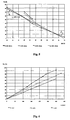
- Te represents the evaporation rate as a percentage of the initial quantity of solvent
- ts the drying time in minutes
- T the drying temperatures for each curve in ° C
- Hr the relative humidity level during the different tests expressed as a percentage.
- the amount of gel deposited on the surface had only a slight influence on the drying characteristics and more particularly on the detachability. Different amounts of gel ranging from 0.1 to 2 kg of gel per m 2 were deposited on surfaces. The amounts of about 0.3 kg.m -2 to about 0.7 kg.m -2 are preferred.
- the drying conditions are the most important parameters in the process of the present invention. Among them is the drying temperature and the moisture content of the drying air. The existence of a convective current is also important. The influence of these parameters was assessed quantitatively by plotting drying charts.
- the temperature range which is retained is 20 ° C to 30 ° C and the relative humidity range of drying air 20% to 70%, the relative humidity being defined as the ratio of the vapor pressure of water at a given temperature at the saturation vapor pressure of the water at the same temperature.
- New 304 L stainless steel parts are gel coated.
- the amount of gel deposited is 0.5 kg.m -2 ( ⁇ 5%) for the following tests when this is not specified.
- the silicas are pre-mixed in a cylindrical beaker tours.min 800 -1 using a propeller stirrer to ensure intimate mixing of the silica.
- When preparing the gel was stirred at 500 tours.min -1 by the same stirring system.
- Coated samples are placed in a climatic chamber at controlled temperature and humidity.
- the climate chamber is a KBF trademark with a volume of 115 liters.
- Humidity control is provided by steam injection generated by the passage of an electric current through humidifier.
- the speed of the convective current at the surface of the samples can be considered as identical for all the cases and of very low intensity.
- the mass of the coating over time is monitored for each set temperature / humidity pair.
- the curves obtained have the same pace as at 30 ° C. However, the drying times are lengthened.
- the total drying is obtained at 35% humidity in a time of the order of 5 hours. Considering the test carried out at 30 ° C it is determined by extrapolation that with a relative humidity of 20% the total drying time for this value at 25 ° C is between 3 hours and 5 hours. At 50% humidity the extrapolated total drying time is 9 hours which remains acceptable in a surface treatment process.
- the test carried out in the DEMETER cell is superimposed with the test carried out at 42% relative humidity in the climatic chamber. This allows to derive a pair of values representative of the atmosphere of an armored cell, ie approximately 20 ° C. and 42% relative humidity. This analogy does not take into account a possible deviation of the convection between the climatic chamber and the armored cell.
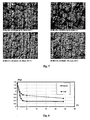
- FIG. 4 gathers curves made for three quantities of gel deposited at 20 ° C. and at 42% relative humidity.
- the humidity levels plotted on the ordinate vary in proportion to the drying speed.
- the direct comparison of one temperature with the other is not possible because the characteristic times retained are not identical for all the temperatures.
- the drying charts set forth in this example allow the drying times required during an application of the process of the present invention to be provided provided that the air temperature of the sheath and its relative humidity are known.
- the area representative of the atmosphere of an armored cell was estimated centered around the following values: temperature: 20 ° C and relative humidity: 40%. These values were obtained by analogy by carrying out a drying test in the DEMETER (trademark) cell.
- the charts show good compatibility as soon as the temperature is above 20 ° C and the humidity is below about 40%. For lower temperatures or higher humidities, it may be necessary to implement a convective regime in the sheath which can be achieved with a half-speed operation.
- AEROSIL 380 (trademark) which is a fumed silica with a high specific surface area of 380 m 2 / g, and from 0.5% to 1% by weight of precipitated silica FK 310 (trademark).
- the present invention provides a gel having characteristics similar to those of a conventional decontamination gel as long as it is not dry in terms of contact time and composition.
- the gel when the gel is dry, its residues are of controlled size relatively independently of the drying characteristics thanks to the addition of precipitated silica.
- the advantages are in particular the absence of pulverulent residue, the sizes obtained being of the order 0.1 to 3 mm, facilitating the debondability of the surface residue, and recovery by brushing or aspiration.
- AEROSIL 380 (trade mark) silica gels and a mixture of nitric acid and phosphoric acid were prepared.
- the concentration of each of the two acids is preferably less than 2 mol / l. Beyond this, the gel does not dry at a temperature of 25 ° C and a relative humidity of 40%. For a concentration of each of the two acids of between 1 and 2 M, the drying times observed at a temperature of 25 ° C and a relative humidity of 40% vary between 2 and 4 hours.
- a gel (HNO 3 1M / H 3 PO 4 1M) was in particular prepared and tested in terms of decontamination on aluminum flanges from a pneumatic transfer network of a nuclear waste reprocessing plant.
- Decontamination factors of the order of 14 (Cs 137, Eu 154) were obtained after a single gel pass (Cs 137: from 1300 Bq / cm 2 to 110 Bq / cm 2 ) and the surface activity was be lowered below 50 Bq / cm 2 with an extra pass.
- an oxidizing gel according to the invention was prepared using 3 M nitric acid and 0.1 to 0.3 M Ce (IV). ).
- the gels dry quickly in less than 3 hours and easily peel off with a brush.
- the corrosion results obtained by coating 500 g / m2 on inconel are quite interesting since generalized erosion is effect between 0.1 and 0.3 ⁇ m.
Landscapes
- Chemical & Material Sciences (AREA)
- Engineering & Computer Science (AREA)
- Chemical Kinetics & Catalysis (AREA)
- Organic Chemistry (AREA)
- Life Sciences & Earth Sciences (AREA)
- Oil, Petroleum & Natural Gas (AREA)
- Wood Science & Technology (AREA)
- General Chemical & Material Sciences (AREA)
- Inorganic Chemistry (AREA)
- Metallurgy (AREA)
- Materials Engineering (AREA)
- Mechanical Engineering (AREA)
- Dispersion Chemistry (AREA)
- Electrochemistry (AREA)
- Food Science & Technology (AREA)
- Physics & Mathematics (AREA)
- General Engineering & Computer Science (AREA)
- High Energy & Nuclear Physics (AREA)
- Silicon Compounds (AREA)
- Cleaning And De-Greasing Of Metallic Materials By Chemical Methods (AREA)
- Detergent Compositions (AREA)
- Physical Or Chemical Processes And Apparatus (AREA)
- Solid-Sorbent Or Filter-Aiding Compositions (AREA)
- Cleaning In General (AREA)
- Paints Or Removers (AREA)
- Application Of Or Painting With Fluid Materials (AREA)
Claims (22)
- Verfahren zur Behandlung einer Oberfläche durch ein Behandlungsgel, wobei das genannte Verfahren in der genannten Reihenfolge die folgenden Stufen umfasst:- Aufbringen eines Behandlungsgels auf die zu behandelnde Oberfläche, wobei das genannte Behandlungsgel besteht aus einer kolloidalen Lösung, die umfasst:• 5 bis 25 Gew.-%, bezogen auf das Gewicht des Gels, einer Mischung von pyrogenem Siliciumdioxid und ausgefälltem Siliciumdioxid,• 0,5 bis 4 mol/l eines aktiven Behandlungsagens und• gegebenenfalls 0,05 bis 1 mol/l eines oxidierenden Agens, das in einem stark sauren Medium ein normales Redox-Potential E0 von > 1,4 V aufweist, oder der reduzierten Form dieses oxidierenden Agens;- Halten des Behandlungsgels auf der zu behandelnden Oberfläche bei einer solchen Temperatur und einer solchen relativen Feuchtigkeit, dass das Gel trocknet und die Temperatur der zu behandelnden Oberfläche annimmt, bevor ein trockener und fester Rückstand gebildet wird, und- Eliminierung des trockenen und festen Rückstandes von der behandelten Oberfläche.
- Verfahren nach Anspruch 1, bei dem die Trocknungstemperatur zwischen 20 und 30°C liegt und der Gehalt an relativer Feuchtigkeit zwischen 20 und 70 % liegt.
- Verfahren nach Anspruch 1, bei dem die Siliciumdioxid-Mischung 5 bis 15 Gew.-% des Gels darstellt.
- Verfahren nach Anspruch 1, bei dem die Siliciumdioxid-Mischung 5 bis 10 Gew.-% des Gels darstellt.
- Verfahren nach Anspruch 1, bei dem das ausgefällte Siliciumdioxid 0,5 Gew.-% des Gels darstellt und das pyrogene Siliciumdioxid 8 Gew.-% des Gels darstellt.
- Vorfahren nach einem der Ansprüche 1 bis 5, bei dem das aktive Behandlungsagens eine anorganische Säure oder ein Gemisch von anorganischen Säuren ist.
- Verfahren nach Anspruch 6, bei dem die anorganische Säure ausgewählt wird aus der Gruppe Chlorwasserstoffsäure, Salpetersäure, Schwefelsäure, Phosphorsäure oder einer Mischung davon.
- Verfahren nach einem der Ansprüche 1 bis 5, bei dem das Gel ein aktives Behandlungsagens umfasst, bei dem es sich um eine anorganische Base handelt, die in einer Konzentration von 0,5 bis 2 mol pro Liter Gel vorliegt.
- Verfahren nach Anspruch 8, bei dem die anorganische Base ausgewählt wird aus der Gruppe Natriumhydroxid, Kaliumhydroxid oder einer Mischung davon.
- Verfahren nach einem der Ansprüche 1 bis 5, bei dem das Behandlungsgel umfasst 0,5 bis 1 mol/l eines oxidierenden Agens, das in einem stark sauren Medium ein normales Redoxpotential E0 von > 1,4 V aufweist, ausgewählt aus der Gruppe Ce(IV), Co(III) oder Ag(II).
- Verfahren nach Anspruch 1, bei dem das Behandlungsgel umfasst 5 bis 15 Gew.-% Siliciumdioxid, 0,5 bis 2 mol/l Salpetersäure und 0,1 bis 0,5 mol, pro Liter Gel, Ce(NO3)4 oder (NH4)2Ce(NO3)6.
- Verfahren nach Anspruch 1, bei dem das Behandlungsgel auf die zu behandelnde Oberfläche in einer Menge von 100 bis 2000 g Gel pro m2 Oberfläche aufgebracht wird.
- Verfahren nach Anspruch 1, bei dem der trockene und feste Rückstand durch Abbürsten und/oder Absaugen von der behandelten Oberfläche eliminiert wird.
- Anwendung eines Verfahrens nach einem der Ansprüche 1 bis 13 zum Entfetten einer Oberfläche, zur Entfernung einer Metallschicht von einer Metalloberfläche oder zur Dekontamination einer Oberfläche.
- Verfahren zur Dekontamination einer Anlage, das umfasst ein Entstauben der zu behandelnden Anlage, gefolgt von einer Behandlung der Anlage mittels eines Verfahrens nach einem der Ansprüche 1 bis 13.
- Verfahren nach Anspruch 15, bei dem die Anlage ein Kanal zur Belüftung eines Kernkraftwerks ist.
- Gel zur Behandlung einer Oberfläche, das besteht aus einer kolloidalen Lösung und umfasst;• 5 bis 25 Gew.-%, bezogen auf das Gewicht des Gels, einer Mischung von pyrogenem Siliciumdioxid und ausgefälltem Siliciumdioxid,• 0,5 bis 4 mol/l eines aktiven Behandlungsagens und• gegebenenfalls 0,05 bis 1 mol/l eines oxidierenden Agens, das in einem stark sauren Medium ein normales Redoxpotential E0 von > 1,4 aufweist, oder der reduzierten Form dieses oxidierenden Agens.
- Gel zur Behandlung einer Oberfläche nach Anspruch 17,
in dem die Siliciumdioxid-Mischung 5 bis 15 Gew.-%, bezogen auf das Gewicht des Gels, darstellt und
in dem das aktive Behandlungsagens eine anorganische Säure oder ein Gemisch von anorganischen Säuren ist. - Behandlungsgel nach Anspruch 17, in dem die Mischung von pyrogenem Siliciumdioxid und ausgefälltem Siliciumdioxid in einer Menge von 5 bis 10 Gew.-%, bezogen auf das Gewicht des Gels, vorliegt.
- Behandlungsgel nach Anspruch 17, in dem das ausgefällte Siliciumdioxid 0,5 Gew.-% des Gels darstellt und das pyrogene Siliciumdioxid 8 Gew.-% des Gels darstellt.
- Behandlungsgel nach Anspruch 18, in dem die anorganische Säure ausgewählt ist aus der Gruppe Chlorwasserstoffsäure, Salpetersäure, Schwefelsäure, Phosphorsäure oder einer Mischung davon.
- Behandlungsgel nach Anspruch 17 oder 20, in dem das oxidierende Agens, das in einem stark sauren Medium ein normales Redoxpotential E0 von > 1,4 aufweist, ausgewählt ist aus der Gruppe Ce(IV), Co(III) oder Ag(II).
Applications Claiming Priority (3)
| Application Number | Priority Date | Filing Date | Title |
|---|---|---|---|
| FR0109520A FR2827530B1 (fr) | 2001-07-17 | 2001-07-17 | Procede de traitement d'une surface par un gel de traitement, et gel de traitement |
| FR0109520 | 2001-07-17 | ||
| PCT/FR2002/002509 WO2003008529A1 (fr) | 2001-07-17 | 2002-07-15 | Procede de traitement d'une surface par un gel de traitement, et gel de traitement |
Publications (2)
| Publication Number | Publication Date |
|---|---|
| EP1421165A1 EP1421165A1 (de) | 2004-05-26 |
| EP1421165B1 true EP1421165B1 (de) | 2006-09-06 |
Family
ID=8865598
Family Applications (1)
| Application Number | Title | Priority Date | Filing Date |
|---|---|---|---|
| EP02760387A Expired - Lifetime EP1421165B1 (de) | 2001-07-17 | 2002-07-15 | Verfahren zur oberflächenbehandlung mittels eines gels zur behandlung, und gel zur behandlung |
Country Status (11)
| Country | Link |
|---|---|
| US (2) | US7713357B2 (de) |
| EP (1) | EP1421165B1 (de) |
| JP (1) | JP4334339B2 (de) |
| CN (1) | CN1273578C (de) |
| AT (1) | ATE338806T1 (de) |
| DE (1) | DE60214567T2 (de) |
| ES (1) | ES2271318T3 (de) |
| FR (1) | FR2827530B1 (de) |
| RU (1) | RU2291895C2 (de) |
| UA (1) | UA82465C2 (de) |
| WO (1) | WO2003008529A1 (de) |
Families Citing this family (29)
| Publication number | Priority date | Publication date | Assignee | Title |
|---|---|---|---|---|
| JP3914721B2 (ja) * | 2001-06-25 | 2007-05-16 | 株式会社平間理化研究所 | 非水系レジスト剥離液管理装置及び非水系レジスト剥離液管理方法 |
| FR2827530B1 (fr) * | 2001-07-17 | 2004-05-21 | Commissariat Energie Atomique | Procede de traitement d'une surface par un gel de traitement, et gel de traitement |
| US8009696B2 (en) * | 2004-08-06 | 2011-08-30 | Ipeak Networks Incorporated | System and method for achieving accelerated throughput |
| CN1332398C (zh) * | 2004-10-15 | 2007-08-15 | 中国人民解放军总参谋部工程兵科研三所 | 剥离型压制去污剂 |
| US20060151434A1 (en) * | 2005-01-07 | 2006-07-13 | The Boc Group, Inc. | Selective surface texturing through the use of random application of thixotropic etching agents |
| FR2891470B1 (fr) * | 2005-10-05 | 2007-11-23 | Commissariat Energie Atomique | Gel aspirable pour la decontamination de surfaces et utilisation |
| FR2962046B1 (fr) * | 2010-07-02 | 2012-08-17 | Commissariat Energie Atomique | Gel de decontamination biologique et procede de decontamination de surfaces utilisant ce gel. |
| FR2984170B1 (fr) * | 2011-12-19 | 2014-01-17 | Commissariat Energie Atomique | Gel de decontamination et procede de decontamination de surfaces par trempage utilisant ce gel. |
| JP5846997B2 (ja) * | 2012-03-30 | 2016-01-20 | 鹿島建設株式会社 | 膜形成用組成物、表面洗浄方法、放射性物質除去方法、表面保護方法、及び膜 |
| FR2990364B1 (fr) | 2012-05-11 | 2014-06-13 | Commissariat Energie Atomique | Procede de decontamination radioactive d'une terre par mousse de flottation a air disperse et ladite mousse |
| FR3003869B1 (fr) | 2013-03-29 | 2015-05-01 | Commissariat Energie Atomique | Gel de decontamination pigmente et procede de decontamination de surfaces utilisant ce gel. |
| FR3003763B1 (fr) | 2013-03-29 | 2015-05-15 | Commissariat Energie Atomique | Gel alcalin oxydant de decontamination biologique et procede de decontamination biologique de surfaces utilisant ce gel. |
| CN103695205B (zh) * | 2013-12-03 | 2016-01-20 | 中国人民解放军总参谋部工程兵科研三所 | 一种自碎式消污液 |
| FR3014336B1 (fr) | 2013-12-05 | 2016-01-22 | Commissariat Energie Atomique | Utilisation d'un gel alcalin oxydant pour eliminer un biofilm sur une surface d'un substrat solide. |
| US9969549B2 (en) | 2014-03-24 | 2018-05-15 | The Boeing Company | Systems and methods for controlling a fuel tank environment |
| FR3027310B1 (fr) * | 2014-10-15 | 2017-12-15 | Commissariat Energie Atomique | Gel pour eliminer les graffitis et procede pour eliminer les graffitis utilisant ce gel. |
| FR3053897B1 (fr) | 2016-07-13 | 2022-05-20 | Commissariat Energie Atomique | Gel de decontamination adsorbant et photocatalytique et procede de decontamination de surfaces utilisant ce gel |
| FR3054839B1 (fr) | 2016-08-05 | 2020-06-26 | Commissariat A L'energie Atomique Et Aux Energies Alternatives | Gel aspirable et procede pour eliminer une contamination radioactive contenue dans une couche organique en surface d'un substrat solide. |
| US20180094217A1 (en) * | 2016-09-30 | 2018-04-05 | General Electric Company | Method and material for cleaning metal surfaces |
| RU2655525C2 (ru) * | 2016-10-05 | 2018-05-28 | Федеральное государственное бюджетное образовательное учреждение высшего образования "Волгоградский государственный медицинский университет" Министерства здравоохранения Российской Федерации ГБОУ ВПО ВолгГМУ МЗ РФ | Неводный способ очистки для удаления поверхностных загрязнений с ортопедических конструкций |
| RU2662531C1 (ru) * | 2017-05-31 | 2018-07-26 | Кирилл Игоревич Мыльников | Камера для обработки изделий из пластика |
| FR3083712B1 (fr) | 2018-07-11 | 2022-01-21 | Commissariat Energie Atomique | Procede de decontamination d'un milieu gazeux contamine par des especes contaminantes en suspension. |
| RU187811U1 (ru) * | 2018-11-14 | 2019-03-19 | Александр Николаевич Костин | Устройство для финишной обработки поверхности изделий из пластика |
| RU189421U1 (ru) * | 2019-02-11 | 2019-05-22 | Александр Николаевич Костин | Портативное устройство для финишной обработки поверхности изделий из пластика |
| US12357185B2 (en) | 2019-06-20 | 2025-07-15 | Hb Innovations, Inc. | System and method for monitoring/detecting and responding to infant breathing |
| US11712180B2 (en) * | 2019-06-20 | 2023-08-01 | Hb Innovations, Inc. | System and method for monitoring/detecting and responding to infant breathing |
| CN112760659B (zh) * | 2020-12-02 | 2022-09-27 | 中国辐射防护研究院 | 一种氧化去污凝胶及其制备方法与用途 |
| CN114672816B (zh) * | 2022-01-07 | 2024-04-05 | 航天科工防御技术研究试验中心 | 一种用于清除铝合金表面腐蚀的组合物及其制备方法和应用 |
| CN115261860B (zh) * | 2022-06-10 | 2024-04-16 | 航天科工防御技术研究试验中心 | 一种铝合金表面腐蚀清除剂及其制备方法和应用 |
Family Cites Families (16)
| Publication number | Priority date | Publication date | Assignee | Title |
|---|---|---|---|---|
| US3578499A (en) * | 1968-08-02 | 1971-05-11 | Grace W R & Co | Gelling composition for general purpose cleaning and sanitizing |
| FR2380624A1 (fr) * | 1977-02-09 | 1978-09-08 | Commissariat Energie Atomique | Procede de decontamination radioactive d'une piece |
| US4365516A (en) * | 1978-01-06 | 1982-12-28 | Rockwell International Corporation | Ultrasonic couplant gel compositions and method for employing same |
| SU825674A1 (ru) * | 1978-01-31 | 1981-04-30 | Предприятие П/Я Р-6476 | Паста для удаления окалины с поверхности углеродистых сталей 1 |
| JPS5939511B2 (ja) * | 1982-08-05 | 1984-09-25 | 正己 小林 | ゲル状脱錆剤 |
| FR2656949B1 (fr) * | 1990-01-09 | 1994-03-25 | Commissariat A Energie Atomique | Gel decontaminant et son utilisation pour la decontamination radioactive de surfaces. |
| US5264010A (en) * | 1992-04-27 | 1993-11-23 | Rodel, Inc. | Compositions and methods for polishing and planarizing surfaces |
| FR2695839B1 (fr) * | 1992-09-23 | 1994-10-14 | Commissariat Energie Atomique | Gel décontaminant réducteur et son utilisation pour la décontamination de surface notamment d'installations nucléaires. |
| US5782940A (en) * | 1996-03-15 | 1998-07-21 | Carborundum Universal Limited | Process for the preparation of alumina abrasives |
| FR2746328B1 (fr) * | 1996-03-21 | 1998-05-29 | Stmi Soc Tech Milieu Ionisant | Gel organomineral de decontamination et son utilisation pour la decontamination de surfaces |
| FR2781809B1 (fr) * | 1998-07-31 | 2002-06-07 | Commissariat Energie Atomique | Composition de degraissage et procedes utilisant cette composition |
| US6455751B1 (en) * | 1999-03-03 | 2002-09-24 | The Regents Of The University Of California | Oxidizer gels for detoxification of chemical and biological agents |
| FR2798603B1 (fr) * | 1999-09-20 | 2002-03-01 | Tech En Milieu Ionisant Stmi S | Gel organique de decontamination et son utilisation pour la decontamination de surfaces |
| US6616910B2 (en) * | 2000-05-05 | 2003-09-09 | Institut Francais Du Petrole | Process for preparation of an EUO-structural-type zeolite, the zeolite that is obtained and its use as catalyst for isomerization of C8-aromatic compounds |
| FR2827530B1 (fr) * | 2001-07-17 | 2004-05-21 | Commissariat Energie Atomique | Procede de traitement d'une surface par un gel de traitement, et gel de traitement |
| US6605158B1 (en) * | 2001-10-12 | 2003-08-12 | Bobolink, Inc. | Radioactive decontamination and translocation method |
-
2001
- 2001-07-17 FR FR0109520A patent/FR2827530B1/fr not_active Expired - Lifetime
-
2002
- 2002-07-15 UA UA2004010352A patent/UA82465C2/uk unknown
- 2002-07-15 EP EP02760387A patent/EP1421165B1/de not_active Expired - Lifetime
- 2002-07-15 AT AT02760387T patent/ATE338806T1/de not_active IP Right Cessation
- 2002-07-15 CN CNB028181379A patent/CN1273578C/zh not_active Expired - Lifetime
- 2002-07-15 JP JP2003514073A patent/JP4334339B2/ja not_active Expired - Lifetime
- 2002-07-15 DE DE60214567T patent/DE60214567T2/de not_active Expired - Lifetime
- 2002-07-15 ES ES02760387T patent/ES2271318T3/es not_active Expired - Lifetime
- 2002-07-15 RU RU2004104467/15A patent/RU2291895C2/ru not_active IP Right Cessation
- 2002-07-15 WO PCT/FR2002/002509 patent/WO2003008529A1/fr not_active Ceased
- 2002-07-15 US US10/483,839 patent/US7713357B2/en not_active Expired - Fee Related
-
2005
- 2005-08-09 US US11/200,700 patent/US7718010B2/en not_active Expired - Fee Related
Also Published As
| Publication number | Publication date |
|---|---|
| US7713357B2 (en) | 2010-05-11 |
| JP4334339B2 (ja) | 2009-09-30 |
| CN1273578C (zh) | 2006-09-06 |
| UA82465C2 (uk) | 2008-04-25 |
| ATE338806T1 (de) | 2006-09-15 |
| FR2827530B1 (fr) | 2004-05-21 |
| WO2003008529A1 (fr) | 2003-01-30 |
| US7718010B2 (en) | 2010-05-18 |
| DE60214567D1 (de) | 2006-10-19 |
| US20060032518A1 (en) | 2006-02-16 |
| EP1421165A1 (de) | 2004-05-26 |
| JP2004535510A (ja) | 2004-11-25 |
| RU2291895C2 (ru) | 2007-01-20 |
| CN1592778A (zh) | 2005-03-09 |
| RU2004104467A (ru) | 2005-05-10 |
| FR2827530A1 (fr) | 2003-01-24 |
| US20040175505A1 (en) | 2004-09-09 |
| DE60214567T2 (de) | 2007-09-13 |
| ES2271318T3 (es) | 2007-04-16 |
Similar Documents
| Publication | Publication Date | Title |
|---|---|---|
| EP1421165B1 (de) | Verfahren zur oberflächenbehandlung mittels eines gels zur behandlung, und gel zur behandlung | |
| EP2334619B1 (de) | Verfahren zur elektrokinetischen dekontamination eines porösen festen mediums | |
| EP1941515B1 (de) | Absaugbares gel zum dekontaminieren von oberflächen und verwendung dafür | |
| EP2588148B1 (de) | Biologisches dekontaminationsgel und verfahren zur dekontamination von oberflächen mit diesem gel | |
| EP2793959B1 (de) | Dekontaminationsgel und verfahren zur dekontamination von oberflächen durch eintauchen in diesem gel | |
| JP2004535510A5 (de) | ||
| EP3206780B1 (de) | Gel zur entfernung von graffitis und verfahren zur entfernung von graffitis bei verwendung dieses gels | |
| EP3494181B1 (de) | Saugbares gel und verfahren zur entsorgung einer kontamination enthaltend in einer organischen schicht auf einer oberfläche eines substrats | |
| WO2018011525A1 (fr) | Gel de décontamination adsorbant et photocatalytique et procédé de décontamination de surfaces utilisant ce gel. | |
| EP3820592B1 (de) | Verfahren zur dekontamination eines mit kontaminierenden spezies in einer suspension kontaminierten gasförmigen mediums | |
| EP1228512B1 (de) | Organisches gel zur dekontaminierung und seine verwendung zur dekontaminierung von oberflächen | |
| EP3870686A1 (de) | Dekontaminationspaste und verfahren zur dekontamination eines substrats aus einem festen material unter verwendung der besagten paste | |
| EP4302314B1 (de) | Verfahren zur dekontamination von oberflächen oder gas mittels eines ferromagnetischen gels | |
| CA3105593C (fr) | Procede de decontamination d'un milieu gazeux contamine par des especes contaminantes en suspension | |
| JP2009108607A (ja) | アスベスト処理用複合体セラミックス水分散物及びアスベスト飛散防止処理方法。 |
Legal Events
| Date | Code | Title | Description |
|---|---|---|---|
| PUAI | Public reference made under article 153(3) epc to a published international application that has entered the european phase |
Free format text: ORIGINAL CODE: 0009012 |
|
| 17P | Request for examination filed |
Effective date: 20040106 |
|
| AK | Designated contracting states |
Kind code of ref document: A1 Designated state(s): AT BE BG CH CY CZ DE DK EE ES FI FR GB GR IE IT LI LU MC NL PT SE SK TR |
|
| AX | Request for extension of the european patent |
Extension state: AL LT LV MK RO SI |
|
| 17Q | First examination report despatched |
Effective date: 20050413 |
|
| GRAP | Despatch of communication of intention to grant a patent |
Free format text: ORIGINAL CODE: EPIDOSNIGR1 |
|
| GRAS | Grant fee paid |
Free format text: ORIGINAL CODE: EPIDOSNIGR3 |
|
| GRAA | (expected) grant |
Free format text: ORIGINAL CODE: 0009210 |
|
| AK | Designated contracting states |
Kind code of ref document: B1 Designated state(s): AT BE BG CH CY CZ DE DK EE ES FI FR GB GR IE IT LI LU MC NL PT SE SK TR |
|
| PG25 | Lapsed in a contracting state [announced via postgrant information from national office to epo] |
Ref country code: IT Free format text: LAPSE BECAUSE OF FAILURE TO SUBMIT A TRANSLATION OF THE DESCRIPTION OR TO PAY THE FEE WITHIN THE PRESCRIBED TIME-LIMIT;WARNING: LAPSES OF ITALIAN PATENTS WITH EFFECTIVE DATE BEFORE 2007 MAY HAVE OCCURRED AT ANY TIME BEFORE 2007. THE CORRECT EFFECTIVE DATE MAY BE DIFFERENT FROM THE ONE RECORDED. Effective date: 20060906 Ref country code: SK Free format text: LAPSE BECAUSE OF FAILURE TO SUBMIT A TRANSLATION OF THE DESCRIPTION OR TO PAY THE FEE WITHIN THE PRESCRIBED TIME-LIMIT Effective date: 20060906 Ref country code: AT Free format text: LAPSE BECAUSE OF FAILURE TO SUBMIT A TRANSLATION OF THE DESCRIPTION OR TO PAY THE FEE WITHIN THE PRESCRIBED TIME-LIMIT Effective date: 20060906 Ref country code: IE Free format text: LAPSE BECAUSE OF FAILURE TO SUBMIT A TRANSLATION OF THE DESCRIPTION OR TO PAY THE FEE WITHIN THE PRESCRIBED TIME-LIMIT Effective date: 20060906 |
|
| REG | Reference to a national code |
Ref country code: GB Ref legal event code: FG4D Free format text: NOT ENGLISH |
|
| REG | Reference to a national code |
Ref country code: CH Ref legal event code: EP |
|
| REG | Reference to a national code |
Ref country code: IE Ref legal event code: FG4D Free format text: LANGUAGE OF EP DOCUMENT: FRENCH |
|
| REF | Corresponds to: |
Ref document number: 60214567 Country of ref document: DE Date of ref document: 20061019 Kind code of ref document: P |
|
| RAP2 | Party data changed (patent owner data changed or rights of a patent transferred) |
Owner name: COMPAGNIE GENERALE DES MATIERES NUCLEAIRES Owner name: COMMISSARIAT A L'ENERGIE ATOMIQUE |
|
| PG25 | Lapsed in a contracting state [announced via postgrant information from national office to epo] |
Ref country code: BG Free format text: LAPSE BECAUSE OF FAILURE TO SUBMIT A TRANSLATION OF THE DESCRIPTION OR TO PAY THE FEE WITHIN THE PRESCRIBED TIME-LIMIT Effective date: 20061206 Ref country code: DK Free format text: LAPSE BECAUSE OF FAILURE TO SUBMIT A TRANSLATION OF THE DESCRIPTION OR TO PAY THE FEE WITHIN THE PRESCRIBED TIME-LIMIT Effective date: 20061206 |
|
| REG | Reference to a national code |
Ref country code: SE Ref legal event code: TRGR |
|
| NLT2 | Nl: modifications (of names), taken from the european patent patent bulletin |
Owner name: COMMISSARIAT A L'ENERGIE ATOMIQUE EN COMPAGNIE GEN Effective date: 20061102 |
|
| GBT | Gb: translation of ep patent filed (gb section 77(6)(a)/1977) |
Effective date: 20061214 |
|
| NLS | Nl: assignments of ep-patents |
Owner name: COMPAGNIE GENERALE DES MATIERES NUCLEAIRES Effective date: 20061206 |
|
| PG25 | Lapsed in a contracting state [announced via postgrant information from national office to epo] |
Ref country code: PT Free format text: LAPSE BECAUSE OF FAILURE TO SUBMIT A TRANSLATION OF THE DESCRIPTION OR TO PAY THE FEE WITHIN THE PRESCRIBED TIME-LIMIT Effective date: 20070219 |
|
| REG | Reference to a national code |
Ref country code: ES Ref legal event code: FG2A Ref document number: 2271318 Country of ref document: ES Kind code of ref document: T3 |
|
| REG | Reference to a national code |
Ref country code: IE Ref legal event code: FD4D |
|
| PLBE | No opposition filed within time limit |
Free format text: ORIGINAL CODE: 0009261 |
|
| STAA | Information on the status of an ep patent application or granted ep patent |
Free format text: STATUS: NO OPPOSITION FILED WITHIN TIME LIMIT |
|
| 26N | No opposition filed |
Effective date: 20070607 |
|
| PG25 | Lapsed in a contracting state [announced via postgrant information from national office to epo] |
Ref country code: GR Free format text: LAPSE BECAUSE OF FAILURE TO SUBMIT A TRANSLATION OF THE DESCRIPTION OR TO PAY THE FEE WITHIN THE PRESCRIBED TIME-LIMIT Effective date: 20061207 Ref country code: MC Free format text: LAPSE BECAUSE OF NON-PAYMENT OF DUE FEES Effective date: 20070731 |
|
| PG25 | Lapsed in a contracting state [announced via postgrant information from national office to epo] |
Ref country code: EE Free format text: LAPSE BECAUSE OF FAILURE TO SUBMIT A TRANSLATION OF THE DESCRIPTION OR TO PAY THE FEE WITHIN THE PRESCRIBED TIME-LIMIT Effective date: 20060906 |
|
| PG25 | Lapsed in a contracting state [announced via postgrant information from national office to epo] |
Ref country code: CY Free format text: LAPSE BECAUSE OF FAILURE TO SUBMIT A TRANSLATION OF THE DESCRIPTION OR TO PAY THE FEE WITHIN THE PRESCRIBED TIME-LIMIT Effective date: 20060906 Ref country code: LU Free format text: LAPSE BECAUSE OF NON-PAYMENT OF DUE FEES Effective date: 20070715 |
|
| PG25 | Lapsed in a contracting state [announced via postgrant information from national office to epo] |
Ref country code: TR Free format text: LAPSE BECAUSE OF FAILURE TO SUBMIT A TRANSLATION OF THE DESCRIPTION OR TO PAY THE FEE WITHIN THE PRESCRIBED TIME-LIMIT Effective date: 20060906 |
|
| PGFP | Annual fee paid to national office [announced via postgrant information from national office to epo] |
Ref country code: CZ Payment date: 20140623 Year of fee payment: 13 Ref country code: FI Payment date: 20140619 Year of fee payment: 13 |
|
| PGFP | Annual fee paid to national office [announced via postgrant information from national office to epo] |
Ref country code: SE Payment date: 20150714 Year of fee payment: 14 |
|
| PG25 | Lapsed in a contracting state [announced via postgrant information from national office to epo] |
Ref country code: CZ Free format text: LAPSE BECAUSE OF NON-PAYMENT OF DUE FEES Effective date: 20150715 |
|
| PG25 | Lapsed in a contracting state [announced via postgrant information from national office to epo] |
Ref country code: FI Free format text: LAPSE BECAUSE OF NON-PAYMENT OF DUE FEES Effective date: 20150715 |
|
| REG | Reference to a national code |
Ref country code: FR Ref legal event code: PLFP Year of fee payment: 15 |
|
| REG | Reference to a national code |
Ref country code: SE Ref legal event code: EUG |
|
| PG25 | Lapsed in a contracting state [announced via postgrant information from national office to epo] |
Ref country code: SE Free format text: LAPSE BECAUSE OF NON-PAYMENT OF DUE FEES Effective date: 20160716 |
|
| REG | Reference to a national code |
Ref country code: FR Ref legal event code: PLFP Year of fee payment: 16 |
|
| REG | Reference to a national code |
Ref country code: FR Ref legal event code: PLFP Year of fee payment: 17 |
|
| PGFP | Annual fee paid to national office [announced via postgrant information from national office to epo] |
Ref country code: NL Payment date: 20210615 Year of fee payment: 20 |
|
| PGFP | Annual fee paid to national office [announced via postgrant information from national office to epo] |
Ref country code: IT Payment date: 20210707 Year of fee payment: 20 Ref country code: FR Payment date: 20210729 Year of fee payment: 20 |
|
| PGFP | Annual fee paid to national office [announced via postgrant information from national office to epo] |
Ref country code: ES Payment date: 20210812 Year of fee payment: 20 Ref country code: GB Payment date: 20210720 Year of fee payment: 20 Ref country code: DE Payment date: 20210712 Year of fee payment: 20 Ref country code: CH Payment date: 20210722 Year of fee payment: 20 Ref country code: BE Payment date: 20210726 Year of fee payment: 20 |
|
| REG | Reference to a national code |
Ref country code: DE Ref legal event code: R071 Ref document number: 60214567 Country of ref document: DE Ref country code: CH Ref legal event code: PL |
|
| REG | Reference to a national code |
Ref country code: NL Ref legal event code: MK Effective date: 20220714 |
|
| REG | Reference to a national code |
Ref country code: BE Ref legal event code: MK Effective date: 20220715 |
|
| REG | Reference to a national code |
Ref country code: GB Ref legal event code: PE20 Expiry date: 20220714 |
|
| REG | Reference to a national code |
Ref country code: ES Ref legal event code: FD2A Effective date: 20220805 |
|
| PG25 | Lapsed in a contracting state [announced via postgrant information from national office to epo] |
Ref country code: GB Free format text: LAPSE BECAUSE OF EXPIRATION OF PROTECTION Effective date: 20220714 Ref country code: ES Free format text: LAPSE BECAUSE OF EXPIRATION OF PROTECTION Effective date: 20220716 |